1955 Roosevelt Dime Coin Value: How Much Is It Worth?
The 1955 Roosevelt Dime is a 90% silver coin that still turns up in collections and old rolls. Guide estimates place it around $5.81 in Good-4 condition up to roughly $14 for an ordinary Mint State 65 business strike, while a proof in PR65 runs about $22.
These are grade-specific retail reference points from USA Coin Book, not guaranteed buy prices, and silver content means the baseline shifts with the metal market.
Fast Way to Identify Your 1955 Roosevelt Dime
Want a quick read on your 1955 dime? Upload clear photos of the front and back, and the identifier can offer a preliminary identification of your coin's mint version and general condition.
Good lighting and a sharp image of the mintmark area on the reverse help the most. This is not a substitute for professional authentication or certified grading.
1955 Roosevelt Dime Value
Upload both sides of your 1955 Roosevelt Dime.
Front Obverse
Upload photo
Back Reverse
Upload photo
Which 1955 Roosevelt Dime Versions Are Worth Money?
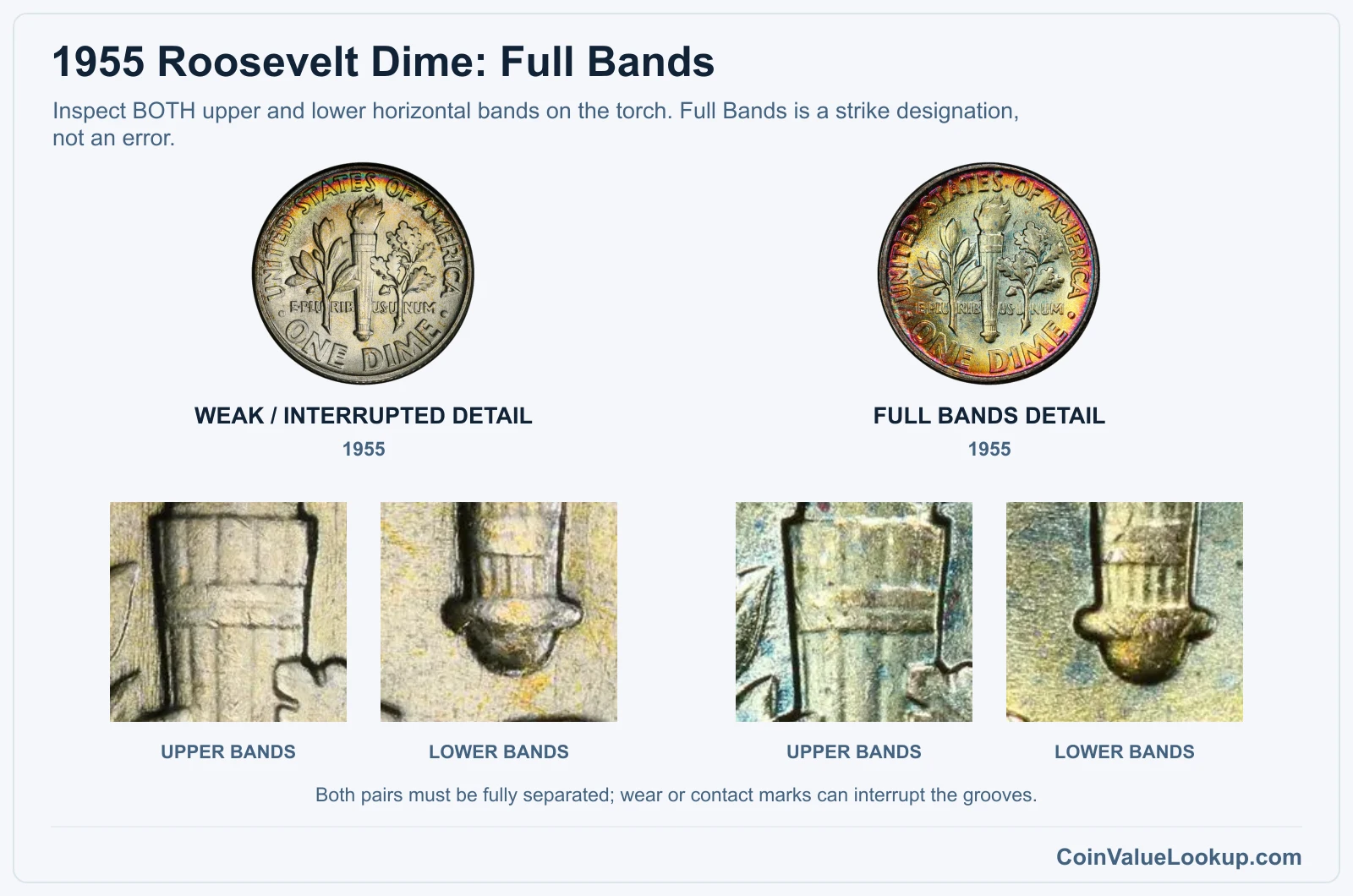
- Uncirculated examples with strong, fully separated torch bands and original luster — the Full Bands designation can meaningfully affect value within a given mint and grade.
- Philadelphia proof strikes, especially those independently graded with cameo or deep-cameo contrast — these carry premiums well above the ordinary PR65 estimate.
- 1955-S Thin Planchet variety — authenticated examples weigh well below the normal 2.50 g standard; confirm with a calibrated scale before assuming a premium.
- 1955-S Repunched Mintmark (S over S) — a hand-punched mintmark variety visible under magnification; value depends on condition and confirmation.
- 1955 Philadelphia Die Crack / Horned Head — a raised crack running to the top of Roosevelt's head gives this variety its nickname and collector interest.
Step 1: Identify Your 1955 Roosevelt Dime Mint Mark and Version
Start with the basics: confirm the date reads 1955 and you see Roosevelt's portrait on the obverse with a torch flanked by olive and oak branches on the reverse. That much is straightforward.
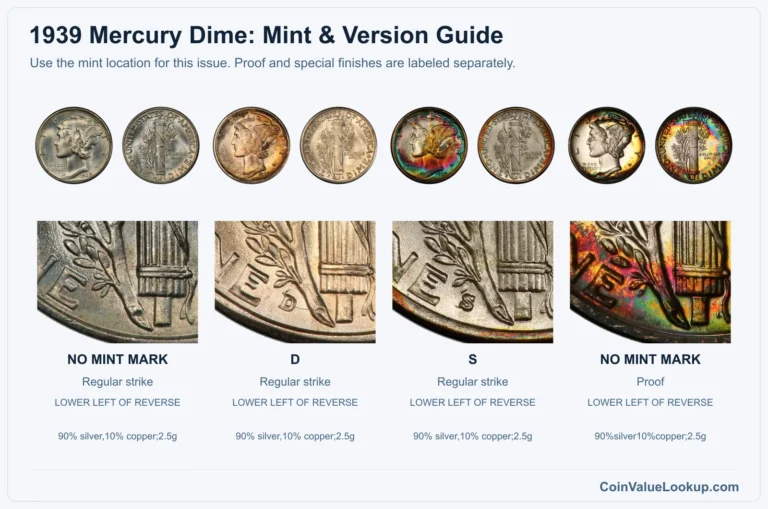
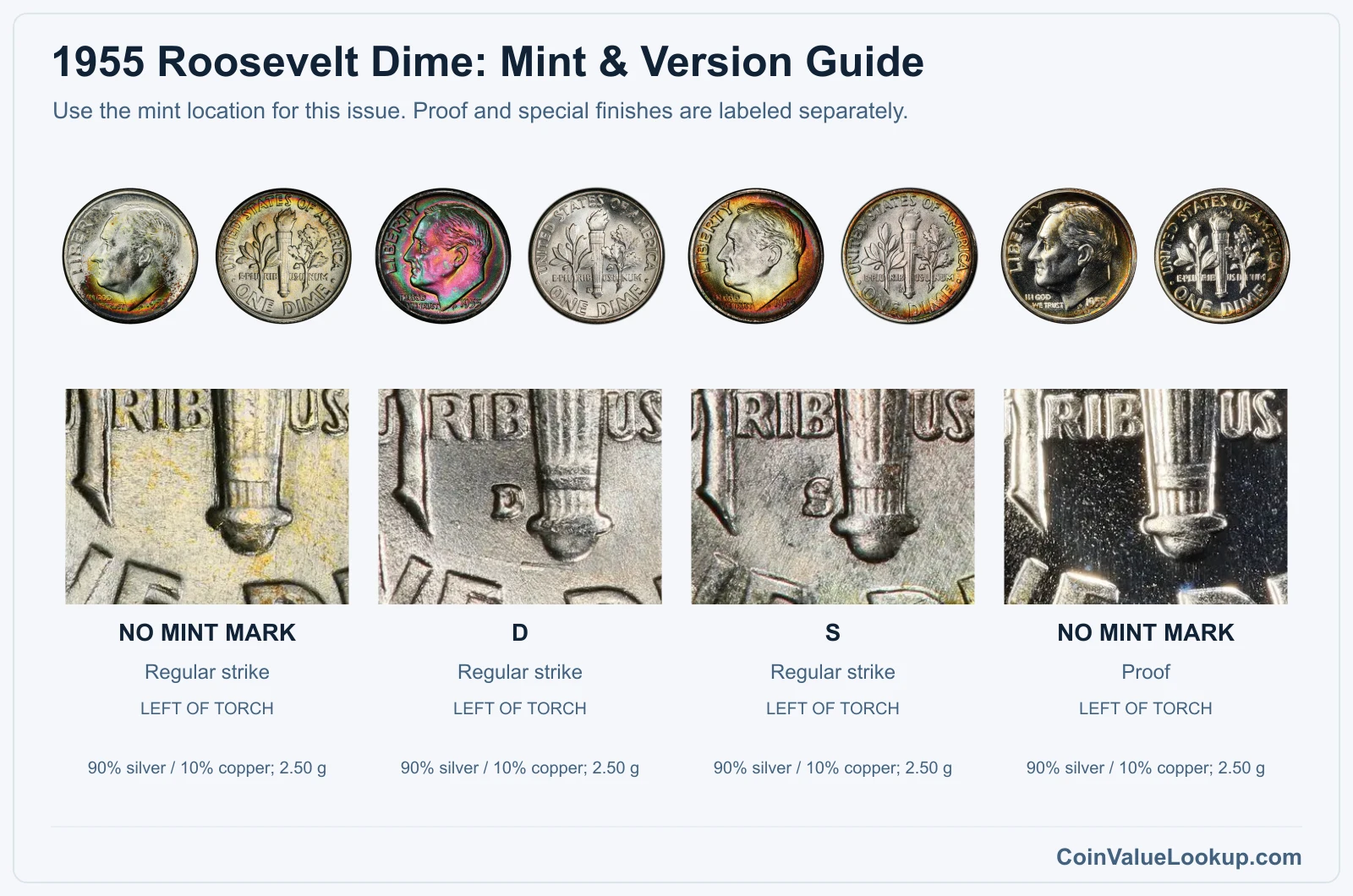
Now flip the coin over and look near the base of the torch for a small letter. A "D" means Denver, an "S" means San Francisco, and no letter at all means Philadelphia.
The absence of a mintmark on a 1955 dime is completely normal and not a missing-mintmark error.
Every regular 1955 dime — Philadelphia, Denver, and San Francisco — is struck in 90% silver and 10% copper, weighing about 2.50 grams with a diameter near 17.9 mm. There is no clad version for this year.
If your coin feels suspiciously light, that is worth investigating for a possible thin-planchet variety rather than assuming it is clad.
Business-strike mintages were relatively low in 1955, but that does not automatically translate into big premiums. Many coins were set aside by collectors at the time, so the surviving population in higher grades is larger than you might expect.
Proof strikes from Philadelphia are a separate category with their own pricing.
Step 2: Check Your 1955 Roosevelt Dime Grade
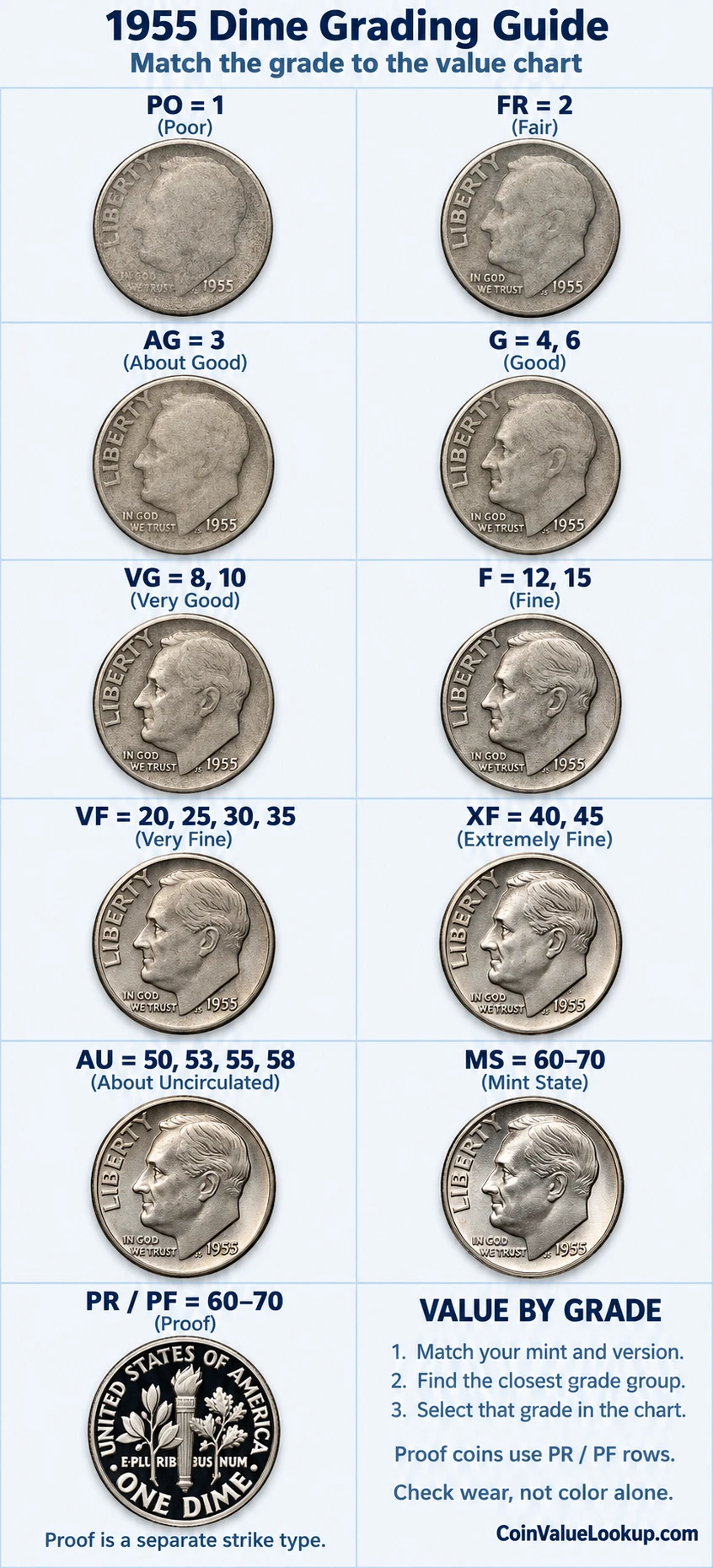
Focus your eye on Roosevelt's cheek first. That broad, smooth area picks up friction before anything else, and even light cabinet rub will dull the original luster there.
Next check the hair detail above the ear and along the jawline.
On the reverse, the upper torch and surrounding leaf tips wear quickly. Compare your coin against the grading image to judge how much detail remains.
One common mistake: assuming a soft or incomplete torch band means the coin circulated. Some 1955 dimes simply received a weaker strike.
Full Bands — the complete separation of both horizontal torch-band pairs — is a strike designation applied by grading services, not proof of wear or lack of it.
When comparing values, keep Full Bands examples within the same mint and same numerical grade. A proof or cameo coin belongs in an entirely separate finish category.
Also watch for cleaning, which kills luster in a way that looks "too bright" under a light; original surfaces with natural toning will always grade better than a polished coin.
Step 3: Check 1955 Roosevelt Dime Value by Mint and Version
1955 Roosevelt Dime — No Mintmark / Philadelphia
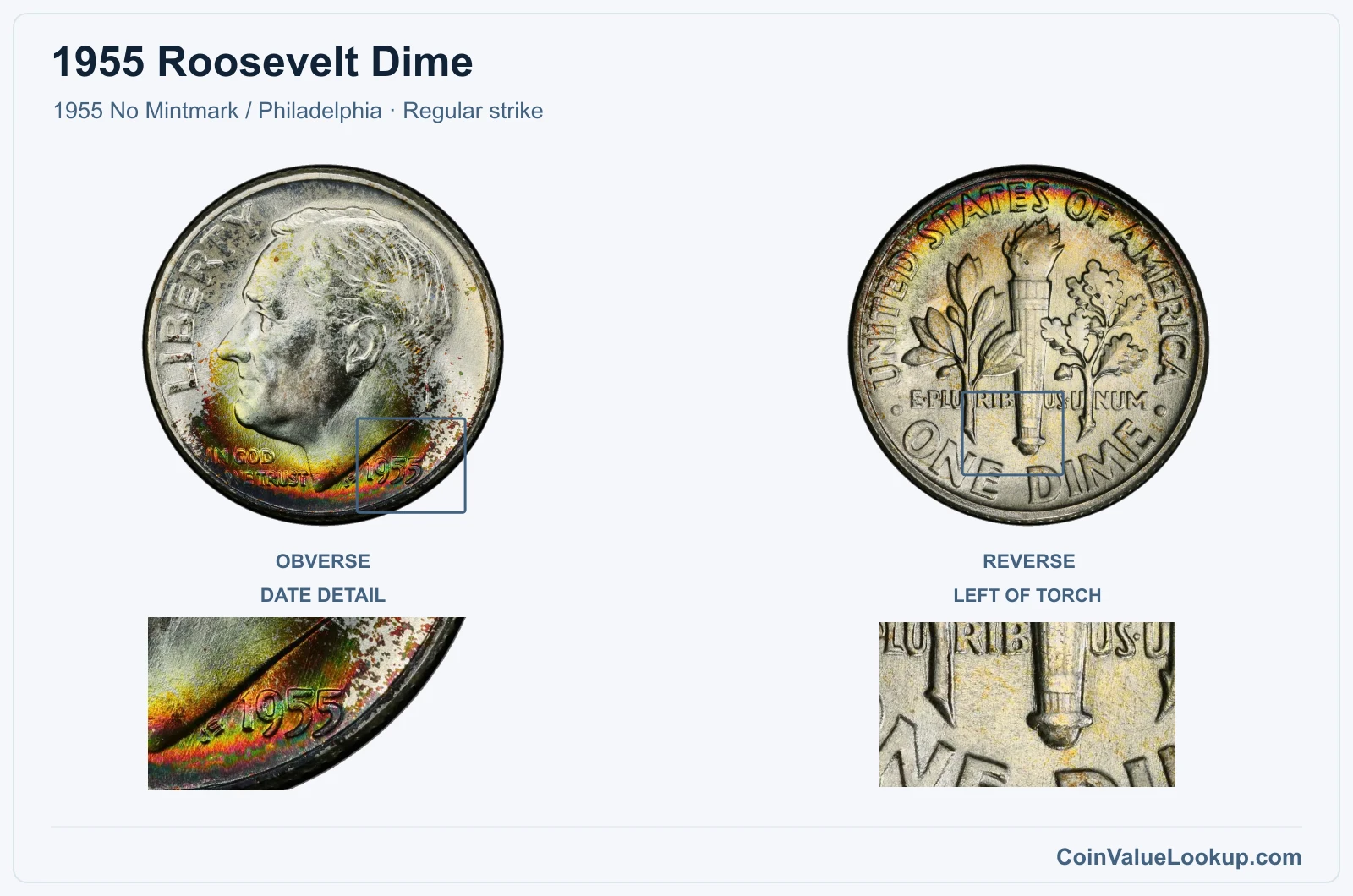
The 1955 Philadelphia dime carries no mintmark, which is standard for the era. It is struck in 90% silver at roughly 2.50 grams.
Guide estimates run from about $5.81 in G4 to around $14 in MS65.
These were saved in quantity despite the lower mintage, so do not assume scarcity just from the date. What actually moves the price is condition and whether the torch bands are fully separated.
Look for original, uncleaned surfaces with complete luster — a coin that has been wiped or dipped will grade lower than one with honest toning.
Range Grade
Price Auction Records Appraisal PO PO 1
—
Coin Identifier FR FR 2
—
Coin Identifier AG AG 3
—
Coin Identifier G G 4
—
Coin Identifier
G 6
—
Coin Identifier VG VG 8
—
Coin Identifier
VG 10
—
Coin Identifier F F 12
—
Coin Identifier
F 15
—
Coin Identifier VF VF 20
—
Coin Identifier
VF 25
—
Coin Identifier
VF 30
—
Coin Identifier
VF 35
—
Coin Identifier XF XF 40
—
Coin Identifier
XF 45
—
Coin Identifier AU AU 50
—
Coin Identifier
AU 53
—
Coin Identifier
AU 55
—
Coin Identifier
AU 58
—
Coin Identifier MS MS 60
—
Coin Identifier
MS 61
—
Coin Identifier
MS 62
—
Coin Identifier
MS 63
—
Coin Identifier
MS 64
Coin Identifier
MS 65
Coin Identifier
MS 66
Coin Identifier
MS 67
Coin Identifier
MS 68
Coin Identifier
MS 69
—
—
—
MS 70
—
—
—
1955 Roosevelt Dime — D / Denver
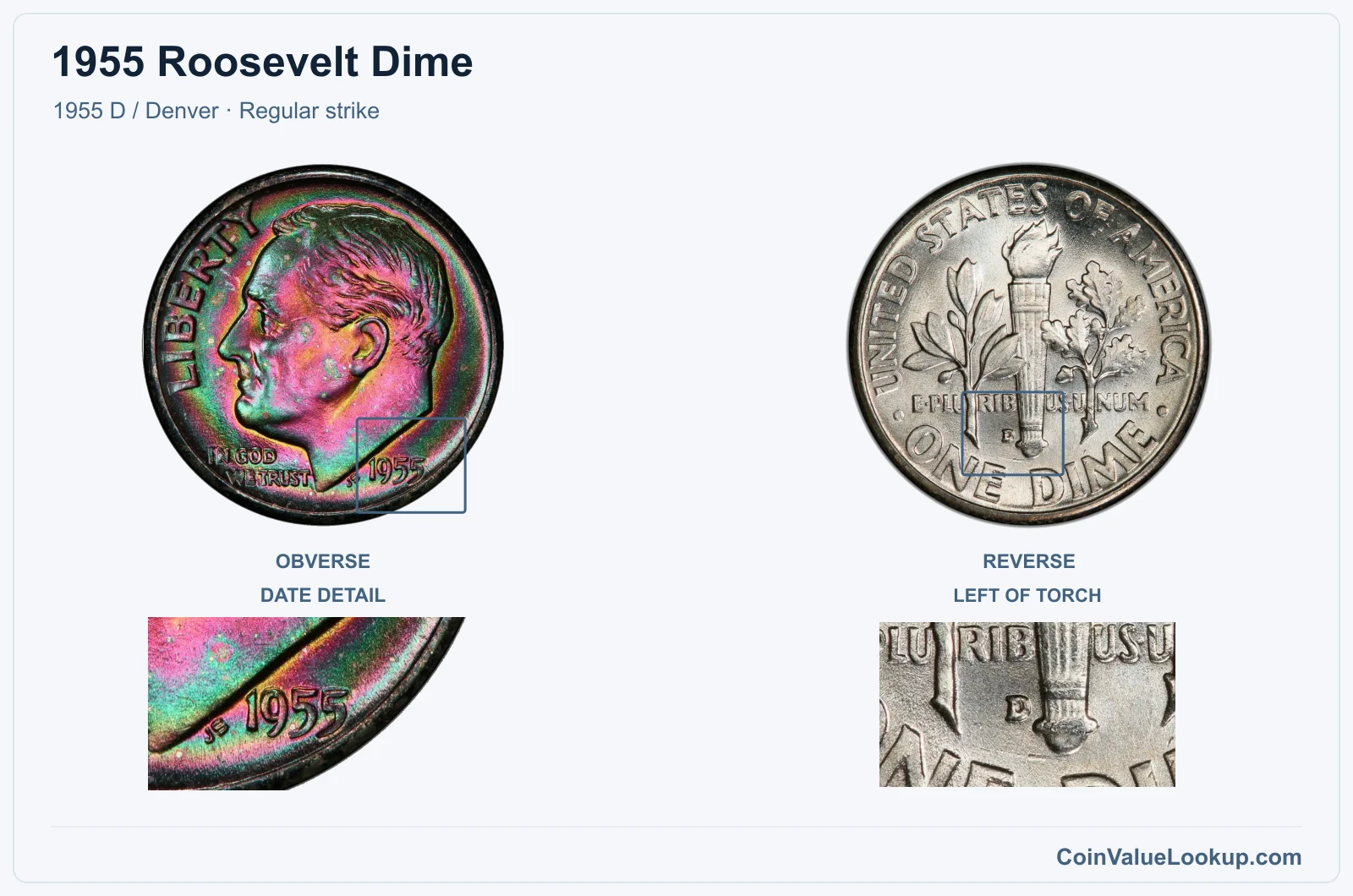
Look for the small "D" mintmark near the torch base on the reverse. The 1955-D is another 90% silver issue at the standard 2.50-gram weight, with guide estimates from about $5.81 in G4 to roughly $14 in MS65.
Denver strikes from this year can be a mixed bag on sharpness. Some show weaker torch bands, which is a strike characteristic, not wear.
A Full Bands example at the same numerical grade will generally command more attention from registry collectors than one without the designation.
Range Grade
Price Auction Records Appraisal PO PO 1
—
Coin Identifier FR FR 2
—
Coin Identifier AG AG 3
—
Coin Identifier G G 4
—
Coin Identifier
G 6
—
Coin Identifier VG VG 8
—
Coin Identifier
VG 10
—
Coin Identifier F F 12
—
Coin Identifier
F 15
—
Coin Identifier VF VF 20
—
Coin Identifier
VF 25
—
Coin Identifier
VF 30
—
Coin Identifier
VF 35
—
Coin Identifier XF XF 40
—
Coin Identifier
XF 45
—
Coin Identifier AU AU 50
—
Coin Identifier
AU 53
—
Coin Identifier
AU 55
—
Coin Identifier
AU 58
Coin Identifier MS MS 60
—
Coin Identifier
MS 61
—
Coin Identifier
MS 62
—
Coin Identifier
MS 63
—
Coin Identifier
MS 64
Coin Identifier
MS 65
Coin Identifier
MS 66
Coin Identifier
MS 67
Coin Identifier
MS 68
—
—
—
MS 69
—
—
—
MS 70
—
—
—
1955 Roosevelt Dime — S / San Francisco
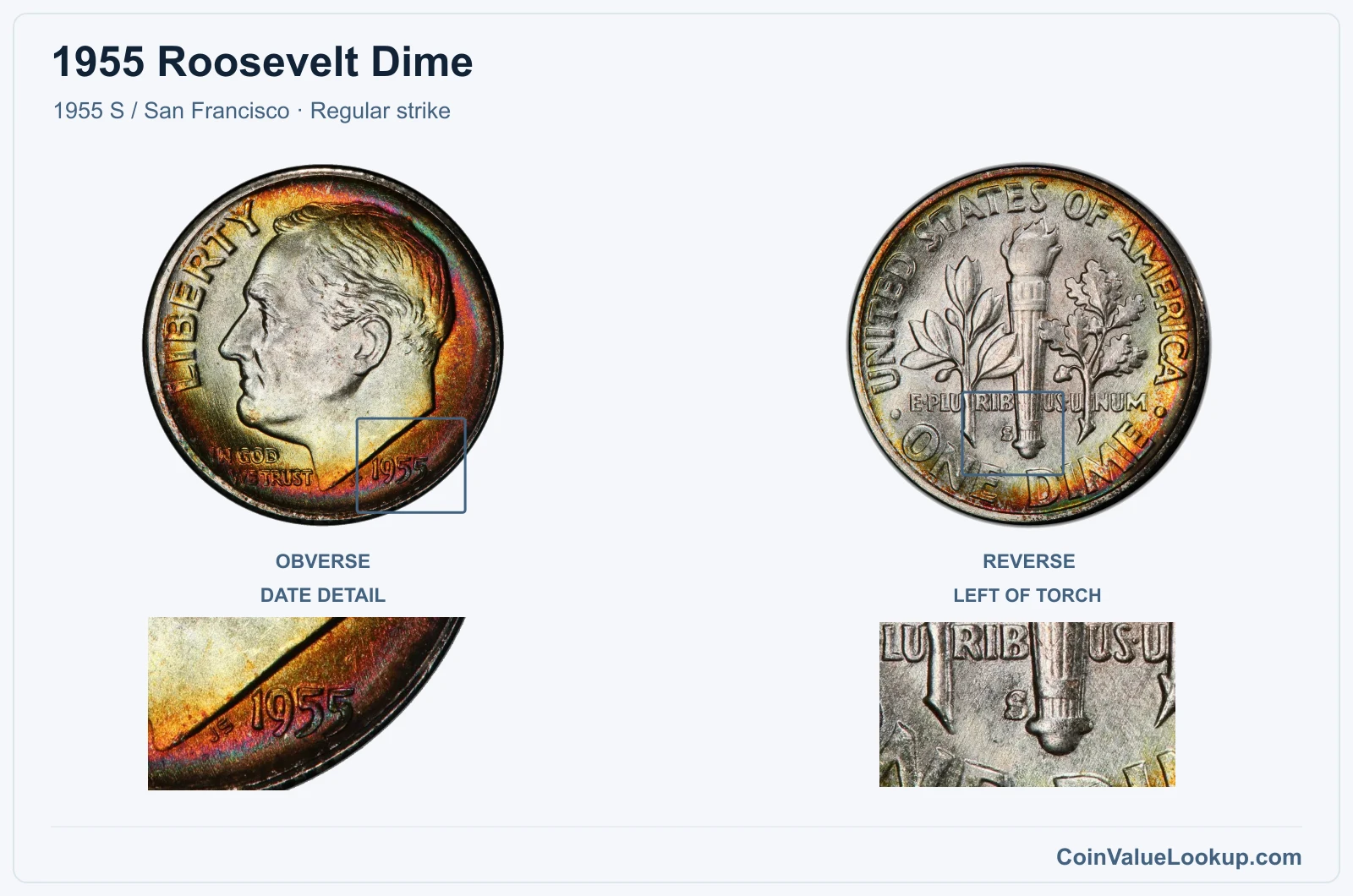
The San Francisco issue bears an "S" mintmark near the base of the torch. Same 90% silver composition, same 2.50-gram target weight.
Guide estimates again sit around $5.81 in G4 and about $14 in MS65.
The 1955-S is also the host for two recognized varieties — the Thin Planchet and the Repunched Mintmark — so it is worth examining more carefully than the other mints. Check the edge thickness, weigh the coin if you can, and look at the mintmark under magnification before dropping it back in the album.
Coin Value Lookup is a good starting point if you want to look up other Roosevelt Dime years or compare across different denominations.
Range Grade
Price Auction Records Appraisal PO PO 1
—
Coin Identifier FR FR 2
—
Coin Identifier AG AG 3
—
Coin Identifier G G 4
—
Coin Identifier
G 6
—
Coin Identifier VG VG 8
—
Coin Identifier
VG 10
—
Coin Identifier F F 12
—
Coin Identifier
F 15
—
Coin Identifier VF VF 20
—
Coin Identifier
VF 25
—
Coin Identifier
VF 30
—
Coin Identifier
VF 35
—
Coin Identifier XF XF 40
—
Coin Identifier
XF 45
—
Coin Identifier AU AU 50
—
Coin Identifier
AU 53
—
Coin Identifier
AU 55
—
Coin Identifier
AU 58
—
Coin Identifier MS MS 60
—
Coin Identifier
MS 61
—
Coin Identifier
MS 62
—
Coin Identifier
MS 63
—
Coin Identifier
MS 64
Coin Identifier
MS 65
Coin Identifier
MS 66
Coin Identifier
MS 67
Coin Identifier
MS 68
Coin Identifier
MS 69
—
—
—
MS 70
—
—
—
1955 Roosevelt Dime — Philadelphia Proof (No Mintmark)
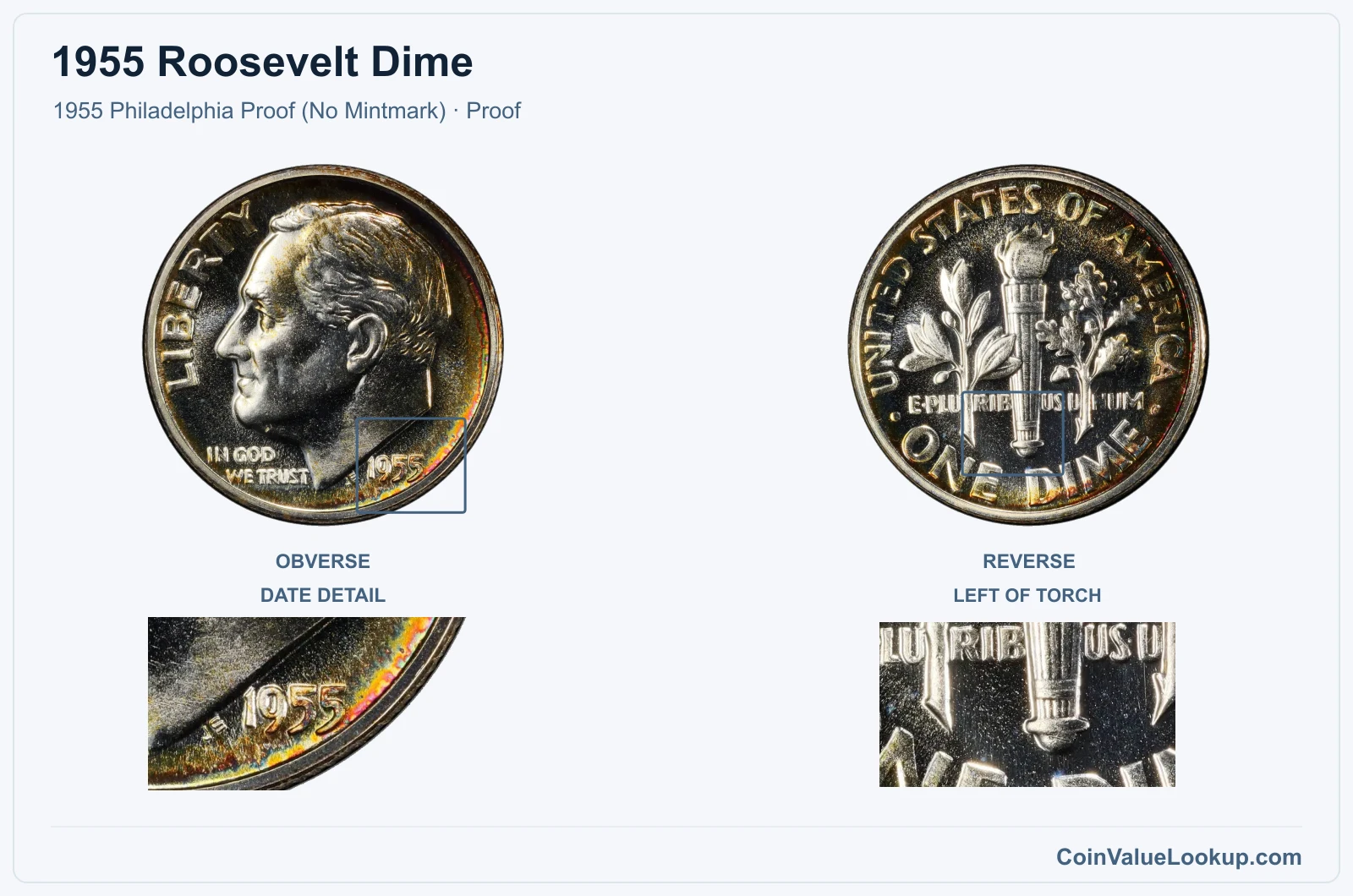
Philadelphia proof dimes from 1955 were intentionally struck for collectors on polished planchets with specially prepared dies. You will see deeply mirrored fields, squared rims, and crisp device detail that business strikes rarely match.
The ordinary PR65 guide estimate is about $22. However, if your proof shows frosted devices contrasting against mirror fields — the cameo or deep-cameo effect — it belongs in a different value tier entirely.
Do not apply the standard PR65 figure to a cameo or deep-cameo coin; those carry their own premiums.
Authentic proofs were sold in sets and are usually well preserved. Watch for hairlines from improper storage or handling, which are the most common grade limiters on proof surfaces.
Range Grade
Price Auction Records Appraisal PR PR 1
—
Coin Identifier
PR 2
—
Coin Identifier
PR 3
—
Coin Identifier
PR 4
—
Coin Identifier
PR 6
—
Coin Identifier
PR 8
—
Coin Identifier
PR 10
—
Coin Identifier
PR 12
—
Coin Identifier
PR 15
—
Coin Identifier
PR 20
—
Coin Identifier
PR 25
—
Coin Identifier
PR 30
—
Coin Identifier
PR 35
—
Coin Identifier
PR 40
—
Coin Identifier
PR 45
—
Coin Identifier
PR 50
—
Coin Identifier
PR 53
—
Coin Identifier
PR 55
—
Coin Identifier
PR 58
—
Coin Identifier
PR 60
—
Coin Identifier
PR 61
—
Coin Identifier
PR 62
—
Coin Identifier
PR 63
—
Coin Identifier
PR 64
Coin Identifier
PR 65
Coin Identifier
PR 66
Coin Identifier
PR 67
Coin Identifier
PR 68
Coin Identifier
PR 69
Coin Identifier
PR 70
—
—
—
1955 Roosevelt Dime Error List
1. 1955 Roosevelt Dime — Thin Planchet
The 1955-S Thin Planchet variety is exactly what it sounds like: a dime struck on a planchet thinner and lighter than normal. One authenticated example, graded NGC MS66, weighed just 1.9 grams versus the standard 2.50 grams.
That is a significant difference you can sometimes feel by hand and certainly verify with a calibrated scale.
Inspect the edge of the coin carefully. A genuinely thin planchet will show a uniformly reduced rim profile, not the uneven look of a filed or acid-treated coin.
Authentication of the metal composition and surfaces matters here, because coins that have been chemically stripped or physically altered can mimic the appearance.
No specific price range is adopted for this variety. Value depends on the severity of the weight reduction, the coin's overall condition, and whether it has been independently authenticated.
Individual assessment is the way to go.
2. 1955 Roosevelt Dime — Repunched S Mintmark
On some 1955-S dimes, the S mintmark was punched more than once, leaving a visible secondary S outline beneath or beside the primary letter. Under magnification you can see the rounded trace of the extra impression — it is subtle but distinct once you know what to look for.
This is a hand-punched mintmark variety from an era when mintmarks were applied individually to working dies. It is not the same class of error as the famous 1955 Lincoln cent doubled die; the scale and mechanism are different.
Flat, shelf-like doubling caused by die chatter during striking looks similar at first glance but lacks the rounded secondary profile of a true repunched mintmark.
No specific price range is adopted. The premium depends on the clarity of the repunching and the coin's grade.
Authentication by a recognized grading service helps establish the variety for resale.
3. 1955 Roosevelt Dime — Die Crack / Horned Head
A documented 1955 Philadelphia business-strike dime shows a raised crack running from about the 2 o'clock position on the rim down to the top of Roosevelt's head. The crack's shape at the skull gives this the nickname "Horned Head" variety — it looks like a small horn or spike protruding upward.
This is a die crack, not an intentional design element. As a die ages and fractures, metal fills the crack during striking and leaves a raised line on the finished coin.
The feature should be raised above the field, not incised.
Do not confuse this with scratches, adhesions, or debris stuck to the surface. A scratch is usually recessed and random; a die crack follows a consistent path and appears on every coin struck from that die state.
No specific price range is adopted for this variety. Value hinges on the crack's prominence, the coin's overall condition, and specialist dealer attribution.
4. 1955 Roosevelt Dime — Doubled Die
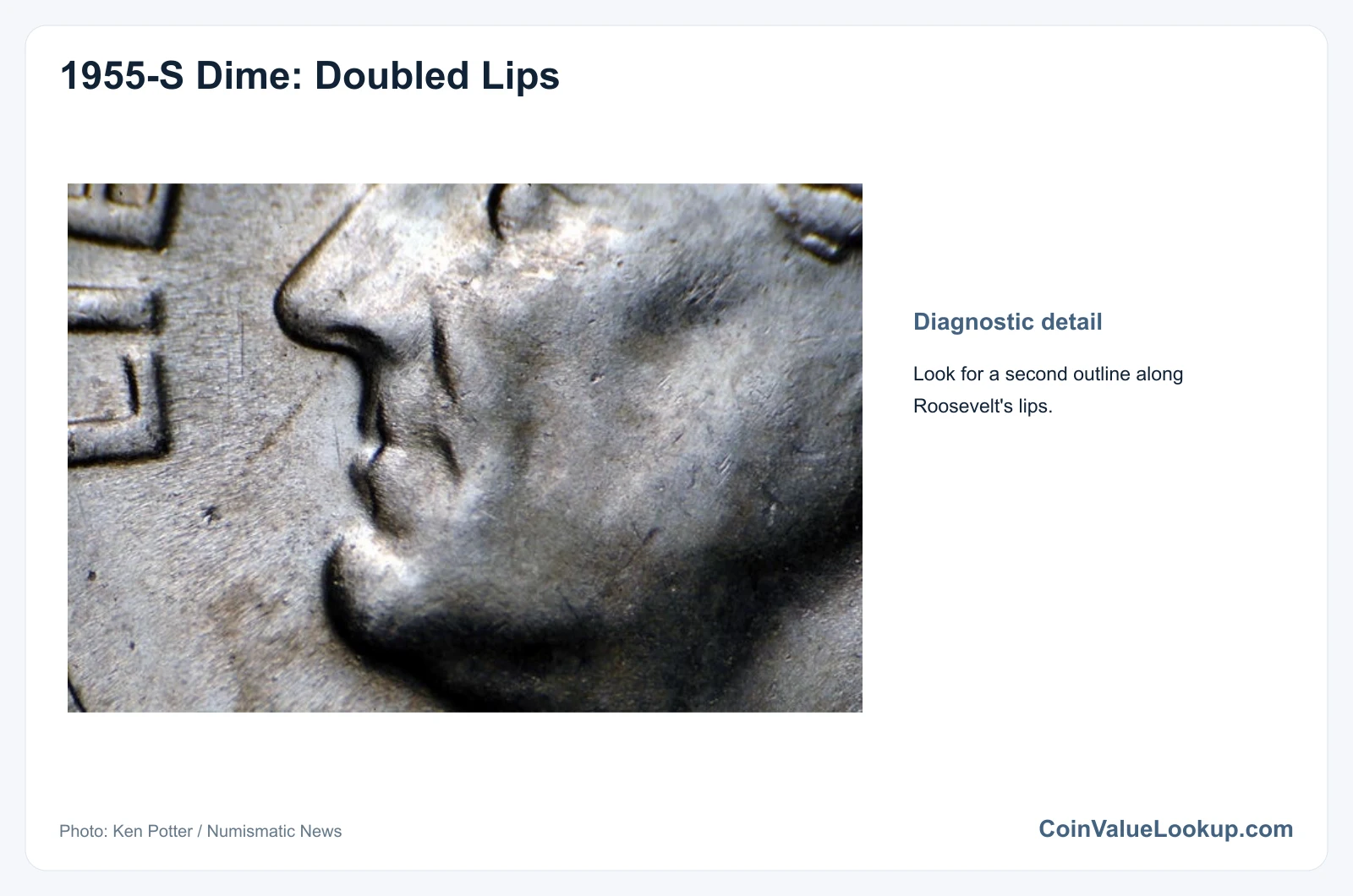
A doubled die on a 1955 Roosevelt Dime shows design elements that appear twice, with a consistent separation or notching visible on the devices. Compare the lettering and Roosevelt's profile against a normal coin — genuine doubling will repeat across multiple design elements in the same direction and magnitude.
The key distinction is between a true doubled die and machine doubling. Machine doubling produces flat, shelf-like distortion on the high points, usually with a loss of detail rather than a crisp secondary image.
Reflections, lighting tricks, and post-mint impressions from contact with other coins can also mimic the look.
No specific price range is adopted for this variety. The value of any doubled-die dime depends on the visibility of the doubling, which design elements are affected, and the coin's condition.
Independent authentication is the surest path to confirming the variety.
5. 1955 Roosevelt Dime — Off-Center Strike
An off-center strike happens when the planchet is not seated properly between the dies, shifting the entire design to one side and leaving an unstruck crescent of blank metal on the opposite edge. On a 1955 dime, the key factor collectors care about is whether the date remains fully visible — a readable date is essential for the coin to be attributed to this year.
Do not confuse an off-center strike with a clipped planchet, which removes a curved bite from the edge but keeps the design centered. One-sided die misalignment and post-mint flattening can also look similar at first glance but lack the characteristic blank crescent paired with a shifted design.
No numerical price range is adopted. Value depends on the percentage of off-center displacement, date visibility, and the coin's overall preservation.
Dramatic shifts with a clear date tend to attract the strongest collector interest.