1990 Roosevelt Dime Coin Value: How Much Is It Worth?
Most 1990 Roosevelt dimes you pull from pocket change are worth face value — ten cents flat. In collectible condition the numbers climb modestly: a USA Coin Book guide lists the 1990-P or 1990-D at about $2.79 in MS65, while the 1990-S clad proof sits around $3.08 in PR65.
The real action comes from mint errors and top-grade examples, which deserve a closer look.
Fast Way to Identify Your 1990 Roosevelt Dime
Snap a clear photo of each side of your 1990 dime and upload both images. The identifier can give you a preliminary read on mintmark, finish and general condition.
It is not a substitute for professional authentication or exact grading, but it is a solid first step toward figuring out what you have.
1990 Roosevelt Dime Value
Upload both sides of your 1990 Roosevelt Dime.
Front Obverse
Upload photo
Back Reverse
Upload photo
Which 1990 Roosevelt Dime Versions Are Worth Money?
- 1990-P or 1990-D business strikes in MS65 or higher with fully separated torch bands.
- 1990-S clad proofs with clean mirrored fields and strong cameo contrast.
- Broadstrike on a straight-clipped blank — a compound error documented on 1990-P strikes.
- Off-center strikes, such as a reported 55-percent shift on a 1990-D dime.
- Broadstrike errors where the coin expands beyond normal diameter.
Step 1: Identify Your 1990 Roosevelt Dime Mint Mark and Version
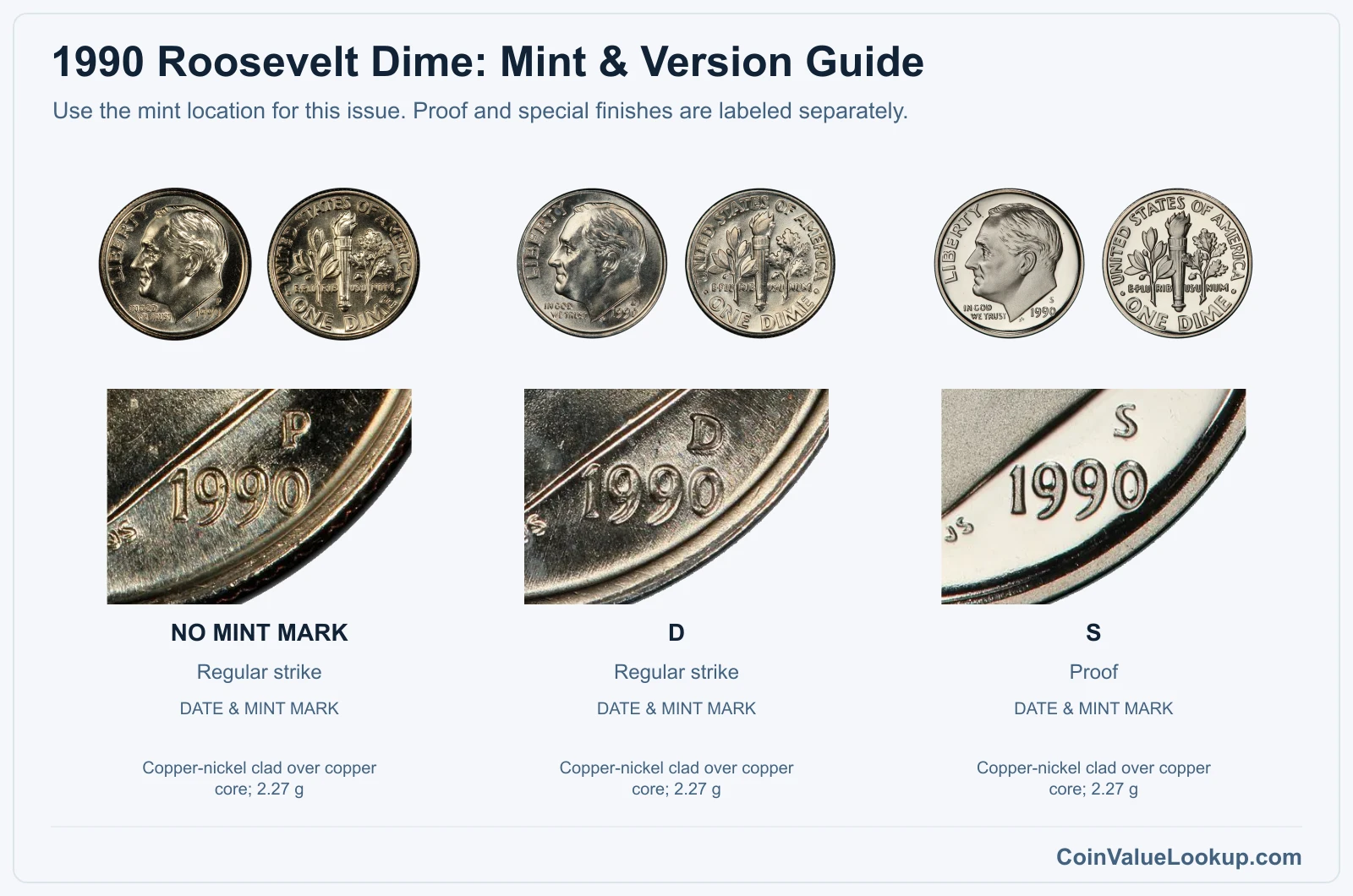
Start with the basics. Confirm the 1990 date on the obverse, Roosevelt's portrait facing left and the torch-with-branches reverse.
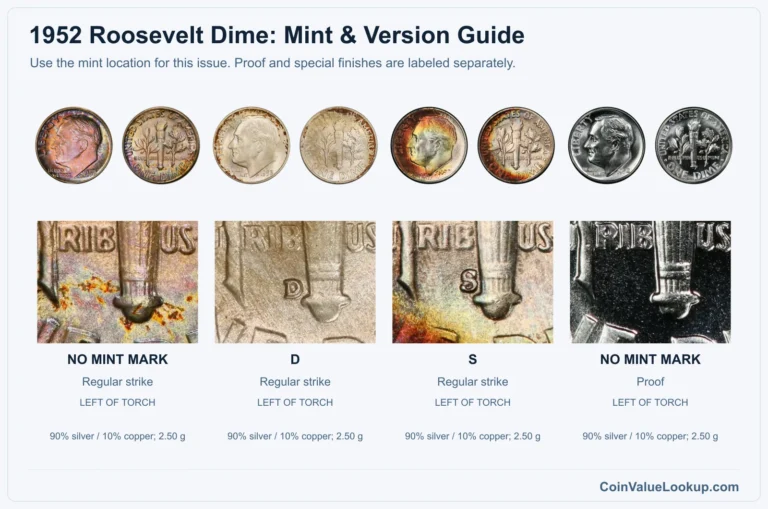
The mintmark — P, D or S — appears on the obverse just above the date. Philadelphia strikes carry a P, Denver a D and San Francisco proofs an S.
All three versions are copper-nickel clad over a copper core, weighing 2.27 grams at about 17.9 mm diameter. There is no regular silver proof for 1990; the U.S. Mint did not introduce a silver Roosevelt proof until 1992.
If your coin's edge shows a solid copper stripe sandwiched between silvery layers, that is normal clad construction. If the color or weight seems off, professional authentication is the next step rather than guessing at the alloy.
Step 2: Check Your 1990 Roosevelt Dime Grade
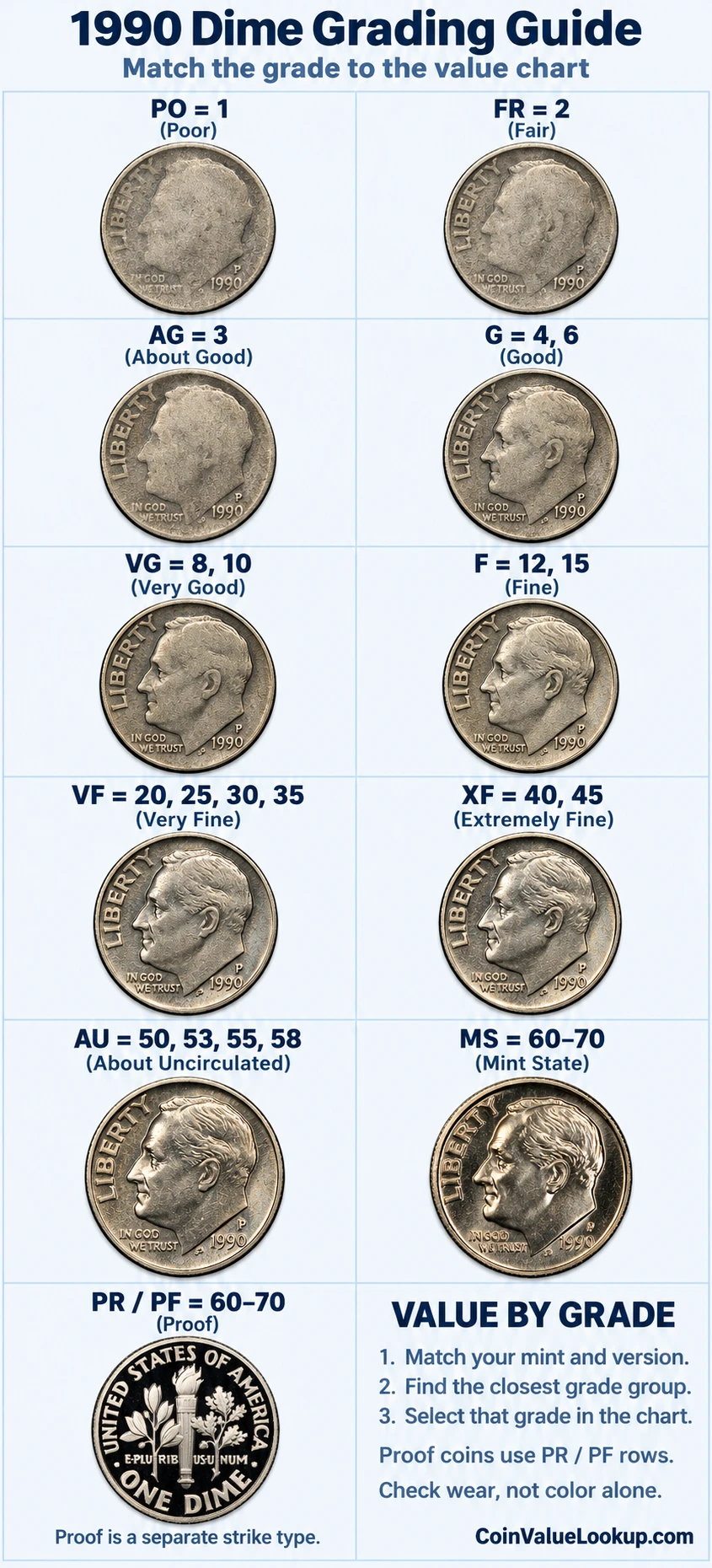
Focus on four wear checkpoints: Roosevelt's cheekbone, the jawline, the hair detail above the ear, and the torch lines on the reverse. On a well-struck uncirculated coin all of these stay sharp with full original luster.
Use the comparison image to judge your coin against known grade benchmarks.
A weak strike can mimic wear, so look at the overall luster before downgrading. Cleaning, hairline scratches and corrosion all reduce eye appeal and therefore grade, even if the high points are intact.
For business strikes, the Full Bands designation applies when both horizontal band pairs on the torch separate cleanly. That is a strike characteristic, not a grade bump, and coins with and without it should be compared within their own designation.
Proof coins are evaluated separately for finish quality and cameo contrast.
Step 3: Check 1990 Roosevelt Dime Value by Mint and Version
1990 Roosevelt Dime — P Business Strike
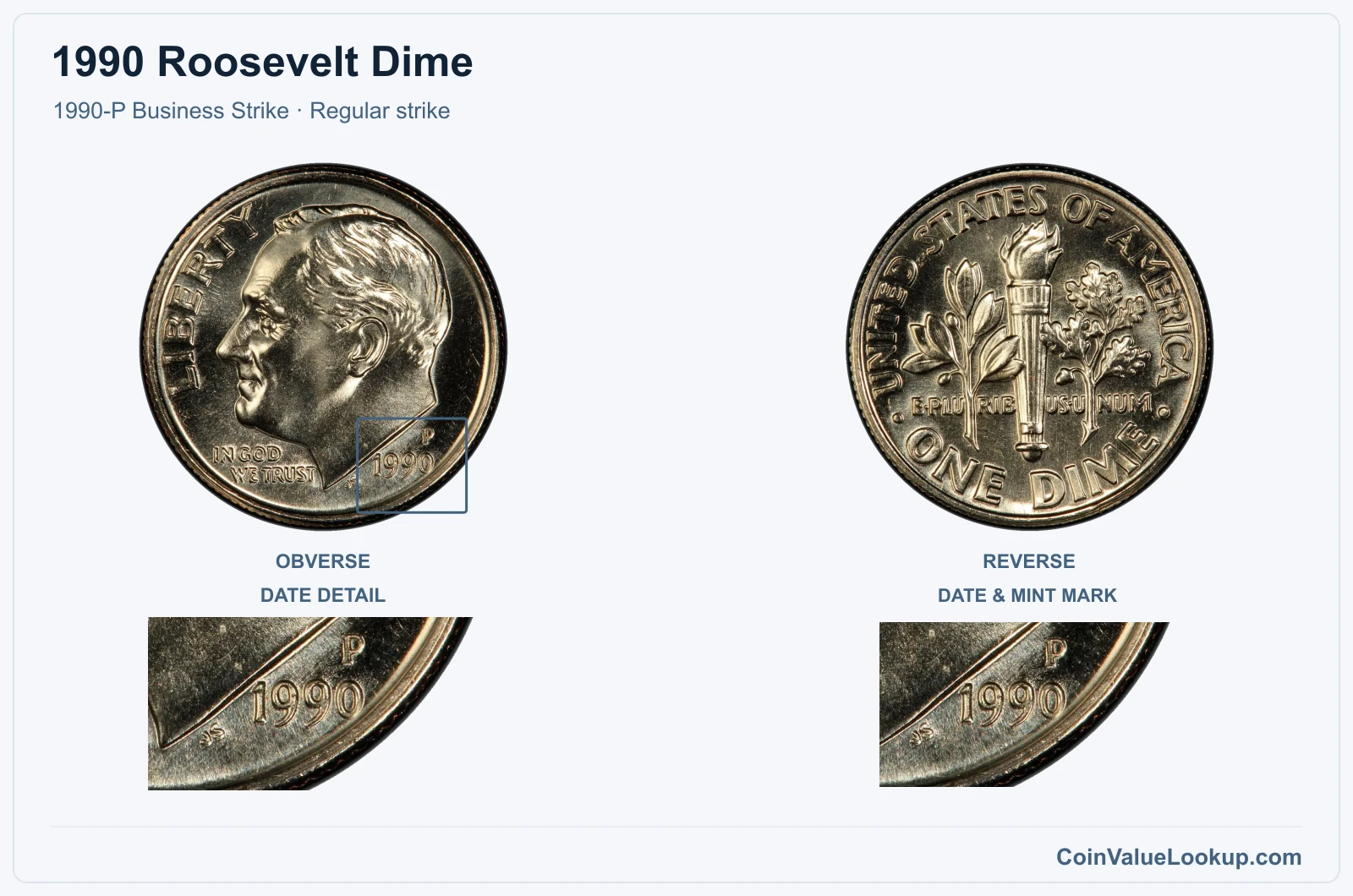
The 1990-P is the standard Philadelphia business strike with the familiar Roosevelt portrait and torch reverse, struck on a 2.27-gram copper-nickel clad planchet. Look for the P mintmark on the obverse above the date.
A USA Coin Book guide places the MS65 value at roughly $2.79. Coins with the Full Bands designation — where both horizontal band pairs on the torch are distinctly separated — trade in their own lane and should not be compared directly to non-Full-Bands examples.
Circulated pieces are common and worth face value.
Range Grade
Price Auction Records Appraisal PO PO 1
—
Coin Identifier FR FR 2
—
Coin Identifier AG AG 3
—
Coin Identifier G G 4
—
Coin Identifier
G 6
—
Coin Identifier VG VG 8
—
Coin Identifier
VG 10
—
Coin Identifier F F 12
—
Coin Identifier
F 15
—
Coin Identifier VF VF 20
—
Coin Identifier
VF 25
—
Coin Identifier
VF 30
—
Coin Identifier
VF 35
—
Coin Identifier XF XF 40
—
Coin Identifier
XF 45
—
Coin Identifier AU AU 50
—
Coin Identifier
AU 53
—
Coin Identifier
AU 55
—
Coin Identifier
AU 58
—
Coin Identifier MS MS 60
—
Coin Identifier
MS 61
—
Coin Identifier
MS 62
Coin Identifier
MS 63
Coin Identifier
MS 64
—
Coin Identifier
MS 65
—
Coin Identifier
MS 66
Coin Identifier
MS 67
Coin Identifier
MS 68
Coin Identifier
MS 69
—
—
—
MS 70
—
—
—
1990 Roosevelt Dime — D Business Strike
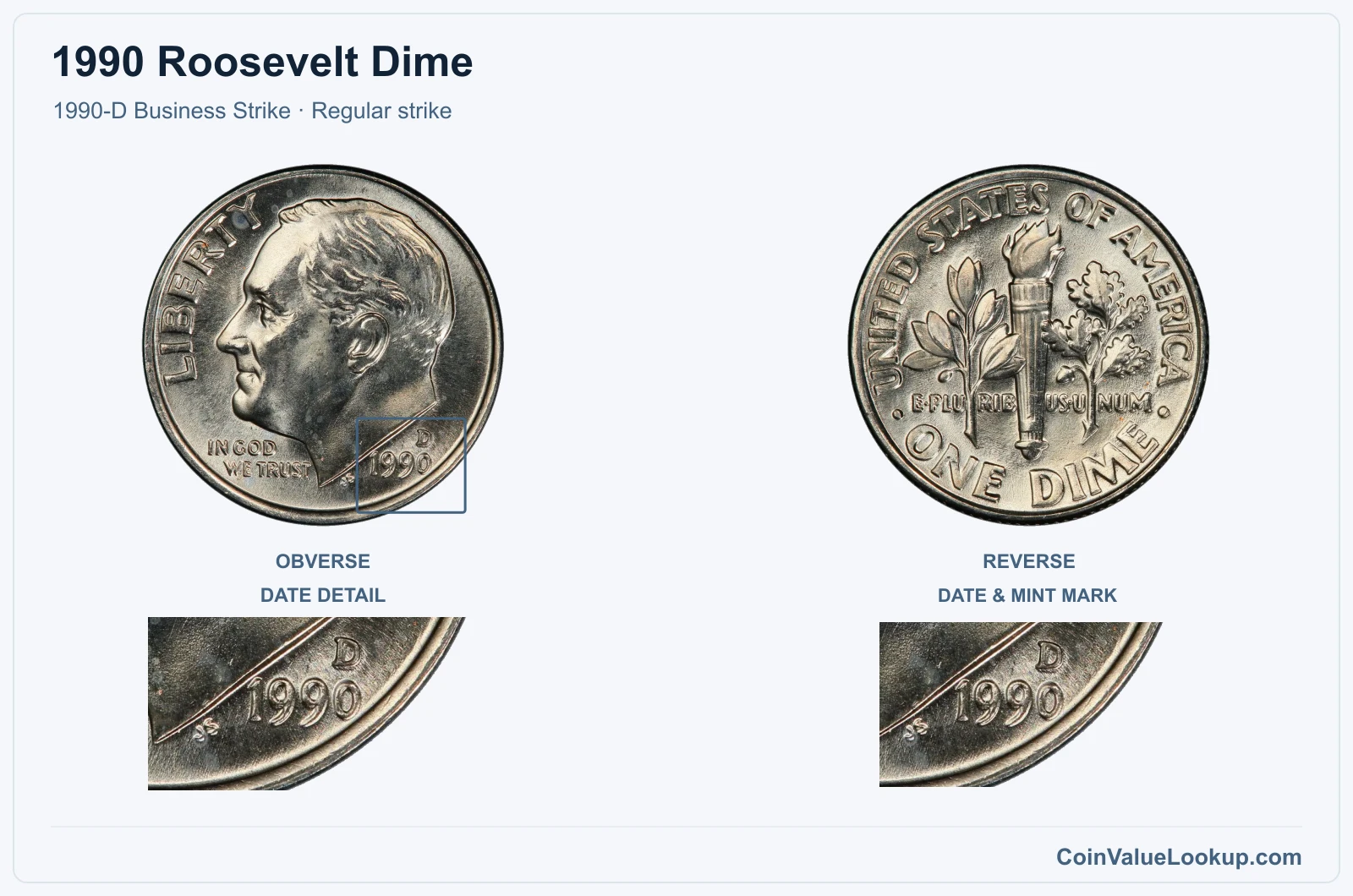
Denver's 1990-D follows the same specifications: copper-nickel clad, 2.27 grams and the identical Roosevelt design. The D mintmark sits on the obverse above the date.
Guide value at MS65 is also about $2.79 per USA Coin Book. As with the Philadelphia issue, Full Bands examples carry a separate market.
Most 1990-D dimes in average circulated condition are still just a dime.
Coin Value Lookup is a handy starting point if you want to check values for other Roosevelt dime dates or denominations alongside this one.
Range Grade
Price Auction Records Appraisal PO PO 1
—
Coin Identifier FR FR 2
—
Coin Identifier AG AG 3
—
Coin Identifier G G 4
—
Coin Identifier
G 6
—
Coin Identifier VG VG 8
—
Coin Identifier
VG 10
—
Coin Identifier F F 12
—
Coin Identifier
F 15
—
Coin Identifier VF VF 20
—
Coin Identifier
VF 25
—
Coin Identifier
VF 30
—
Coin Identifier
VF 35
—
Coin Identifier XF XF 40
—
Coin Identifier
XF 45
—
Coin Identifier AU AU 50
—
Coin Identifier
AU 53
—
Coin Identifier
AU 55
—
Coin Identifier
AU 58
Coin Identifier MS MS 60
—
Coin Identifier
MS 61
—
Coin Identifier
MS 62
—
Coin Identifier
MS 63
—
Coin Identifier
MS 64
—
Coin Identifier
MS 65
—
Coin Identifier
MS 66
Coin Identifier
MS 67
Coin Identifier
MS 68
Coin Identifier
MS 69
—
—
—
MS 70
—
—
—
1990 Roosevelt Dime — S Clad Proof
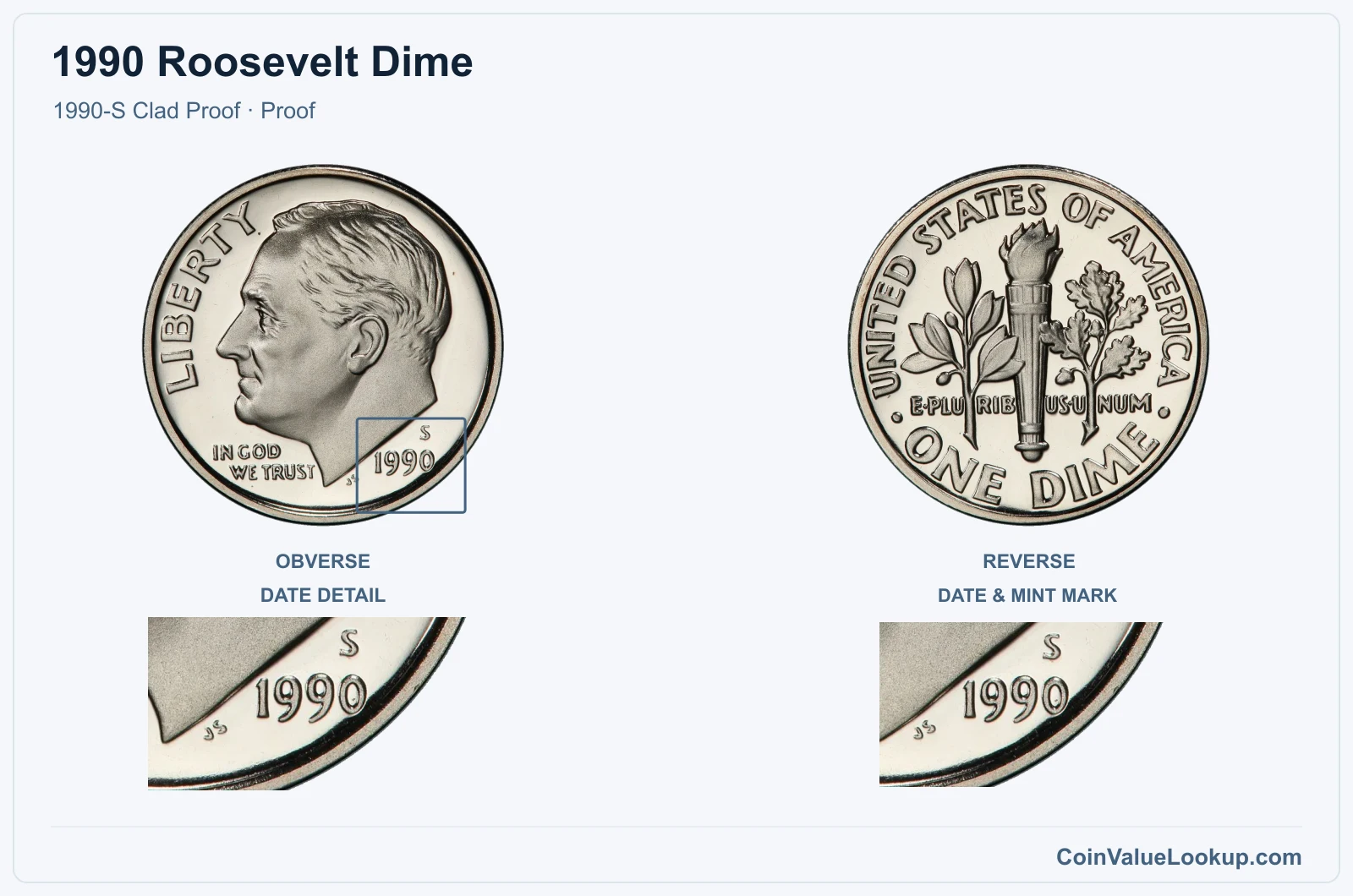
San Francisco struck the 1990-S as a clad proof — no silver version exists for this year. It was sold in official proof sets, so virtually all survivors are in original or near-original condition.
The USA Coin Book guide lists PR65 at approximately $3.08. Proof grading focuses on the mirror finish and whether the devices show frosted cameo contrast against the fields.
Hairlines from mishandling or album friction are the most common detractors. Original government packaging is a good sign that the surfaces have been protected.
Range Grade
Price Auction Records Appraisal PR PR 1
—
Coin Identifier
PR 2
—
Coin Identifier
PR 3
—
Coin Identifier
PR 4
—
Coin Identifier
PR 6
—
Coin Identifier
PR 8
—
Coin Identifier
PR 10
—
Coin Identifier
PR 12
—
Coin Identifier
PR 15
—
Coin Identifier
PR 20
—
Coin Identifier
PR 25
—
Coin Identifier
PR 30
—
Coin Identifier
PR 35
—
Coin Identifier
PR 40
—
Coin Identifier
PR 45
—
Coin Identifier
PR 50
—
Coin Identifier
PR 53
—
Coin Identifier
PR 55
—
Coin Identifier
PR 58
—
Coin Identifier
PR 60
—
Coin Identifier
PR 61
—
Coin Identifier
PR 62
—
Coin Identifier
PR 63
—
Coin Identifier
PR 64
—
Coin Identifier
PR 65
—
Coin Identifier
PR 66
—
Coin Identifier
PR 67
—
Coin Identifier
PR 68
—
Coin Identifier
PR 69
Coin Identifier
PR 70
Coin Identifier
1990 Roosevelt Dime Error List
1. 1990 Roosevelt Dime — Broadstrike on Straight-Clipped Blank
This is a compound error: a broadstrike combined with a straight-clipped blank, documented on a 1990-P business strike. The coin was struck outside the restraining collar, so it spread wider than a normal dime, and the planchet itself had a straight edge defect from the blanking press before it was struck.
A Heritage Auctions lot (NGC MS65) weighed just 2 grams, confirming missing planchet material. To identify one, check for an expanded diameter plus a flat, straight missing section along one edge — both conditions on the same coin.
Watch out for filed edges or coins hammered flat after leaving the mint. Those lack the strike flow and die detail that run up to the irregular edge.
Value depends on the authenticated identity, condition and how dramatic the combined error appears; no standard price range is established here.
2. 1990 Roosevelt Dime — Off-Center Strike
A 1990-D dime has been cataloged with a dramatic 55-percent off-center strike toward the one-o'clock position, leaving an unstruck crescent on one side while the dated portion remains visible. The source is an original dealer catalog listing (Jims Coins, lot 267) with a minimum bid of $22 — that is not a confirmed sale price.
Off-center dimes need the date to be readable to be attributed to a specific year; without the date, they cannot be assigned here. A normal slightly uneven rim is not the same thing — look for a genuine blank crescent where no design was impressed at all.
Value depends on the percentage of shift, whether the date is visible, overall condition and authentication. No reliable numeric range is adopted for this error.
3. 1990 Roosevelt Dime — Broadstrike
A broadstrike occurs when the collar die fails and the planchet is free to expand outward during striking. The central design still appears, but the coin's diameter is noticeably larger than the standard 17.9 mm.
A 1990-P broadstrike graded MS64 by ANACS has appeared at Heritage Auctions. To check your coin, measure the diameter and inspect the rim — a broadstrike will have a smooth, uncontained edge rather than the normal reeded edge of a dime.
Post-mint flattening (someone hitting a coin with a hammer) can look similar, but it distorts the design and typically shows uneven spread. A clip or off-center strike is a different category entirely.
No single-coin price range is adopted; assessment depends on authentication and condition.
4. 1990 Roosevelt Dime — Doubled Die Obverse
Doubled die obverse (DDO) errors have been reported for 1990 dimes. A true DDO shows consistent doubling — separation or notching — on obverse lettering or design elements, visible under magnification in steady light.
The key word is consistent. Every instance of the doubled feature should look the same across the affected area.
Machine doubling, by contrast, tends to produce a flat shelf on one side of the lettering and lacks the raised, separated profile of a genuine hub-doubled die.
Reflections and worn die contours can also fool the eye, so compare your coin carefully against a known normal example under the same lighting. Condition, the visibility of the doubling and the specific die involved all affect value.
No numerical price range is established here; professional attribution is recommended.
5. 1990 Roosevelt Dime — Missing Clad Layer
Missing clad layer errors have been reported for 1990 dimes. On a normal coin the outer copper-nickel layer covers both faces.
When one clad layer is absent, the exposed copper core gives that side a distinctly brownish or reddish tone, and the coin weighs noticeably less than the standard 2.27 grams.
Compare the edge of a suspect coin to a normal dime. You should see the layered sandwich on a normal piece; on a missing-clad error one outer layer is simply gone.
Weigh the coin if possible — a meaningful weight difference supports the diagnosis.
Toning, environmental corrosion and deliberate plating removal can all mimic the look. The difference is that a genuine missing-clad error has a uniform, factory-original copper surface rather than patchy discoloration.
Value depends on condition, which face is affected and authentication.