1992 Roosevelt Dime Coin Value: How Much Is It Worth?
Most 1992 Roosevelt dimes you pull from pocket change are worth face value — ten cents. In higher uncirculated grades, a USA Coin Book guide lists the P or D business strike at about $2.79 in MS65.
The S clad proof sits around $3.62 in PR65, while the S silver proof jumps to roughly $10.69 in PR65. Special versions, top grades, and authenticated errors can push values well beyond those guide figures.
Fast Way to Identify Your 1992 Roosevelt Dime
Snap a clear photo of the front and back of your 1992 dime, then upload both images for a preliminary identification. This can help you figure out which mint and version you have before diving into value comparisons.
It will not authenticate or certify your coin, but it is a solid first step toward understanding what you are holding.
1992 Roosevelt Dime Value
Upload both sides of your 1992 Roosevelt Dime.
Front Obverse
Upload photo
Back Reverse
Upload photo
Which 1992 Roosevelt Dime Versions Are Worth Money?
- P or D business strikes in MS65 or above with fully separated torch bands deserve a closer look.
- S clad proofs in PR65 and higher with clean mirrored fields and strong cameo contrast.
- S silver proofs — confirm the metal first; the silver version carries a meaningfully higher guide value than clad.
- Triple-struck 1992-D errors: one documented NGC MS66 specimen sold for $129 at auction in June 2023.
- Off-center strikes on 1992-P dimes with visible date and significant displacement.
- Struck Through Late-State Capped Die on 1992-D — a dramatic and unusual error type.
Step 1: Identify Your 1992 Roosevelt Dime Mint Mark and Version
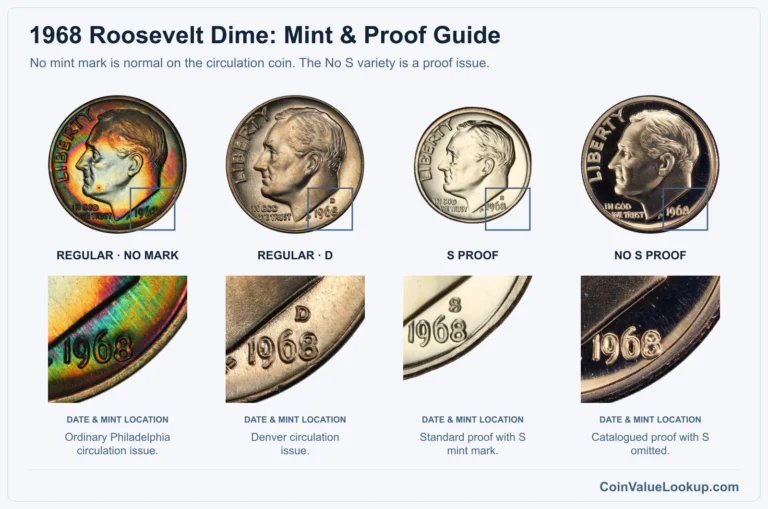
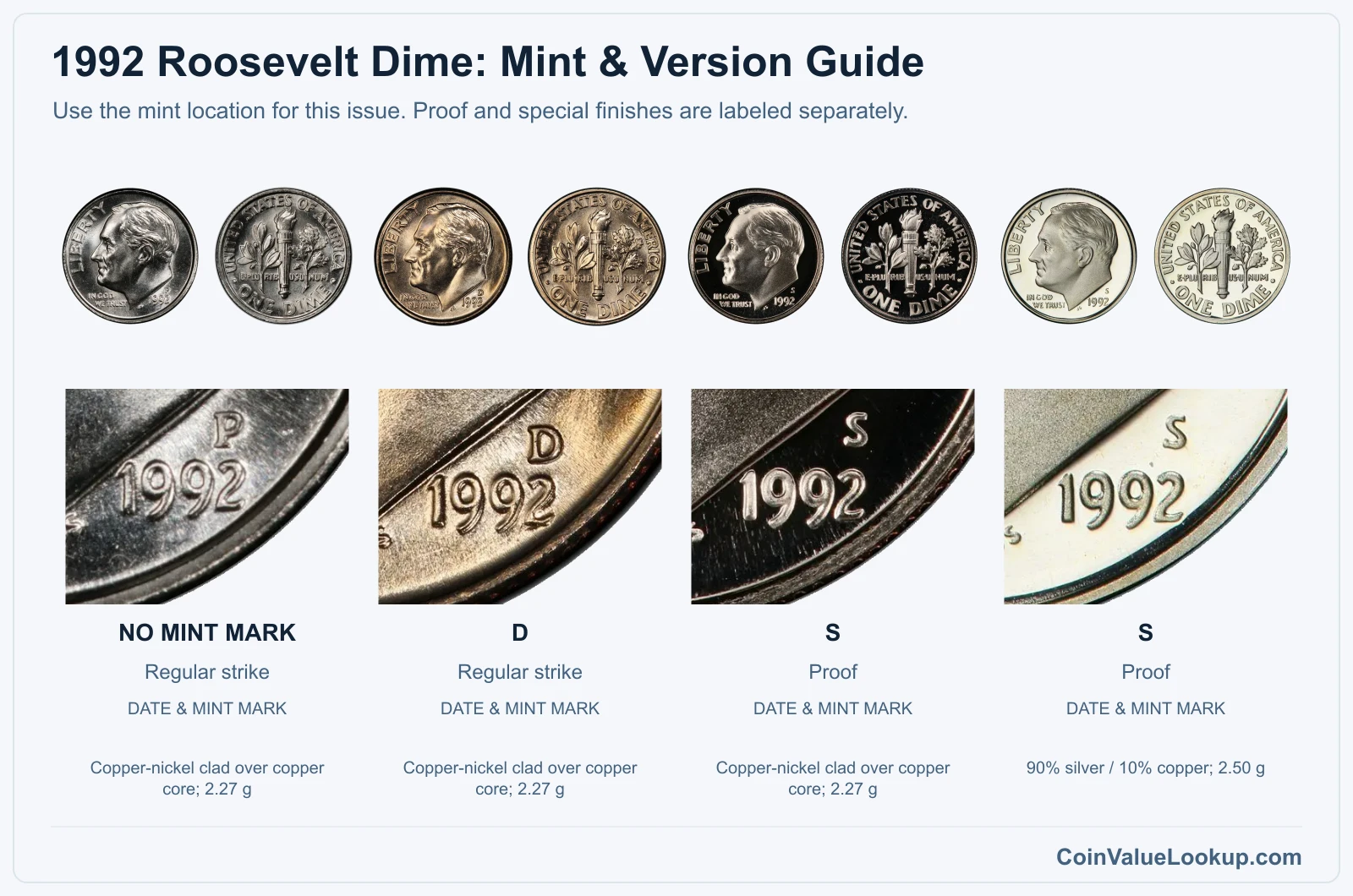
Start with the basics: you should see a 1992 date, Franklin Roosevelt's portrait on the front, and a torch flanked by olive and oak branches on the back. The mintmark sits on the obverse near the date — look for a P, D, or S.
P means Philadelphia, D means Denver, and S means San Francisco. All business strikes (P and D) are copper-nickel clad weighing 2.27 grams and measuring about 17.9 mm across.
Here is where it gets tricky. Both the clad proof and the silver proof carry an S mintmark and look identical at first glance.
The mintmark alone does not tell you the metal. A normal clad dime weighs 2.27 grams; the 90% silver proof weighs 2.50 grams.
That is a small difference, so a precise scale helps.
Check the edge. A clad coin typically shows a visible copper-colored stripe along the rim, while a silver coin has a uniform silvery edge.
Original government packaging is another strong clue — the silver proof came in a separate Silver Proof Set. If you are still unsure, professional authentication is the reliable path.
Step 2: Check Your 1992 Roosevelt Dime Grade
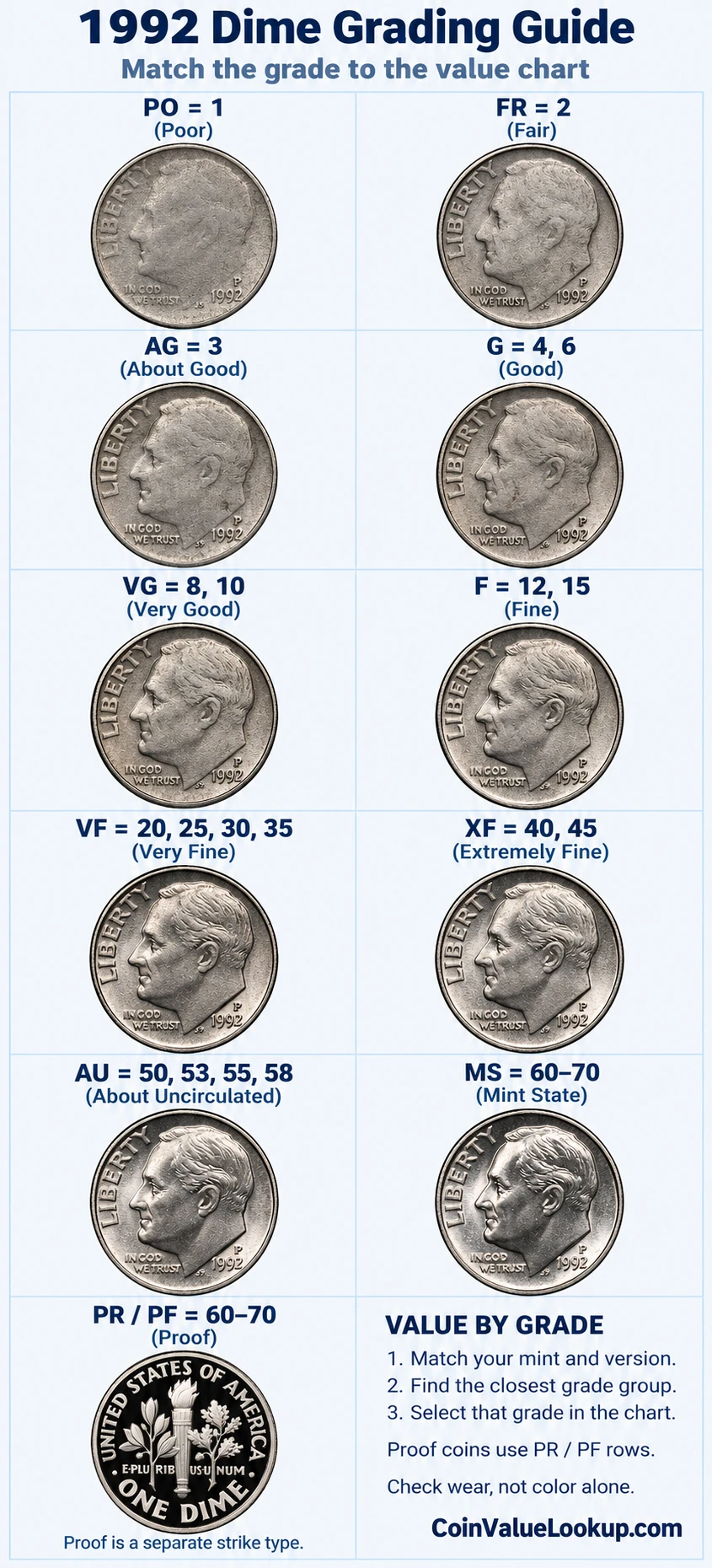
Focus on the high points first. Roosevelt's cheekbone, jawline, and the hair detail just above his ear show wear earliest on a circulated dime.
On the reverse, the torch lines and leaf veins flatten out as the coin sees use.
Do not confuse a weak strike with actual wear. A weakly struck coin may lack sharp detail even in mint state, while a worn coin loses its original luster across the high spots.
The comparison image is your friend here — line your coin up against it and look for matching wear patterns.
Scratches, cleaning, and corrosion all drag down a coin's grade and eye appeal regardless of how little actual wear exists. Bright does not mean high grade.
For proof coins, look at the mirrored fields for hazing or hairlines. Cameo contrast — frosted devices against mirror fields — is a separate quality from the numerical grade.
Full Bands, which describes whether both horizontal torch-band pairs are fully separated, is a strike designation rather than an error, so compare coins within that same designation when checking values.
Step 3: Check 1992 Roosevelt Dime Value by Mint and Version
1992 Roosevelt Dime — P Business Strike
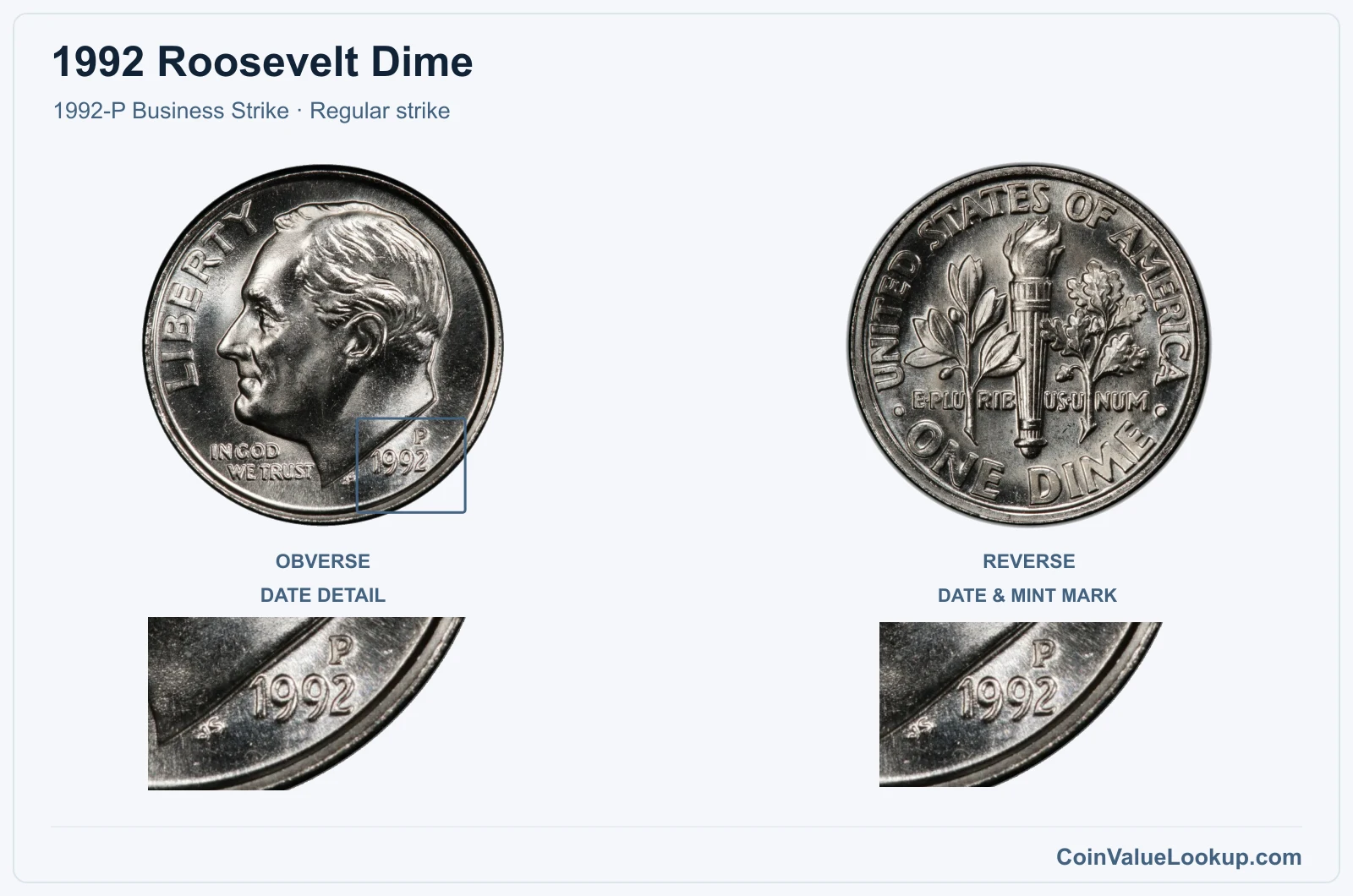
The 1992-P Roosevelt dime was struck in Philadelphia and carries a small P mintmark on the obverse. It is a copper-nickel clad coin weighing 2.27 grams.
In everyday circulation these are worth ten cents, but a USA Coin Book guide places an MS65 example at about $2.79.
Look for specimens with strong torch-band separation and original mint luster if you want coins that command attention from collectors. The price and history tools on Coin Value Lookup can help you compare values across grades and designations for this specific mint and finish.
Range Grade
Price Auction Records Appraisal PO PO 1
—
Coin Identifier FR FR 2
—
Coin Identifier AG AG 3
—
Coin Identifier G G 4
—
Coin Identifier
G 6
—
Coin Identifier VG VG 8
—
Coin Identifier
VG 10
—
Coin Identifier F F 12
—
Coin Identifier
F 15
—
Coin Identifier VF VF 20
—
Coin Identifier
VF 25
—
Coin Identifier
VF 30
—
Coin Identifier
VF 35
—
Coin Identifier XF XF 40
—
Coin Identifier
XF 45
—
Coin Identifier AU AU 50
—
Coin Identifier
AU 53
—
Coin Identifier
AU 55
—
Coin Identifier
AU 58
—
Coin Identifier MS MS 60
—
Coin Identifier
MS 61
—
Coin Identifier
MS 62
—
Coin Identifier
MS 63
—
Coin Identifier
MS 64
—
Coin Identifier
MS 65
Coin Identifier
MS 66
Coin Identifier
MS 67
Coin Identifier
MS 68
Coin Identifier
MS 69
—
—
—
MS 70
—
—
—
1992 Roosevelt Dime — D Business Strike
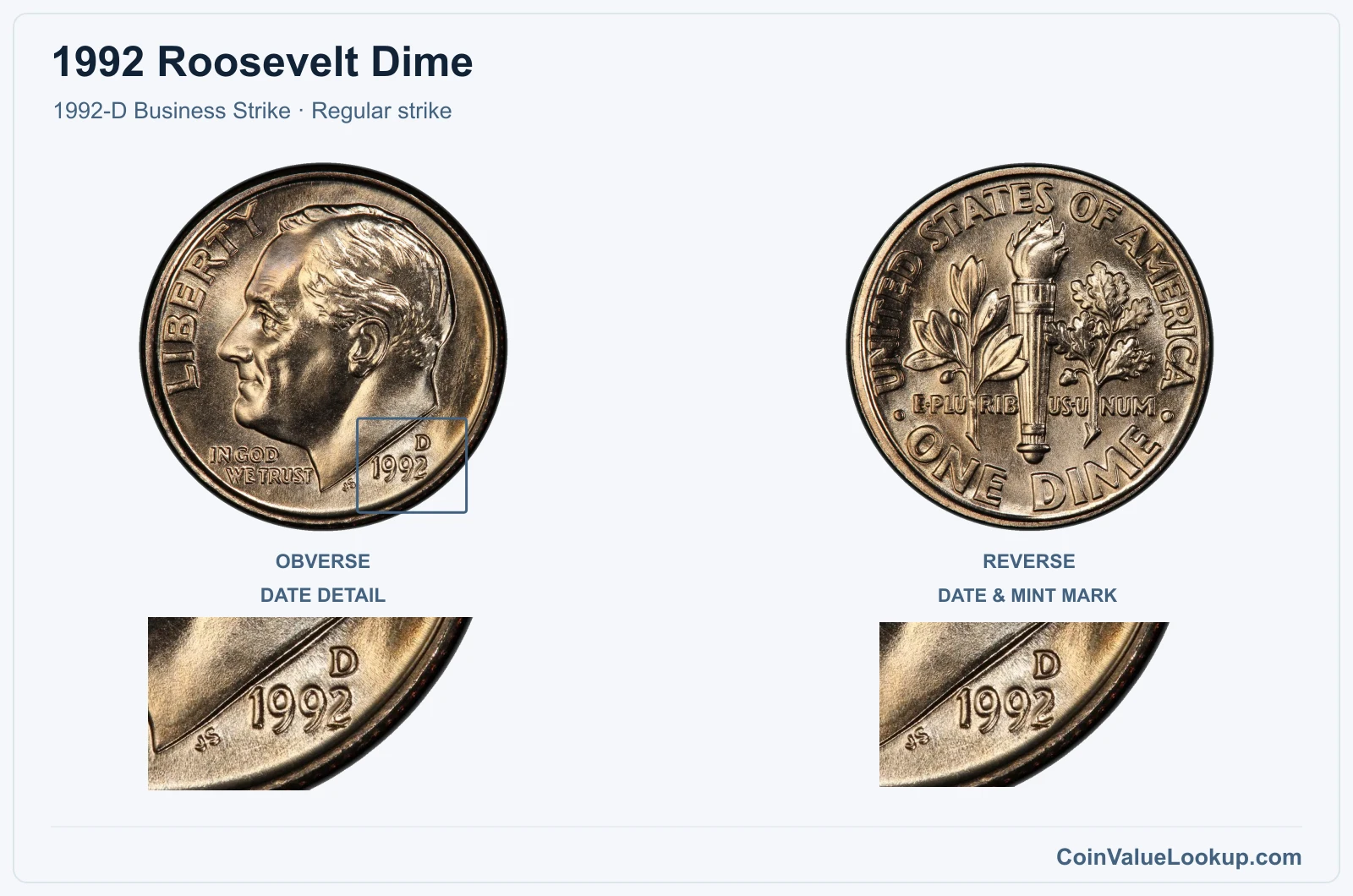
Denver's 1992-D dime is the same copper-nickel clad composition as the Philadelphia issue, weighing 2.27 grams with a D mintmark near the date. The USA Coin Book guide also lists MS65 at $2.79.
Circulated examples are common, so the premium starts when you find well-preserved uncirculated pieces. Full Bands detail on the torch is worth checking, because that designation changes the comparison pool.
Use the exact mint, metal, and finish when looking up values — a generic "1992 dime" search can mix up quite different coins.
Range Grade
Price Auction Records Appraisal PO PO 1
—
Coin Identifier FR FR 2
—
Coin Identifier AG AG 3
—
Coin Identifier G G 4
—
Coin Identifier
G 6
—
Coin Identifier VG VG 8
—
Coin Identifier
VG 10
—
Coin Identifier F F 12
—
Coin Identifier
F 15
—
Coin Identifier VF VF 20
—
Coin Identifier
VF 25
—
Coin Identifier
VF 30
—
Coin Identifier
VF 35
—
Coin Identifier XF XF 40
—
Coin Identifier
XF 45
—
Coin Identifier AU AU 50
—
Coin Identifier
AU 53
—
Coin Identifier
AU 55
—
Coin Identifier
AU 58
—
Coin Identifier MS MS 60
—
Coin Identifier
MS 61
—
Coin Identifier
MS 62
—
Coin Identifier
MS 63
—
Coin Identifier
MS 64
—
Coin Identifier
MS 65
—
Coin Identifier
MS 66
Coin Identifier
MS 67
Coin Identifier
MS 68
Coin Identifier
MS 69
—
—
—
MS 70
—
—
—
1992 Roosevelt Dime — S Clad Proof
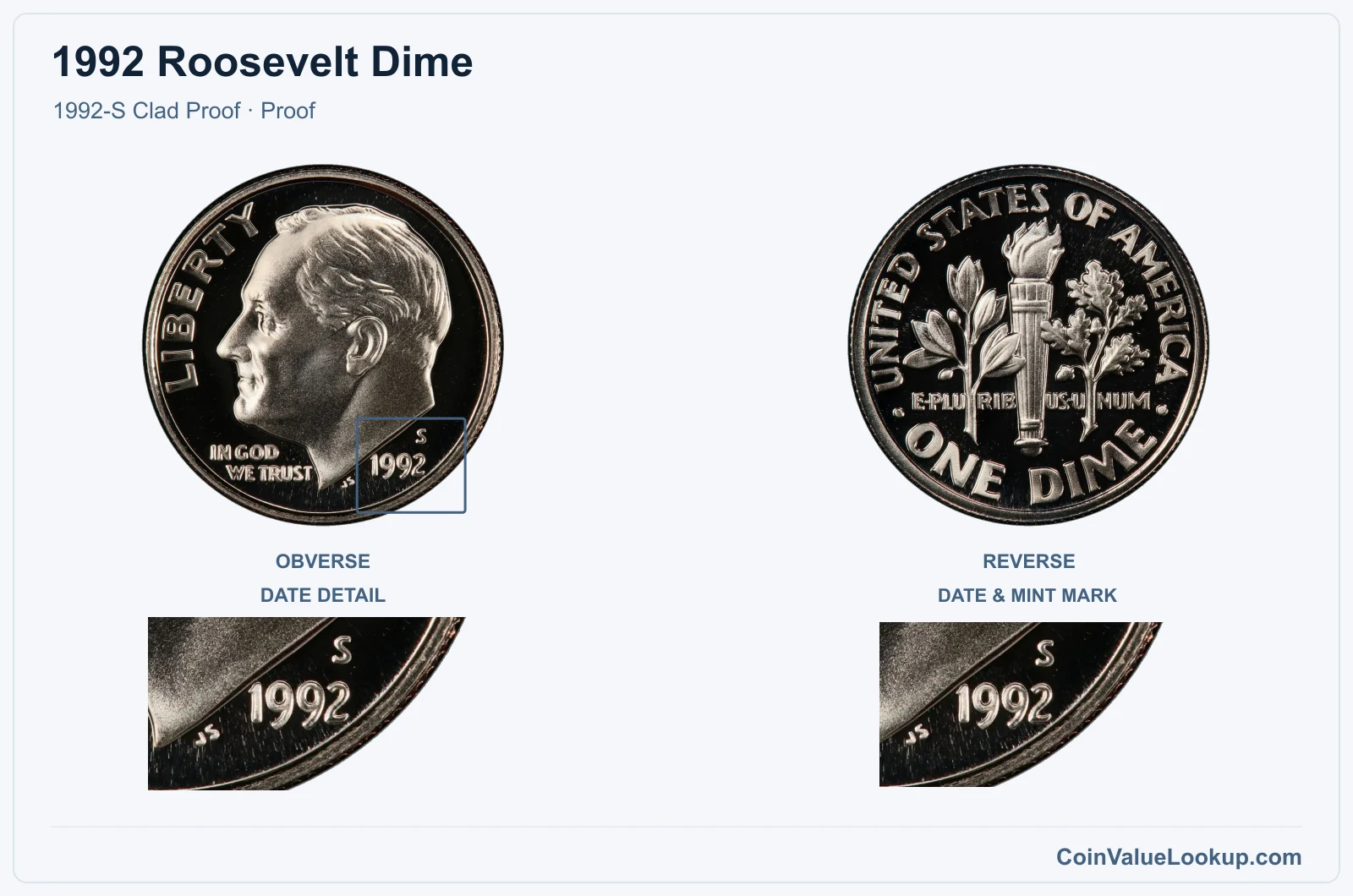
The 1992-S clad proof was struck at San Francisco with polished dies and specially prepared planchets, giving it mirror-like fields. It weighs 2.27 grams, the same as a business strike, and uses the same copper-nickel clad composition.
A USA Coin Book guide places PR65 at $3.62.
The critical step is confirming this is clad and not silver. Check the edge for a copper-colored stripe and weigh it if possible.
These came in the standard Proof Set, not the Silver Proof Set. Cameo and deep cameo contrast are desirable qualities that can affect value beyond the base proof grade.
Range Grade
Price Auction Records Appraisal PR PR 1
—
Coin Identifier
PR 2
—
Coin Identifier
PR 3
—
Coin Identifier
PR 4
—
Coin Identifier
PR 6
—
Coin Identifier
PR 8
—
Coin Identifier
PR 10
—
Coin Identifier
PR 12
—
Coin Identifier
PR 15
—
Coin Identifier
PR 20
—
Coin Identifier
PR 25
—
Coin Identifier
PR 30
—
Coin Identifier
PR 35
—
Coin Identifier
PR 40
—
Coin Identifier
PR 45
—
Coin Identifier
PR 50
—
Coin Identifier
PR 53
—
Coin Identifier
PR 55
—
Coin Identifier
PR 58
—
Coin Identifier
PR 60
—
Coin Identifier
PR 61
—
Coin Identifier
PR 62
—
Coin Identifier
PR 63
—
Coin Identifier
PR 64
—
Coin Identifier
PR 65
—
Coin Identifier
PR 66
—
Coin Identifier
PR 67
—
Coin Identifier
PR 68
—
Coin Identifier
PR 69
Coin Identifier
PR 70
Coin Identifier
1992 Roosevelt Dime — S Silver Proof
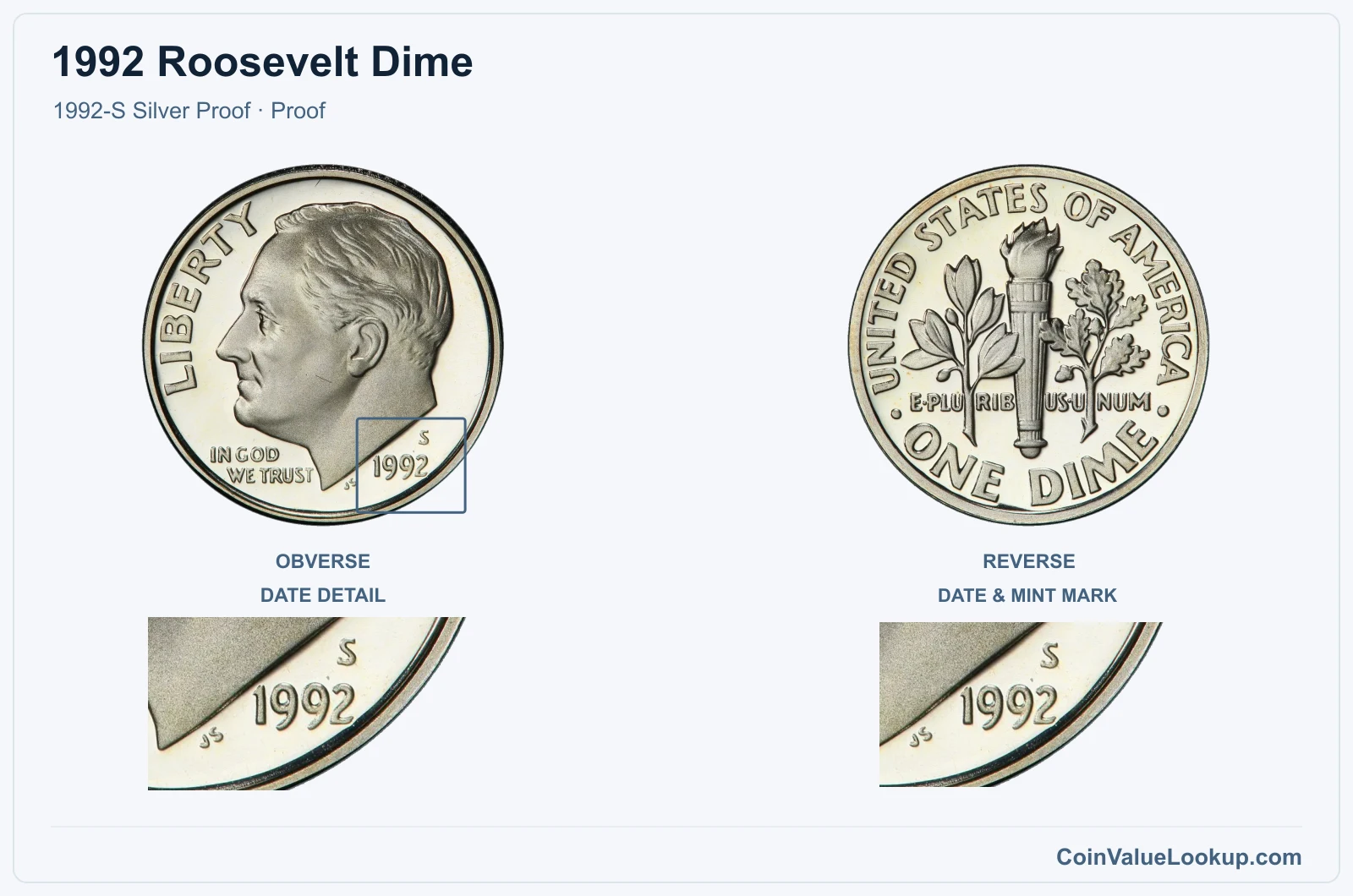
1992 was the year the U.S. Mint reintroduced silver proof sets, making this dime a modern collectible milestone. The 1992-S silver proof is 90% silver and 10% copper, weighing 2.50 grams — slightly heavier than the 2.27-gram clad version.
A USA Coin Book guide lists PR65 at $10.69, roughly triple the clad proof.
Because silver content fluctuates with the metal market, the coin's melt value moves independently of its numismatic premium. Both the clad and silver proof share an S mintmark and the same design, so edge inspection and weight are your primary screening tools.
Original Silver Proof Set packaging is the easiest confirmation method.
Range Grade
Price Auction Records Appraisal PR PR 1
—
Coin Identifier
PR 2
—
Coin Identifier
PR 3
—
Coin Identifier
PR 4
—
Coin Identifier
PR 6
—
Coin Identifier
PR 8
—
Coin Identifier
PR 10
—
Coin Identifier
PR 12
—
Coin Identifier
PR 15
—
Coin Identifier
PR 20
—
Coin Identifier
PR 25
—
Coin Identifier
PR 30
—
Coin Identifier
PR 35
—
Coin Identifier
PR 40
—
Coin Identifier
PR 45
—
Coin Identifier
PR 50
—
Coin Identifier
PR 53
—
Coin Identifier
PR 55
—
Coin Identifier
PR 58
—
Coin Identifier
PR 60
—
Coin Identifier
PR 61
—
Coin Identifier
PR 62
—
Coin Identifier
PR 63
—
Coin Identifier
PR 64
—
Coin Identifier
PR 65
—
Coin Identifier
PR 66
—
Coin Identifier
PR 67
—
Coin Identifier
PR 68
—
Coin Identifier
PR 69
Coin Identifier
PR 70
Coin Identifier
1992 Roosevelt Dime Error List
1. 1992 Roosevelt Dime — Triple Strike
A triple-struck 1992-D dime shows three distinguishable impressions of the design, created when the coin failed to eject properly and was struck again by the dies. You should be able to see overlapping dates and a clear D mintmark across the multiple impressions.
One documented specimen, graded NGC MS66, sold for $129 at Heritage Auctions in June 2023. That gives you a concrete data point, though individual results depend on the severity and visual appeal of the error plus the coin's overall condition.
Do not confuse this with doubled die lettering or mechanical doubling. Doubled dies show consistent doubling from a hubbing issue, and mechanical doubling produces flat, shelf-like doubling.
A true triple strike has three distinct, shifted full-design impressions — a much more dramatic effect that is hard to miss once you know what to look for.
2. 1992 Roosevelt Dime — Off-Center Strike
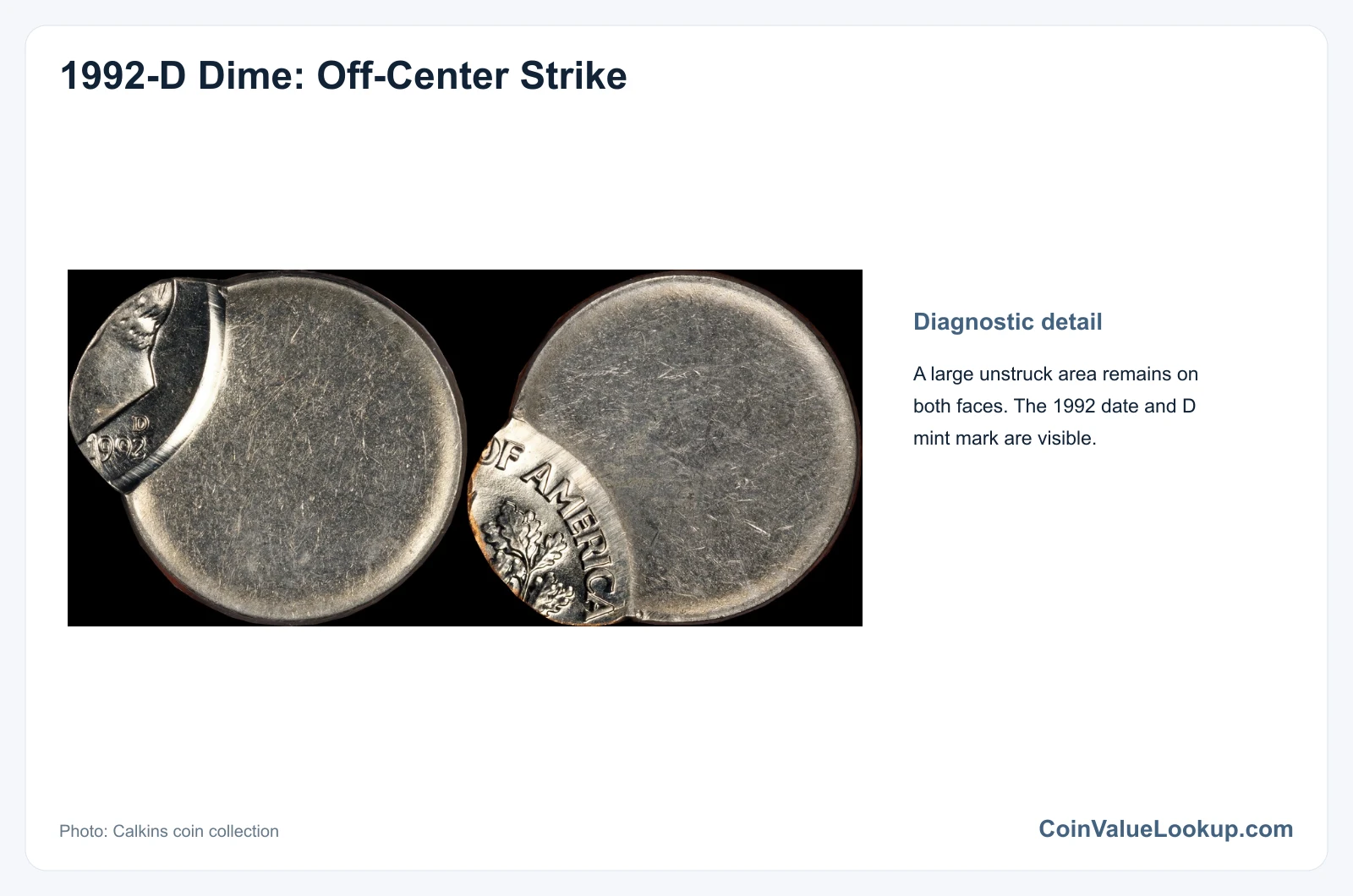
An off-center 1992-P dime has part of the design missing because the planchet was not properly seated between the dies during striking. The documented example shows roughly 35% displacement toward the 1 o'clock position, leaving a blank crescent on one side while still preserving the date — which is critical for identification and collector interest.
No supported price range exists for this error. One Heritage Auctions lot included a 1992-P off-center dime alongside other dates for a total of $75, but that lot price cannot be treated as an individual coin value.
Each off-center piece is assessed on its own based on displacement percentage, date visibility, and condition.
Do not confuse an off-center strike with a clipped planchet or one-sided misalignment. An off-center coin has a blank crescent of unstruck metal, while a clip removes part of the planchet itself before striking.
3. 1992 Roosevelt Dime — Struck Through Late-State Capped Die
When a struck coin sticks to the upper die and is not ejected, it becomes a cap that progressively distorts with each subsequent strike. A 1992-D Roosevelt dime struck through a late-stage capped die shows a stretched, distorted design impression with weakened detail.
Confirm the date and D mintmark are present.
This error type produces a distinctive appearance: the obverse or reverse takes on a washed-out, spread-out look that differs from other weak-detail issues. A grease-filled die leaves mushy details in specific areas but the coin's overall shape and size remain normal.
Corrosion or polishing can mimic lost detail but will show surface damage rather than the characteristic die-cap distortion.
No supported price range is available. Value depends on the stage of the cap, overall preservation, and authenticated identity.
Professional attribution is strongly recommended for this type of error.
4. 1992 Roosevelt Dime — Die Crack / Die Chip
Die cracks and die chips appear as raised lines or small raised blobs on the coin's surface, caused by damage to the steel die itself. On a 1992 dime, look for thin raised lines that may connect across the design or small lumps near letters and the rim.
A crack that reaches the rim and displaces a chunk of metal is called a cud, which is a different beast from an interior chip.
The key word is raised. Scratches and incuse marks sit below the surface and were inflicted on the coin after it left the press.
Corrosion or foreign material stuck to the surface can also mimic a die chip but will not have the same sharp, metallic raised profile.
No specific price range is available for 1992 dime die cracks. Value depends on the visibility, location, and size of the crack, along with the coin's overall condition.
5. 1992 Roosevelt Dime — Clipped Planchet
A clipped planchet error occurs when the blank metal disc is punched incorrectly from the strip, leaving a missing curved, straight, or ragged section. On a 1992 dime, you will see a portion of the rim and design simply absent, with the metal showing natural flow rather than a sharp cut.
One helpful diagnostic: look for weakness in the design directly opposite the clip. The metal does not fill the die cavity fully on the far side, creating a subtle flat area.
This weakness pattern is hard to fake.
Do not confuse a genuine clip with a coin that has been filed, cut, or corroded along the edge. Post-mint damage tends to leave sharp or irregular tool marks and does not produce the opposite-side weakness.
No specific price data is available for 1992 clipped dimes — value varies with the clip's size, type, and the coin's overall condition.
6. 1992 Roosevelt Dime — Missing Clad Layer
A missing clad layer error means one of the outer copper-nickel layers was absent from the planchet before striking. On a 1992 dime, the affected side may appear an unusual copper color because the core is exposed.
The coin should also weigh noticeably less than the standard 2.27 grams.
Check the edge carefully. A normal clad dime shows a visible sandwich of layers; a coin missing one clad layer will look different along that edge.
Compare both sides — sometimes only one face is affected.
Toning, environmental damage, and deliberate plating or acid treatment can all make a coin look like it has a different surface metal. The difference is that a genuine missing-clad error will show proper strike detail and a consistent weight reduction, while post-mint alterations tend to leave uneven surfaces or chemical residue.
No specific price is available; value depends on the error's visibility, condition, and authentication.