2001 Roosevelt Dime Coin Value: How Much Is It Worth?
Most 2001 Roosevelt dimes pulled from pocket change are worth face value — ten cents. A USA Coin Book guide estimate places an MS65 business strike at about $2.50, an S clad proof at $3.08 in PR65, and an S silver proof at $9.65 in PR65.
Those are starting reference points, not guaranteed sale prices. Finish, condition, and authenticated errors can push certain examples well beyond ordinary levels.
Fast Way to Identify Your 2001 Roosevelt Dime
The quickest way to start figuring out what you have is to upload clear photos of both sides of your coin. Front and back images let us provide a preliminary identification of your mint, finish, and version so you can compare it against the right value information.
Snap the photos in good light, keep the coin in focus, and include the edge if possible.
2001 Roosevelt Dime Value
Upload both sides of your 2001 Roosevelt Dime.
Front Obverse
Upload photo
Back Reverse
Upload photo
Which 2001 Roosevelt Dime Versions Are Worth Money?
- Uncirculated P or D business strikes with sharp, fully separated torch bands — the Full Bands designation adds collector interest beyond a standard MS65.
- S silver proof confirmed by weight (2.50 g) and edge appearance — the PR65 guide estimate of $9.65 is higher than the clad proof starting point.
- Double Strike with Off-Center Second Strike on a 2001-P — one authenticated example sold for $114 at auction in October 2021.
- Double Clipped Planchet on a 2001-P — value depends on authenticated identity, condition, and severity of the clips; individual assessment is needed.
Step 1: Identify Your 2001 Roosevelt Dime Mint Mark and Version
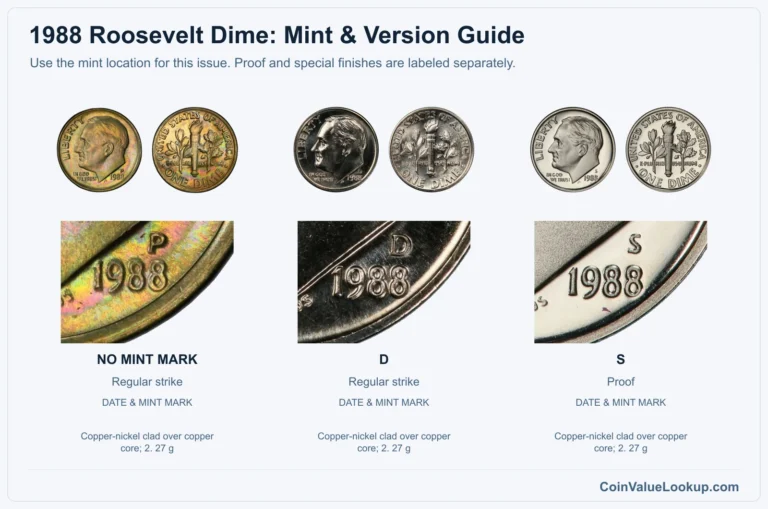
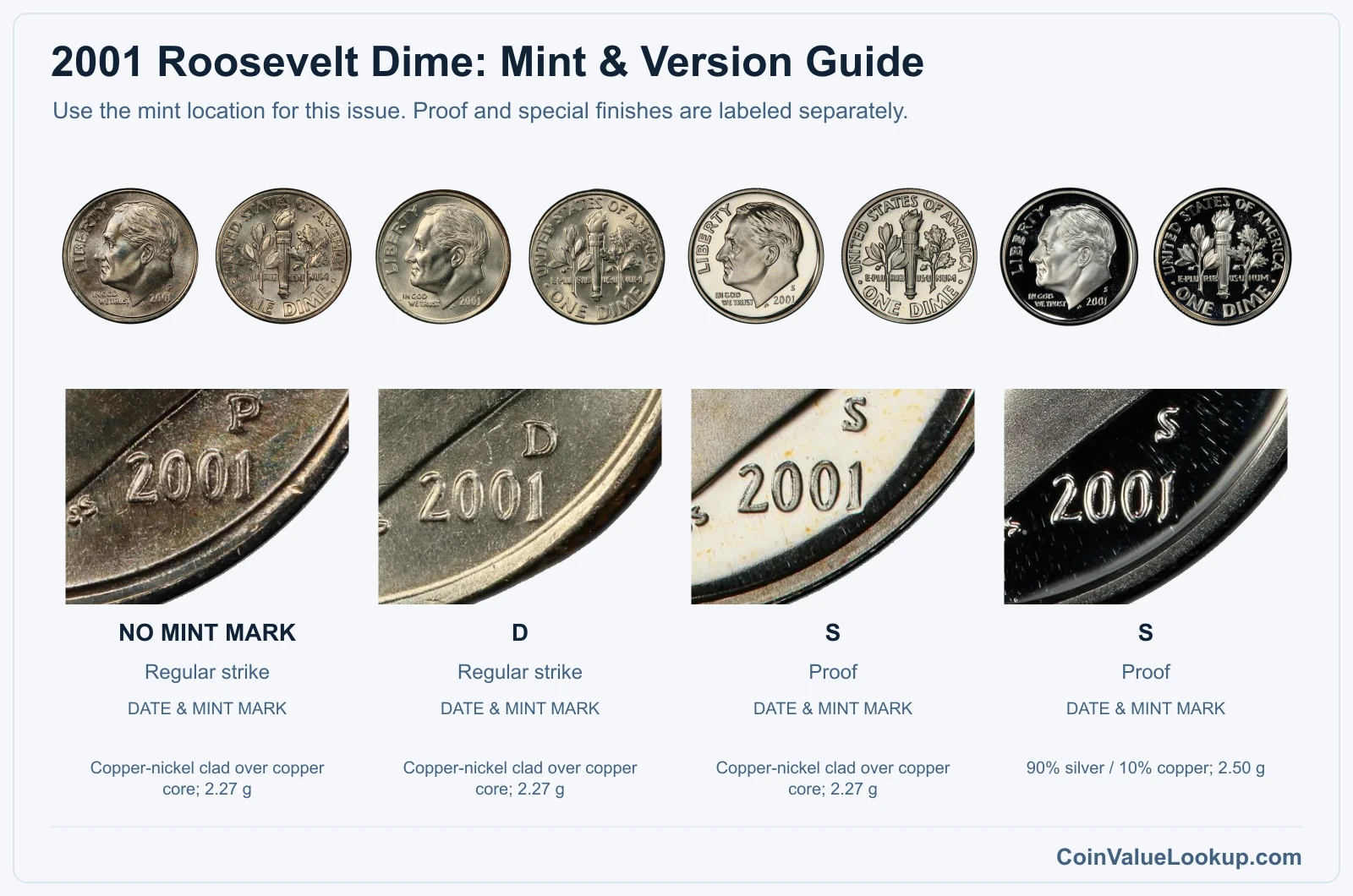
First, confirm the date reads 2001 and the design shows Roosevelt's portrait on the obverse with a torch flanked by branches on the reverse. Look just above the date on the obverse for the mintmark: P for Philadelphia, D for Denver, or S for San Francisco.
P and D coins are circulation strikes made from copper-nickel clad. They weigh about 2.27 grams and have a diameter near 17.9 mm.
The S mintmark appears on both the clad proof and the silver proof, so the mintmark alone does not tell you which one you have.
To separate the two S-mint versions, check the edge. A clad coin shows a visible copper-toned stripe along the edge, while a silver proof does not.
Weight helps too: the silver proof comes in at about 2.50 grams versus 2.27 grams for the clad version. Original government packaging is another strong clue — silver proofs shipped in a distinct set.
Color alone is unreliable for identifying the alloy.
Step 2: Check Your 2001 Roosevelt Dime Grade
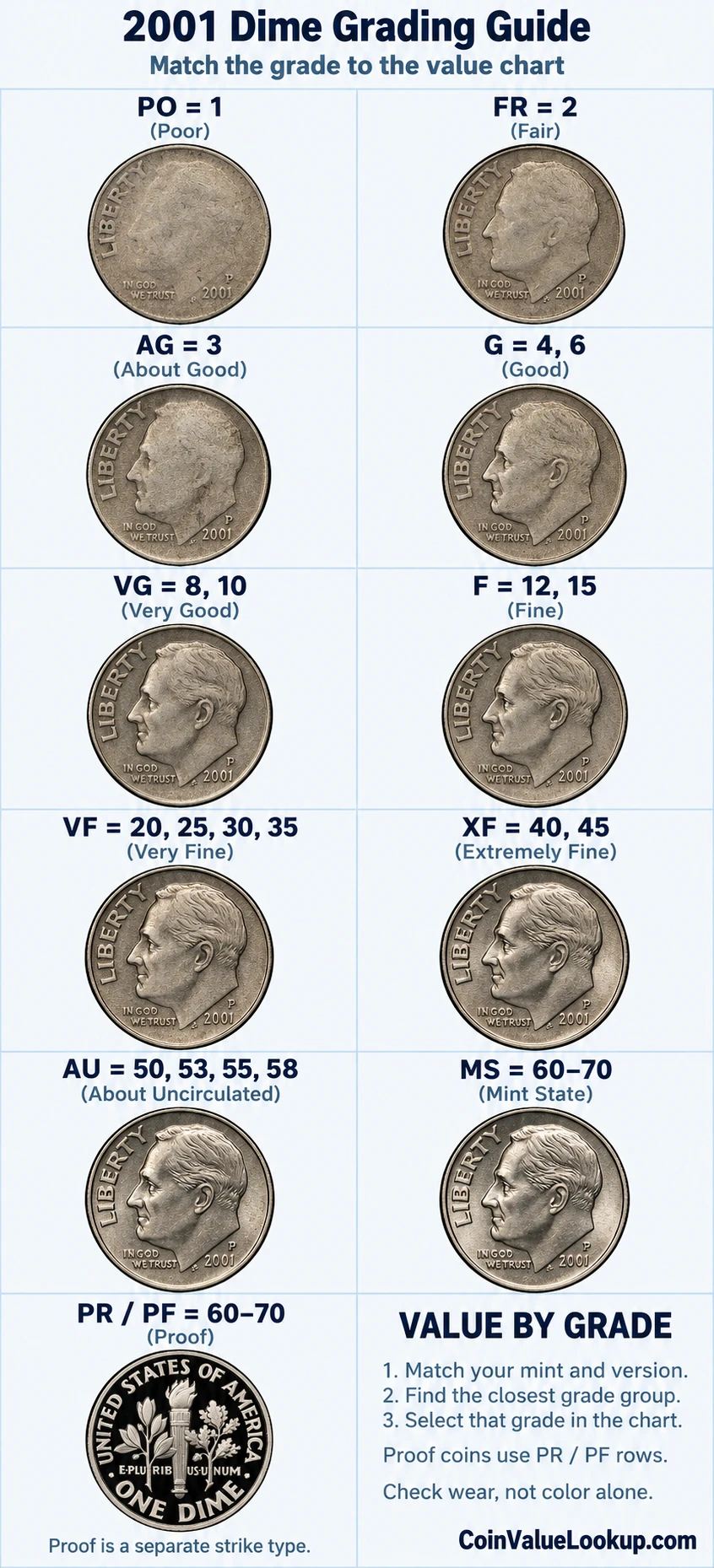
Start by examining the high points where wear shows first: Roosevelt's cheekbone, jawline, and the hair above the ear on the obverse, plus the torch and leaf details on the reverse. On a well-preserved coin, original mint luster covers the entire surface evenly.
As the grade drops, luster fades from those raised areas and flat spots develop.
Don't confuse a weak strike with actual wear. Full Bands is a strike designation referring to complete separation of both horizontal torch-band pairs — it reflects how well the dies impressed the design, not how much the coin circulated.
A softly struck coin can still be uncirculated.
Proof coins have their own grading scale starting at PR60. Haze, hairlines from mishandling, and contact marks all lower a proof's grade.
Compare your coin against the reference image to see where it falls. Cleaned or damaged coins receive qualified grades regardless of remaining detail.
Step 3: Check 2001 Roosevelt Dime Value by Mint and Version
2001 Roosevelt Dime — P Business Strike
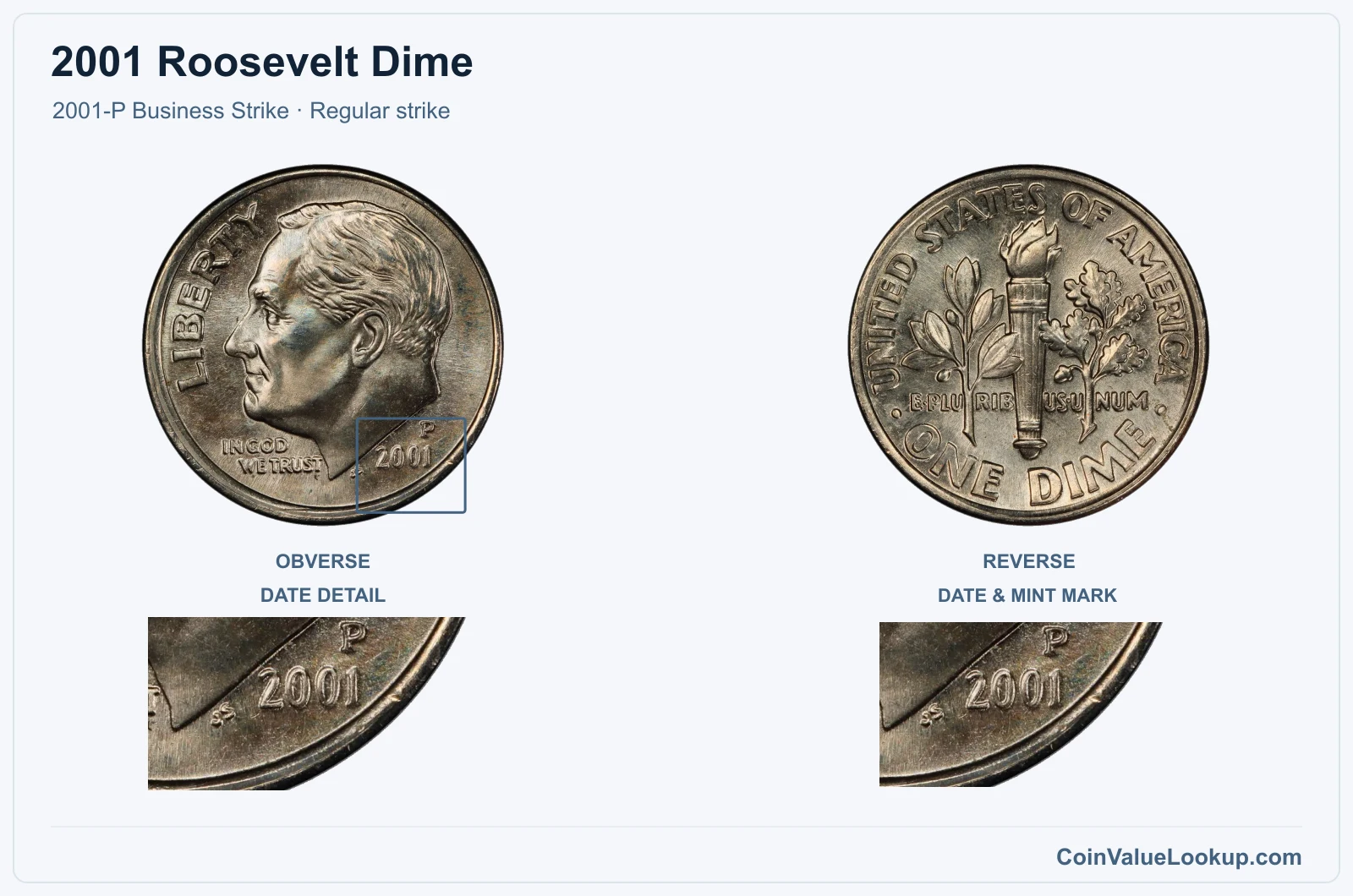
The 2001-P business strike was produced at Philadelphia and carries a small P mintmark on the obverse. It is copper-nickel clad, weighing about 2.27 grams.
In circulated condition these are face-value coins. A USA Coin Book guide estimate places the MS65 grade at roughly $2.50.
Sharp examples showing full separation of both horizontal torch-band pairs earn a Full Bands designation, which is a strike quality label, not a different alloy or variety. If you find one in original uncirculated condition, compare it in the dedicated price widget for this version.
Range Grade
Price Auction Records Appraisal PO PO 1
—
Coin Identifier FR FR 2
—
Coin Identifier AG AG 3
—
Coin Identifier G G 4
—
Coin Identifier
G 6
—
Coin Identifier VG VG 8
—
Coin Identifier
VG 10
—
Coin Identifier F F 12
—
Coin Identifier
F 15
—
Coin Identifier VF VF 20
—
Coin Identifier
VF 25
—
Coin Identifier
VF 30
—
Coin Identifier
VF 35
—
Coin Identifier XF XF 40
—
Coin Identifier
XF 45
—
Coin Identifier AU AU 50
—
Coin Identifier
AU 53
—
Coin Identifier
AU 55
—
Coin Identifier
AU 58
—
Coin Identifier MS MS 60
—
Coin Identifier
MS 61
—
Coin Identifier
MS 62
—
Coin Identifier
MS 63
—
Coin Identifier
MS 64
Coin Identifier
MS 65
Coin Identifier
MS 66
Coin Identifier
MS 67
—
Coin Identifier
MS 68
Coin Identifier
MS 69
—
—
—
MS 70
—
—
—
2001 Roosevelt Dime — D Business Strike
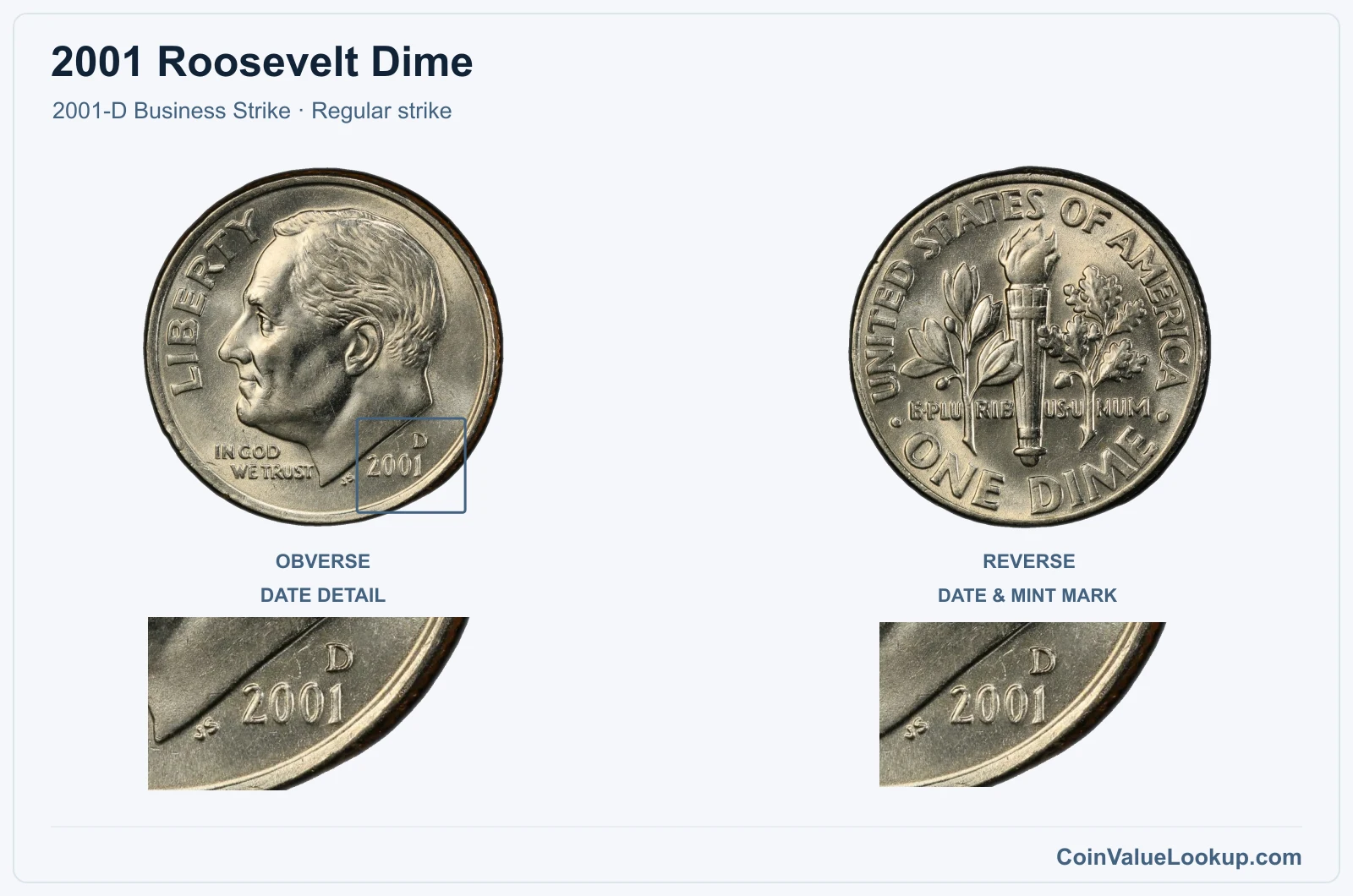
Denver's 2001-D dime is the same copper-nickel clad composition and 2.27-gram weight as its Philadelphia counterpart, distinguished only by the D mintmark. Circulated pieces trade at ten cents.
The USA Coin Book guide estimate for MS65 is $2.50, identical to the P issue.
Look for complete torch-band separation if you have an uncirculated example — the Full Bands strike designation can make a difference to collectors who specialize in Roosevelt dimes. Check this version's own comparison data for the most relevant pricing.
Range Grade
Price Auction Records Appraisal PO PO 1
—
Coin Identifier FR FR 2
—
Coin Identifier AG AG 3
—
Coin Identifier G G 4
—
Coin Identifier
G 6
—
Coin Identifier VG VG 8
—
Coin Identifier
VG 10
—
Coin Identifier F F 12
—
Coin Identifier
F 15
—
Coin Identifier VF VF 20
—
Coin Identifier
VF 25
—
Coin Identifier
VF 30
—
Coin Identifier
VF 35
—
Coin Identifier XF XF 40
—
Coin Identifier
XF 45
—
Coin Identifier AU AU 50
—
Coin Identifier
AU 53
—
Coin Identifier
AU 55
—
Coin Identifier
AU 58
—
Coin Identifier MS MS 60
—
Coin Identifier
MS 61
—
Coin Identifier
MS 62
—
Coin Identifier
MS 63
—
Coin Identifier
MS 64
—
Coin Identifier
MS 65
—
Coin Identifier
MS 66
Coin Identifier
MS 67
Coin Identifier
MS 68
Coin Identifier
MS 69
—
Coin Identifier
MS 70
—
—
—
2001 Roosevelt Dime — S Clad Proof
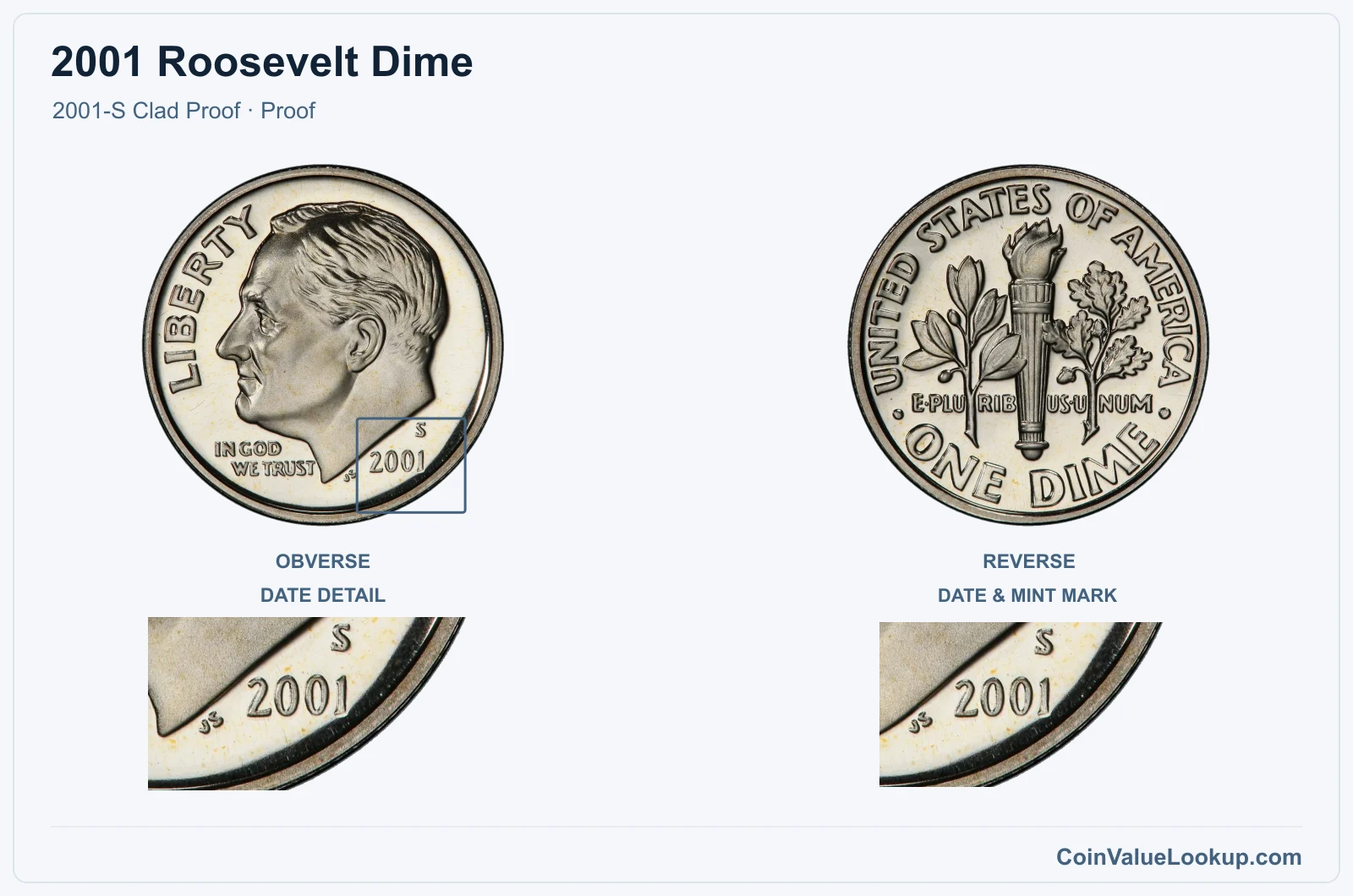
The 2001-S clad proof was struck at San Francisco on the same copper-nickel clad blank used for business strikes, so it also weighs about 2.27 grams. Its mirror fields and frosted devices distinguish it from circulation coins.
The USA Coin Book guide estimate is $3.08 at PR65.
Because this coin shares its S mintmark with the silver proof, confirm the clad identity by checking the edge for a copper-toned stripe and weighing the coin. Coin Value Lookup is a useful starting place when you need to look up guides for specific coin types and years.
Original proof-set packaging, if you still have it, removes most of the guesswork.
Range Grade
Price Auction Records Appraisal PR PR 1
—
Coin Identifier
PR 2
—
Coin Identifier
PR 3
—
Coin Identifier
PR 4
—
Coin Identifier
PR 6
—
Coin Identifier
PR 8
—
Coin Identifier
PR 10
—
Coin Identifier
PR 12
—
Coin Identifier
PR 15
—
Coin Identifier
PR 20
—
Coin Identifier
PR 25
—
Coin Identifier
PR 30
—
Coin Identifier
PR 35
—
Coin Identifier
PR 40
—
Coin Identifier
PR 45
—
Coin Identifier
PR 50
—
Coin Identifier
PR 53
—
Coin Identifier
PR 55
—
Coin Identifier
PR 58
—
Coin Identifier
PR 60
—
Coin Identifier
PR 61
—
Coin Identifier
PR 62
—
Coin Identifier
PR 63
—
Coin Identifier
PR 64
—
Coin Identifier
PR 65
—
Coin Identifier
PR 66
—
Coin Identifier
PR 67
—
Coin Identifier
PR 68
—
Coin Identifier
PR 69
Coin Identifier
PR 70
Coin Identifier
2001 Roosevelt Dime — S Silver Proof
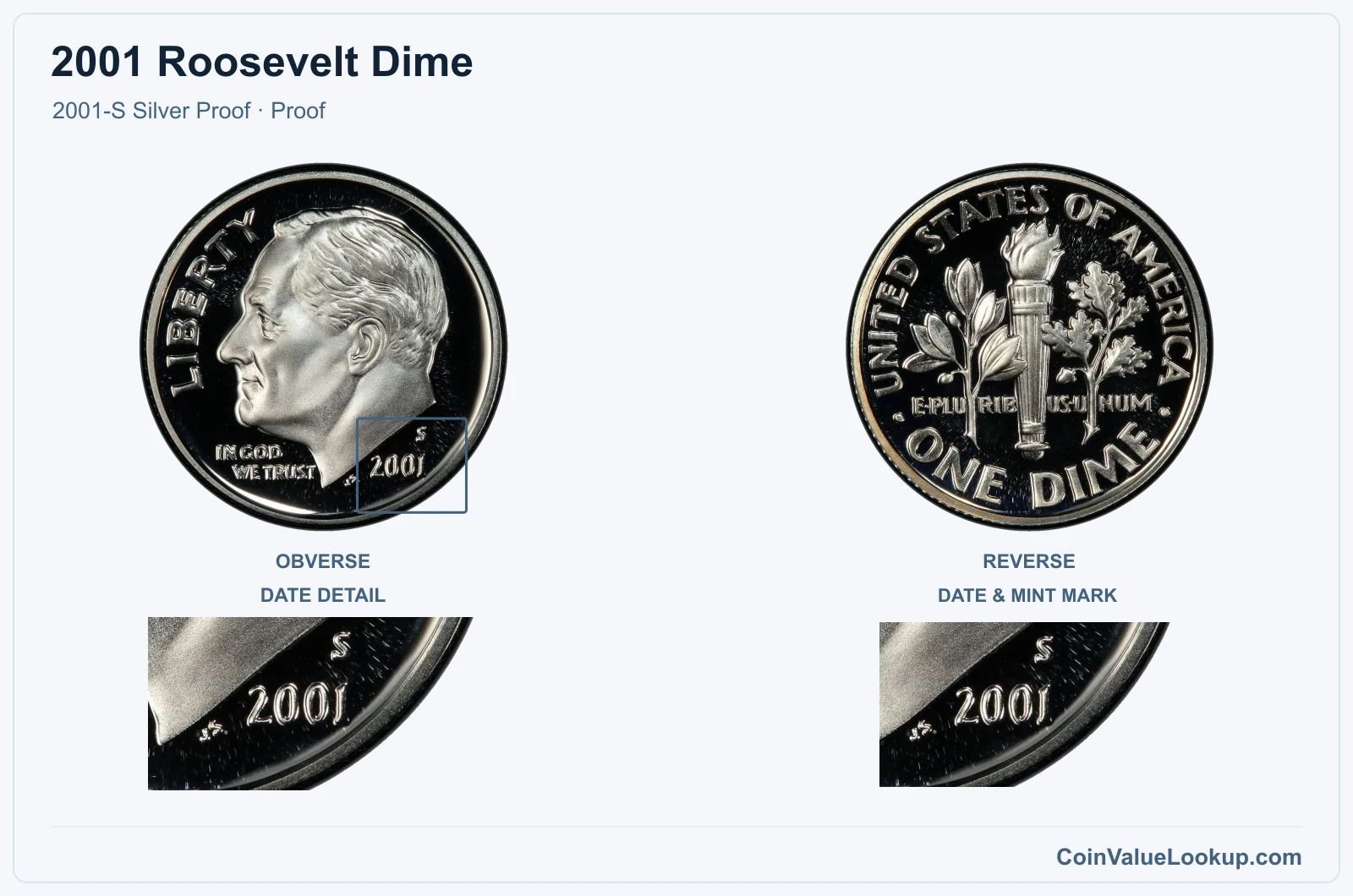
The 2001-S silver proof is struck on a 90% silver, 10% copper planchet weighing approximately 2.50 grams. The U.S. Mint reintroduced silver proof sets in 1992, and the 2001 issue is part of that continuing series.
At PR65, the USA Coin Book guide estimate is $9.65 — the highest of the four standard 2001 dime versions at that grade level.
Identification matters here. The silver proof's edge lacks the copper stripe visible on clad coins, and it weighs noticeably more.
If you have the original silver proof set holder, that settles it. Without packaging, a precision scale and an edge inspection together give you the answer.
Range Grade
Price Auction Records Appraisal PR PR 1
—
Coin Identifier
PR 2
—
Coin Identifier
PR 3
—
Coin Identifier
PR 4
—
Coin Identifier
PR 6
—
Coin Identifier
PR 8
—
Coin Identifier
PR 10
—
Coin Identifier
PR 12
—
Coin Identifier
PR 15
—
Coin Identifier
PR 20
—
Coin Identifier
PR 25
—
Coin Identifier
PR 30
—
Coin Identifier
PR 35
—
Coin Identifier
PR 40
—
Coin Identifier
PR 45
—
Coin Identifier
PR 50
—
Coin Identifier
PR 53
—
Coin Identifier
PR 55
—
Coin Identifier
PR 58
—
Coin Identifier
PR 60
—
Coin Identifier
PR 61
—
Coin Identifier
PR 62
—
Coin Identifier
PR 63
—
Coin Identifier
PR 64
—
Coin Identifier
PR 65
—
Coin Identifier
PR 66
—
Coin Identifier
PR 67
—
Coin Identifier
PR 68
—
Coin Identifier
PR 69
Coin Identifier
PR 70
Coin Identifier
2001 Roosevelt Dime Error List
1. 2001 Roosevelt Dime — Double Strike with Off-Center Second Strike
A 2001-P business strike is documented with a double strike where the second impression landed roughly 75% off center. The coin retains the date and P mintmark from the first, normal strike, while a second, displaced design overlaps dramatically.
One example graded PCGS MS64 sold through Heritage Auctions in October 2021 for $114.
That price reflects one authenticated specimen at one grade and one moment in time — your coin could differ. The key diagnostic is seeing two clearly separate design impressions on the same planchet.
Do not confuse this with minor doubled lettering or design elements caused by die doubling or strike vibration, which look like slight shadowing rather than a second complete image.
2. 2001 Roosevelt Dime — Double Clipped Planchet
A double clipped planchet error is documented on a 2001-P business strike. The cited coin weighs 2.09 grams — lighter than the standard 2.27 grams — and shows two areas of incomplete blank edge where the punch overlapped previously cut areas of the metal strip.
It received an ANACS MS60 Details grade.
No supported price range is available for this error. Value depends on the severity and visual impact of the clips, overall condition, and authenticated identity.
When examining a suspect coin, look for two distinct curved indentations along the rim with characteristic Blakesley effects (flat areas opposite each clip). Low weight alone does not prove a clipped planchet — post-mint cutting or filing can mimic the appearance.
3. 2001 Roosevelt Dime — Die Crack / Die Chip
Die cracks and die chips have been reported on 2001 dimes. A die crack appears as a fine raised line across the coin's surface, created when the die itself develops a fracture.
A die chip is a small raised blob where a piece of the die face has broken away. If the break reaches the rim, it may produce a larger raised area sometimes called a cud.
Condition, visibility, and exact location all influence what a particular die crack or chip is worth — no single price applies broadly. When checking your coin, look for raised irregularities that follow no part of the intended design.
Incuse scratches, corrosion pitting, or foreign material stuck to the surface can mimic these features but sit into the metal rather than above it.
4. 2001 Roosevelt Dime — Broadstrike
Broadstruck 2001 dimes have been reported. A broadstrike happens when a coin is struck without being fully confined by the collar die, allowing metal to spread outward beyond the normal diameter.
The design is typically complete but the rim is weak, missing, or irregular, and the coin appears wider and thinner than normal.
No adopted price range is available. Value varies with the degree of spread, overall condition, and authentication.
Distinguish a broadstrike from an off-center strike, where part of the design is missing entirely. Also rule out coins that were flattened after leaving the mint — post-mint damage lacks the uniform spread and full design retention of a true broadstrike.
Compare your coin's edge profile to a normal dime.
5. 2001 Roosevelt Dime — Lamination / Split Planchet
Split planchet and lamination errors have been reported on 2001 dimes. A lamination error shows peeling or flaking metal on one face, sometimes with a retained flap still attached.
A full split planchet separates the coin into two thinner pieces, each retaining design on one side.
No numerical price range is available for this error. Value depends on the size, severity, and visual drama of the separation, plus the coin's overall condition.
Photograph both the affected face and the edge together for proper documentation. Lookalikes include scraping, environmental corrosion, or deliberate cutting — genuine laminations result from impurities or gas pockets trapped during the planchet manufacturing process, and they follow the metal's internal layers rather than the surface.
6. 2001 Roosevelt Dime — Rotated Dies
Rotated die errors have been reported on 2001 dimes. Normal United States coins have a 180-degree coin turn — hold the obverse upright, flip the coin top to bottom, and the reverse should also appear upright.
A rotated die error shows the reverse tilted by some number of degrees from that standard alignment.
Small rotations of a few degrees are relatively common and carry minimal premium. Larger rotations attract more attention.
No adopted price range applies here. To test your coin, hold Roosevelt's portrait upright, rotate the coin on its vertical axis, and observe the torch's orientation.
A photograph rotated in editing or a coin simply turned sideways in your hand is not an error — the misalignment must be built into the strike itself.
7. 2001 Roosevelt Dime — Misaligned Die
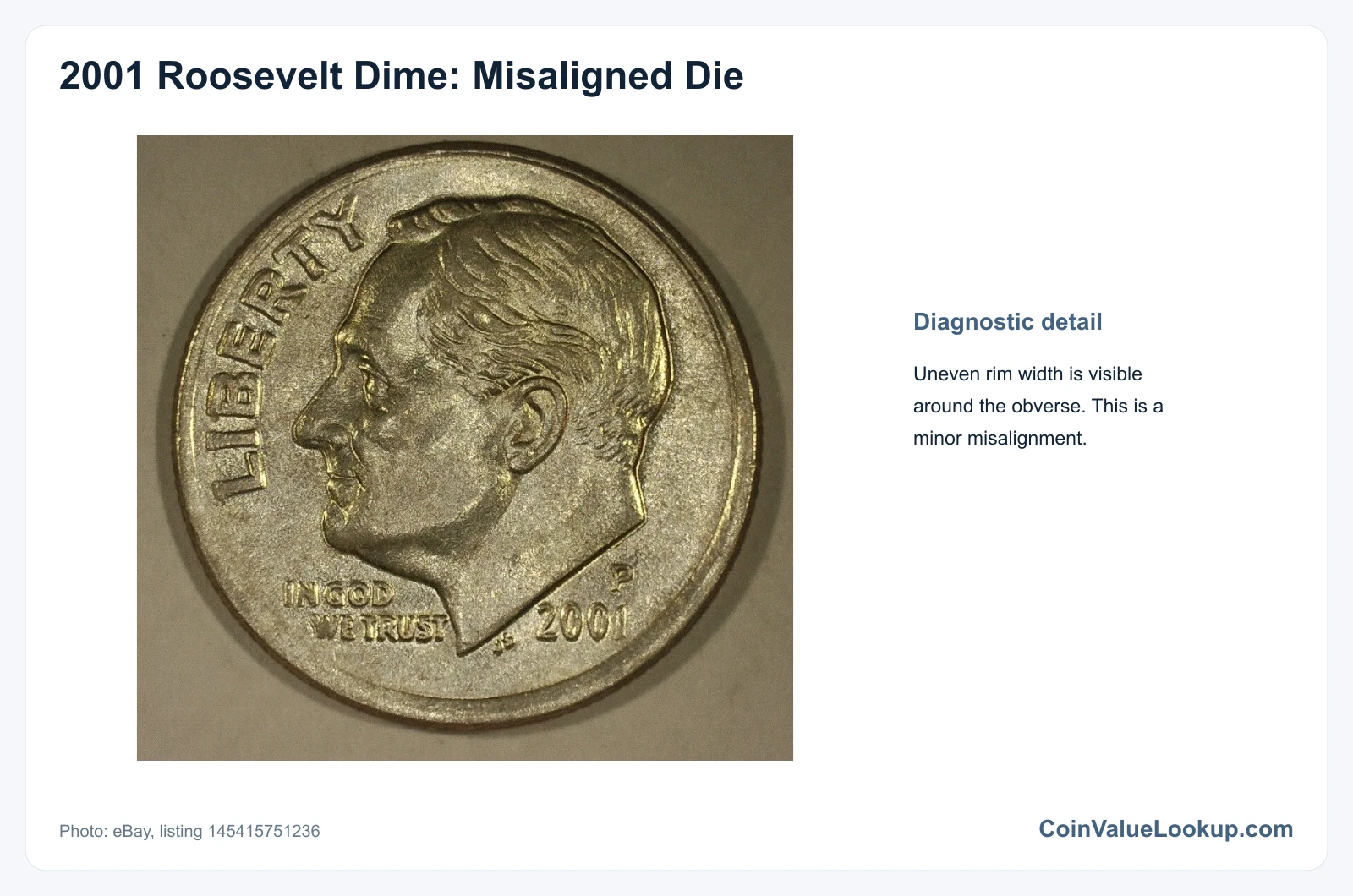
Misaligned die errors have been reported on 2001 dimes. This occurs when one die is shifted horizontally relative to the other or relative to the blank.
The result is a design that appears off-center on one face while the other face remains normally positioned, or both faces are shifted in different directions.
This is distinct from a rotated die (which involves angular rotation) and from an off-center strike (where the blank itself is mispositioned). No numerical price range is available.
The severity of the shift and the coin's condition both influence value. Rule out tilted photographs, post-mint rim damage, and simple wear patterns that might create an illusion of misalignment.
Compare both sides carefully against a normal 2001 dime.
8. 2001 Roosevelt Dime — Brockage
Brockage errors have been reported on 2001 dimes. A brockage occurs when a previously struck coin remains stuck to a die and impresses its design into the next blank in mirror image and incuse relief.
The result is one normal side and one side showing a backwards, sunken version of a design.
No adopted price range is available. Full brockages — where the entire mirror image is clear — are generally more desirable than partial ones.
To identify a genuine brockage, look for a complete incuse mirror-image design on one face that aligns with the normal design's elements in reverse. A die clash produces faint incuse outlines but retains both normal designs, and coins pressed together after minting lack the depth and uniformity of a true brockage impression.
9. 2001 Roosevelt Dime — Wrong Planchet / Off-Metal Strike
Wrong planchet errors have been reported on 2001 dimes. This happens when a blank intended for a different denomination or even a different country's coin ends up in the dime press.
The dime dies strike whatever blank is fed to them, producing a coin with Roosevelt's design on the wrong size, weight, or metal.
No adopted price range is available — value depends heavily on which wrong planchet was used and the coin's condition. To investigate, compare your coin's weight, diameter, and edge characteristics against the standard 2.27-gram, 17.9-mm clad dime specifications.
Do not assume a strange appearance means a wrong planchet; plating loss, corrosion, acid exposure, and deliberate alteration are far more common explanations for unusual-looking dimes.
10. 2001 Roosevelt Dime — Struck-Through Error
Struck-through errors have been reported on 2001 dimes. A struck-through happens when foreign material — grease, metal fragments, cloth fibers, or other debris — sits between the die and the blank during striking.
The result is a localized area of missing or incomplete design, often appearing as a smooth depression or a textured impression of whatever object was trapped.
Grease fills tend to produce smooth, flat areas where fine detail is absent. A retained foreign object leaves a more distinct impression.
No adopted price range is available; value depends on the size and visual impact of the obstruction and the coin's overall condition. Ordinary wear, cleaning, and weak strikes from tired dies can all mimic struck-through features, so look for a sharply defined boundary between the affected area and the normal design.
11. 2001 Roosevelt Dime — Partial Collar Strike
Partial collar strikes have been reported on 2001 dimes. The collar die normally confines the blank during striking, forming the coin's reeded edge and consistent diameter.
When the blank sits partially above or below the collar, one portion of the edge is properly reeded while the other portion expands outward, creating a visible step or shelf.
No adopted price range is available. The degree of the misalignment and the coin's condition determine collector interest.
To check, examine the edge all the way around — you should see a distinct transition from normal reeding to a smooth, expanded section. Compare this to a complete broadstrike, which lacks reeding entirely, and to post-mint edge damage or a flattened rim, which typically shows irregular marks rather than a clean step.