2002 Roosevelt Dime Coin Value: How Much Is It Worth?
Most 2002 Roosevelt dimes pulled from pocket change are worth face value — ten cents. According to USA Coin Book guide estimates, a Philadelphia or Denver mint-state example in MS65 condition lists around $2.50, while the S clad proof at PR65 is about $3.08 and the S silver proof at PR65 reaches roughly $9.65.
Finish, condition and authenticated errors can shift these numbers considerably, so the version you hold matters.
Fast Way to Identify Your 2002 Roosevelt Dime
The quickest way to start figuring out what you have is to upload clear photos of both the front and back of your coin. Our identifier can offer a preliminary identification of your 2002 dime's mint, finish and general version based on those images.
It is not a substitute for professional authentication or exact grading, but it gives you a useful starting point.
2002 Roosevelt Dime Value
Upload both sides of your 2002 Roosevelt Dime.
Front Obverse
Upload photo
Back Reverse
Upload photo
Which 2002 Roosevelt Dime Versions Are Worth Money?
- Mint-state 2002-P or 2002-D dimes with sharp, fully separated torch bands — the Full Bands strike designation can carry a premium over a typical MS65.
- 2002-S silver proof dime, confirmed by weight and edge — guide value at PR65 is roughly $9.65, well above face value.
- Intact 2002-S clad proof dimes in original condition — PR65 guide value is about $3.08.
- Double clipped planchet errors on authenticated 2002-P business strikes — a documented variety that requires certification to confirm.
Step 1: Identify Your 2002 Roosevelt Dime Mint Mark and Version
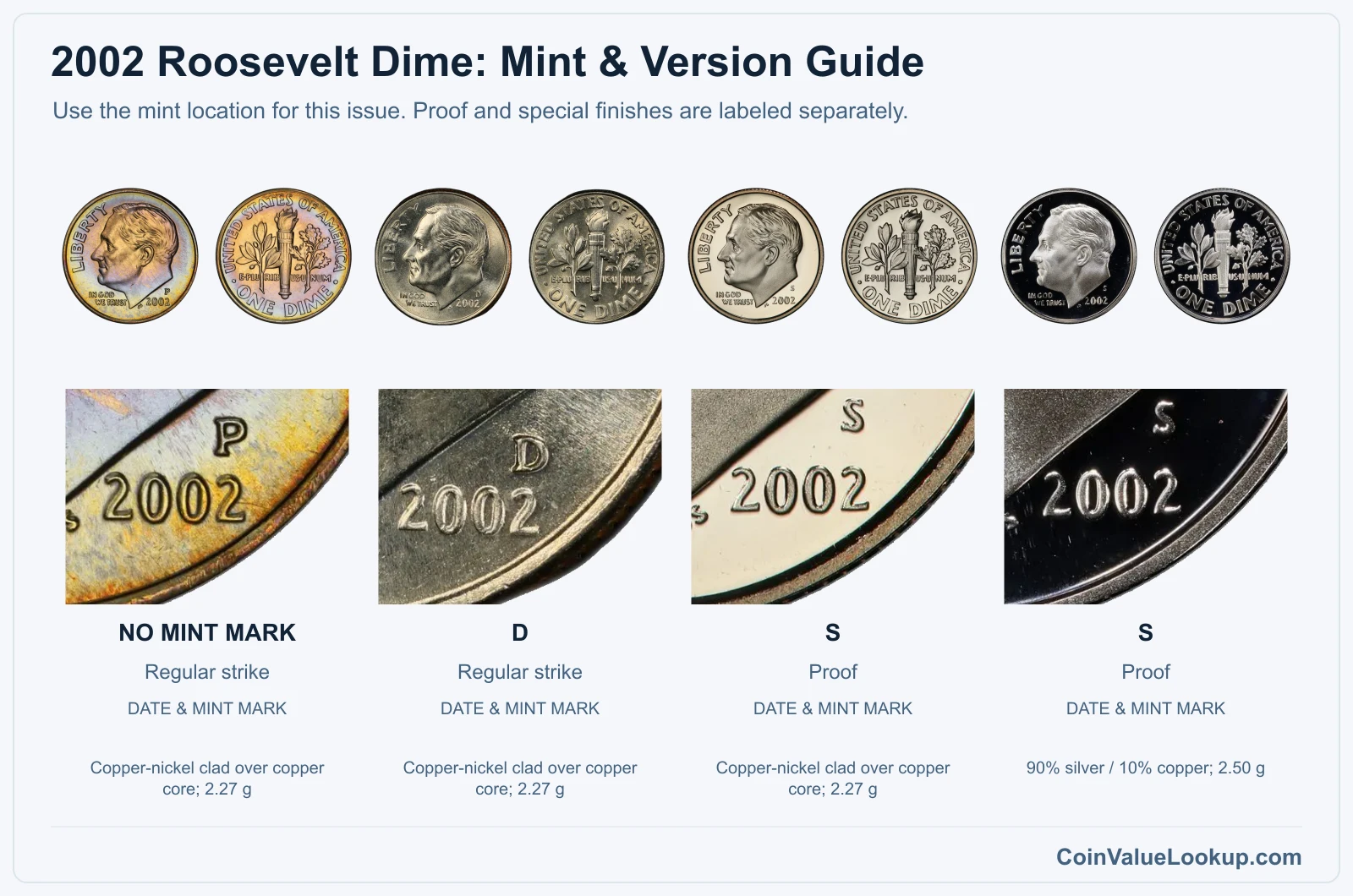
First, confirm the date reads 2002 and you are looking at Roosevelt's portrait on the obverse with a torch flanked by branches on the reverse. Check just to the right of the date for the mintmark: P means Philadelphia, D means Denver, and S means San Francisco.
P and D dimes are circulation-strike clad coins weighing about 2.27 grams with a diameter near 17.9 mm. S-mint dimes come in two flavors — clad proof and 90% silver proof — and they share the same mintmark and design, so the letter alone will not tell you which one you have.
To separate S clad from S silver, use weight, edge color and original packaging together. The silver proof weighs about 2.50 grams; the clad proof weighs 2.27 grams.
On the edge of a clad coin you can sometimes see the layered structure, while a silver proof edge looks uniform. Color alone is not reliable enough to confirm the alloy.
Step 2: Check Your 2002 Roosevelt Dime Grade
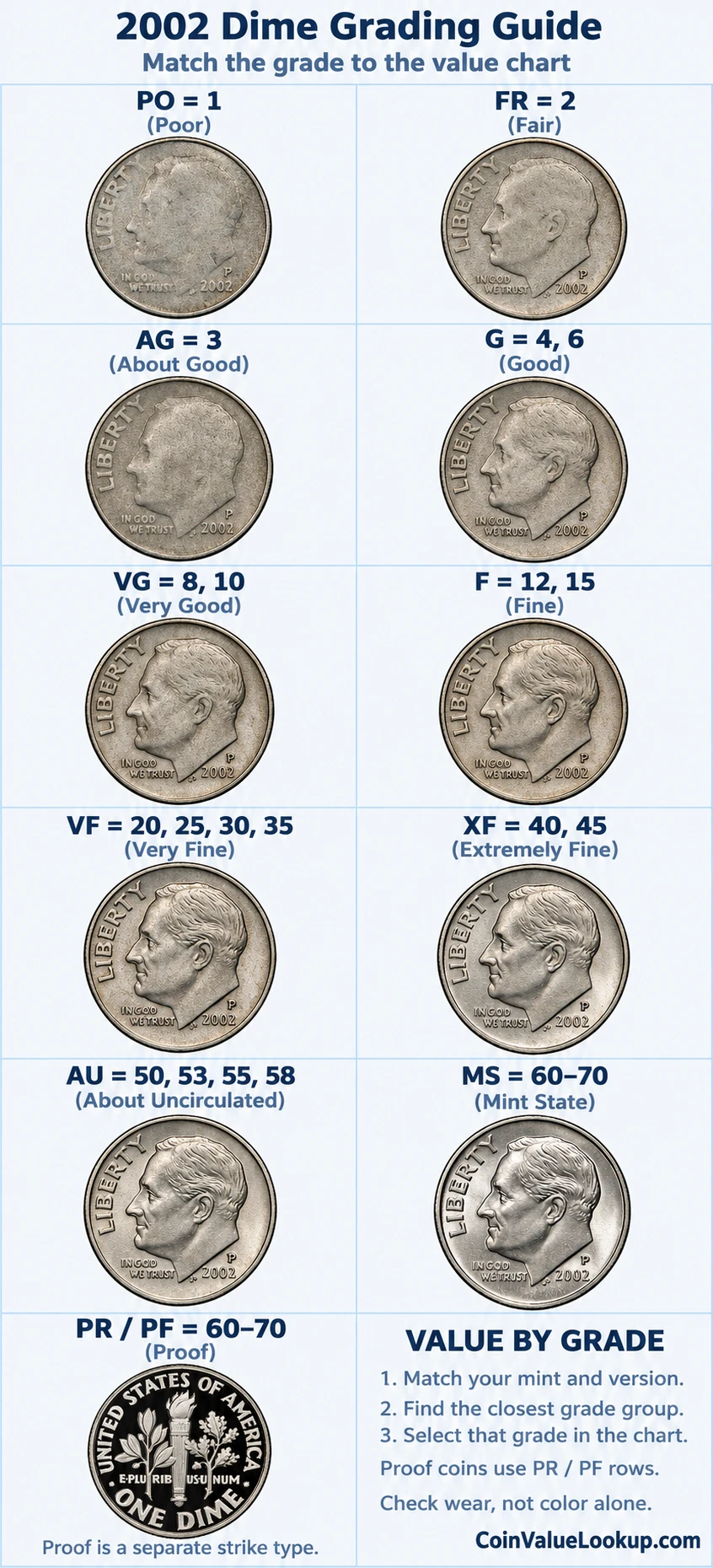
Start by examining Roosevelt's cheekbone, jawline and the hair above his ear. These are the first areas where friction shows.
On the reverse, look at the torch lines and the leaf details — they lose sharpness before the rest of the design.
Original mint luster matters more than shininess. A polished coin can look bright but still grade poorly because cleaning leaves telltale hairlines.
Compare your coin against the reference image to see how much original surface texture remains.
Do not confuse a weak strike with wear. Full Bands is a strike designation referring to the separation of both horizontal torch-band pairs; it reflects how well the die impressed the planchet, not how much the coin circulated.
Proof coins have their own grading scale and comparison standards, so do not judge a proof against a business strike or vice versa.
Step 3: Check 2002 Roosevelt Dime Value by Mint and Version
2002 Roosevelt Dime — P Business Strike
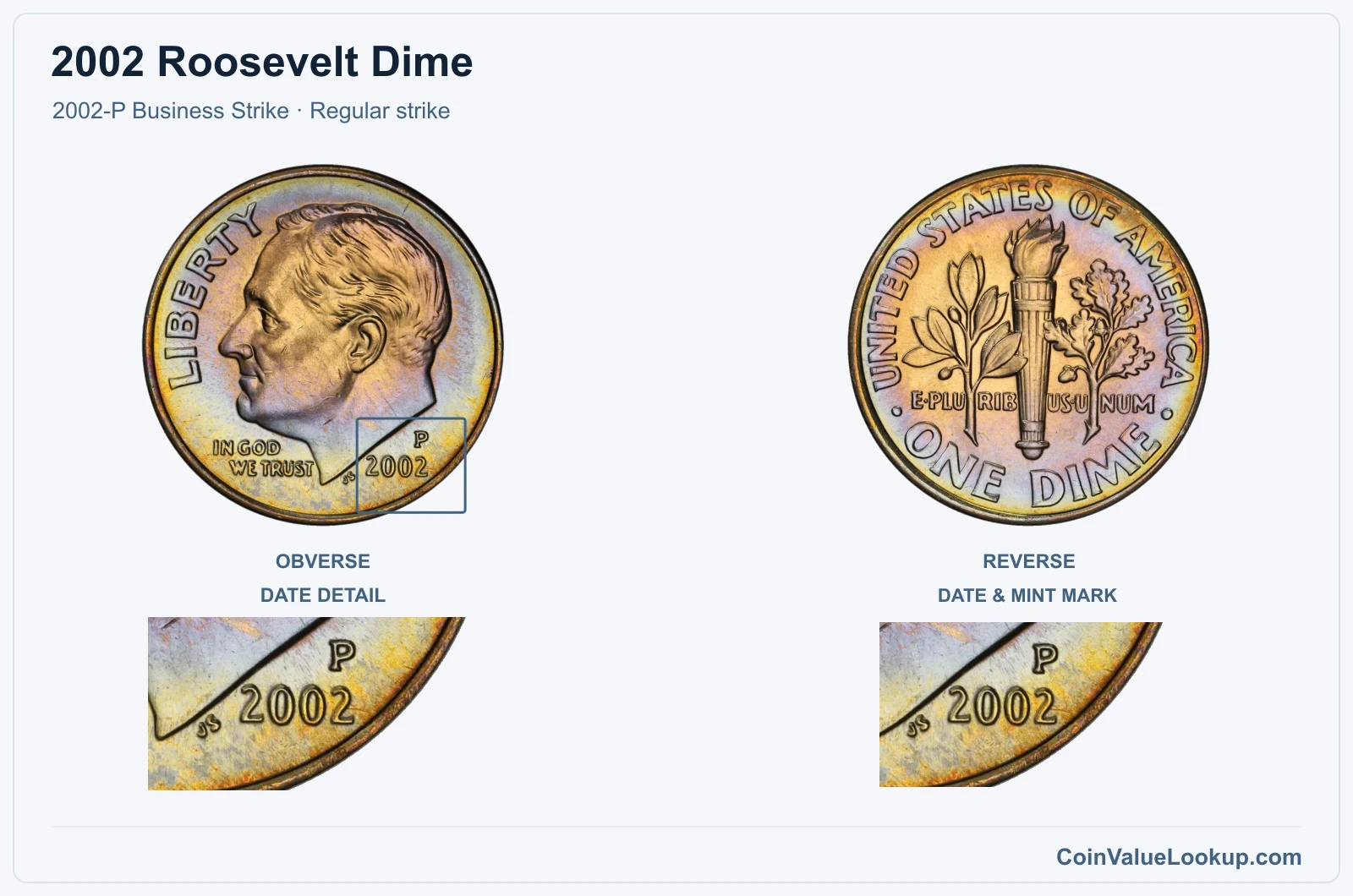
The 2002-P dime was struck at Philadelphia on a copper-nickel clad planchet weighing 2.27 grams. Look for the small P mintmark to the right of Roosevelt's neck.
In typical circulated condition these are worth face value.
The USA Coin Book guide lists the MS65 value at about $2.50. Coins with fully separated horizontal torch bands — the Full Bands designation — can command a stronger price because the detail reflects a sharp strike, something many 2002-P dimes lack.
Range Grade
Price Auction Records Appraisal PO PO 1
—
Coin Identifier FR FR 2
—
Coin Identifier AG AG 3
—
Coin Identifier G G 4
—
Coin Identifier
G 6
—
Coin Identifier VG VG 8
—
Coin Identifier
VG 10
—
Coin Identifier F F 12
—
Coin Identifier
F 15
—
Coin Identifier VF VF 20
—
Coin Identifier
VF 25
—
Coin Identifier
VF 30
—
Coin Identifier
VF 35
—
Coin Identifier XF XF 40
—
Coin Identifier
XF 45
—
Coin Identifier AU AU 50
—
Coin Identifier
AU 53
—
Coin Identifier
AU 55
—
Coin Identifier
AU 58
—
Coin Identifier MS MS 60
—
Coin Identifier
MS 61
—
Coin Identifier
MS 62
—
Coin Identifier
MS 63
—
Coin Identifier
MS 64
Coin Identifier
MS 65
—
Coin Identifier
MS 66
—
Coin Identifier
MS 67
Coin Identifier
MS 68
Coin Identifier
MS 69
Coin Identifier
MS 70
—
—
—
2002 Roosevelt Dime — D Business Strike
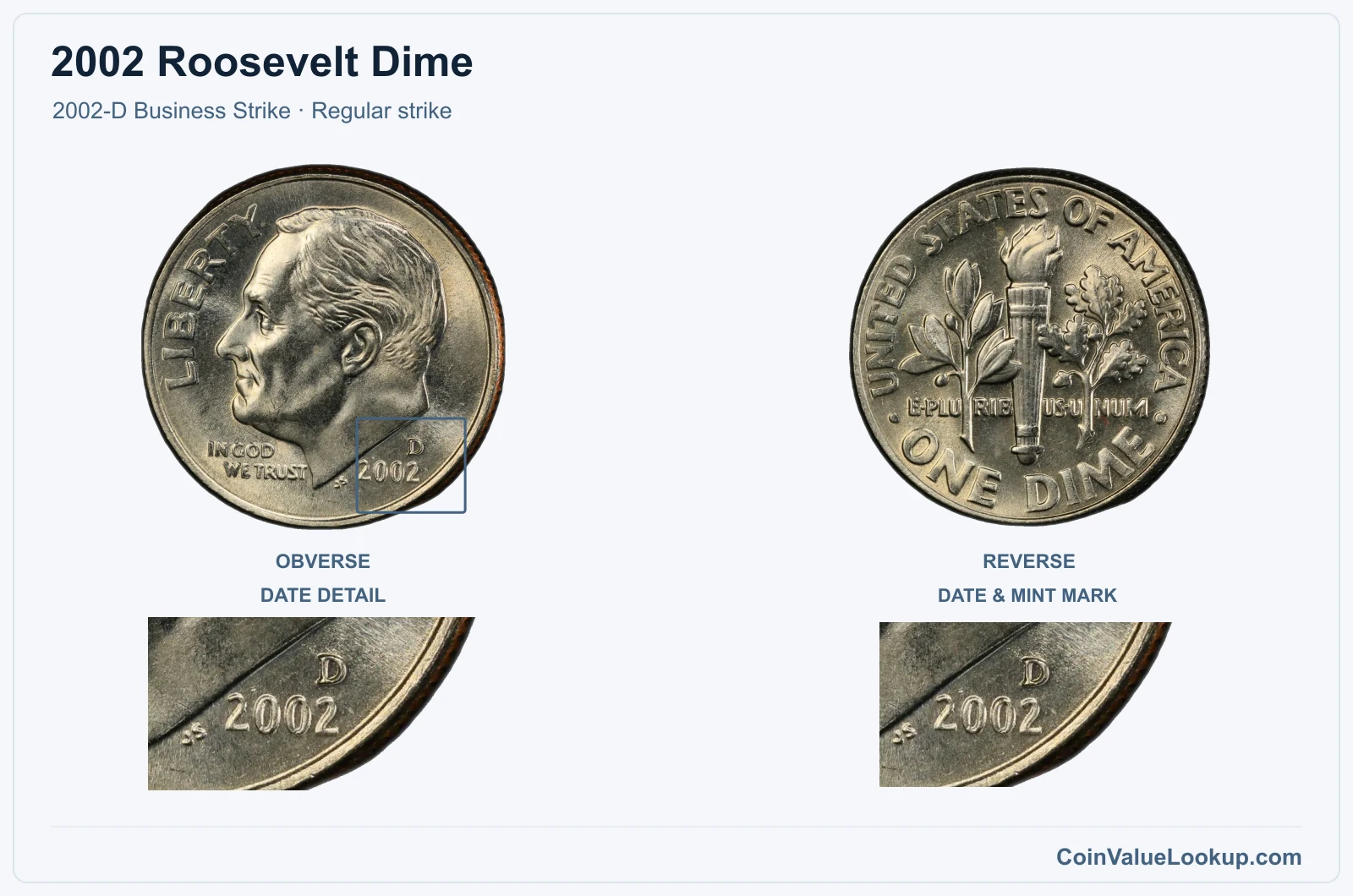
Denver's 2002-D dime is the same copper-nickel clad composition and weight as the Philadelphia issue. The D mintmark sits in the same spot, just right of the portrait.
Guide value at MS65 is around $2.50 per USA Coin Book. Like its P-mint counterpart, a coin earning the Full Bands designation may trade above that figure.
In circulated grades, expect face value only.
Coin Value Lookup is a handy place to look up guides for other Roosevelt dime dates and denominations while you are sorting through your coins.
Range Grade
Price Auction Records Appraisal PO PO 1
—
Coin Identifier FR FR 2
—
Coin Identifier AG AG 3
—
Coin Identifier G G 4
—
Coin Identifier
G 6
—
Coin Identifier VG VG 8
—
Coin Identifier
VG 10
—
Coin Identifier F F 12
—
Coin Identifier
F 15
—
Coin Identifier VF VF 20
—
Coin Identifier
VF 25
—
Coin Identifier
VF 30
—
Coin Identifier
VF 35
—
Coin Identifier XF XF 40
—
Coin Identifier
XF 45
—
Coin Identifier AU AU 50
—
Coin Identifier
AU 53
—
Coin Identifier
AU 55
—
Coin Identifier
AU 58
—
Coin Identifier MS MS 60
—
Coin Identifier
MS 61
—
Coin Identifier
MS 62
—
Coin Identifier
MS 63
—
Coin Identifier
MS 64
—
Coin Identifier
MS 65
—
Coin Identifier
MS 66
—
Coin Identifier
MS 67
Coin Identifier
MS 68
—
Coin Identifier
MS 69
—
—
—
MS 70
—
—
—
2002 Roosevelt Dime — S Clad Proof
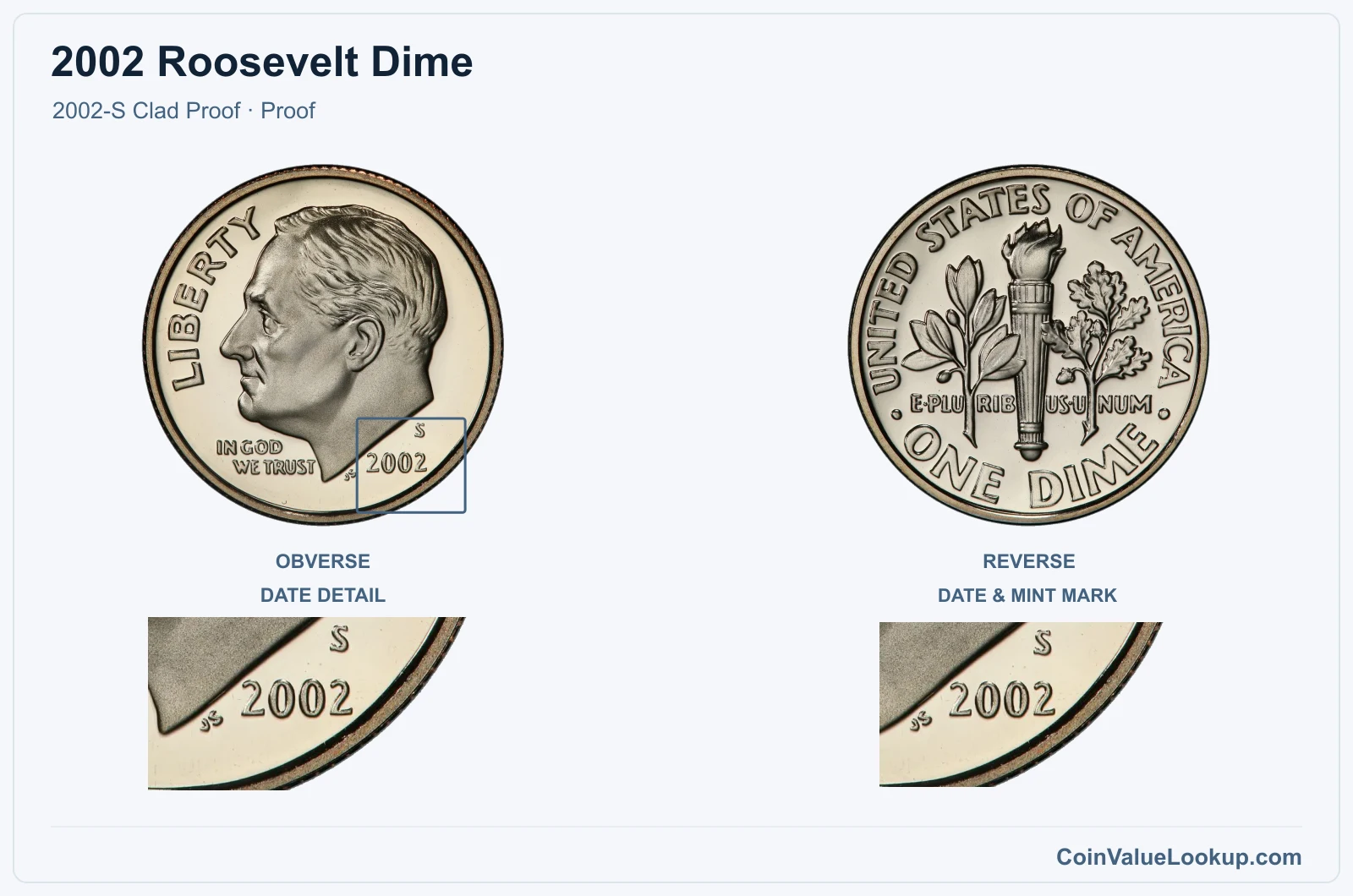
The 2002-S clad proof was produced at San Francisco for collector sets, struck on the same copper-nickel clad planchet as the circulation issues. It weighs 2.27 grams.
The proof finish gives the fields a mirror-like surface with frosted design elements.
At PR65, the USA Coin Book guide lists this version at approximately $3.08. Since both S-mint proofs carry the same mintmark and design, you need to check the edge, weight and original packaging to confirm you have the clad version rather than the silver.
Range Grade
Price Auction Records Appraisal PR PR 1
—
Coin Identifier
PR 2
—
Coin Identifier
PR 3
—
Coin Identifier
PR 4
—
Coin Identifier
PR 6
—
Coin Identifier
PR 8
—
Coin Identifier
PR 10
—
Coin Identifier
PR 12
—
Coin Identifier
PR 15
—
Coin Identifier
PR 20
—
Coin Identifier
PR 25
—
Coin Identifier
PR 30
—
Coin Identifier
PR 35
—
Coin Identifier
PR 40
—
Coin Identifier
PR 45
—
Coin Identifier
PR 50
—
Coin Identifier
PR 53
—
Coin Identifier
PR 55
—
Coin Identifier
PR 58
—
Coin Identifier
PR 60
—
Coin Identifier
PR 61
—
Coin Identifier
PR 62
—
Coin Identifier
PR 63
—
Coin Identifier
PR 64
—
Coin Identifier
PR 65
—
Coin Identifier
PR 66
—
Coin Identifier
PR 67
—
Coin Identifier
PR 68
Coin Identifier
PR 69
Coin Identifier
PR 70
Coin Identifier
2002 Roosevelt Dime — S Silver Proof
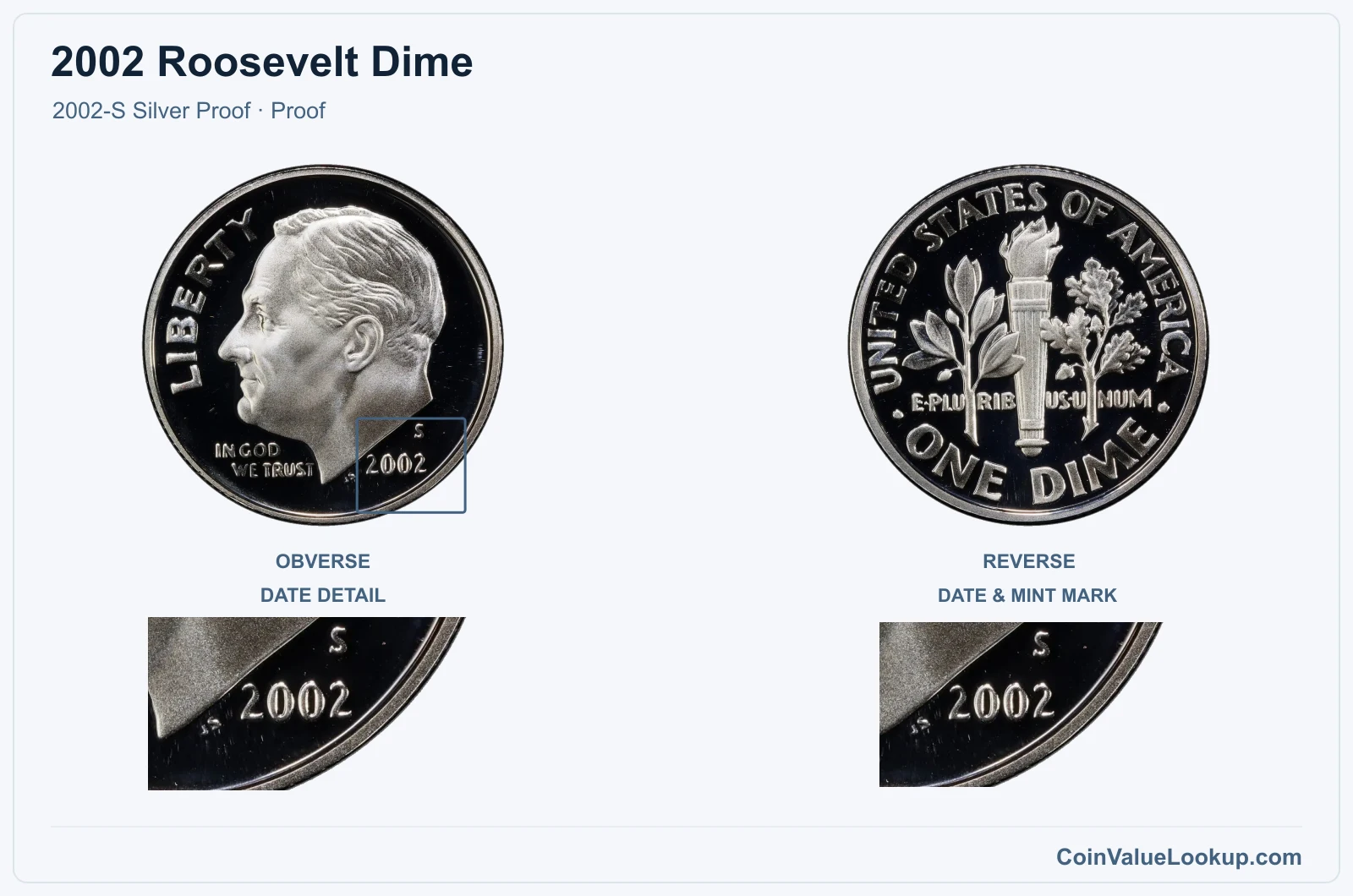
This is the 90% silver version of the 2002-S proof dime, weighing about 2.50 grams compared to the 2.27-gram clad proof. The United States Mint reintroduced silver proof sets in 1992, and the 2002 issue continues that program.
USA Coin Book places the PR65 guide value at roughly $9.65, making it the highest-valued standard version of the 2002 dime at that grade level. Confirming the silver content is essential — weigh the coin on a precise scale and examine the edge for a uniform silver-gray appearance rather than the layered look of a clad coin.
Range Grade
Price Auction Records Appraisal PR PR 1
—
Coin Identifier
PR 2
—
Coin Identifier
PR 3
—
Coin Identifier
PR 4
—
Coin Identifier
PR 6
—
Coin Identifier
PR 8
—
Coin Identifier
PR 10
—
Coin Identifier
PR 12
—
Coin Identifier
PR 15
—
Coin Identifier
PR 20
—
Coin Identifier
PR 25
—
Coin Identifier
PR 30
—
Coin Identifier
PR 35
—
Coin Identifier
PR 40
—
Coin Identifier
PR 45
—
Coin Identifier
PR 50
—
Coin Identifier
PR 53
—
Coin Identifier
PR 55
—
Coin Identifier
PR 58
—
Coin Identifier
PR 60
—
Coin Identifier
PR 61
—
Coin Identifier
PR 62
—
Coin Identifier
PR 63
—
Coin Identifier
PR 64
—
Coin Identifier
PR 65
—
Coin Identifier
PR 66
—
Coin Identifier
PR 67
—
Coin Identifier
PR 68
Coin Identifier
PR 69
Coin Identifier
PR 70
Coin Identifier
2002 Roosevelt Dime Error List
1. 2002 Roosevelt Dime — Double Clipped Planchet
A double clipped planchet means two separate portions of the blank were missing before the coin was struck, leaving two overlapping curved bite marks that interrupt the rim. On a documented 2002-P business strike, the certified reference weighed 2.14 grams — noticeably below the normal 2.27-gram standard.
To check your coin, look for two distinct concave sections along the edge where the rim simply stops. The design in those areas may appear weak or stretched because the metal was not there to receive the full strike.
Be careful with lookalikes. A filed rim or tool-cut edge made after the coin left the mint can mimic a clip.
Genuine clips show Blakesley effects and flow characteristics that post-mint damage does not. Value depends on the severity of both clips, overall condition and professional authentication.
2. 2002 Roosevelt Dime — Die Crack / Die Chip
Die cracks appear as raised irregular lines on the coin's surface, caused by fractures in the steel die during production. A small isolated raised blob is called a die chip.
If the crack extends from the design to the rim and displaces a chunk of metal, that is called a cud — generally more desirable to error collectors.
When examining your 2002 dime, look for thin raised lines that follow no part of the intended design. They will feel slightly raised, not incuse.
Scratches, corrosion and random debris stuck to the surface are all common lookalikes, but those tend to be recessed or lack the consistent raised profile of a die crack.
Condition, visibility and the specific location of the crack all affect value. Professional authentication helps confirm the error.
3. 2002 Roosevelt Dime — Struck-Through Error
A struck-through error happens when foreign material — grease, a thread, a metal fragment — sits between the die and the planchet during striking. The result is a localized depression or an impression of the object in the coin's surface, with missing or distorted design detail in that area.
On a 2002 dime, look for a spot where the design seems flattened or obscured in a way that does not match normal wear patterns. A grease-filled die creates a smooth blank area, while a retained foreign object may leave a textured impression.
Do not confuse ordinary wear, cleaning or a weak strike with a struck-through. Wear affects high points uniformly; a struck-through is localized and often has distinct edges.
Value depends on the size of the affected area, what caused the obstruction and the coin's overall condition.
4. 2002 Roosevelt Dime — Clashed Dies
Clashed dies occur when the obverse and reverse dies strike each other without a planchet between them. The impact transfers traces of each design onto the opposite die, and those ghost impressions then appear on subsequent coins as faint, misplaced design elements.
On a 2002 dime, look for faint outlines of the torch or lettering on the obverse, or traces of Roosevelt's profile on the reverse. The transferred elements should line up with where the opposing die features would naturally contact.
Random raised lines, scratches or a brockage can look similar at first glance but differ in alignment and relief. A true die clash is consistent across multiple coins from the same die pair.
Condition and the clarity of the transferred design affect collector interest.
5. 2002 Roosevelt Dime — Off-Center Strike
An off-center strike results when the planchet is not properly seated between the dies. The design shifts to one side and an unstruck crescent of blank metal appears opposite the shift.
The more dramatic the displacement, the more dramatic the appearance — but the date and mintmark need to remain visible for most collectors to find it desirable.
On a 2002 dime, check whether the entire design is shifted uniformly in one direction with a corresponding blank area. A clipped planchet, a misaligned die, or post-mint flattening can all create superficially similar appearances, but none produce the characteristic combination of a displaced full design and a smooth unstruck crescent.
Value varies with the percentage off center, date visibility and overall condition.
6. 2002 Roosevelt Dime — Brockage
A brockage happens when a previously struck coin fails to eject and acts as a die for the next blank. The result is one normal side and one side bearing an incuse, mirror-image impression of the struck coin's design — visually striking and unmistakable once you know what to look for.
On a 2002 dime, check for a sunken, reversed version of either Roosevelt or the torch on one face. The incuse image should be a clear mirror of the normal design, not just a vague outline.
Die clashes can leave faint transferred impressions, but they are raised, not incuse, and far less detailed. Coins pressed together after minting lack the spread and depth of a genuine brockage.
Authentication is important here because of the dramatic appearance and collector interest.
7. 2002 Roosevelt Dime — Die Gouge / Named Raised-Line Variety
A die gouge produces a raised line or raised lump of extra metal on the coin's surface, caused by physical damage to the die itself — a scratch, nick or gouge in the steel. Some die gouges appear in distinctive, repeatable positions and earn informal nicknames among collectors.
On a 2002 dime, look for a raised feature that does not belong to the standard Roosevelt or torch design. It should appear in the same spot on multiple coins struck from the same die.
An incuse scratch, post-mint damage or an unrelated die crack may look similar but differ in profile. Die gouges are raised and consistent; random scratches are incuse and unique to one coin.
Value depends on the gouge's size, location and condition of the coin.
8. 2002 Roosevelt Dime — Missing Clad Layer
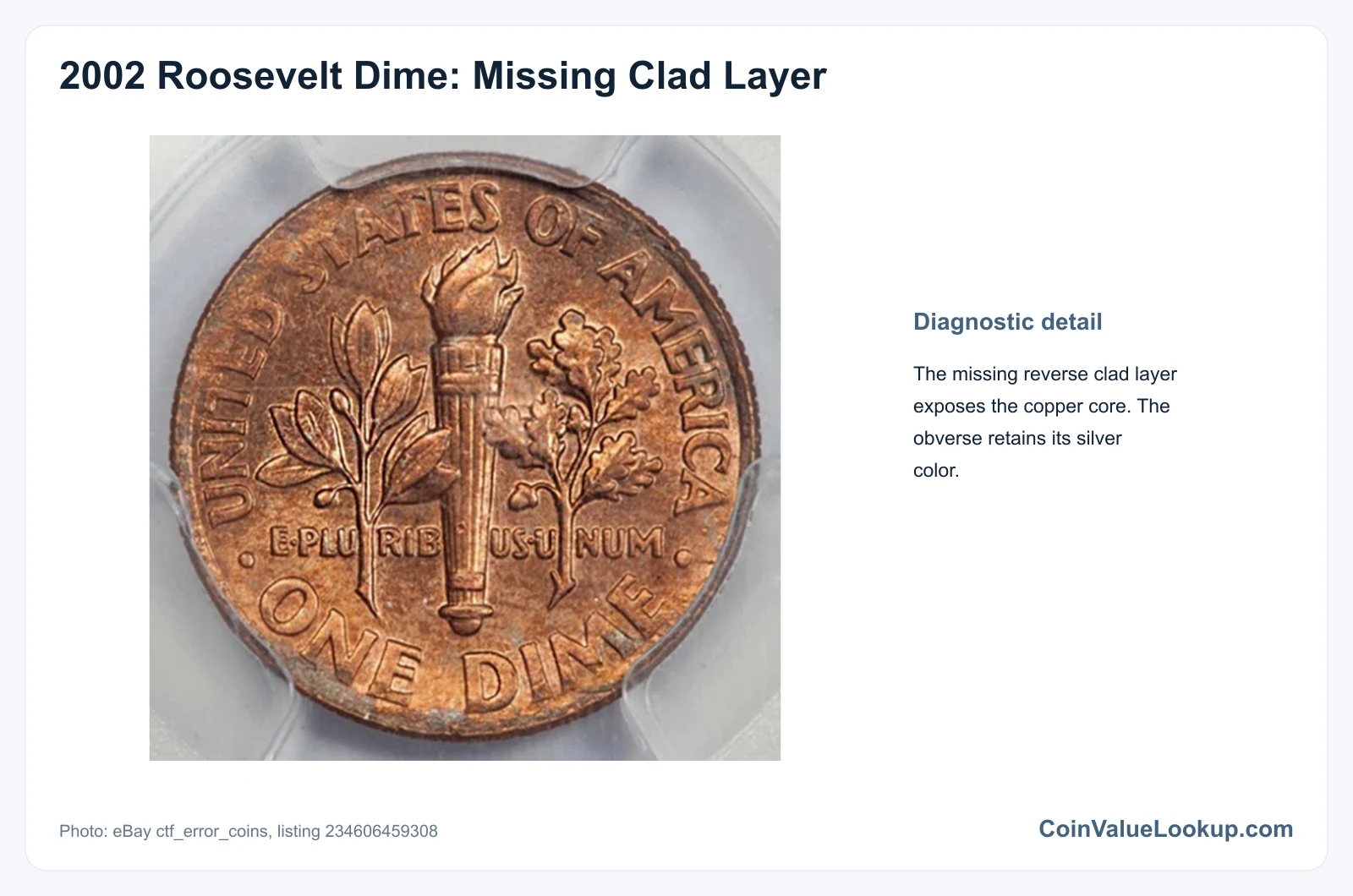
A missing clad layer error means one of the outer copper-nickel layers was absent from the planchet before striking. The exposed face shows a different color — often a copper tone — and the coin weighs less than the standard 2.27 grams because an entire layer of metal is gone.
To check a 2002 dime, compare the suspect face's color and the coin's weight against a normal example. Look at the edge: a genuine missing-clad coin should show an asymmetric layer structure where one side's cladding is absent.
Toning, corrosion, environmental damage and deliberate plating removal can all change a coin's surface color and mimic this error. Weight is the most reliable initial indicator — if the coin weighs close to normal, the color change is likely surface alteration, not a planchet error.
Professional authentication is recommended.