1797 Draped Bust Dollar Coin Value: How Much Is It Worth?
The 1797 Draped Bust Dollar is one of the earliest silver dollars struck at the Philadelphia Mint, and it draws serious attention from collectors of early American coinage. Its value depends on the specific star arrangement, letter size, surface condition, and whether the coin has been cleaned or altered.
Because each version requires individual assessment by authenticated identity and grade, there is no single price range that covers them all.
Fast Way to Identify Your 1797 Draped Bust Dollar
If you have a 1797 Draped Bust Dollar and want a quick starting point, upload clear photos of the front and back. The preliminary identification tool can help you figure out which star arrangement and letter variety you are looking at.
From there, you can compare your coin's details against known versions before seeking professional authentication.
1797 Draped Bust Dollar Value
Upload both sides of your 1797 Draped Bust Dollar.
Front Obverse
Upload photo
Back Reverse
Upload photo
Which 1797 Draped Bust Dollar Versions Are Worth Money?
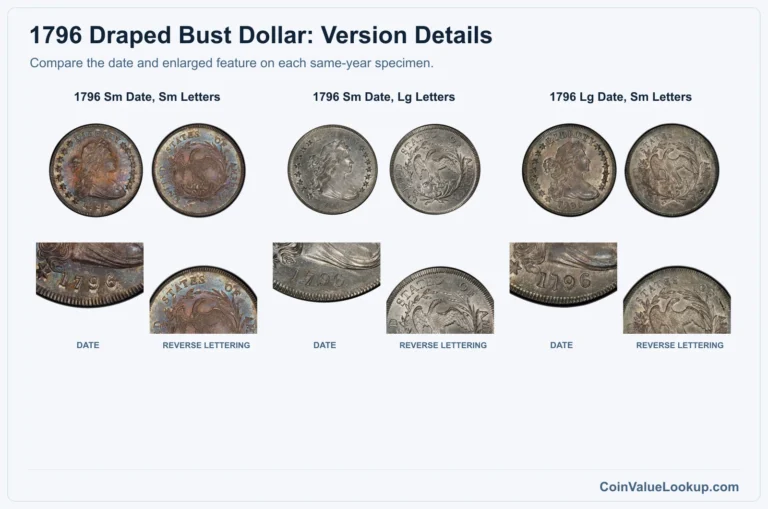
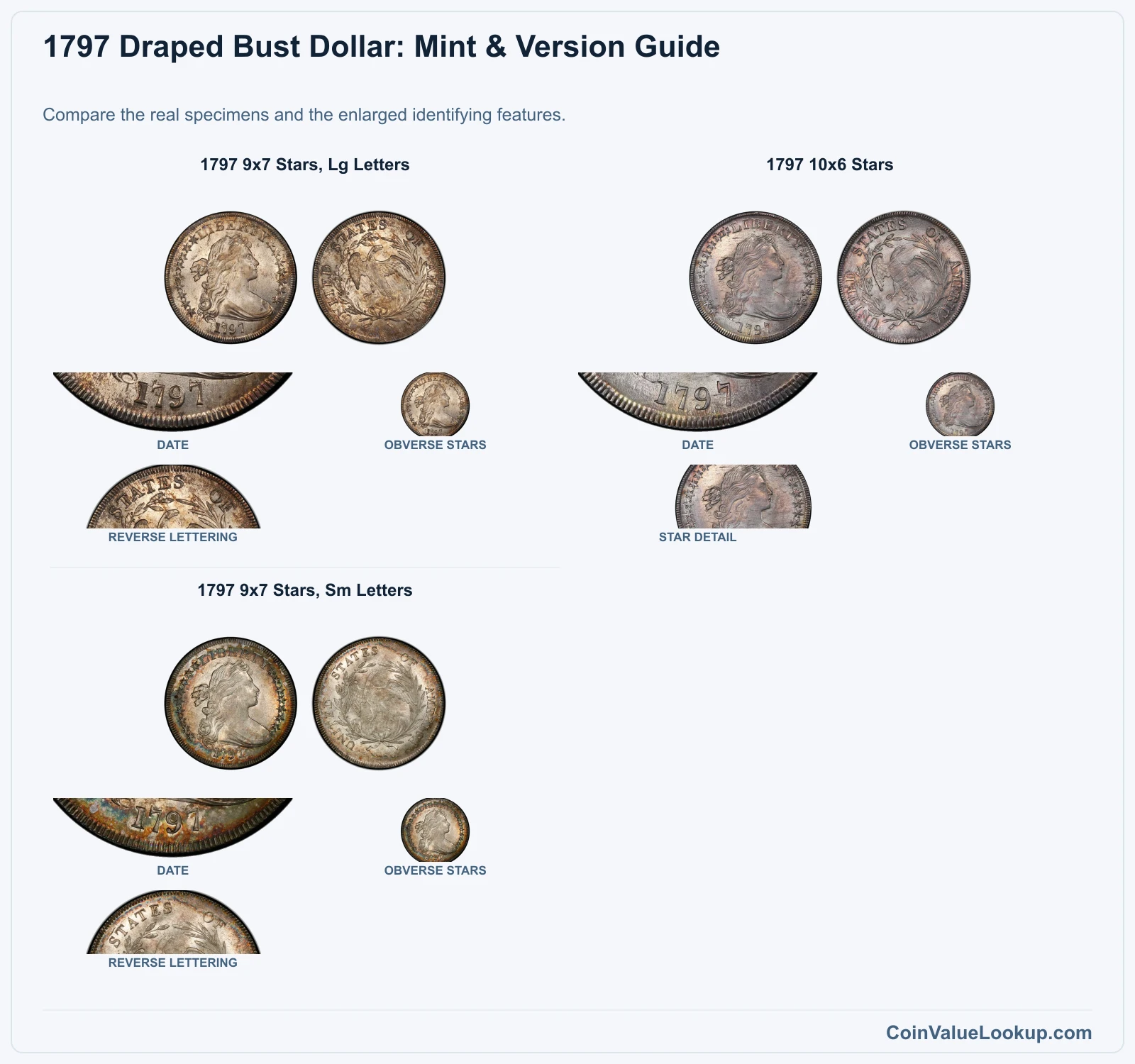
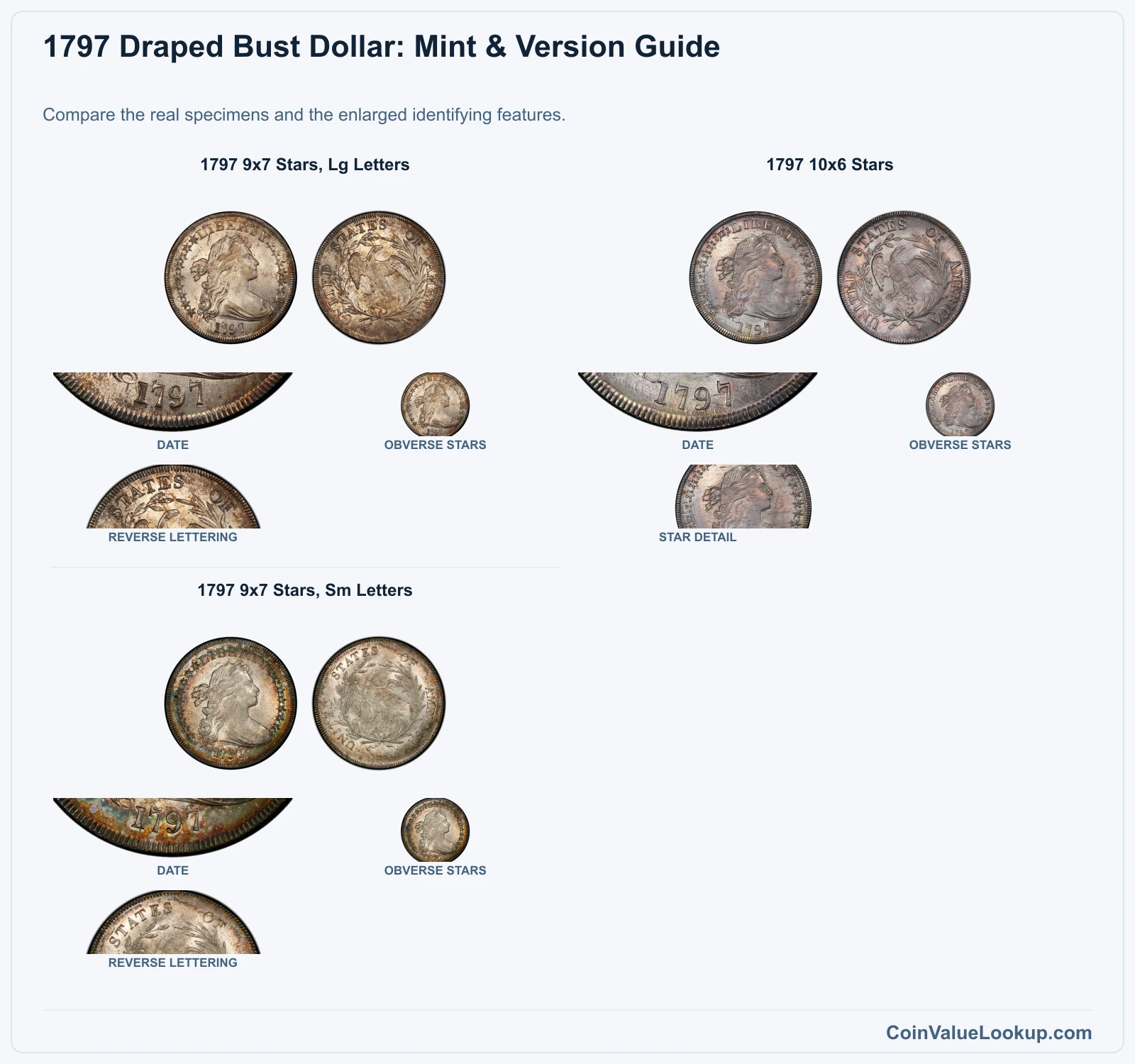
- The 1797 9×7 Stars, Lg Letters has nine stars left of Liberty, seven right, and noticeably larger reverse lettering — confirm both features before comparing.
- The 1797 10×6 Stars is the only version with ten stars left and six right, making the star count the fastest way to identify it.
- The 1797 9×7 Stars, Sm Letters shares the 9×7 star layout but has distinctly smaller reverse lettering — compare letter height directly against the Lg Letters version.
- Do not pay a premium based solely on heavy wear, cleaning, plating, glare, or an unverified error claim.
Step 1: Identify Your 1797 Draped Bust Dollar Mint Mark and Version
All 1797 Draped Bust Dollars were struck at the Philadelphia Mint, so there is no mintmark to look for. The obverse features a Draped Bust Liberty facing right, with stars flanking either side.
The reverse shows a Small Eagle within a wreath.
The key to telling versions apart is the star count on each side of Liberty and the size of the reverse lettering. Count the stars carefully: some have nine stars to the left and seven to the right (9×7), while one version has ten stars left and six right (10×6).
Once you have the star count, look at the reverse lettering — "UNITED STATES OF AMERICA" — to see whether the letters are large or small.
The coin is struck in a silver-copper alloy at a nominal weight of 26.96 grams and has a lettered edge. Cleaning, polishing, or artificial toning will reduce any coin's desirability and comparability to graded examples, so original surfaces matter a great deal on these early dollars.
Step 2: Check Your 1797 Draped Bust Dollar Grade
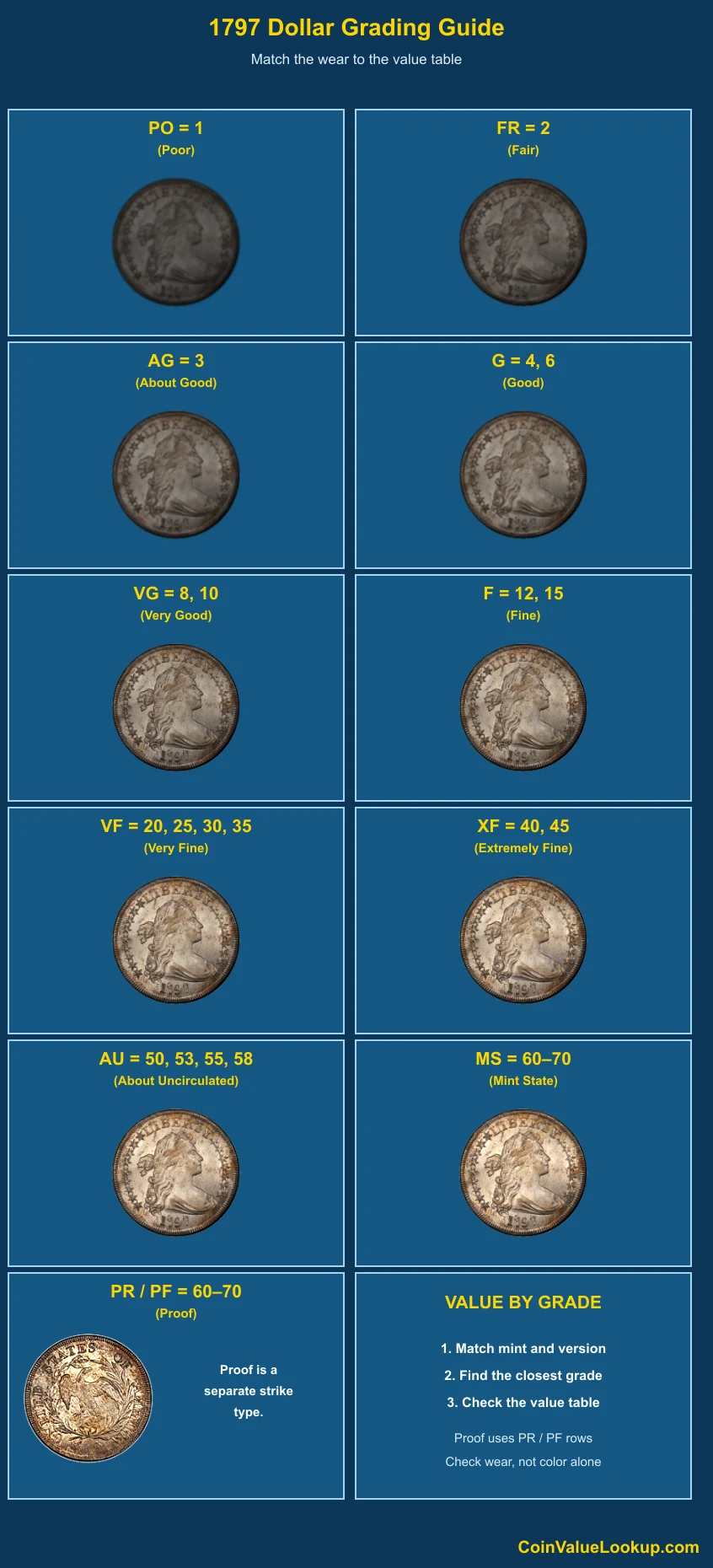
Start by examining the hair detail above Liberty's forehead and around the ear. On a well-worn example, these areas will be flat and merged together, while a lightly circulated coin retains distinct strands.
The drapery across Liberty's bust is another quick checkpoint — heavy wear smooths those folds into a featureless surface.
On the reverse, look at the eagle's breast feathers. They wear down early and often blend together even on coins graded About Uncirculated.
A Mint State piece will show full feather separation and original luster across both sides.
Strike weakness is common on early dollars, so don't confuse a soft strike with wear. A weakly struck area lacks detail but still shows mint luster, while a worn area is smooth and dull.
Use the comparison image for the same coin type to see circulated, AU, and Mint State examples side by side — it makes these differences much easier to spot.
Coin Value Lookup is a useful place to look up coin guides when you are comparing your coin's condition to known grade benchmarks. It can save you a lot of time before you reach out for a professional opinion.
Step 3: Check 1797 Draped Bust Dollar Value by Mint and Version
1797 Draped Bust Dollar — 9×7 Stars, Lg Letters
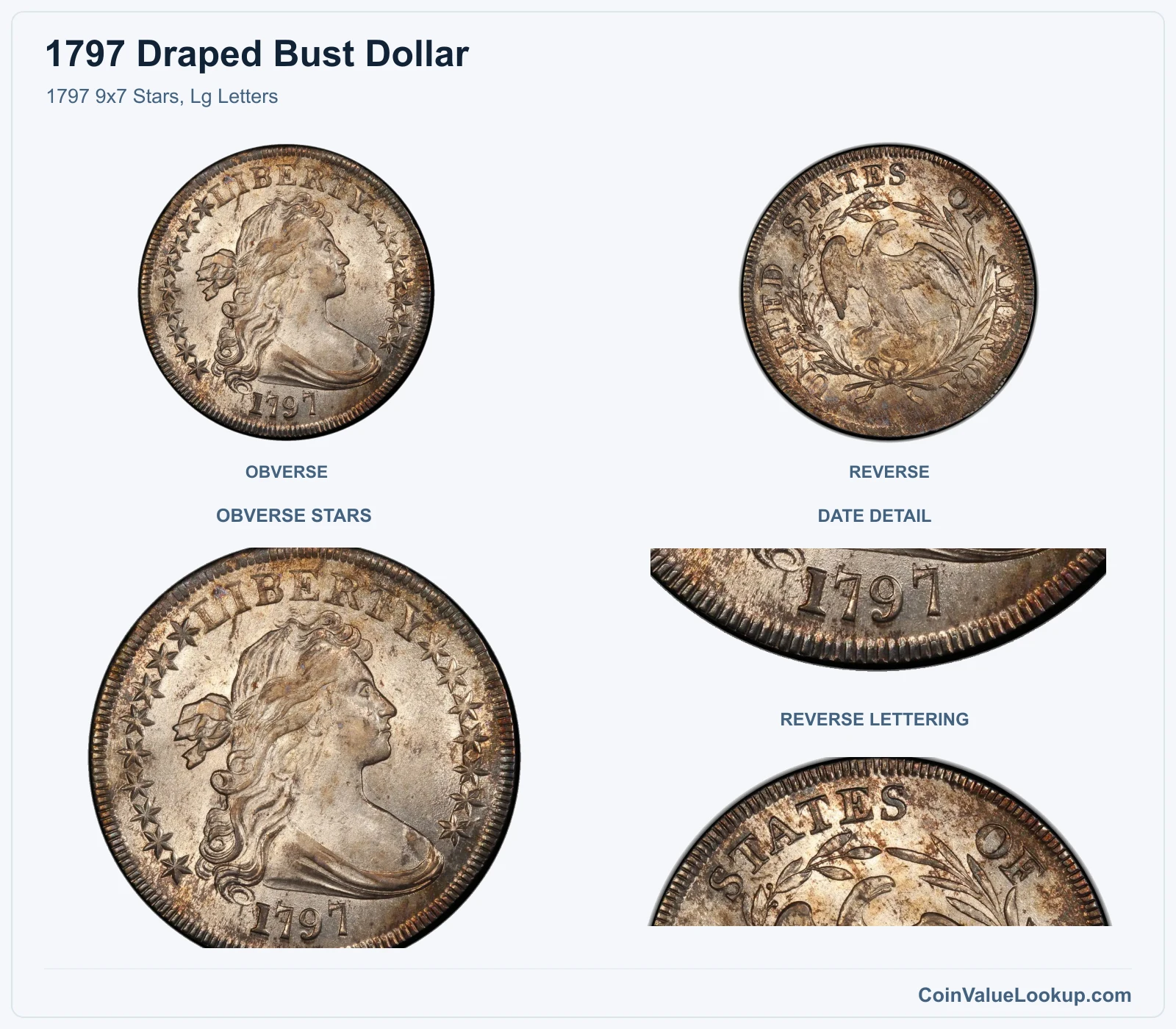
The 1797 9×7 Stars, Large Letters variety has nine stars to the left of Liberty and seven to the right. On the reverse, the inscription "UNITED STATES OF AMERICA" appears in comparatively large letters — this is the detail that separates it from the Small Letters version with the same star arrangement.
This is a business-strike coin in a silver-copper alloy at a nominal 26.96 grams, with a Draped Bust obverse and Small Eagle reverse. No numerical price range applies broadly; each coin's value depends on authenticated identity, grade, and surface quality.
Cleaning or polishing significantly reduces comparability to graded population examples.
Range Grade
Price Auction Records Appraisal PO PO 1
—
Coin Identifier FR FR 2
—
Coin Identifier AG AG 3
—
Coin Identifier G G 4
Coin Identifier
G 6
—
Coin Identifier VG VG 8
Coin Identifier
VG 10
Coin Identifier F F 12
Coin Identifier
F 15
Coin Identifier VF VF 20
Coin Identifier
VF 25
Coin Identifier
VF 30
Coin Identifier
VF 35
Coin Identifier XF XF 40
Coin Identifier
XF 45
Coin Identifier AU AU 50
Coin Identifier
AU 53
Coin Identifier
AU 55
Coin Identifier
AU 58
Coin Identifier MS MS 60
—
Coin Identifier
MS 61
—
Coin Identifier
MS 62
Coin Identifier
MS 63
Coin Identifier
MS 64
—
Coin Identifier
MS 65
—
—
—
MS 66
—
—
—
MS 67
—
—
—
MS 68
—
—
—
MS 69
—
—
—
MS 70
—
—
—
1797 Draped Bust Dollar — 10×6 Stars
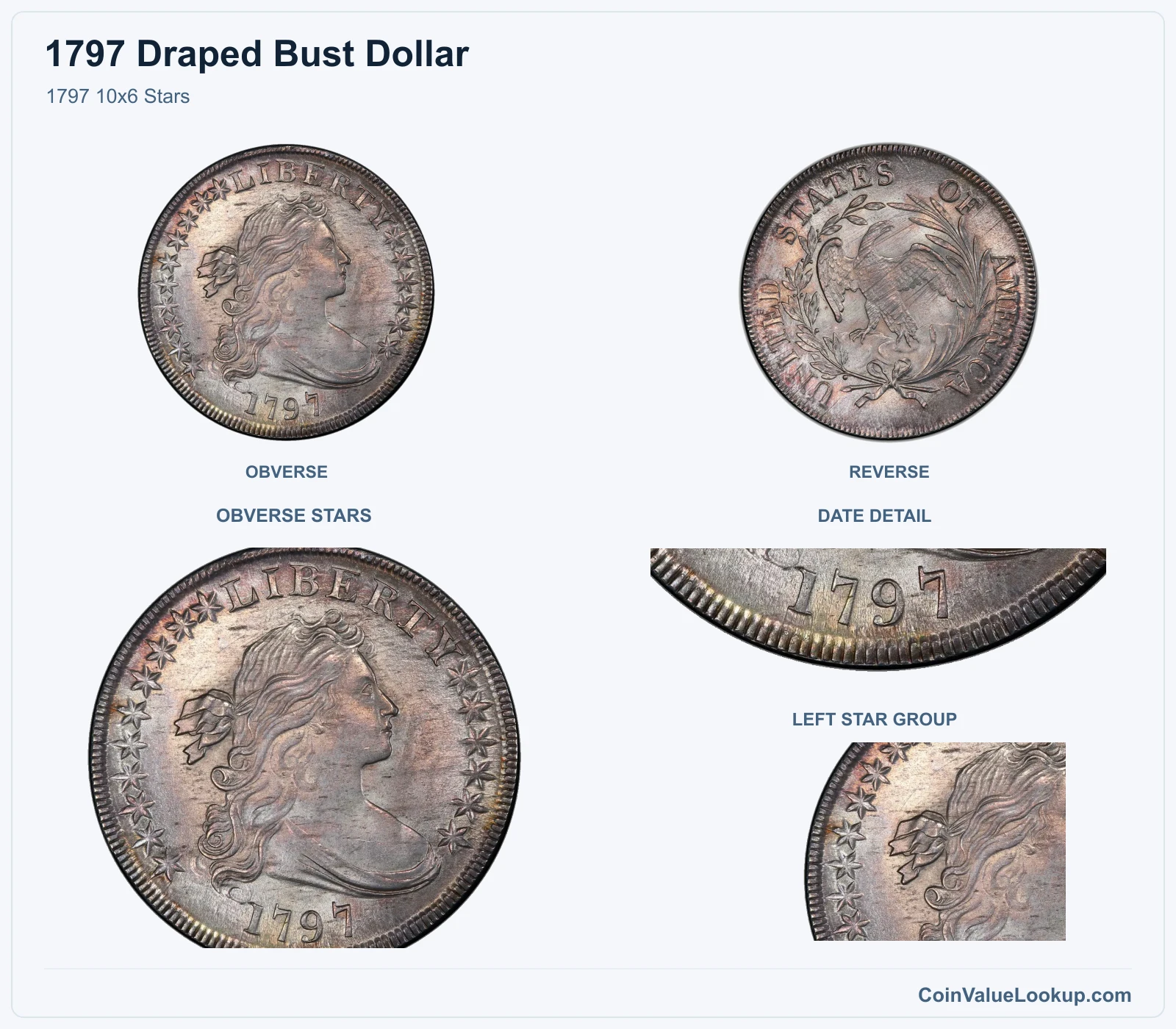
The 1797 10×6 Stars is the easiest version to identify: just count the stars. Ten appear to the left of Liberty and six to the right.
No other 1797 dollar has that arrangement, so you can confirm this one quickly.
It shares the same Draped Bust obverse and Small Eagle reverse design, struck in a silver-copper alloy at a nominal 26.96 grams with a lettered edge. Because value depends entirely on authenticated identity and condition, no single price range covers all grades.
Original surfaces matter — coins that have been cleaned or improperly handled are harder to compare against certified examples.
Range Grade
Price Auction Records Appraisal PO PO 1
Coin Identifier FR FR 2
—
Coin Identifier AG AG 3
—
Coin Identifier G G 4
Coin Identifier
G 6
Coin Identifier VG VG 8
Coin Identifier
VG 10
Coin Identifier F F 12
Coin Identifier
F 15
Coin Identifier VF VF 20
Coin Identifier
VF 25
Coin Identifier
VF 30
Coin Identifier
VF 35
Coin Identifier XF XF 40
Coin Identifier
XF 45
Coin Identifier AU AU 50
Coin Identifier
AU 53
Coin Identifier
AU 55
Coin Identifier
AU 58
Coin Identifier MS MS 60
—
Coin Identifier
MS 61
Coin Identifier
MS 62
Coin Identifier
MS 63
Coin Identifier
MS 64
Coin Identifier
MS 65
—
—
—
MS 66
—
—
—
MS 67
—
—
—
MS 68
—
—
—
MS 69
—
—
—
MS 70
—
—
—
1797 Draped Bust Dollar — 9×7 Stars, Sm Letters
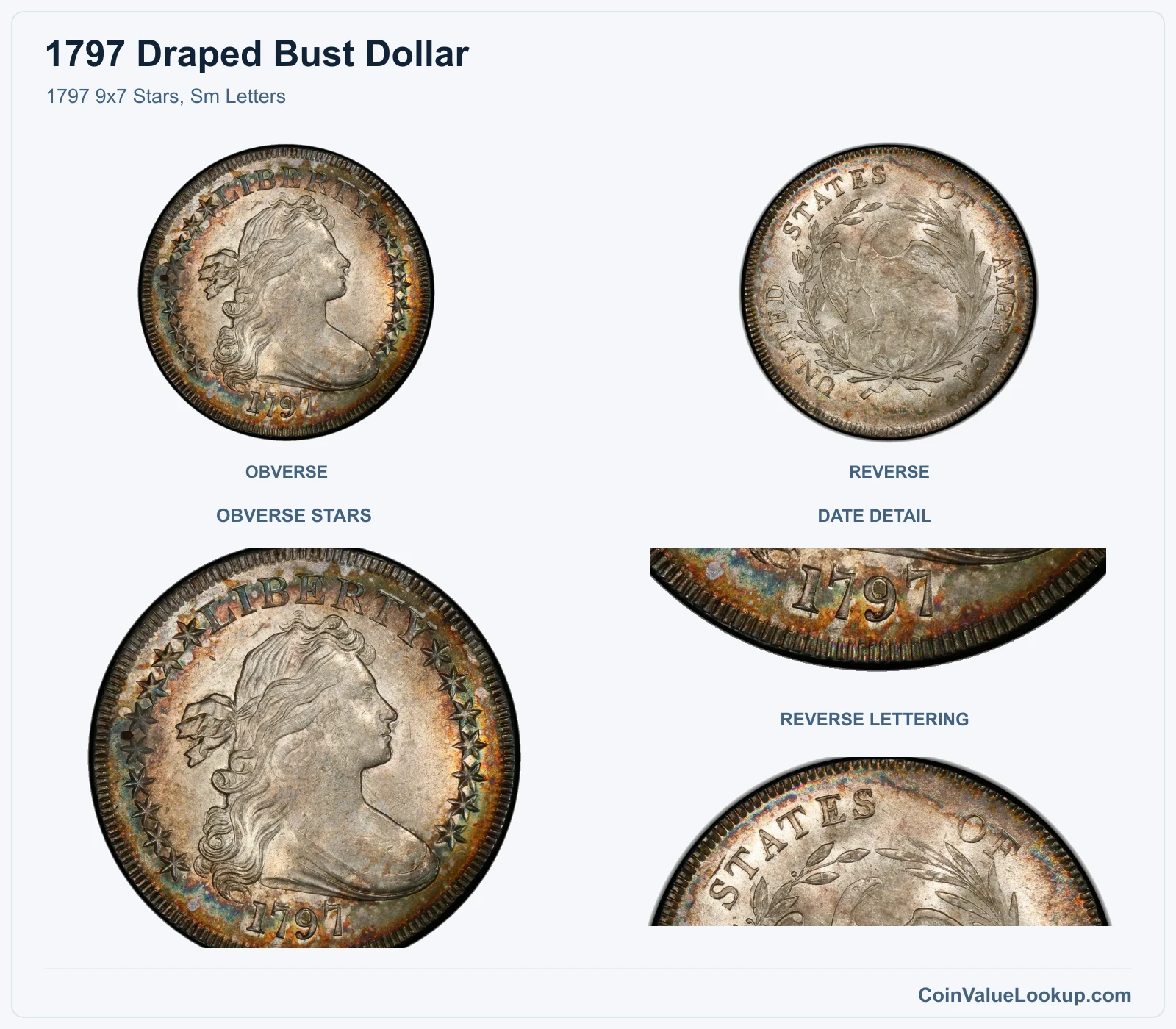
The 1797 9×7 Stars, Small Letters variety has nine stars left and seven right, just like the Large Letters version. The difference is on the reverse: the lettering in "UNITED STATES OF AMERICA" is noticeably smaller.
Place both versions side by side — or compare photos — and the height difference becomes obvious.
This business-strike coin uses the same silver-copper alloy at 26.96 grams and the Draped Bust / Small Eagle design. Value requires individual assessment based on authenticated identity, grade, and whether original surfaces remain intact.
Polishing or environmental damage reduces desirability significantly on any early dollar.
Range Grade
Price Auction Records Appraisal PO PO 1
—
Coin Identifier FR FR 2
—
Coin Identifier AG AG 3
—
Coin Identifier G G 4
Coin Identifier
G 6
—
Coin Identifier VG VG 8
Coin Identifier
VG 10
Coin Identifier F F 12
Coin Identifier
F 15
Coin Identifier VF VF 20
Coin Identifier
VF 25
Coin Identifier
VF 30
Coin Identifier
VF 35
Coin Identifier XF XF 40
Coin Identifier
XF 45
Coin Identifier AU AU 50
Coin Identifier
AU 53
Coin Identifier
AU 55
Coin Identifier
AU 58
Coin Identifier MS MS 60
—
Coin Identifier
MS 61
—
Coin Identifier
MS 62
—
Coin Identifier
MS 63
—
Coin Identifier
MS 64
Coin Identifier
MS 65
—
—
—
MS 66
—
—
—
MS 67
—
—
—
MS 68
—
—
—
MS 69
—
—
—
MS 70
—
—
—
1797 Draped Bust Dollar Error List
1. 1797 Draped Bust Dollar — Die Crack / Die Chip
Die cracks on the 1797 Draped Bust Dollar appear as thin raised lines running across the coin's surface. They result from fractures in the die itself, so the crack transfers as a raised feature — the opposite of a scratch, which is incised into the metal.
A die chip looks like a small raised blob rather than a line.
According to reported information, the die cracks advanced slightly during the coinage of this issue, meaning early strikes from the same die pair may show faint cracks while later strikes show more prominent ones. A rim-connected break that displaces metal is sometimes called a cud, which is distinct from an interior crack.
Be careful not to confuse die cracks with incuse scratches, corrosion lines, or foreign material stuck to the surface. Scratches are recessed, not raised, and corrosion tends to be irregular and pitted.
The specific crack's visibility, location, and the coin's overall condition all factor into value, but no numerical price range applies here. Professional authentication is the safest way to confirm any error claim on a coin of this age and importance.