1799 Draped Bust Dollar Coin Value: How Much Is It Worth?
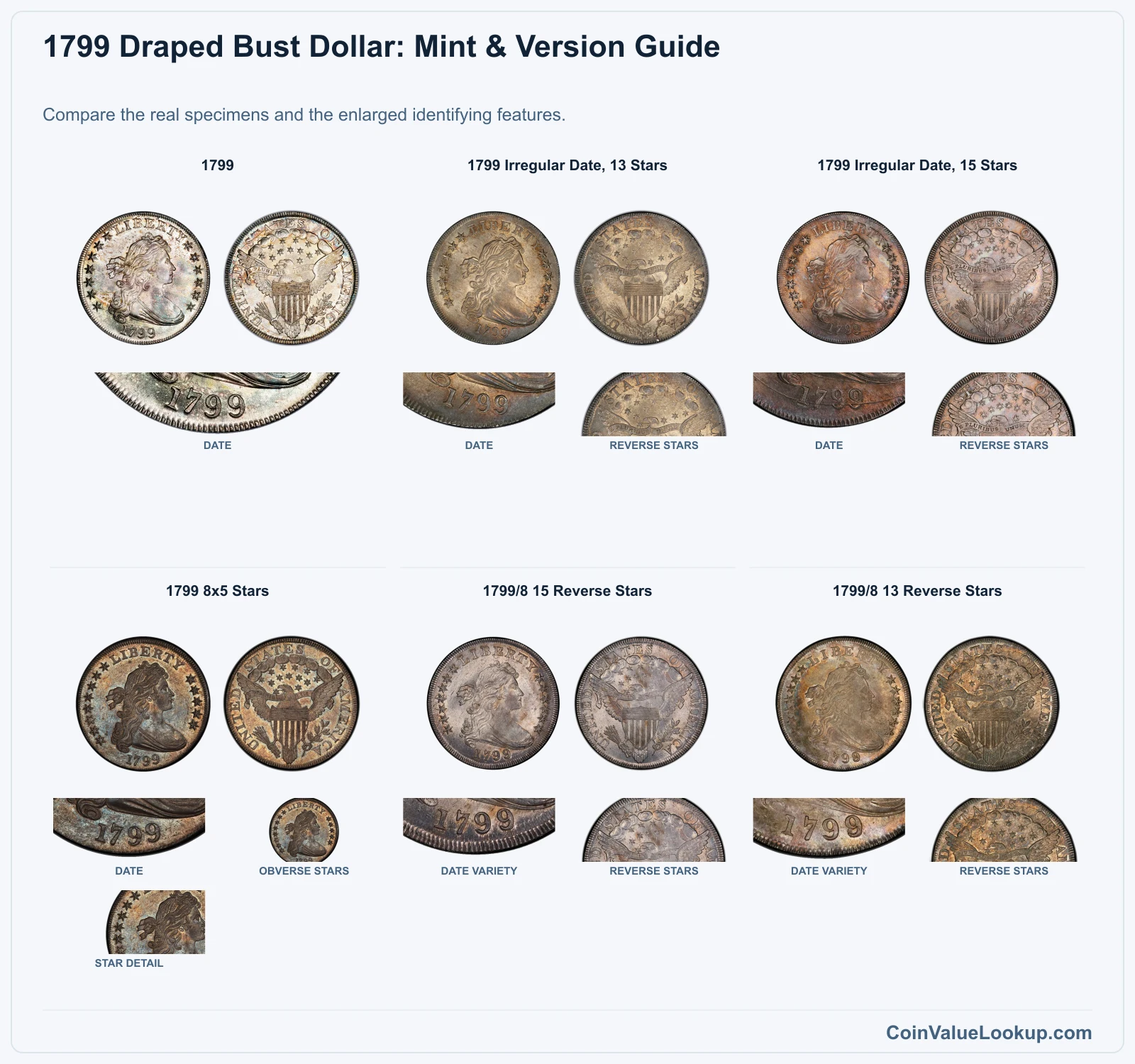
The 1799 Draped Bust Dollar is one of the earliest large silver dollars struck at the Philadelphia Mint, and it comes in several distinct varieties that matter for value. Guide estimates range from about $1,334 in Good-4 to $604,227 in MS65, depending on the specific version and grade.
Before you assume your coin falls anywhere in that span, you need to pin down which variety you actually have — the date style, star count, and overdate status all play a role. An ordinary worn example still commands a strong four-figure price, but the wrong identification or a cleaned surface can shift value dramatically.
Fast Way to Identify Your 1799 Draped Bust Dollar
The quickest way to start figuring out what you have is to upload clear photos of both the front and back of your coin. Our identifier can give you a preliminary read on the date style, star arrangement, and design type.
It is not a substitute for professional authentication or precise grading, but it helps you narrow down which version you are looking at before diving deeper.
1799 Draped Bust Dollar Value
Upload both sides of your 1799 Draped Bust Dollar.
Front Obverse
Upload photo
Back Reverse
Upload photo
Which 1799 Draped Bust Dollar Versions Are Worth Money?
- 1799/8 15 Reverse Stars and 1799/8 13 Reverse Stars — overdate varieties where traces of an 8 sit beneath the final 9, with different reverse star counts distinguishing the two.
- 1799 Irregular Date, 13 Stars and 1799 Irregular Date, 15 Stars — irregular numeral spacing in the date with different obverse star totals; proper attribution matters for accurate valuation.
- 1799 8×5 Stars — the obverse star arrangement (eight left, five right) differs from the standard layout and defines this variety.
- All six versions carry strong four-figure guide values even in low circulated grades, but condition and original surfaces drive real-world pricing.
Step 1: Identify Your 1799 Draped Bust Dollar Mint Mark and Version
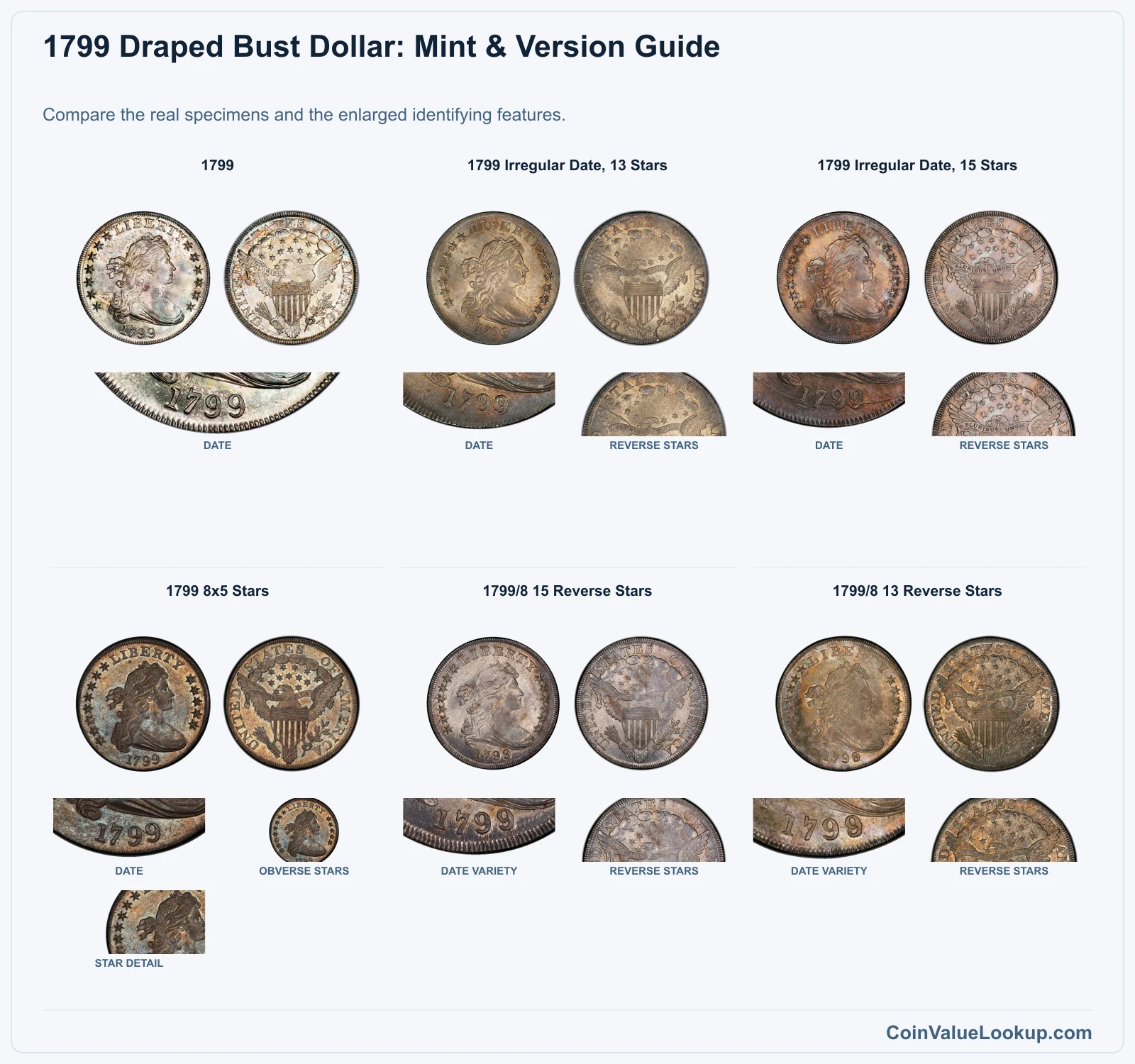
Every 1799 Draped Bust Dollar was struck in Philadelphia — there is no mintmark to hunt for. The coin is a silver-copper alloy weighing roughly 26.96 grams, with a lettered edge rather than reeding.
The obverse shows Liberty facing right with flowing drapery, and the reverse features the Heraldic Eagle design. What separates one variety from another is the arrangement of details: the date numerals, the number of obverse stars, and whether the final digit is punched over an 8.
Start with the date. On a normal-date coin the numerals are evenly spaced and uniform.
On the Irregular Date varieties the spacing or alignment of the digits looks off — once you see a normal one next to an irregular one, the difference jumps out. Count the obverse stars next: most have 13, but the 15-star variety adds two extras.
For the 8×5 Stars version, the stars are split eight on the left and five on the right of Liberty instead of the more common seven-left, six-right arrangement. The overdate varieties (1799/8) show traces of an underlying 8 beneath the final 9.
Then check the reverse: count 13 or 15 stars around the eagle to finish the classification.
If you are exploring other dates or denominations, Coin Value Lookup has guides across a wide range of U.S. coins to help you look up values quickly.
Step 2: Check Your 1799 Draped Bust Dollar Grade
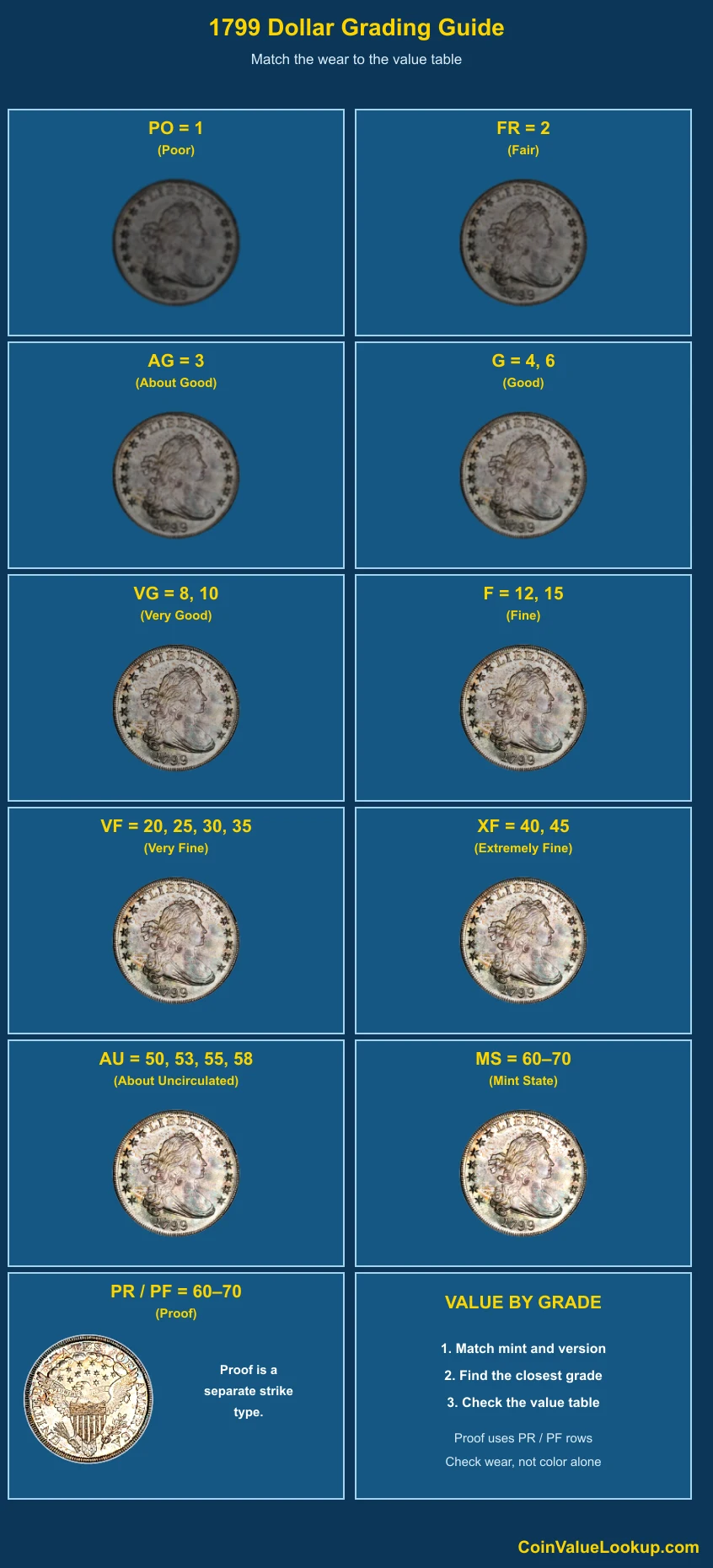
When grading an 1799 Draped Bust Dollar, focus first on Liberty's hair above the forehead and around the ear. In lower grades these high points go flat early, and by Good-4 only the outline of the portrait remains with minimal interior detail.
The drapery across Liberty's bust is another key checkpoint. On a well-preserved coin the folds are sharp and distinct; on a worn piece they merge into a smooth surface.
Flip the coin over and examine the eagle's breast feathers — they wear down in a predictable pattern from the center outward.
Strike weakness is common on these early dollars, so do not confuse a soft strike with heavy wear. A weakly struck coin may still show luster in protected areas, while a genuinely worn coin will have uniform dullness across the high points.
Use the comparison image to see how hair detail, drapery folds, and eagle feathers should look at different grade levels.
Cleaned or polished coins lose their original skin and often show hairline scratches under magnification. These surfaces reduce a coin's grade and desirability significantly compared to an untouched example with honest wear.
Step 3: Check 1799 Draped Bust Dollar Value by Mint and Version
1799 Draped Bust Dollar
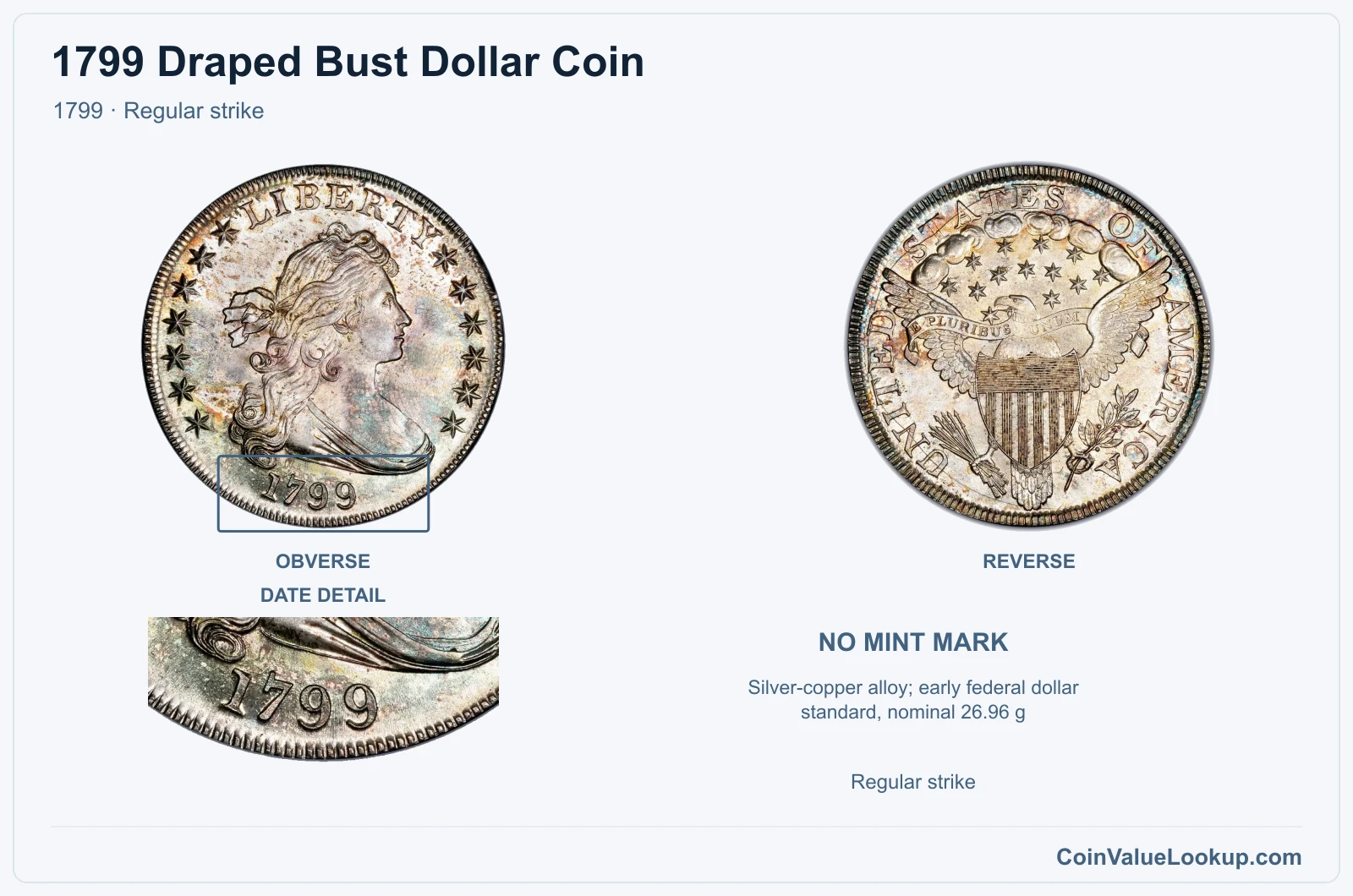
The baseline 1799 Draped Bust Dollar features the standard Heraldic Eagle reverse and a normal date. It was struck in Philadelphia in a silver-copper alloy at the early federal dollar standard of about 26.96 grams.
USA Coin Book guide estimates place this version at roughly $1,382 in Good-4 and up to $604,227 in MS65. Those figures assume original, uncleaned surfaces.
Polishing, tooling, or environmental damage can push a coin well below guide values for the same technical grade.
Before comparing prices, confirm the date is not irregular and that the stars split eight left, five right — this is the 8×5 Stars obverse layout that corresponds to the normal-date listing.
Range Grade
Price Auction Records Appraisal PO PO 1
Coin Identifier FR FR 2
Coin Identifier AG AG 3
Coin Identifier G G 4
Coin Identifier
G 6
Coin Identifier VG VG 8
Coin Identifier
VG 10
Coin Identifier F F 12
Coin Identifier
F 15
Coin Identifier VF VF 20
Coin Identifier
VF 25
Coin Identifier
VF 30
Coin Identifier
VF 35
Coin Identifier XF XF 40
Coin Identifier
XF 45
Coin Identifier AU AU 50
Coin Identifier
AU 53
Coin Identifier
AU 55
Coin Identifier
AU 58
Coin Identifier MS MS 60
Coin Identifier
MS 61
Coin Identifier
MS 62
Coin Identifier
MS 63
Coin Identifier
MS 64
Coin Identifier
MS 65
Coin Identifier
MS 66
Coin Identifier
MS 67
—
—
—
MS 68
—
—
—
MS 69
—
—
—
MS 70
—
—
—
1799 Draped Bust Dollar — Irregular Date, 13 Stars
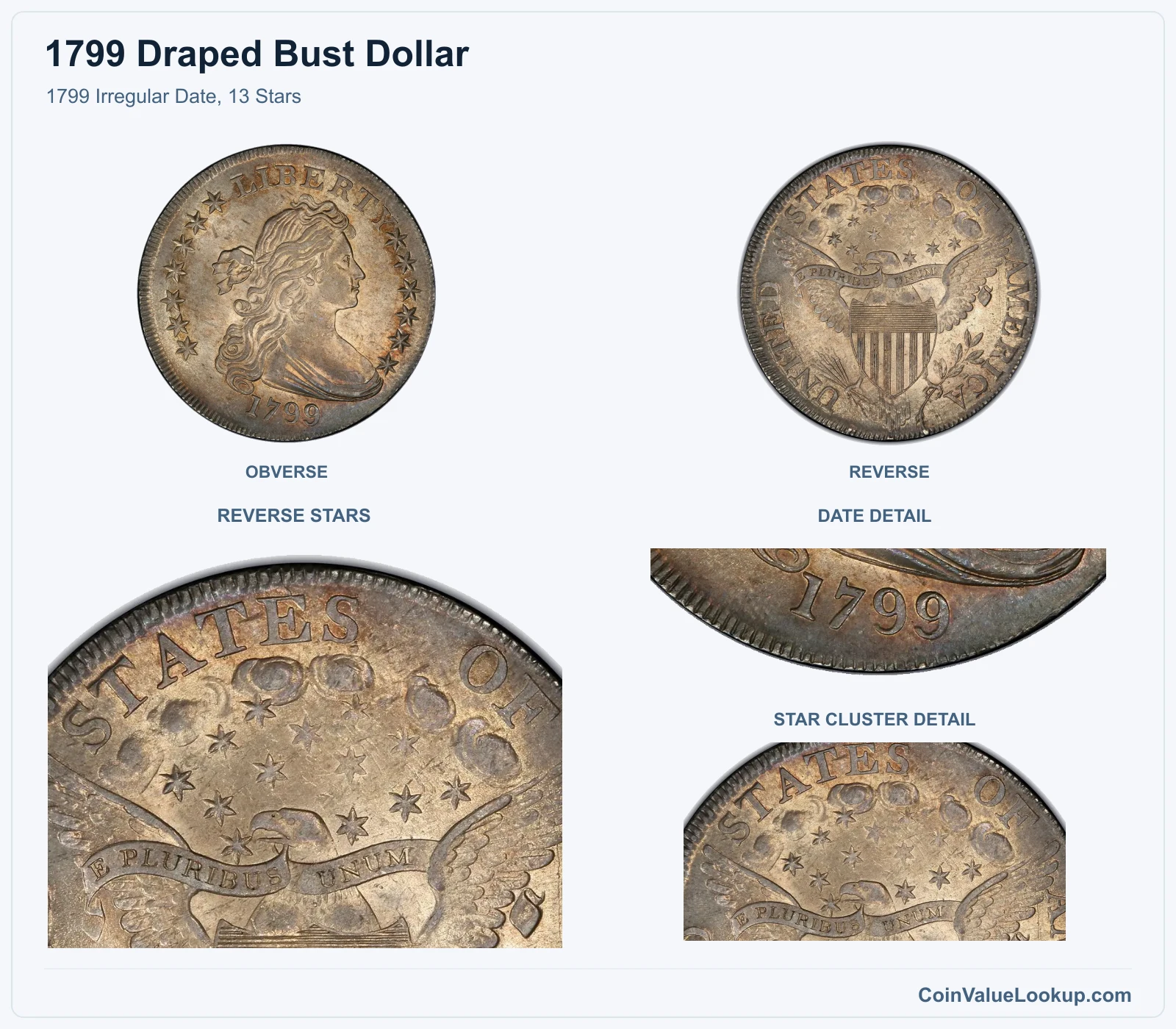
The 1799 Irregular Date, 13 Stars variety stands out because the date numerals are unevenly spaced or tilted compared to the normal-date version. The obverse carries 13 stars arranged around Liberty.
Look closely at the 1-7-9-9 punches: the gaps between digits or the angle of individual numerals will appear inconsistent. Once you have a normal-date coin for comparison, the irregularity is easy to spot under moderate magnification.
Guide estimates from USA Coin Book run about $1,382 at Good-4 up to $604,227 at MS65. As with all versions, those numbers assume problem-free surfaces and proper attribution.
Misidentifying the star count or date style could lead you to the wrong value column entirely.
Range Grade
Price Auction Records Appraisal PO PO 1
—
Coin Identifier FR FR 2
—
Coin Identifier AG AG 3
Coin Identifier G G 4
—
Coin Identifier
G 6
—
Coin Identifier VG VG 8
—
Coin Identifier
VG 10
Coin Identifier F F 12
Coin Identifier
F 15
Coin Identifier VF VF 20
Coin Identifier
VF 25
Coin Identifier
VF 30
Coin Identifier
VF 35
Coin Identifier XF XF 40
Coin Identifier
XF 45
Coin Identifier AU AU 50
Coin Identifier
AU 53
Coin Identifier
AU 55
Coin Identifier
AU 58
Coin Identifier MS MS 60
—
Coin Identifier
MS 61
Coin Identifier
MS 62
Coin Identifier
MS 63
Coin Identifier
MS 64
Coin Identifier
MS 65
—
—
—
MS 66
—
—
—
MS 67
—
—
—
MS 68
—
—
—
MS 69
—
—
—
MS 70
—
—
—
1799 Draped Bust Dollar — Irregular Date, 15 Stars
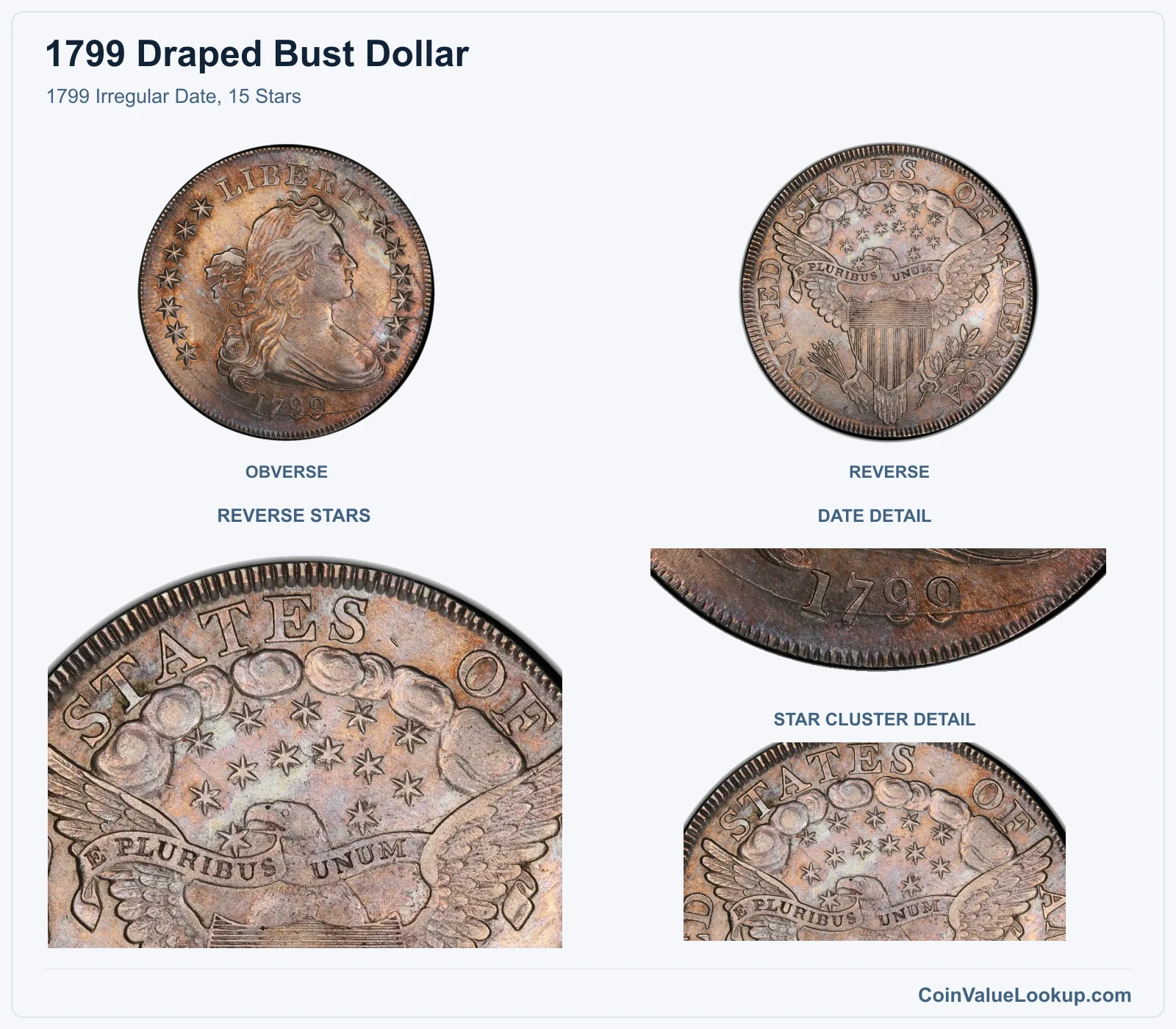
This variety combines the irregular date with 15 obverse stars instead of the usual 13. That is two extra stars — count carefully, because a worn star near the rim can be easy to miss or misread.
The irregular date shows the same uneven numeral positioning found on the 13-star irregular version, so you need to check both the date and the star count to land on the correct variety. Guide estimates from USA Coin Book sit at approximately $1,382 in Good-4 and $604,227 in MS65.
The 15-star obverse is an unusual layout that reflects die production choices at the early Philadelphia Mint. Confirm the count on both sides of Liberty's portrait to be sure you are not confusing a weak or partially struck star with an absent one.
Range Grade
Price Auction Records Appraisal PO PO 1
—
Coin Identifier FR FR 2
—
Coin Identifier AG AG 3
—
Coin Identifier G G 4
Coin Identifier
G 6
—
Coin Identifier VG VG 8
Coin Identifier
VG 10
Coin Identifier F F 12
Coin Identifier
F 15
Coin Identifier VF VF 20
Coin Identifier
VF 25
Coin Identifier
VF 30
Coin Identifier
VF 35
Coin Identifier XF XF 40
Coin Identifier
XF 45
Coin Identifier AU AU 50
—
Coin Identifier
AU 53
Coin Identifier
AU 55
Coin Identifier
AU 58
Coin Identifier MS MS 60
—
—
—
MS 61
—
—
—
MS 62
—
—
—
MS 63
—
—
—
MS 64
—
—
—
MS 65
—
—
—
MS 66
—
—
—
MS 67
—
—
—
MS 68
—
—
—
MS 69
—
—
—
MS 70
—
—
—
1799 Draped Bust Dollar — 8×5 Stars
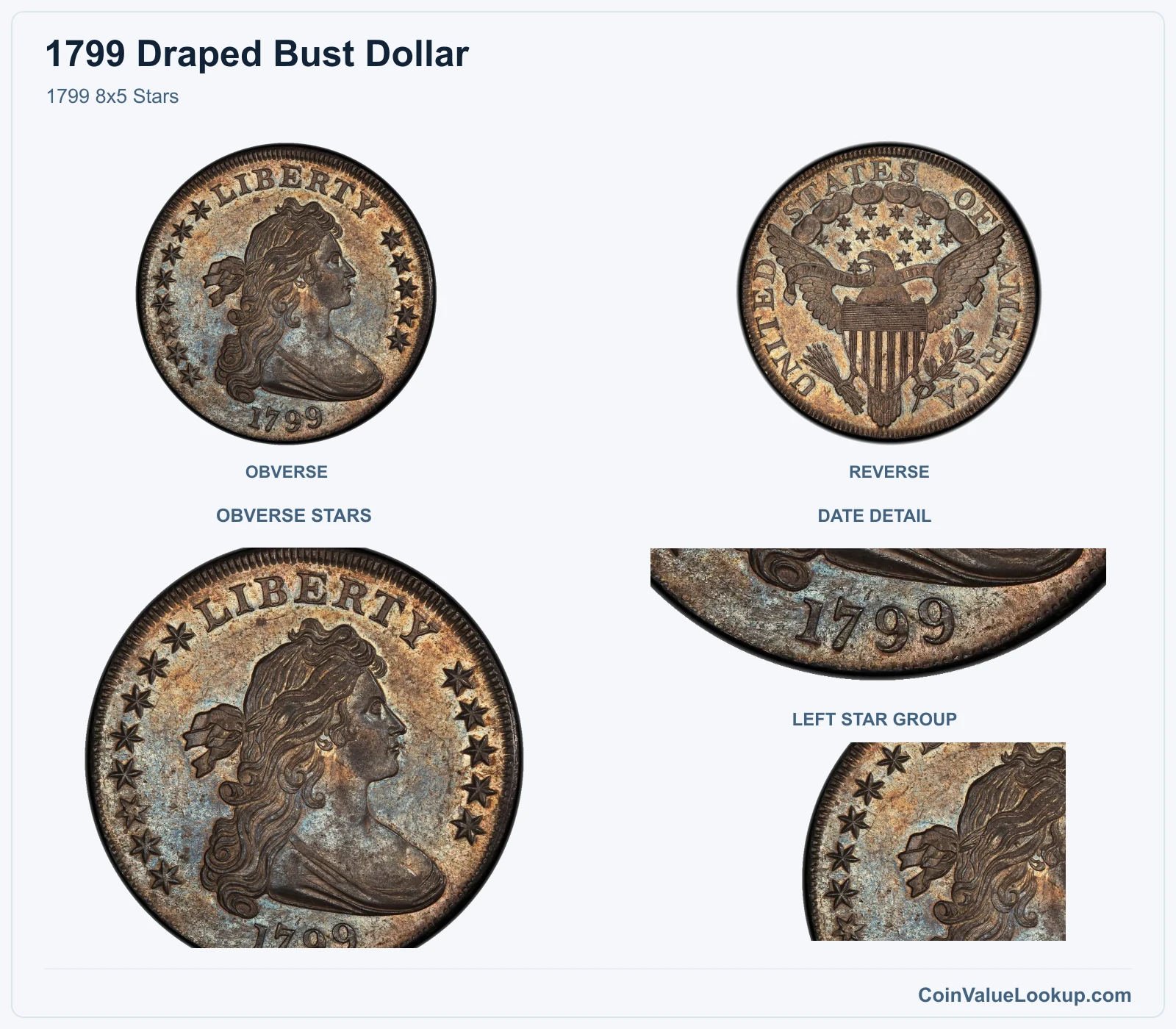
The 8×5 Stars variety arranges its obverse stars eight to the left of Liberty and five to the right. Most other 1799 varieties use a 7×6 split, so this one is straightforward to identify — just count.
Philadelphia struck this in the standard silver-copper alloy at roughly 26.96 grams with a lettered edge. USA Coin Book estimates range from about $1,382 in Good-4 to $604,227 in MS65.
When checking star counts, watch for rim wear that might partially obscure a star. A loupe and good lighting help.
This version is the normal-date companion to the irregular-date varieties, so confirm the date numerals are evenly spaced before settling on this attribution.
Range Grade
Price Auction Records Appraisal PO PO 1
—
Coin Identifier FR FR 2
—
Coin Identifier AG AG 3
—
Coin Identifier G G 4
Coin Identifier
G 6
—
Coin Identifier VG VG 8
Coin Identifier
VG 10
Coin Identifier F F 12
Coin Identifier
F 15
Coin Identifier VF VF 20
Coin Identifier
VF 25
Coin Identifier
VF 30
Coin Identifier
VF 35
Coin Identifier XF XF 40
Coin Identifier
XF 45
Coin Identifier AU AU 50
Coin Identifier
AU 53
Coin Identifier
AU 55
Coin Identifier
AU 58
Coin Identifier MS MS 60
—
Coin Identifier
MS 61
Coin Identifier
MS 62
—
Coin Identifier
MS 63
—
Coin Identifier
MS 64
Coin Identifier
MS 65
—
—
—
MS 66
—
—
—
MS 67
—
—
—
MS 68
—
—
—
MS 69
—
—
—
MS 70
—
—
—
1799 Draped Bust Dollar — /8 15 Reverse Stars
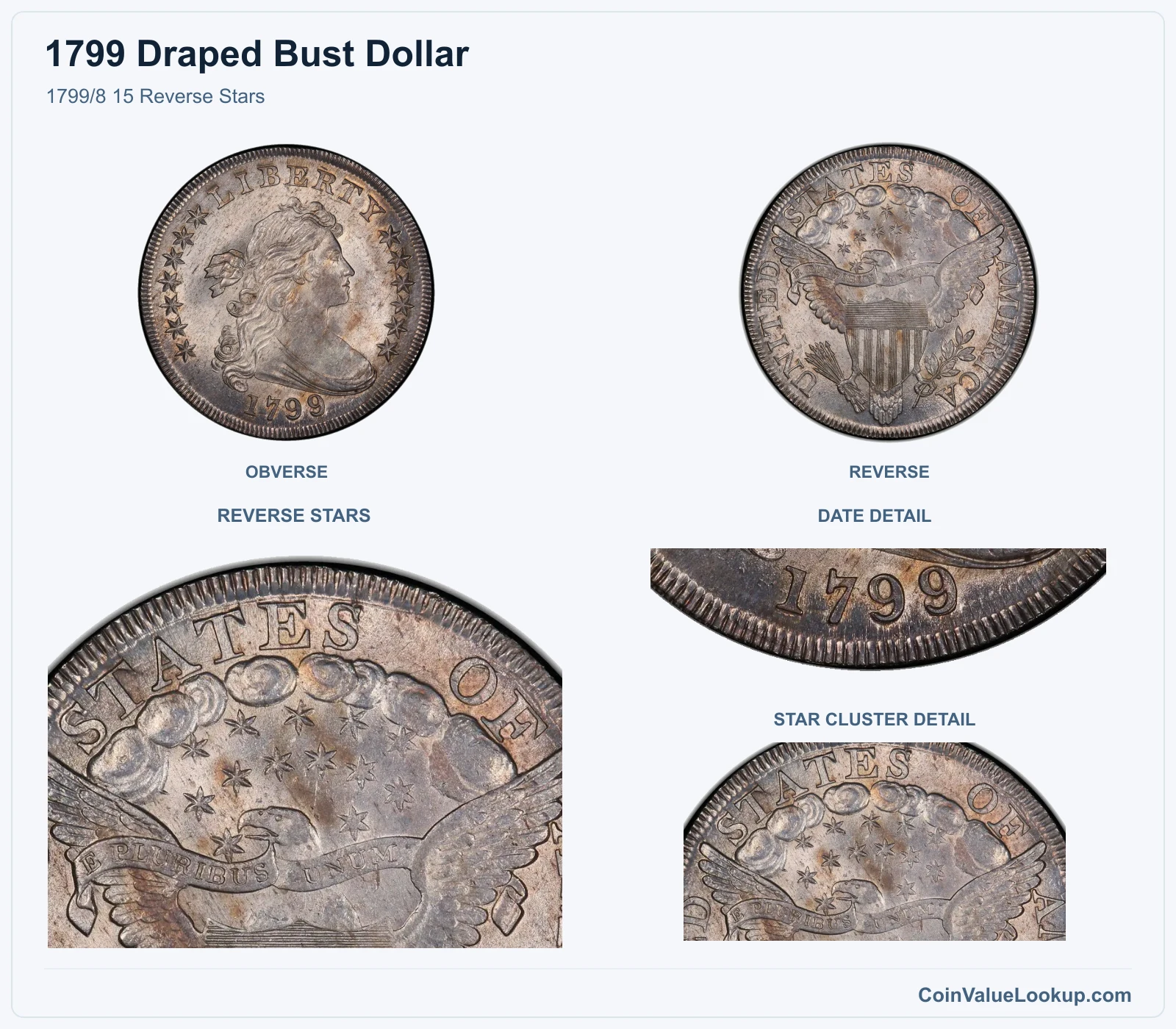
The 1799/8 overdate is one of the more dramatic varieties in the series. Beneath the final 9 in the date you can see remnants of an underlying 8, evidence that an older die was re-punched with the new date.
This particular version pairs the overdate obverse with a reverse carrying 15 stars around the eagle.
USA Coin Book guide estimates start at about $1,334 in Good-4 and reach $604,227 at MS65. The overdate detail can be difficult to see on heavily worn coins, so use magnification and angled light.
Count the reverse stars carefully — the distinction between the 15-star and 13-star reverse is what separates this version from its sibling. Both the overdate trace and the correct star total are necessary for proper attribution.
Range Grade
Price Auction Records Appraisal PO PO 1
—
Coin Identifier FR FR 2
—
Coin Identifier AG AG 3
—
Coin Identifier G G 4
Coin Identifier
G 6
Coin Identifier VG VG 8
Coin Identifier
VG 10
Coin Identifier F F 12
Coin Identifier
F 15
Coin Identifier VF VF 20
Coin Identifier
VF 25
Coin Identifier
VF 30
Coin Identifier
VF 35
Coin Identifier XF XF 40
Coin Identifier
XF 45
Coin Identifier AU AU 50
Coin Identifier
AU 53
Coin Identifier
AU 55
Coin Identifier
AU 58
Coin Identifier MS MS 60
—
Coin Identifier
MS 61
Coin Identifier
MS 62
Coin Identifier
MS 63
Coin Identifier
MS 64
Coin Identifier
MS 65
Coin Identifier
MS 66
—
Coin Identifier
MS 67
—
—
—
MS 68
—
—
—
MS 69
—
—
—
MS 70
—
—
—
1799 Draped Bust Dollar — /8 13 Reverse Stars
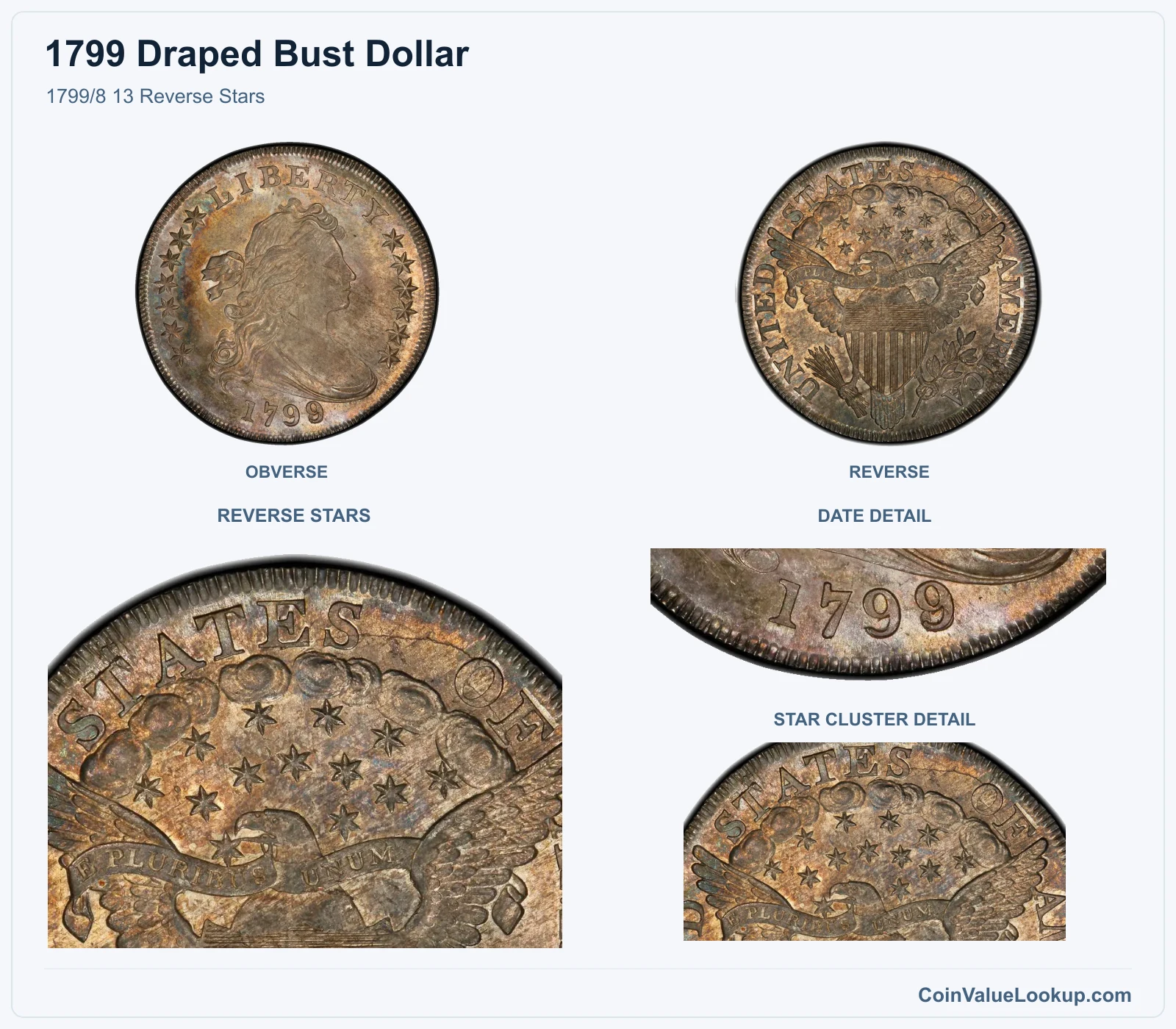
This is the other overdate variety: 1799/8 with only 13 reverse stars. Like the 15-star overdate, the last digit of the date shows clear traces of a prior 8 beneath the 9.
The key difference is the reverse. Instead of 15 stars around the Heraldic Eagle, this die carries 13.
That single distinction separates two different die pairings and potentially different market perceptions.
USA Coin Book estimates place this version at approximately $1,334 in Good-4 and up to $604,227 in MS65. Original surfaces and sharp overdate visibility are both important to value.
A coin with the overdate worn nearly flat will be harder to attribute and may not command the same confidence from buyers.
Range Grade
Price Auction Records Appraisal PO PO 1
—
Coin Identifier FR FR 2
—
Coin Identifier AG AG 3
Coin Identifier G G 4
Coin Identifier
G 6
—
Coin Identifier VG VG 8
Coin Identifier
VG 10
Coin Identifier F F 12
Coin Identifier
F 15
Coin Identifier VF VF 20
Coin Identifier
VF 25
Coin Identifier
VF 30
Coin Identifier
VF 35
Coin Identifier XF XF 40
Coin Identifier
XF 45
Coin Identifier AU AU 50
Coin Identifier
AU 53
Coin Identifier
AU 55
Coin Identifier
AU 58
Coin Identifier MS MS 60
—
Coin Identifier
MS 61
Coin Identifier
MS 62
Coin Identifier
MS 63
Coin Identifier
MS 64
Coin Identifier
MS 65
—
Coin Identifier
MS 66
—
—
—
MS 67
—
—
—
MS 68
—
—
—
MS 69
—
—
—
MS 70
—
—
—
1799 Draped Bust Dollar Error List
1. 1799 Draped Bust Dollar — Broadstrike
A broadstrike occurs when the coin is struck without the normal restraining collar, allowing metal to spread outward beyond the standard diameter. On an 1799 Draped Bust Dollar, this produces a coin that looks slightly wider than normal with design elements pushed toward or past where the rim should be.
The edge lettering may be weak or distorted.
This error has been reported on the 1799 Philadelphia issue. To distinguish a genuine broadstrike from post-mint damage, check that the design is complete but expanded uniformly — a coin flattened by a vise or hammer after leaving the mint usually shows uneven distortion and surface damage.
An off-center strike, by contrast, shifts the design and leaves a blank crescent.
No adopted price range is available for this error. Value depends on the degree of collar absence, the coin's grade, and surface preservation.
2. 1799 Draped Bust Dollar — Die Crack / Die Chip
Die cracks appear as thin raised lines on the coin's surface, formed when the steel die developed fractures during use. On the 1799 Draped Bust Dollar, die cracks have been documented at various stages of die deterioration, with earlier states showing less-advanced cracking.
These raised lines follow straight or gently curving paths and are part of the coin's metal — they will not scrape off. That is how you separate them from incuse scratches (which are recessed into the surface), corrosion trails, or debris stuck to the coin.
A small raised blob rather than a line points to a die chip, which is related but distinct.
No specific price range is adopted for this error. The size, location, and visual impact of the crack all influence collector interest, as does the coin's overall condition.
3. 1799 Draped Bust Dollar — Die Break / Cud
A die break — sometimes called a cud when it connects to the rim — occurs when a chunk of the die literally breaks away. The result is a raised, featureless blob on the coin where the missing die piece no longer imparts design detail.
Rim-connected cuds are the most recognized form.
On the 1799 Draped Bust Dollar, die breaks have been documented across different die states. Look for a raised, flat or slightly rounded area that displaces part of the normal design.
The boundary between the cud and the intact design should be sharp and consistent with a fracture line.
Do not confuse a cud with a rim ding (which is depressed, not raised), surface corrosion, or an interior die chip that does not reach the rim. No adopted price range is available.
Value depends on the break's size, location, and the coin's overall grade.
4. 1799 Draped Bust Dollar — Clashed Dies
Clashed dies happen when the obverse and reverse dies strike each other without a planchet between them. The impact transfers faint mirror-image impressions of one die's design onto the other.
On the resulting coins you can see ghostly outlines — often parts of Liberty's portrait on the reverse or traces of the eagle on the obverse — that do not belong there.
For the 1799 Draped Bust Dollar, clashed dies have been documented on specific obverse dies used across multiple die pairings. Some of those dies were later relapped (lightly resurfaced) to remove the clash marks, so the strength of remaining traces varies.
These ghost impressions will align with the expected position of the opposing design. Random scratches, raised lines from die cracks, or brockage transfers will not show that consistent alignment.
No adopted price is available for this error; value depends on how visible the clash marks are and the coin's overall condition.