1848 Liberty Seated Dollar Coin Value: How Much Is It Worth?
The 1848 Liberty Seated Dollar is a scarce early silver dollar that draws serious collector attention. Guide estimates for business-strike examples range from roughly $652 in Good-4 condition to around $11,522 in MS63, according to USA Coin Book.
A proof version also exists for this year, though no numeric guide price is currently adopted for it. Before assigning any value, you need to confirm the mint, finish and design of your specific coin.
Fast Way to Identify Your 1848 Liberty Seated Dollar
Want a quick read on what you have? Upload clear photos of the front and back of your 1848 Liberty Seated Dollar.
Our identifier can offer a preliminary identification of the version and general condition based on those images. It is not a substitute for professional authentication or precise grading, but it gives you a solid starting point.
1848 Liberty Seated Dollar Value
Upload both sides of your 1848 Liberty Seated Dollar.
Front Obverse
Upload photo
Back Reverse
Upload photo
Which 1848 Liberty Seated Dollar Versions Are Worth Money?
- The 1848 Proof is a special manufacturing finish worth confirming through professional authentication, as proof Seated Dollars from this era are genuinely rare.
- Business strikes in high grades like MS63 carry guide estimates near $11,522, making original-surface uncirculated examples the ones to watch for.
Step 1: Identify Your 1848 Liberty Seated Dollar Mint Mark and Version
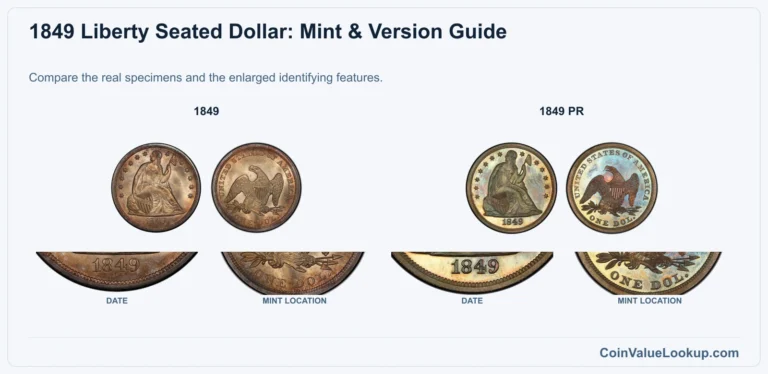
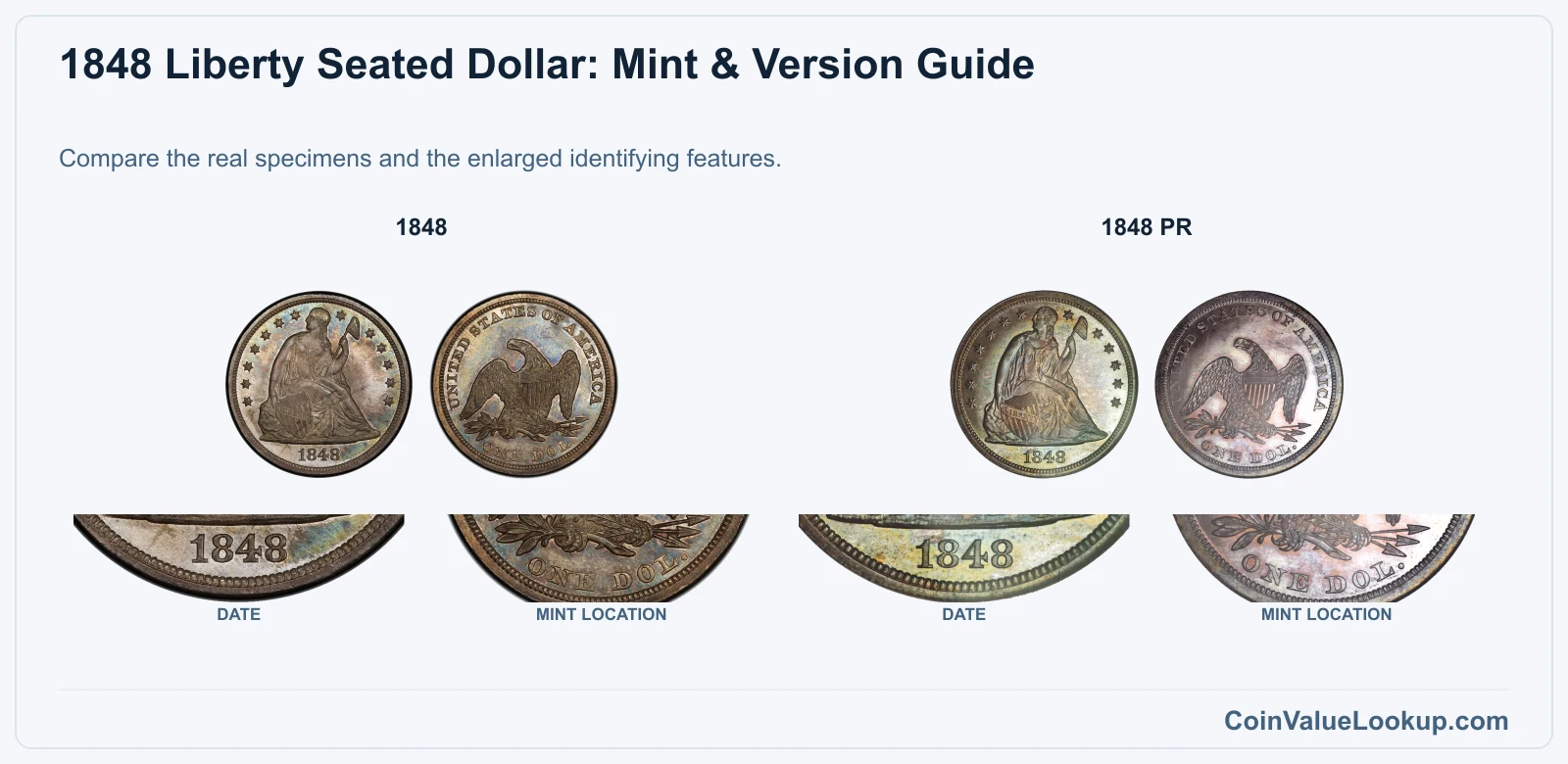
The 1848 dollar was struck at Philadelphia only, so there is no mintmark on genuine examples. On branch-mint Seated Dollars from other years, a small letter appears on the reverse below the eagle and above the ONE DOL.
denomination. No letter means Philadelphia.
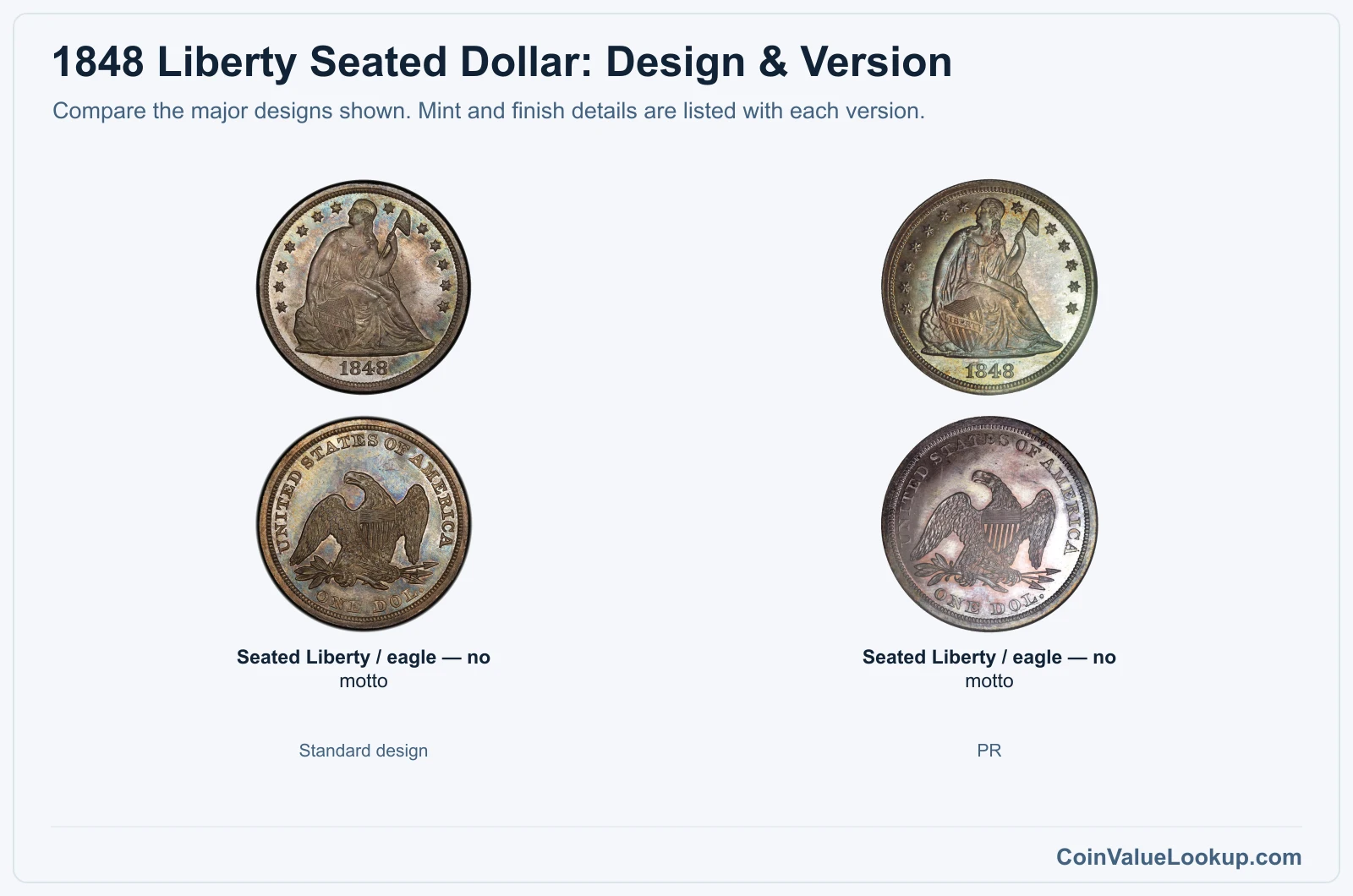
The design shows a seated Liberty figure on the obverse holding a pole with a cap, backed by a shield. The reverse features a spread eagle clutching arrows and an olive branch.
This particular year uses the no-motto reverse, meaning no banner of text appears above the eagle.
The coin is composed of 90% silver and 10% copper, with a nominal weight of 26.73 grams. If yours feels significantly lighter or doesn't ping like silver, that warrants further investigation.
Two collectible branches exist for 1848: the regular business strike and the proof finish. The proof is a deliberately manufactured mirror-finish coin, not just a well-preserved regular strike.
Distinguishing the two matters enormously for value.
Step 2: Check Your 1848 Liberty Seated Dollar Grade
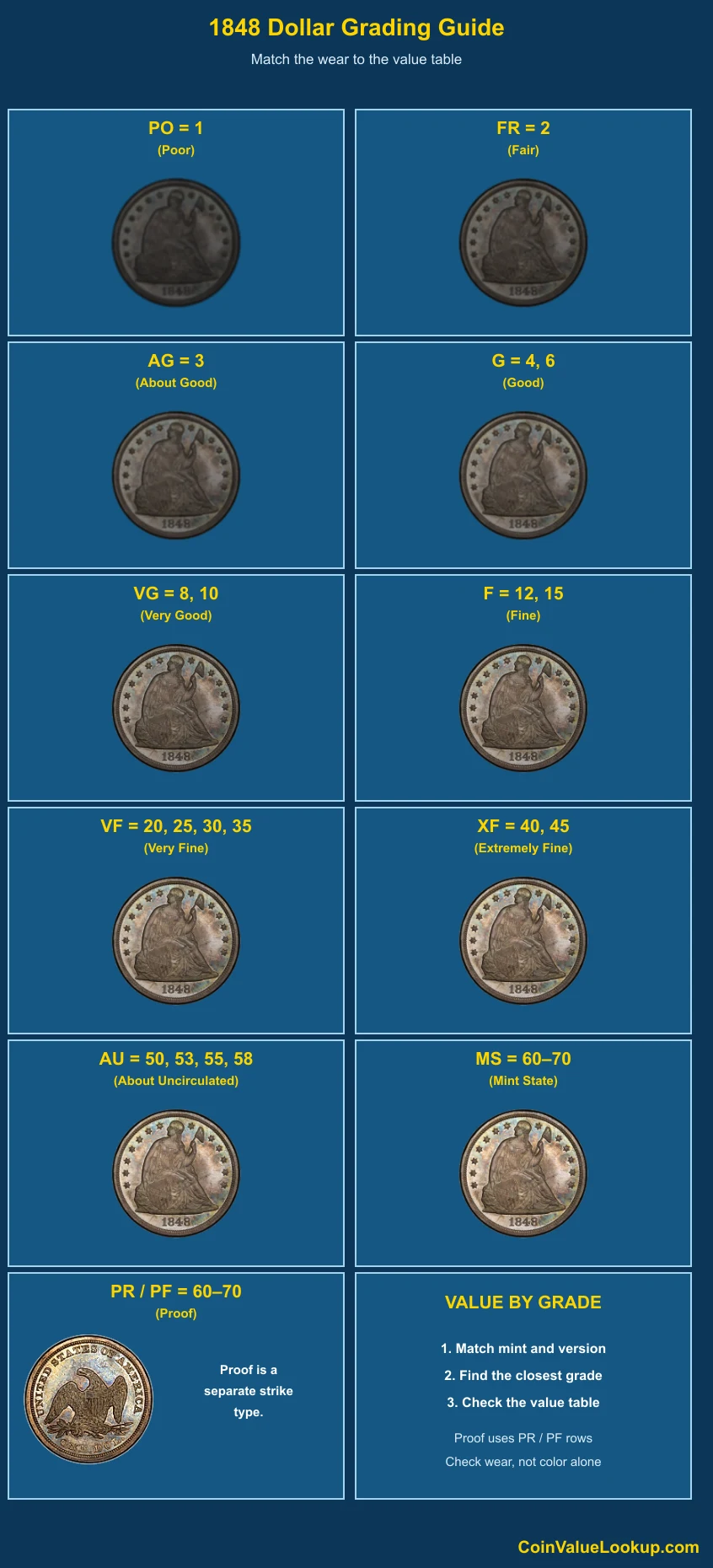
Start with the obverse. Liberty's head, the details on her breast, and the knee area wear first on circulated coins.
The shield in her left hand also loses definition early. On lightly worn pieces around AU, you will see faint friction on the high points but most original luster should survive in protected areas.
Flip to the reverse. The eagle's breast feathers and wing tips are the first casualties of circulation.
A coin grading Good-4 will show a flat eagle with only an outline visible, while an MS63 should have full feather detail, moderate luster and only light contact marks.
Do not judge strike weakness as wear. Some Seated Dollars came off the press with a soft head or incomplete stars, and that is a manufacturing trait, not evidence of circulation.
Compare your coin to a genuine same-type grading image that separates circulated, AU and Mint State examples from proof finishes, since proofs have a completely different surface character.
Cleaned or polished coins will look artificially bright with hairline scratches visible under a light. These pieces grade lower than their detail level suggests and sell for less than original-surface examples.
Step 3: Check 1848 Liberty Seated Dollar Value by Mint and Version
1848 Liberty Seated Dollar
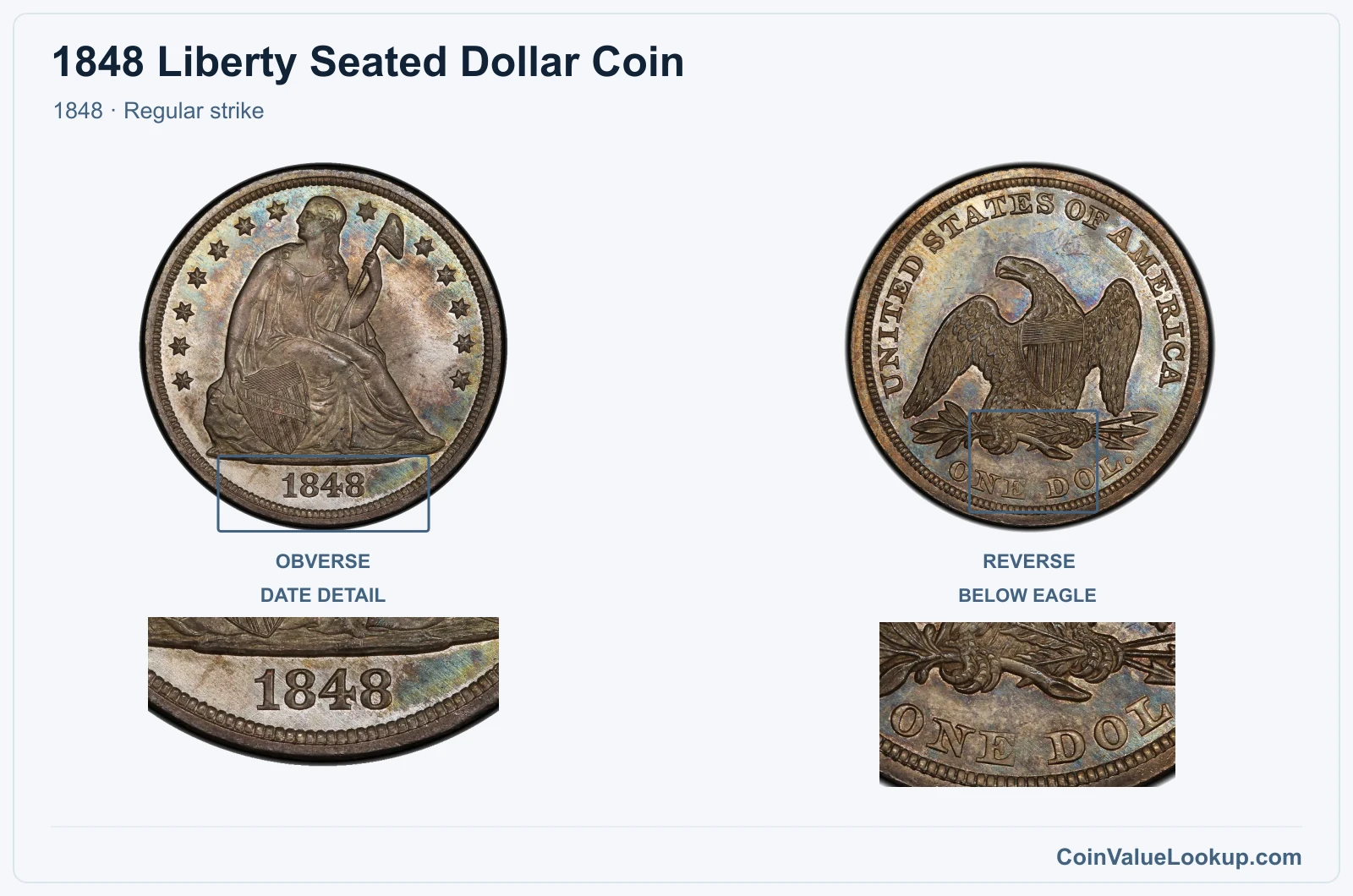
The 1848 business strike was produced at Philadelphia with no mintmark. It features the Seated Liberty obverse and no-motto eagle reverse, struck in 90% silver at a nominal 26.73 grams.
Guide estimates from USA Coin Book place a Good-4 example at about $652 and an MS63 at approximately $11,522. These are reference points, not guaranteed sale prices.
Original surfaces matter here. A coin with natural toning and no evidence of cleaning will always command stronger interest than one that has been polished or dipped.
Confirm the design, weight and lack of mintmark before comparing grade to a price chart.
Coin Value Lookup is a handy starting point if you want to look up guides for other dates and denominations in this series.
Range Grade
Price Auction Records Appraisal PO PO 1
—
Coin Identifier FR FR 2
—
Coin Identifier AG AG 3
—
Coin Identifier G G 4
—
Coin Identifier
G 6
Coin Identifier VG VG 8
Coin Identifier
VG 10
Coin Identifier F F 12
Coin Identifier
F 15
—
Coin Identifier VF VF 20
—
Coin Identifier
VF 25
Coin Identifier
VF 30
Coin Identifier
VF 35
Coin Identifier XF XF 40
Coin Identifier
XF 45
Coin Identifier AU AU 50
Coin Identifier
AU 53
Coin Identifier
AU 55
Coin Identifier
AU 58
Coin Identifier MS MS 60
Coin Identifier
MS 61
Coin Identifier
MS 62
Coin Identifier
MS 63
Coin Identifier
MS 64
Coin Identifier
MS 65
—
Coin Identifier
MS 66
—
Coin Identifier
MS 67
—
—
—
MS 68
—
—
—
MS 69
—
—
—
MS 70
—
—
—
1848 Liberty Seated Dollar — PR
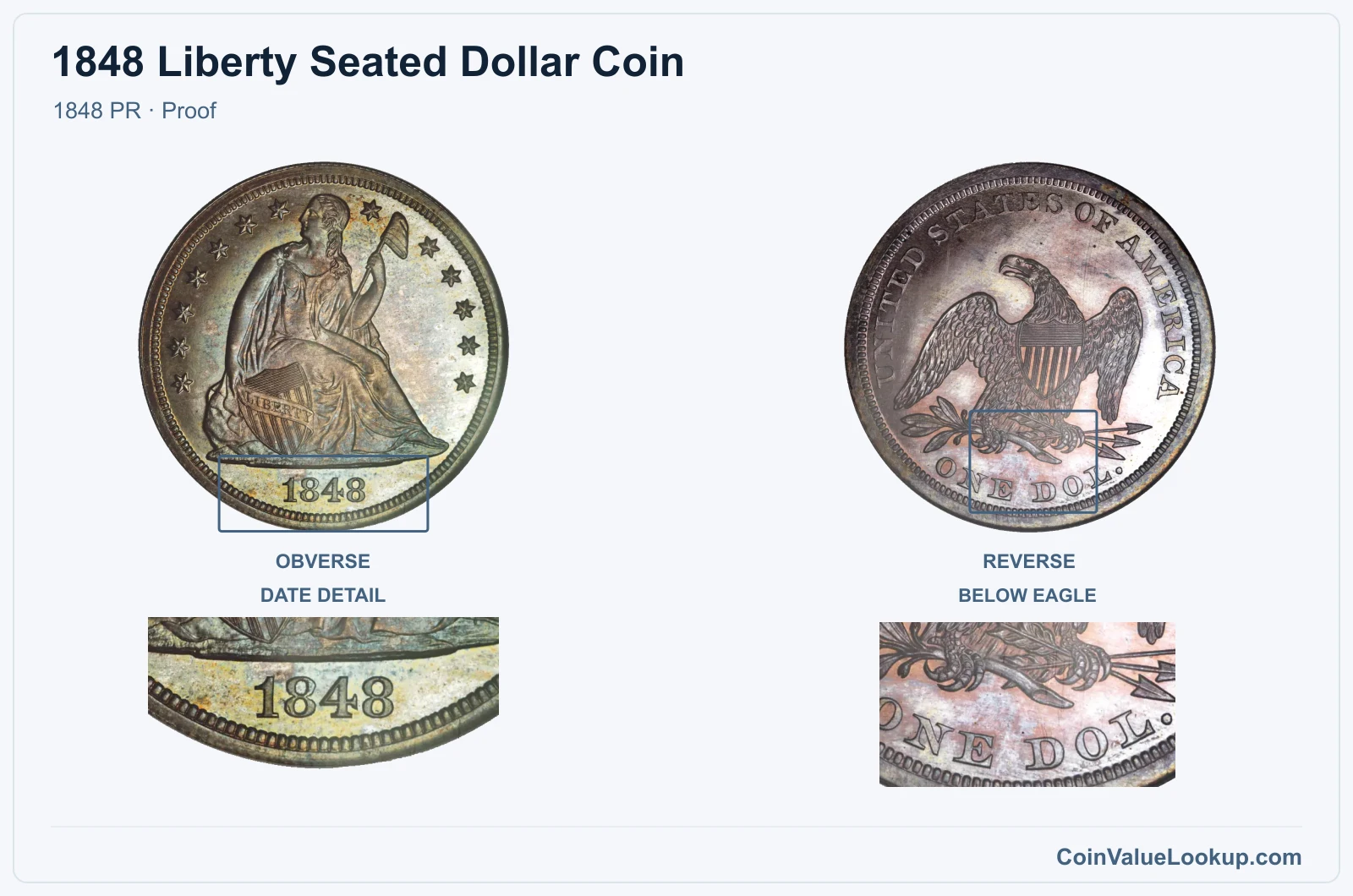
The 1848 Proof is a Philadelphia issue struck with specially prepared dies and polished planchets, producing mirror-like fields. A proof is a manufacturing finish, not simply a shiny or high-grade regular coin.
The composition and weight match the business strike: 90% silver, 10% copper, 26.73 grams.
No numeric guide price is currently adopted for this version, so value depends heavily on individual assessment by authenticated identity and condition. Professional third-party authentication is essential here because genuine proof Seated Dollars of this era are rare, and misattributed coins circulate in the market.
Look for squared, sharply defined rims and deeply mirrored fields as basic indicators of a proof finish. If those features are absent, you likely have a high-grade business strike rather than a proof.
Range Grade
Price Auction Records Appraisal PR PR 1
—
Coin Identifier
PR 2
—
Coin Identifier
PR 3
—
Coin Identifier
PR 4
—
Coin Identifier
PR 6
—
Coin Identifier
PR 8
—
Coin Identifier
PR 10
—
Coin Identifier
PR 12
—
Coin Identifier
PR 15
—
Coin Identifier
PR 20
—
Coin Identifier
PR 25
—
Coin Identifier
PR 30
—
Coin Identifier
PR 35
—
Coin Identifier
PR 40
—
Coin Identifier
PR 45
—
Coin Identifier
PR 55
Coin Identifier
PR 58
—
Coin Identifier
PR 60
—
Coin Identifier
PR 61
—
Coin Identifier
PR 62
Coin Identifier
PR 63
—
Coin Identifier
PR 64
Coin Identifier
PR 65
—
Coin Identifier
PR 66
Coin Identifier
PR 67
Coin Identifier
PR 68
—
—
—
PR 69
—
—
—
PR 70
—
—
—