1867 Liberty Seated Dollar Coin Value: How Much Is It Worth?
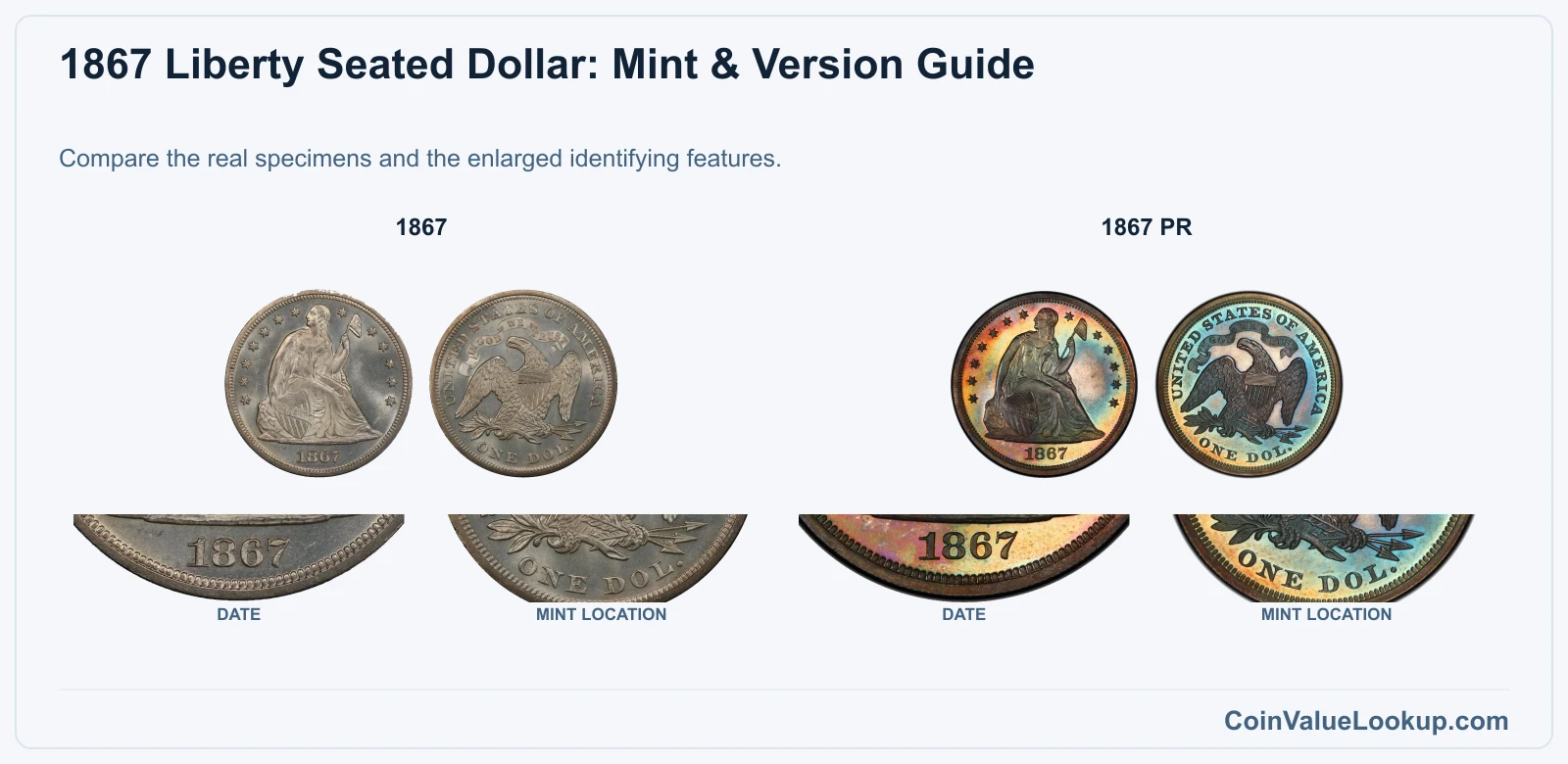
The 1867 Liberty Seated Dollar is a scarce late-series issue that draws attention from silver dollar collectors. Guide estimates for business strikes range from roughly $567 in Good-4 condition to around $7,372 in MS63, according to USA Coin Book.
Proof examples also exist for this date but require individual assessment based on authenticated identity and condition.
Before you assign a value, you need to confirm the mint, finish and whether any die variety is present. A cleaned or polished coin will not compare favorably to one with original surfaces, and a proof is a specific manufacturing finish, not just a shiny coin.
Read on to sort out exactly what you have.
Fast Way to Identify Your 1867 Liberty Seated Dollar
The quickest way to start figuring out what your 1867 Liberty Seated Dollar is worth is to upload clear photos of both the front and back of your coin. Our identifier can provide a preliminary identification of mint, design type and finish based on those images.
That first step helps you narrow down which version you are dealing with before diving into condition and variety details.
1867 Liberty Seated Dollar Value
Upload both sides of your 1867 Liberty Seated Dollar.
Front Obverse
Upload photo
Back Reverse
Upload photo
Which 1867 Liberty Seated Dollar Versions Are Worth Money?
- The 1867 Proof (PR) is a distinct collectible finish that requires authentication; it has no adopted guide price and value depends on individual condition and verification.
- The 1867 business strike in high grade (MS63) can reach around $7,372 per USA Coin Book guide estimates, making uncirculated survivors far more valuable than worn examples.
- A repunched date variety (Large over Small Date) exists for 1867 and can add a premium when confirmed, though no specific price is adopted.
- Do not pay a premium for ordinary wear, cleaning, plating, glare or an unverified error claim.
Step 1: Identify Your 1867 Liberty Seated Dollar Mint Mark and Version
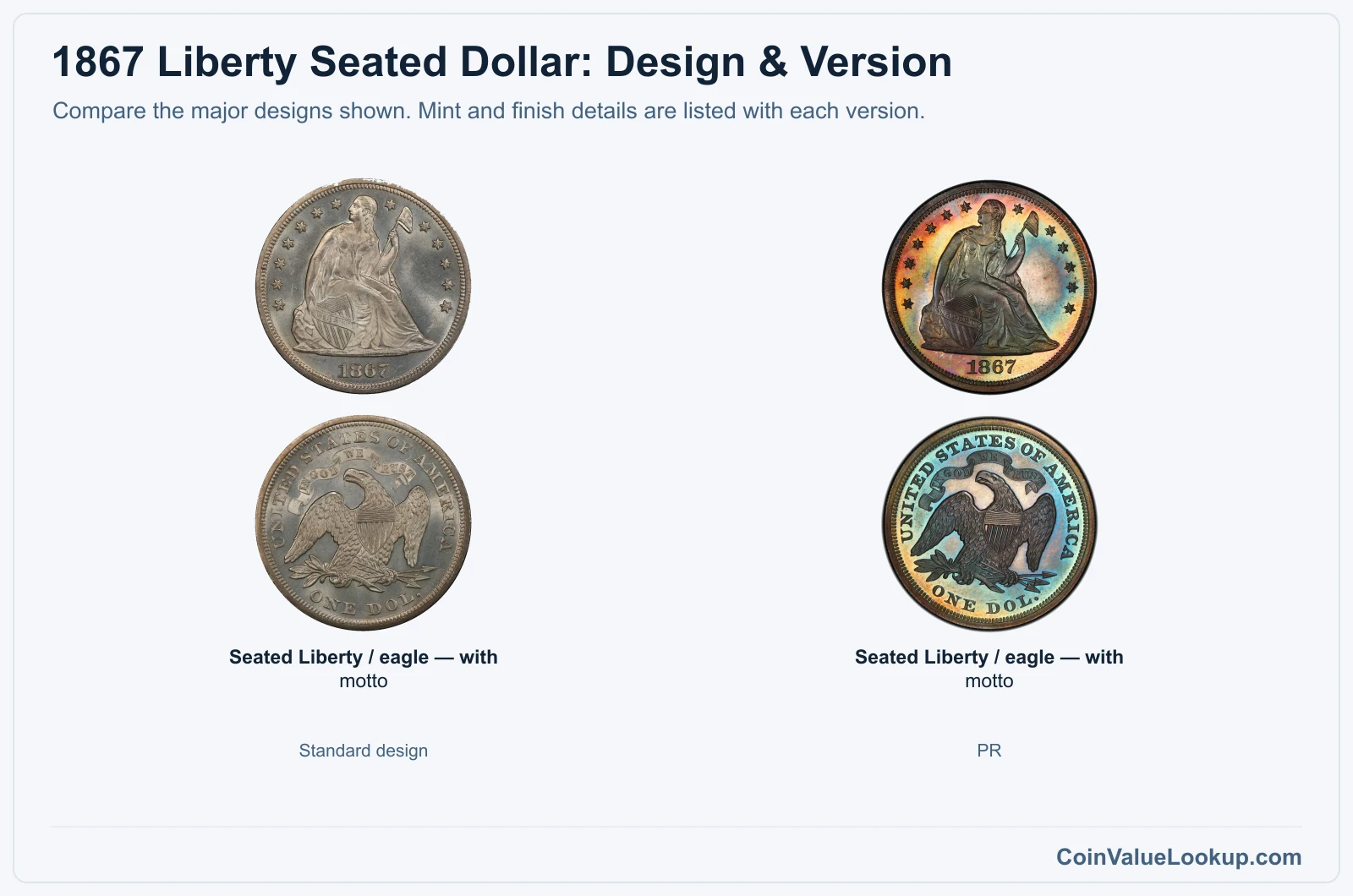
The 1867 Liberty Seated Dollar was struck only at the Philadelphia Mint, so there is no mintmark to hunt for. Branch-mint issues of other years carry a small letter below the eagle on the reverse, just above the ONE DOL.
denomination, but 1867 has none.
The coin is 90% silver and 10% copper, with a nominal weight of 26.73 grams for the 1840–1873 series. If yours feels light or has a wrong ring when tapped, that is a red flag worth investigating.
The obverse shows the Seated Liberty figure holding a pole with a liberty cap. The reverse depicts an eagle with a shield, and this date carries the motto IN GOD WE TRUST on a banner above the eagle, distinguishing it from the earlier no-motto design used before 1866.
Two collectible branches exist for 1867: the regular business strike and the proof. A proof has sharp, squared rims, deeply mirrored fields and was made with specially prepared dies for collectors.
If your coin simply looks shiny from wear or polishing, that does not make it a proof.
Step 2: Check Your 1867 Liberty Seated Dollar Grade
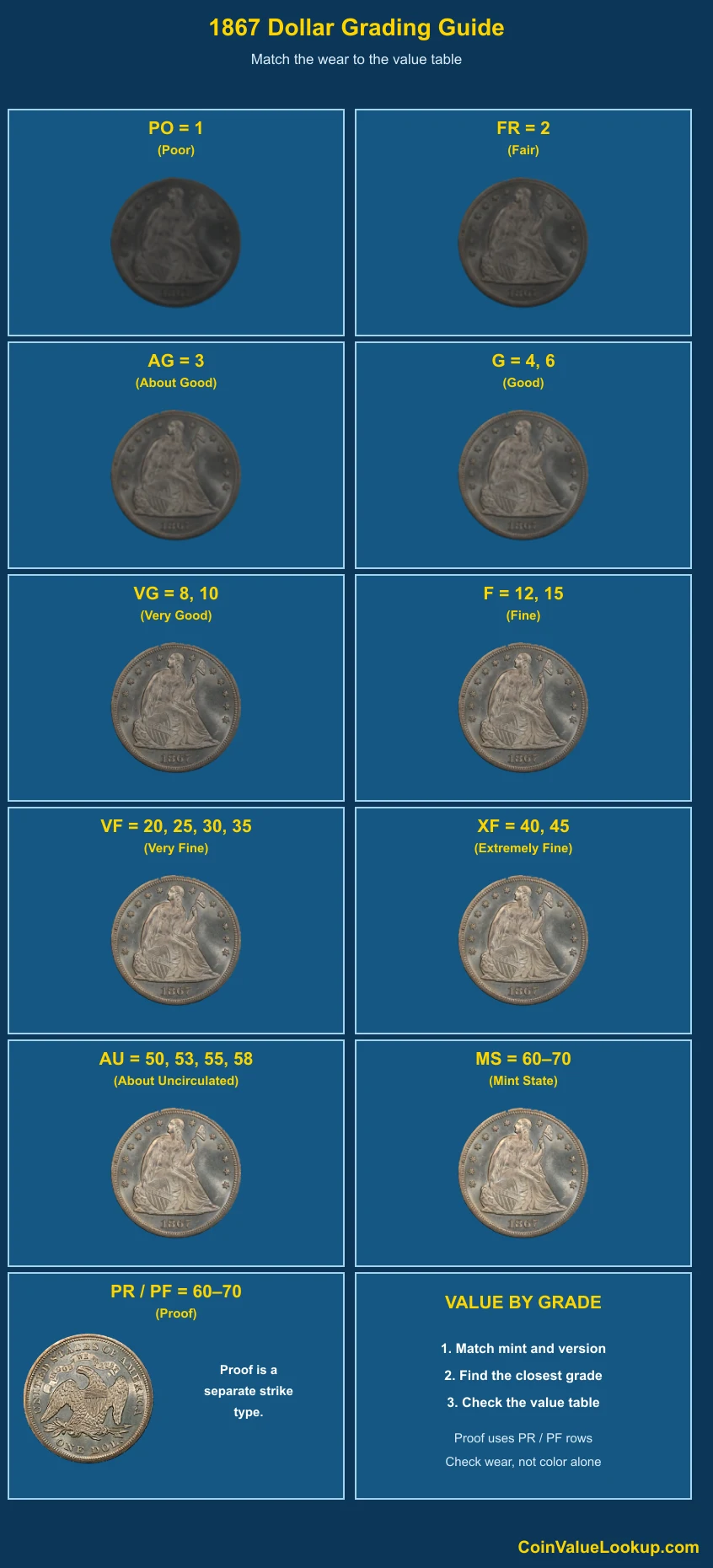
Start by examining the high points of the obverse. Liberty's head, the area across her breast and lap, her knee and the horizontal lines on the shield are the first places to lose detail as a coin circulates.
A coin in Good condition will show a clear outline of Liberty but most interior detail will be worn smooth.
On the reverse, check the eagle's breast feathers and wing tips. These wear in step with the obverse, so a coin with a sharp eagle but a flat Liberty likely has a strike weakness on one side rather than even wear.
Do not grade a weakly struck head in isolation. Some Seated Dollar dies produced soft strikes on the head or stars even on otherwise unworn coins.
Compare your coin to the same-type grading image to see how circulated, About Uncirculated and Mint State examples differ in luster and detail retention.
Proof coins should be evaluated separately from business strikes. Mirror fields, frosted devices and the absence of wear distinguish a proof, but hairlines from improper cleaning will lower the effective grade significantly.
Step 3: Check 1867 Liberty Seated Dollar Value by Mint and Version
1867 Liberty Seated Dollar
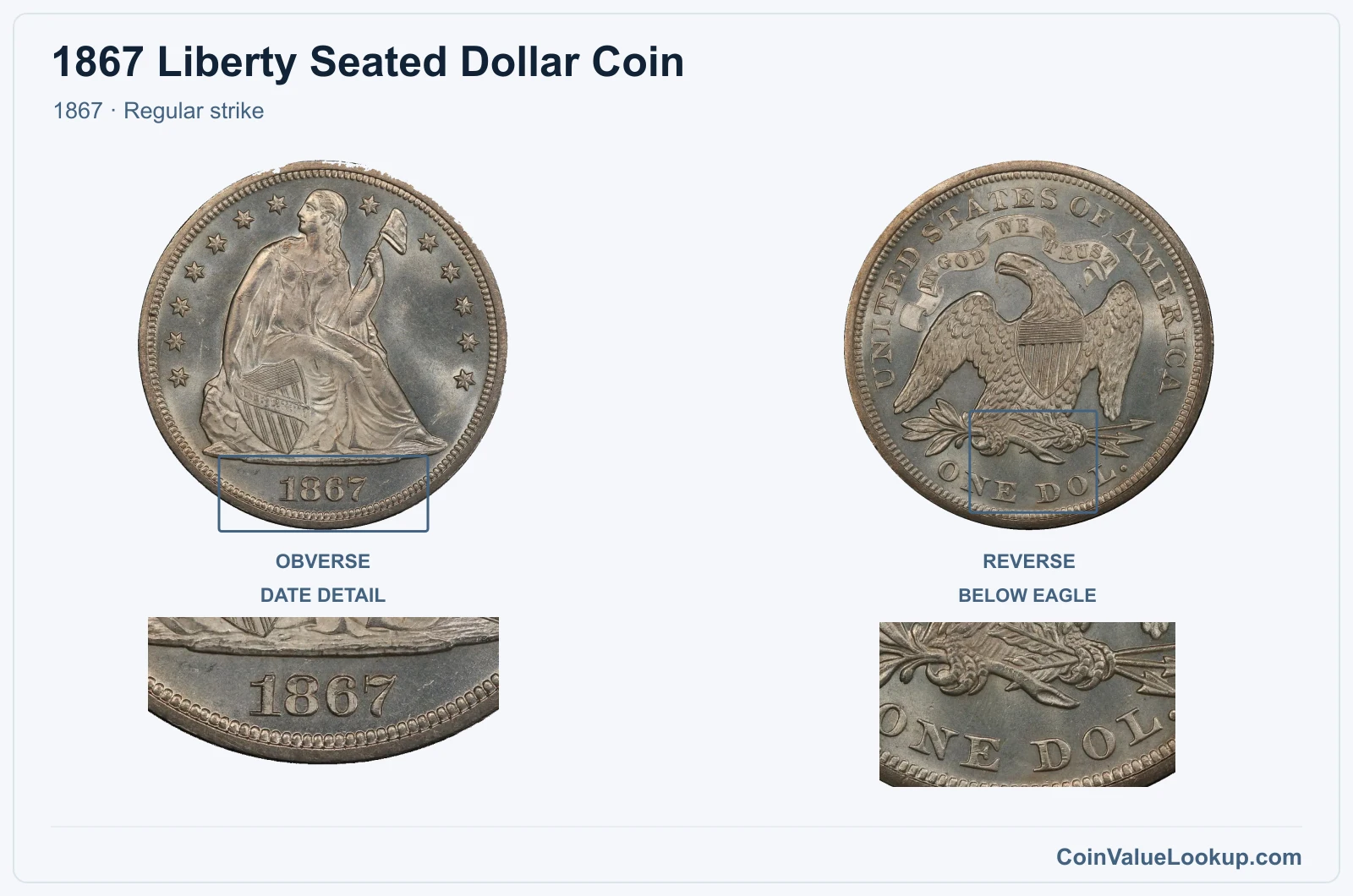
The 1867 business strike was produced at Philadelphia with no mintmark. It features the with-motto reverse design showing IN GOD WE TRUST above the eagle.
The coin is 90% silver and 10% copper at a nominal 26.73 grams.
USA Coin Book guide estimates place this version at about $567 in Good-4 and around $7,372 in MS63. These are guide estimates, not guaranteed sale prices.
The gap between those two figures tells you how much condition matters on this date.
Original surfaces are critical. A coin that has been polished, cleaned or whizzed loses much of its appeal to collectors, even if the underlying detail is strong.
Match the mint, design and variety before comparing grade to any published value.
Range Grade
Price Auction Records Appraisal PO PO 1
—
Coin Identifier FR FR 2
—
Coin Identifier AG AG 3
—
Coin Identifier G G 4
—
Coin Identifier
G 6
—
Coin Identifier VG VG 8
—
Coin Identifier
VG 10
Coin Identifier F F 12
Coin Identifier
F 15
Coin Identifier VF VF 20
Coin Identifier
VF 25
—
Coin Identifier
VF 30
Coin Identifier
VF 35
Coin Identifier XF XF 40
Coin Identifier
XF 45
Coin Identifier AU AU 50
Coin Identifier
AU 53
Coin Identifier
AU 55
Coin Identifier
AU 58
Coin Identifier MS MS 60
Coin Identifier
MS 61
Coin Identifier
MS 62
Coin Identifier
MS 63
Coin Identifier
MS 64
Coin Identifier
MS 65
Coin Identifier
MS 66
—
—
—
MS 67
—
—
—
MS 68
—
—
—
MS 69
—
—
—
MS 70
—
—
—
1867 Liberty Seated Dollar — PR
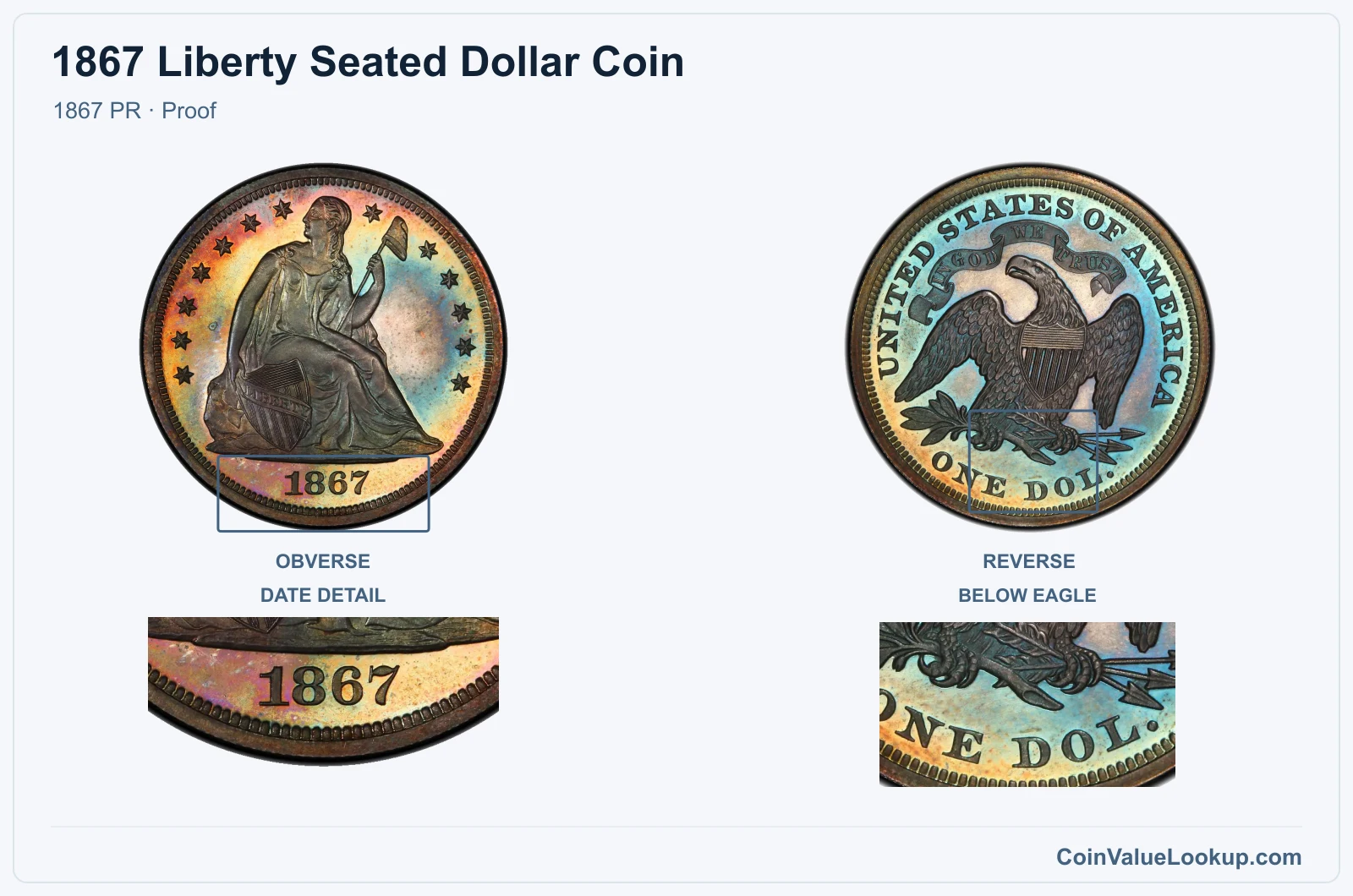
The 1867 Proof was also struck at Philadelphia with no mintmark, sharing the same with-motto Seated Liberty and eagle design. What separates it is the manufacturing process: proof coins were struck on polished planchets with specially prepared dies, producing deeply mirrored fields and crisp detail that business strikes do not display.
No adopted numeric price range is available for this version. Value depends on authenticated identity, the coin's condition including the presence or absence of hairlines, and any die variety.
A proof that has been mishandled or cleaned may still be identifiable as a proof but will command far less than one with original surfaces.
Coin Value Lookup is a useful starting point if you want to look up other Liberty Seated Dollar dates or compare across denominations. Each guide can help you zero in on what matters for your specific coin.
Range Grade
Price Auction Records Appraisal PR PR 1
—
Coin Identifier
PR 2
—
Coin Identifier
PR 3
—
Coin Identifier
PR 4
—
Coin Identifier
PR 6
—
Coin Identifier
PR 8
—
Coin Identifier
PR 10
—
Coin Identifier
PR 12
—
Coin Identifier
PR 15
—
Coin Identifier
PR 20
—
Coin Identifier
PR 25
—
Coin Identifier
PR 30
—
Coin Identifier
PR 35
—
Coin Identifier
PR 40
—
Coin Identifier
PR 45
—
Coin Identifier
PR 50
—
Coin Identifier
PR 53
—
Coin Identifier
PR 55
Coin Identifier
PR 58
Coin Identifier
PR 60
Coin Identifier
PR 61
Coin Identifier
PR 62
Coin Identifier
PR 63
Coin Identifier
PR 64
Coin Identifier
PR 65
Coin Identifier
PR 66
Coin Identifier
PR 67
Coin Identifier
PR 68
Coin Identifier
PR 69
—
—
—
PR 70
—
—
—
1867 Liberty Seated Dollar Error List
1. 1867 Liberty Seated Dollar — Repunched Date
A repunched date variety is reported for the 1867 Liberty Seated Dollar, described as a Large over Small Date. This variety shows remnants of an earlier, smaller date punch beneath or beside the final numerals.
Look carefully at the digits in the date, especially the 6 and 7, for traces of a previous impression that does not align perfectly with the finished numbers.
This is a date-punching variety, not doubling of the entire design. The distinction matters because machine doubling, which is a flat, shelf-like displacement on many design elements, is a much less collectible form of duplication.
Also watch out for simple date damage. Post-mint scratches, corrosion or contact marks near the date can mimic a repunched appearance under magnification.
Genuine repunching will show consistent, rounded remnants that match the style of the original numerals.
No specific price is adopted for this variety. Its value depends on the visibility of the repunching, the coin's overall condition and authentication of the variety itself.
A third-party grading service attribution adds confidence for buyers.