1874 Trade Dollar Coin Value: How Much Is It Worth?
The 1874 Trade Dollar is a heavy silver coin designed for international commerce, and guide estimates for business strikes range from about $232 in well-worn condition up to $6,444 at the MS63 level, depending on mint and grade. That spread is wide because three mints struck these coins, plus a proof finish exists.
Before you assign any value, you need to confirm the mint, finish and whether the surfaces are original or cleaned.
Fast Way to Identify Your 1874 Trade Dollar
The quickest way to start figuring out what you have is to upload clear photos of the front and back of your coin. That lets us provide a preliminary identification of the mint, design type and general condition.
Snap both sides in even, natural light and avoid glare on the silver surfaces — it hides details that matter.
1874 Trade Dollar Value
Upload both sides of your 1874 Trade Dollar.
Front Obverse
Upload photo
Back Reverse
Upload photo
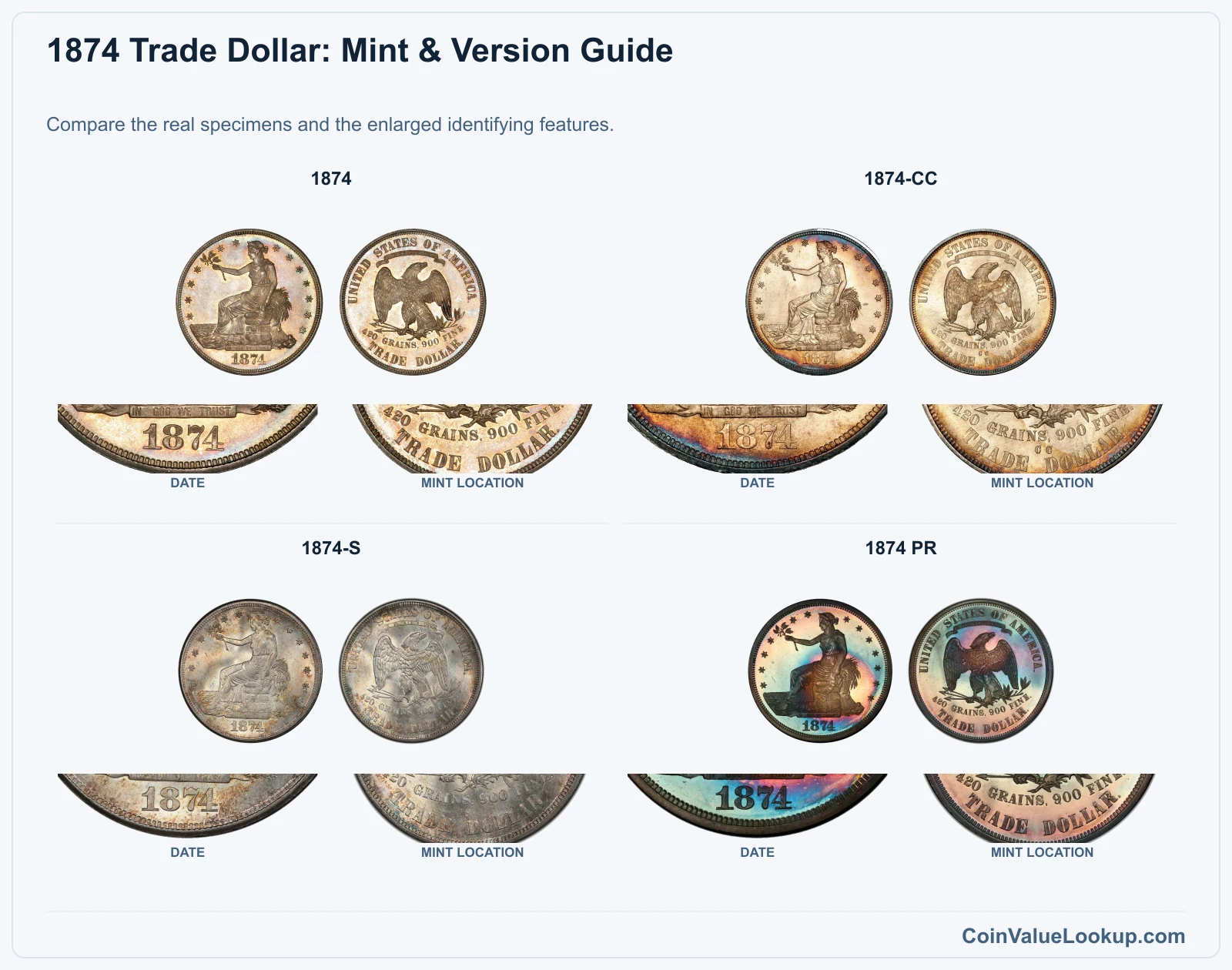
Which 1874 Trade Dollar Versions Are Worth Money?
- 1874 Proof (PR): A proof-finish Trade Dollar struck at Philadelphia — requires authentication since no guide price is adopted here; individual assessment is essential.
- 1874-CC: The Carson City mint issue carries the highest business-strike guide values, with estimates from $383 at G4 to $6,444 at MS63.
Step 1: Identify Your 1874 Trade Dollar Mint Mark and Version
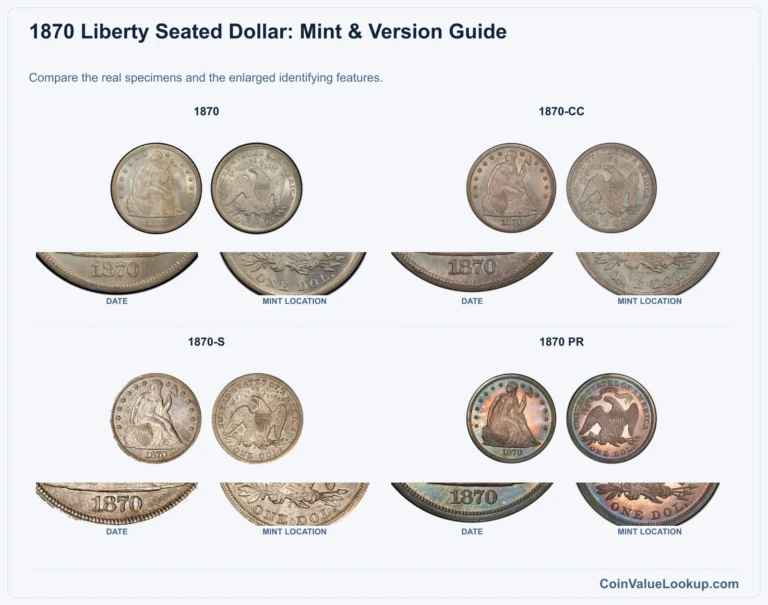
Flip the coin to its reverse and look below the eagle, near the base. A "CC" mintmark means Carson City, an "S" means San Francisco, and no mark at all means Philadelphia.
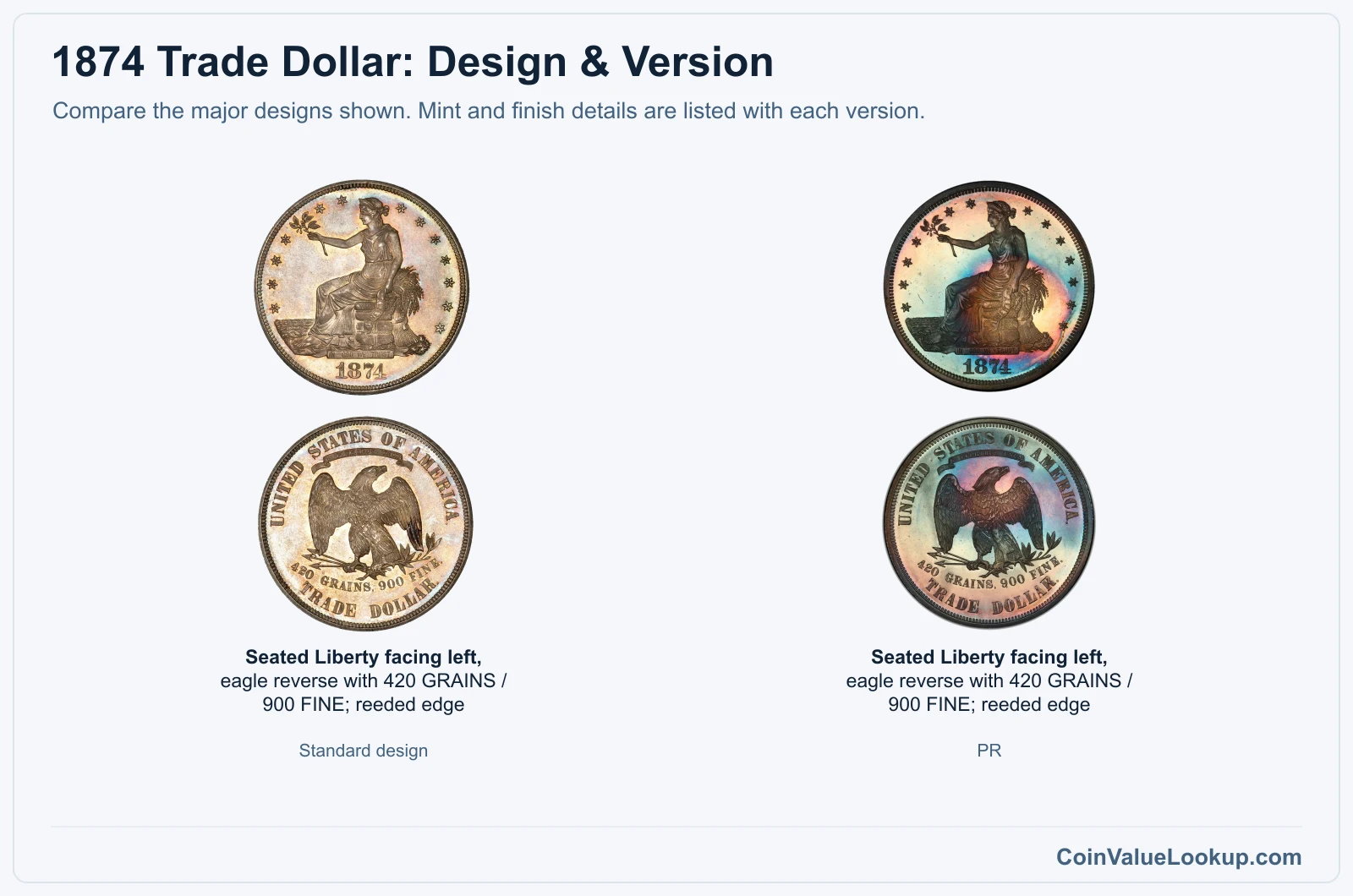
All three mints used the same design: Seated Liberty facing left on the obverse, an eagle clutching arrows and an olive branch on the reverse, with 420 GRAINS and 900 FINE inscribed.
The coin is 90% silver, 10% copper, and weighs 27.22 grams. If it feels light or doesn't ring like silver, be cautious — counterfeits exist in this series.
The edge should be reeded.
You may notice small stamped symbols on the surfaces. Those are chopmarks, applied by Asian merchants to verify silver content.
They are not mint errors and they are not damage in the traditional sense, though they do affect collector value differently than scratches or cleaning would.
Coin Value Lookup is a good starting point if you want to look up guides for other coins in the Trade Dollar series or different denominations entirely. It covers a wide range of U.S. coinage.
Step 2: Check Your 1874 Trade Dollar Grade
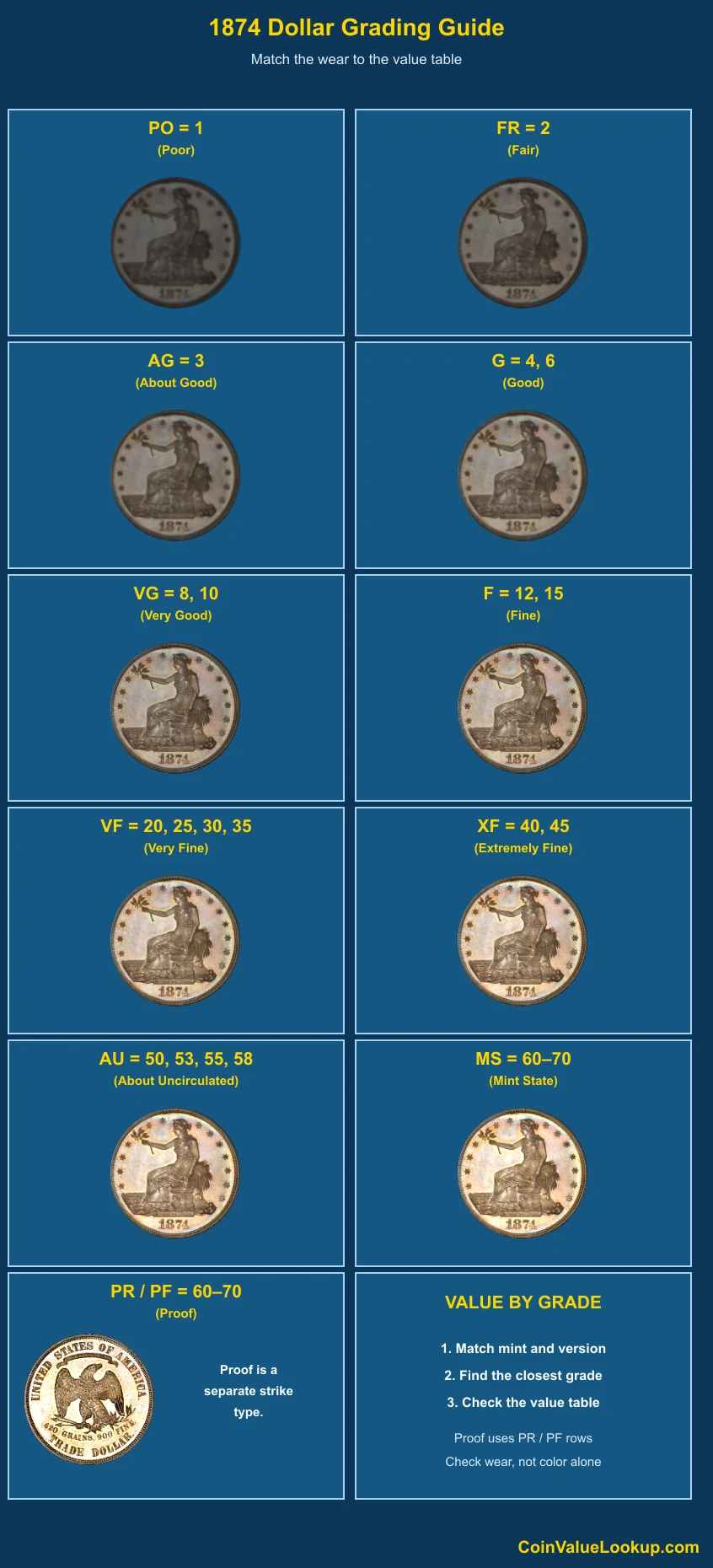
Start with Liberty's head on the obverse — the hair detail above the forehead wears first, followed by the shoulder and the knee of her extended leg. On the reverse, check the eagle's breast feathers and the tops of the wings.
These are the high points that lose detail earliest.
A coin in Good (G4) condition will have a flat, outline-only Liberty and a mostly smooth eagle. At About Uncirculated, you will see just the faintest friction on those high points with most luster intact.
A true Mint State piece has no wear at all, just possible contact marks from other coins.
Use the comparison image to match your coin against circulated, AU and Mint State examples side by side. Evaluate chopmarks, cleaning and outright damage separately from wear — a coin can be technically high grade but still show problems that reduce its market appeal.
Polished or cleaned Trade Dollars trade for significantly less than original-surface examples at the same grade level.
Step 3: Check 1874 Trade Dollar Value by Mint and Version
1874 Trade Dollar
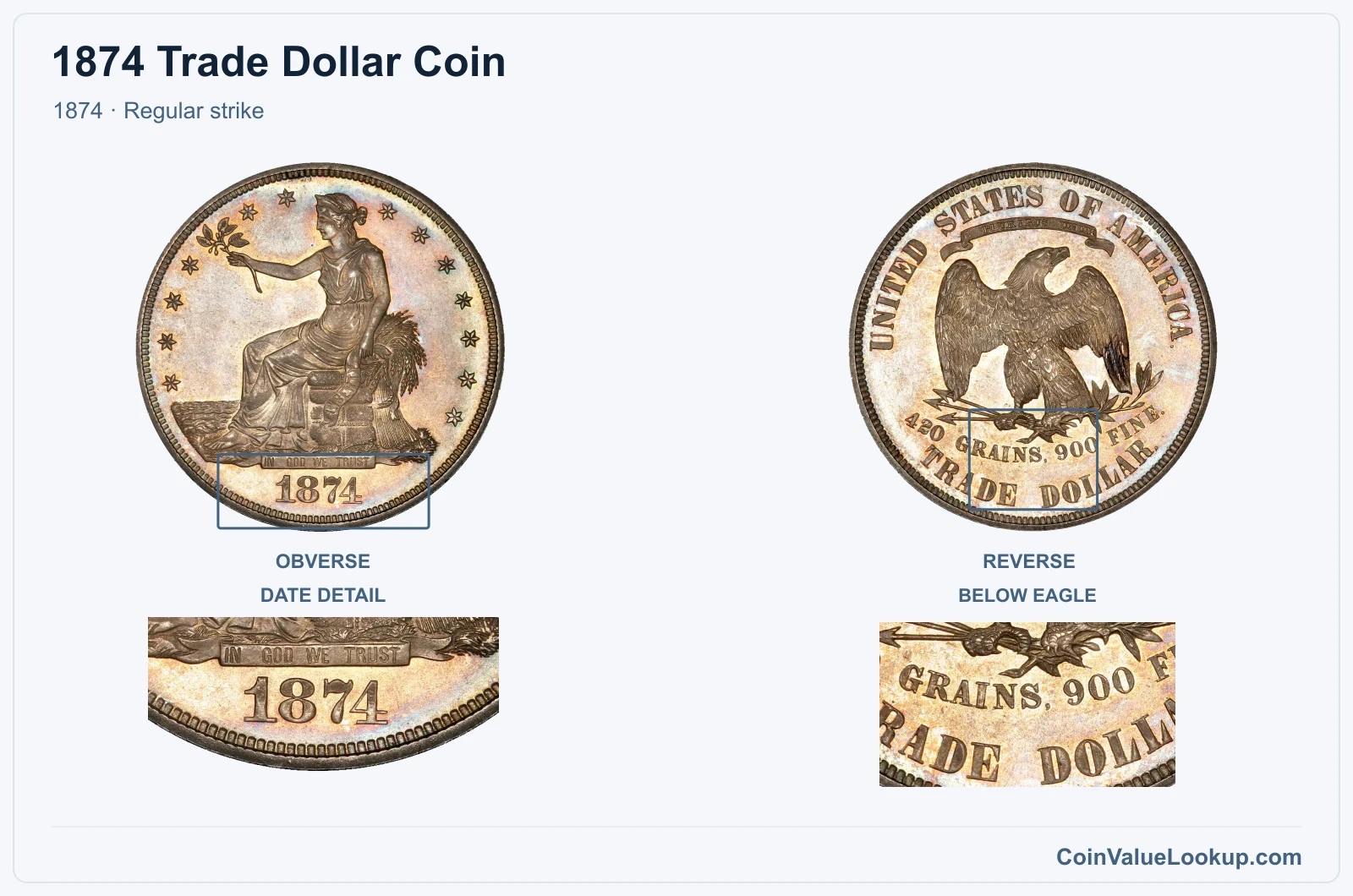
The 1874 Philadelphia Trade Dollar carries no mintmark. Look below the eagle on the reverse to confirm the space is blank.
Guide estimates place this coin at roughly $232 in G4 and around $2,940 at the MS63 level, per USA Coin Book.
Original surfaces matter a lot here. A cleaned or polished example is less comparable to guide values, even if it technically shows little wear.
When examining your coin, pay attention to the obverse ribbon and the hand holding the olive branch, as well as the eagle's arrow details — these help confirm the specific type attribution.
Range Grade
Price Auction Records Appraisal PO PO 1
—
Coin Identifier FR FR 2
—
Coin Identifier AG AG 3
—
Coin Identifier G G 4
—
Coin Identifier
G 6
—
Coin Identifier VG VG 8
—
Coin Identifier
VG 10
—
Coin Identifier F F 12
Coin Identifier
F 15
Coin Identifier VF VF 20
Coin Identifier
VF 25
Coin Identifier
VF 30
—
Coin Identifier
VF 35
—
Coin Identifier XF XF 40
Coin Identifier
XF 45
Coin Identifier AU AU 50
Coin Identifier
AU 53
Coin Identifier
AU 55
Coin Identifier
AU 58
Coin Identifier MS MS 60
Coin Identifier
MS 61
Coin Identifier
MS 62
Coin Identifier
MS 63
Coin Identifier
MS 64
Coin Identifier
MS 65
Coin Identifier
MS 66
Coin Identifier
MS 67
—
Coin Identifier
MS 68
—
—
—
MS 69
—
—
—
MS 70
—
—
—
1874 Trade Dollar — CC
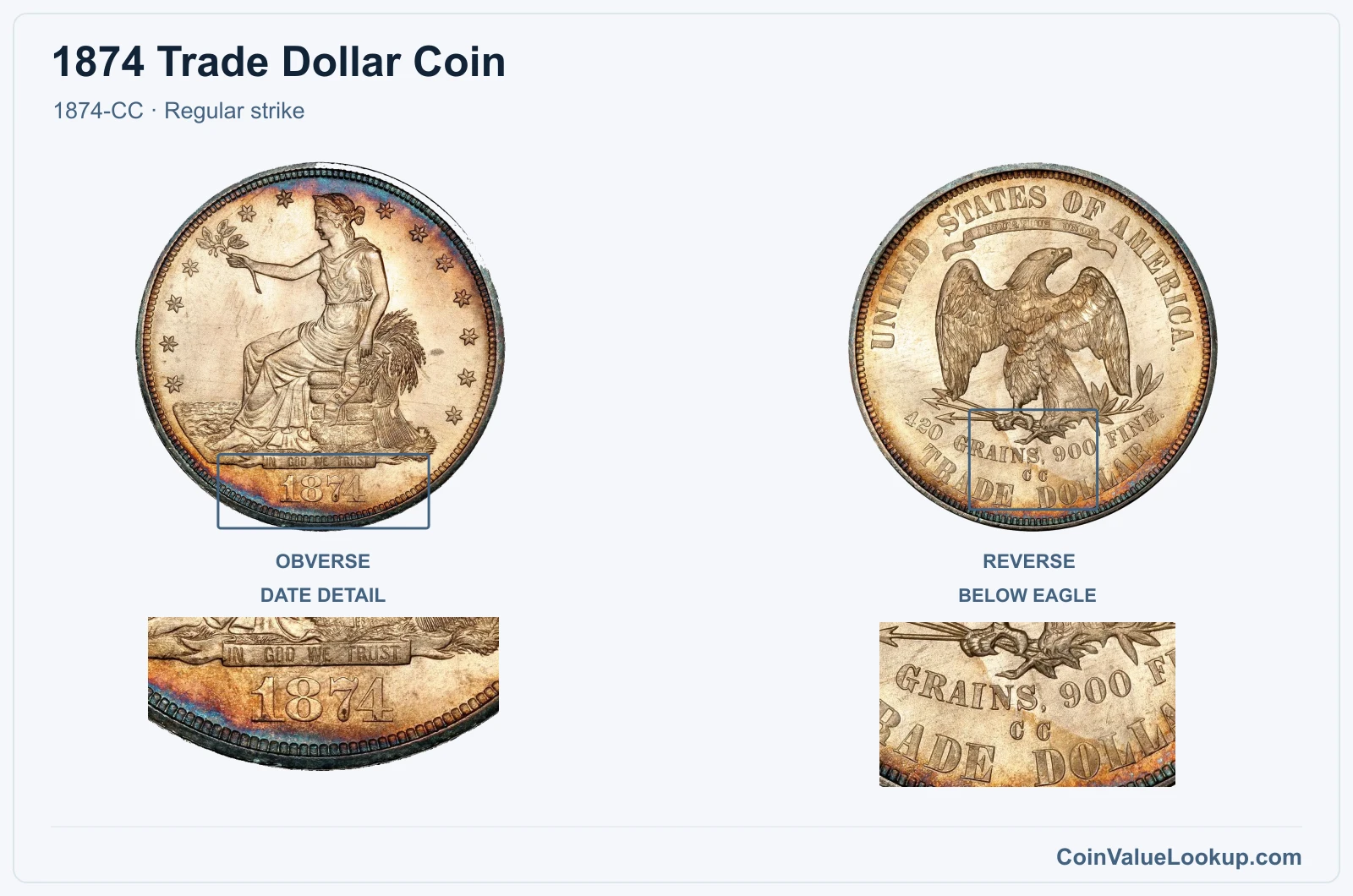
The 1874-CC is the Carson City issue, identifiable by the small "CC" mintmark below the eagle on the reverse. Carson City Trade Dollars consistently command premiums over their Philadelphia and San Francisco counterparts, and this date is no exception.
Guide estimates from USA Coin Book put the 1874-CC at about $383 in G4 and up to $6,444 at MS63. That is a steep climb from low grade to high grade, reflecting how few survived in top condition.
Original, uncleaned surfaces are critical — a harsh cleaning on a Carson City coin is especially painful to the wallet. Confirm the mintmark is genuinely part of the die impression, not added or altered, because the CC premium has always attracted forgeries.
Range Grade
Price Auction Records Appraisal PO PO 1
—
Coin Identifier FR FR 2
—
Coin Identifier AG AG 3
—
Coin Identifier G G 4
—
Coin Identifier
G 6
—
Coin Identifier VG VG 8
—
Coin Identifier
VG 10
—
Coin Identifier F F 12
—
Coin Identifier
F 15
Coin Identifier VF VF 20
—
Coin Identifier
VF 25
Coin Identifier
VF 30
Coin Identifier
VF 35
Coin Identifier XF XF 40
Coin Identifier
XF 45
Coin Identifier AU AU 50
Coin Identifier
AU 53
Coin Identifier
AU 55
Coin Identifier
AU 58
Coin Identifier MS MS 60
Coin Identifier
MS 61
Coin Identifier
MS 62
Coin Identifier
MS 63
Coin Identifier
MS 64
Coin Identifier
MS 65
Coin Identifier
MS 66
—
Coin Identifier
MS 67
—
—
—
MS 68
—
—
—
MS 69
—
—
—
MS 70
—
—
—
1874 Trade Dollar — S
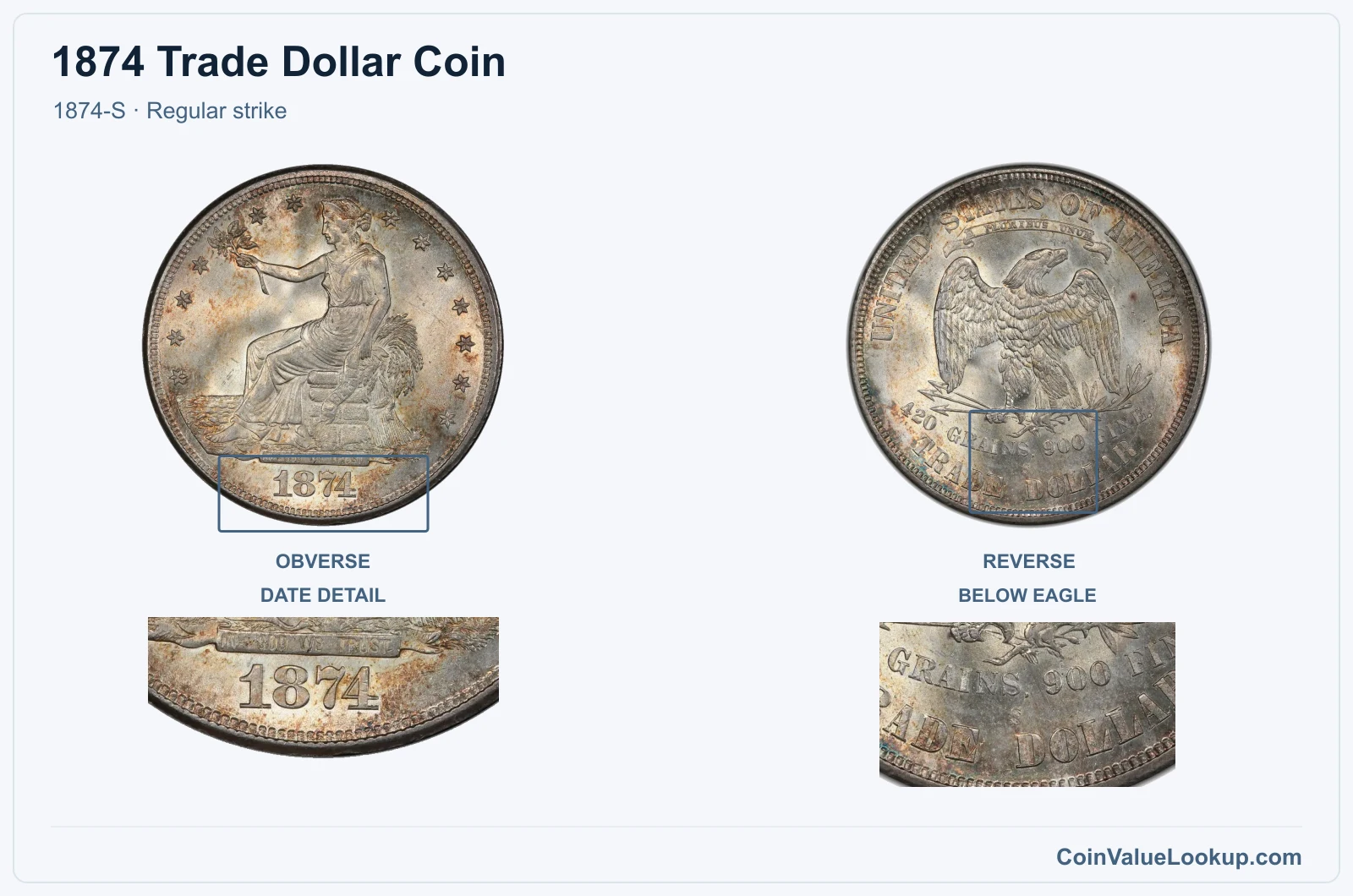
The 1874-S was struck at the San Francisco Mint and carries a small "S" mintmark below the eagle. San Francisco produced large quantities of Trade Dollars for Pacific Rim commerce, so this is a relatively available issue in lower grades.
Guide estimates run about $232 at G4 and around $2,721 at MS63. That puts it close to the Philadelphia issue in value at most grades, and well below the Carson City version.
As always, check for original surfaces — luster, toning pattern and the absence of hairlines from cleaning all influence real-world value. Chopmarked examples are common on San Francisco Trade Dollars and should be evaluated on their own terms.
Range Grade
Price Auction Records Appraisal PO PO 1
—
Coin Identifier FR FR 2
—
Coin Identifier AG AG 3
—
Coin Identifier G G 4
—
Coin Identifier
G 6
—
Coin Identifier VG VG 8
—
Coin Identifier
VG 10
—
Coin Identifier F F 12
—
Coin Identifier
F 15
—
Coin Identifier VF VF 20
—
Coin Identifier
VF 25
—
Coin Identifier
VF 30
—
Coin Identifier
VF 35
—
Coin Identifier XF XF 40
Coin Identifier
XF 45
Coin Identifier AU AU 50
Coin Identifier
AU 53
Coin Identifier
AU 55
Coin Identifier
AU 58
Coin Identifier MS MS 60
Coin Identifier
MS 61
Coin Identifier
MS 62
Coin Identifier
MS 63
Coin Identifier
MS 64
Coin Identifier
MS 65
Coin Identifier
MS 66
—
—
—
MS 67
—
—
—
MS 68
—
—
—
MS 69
—
—
—
MS 70
—
—
—
1874 Trade Dollar — PR
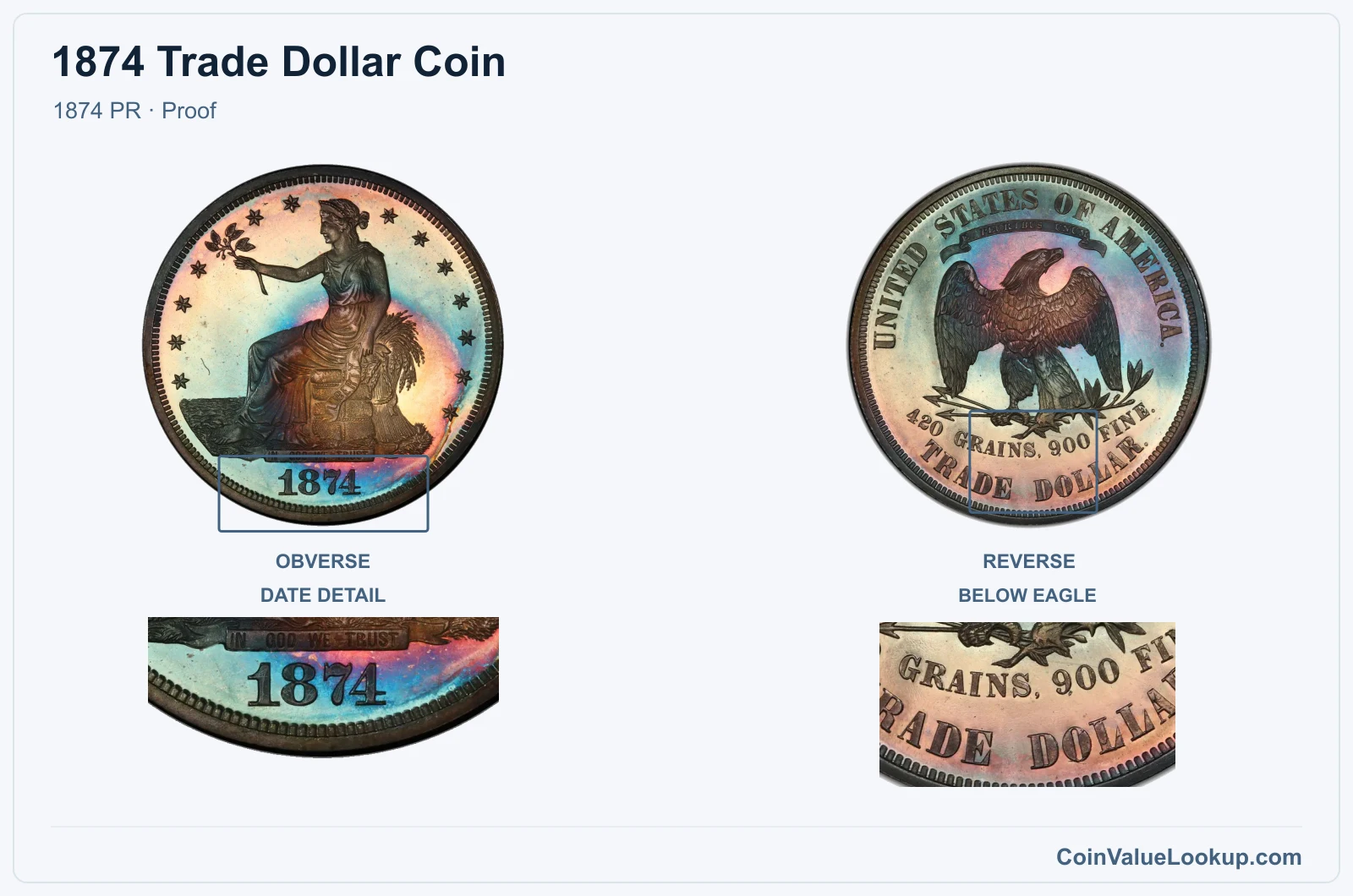
The 1874 Proof is a Philadelphia-struck coin made with a proof manufacturing finish — mirrored fields, sharp rims and fully struck details. A proof is not just a shiny coin or a high-grade business strike.
The surfaces should show deep reflectivity in the fields with frosted or at least well-defined devices.
No supported numerical price range is adopted for this version. Value depends heavily on authenticated identity, the coin's specific condition and whether the surfaces remain original.
Because proof Trade Dollars were made in small numbers for collectors, authentication by a recognized grading service is important before buying or selling. Examine the ribbon, hand and eagle arrow details against known proof examples to help with attribution.
Range Grade
Price Auction Records Appraisal PR PR 1
—
Coin Identifier
PR 2
—
Coin Identifier
PR 3
—
Coin Identifier
PR 4
—
Coin Identifier
PR 6
—
Coin Identifier
PR 8
—
Coin Identifier
PR 10
—
Coin Identifier
PR 12
—
Coin Identifier
PR 15
—
Coin Identifier
PR 20
—
Coin Identifier
PR 25
—
Coin Identifier
PR 30
—
Coin Identifier
PR 35
—
Coin Identifier
PR 40
—
Coin Identifier
PR 45
—
Coin Identifier
PR 50
Coin Identifier
PR 53
—
Coin Identifier
PR 55
Coin Identifier
PR 58
Coin Identifier
PR 60
Coin Identifier
PR 61
Coin Identifier
PR 62
Coin Identifier
PR 63
Coin Identifier
PR 64
Coin Identifier
PR 65
Coin Identifier
PR 66
Coin Identifier
PR 67
Coin Identifier
PR 68
—
—
—
PR 69
—
—
—
PR 70
—
—
—
1874 Trade Dollar Error List
1. 1874 Trade Dollar — Rotated Dies
A rotated die error has been reported for the 1874-S Trade Dollar specifically. To check, hold the obverse upright and rotate the coin top-to-bottom along its vertical axis.
On a normally aligned U.S. coin, the reverse should appear upright as well. If the eagle is tilted — say 15, 45 or 90 degrees off normal — you may have a rotated reverse.
The degree of rotation matters. A slight tilt of a few degrees is less significant than a dramatic 90- or 180-degree rotation.
Be careful not to confuse this with a photograph that was simply taken at an angle, or with turning the coin sideways instead of flipping it top-to-bottom.
No numerical price is adopted for this error. Value depends on the visibility of the rotation, the coin's overall condition and the specific degree of misalignment.
Authentication is recommended, as this is not something easily confirmed from photos alone.