1892 Barber Half Dollar Coin Value: How Much Is It Worth?
The 1892 Barber Half Dollar launched an entire series and remains a rewarding first-year coin to study. Retail guide estimates for ordinary business strikes range from about $61 at G4 to $2,701 at MS63, depending on mint and condition.
Proofs and the famous Micro O variety occupy their own price tier entirely. Four distinct collectible branches exist for this date, and knowing which one you hold matters a great deal.
Fast Way to Identify Your 1892 Barber Half Dollar
The quickest way to get a preliminary identification of your 1892 Barber Half Dollar is to upload clear photos of both the front and back of your coin. A close-up of the mintmark area beneath the eagle's tail feathers is especially helpful.
That single detail separates a common Philadelphia strike from a scarce San Francisco issue or the celebrated Micro O variety.
1892 Barber Half Dollar Value
Upload both sides of your 1892 Barber Half Dollar.
Front Obverse
Upload photo
Back Reverse
Upload photo
Which 1892 Barber Half Dollar Versions Are Worth Money?
- The 1892-O Micro O variety is the standout, with guide estimates reaching about $4,689 at G4 and $54,409 at MS63 — compare that mintmark carefully against a normal O at equal magnification.
- San Francisco issues (1892-S) are scarce across all grades, with guide estimates around $388 at G4 and $2,701 at MS63.
- The regular 1892-O with a normal-size mintmark carries higher guide values than the Philadelphia issue, estimated near $360 at G4 and $2,092 at MS63.
- Original, problem-free coins in upper circulated or Mint State grades can be far more valuable than heavily worn or cleaned examples of the same date and mint.
- Proof 1892 halves from Philadelphia are collectible in their own right, with a guide estimate near $1,261 at PR63.
- Confirm the actual mint and finish before looking up values — an unusual mark alone does not establish a valuable error.
Step 1: Identify Your 1892 Barber Half Dollar Mint Mark and Version
Start by confirming the 1892 date on the obverse and HALF DOLLAR on the reverse. The obverse shows Liberty facing right with a laurel wreath and Phrygian cap; the reverse carries a heraldic eagle with arrows and an olive branch.
All regular 1892 half dollars are struck in 90% silver and 10% copper, weigh about 12.5 grams, measure 30.6 mm across, and have a reeded edge. Three mints produced coins this year: Philadelphia, New Orleans, and San Francisco.
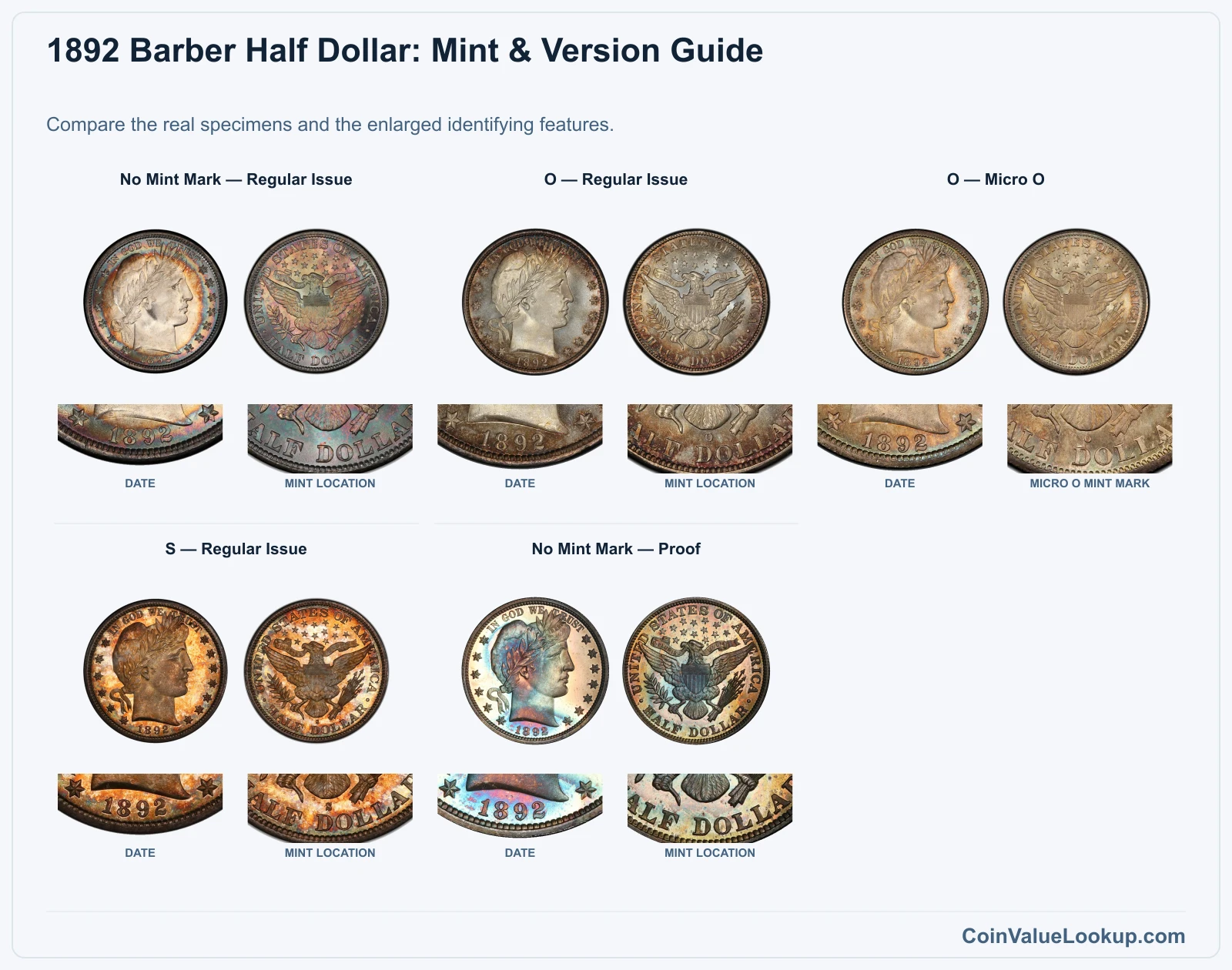
Philadelphia coins carry no mintmark. For the other two, look on the reverse just below the eagle's tail and above the words HALF DOLLAR.
An O means New Orleans; an S means San Francisco.
The critical distinction among O-mint coins is the size of that O. The normal 1892-O uses a standard-size mintmark punch, while the Micro O variety shows a noticeably smaller letter.
You need a side-by-side comparison at the same magnification to tell them apart reliably. Do not confuse this coin with the 1892 Columbian Exposition commemorative half dollar, which has an entirely different design.
Step 2: Check Your 1892 Barber Half Dollar Grade
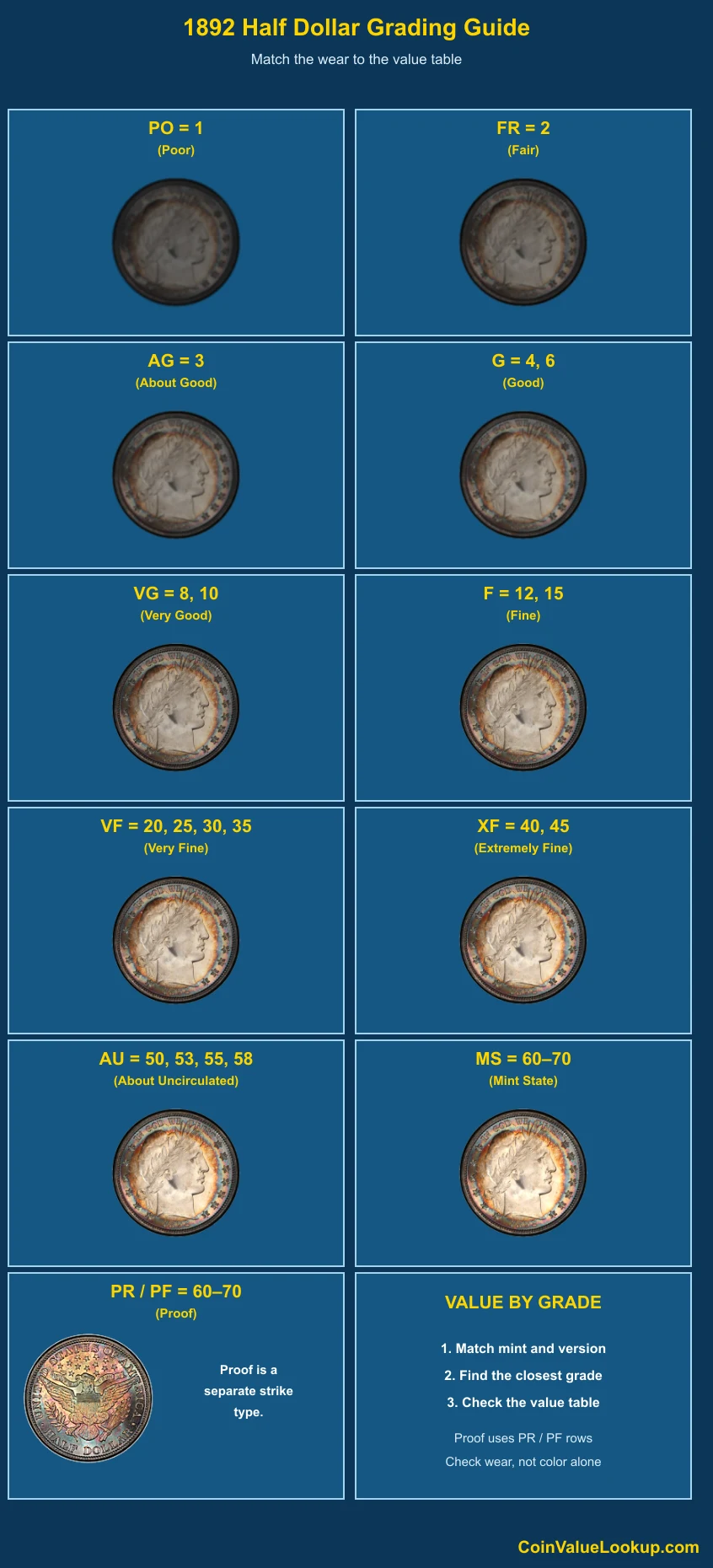
Focus on Liberty's cheek, the hair above her ear, and the individual letters of the LIBERTY headband. On the reverse, check the eagle's head detail, wing-tip feathers, and tail feathers.
Compare your coin against the grade comparison image to see how much design remains.
Separate actual wear from a weak strike. New Orleans coins in particular can show soft detail at the eagle's claws and arrow feathers even on higher-grade pieces.
That softness is a strike characteristic, not friction, so look at the highest points of both sides before deciding.
Luster matters. A coin with full original mint luster in the protected areas grades higher than a dull, cleaned piece with the same amount of remaining design.
Polishing or harsh cleaning permanently damages surfaces and reduces collector appeal.
Remember that Proof is a special reflective finish applied during manufacturing, not a grade above Mint State. A shiny coin is not automatically a Proof.
Step 3: Check 1892 Barber Half Dollar Value by Mint and Version
1892 Barber Half Dollar — No Mint Mark — Regular Issue
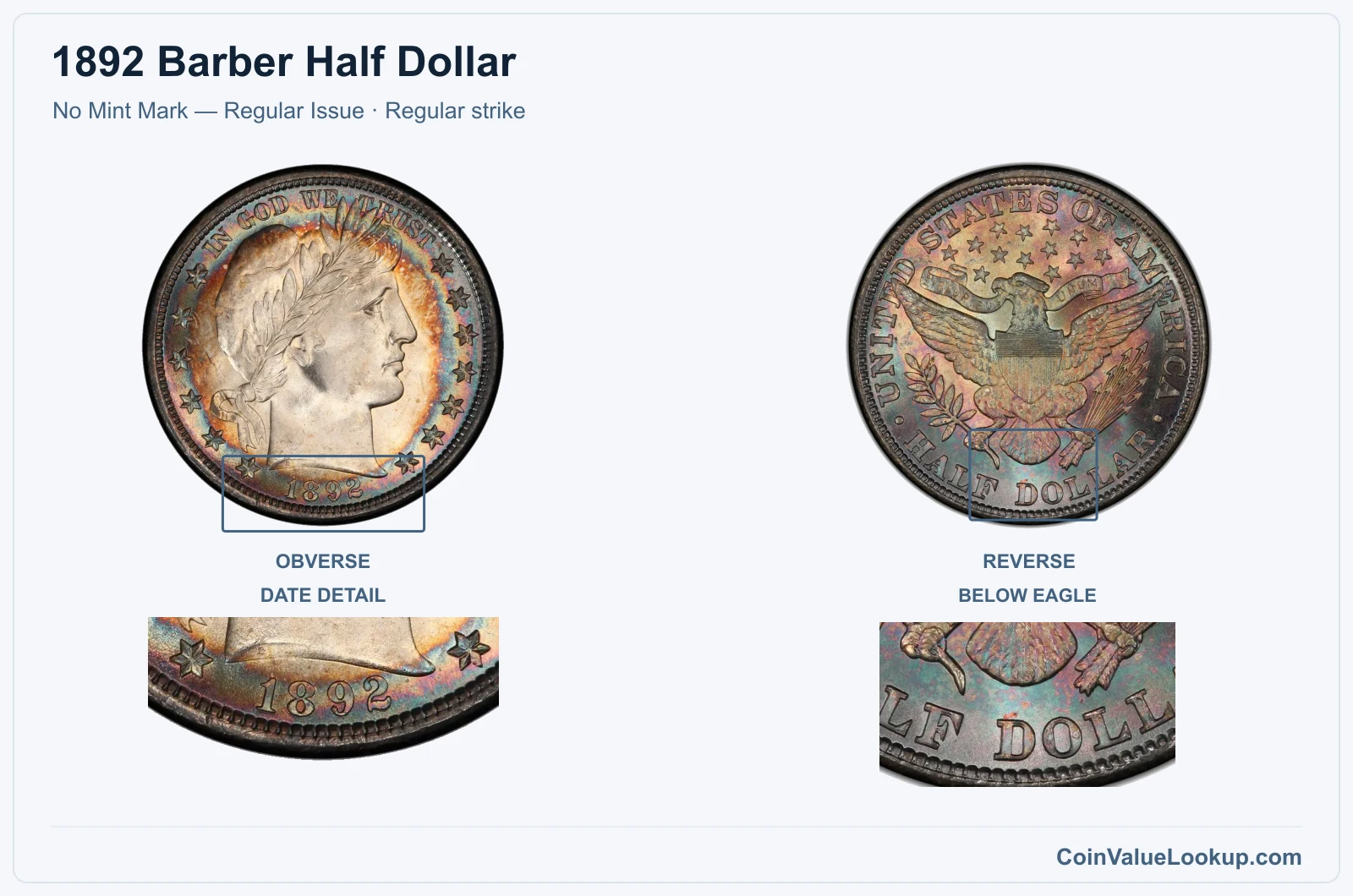
The Philadelphia issue carries no mintmark and is the most available 1892 Barber half dollar. Guide estimates place it around $61 at G4 and roughly $1,082 at MS63, based on a USA Coin Book retail snapshot.
Look for original silver-gray surfaces and no signs of cleaning or tooling. A well-struck Philadelphia coin with full luster in the recessed areas is a different animal from a worn, dull piece of the same date.
Condition and originality drive collector interest far more than the date alone on this issue.
Range Grade
Price Auction Records Appraisal PO PO 1
—
Coin Identifier FR FR 2
—
Coin Identifier AG AG 3
—
Coin Identifier G G 4
—
Coin Identifier
G 6
Coin Identifier VG VG 8
—
Coin Identifier
VG 10
Coin Identifier F F 12
Coin Identifier
F 15
Coin Identifier VF VF 20
—
Coin Identifier
VF 25
Coin Identifier
VF 30
Coin Identifier
VF 35
Coin Identifier XF XF 40
Coin Identifier
XF 45
Coin Identifier AU AU 50
Coin Identifier
AU 53
Coin Identifier
AU 55
Coin Identifier
AU 58
Coin Identifier MS MS 60
Coin Identifier
MS 61
Coin Identifier
MS 62
Coin Identifier
MS 63
Coin Identifier
MS 64
Coin Identifier
MS 65
Coin Identifier
MS 66
Coin Identifier
MS 67
Coin Identifier
MS 68
Coin Identifier
MS 69
—
—
—
MS 70
—
—
—
1892 Barber Half Dollar — O — Regular Issue
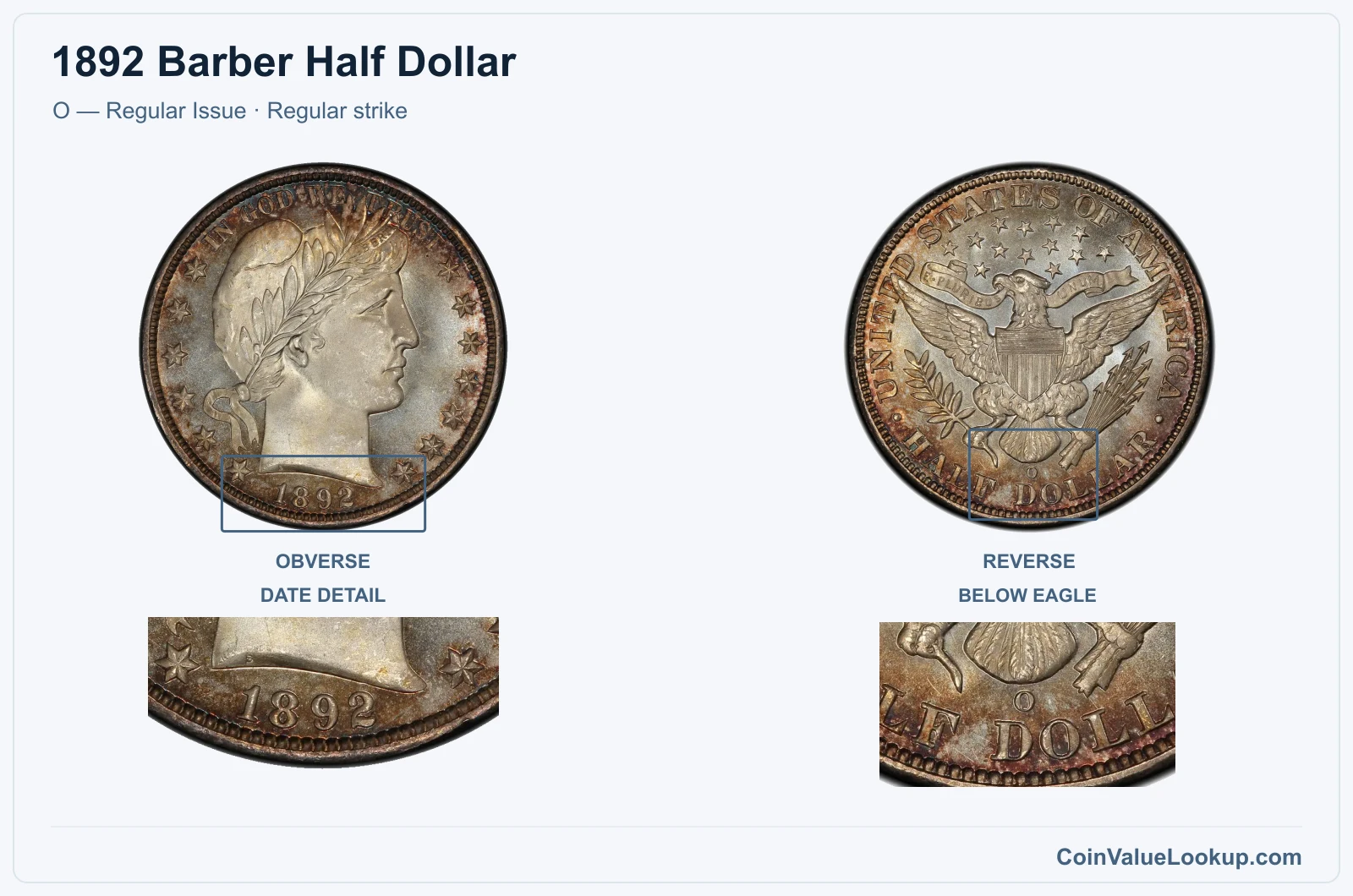
The 1892-O with a normal-size O mintmark is the regular New Orleans issue. Guide estimates run about $360 at G4 and around $2,092 at MS63.
Before pricing, make sure your coin actually has the standard-size O. Place it next to a reference image at matching magnification.
If the O looks conspicuously small, you may have the much rarer Micro O variety instead. Strike quality from New Orleans tends to be softer than Philadelphia, so don't downgrade your coin just because the eagle's claws look mushy — that's often the mint, not the owner.
Range Grade
Price Auction Records Appraisal PO PO 1
—
Coin Identifier FR FR 2
Coin Identifier AG AG 3
Coin Identifier G G 4
Coin Identifier
G 6
Coin Identifier VG VG 8
Coin Identifier
VG 10
Coin Identifier F F 12
Coin Identifier
F 15
Coin Identifier VF VF 20
Coin Identifier
VF 25
Coin Identifier
VF 30
Coin Identifier
VF 35
Coin Identifier XF XF 40
Coin Identifier
XF 45
Coin Identifier AU AU 50
Coin Identifier
AU 53
Coin Identifier
AU 55
Coin Identifier
AU 58
Coin Identifier MS MS 60
—
Coin Identifier
MS 61
Coin Identifier
MS 62
Coin Identifier
MS 63
Coin Identifier
MS 64
Coin Identifier
MS 65
Coin Identifier
MS 66
Coin Identifier
MS 67
Coin Identifier
MS 68
Coin Identifier
MS 69
—
—
—
MS 70
—
—
—
1892 Barber Half Dollar — O — Micro O
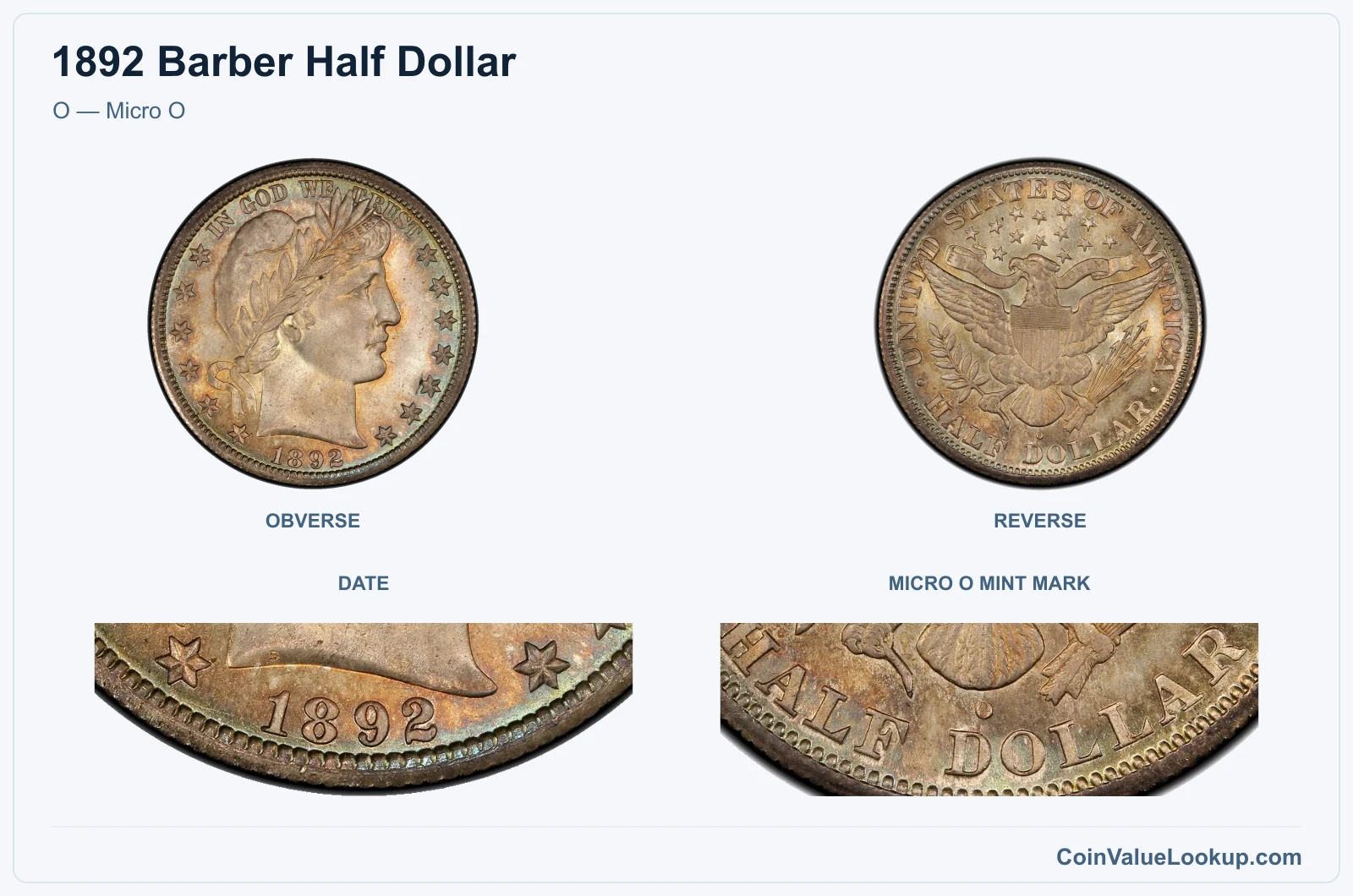
This is the headline variety. The 1892-O Micro O uses a distinctly smaller mintmark punch than the normal O, and the difference is visible under modest magnification when you compare both side by side at matching scale.
Coin Value Lookup is a good starting point if you want to look up additional coin guides and get oriented before diving into variety attribution.
Guide estimates for the Micro O are dramatic: about $4,689 at G4 and roughly $54,409 at MS63, per a USA Coin Book retail snapshot. Those numbers reflect genuine scarcity — this variety is widely recognized by collectors and third-party grading services alike.
To confirm attribution, you need a clear, close-up photo of the mintmark alongside a normal 1892-O at the same magnification. A slightly fuzzy O is not enough; the Micro O is a different, smaller punch altogether.
Range Grade
Price Auction Records Appraisal PO PO 1
—
Coin Identifier FR FR 2
Coin Identifier AG AG 3
Coin Identifier G G 4
Coin Identifier
G 6
Coin Identifier VG VG 8
Coin Identifier
VG 10
Coin Identifier F F 12
—
Coin Identifier
F 15
—
Coin Identifier VF VF 20
—
Coin Identifier
VF 25
—
Coin Identifier
VF 30
Coin Identifier
VF 35
—
Coin Identifier XF XF 40
Coin Identifier
XF 45
—
Coin Identifier AU AU 50
Coin Identifier
AU 53
—
Coin Identifier
AU 55
Coin Identifier
AU 58
—
Coin Identifier MS MS 60
—
Coin Identifier
MS 61
—
Coin Identifier
MS 62
—
Coin Identifier
MS 63
Coin Identifier
MS 64
Coin Identifier
MS 65
Coin Identifier
MS 66
—
Coin Identifier
MS 67
Coin Identifier
MS 68
Coin Identifier
MS 69
—
—
—
MS 70
—
—
—
1892 Barber Half Dollar — S — Regular Issue
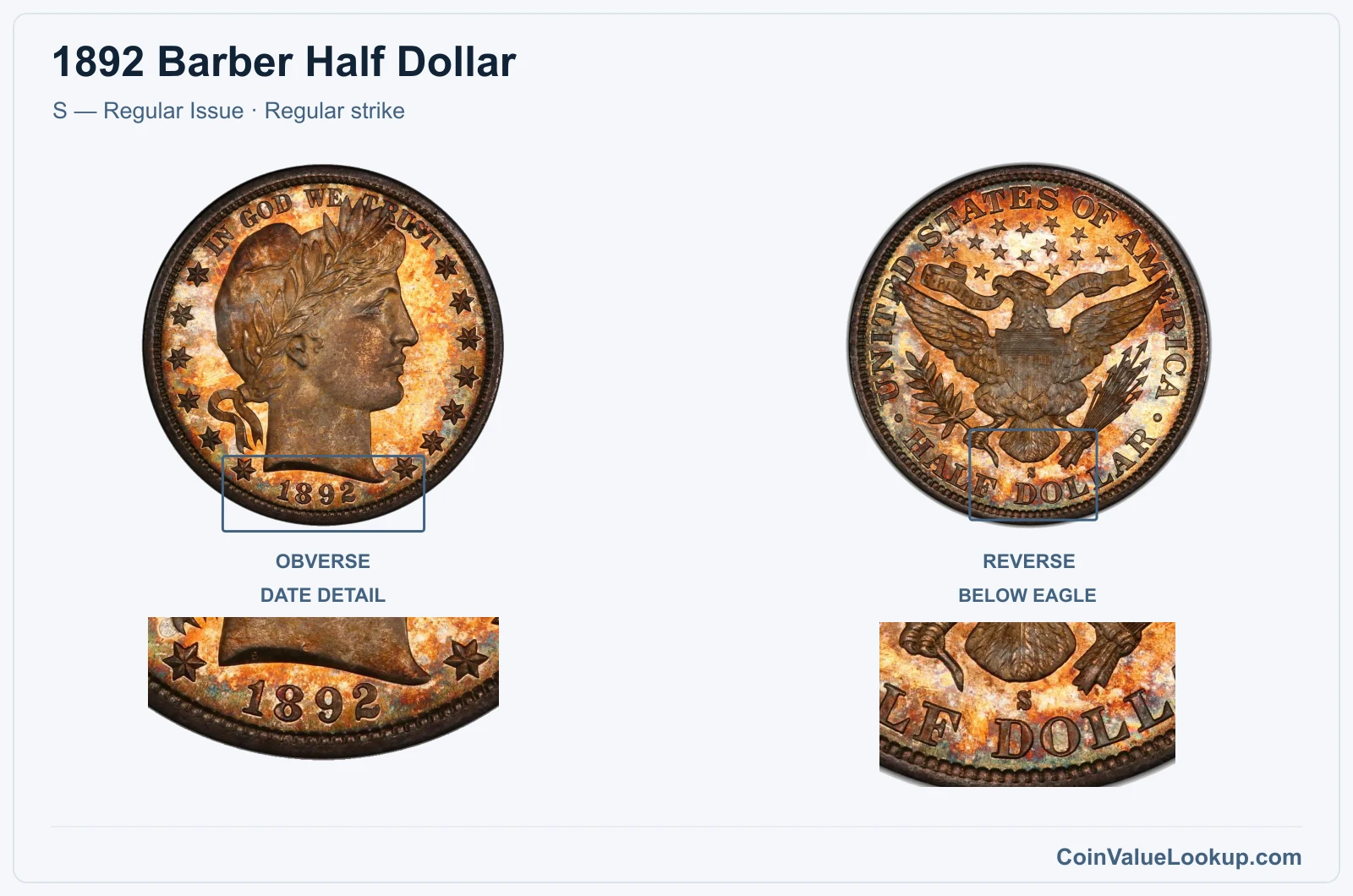
San Francisco struck 1892 half dollars in lower quantities, making the 1892-S scarce across all grades. Guide estimates are about $388 at G4 and approximately $2,701 at MS63.
The S mintmark sits below the eagle's tail. Check that it is genuinely an S and not a damaged or corroded O — this distinction matters for accurate identification.
Original, uncleaned 1892-S halves with strong detail command serious attention from Barber series collectors. As with any scarce date, the jump from a worn survivor to a sharply detailed example is steep in both eye appeal and value.
Range Grade
Price Auction Records Appraisal PO PO 1
—
Coin Identifier FR FR 2
Coin Identifier AG AG 3
Coin Identifier G G 4
Coin Identifier
G 6
Coin Identifier VG VG 8
Coin Identifier
VG 10
Coin Identifier F F 12
Coin Identifier
F 15
Coin Identifier VF VF 20
Coin Identifier
VF 25
Coin Identifier
VF 30
Coin Identifier
VF 35
Coin Identifier XF XF 40
Coin Identifier
XF 45
Coin Identifier AU AU 50
Coin Identifier
AU 53
Coin Identifier
AU 55
Coin Identifier
AU 58
Coin Identifier MS MS 60
—
Coin Identifier
MS 61
Coin Identifier
MS 62
Coin Identifier
MS 63
Coin Identifier
MS 64
Coin Identifier
MS 65
Coin Identifier
MS 66
Coin Identifier
MS 67
Coin Identifier
MS 68
—
—
—
MS 69
—
—
—
MS 70
—
—
—
1892 Barber Half Dollar — No Mint Mark — Proof
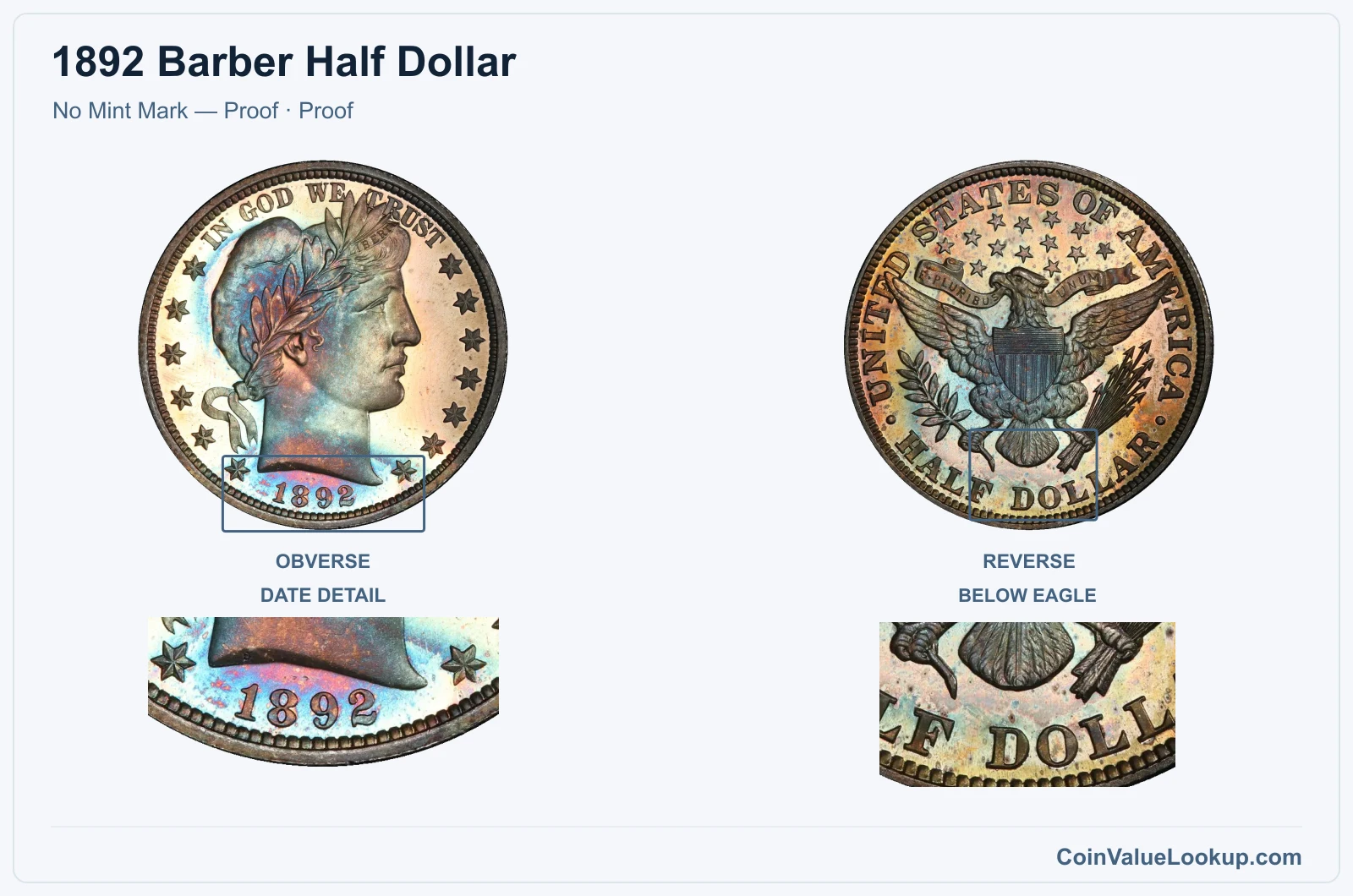
Philadelphia produced Proof Barber half dollars with mirrored fields and sharply struck devices. At PR63, the guide estimate is about $1,261.
Genuine Proofs show deeply reflective surfaces and precise rim detail that business strikes simply do not have. A polished coin is not a Proof — the finish is created during manufacturing with specially prepared dies and planchets.
If your coin's fields look like a mirror but the devices are soft or the rims are rounded, it has likely been polished rather than Proof-struck. Cameo contrast, where the devices appear frosty against mirror fields, can exist within the Proof category but is a separate characteristic from the Proof finish itself.
Range Grade
Price Auction Records Appraisal PR PR 1
—
Coin Identifier
PR 2
—
Coin Identifier
PR 3
—
Coin Identifier
PR 4
—
Coin Identifier
PR 6
—
Coin Identifier
PR 8
—
Coin Identifier
PR 10
—
Coin Identifier
PR 12
—
Coin Identifier
PR 15
—
Coin Identifier
PR 20
—
Coin Identifier
PR 25
—
Coin Identifier
PR 30
—
Coin Identifier
PR 35
—
Coin Identifier
PR 40
—
Coin Identifier
PR 45
—
Coin Identifier
PR 50
Coin Identifier
PR 53
—
Coin Identifier
PR 55
Coin Identifier
PR 58
Coin Identifier
PR 60
Coin Identifier
PR 61
Coin Identifier
PR 62
Coin Identifier
PR 63
Coin Identifier
PR 64
Coin Identifier
PR 65
Coin Identifier
PR 66
Coin Identifier
PR 67
Coin Identifier
PR 68
Coin Identifier
PR 69
—
—
—
PR 70
—
—
—
1892 Barber Half Dollar Error List
1. 1892 Barber Half Dollar — Doubled Die Obverse
A Doubled Die Obverse has been reported for the 1892 half dollar. The diagnostic areas to inspect are the IN GOD WE TRUST motto and the obverse stars, where traces of a second impression from the die-making process may appear as raised, slightly offset contours next to the intended design.
Not every odd-looking letter is a doubled die. Machine doubling — caused by die chatter during striking — produces flat, shelf-like distortions rather than the rounded, raised secondary image of a true doubled die.
Worn dies and reflected light can also mimic doubling under magnification.
No specific price range is available for this variety. Value depends on the strength and visibility of the doubling, the coin's overall condition, and the particular die involved.
Have a qualified attributor examine the coin if you suspect genuine hub doubling.
2. 1892 Barber Half Dollar — Tripled Die Reverse
A Tripled Die Reverse has been reported for the 1892 half dollar. This variety involves three impressions from the hub during die production, leaving repeated contours on the outer reverse lettering, stars, and ribbon ends.
To check, compare your coin's reverse lettering against a normal example at matching magnification. Genuine tripling shows raised, separated outlines that follow the design's contour at consistent spacing.
Machine doubling, by contrast, tends to flatten details and produces irregular shelf-like distortions without the rounded secondary and tertiary images.
Random contact marks, corrosion, or lighting reflections can also create false impressions of doubling. No specific price range is available.
The coin's grade, the clarity of the tripling, and collector demand for the specific die all influence what a piece might bring.
3. 1892 Barber Half Dollar — Repunched Mintmark
A Repunched Mintmark has been reported for the 1892-S half dollar. The diagnostic is an earlier S positioned west of the upper serif of the final mintmark.
Under magnification, you may see remnants of the first punch partially visible beside or beneath the accepted S.
This is a die-making variety: the mintmark was hand-punched into the working die, and when the first placement was slightly off, a second punch corrected it. The leftover trace of the first attempt is the tell.
Do not confuse a repunched mintmark with a die chip clinging to the letter's edge, corrosion pitting, or machine doubling of the mintmark. Those anomalies look different under magnification and are not the same category of variety.
No specific price is available — value depends on the visibility of the remnant punch, the coin's overall condition, and collector interest.
4. 1892 Barber Half Dollar — Repunched Date
A Repunched Date variety has been reported for the 1892 Philadelphia half dollar, with the earlier punch positioned south of the final date numerals. This is listed in a society survey, though no confirmed respondent specimen was reported in that survey.
If present, you would see faint remnants of one or more date digits below their final positions. This is distinct from a doubled die, which affects the entire design from hub doubling.
A repunched date comes from the date punch itself being applied more than once to the working die.
Damaged dates — from contact marks, corrosion, or post-mint scratching — can mimic repunching, so inspect under steady magnification and compare with a normal 1892 date at the same scale. No specific price range is available; value would depend on the clarity of the repunching and the coin's condition.