1902 Barber Half Dollar Coin Value: How Much Is It Worth?
A 1902 Barber Half Dollar in well-worn G4 condition starts around $44, based on a USA Coin Book retail guide snapshot. Push that up to MS63 and you are looking at $1,145 to $3,652 depending on the mint.
Three business-strike versions exist — Philadelphia, New Orleans, and San Francisco — plus a Philadelphia proof. Condition and originality matter enormously with this date, so read on before you price yours.
Fast Way to Identify Your 1902 Barber Half Dollar
The quickest way to start figuring out what you have is to upload clear photos of both the front and back of your coin. Our identifier can give you a preliminary read on the mint, version, and approximate condition from those images alone.
It is not a substitute for professional authentication or grading, but it is a solid first step.
1902 Barber Half Dollar Value
Upload both sides of your 1902 Barber Half Dollar.
Front Obverse
Upload photo
Back Reverse
Upload photo
Which 1902 Barber Half Dollar Versions Are Worth Money?
- The San Francisco (S) mint version carries the highest guide value at MS63 — around $3,652 — making it the one to check for first if your coin is in strong condition.
- New Orleans (O) coins in genuine high grade are scarce because many survivors show original strike weakness; a truly sharp, lustrous example at MS63 is guided near $2,516.
- Philadelphia proofs with mirrored fields and crisp rims are guided around $1,363 at PR63, a separate category from business strikes.
- Original, problem-free coins in upper circulated or Mint State grades can be worth many times more than a heavily worn example of the same mint — condition is the biggest value driver on this date.
Step 1: Identify Your 1902 Barber Half Dollar Mint Mark and Version
The 1902 Barber Half Dollar shows Charles Barber's Liberty head facing right on the obverse, wearing a laurel wreath and Phrygian cap, with the date at the bottom. The reverse features a heraldic eagle with a shield, arrows, and olive branch, with HALF DOLLAR spelled out below.
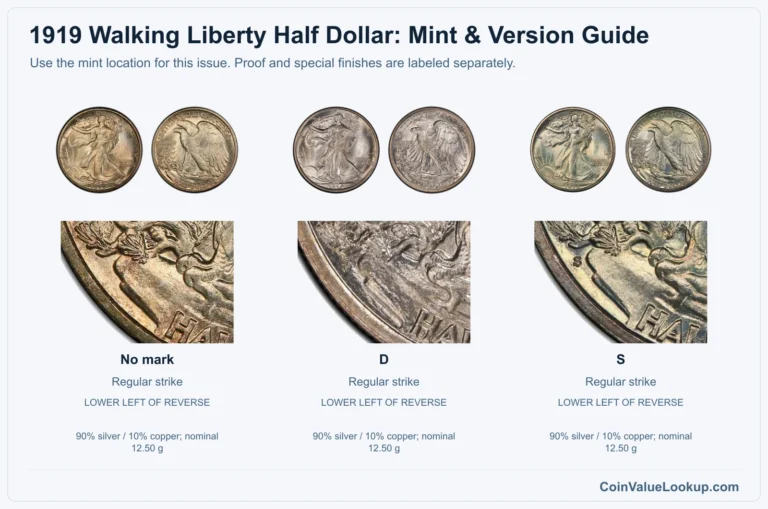
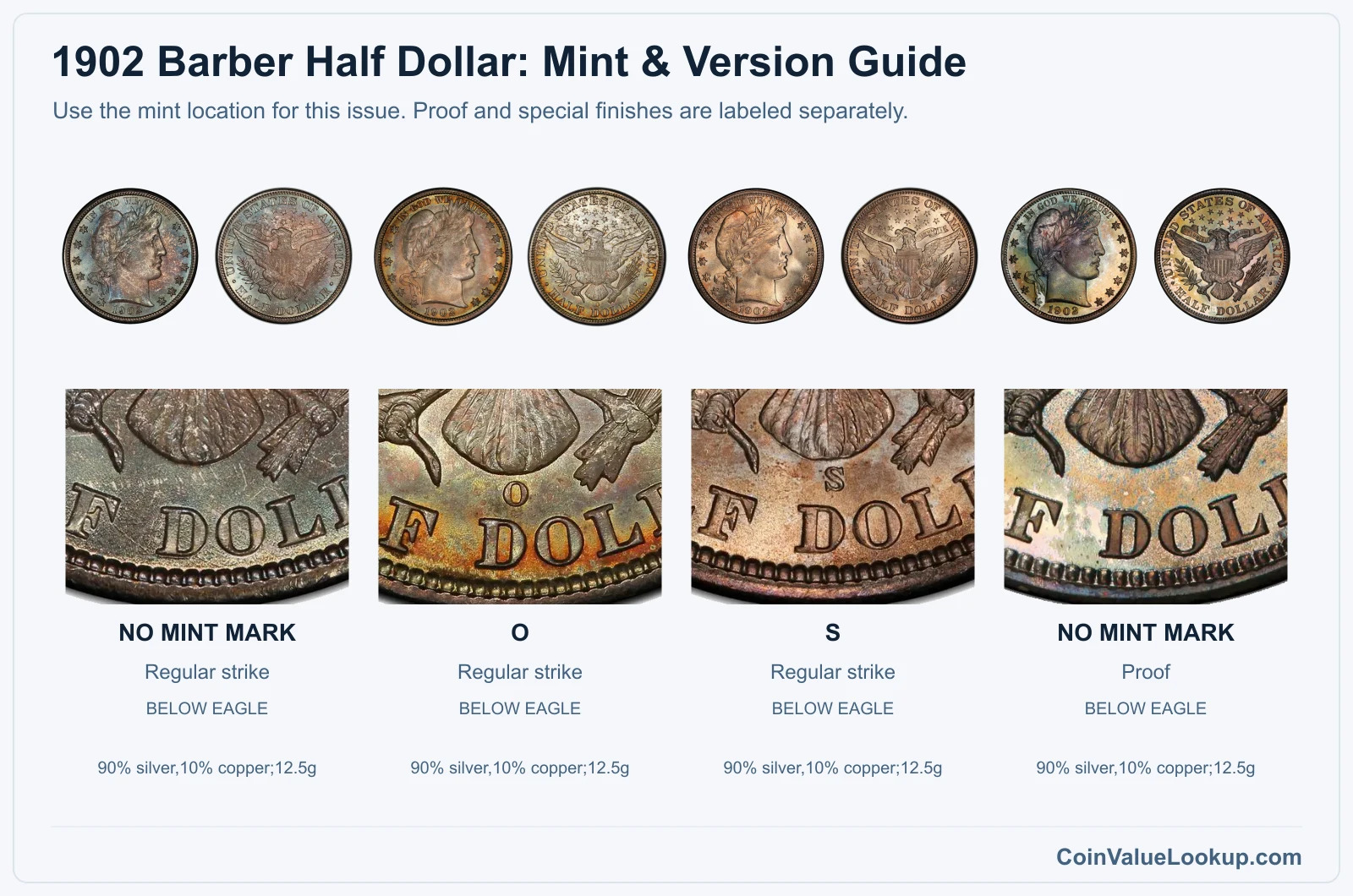
To find your mintmark, flip the coin over and look just below the eagle's tail feathers and above the words HALF DOLLAR. A small "O" means New Orleans, an "S" means San Francisco, and no letter at all means Philadelphia.
All three mints struck this coin in 90% silver and 10% copper, with a standard weight of about 12.5 grams, a diameter of 30.6 mm, and a reeded edge. If yours feels light or the edge is smooth, something is off.
One important warning: New Orleans coins are often weakly struck, especially on the eagle's claws and arrow feathers. That soft detail is a manufacturing trait, not evidence of heavy circulation or a struck-through error.
Do not confuse it with wear. Also, if you encounter a coin that looks like a 1912-D struck over a 1902 host, that variety belongs on the 1912 page, not here.
Step 2: Check Your 1902 Barber Half Dollar Grade
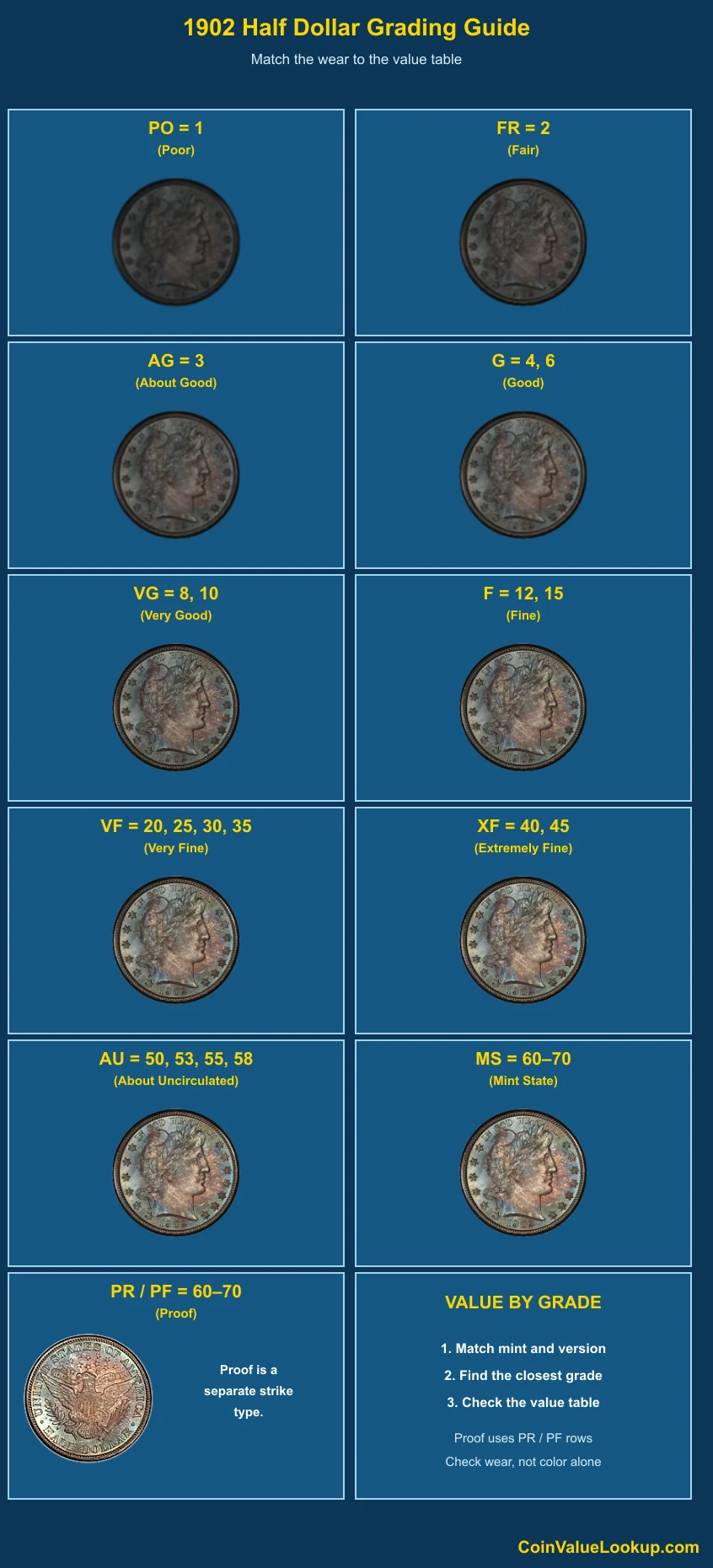
Start by examining Liberty's cheek and the hair detail above her ear on the obverse. Then check the headband — in higher grades, individual letters in LIBERTY remain sharp and fully separated.
On the reverse, focus on the eagle's head, the tips of the wing feathers, and the tail.
Use the comparison image to match your coin against known grade examples. Loss of luster from gentle circulation is different from a flat, mushy strike, and New Orleans pieces in particular can fool you because the eagle's claws and arrow feathers sometimes came off the press looking soft.
Do not rely on reading LIBERTY alone to assign a grade. Hub changes during this era altered how quickly those letters wore, so the old shortcut is not always reliable.
Also remember that proof is a manufacturing finish — mirror fields, sharp rims, squared-off edges — not a grade above Mint State. A polished business strike is not a proof, no matter how shiny it looks.
Step 3: Check 1902 Barber Half Dollar Value by Mint and Version
1902 Barber Half Dollar — No Mint Mark — Regular Issue
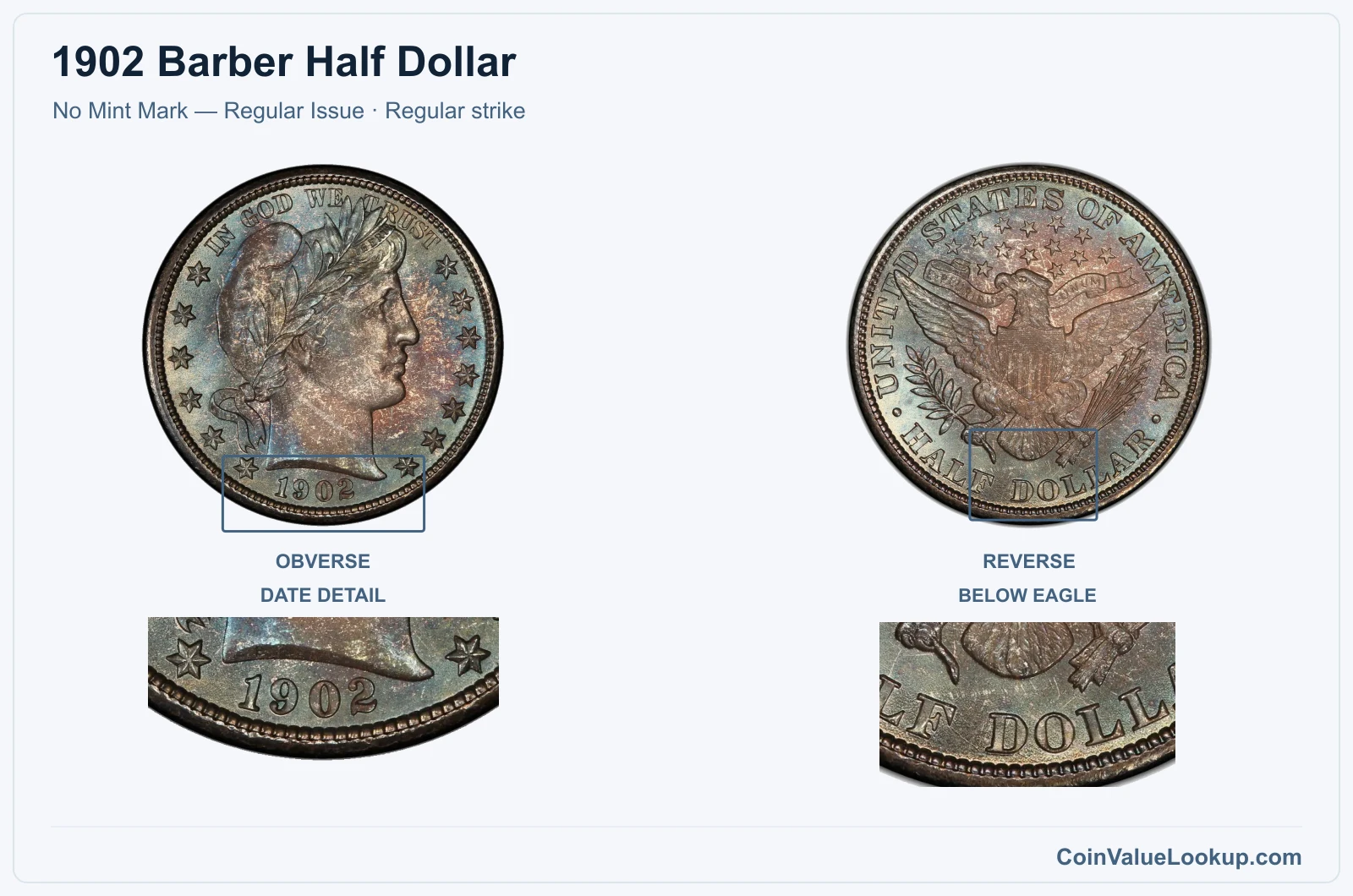
The Philadelphia version has no mintmark — the space below the eagle's tail feathers is blank. This is the most commonly encountered 1902 Barber Half.
A USA Coin Book guide estimate places it at roughly $44 in G4 and around $1,145 in MS63.
Original surfaces matter here. Cleaned or polished coins trade for less, even if the underlying detail looks decent.
Before checking a price chart, confirm your coin has not been harshly cleaned — look for unnatural brightness, hairline scratches in the fields, or a washed-out look where the original skin tone should be.
Range Grade
Price Auction Records Appraisal PO PO 1
—
Coin Identifier FR FR 2
—
Coin Identifier AG AG 3
—
Coin Identifier G G 4
—
Coin Identifier
G 6
Coin Identifier VG VG 8
Coin Identifier
VG 10
Coin Identifier F F 12
Coin Identifier
F 15
Coin Identifier VF VF 20
Coin Identifier
VF 25
Coin Identifier
VF 30
Coin Identifier
VF 35
Coin Identifier XF XF 40
Coin Identifier
XF 45
Coin Identifier AU AU 50
Coin Identifier
AU 53
Coin Identifier
AU 55
Coin Identifier
AU 58
Coin Identifier MS MS 60
Coin Identifier
MS 61
Coin Identifier
MS 62
Coin Identifier
MS 63
Coin Identifier
MS 64
Coin Identifier
MS 65
Coin Identifier
MS 66
Coin Identifier
MS 67
Coin Identifier
MS 68
—
—
—
MS 69
—
—
—
MS 70
—
—
—
1902 Barber Half Dollar — O — Regular Issue
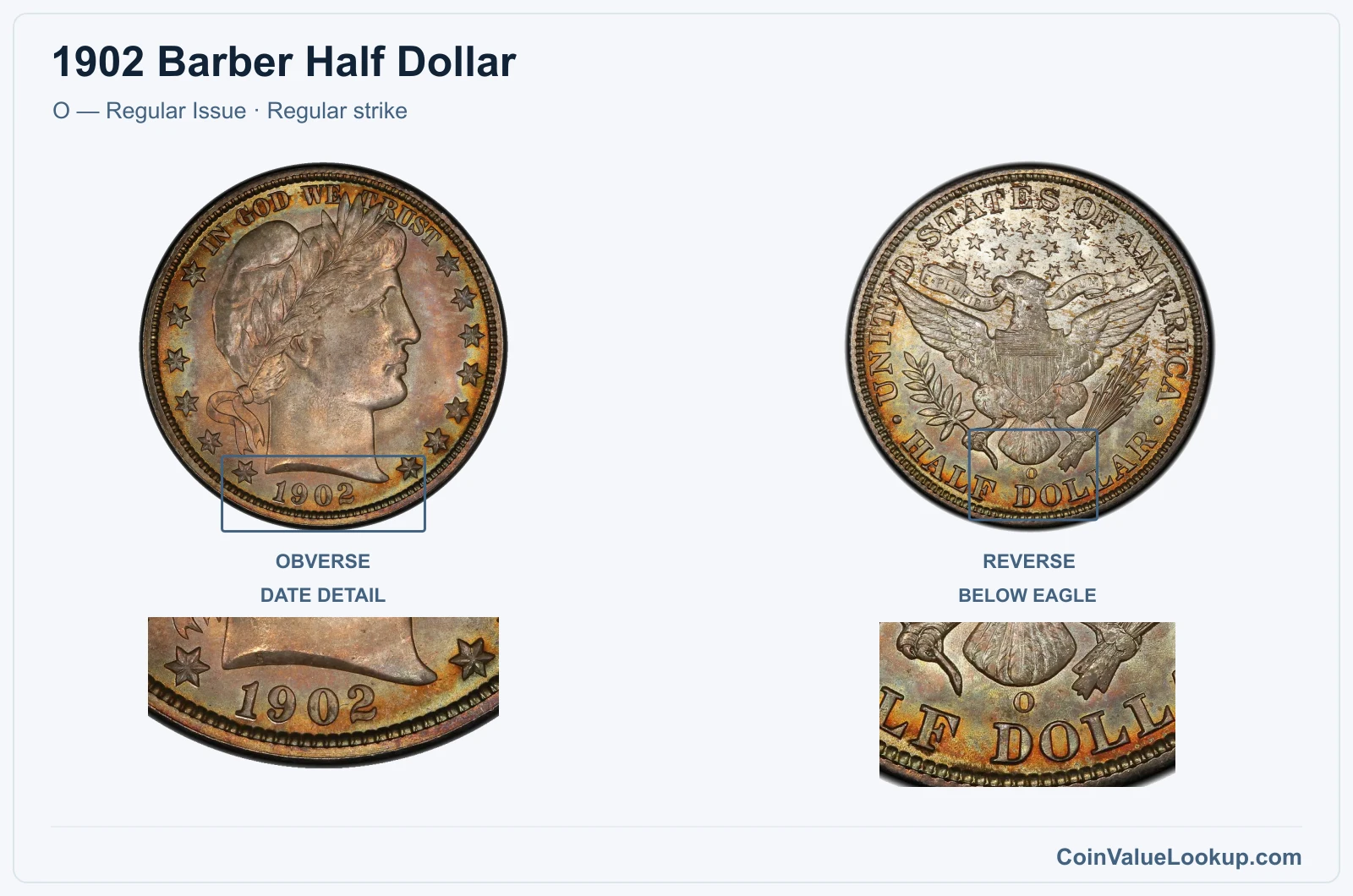
Look for a small "O" mintmark below the eagle's tail on the reverse. That marks a New Orleans strike.
Guide values run about $44 at G4 and roughly $2,516 at MS63.
Here is the catch: New Orleans Barber halves are notorious for weak strikes, particularly on the eagle's claws and the feather detail near the arrows. This softness is baked in from the press, not from someone carrying the coin around in a pocket.
If you see crisp detail everywhere else but mushy claws, that is a strike issue, not wear. Genuine high-grade O-mint survivors with full strike details are scarce, which is exactly why the MS63 guide figure sits well above Philadelphia's.
Range Grade
Price Auction Records Appraisal PO PO 1
—
Coin Identifier FR FR 2
—
Coin Identifier AG AG 3
—
Coin Identifier G G 4
—
Coin Identifier
G 6
—
Coin Identifier VG VG 8
—
Coin Identifier
VG 10
Coin Identifier F F 12
Coin Identifier
F 15
Coin Identifier VF VF 20
Coin Identifier
VF 25
Coin Identifier
VF 30
Coin Identifier
VF 35
Coin Identifier XF XF 40
Coin Identifier
XF 45
Coin Identifier AU AU 50
Coin Identifier
AU 53
Coin Identifier
AU 55
Coin Identifier
AU 58
Coin Identifier MS MS 60
Coin Identifier
MS 61
Coin Identifier
MS 62
Coin Identifier
MS 63
Coin Identifier
MS 64
Coin Identifier
MS 65
Coin Identifier
MS 66
Coin Identifier
MS 67
Coin Identifier
MS 68
—
—
—
MS 69
—
—
—
MS 70
—
—
—
1902 Barber Half Dollar — S — Regular Issue
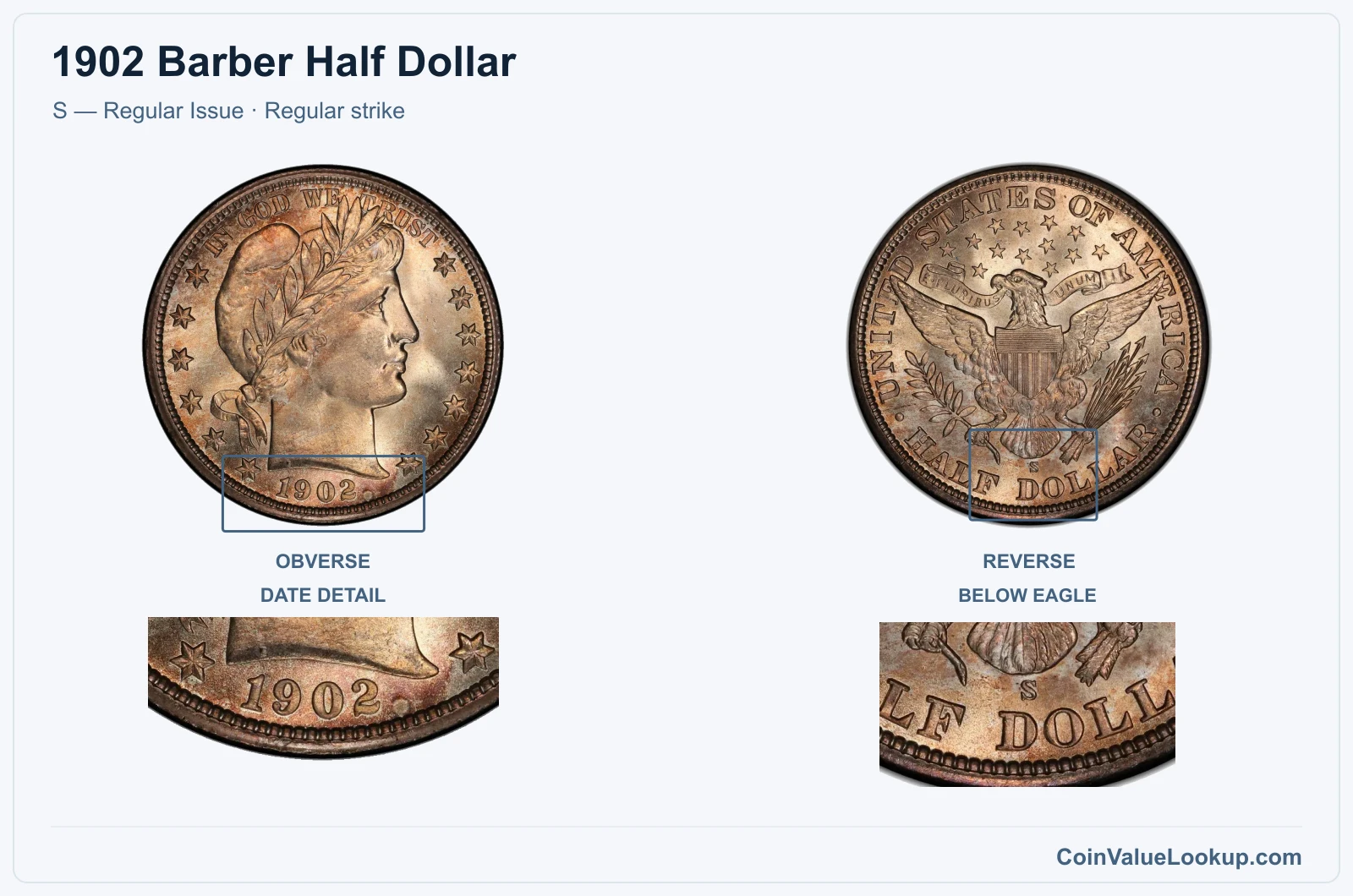
A small "S" below the eagle's tail identifies the San Francisco mint. This version carries the highest business-strike guide values for 1902: about $52 at G4 and approximately $3,652 at MS63 per USA Coin Book.
That gap between worn and Mint State tells you the story. Plenty survived in low grades, but original, lustrous examples are tough.
Check for honest wear patterns rather than tooling or artificial toning that might mask problems. If yours has sharp Liberty hair detail and full eagle feathers with original luster, it could be a significant coin.
Coin Value Lookup is a good starting point if you want to look up other Barber half dollar dates and mints to compare what you have.
Range Grade
Price Auction Records Appraisal PO PO 1
—
Coin Identifier FR FR 2
—
Coin Identifier AG AG 3
—
Coin Identifier G G 4
—
Coin Identifier
G 6
—
Coin Identifier VG VG 8
—
Coin Identifier
VG 10
—
Coin Identifier F F 12
Coin Identifier
F 15
Coin Identifier VF VF 20
Coin Identifier
VF 25
Coin Identifier
VF 30
Coin Identifier
VF 35
Coin Identifier XF XF 40
Coin Identifier
XF 45
Coin Identifier AU AU 50
Coin Identifier
AU 53
Coin Identifier
AU 55
Coin Identifier
AU 58
Coin Identifier MS MS 60
Coin Identifier
MS 61
Coin Identifier
MS 62
Coin Identifier
MS 63
Coin Identifier
MS 64
Coin Identifier
MS 65
Coin Identifier
MS 66
Coin Identifier
MS 67
Coin Identifier
MS 68
—
—
—
MS 69
—
—
—
MS 70
—
—
—
1902 Barber Half Dollar — No Mint Mark — Proof
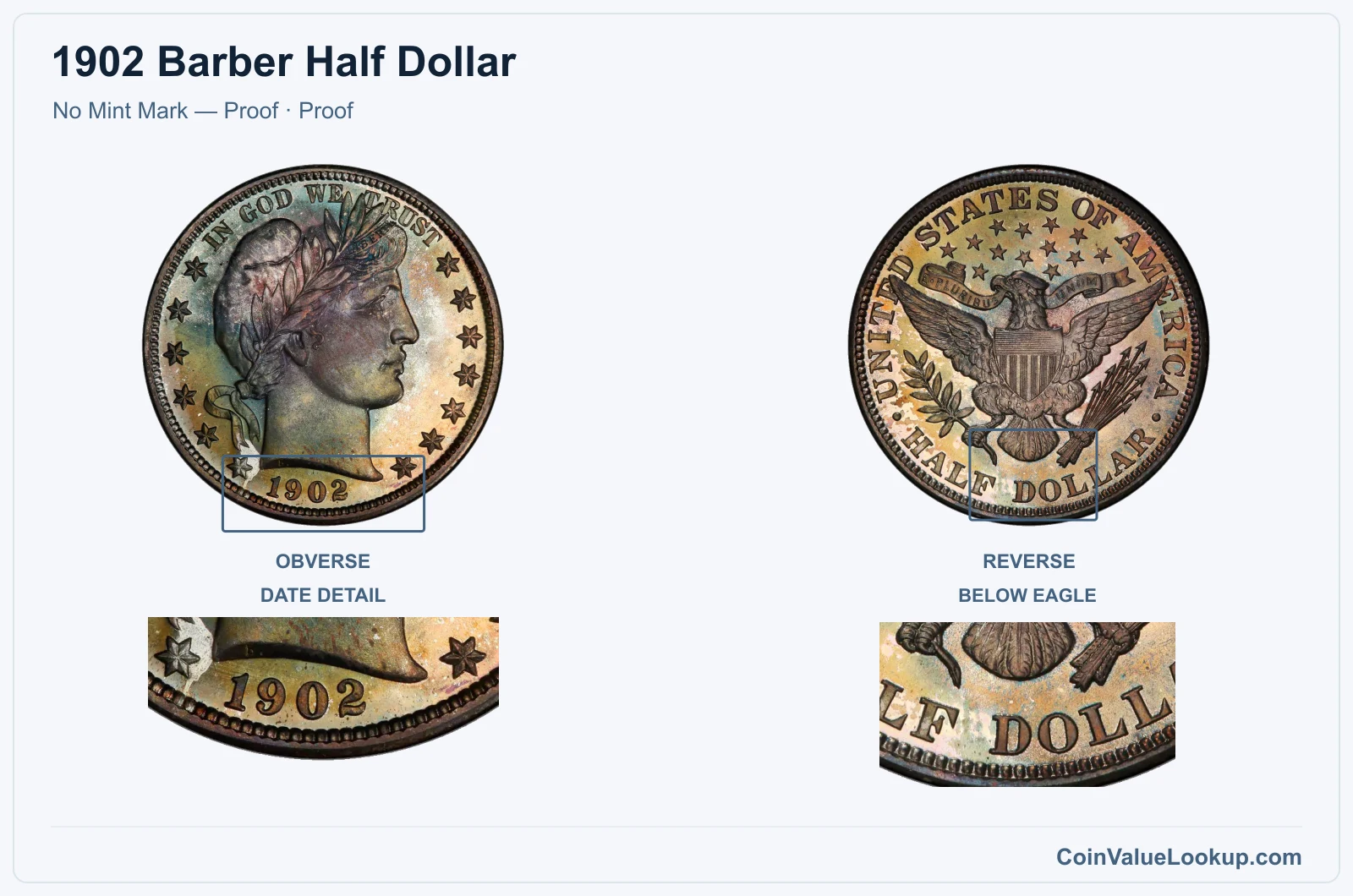
Proofs were struck only at Philadelphia and carry no mintmark, just like regular business strikes. The difference is in how the coin was made: mirror-like fields, razor-sharp rim edges, and fully defined design details down to the smallest element.
A USA Coin Book guide estimate places the 1902 proof at about $1,363 in PR63. Do not confuse a polished business strike with a genuine proof — polishing creates hairlines and a different surface texture than the deep, liquid reflectivity of a true proof.
Compare cameo contrast and field depth rather than just shininess. Professional attribution is strongly recommended before assuming you have a proof.
Range Grade
Price Auction Records Appraisal PR PR 1
—
Coin Identifier
PR 2
—
Coin Identifier
PR 3
—
Coin Identifier
PR 4
—
Coin Identifier
PR 6
—
Coin Identifier
PR 8
—
Coin Identifier
PR 10
—
Coin Identifier
PR 12
—
Coin Identifier
PR 15
—
Coin Identifier
PR 20
—
Coin Identifier
PR 25
—
Coin Identifier
PR 30
—
Coin Identifier
PR 35
—
Coin Identifier
PR 40
—
Coin Identifier
PR 45
—
Coin Identifier
PR 50
—
Coin Identifier
PR 53
—
Coin Identifier
PR 55
—
Coin Identifier
PR 58
—
Coin Identifier
PR 60
Coin Identifier
PR 61
Coin Identifier
PR 62
Coin Identifier
PR 63
Coin Identifier
PR 64
Coin Identifier
PR 65
Coin Identifier
PR 66
Coin Identifier
PR 67
Coin Identifier
PR 68
Coin Identifier
PR 69
—
—
—
PR 70
—
—
—
1902 Barber Half Dollar Error List
1. 1902 Barber Half Dollar — Doubled Die Obverse
A Doubled Die Obverse has been listed for the 1902 Philadelphia half dollar in a Barber specialist society survey. The reported diagnostic involves doubled contours visible on the left-side stars and ribbon areas of the obverse.
Look carefully under magnification for secondary outlines or shelf-like doubling on those elements.
No survey respondent recorded an actual specimen, so this remains a listed candidate rather than a confirmed and widely documented variety. No reliable price data exists for this specific error on the 1902 date.
Be careful not to confuse genuine hub doubling with machine doubling, which tends to show flat, shelf-like displacement without the raised secondary contours of a true doubled die. Worn dies and reflective surfaces can also mimic doubling under certain lighting.
Condition, the visibility of the doubling, and the specific die involved all affect what such a coin might be worth, so professional evaluation is the right move if you suspect you have one.