1913 Barber Half Dollar Coin Value: How Much Is It Worth?
The 1913 Barber Half Dollar spans roughly $44 at G4 to about $2,920 at MS63 across its three business-strike mints, based on a USA Coin Book guide snapshot. Philadelphia, Denver, and San Francisco all produced half dollars this year.
The Philadelphia issue is the scarce one here — it can actually cost more than a Proof at comparable grade levels. Proofs and mint errors occupy their own pricing territory entirely.
Fast Way to Identify Your 1913 Barber Half Dollar
Snap a clear photo of the front and back of your coin and upload both images for a preliminary identification. This helps confirm the date, design, and mintmark location so you can start narrowing down which version you have.
It is not a substitute for professional authentication or exact grading, but it gets you pointed in the right direction quickly.
1913 Barber Half Dollar Value
Upload both sides of your 1913 Barber Half Dollar.
Front Obverse
Upload photo
Back Reverse
Upload photo
Which 1913 Barber Half Dollar Versions Are Worth Money?
- The 1913 Philadelphia (no mintmark) business strike is the scarce issue this year, with a guide value of about $118 at G4 climbing to around $2,920 at MS63 — check the mintmark area carefully.
- The 1913-S San Francisco half reaches roughly $2,092 at MS63 per the guide, making original uncirculated examples worth investigating.
- Problem-free coins in upper circulated or Mint State grades can be worth many times more than heavily worn pieces — surface quality and originality matter a great deal.
- The 1913 Proof (Philadelphia, no mintmark) is a distinct finish valued separately at about $1,363 at PR63 in the guide; do not confuse a polished business strike for a Proof.
Step 1: Identify Your 1913 Barber Half Dollar Mint Mark and Version
The 1913 Barber Half Dollar shows Liberty facing right on the obverse, wearing a Phrygian cap over a laurel wreath, with the date at the bottom. The reverse features a heraldic eagle clutching arrows and an olive branch, with HALF DOLLAR spelled out below.
All business strikes use 90% silver and 10% copper, weigh about 12.5 grams, and measure 30.6 mm with a reeded edge. Three mints produced this date: Philadelphia, Denver, and San Francisco.
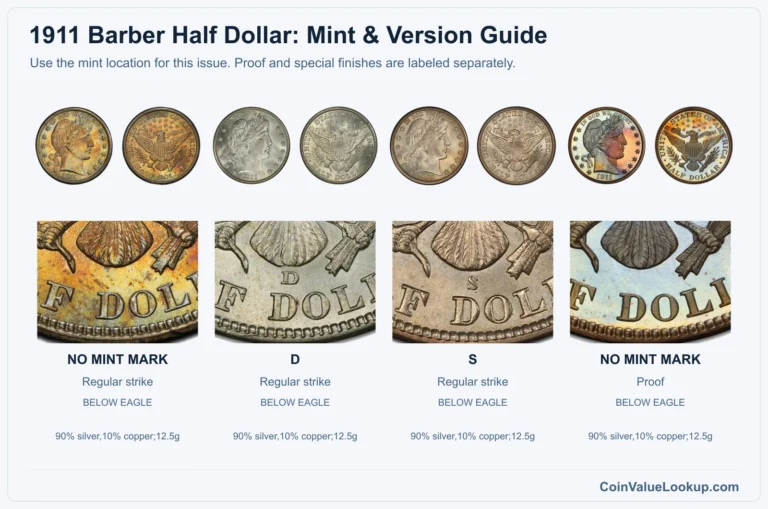
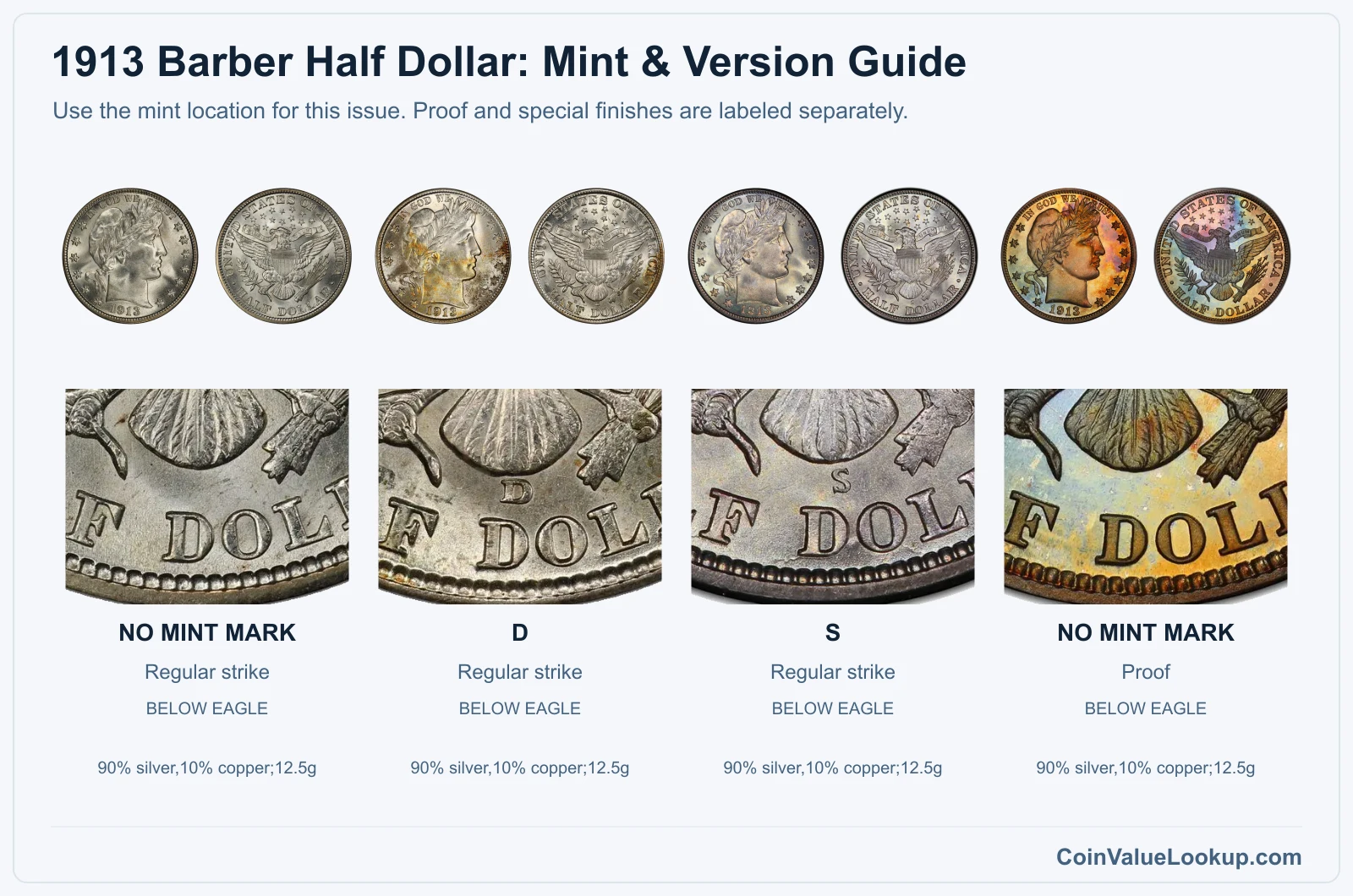
To find the mintmark, flip to the reverse and look just below the eagle's tail feathers and above HALF DOLLAR. A "D" means Denver, an "S" means San Francisco.
No letter at all means Philadelphia. That bare spot where a mintmark would be is easy to overlook, so use good lighting.
Don't assume an unusual surface mark or die scratch is automatically a valuable error. Confirm the mint and finish first, then check the value charts for your specific version.
Step 2: Check Your 1913 Barber Half Dollar Grade
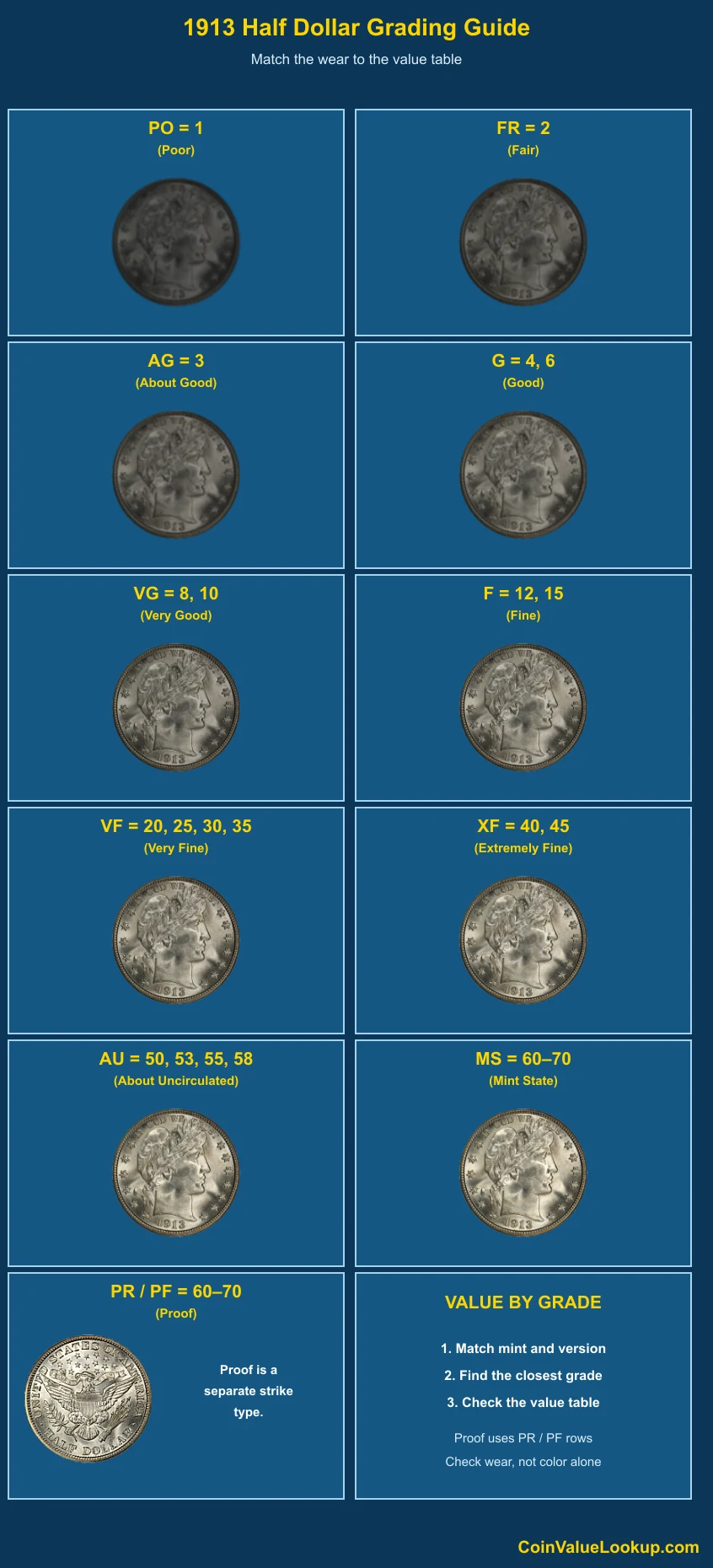
Start by examining Liberty's cheek, the hair detail above her ear, and the letters in the LIBERTY headband. On the reverse, check the eagle's head, the tips of the wings, and the tail feathers.
Compare your coin side-by-side with the grade comparison image to match the level of wear you see.
A common mistake is confusing a weak strike with actual wear. Some Barber halves left the press with soft details, especially around the eagle's claws and arrow feathers.
If the coin still has original luster in the protected areas but looks flat in spots, strike weakness may be the cause rather than circulation damage.
Don't rely solely on the LIBERTY letters to assign a grade. Hub changes during the Barber series affected how quickly those letters wore, so they aren't always a reliable single indicator.
Look at the whole coin together — cheek smoothness, shield lines, wing feathers.
A Proof is a special manufacturing finish with mirrored fields and sharp rims. It is not a grade above Mint State.
Polishing a business strike will never turn it into a Proof, and it will actually reduce the coin's value.
Step 3: Check 1913 Barber Half Dollar Value by Mint and Version
1913 Barber Half Dollar — No Mint Mark — Regular Issue
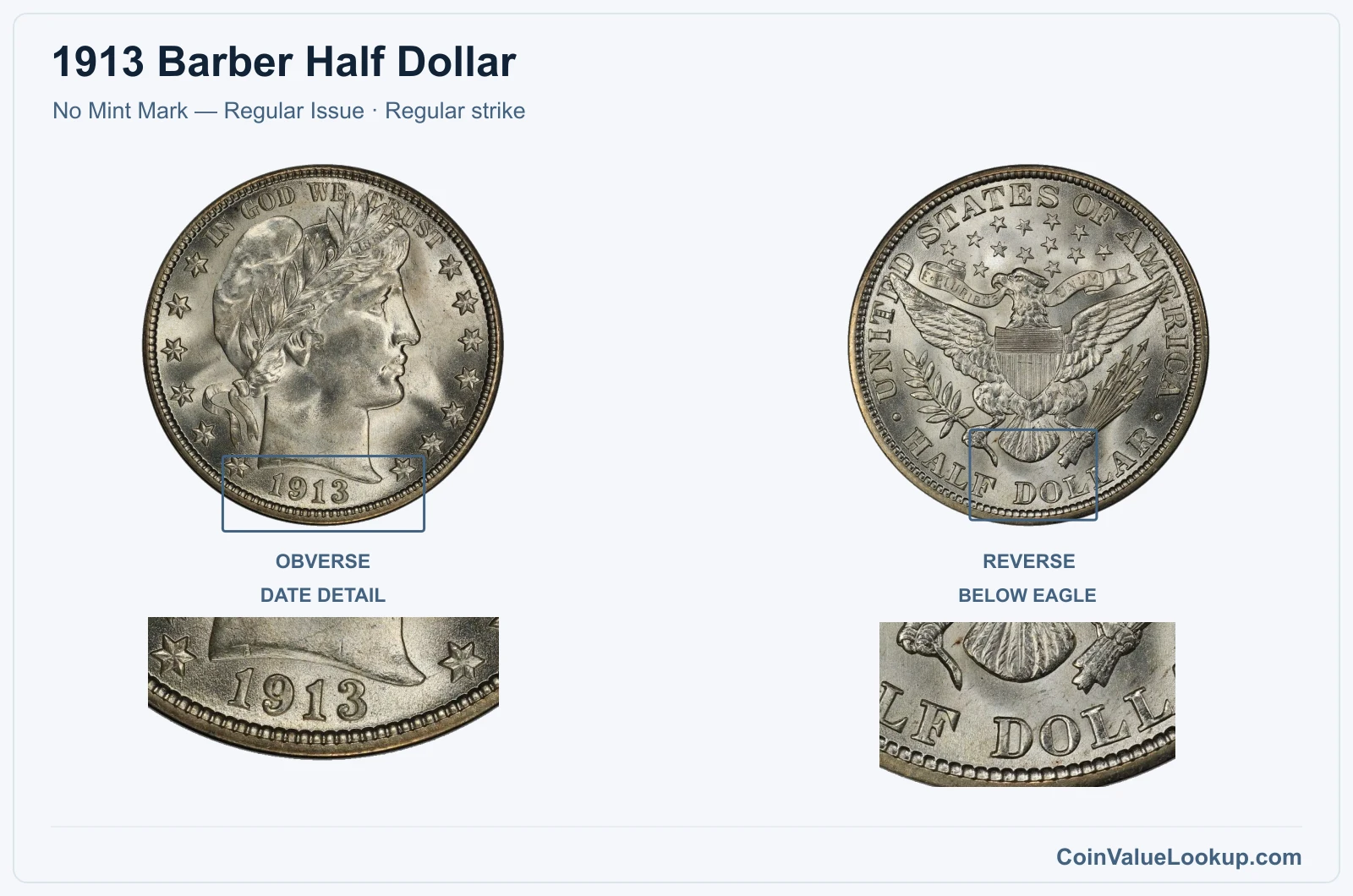
The 1913 Philadelphia half dollar carries no mintmark — look below the eagle's tail on the reverse, and if the space is blank, you have the Philly issue. This is the scarce business strike of the year.
A USA Coin Book guide estimate places the no-mintmark 1913 at about $118 in G4, rising to roughly $2,920 at MS63. That G4 price is nearly three times the Denver or San Francisco equivalent, which tells you how much collectors value this date from Philadelphia.
Original, unimpaired surfaces matter enormously here. A cleaned or damaged example loses much of the premium that scarcity provides.
Before pricing your coin, assess its condition honestly and look for signs of original luster or attractive toning.
Coin Value Lookup is a handy starting point if you want to look up guides for other Barber half dates or different denominations in your collection.
Range Grade
Price Auction Records Appraisal PO PO 1
—
Coin Identifier FR FR 2
—
Coin Identifier AG AG 3
Coin Identifier G G 4
Coin Identifier
G 6
Coin Identifier VG VG 8
Coin Identifier
VG 10
Coin Identifier F F 12
Coin Identifier
F 15
Coin Identifier VF VF 20
Coin Identifier
VF 25
Coin Identifier
VF 30
Coin Identifier
VF 35
Coin Identifier XF XF 40
Coin Identifier
XF 45
Coin Identifier AU AU 50
Coin Identifier
AU 53
Coin Identifier
AU 55
Coin Identifier
AU 58
Coin Identifier MS MS 60
—
Coin Identifier
MS 61
Coin Identifier
MS 62
Coin Identifier
MS 63
Coin Identifier
MS 64
Coin Identifier
MS 65
Coin Identifier
MS 66
Coin Identifier
MS 67
—
—
—
MS 68
—
—
—
MS 69
—
—
—
MS 70
—
—
—
1913 Barber Half Dollar — D — Regular Issue
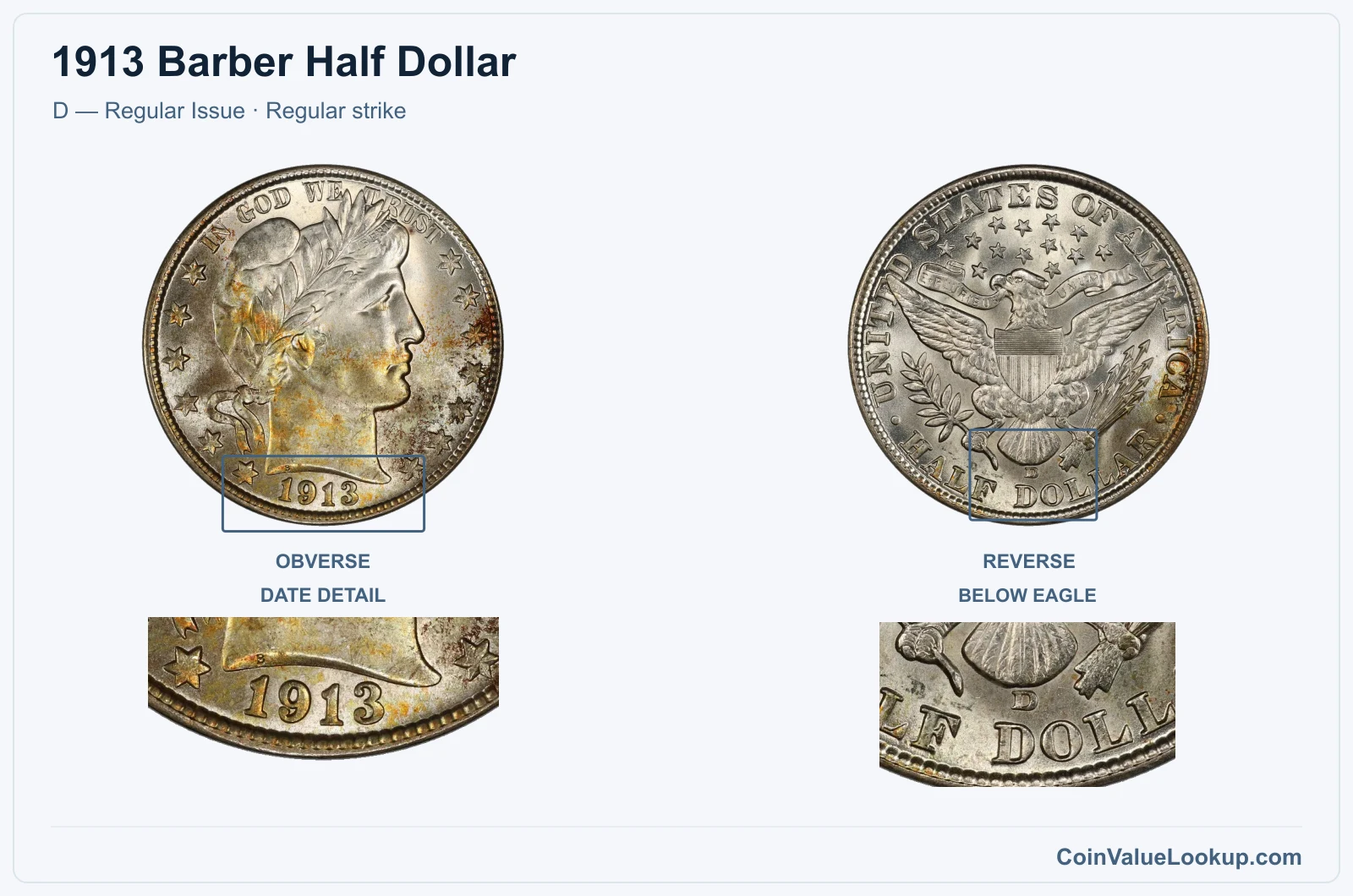
The Denver mint used a "D" mintmark placed below the eagle's tail feathers on the reverse. If you see that small letter, you have the 1913-D.
Guide estimates from USA Coin Book put this version at about $44 in G4 and around $1,205 at MS63. It is the most affordable entry point for the 1913 date in low grades.
Even so, the jump from G4 to MS63 is dramatic. A coin with full original luster and clean surfaces is worth investigating further.
Check for scratches, rim damage, and any signs of cleaning before assuming your coin is uncirculated.
Range Grade
Price Auction Records Appraisal PO PO 1
—
Coin Identifier FR FR 2
—
Coin Identifier AG AG 3
—
Coin Identifier G G 4
Coin Identifier
G 6
—
Coin Identifier VG VG 8
Coin Identifier
VG 10
Coin Identifier F F 12
Coin Identifier
F 15
Coin Identifier VF VF 20
Coin Identifier
VF 25
Coin Identifier
VF 30
Coin Identifier
VF 35
Coin Identifier XF XF 40
Coin Identifier
XF 45
Coin Identifier AU AU 50
Coin Identifier
AU 53
Coin Identifier
AU 55
Coin Identifier
AU 58
Coin Identifier MS MS 60
Coin Identifier
MS 61
Coin Identifier
MS 62
Coin Identifier
MS 63
Coin Identifier
MS 64
Coin Identifier
MS 65
Coin Identifier
MS 66
Coin Identifier
MS 67
Coin Identifier
MS 68
—
—
—
MS 69
—
—
—
MS 70
—
—
—
1913 Barber Half Dollar — S — Regular Issue
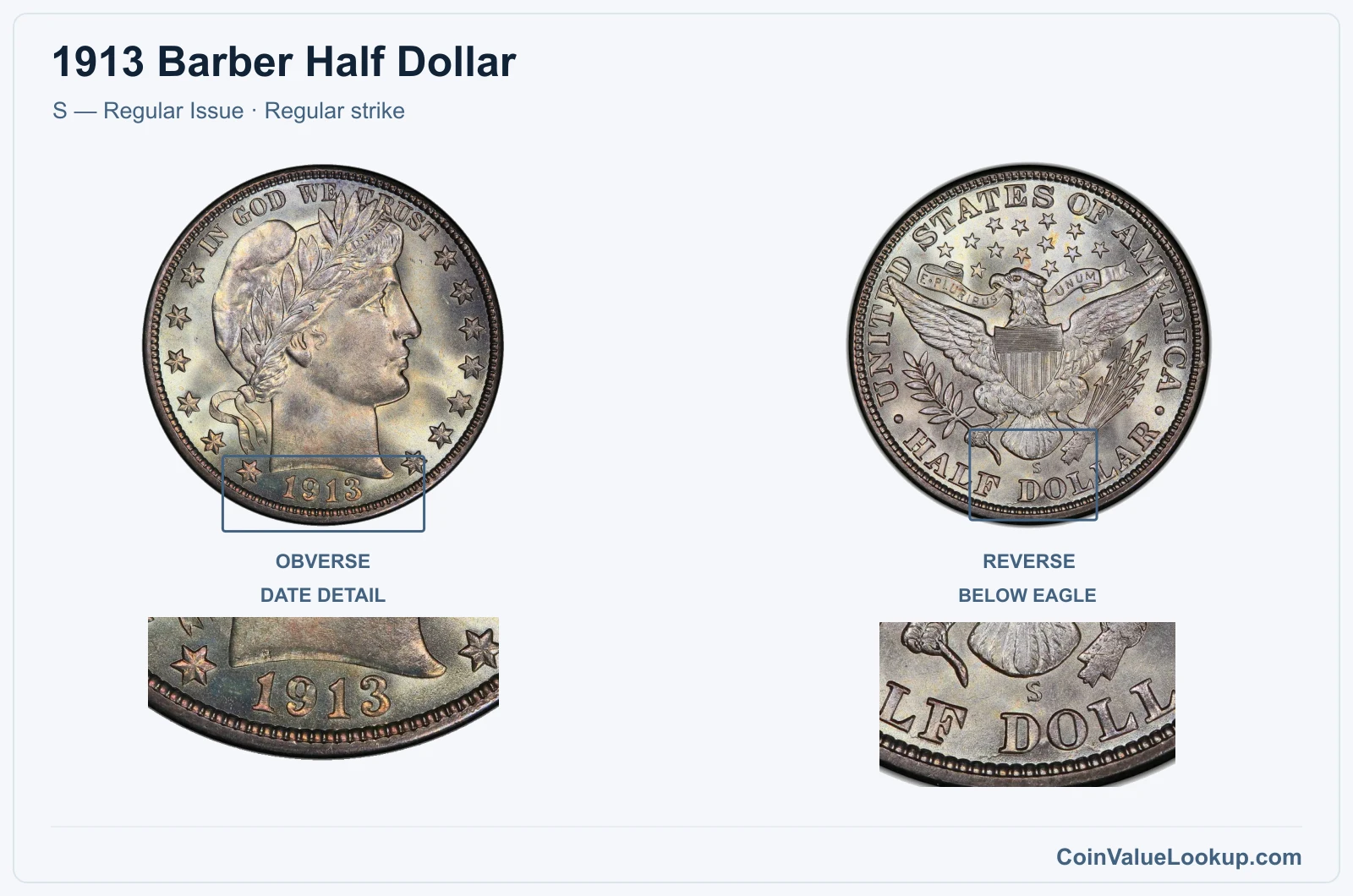
San Francisco struck 1913 halves with an "S" mintmark, found in the same spot below the eagle's tail. The 1913-S is on par with the Denver issue at about $44 in G4 per the USA Coin Book guide.
At MS63, however, the guide estimate jumps to roughly $2,092 — considerably higher than the Denver version at the same grade. That spread means a well-preserved 1913-S in original Mint State condition is a coin worth examining closely.
Look for full luster across both sides and sharp detail on Liberty's hair and the eagle's feathers. Any signs of cleaning or artificial toning will significantly reduce the coin's appeal and value to collectors.
Range Grade
Price Auction Records Appraisal PO PO 1
—
Coin Identifier FR FR 2
—
Coin Identifier AG AG 3
—
Coin Identifier G G 4
Coin Identifier
G 6
Coin Identifier VG VG 8
Coin Identifier
VG 10
Coin Identifier F F 12
Coin Identifier
F 15
Coin Identifier VF VF 20
Coin Identifier
VF 25
Coin Identifier
VF 30
Coin Identifier
VF 35
Coin Identifier XF XF 40
Coin Identifier
XF 45
Coin Identifier AU AU 50
Coin Identifier
AU 53
Coin Identifier
AU 55
Coin Identifier
AU 58
Coin Identifier MS MS 60
—
Coin Identifier
MS 61
Coin Identifier
MS 62
Coin Identifier
MS 63
Coin Identifier
MS 64
Coin Identifier
MS 65
Coin Identifier
MS 66
Coin Identifier
MS 67
Coin Identifier
MS 68
—
—
—
MS 69
—
—
—
MS 70
—
—
—
1913 Barber Half Dollar — No Mint Mark — Proof
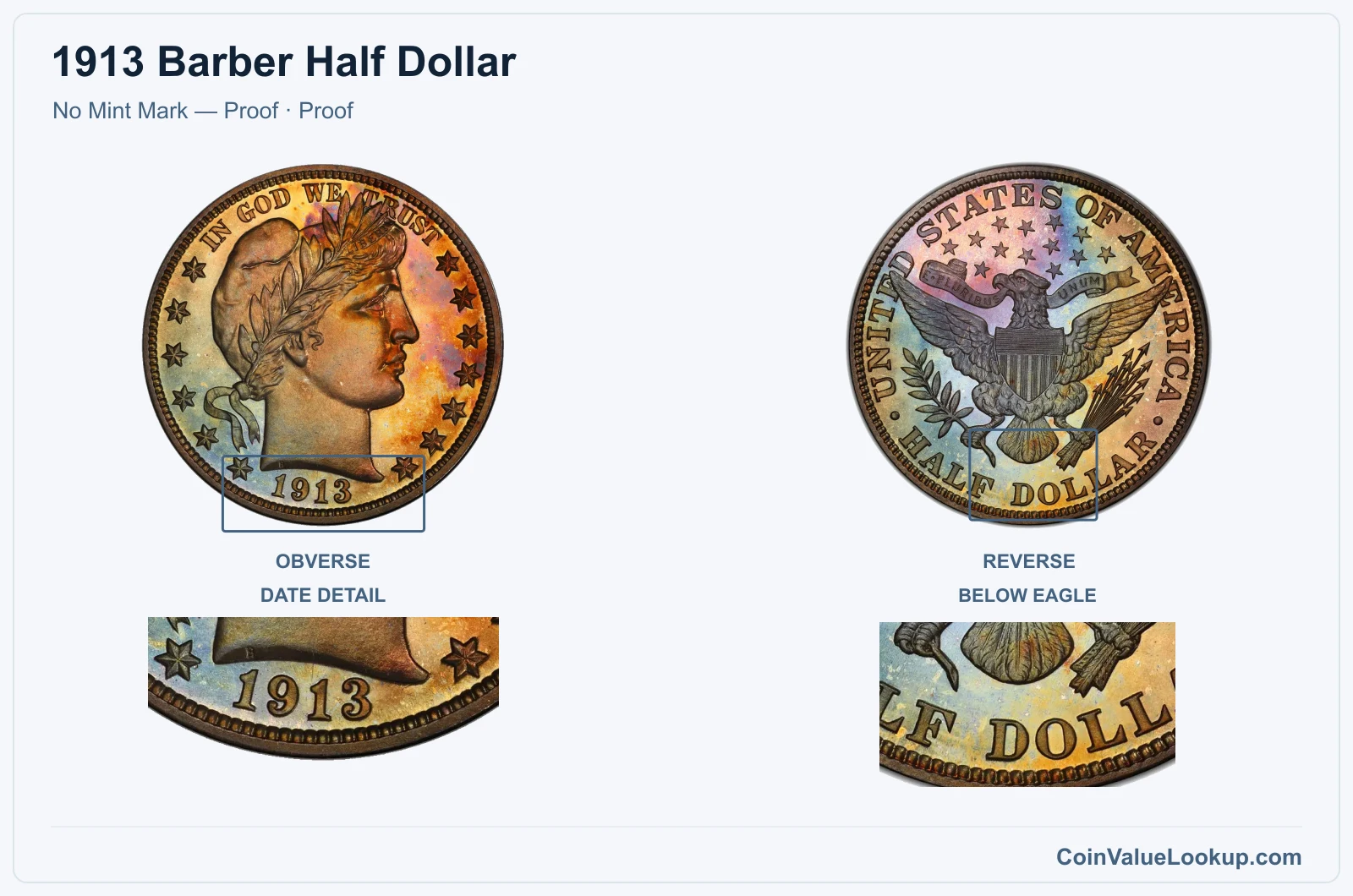
The 1913 Proof Barber Half Dollar was struck at Philadelphia with specially prepared dies on polished planchets, producing deeply mirrored fields and crisp design edges. Like all Proofs of this series, it carries no mintmark.
USA Coin Book lists the guide estimate at about $1,363 in PR63. That is actually less than the Philadelphia business strike at MS63, which reflects just how scarce the regular-issue 1913-P is in top condition.
To identify a genuine Proof, look for glass-like reflective fields and squared-off, knife-sharp rims. A business strike that has been polished might look shiny, but it will show hairline scratches and rounded rims — dead giveaways.
Cameo contrast, where the devices appear frosted against mirrored fields, can vary among surviving Proofs and is worth comparing within this finish category rather than treating it as a separate variety.
Range Grade
Price Auction Records Appraisal PR PR 1
—
Coin Identifier
PR 2
—
Coin Identifier
PR 3
—
Coin Identifier
PR 4
—
Coin Identifier
PR 6
—
Coin Identifier
PR 8
—
Coin Identifier
PR 10
—
Coin Identifier
PR 12
—
Coin Identifier
PR 15
—
Coin Identifier
PR 20
—
Coin Identifier
PR 25
—
Coin Identifier
PR 30
—
Coin Identifier
PR 35
—
Coin Identifier
PR 40
—
Coin Identifier
PR 45
—
Coin Identifier
PR 50
—
Coin Identifier
PR 53
—
Coin Identifier
PR 55
Coin Identifier
PR 58
Coin Identifier
PR 60
Coin Identifier
PR 61
Coin Identifier
PR 62
Coin Identifier
PR 63
Coin Identifier
PR 64
Coin Identifier
PR 65
Coin Identifier
PR 66
Coin Identifier
PR 67
Coin Identifier
PR 68
Coin Identifier
PR 69
—
—
—
PR 70
—
—
—
1913 Barber Half Dollar Error List
1. 1913 Barber Half Dollar — Double / Multiple Strike
A double-struck 1913 Philadelphia half dollar has been reported, struck twice within the collar. The diagnostic to look for is a rotated second impression visible on the reverse — the reported example shows extra wing outlines and duplicated eagle feet, creating an unmistakable overlapping image.
This is a double strike, not a doubled die. The difference matters.
A doubled die results from a misaligned hub impression during die manufacture, producing subtle doubling in consistent locations across many coins. A double strike means your specific coin was hit twice by the press, and the second blow landed at a slightly different angle.
The effect is usually far more dramatic and obvious.
Watch out for lookalikes. Impressions added after the coin left the mint — from vises, hammers, or other coins pressing against the surface — can mimic a second strike.
Machine doubling from a bouncing die is another common imposter. No specific price range is available for this error; value depends on the visibility of the second impression, overall condition, and market demand at the time of sale.
2. 1913 Barber Half Dollar — Clipped Planchet
A clipped planchet error on a 1913-S Barber Half Dollar has been discussed among error collectors in the context of a Heritage auction conversation. This type of error occurs when the blank is punched from strip metal that overlaps a previously punched hole, leaving the coin with a missing curved section along its edge.
Look for an area where the rim and edge are absent in a smooth, curved arc — not a straight cut or a jagged gouge. A genuine clip will sometimes show a corresponding area of weakness on the opposite side of the coin, known as the Blakesley effect, where metal did not flow fully during striking.
Be cautious about lookalikes. A coin that was filed, cut, or corroded after leaving the mint can mimic a clip.
Post-mint damage usually leaves sharp or irregular edges rather than the smooth contour of a genuine blank defect. No specific price is available for this error; the value depends on clip size, coin condition, and overall eye appeal.