1812 Capped Bust Half Dollar Coin Value: How Much Is It Worth?
A normal 1812 Capped Bust Half Dollar runs roughly $111 in G4 to $948 in AU50 based on guide estimates. Those are starting points, not guarantees.
The overdate and single-leaf varieties can push values dramatically higher, so identifying which version you hold matters more than most collectors expect.
Fast Way to Identify Your 1812 Capped Bust Half Dollar
The quickest way to start is to upload clear photos of both sides of your coin. Our identifier can offer a preliminary read on which version you might have — Normal Date, overdate, or Single Leaf.
It cannot authenticate, certify, or give an exact grade, but it will point you in the right direction.
1812 Capped Bust Half Dollar Value
Upload both sides of your 1812 Capped Bust Half Dollar.
Front Obverse
Upload photo
Back Reverse
Upload photo
Which 1812 Capped Bust Half Dollar Versions Are Worth Money?
- The 1812/1 Large 8 overdate is the standout variety, with guide estimates from around $2,516 at G4 to $42,846 at AU50 — positive identification of both the large date punches and the underlying 1 is required.
- The Single Leaf variety, missing an upper olive leaf on the reverse, carries guide estimates from about $1,262 at G4 to $30,039 at AU50, but wear alone does not confirm the missing leaf.
- The 1812/1 Small 8 overdate trades at roughly $205 in G4 to $1,464 in AU50, well above the Normal Date baseline.
- Even a Normal Date example in AU50 guides near $948, reflecting the age and silver content of these early half dollars.
Step 1: Identify Your 1812 Capped Bust Half Dollar Mint Mark and Version
Every 1812 Capped Bust Half Dollar was struck at Philadelphia. There is no mintmark, and that is perfectly normal for this issue.
Confirm the design first: a left-facing Liberty wearing a cloth cap on the obverse, and a heraldic eagle with a shield on the reverse. The denomination reads 50C.
If your coin shows a Draped Bust portrait instead, you have an earlier type from a different series page.
The coin is a silver-copper alloy, approximately 89.24% silver, with a nominal weight of 13.48 grams and a diameter of about 32.5 mm. Check the edge — it should be lettered, reading FIFTY CENTS OR HALF A DOLLAR.
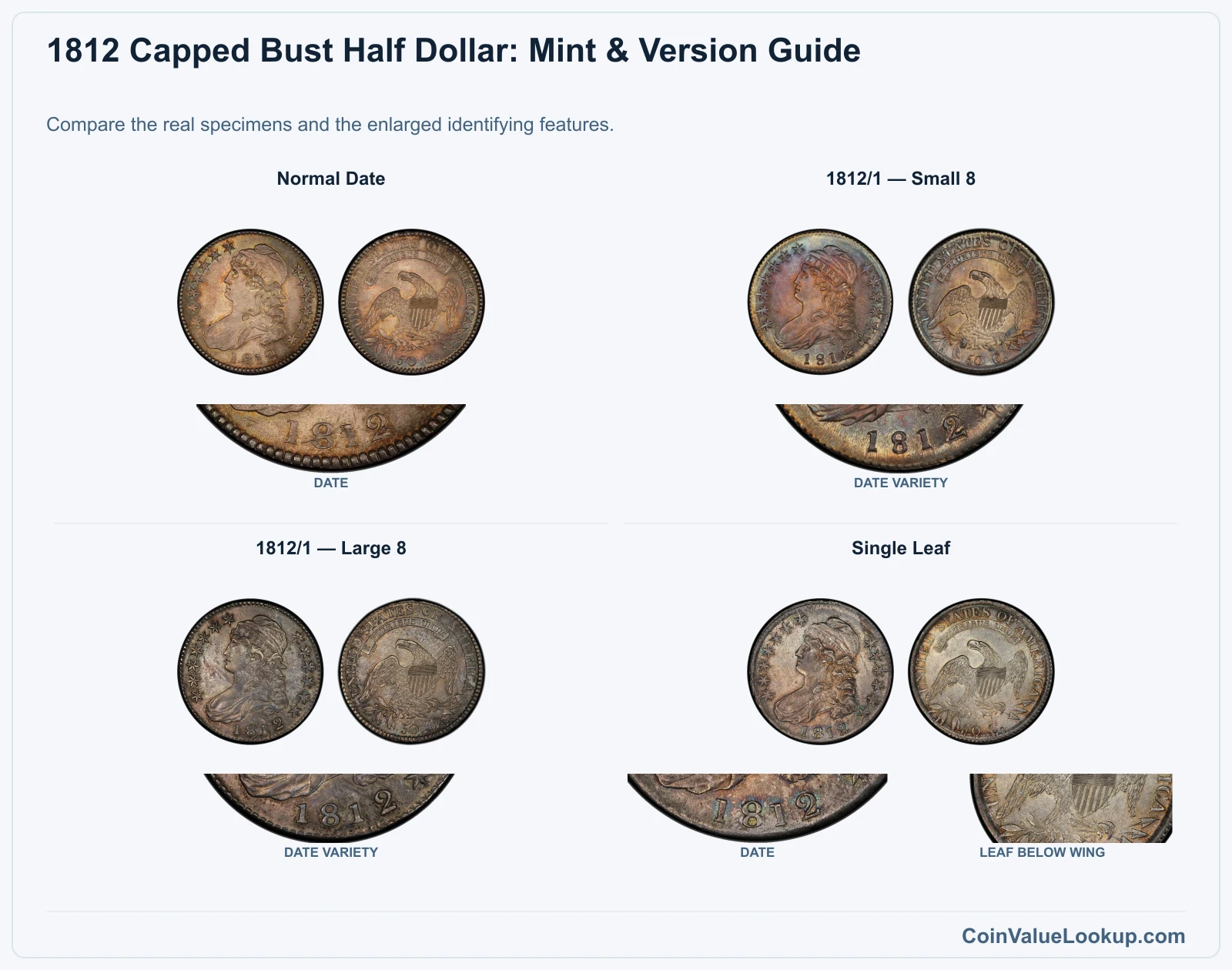
Now the critical step: determine which of four versions you have. Look at the date closely.
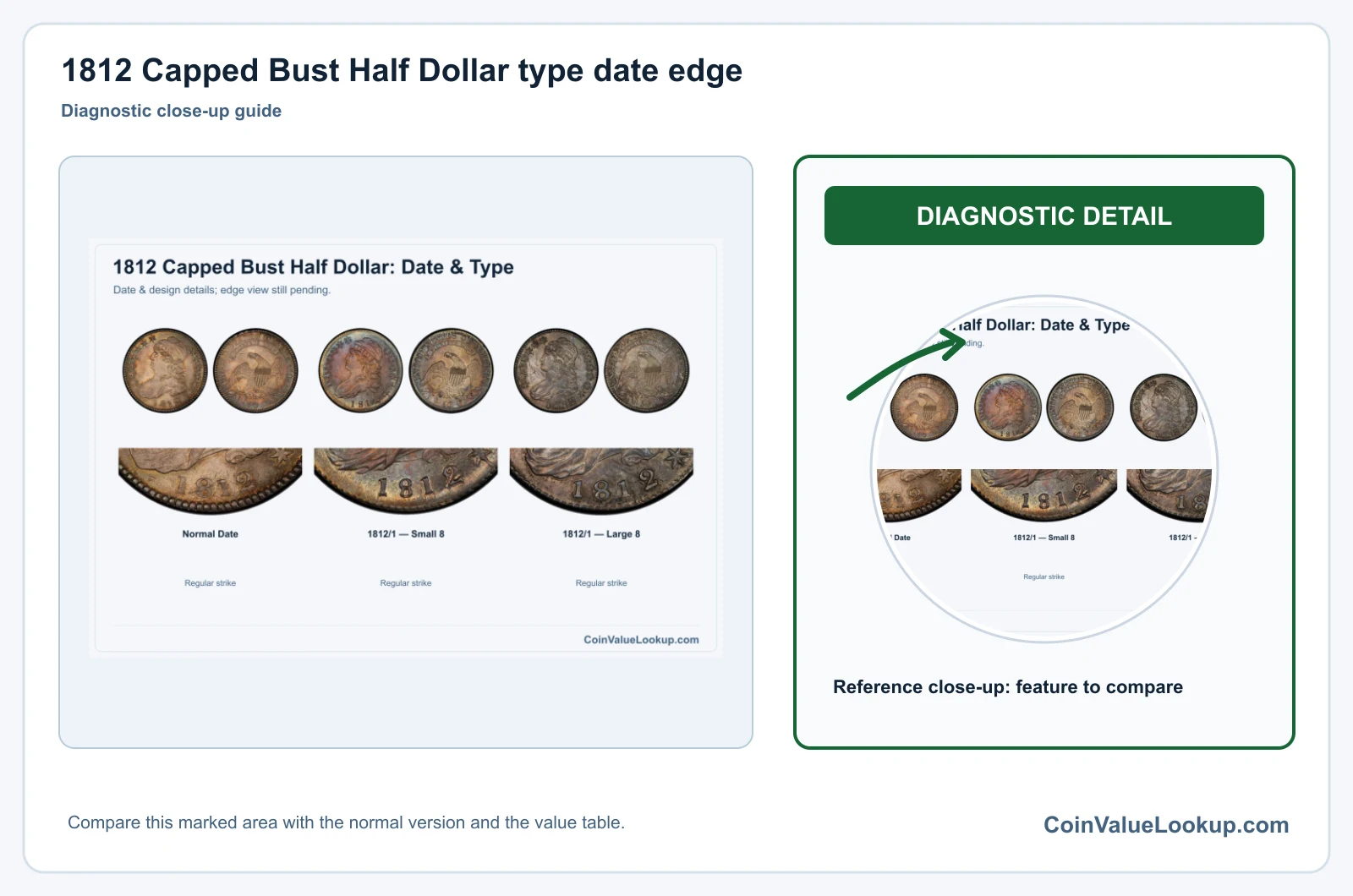
On overdates, remnants of a 1 are visible beneath the final 2. The Small 8 and Large 8 overdates use different-sized date punches, so the overall numeral size matters as much as the ghosted digit.
The Single Leaf variety is identified on the reverse — one of the olive leaves beneath the eagle's wing is missing. Wear can hide that leaf on any coin, so its absence alone does not confirm the variety; compare against an attributed example.
Step 2: Check Your 1812 Capped Bust Half Dollar Grade
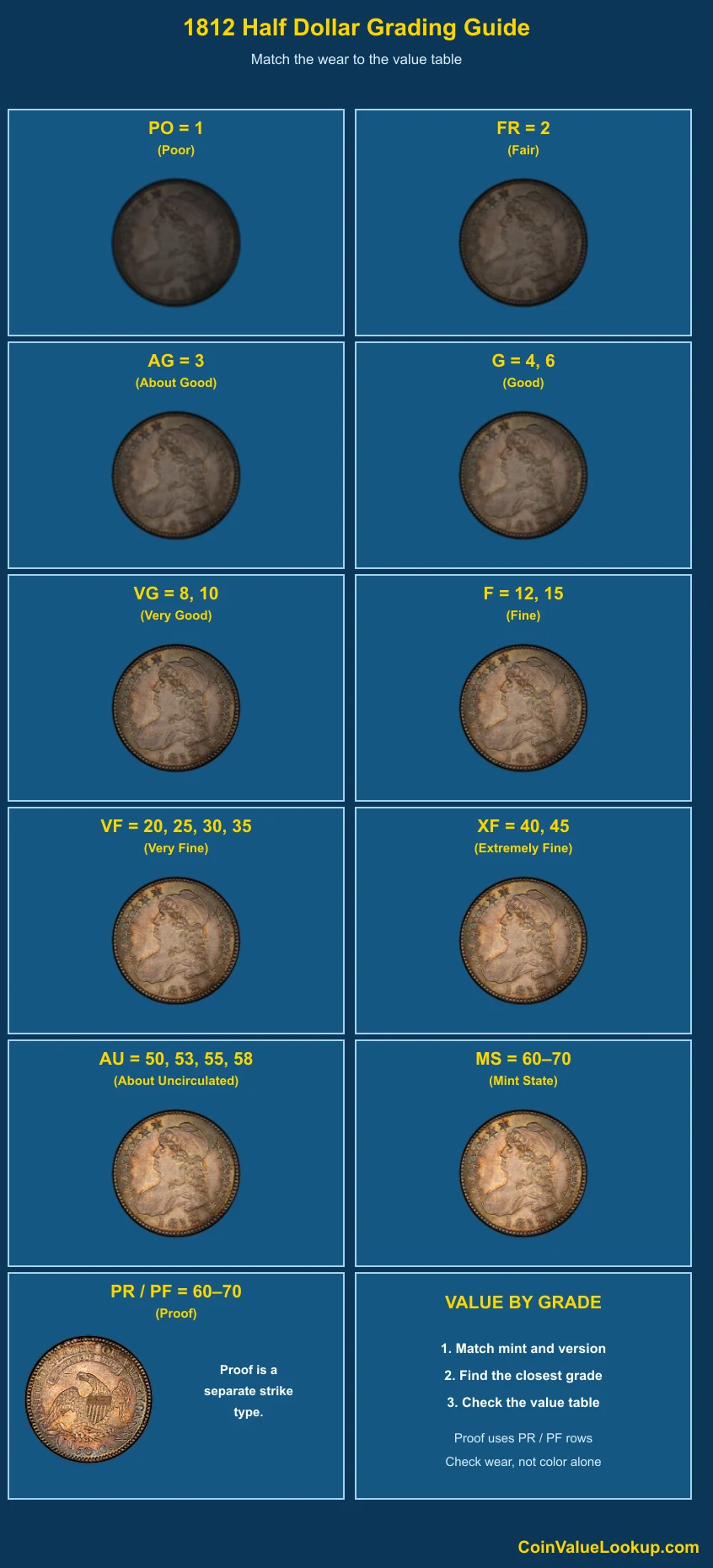
Start with the obverse. The first areas to lose detail are the hair above Liberty's forehead, the ear, and the cheek.
On well-worn coins, the cap and shoulder clasp flatten together into a single mass.
Flip to the reverse. Eagle breast feathers and wing tips wear next.
A weakly struck coin can look similar to a worn one, so compare luster — original mint frost suggests a strike issue rather than circulation loss.
The comparison image beside this section shows genuine Capped Bust halves at various grades. Use it to bracket your coin between two known examples.
If your coin has been cleaned, holed, tooled, or heavily scratched, it falls into a "Details" category. Do not price a Details coin on the straight-grade value curve; the discount is steep and varies case by case.
Step 3: Check 1812 Capped Bust Half Dollar Value by Mint and Version
1812 Capped Bust Half Dollar — Normal Date
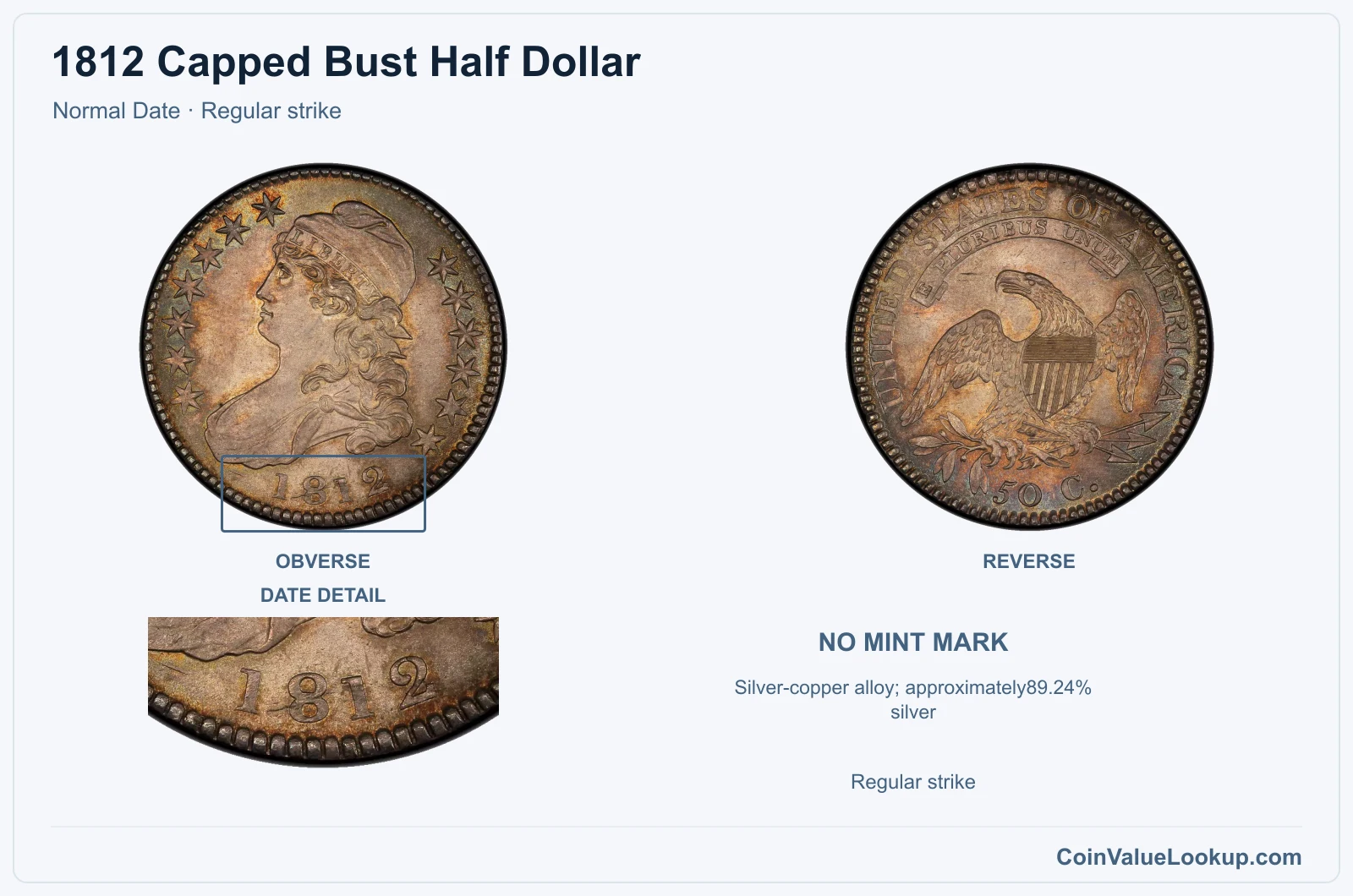
The Normal Date 1812 is the baseline issue. Guide estimates place it at about $111 in G4, $268 in VF20, and $948 in AU50.
Before you settle on this version, do two things. First, examine the final digit — the 2 — under magnification for any trace of an underlying 1.
Second, flip the coin and count the olive leaves beneath the eagle's wing. If neither check turns up anything unusual, you likely have the ordinary variety.
These are common enough in circulated grades and make a solid, affordable entry into the Capped Bust series.
Range Grade
Price Auction Records Appraisal PO PO 1
—
Coin Identifier FR FR 2
—
Coin Identifier AG AG 3
—
Coin Identifier G G 4
—
Coin Identifier
G 6
Coin Identifier VG VG 8
Coin Identifier
VG 10
Coin Identifier F F 12
Coin Identifier
F 15
Coin Identifier VF VF 20
Coin Identifier
VF 25
Coin Identifier
VF 30
Coin Identifier
VF 35
Coin Identifier XF XF 40
Coin Identifier
XF 45
Coin Identifier AU AU 50
Coin Identifier
AU 53
Coin Identifier
AU 55
Coin Identifier
AU 58
Coin Identifier MS MS 60
Coin Identifier
MS 61
Coin Identifier
MS 62
Coin Identifier
MS 63
Coin Identifier
MS 64
Coin Identifier
MS 65
Coin Identifier
MS 66
Coin Identifier
MS 67
—
Coin Identifier
MS 68
—
—
—
MS 69
—
—
—
MS 70
—
—
—
1812 Capped Bust Half Dollar — /1 — Small 8
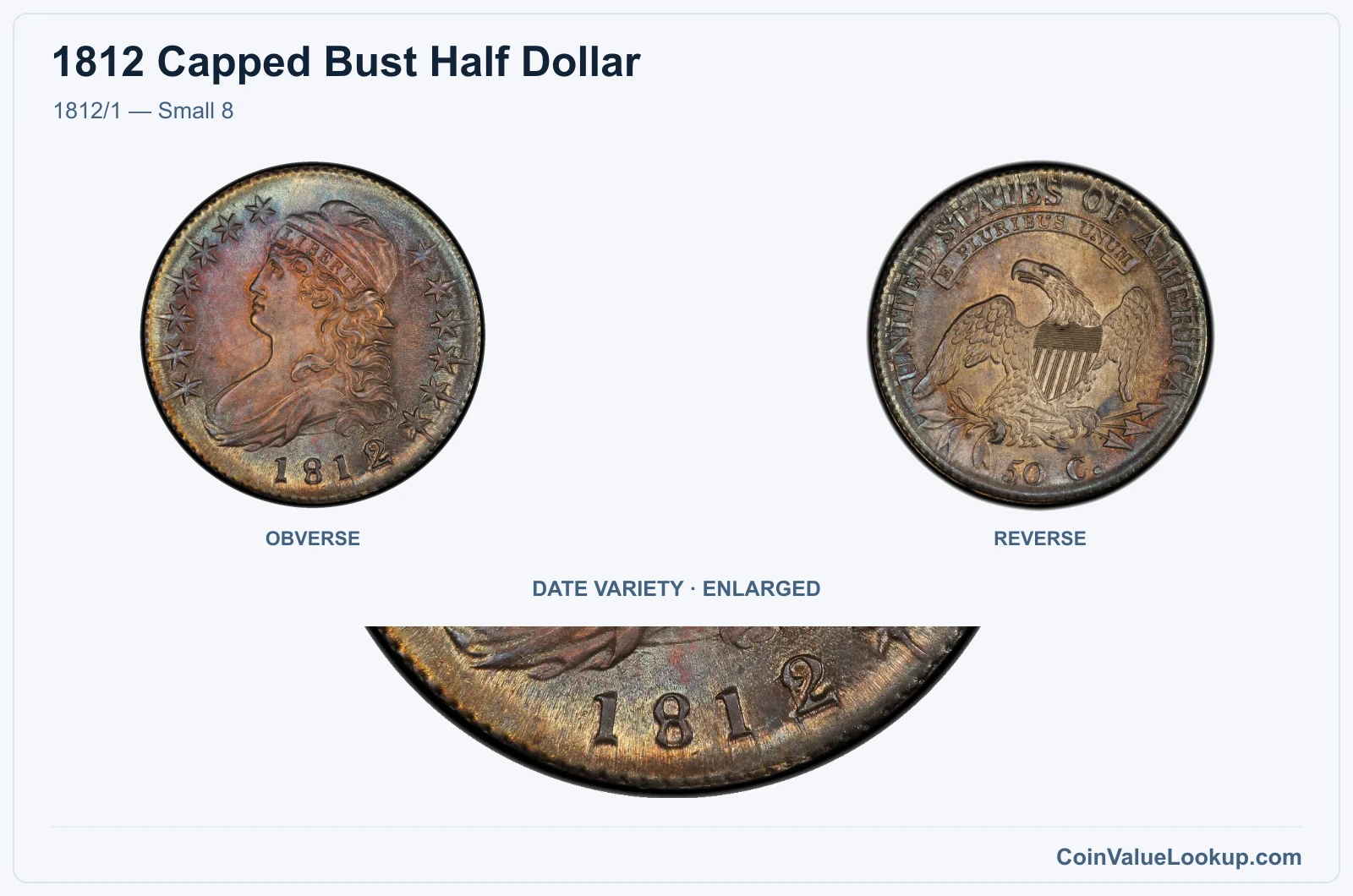
The 1812/1 Small 8 overdate shows remnants of a 1 beneath the 2, and the date numerals are noticeably smaller than on the Large 8 counterpart. Both diagnostics must be present — small punches and the ghosted digit — before you apply this premium.
Guide estimates run about $205 at G4, $457 at VF20, and $1,464 at AU50. That is roughly double the Normal Date across the board.
On heavily worn coins the underlying 1 can be faint, so good lighting and a loupe are essential. Compare the overall date size against reference images before committing to either overdate attribution.
Coin Value Lookup is a good starting point if you want to look up other dates in the Capped Bust Half Dollar series or compare values across early U.S. silver.
Range Grade
Price Auction Records Appraisal PO PO 1
—
Coin Identifier FR FR 2
—
Coin Identifier AG AG 3
—
Coin Identifier G G 4
—
Coin Identifier
G 6
—
Coin Identifier VG VG 8
Coin Identifier
VG 10
—
Coin Identifier F F 12
Coin Identifier
F 15
Coin Identifier VF VF 20
Coin Identifier
VF 25
Coin Identifier
VF 30
Coin Identifier
VF 35
Coin Identifier XF XF 40
Coin Identifier
XF 45
Coin Identifier AU AU 50
Coin Identifier
AU 53
Coin Identifier
AU 55
Coin Identifier
AU 58
Coin Identifier MS MS 60
—
Coin Identifier
MS 61
Coin Identifier
MS 62
Coin Identifier
MS 63
Coin Identifier
MS 64
Coin Identifier
MS 65
Coin Identifier
MS 66
—
—
—
MS 67
—
—
—
MS 68
—
—
—
MS 69
—
—
—
MS 70
—
—
—
1812 Capped Bust Half Dollar — /1 — Large 8
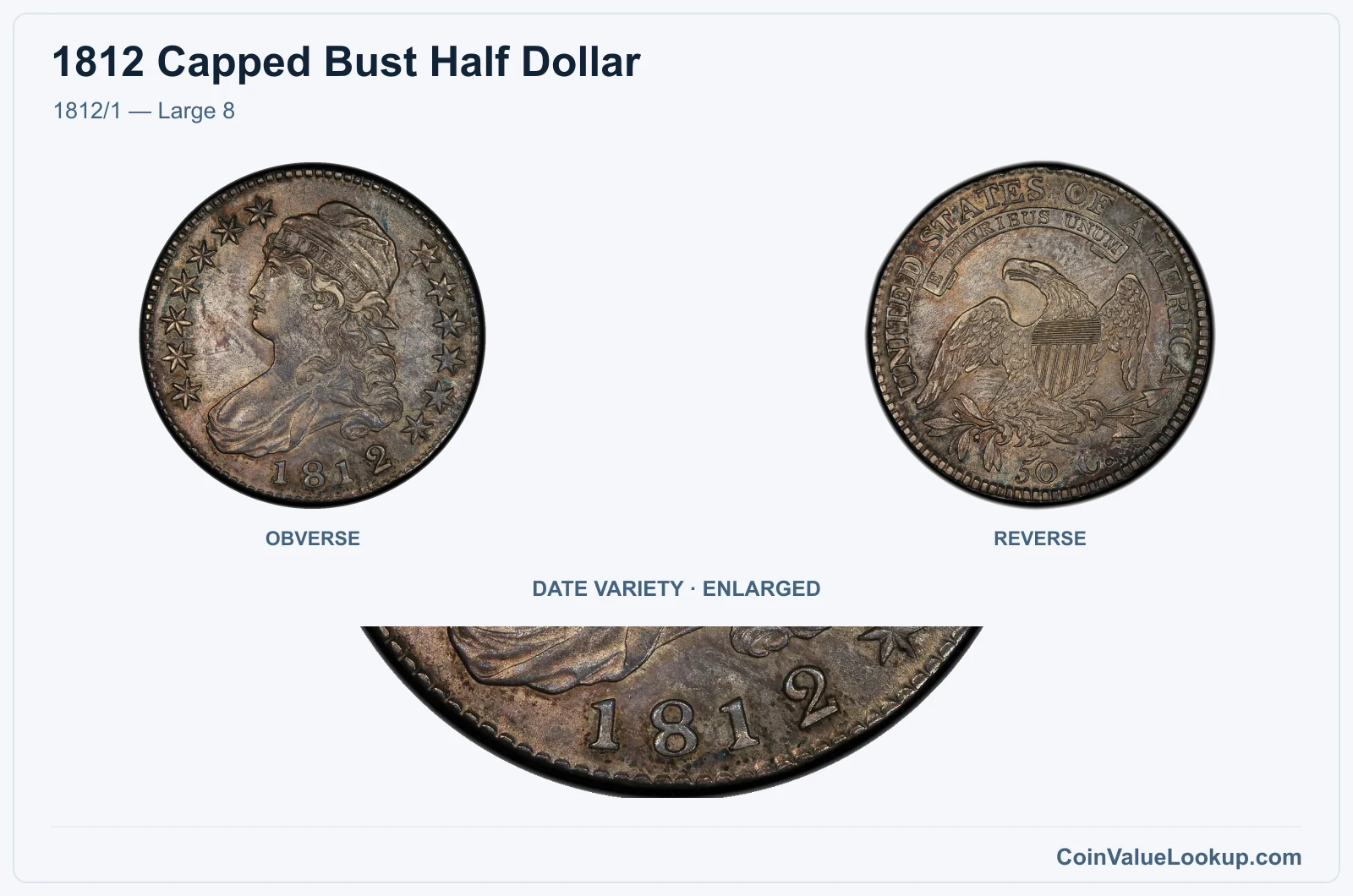
This is the heavy hitter. The 1812/1 Large 8 uses visibly larger date punches than the Small 8 variety, and the underlying 1 is still present beneath the final 2.
Guide estimates reach approximately $2,516 at G4, $18,713 at VF20, and a remarkable $42,846 at AU50.
Because the premium is enormous, positive identification of both features is non-negotiable. An irregular-looking 2 by itself is not sufficient — you need to match the large numeral style and confirm the repunched digit.
If you think you have one, professional attribution from a major grading service is the logical next step. A wrong call here means the difference between a few hundred dollars and tens of thousands.
Range Grade
Price Auction Records Appraisal PO PO 1
—
Coin Identifier FR FR 2
—
Coin Identifier AG AG 3
—
Coin Identifier G G 4
—
Coin Identifier
G 6
—
Coin Identifier VG VG 8
Coin Identifier
VG 10
—
Coin Identifier F F 12
—
Coin Identifier
F 15
Coin Identifier VF VF 20
Coin Identifier
VF 25
Coin Identifier
VF 30
Coin Identifier
VF 35
Coin Identifier XF XF 40
Coin Identifier
XF 45
Coin Identifier AU AU 50
Coin Identifier
AU 53
Coin Identifier
AU 55
Coin Identifier
AU 58
—
—
— MS MS 60
—
—
—
MS 61
—
—
—
MS 62
—
—
—
MS 63
—
—
—
MS 64
—
—
—
MS 65
—
—
—
MS 66
—
—
—
MS 67
—
—
—
MS 68
—
—
—
MS 69
—
—
—
MS 70
—
—
—
1812 Capped Bust Half Dollar — Single Leaf
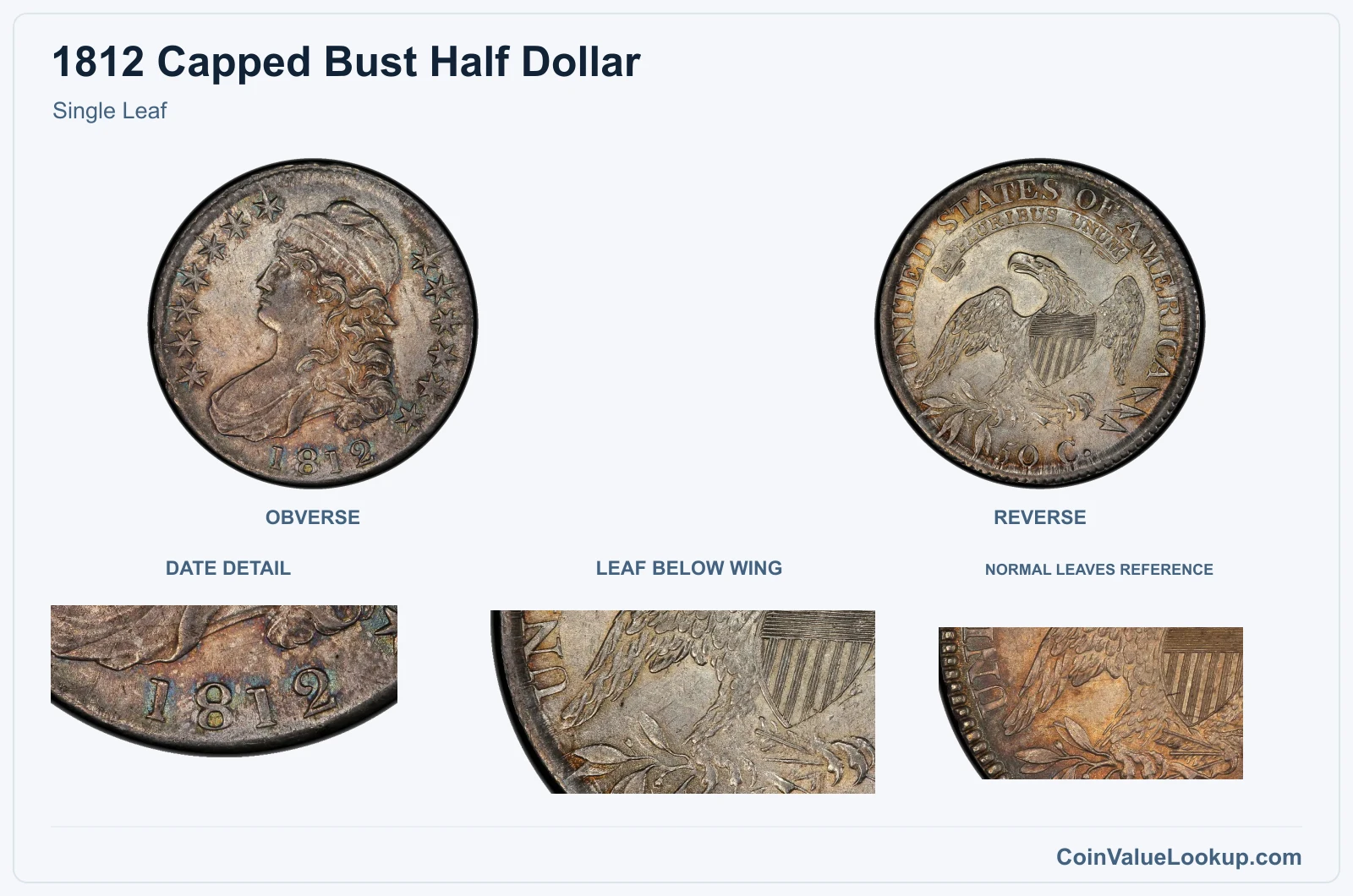
On most 1812 half dollars, two olive leaves sit below the eagle's left wing. The Single Leaf variety is missing the upper one of those leaves, and it was absent from the die — not worn off a particular coin.
That distinction matters. Heavy wear can obscure leaves on any example, so a bald spot where a leaf should be does not automatically confirm this variety.
You need to compare against an attributed Single Leaf specimen and verify the surrounding detail is consistent.
Guide estimates sit at about $1,262 in G4, $9,349 in VF20, and $30,039 in AU50. The jump from Normal Date pricing is substantial, which is exactly why careful attribution is important before assuming you have found one.
Ordinary-issue reference: Ordinary-issue reference only: The table below shows prices for the 1812 Capped Bust Half Dollar (regular strike). It does not represent the value of the specific Single Leaf variety or its variety premium. Year, mint, metal and strike type are matched; the specific variety is not priced by this table.
Range Grade
Price Auction Records Appraisal PO PO 1
—
Coin Identifier FR FR 2
—
Coin Identifier AG AG 3
—
Coin Identifier G G 4
—
Coin Identifier
G 6
Coin Identifier VG VG 8
Coin Identifier
VG 10
Coin Identifier F F 12
Coin Identifier
F 15
Coin Identifier VF VF 20
Coin Identifier
VF 25
Coin Identifier
VF 30
Coin Identifier
VF 35
Coin Identifier XF XF 40
Coin Identifier
XF 45
Coin Identifier AU AU 50
Coin Identifier
AU 53
Coin Identifier
AU 55
Coin Identifier
AU 58
Coin Identifier MS MS 60
Coin Identifier
MS 61
Coin Identifier
MS 62
Coin Identifier
MS 63
Coin Identifier
MS 64
Coin Identifier
MS 65
Coin Identifier
MS 66
Coin Identifier
MS 67
—
Coin Identifier
MS 68
—
—
—
MS 69
—
—
—
MS 70
—
—
—
1812 Capped Bust Half Dollar Error List
1. 1812 Capped Bust Half Dollar — Missing Edge Lettering
The standard 1812 half dollar carries the lettered edge FIFTY CENTS OR HALF A DOLLAR. On a missing-edge-lettering error, that inscription is partially or entirely absent, leaving a smooth or blank edge strip.
To check properly, you need to view the entire 360-degree edge. A coin in a holder may simply have its letters hidden by the plastic.
Edges that have been filed, worn flat, or tooled after leaving the mint can mimic this error, so look for tool marks or uneven surfaces that suggest post-mint alteration.
No specific price data is available for this error on the 1812 issue. Value depends on how much lettering is missing, the overall condition of the coin, and buyer interest at the time of sale.
Individual assessment by a specialist is the practical path forward.
2. 1812 Capped Bust Half Dollar — Double / Multiple Strike
A double or multiple strike occurs when the coin receives a second impression from the dies, producing displaced duplicate design elements. On the 1812 half dollar, a reported example involves a double-struck obverse on a Large 8 specimen, with shifted Liberty features visible alongside the primary strike.
This is different from a doubled die, where the doubling is baked into the die itself and appears identically on every coin struck from it. A true double strike shows offset duplication unique to that individual planchet.
Also rule out post-mint damage — letters or devices that were impressed after the coin left the press look different under magnification.
No adopted price range exists for this error. The degree of displacement, the coin's grade, and whether it pairs with a scarce variety all influence what a buyer might pay.
3. 1812 Capped Bust Half Dollar — Die Crack / Die Chip
Die cracks appear as thin raised lines on the coin's surface, formed when a working die begins to fracture under repeated striking pressure. A cataloged 1812 example shows swirling obverse die breaks — not just a single hairline crack but a more dramatic pattern across Liberty's portrait.
Not every thin line on an old half dollar is a die crack. Incuse scratches sit below the surface rather than above it.
Corrosion and encrusted debris can also mimic crack patterns but lack the sharp, consistent raised profile of a genuine die break.
There is no standard premium attached to every minor crack on an 1812 half. Small cracks are routine on early dies.
Larger, more visually dramatic breaks attract collector interest, and value depends on the specific pattern, visibility, and the coin's overall condition.