1818 Capped Bust Half Dollar Coin Value: How Much Is It Worth?
A typical circulated 1818 Capped Bust Half Dollar runs from about $106 in Good-4 to around $809 in About Uncirculated-50 for the Normal Date variety, based on USA Coin Book guide estimates. Actual value depends heavily on condition and whether your coin is a common date or one of the scarcer 1818/7 overdate varieties.
Early Proofs exist but are a completely different animal.
Fast Way to Identify Your 1818 Capped Bust Half Dollar
Snap clear photos of the front and back of your 1818 half dollar and upload them to our identifier for a preliminary look at what you have. This step can help you figure out whether you are holding a Normal Date or one of the overdate varieties before you go deeper into the details.
1818 Capped Bust Half Dollar Value
Upload both sides of your 1818 Capped Bust Half Dollar.
Front Obverse
Upload photo
Back Reverse
Upload photo
Which 1818 Capped Bust Half Dollar Versions Are Worth Money?
- 1818/7 Small 8 overdate: Guide values reach $1,834 at AU-50, roughly double the Normal Date at the same grade.
- 1818/7 Large 8 overdate: Also a strong premium over the Normal Date, with guide estimates up to $1,541 at AU-50.
- Early Proof (Normal Date): A single PR-66 sold for $126,500 at Heritage in January 2008, showing the extreme rarity of confirmed Proofs.
- 1818/7 Small 8 Early Proof: A cataloged overdate Proof with no adopted price range, reflecting how few are known to exist.
Step 1: Identify Your 1818 Capped Bust Half Dollar Mint Mark and Version
Every 1818 Capped Bust Half Dollar was struck at Philadelphia, so there is no mintmark to hunt for. The obverse shows Liberty facing left in a cap, and the reverse features an eagle with a shield and the denomination 50C.
The lettered edge reads FIFTY CENTS OR HALF A DOLLAR.
The coin is a silver-copper alloy, approximately 89.24% silver, with a nominal weight of 13.48 grams and a diameter of 32.5 mm. A correct weight alone does not authenticate the coin, but a wildly wrong one is a red flag.
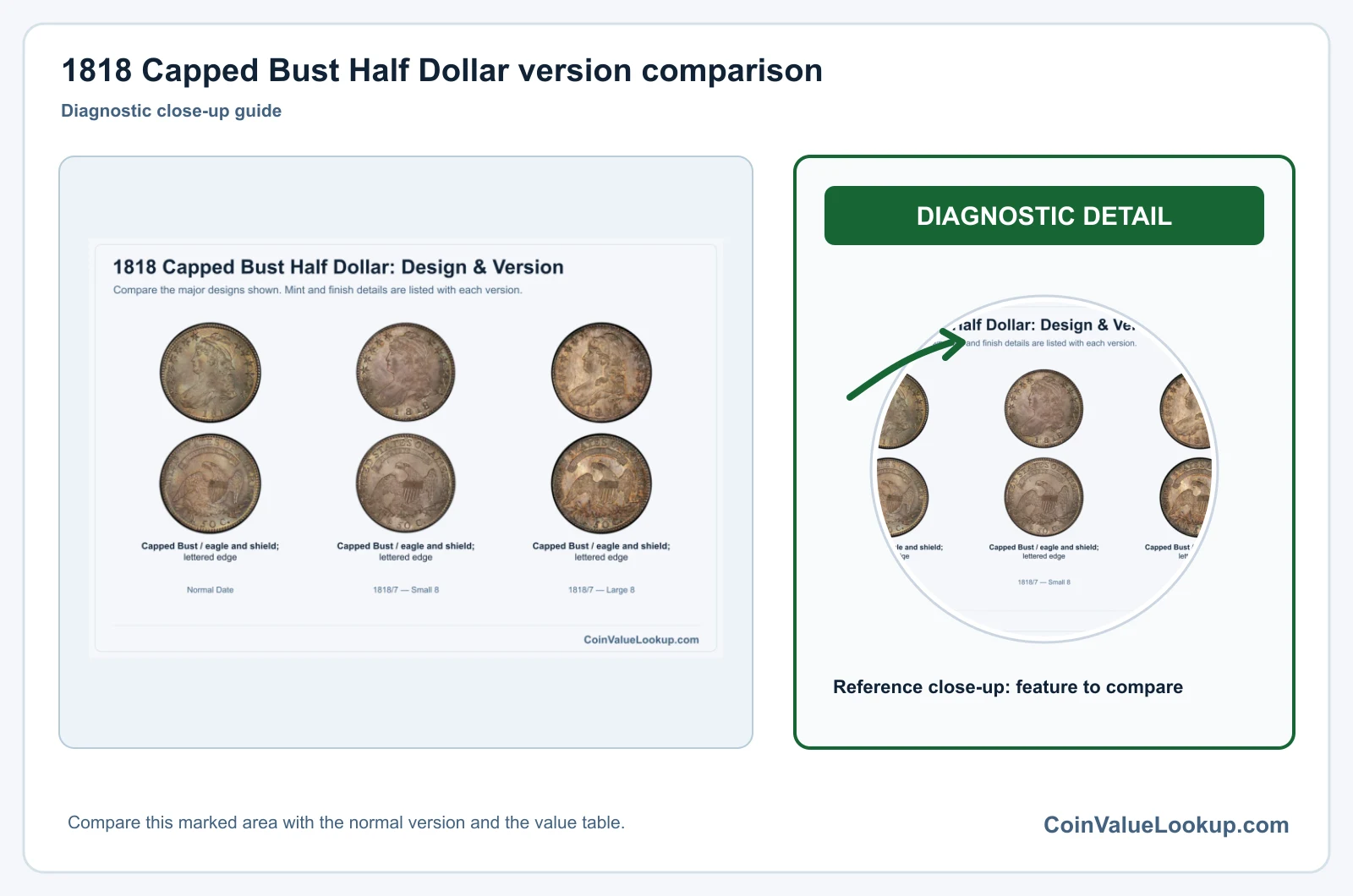
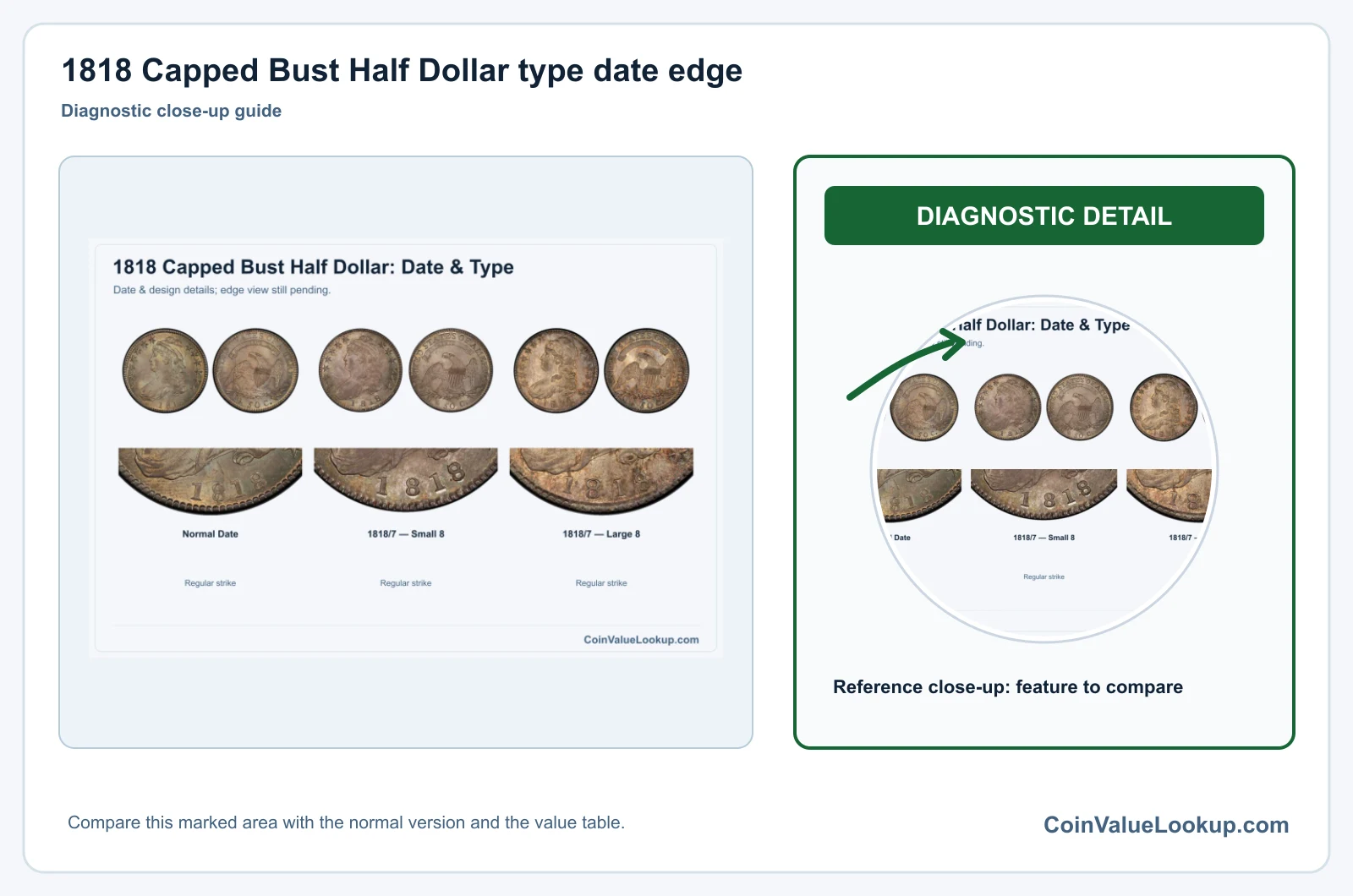
The critical thing to check is the date. Look closely at the final 8 in the date.
If you see traces of an underlying 7 inside or around that 8, you have an 1818/7 overdate. There are two overdate sub-types distinguished by the size of the 8 punch used to over-stamp the 7.
If the final 8 is clean with no ghost of a 7, you have the Normal Date. A loupe or good macro photo makes this comparison much easier.
Early Proof examples of the 1818 half dollar do exist, but calling a coin Proof requires specialist die-study and provenance evidence. A shiny, polished, or prooflike regular-strike coin is not automatically a Proof.
Step 2: Check Your 1818 Capped Bust Half Dollar Grade
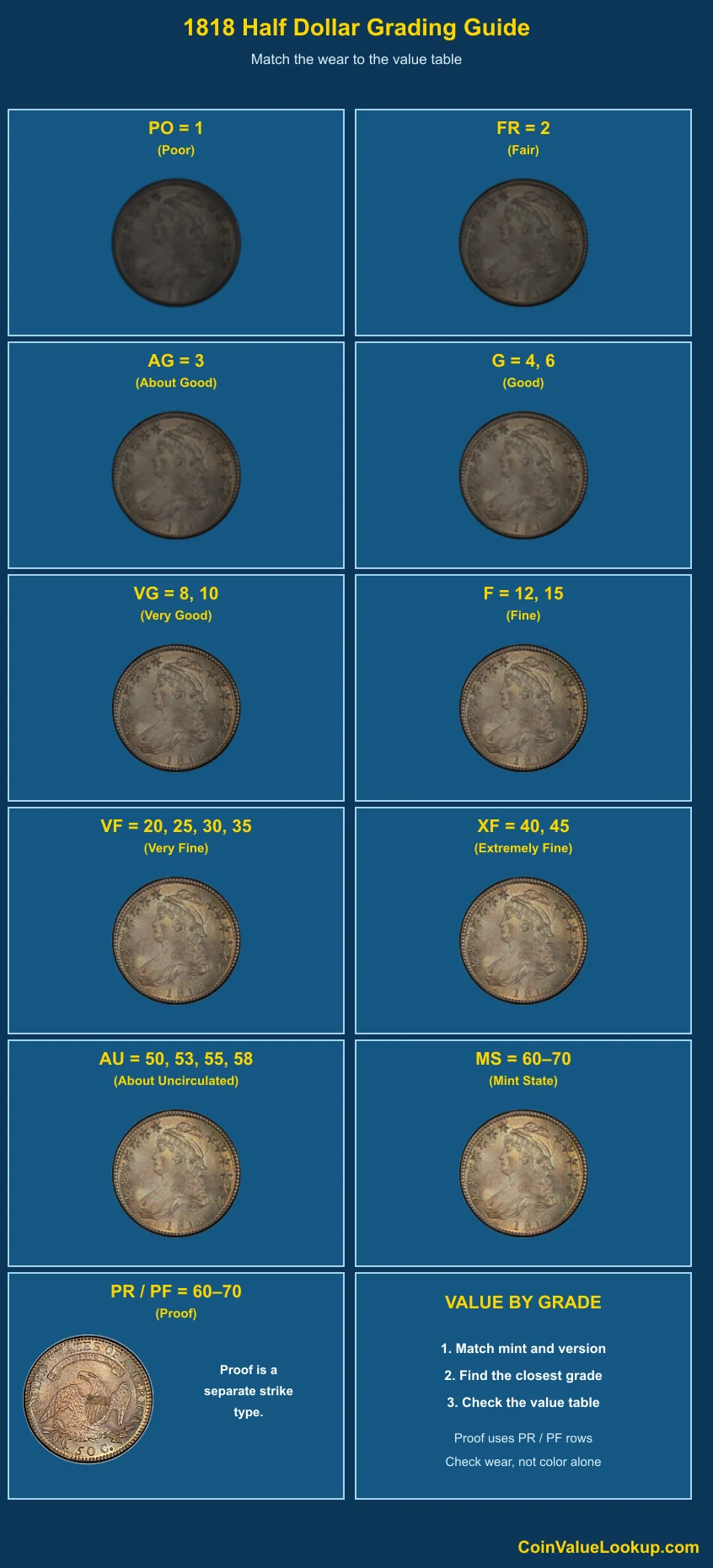
Start at the obverse. Check for wear on Liberty's hair above the forehead and ear, across the cheek, and on the cap and shoulder clasp.
These high points lose detail first.
On the reverse, examine the eagle's breast feathers and wing tips. This series is known for soft original strikes in spots, so do not mistake a weakly struck area for wear.
Look for breaks in the original mint luster before you call it lightly circulated.
The comparison image is your best friend here. Line up your coin against the grading reference and match the wear pattern at each grade level.
Coins that have been cleaned, holed, tooled, or scratched will receive a "Details" grade rather than a straight numeric grade, and their market value drops significantly. If you are tempted to clean your coin, stop.
That is the single fastest way to destroy its value.
Coin Value Lookup is a good starting point when you want to look up guides for other denominations or years in the Capped Bust series.
Step 3: Check 1818 Capped Bust Half Dollar Value by Mint and Version
1818 Capped Bust Half Dollar — Normal Date
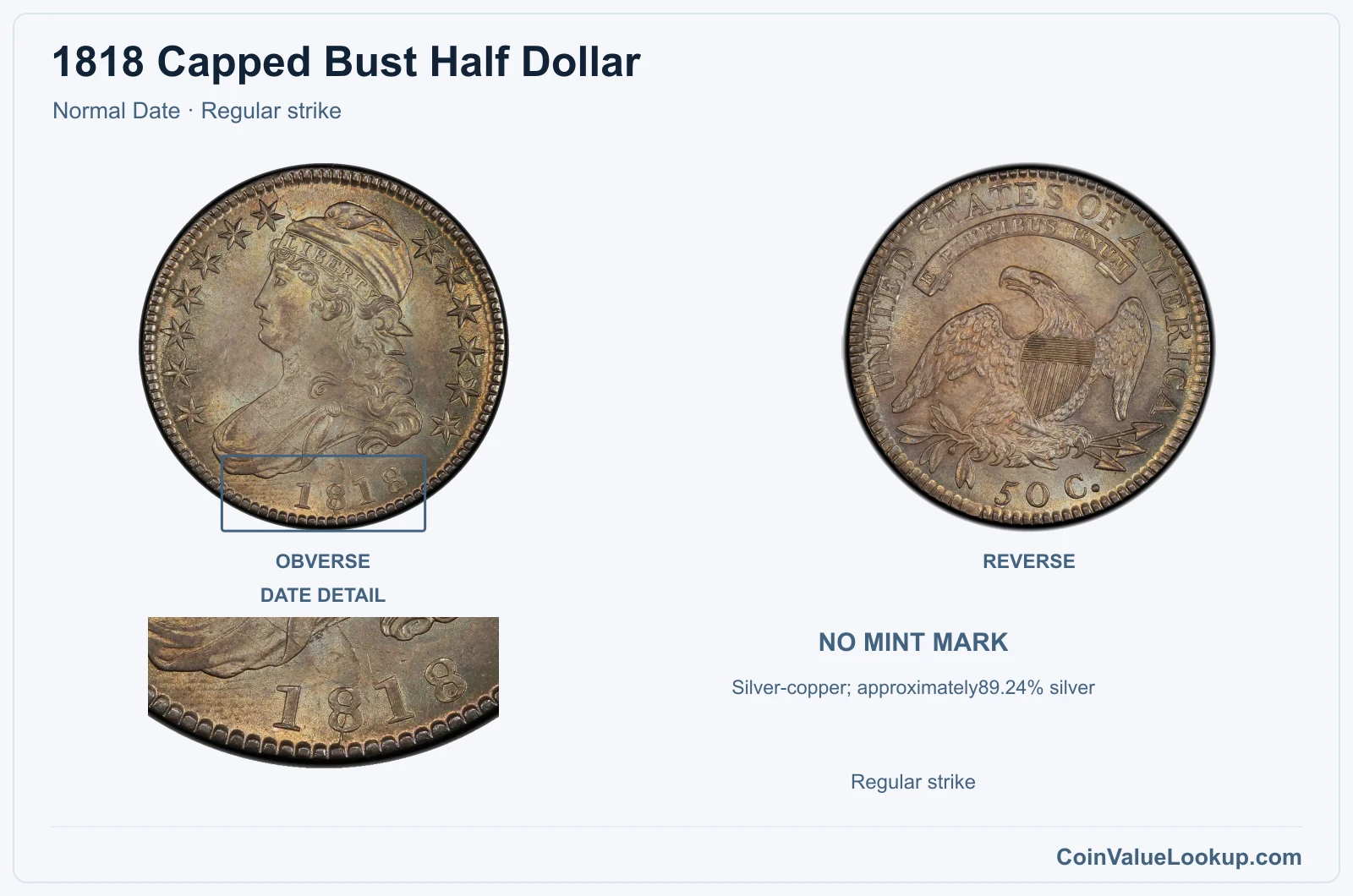
The Normal Date is the baseline 1818 Capped Bust Half Dollar, struck at Philadelphia with no mintmark. USA Coin Book guide estimates place it at roughly $106 in Good-4, $212 in Very Fine-20, and $809 in About Uncirculated-50.
Before you settle on this attribution, examine the last digit under magnification. Any remnant of a 7 beneath the 8 means you have an overdate, not the Normal Date.
A clean, unambiguous 8 is what you need to see. Higher-grade survivors with original luster are considerably scarcer than the well-worn examples that make up most of the surviving population.
Range Grade
Price Auction Records Appraisal PO PO 1
—
Coin Identifier FR FR 2
—
Coin Identifier AG AG 3
—
Coin Identifier G G 4
—
Coin Identifier
G 6
Coin Identifier VG VG 8
Coin Identifier
VG 10
Coin Identifier F F 12
Coin Identifier
F 15
Coin Identifier VF VF 20
Coin Identifier
VF 25
Coin Identifier
VF 30
Coin Identifier
VF 35
Coin Identifier XF XF 40
Coin Identifier
XF 45
Coin Identifier AU AU 50
Coin Identifier
AU 53
Coin Identifier
AU 55
Coin Identifier
AU 58
Coin Identifier MS MS 60
Coin Identifier
MS 61
Coin Identifier
MS 62
Coin Identifier
MS 63
Coin Identifier
MS 64
Coin Identifier
MS 65
Coin Identifier
MS 66
Coin Identifier
MS 67
Coin Identifier
MS 68
—
—
—
MS 69
—
—
—
MS 70
—
—
—
1818 Capped Bust Half Dollar — /7 — Small 8
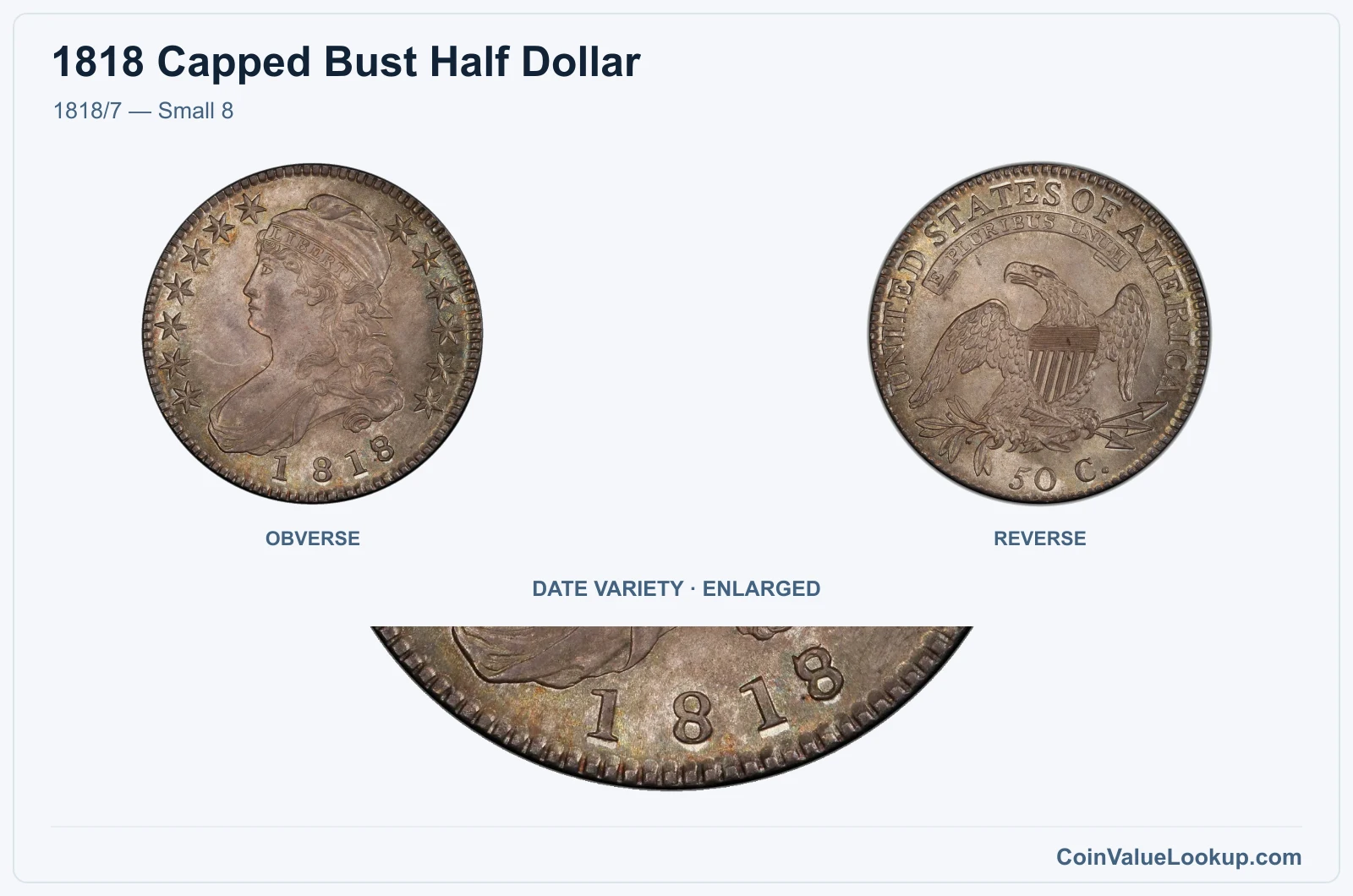
The 1818/7 Small 8 overdate was created when the Mint punched a smaller-sized 8 over a 7 in the date. Under magnification you can see vestiges of the original 7, especially traces of its diagonal stroke and upper curve within or around the 8.
The key diagnostic is the size of the 8 itself. Compare it side-by-side with the Large 8 variety.
The Small 8 punch is visibly narrower and shorter relative to the other digits.
Guide estimates from USA Coin Book run $142 at Good-4, $364 at Very Fine-20, and $1,834 at About Uncirculated-50. That AU-50 figure is more than double the Normal Date at the same grade, making this the priciest regular-strike variety of the year.
Range Grade
Price Auction Records Appraisal PO PO 1
—
Coin Identifier FR FR 2
—
Coin Identifier AG AG 3
—
Coin Identifier G G 4
—
Coin Identifier
G 6
—
Coin Identifier VG VG 8
Coin Identifier
VG 10
Coin Identifier F F 12
Coin Identifier
F 15
Coin Identifier VF VF 20
Coin Identifier
VF 25
Coin Identifier
VF 30
Coin Identifier
VF 35
Coin Identifier XF XF 40
Coin Identifier
XF 45
Coin Identifier AU AU 50
Coin Identifier
AU 53
Coin Identifier
AU 55
Coin Identifier
AU 58
Coin Identifier MS MS 60
—
Coin Identifier
MS 61
Coin Identifier
MS 62
Coin Identifier
MS 63
Coin Identifier
MS 64
Coin Identifier
MS 65
Coin Identifier
MS 66
Coin Identifier
MS 67
—
—
—
MS 68
—
—
—
MS 69
—
—
—
MS 70
—
—
—
1818 Capped Bust Half Dollar — /7 — Large 8
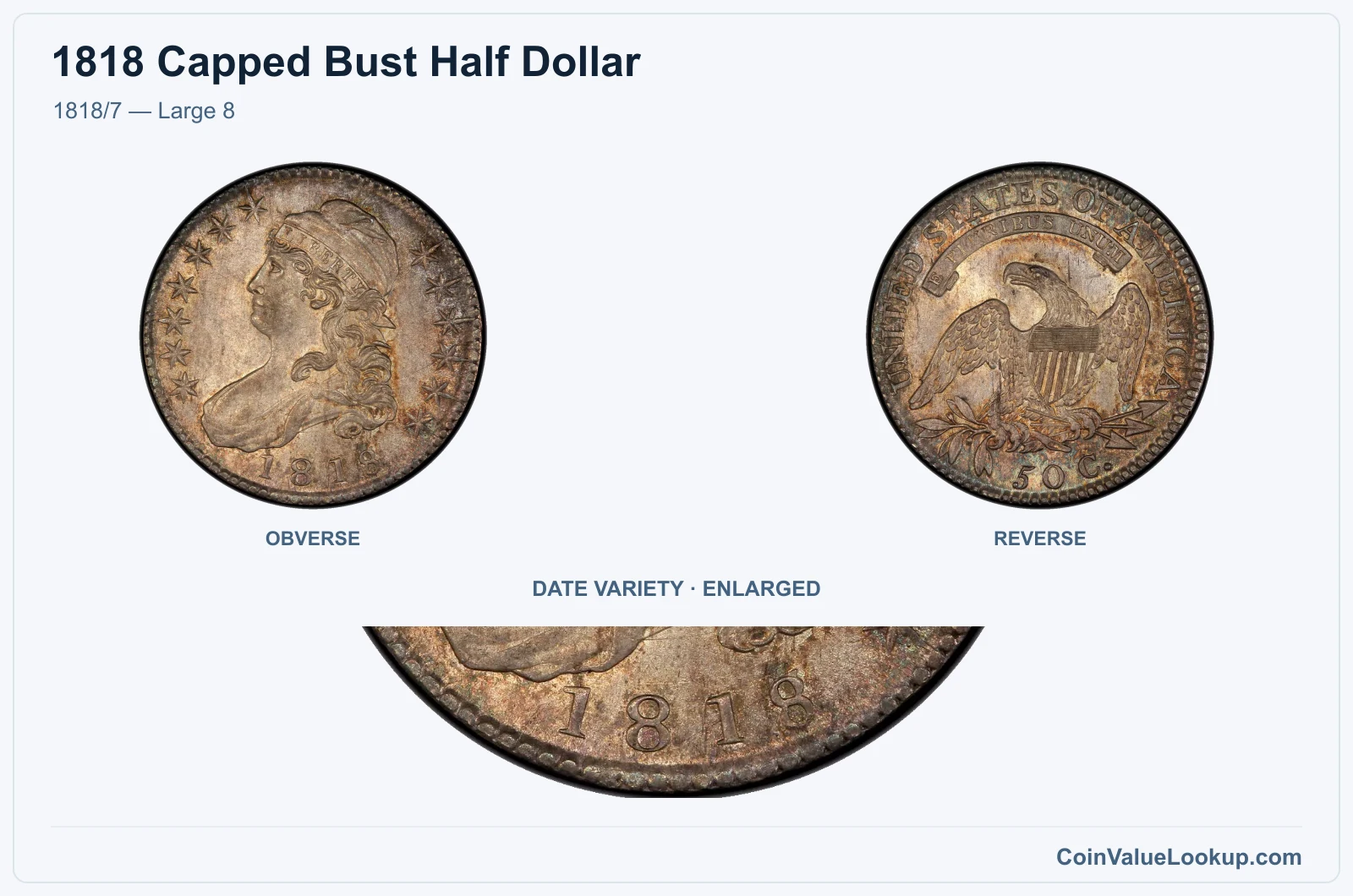
The 1818/7 Large 8 shares the same overdate origin as the Small 8, but a noticeably larger 8 punch was used to overstamp the original 7. Look for remnants of the 7 near the top of the 8 and around its upper and lower loops.
The larger punch makes the 8 appear more proportional to the neighboring digits, so the overdate traces can be subtler than on the Small 8. A side-by-side comparison of both 8 shapes at the same scale is the most reliable way to tell them apart.
USA Coin Book guide estimates are $132 at Good-4, $300 at Very Fine-20, and $1,541 at About Uncirculated-50. Strong premiums over the Normal Date, though slightly below the Small 8 at each listed grade.
Range Grade
Price Auction Records Appraisal PO PO 1
—
Coin Identifier FR FR 2
—
Coin Identifier AG AG 3
—
Coin Identifier G G 4
—
Coin Identifier
G 6
—
Coin Identifier VG VG 8
—
Coin Identifier
VG 10
Coin Identifier F F 12
Coin Identifier
F 15
—
Coin Identifier VF VF 20
Coin Identifier
VF 25
Coin Identifier
VF 30
Coin Identifier
VF 35
Coin Identifier XF XF 40
Coin Identifier
XF 45
Coin Identifier AU AU 50
Coin Identifier
AU 53
Coin Identifier
AU 55
Coin Identifier
AU 58
Coin Identifier MS MS 60
—
Coin Identifier
MS 61
Coin Identifier
MS 62
Coin Identifier
MS 63
Coin Identifier
MS 64
Coin Identifier
MS 65
Coin Identifier
MS 66
—
—
—
MS 67
—
—
—
MS 68
—
—
—
MS 69
—
—
—
MS 70
—
—
—
1818 Capped Bust Half Dollar — Early Proof — Normal Date
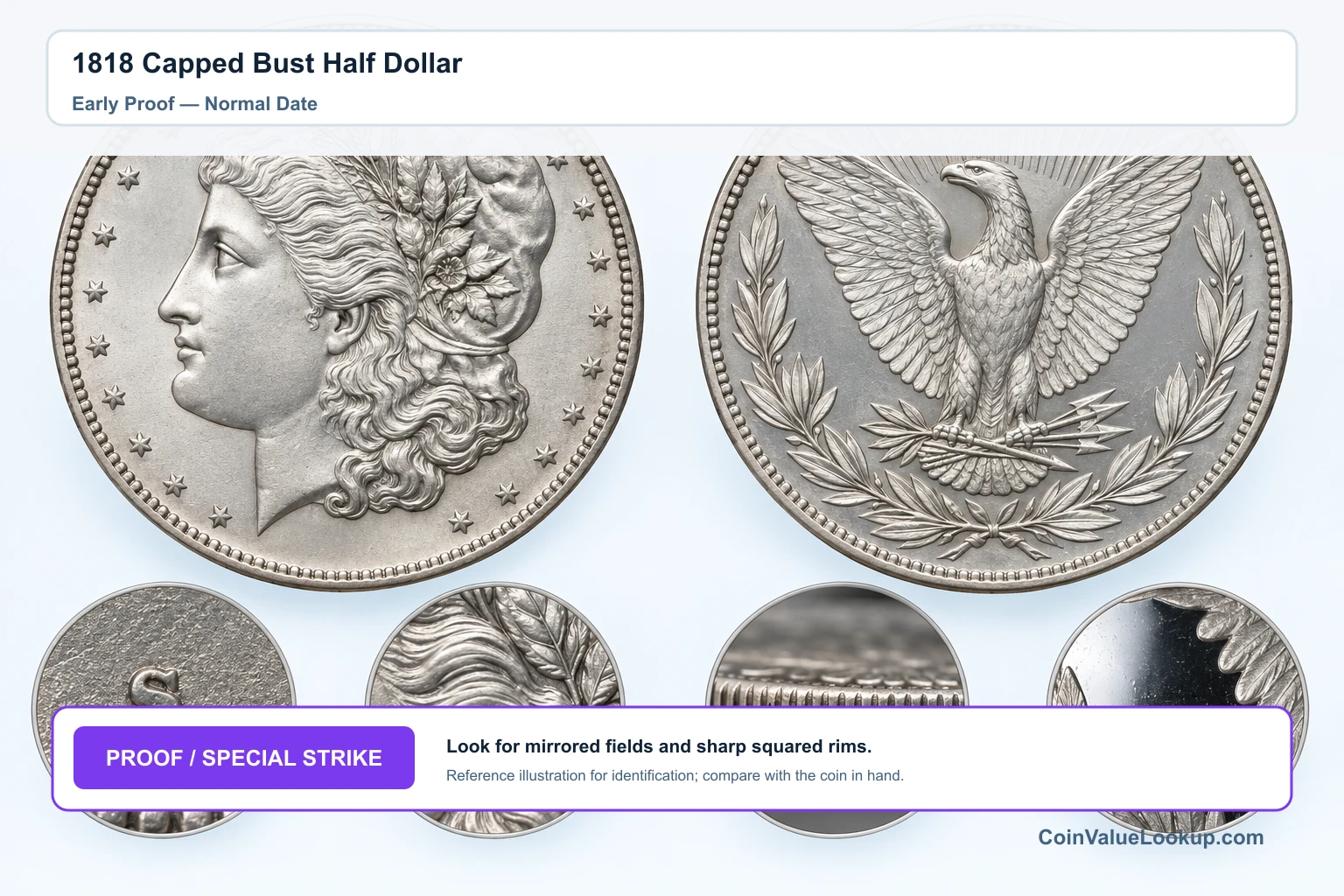
An early Proof 1818 Capped Bust Half Dollar is a rare specialist-attributed coin, not just a regular strike that happens to look shiny. Confirmation requires examination of die characteristics, surface quality, and ideally provenance tracing back through known collections.
The only historical sale anchor reported by PCGS is a PR-66 example that brought $126,500 at a Heritage auction in January 2008. That is a single data point, not a current market range, and it applies only to that specific grade and certification.
Do not assume a prooflike or well-preserved business strike is a Proof. The difference is in how the coin was manufactured, not simply how it looks after two centuries.
Professional authentication is essential before any Proof claim is taken seriously.
1818 Capped Bust Half Dollar Proof, Normal Date Value by Grade
Reliable grade-by-grade prices are not currently available. The confirmed Proof catalogue entry has no usable grade-by-grade values in the current price feed. Normal circulation strikes and the 1818/7 Proof are separate issues.
1818 Capped Bust Half Dollar — /7 Small 8 — Early Proof
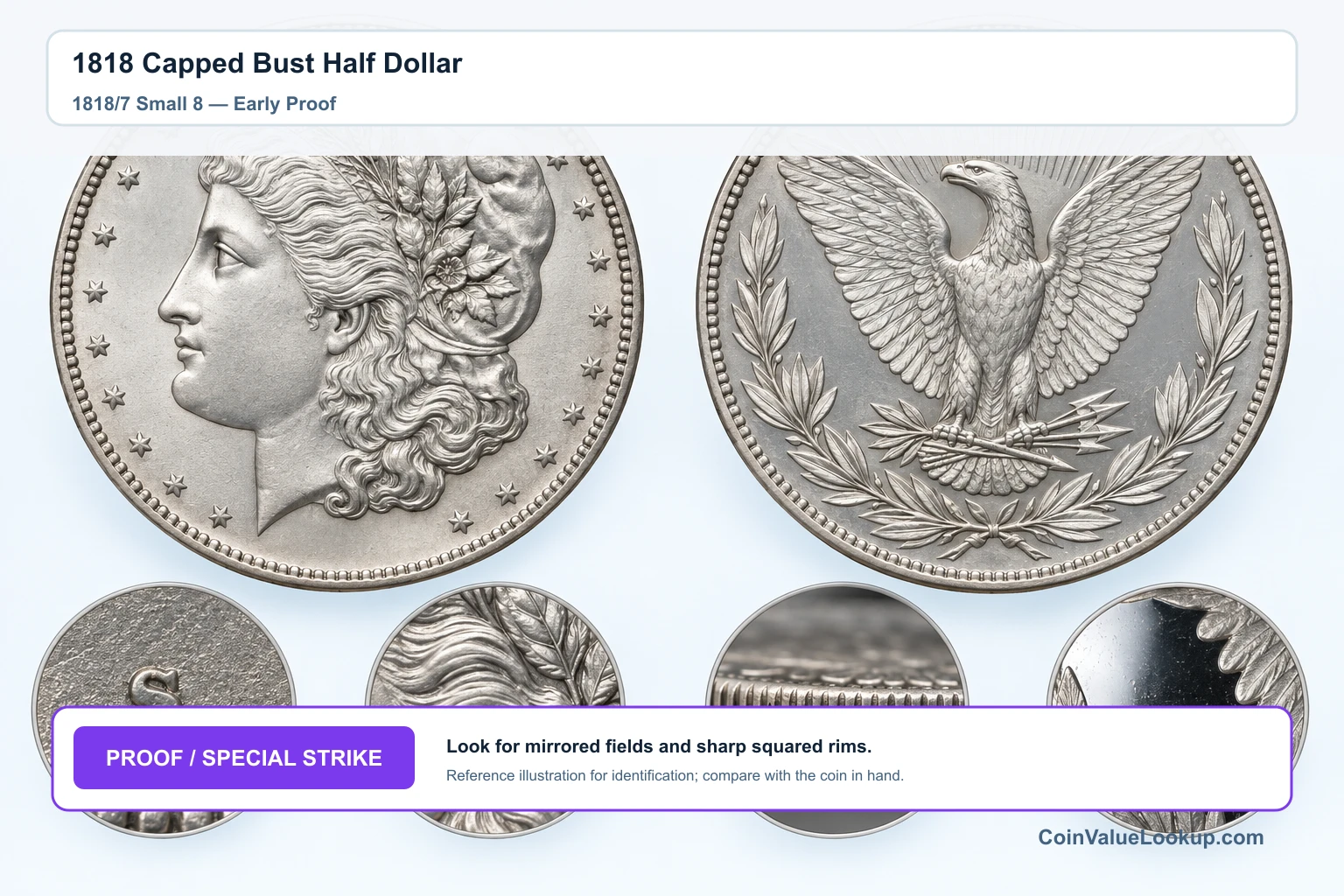
This is the rarest branch of the 1818 date: a Proof-finish coin that also displays the Small 8 overdate. It must satisfy both conditions simultaneously.
The overdate diagnostics are the same as the regular-strike Small 8, but the coin must also show Proof-manufacture characteristics confirmed by specialist attribution.
No numerical price range has been adopted for this variety. Value depends entirely on authenticated identity, condition, and the specifics of any errors present.
Individual professional assessment is the only realistic path to pricing.
Do not confuse this with an ordinary 1818 Proof or an ordinary 1818/7 Small 8 regular strike. Both attributions must be confirmed together on the same coin.
1818/7 Small 8 Capped Bust Half Dollar Proof Value by Grade
Reliable grade-by-grade prices are not currently available. The confirmed overdate Proof catalogue entry has no usable grade-by-grade values in the current price feed. The ordinary overdate circulation-strike table does not price this rare Proof.
1818 Capped Bust Half Dollar Error List
1. 1818 Capped Bust Half Dollar — Overlapping or Doubled Edge Lettering
Overlapping or doubled edge lettering on an 1818 half dollar means you see duplicated letters along the edge inscription, not just slightly uneven ones. Because this series uses a lettered edge, the inscription FIFTY CENTS OR HALF A DOLLAR was applied in a separate step, and mechanical misalignment could produce genuinely doubled impressions.
Look at the full edge continuously. You want to see whole letters clearly repeated or overlapping, not just individual strokes that appear thicker than normal.
Single thick strokes can result from edge-die preparation rather than an error.
Wear, post-mint damage, and ordinary design features can mimic this. Compare against an attributed same-year example before drawing conclusions.
No specific price range is adopted for this error; value depends on the visibility and extent of the doubling as well as the coin's overall condition.
2. 1818 Capped Bust Half Dollar — Off-Center Strike
An off-center strike on an 1818 Capped Bust Half Dollar shows the entire design shifted in one direction, leaving a crescent of blank planchet on the opposite side. The displacement should be visible on both obverse and reverse.
Do not mistake an uneven rim or slightly irregular dentils for an off-center strike. On a genuine off-center coin, the whole design is displaced from the geometric center of the planchet, and there is a clear blank border where no design was impressed at all.
Lookalikes include clipped planchets, one-sided die misalignment, and post-mint flattening. Each produces a different visual signature.
No numerical price range is adopted for this error. Condition, the degree of off-center displacement, and whether the full date is visible all affect what a collector will pay.
3. 1818 Capped Bust Half Dollar — Double / Multiple Strike
A double or multiple strike on the 1818 half dollar shows evidence that the coin received more than one impression from the dies. The reported example displays light repeated dentil tracks near Liberty's cap, suggesting a slight shift between strikes.
This is distinct from a doubled die, which is a die-manufacturing issue affecting every coin struck from that die. A double strike is a planchet-feeding error, and the duplicate impressions often appear at slightly different angles or positions.
Post-mint impressions or contact marks can look similar, so cross-reference with any associated off-center displacement on the same coin. Genuine multiple strikes often accompany other striking anomalies.
No numerical price range is adopted; value depends on condition, the clarity of the extra impressions, and collector interest in the specific combination of errors present.
4. 1818 Capped Bust Half Dollar — Partly Inverted Edge Lettering
Partly inverted edge lettering is a distinctive error where part of the edge inscription reads normally and part is flipped. On the reported 1818 example, FIFTY CENTS OR appears upright relative to the obverse while HALF A DOLLAR appears inverted.
To check for this, orient the coin so one segment of the edge lettering reads correctly, then slowly rotate along the edge. If the remaining text flips orientation partway around, you may have this error.
A common confusion is the normal orientation of edge lettering, which reads fully upside down relative to one face. That is standard.
This error is different because only part of the inscription reverses.
Post-mint damage and wear can obscure or mimic partial inversion. Compare against an attributed same-year example.
No price range is adopted; value hinges on clarity, condition, and the specific nature of the inversion.
5. 1818 Capped Bust Half Dollar — Die Crack / Die Chip
Die cracks on 1818 half dollars appear as raised lines on the coin's surface, created when the steel die developed fractures during use. The reported late-state example shows a raised crack running from below the first 8 in the date, through the right-side stars, and across Liberty's cap.
These lines are raised because the cracked die left a channel that filled with metal during striking. That is the key diagnostic: a die crack sits above the field, while a scratch or incuse line sits below it.
Corrosion, foreign material stuck to the surface, and post-mint scratches can all look vaguely similar. Run a fingernail or wooden toothpick across the line.
If it is raised, a die crack is likely. No numerical price range is adopted for die cracks on this date.
Value depends on severity, location, and overall coin condition.