1823 Capped Bust Half Dollar Coin Value: How Much Is It Worth?
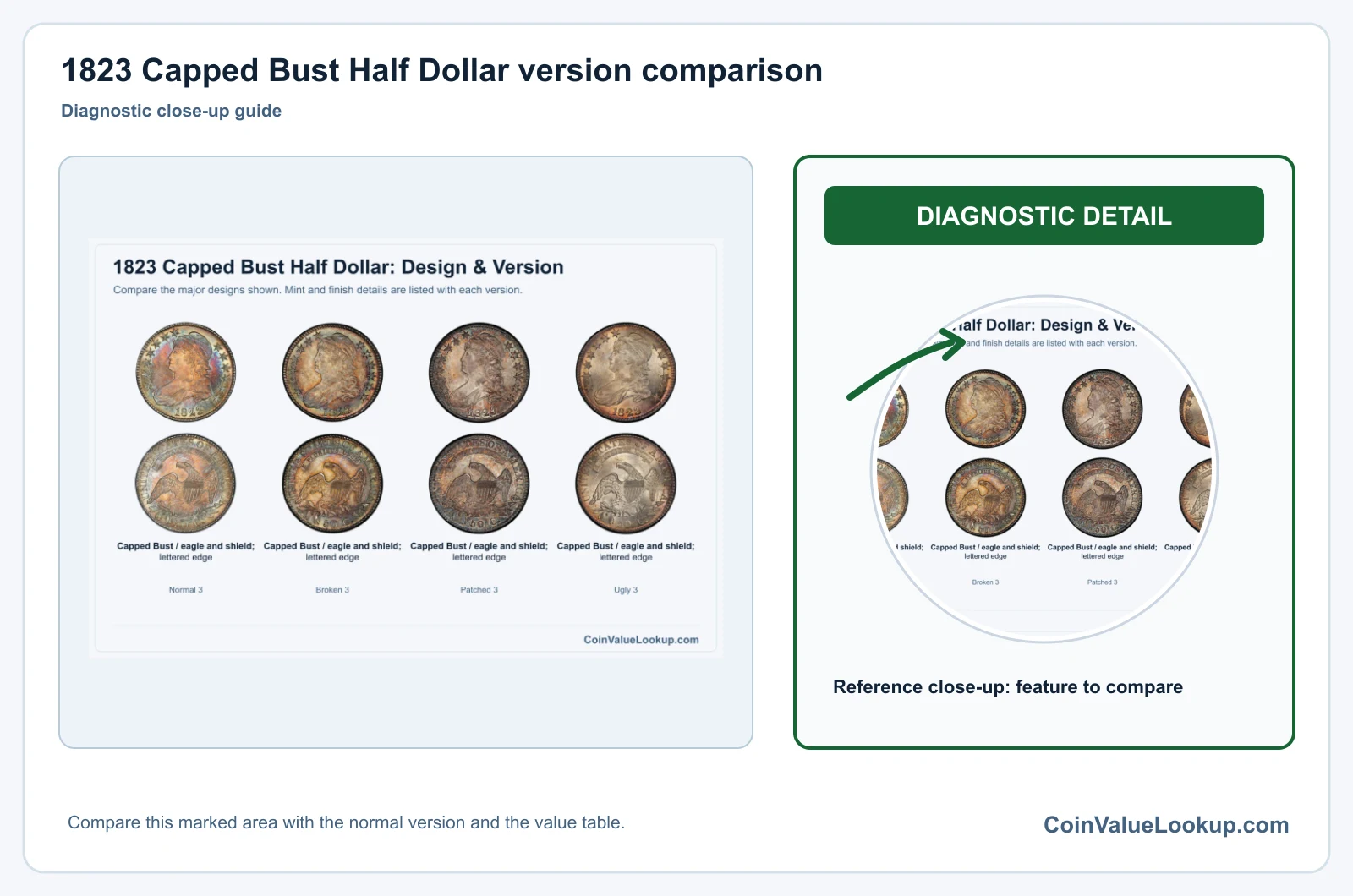
The 1823 Capped Bust Half Dollar is one of the most variety-rich dates in the entire series, and the shape of the numeral 3 is where the action is. Ordinary circulated examples with a Normal 3 start around $106 in Good condition and climb to roughly $631 near About Uncirculated, but several recognized date-punch varieties and an extremely rare early Proof can push values much higher depending on the specific variety and condition.
Fast Way to Identify Your 1823 Capped Bust Half Dollar
Want a quick read on which 1823 variety you have? Upload clear photos of both the front and back of your coin.
Our identification tool can offer a preliminary assessment of the date punch shape, overall condition, and general type, helping you figure out your next steps before pursuing professional attribution.
1823 Capped Bust Half Dollar Value
Upload both sides of your 1823 Capped Bust Half Dollar.
Front Obverse
Upload photo
Back Reverse
Upload photo
Which 1823 Capped Bust Half Dollar Versions Are Worth Money?
- The Broken 3 variety commands a strong premium, with guide values from $167 at G4 up to $2,786 at AU50, driven by the distinctive near-separation in the middle of the numeral.
- The Ugly 3 matches the Broken 3 at the top end, with an AU50 guide value around $2,786, thanks to its irregular and incomplete date punch.
- The Patched 3 sits close behind, estimated at $142 in G4 and $2,006 in AU50, recognizable by its repaired connection in the middle of the 3.
- The early Proof issue is in a different league entirely: a single PR63 example sold for $80,500 at Heritage Auctions in April 2011.
- Even the Normal 3 and Tampered 3 carry solid base values in silver content and collector demand, starting around $106 in G4.
Step 1: Identify Your 1823 Capped Bust Half Dollar Mint Mark and Version
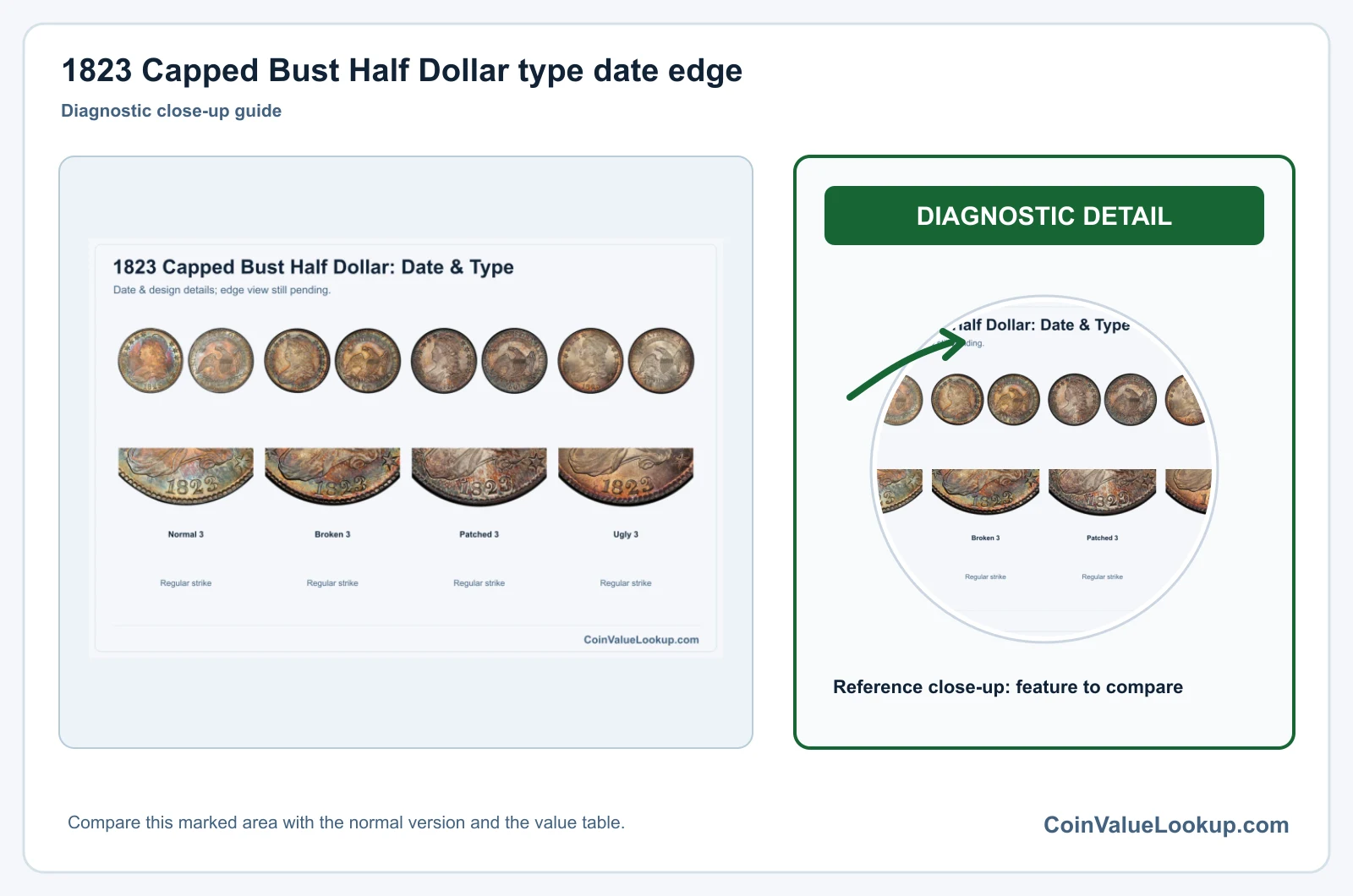
Every 1823 Capped Bust Half Dollar was struck at Philadelphia, so there is no mintmark to look for. The obverse shows a left-facing Liberty in a cap, and the reverse features an eagle with a shield and the denomination 50C.
The edge is lettered: FIFTY CENTS OR HALF A DOLLAR.
The coin is a silver-copper alloy, approximately 89.24% silver, with a nominal weight of 13.48 grams and a diameter of 32.5 mm. A correct weight by itself does not authenticate the coin, but a significantly off-weight piece deserves suspicion.
The critical identification point is the numeral 3 in the date. Five major regular varieties exist: Normal 3, Broken 3, Patched 3, Ugly 3, and Tampered 3.
Each reflects a different original die-punch condition, not post-strike damage. Compare the curves and connections at the middle of the 3 carefully against attributed examples rather than guessing.
Early Proof examples also exist for this date, but attribution requires specialist die-state and surface analysis plus provenance evidence. A coin that looks shiny or has mirror-like fields is not automatically a Proof.
Polished or prooflike regular strikes are common sources of confusion.
Step 2: Check Your 1823 Capped Bust Half Dollar Grade
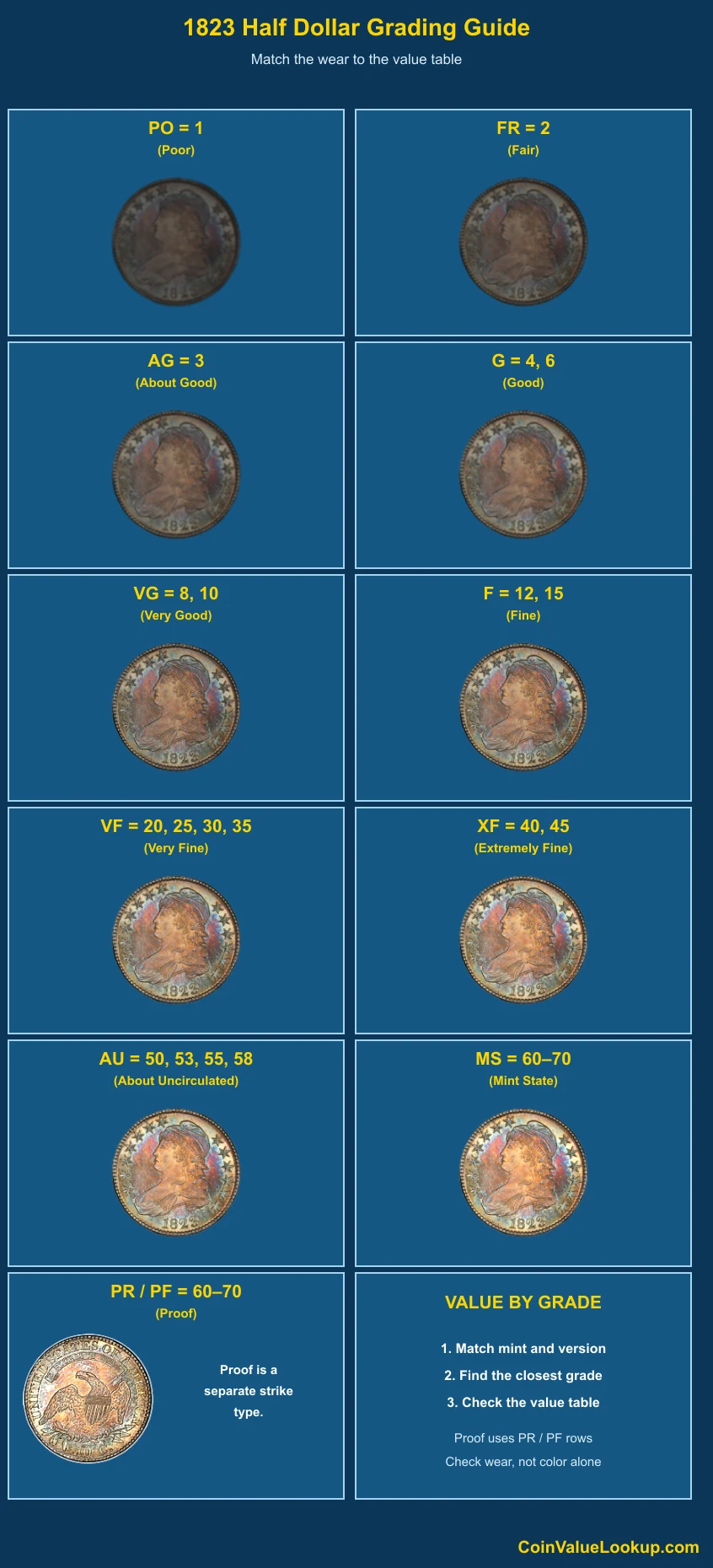
Start at the obverse. Hair detail above the forehead and around the ear wears first, followed by the cheek and cap folds.
On a well-worn piece these areas merge into flat, featureless zones.
Flip to the reverse. The eagle's breast feathers and wing tips lose definition early, but be careful here.
Many 1823 halves had a soft original strike, so incomplete feather detail does not always mean heavy wear. Look for interrupted luster across the high points before downgrading.
Use the comparison image to gauge where your coin falls. A Good-4 example will show a full outline with almost no interior detail, while an AU-50 will retain most luster with only slight friction on the highest points.
Coins that have been cleaned, holed, tooled, or scratched typically receive a Details grade from professional services, which sharply reduces their market value compared to straight-graded coins at the same apparent wear level. Resist the urge to clean your coin.
Step 3: Check 1823 Capped Bust Half Dollar Value by Mint and Version
1823 Capped Bust Half Dollar — Normal 3
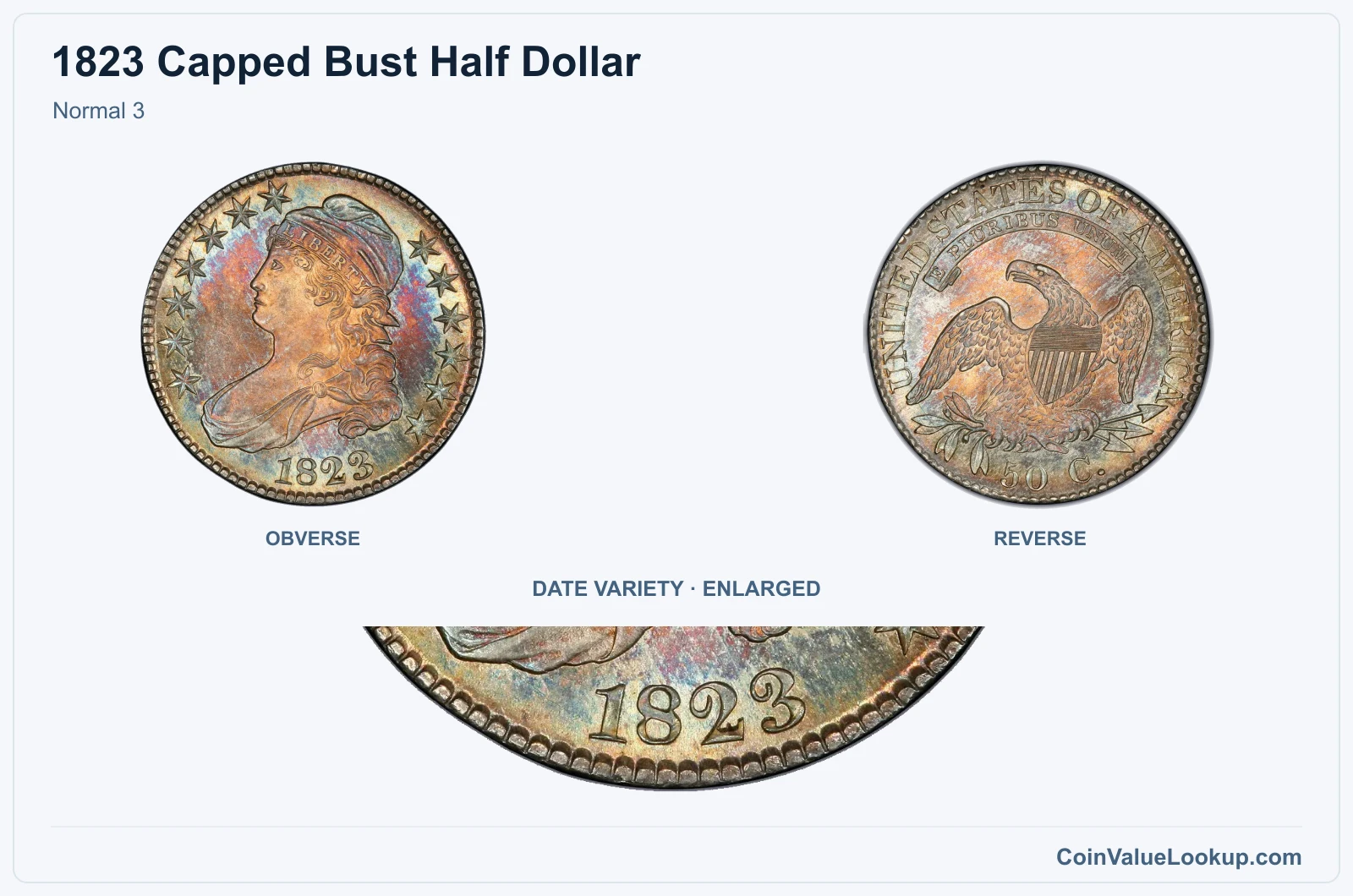
The Normal 3 is your baseline. Look for a complete, cleanly shaped numeral 3 in the date with smooth, unbroken curves at the middle connection.
No odd gaps, repairs, or irregularities.
USA Coin Book guide estimates place the Normal 3 at roughly $106 in G4, $182 in VF20, and $631 in AU50. This is the most commonly encountered variety for the date.
If the 3 on your coin looks perfectly ordinary, you probably have this one. Still a solid early federal silver half dollar worth owning.
Range Grade
Price Auction Records Appraisal PO PO 1
—
Coin Identifier FR FR 2
—
Coin Identifier AG AG 3
Coin Identifier G G 4
Coin Identifier
G 6
Coin Identifier VG VG 8
Coin Identifier
VG 10
—
Coin Identifier F F 12
Coin Identifier
F 15
Coin Identifier VF VF 20
Coin Identifier
VF 25
Coin Identifier
VF 30
Coin Identifier
VF 35
Coin Identifier XF XF 40
Coin Identifier
XF 45
Coin Identifier AU AU 50
Coin Identifier
AU 53
Coin Identifier
AU 55
Coin Identifier
AU 58
Coin Identifier MS MS 60
—
Coin Identifier
MS 61
Coin Identifier
MS 62
Coin Identifier
MS 63
Coin Identifier
MS 64
Coin Identifier
MS 65
Coin Identifier
MS 66
Coin Identifier
MS 67
Coin Identifier
MS 68
—
—
—
MS 69
—
—
—
MS 70
—
—
—
1823 Capped Bust Half Dollar — Broken 3
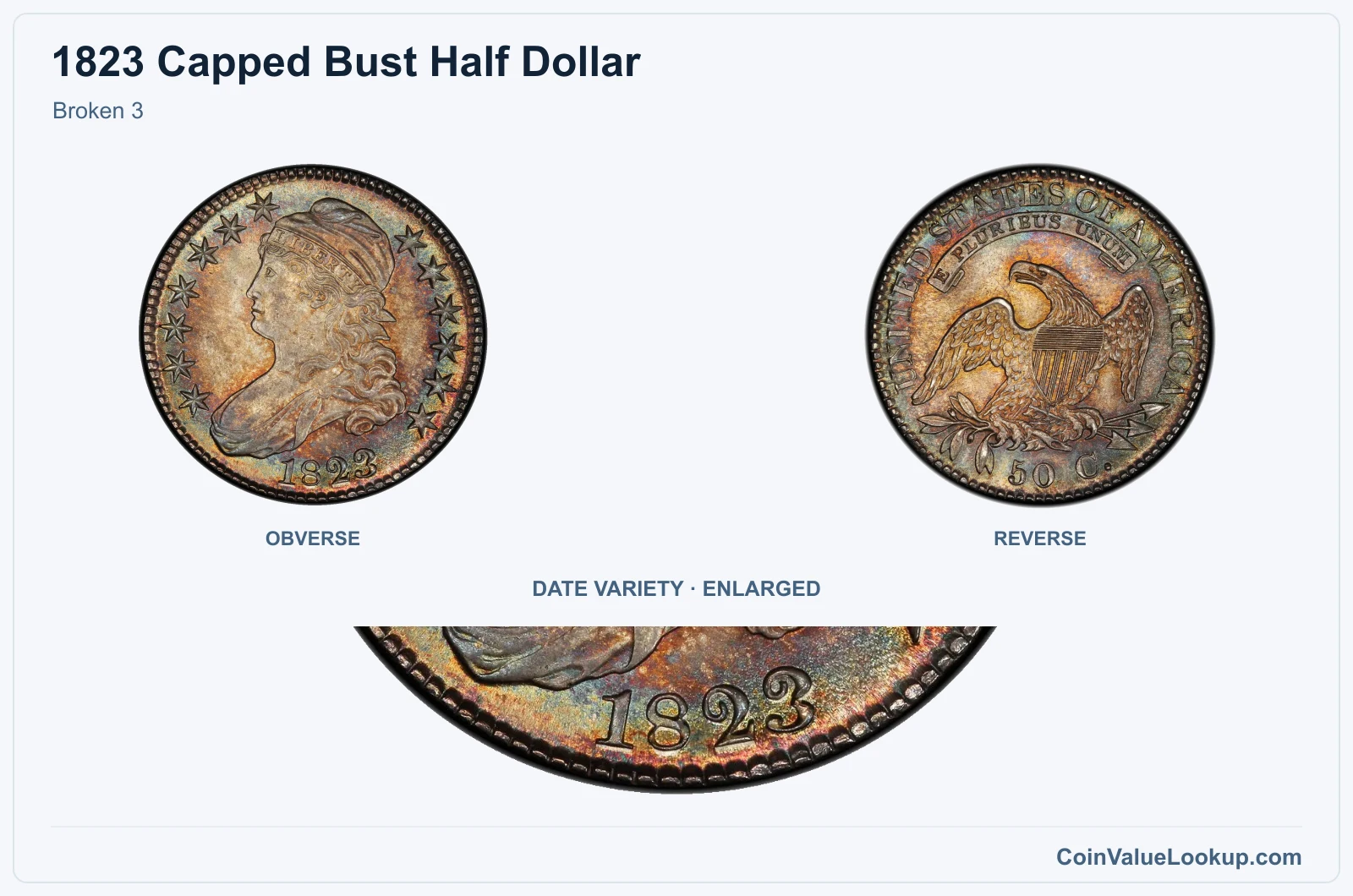
The Broken 3 is where premiums start climbing. The defining feature is a near-separation at the middle of the numeral 3, where the upper and lower loops almost disconnect.
This is an original die-punch characteristic, not a chunk physically broken off your coin after it left the mint.
Guide estimates from USA Coin Book run $167 at G4, $517 at VF20, and $2,786 at AU50. That AU50 figure is roughly four times the Normal 3 at the same grade.
Compare the middle junction of the 3 closely under magnification. The gap should be consistent with known attributed examples, not random damage.
Range Grade
Price Auction Records Appraisal PO PO 1
—
Coin Identifier FR FR 2
—
Coin Identifier AG AG 3
—
Coin Identifier G G 4
—
Coin Identifier
G 6
Coin Identifier VG VG 8
Coin Identifier
VG 10
Coin Identifier F F 12
Coin Identifier
F 15
Coin Identifier VF VF 20
Coin Identifier
VF 25
Coin Identifier
VF 30
Coin Identifier
VF 35
Coin Identifier XF XF 40
Coin Identifier
XF 45
Coin Identifier AU AU 50
Coin Identifier
AU 53
Coin Identifier
AU 55
Coin Identifier
AU 58
Coin Identifier MS MS 60
—
Coin Identifier
MS 61
Coin Identifier
MS 62
Coin Identifier
MS 63
Coin Identifier
MS 64
Coin Identifier
MS 65
—
Coin Identifier
MS 66
—
—
—
MS 67
—
—
—
MS 68
—
—
—
MS 69
—
—
—
MS 70
—
—
—
1823 Capped Bust Half Dollar — Patched 3
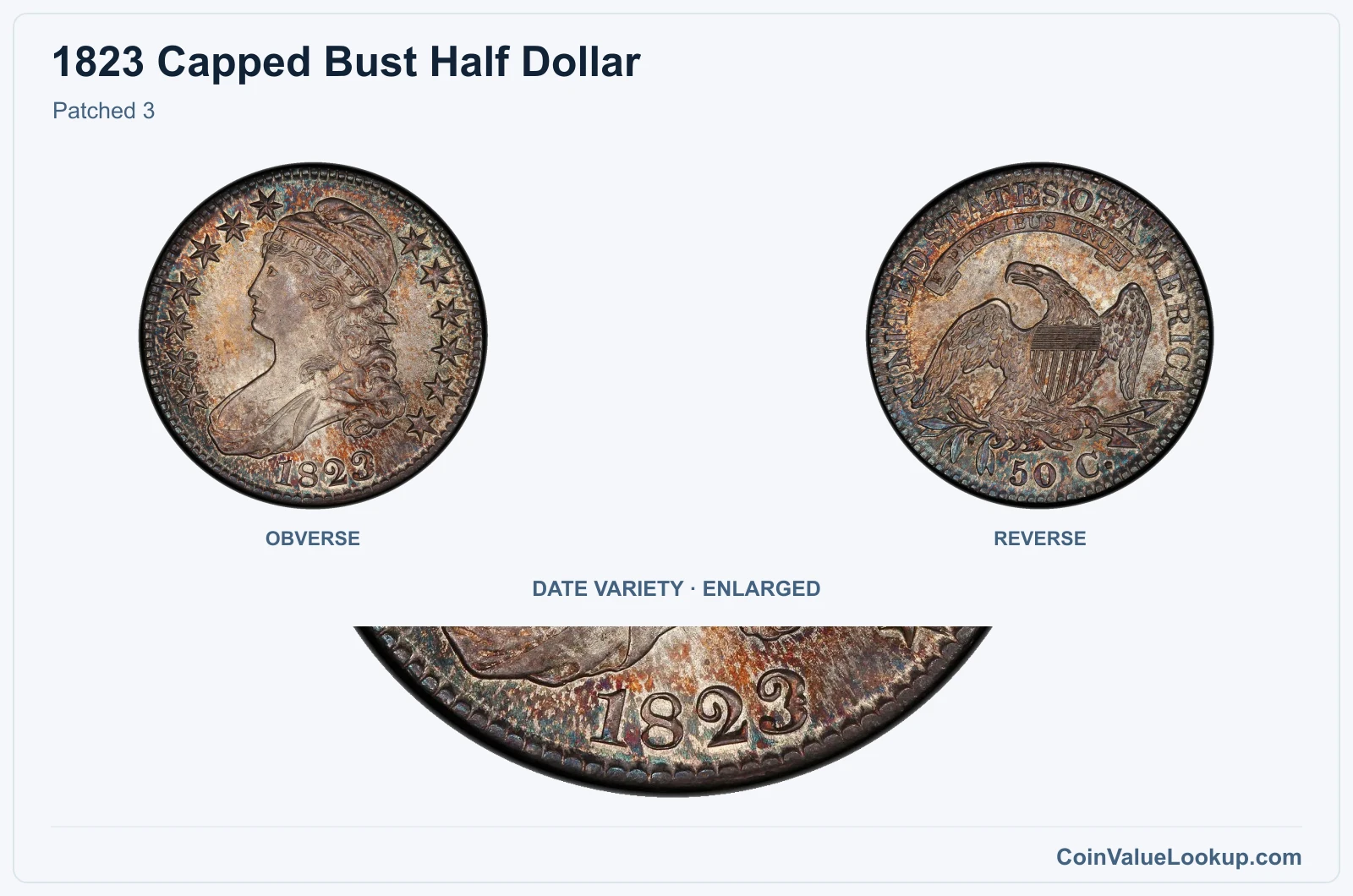
The Patched 3 tells a story. After the Broken 3 die punch showed its near-separation, someone attempted a repair.
The result is a visible reconnection at the middle of the 3 that looks slightly lumpy or filled compared to the clean curves of a Normal 3.
Compare side by side with the Broken 3 to see what was fixed. USA Coin Book estimates place this variety at $142 in G4, $364 in VF20, and $2,006 in AU50.
The premium over a Normal 3 is significant, especially in higher grades, reflecting collector interest in the whole Broken-Patched narrative.
Coin Value Lookup is a handy starting point if you are trying to sort through values for other dates and varieties in the Capped Bust Half Dollar series.
Range Grade
Price Auction Records Appraisal PO PO 1
—
Coin Identifier FR FR 2
—
Coin Identifier AG AG 3
—
Coin Identifier G G 4
Coin Identifier
G 6
Coin Identifier VG VG 8
Coin Identifier
VG 10
—
Coin Identifier F F 12
Coin Identifier
F 15
Coin Identifier VF VF 20
Coin Identifier
VF 25
Coin Identifier
VF 30
Coin Identifier
VF 35
Coin Identifier XF XF 40
Coin Identifier
XF 45
Coin Identifier AU AU 50
Coin Identifier
AU 53
Coin Identifier
AU 55
Coin Identifier
AU 58
Coin Identifier MS MS 60
—
Coin Identifier
MS 61
—
Coin Identifier
MS 62
Coin Identifier
MS 63
Coin Identifier
MS 64
Coin Identifier
MS 65
Coin Identifier
MS 66
—
—
—
MS 67
—
—
—
MS 68
—
—
—
MS 69
—
—
—
MS 70
—
—
—
1823 Capped Bust Half Dollar — Ugly 3
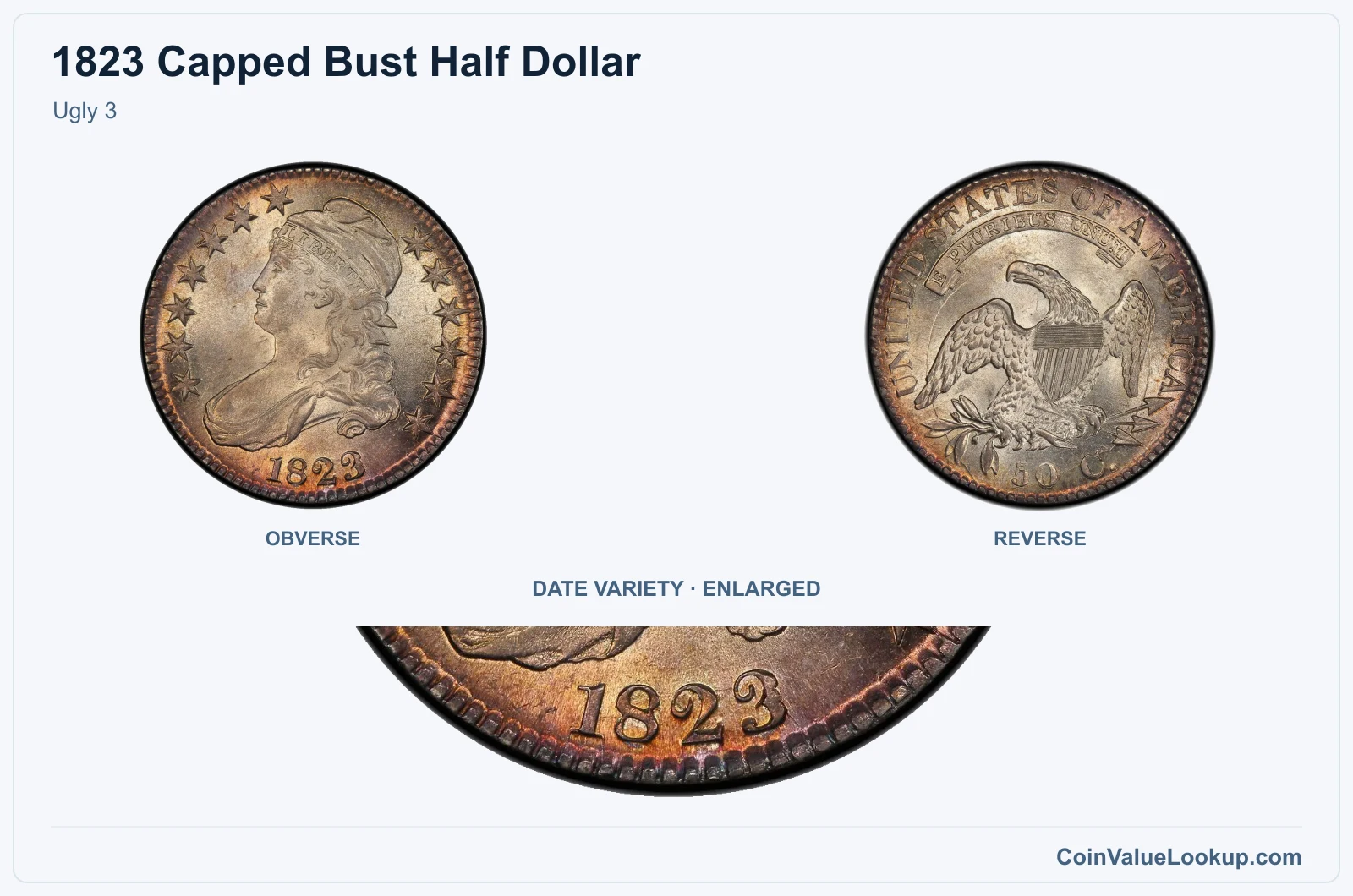
The Ugly 3 lives up to its name. The numeral shows irregular, incomplete portions that give it a rough, misshapen appearance compared to all the other varieties.
This is not random scratching or post-mint damage across an otherwise normal digit. The irregularity comes from the original die punch itself.
USA Coin Book guide values sit at $142 in G4, $332 in VF20, and $2,786 in AU50, tying the Broken 3 at the top grade. Distinguishing this from a scratched Normal 3 requires careful comparison to an attributed example.
The malformed areas should match known diagnostics, not look like random contact marks.
Range Grade
Price Auction Records Appraisal PO PO 1
—
Coin Identifier FR FR 2
—
Coin Identifier AG AG 3
—
Coin Identifier G G 4
—
Coin Identifier
G 6
—
Coin Identifier VG VG 8
Coin Identifier
VG 10
—
Coin Identifier F F 12
Coin Identifier
F 15
Coin Identifier VF VF 20
Coin Identifier
VF 25
Coin Identifier
VF 30
Coin Identifier
VF 35
Coin Identifier XF XF 40
Coin Identifier
XF 45
Coin Identifier AU AU 50
Coin Identifier
AU 53
Coin Identifier
AU 55
Coin Identifier
AU 58
Coin Identifier MS MS 60
—
Coin Identifier
MS 61
—
Coin Identifier
MS 62
Coin Identifier
MS 63
Coin Identifier
MS 64
Coin Identifier
MS 65
Coin Identifier
MS 66
—
—
—
MS 67
—
—
—
MS 68
—
—
—
MS 69
—
—
—
MS 70
—
—
—
1823 Capped Bust Half Dollar — Tampered 3 — Recognized Die Variety
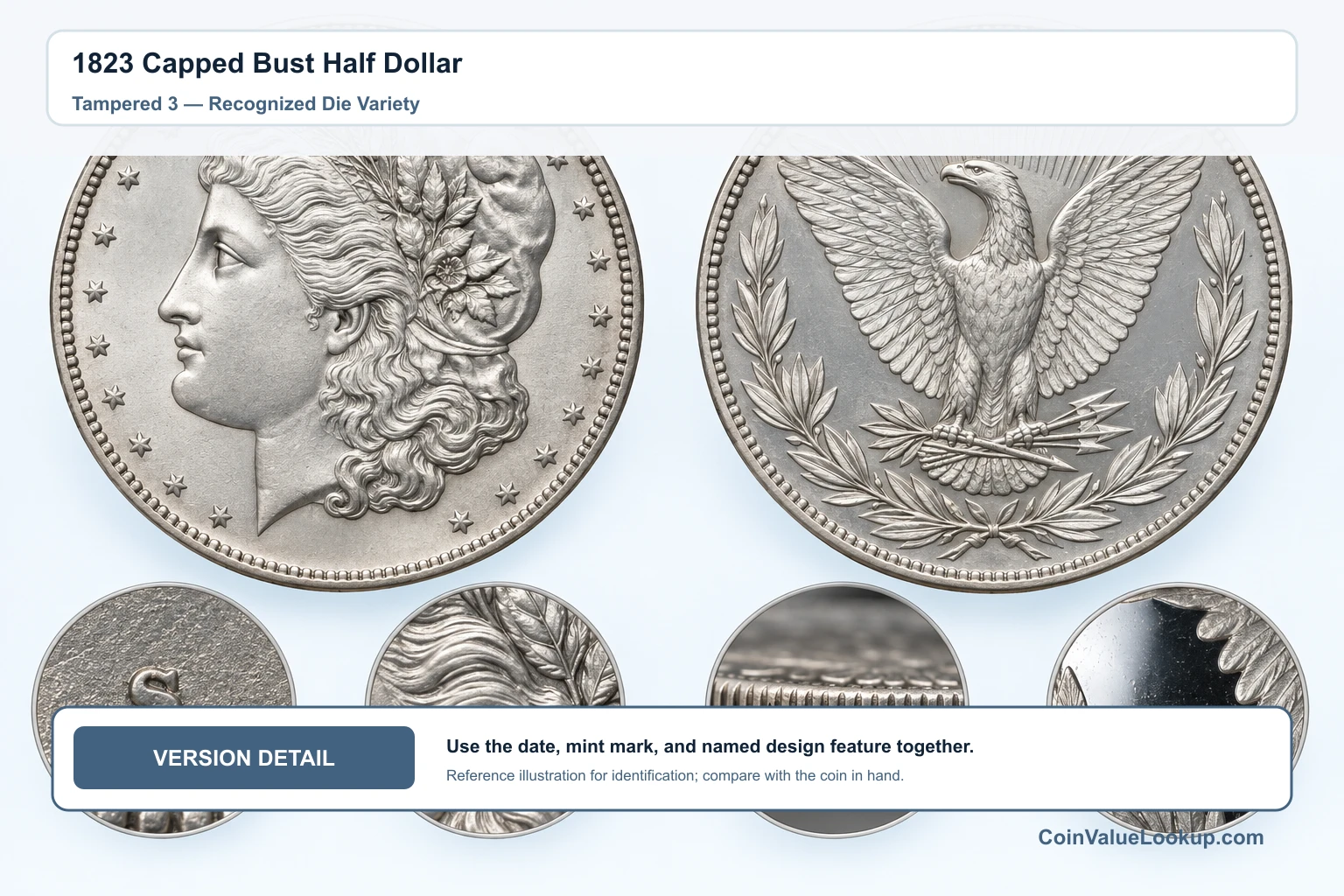
The name sounds alarming, but the Tampered 3 is a fully recognized die variety, not a coin that someone altered after minting. The historical term describes modifications made to the date punch at the die-making stage.
Heritage Auctions has specifically identified this variety, noting the altered die-punch shape as a production characteristic.
Guide estimates from USA Coin Book match the Normal 3: $106 at G4, $182 at VF20, and $631 at AU50. Compare the characteristic shape of the 3 at equal magnification to Normal 3 examples.
The differences are subtle but consistent. Collectors who specialize in Capped Bust halves track this variety carefully even though its guide values do not yet carry a large premium.
Ordinary-issue reference: Ordinary-issue reference only: The table below shows prices for the 1823 Capped Bust Half Dollar (regular strike). It does not represent the value of the specific Tampered 3 — Recognized Die Variety variety or its variety premium. Year, mint, metal and strike type are matched; the specific variety is not priced by this table.
Range Grade
Price Auction Records Appraisal PO PO 1
—
Coin Identifier FR FR 2
—
Coin Identifier AG AG 3
Coin Identifier G G 4
Coin Identifier
G 6
Coin Identifier VG VG 8
Coin Identifier
VG 10
—
Coin Identifier F F 12
Coin Identifier
F 15
Coin Identifier VF VF 20
Coin Identifier
VF 25
Coin Identifier
VF 30
Coin Identifier
VF 35
Coin Identifier XF XF 40
Coin Identifier
XF 45
Coin Identifier AU AU 50
Coin Identifier
AU 53
Coin Identifier
AU 55
Coin Identifier
AU 58
Coin Identifier MS MS 60
—
Coin Identifier
MS 61
Coin Identifier
MS 62
Coin Identifier
MS 63
Coin Identifier
MS 64
Coin Identifier
MS 65
Coin Identifier
MS 66
Coin Identifier
MS 67
Coin Identifier
MS 68
—
—
—
MS 69
—
—
—
MS 70
—
—
—
1823 Capped Bust Half Dollar — Early Proof — Normal Date
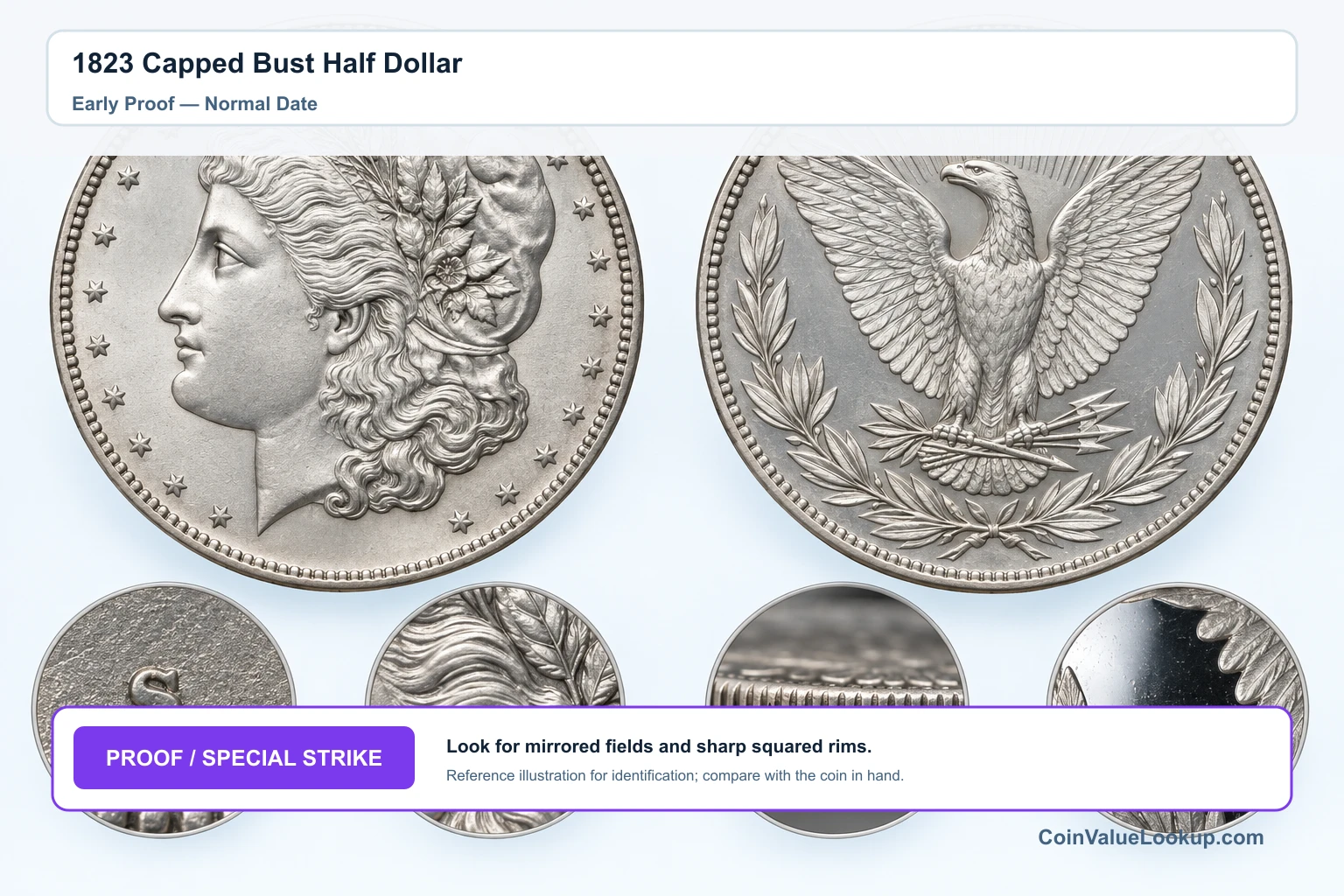
The early Proof 1823 Capped Bust Half Dollar is a rare specialist issue. These are not simply pretty coins with nice surfaces.
Attribution requires matching specific die states, examining surface characteristics, and tracing provenance.
PCGS catalogs this as a separate issue. One historical sale anchor exists: a PR63 example brought $80,500 at Heritage Auctions in April 2011.
That is a single recorded transaction, not a current market range or a price curve you can extrapolate from circulated values.
Do not assume any reflective or prooflike coin is a Proof. Many regular-strike Capped Bust halves can look mirror-like after cleaning or from die polish.
Professional certification with Proof attribution is essential before assigning this kind of value.
Range Grade
Price Auction Records Appraisal PR PR 1
—
Coin Identifier
PR 2
—
Coin Identifier
PR 3
—
Coin Identifier
PR 4
—
Coin Identifier
PR 6
—
Coin Identifier
PR 8
—
Coin Identifier
PR 10
—
Coin Identifier
PR 12
—
Coin Identifier
PR 15
—
Coin Identifier
PR 20
—
Coin Identifier
PR 25
—
Coin Identifier
PR 30
—
Coin Identifier
PR 35
—
Coin Identifier
PR 40
—
Coin Identifier
PR 45
—
Coin Identifier
PR 50
—
Coin Identifier
PR 53
—
Coin Identifier
PR 55
—
Coin Identifier
PR 58
—
Coin Identifier
PR 60
—
Coin Identifier
PR 61
—
Coin Identifier
PR 62
—
Coin Identifier
PR 63
Coin Identifier
PR 64
—
—
—
PR 65
—
—
—
PR 66
—
—
—
PR 67
—
—
—
PR 68
—
—
—
PR 69
—
—
—
PR 70
—
—
—
1823 Capped Bust Half Dollar Error List
1. 1823 Capped Bust Half Dollar — Double / Multiple Strike
A double or multiple strike on an 1823 Half Dollar occurs when the coin receives more than one impression from the dies, with the second strike slightly offset. The reported diagnostic for this date shows close-overlap doubling that is strongest around the chin and neck area of Liberty, producing a displaced or shadowed profile.
This is not the same thing as the Broken, Patched, or Ugly 3 punch varieties, which involve the shape of the date numeral rather than a repeated strike impression. It also differs from a doubled die, which originates in the die-making process rather than the striking press.
Look for a distinct second outline of the portrait features.
No specific price range is available for this error on the 1823 date. Value depends on the degree of displacement, overall visibility, and the coin's condition.
2. 1823 Capped Bust Half Dollar — Clashed Dies
Clashed dies happen when the obverse and reverse dies strike each other without a planchet between them, transferring design elements onto the wrong die. On the reported 1823 specimen, clash marks appear on both faces of the same coin, meaning you can find traces of the eagle design impressed into the obverse fields and Liberty's portrait ghosted onto the reverse.
Do not confuse die clash marks with random scratches, raised lines from debris, or a brockage error, which involves a previously struck coin acting as a die. Clash impressions follow the geometry of the opposite die's design and should be identifiable as specific transferred elements.
No numerical price range is established for this error on the 1823 Half Dollar. The value depends on how visible and dramatic the clash marks are, along with the coin's overall grade and eye appeal.