1824 Capped Bust Half Dollar Coin Value: How Much Is It Worth?
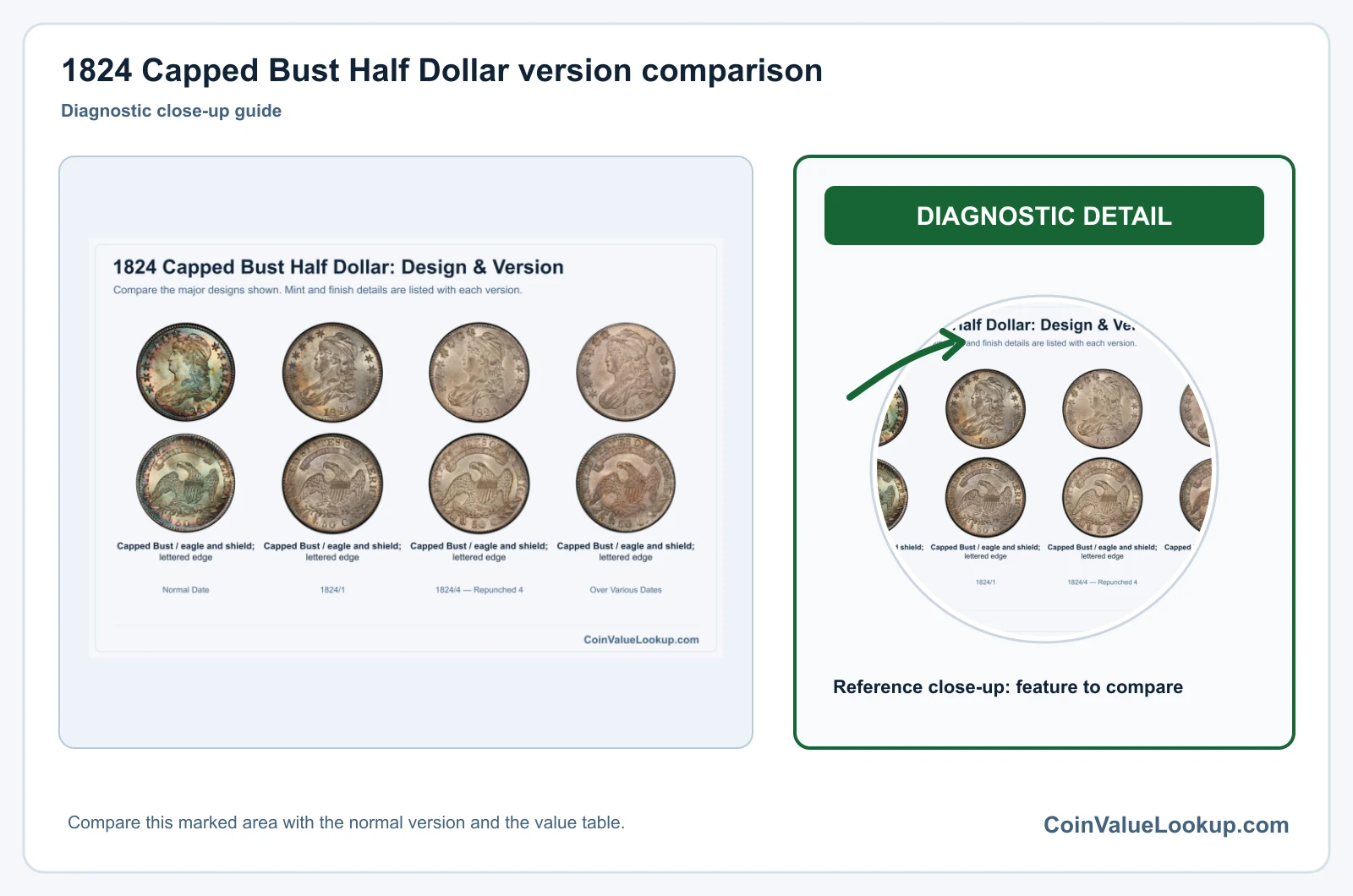
A circulated 1824 Capped Bust Half Dollar in ordinary Normal Date form carries guide values from roughly $111 at G4 to $631 at AU50, depending on condition and variety. Several overdate and repunched-date varieties exist for this year, and some command higher premiums.
Early Proofs are a separate, rare class entirely and should not be confused with shiny circulated coins.
Fast Way to Identify Your 1824 Capped Bust Half Dollar
Snap clear photos of the front and back of your 1824 half dollar and upload them to our identifier. It can help with preliminary identification of your coin's variety and approximate condition.
Good lighting at a slight angle brings out the date details that matter most for separating the different 1824 branches.
1824 Capped Bust Half Dollar Value
Upload both sides of your 1824 Capped Bust Half Dollar.
Front Obverse
Upload photo
Back Reverse
Upload photo
Which 1824 Capped Bust Half Dollar Versions Are Worth Money?
- The 1824/1 overdate shows traces of an underlying 1 near the final 4, and its guide value at AU50 reaches $1,016 — well above the Normal Date.
- The 1824/4 Repunched 4 carries AU50 guide estimates around $1,262, making it worth a close look at the date area with magnification.
- The Over Various Dates variety, with multiple corrected numeral traces, lists at $1,541 in AU50 guide estimates, the highest among regular strikes.
- Early Proofs are exceptionally rare; a single historical sale brought $17,250 at a 2006 Stack's auction, though that is an individual result, not a current market range.
- Even a Normal Date example in well-circulated G4 condition guides at $111, so any genuine 1824 half dollar has meaningful silver and collector value.
Step 1: Identify Your 1824 Capped Bust Half Dollar Mint Mark and Version
Every 1824 Capped Bust Half Dollar was struck at Philadelphia. There is no mintmark to look for.
The obverse shows Liberty facing left wearing a cloth cap, surrounded by stars. The reverse displays an eagle with a shield and the denomination "50 C," with the lettered edge reading FIFTY CENTS OR HALF A DOLLAR.
The coin is a silver-copper alloy, approximately 89.24% silver, with a nominal weight of 13.48 grams and a diameter of 32.5 mm. A correct weight alone does not authenticate a coin.
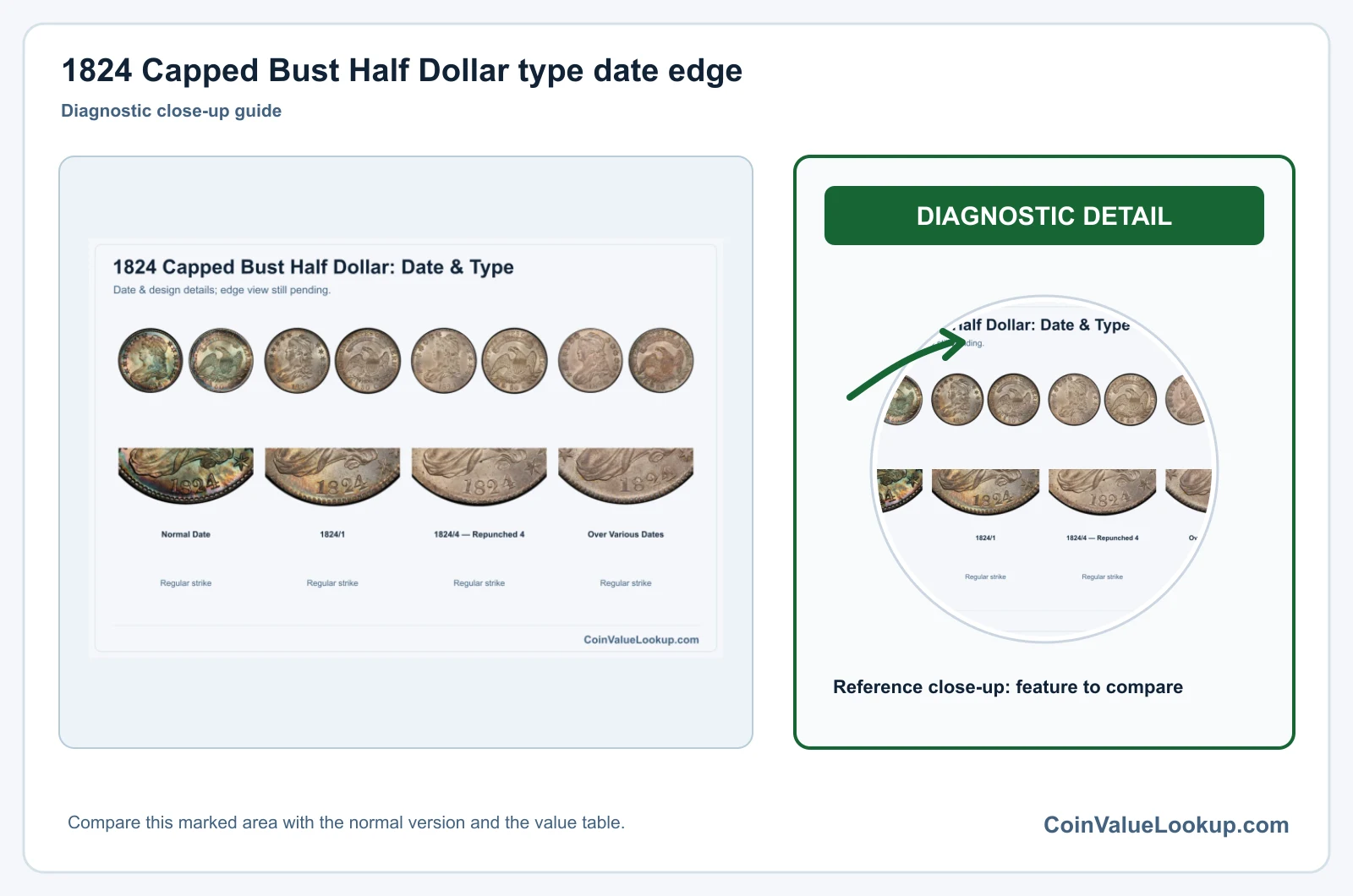
Your main job is inspecting the final digit in the date. On a Normal Date coin, the 4 is cleanly punched with no underlying traces.
On an 1824/1 overdate, remnants of a 1 are visible around the base and shaft of the final 4. On the 1824/4 Repunched 4, you will see a second impression of the same digit 4 — this is not an overdate from a different year, just a re-entry of the same numeral.
The Over Various Dates variety shows multiple corrected numeral traces in the date area; do not try to declare exactly which underlying digits are present, because the evidence is often ambiguous.
If you think you have a Proof, be cautious. A shiny, polished, or prooflike regular-strike coin is not automatically a Proof.
Early Proof attribution requires specialist die-state, surface, and provenance evidence.
Step 2: Check Your 1824 Capped Bust Half Dollar Grade
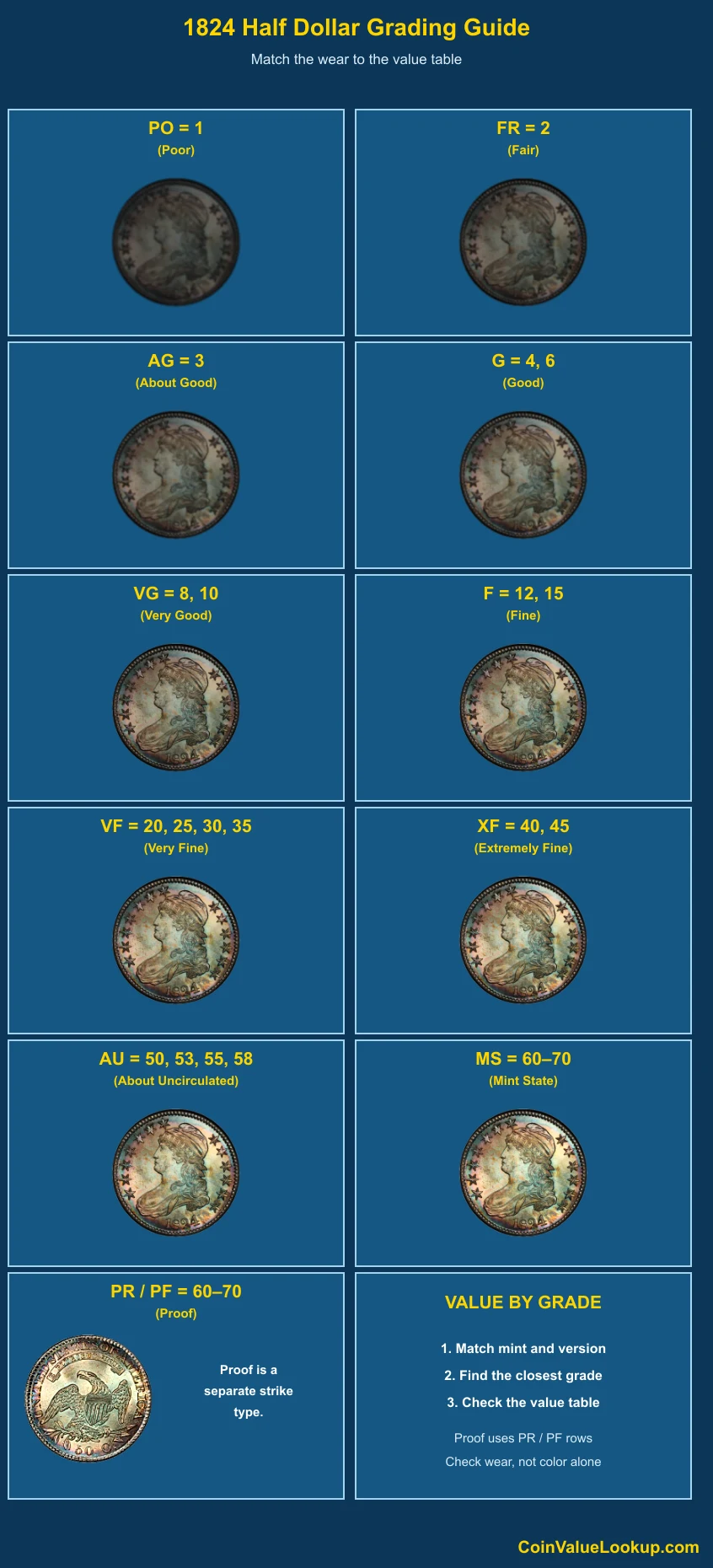
Start by looking at Liberty's hair above the forehead and ear. In lower grades, the individual curls merge into flat areas, and the cheek loses its roundness.
The cap and shoulder clasp also flatten progressively. Compare your coin to the grading comparison image to see these stages side by side.
On the reverse, check the eagle's breast feathers and wing tips. Some 1824 strikes were soft in the center originally, so a lack of detail there does not always mean heavy wear.
Look for interrupted luster — small breaks in the original sheen — before calling it light wear versus a weak strike.
Coins that have been cleaned, holed, tooled, or visibly scratched typically receive a "Details" grade from certification services, and their values fall well below straight-graded examples. Do not clean your coin.
Even gentle polishing removes original surfaces permanently.
Step 3: Check 1824 Capped Bust Half Dollar Value by Mint and Version
1824 Capped Bust Half Dollar — Normal Date
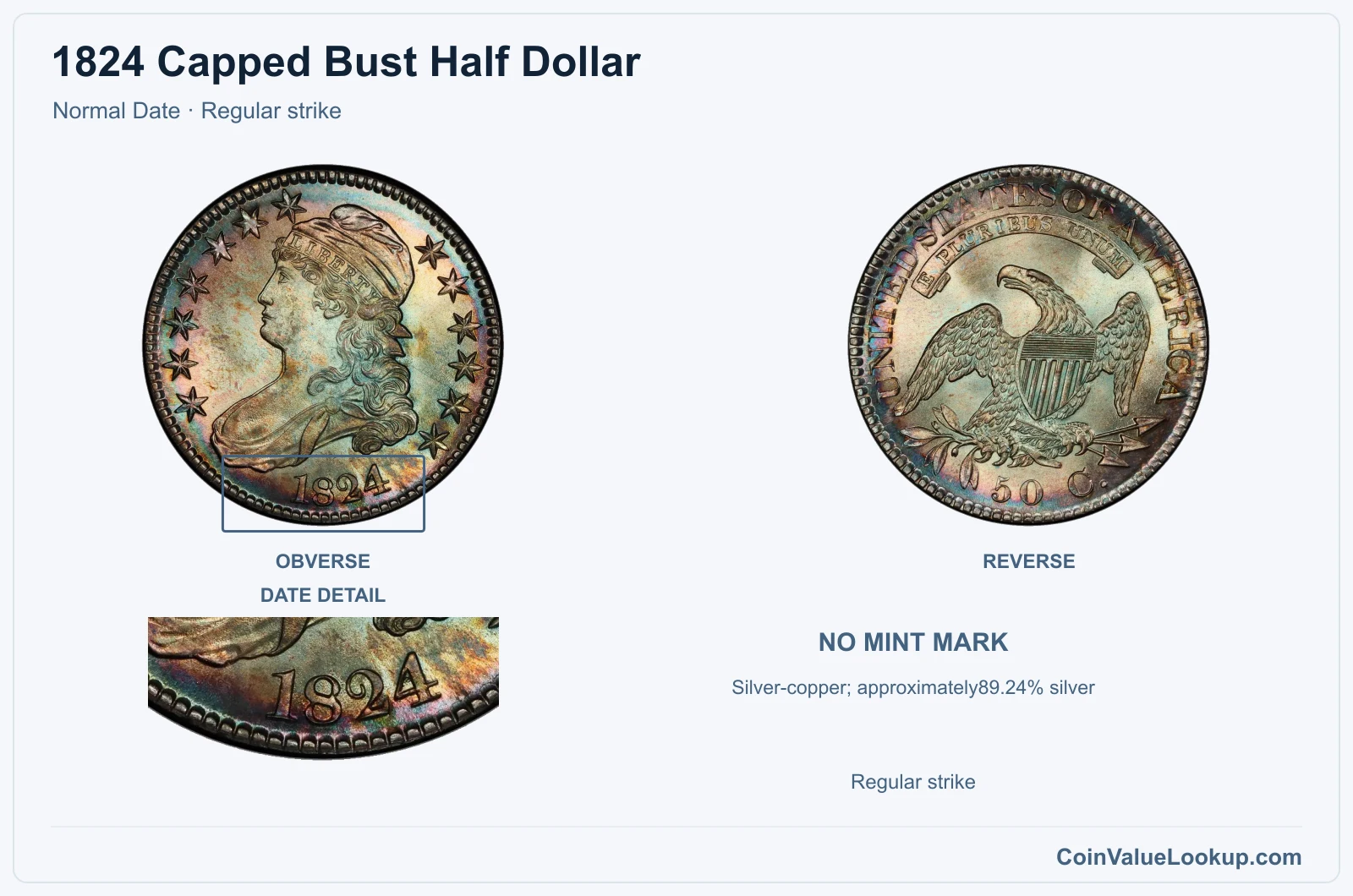
The Normal Date 1824 is the baseline variety. The final 4 in the date is cleanly punched, with no ghost digits or doubling visible underneath.
Before settling on this identification, use a loupe to confirm there are no underlying numeral traces — many collectors have mistaken a lightly struck overdate for a normal coin.
Guide estimates from USA Coin Book place this variety at about $111 in G4, $163 in VF20, and $631 in AU50. These are retail guide figures, not guaranteed offers.
Still, even well-worn examples carry solid value thanks to the silver content and the series' popularity with type collectors.
Range Grade
Price Auction Records Appraisal PO PO 1
—
Coin Identifier FR FR 2
—
Coin Identifier AG AG 3
—
Coin Identifier G G 4
Coin Identifier
G 6
Coin Identifier VG VG 8
Coin Identifier
VG 10
Coin Identifier F F 12
Coin Identifier
F 15
Coin Identifier VF VF 20
Coin Identifier
VF 25
Coin Identifier
VF 30
Coin Identifier
VF 35
Coin Identifier XF XF 40
Coin Identifier
XF 45
Coin Identifier AU AU 50
Coin Identifier
AU 53
Coin Identifier
AU 55
Coin Identifier
AU 58
Coin Identifier MS MS 60
Coin Identifier
MS 61
Coin Identifier
MS 62
Coin Identifier
MS 63
Coin Identifier
MS 64
Coin Identifier
MS 65
Coin Identifier
MS 66
Coin Identifier
MS 67
—
Coin Identifier
MS 68
—
Coin Identifier
MS 69
—
—
—
MS 70
—
—
—
1824 Capped Bust Half Dollar — /1
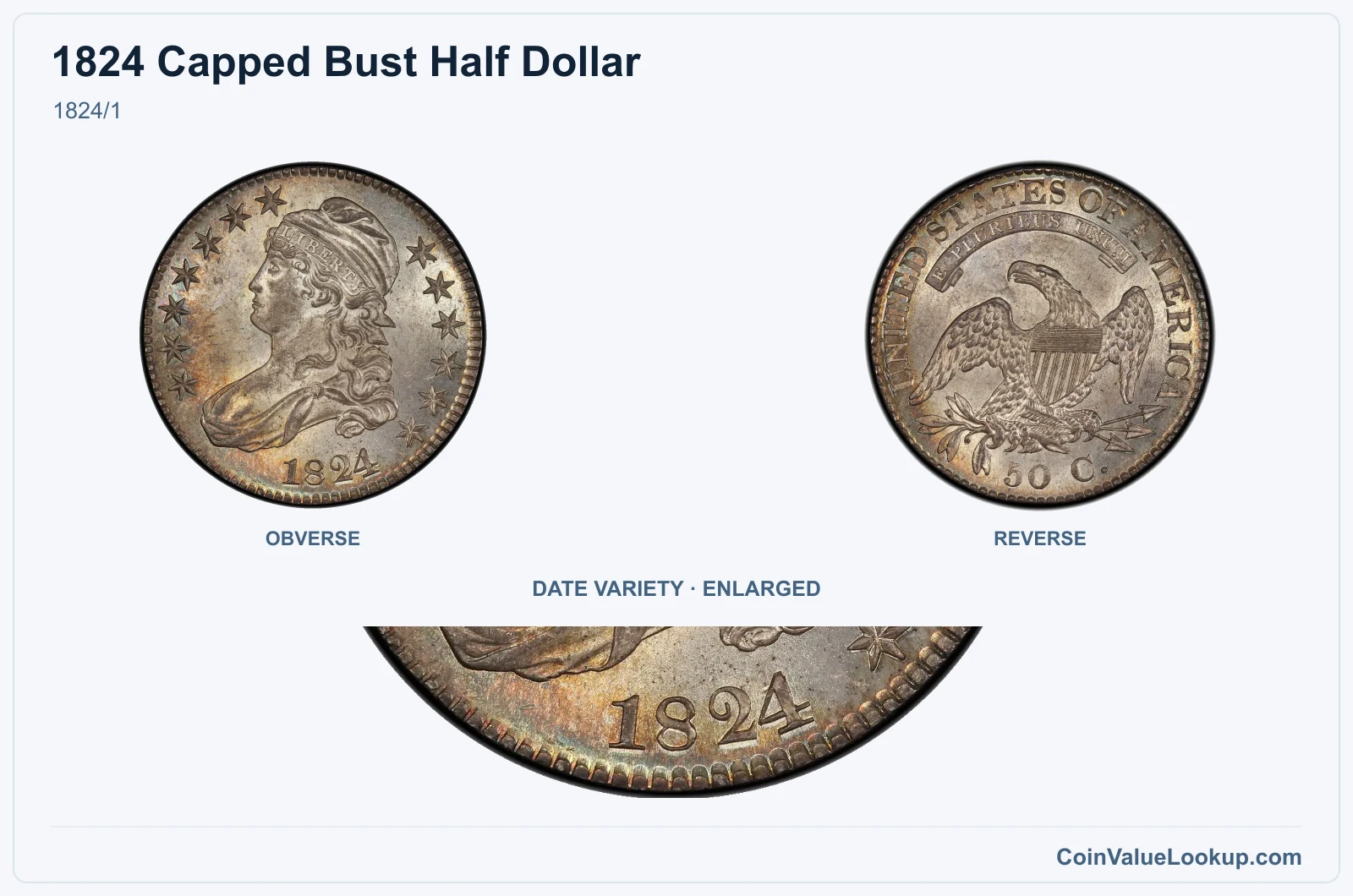
The 1824/1 overdate was created when a die originally punched with a final digit of 1 was corrected to 4. Under magnification, you can see remnants of the underlying 1 peeking out around the base and lower shaft of the 4.
The traces are sometimes subtle, so strong lighting and at least 5x magnification help.
This variety commands a premium, especially in higher grades. USA Coin Book guide estimates run $111 at G4, $268 at VF20, and $1,016 at AU50.
The jump from VF to AU is steep because overdates attract registry-set collectors who compete for problem-free upper-grade examples. Make sure the overdate traces are genuinely part of the die, not just a scratch or planchet mark.
Range Grade
Price Auction Records Appraisal PO PO 1
—
Coin Identifier FR FR 2
—
Coin Identifier AG AG 3
—
Coin Identifier G G 4
—
Coin Identifier
G 6
Coin Identifier VG VG 8
—
Coin Identifier
VG 10
—
Coin Identifier F F 12
—
Coin Identifier
F 15
Coin Identifier VF VF 20
Coin Identifier
VF 25
Coin Identifier
VF 30
Coin Identifier
VF 35
Coin Identifier XF XF 40
Coin Identifier
XF 45
Coin Identifier AU AU 50
Coin Identifier
AU 53
Coin Identifier
AU 55
Coin Identifier
AU 58
Coin Identifier MS MS 60
Coin Identifier
MS 61
—
Coin Identifier
MS 62
Coin Identifier
MS 63
Coin Identifier
MS 64
Coin Identifier
MS 65
Coin Identifier
MS 66
—
—
—
MS 67
—
—
—
MS 68
—
—
—
MS 69
—
—
—
MS 70
—
—
—
1824 Capped Bust Half Dollar — /4 — Repunched 4
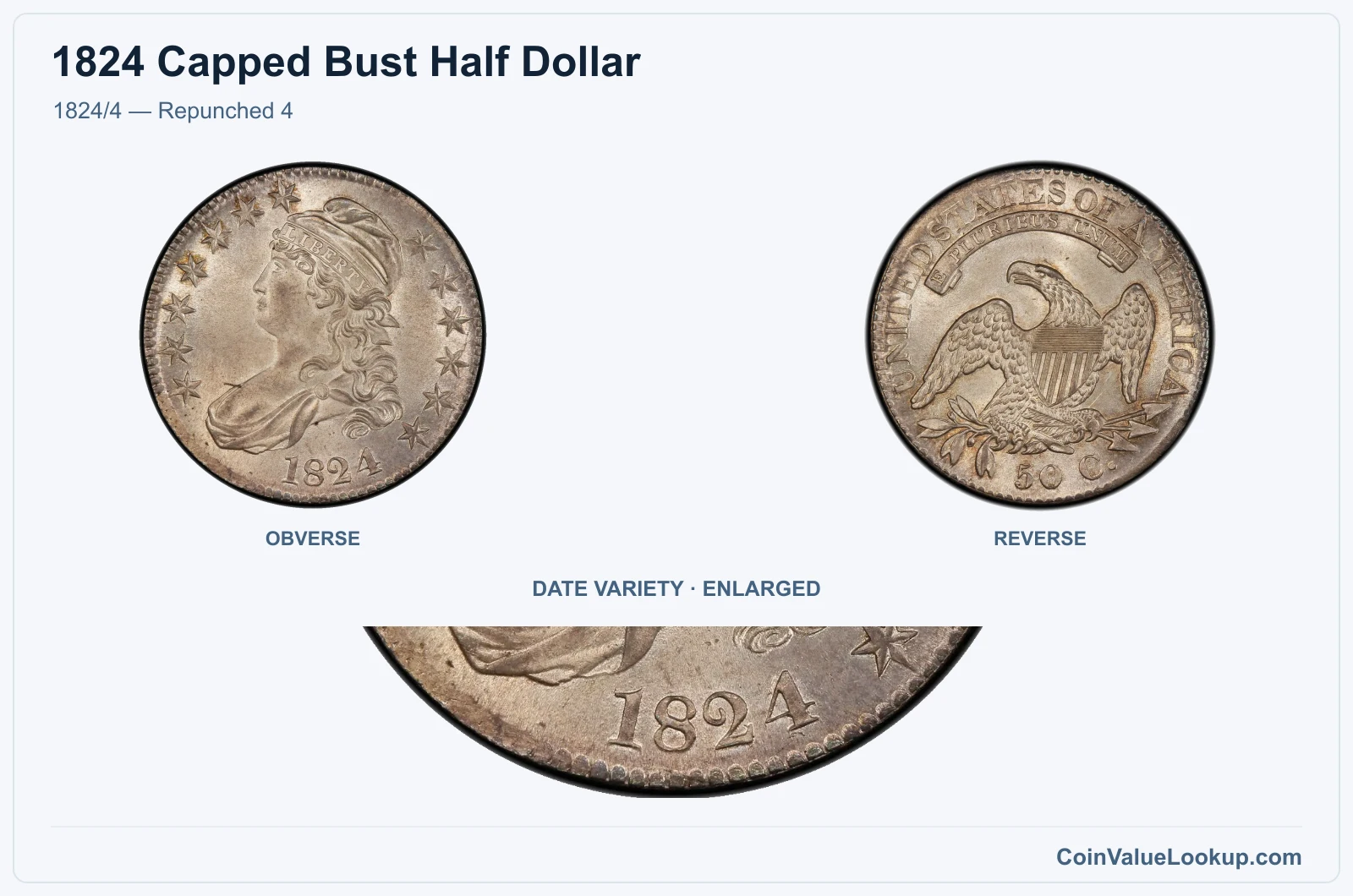
This one trips people up. The 1824/4 Repunched 4 shows a second impression of the digit 4 — the die engraver punched the same numeral twice in slightly different positions.
It is not an overdate from a different calendar year. Look for a doubled outline or shadow of the 4, especially at its top crossbar and lower diagonal.
Guide values from USA Coin Book list $111 at G4, $268 at VF20, and $1,262 at AU50. That AU50 figure exceeds the 1824/1 overdate, reflecting the variety's appeal among specialists.
Confirm the doubling is die-struck and not post-mint damage by checking that the doubled image matches the exact shape and proportions of the primary 4.
Coin Value Lookup is a useful starting point if you want to compare this variety's value against other Capped Bust half dollar dates and branches.
Range Grade
Price Auction Records Appraisal PO PO 1
—
Coin Identifier FR FR 2
—
Coin Identifier AG AG 3
Coin Identifier G G 4
—
Coin Identifier
G 6
—
Coin Identifier VG VG 8
—
Coin Identifier
VG 10
Coin Identifier F F 12
Coin Identifier
F 15
Coin Identifier VF VF 20
Coin Identifier
VF 25
Coin Identifier
VF 30
Coin Identifier
VF 35
Coin Identifier XF XF 40
Coin Identifier
XF 45
Coin Identifier AU AU 50
Coin Identifier
AU 53
Coin Identifier
AU 55
Coin Identifier
AU 58
Coin Identifier MS MS 60
—
Coin Identifier
MS 61
Coin Identifier
MS 62
Coin Identifier
MS 63
Coin Identifier
MS 64
Coin Identifier
MS 65
Coin Identifier
MS 66
Coin Identifier
MS 67
—
—
—
MS 68
—
—
—
MS 69
—
—
—
MS 70
—
—
—
1824 Capped Bust Half Dollar — Over Various Dates
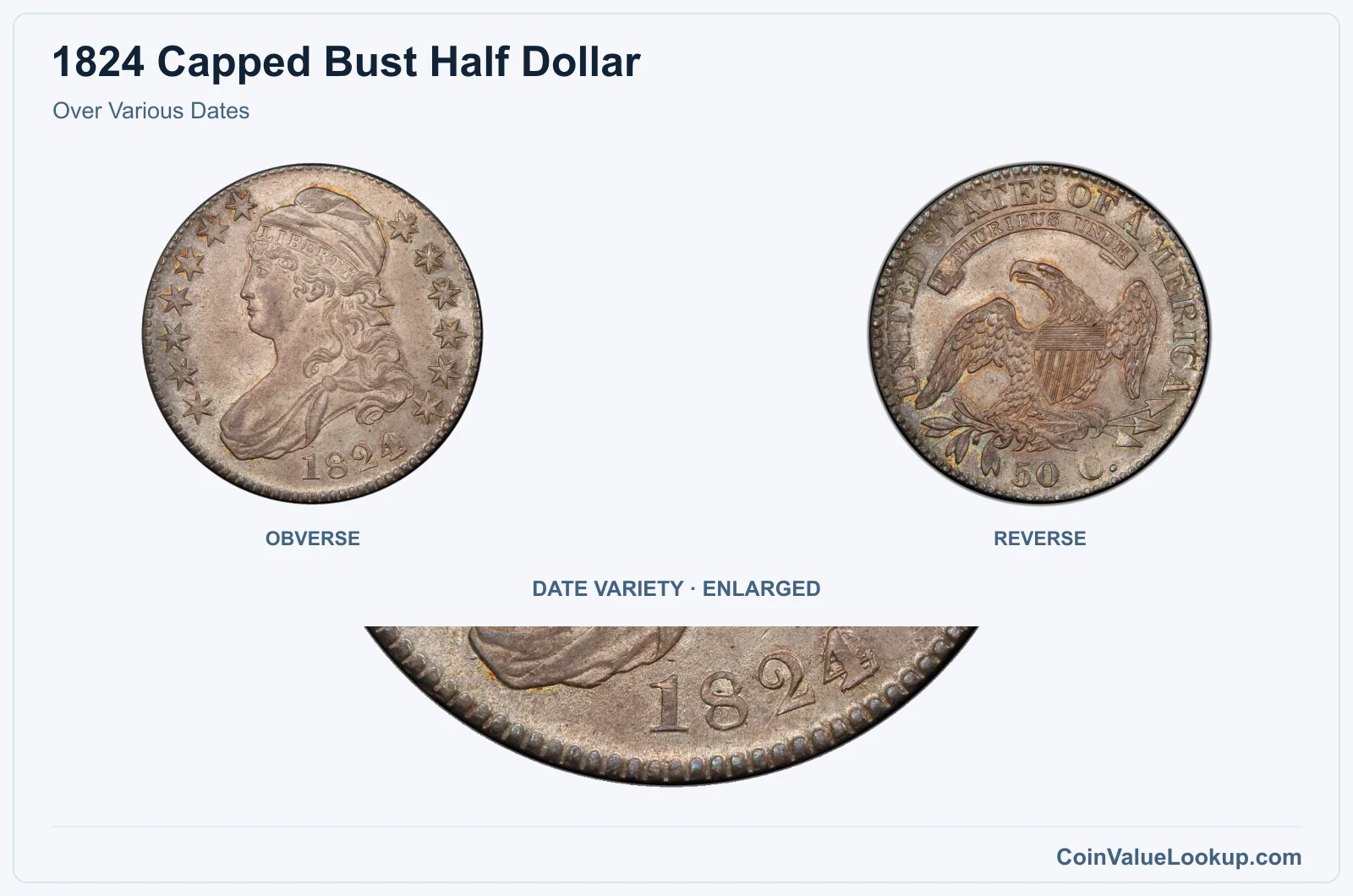
The Over Various Dates variety is the most visually complex of the 1824 regular strikes. Multiple corrected numeral traces are visible in the date area, suggesting the die was reworked more than once.
Avoid confidently declaring exactly which underlying digits are present — the evidence is often ambiguous, and specialists themselves debate the sequence.
Weak central detail on this variety can be original to the die state, not just a sign of heavy wear. That matters when grading.
USA Coin Book guide estimates come in at $106 at G4, $237 at VF20, and $1,541 at AU50, making this the highest-valued regular-strike branch at the AU level. The premium reflects its complexity and the collector interest in documented die corrections.
Proper attribution by a certification service adds confidence and usually a price bump at sale.
Range Grade
Price Auction Records Appraisal PO PO 1
—
Coin Identifier FR FR 2
—
Coin Identifier AG AG 3
—
Coin Identifier G G 4
—
Coin Identifier
G 6
—
Coin Identifier VG VG 8
—
Coin Identifier
VG 10
Coin Identifier F F 12
Coin Identifier
F 15
Coin Identifier VF VF 20
Coin Identifier
VF 25
Coin Identifier
VF 30
Coin Identifier
VF 35
Coin Identifier XF XF 40
Coin Identifier
XF 45
Coin Identifier AU AU 50
Coin Identifier
AU 53
Coin Identifier
AU 55
Coin Identifier
AU 58
Coin Identifier MS MS 60
—
Coin Identifier
MS 61
Coin Identifier
MS 62
Coin Identifier
MS 63
Coin Identifier
MS 64
Coin Identifier
MS 65
Coin Identifier
MS 66
—
—
—
MS 67
—
—
—
MS 68
—
—
—
MS 69
—
—
—
MS 70
—
—
—
1824 Capped Bust Half Dollar — Early Proof — Normal Date
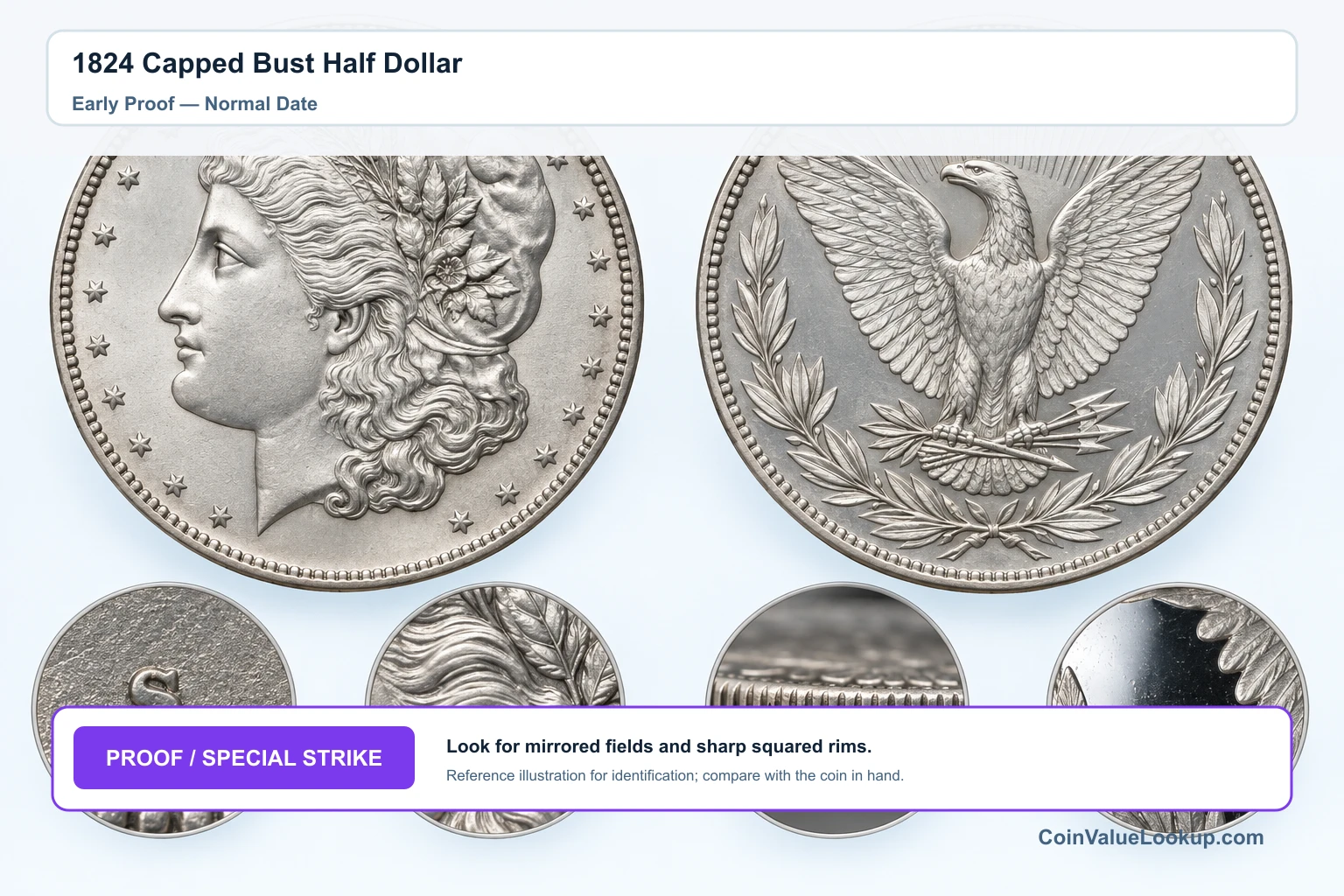
The early Proof 1824 Capped Bust Half Dollar is a rare specialist item. These were manufactured with a different process than regular circulation strikes and require professional die-state, surface, and provenance analysis to confirm.
A bright or reflective coin is not automatically a Proof — many regular strikes have been polished or have prooflike surfaces from fresh dies.
The only historical sale anchor reported by PCGS is a single example sold at Stack's in October 2006 for $17,250, with the numerical Proof grade unspecified. That is one auction result, not a current market range or grade curve.
If you believe you have an 1824 Proof, third-party certification with full provenance documentation is essential before assigning any value.
Range Grade
Price Auction Records Appraisal PR PR 1
—
Coin Identifier
PR 2
—
Coin Identifier
PR 3
—
Coin Identifier
PR 4
—
Coin Identifier
PR 6
—
Coin Identifier
PR 8
—
Coin Identifier
PR 10
—
Coin Identifier
PR 12
—
Coin Identifier
PR 15
—
Coin Identifier
PR 20
—
Coin Identifier
PR 25
—
Coin Identifier
PR 30
—
Coin Identifier
PR 35
—
Coin Identifier
PR 40
—
Coin Identifier
PR 45
—
Coin Identifier
PR 50
—
Coin Identifier
PR 53
—
Coin Identifier
PR 55
—
Coin Identifier
PR 58
—
Coin Identifier
PR 60
—
Coin Identifier
PR 61
—
Coin Identifier
PR 62
—
Coin Identifier
PR 63
—
Coin Identifier
PR 64
—
Coin Identifier
PR 65
—
—
—
PR 66
—
—
—
PR 67
—
—
—
PR 68
—
—
—
PR 69
—
—
—
PR 70
—
—
—
1824 Capped Bust Half Dollar Error List
1. 1824 Capped Bust Half Dollar — Double / Multiple Strike
A double or multiple strike on an 1824 Half Dollar means the coin received more than one blow from the dies, with the planchet shifting between impressions. Specialist sources describe displaced elements across the forehead, mouth, chin, bust, stars, and date on the obverse, plus duplicated features on the reverse.
The key diagnostic is spread visible across several design elements simultaneously, not merely a single recut digit in the date.
Do not confuse this with a doubled die, which is a different error created during die manufacturing rather than striking. Post-mint damage from a vice or drop can also create the illusion of a second strike.
A genuine multiple strike will show consistent displacement direction and depth across both sides. No specific price range is adopted for this error; value depends on the degree of displacement, overall condition, and specialist demand.
2. 1824 Capped Bust Half Dollar — Off-Center Strike
An off-center strike occurs when the planchet is not properly seated between the dies at the moment of striking. One reported example of an 1824 Half Dollar was labeled by PCGS as struck 5% off center.
At that modest percentage, part of the design shifts toward one edge while a blank crescent appears on the opposite side.
The diagnostic to look for is an asymmetric blank area along one border, with the full design elements displaced in the opposite direction. Do not mistake an uneven rim, a slightly misaligned die, or post-mint flattening for a genuine off-center strike.
A clipped planchet also looks different — it removes metal in a curved bite rather than shifting the entire design. No numerical price is adopted; value depends on the percentage of displacement, whether the date remains visible, and the coin's overall condition.
3. 1824 Capped Bust Half Dollar — Doubled Edge Lettering
Doubled edge lettering on an 1824 Half Dollar means the lettered edge inscription — FIFTY CENTS OR HALF A DOLLAR — was impressed more than once, creating overlapping or shadowed letters along the edge. Published bust-half sales references record this category for the 1824 date.
Different die pairings may exhibit this error, but they fall under one general category.
To identify it, examine the edge lettering under magnification. Genuine examples show complete overlapping letter forms, not just wear-flattened text or minor irregularities.
Post-mint damage, ordinary edge wear, and design features from other years can mimic the look. Compare your coin against an attributed same-year example whenever possible.
No specific price is adopted for this error; the value will depend on the clarity of the doubling, the coin's grade, and collector interest.
4. 1824 Capped Bust Half Dollar — Struck-Through Error
A struck-through error happens when foreign material — grease, metal fragments, cloth, or other debris — gets trapped between the die and the planchet during striking, leaving an impression or blank area on the finished coin. One attributed example is an 1824 Half Dollar graded NGC AU53 with a struck-through designation.
The specific material and face location are not established in available records for that piece.
Look for a depressed or abnormally smooth area that does not match normal wear or cleaning. Genuine struck-through impressions sit below the surrounding surface and often have crisp boundaries.
Wear, scratches, cleaning residue, and ordinary weak strikes can all create similar-looking flat spots, so careful comparison matters. No price range is adopted for this error; value depends on the size, location, and visual impact of the struck-through area, along with overall coin condition.