1830 Capped Bust Half Dollar Coin Value: How Much Is It Worth?
An 1830 Capped Bust Half Dollar in typical circulated condition carries guide values from roughly $100 at G4 to $487 at AU50 for the regular Small 0 or Large 0 varieties. But not all 1830 halves are equal.
The scarce Large Letters Reverse variety commands significantly higher prices, and authenticated Proofs are rare specialist pieces with their own market entirely.
Fast Way to Identify Your 1830 Capped Bust Half Dollar
Snap clear photos of the front and back of your 1830 half dollar and upload them here. Our identifier can give you a preliminary read on which version you might have, whether it is a Small 0, Large 0, or possibly the scarce Large Letters Reverse.
Sharp, well-lit images of both sides help the most.
1830 Capped Bust Half Dollar Value
Upload both sides of your 1830 Capped Bust Half Dollar.
Front Obverse
Upload photo
Back Reverse
Upload photo
Which 1830 Capped Bust Half Dollar Versions Are Worth Money?
- Small 0 and Large 0 varieties share similar guide values, around $100 at G4 up to $487 at AU50, so identifying which you have is mainly a collector classification exercise.
- The Large Letters Reverse is the one to watch: guide estimates run from about $1,464 at G4 to $7,350 at AU50, making it far more valuable than the standard reverse types.
- Authenticated Lettered Edge Proofs are rare; a single PR65+ example sold for $64,625 at Heritage in January 2014, illustrating the specialist demand for confirmed early Proofs.
- Double or multiple strike errors have been reported for this date and can carry premiums depending on the severity and condition of the specific coin.
Step 1: Identify Your 1830 Capped Bust Half Dollar Mint Mark and Version
Every 1830 Capped Bust Half Dollar was struck at Philadelphia. There is no mintmark to look for.
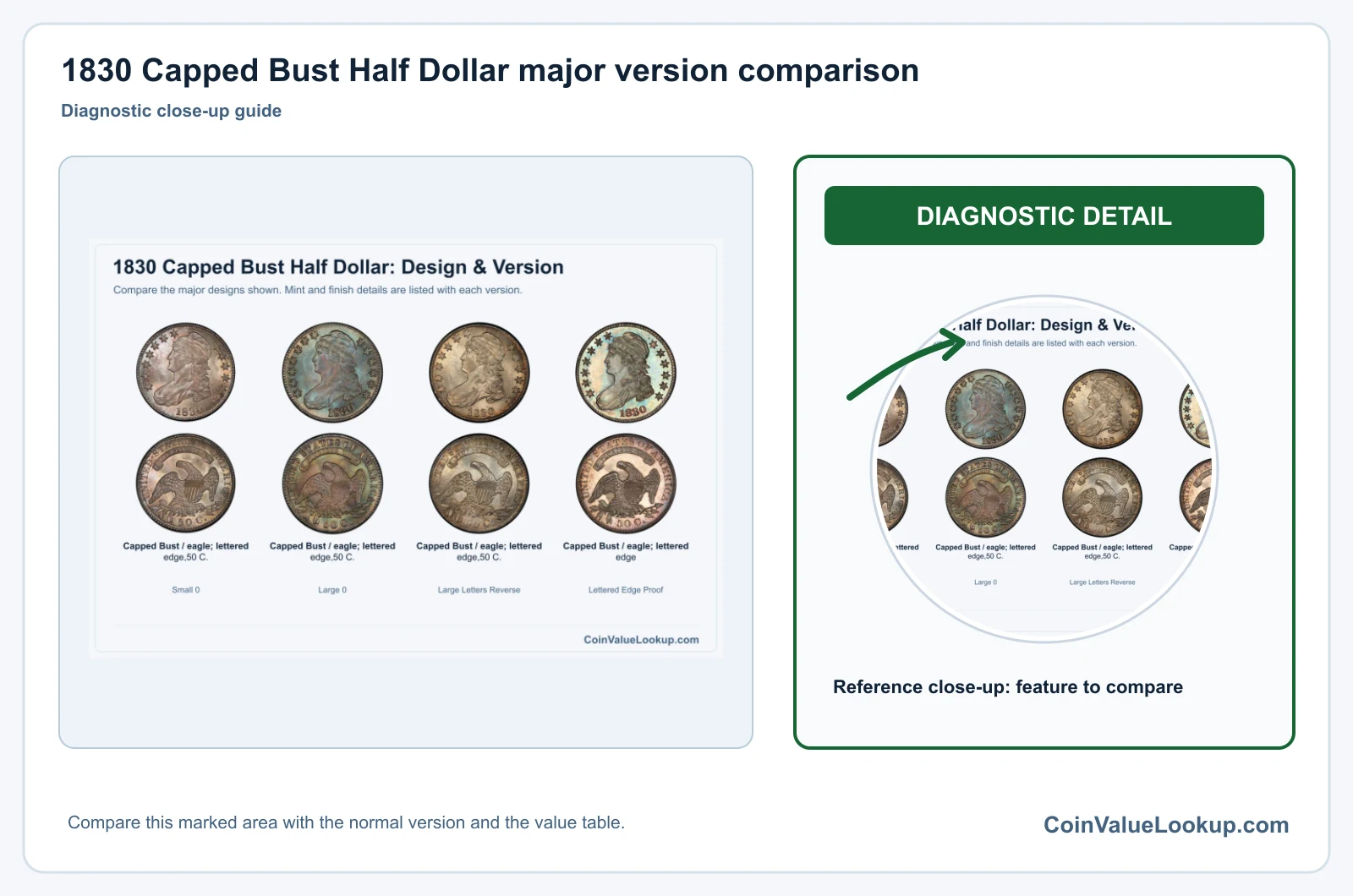
Confirm the basics first: the obverse shows Liberty wearing a cap, the reverse features an eagle, the edge is lettered FIFTY CENTS OR HALF A DOLLAR, and the coin measures about 32.5 mm and weighs approximately 13.48 grams. The composition is silver-copper, roughly 89.24% silver.
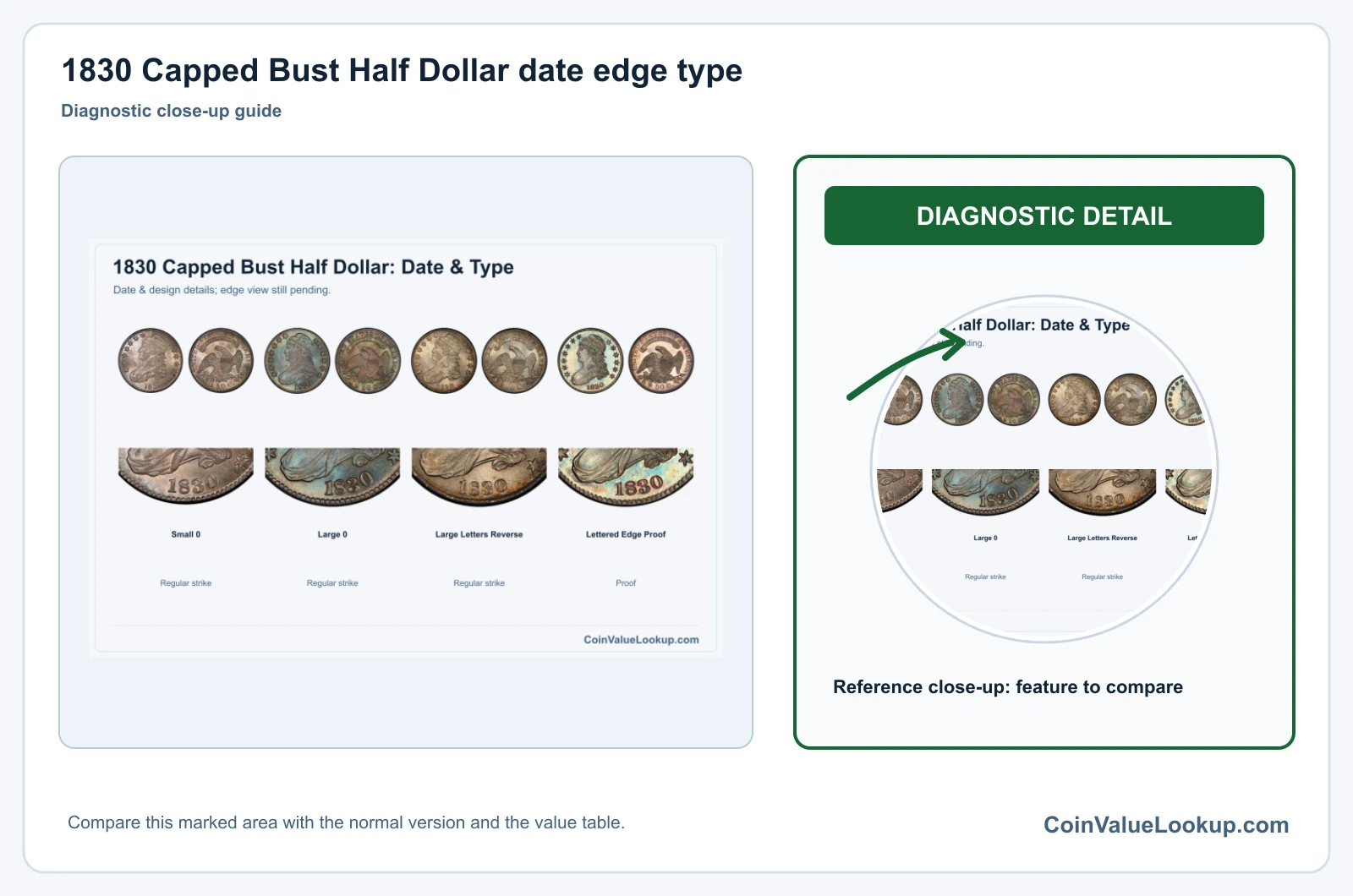
Now the versions. Look at the final digit of the date, the zero.
On the Small 0 variety, that zero is noticeably smaller or comparable to the other date numerals. On the Large 0, the zero is visibly taller and wider; compare both side by side at the same scale if you can.
The Large Letters Reverse is identified on the back of the coin. The legend lettering around the reverse is distinctly larger than on the standard reverse.
You need to examine the whole reverse to confirm this, not just the date side.
Proof status is a manufacturing finish, not a grade. A shiny or prooflike regular strike is not a Proof.
If you suspect yours might be a Proof, professional attribution from a third-party grading service is essential.
Step 2: Check Your 1830 Capped Bust Half Dollar Grade
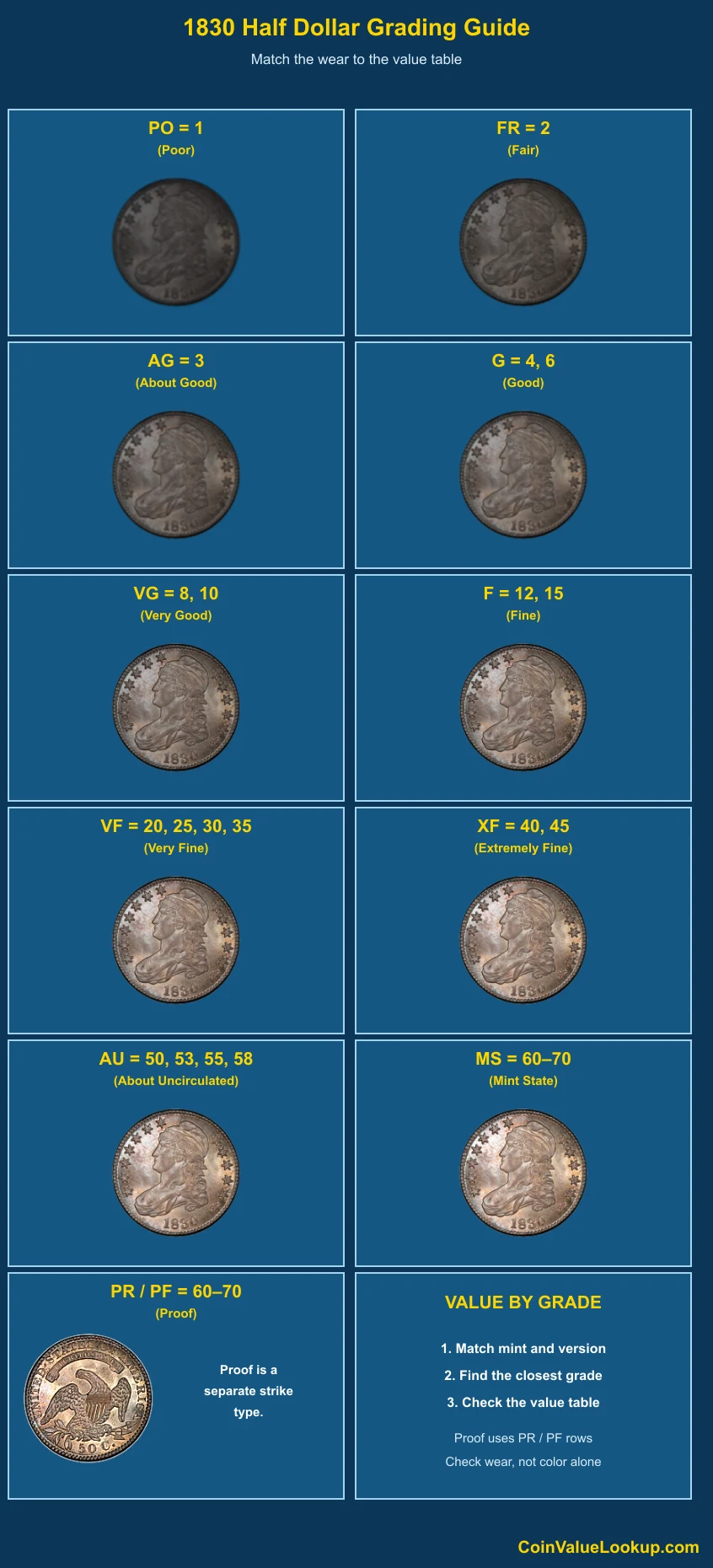
Start with the highest points on Liberty's portrait: the hair above the forehead, the cheek, the cap, and the clasp at the shoulder. These wear first.
On the reverse, check the eagle's breast feathers and wing tips.
A coin grading G4 will show a smooth, worn portrait with the main outline still visible but little interior detail. By VF20, you can see moderate hair and feather detail with wear confined to the high points.
At AU50, only light friction is present on the very tops of the design, and most original luster remains.
Separate genuine wear from weak strike. Some Capped Bust halves left the press with soft detail in spots, which is not the same as circulation loss.
Also watch for cleaning, scratches, or holes, all of which reduce value significantly. Compare your coin to the type-matched grading image to get a realistic read on condition.
Proof coins use their own PR grading scale and should not be evaluated on the circulated or Mint State ladder.
Step 3: Check 1830 Capped Bust Half Dollar Value by Mint and Version
1830 Capped Bust Half Dollar — Small 0
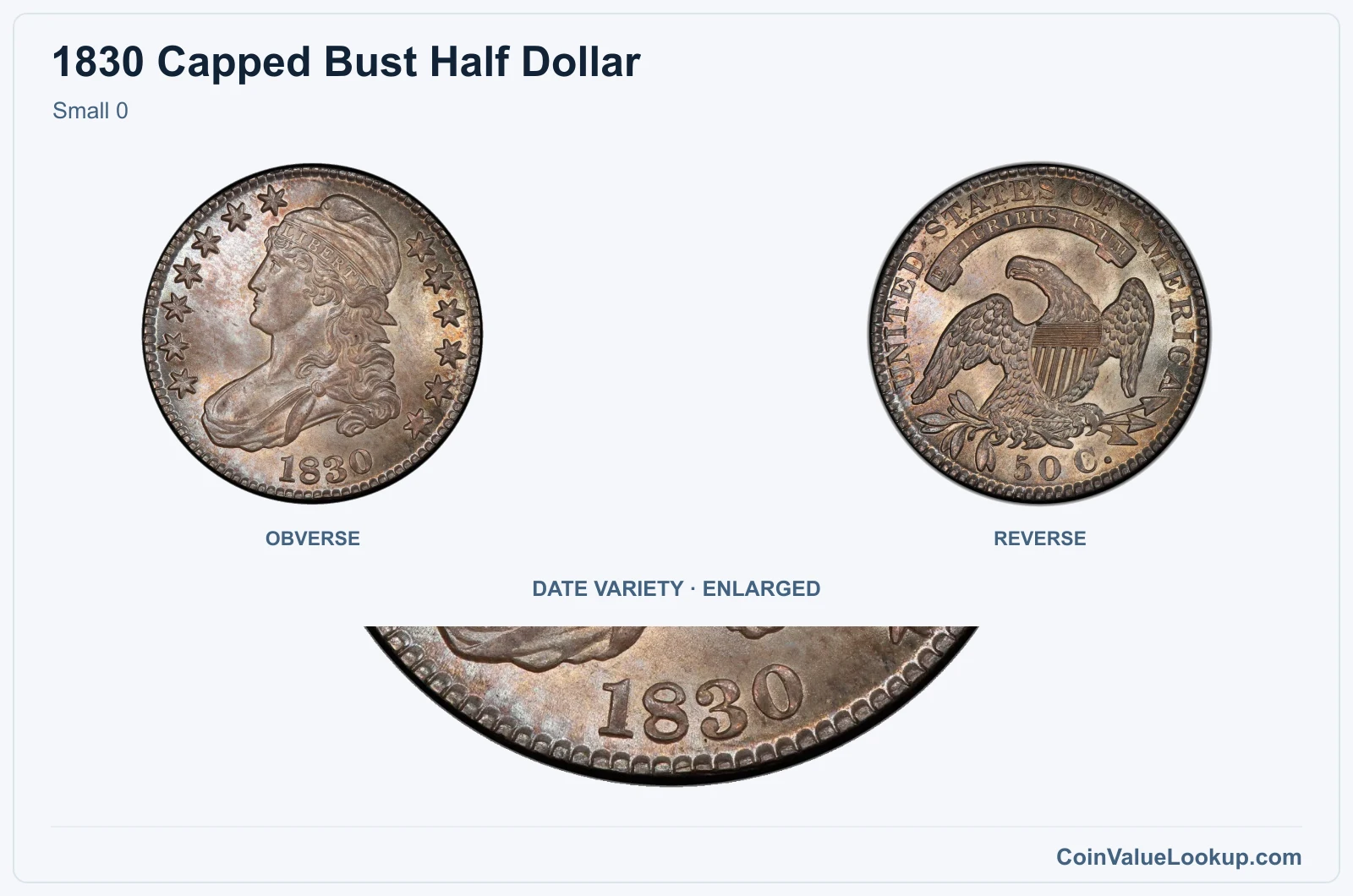
The Small 0 is the version most collectors encounter first. Look at the final zero in 1830: it should appear similar in size to the other date digits, particularly the 3.
This is a Philadelphia regular circulation strike on a lettered-edge planchet of approximately 89.24% silver.
USA Coin Book guide estimates place this variety at about $100 in G4, $167 in VF20, and $487 in AU50. These are retail guide figures, not guaranteed sale prices.
Condition and eye appeal matter, so a problem-free example will always outperform a cleaned or damaged one at the same technical grade.
Range Grade
Price Auction Records Appraisal PO PO 1
—
Coin Identifier FR FR 2
—
Coin Identifier AG AG 3
—
Coin Identifier G G 4
—
Coin Identifier
G 6
—
Coin Identifier VG VG 8
Coin Identifier
VG 10
Coin Identifier F F 12
Coin Identifier
F 15
Coin Identifier VF VF 20
Coin Identifier
VF 25
Coin Identifier
VF 30
Coin Identifier
VF 35
Coin Identifier XF XF 40
Coin Identifier
XF 45
Coin Identifier AU AU 50
Coin Identifier
AU 53
Coin Identifier
AU 55
Coin Identifier
AU 58
Coin Identifier MS MS 60
Coin Identifier
MS 61
Coin Identifier
MS 62
Coin Identifier
MS 63
Coin Identifier
MS 64
Coin Identifier
MS 65
Coin Identifier
MS 66
Coin Identifier
MS 67
Coin Identifier
MS 68
—
—
—
MS 69
—
—
—
MS 70
—
—
—
1830 Capped Bust Half Dollar — Large 0
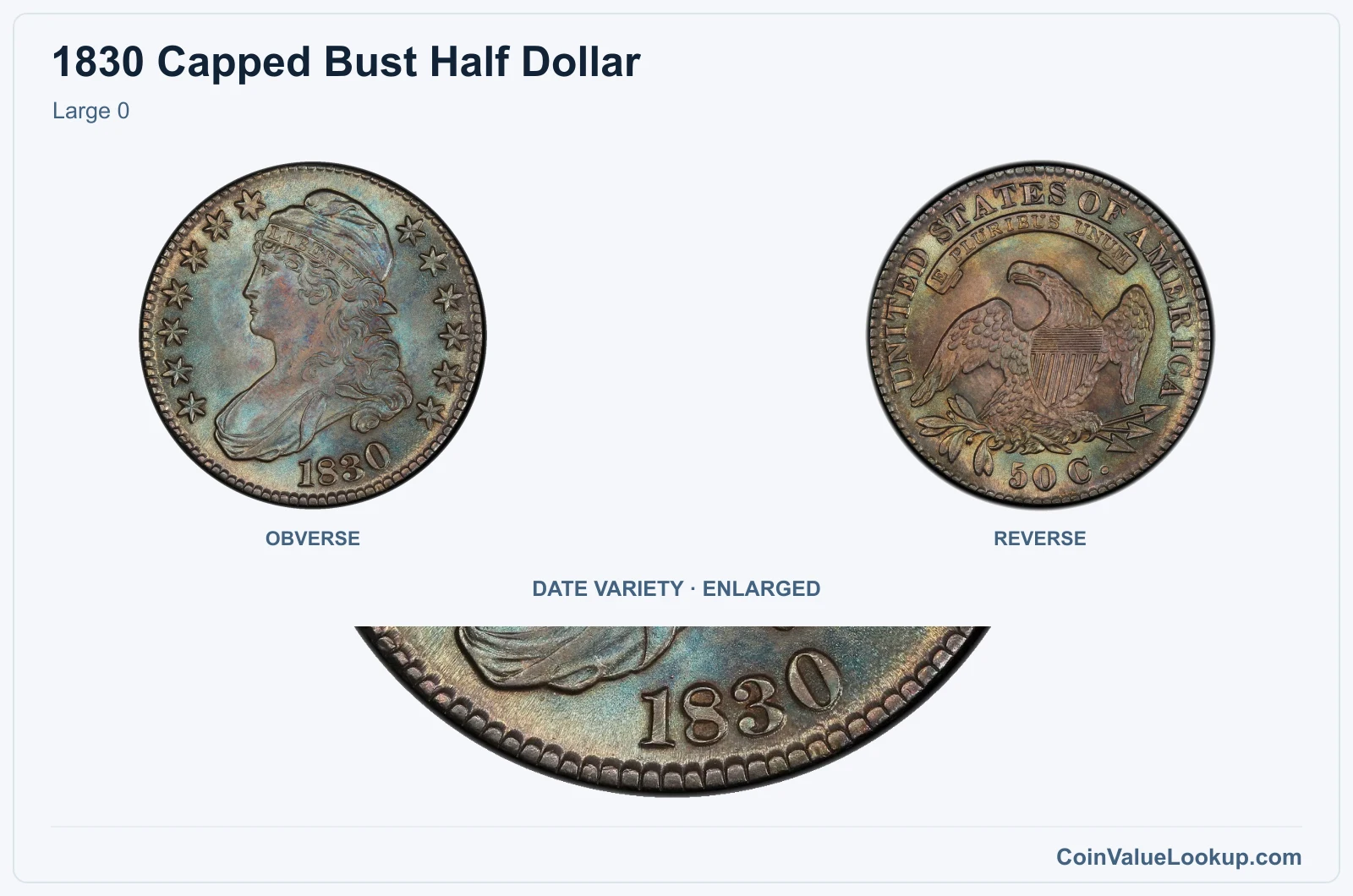
The Large 0 variety is distinguished by, well, a larger zero. When you compare the final digit to the 3 or the 1 in the date, the zero is noticeably taller and wider.
Use an equal-scale reference image if you are uncertain.
This is also a Philadelphia regular circulation strike with the standard lettered edge and approximately 89.24% silver composition. Guide estimates from USA Coin Book match the Small 0: roughly $100 at G4, $167 at VF20, and $487 at AU50.
The distinction matters for die-variety collectors more than for a price difference at these grades.
Coin Value Lookup is a good starting point if you are sorting through other dates or denominations in the Capped Bust series and want quick access to value guides.
Range Grade
Price Auction Records Appraisal PO PO 1
—
Coin Identifier FR FR 2
—
Coin Identifier AG AG 3
—
Coin Identifier G G 4
—
Coin Identifier
G 6
—
Coin Identifier VG VG 8
—
Coin Identifier
VG 10
—
Coin Identifier F F 12
Coin Identifier
F 15
Coin Identifier VF VF 20
Coin Identifier
VF 25
Coin Identifier
VF 30
Coin Identifier
VF 35
Coin Identifier XF XF 40
Coin Identifier
XF 45
Coin Identifier AU AU 50
Coin Identifier
AU 53
Coin Identifier
AU 55
Coin Identifier
AU 58
Coin Identifier MS MS 60
—
Coin Identifier
MS 61
Coin Identifier
MS 62
Coin Identifier
MS 63
Coin Identifier
MS 64
Coin Identifier
MS 65
Coin Identifier
MS 66
Coin Identifier
MS 67
—
—
—
MS 68
—
—
—
MS 69
—
—
—
MS 70
—
—
—
1830 Capped Bust Half Dollar — Large Letters Reverse
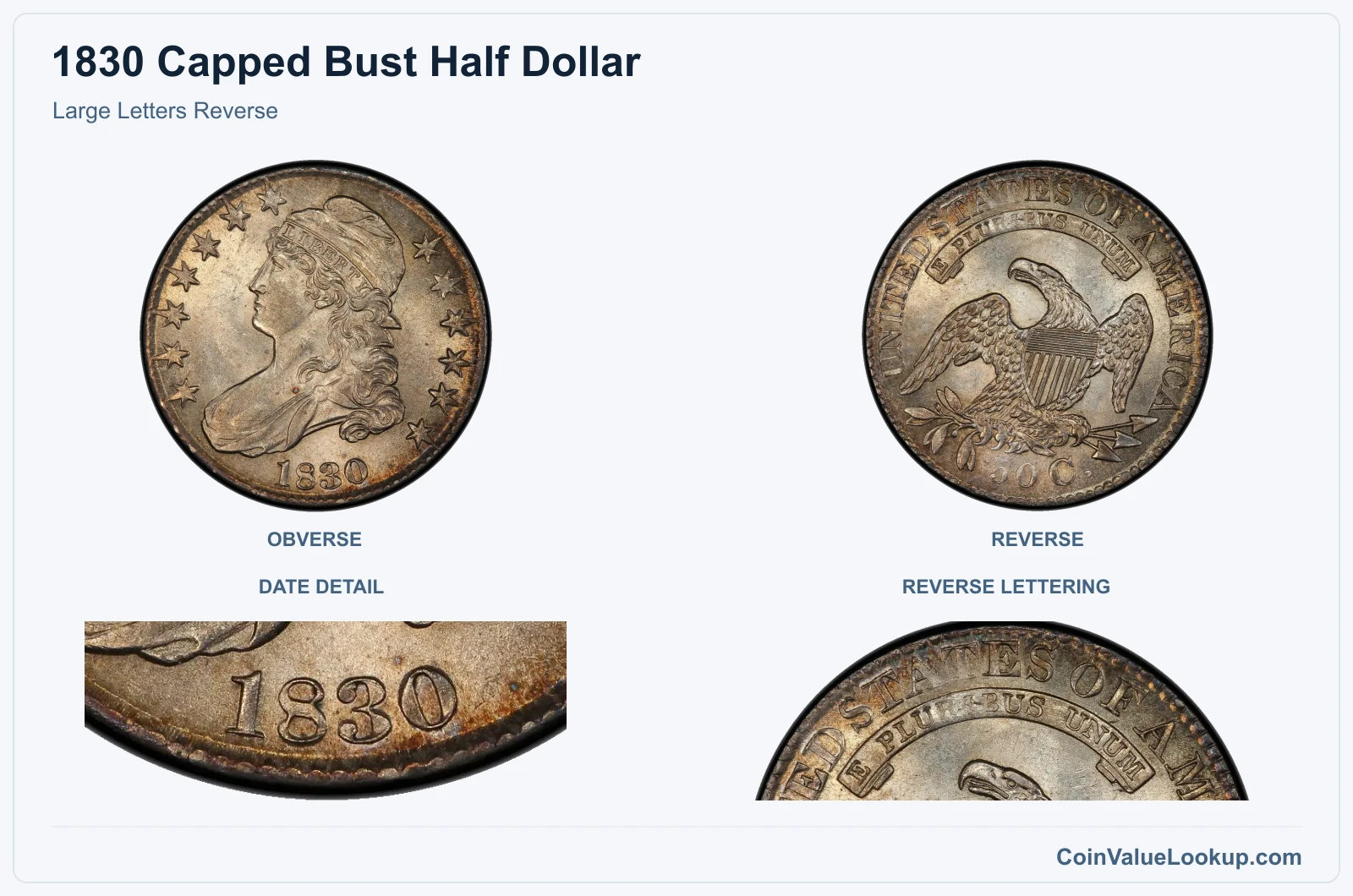
This is where things get interesting for your wallet. The Large Letters Reverse variety has noticeably larger lettering in the reverse legend compared to the standard reverse.
You must examine the entire back of the coin to confirm this; do not assume it based on the date side alone.
The premium is substantial. USA Coin Book guide estimates place this variety at approximately $1,464 in G4, $4,088 in VF20, and $7,350 in AU50.
That is roughly ten to fifteen times the value of a standard Small 0 or Large 0 at the same grade. It is a scarce major variety, and misidentification in either direction is costly.
If you think you have one, compare the reverse letter sizes carefully against confirmed examples before drawing a conclusion.
Range Grade
Price Auction Records Appraisal PO PO 1
—
Coin Identifier FR FR 2
—
Coin Identifier AG AG 3
—
Coin Identifier G G 4
—
Coin Identifier
G 6
—
Coin Identifier VG VG 8
—
Coin Identifier
VG 10
—
Coin Identifier F F 12
—
Coin Identifier
F 15
—
Coin Identifier VF VF 20
—
Coin Identifier
VF 25
—
Coin Identifier
VF 30
—
Coin Identifier
VF 35
—
Coin Identifier XF XF 40
—
Coin Identifier
XF 45
—
Coin Identifier AU AU 50
—
Coin Identifier
AU 53
—
Coin Identifier
AU 55
—
Coin Identifier
AU 58
—
Coin Identifier MS MS 60
—
—
—
MS 61
—
—
—
MS 62
—
—
—
MS 63
—
—
—
MS 64
—
—
—
MS 65
—
—
—
MS 66
—
—
—
MS 67
—
—
—
MS 68
—
—
—
MS 69
—
—
—
MS 70
—
—
—
1830 Capped Bust Half Dollar — Lettered Edge Proof
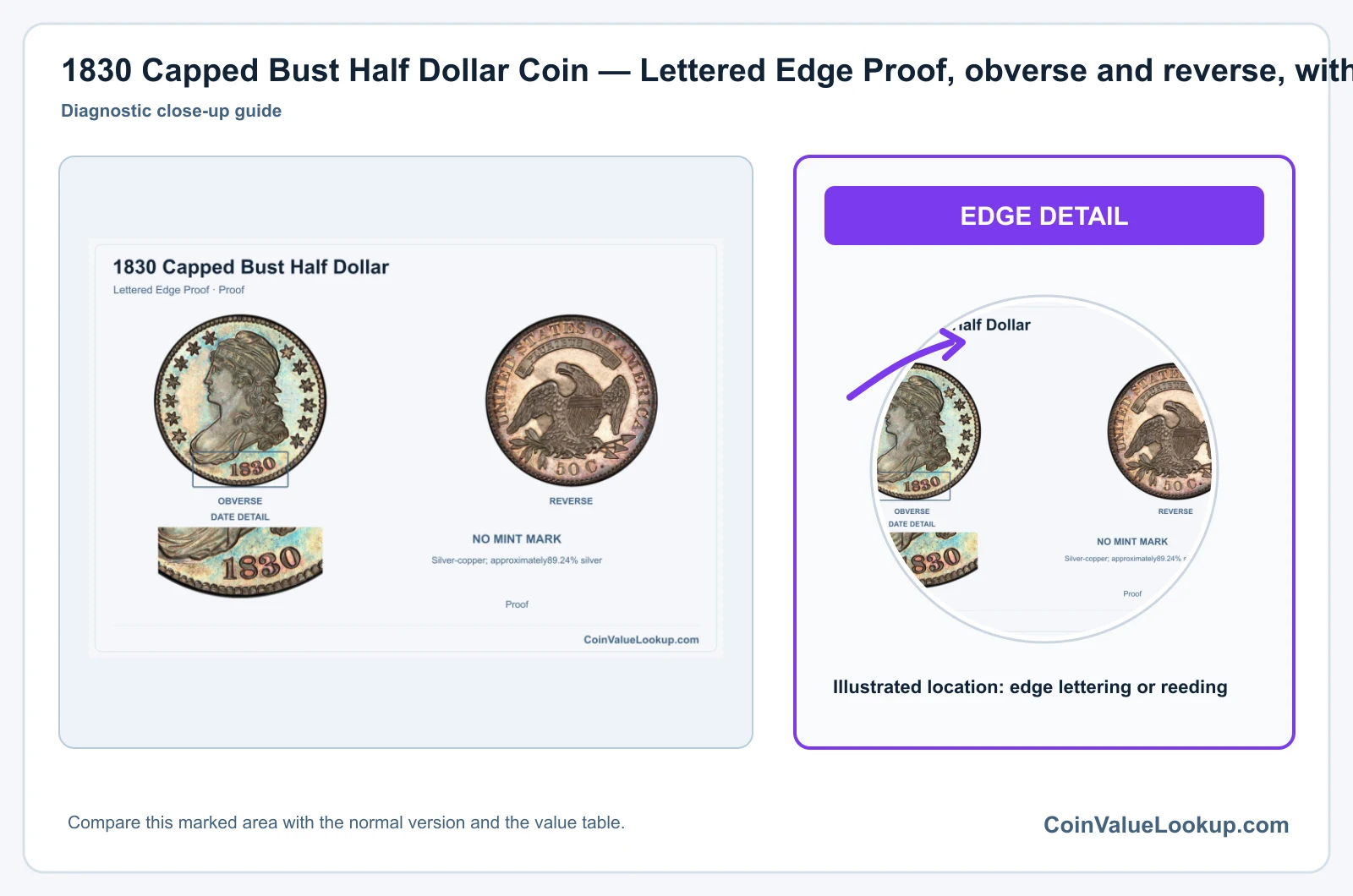
The 1830 Lettered Edge Proof is a rare specialist coin. These were made at Philadelphia with mirrored fields and sharp detail struck from specially prepared dies on a lettered-edge planchet of approximately 89.24% silver.
A bright or reflective regular strike is not a Proof. Polished coins, prooflike surfaces from fresh dies, and cabinet-toned pieces can all mimic the look.
Professional third-party attribution is required to confirm Proof status. Do not assign this branch to any coin based solely on appearance.
For context, a single example graded PR65+ sold for $64,625 at Heritage Auctions in January 2014. That is one historical sale, not a current market range.
The Proof market for early half dollars is thin enough that each coin essentially trades on its own merits, provenance, and eye appeal.
Range Grade
Price Auction Records Appraisal PR PR 1
—
Coin Identifier
PR 2
—
Coin Identifier
PR 3
—
Coin Identifier
PR 4
—
Coin Identifier
PR 6
—
Coin Identifier
PR 8
—
Coin Identifier
PR 10
—
Coin Identifier
PR 12
—
Coin Identifier
PR 15
—
Coin Identifier
PR 20
—
Coin Identifier
PR 25
—
Coin Identifier
PR 30
—
Coin Identifier
PR 35
—
Coin Identifier
PR 40
—
Coin Identifier
PR 45
—
Coin Identifier
PR 50
—
Coin Identifier
PR 53
—
Coin Identifier
PR 55
—
Coin Identifier
PR 58
—
Coin Identifier
PR 60
—
Coin Identifier
PR 61
—
Coin Identifier
PR 62
—
Coin Identifier
PR 63
—
Coin Identifier
PR 64
Coin Identifier
PR 65
Coin Identifier
PR 66
—
—
—
PR 67
—
—
—
PR 68
—
—
—
PR 69
—
—
—
PR 70
—
—
—
1830 Capped Bust Half Dollar Error List
1. 1830 Capped Bust Half Dollar — Double / Multiple Strike
A double or multiple strike error occurs when the coin receives more than one impression from the dies, with the planchet shifting between strikes. On a confirmed 1830 half dollar double strike, you would see a displaced second image of the design overlapping the first, creating a dramatic visual doubling across much of the coin.
One reported example is a PCGS-graded F15 lettered-edge half dollar described as double struck. The displaced design on that piece is the key diagnostic: an entire second impression shifted from the original, not just minor shelf doubling on a few letters.
Do not confuse this with a doubled die, which shows consistent doubling from a defective die on every coin struck from it. Post-mint damage from a vise or impact can also produce similar-looking distortion.
True double strikes involve the minting press itself and affect the entire design. No specific price range is adopted here because value depends heavily on the severity of the displacement, overall condition, and the individual coin's visual impact.