1831 Capped Bust Half Dollar Coin Value: How Much Is It Worth?
An 1831 Capped Bust Half Dollar in well-worn Good-4 condition carries a guide estimate around $100, climbing to roughly $152 at VF20 and about $487 at AU50 according to USA Coin Book. Those figures cover the standard Philadelphia regular strike.
Rare Proof examples and major die varieties sit in a different pricing universe entirely, so identifying your exact version and grade matters.
Fast Way to Identify Your 1831 Capped Bust Half Dollar
The quickest way to start figuring out what you have is to upload clear photos of both the front and the back of your coin. Our identifier can give you a preliminary read on the date, design type, and general condition.
Good lighting and a steady shot make a real difference, so take your time with the pictures.
1831 Capped Bust Half Dollar Value
Upload both sides of your 1831 Capped Bust Half Dollar.
Front Obverse
Upload photo
Back Reverse
Upload photo
Which 1831 Capped Bust Half Dollar Versions Are Worth Money?
- Philadelphia Regular Strike examples range from about $100 at G4 to roughly $487 at AU50 per USA Coin Book guide estimates, with higher grades commanding more.
- Authenticated Lettered Edge Proofs are rare specialist coins; one graded PR65 sold for $79,313 at a Heritage auction in April 2013.
Step 1: Identify Your 1831 Capped Bust Half Dollar Mint Mark and Version
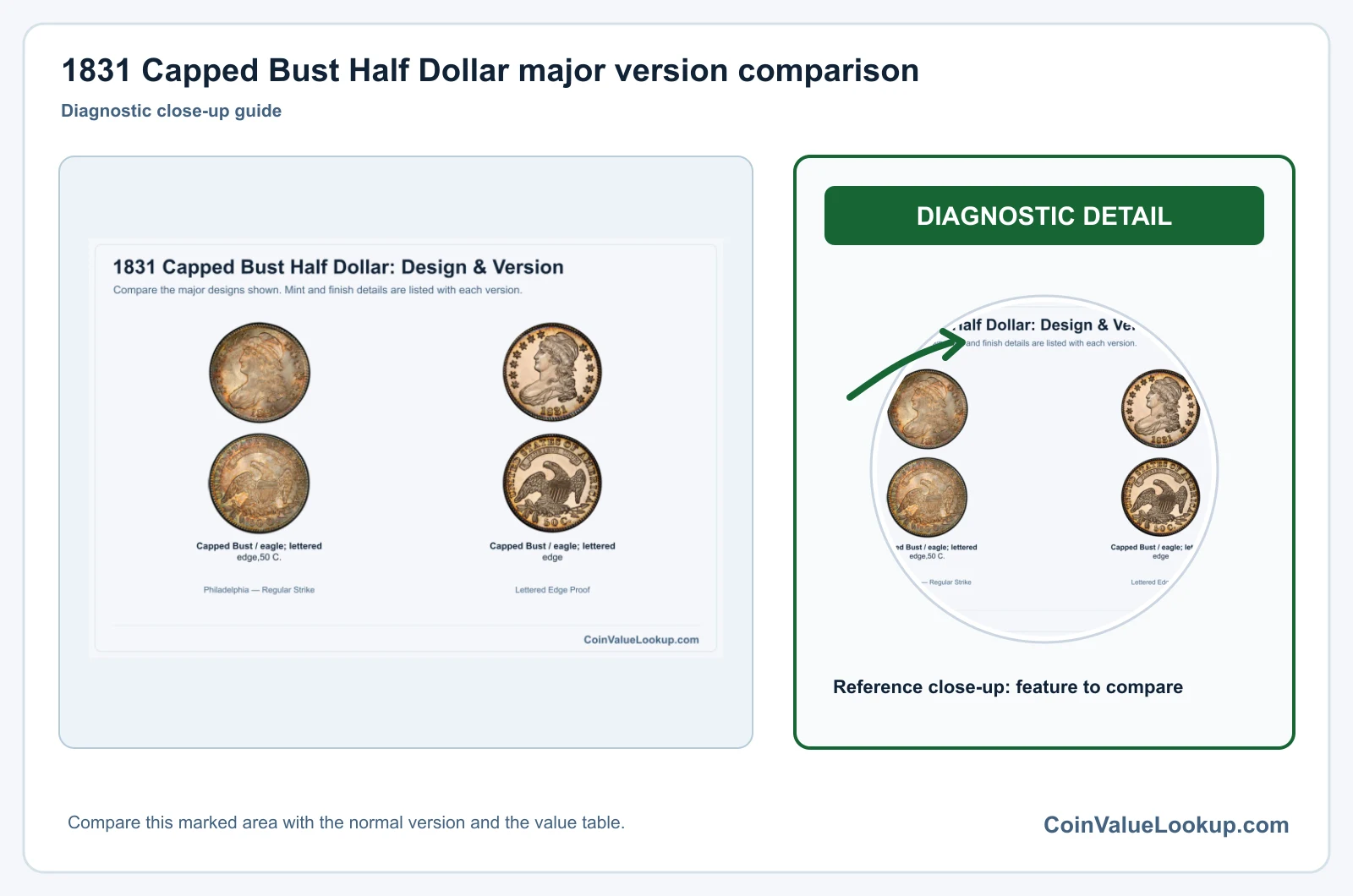
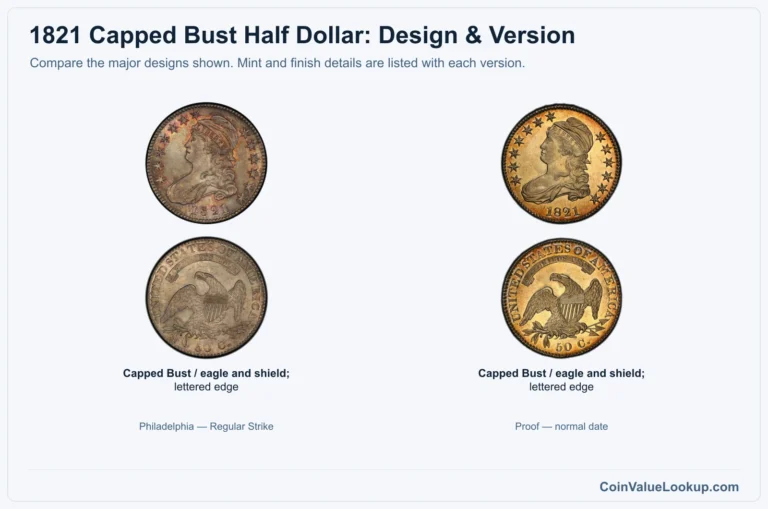
Every 1831 Capped Bust Half Dollar was struck at the Philadelphia Mint, so there is no mintmark to hunt for. The obverse shows Liberty wearing a cap with flowing hair, surrounded by stars and the date 1831.
Flip it over and you will see a heraldic eagle with a shield on its breast, arrows and an olive branch in its talons, and the legend UNITED STATES OF AMERICA.
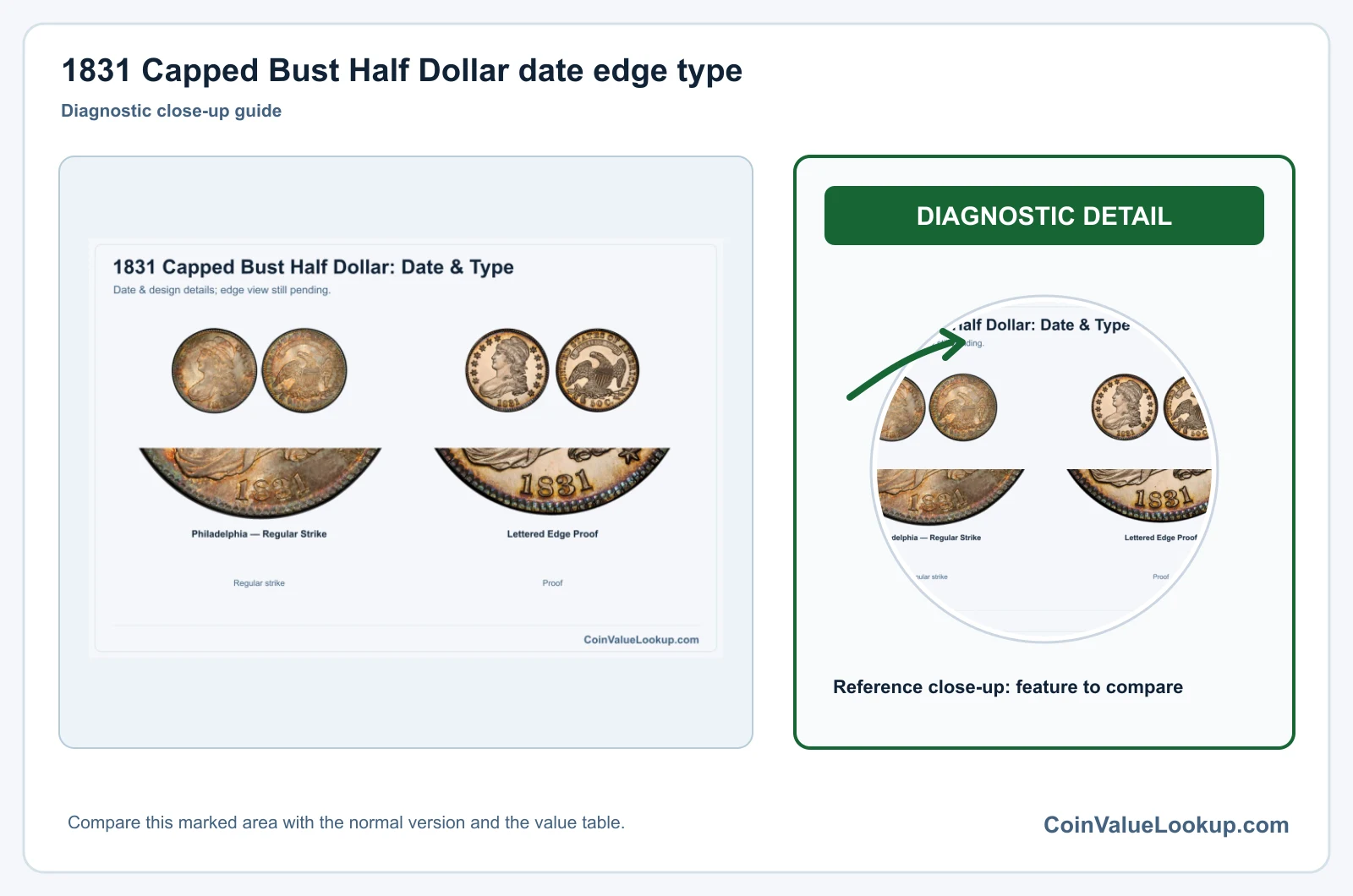
The edge is where this series gets distinctive. Run your finger along it and you should feel raised letters reading FIFTY CENTS OR HALF A DOLLAR.
The coin measures about 32.5 mm in diameter, weighs roughly 13.48 grams, and is struck in silver-copper alloy at approximately 89.24 percent silver.
For value purposes, your main task is confirming whether you have a regular circulation strike or a genuine Proof. Proof attribution requires professional confirmation.
A shiny or well-preserved coin is not automatically a Proof; polished and prooflike regular strikes exist and are a completely different thing.
Coin Value Lookup is a good starting point if you want to look up guides for other dates and denominations in this series. You can search by year and type to compare your coin against known value ranges.
Step 2: Check Your 1831 Capped Bust Half Dollar Grade
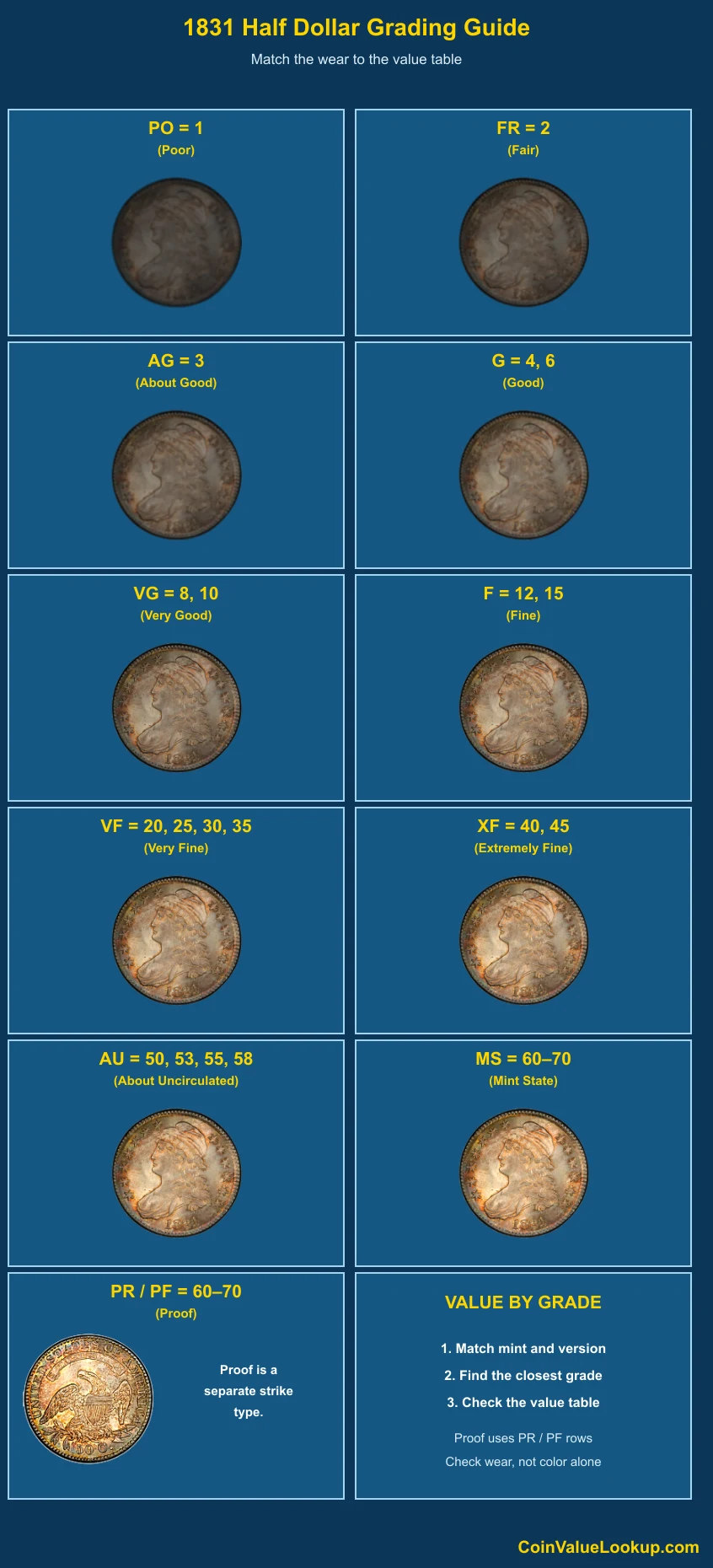
Start by examining the highest points of the design, because that is where wear shows up first. On the obverse, check Liberty's forehead curls, her cheek, and the top of the cap.
On the reverse, look at the eagle's breast feathers and the tops of the wings.
A coin in Good-4 will have a smooth, flat portrait with the outline still clear but most hair detail gone. Move up to VF20 and you will see moderate wear on the high points, but the major hair strands and cap folds remain visible.
At AU50 only the very tips of the highest features show friction, and most original luster survives in the protected areas.
Always grade both sides independently and go with the lower of the two. Note any cleaning, scratches, or holes, because those problems will push the effective grade and value well below what the wear alone suggests.
Use the comparison image to match your coin's wear pattern step by step.
Proof coins are graded on a separate PR scale. They are defined by the manufacturing process, not by being nicer than Mint State.
Bright surfaces alone do not make a Proof.
Step 3: Check 1831 Capped Bust Half Dollar Value by Mint and Version
1831 Capped Bust Half Dollar — Philadelphia — Regular Strike
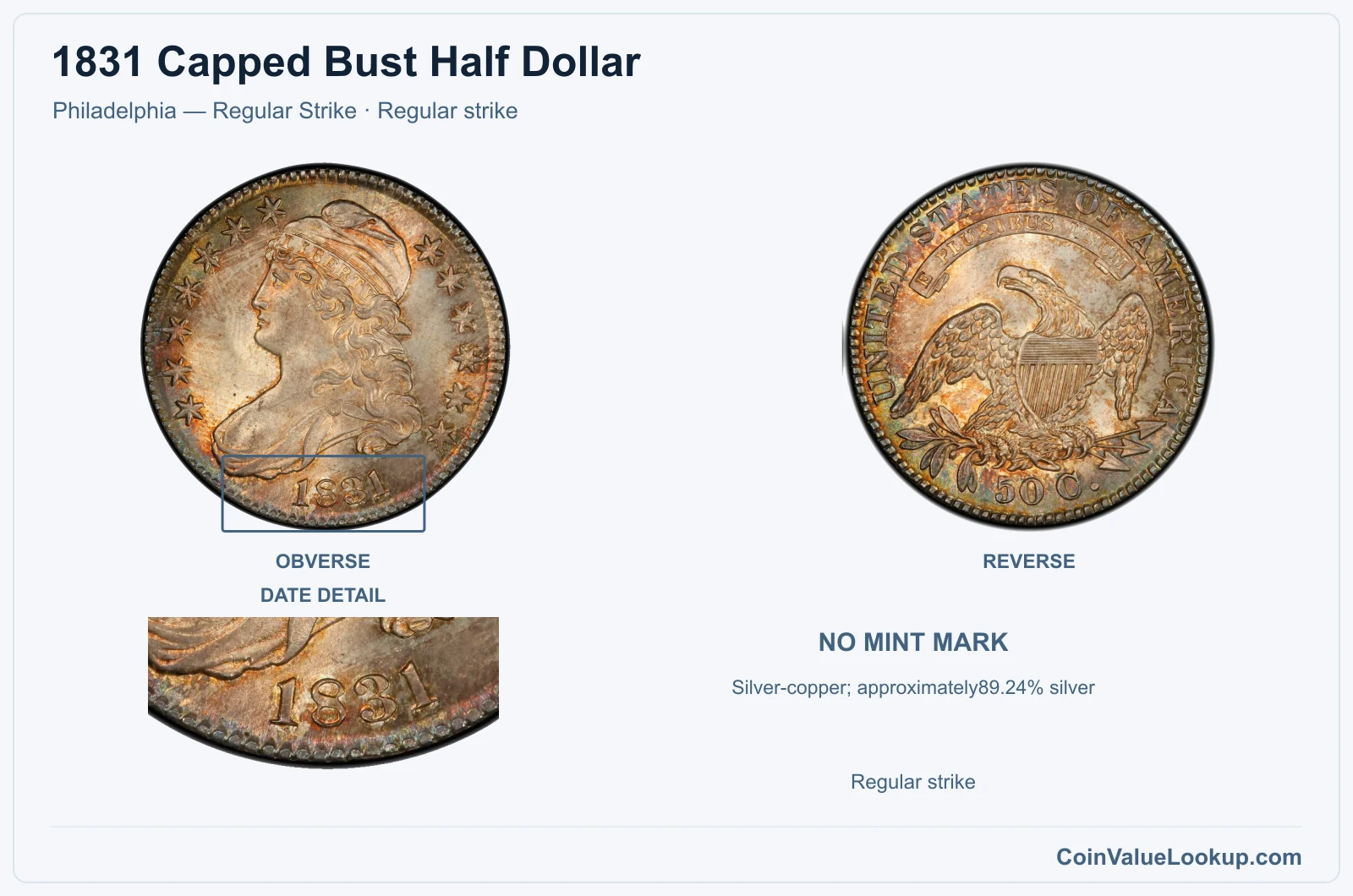
The Philadelphia regular strike is the version most collectors will encounter. Struck for circulation with a lettered edge reading FIFTY CENTS OR HALF A DOLLAR, it features the standard Capped Bust obverse and eagle reverse in silver-copper alloy at about 89.24 percent silver.
USA Coin Book guide estimates place this version at roughly $100 in G4, about $152 in VF20, and around $487 in AU50. These are retail guide figures, not guaranteed sale prices.
Your actual result depends on the specific grade, eye appeal, and whether the coin has been cleaned or damaged. Specialist die-variety attribution can shift the value further, but the baseline year curve applies before any of that enters the picture.
Range Grade
Price Auction Records Appraisal PO PO 1
—
Coin Identifier FR FR 2
—
Coin Identifier AG AG 3
—
Coin Identifier G G 4
—
Coin Identifier
G 6
—
Coin Identifier VG VG 8
Coin Identifier
VG 10
Coin Identifier F F 12
Coin Identifier
F 15
Coin Identifier VF VF 20
Coin Identifier
VF 25
Coin Identifier
VF 30
Coin Identifier
VF 35
Coin Identifier XF XF 40
Coin Identifier
XF 45
Coin Identifier AU AU 50
Coin Identifier
AU 53
Coin Identifier
AU 55
Coin Identifier
AU 58
Coin Identifier MS MS 60
Coin Identifier
MS 61
Coin Identifier
MS 62
Coin Identifier
MS 63
Coin Identifier
MS 64
Coin Identifier
MS 65
Coin Identifier
MS 66
Coin Identifier
MS 67
Coin Identifier
MS 68
—
—
—
MS 69
—
—
—
MS 70
—
—
—
1831 Capped Bust Half Dollar — Lettered Edge Proof
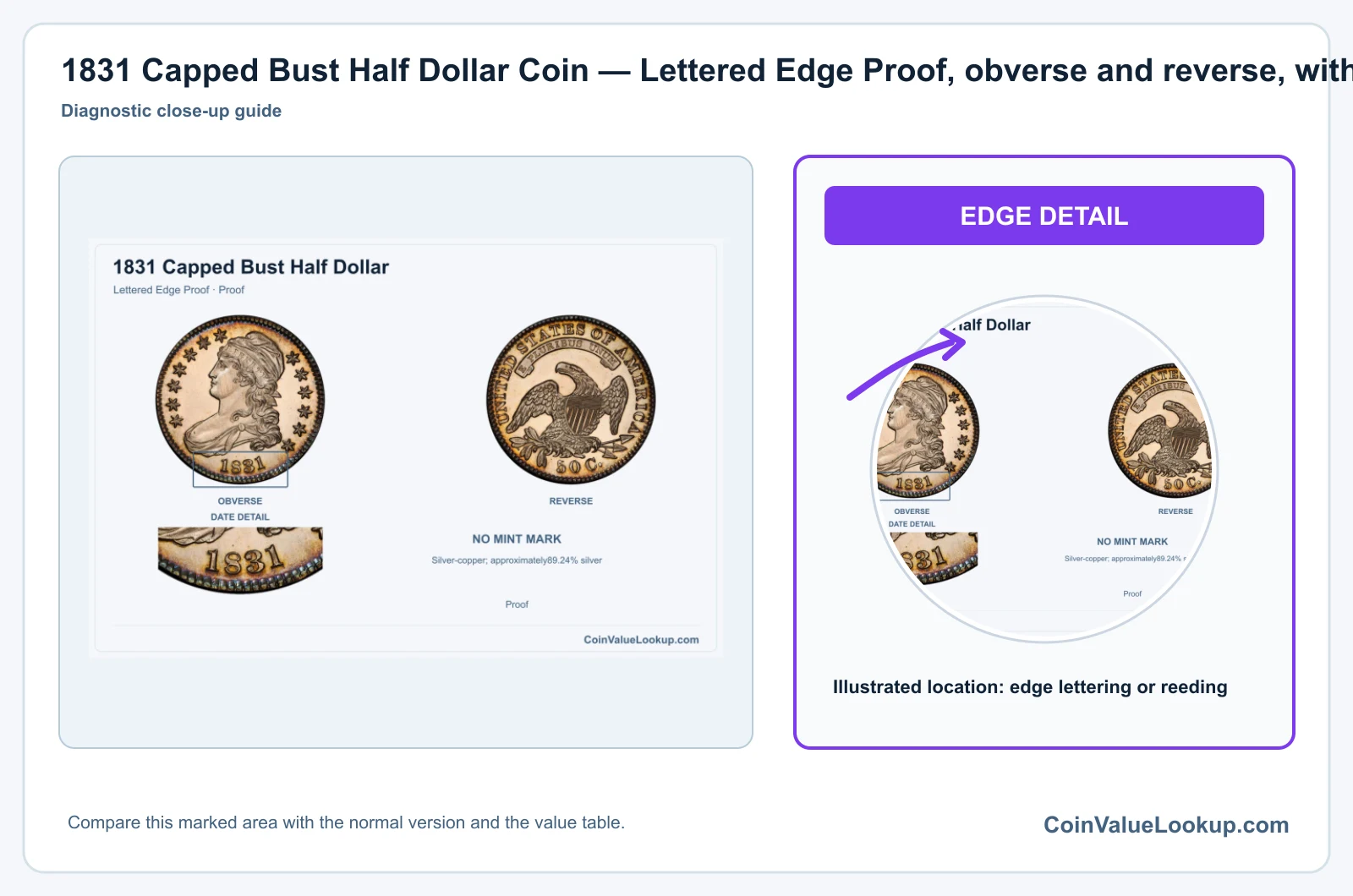
The 1831 Lettered Edge Proof is a rare bird. These were struck at the Philadelphia Mint using specially prepared dies and planchets, producing mirror-like fields and sharp detail that a regular strike simply does not match.
The edge lettering is the same as on circulation coins.
A single historical auction record gives some sense of the territory: a PR65 example sold through Heritage in April 2013 for $79,313. That is one sale, not a current market curve, and different grades or auction conditions will produce very different numbers.
Do not assume your coin is a Proof just because it is shiny or has strong detail. Polished regular strikes and prooflike coins can fool even experienced eyes.
Professional attribution from a major grading service is the only reliable way to confirm Proof status. When submitting, provide clear images of both faces, the edge, and any reflective surface characteristics or sharp rim details that might support the claim.
Range Grade
Price Auction Records Appraisal PR PR 1
—
Coin Identifier
PR 2
—
Coin Identifier
PR 3
—
Coin Identifier
PR 4
—
Coin Identifier
PR 6
—
Coin Identifier
PR 8
—
Coin Identifier
PR 10
—
Coin Identifier
PR 12
—
Coin Identifier
PR 15
—
Coin Identifier
PR 20
—
Coin Identifier
PR 25
—
Coin Identifier
PR 30
—
Coin Identifier
PR 35
—
Coin Identifier
PR 40
—
Coin Identifier
PR 45
—
Coin Identifier
PR 50
—
Coin Identifier
PR 53
—
Coin Identifier
PR 55
—
Coin Identifier
PR 58
—
Coin Identifier
PR 60
—
Coin Identifier
PR 61
—
Coin Identifier
PR 62
—
Coin Identifier
PR 63
—
Coin Identifier
PR 64
Coin Identifier
PR 65
Coin Identifier
PR 66
—
—
—
PR 67
—
—
—
PR 68
—
—
—
PR 69
—
—
—
PR 70
—
—
—
1831 Capped Bust Half Dollar Error List
1. 1831 Capped Bust Half Dollar — Incomplete Planchet Punch
An incomplete planchet punch occurs when the blanking press does not fully cut the coin's planchet from the strip of metal. On one reported 1831 Half Dollar, an O-116 die pair graded XF45 by NGC, the result is a retained partial arc visible from roughly the 10 o'clock to the 1 o'clock position along the rim.
The edge in that zone shows the incomplete cut rather than the normal finished profile.
When examining your coin, look for a curved irregularity along the rim that follows the shape of the blanking die. A straight scratch, a gouge from a tool, or a groove caused by corrosion will not follow that smooth arc.
The value of such an error depends on the visibility of the defect and the overall condition of the coin, so each piece needs individual assessment.
2. 1831 Capped Bust Half Dollar — Brockage
A brockage happens when a previously struck coin stays on one of the dies and impresses its image into the next blank. The reported 1831 Half Dollar brockage shows a normal dated obverse on one side, paired with an incuse, mirror-image version of the obverse on the other side, rotated 180 degrees.
You will see reversed lettering and a sunken negative-relief portrait where the eagle should be.
This is a dramatic error and easy to spot once you know what to look for. Do not confuse it with a die clash, which leaves faint ghost outlines but still shows the correct reverse design.
Post-mint damage from pressing two coins together also looks different because the transferred detail will lack the full impression depth. Value depends on the clarity of the brockage and the coin's condition.
3. 1831 Capped Bust Half Dollar — Off-Center Strike
An off-center strike happens when the planchet is not properly seated between the dies. On the reported 1831 specimen, the same brockage coin also exhibits displacement toward the 3 to 4 o'clock area, with the lower-right dentils completely absent.
The design is visibly shifted, leaving a blank crescent along part of the rim.
To identify an off-center strike, check whether the entire design is shifted in one direction with a corresponding area of blank planchet. Do not confuse this with a clipped planchet, which has a curved bite out of the edge, or with post-mint flattening that squishes the coin unevenly.
One-sided die misalignment can also mimic a mild off-center appearance. Each error coin's value depends on the degree of displacement and the overall condition.
4. 1831 Capped Bust Half Dollar — Missing Edge Lettering
The 1831 Half Dollar normally carries incuse lettering on its edge reading FIFTY CENTS OR HALF A DOLLAR. The reported missing-edge-lettering variety is an 1831 O-118 graded PCGS MS63, which has a plain edge with the expected inscription absent.
This is a minting anomaly, not simple wear.
To evaluate your coin, you need a clear, continuous photo of the entire edge. Compare it under the same lighting to an attributed same-year coin that shows normal lettering.
Ordinary circulation wear can flatten edge letters over time, and filing or other post-mint damage can also remove them. None of those situations represent this error.
Value will depend on condition and the certainty of the attribution.
5. 1831 Capped Bust Half Dollar — Die Crack / Die Chip
Die cracks appear as thin raised lines on the coin's surface, formed when a working die develops a fracture that fills with metal during striking. On one specialist-documented 1831 Half Dollar, cracks run through the base of the digits 3 and 1 in the date, extending downward toward below the 8, and also appear between stars 9 and 10 on the obverse.
Because the lines are raised, you can feel them with a fingernail or see them catch light differently from the surrounding field. That is the key distinction from incuse scratches, which sit below the surface.
Corrosion lines and foreign material stuck to the coin can also mimic cracks visually but will not share the same crisp, raised profile. Value depends on the prominence of the crack and the coin's overall grade.