1837 Capped Bust Half Dollar Coin Value: How Much Is It Worth?
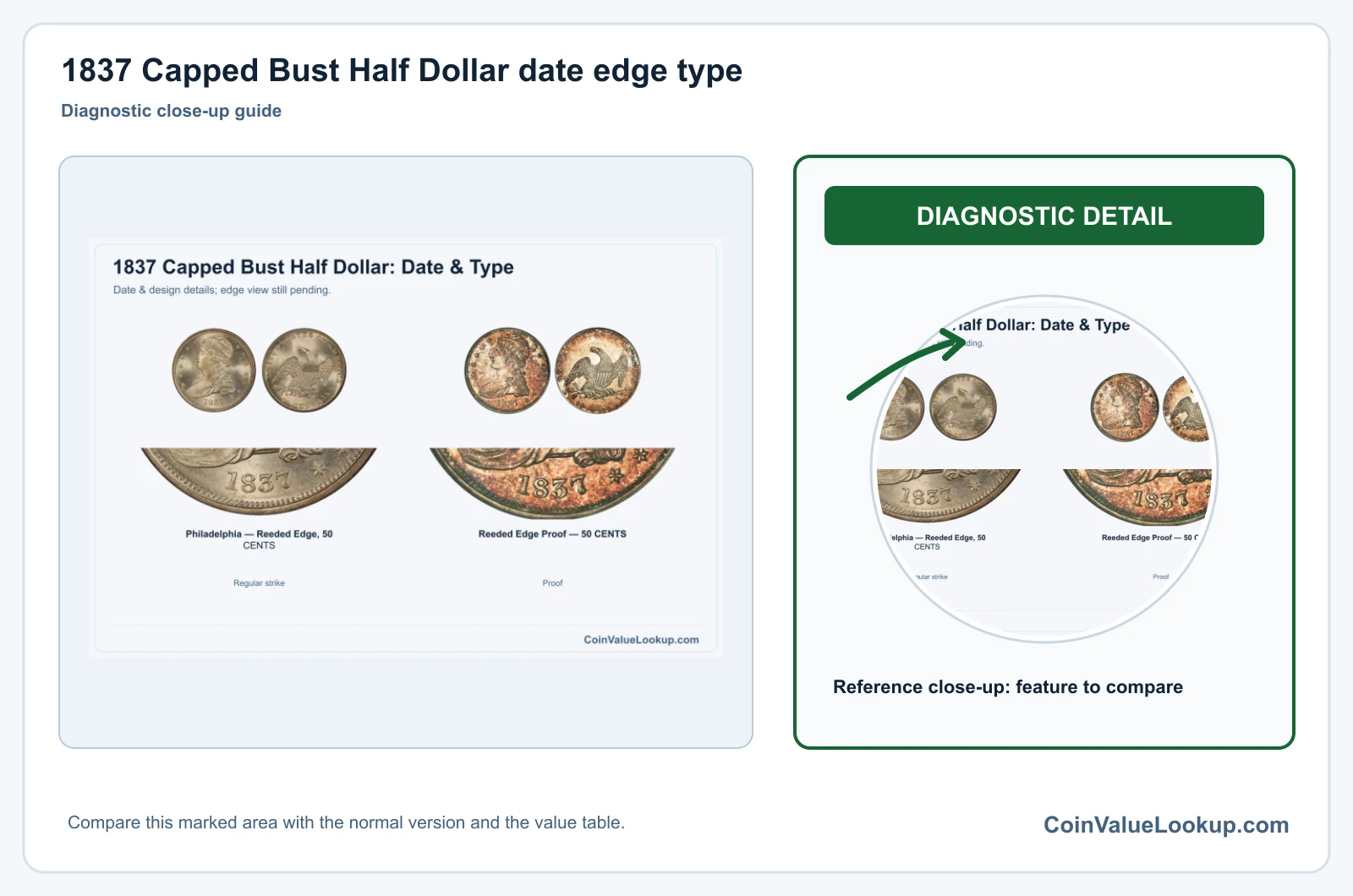
An 1837 Capped Bust Half Dollar in typical circulated condition carries guide estimates from around $100 at G4 up to roughly $575 at AU50 for the regular Philadelphia reeded-edge issue. Rare Proof examples and notable die varieties occupy their own price territory entirely.
Grade and exact version matter here, so read on before assuming what yours is worth.
Fast Way to Identify Your 1837 Capped Bust Half Dollar
The quickest way to start figuring out what you have is to snap clear photos of both the front and back of your coin, plus the edge. Upload those images to our identifier for a preliminary read on your coin's version, date and general condition.
It is not a substitute for professional grading or authentication, but it gives you a solid starting point.
1837 Capped Bust Half Dollar Value
Upload both sides of your 1837 Capped Bust Half Dollar.
Front Obverse
Upload photo
Back Reverse
Upload photo
Which 1837 Capped Bust Half Dollar Versions Are Worth Money?
- Philadelphia Reeded Edge, 50 CENTS — the standard 1837 issue; guide estimates range from about $100 at G4 to $575 at AU50, with higher grades worth substantially more.
- Reeded Edge Proof — extremely rare; a single PR62 example sold at Heritage in July 2008 for $32,200, illustrating the premium authenticated Proofs command.
Step 1: Identify Your 1837 Capped Bust Half Dollar Mint Mark and Version
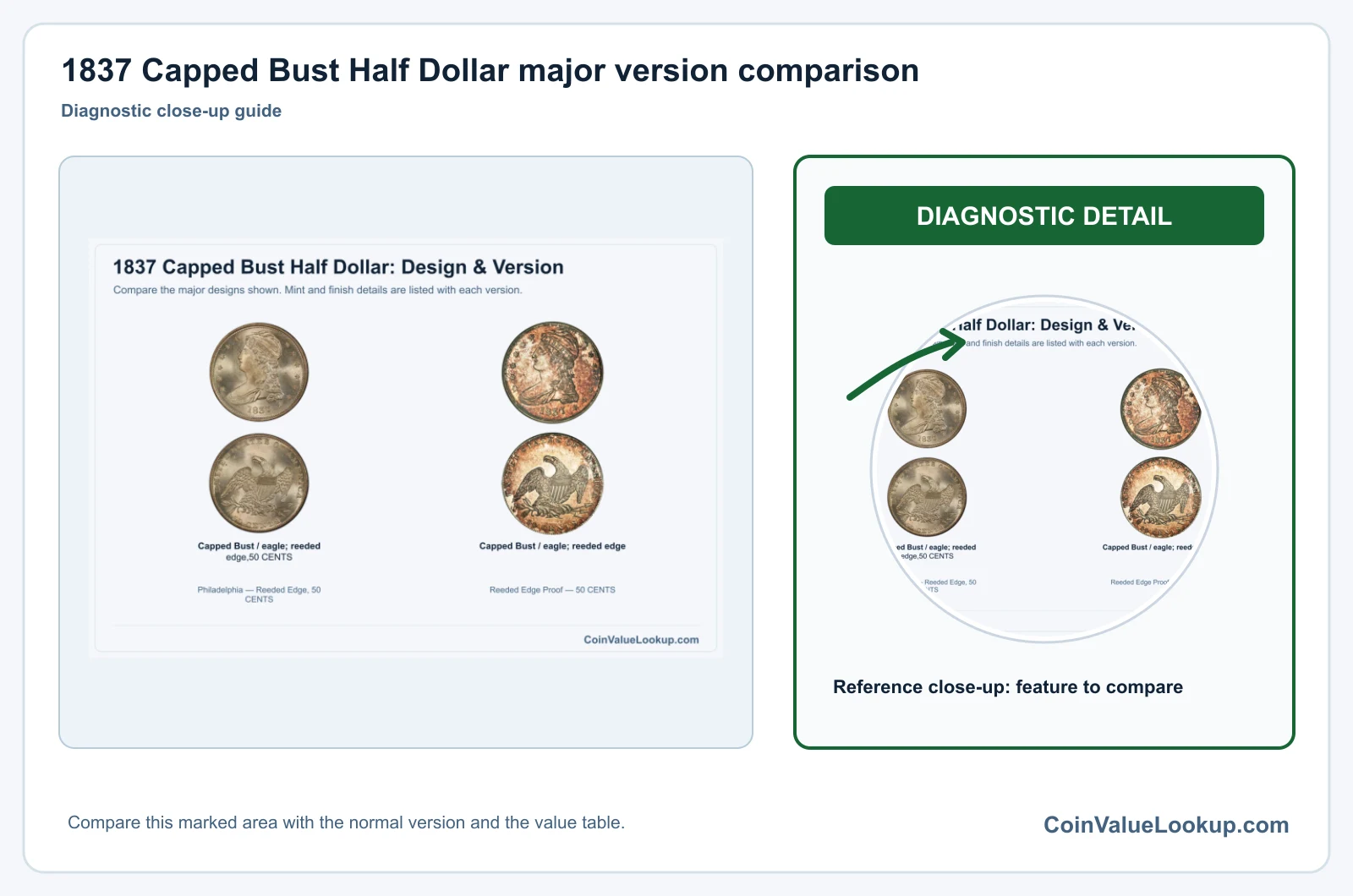
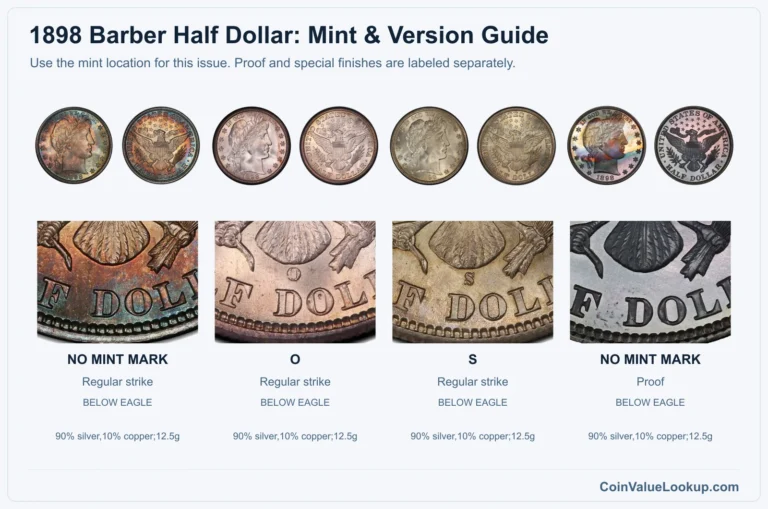
Every 1837 Capped Bust Half Dollar was struck at the Philadelphia Mint, so there is no mintmark to look for. The obverse shows Liberty wearing a cap with flowing hair; the reverse features a heraldic eagle with a shield.
The key physical detail is the edge. The 1837 issue has a reeded edge, not a lettered one, and the reverse reads 50 CENTS.
Diameter is 30 mm, weight 13.36 grams, and the composition is 90% silver with 10% copper.
Check the edge first. If it has lettering instead of reeding, you may have an earlier type or a different date entirely.
Match what you see to the reeded-edge, 50 CENTS branch before looking up values.
Proof status requires professional attribution. A shiny or prooflike surface on a regular strike does not make it a Proof.
Polished coins are common and easily confused with genuine Proof finishes by newer collectors.
Step 2: Check Your 1837 Capped Bust Half Dollar Grade
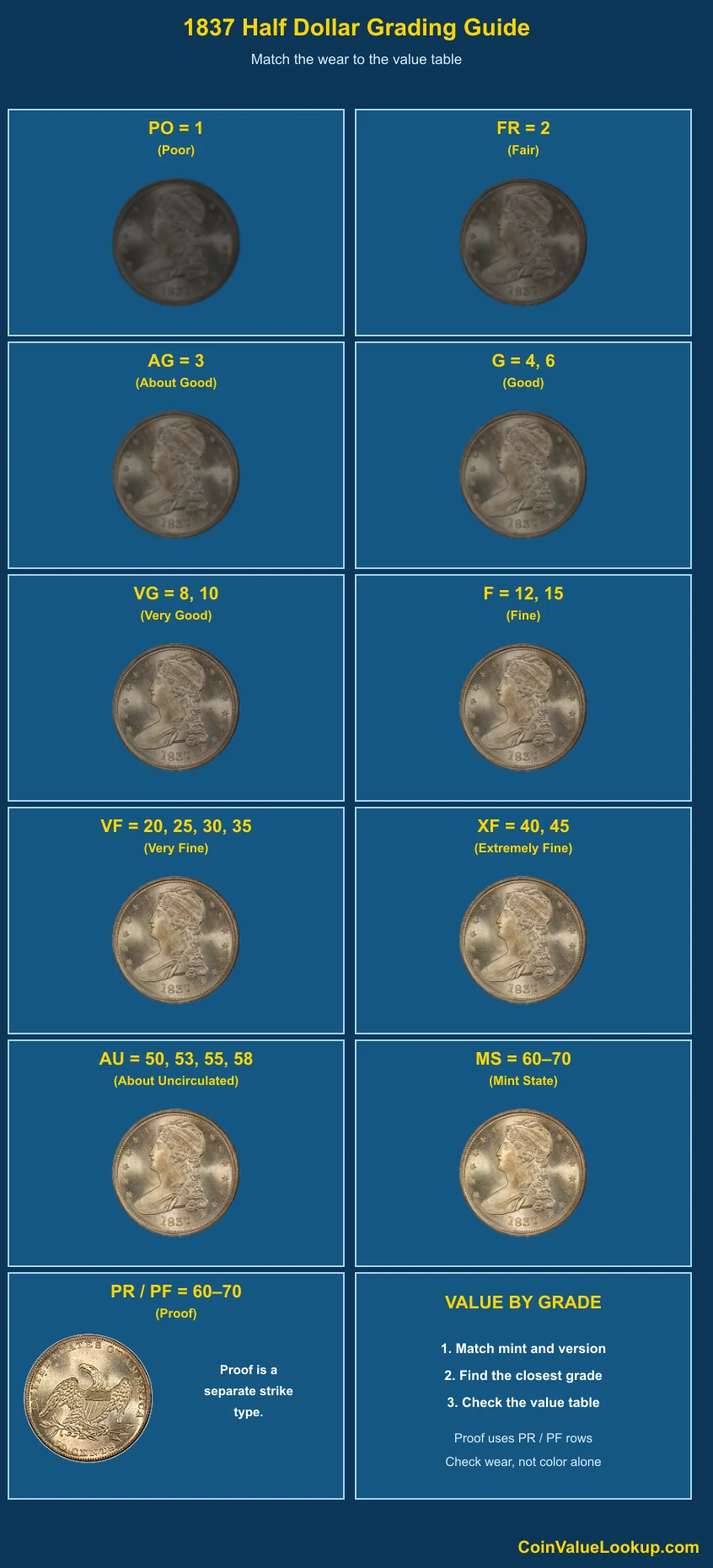
Start by examining the highest points of the design, which wear first. On the obverse, check Liberty's forehead curls, the hair above the ear, the cap and the shoulder clasp area.
On the reverse, look at the eagle's breast feathers and the tops of the wings.
Weak original detail from the strike is not the same as wear from circulation. A coin with full luster but soft hair curls may have been weakly struck, not lightly circulated.
Compare both sides against the grading image to see how much metal has actually been lost from handling.
Always note problems like cleaning, scratches, rim damage or holes. These reduce a coin's grade and value significantly regardless of how little wear the high points show.
A cleaned AU can trade below an original VF.
Proof coins are graded on a separate PR scale. That scale measures surface quality, not wear in the circulation sense.
Do not mix Proof and Mint State grading when evaluating your coin.
Step 3: Check 1837 Capped Bust Half Dollar Value by Mint and Version
1837 Capped Bust Half Dollar — Philadelphia — Reeded Edge, 50 CENTS
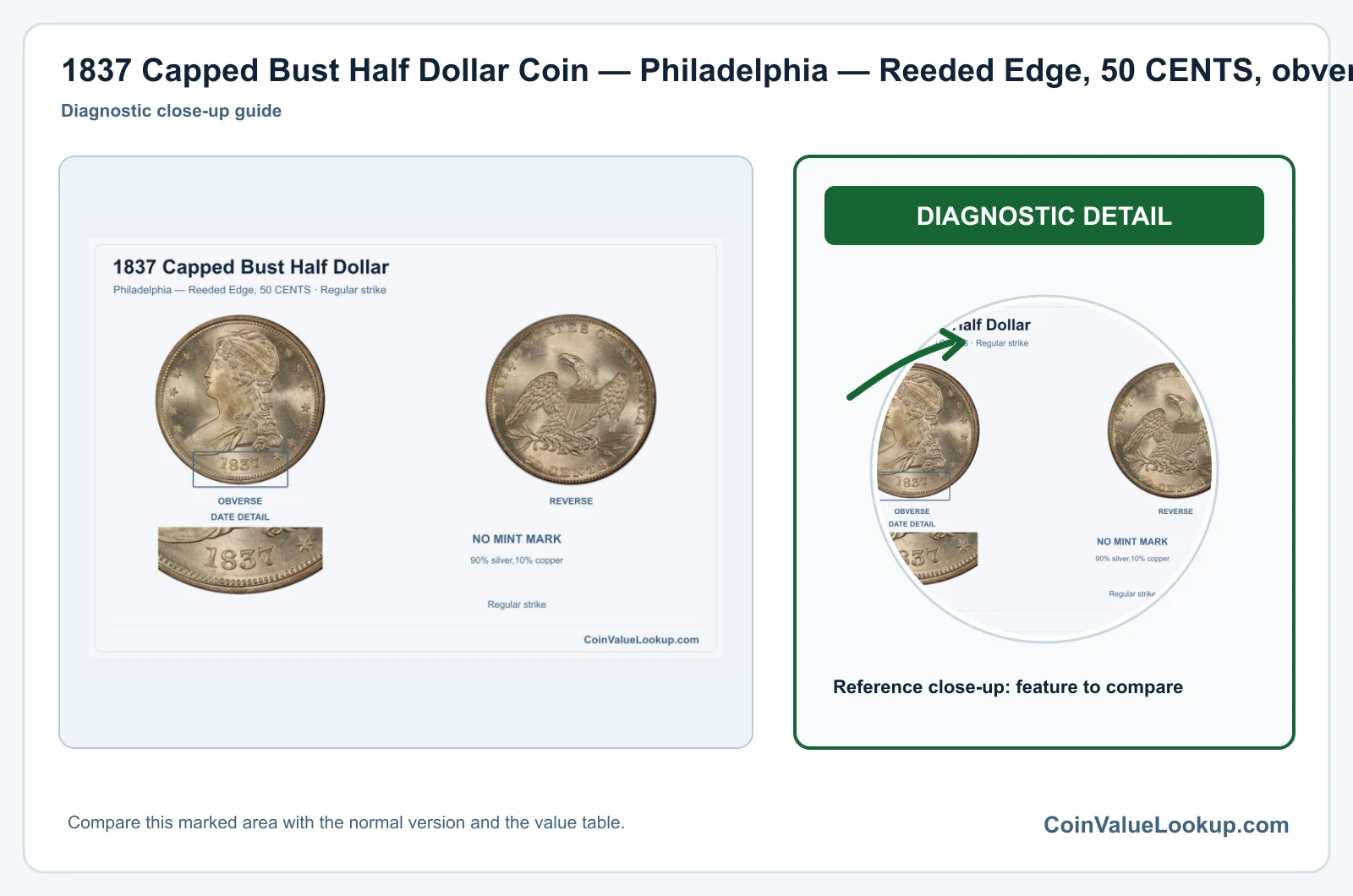
This is the regular circulation strike from Philadelphia. It has a reeded edge and the reverse denomination reads 50 CENTS.
Confirm both details before pricing.
Guide estimates from USA Coin Book place this version at roughly $100 in G4, $167 in VF20 and $575 in AU50. These are retail guide figures, not guaranteed sale prices.
Your coin's actual value depends on its precise grade, eye appeal and whether it has been cleaned or damaged.
Coin Value Lookup is a useful place to browse guides for this and other half dollar dates when you want to compare values across the Capped Bust series.
Ordinary-issue reference: Ordinary-issue reference only: The table below shows prices for the 1837 Capped Bust Half Dollar (regular strike). It does not represent the value of the specific Philadelphia — Reeded Edge, 50 CENTS variety or its variety premium. Year, mint, metal and strike type are matched; the specific variety is not priced by this table.
Range Grade
Price Auction Records Appraisal PO PO 1
—
Coin Identifier FR FR 2
Coin Identifier AG AG 3
Coin Identifier G G 4
—
Coin Identifier
G 6
—
Coin Identifier VG VG 8
Coin Identifier
VG 10
Coin Identifier F F 12
Coin Identifier
F 15
—
Coin Identifier VF VF 20
Coin Identifier
VF 25
Coin Identifier
VF 30
Coin Identifier
VF 35
Coin Identifier XF XF 40
Coin Identifier
XF 45
Coin Identifier AU AU 50
Coin Identifier
AU 53
Coin Identifier
AU 55
Coin Identifier
AU 58
Coin Identifier MS MS 60
Coin Identifier
MS 61
Coin Identifier
MS 62
Coin Identifier
MS 63
Coin Identifier
MS 64
Coin Identifier
MS 65
Coin Identifier
MS 66
Coin Identifier
MS 67
Coin Identifier
MS 68
—
—
—
MS 69
—
—
—
MS 70
—
—
—
1837 Capped Bust Half Dollar — Reeded Edge Proof — 50 CENTS
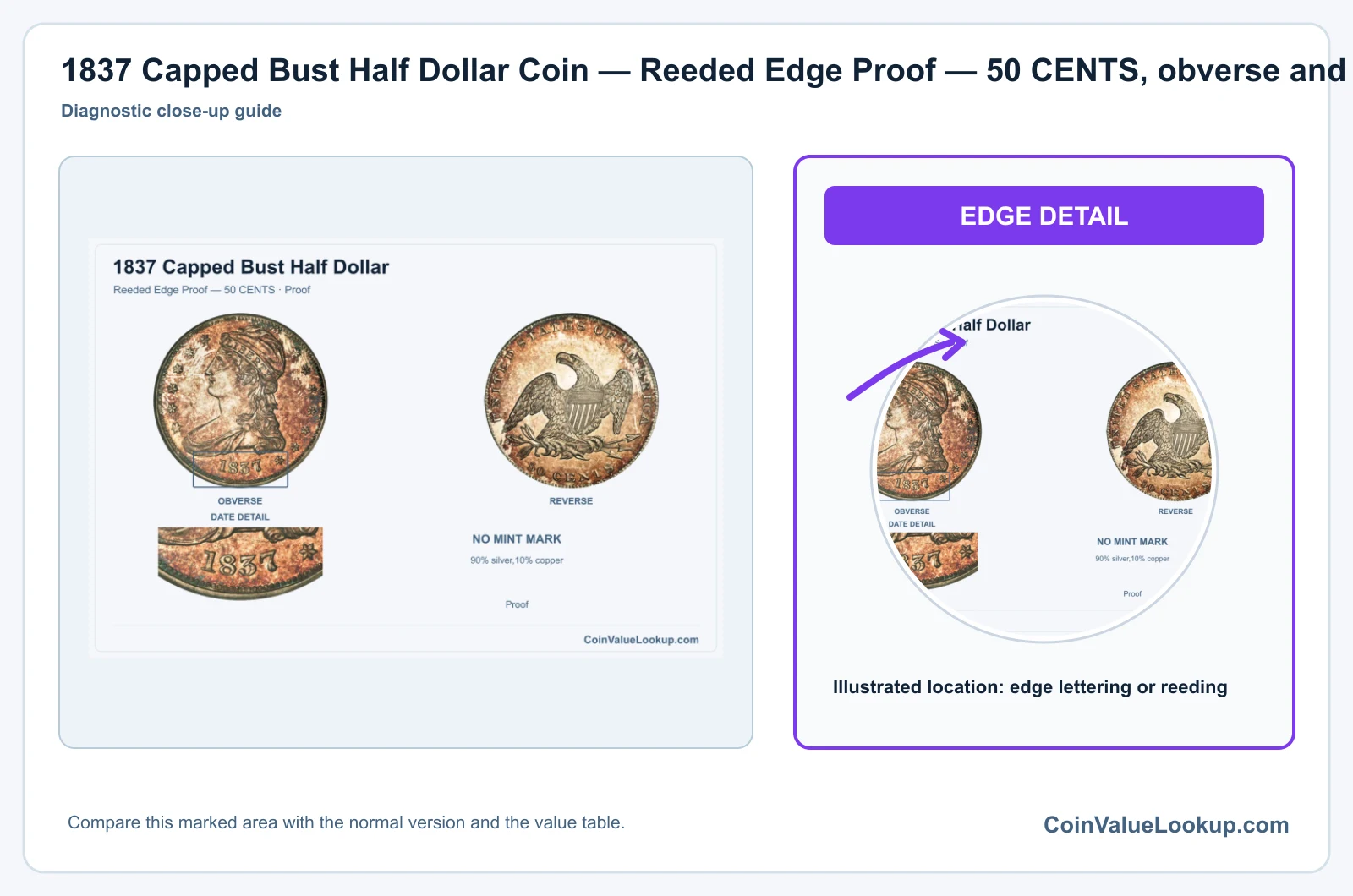
The 1837 Reeded Edge Proof is a rare specialist coin struck with specially prepared dies at Philadelphia. Surviving examples are scarce enough that most collectors will never handle one.
A single recorded sale provides a reference point: a PR62 example sold through Heritage Auctions in July 2008 for $32,200. That is one historical transaction, not a current market range, so it should be treated as a data point rather than a price tag.
Do not assign this branch to a coin just because it looks shiny. Polished regular strikes, prooflike surfaces and genuine Proof finishes can look similar to the untrained eye.
Professional attribution from a recognized grading service is essential before claiming Proof status.
Range Grade
Price Auction Records Appraisal PR PR 1
—
Coin Identifier
PR 2
—
Coin Identifier
PR 3
—
Coin Identifier
PR 4
—
Coin Identifier
PR 6
—
Coin Identifier
PR 8
—
Coin Identifier
PR 10
—
Coin Identifier
PR 12
—
Coin Identifier
PR 15
—
Coin Identifier
PR 20
—
Coin Identifier
PR 25
—
Coin Identifier
PR 30
—
Coin Identifier
PR 35
—
Coin Identifier
PR 40
—
Coin Identifier
PR 45
—
Coin Identifier
PR 50
—
Coin Identifier
PR 53
—
Coin Identifier
PR 55
—
Coin Identifier
PR 58
—
Coin Identifier
PR 60
—
Coin Identifier
PR 61
—
Coin Identifier
PR 62
Coin Identifier
PR 63
—
Coin Identifier
PR 64
—
—
—
PR 65
—
—
—
PR 66
—
—
—
PR 67
—
—
—
PR 68
—
—
—
PR 69
—
—
—
PR 70
—
—
—
1837 Capped Bust Half Dollar Error List
1. 1837 Capped Bust Half Dollar — Double / Multiple Strike
A double or multiple strike on an 1837 reeded-edge half dollar means the coin was struck more than once while shifting between impressions. One documented example is actually a triple strike, showing a large-offset duplicated obverse profile with clearly separated, repeated portrait contours.
Look for a ghostly second or third outline of Liberty's head that is visibly displaced from the primary image. The duplication affects the entire design, not just isolated letters or digits.
Do not confuse this with a doubled die, which is a different category caused by a misaligned hub impression on the die itself. Post-mint damage from a vise or similar pressure can also mimic a second strike.
Condition, degree of offset and visual drama all affect value, but no specific price range is established for this category.
2. 1837 Capped Bust Half Dollar — Die Crack / Die Chip
Die cracks on 1837 half dollars appear as thin raised lines running across the coin's surface. One documented example shows heavy reverse cracks forking from the D in UNITED toward the eagle's wing and continuing through STATES along the border.
These cracks formed as the steel die fractured under repeated use. They transferred as raised ridges onto every coin struck afterward.
The more prominent and extensive the crack, the more collector interest it tends to attract.
Do not mistake incuse scratches, surface corrosion or foreign material stuck to the coin for a genuine die crack. Real cracks are raised above the field, follow a consistent path and appear on multiple surviving specimens from the same die.
Value depends on the crack's size, location and the coin's overall condition; no set price range applies.
3. 1837 Capped Bust Half Dollar — Clashed Dies
Clashed dies occur when the obverse and reverse dies strike each other without a planchet between them. The impact transfers a faint mirror image of each die's design onto the opposing die, which then appears as ghost outlines on subsequent coins.
On an 1837 half dollar, light reverse clash marks have been noted. You may see faint traces of the obverse portrait outline in the reverse field near the eagle.
These transferred impressions are incuse on one side and can be subtle.
Compare what you see against the coin's normal design to isolate the foreign elements. Scratches, random raised lines or a brockage impression are not the same thing.
A brockage involves a previously struck coin acting as a die, producing a much more dramatic and different-looking result. Value varies with visibility and overall coin condition.
4. 1837 Capped Bust Half Dollar — Rotated Dies
A rotated die error means the obverse and reverse are not aligned in the normal orientation. On a correctly struck coin, flipping it top to bottom should show the reverse right-side up.
An 1837 half dollar has been documented with approximately 45 degrees of counterclockwise reverse rotation.
To test yours, hold the coin with the obverse upright and flip it along the vertical axis. If the reverse is tilted rather than upright, you may have a rotation error.
The greater the rotation, the more unusual the coin.
Be careful with photographs. A coin that was simply placed at an angle for a photo can look rotated.
You need to perform the controlled flip yourself. Value depends on the degree of rotation and the coin's grade, but no specific price range is established for this error on the 1837 date.