1978 Kennedy Half Dollar Coin Value: How Much Is It Worth?
The 1978 Kennedy half dollar carries a face value of fifty cents, and most circulated clad examples are worth exactly that. Collector guide estimates for well-preserved pieces across all three mint/finish branches cluster around $3.62 at the grades listed below.
Before you check a price chart, you need to know whether your coin is a regular business strike, a San Francisco proof, or something unusual. Proofs, special finishes and mint-made errors each follow different value tracks, so identification comes first.
Fast Way to Identify Your 1978 Kennedy Half Dollar
The quickest way to start is to snap clear photos of both sides of your coin and upload them here. A front-and-back image lets the identifier give you a preliminary read on your coin's mint, finish and general condition.
It won't replace professional authentication, but it points you in the right direction before you dig deeper.
1978 Kennedy Half Dollar Value
Upload both sides of your 1978 Kennedy Half Dollar.
Front Obverse
Upload photo
Back Reverse
Upload photo
Which 1978 Kennedy Half Dollar Versions Are Worth Money?
- Philadelphia (no mintmark) and Denver business strikes are common in circulation grades but worth checking in original, high-grade Mint State condition.
- San Francisco clad proofs were sold in sets; well-preserved examples with clean fields and no hairlines hold the most collector appeal among standard 1978 issues.
- Several reported mint-made errors — doubled die obverse, missing FG initials on the 1978-D, lamination, wrong planchet, struck-through, broadstrike and off-center — can carry premiums that depend on visibility, condition and professional authentication.
Step 1: Identify Your 1978 Kennedy Half Dollar Mint Mark and Version
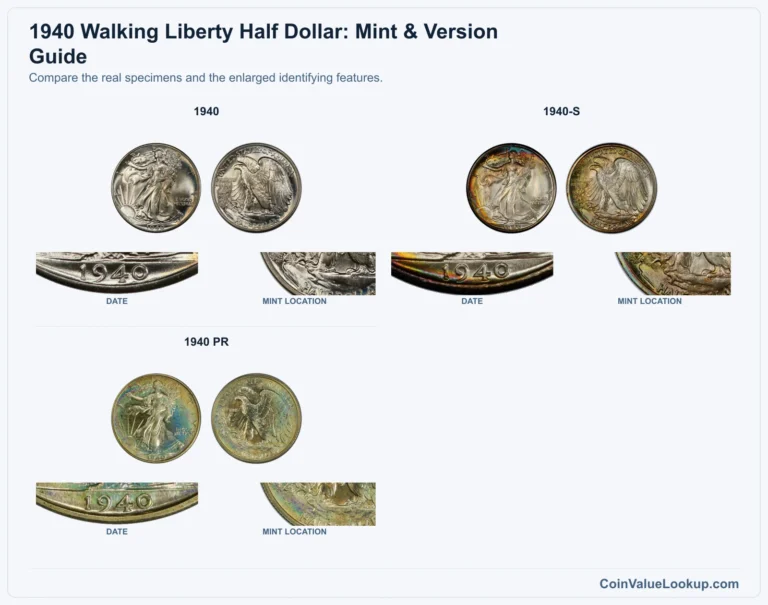
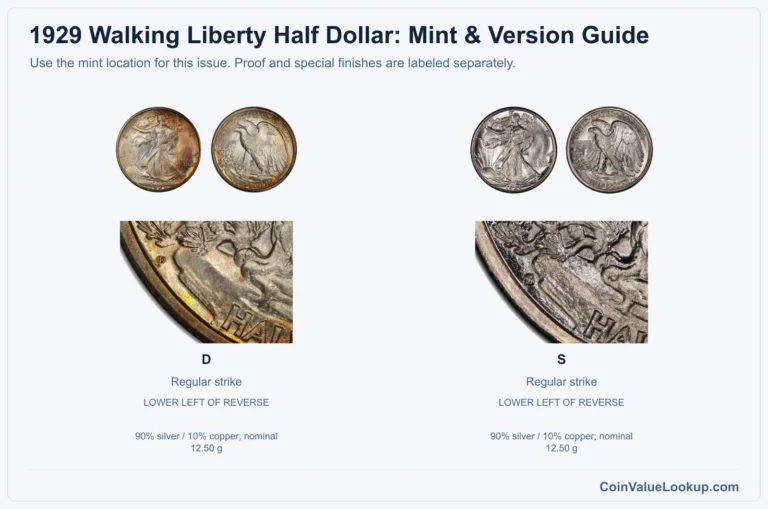
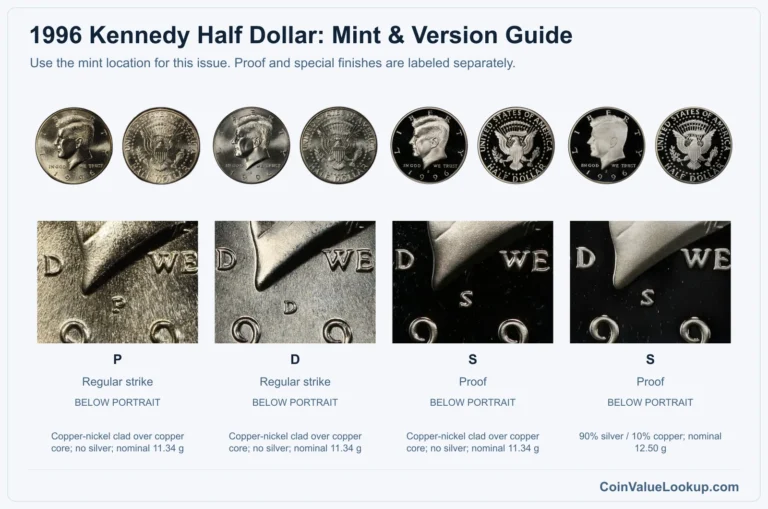
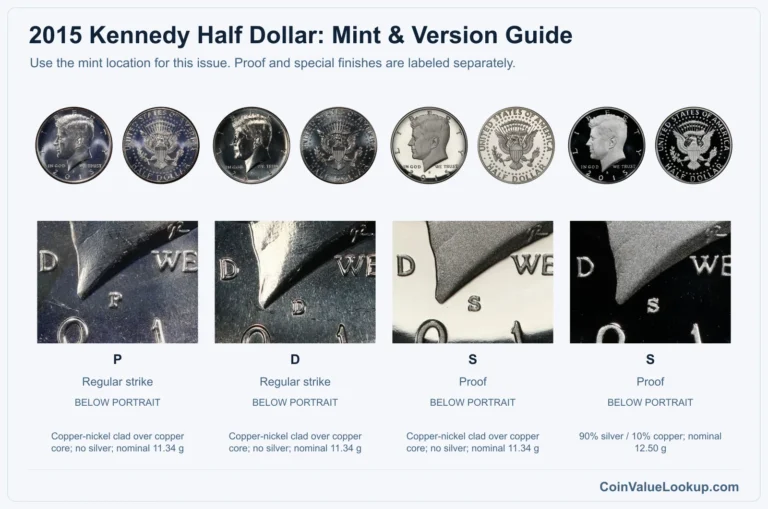
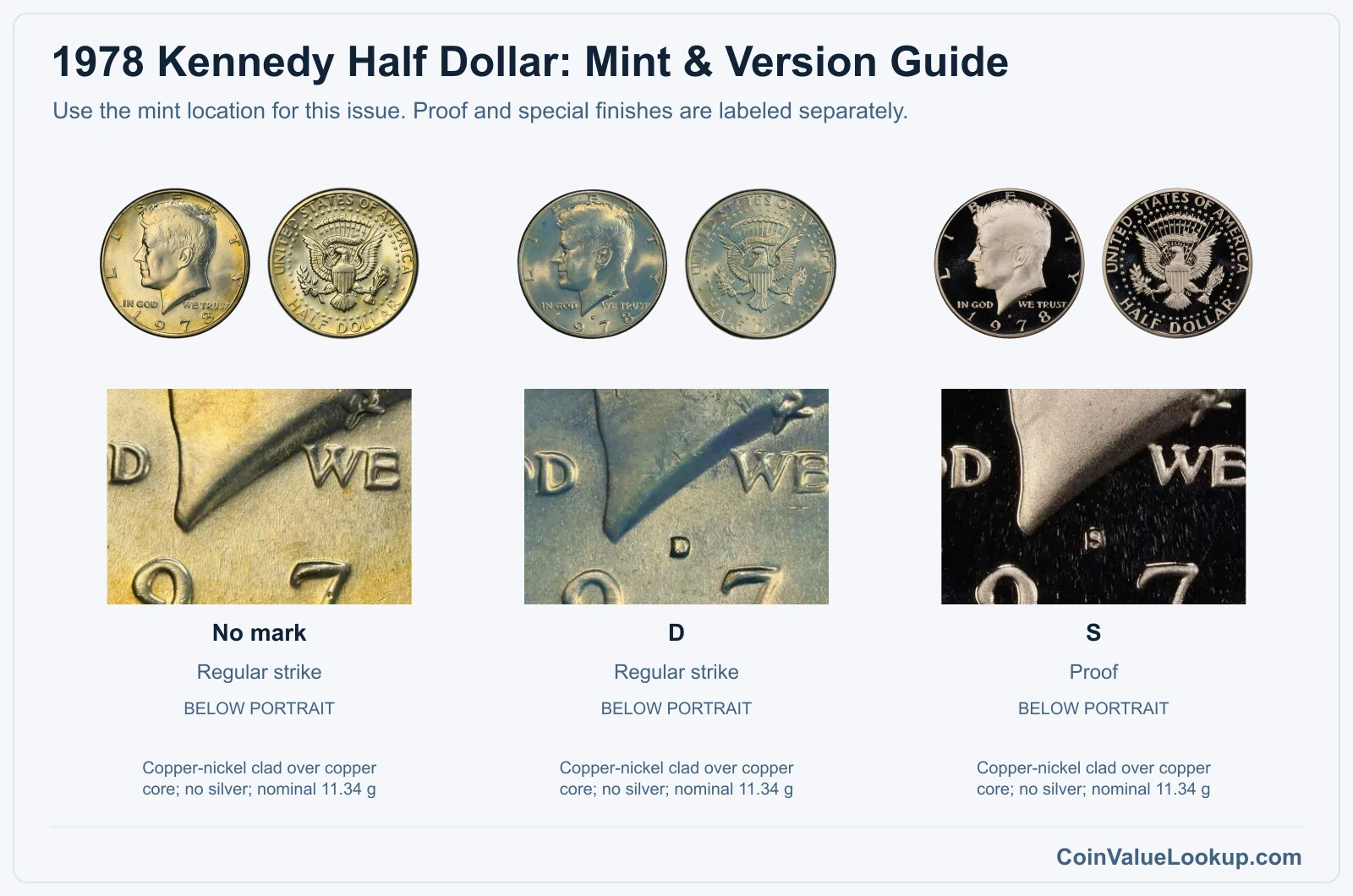
Look beneath Kennedy's portrait on the obverse, just above the date. That is where the mintmark lives.
A 1978 half dollar struck in Philadelphia has no mintmark at all — the Mint did not add a "P" to this denomination until 1980. A small "D" means Denver, and an "S" means San Francisco (proof only for this year).
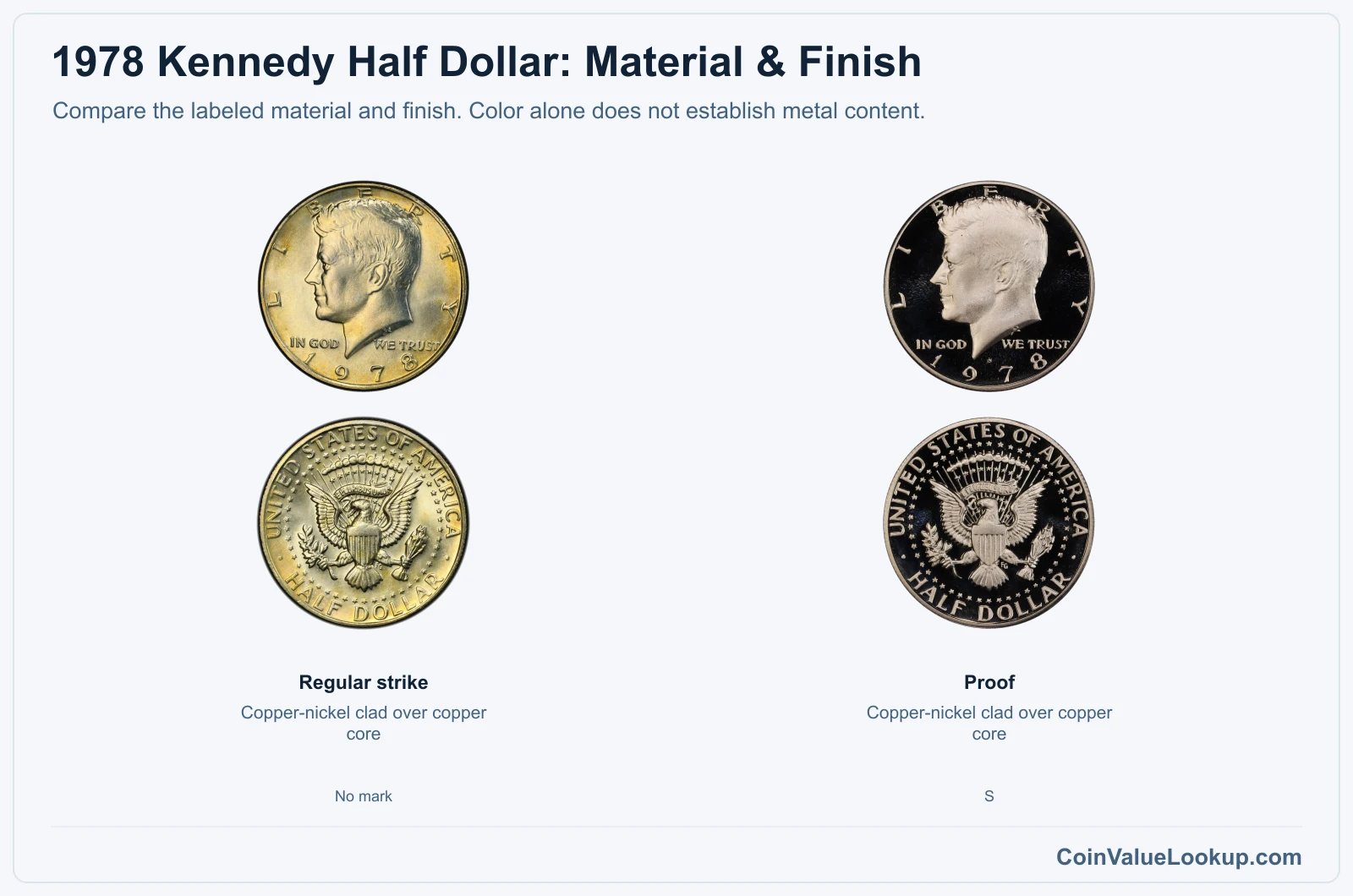
All three 1978 branches are copper-nickel clad over a copper core. None contain silver.
If someone tells you otherwise, weigh the coin: a standard clad half tips the scale at roughly 11.34 grams, while a 40% silver Kennedy would be noticeably heavier and show a silver-colored edge with no visible copper stripe.
Edge inspection matters. A clad half dollar shows a distinct copper line sandwiched between nickel-colored layers.
Toning, lighting and even old grime can imitate a silver look, so always check that edge under good light before jumping to conclusions.
Step 2: Check Your 1978 Kennedy Half Dollar Grade
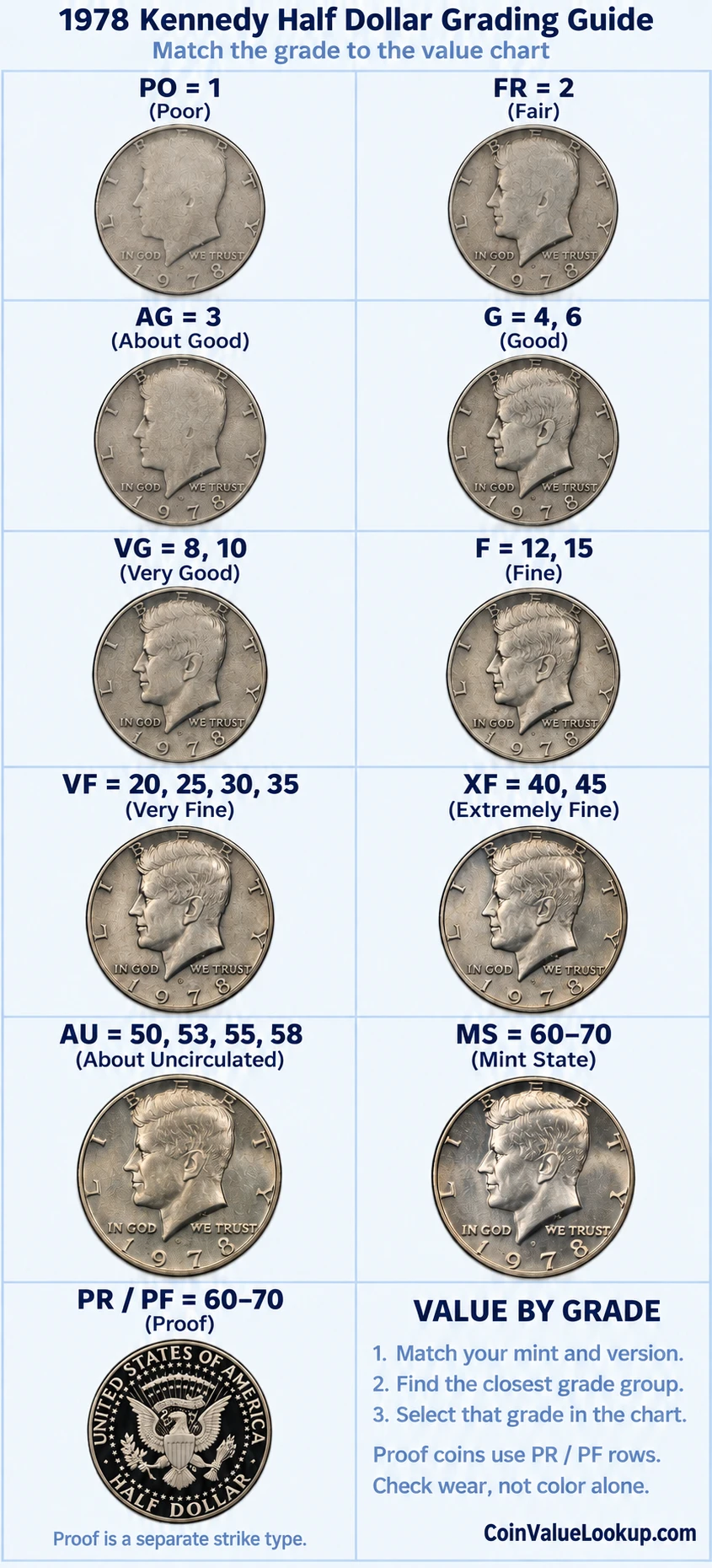
Start with Kennedy's cheek and jawline. On a lightly circulated coin, the first wear shows as a smooth, flat patch right on the cheekbone.
Next check the hair above the ear — high points there lose detail quickly.
Flip the coin over. The eagle's breast feathers and the tops of the wings are the reverse wear indicators.
If those areas are mushy but the rest looks sharp, you are likely in the VF to AU range.
Mint State coins can still look rough. Bag marks — small dings from coins banging together in bulk storage — lower the grade without being true circulation wear.
Compare your coin to the reference image for that specific grade tier.
Proofs get graded on a separate scale. Hairlines from mishandling, haze from improper storage and contact marks all knock a proof down.
Mirror fields should be deeply reflective; frosted devices should be crisp.
Step 3: Check 1978 Kennedy Half Dollar Value by Mint and Version
1978 Kennedy Half Dollar — No mark — clad business
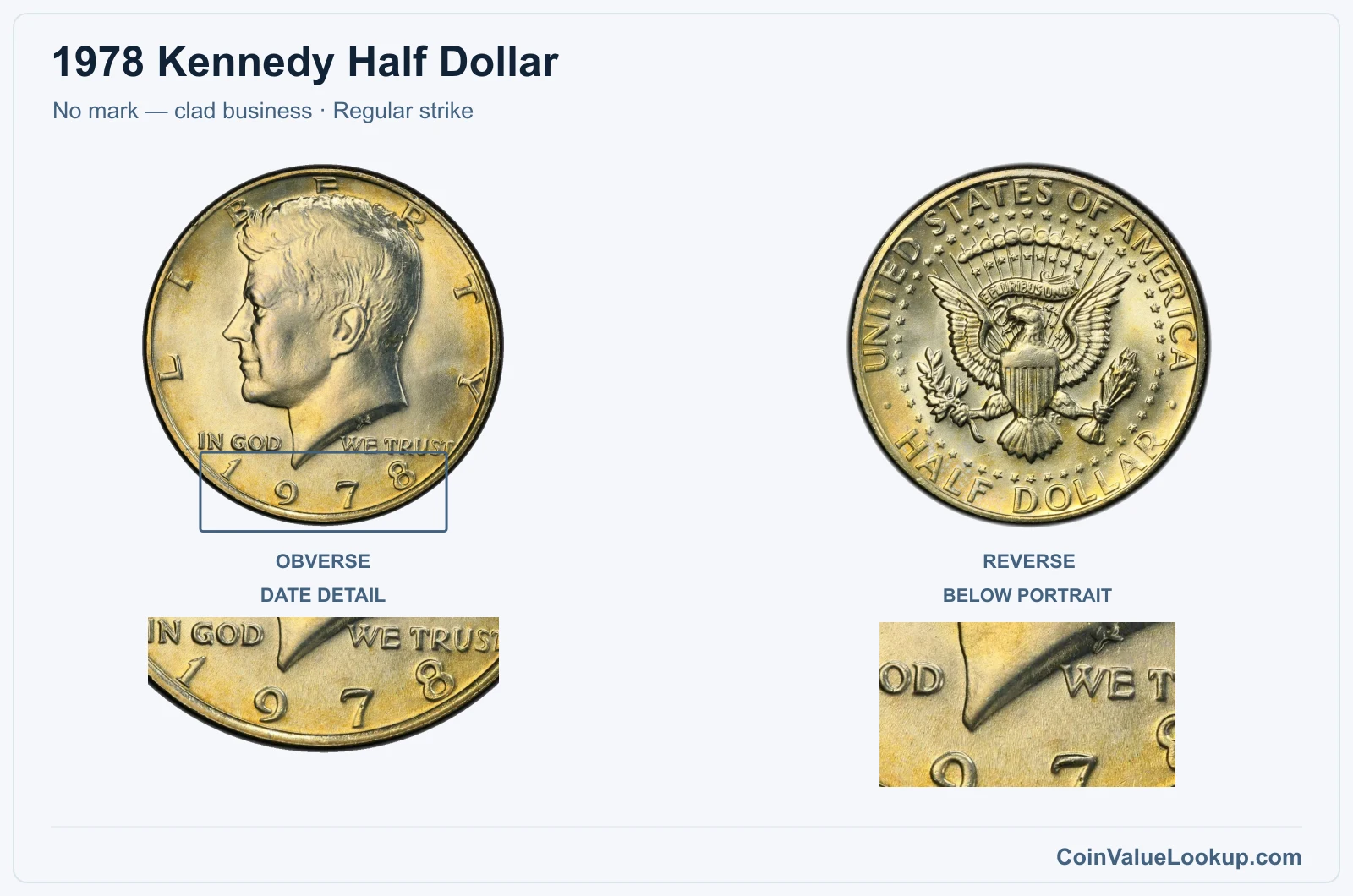
The 1978 Philadelphia half dollar has no mintmark beneath Kennedy's portrait, which is perfectly normal for this era. It is a copper-nickel clad coin with no silver content whatsoever.
Circulated examples are face-value coins in almost every case. The collector guide from USA Coin Book places a well-preserved MS65 example at roughly $3.62, though that is an estimate, not a guaranteed offer.
If you pull one from a roll and it still has full luster with minimal bag marks, it is worth setting aside. Anything below MS60 territory is generally a spender.
Range Grade
Price Auction Records Appraisal PO PO 1
—
Coin Identifier FR FR 2
—
Coin Identifier AG AG 3
—
Coin Identifier G G 4
—
Coin Identifier
G 6
—
Coin Identifier VG VG 8
—
Coin Identifier
VG 10
—
Coin Identifier F F 12
—
Coin Identifier
F 15
—
Coin Identifier VF VF 20
—
Coin Identifier
VF 25
—
Coin Identifier
VF 30
—
Coin Identifier
VF 35
—
Coin Identifier XF XF 40
—
Coin Identifier
XF 45
—
Coin Identifier AU AU 50
—
Coin Identifier
AU 53
—
Coin Identifier
AU 55
—
Coin Identifier
AU 58
—
Coin Identifier MS MS 60
—
Coin Identifier
MS 61
—
Coin Identifier
MS 62
—
Coin Identifier
MS 63
—
Coin Identifier
MS 64
Coin Identifier
MS 65
Coin Identifier
MS 66
Coin Identifier
MS 67
Coin Identifier
MS 68
—
—
—
MS 69
—
—
—
MS 70
—
—
—
1978 Kennedy Half Dollar — D — clad business
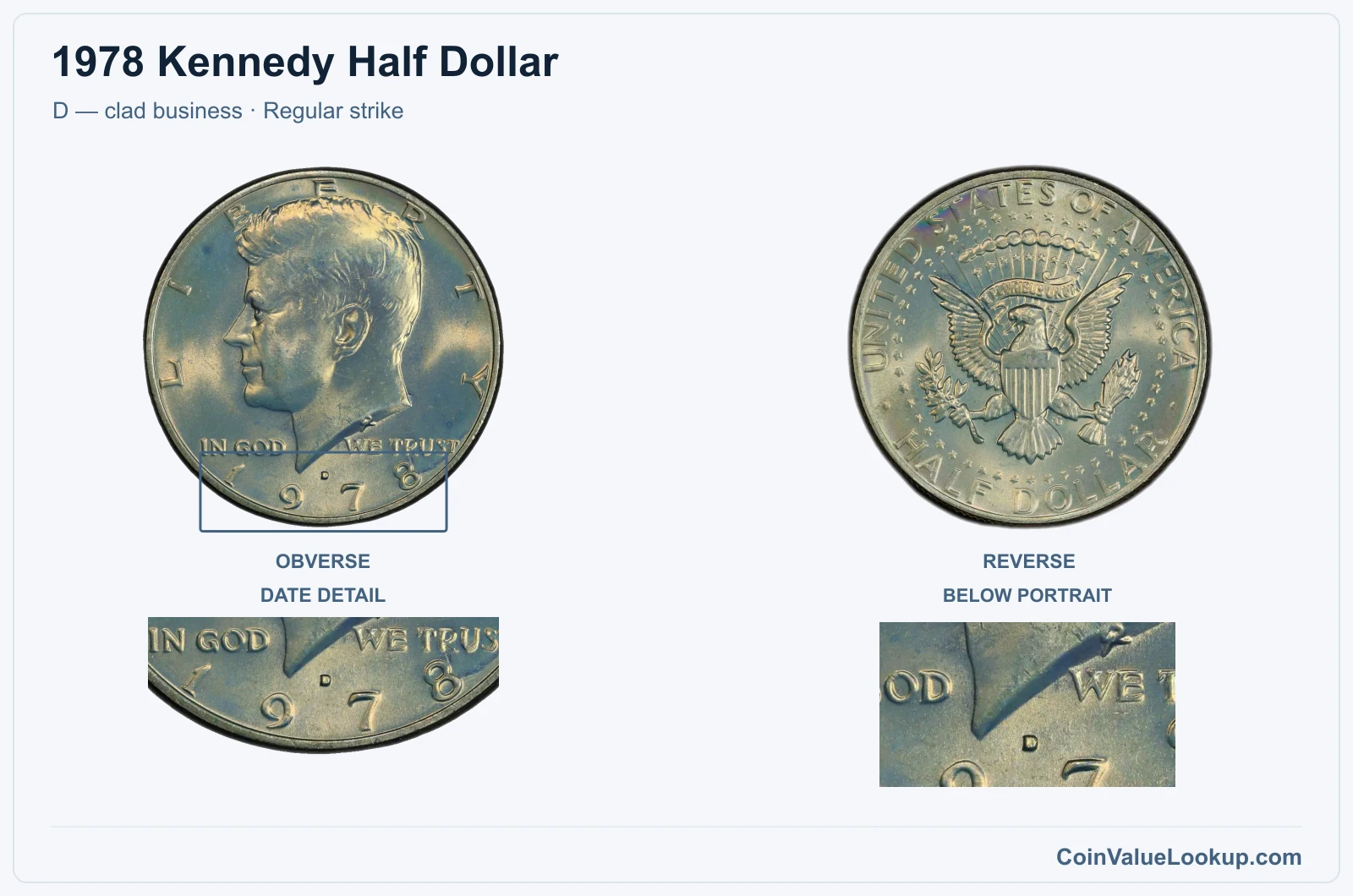
Denver-struck 1978 halves carry a small "D" mintmark beneath Kennedy's portrait. Same copper-nickel clad composition, same 11.34-gram target weight, same design.
Worn pieces trade at face value. A guide estimate from USA Coin Book puts an MS65 example at about $3.62.
That is a reference point, not a locked-in buy price.
Coin Value Lookup is a handy starting point if you want to look up other Kennedy half dollar years or denominations while you are sorting through a batch.
The 1978-D is also the specific date tied to a reported "No FG" variety, so check the reverse if you have a Denver coin — more on that in the error section below.
Range Grade
Price Auction Records Appraisal PO PO 1
—
Coin Identifier FR FR 2
—
Coin Identifier AG AG 3
—
Coin Identifier G G 4
—
Coin Identifier
G 6
—
Coin Identifier VG VG 8
—
Coin Identifier
VG 10
—
Coin Identifier F F 12
—
Coin Identifier
F 15
—
Coin Identifier VF VF 20
—
Coin Identifier
VF 25
—
Coin Identifier
VF 30
—
Coin Identifier
VF 35
—
Coin Identifier XF XF 40
—
Coin Identifier
XF 45
—
Coin Identifier AU AU 50
—
Coin Identifier
AU 53
—
Coin Identifier
AU 55
—
Coin Identifier
AU 58
—
Coin Identifier MS MS 60
—
Coin Identifier
MS 61
—
Coin Identifier
MS 62
—
Coin Identifier
MS 63
—
Coin Identifier
MS 64
Coin Identifier
MS 65
Coin Identifier
MS 66
Coin Identifier
MS 67
Coin Identifier
MS 68
—
—
—
MS 69
—
—
—
MS 70
—
—
—
1978 Kennedy Half Dollar — S — clad proof
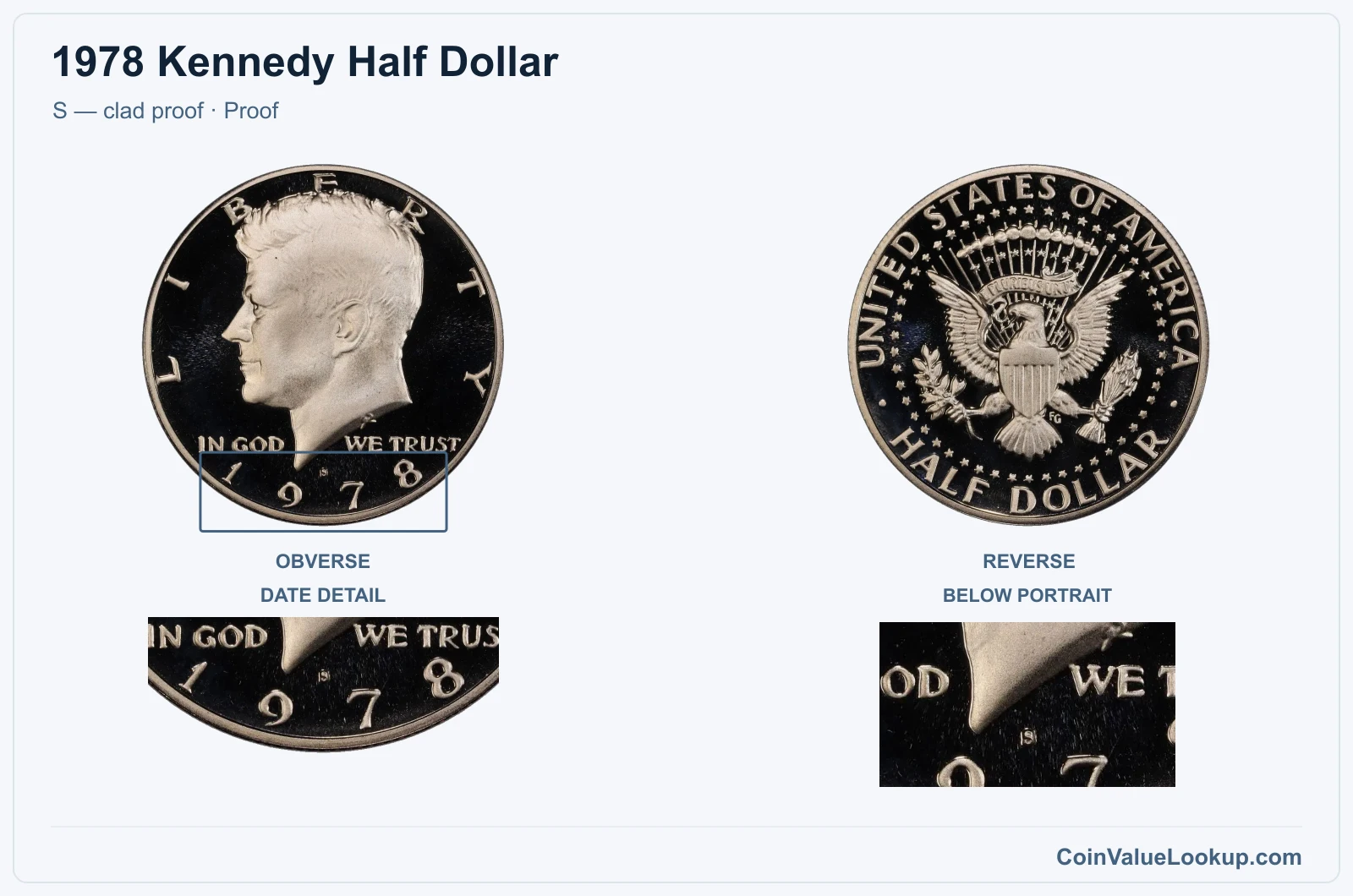
The 1978-S is a proof-only issue struck at San Francisco. It has an "S" mintmark and was sold in annual proof sets, not released into circulation.
Look for deeply mirrored fields and sharply frosted raised devices — that contrast is the hallmark of a proof finish. It is a manufacturing method, not a grade above Mint State, so proofs are graded on their own PR scale.
USA Coin Book lists a PR65 at approximately $3.62. Hairlines, haze or contact marks will pull the grade down.
If yours still sits untouched in the original government packaging, that is the best possible starting point for a strong grade.
Range Grade
Price Auction Records Appraisal PR PR 1
—
Coin Identifier
PR 2
—
Coin Identifier
PR 3
—
Coin Identifier
PR 4
—
Coin Identifier
PR 6
—
Coin Identifier
PR 8
—
Coin Identifier
PR 10
—
Coin Identifier
PR 12
—
Coin Identifier
PR 15
—
Coin Identifier
PR 20
—
Coin Identifier
PR 25
—
Coin Identifier
PR 30
—
Coin Identifier
PR 35
—
Coin Identifier
PR 40
—
Coin Identifier
PR 45
—
Coin Identifier
PR 50
—
Coin Identifier
PR 53
—
Coin Identifier
PR 55
—
Coin Identifier
PR 58
—
Coin Identifier
PR 60
Coin Identifier
PR 61
—
Coin Identifier
PR 62
—
Coin Identifier
PR 63
—
Coin Identifier
PR 64
—
Coin Identifier
PR 65
Coin Identifier
PR 66
Coin Identifier
PR 67
Coin Identifier
PR 68
Coin Identifier
PR 69
Coin Identifier
PR 70
Coin Identifier
1978 Kennedy Half Dollar Error List
1. 1978 Kennedy Half Dollar — Doubled Die Obverse
A doubled die obverse on the 1978 Kennedy half shows consistent separation or notching on obverse lettering or design elements. You are looking for a doubling effect that repeats uniformly — not a flat, shelf-like smear.
Compare suspect letters (especially LIBERTY or IN GOD WE TRUST) against a normal 1978 half under the same magnification and lighting. Genuine hub doubling produces crisp, separated outlines that appear on every example struck from that die.
Machine doubling, reflections from worn dies and even lighting angles can mimic the look. Machine doubling tends to produce a flat, mushy shelf rather than distinct raised separation.
Value depends on how visible the doubling is, the coin's overall condition and professional confirmation of the variety.
2. 1978 Kennedy Half Dollar — Lamination / Split Planchet
Lamination errors occur when the planchet's metal layers do not bond properly before striking. On a 1978 Kennedy half, this can appear as a peeling flap of metal, a crack that exposes a lower layer, or an outright split through part of the coin's thickness.
Photograph both the affected face and the edge together — that context helps distinguish a genuine lamination from surface damage. The separation follows the coin's contour rather than cutting across it randomly.
Scraping, corrosion pits and deliberately cut or filed coins can look similar at first glance. Genuine laminations have a natural, layered appearance at the separation boundary.
Condition, size of the affected area and visual drama all influence what a lamination error is worth; no standard price range applies here.
3. 1978 Kennedy Half Dollar — Wrong Planchet / Off-Metal Strike
A wrong-planchet error means the 1978 Kennedy half die struck a blank intended for a different denomination or composition. The result is a coin that looks like a half dollar but has the wrong weight, diameter or edge profile — sometimes all three.
Weigh and measure the coin carefully. Compare diameter, thickness and edge reeding against normal 1978 half dollar specifications (roughly 30.6 mm, 11.34 g, reeded edge).
If the design is incomplete because the blank was too small, that is another strong indicator.
Plating, corrosion, acid treatments and intentional alterations can produce coins that look off-metal. A genuine wrong-planchet strike will still show proper die detail across whatever portion of the blank received the impression.
Value varies widely and depends on the specific planchet involved and the coin's condition.
4. 1978 Kennedy Half Dollar — Missing FG Initials
The "No FG" variety has been specifically reported on the 1978-D Kennedy half dollar. The initials "FG" — for reverse designer Frank Gasparro — normally appear near the eagle's tail feathers on the lower right of the reverse.
On reported No FG examples, the initials are missing or nearly invisible due to die polishing that smoothed them away before striking. Check the surrounding reverse detail: if nearby feathers and design elements remain sharp while the FG area is blank, that is consistent with die polishing rather than simple wear.
Heavy circulation wear, grease fill during striking, or deliberate removal after the fact can all make the initials disappear. Wear usually dulls the entire area uniformly, while die polishing tends to leave adjacent detail intact.
Value depends on the coin's condition and how cleanly the initials are absent.
5. 1978 Kennedy Half Dollar — Struck-Through Error
A struck-through error happens when foreign material — grease, cloth fibers, a metal fragment, even another coin's edge — sits between the die and the planchet during striking. The result is a localized depression or an impression of the obstruction pressed into the coin's surface.
On a 1978 Kennedy half, look for a smooth, sunken area where design detail is missing or muted. Grease fill-ins tend to affect a broad, soft zone (commonly seen on high points like the hair or eagle breast).
A retained foreign object leaves a sharper, more defined impression.
Scratches, cleaning damage, ordinary weak strikes and post-mint wear can all mimic the look of a struck-through. The key difference is that a genuine struck-through impression is recessed into the surface and surrounded by otherwise normal detail.
Condition and the size of the affected area determine the premium.
6. 1978 Kennedy Half Dollar — Broadstrike
A broadstrike occurs when the retaining collar fails to engage during striking. Without the collar holding the planchet in place, metal spreads outward beyond the coin's normal diameter.
The design is fully centered, but the rim is absent or malformed and the coin is visibly wider and thinner than normal.
Check the edge profile. A broadstruck 1978 Kennedy half will lack the normal reeded edge and instead show a smooth, rounded or irregular border.
The full design should still be present and centered — that distinguishes a broadstrike from an off-center strike.
Coins that have been flattened after minting (by a train, vise or hammer) can look similar, but post-mint damage usually distorts the design unevenly. A genuine broadstrike retains sharp die detail even as the metal extends outward.
Value depends on condition and the degree of spread.
7. 1978 Kennedy Half Dollar — Off-Center Strike
An off-center strike means the planchet was not properly seated between the dies, so part of the design is missing and a blank crescent of unstruck metal appears on one side. The further off-center the strike, the more dramatic the error.
Collectors generally prize off-center strikes that still show the full date, because that confirms the year and makes the coin attributable. A 1978 Kennedy half struck 10% off-center with the date visible is more collectible than one struck 50% off-center with the date gone.
Do not confuse an off-center strike with a clipped planchet (which removes a curved bite from the blank before striking) or with one-sided die misalignment (which shifts only one side's design). Post-mint flattening can also push metal sideways, but it distorts the existing design rather than leaving a clean unstruck area.
Value depends on the percentage off-center and overall condition.