1992 Kennedy Half Dollar Coin Value: How Much Is It Worth?
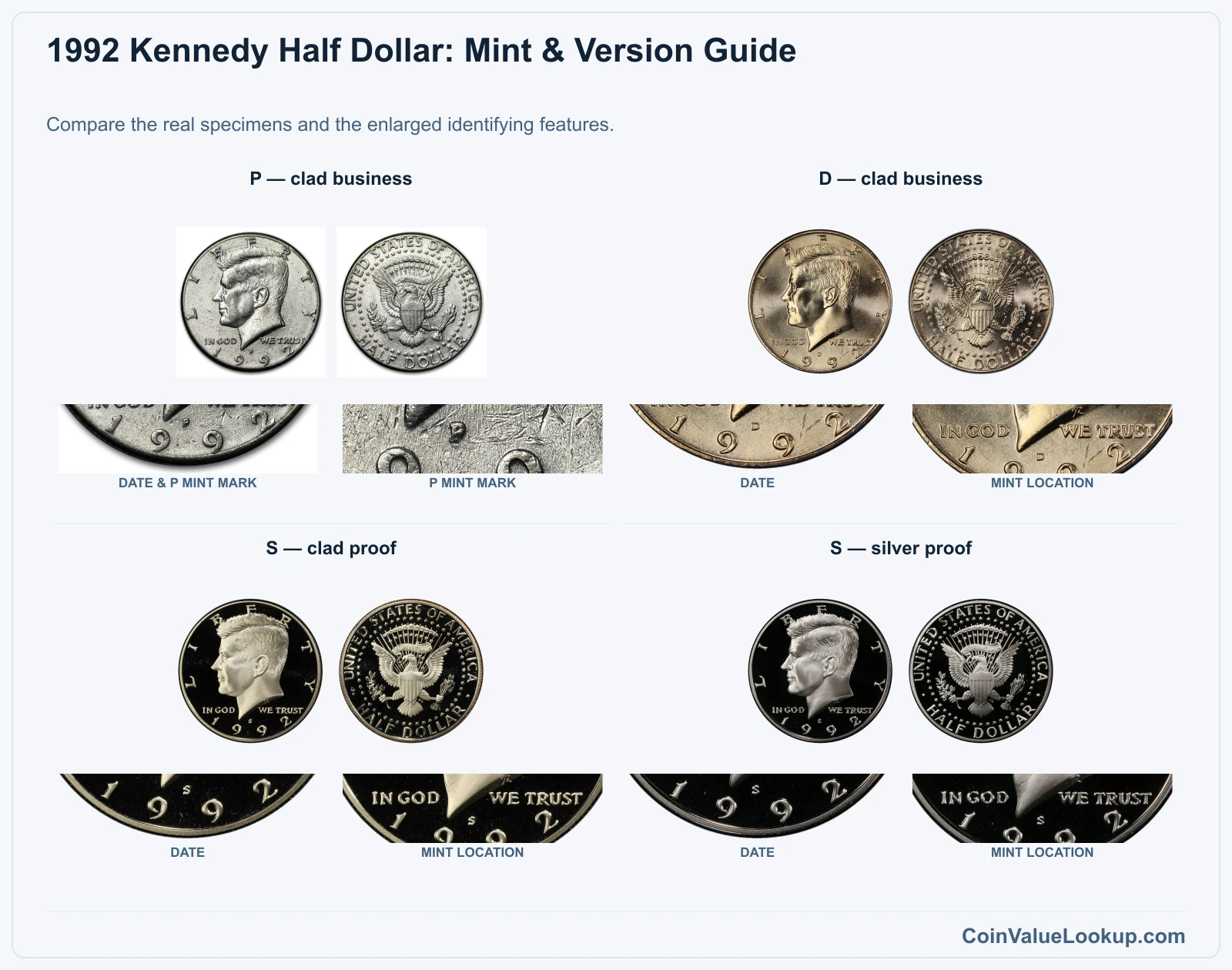
The 1992 Kennedy half dollar carries a face value of 50 cents, and most circulated clad examples are worth exactly that. Collector guide estimates for specific mint, finish and grade combinations range from about $3.62 to $39.00.
Before you check a price chart, you need to know whether your coin is a regular business strike, a clad proof or the heavier silver proof — each one lands in a different value bracket.
Fast Way to Identify Your 1992 Kennedy Half Dollar
The quickest way to start is to upload clear photos of both sides of your coin. A well-lit front shot lets us read the mintmark and check design details, while the back confirms the eagle type and any anomalies.
Snap both sides against a plain background and submit them for a preliminary identification.
1992 Kennedy Half Dollar Value
Upload both sides of your 1992 Kennedy Half Dollar.
Front Obverse
Upload photo
Back Reverse
Upload photo
Which 1992 Kennedy Half Dollar Versions Are Worth Money?
- The 1992-S silver proof commands the highest guide estimate at $39.00 in PR65 — confirm the heavier weight and 90% silver composition before assuming you have one.
- Clad proofs from San Francisco carry a PR65 guide estimate of $6.25, well above face value but far below the silver version.
- Business strikes from Philadelphia or Denver in MS65 condition list at $3.62 per guide estimates; lower grades are typically face-value coins.
- Reported mint errors such as doubled dies, off-center strikes and clipped planchets can affect value depending on visibility and condition — check the error section below.
Step 1: Identify Your 1992 Kennedy Half Dollar Mint Mark and Version
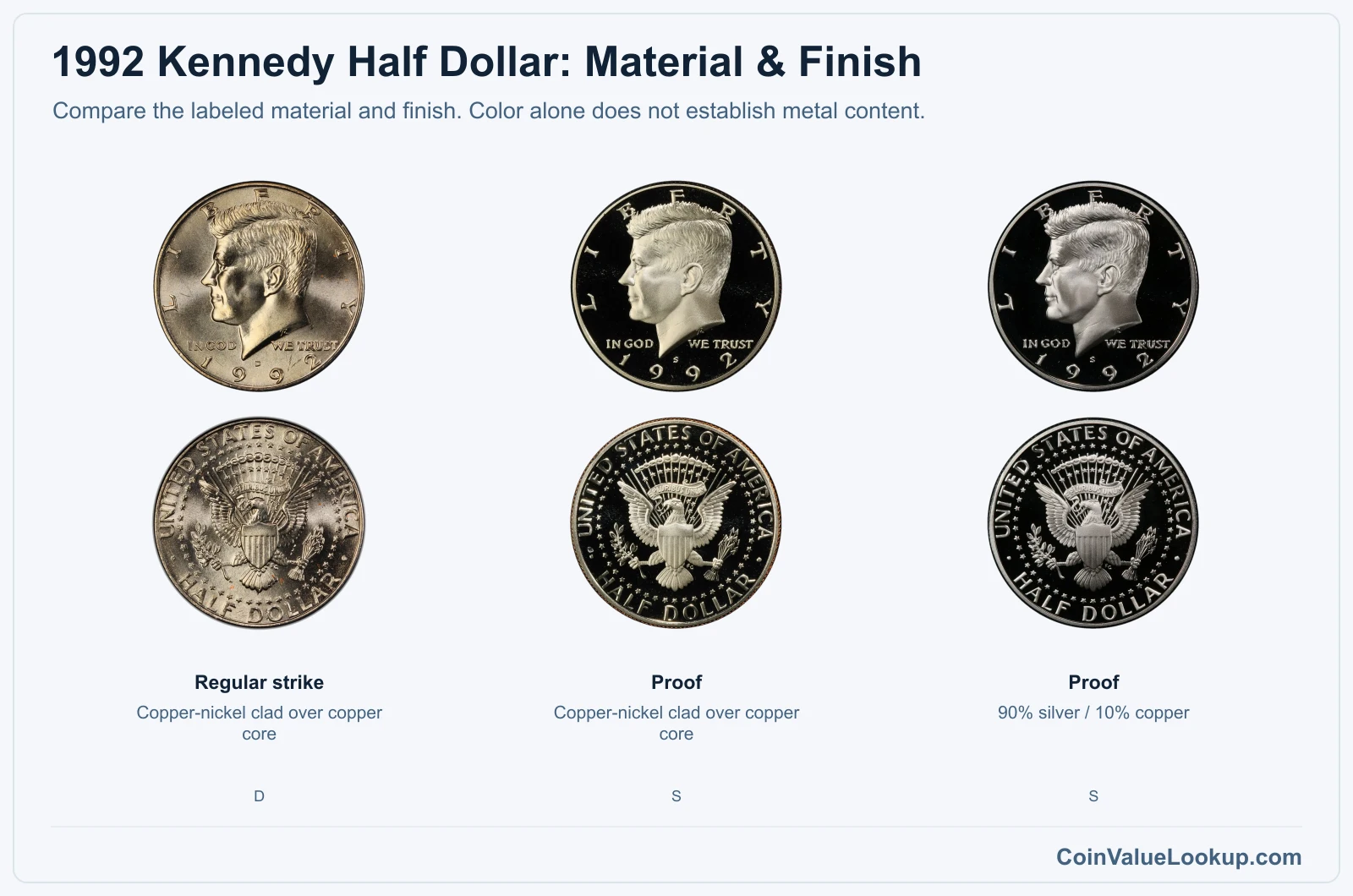
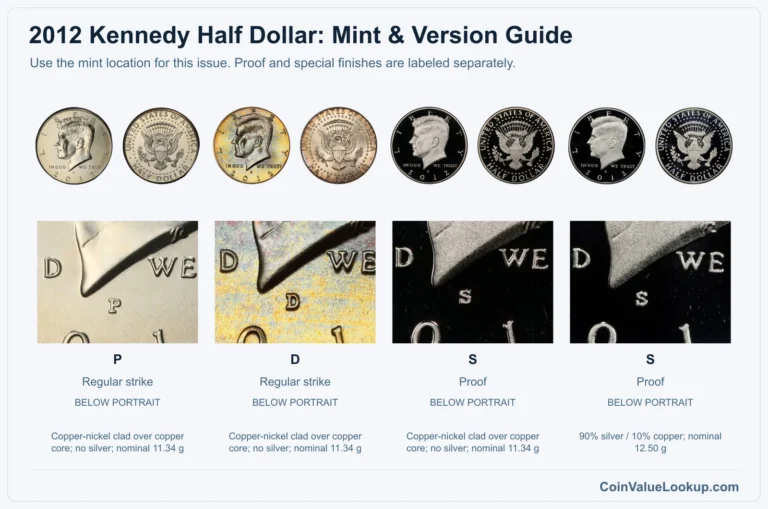
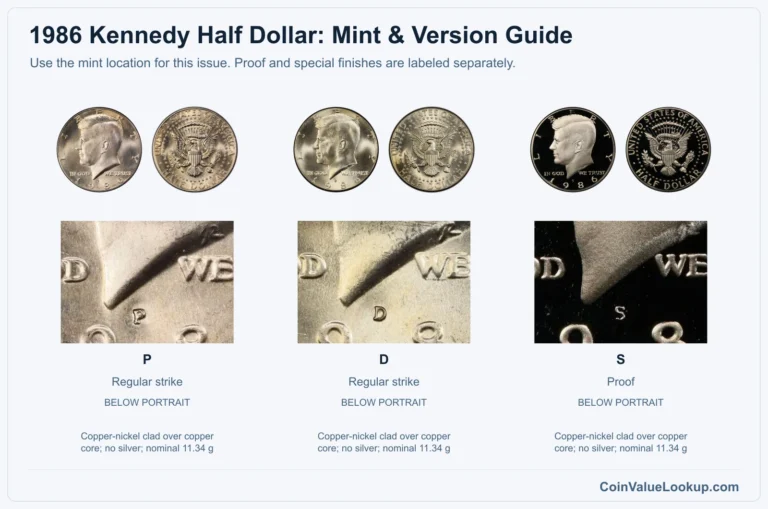
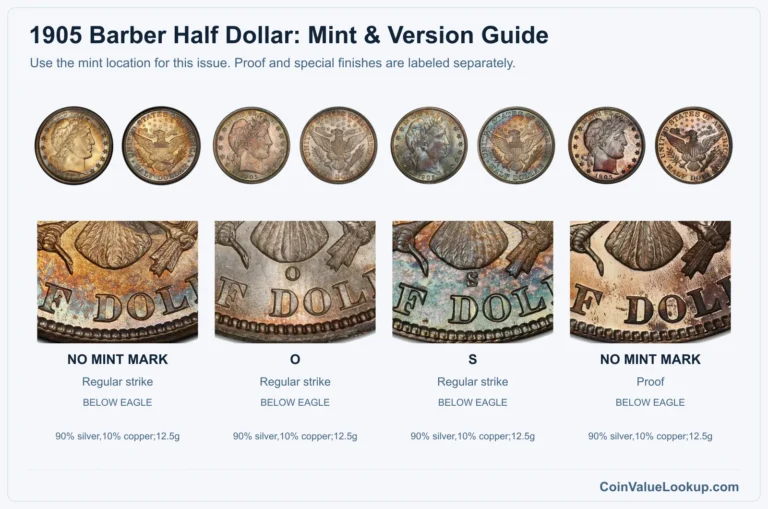
Look beneath Kennedy's portrait on the obverse, just above the date. That is where the mintmark lives.
A "P" means Philadelphia, "D" means Denver, and "S" means San Francisco. Philadelphia coins struck before 1980 carry no mintmark at all, but by 1992 the P was standard.
Both the P and D strikes are copper-nickel clad business coins with no silver content, weighing about 11.34 grams. The S mint produced two different versions this year: a clad proof and a 90% silver proof.
Same mintmark, two different metals.
To tell the S proofs apart, compare weight and edge. The silver proof weighs roughly 12.50 grams versus 11.34 grams for the clad.
Original government packaging also helps — silver proofs shipped in distinct sets. Toning, lighting and worn plating can fake a silver look, so weight is your most reliable tool without professional testing.
The initials "FG" on the reverse near the eagle's tail feathers stand for designer Frank Gasparro. If they look faint or missing, that is usually die wear or grease fill, not automatically a recognized variety.
Step 2: Check Your 1992 Kennedy Half Dollar Grade
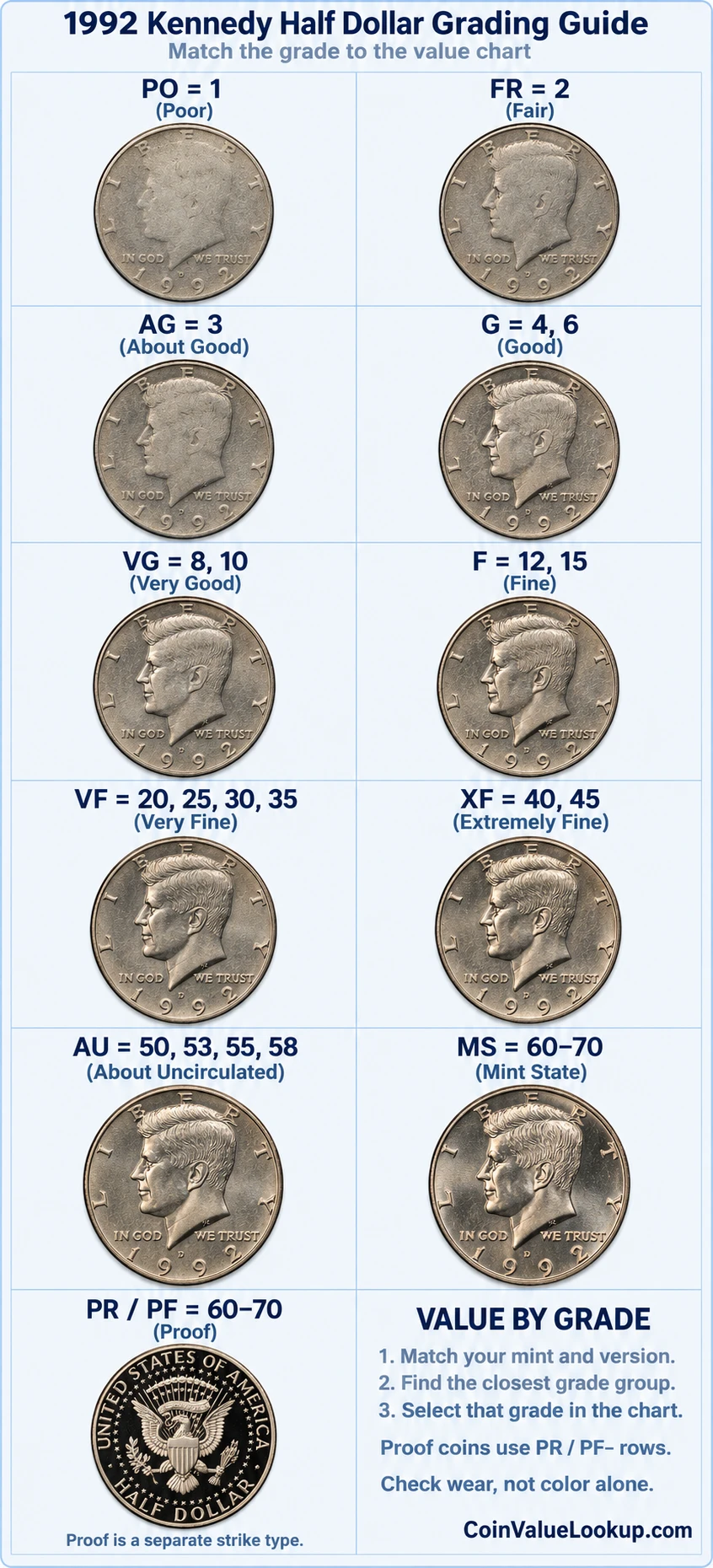
Focus on Kennedy's cheek and jawline first. These are the highest points on the obverse and the first to show friction.
Then check the hair detail above and behind the ear — on a well-struck Mint State coin those strands are sharp and distinct.
On the reverse, the eagle's breast feathers and the tops of the wings lose definition early. A coin with full detail in all these areas and strong luster is a candidate for a high Mint State grade.
Bag marks matter. Two coins can both be uncirculated, but the one with fewer contact marks from jostling in mint bags will grade higher.
These dings are not the same as circulation wear — they happen before the coin ever reaches a cash register.
Proofs get graded on a different scale. Look for hairlines from handling, haze from improper storage and contact marks.
A clean, deeply mirrored proof with frosted devices grades well. Use the comparison image to match your coin's surface quality against known examples at different grade levels.
Step 3: Check 1992 Kennedy Half Dollar Value by Mint and Version
1992 Kennedy Half Dollar — P — clad business
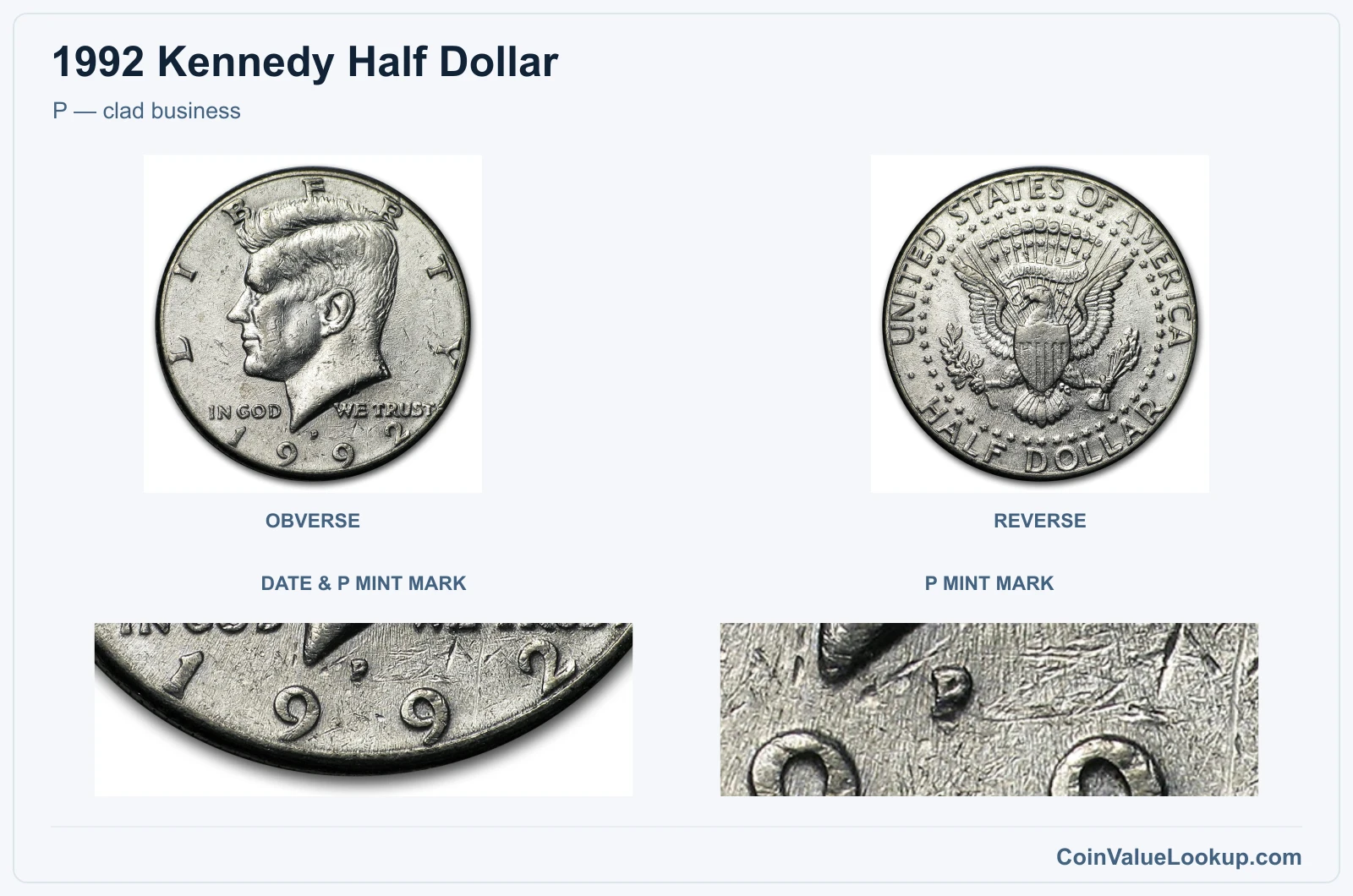
The 1992-P is the Philadelphia business strike, made from copper-nickel clad and weighing about 11.34 grams. Look for the small "P" mintmark beneath Kennedy's portrait.
Millions were produced for everyday commerce, and circulated examples are worth face value.
In higher preserved condition the coin becomes collectible. A USA Coin Book guide estimate places an MS65 example at roughly $3.62.
That is not a guaranteed sale price — it is a reference point. To reach that grade a coin needs full luster, sharp detail and minimal bag marks.
Range Grade
Price Auction Records Appraisal PO PO 1
—
Coin Identifier FR FR 2
—
Coin Identifier AG AG 3
—
Coin Identifier G G 4
—
Coin Identifier
G 6
—
Coin Identifier VG VG 8
—
Coin Identifier
VG 10
—
Coin Identifier F F 12
—
Coin Identifier
F 15
—
Coin Identifier VF VF 20
—
Coin Identifier
VF 25
—
Coin Identifier
VF 30
—
Coin Identifier
VF 35
—
Coin Identifier XF XF 40
—
Coin Identifier
XF 45
—
Coin Identifier AU AU 50
—
Coin Identifier
AU 53
—
Coin Identifier
AU 55
—
Coin Identifier
AU 58
—
Coin Identifier MS MS 60
—
Coin Identifier
MS 61
—
Coin Identifier
MS 62
—
Coin Identifier
MS 63
—
Coin Identifier
MS 64
—
Coin Identifier
MS 65
—
Coin Identifier
MS 66
Coin Identifier
MS 67
Coin Identifier
MS 68
Coin Identifier
MS 69
—
—
—
MS 70
—
—
—
1992 Kennedy Half Dollar — D — clad business
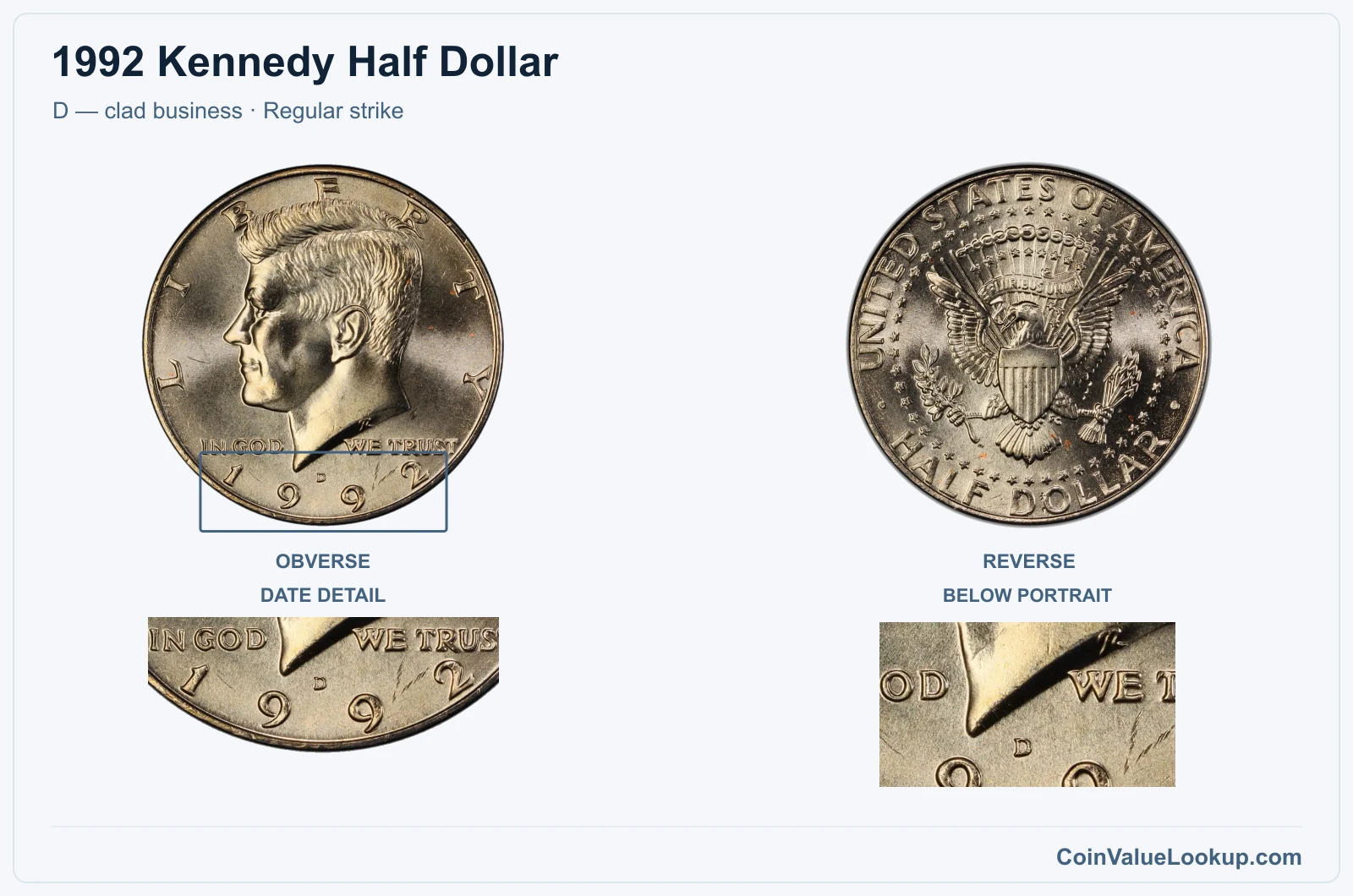
The 1992-D is the Denver business strike, identical in composition and weight to its Philadelphia counterpart. The "D" mintmark sits in the same spot beneath Kennedy's portrait.
Like the P issue, worn 1992-D halves trade at face value. The MS65 guide estimate from USA Coin Book is about $3.62.
Condition is everything here — a coin pulled from a bank roll with clean surfaces and strong strike will always outperform one that rattled around in a drawer for thirty years.
Coin Value Lookup is a good starting point if you want to look up guides for other dates and denominations in the Kennedy series.
Range Grade
Price Auction Records Appraisal PO PO 1
—
Coin Identifier FR FR 2
—
Coin Identifier AG AG 3
—
Coin Identifier G G 4
—
Coin Identifier
G 6
—
Coin Identifier VG VG 8
—
Coin Identifier
VG 10
—
Coin Identifier F F 12
—
Coin Identifier
F 15
—
Coin Identifier VF VF 20
—
Coin Identifier
VF 25
—
Coin Identifier
VF 30
—
Coin Identifier
VF 35
—
Coin Identifier XF XF 40
—
Coin Identifier
XF 45
—
Coin Identifier AU AU 50
—
Coin Identifier
AU 53
—
Coin Identifier
AU 55
—
Coin Identifier
AU 58
—
Coin Identifier MS MS 60
—
Coin Identifier
MS 61
—
Coin Identifier
MS 62
—
Coin Identifier
MS 63
—
Coin Identifier
MS 64
—
Coin Identifier
MS 65
—
Coin Identifier
MS 66
Coin Identifier
MS 67
Coin Identifier
MS 68
Coin Identifier
MS 69
—
—
—
MS 70
—
—
—
1992 Kennedy Half Dollar — S — clad proof
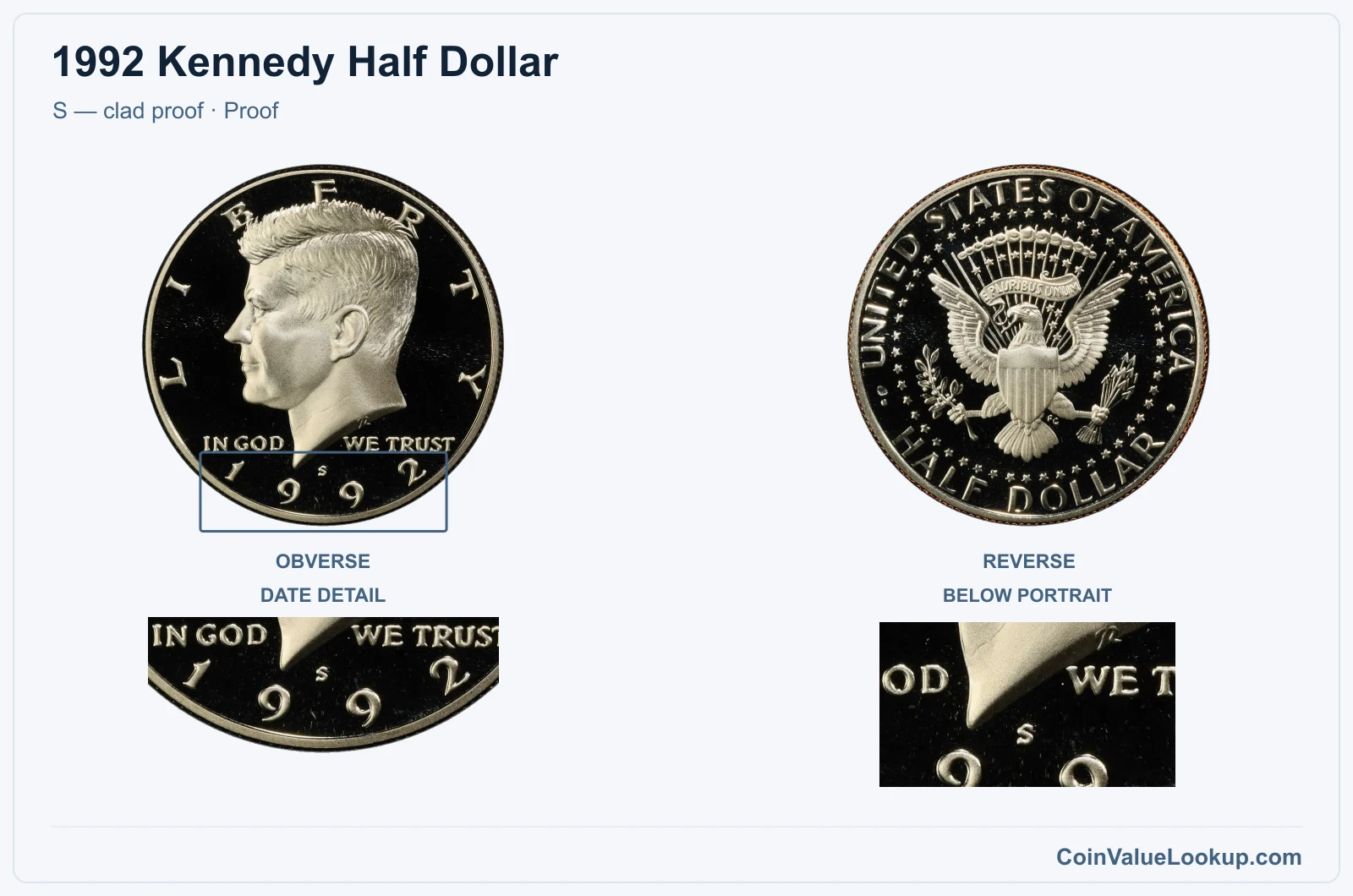
The 1992-S clad proof was struck at San Francisco on the same copper-nickel clad planchets used for business strikes, but with polished dies and deliberate multiple strikes that produce mirror-like fields and frosted raised design elements.
Do not confuse this with the silver proof — both carry the "S" mintmark. The clad proof weighs about 11.34 grams, matching the regular issue.
A PR65 guide estimate from USA Coin Book is approximately $6.25. Grade proofs by checking for hairlines across those mirror surfaces and any haze from storage.
Range Grade
Price Auction Records Appraisal PR PR 1
—
Coin Identifier
PR 2
—
Coin Identifier
PR 3
—
Coin Identifier
PR 4
—
Coin Identifier
PR 6
—
Coin Identifier
PR 8
—
Coin Identifier
PR 10
—
Coin Identifier
PR 12
—
Coin Identifier
PR 15
—
Coin Identifier
PR 20
—
Coin Identifier
PR 25
—
Coin Identifier
PR 30
—
Coin Identifier
PR 35
—
Coin Identifier
PR 40
—
Coin Identifier
PR 45
—
Coin Identifier
PR 50
—
Coin Identifier
PR 53
—
Coin Identifier
PR 55
—
Coin Identifier
PR 58
—
Coin Identifier
PR 60
—
Coin Identifier
PR 61
—
Coin Identifier
PR 62
—
Coin Identifier
PR 63
—
Coin Identifier
PR 64
—
Coin Identifier
PR 65
—
Coin Identifier
PR 66
Coin Identifier
PR 67
—
Coin Identifier
PR 68
Coin Identifier
PR 69
Coin Identifier
PR 70
Coin Identifier
1992 Kennedy Half Dollar — S — silver proof
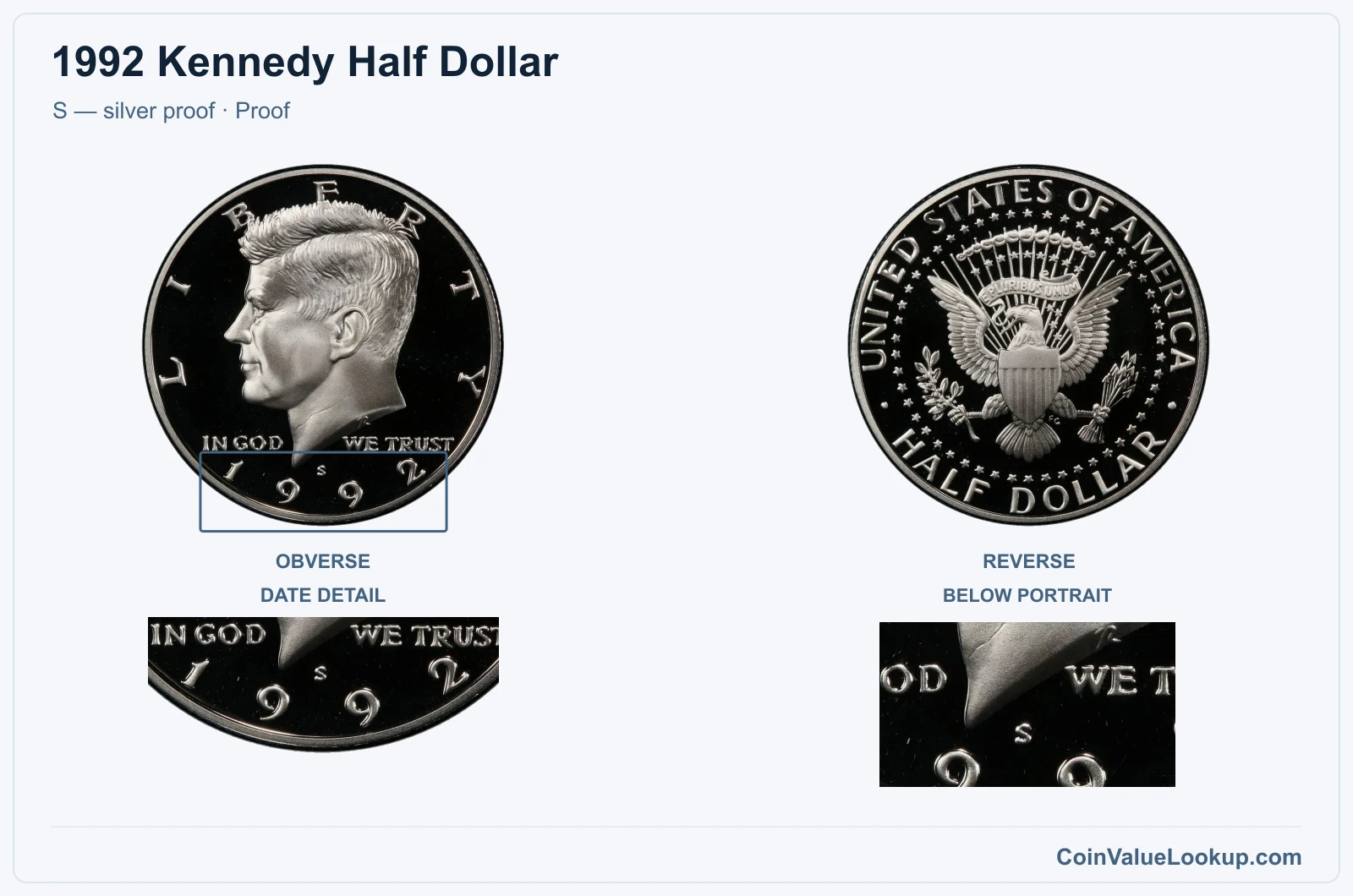
This is the one collectors pay attention to. The 1992-S silver proof is struck on a 90% silver, 10% copper planchet weighing roughly 12.50 grams — noticeably heavier than the 11.34-gram clad version.
The USA Coin Book guide estimate for a PR65 silver proof is about $39.00, making it the most valuable standard-issue 1992 Kennedy half. That premium reflects both the precious-metal content and the proof finish.
Confirm composition before celebrating. Weight is the easiest home test.
Original mint packaging is another strong clue. The silver fineness for Kennedy proof halves stayed at .900 until a change to .999 in 2019, so for 1992 you are looking at the traditional 90/10 alloy.
Range Grade
Price Auction Records Appraisal PR PR 1
—
Coin Identifier
PR 2
—
Coin Identifier
PR 3
—
Coin Identifier
PR 4
—
Coin Identifier
PR 6
—
Coin Identifier
PR 8
—
Coin Identifier
PR 10
—
Coin Identifier
PR 12
—
Coin Identifier
PR 15
—
Coin Identifier
PR 20
—
Coin Identifier
PR 25
—
Coin Identifier
PR 30
—
Coin Identifier
PR 35
—
Coin Identifier
PR 40
—
Coin Identifier
PR 45
—
Coin Identifier
PR 50
—
Coin Identifier
PR 53
—
Coin Identifier
PR 55
—
Coin Identifier
PR 58
—
Coin Identifier
PR 60
—
Coin Identifier
PR 61
—
Coin Identifier
PR 62
—
Coin Identifier
PR 63
—
Coin Identifier
PR 64
—
Coin Identifier
PR 65
—
Coin Identifier
PR 66
Coin Identifier
PR 67
—
Coin Identifier
PR 68
Coin Identifier
PR 69
Coin Identifier
PR 70
Coin Identifier
1992 Kennedy Half Dollar Error List
1. 1992 Kennedy Half Dollar — Doubled Die Obverse
A doubled die obverse has been reported specifically on the 1992-S silver proof. This variety shows consistent doubling on obverse lettering or design elements — look for clear separation or notching on inscriptions when examined under magnification.
The key word is consistent. Genuine doubled dies repeat the same offset across multiple letters or features because the doubling occurred during die manufacturing.
Machine doubling, by contrast, tends to produce flat, shelf-like distortion that lacks the sharp secondary image.
Reflections on proof surfaces can also mimic doubling under certain lighting angles, so tilt the coin and check whether the apparent doubling shifts with the light. No numerical price range is available for this variety; value depends on the strength of the doubling, overall condition and professional verification.
2. 1992 Kennedy Half Dollar — Off-Center Strike
Off-center strikes occur when the planchet is not seated properly in the collar before the dies close. The result is a displaced design with an unstruck crescent of blank metal along one edge.
The percentage of off-center shift and whether the date remains visible are the two biggest factors collectors consider. A 5% shift is mild and common; a 50% shift with a readable date is far more dramatic and desirable.
Do not confuse an off-center strike with a one-sided misalignment, a clipped planchet or post-mint damage from being pressed or flattened. On a genuine off-center coin the design is complete on the struck portion — it is simply shifted.
No adopted price range is available; value varies with the degree of displacement and the coin's condition.
3. 1992 Kennedy Half Dollar — Clipped Planchet
A clipped planchet error means part of the metal blank was missing before the coin was struck. Clips can be curved, straight or irregular depending on how the blank was mispunched or broken during production.
Look for a section of the rim and adjacent design that is simply absent, with the edge showing original blank texture rather than a sharp cut. A useful confirmation is the Blakesley effect — a zone of weakness on the rim directly opposite the clip caused by incomplete metal flow during striking.
Filed edges, deliberate cuts and corrosion-eaten rims can imitate clips. Genuine clips have smooth, natural-looking boundaries and the expected weakness pattern.
No numerical price is available for 1992 half dollar clipped planchet errors; the size and location of the clip, plus the coin's overall condition, determine collector interest.
4. 1992 Kennedy Half Dollar — Clashed Dies
Die clash errors happen when the obverse and reverse dies strike each other without a planchet between them. The impact transfers faint impressions of the opposing design onto each die, and those ghost images then appear on subsequently struck coins.
On a Kennedy half, look for traces of the eagle or shield design ghosted onto the obverse field near Kennedy's portrait, or portions of the portrait outline appearing on the reverse. The transferred elements should align with where the opposite die would naturally contact.
Random scratches, raised lines from die polishing or handling damage can look similar at first glance. Genuine clash marks follow the geometry of the opposing design.
No specific price data is available for 1992 half dollar die clashes; value depends on the clarity of the transferred design and overall coin condition.