2002 Kennedy Half Dollar Coin Value: How Much Is It Worth?
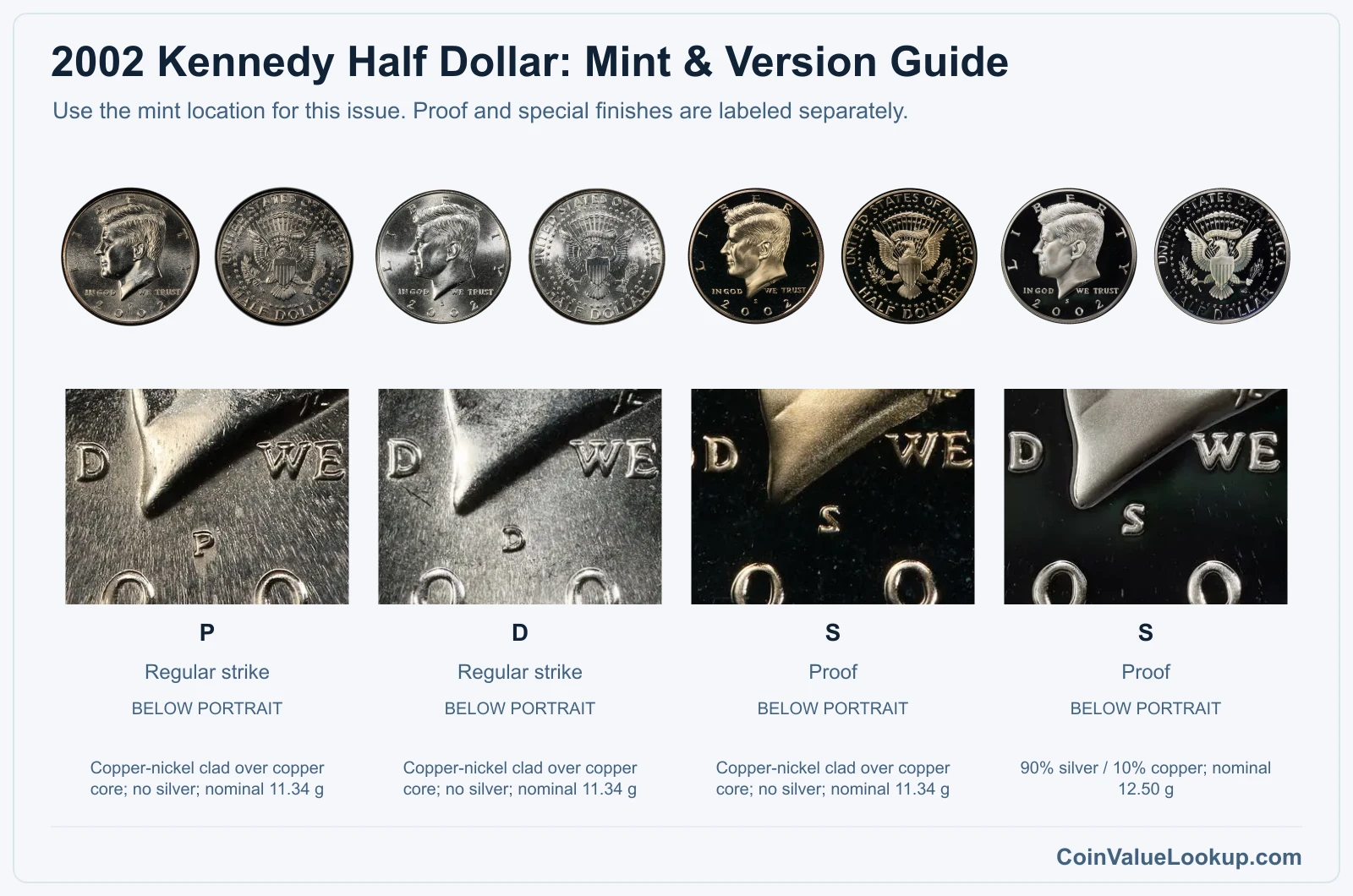
The 2002 Kennedy half dollar carries a face value of fifty cents, and most worn clad examples are worth exactly that. Collector guide estimates from USA Coin Book place the four main branches between roughly $3.62 and $36.00, depending on mint, finish and grade.
Before you check a price chart, you need to know whether your coin is a standard clad strike, a clad proof or the heavier silver proof.
Fast Way to Identify Your 2002 Kennedy Half Dollar
The quickest way to narrow down your 2002 Kennedy half is to upload clear photos of both the front and back. Our identifier can give you a preliminary read on the mint, finish and general version so you know which branch of the price chart applies.
Snap both sides in even lighting and avoid glare on the fields.
2002 Kennedy Half Dollar Value
Upload both sides of your 2002 Kennedy Half Dollar.
Front Obverse
Upload photo
Back Reverse
Upload photo
Which 2002 Kennedy Half Dollar Versions Are Worth Money?
- The 2002-S silver proof at PR65 carries a USA Coin Book guide estimate of $36.00, the highest listed branch for this date.
- Clad proofs from San Francisco are estimated around $6.25 at PR65 — modest but well above face value.
- Business strikes from P or D in original MS65 condition list at $3.62; lower grades are typically face-value coins.
- Mint-made errors such as doubled dies or wrong-planchet strikes can carry premiums, though values depend on the specific error and its condition.
Step 1: Identify Your 2002 Kennedy Half Dollar Mint Mark and Version
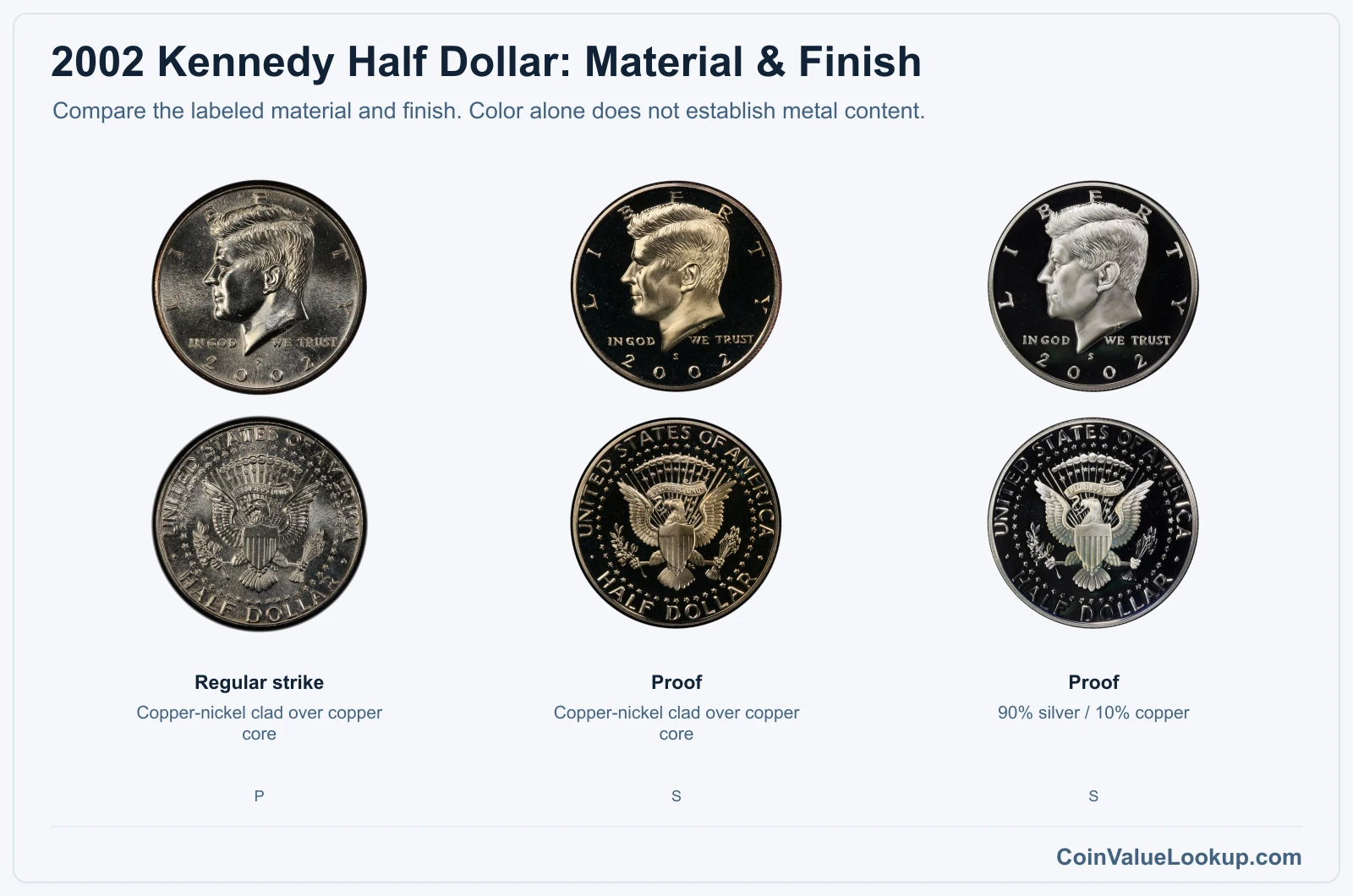
Flip your coin to the obverse and look just beneath Kennedy's portrait, above the date. You should see either a P, a D, or an S mintmark.
No mintmark at all means Philadelphia production from before 1980, which does not apply here.
P and D strikes are copper-nickel clad business coins. An S mintmark means your coin was made in San Francisco, but that still leaves two possibilities: a clad proof and a 90% silver proof.
To tell the two S-mint proofs apart, compare weight and edge. The silver proof weighs about 12.50 grams versus roughly 11.34 grams for clad.
On the edge of a clad coin you can often spot a visible copper-colored stripe; a silver proof's edge is uniformly silver-white.
Don't rely on surface color alone. Toning, lighting and even cleaning can make a clad coin look silver or vice versa.
Original government packaging is a strong clue — silver proofs shipped in separate cases — but a scale settles it.
Step 2: Check Your 2002 Kennedy Half Dollar Grade
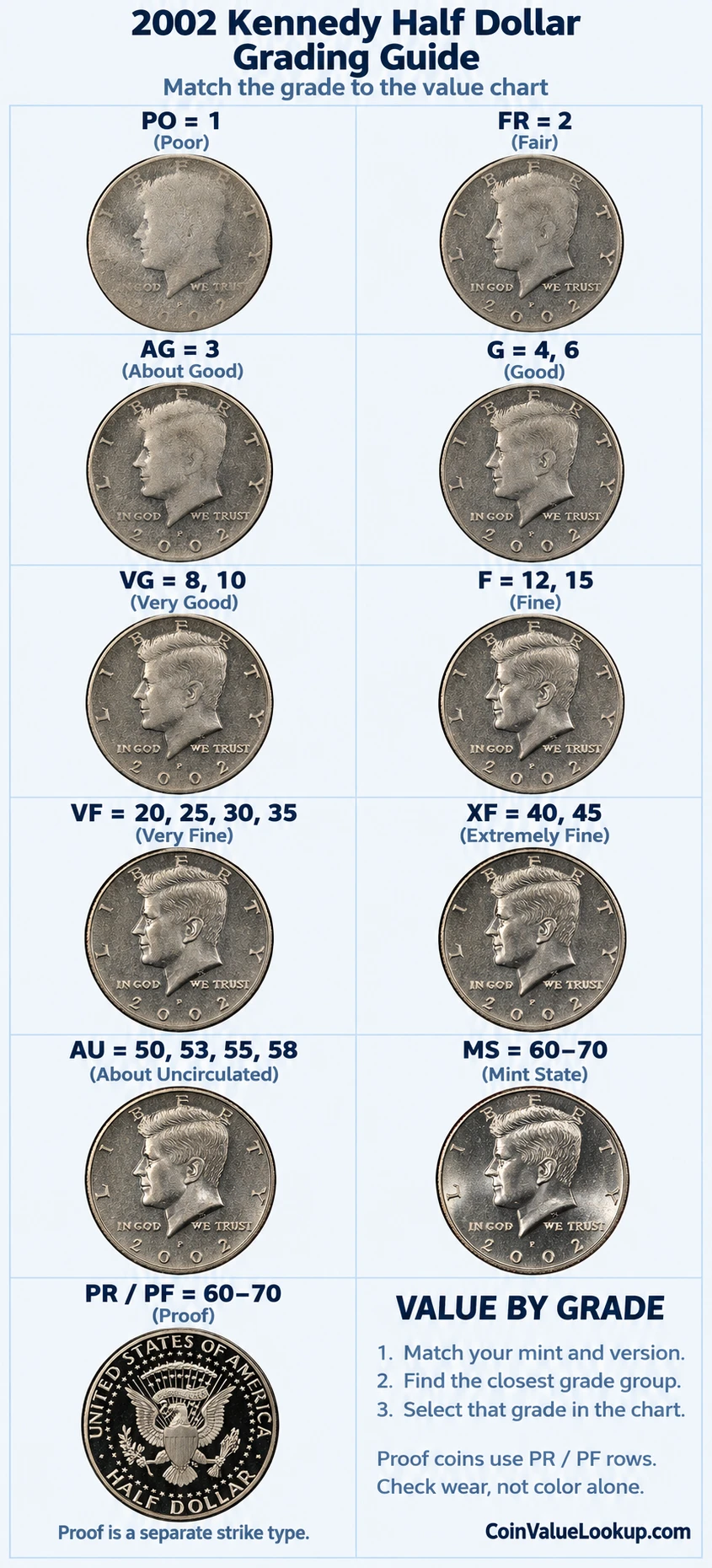
Start with Kennedy's cheek and jawline on the obverse. On a well-circulated coin these areas go flat and lose texture first.
Then check the hair just above the ear — fine strands disappear quickly with wear.
On the reverse, the eagle's breast feathers and the tops of the wings show wear soonest. If those areas are mushy but the rest looks sharp, you are probably looking at an AU or lower-end Mint State coin.
Mint State coins can still look rough. Bag marks — small nicks from coins banging together in storage — lower the grade without being circulation wear.
A coin covered in contact marks might technically be uncirculated yet grade well below MS65.
Proofs get their own scale. Look for hairlines from mishandling, haze from improper storage, and contact marks on the mirrored fields.
Even light fingerprint residue can knock a proof down a grade or two. Use the comparison image to calibrate your eye against known examples at different grade levels.
Step 3: Check 2002 Kennedy Half Dollar Value by Mint and Version
2002 Kennedy Half Dollar — P — clad business
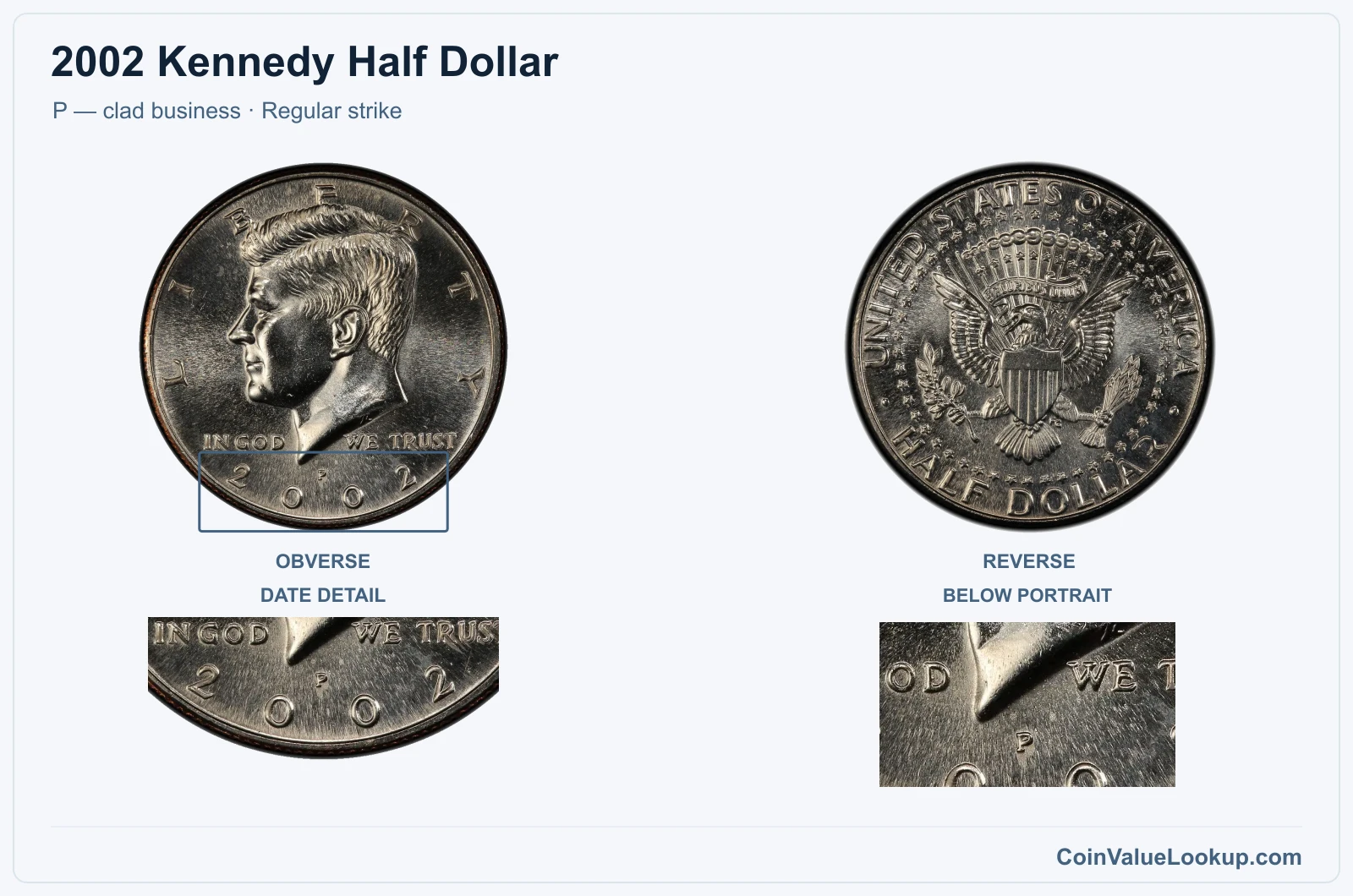
The 2002-P Kennedy half is a copper-nickel clad business strike. Look for the P mintmark beneath Kennedy's portrait on the obverse.
Most of these were sold in mint sets rather than released into everyday circulation, so finding one in change is uncommon.
A worn example is a face-value coin. In original MS65 condition, USA Coin Book lists a guide estimate of $3.62.
Because many survivors came straight out of mint sets, the typical example is either high-grade or shows handling damage from being broken out of packaging and spent. Check for bag marks and toning before assuming yours is gem quality.
Range Grade
Price Auction Records Appraisal PO PO 1
—
Coin Identifier FR FR 2
—
Coin Identifier AG AG 3
—
Coin Identifier G G 4
—
Coin Identifier
G 6
—
Coin Identifier VG VG 8
—
Coin Identifier
VG 10
—
Coin Identifier F F 12
—
Coin Identifier
F 15
—
Coin Identifier VF VF 20
—
Coin Identifier
VF 25
—
Coin Identifier
VF 30
—
Coin Identifier
VF 35
—
Coin Identifier XF XF 40
—
Coin Identifier
XF 45
—
Coin Identifier AU AU 50
—
Coin Identifier
AU 53
—
Coin Identifier
AU 55
—
Coin Identifier
AU 58
—
Coin Identifier MS MS 60
—
Coin Identifier
MS 61
—
Coin Identifier
MS 62
—
Coin Identifier
MS 63
—
Coin Identifier
MS 64
—
Coin Identifier
MS 65
Coin Identifier
MS 66
Coin Identifier
MS 67
Coin Identifier
MS 68
Coin Identifier
MS 69
—
—
—
MS 70
—
—
—
2002 Kennedy Half Dollar — D — clad business
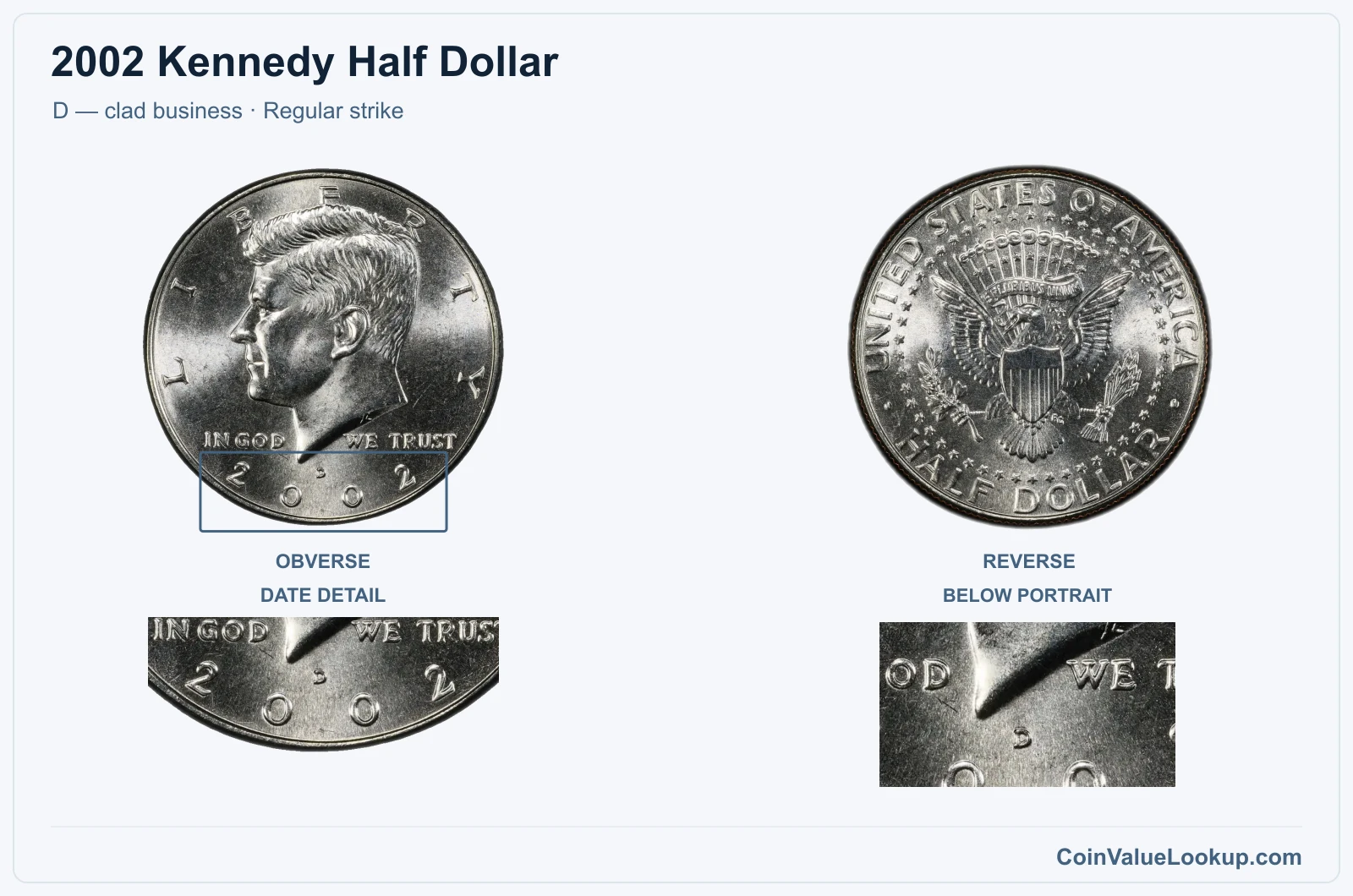
The 2002-D carries a Denver mintmark in the same location beneath Kennedy's portrait. Like its Philadelphia sibling, it was distributed primarily through mint sets rather than bank rolls.
At MS65 the USA Coin Book guide estimate is $3.62. Worn pieces trade at face value.
If yours came from an opened mint set, inspect the fields carefully — even light scuffs from the original plastic holder can affect the grade.
Coin Value Lookup is a handy starting point when you want to look up guide values for other Kennedy half dollar dates or different coin series entirely.
Range Grade
Price Auction Records Appraisal PO PO 1
—
Coin Identifier FR FR 2
—
Coin Identifier AG AG 3
—
Coin Identifier G G 4
—
Coin Identifier
G 6
—
Coin Identifier VG VG 8
—
Coin Identifier
VG 10
—
Coin Identifier F F 12
—
Coin Identifier
F 15
—
Coin Identifier VF VF 20
—
Coin Identifier
VF 25
—
Coin Identifier
VF 30
—
Coin Identifier
VF 35
—
Coin Identifier XF XF 40
—
Coin Identifier
XF 45
—
Coin Identifier AU AU 50
—
Coin Identifier
AU 53
—
Coin Identifier
AU 55
—
Coin Identifier
AU 58
—
Coin Identifier MS MS 60
—
Coin Identifier
MS 61
—
Coin Identifier
MS 62
—
Coin Identifier
MS 63
—
Coin Identifier
MS 64
—
Coin Identifier
MS 65
—
Coin Identifier
MS 66
Coin Identifier
MS 67
Coin Identifier
MS 68
—
Coin Identifier
MS 69
—
—
—
MS 70
—
—
—
2002 Kennedy Half Dollar — S — clad proof
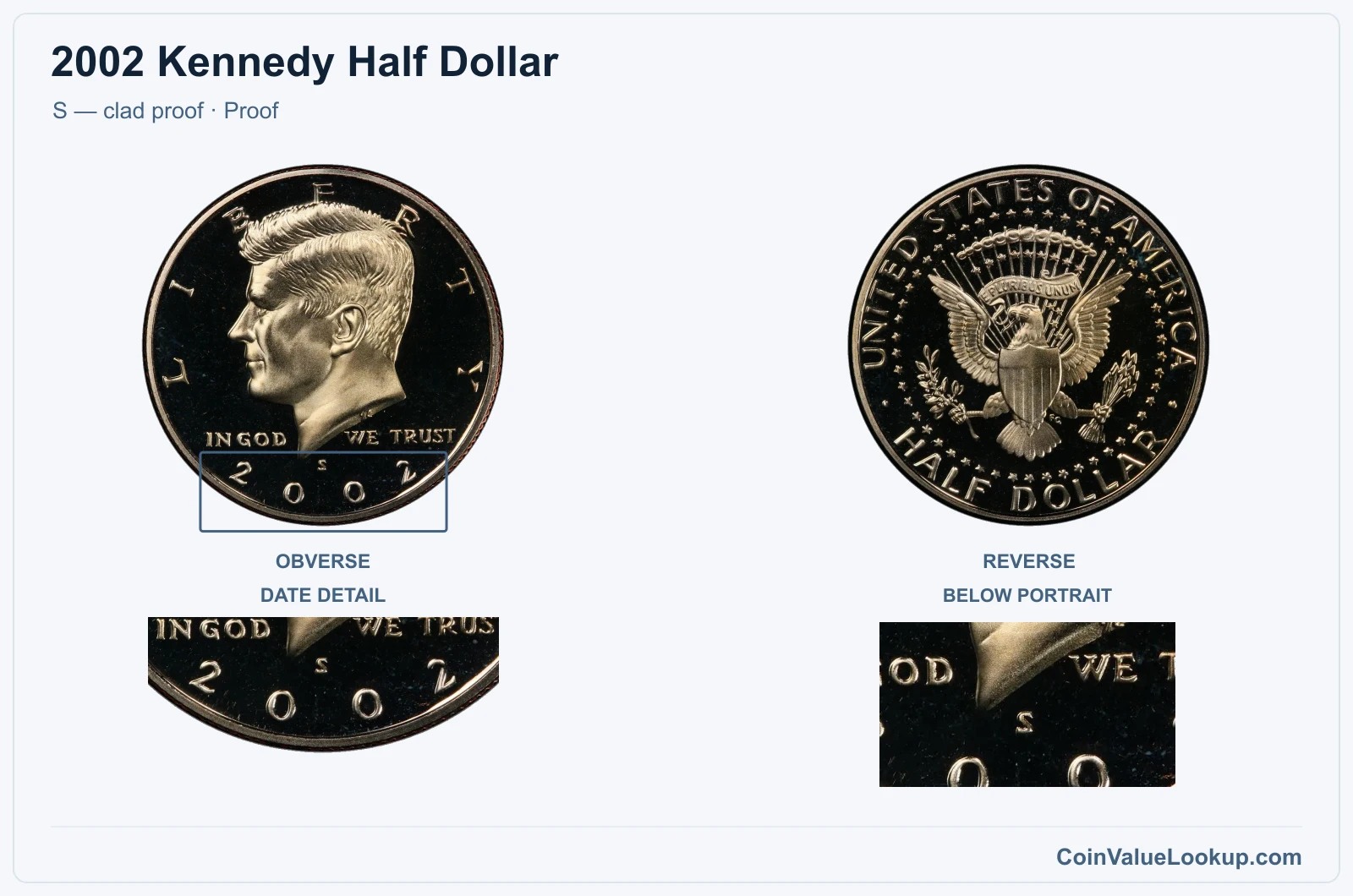
The 2002-S clad proof was struck at San Francisco on the same copper-nickel clad planchet used for business strikes. The difference is the finish: mirror-like fields with frosted, sculpted devices.
At PR65, the USA Coin Book guide estimate sits at $6.25. That is above face value but not dramatic.
Condition matters — hairlines across the mirrored fields or haze from humidity will push the grade down. Always handle proof coins by their edges.
If your coin still lives in its original government capsule, leave it there.
Range Grade
Price Auction Records Appraisal PR PR 1
—
Coin Identifier
PR 2
—
Coin Identifier
PR 3
—
Coin Identifier
PR 4
—
Coin Identifier
PR 6
—
Coin Identifier
PR 8
—
Coin Identifier
PR 10
—
Coin Identifier
PR 12
—
Coin Identifier
PR 15
—
Coin Identifier
PR 20
—
Coin Identifier
PR 25
—
Coin Identifier
PR 30
—
Coin Identifier
PR 35
—
Coin Identifier
PR 40
—
Coin Identifier
PR 45
—
Coin Identifier
PR 50
—
Coin Identifier
PR 53
—
Coin Identifier
PR 55
—
Coin Identifier
PR 58
—
Coin Identifier
PR 60
—
Coin Identifier
PR 61
—
Coin Identifier
PR 62
—
Coin Identifier
PR 63
—
Coin Identifier
PR 64
—
Coin Identifier
PR 65
—
Coin Identifier
PR 66
—
Coin Identifier
PR 67
—
Coin Identifier
PR 68
—
Coin Identifier
PR 69
Coin Identifier
PR 70
Coin Identifier
2002 Kennedy Half Dollar — S — silver proof
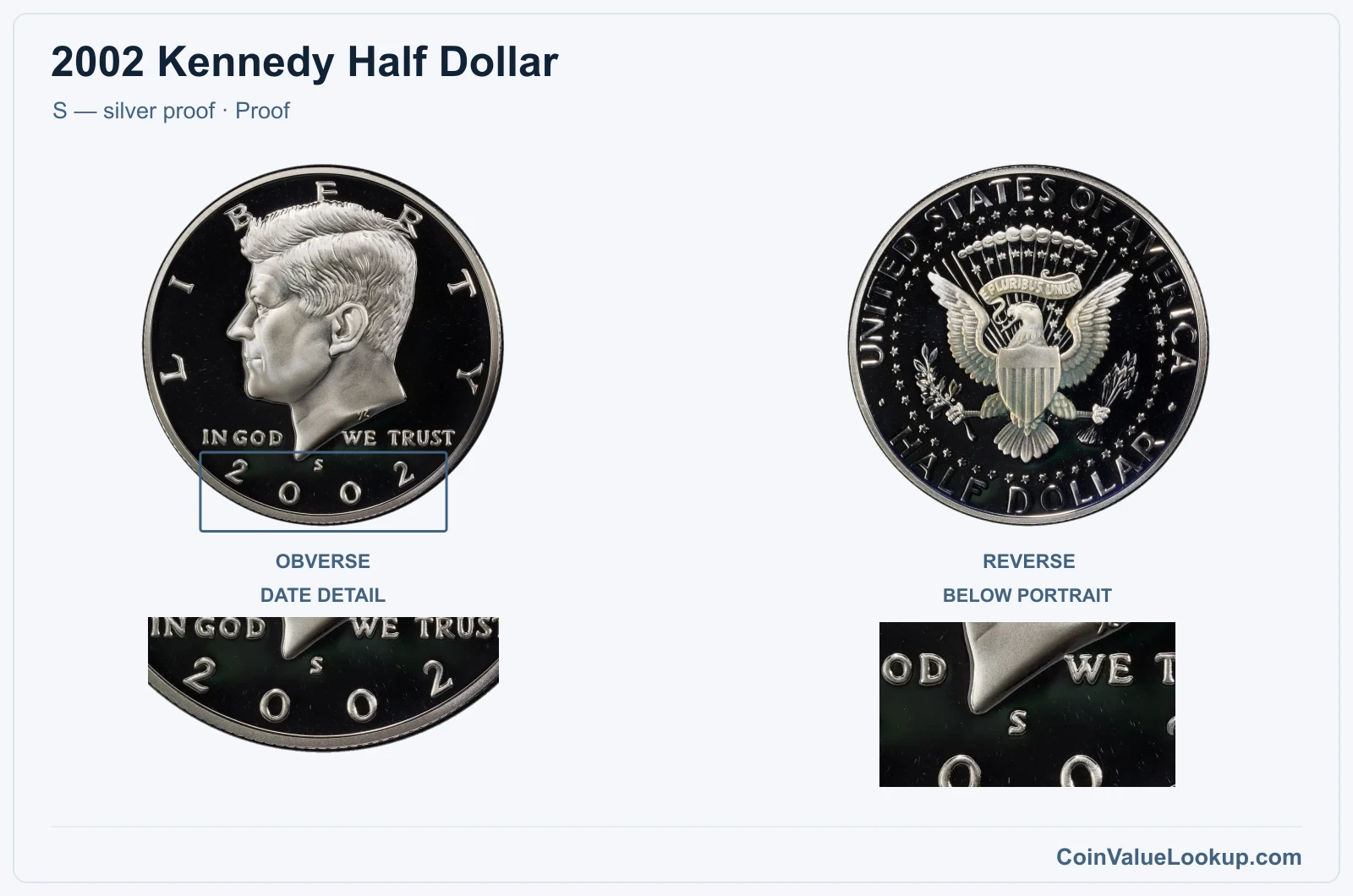
This is the branch collectors care about most from the 2002 date. The silver proof is struck on a 90% silver, 10% copper planchet weighing approximately 12.50 grams — noticeably heavier than the 11.34-gram clad version.
It also carries an S mintmark, so you cannot separate it from the clad proof by mintmark alone. Weigh it.
If you do not have a scale, check the edge: a uniform silver-white edge with no copper stripe confirms silver composition.
USA Coin Book lists the PR65 guide estimate at $36.00, the highest value among the four 2002 Kennedy branches at their listed grades. Keep in mind that silver proof fineness changed to .999 fine starting in 2019, but this 2002 issue is the older 90% formula.
Range Grade
Price Auction Records Appraisal PR PR 1
—
Coin Identifier
PR 2
—
Coin Identifier
PR 3
—
Coin Identifier
PR 4
—
Coin Identifier
PR 6
—
Coin Identifier
PR 8
—
Coin Identifier
PR 10
—
Coin Identifier
PR 12
—
Coin Identifier
PR 15
—
Coin Identifier
PR 20
—
Coin Identifier
PR 25
—
Coin Identifier
PR 30
—
Coin Identifier
PR 35
—
Coin Identifier
PR 40
—
Coin Identifier
PR 45
—
Coin Identifier
PR 50
—
Coin Identifier
PR 53
—
Coin Identifier
PR 55
—
Coin Identifier
PR 58
—
Coin Identifier
PR 60
—
Coin Identifier
PR 61
—
Coin Identifier
PR 62
—
Coin Identifier
PR 63
—
Coin Identifier
PR 64
—
Coin Identifier
PR 65
—
Coin Identifier
PR 66
—
Coin Identifier
PR 67
—
Coin Identifier
PR 68
—
Coin Identifier
PR 69
Coin Identifier
PR 70
Coin Identifier
2002 Kennedy Half Dollar Error List
1. 2002 Kennedy Half Dollar — Doubled Die Obverse
A doubled die obverse on the 2002 Kennedy half shows consistent doubling on obverse design elements — typically lettering or date digits. Under magnification you would see separation or notching that repeats in the same direction across multiple letters, not just one spot.
The key word is consistent. Machine doubling, which is far more common, produces a flat, shelf-like distortion that lacks the sharp secondary image of a true doubled die.
Reflections in the field near raised devices can also mimic doubling in photographs.
Condition, the strength of the doubling and the specific die involved all affect what a doubled die obverse is worth. No reliable numerical range is available for this date, so individual assessment is necessary.
2. 2002 Kennedy Half Dollar — Doubled Die Reverse
A doubled die reverse affects the back of the coin — look at the legend, motto and eagle design contours. Compare your coin side by side with a normal 2002 half under the same lighting and magnification.
Genuine doubling will show a secondary outline or notching that is directionally consistent across several design elements. Machine doubling, by contrast, tends to produce a mushy, flat shelf with no distinct secondary image.
Random scratches and die polish lines can also look suspicious in photos but lack the systematic pattern.
Value depends on the visibility and the specific die pair, and no adopted price range is available. A professional opinion is worthwhile if the doubling is strong and repeatable.
3. 2002 Kennedy Half Dollar — Struck-Through Error
A struck-through error occurs when foreign material — grease, a fragment of metal, thread or debris — sits between the die and the planchet during striking. The result is a localized depression or incomplete design area on the finished coin.
Grease-filled dies tend to leave a smooth, slightly sunken blank patch, often in recessed areas of the design. A retained foreign object can leave a distinct impression of its shape.
Either way, the affected zone should show no tool marks or scratches that would suggest post-mint damage.
Ordinary wear, cleaning or a weakly struck area from low die pressure can look similar at a glance. The difference is that a struck-through defect is sharply defined against the surrounding normal strike.
Value varies with size, location and overall coin condition; no adopted price data is available for this date.
4. 2002 Kennedy Half Dollar — Die Crack / Die Chip
Die cracks appear as thin raised lines on the coin's surface, formed when a crack in the steel die transfers as raised metal during striking. A die chip is a small raised blob where a piece of the die face broke away, leaving a void that fills with metal.
If the crack runs from the interior of the design out to the rim and a larger section of die has broken, that is sometimes called a cud — a flat, featureless raised area at the rim. Smaller interior cracks and chips are more common.
Do not confuse raised die cracks with incuse scratches, which are cut into the surface rather than raised above it. Corrosion or foreign material deposits can also create raised bumps but usually lack the linear pattern of a crack.
No adopted price range is available; value depends on size, location and the coin's overall condition.
5. 2002 Kennedy Half Dollar — Wrong Planchet / Off-Metal Strike
A wrong-planchet error means the 2002 Kennedy half dollar design was struck on a blank intended for a different denomination or even a different country's coin. The result is a coin that looks like a Kennedy half but has the wrong weight, diameter or edge characteristics.
To check, weigh your coin and measure its diameter. A normal clad Kennedy half weighs about 11.34 grams and measures 30.6 mm.
Any significant deviation — especially combined with an incomplete or misaligned design — suggests something unusual.
Be cautious. Plating, acid damage, environmental corrosion and deliberate alteration can all change a coin's appearance and weight enough to mimic an off-metal strike.
If the coin's weight and diameter match normal specs, it is almost certainly standard. No adopted price data is available for this error on the 2002 date, so professional evaluation is recommended for any suspected example.