1848 Liberty Seated Half Dollar Coin Value: How Much Is It Worth?
An 1848 Liberty Seated Half Dollar in well-worn Good-4 condition carries a guide value around $111 for a Philadelphia strike, climbing to roughly $879 near AU-50. New Orleans coins and scarce Proof strikes follow their own curves.
What your particular coin is worth depends on its grade, which mint produced it, and whether it carries any die variety or error. None of the rare auction figures mentioned below reflect what a typical circulated example will bring.
Fast Way to Identify Your 1848 Liberty Seated Half Dollar
The quickest way to start figuring out what you have is to upload clear photos of the front and back of your coin. Our identifier can give you a preliminary read on the date, mint and general type so you know which value range to explore.
Snap both sides in even lighting and avoid any cleaning before you photograph.
1848 Liberty Seated Half Dollar Value
Upload both sides of your 1848 Liberty Seated Half Dollar.
Front Obverse
Upload photo
Back Reverse
Upload photo
Which 1848 Liberty Seated Half Dollar Versions Are Worth Money?
- Philadelphia business strikes range from about $111 in Good-4 to $879 near AU-50 per USA Coin Book guide estimates, making even worn examples worth checking.
- New Orleans (O mintmark) coins start lower at roughly $80 in G-4 but remain solid silver-content pieces worth identifying.
- Philadelphia Proof strikes are scarce survivors; a single PR-66 example sold for $74,750 at Heritage in 2008.
- Die errors such as repunched dates, doubled dies, crumbling dies, and die breaks can add a premium that depends on visibility and condition.
Step 1: Identify Your 1848 Liberty Seated Half Dollar Mint Mark and Version
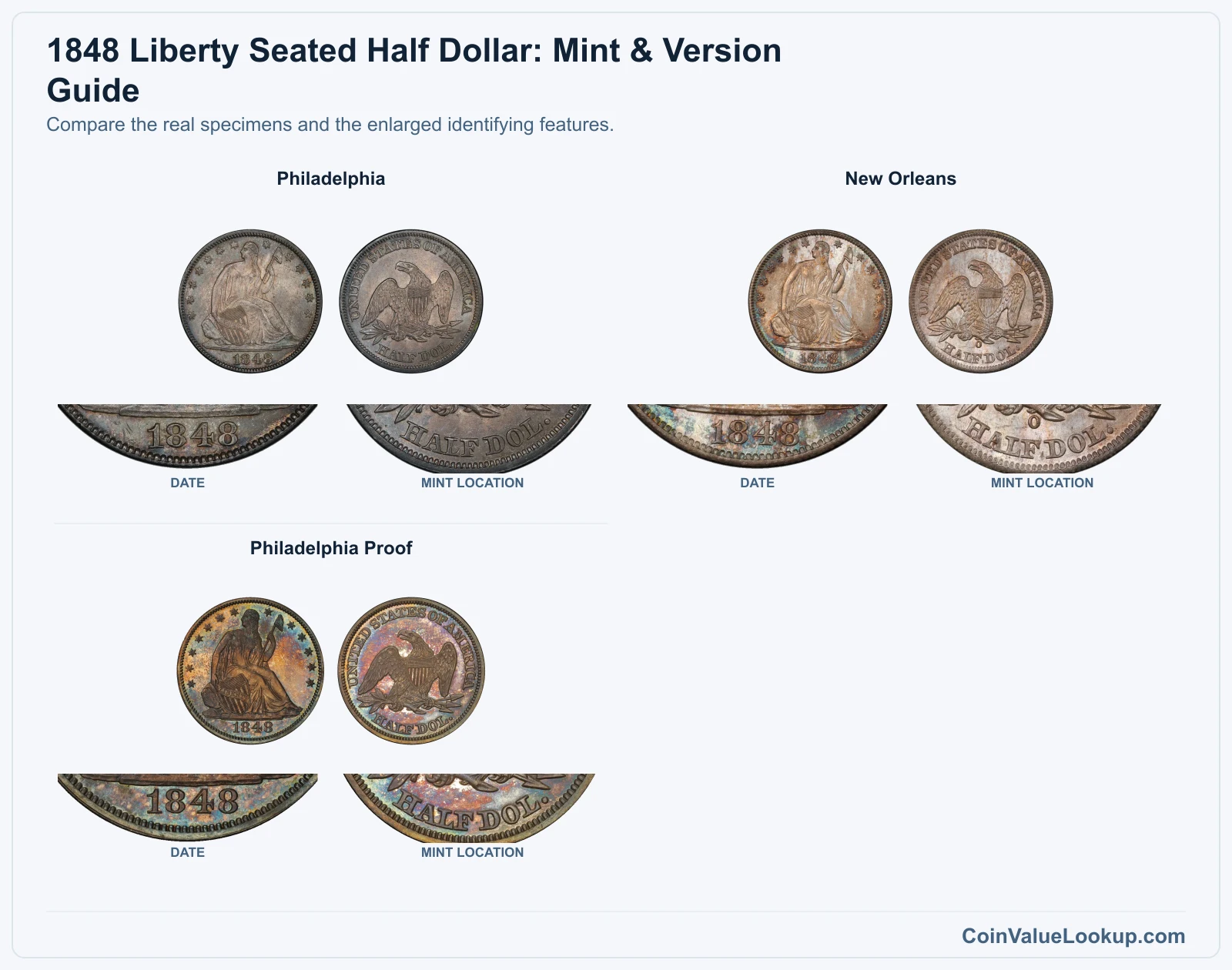
The obverse shows a seated Liberty figure holding a pole topped with a cap, surrounded by thirteen stars and the date 1848. The reverse displays an eagle clutching arrows and an olive branch with HALF DOL.
at the bottom. There is no IN GOD WE TRUST motto on this date.
Flip the coin over and look directly below the eagle. A small "O" means New Orleans.
No letter at all means Philadelphia. That single detail shifts your value range immediately.
The coin is struck in 90% silver and 10% copper, weighing 13.36 grams under the old pre-1853 standard. Later Seated halves weigh less and show arrowheads at the date, but your 1848 should have neither arrows nor rays.
Proof 1848 half dollars exist but are genuinely rare. Mirror-like fields alone do not make a Proof; cleaned or lightly circulated business strikes can fool you.
A real Proof shows squared, knife-edge rims, fully struck devices, and deep reflectivity on both sides. If you suspect a Proof, professional authentication is the right next step.
Step 2: Check Your 1848 Liberty Seated Half Dollar Grade
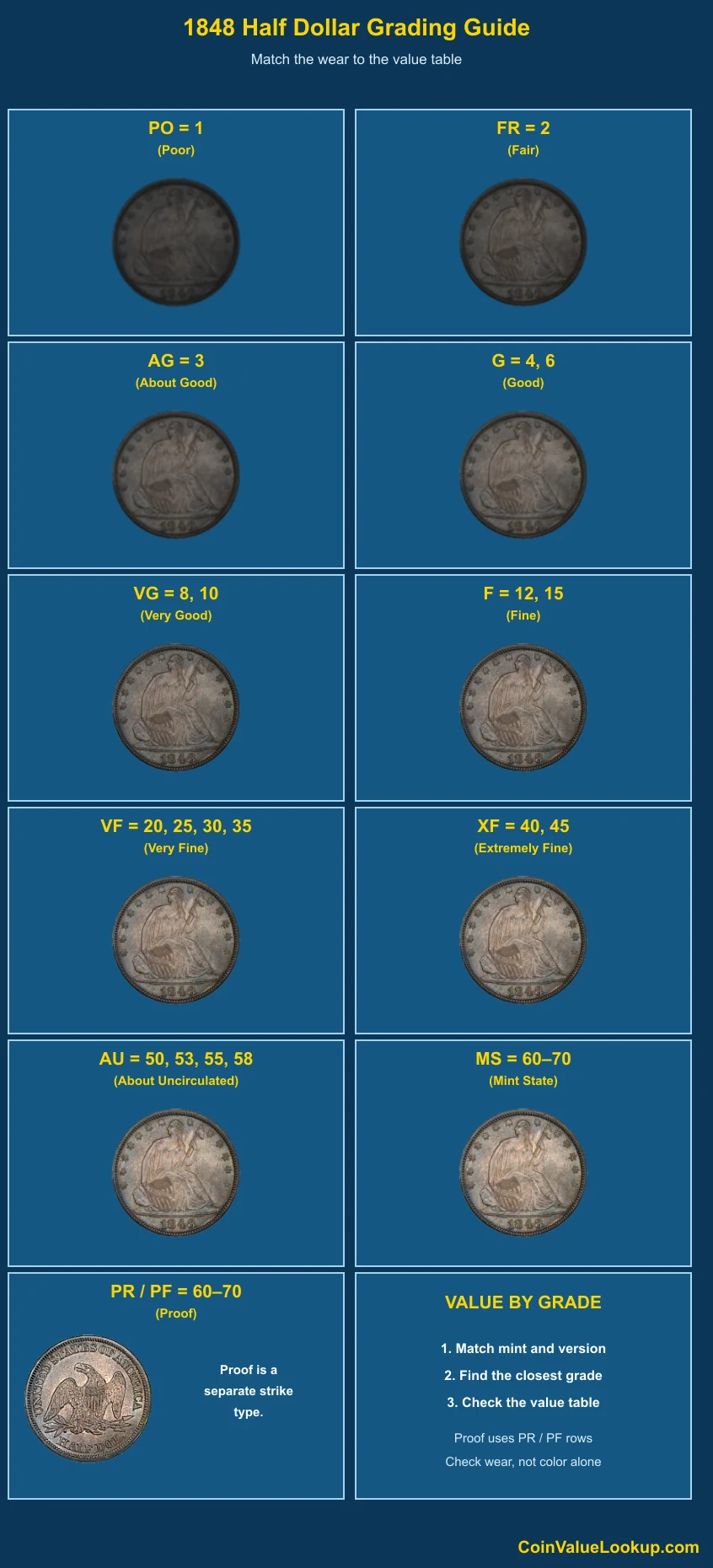
Start by checking the high points on Liberty's figure: her head, the area across her breast, and the knee of the forward leg. On a well-worn coin these merge into flat shapes with no interior detail.
The shield on her lap loses its horizontal lines early, so count how many remain.
On the reverse, examine the eagle's breast feathers, wing tips, and claws. Sharp individual feathers mean a higher grade; smooth lumps mean heavy wear.
One caution with this series: weak strikes can mimic wear. A weakly struck coin still shows original mint luster in protected areas, while a genuinely worn coin does not.
Compare your piece to the type-matched grading image to see where true wear versus strike softness shows up.
Photograph both faces and the edge in good light. Do not clean the coin, even if it looks dark.
Cleaning removes original surfaces and almost always reduces value.
Step 3: Check 1848 Liberty Seated Half Dollar Value by Mint and Version
1848 Liberty Seated Half Dollar — Philadelphia
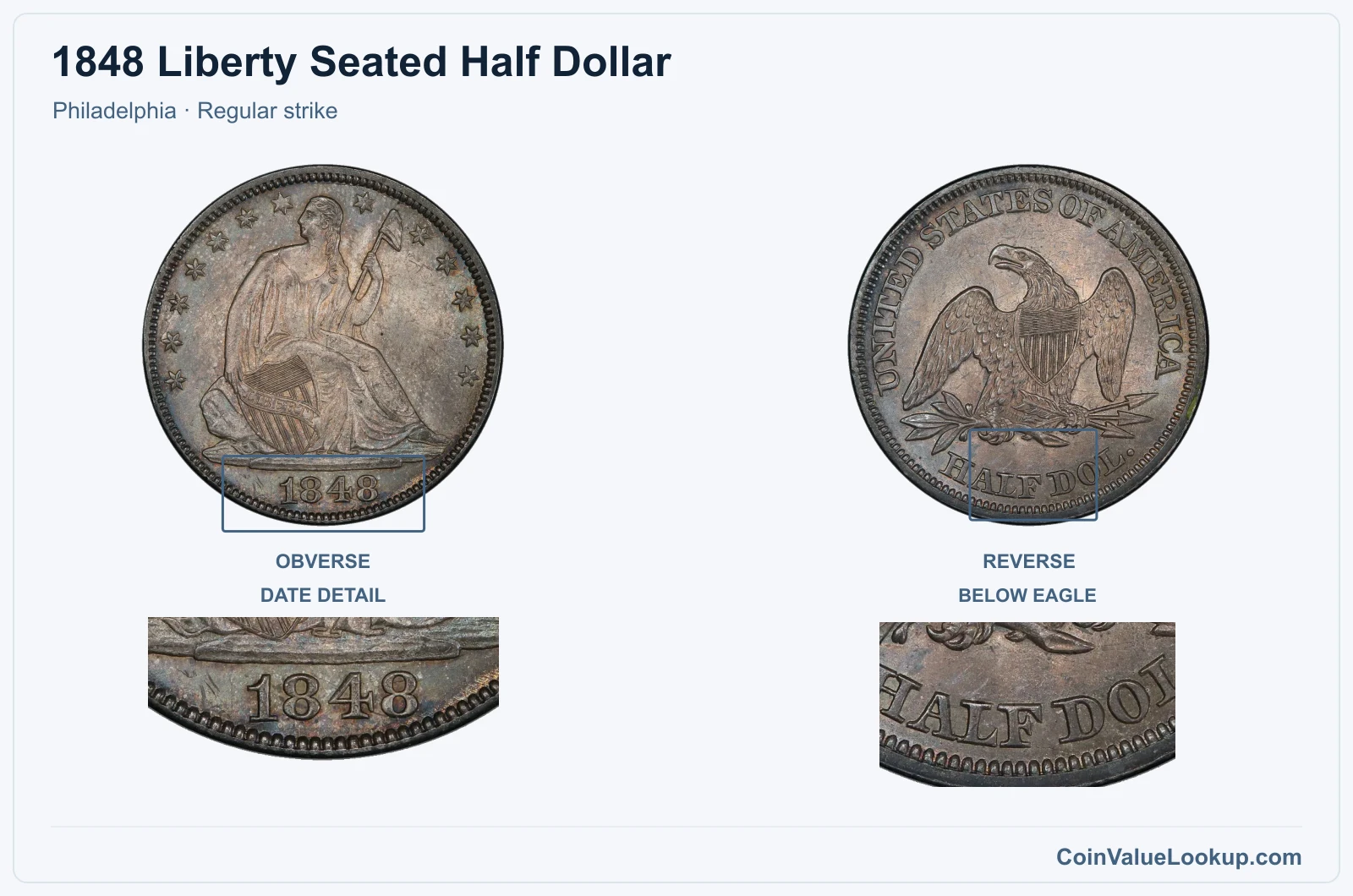
The Philadelphia issue carries no mintmark below the reverse eagle. In Good-4 condition, USA Coin Book places a guide value around $111.
That rises to roughly $332 at VF-20, where you can still see moderate wear but Liberty's major details remain clear, and reaches about $879 near AU-50, a grade showing only light friction on the highest points.
These are guide estimates, not guaranteed sale prices. Your actual result depends on surface quality, eye appeal, and whether the coin has been cleaned.
Several Philadelphia dies from 1848 also produced repunched dates and other varieties, which are covered in the error section below.
Range Grade
Price Auction Records Appraisal PO PO 1
—
Coin Identifier FR FR 2
—
Coin Identifier AG AG 3
—
Coin Identifier G G 4
—
Coin Identifier
G 6
—
Coin Identifier VG VG 8
—
Coin Identifier
VG 10
Coin Identifier F F 12
—
Coin Identifier
F 15
Coin Identifier VF VF 20
Coin Identifier
VF 25
Coin Identifier
VF 30
Coin Identifier
VF 35
Coin Identifier XF XF 40
Coin Identifier
XF 45
Coin Identifier AU AU 50
Coin Identifier
AU 53
Coin Identifier
AU 55
Coin Identifier
AU 58
Coin Identifier MS MS 60
Coin Identifier
MS 61
Coin Identifier
MS 62
Coin Identifier
MS 63
Coin Identifier
MS 64
Coin Identifier
MS 65
Coin Identifier
MS 66
—
—
—
MS 67
—
—
—
MS 68
—
—
—
MS 69
—
—
—
MS 70
—
—
—
1848 Liberty Seated Half Dollar — New Orleans
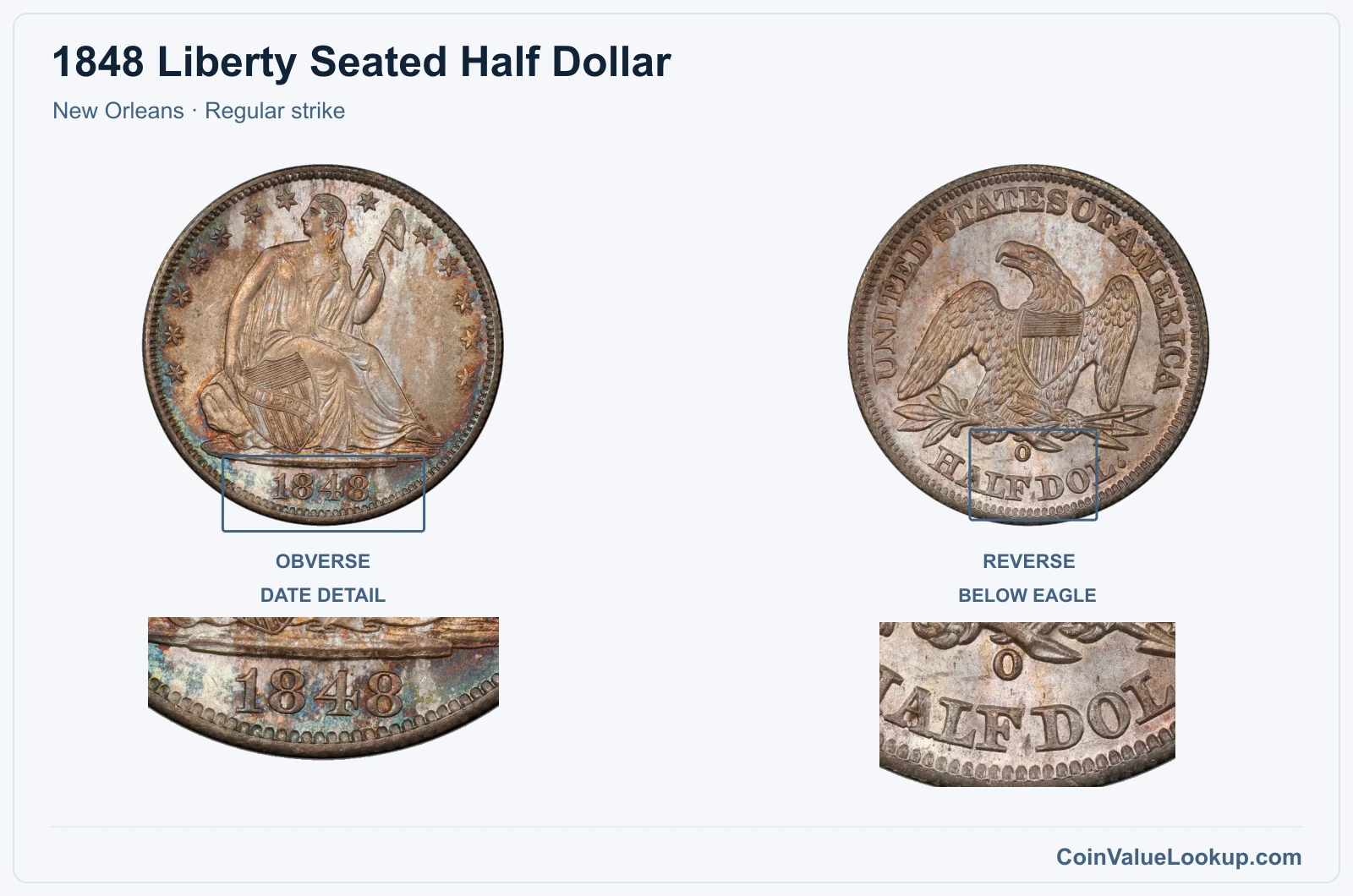
Look for a small "O" below the eagle on the reverse. That marks a New Orleans half dollar.
Guide values from USA Coin Book sit a bit below Philadelphia: around $80 in G-4, approximately $205 at VF-20, and roughly $576 near AU-50.
Coin Value Lookup is a handy starting point if you want to compare this date against other years in the Seated Liberty series or look up different denominations entirely.
The O mintmark can be faint on well-worn pieces, so tilt the coin under a light and check carefully. Confirming the mint is the first step toward an accurate value.
Range Grade
Price Auction Records Appraisal PO PO 1
—
Coin Identifier FR FR 2
—
Coin Identifier AG AG 3
—
Coin Identifier G G 4
—
Coin Identifier
G 6
—
Coin Identifier VG VG 8
—
Coin Identifier
VG 10
Coin Identifier F F 12
—
Coin Identifier
F 15
—
Coin Identifier VF VF 20
Coin Identifier
VF 25
—
Coin Identifier
VF 30
Coin Identifier
VF 35
Coin Identifier XF XF 40
Coin Identifier
XF 45
Coin Identifier AU AU 50
Coin Identifier
AU 53
Coin Identifier
AU 55
Coin Identifier
AU 58
Coin Identifier MS MS 60
—
Coin Identifier
MS 61
Coin Identifier
MS 62
Coin Identifier
MS 63
Coin Identifier
MS 64
Coin Identifier
MS 65
Coin Identifier
MS 66
Coin Identifier
MS 67
—
—
—
MS 68
—
—
—
MS 69
—
—
—
MS 70
—
—
—
1848 Liberty Seated Half Dollar — Philadelphia Proof
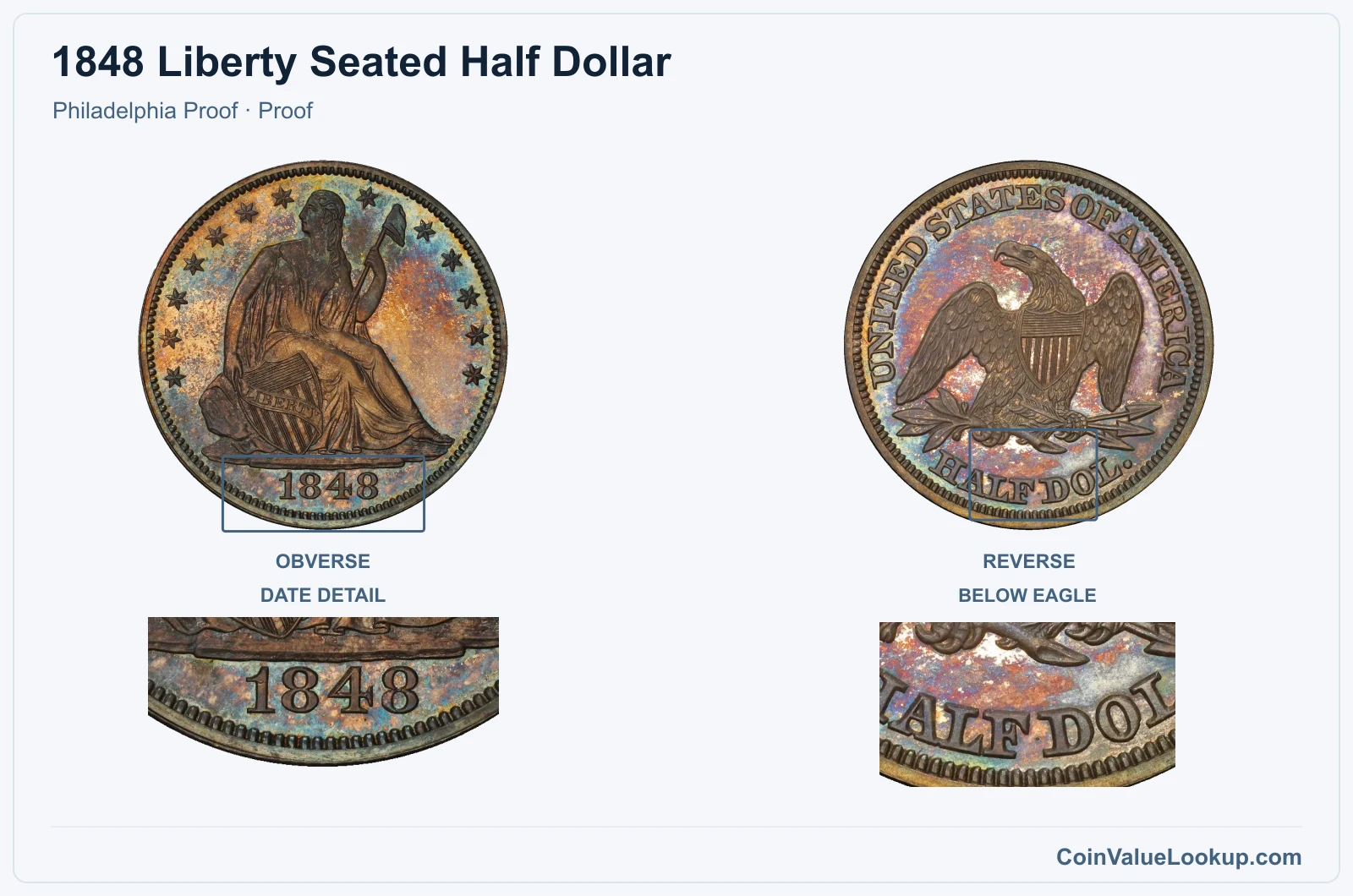
Philadelphia Proof half dollars from 1848 are rare collectibles made with specially prepared dies and polished planchets. They share the same design as the regular Philadelphia issue but show deeply mirrored fields, sharp rims, and fully rendered details that business strikes rarely match.
Do not assume a shiny coin is a Proof. Cleaned circulation strikes can look reflective at first glance, but they lack the squared-rim profile and consistent depth of mirror finish across both sides.
Professional certification is essentially required for this category.
The only confirmed recent sale in the supplied records is a PR-66 example that brought $74,750 through Heritage Auctions in 2008. That is a single historical result at a very high grade, not a current market curve, so treat it as a reference point rather than a promise of what any Proof 1848 half dollar would fetch today.
Range Grade
Price Auction Records Appraisal PR PR 1
—
Coin Identifier
PR 2
—
Coin Identifier
PR 3
—
Coin Identifier
PR 4
—
Coin Identifier
PR 6
—
Coin Identifier
PR 8
—
Coin Identifier
PR 10
—
Coin Identifier
PR 12
—
Coin Identifier
PR 15
—
Coin Identifier
PR 20
—
Coin Identifier
PR 25
—
Coin Identifier
PR 30
—
Coin Identifier
PR 35
—
Coin Identifier
PR 40
—
Coin Identifier
PR 45
—
Coin Identifier
PR 50
—
Coin Identifier
PR 53
—
Coin Identifier
PR 55
—
Coin Identifier
PR 58
—
Coin Identifier
PR 60
—
Coin Identifier
PR 61
—
Coin Identifier
PR 62
—
Coin Identifier
PR 63
—
Coin Identifier
PR 64
Coin Identifier
PR 65
Coin Identifier
PR 66
—
—
—
PR 67
—
—
—
PR 68
—
—
—
PR 69
—
—
—
PR 70
—
—
—
1848 Liberty Seated Half Dollar Error List
1. 1848 Liberty Seated Half Dollar — Repunched Date
Several 1848 Philadelphia dies show recut digits in the date, where a digit was punched into the die more than once in slightly different positions. Under magnification you will see traces of an extra digit outline overlapping one or more of the numerals.
The doubling is usually most visible on the 1 or the 8.
Do not confuse a repunched date with simple damage or machine doubling. Machine doubling produces flat, shelf-like distortion rather than a distinct second impression with its own rounded contours.
Post-strike scratches near the date can also mimic a repunch to the naked eye.
No specific price range is adopted for these varieties. The premium depends on how bold the repunching is, the overall condition of the coin, and collector demand for the particular die marriage.
A barely visible repunch on a worn coin adds little, while a dramatic example on a sharp piece is a different story.
2. 1848 Liberty Seated Half Dollar — Doubled Die Obverse
A Doubled Die Obverse on the 1848 half dollar means the obverse hub impressed the die twice in slightly offset positions, leaving doubled design elements beyond the date. Look for doubling on stars, lettering, or Liberty's features rather than just the numerals.
A repunched date alone does not prove a doubled die obverse, even though both can appear on the same coin.
The tricky part is distinguishing genuine hub doubling from machine doubling or worn-die softness. Hub doubling produces rounded, separated outlines with distinct depth.
Machine doubling tends to be flat and shelf-like, often appearing on one side only. Reflections under certain lighting can also imitate doubling.
No adopted price range exists for this variety. Value hinges on the strength of the doubling, the coin's grade, and how well the error photographs.
Any suspected doubled die should be compared carefully against an attributed reference image before drawing conclusions.
3. 1848 Liberty Seated Half Dollar — Crumbling Die
A crumbling die produces raised rough patches on the coin's surface. As a die deteriorates, pieces of its face flake away, and those missing chunks translate into lumpy raised areas on every coin struck afterward.
On the 1848 half dollar, multiple die states have been cataloged showing progressive die damage of this type.
These raised patches feel rough under magnification and stand above the normal field. Do not mistake corrosion pits, rim dings, or post-strike contact marks for crumbling die evidence.
Corrosion creates depressed pitting, while crumbling die marks are raised because they correspond to material lost from the die itself.
No specific price range is adopted here. The premium, if any, depends on how dramatic the crumbling is, the coin's overall grade, and whether the die state is recognized among collectors of the series.
4. 1848 Liberty Seated Half Dollar — Die Break / Cud
A die break or cud is a raised lump of metal connected to the rim, caused by a chunk of the die breaking away entirely. On one documented 1848 die pair, a rim-connected cud appears southwest of the date numeral 1, and a small companion die chip sits inside the reverse letter C.
The key diagnostic is that the raised blob touches the rim. Interior die chips that do not reach the rim are related but classified differently.
A rim dent or corrosion bump can look similar, so check that the feature is raised, smooth-topped, and consistent with metal flowing into a void in the die rather than being displaced by a hit.
No specific price is adopted for this variety. The size and location of the cud, the coin's condition, and buyer interest all influence any added value.
Larger, more visually striking cuds generally attract more attention than tiny rim chips.