1862 Liberty Seated Half Dollar Coin Value: How Much Is It Worth?
The 1862 Liberty Seated Half Dollar is a Civil War-era silver coin struck at Philadelphia and San Francisco. Philadelphia guide estimates range from about $141 in G4 to $808 in AU50.
San Francisco pieces start lower, around $91 in G4. Proofs, mintmark varieties and condition differences can push values well beyond those baselines, so identifying your exact version matters.
Fast Way to Identify Your 1862 Liberty Seated Half Dollar
The quickest way to start figuring out what you have is to upload clear photos of both sides of your coin. A front-and-back image lets us offer a preliminary identification of the mint, design type and general condition.
Snap the pictures in even lighting, avoid glare, and try to keep the coin flat and centered.
1862 Liberty Seated Half Dollar Value
Upload both sides of your 1862 Liberty Seated Half Dollar.
Front Obverse
Upload photo
Back Reverse
Upload photo
Which 1862 Liberty Seated Half Dollar Versions Are Worth Money?
- Philadelphia Type 2 pieces guide from $141 (G4) to $808 (AU50); higher grades can exceed that range.
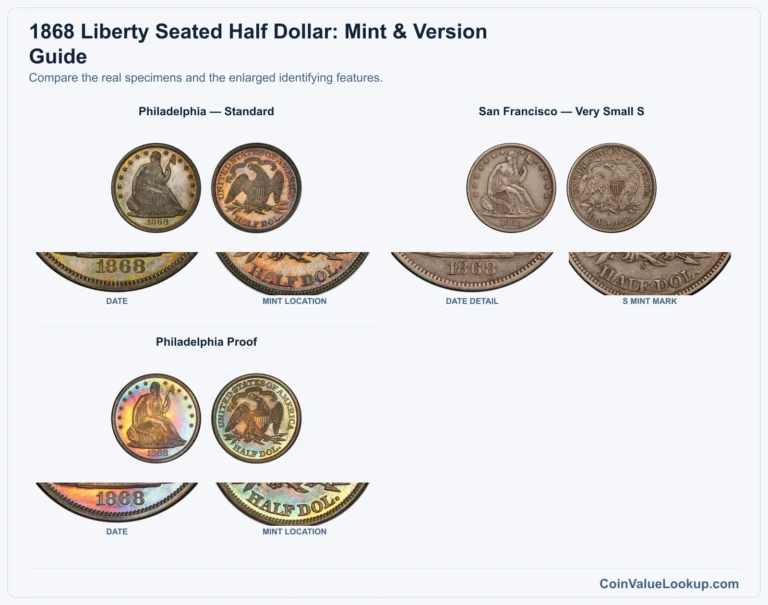
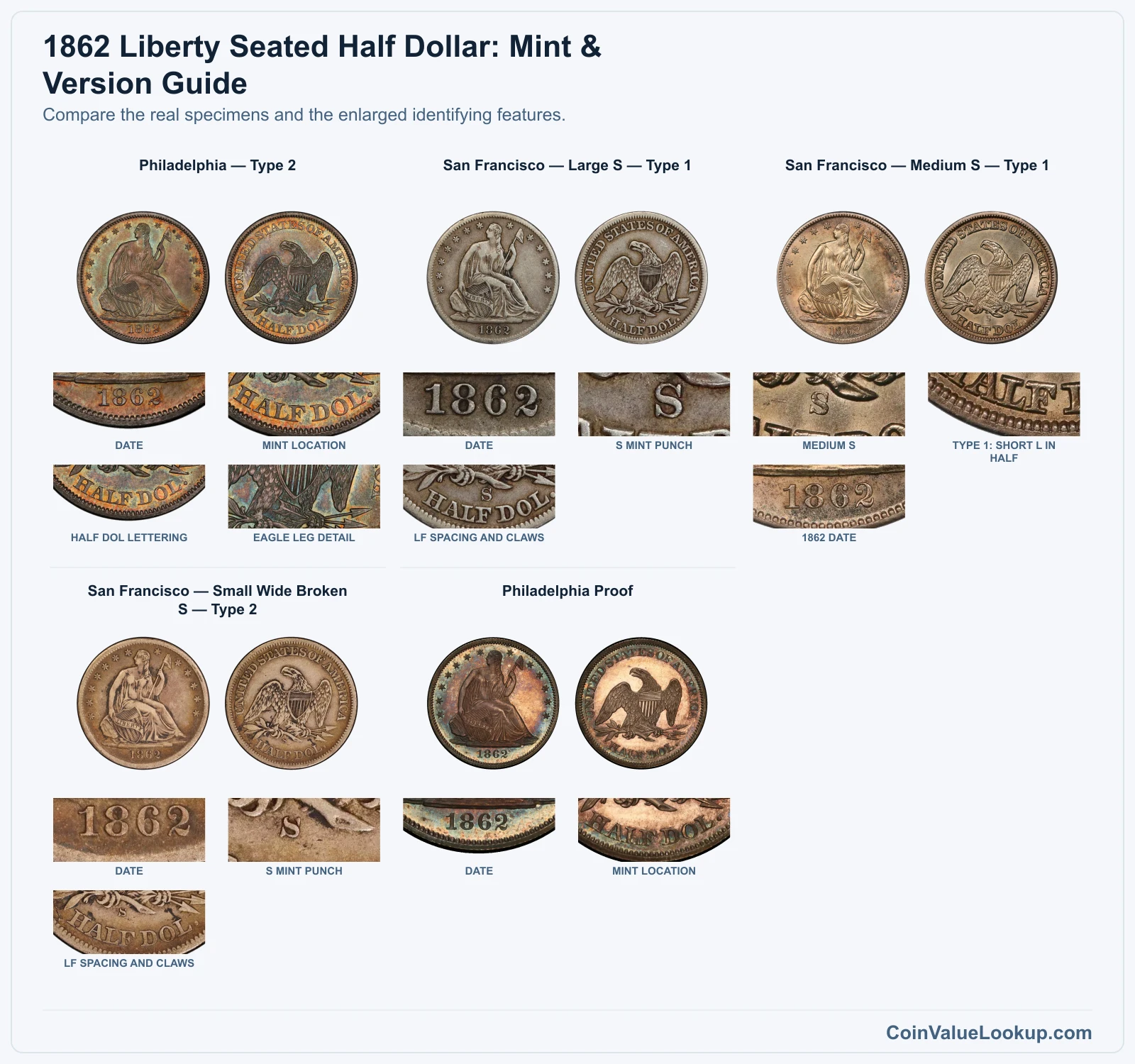
- San Francisco coins come in three mintmark punch styles — Large S, Medium S and Small Wide Broken S — each paired with a specific reverse type.
- Philadelphia Proofs are a separate category, with a PR63 guide value around $2,005.
- Clashed dies, die gouges and die cracks have been reported for 1862 and can add collector interest beyond base values.
Step 1: Identify Your 1862 Liberty Seated Half Dollar Mint Mark and Version
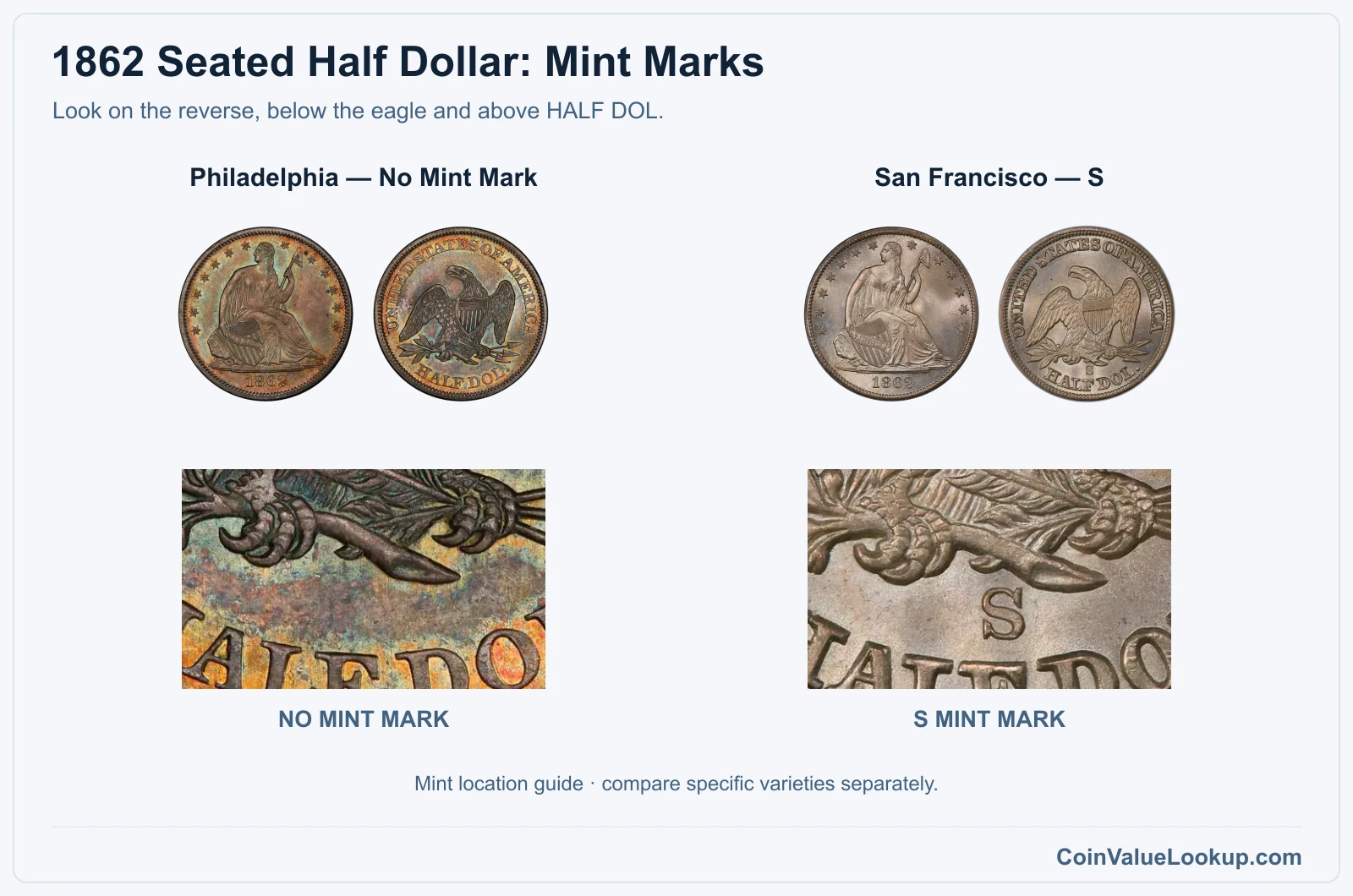
First, confirm you actually have a half dollar. Read the reverse: it says HALF DOL.
beneath the eagle. Half dimes and quarters can look similar at a glance, especially when worn, so that inscription is your anchor.
Next, check for a mintmark below the eagle on the reverse. Philadelphia coins have no mintmark at all.
San Francisco pieces carry an S in that spot. There is no O-mint (New Orleans) half dollar for 1862.
The coin is 90% silver and 10% copper, weighs about 12.44 grams and has a reeded edge. If it feels too light or the edge is smooth, you may have a counterfeit or a different denomination.
You will also see references to Type 1 and Type 2 reverses. These refer to different hub designs, not errors.
Type 1 has a short base on the letter L in HALF and no lump near the eagle's left leg. Type 2 has a longer L base and a small lump by that leg.
Both types exist for 1862.
Proof is a special manufacturing finish with mirrored fields and sharp rims. Do not assume a shiny coin is a Proof; brightness alone from cleaning does not qualify.
The motto IN GOD WE TRUST does not appear on this date; it was added in 1866.
Step 2: Check Your 1862 Liberty Seated Half Dollar Grade
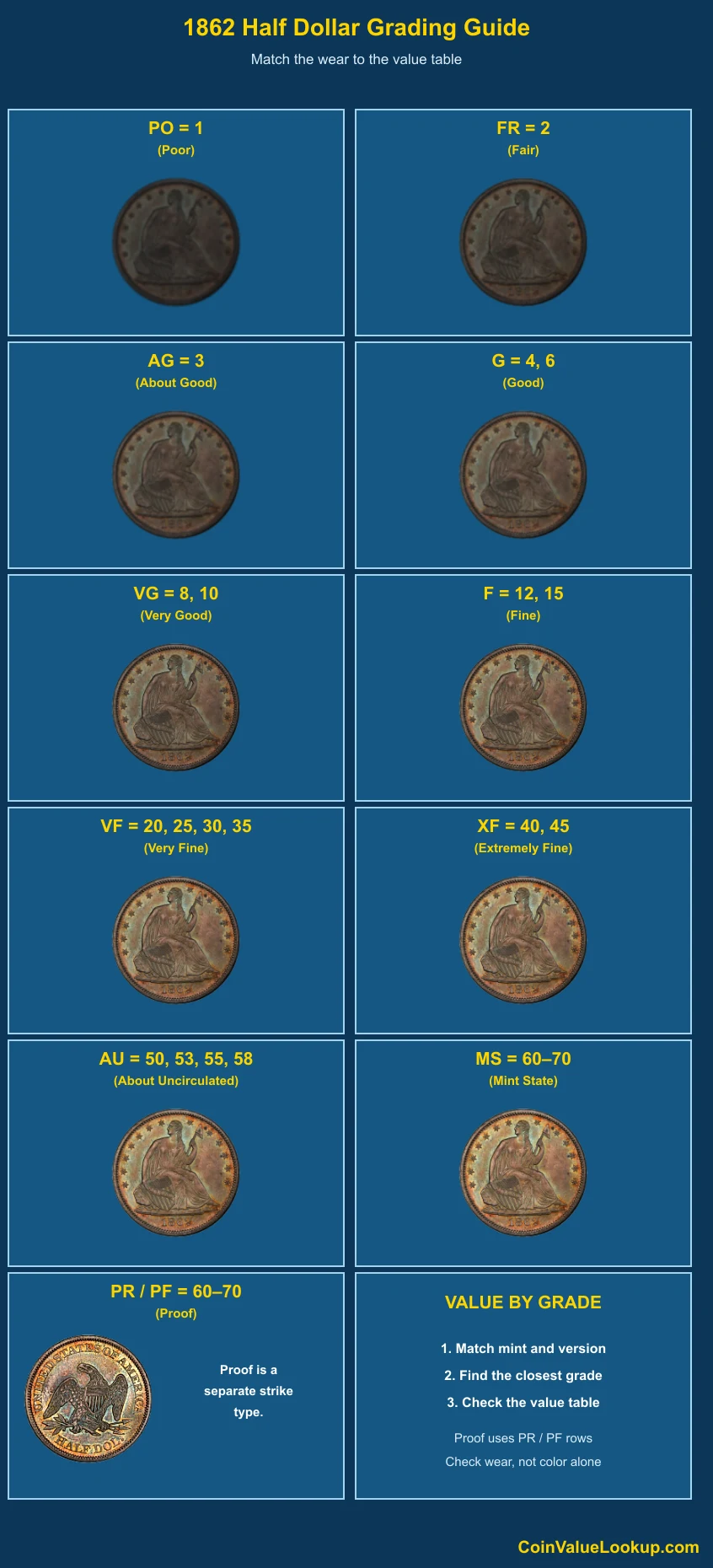
Start with the obverse. Liberty's head, the breast area, her knee and the shield lines are the first spots to lose detail.
On the reverse, the eagle's head, neck feathers and wing tips wear earliest.
A coin in G4 (Good) will show a full outline of Liberty but most interior detail is gone. At VF20 (Very Fine) the gown folds are visible though the high points are flat.
AU50 (About Uncirculated) keeps nearly full detail with only light rub on the absolute highest surfaces.
Don't confuse a weak strike with wear. A weakly struck coin can still show underlying luster and a smooth, undisturbed surface texture, while a worn coin will have broken luster and friction marks.
Check both sides and the edge.
Cleaning, scratches and rim damage all reduce value, sometimes drastically. Use the comparison image to match your coin's detail level against known grade examples rather than guessing from a single feature.
Step 3: Check 1862 Liberty Seated Half Dollar Value by Mint and Version
1862 Liberty Seated Half Dollar — Philadelphia — Type 2
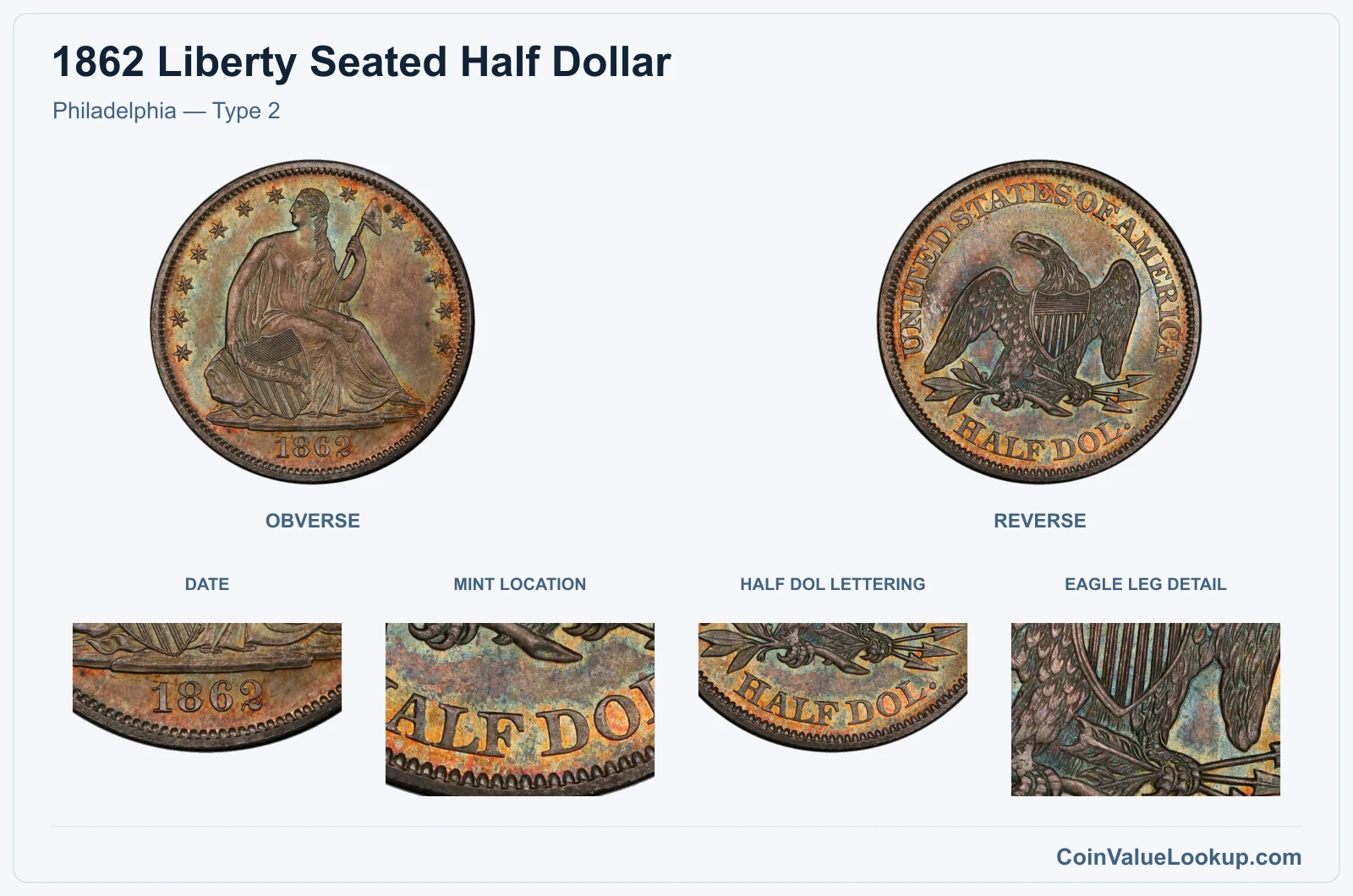
Philadelphia struck 1862 half dollars without a mintmark, using the Type 2 reverse hub. You can confirm Type 2 by looking at the base of the L in HALF: it extends noticeably longer than on a Type 1 die, and there is a small lump near the eagle's left leg.
Guide estimates from USA Coin Book place this issue at roughly $141 in G4, $456 in VF20 and $808 in AU50. These are aggregate Philadelphia figures, not subtype-specific premiums.
They are guide estimates, not guaranteed sale prices.
Both faces of the coin are needed to confirm the hub type, so examine the reverse carefully under magnification if possible.
Ordinary-issue reference: Ordinary-issue reference only: The table below shows prices for the 1862 Liberty Seated Half Dollar (regular strike). It does not represent the value of the specific Philadelphia — Type 2 variety or its variety premium. Year, mint, metal and strike type are matched; the specific variety is not priced by this table.
Range Grade
Price Auction Records Appraisal PO PO 1
—
Coin Identifier FR FR 2
—
Coin Identifier AG AG 3
—
Coin Identifier G G 4
—
Coin Identifier
G 6
—
Coin Identifier VG VG 8
—
Coin Identifier
VG 10
Coin Identifier F F 12
Coin Identifier
F 15
—
Coin Identifier VF VF 20
Coin Identifier
VF 25
Coin Identifier
VF 30
Coin Identifier
VF 35
Coin Identifier XF XF 40
Coin Identifier
XF 45
Coin Identifier AU AU 50
Coin Identifier
AU 53
Coin Identifier
AU 55
Coin Identifier
AU 58
Coin Identifier MS MS 60
Coin Identifier
MS 61
Coin Identifier
MS 62
Coin Identifier
MS 63
Coin Identifier
MS 64
Coin Identifier
MS 65
Coin Identifier
MS 66
Coin Identifier
MS 67
Coin Identifier
MS 68
—
—
—
MS 69
—
—
—
MS 70
—
—
—
1862 Liberty Seated Half Dollar — San Francisco — Large S — Type 1
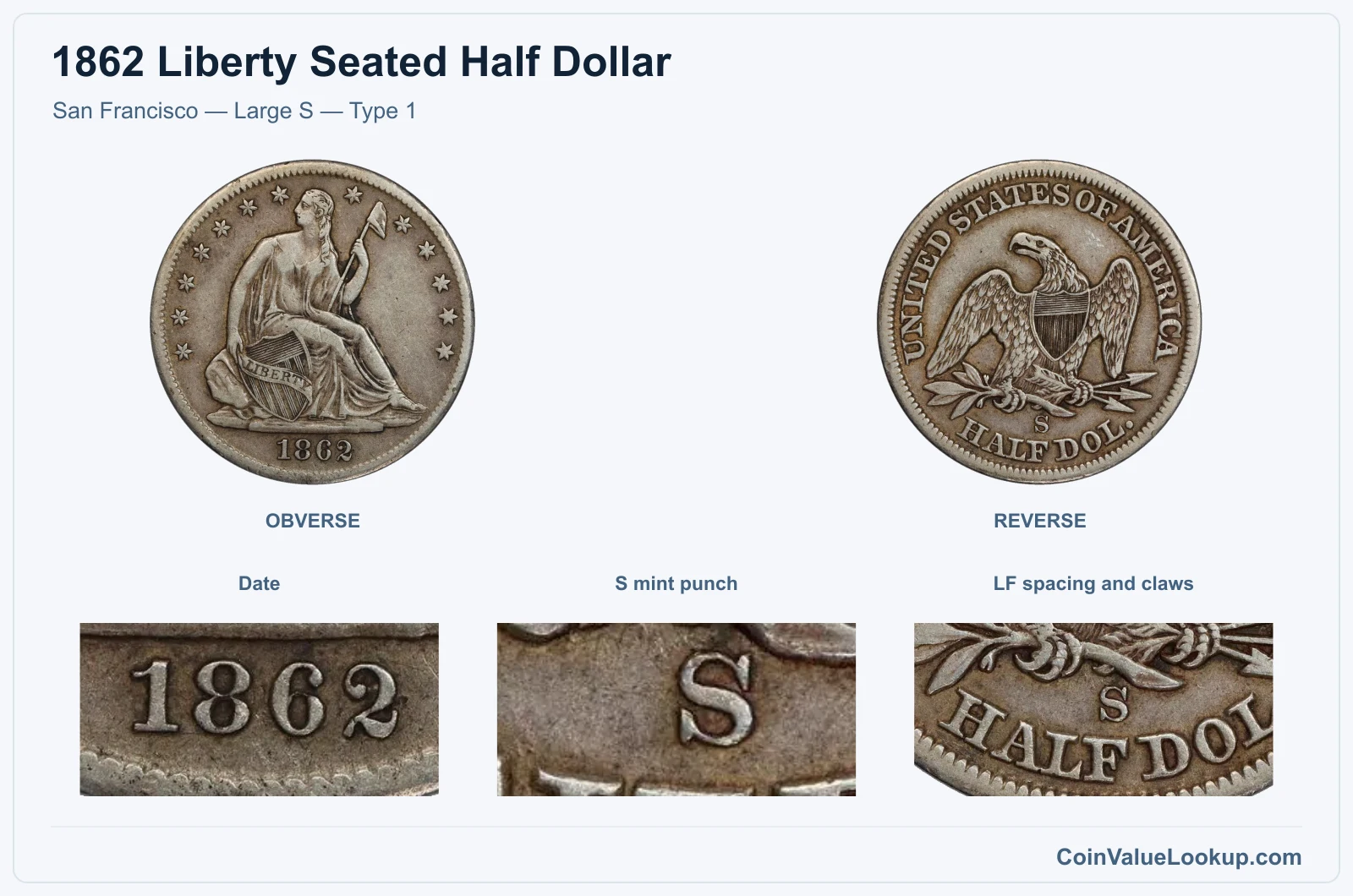
The San Francisco Large S, Type 1 variety uses the earlier reverse hub paired with a bold, tall S mintmark below the eagle. Type 1 shows a short base on the L in HALF and no lump by the eagle's left leg.
Compare the S to a known reference image at the same scale. A small or broken punch is a different variety entirely, not a damaged version of this one.
Aggregate San Francisco guide estimates run about $91 in G4, $331 in VF20 and $630 in AU50 per USA Coin Book. No separate subtype premium is currently adopted, so these figures cover all S-mint versions collectively.
Coin Value Lookup is a handy starting point when you need to compare values across different Seated Liberty dates and mints.
Ordinary-issue reference: Ordinary-issue reference only: The table below shows prices for the 1862-S Liberty Seated Half Dollar (regular strike). It does not represent the value of the specific San Francisco — Large S — Type 1 variety or its variety premium. Year, mint, metal and strike type are matched; the specific variety is not priced by this table.
Range Grade
Price Auction Records Appraisal PO PO 1
—
Coin Identifier FR FR 2
—
Coin Identifier AG AG 3
—
Coin Identifier G G 4
—
Coin Identifier
G 6
—
Coin Identifier VG VG 8
—
Coin Identifier
VG 10
—
Coin Identifier F F 12
Coin Identifier
F 15
Coin Identifier VF VF 20
Coin Identifier
VF 25
Coin Identifier
VF 30
Coin Identifier
VF 35
Coin Identifier XF XF 40
Coin Identifier
XF 45
Coin Identifier AU AU 50
Coin Identifier
AU 53
Coin Identifier
AU 55
Coin Identifier
AU 58
Coin Identifier MS MS 60
—
Coin Identifier
MS 61
Coin Identifier
MS 62
Coin Identifier
MS 63
Coin Identifier
MS 64
Coin Identifier
MS 65
Coin Identifier
MS 66
Coin Identifier
MS 67
—
—
—
MS 68
—
—
—
MS 69
—
—
—
MS 70
—
—
—
1862 Liberty Seated Half Dollar — San Francisco — Medium S — Type 1
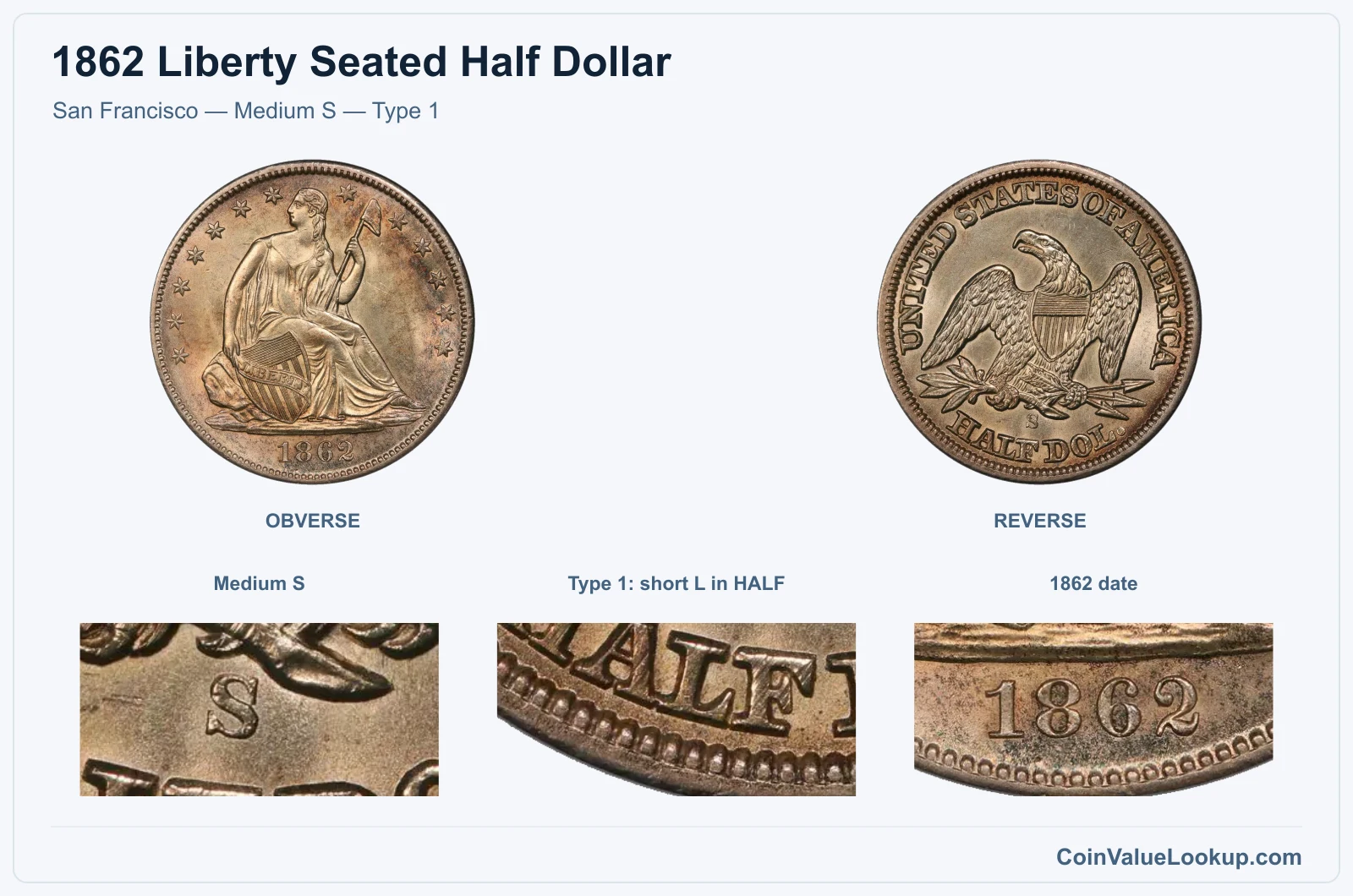
This variety pairs the Type 1 reverse with a medium-sized S mintmark. The punch is visibly smaller than the Large S but retains clean, unbroken curves.
Look at the proportions and spacing of the S relative to the eagle's tail feathers.
As with all San Francisco 1862 half dollars, the aggregate guide estimates apply: about $91 in G4, $331 in VF20 and $630 in AU50. These are USA Coin Book guide figures and do not reflect a dedicated premium for this specific mintmark style.
Side-by-side comparison with the Large S and the Small Wide Broken S varieties is the most reliable way to classify your coin's punch.
Ordinary-issue reference: Ordinary-issue reference only: The table below shows prices for the 1862-S Liberty Seated Half Dollar (regular strike). It does not represent the value of the specific San Francisco — Medium S — Type 1 variety or its variety premium. Year, mint, metal and strike type are matched; the specific variety is not priced by this table.
Range Grade
Price Auction Records Appraisal PO PO 1
—
Coin Identifier FR FR 2
—
Coin Identifier AG AG 3
—
Coin Identifier G G 4
—
Coin Identifier
G 6
—
Coin Identifier VG VG 8
—
Coin Identifier
VG 10
—
Coin Identifier F F 12
Coin Identifier
F 15
Coin Identifier VF VF 20
Coin Identifier
VF 25
Coin Identifier
VF 30
Coin Identifier
VF 35
Coin Identifier XF XF 40
Coin Identifier
XF 45
Coin Identifier AU AU 50
Coin Identifier
AU 53
Coin Identifier
AU 55
Coin Identifier
AU 58
Coin Identifier MS MS 60
—
Coin Identifier
MS 61
Coin Identifier
MS 62
Coin Identifier
MS 63
Coin Identifier
MS 64
Coin Identifier
MS 65
Coin Identifier
MS 66
Coin Identifier
MS 67
—
—
—
MS 68
—
—
—
MS 69
—
—
—
MS 70
—
—
—
1862 Liberty Seated Half Dollar — San Francisco — Small Wide Broken S — Type 2
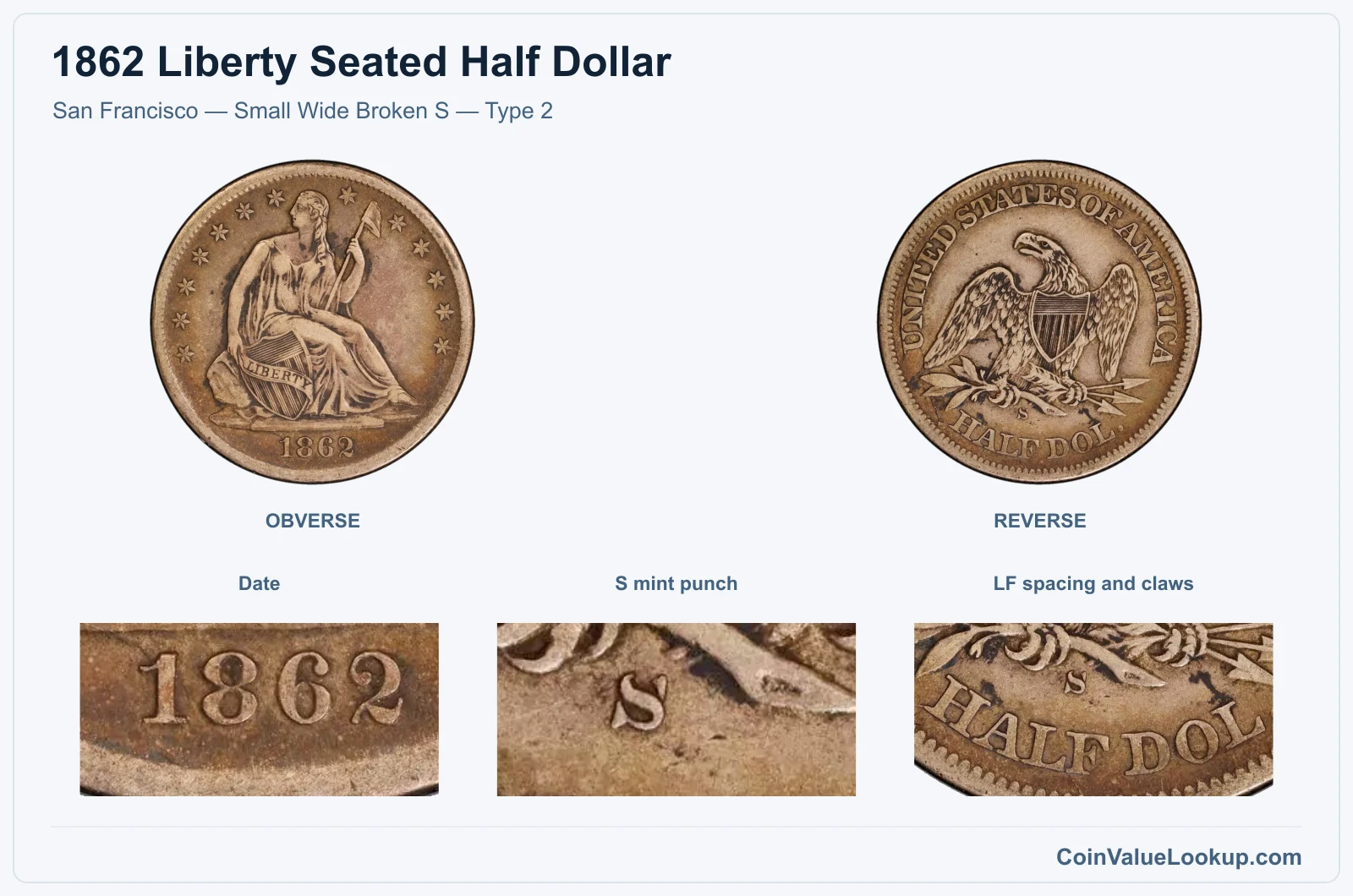
The 1862-S Small Wide Broken S is the first appearance of the Type 2 reverse hub at the San Francisco Mint. The mintmark punch is noticeably smaller and wider than the Large or Medium S, and it shows a break or gap in the curves of the letter.
This broken character is a die feature, not post-strike damage.
Do not confuse a broken S with a removed or altered mintmark. The break follows a consistent pattern across multiple specimens of this die pair.
Aggregate S-mint guide estimates still apply: roughly $91 in G4, $331 in VF20 and $630 in AU50 from USA Coin Book. Dedicated pricing for this subtype has not been separately adopted.
Ordinary-issue reference: Ordinary-issue reference only: The table below shows prices for the 1862-S Liberty Seated Half Dollar (regular strike). It does not represent the value of the specific San Francisco — Small Wide Broken S — Type 2 variety or its variety premium. Year, mint, metal and strike type are matched; the specific variety is not priced by this table.
Range Grade
Price Auction Records Appraisal PO PO 1
—
Coin Identifier FR FR 2
—
Coin Identifier AG AG 3
—
Coin Identifier G G 4
—
Coin Identifier
G 6
—
Coin Identifier VG VG 8
—
Coin Identifier
VG 10
—
Coin Identifier F F 12
Coin Identifier
F 15
Coin Identifier VF VF 20
Coin Identifier
VF 25
Coin Identifier
VF 30
Coin Identifier
VF 35
Coin Identifier XF XF 40
Coin Identifier
XF 45
Coin Identifier AU AU 50
Coin Identifier
AU 53
Coin Identifier
AU 55
Coin Identifier
AU 58
Coin Identifier MS MS 60
—
Coin Identifier
MS 61
Coin Identifier
MS 62
Coin Identifier
MS 63
Coin Identifier
MS 64
Coin Identifier
MS 65
Coin Identifier
MS 66
Coin Identifier
MS 67
—
—
—
MS 68
—
—
—
MS 69
—
—
—
MS 70
—
—
—
1862 Liberty Seated Half Dollar — Philadelphia Proof
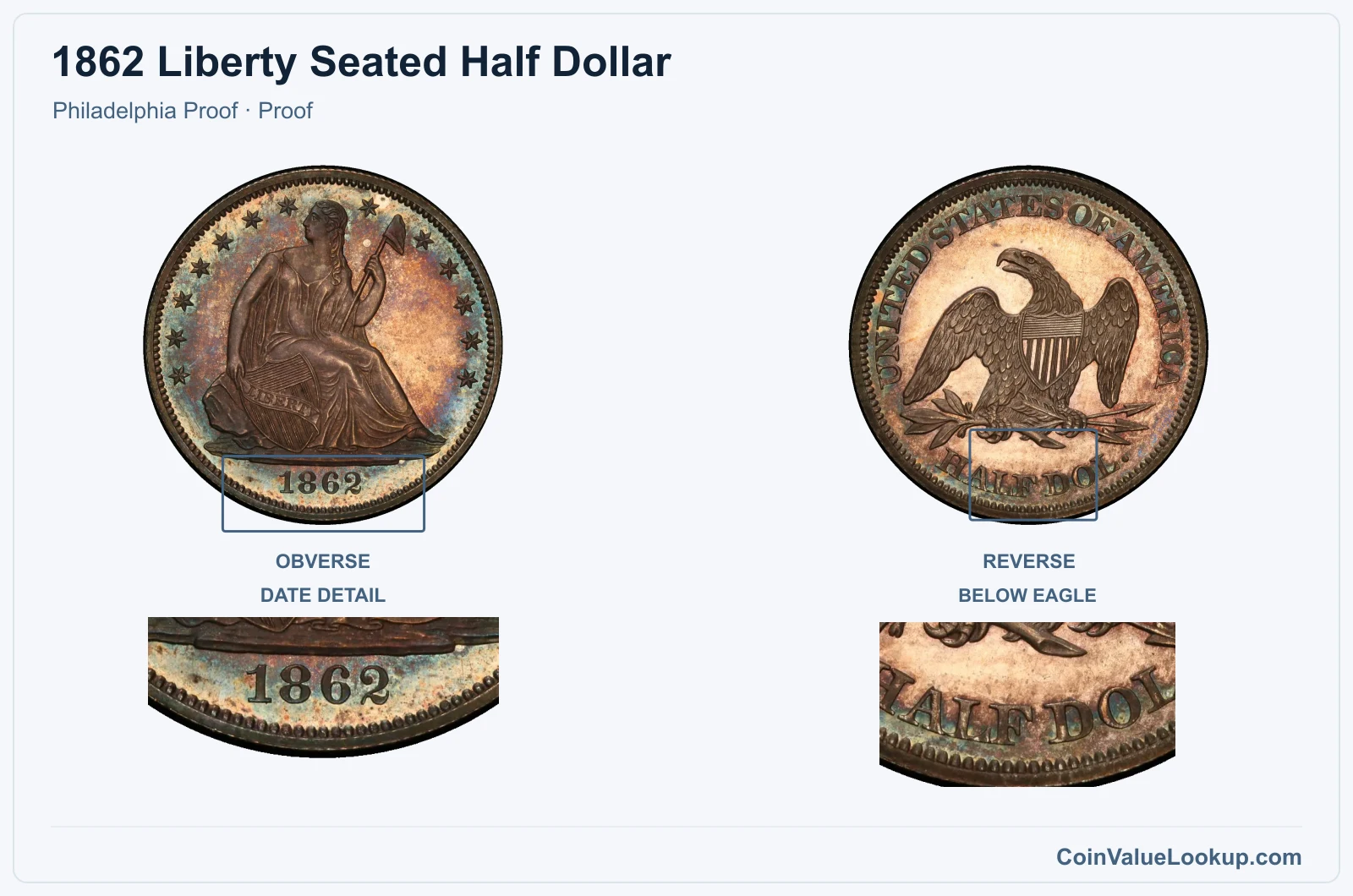
Philadelphia Proofs were struck with specially prepared dies on polished planchets, producing mirror-like fields and razor-sharp design details. The rims are typically squared and well-defined.
Do not identify a Proof solely by brightness; cleaned circulation strikes can mimic reflectivity at first glance.
A genuine Proof should show fully mirrored surfaces when tilted under a light, with no signs of wear or circulation contact. Cameo and deep cameo designations describe the degree of frost on the raised devices against those mirrored fields, and they remain within the Proof branch of classification.
The USA Coin Book guide places a PR63 example at approximately $2,005. This is a guide estimate, not a guaranteed offer.
Condition, eye appeal and any surface imperfections all influence actual transaction prices.
Range Grade
Price Auction Records Appraisal PR PR 1
—
Coin Identifier
PR 2
—
Coin Identifier
PR 3
—
Coin Identifier
PR 4
—
Coin Identifier
PR 6
—
Coin Identifier
PR 8
—
Coin Identifier
PR 10
—
Coin Identifier
PR 12
—
Coin Identifier
PR 15
—
Coin Identifier
PR 20
—
Coin Identifier
PR 25
—
Coin Identifier
PR 30
—
Coin Identifier
PR 35
—
Coin Identifier
PR 40
—
Coin Identifier
PR 45
—
Coin Identifier
PR 50
Coin Identifier
PR 53
—
Coin Identifier
PR 55
—
Coin Identifier
PR 58
—
Coin Identifier
PR 60
Coin Identifier
PR 61
Coin Identifier
PR 62
Coin Identifier
PR 63
Coin Identifier
PR 64
Coin Identifier
PR 65
Coin Identifier
PR 66
Coin Identifier
PR 67
Coin Identifier
PR 68
—
—
—
PR 69
—
—
—
PR 70
—
—
—
1862 Liberty Seated Half Dollar Error List
1. 1862 Liberty Seated Half Dollar — Clashed Dies
A die clash happens when the obverse and reverse dies strike each other without a planchet between them, transferring design elements from one die onto the other. On an 1862-S half dollar, the reported clash shows impressions to the right of Liberty's elbow that correspond to the crook of the eagle's wing from the reverse die.
To spot it, look for faint, raised design traces in an area of the coin where they do not belong. Tilt the coin under a directional light to pick up the shallow relief.
Do not confuse clash marks with random scratches, raised lines from a damaged die or a brockage (which would show a full mirror-image impression). Clashed dies produce a specific, repeatable pattern tied to the opposite die's design.
The value impact depends on the visibility of the clash, overall coin condition and collector demand for the specific die pair, so individual assessment is essential.
2. 1862 Liberty Seated Half Dollar — Die Gouge / Named Raised-Line Variety
Die gouges appear as raised lines or lumps on the coin because material was removed from the die itself, creating a recessed area that fills with metal during striking. On the reported 1862-S examples, these raised lines appear in the gown area below Liberty's underarm and across her lap.
The key diagnostic is relief: a die gouge produces a raised line on the coin's surface, while a scratch from post-strike damage is incuse, meaning it digs into the surface. Run a fingernail or wooden toothpick across the line.
If it sits above the field, it originated on the die.
Do not confuse die gouges with incuse scratches, unrelated die cracks or general surface damage. Condition, the prominence of the gouge and collector interest in the specific variety all influence value, so each coin needs individual evaluation.
3. 1862 Liberty Seated Half Dollar — Die Crack / Die Chip
Die cracks form when a working die develops a fracture from repeated use or stress. The crack transfers to the coin as a thin, raised line because metal flows into the gap during striking.
On the reported 1862-S Small Wide Broken S variety, a diagonal crack runs near the digits 8 and 1 of the date, extending toward the rock and rim, with another crack appearing near Liberty's toes.
These raised lines are consistent across multiple strikes from the same cracked die, so they appear in the same position on every coin from that die state. Do not mistake them for incuse scratches, surface corrosion or foreign material stuck to the coin.
Also keep them separate from any intentionally repunched date digit, which is a different category.
Value depends on how prominent the cracks are, the coin's overall grade and collector demand for that particular die state.