1913 Buffalo Nickel Coin Value: How Much Is It Worth?
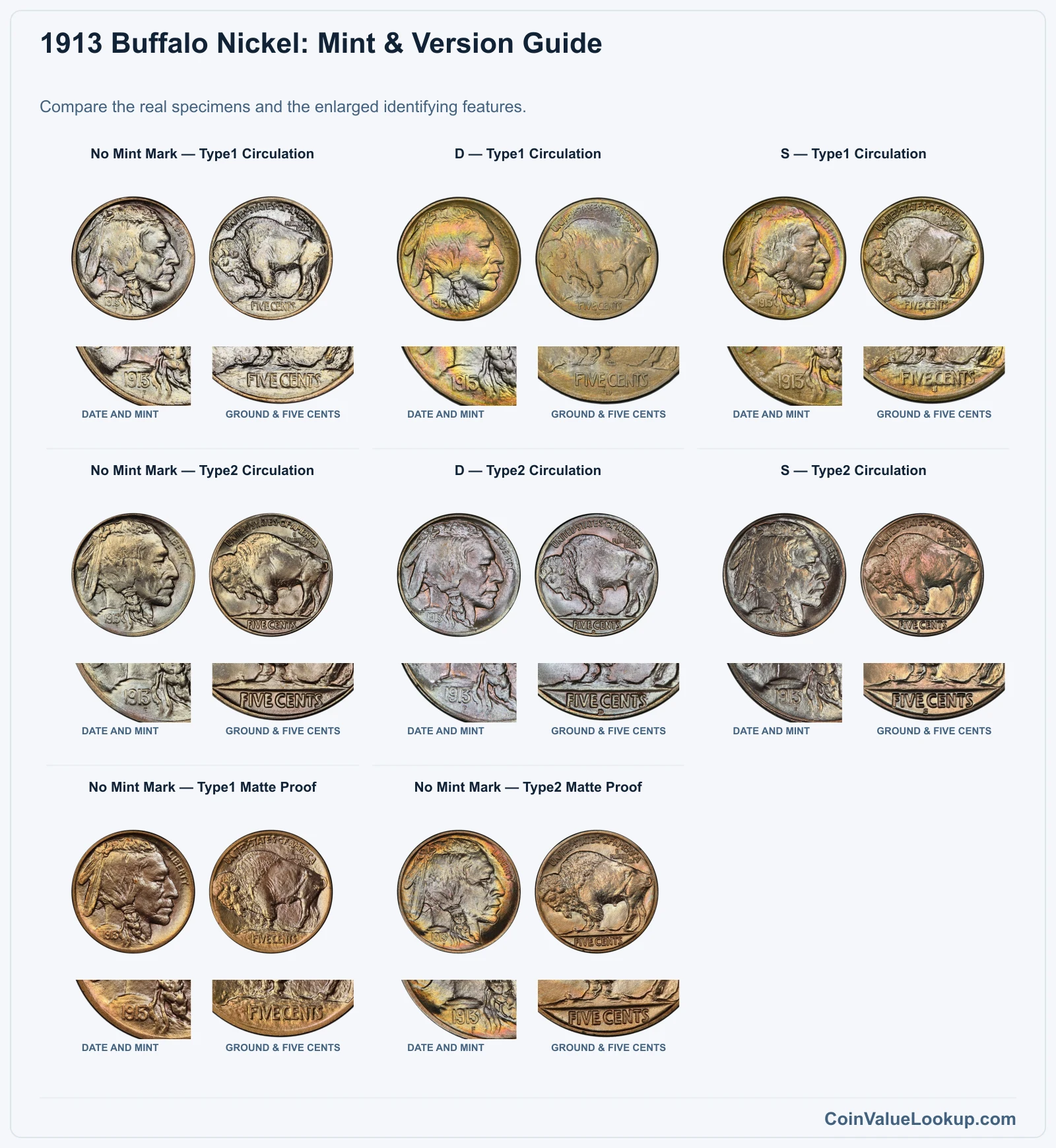
The 1913 Buffalo Nickel was the debut year for James Earle Fraser's iconic design, and it came in two distinct reverse types. USA Coin Book guide estimates for circulation strikes range from about $15 in G4 to $1,523 in MS63, depending on mint, reverse type, and condition.
Matte proofs carry their own premium at PR63. Before you can price your coin, you need to figure out whether you have a Type 1 or Type 2 reverse.
Fast Way to Identify Your 1913 Buffalo Nickel
The quickest way to start figuring out what your 1913 Buffalo Nickel is worth is to upload clear photos of both sides. Show the full date, the area below FIVE CENTS on the reverse, and the overall edge profile.
A preliminary identification from those images can help you narrow down the mint, reverse type, and general condition before you dig deeper.
1913 Buffalo Nickel Value
Upload both sides of your 1913 Buffalo Nickel.
Front Obverse
Upload photo
Back Reverse
Upload photo
Which 1913 Buffalo Nickel Versions Are Worth Money?
- Type 2 San Francisco (S) coins are the scarcest regular-issue branch, with guide estimates from $289 in G4 to $1,523 in MS63.
- Type 2 Denver (D) coins also carry a strong premium, estimated at $162 in G4 and $527 in MS63.
- Matte proofs of both Type 1 and Type 2 were made only at Philadelphia and are uncommon; PR63 guide estimates are $1,523 and $1,345 respectively.
- Check for reported errors such as repunched mintmarks on D and S coins, or the Three-and-a-Half Legs variety on Philadelphia Type 1 strikes.
Step 1: Identify Your 1913 Buffalo Nickel Mint Mark and Version
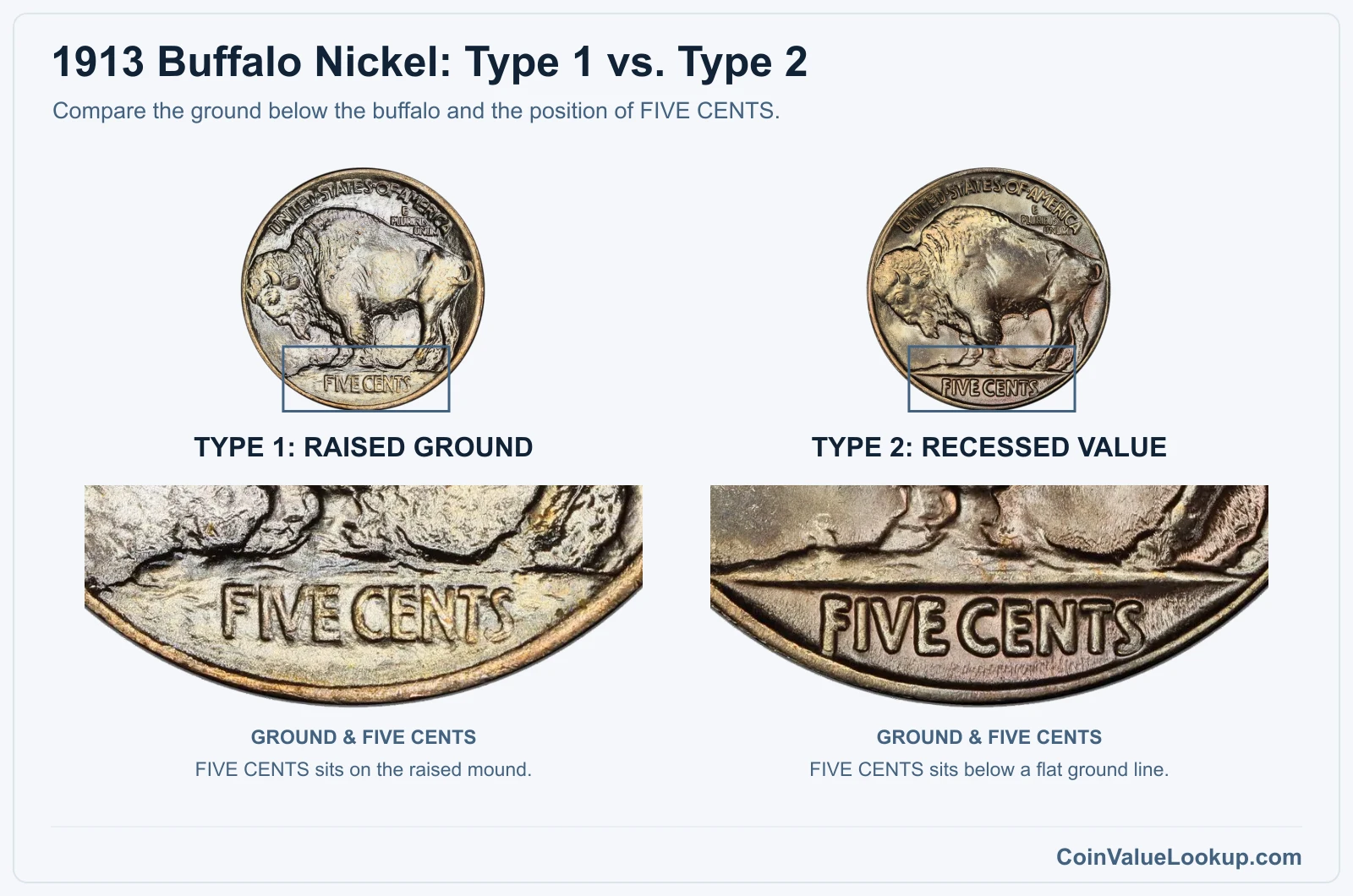
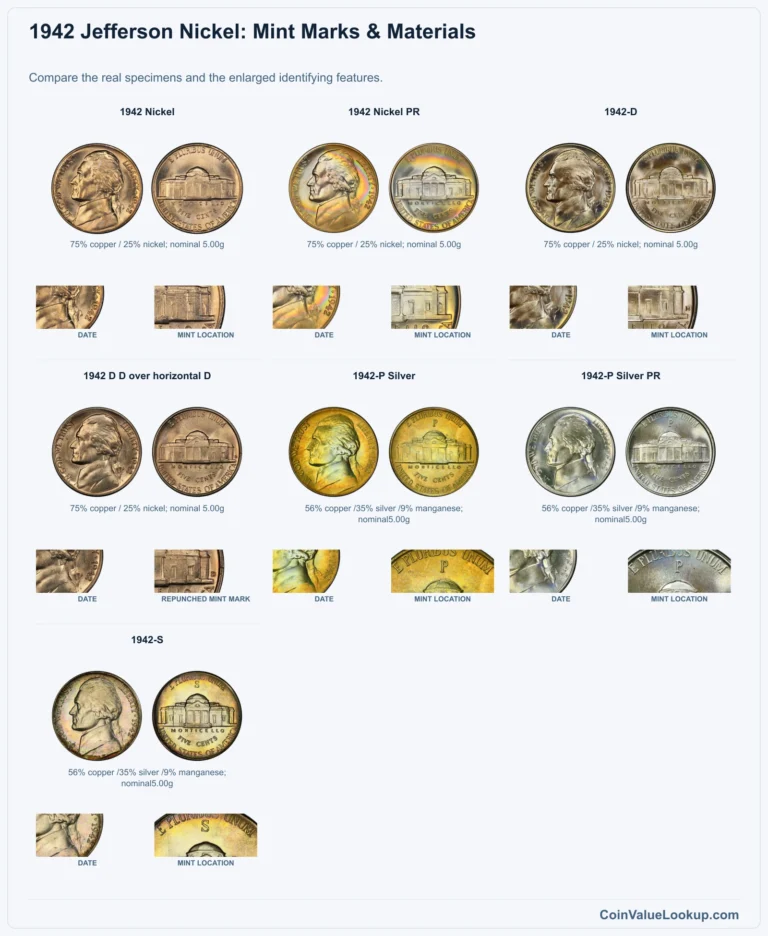
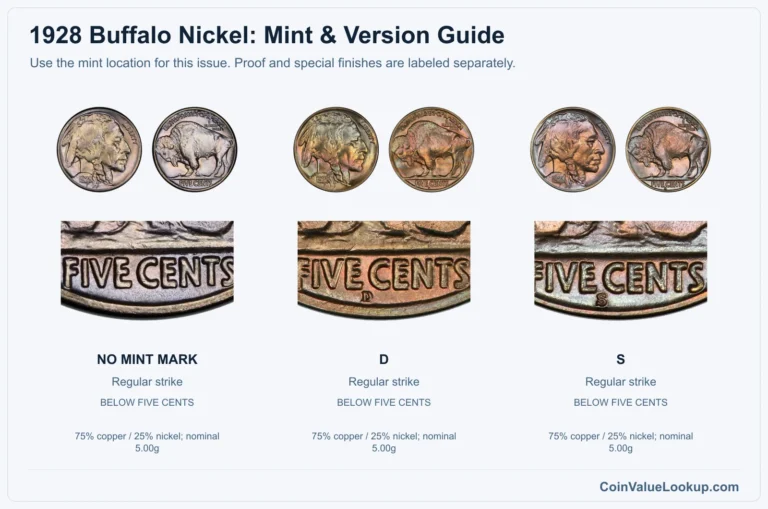
The 1913 Buffalo Nickel was struck at three mints: Philadelphia (no mintmark), Denver (D), and San Francisco (S). The mintmark sits on the reverse, below FIVE CENTS.
If you see no letter there, it is a Philadelphia coin.
All regular 1913 nickels are 75% copper and 25% nickel, weigh about 5 grams, measure 21.2 mm, and have a plain edge. There is no silver version in this series.
The critical first step is identifying the reverse type. Type 1 has the bison standing on a raised mound, with FIVE CENTS inscribed on that mound.
Type 2 has the denomination recessed below a flat ground line. These are intentional design changes, not errors, and they affect value significantly.
Get this right before checking anything else.
Philadelphia also produced matte proof versions of both Type 1 and Type 2. A matte proof has a distinctive granular field texture and sharp rims, not the mirror-like surface most people associate with proofs.
Do not assume a shiny coin is a proof.
Step 2: Check Your 1913 Buffalo Nickel Grade
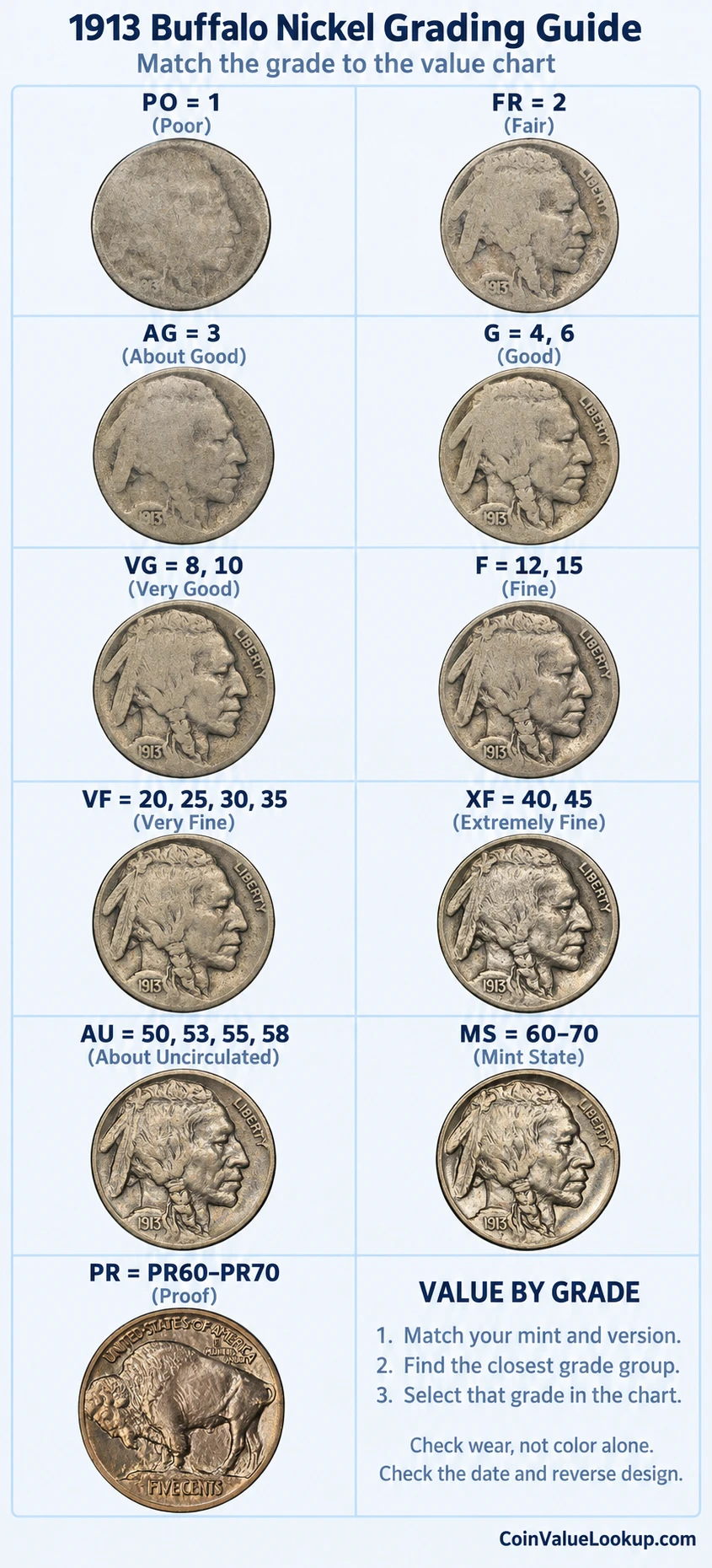
When grading a 1913 Buffalo Nickel, focus on the obverse portrait first. Check the hair braid above the ear, the cheek, and the area around the ribbon tie.
These are the highest points and show wear earliest.
On the reverse, examine the bison's shoulder, the top of the hip, and especially the horn. A full horn is a key indicator of higher grade.
Here is the catch: weak strikes are common on Buffalo Nickels, and a soft horn does not always mean the coin circulated heavily. Compare your coin against the grading image to separate genuine wear from a strike issue.
Original luster matters a lot for Mint State coins. Look for a soft, satiny cartwheel effect across the fields.
Cleaning, scratches, or other surface damage will reduce value even on a coin with no wear.
Never use acid or any chemical to restore a worn date. It destroys the coin's surface and makes accurate grading impossible.
Step 3: Check 1913 Buffalo Nickel Value by Mint and Version
1913 Buffalo Nickel — No Mint Mark — Type1 Circulation
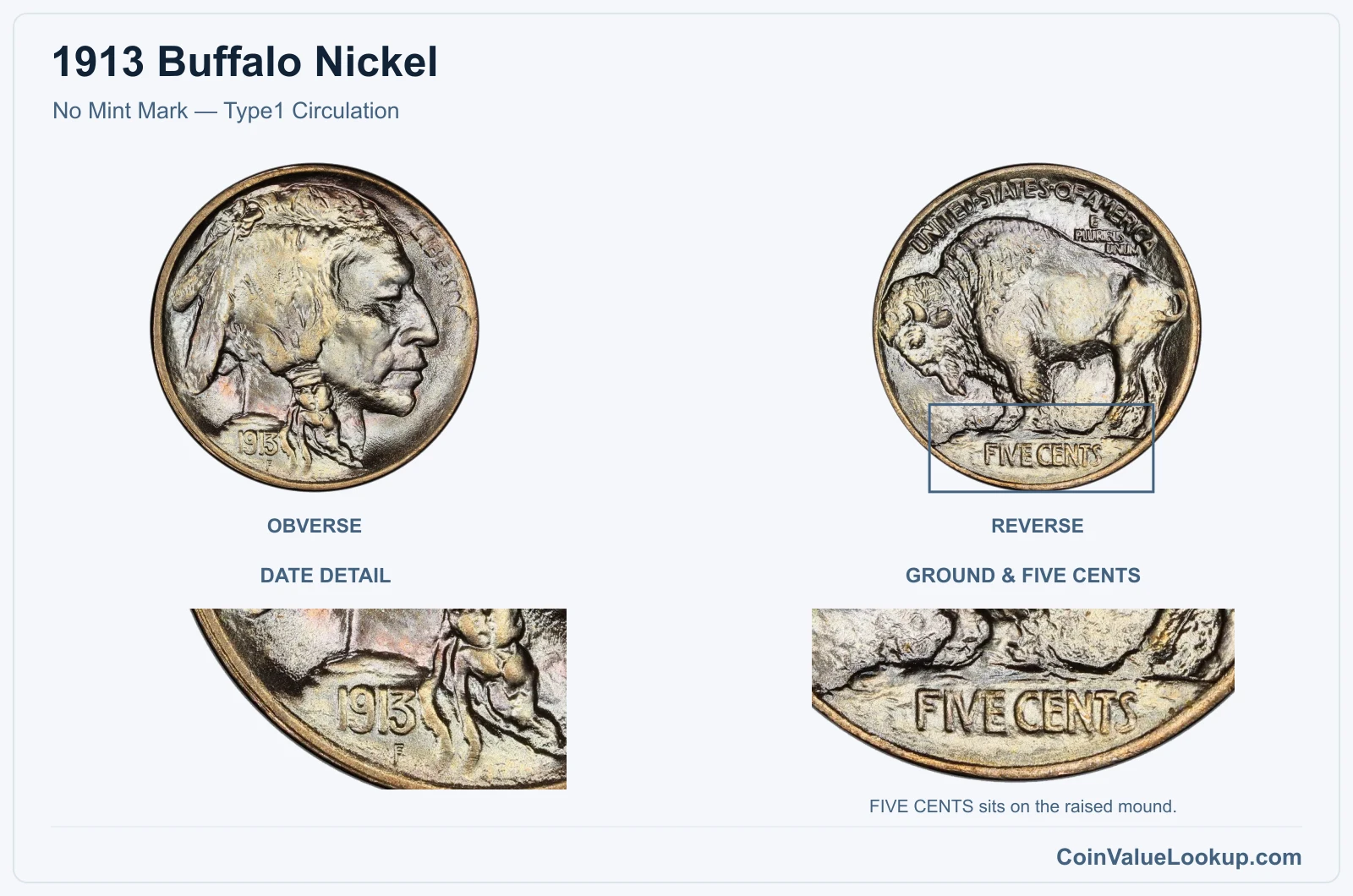
The Philadelphia Type 1 is the most common variety of the 1913 Buffalo Nickel. It has no mintmark and shows the bison on a raised mound.
USA Coin Book guide estimates place it around $16 in G4 and $73 in MS63.
To confirm this version, flip to the reverse and check that FIVE CENTS appears on a raised platform beneath the bison, and that there is no mintmark letter below the denomination. A clean, problem-free example with full original luster in the MS range is still a solid coin for a type set.
Range Grade
Price Auction Records Appraisal PO PO 1
—
Coin Identifier FR FR 2
—
Coin Identifier AG AG 3
—
Coin Identifier G G 4
—
Coin Identifier
G 6
—
Coin Identifier VG VG 8
—
Coin Identifier
VG 10
—
Coin Identifier F F 12
—
Coin Identifier
F 15
—
Coin Identifier VF VF 20
Coin Identifier
VF 25
—
Coin Identifier
VF 30
—
Coin Identifier
VF 35
—
Coin Identifier XF XF 40
Coin Identifier
XF 45
Coin Identifier AU AU 50
—
Coin Identifier
AU 53
Coin Identifier
AU 55
Coin Identifier
AU 58
Coin Identifier MS MS 60
Coin Identifier
MS 61
Coin Identifier
MS 62
Coin Identifier
MS 63
Coin Identifier
MS 64
Coin Identifier
MS 65
Coin Identifier
MS 66
Coin Identifier
MS 67
Coin Identifier
MS 68
Coin Identifier
MS 69
—
—
—
MS 70
—
—
—
1913 Buffalo Nickel — D — Type1 Circulation
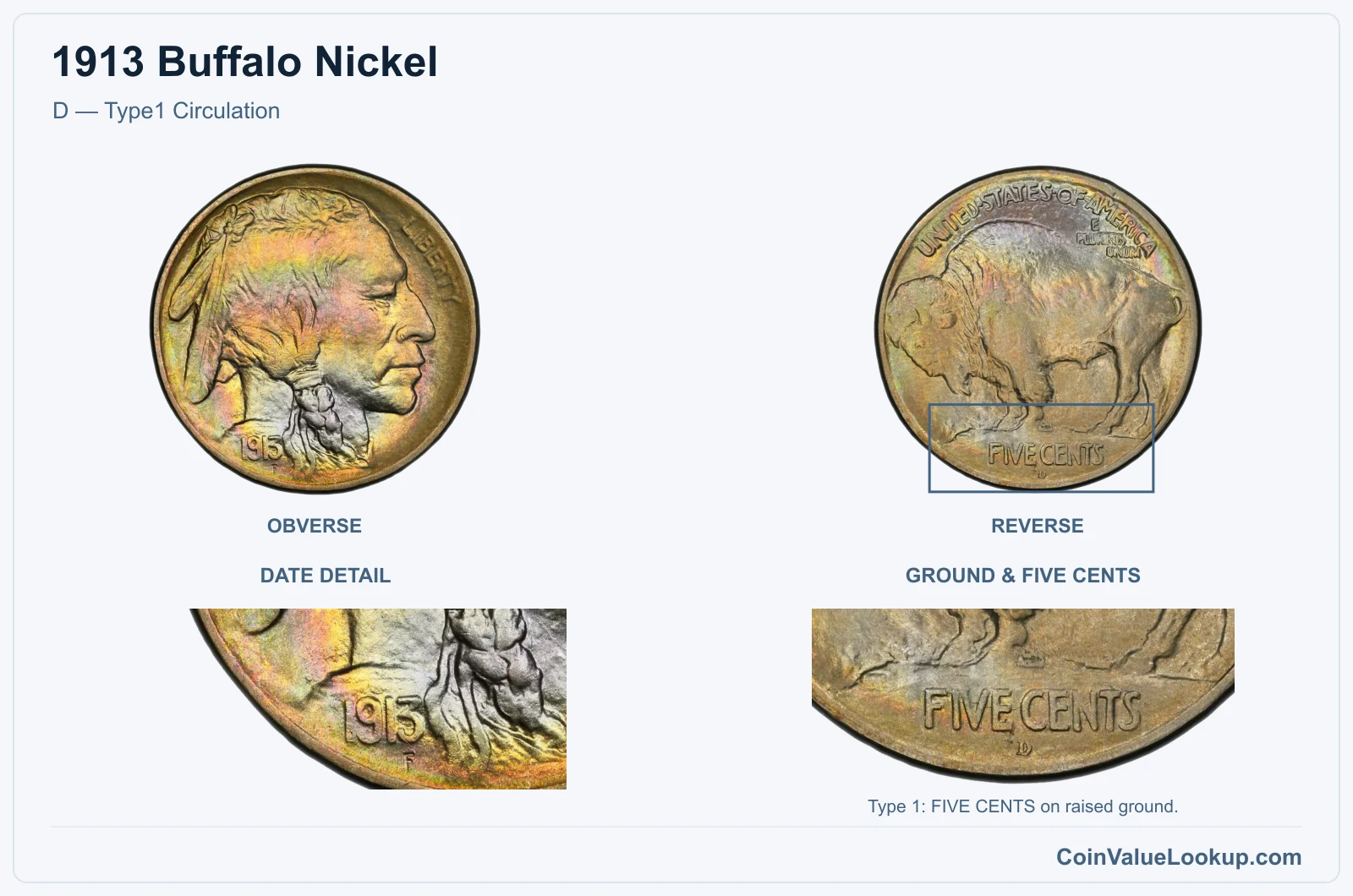
The Denver Type 1 carries a small D mintmark on the reverse, sitting below FIVE CENTS on the raised mound. Guide estimates from USA Coin Book run about $25 in G4 and $117 in MS63.
Denver production quality varied, so look carefully at the strike sharpness on the bison's horn and shoulder before drawing conclusions about grade. A weak horn on a Denver coin may reflect how it was made, not how long it spent in pockets.
Range Grade
Price Auction Records Appraisal PO PO 1
—
Coin Identifier FR FR 2
—
Coin Identifier AG AG 3
—
Coin Identifier G G 4
—
Coin Identifier
G 6
—
Coin Identifier VG VG 8
—
Coin Identifier
VG 10
—
Coin Identifier F F 12
—
Coin Identifier
F 15
Coin Identifier VF VF 20
Coin Identifier
VF 25
—
Coin Identifier
VF 30
Coin Identifier
VF 35
Coin Identifier XF XF 40
Coin Identifier
XF 45
Coin Identifier AU AU 50
Coin Identifier
AU 53
Coin Identifier
AU 55
Coin Identifier
AU 58
Coin Identifier MS MS 60
Coin Identifier
MS 61
Coin Identifier
MS 62
Coin Identifier
MS 63
Coin Identifier
MS 64
Coin Identifier
MS 65
Coin Identifier
MS 66
Coin Identifier
MS 67
Coin Identifier
MS 68
Coin Identifier
MS 69
—
—
—
MS 70
—
—
—
1913 Buffalo Nickel — S — Type1 Circulation
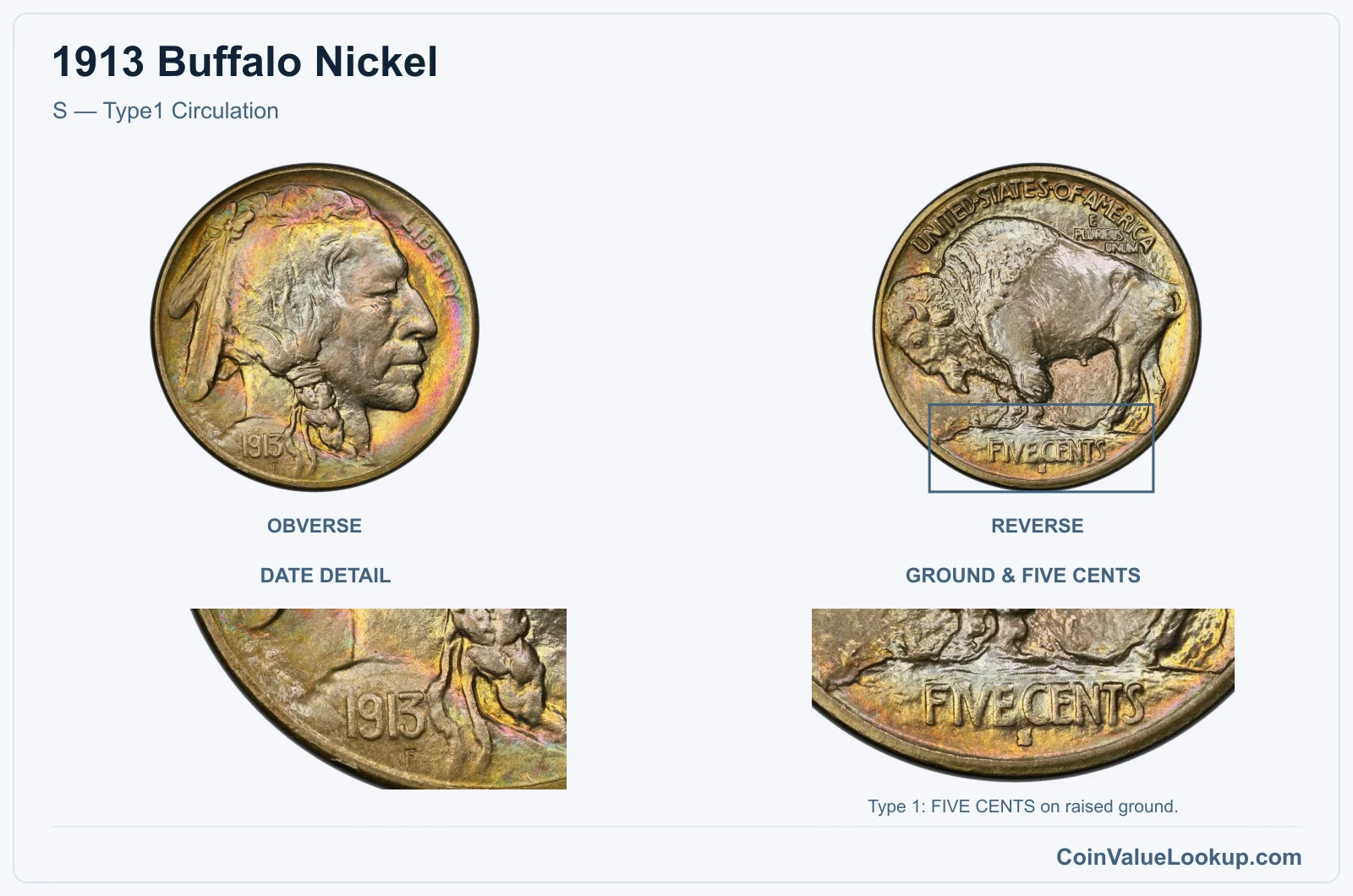
San Francisco's Type 1 is marked by an S mintmark below FIVE CENTS on the mound. USA Coin Book estimates it at roughly $61 in G4 and $217 in MS63, a noticeable step up from the Philadelphia and Denver Type 1 coins.
This mint is also associated with reported error varieties, including the Two Feathers and Missing Designer Initial F, so it is worth examining your S-mint Type 1 closely under magnification before settling on a plain attribution.
Range Grade
Price Auction Records Appraisal PO PO 1
—
Coin Identifier FR FR 2
Coin Identifier AG AG 3
—
Coin Identifier G G 4
Coin Identifier
G 6
—
Coin Identifier VG VG 8
Coin Identifier
VG 10
Coin Identifier F F 12
Coin Identifier
F 15
Coin Identifier VF VF 20
Coin Identifier
VF 25
Coin Identifier
VF 30
Coin Identifier
VF 35
Coin Identifier XF XF 40
Coin Identifier
XF 45
Coin Identifier AU AU 50
Coin Identifier
AU 53
Coin Identifier
AU 55
Coin Identifier
AU 58
Coin Identifier MS MS 60
Coin Identifier
MS 61
Coin Identifier
MS 62
Coin Identifier
MS 63
Coin Identifier
MS 64
Coin Identifier
MS 65
Coin Identifier
MS 66
Coin Identifier
MS 67
Coin Identifier
MS 68
Coin Identifier
MS 69
—
—
—
MS 70
—
—
—
1913 Buffalo Nickel — No Mint Mark — Type2 Circulation
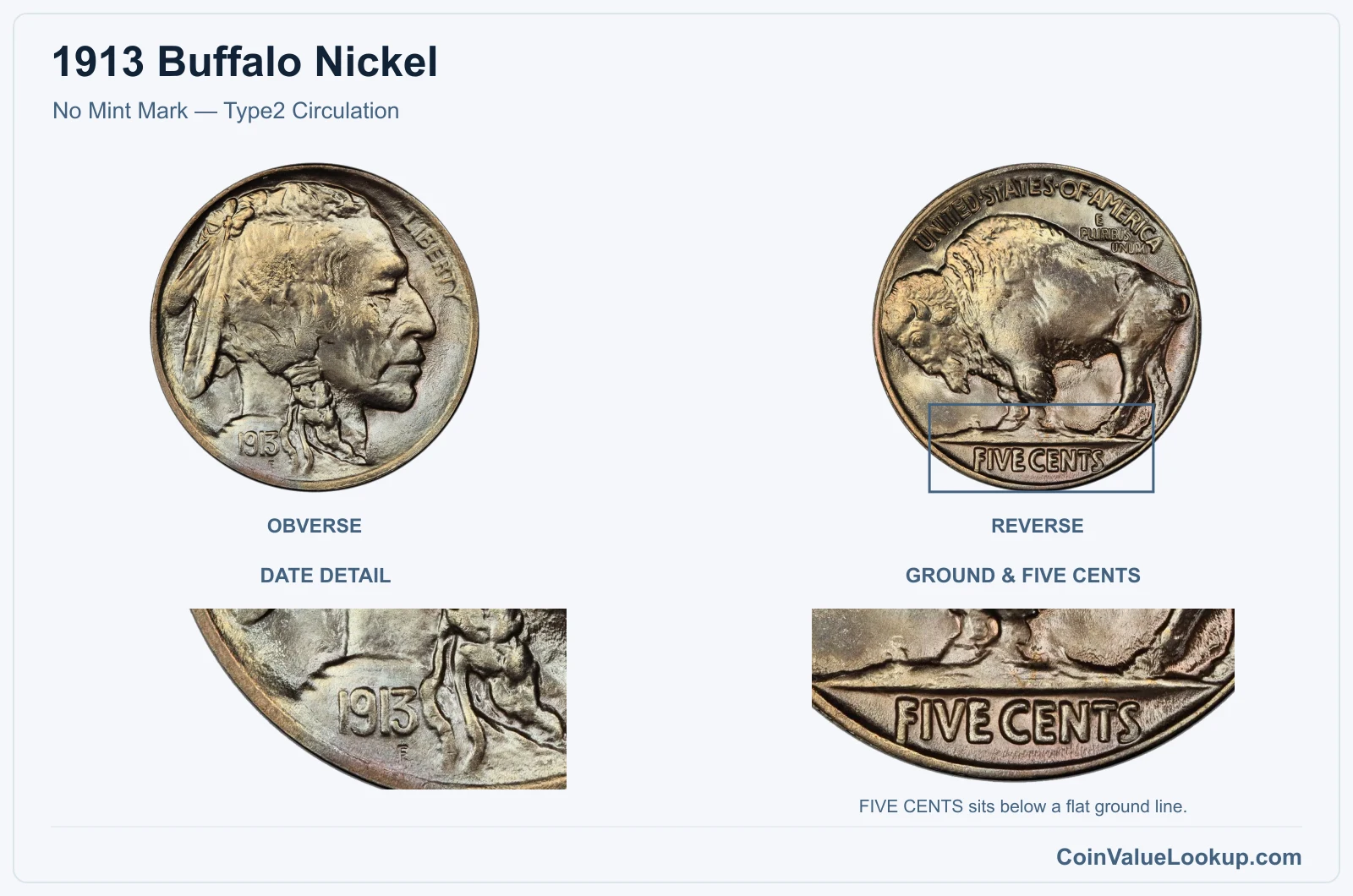
The Philadelphia Type 2 shows the recessed denomination design, where FIVE CENTS sits in a flat area below the bison rather than on a mound. No mintmark.
USA Coin Book estimates put it near $15 in G4 and $81 in MS63.
This is one of the more affordable entries for the year. The Type 2 design was adopted because the raised mound on Type 1 caused FIVE CENTS to wear off quickly.
Knowing which type you hold is essential before applying any value estimate.
Range Grade
Price Auction Records Appraisal PO PO 1
—
Coin Identifier FR FR 2
—
Coin Identifier AG AG 3
—
Coin Identifier G G 4
—
Coin Identifier
G 6
—
Coin Identifier VG VG 8
—
Coin Identifier
VG 10
Coin Identifier F F 12
—
Coin Identifier
F 15
—
Coin Identifier VF VF 20
—
Coin Identifier
VF 25
—
Coin Identifier
VF 30
Coin Identifier
VF 35
—
Coin Identifier XF XF 40
Coin Identifier
XF 45
Coin Identifier AU AU 50
Coin Identifier
AU 53
—
Coin Identifier
AU 55
Coin Identifier
AU 58
Coin Identifier MS MS 60
Coin Identifier
MS 61
Coin Identifier
MS 62
Coin Identifier
MS 63
Coin Identifier
MS 64
Coin Identifier
MS 65
Coin Identifier
MS 66
Coin Identifier
MS 67
Coin Identifier
MS 68
—
Coin Identifier
MS 69
—
—
—
MS 70
—
—
—
1913 Buffalo Nickel — D — Type2 Circulation
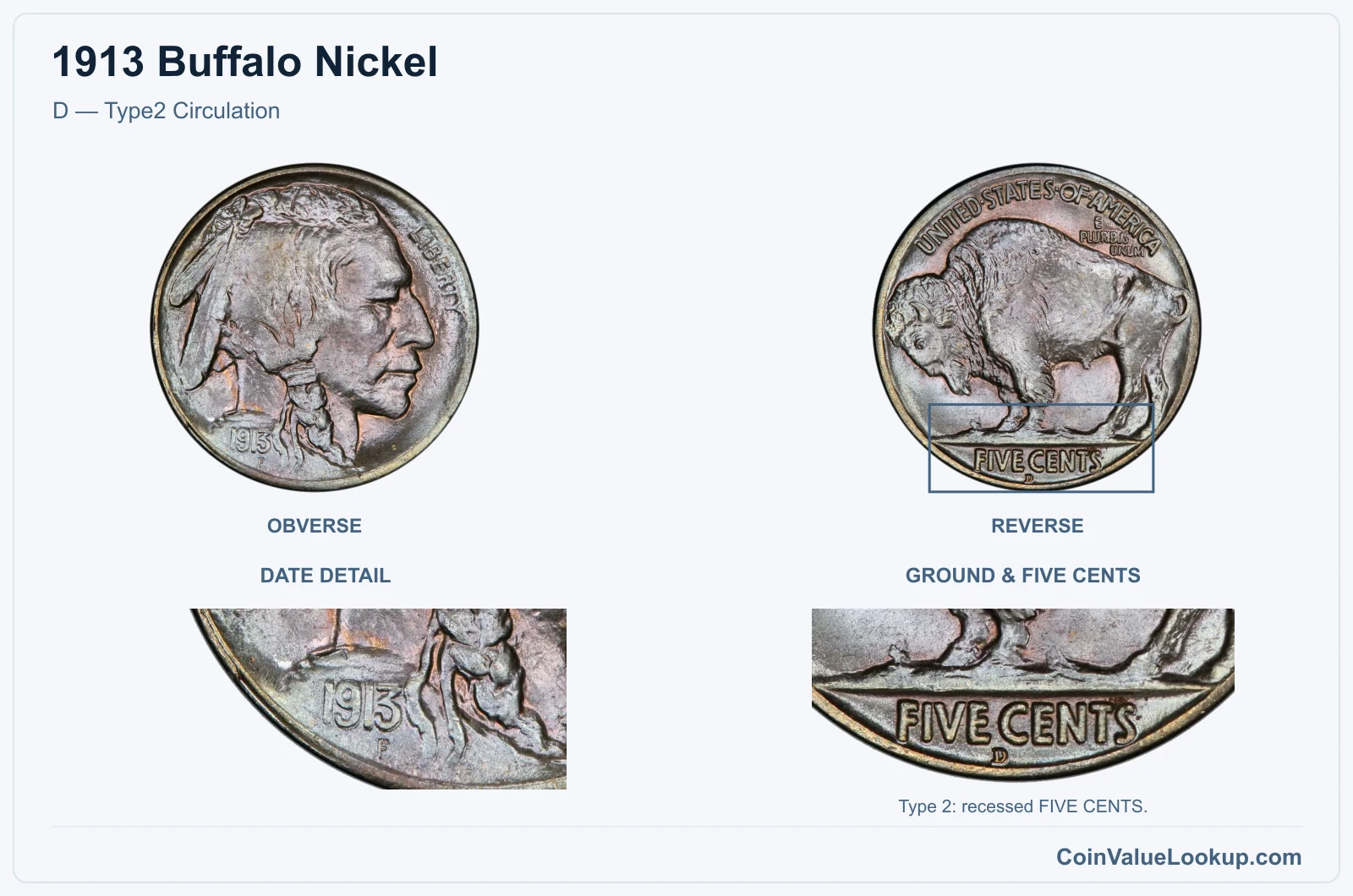
The Denver Type 2 starts getting into real money. Look for the D mintmark on the reverse below the recessed FIVE CENTS.
USA Coin Book guide estimates are around $162 in G4 and $527 in MS63.
That steep price in even low grades tells you these did not survive in large numbers. If you find one, photograph both sides carefully and protect the surfaces.
Even a well-worn example has significant collector demand.
Coin Value Lookup is a good starting point if you want to look up guide values for other dates and mints in the Buffalo Nickel series.
Range Grade
Price Auction Records Appraisal PO PO 1
—
Coin Identifier FR FR 2
—
Coin Identifier AG AG 3
—
Coin Identifier G G 4
Coin Identifier
G 6
Coin Identifier VG VG 8
Coin Identifier
VG 10
Coin Identifier F F 12
Coin Identifier
F 15
Coin Identifier VF VF 20
Coin Identifier
VF 25
Coin Identifier
VF 30
Coin Identifier
VF 35
Coin Identifier XF XF 40
Coin Identifier
XF 45
Coin Identifier AU AU 50
Coin Identifier
AU 53
Coin Identifier
AU 55
Coin Identifier
AU 58
Coin Identifier MS MS 60
Coin Identifier
MS 61
Coin Identifier
MS 62
Coin Identifier
MS 63
Coin Identifier
MS 64
Coin Identifier
MS 65
Coin Identifier
MS 66
Coin Identifier
MS 67
Coin Identifier
MS 68
Coin Identifier
MS 69
—
—
—
MS 70
—
—
—
1913 Buffalo Nickel — S — Type2 Circulation
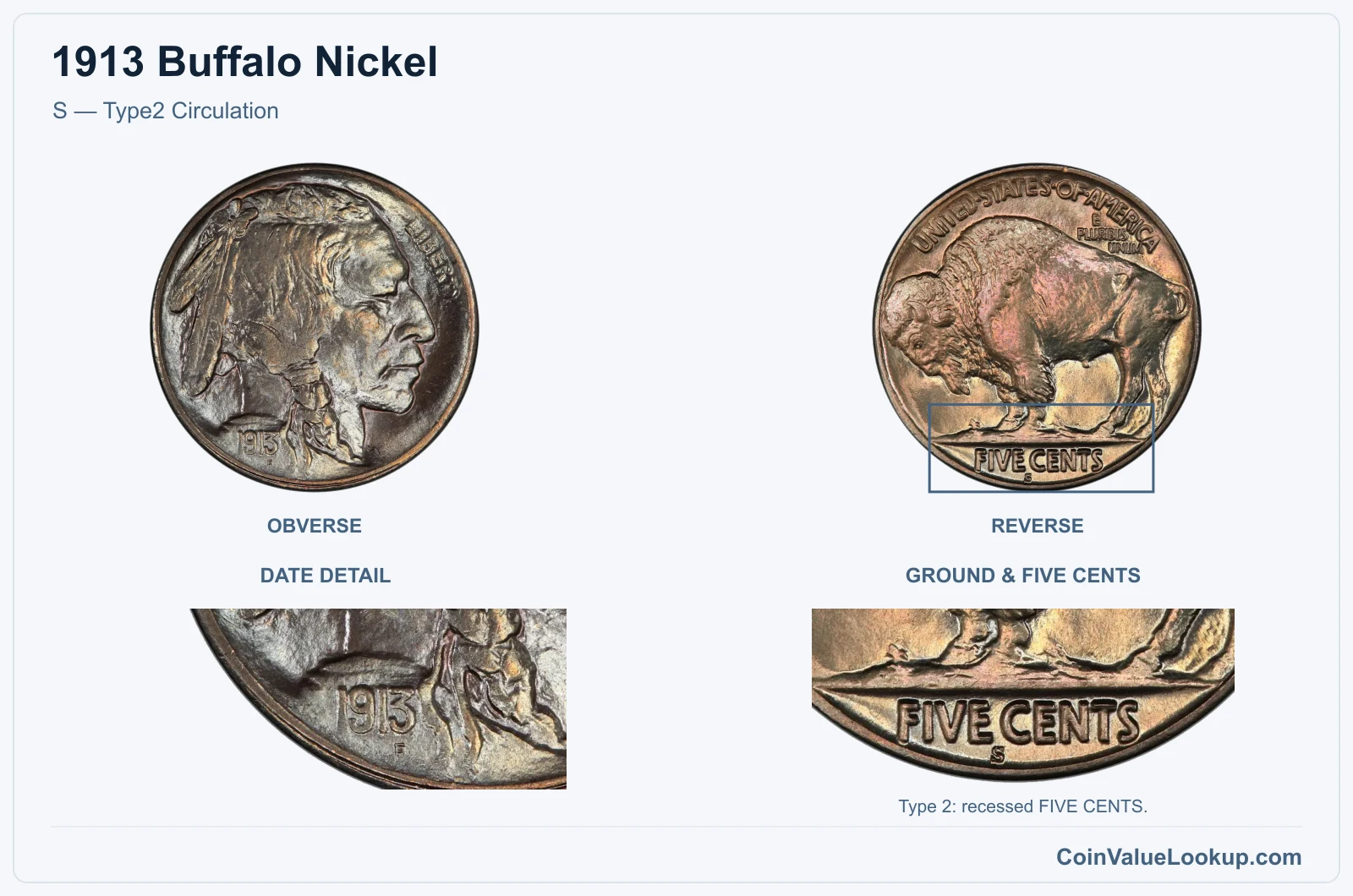
The San Francisco Type 2 is the key circulation coin of 1913. The S mintmark appears below the recessed FIVE CENTS.
USA Coin Book estimates reach about $289 in G4 and $1,523 in MS63.
Those numbers reflect genuine scarcity. An MS63 example commands the highest guide figure among all regular-issue 1913 Buffalo Nickel circulation strikes.
Even heavily worn pieces carry a premium worth verifying. Confirm the mintmark under magnification, because a misread letter changes value dramatically.
Range Grade
Price Auction Records Appraisal PO PO 1
—
Coin Identifier FR FR 2
—
Coin Identifier AG AG 3
Coin Identifier G G 4
Coin Identifier
G 6
Coin Identifier VG VG 8
Coin Identifier
VG 10
Coin Identifier F F 12
Coin Identifier
F 15
Coin Identifier VF VF 20
Coin Identifier
VF 25
Coin Identifier
VF 30
Coin Identifier
VF 35
Coin Identifier XF XF 40
Coin Identifier
XF 45
Coin Identifier AU AU 50
Coin Identifier
AU 53
Coin Identifier
AU 55
Coin Identifier
AU 58
Coin Identifier MS MS 60
Coin Identifier
MS 61
Coin Identifier
MS 62
Coin Identifier
MS 63
Coin Identifier
MS 64
Coin Identifier
MS 65
Coin Identifier
MS 66
Coin Identifier
MS 67
Coin Identifier
MS 68
—
—
—
MS 69
—
—
—
MS 70
—
—
—
1913 Buffalo Nickel — No Mint Mark — Type1 Matte Proof
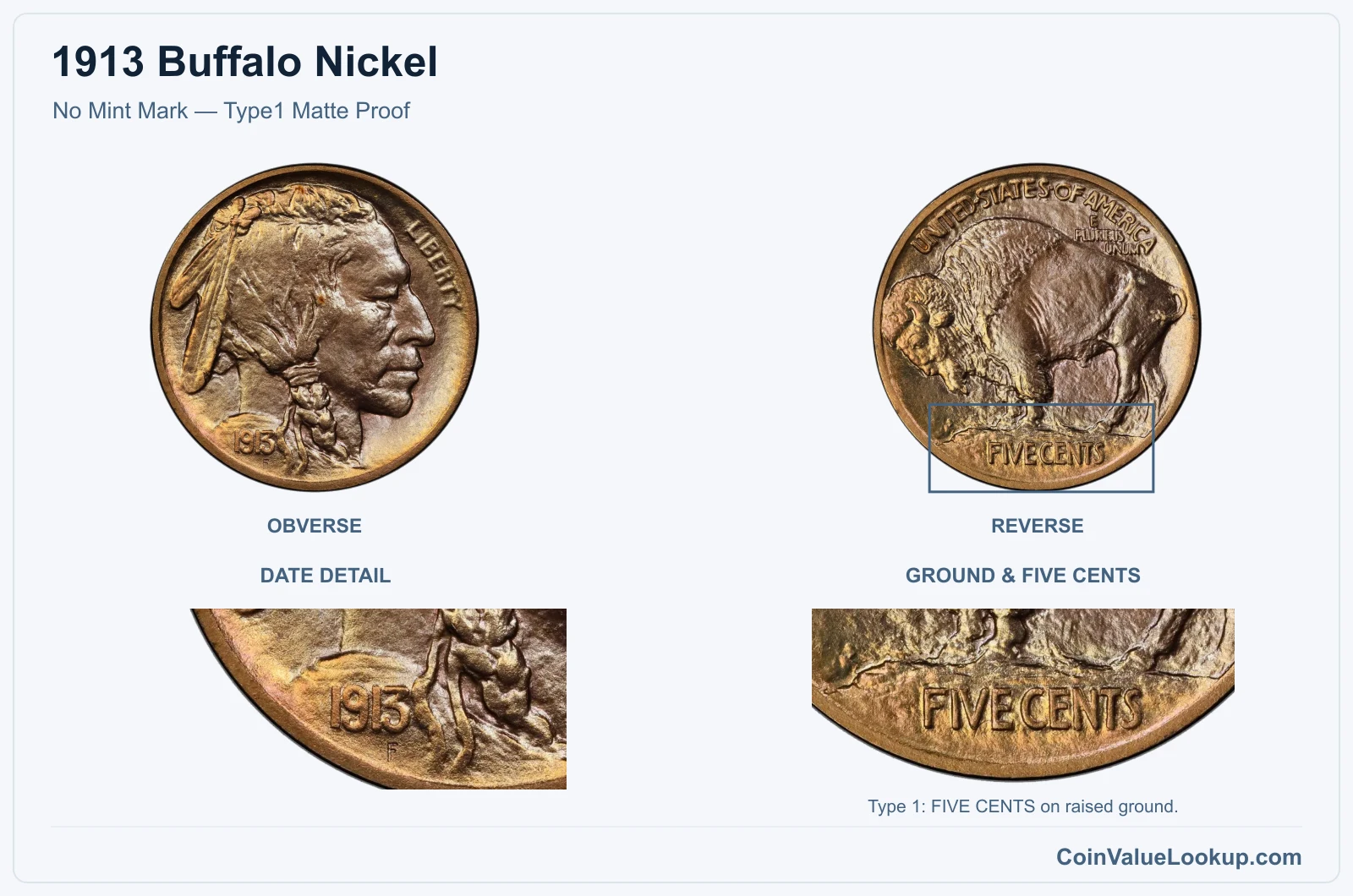
Philadelphia produced matte proof versions of the Type 1 design. These have a distinctive granular, non-reflective field texture with extremely sharp design details and clean, squared-off rims.
The USA Coin Book guide estimate at PR63 is $1,523.
Do not identify a proof simply because your coin looks sharp or shiny. Matte proofs have a specific surface character that differs from a well-struck business strike.
If you suspect you have one, professional certification is the practical path to confirming it, since the difference is subtle to untrained eyes.
Range Grade
Price Auction Records Appraisal PR PR 1
—
Coin Identifier
PR 2
—
Coin Identifier
PR 3
—
Coin Identifier
PR 4
—
Coin Identifier
PR 6
—
Coin Identifier
PR 8
—
Coin Identifier
PR 10
—
Coin Identifier
PR 12
—
Coin Identifier
PR 15
—
Coin Identifier
PR 20
—
Coin Identifier
PR 25
—
Coin Identifier
PR 30
—
Coin Identifier
PR 35
—
Coin Identifier
PR 40
—
Coin Identifier
PR 45
—
Coin Identifier
PR 50
—
Coin Identifier
PR 53
—
Coin Identifier
PR 55
—
Coin Identifier
PR 58
—
Coin Identifier
PR 60
—
Coin Identifier
PR 61
—
Coin Identifier
PR 62
—
Coin Identifier
PR 63
—
Coin Identifier
PR 64
Coin Identifier
PR 65
Coin Identifier
PR 66
Coin Identifier
PR 67
Coin Identifier
PR 68
Coin Identifier
PR 69
—
—
—
PR 70
—
—
—
1913 Buffalo Nickel — No Mint Mark — Type2 Matte Proof
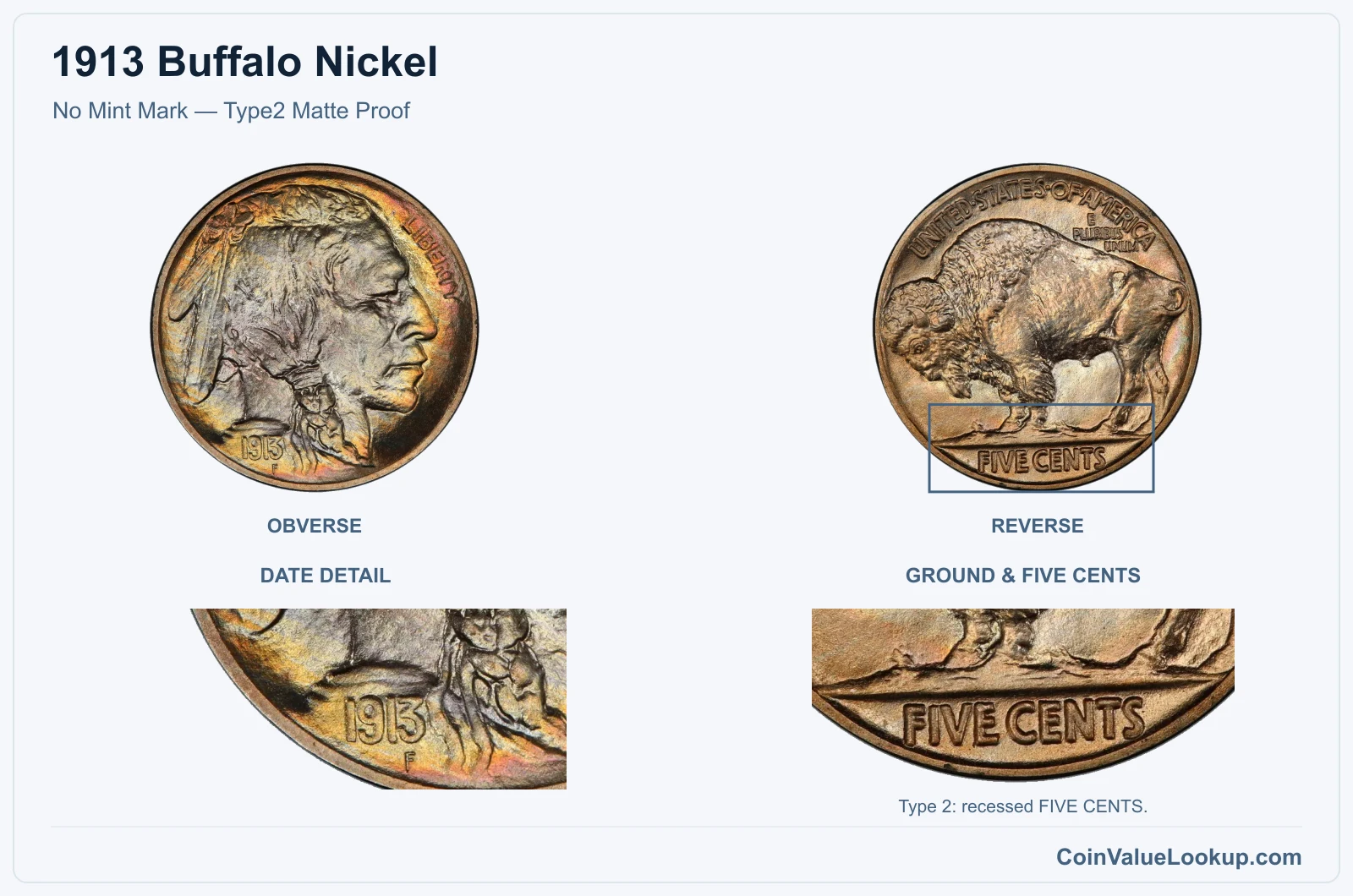
The Type 2 matte proof was also struck at Philadelphia. It shares the recessed FIVE CENTS reverse with circulation Type 2 coins but displays the same matte proof field texture and precise rim work as the Type 1 proof.
The USA Coin Book guide estimate at PR63 is $1,345.
Identifying a matte proof requires careful examination of the fields and rims under good lighting. A coin that simply looks uncirculated is not necessarily a proof.
These are uncommon coins and any suspected example deserves expert evaluation.
Range Grade
Price Auction Records Appraisal PR PR 1
—
Coin Identifier
PR 2
—
Coin Identifier
PR 3
—
Coin Identifier
PR 4
—
Coin Identifier
PR 6
—
Coin Identifier
PR 8
—
Coin Identifier
PR 10
—
Coin Identifier
PR 12
—
Coin Identifier
PR 15
—
Coin Identifier
PR 20
—
Coin Identifier
PR 25
—
Coin Identifier
PR 30
—
Coin Identifier
PR 35
—
Coin Identifier
PR 40
—
Coin Identifier
PR 45
—
Coin Identifier
PR 50
—
Coin Identifier
PR 53
—
Coin Identifier
PR 55
—
Coin Identifier
PR 58
—
Coin Identifier
PR 60
—
Coin Identifier
PR 61
—
Coin Identifier
PR 62
—
Coin Identifier
PR 63
Coin Identifier
PR 64
Coin Identifier
PR 65
Coin Identifier
PR 66
Coin Identifier
PR 67
Coin Identifier
PR 68
Coin Identifier
PR 69
—
—
—
PR 70
—
—
—
1913 Buffalo Nickel Error List
1. 1913 Buffalo Nickel — Broadstrike
A broadstrike occurs when a coin is struck without the normal retaining collar, allowing metal to spread outward beyond the standard diameter. On a 1913 Philadelphia Type 1, this produces a coin that is noticeably wider than usual, with design elements that may look slightly spread but remain essentially complete.
To spot one, compare the edge profile and overall diameter against a normal coin. A broadstrike will lack the sharp, defined rim that the collar normally creates.
The entire design should still be present and centered, which distinguishes it from an off-center strike where part of the design is missing.
Watch out for coins that were simply flattened after leaving the mint, such as by a railroad track or vise. Those show distorted details rather than the uniform metal flow of a genuine broadstrike.
Value depends on condition and how dramatic the spread is.
2. 1913 Buffalo Nickel — Repunched Mintmark
Repunched mintmarks have been reported on the 1913-D Type 1 and the 1913-S Type 2. This variety results from the mintmark punch being applied more than once in slightly different positions, leaving traces of the earlier impression visible near the final letter.
Under magnification, look for a shadow, partial outline, or offset remnant next to the primary D or S mintmark. Compare what you see against a normal mintmark at the same magnification to confirm the extra impression is genuine.
Machine doubling, die chips, and surface corrosion can all mimic the look of a repunched mark. Machine doubling tends to produce flat, shelf-like distortion rather than the rounded shape of a true second punch.
The specific variety, its clarity, and the coin's overall condition all factor into how collectors assess value.
3. 1913 Buffalo Nickel — Off-Center Strike
Off-center strikes have been reported on 1913-S coins in both Type 1 and Type 2. This error happens when the planchet is not seated properly between the dies, so the design shifts to one side and leaves an unstruck crescent of blank metal on the opposite edge.
The key diagnostic is that crescent of blank metal paired with a shifted but otherwise normally struck design. For collector appeal, the date should remain fully visible.
Do not confuse this with a clipped planchet, which removes a curved bite from the edge but keeps the design centered. Post-mint damage from a press or vise can also create an uneven appearance.
Genuine off-center errors show the shift consistently on both obverse and reverse. Value varies with the percentage of offset, date visibility, and overall condition.
4. 1913 Buffalo Nickel — Wrong Planchet / Off-Metal Strike
A 1913 Type 2 Buffalo Nickel struck on a $5 gold planchet has been reported. This is an individual mint error, not a standard gold-composition issue.
It happened when a blank intended for a different denomination ended up in the nickel press.
To evaluate a suspected wrong-planchet coin, compare its weight, diameter, and edge characteristics against a normal 5-gram, 21.2 mm nickel. Significant differences in any of those measurements are the first clue.
Many coins that appear to be off-metal are actually plated, corroded, acid-treated, or deliberately altered after leaving the mint. These fakes are common.
A genuine wrong-planchet error would show the Buffalo Nickel design impressed into a blank that does not match normal nickel specifications. Professional authentication is essential for any such claim.
5. 1913 Buffalo Nickel — Three-and-a-Half Legs
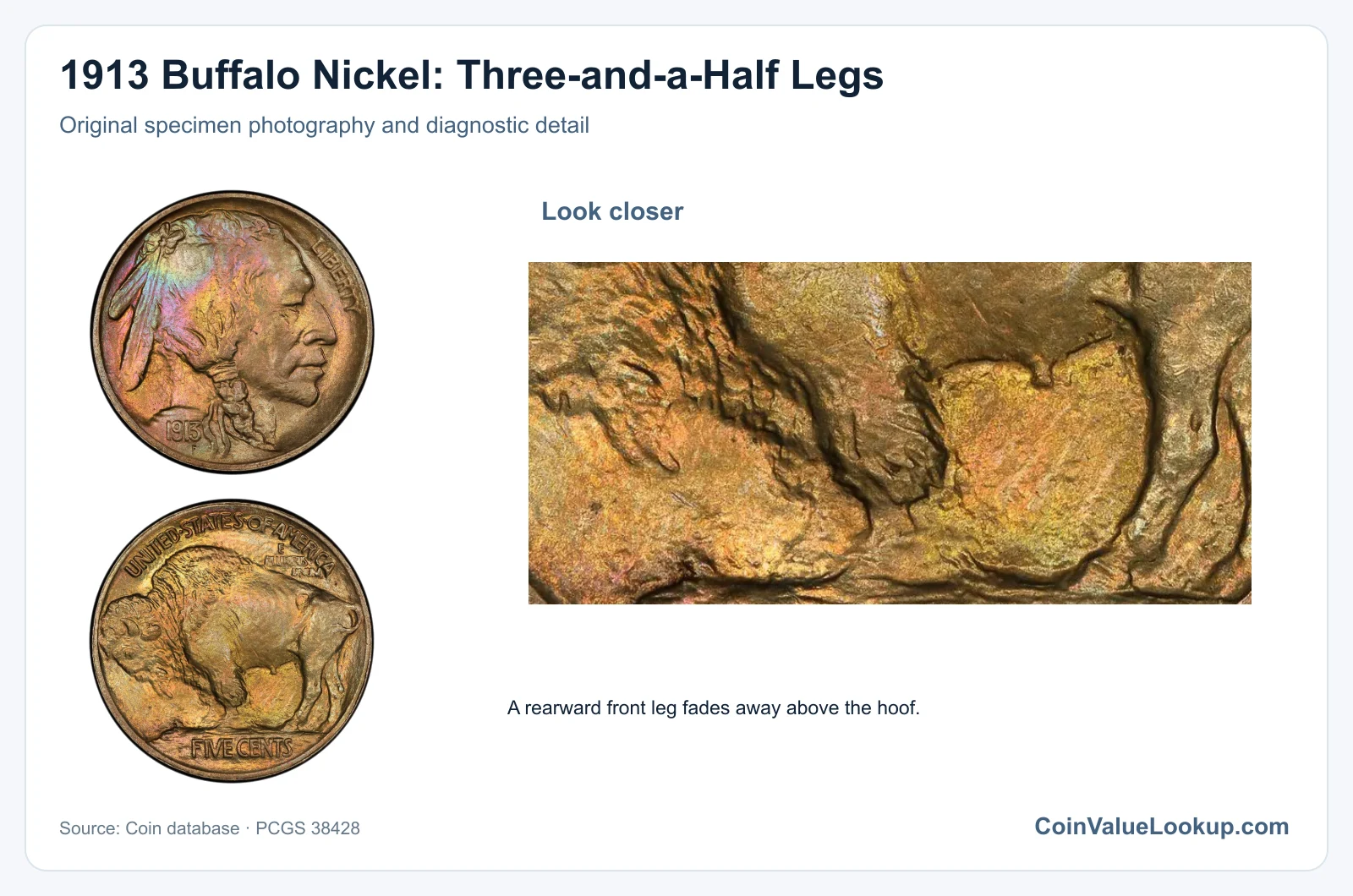
The Three-and-a-Half Legs variety has been reported on the 1913 Philadelphia Type 1. On this die variety, one of the bison's front legs shows an abraded or partially missing section, giving the appearance that the animal has three and a half legs rather than four.
To check for this, compare the bison's front legs on your coin against a normal Type 1 reverse. On the attributed variety, one leg segment is visibly reduced while the hoof and the connection to the body remain intact.
Plain old wear can make legs look thin. Acid treatment, tooling, or deliberate scraping can remove metal from a leg area too.
The key distinction is that the genuine variety shows a consistent die characteristic, not random damage. Condition and clarity of the affected area determine collector interest.
6. 1913 Buffalo Nickel — Two Feathers / Abraded Third Feather
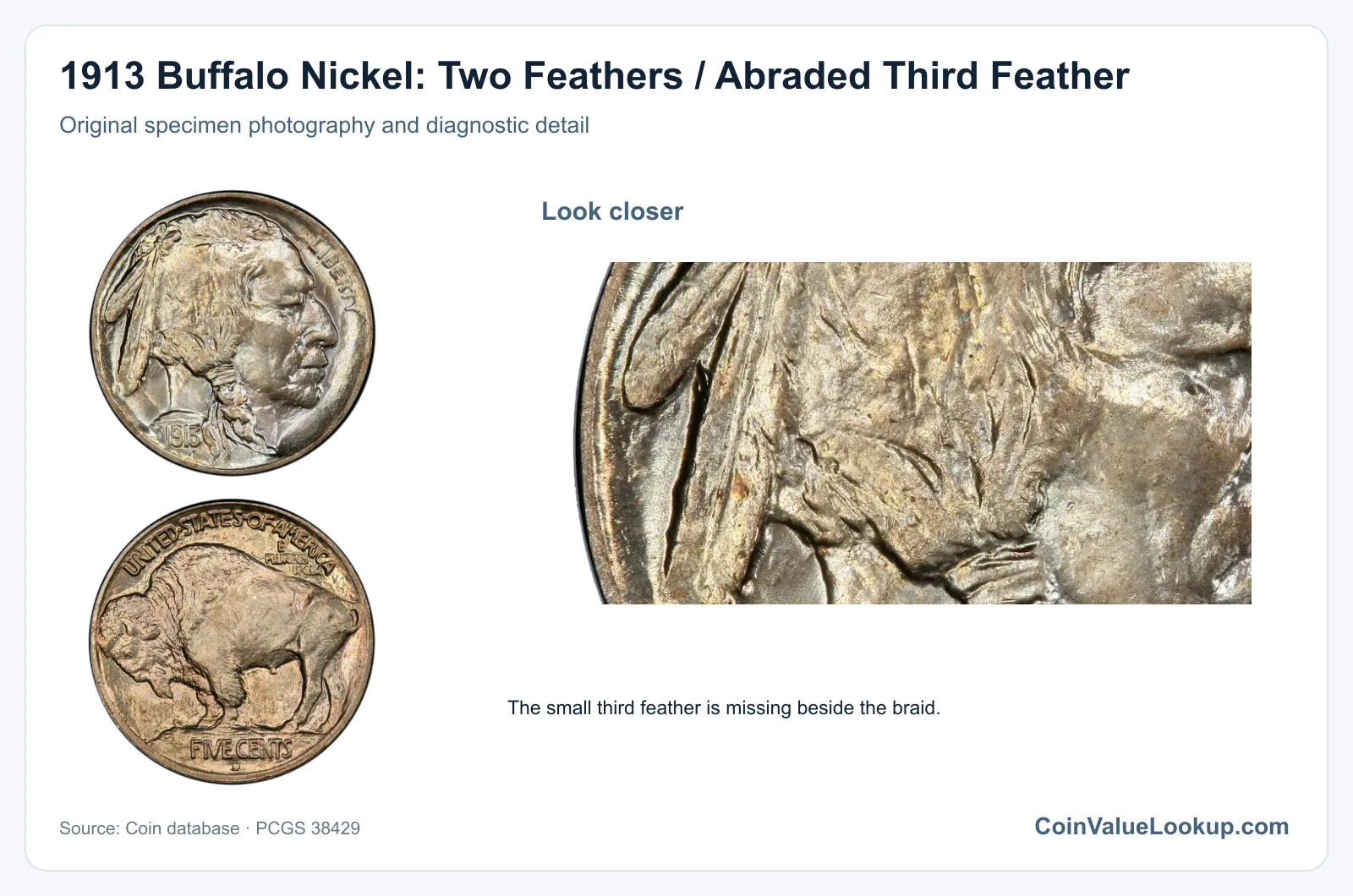
The Two Feathers variety, sometimes called the Abraded Third Feather, has been reported on the 1913-S Type 1. The obverse normally shows three feathers extending from the back of the Native American portrait's head.
On this variety, the third feather near the neck is missing or reduced to a faint remnant.
Compare the feather area on your coin with a normal three-feather obverse at the same angle and magnification. On the attributed variety, two feathers are clear while the third is absent or barely visible due to die abrasion.
Weak strikes, accumulated wear, grease filling, and deliberate scraping can all make a feather disappear. The genuine variety is a die characteristic that appears consistently on coins from that specific die pair.
Value depends on the coin's condition and how clearly the missing feather is evident.
7. 1913 Buffalo Nickel — Missing Designer Initial F
The Missing Designer Initial F variety has been reported on the 1913-S Type 1. Fraser's initial F normally appears in small relief beneath the date on the obverse.
On this variety, the F is absent due to die polishing that removed the letter from the working die.
To check, examine the area just below the date under magnification. Compare it to a normal coin where the small F is clearly visible.
On the attributed variety, the surface where the F should be is smooth and shows no trace of the letter.
Wear, grease fills, weak strikes, and deliberate removal can all produce a similar look. The genuine variety stems from a specific die-polishing event, not random damage.
A missing initial alone does not confirm the variety without proper attribution. Condition and confirmation by knowledgeable evaluation affect how this variety is valued.
8. 1913 Buffalo Nickel — Doubled Die Reverse
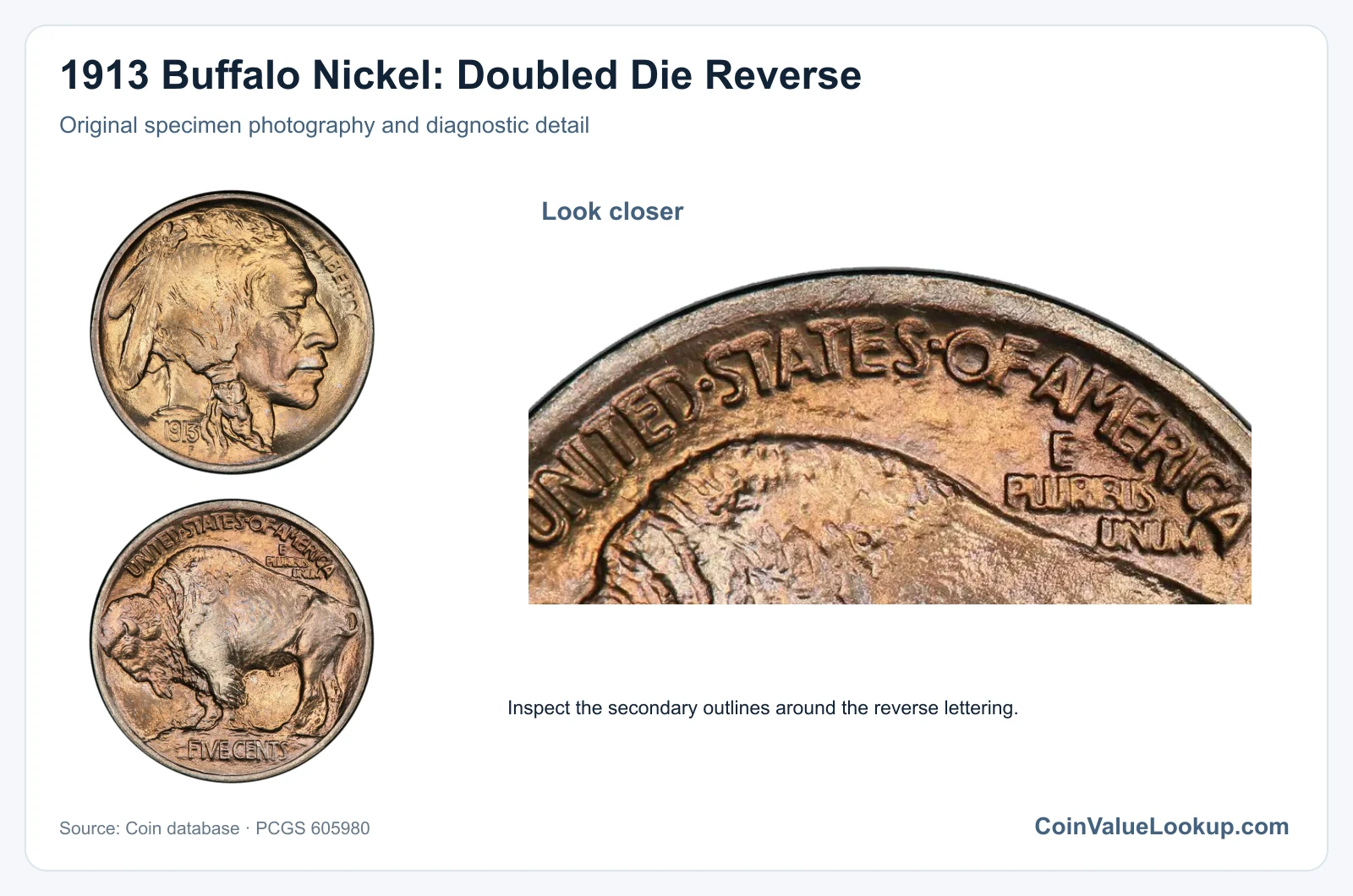
Doubled die reverse varieties have been reported on the 1913 Philadelphia Type 1 and Type 2. This occurs when the die itself receives a doubled impression during its manufacturing, resulting in a consistent doubling of design elements on every coin struck from that die.
Look at the reverse legends and the contours of the bison or denomination for any signs of doubled outlines, thickened lettering, or split serifs. Compare your coin's reverse against a normal example at the same magnification.
Machine doubling is a common lookalike. It produces flat, shelf-like distortion on the high points and is a strike artifact, not a die variety.
Light reflections and random surface damage can also mimic true doubling. Genuine doubled die varieties show raised, rounded secondary impressions that are consistent across every example from that die.
The value of any doubled die depends on the strength of the doubling and the coin's condition.