1916 Buffalo Nickel Coin Value: How Much Is It Worth?
A 1916 Buffalo Nickel in well-worn Good-4 condition starts around $7.87 for a Philadelphia issue, while a San Francisco coin in MS63 can reach roughly $376 according to USA Coin Book guide estimates. Those are just the ordinary circulation strikes.
The recognized Doubled Die Obverse variety commands dramatically higher figures, and matte proofs occupy their own tier entirely. Your coin's specific mint, condition and any die variety will determine where it falls.
Fast Way to Identify Your 1916 Buffalo Nickel
The quickest way to start figuring out what you have is to snap clear photos of both the front and back of your coin. Upload them here for a preliminary identification based on the mint, design type and visible condition.
Make sure the date is legible and the area below FIVE CENTS on the reverse is in focus, since that is where the mintmark lives.
1916 Buffalo Nickel Value
Upload both sides of your 1916 Buffalo Nickel.
Front Obverse
Upload photo
Back Reverse
Upload photo
Which 1916 Buffalo Nickel Versions Are Worth Money?
- The Doubled Die Obverse (Philadelphia) is the standout variety, with guide estimates of roughly $5,623 in G4 and $154,837 in MS63 — authenticate carefully before celebrating.
- San Francisco circulation strikes carry the highest ordinary MS63 guide value at about $376, well above the Philadelphia MS63 figure of $123.
- Denver coins command a premium even in low grades, with a G4 guide estimate of $30 compared to Philadelphia's $7.87.
- Matte Proof strikes from Philadelphia are a separate category entirely, with a PR63 guide figure near $1,878.
- Mint errors such as broadstrikes, die breaks and off-center strikes are reported for this date and can add significant value depending on severity and condition.
Step 1: Identify Your 1916 Buffalo Nickel Mint Mark and Version
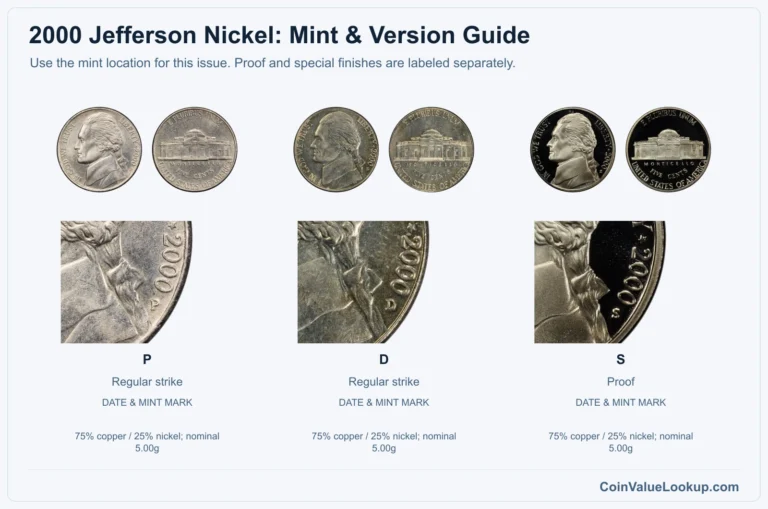
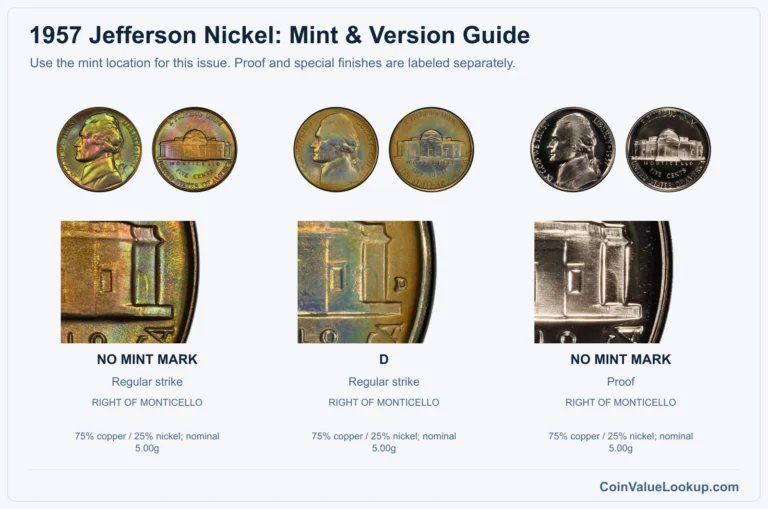
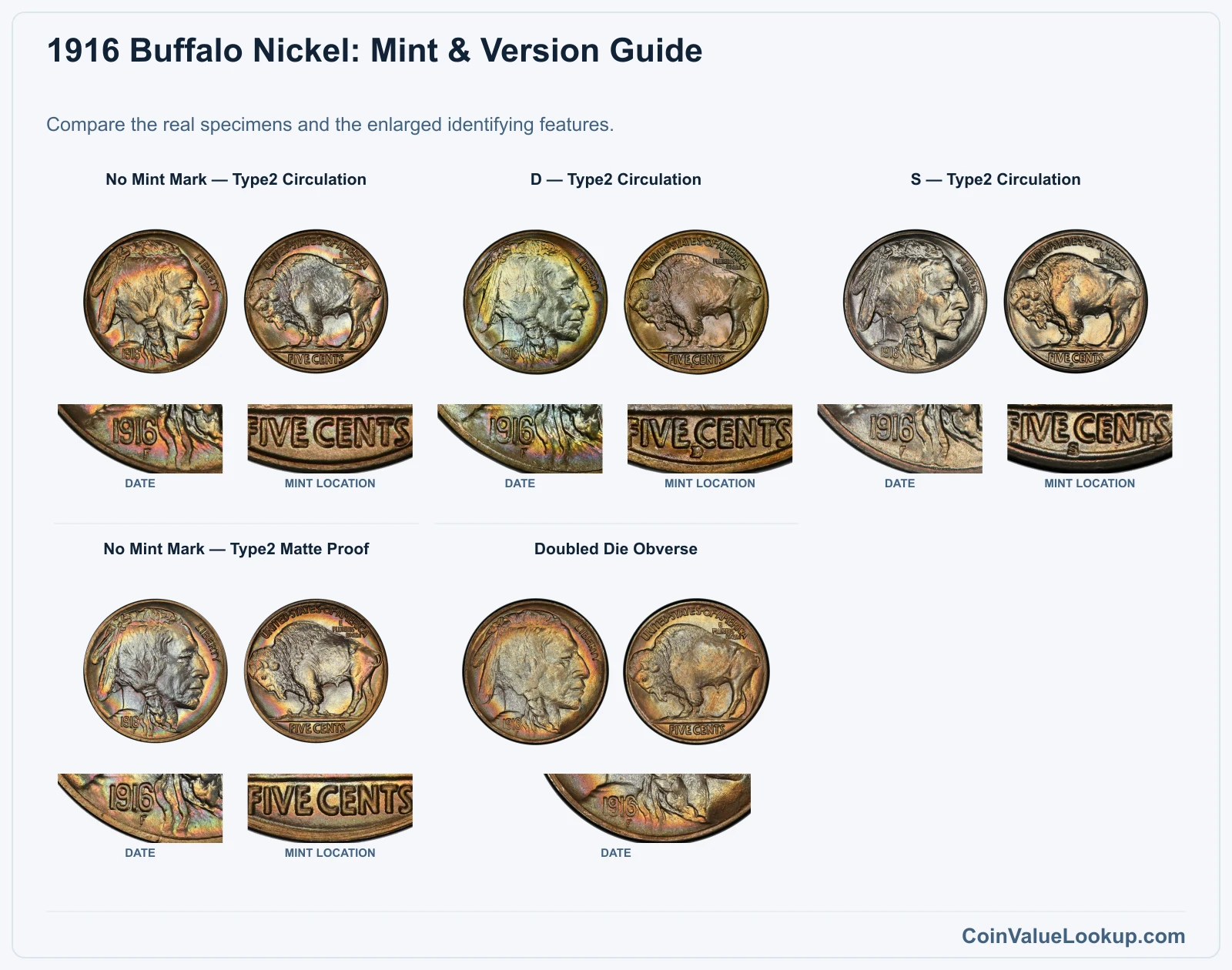
All 1916 Buffalo Nickels use the Type 2 reverse design, where FIVE CENTS sits in a recessed area below the bison. There is no Type 1 variant for this date; that distinction only applies to the 1913 issue.
Three mints produced these coins. Philadelphia strikes carry no mintmark.
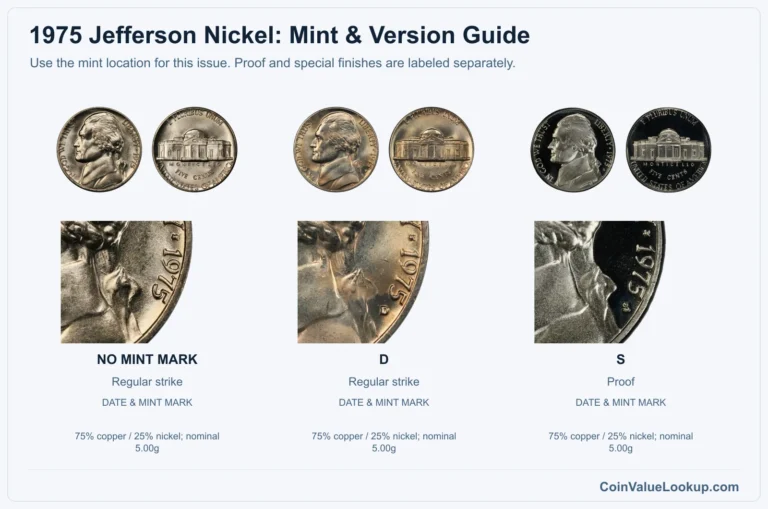
Denver coins show a small D on the reverse beneath FIVE CENTS, and San Francisco pieces display an S in the same spot. The mintmark can be faint, so use magnification and good light.
The coin is 75% copper and 25% nickel, weighs about 5 grams, measures 21.2 mm in diameter, and has a plain edge. There is no silver version of this denomination.
If your coin is attracted to a magnet or has a reeded edge, it is something else entirely.
Beyond the three standard mint issues and the matte proof, one major variety exists for this date: the Doubled Die Obverse. That piece shows strong doubling on the date and obverse design elements and should be authenticated against the recognized die, not confused with common machine doubling.
Step 2: Check Your 1916 Buffalo Nickel Grade
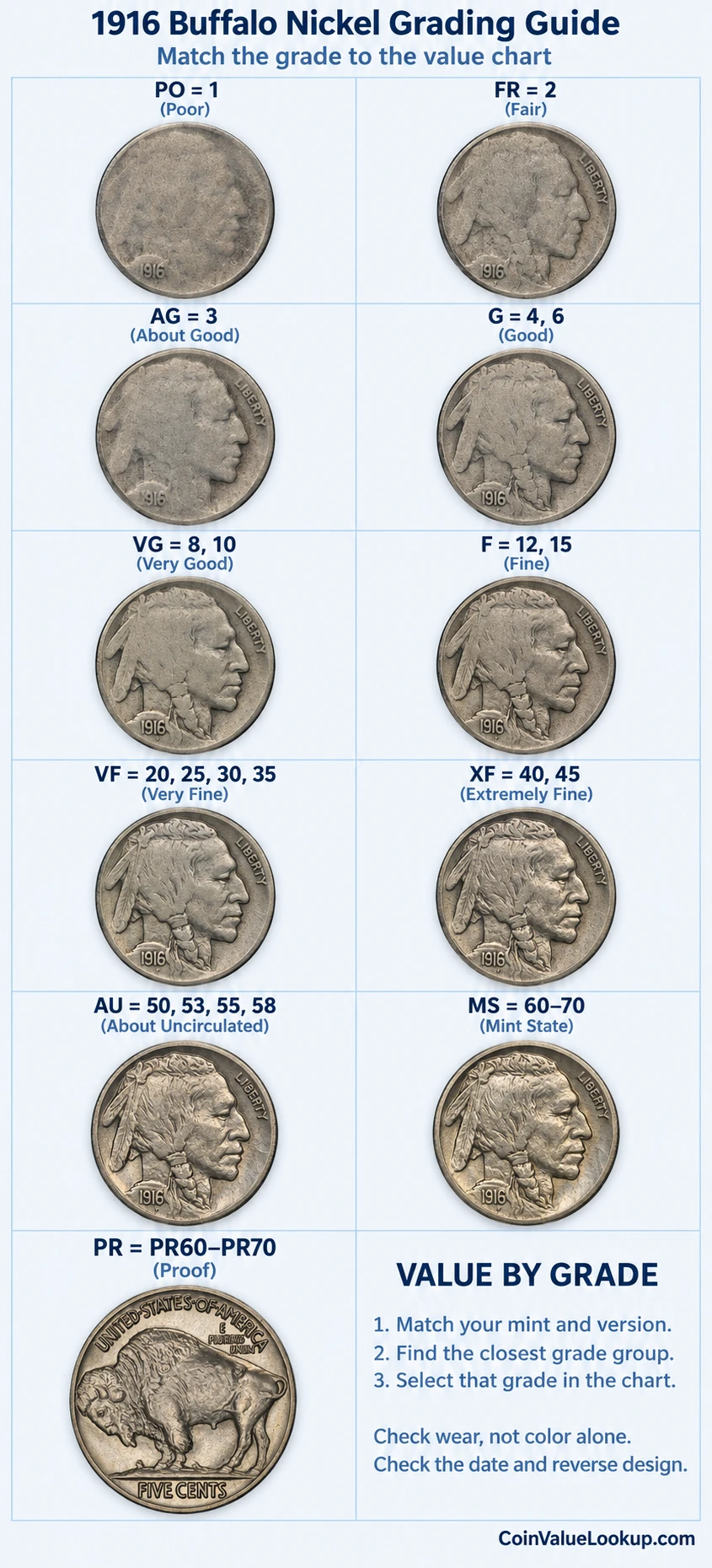
Start by examining the Native American portrait on the obverse. In lower grades the hair braid and cheek flatten first, and the feathers lose individual separation.
On the reverse, check the bison's shoulder and horn — those are the highest points and wear down early.
Here is the tricky part with Buffalo Nickels: weak strikes can mimic wear. Some pieces left the mint with soft horn detail or mushy feathers, especially on branch-mint coins.
Compare your coin against the grading image to see what genuine circulation loss looks like versus a strike issue.
Original luster matters a lot in the mint-state range. A coin with full cartwheel luster and no contact marks will grade much higher than a technically unworn piece that has been cleaned or scratched.
Never use acid or chemicals to bring back a worn date — that destroys the coin's surface and its collector value.
Step 3: Check 1916 Buffalo Nickel Value by Mint and Version
1916 Buffalo Nickel — No Mint Mark — Type2 Circulation
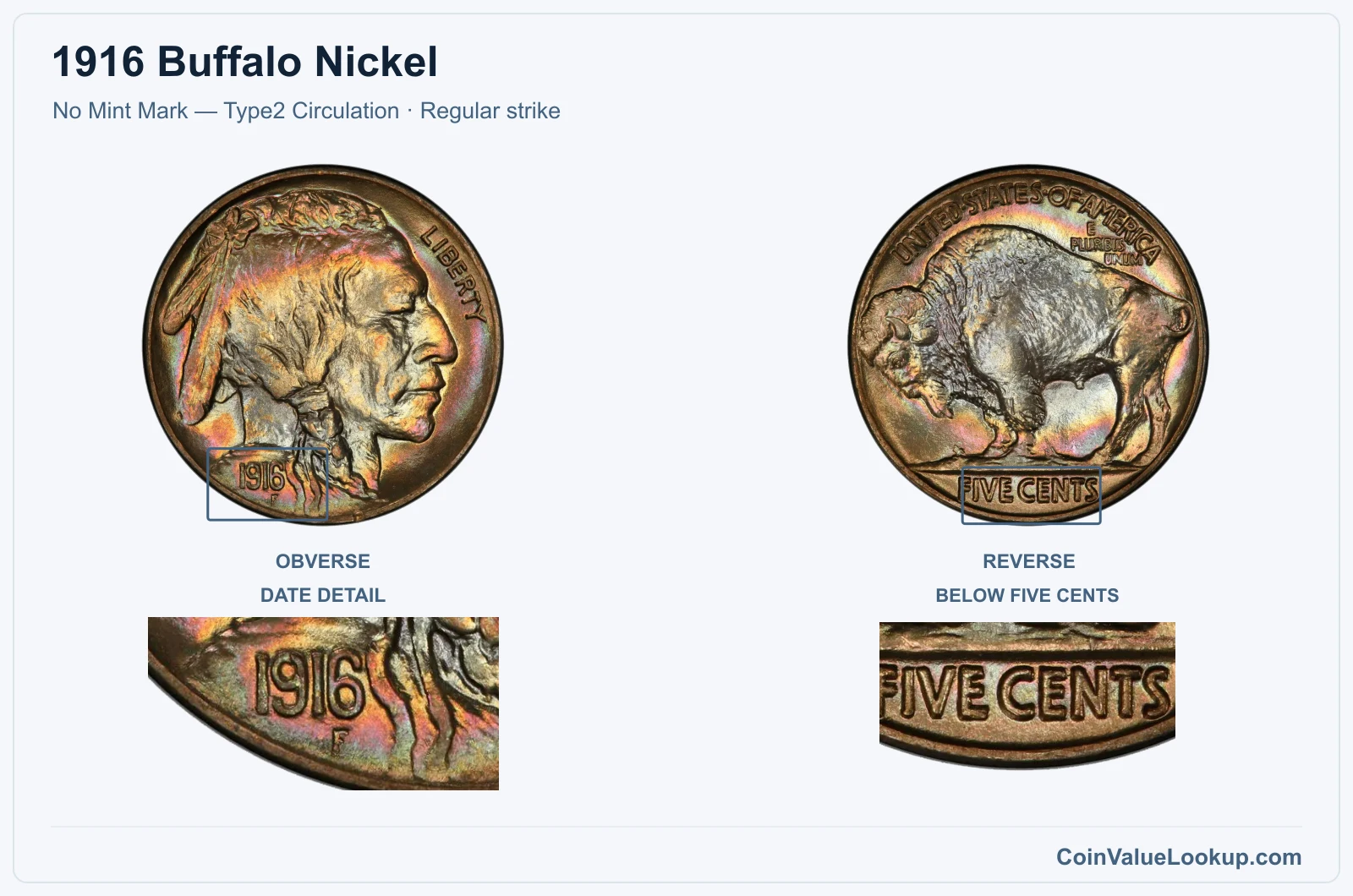
The 1916 Philadelphia Buffalo Nickel has no mintmark. Look on the reverse below FIVE CENTS — if the space is empty, you have the P-mint coin.
USA Coin Book guide estimates place this issue at about $7.87 in Good-4 and $123 in MS63.
Philadelphia produced the largest share of 1916 nickels, so these are the most available in circulated grades. Even so, a fully original mint-state example with strong luster is a different animal from a worn pocket piece.
Check for the Doubled Die Obverse variety before settling on a standard attribution.
Range Grade
Price Auction Records Appraisal PO PO 1
—
Coin Identifier FR FR 2
—
Coin Identifier AG AG 3
—
Coin Identifier G G 4
—
Coin Identifier
G 6
—
Coin Identifier VG VG 8
—
Coin Identifier
VG 10
—
Coin Identifier F F 12
Coin Identifier
F 15
—
Coin Identifier VF VF 20
Coin Identifier
VF 25
—
Coin Identifier
VF 30
—
Coin Identifier
VF 35
—
Coin Identifier XF XF 40
Coin Identifier
XF 45
Coin Identifier AU AU 50
—
Coin Identifier
AU 53
—
Coin Identifier
AU 55
Coin Identifier
AU 58
Coin Identifier MS MS 60
Coin Identifier
MS 61
Coin Identifier
MS 62
Coin Identifier
MS 63
Coin Identifier
MS 64
Coin Identifier
MS 65
Coin Identifier
MS 66
Coin Identifier
MS 67
Coin Identifier
MS 68
Coin Identifier
MS 69
—
—
—
MS 70
—
—
—
1916 Buffalo Nickel — D — Type2 Circulation
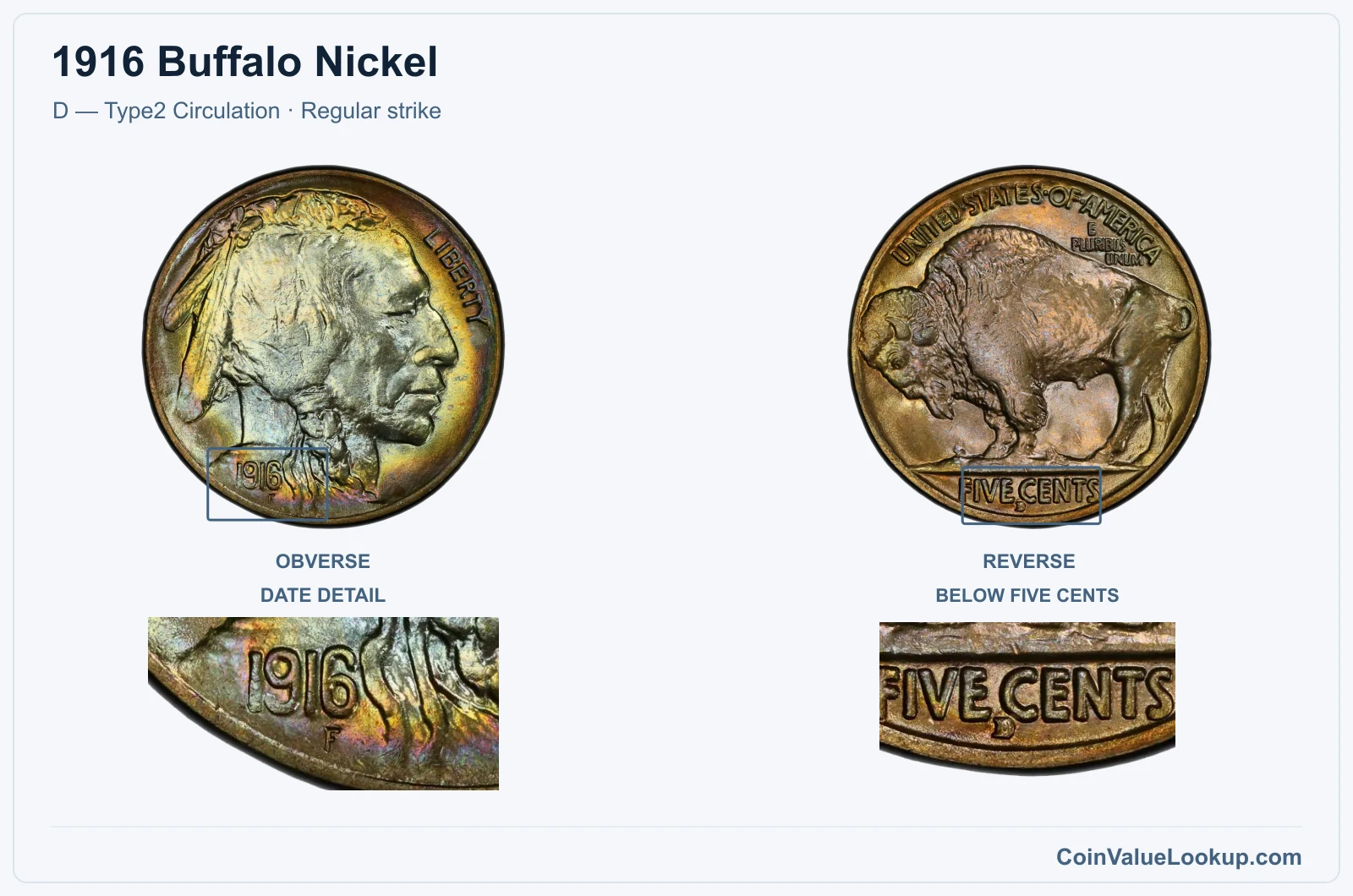
Denver strikes carry a small D mintmark on the reverse beneath FIVE CENTS. Guide estimates from USA Coin Book run about $30 in G4 and $344 in MS63 — a clear step above the Philadelphia issue at every grade level.
The Denver mint's lower output for this year keeps demand steady. Full-horn examples with original surfaces trade at a premium, so inspect the bison's horn carefully and compare it against the grading reference.
A weak horn on a Denver coin might be a strike issue rather than wear, but the market still rewards sharp detail.
Coin Value Lookup is a good starting point if you want to compare your 1916-D against other dates and mints in the Buffalo Nickel series.
Range Grade
Price Auction Records Appraisal PO PO 1
—
Coin Identifier FR FR 2
—
Coin Identifier AG AG 3
—
Coin Identifier G G 4
—
Coin Identifier
G 6
Coin Identifier VG VG 8
—
Coin Identifier
VG 10
—
Coin Identifier F F 12
—
Coin Identifier
F 15
Coin Identifier VF VF 20
Coin Identifier
VF 25
—
Coin Identifier
VF 30
Coin Identifier
VF 35
Coin Identifier XF XF 40
Coin Identifier
XF 45
Coin Identifier AU AU 50
Coin Identifier
AU 53
Coin Identifier
AU 55
Coin Identifier
AU 58
Coin Identifier MS MS 60
Coin Identifier
MS 61
Coin Identifier
MS 62
Coin Identifier
MS 63
Coin Identifier
MS 64
Coin Identifier
MS 65
Coin Identifier
MS 66
Coin Identifier
MS 67
—
Coin Identifier
MS 68
—
—
—
MS 69
—
—
—
MS 70
—
—
—
1916 Buffalo Nickel — S — Type2 Circulation
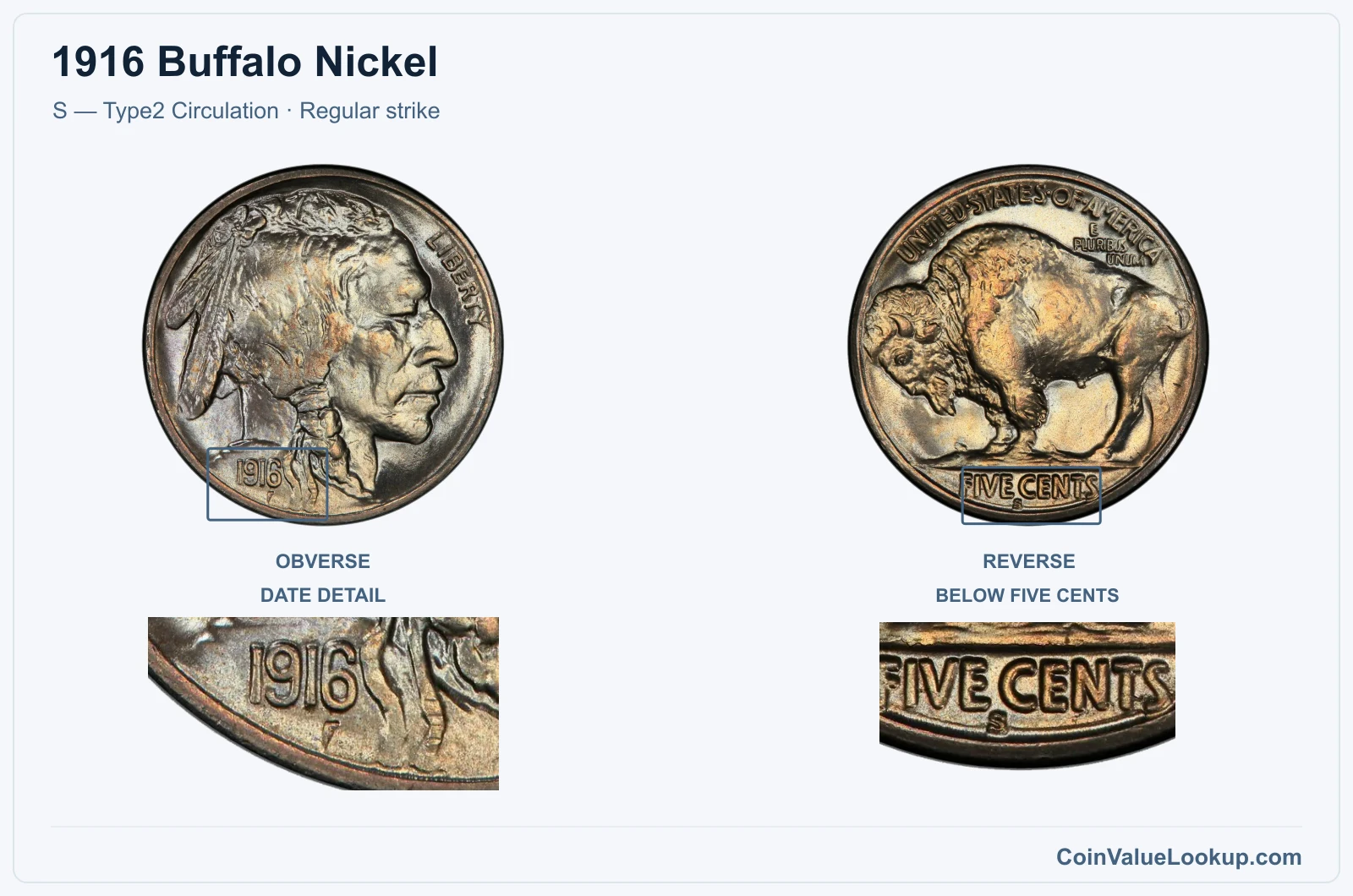
San Francisco coins display an S mintmark in the same reverse location. USA Coin Book estimates put the S-mint at about $16 in G4 and roughly $376 in MS63, making it the highest-valued standard circulation strike for this date in uncirculated condition.
San Francisco Buffalo Nickels from this era can come softly struck, so do not automatically downgrade a coin that looks mushy on the horn or feathers. Compare high points and luster against known examples.
A genuinely mint-state 1916-S with a full strike is harder to find than the guide number alone suggests.
Range Grade
Price Auction Records Appraisal PO PO 1
—
Coin Identifier FR FR 2
—
Coin Identifier AG AG 3
—
Coin Identifier G G 4
—
Coin Identifier
G 6
—
Coin Identifier VG VG 8
—
Coin Identifier
VG 10
—
Coin Identifier F F 12
Coin Identifier
F 15
Coin Identifier VF VF 20
Coin Identifier
VF 25
—
Coin Identifier
VF 30
Coin Identifier
VF 35
Coin Identifier XF XF 40
Coin Identifier
XF 45
Coin Identifier AU AU 50
Coin Identifier
AU 53
Coin Identifier
AU 55
Coin Identifier
AU 58
Coin Identifier MS MS 60
Coin Identifier
MS 61
Coin Identifier
MS 62
Coin Identifier
MS 63
Coin Identifier
MS 64
Coin Identifier
MS 65
Coin Identifier
MS 66
Coin Identifier
MS 67
Coin Identifier
MS 68
—
—
—
MS 69
—
—
—
MS 70
—
—
—
1916 Buffalo Nickel — No Mint Mark — Type2 Matte Proof
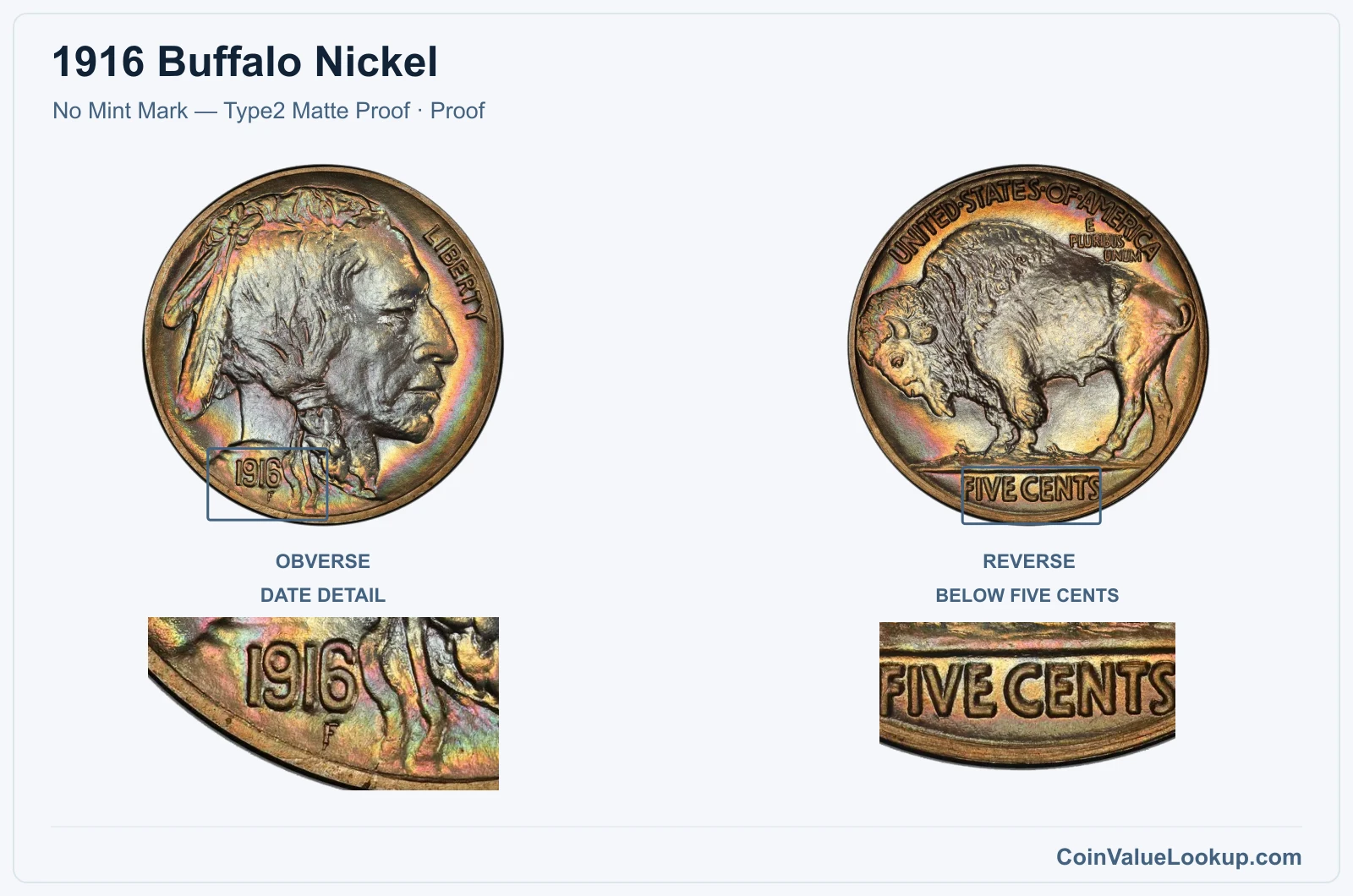
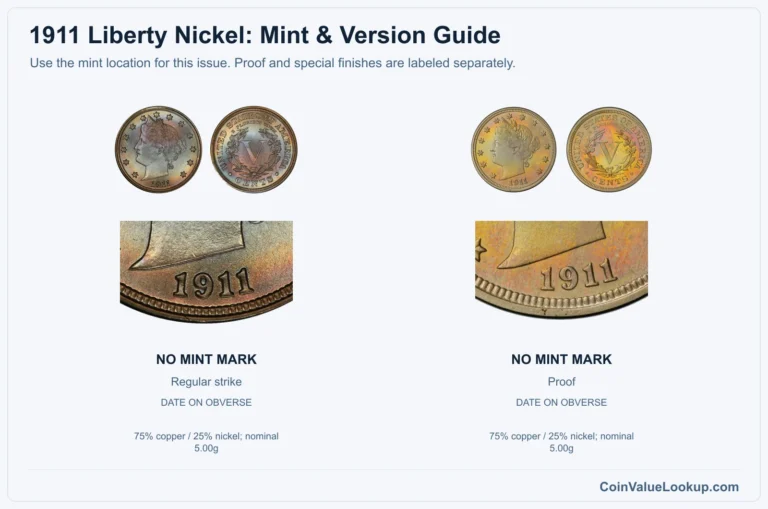
Philadelphia struck matte proof Buffalo Nickels from 1913 through 1916, making this the final year of that run. These are not mirror-bright proofs like later issues; matte proofs have a granular, satiny surface that can fool the untrained eye.
Identifying one requires careful inspection of the rim sharpness, field texture and overall strike precision. A shiny coin is not automatically a proof.
The USA Coin Book guide estimate for a PR63 matte proof is around $1,878. Because the finish is subtle, third-party certification is practically essential for confident attribution — and for realizing full market value.
Range Grade
Price Auction Records Appraisal PR PR 1
—
Coin Identifier
PR 2
—
Coin Identifier
PR 3
—
Coin Identifier
PR 4
—
Coin Identifier
PR 6
—
Coin Identifier
PR 8
—
Coin Identifier
PR 10
—
Coin Identifier
PR 12
—
Coin Identifier
PR 15
—
Coin Identifier
PR 20
—
Coin Identifier
PR 25
—
Coin Identifier
PR 30
—
Coin Identifier
PR 35
—
Coin Identifier
PR 40
—
Coin Identifier
PR 45
—
Coin Identifier
PR 50
—
Coin Identifier
PR 53
—
Coin Identifier
PR 55
—
Coin Identifier
PR 58
—
Coin Identifier
PR 60
—
Coin Identifier
PR 61
—
Coin Identifier
PR 62
—
Coin Identifier
PR 63
—
Coin Identifier
PR 64
Coin Identifier
PR 65
Coin Identifier
PR 66
Coin Identifier
PR 67
Coin Identifier
PR 68
Coin Identifier
PR 69
—
—
—
PR 70
—
—
—
1916 Buffalo Nickel — Doubled Die Obverse
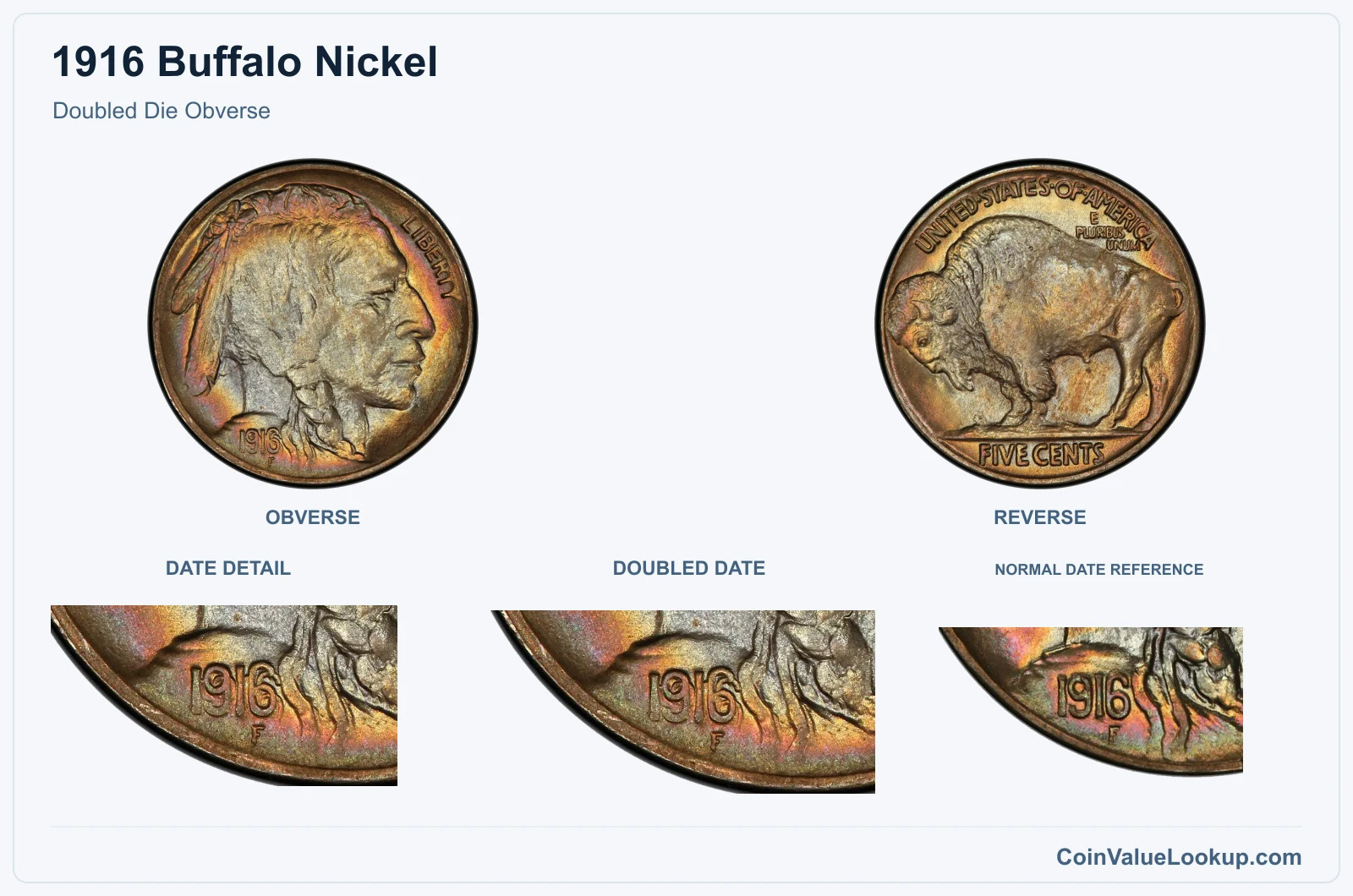
This is the big one. The 1916 Doubled Die Obverse shows strong, visible doubling on the date numerals and other obverse design elements.
It is a recognized major variety struck at Philadelphia with no mintmark.
USA Coin Book guide estimates are staggering: roughly $5,623 in G4 and about $154,837 in MS63. Those numbers reflect genuine scarcity and collector demand, not hype.
Before you get too excited, know that machine doubling — a common, worthless form of strike doubling — can look similar to the untrained eye. The real Doubled Die Obverse has a specific profile involving hub doubling, which appears as shelf-like separation on the affected elements.
Authentication by a major grading service is strongly recommended for any coin you suspect might be this variety. The stakes are too high to guess.
Range Grade
Price Auction Records Appraisal PO PO 1
—
Coin Identifier FR FR 2
Coin Identifier AG AG 3
Coin Identifier G G 4
Coin Identifier
G 6
Coin Identifier VG VG 8
Coin Identifier
VG 10
Coin Identifier F F 12
Coin Identifier
F 15
Coin Identifier VF VF 20
Coin Identifier
VF 25
Coin Identifier
VF 30
Coin Identifier
VF 35
Coin Identifier XF XF 40
Coin Identifier
XF 45
Coin Identifier AU AU 50
Coin Identifier
AU 53
Coin Identifier
AU 55
Coin Identifier
AU 58
Coin Identifier MS MS 60
—
Coin Identifier
MS 61
Coin Identifier
MS 62
Coin Identifier
MS 63
Coin Identifier
MS 64
Coin Identifier
MS 65
—
—
—
MS 66
—
—
—
MS 67
—
—
—
MS 68
—
—
—
MS 69
—
—
—
MS 70
—
—
—
1916 Buffalo Nickel Error List
1. 1916 Buffalo Nickel — Broadstrike
A broadstrike happens when the coin is struck without the normal collar die that constrains its diameter. The result is a nickel that spreads outward, appearing slightly wider than usual with a weakened or absent rim.
Broadstrikes have been reported on 1916 Buffalo Nickels from Philadelphia, Denver and San Francisco. Look for metal that has flowed beyond the normal 21.2 mm boundary while the full design remains mostly intact.
The edge profile will look soft or rounded rather than sharply defined.
Do not confuse this with a coin that was flattened after leaving the mint, such as by a railroad track or a vise. Post-mint damage distorts the design unevenly.
A genuine broadstrike retains a centered, recognizable design. Value depends on condition, the degree of spread and overall eye appeal.
2. 1916 Buffalo Nickel — Lamination / Split Planchet
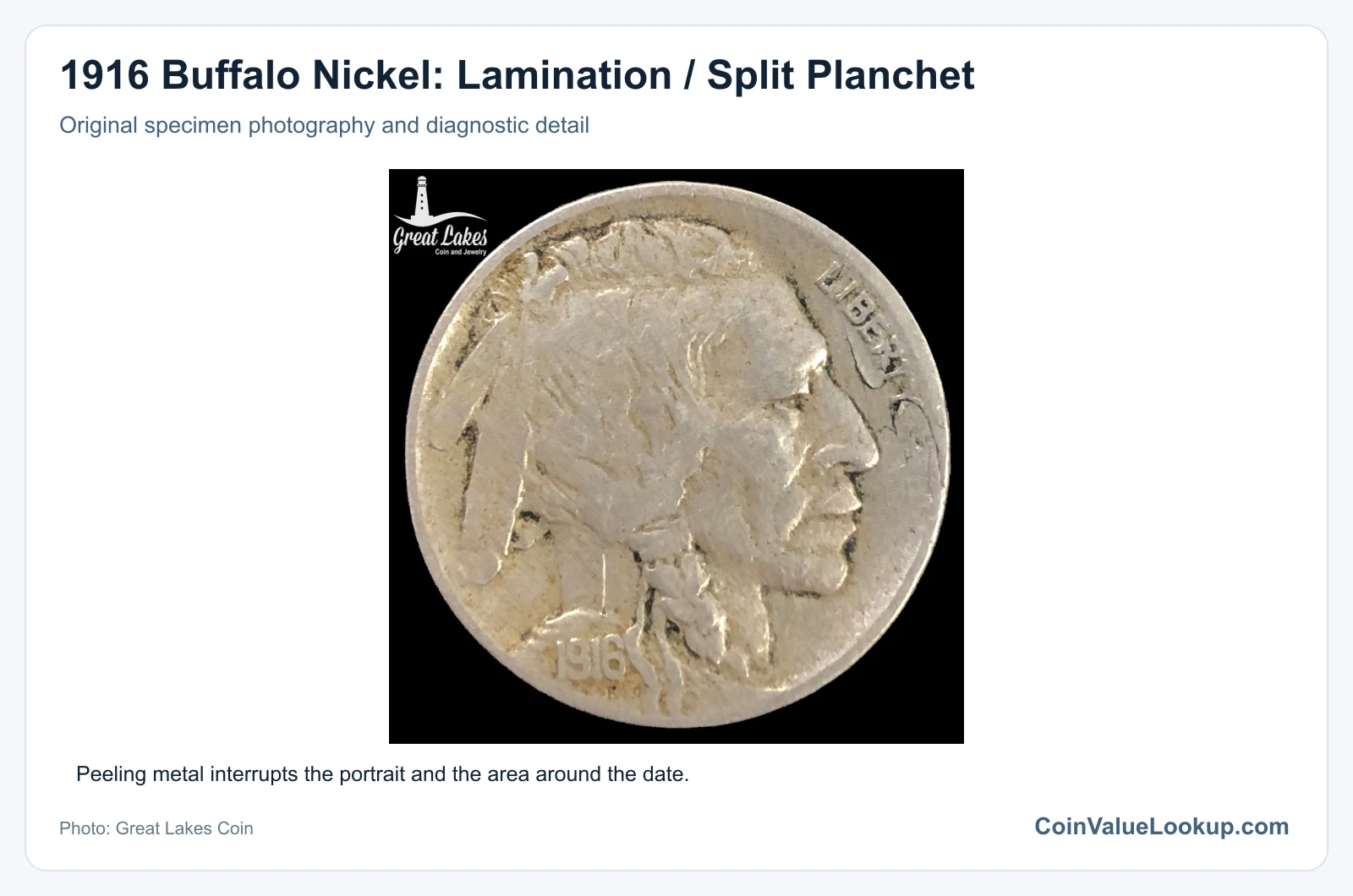
Lamination errors occur when the planchet metal separates into layers, producing peeling flaps, missing chunks or visible cracks within the alloy itself. A split planchet — where the coin literally divides into two halves — is the extreme version.
For 1916, split-planchet mated halves have been reported from the Philadelphia mint. If you find a coin that seems unusually thin or has a flap of metal lifting from the surface, photograph the edge alongside the affected face.
These are not the same as post-mint scrapes, corrosion pitting or a coin that someone deliberately cut. Genuine lamination flaws follow the metal's internal structure and typically have a smooth, natural-looking separation edge.
The value of any lamination error depends on severity, the amount of missing or displaced metal and overall condition.
3. 1916 Buffalo Nickel — Die Break / Cud
A cud is a specific type of die break where a piece of the die rim chips away. When that broken die strikes a planchet, the result is a raised, featureless blob of metal connected to the rim on the finished coin.
For the 1916 series, a retained reverse cud has been reported on Denver-mint strikes. Look for an irregular raised lump at the rim that displaces part of the normal design.
Do not confuse a cud with a simple rim dent, which is damage inflicted after striking. A rim dent pushes metal inward; a cud raises metal outward from the strike itself.
Corrosion and interior die chips can also mimic a cud but will not connect to the rim in the same way. Value depends on the cud's size, location and the coin's overall grade.
4. 1916 Buffalo Nickel — Die Crack / Die Chip
Die cracks show up as thin, raised lines on the coin's surface — they are the impression of a crack in the steel die transferred during striking. A die chip is a small raised blob from a tiny piece of die that flaked away.
A pre-cud obverse crack has been reported on 1916-S nickels. This means the crack had not yet progressed to a full rim break.
Look for a fine raised line running across the obverse design, possibly extending toward the rim.
These raised features should not be confused with incuse scratches, which are grooves cut into the surface after minting. Die cracks sit above the field; scratches sit below it.
Corrosion lines and surface debris can also cause confusion. Value varies with length, prominence and condition of the host coin.
5. 1916 Buffalo Nickel — Off-Center Strike
An off-center strike occurs when the planchet is not properly seated between the dies, resulting in a design that is shifted to one side with a blank crescent of unstruck metal on the opposite edge.
Off-center examples have been reported for the 1916-S Buffalo Nickel. The most desirable off-center errors retain a readable date, since that confirms the year and adds collector interest.
Do not confuse an off-center strike with a clipped planchet, which removes material before striking, or with post-mint flattening that distorts the design. A genuine off-center coin will have a clean, unstruck area with the design shifted uniformly in one direction.
Condition, the percentage of off-center displacement and date visibility all factor into value.
6. 1916 Buffalo Nickel — Missing Designer Initial F
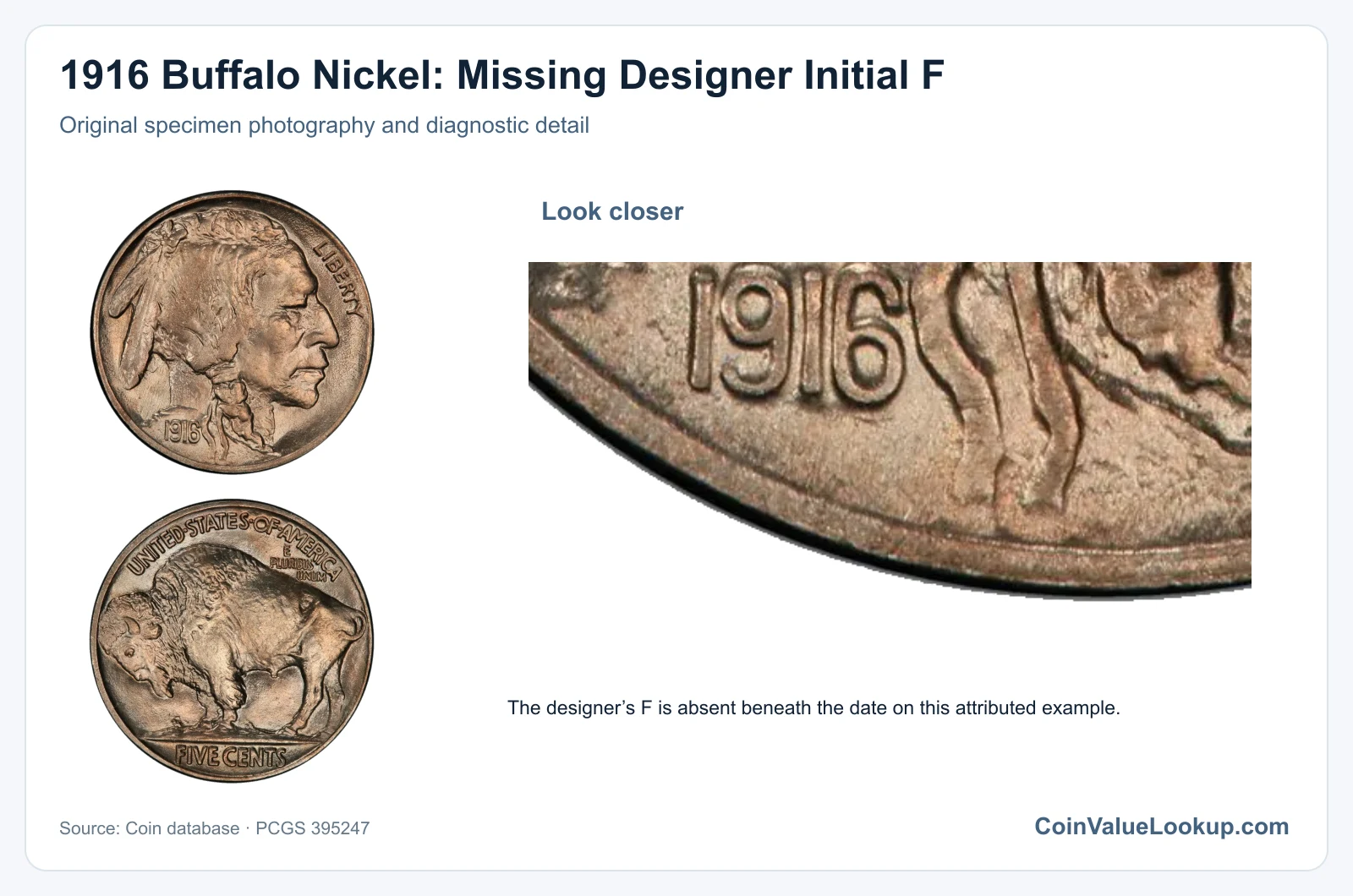
The designer's initial F, for James Earle Fraser, normally appears on the obverse beneath the date. On some 1916 Philadelphia nickels, this F is missing due to die polishing that removed it from the working die.
This variety has been reported for the Philadelphia mint. A claimed 1916-S example was described by its own owner as possibly counterfeit, so treat any S-mint "No F" claim with extreme caution.
The absence of the F alone does not establish this variety. Wear, grease fill during striking, a weak strike or deliberate removal can all make the initial disappear.
The attributed examples show evidence of die polishing in the surrounding area, not just a blank spot. Value depends on condition and confident attribution.
7. 1916 Buffalo Nickel — Rotated Dies
On a normally struck US coin, if you hold the obverse upright and flip the coin top to bottom, the reverse should also appear upright. A rotated-die error means the reverse is turned at an angle relative to where it should be.
Rotated dies have been reported for the 1916 Buffalo Nickel. To check yours, hold the obverse face-up with the Native American portrait upright, then rotate the coin on its vertical axis.
If the bison on the reverse is tilted, you may have a rotation error.
Be careful not to mistake a rotated photograph for a rotated die. The coin itself must be physically examined.
Minor rotations of a few degrees are relatively common and less valued; dramatic rotations approaching 90 or 180 degrees are far scarcer. Condition and degree of rotation determine the premium.