1918 Buffalo Nickel Coin Value: How Much Is It Worth?
The 1918 Buffalo Nickel is a coin that rewards careful inspection. Across the three mints and the major overdate variety, USA Coin Book guide estimates range from about $7.29 in G4 to $62,626 in MS63 for the rarest branch.
Your particular coin's value depends on its mint, condition, and whether it carries any recognized variety or striking error.
Fast Way to Identify Your 1918 Buffalo Nickel
The quickest way to start figuring out what you have is to upload clear photos of both the front and back of your coin. Our identifier can give you a preliminary read on the mint, design type, and general condition from those images.
Make sure the date is readable and the area below FIVE CENTS on the reverse is in focus, since that is where the mintmark sits.
1918 Buffalo Nickel Value
Upload both sides of your 1918 Buffalo Nickel.
Front Obverse
Upload photo
Back Reverse
Upload photo
Which 1918 Buffalo Nickel Versions Are Worth Money?
- The 1918/7-D Overdate is the headline variety, with a USA Coin Book guide estimate of $998 in G4 and $62,626 in MS63 — authentication is essential because altered dates exist.
- San Francisco (S mint) coins carry the highest regular-issue guide values in mint state, estimated at $3,085 in MS63 compared to $407 for Philadelphia and $1,296 for Denver.
- Denver (D mint) coins are notably pricier than Philadelphia issues in lower grades, with a G4 guide estimate of $38 versus $7.29 for no-mintmark coins.
- Recognized mint errors such as double strikes, off-center strikes, wrong-planchet strikes, and the Two Feathers variety on 1918-S coins can carry individual premiums that depend on visibility and condition.
Step 1: Identify Your 1918 Buffalo Nickel Mint Mark and Version
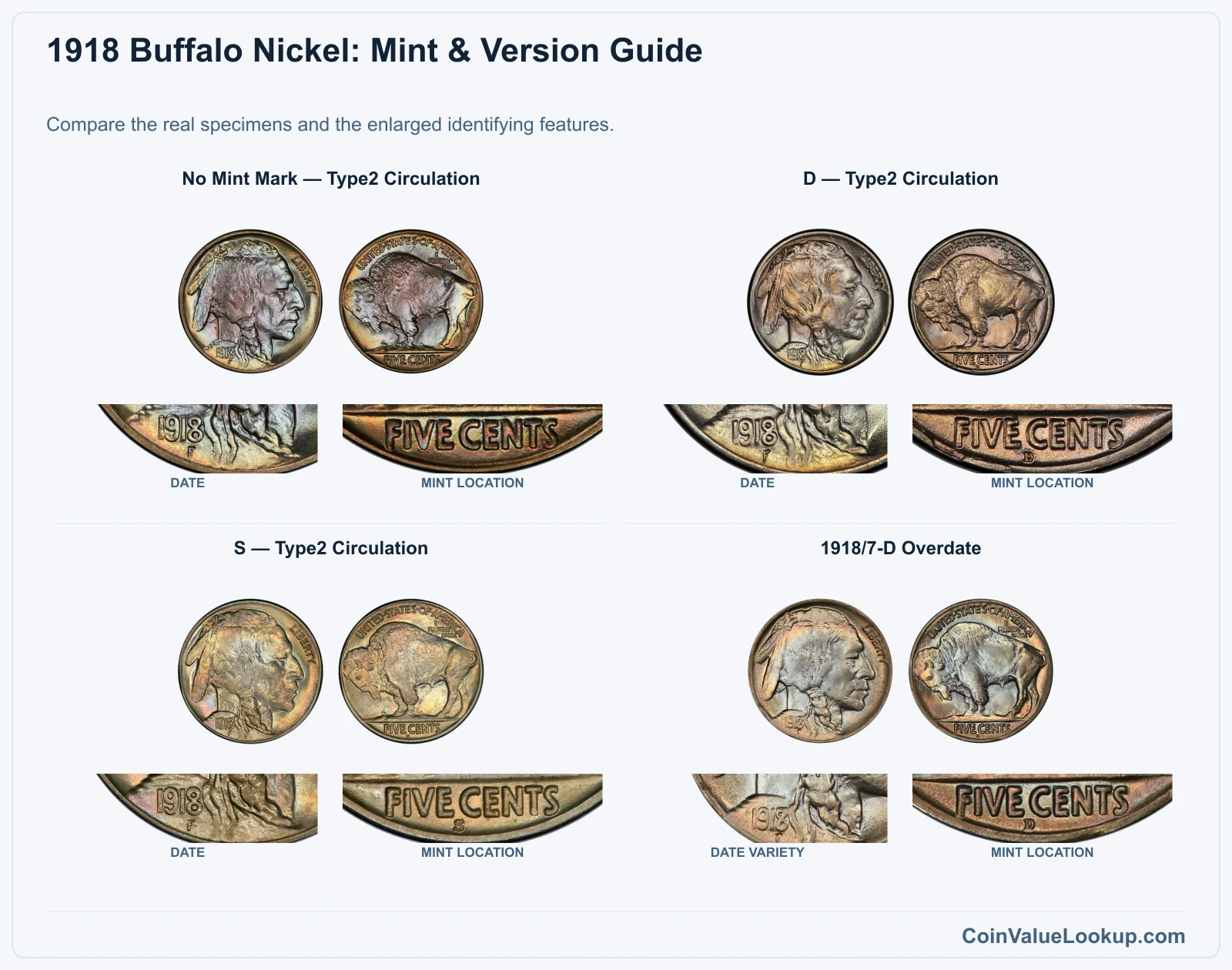
All 1918 Buffalo Nickels use the Type 2 reverse, where FIVE CENTS sits in a recessed area below the bison. There was no Type 1 version struck this year; that design ended in 1913.
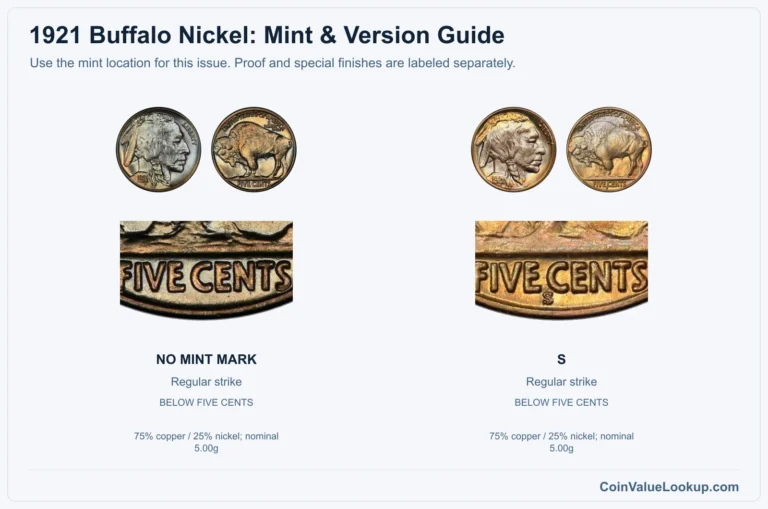
Three mints produced these nickels. Philadelphia coins carry no mintmark.
Denver coins show a small D below FIVE CENTS on the reverse, and San Francisco coins show an S in the same spot. Look carefully with a magnifier, because wear and grime love to hide that tiny letter.
The composition is 75% copper and 25% nickel, weighing about 5 grams with a 21.2 mm diameter and a plain edge. There is no silver version, no proof issue, and no clad variant for this date.
One major variety exists: the 1918/7-D overdate, where the underlying digit 7 is visible beneath the 8 in the date. This is a Denver-mint coin, and because altered dates can mimic it, third-party authentication is important before assuming you have one.
Step 2: Check Your 1918 Buffalo Nickel Grade
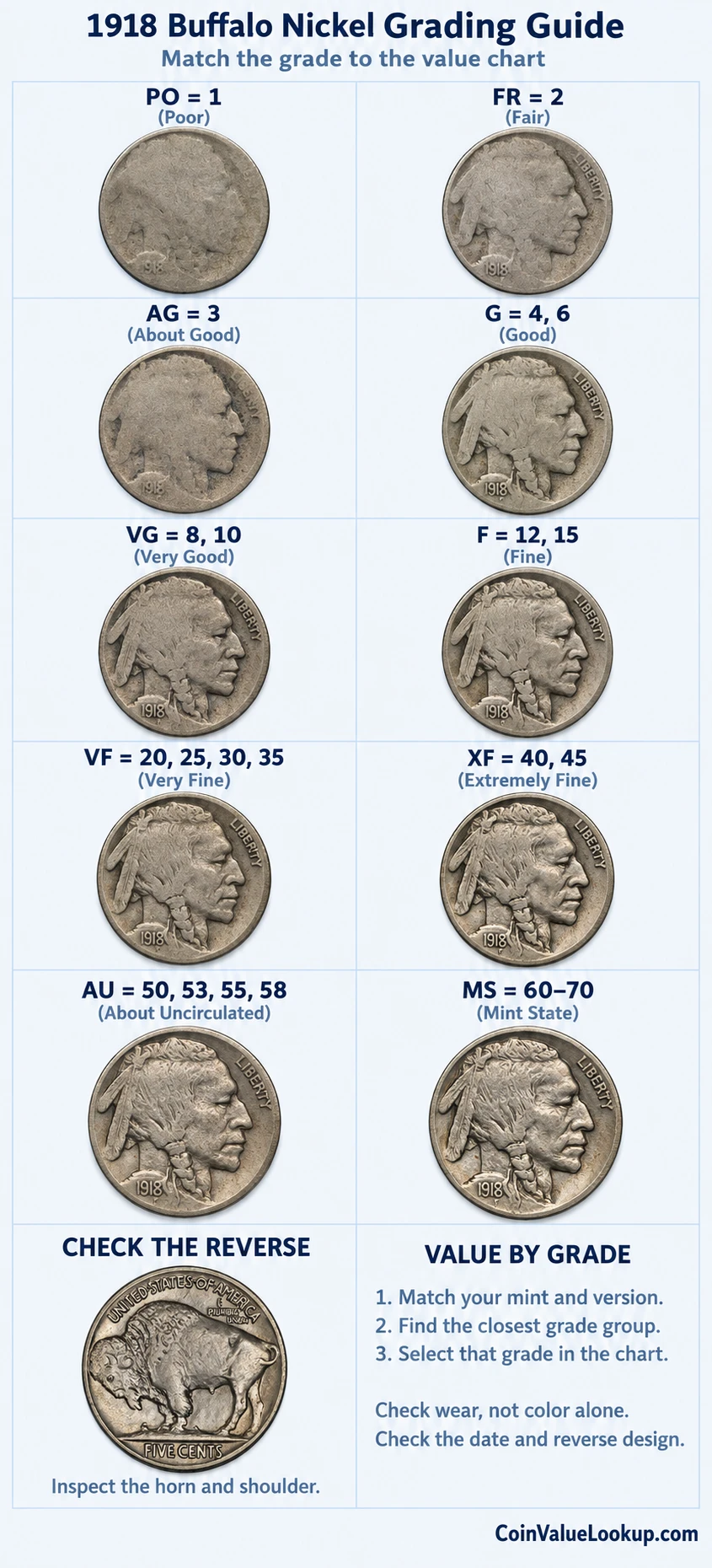
Start by examining the Native American portrait on the obverse. In higher grades the hair braid shows full, separated strands, and the cheek retains a rounded contour with original luster.
As the coin wears, the braid flattens first, then the cheek goes smooth.
On the reverse, the bison's shoulder and horn are the key wear points. A sharp horn with visible texture means minimal circulation.
But here is the catch: 1918 branch-mint issues, especially from Denver and San Francisco, sometimes came with soft strikes that left the horn looking weak even on uncirculated coins.
So do not grade by the horn alone. Check for unbroken cartwheel luster across the fields and look at whether high points show friction or just incomplete metal flow from a tired die.
The comparison image nearby shows these differences side by side.
One more thing: never use acid or chemical treatments to bring out a faded date. A restored surface destroys any collector premium the coin might have had.
Step 3: Check 1918 Buffalo Nickel Value by Mint and Version
1918 Buffalo Nickel — No Mint Mark — Type2 Circulation
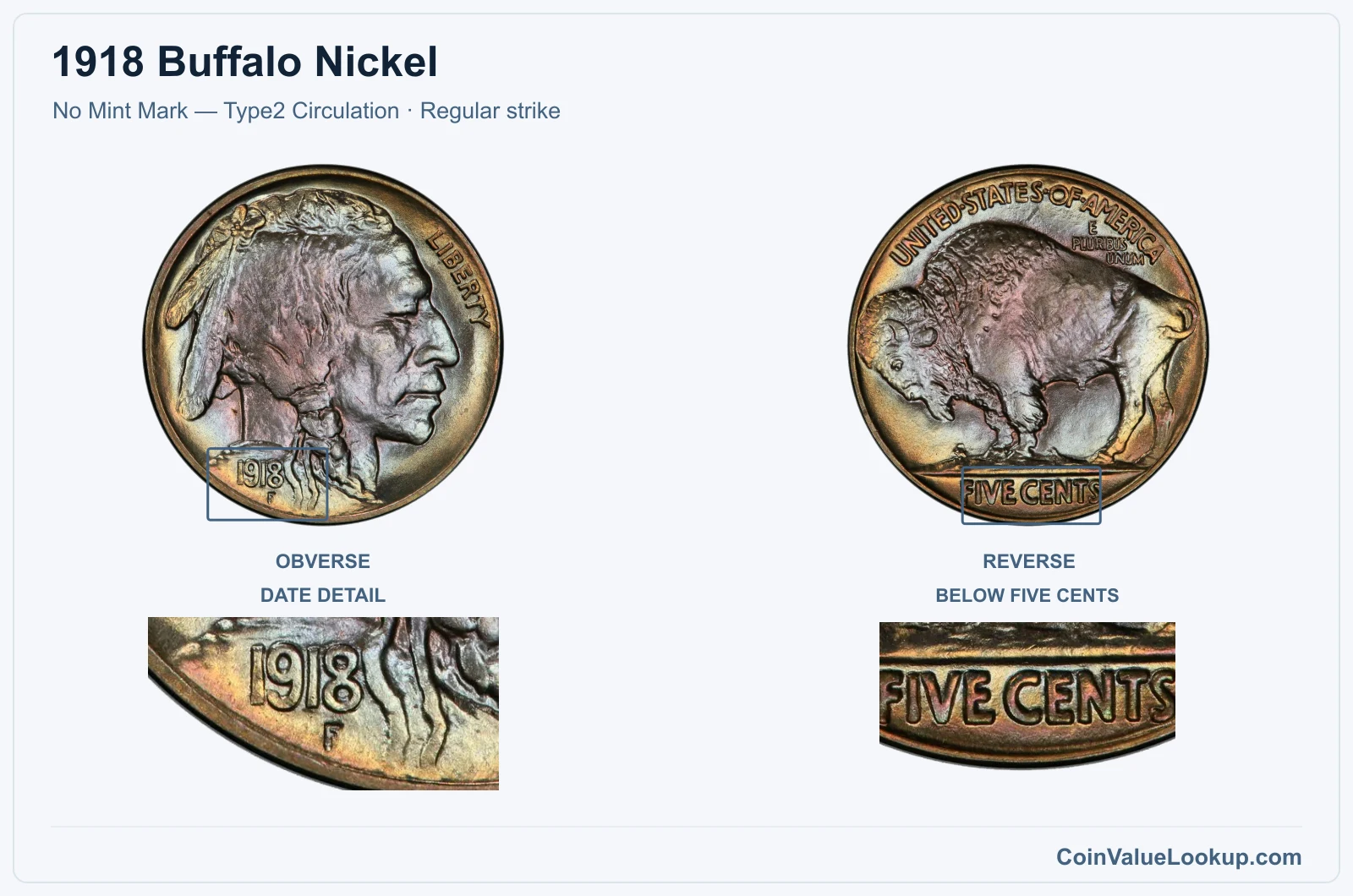
The 1918 Philadelphia Buffalo Nickel has no mintmark. Look at the reverse below FIVE CENTS — if that space is empty, you have the Philly issue.
USA Coin Book guide estimates place this coin at roughly $7.29 in G4 and $407 in MS63. It is the most affordable of the three regular 1918 mints in low grades, so it is a common starting point for date collectors.
Mint-state examples with strong strikes and clean fields command more attention, since many survivors are well worn after a century of pocket duty.
Range Grade
Price Auction Records Appraisal PO PO 1
—
Coin Identifier FR FR 2
—
Coin Identifier AG AG 3
—
Coin Identifier G G 4
—
Coin Identifier
G 6
—
Coin Identifier VG VG 8
—
Coin Identifier
VG 10
—
Coin Identifier F F 12
—
Coin Identifier
F 15
Coin Identifier VF VF 20
Coin Identifier
VF 25
—
Coin Identifier
VF 30
Coin Identifier
VF 35
—
Coin Identifier XF XF 40
Coin Identifier
XF 45
Coin Identifier AU AU 50
—
Coin Identifier
AU 53
Coin Identifier
AU 55
Coin Identifier
AU 58
Coin Identifier MS MS 60
—
Coin Identifier
MS 61
—
Coin Identifier
MS 62
Coin Identifier
MS 63
Coin Identifier
MS 64
Coin Identifier
MS 65
Coin Identifier
MS 66
Coin Identifier
MS 67
Coin Identifier
MS 68
—
—
—
MS 69
—
—
—
MS 70
—
—
—
1918 Buffalo Nickel — D — Type2 Circulation
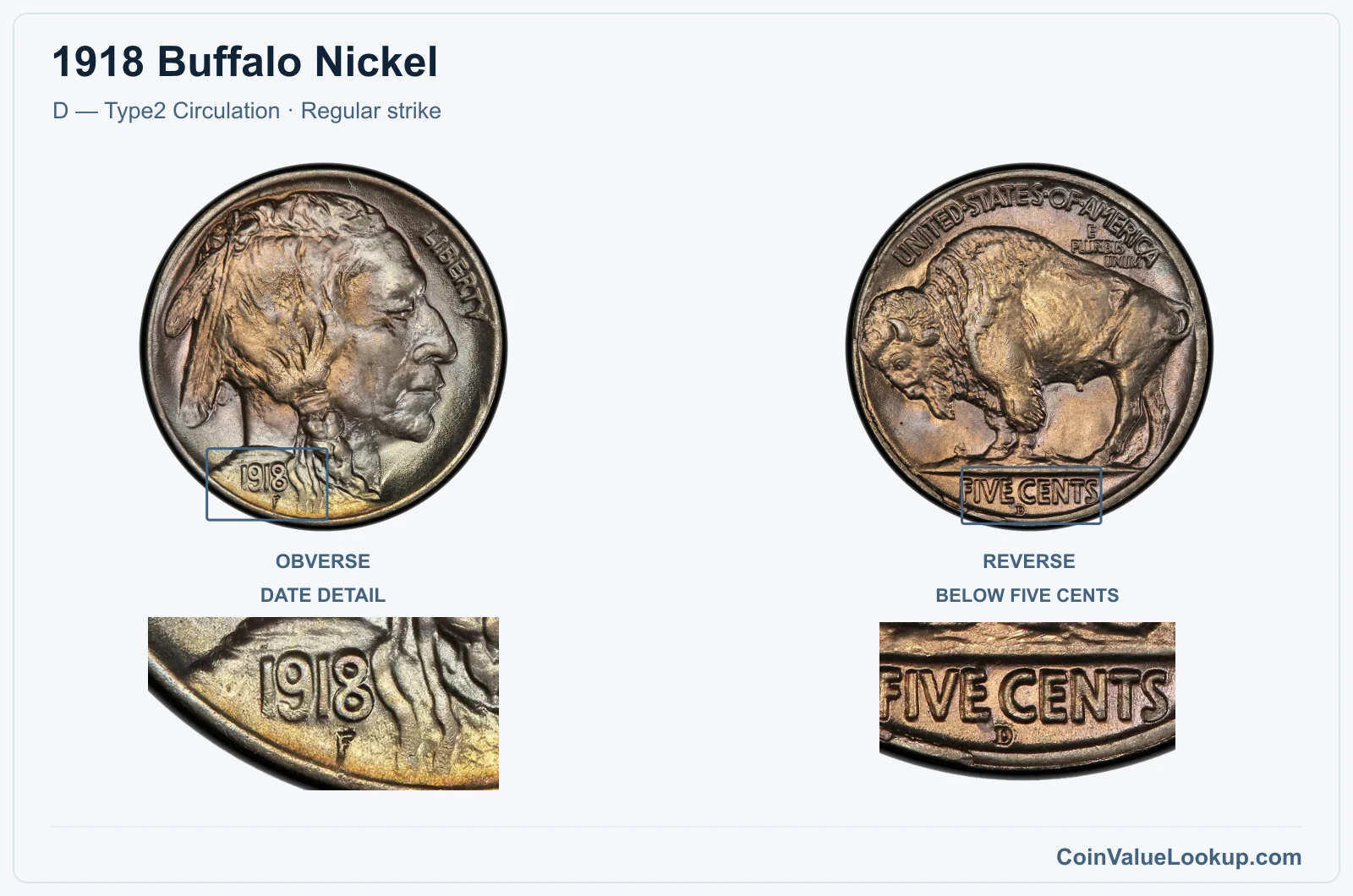
The 1918-D carries a small D mintmark on the reverse, sitting just below FIVE CENTS. Guide estimates from USA Coin Book run about $38 in G4 up to $1,296 in MS63, a significant jump from the Philadelphia issue.
Denver production for this year tends to show softer strikes on the bison's horn and shoulder, which complicates grading. A coin that looks worn might actually be mint state with a mushy strike, or vice versa.
Examine luster across the flat fields rather than relying on a single high point. This mint is also home to the famous 1918/7-D overdate, so always give the date a second look under magnification.
Range Grade
Price Auction Records Appraisal PO PO 1
—
Coin Identifier FR FR 2
—
Coin Identifier AG AG 3
—
Coin Identifier G G 4
—
Coin Identifier
G 6
Coin Identifier VG VG 8
Coin Identifier
VG 10
Coin Identifier F F 12
Coin Identifier
F 15
Coin Identifier VF VF 20
Coin Identifier
VF 25
Coin Identifier
VF 30
Coin Identifier
VF 35
Coin Identifier XF XF 40
Coin Identifier
XF 45
Coin Identifier AU AU 50
Coin Identifier
AU 53
Coin Identifier
AU 55
Coin Identifier
AU 58
Coin Identifier MS MS 60
Coin Identifier
MS 61
Coin Identifier
MS 62
Coin Identifier
MS 63
Coin Identifier
MS 64
Coin Identifier
MS 65
Coin Identifier
MS 66
Coin Identifier
MS 67
Coin Identifier
MS 68
—
—
—
MS 69
—
—
—
MS 70
—
—
—
1918 Buffalo Nickel — S — Type2 Circulation
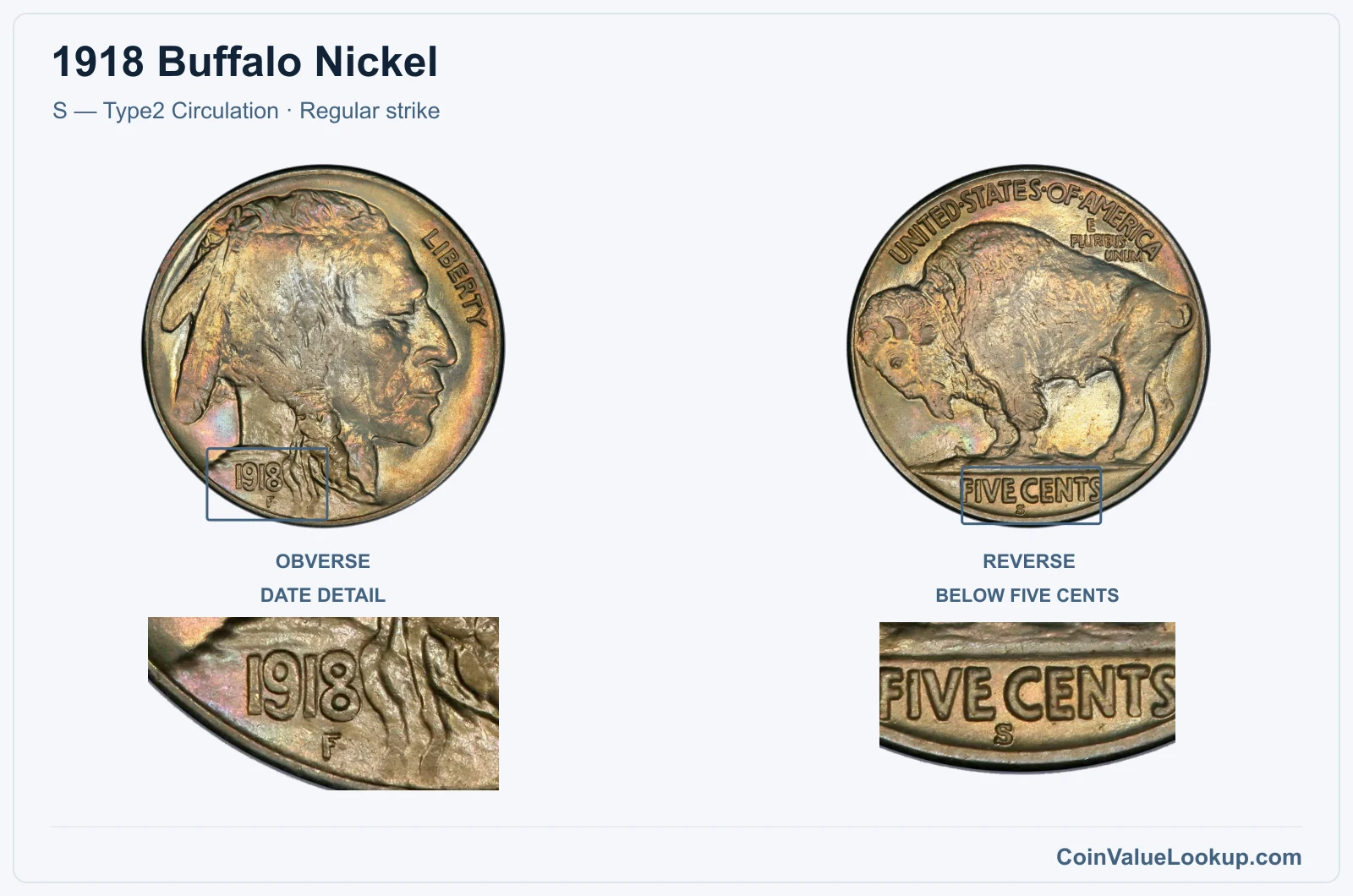
San Francisco's 1918-S nickel shows an S mintmark below FIVE CENTS on the reverse. USA Coin Book estimates about $25 in G4 and $3,085 in MS63, making it the most valuable regular-issue 1918 Buffalo Nickel in upper grades.
That MS63 figure reflects genuine scarcity in high condition. Like Denver, San Francisco strikes can be inconsistent, so separating strike softness from actual wear takes patience.
Full, original luster and sharp hair-braid detail on the obverse are strong indicators of a coin that saw little or no circulation.
Coin Value Lookup is a good place to look up guides for other dates in the Buffalo Nickel series if you are working through a set.
Range Grade
Price Auction Records Appraisal PO PO 1
—
Coin Identifier FR FR 2
—
Coin Identifier AG AG 3
—
Coin Identifier G G 4
—
Coin Identifier
G 6
—
Coin Identifier VG VG 8
Coin Identifier
VG 10
—
Coin Identifier F F 12
Coin Identifier
F 15
Coin Identifier VF VF 20
Coin Identifier
VF 25
Coin Identifier
VF 30
Coin Identifier
VF 35
Coin Identifier XF XF 40
Coin Identifier
XF 45
Coin Identifier AU AU 50
Coin Identifier
AU 53
Coin Identifier
AU 55
Coin Identifier
AU 58
Coin Identifier MS MS 60
Coin Identifier
MS 61
Coin Identifier
MS 62
Coin Identifier
MS 63
Coin Identifier
MS 64
Coin Identifier
MS 65
Coin Identifier
MS 66
Coin Identifier
MS 67
—
—
—
MS 68
—
—
—
MS 69
—
—
—
MS 70
—
—
—
1918 Buffalo Nickel — /7-D Overdate
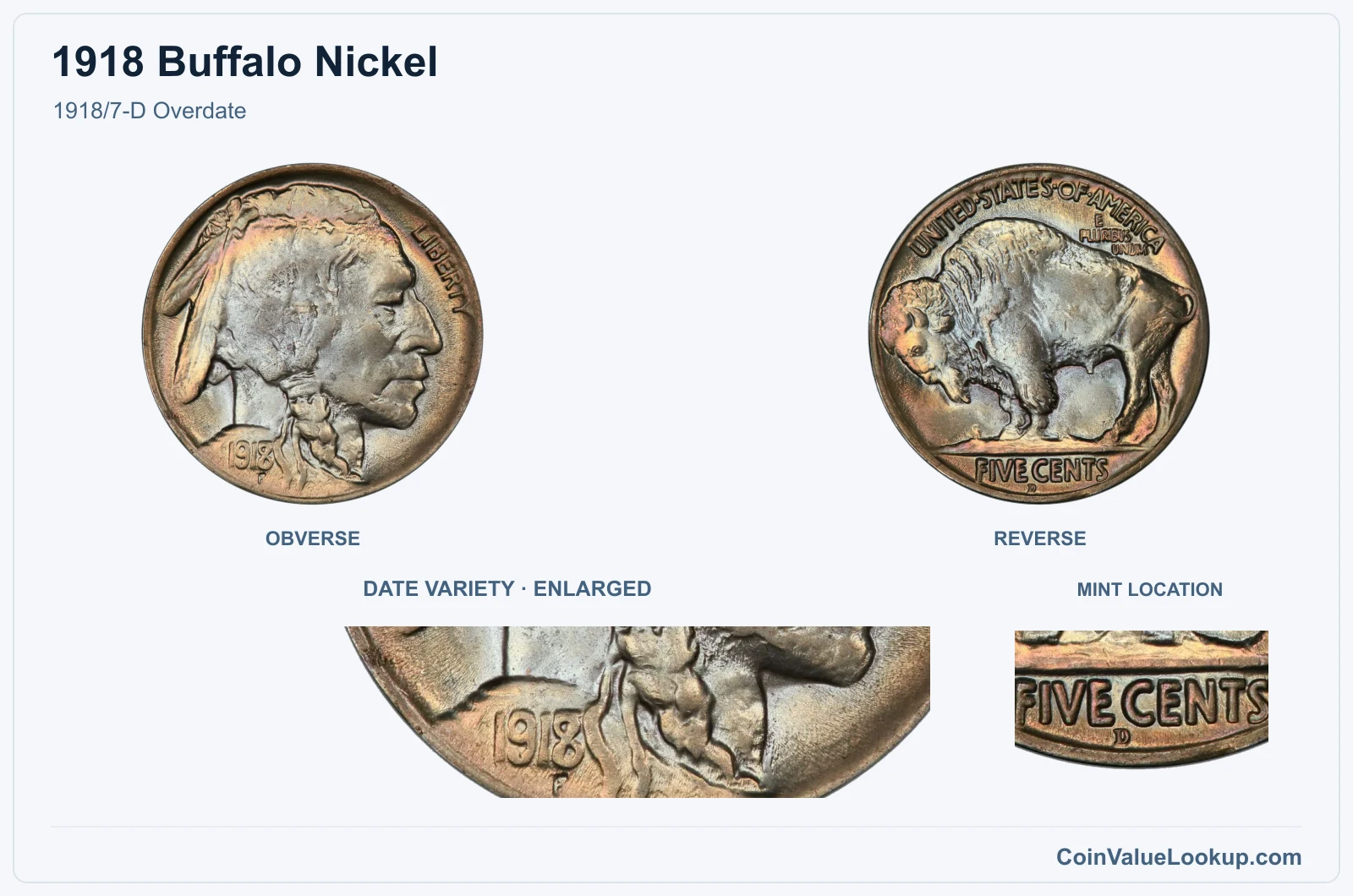
The 1918/7-D is one of the most famous overdates in U.S. coinage. It was struck at Denver using a die originally hubbed with a 1917 date, then re-entered with 1918.
The result is a visible 7 lurking beneath the 8 in the date.
USA Coin Book guide estimates start at roughly $998 in G4 and climb to $62,626 in MS63. Even heavily worn examples carry strong premiums.
Authentication is critical here. The underlying 7 should show a distinct curved top and crossbar inside or behind the 8.
Tooled or acid-treated dates can create a convincing illusion, so third-party certification from a major grading service is strongly recommended before buying or selling. The D mintmark must also be present, since this variety exists only on Denver coins.
Range Grade
Price Auction Records Appraisal PO PO 1
—
Coin Identifier FR FR 2
—
Coin Identifier AG AG 3
Coin Identifier G G 4
Coin Identifier
G 6
Coin Identifier VG VG 8
Coin Identifier
VG 10
Coin Identifier F F 12
Coin Identifier
F 15
Coin Identifier VF VF 20
Coin Identifier
VF 25
Coin Identifier
VF 30
Coin Identifier
VF 35
Coin Identifier XF XF 40
Coin Identifier
XF 45
Coin Identifier AU AU 50
Coin Identifier
AU 53
Coin Identifier
AU 55
Coin Identifier
AU 58
Coin Identifier MS MS 60
Coin Identifier
MS 61
Coin Identifier
MS 62
Coin Identifier
MS 63
Coin Identifier
MS 64
Coin Identifier
MS 65
Coin Identifier
MS 66
—
Coin Identifier
MS 67
—
—
—
MS 68
—
—
—
MS 69
—
—
—
MS 70
—
—
—
1918 Buffalo Nickel Error List
1. 1918 Buffalo Nickel — Double / Multiple Strike
A double-struck or multiple-struck 1918 Buffalo Nickel shows two or more separate impressions of the design, displaced or rotated relative to each other. This has been reported on Philadelphia issues struck within the collar.
When examining your coin, look for a second, shifted outline of the portrait or bison — not just thickened letters. The displaced image should show its own raised detail, not a flat shelf alongside the main design.
Do not confuse this with a doubled die, which affects every coin from a single die and produces uniform doubling. A double strike is a planchet-level event, unique to that coin.
Post-mint damage from a vise or impact can also mimic doubled features but will show damage rather than struck detail. Value depends on the visibility, degree of displacement, and overall condition of the coin.
2. 1918 Buffalo Nickel — Indented Strike
An indented strike occurs when a second planchet or foreign object overlaps the coin blank during striking, leaving a bounded depressed area on one side. This error has been reported on 1918 Philadelphia nickels, accompanying a double strike.
The indent should have a distinct, curved boundary that matches the shape of whatever caused it. Inside that depression, design detail will be weak or absent, while the surrounding area retains normal detail.
A post-mint dent differs because it typically shows sharp, irregular edges and disturbed metal rather than a smooth pressed-in contour. A brockage is another lookalike, but a true brockage carries a mirrored design impression inside the depressed area.
Condition, size, and clarity of the indent all factor into the coin's individual value.
3. 1918 Buffalo Nickel — Partial Collar Strike
A partial collar strike happens when the coin blank is not fully seated in the collar die during striking. Part of the edge gets the normal rim and diameter, while the exposed portion fans out or shows a stepped ledge.
This error has been reported on 1918 Philadelphia nickels as part of a compound striking event. To identify it, examine the edge all the way around.
One section should look perfectly normal, while another section appears wider, with a visible step or shelf where confinement ended.
Do not confuse this with simple rim damage from a coin counter or a complete broadstrike, where the entire edge is unconfined. Post-mint edge dings create irregular dents, not the smooth shelf a partial collar produces.
The degree of misalignment and the coin's overall condition determine its collector interest.
4. 1918 Buffalo Nickel — Wrong Planchet / Off-Metal Strike
A wrong-planchet error means the nickel dies struck a blank intended for a different denomination. A 1918-D Buffalo Nickel struck on a cent planchet has been reported.
The giveaway is physical mismatch. Compare the coin's weight, diameter, and edge to a normal nickel (5 grams, 21.2 mm, plain edge).
A cent planchet would be smaller and lighter, likely leaving the design incomplete around the periphery.
Lookalikes include coins that have been plated, corroded, or deliberately filed down to look like a different metal. Acid-treated nickels can lose weight and change color.
A genuine wrong-planchet strike should show properly struck detail wherever the dies met the blank, not surface degradation. Each example is unique, so value hinges on the specific planchet, completeness of design, and condition.
5. 1918 Buffalo Nickel — Off-Center Strike
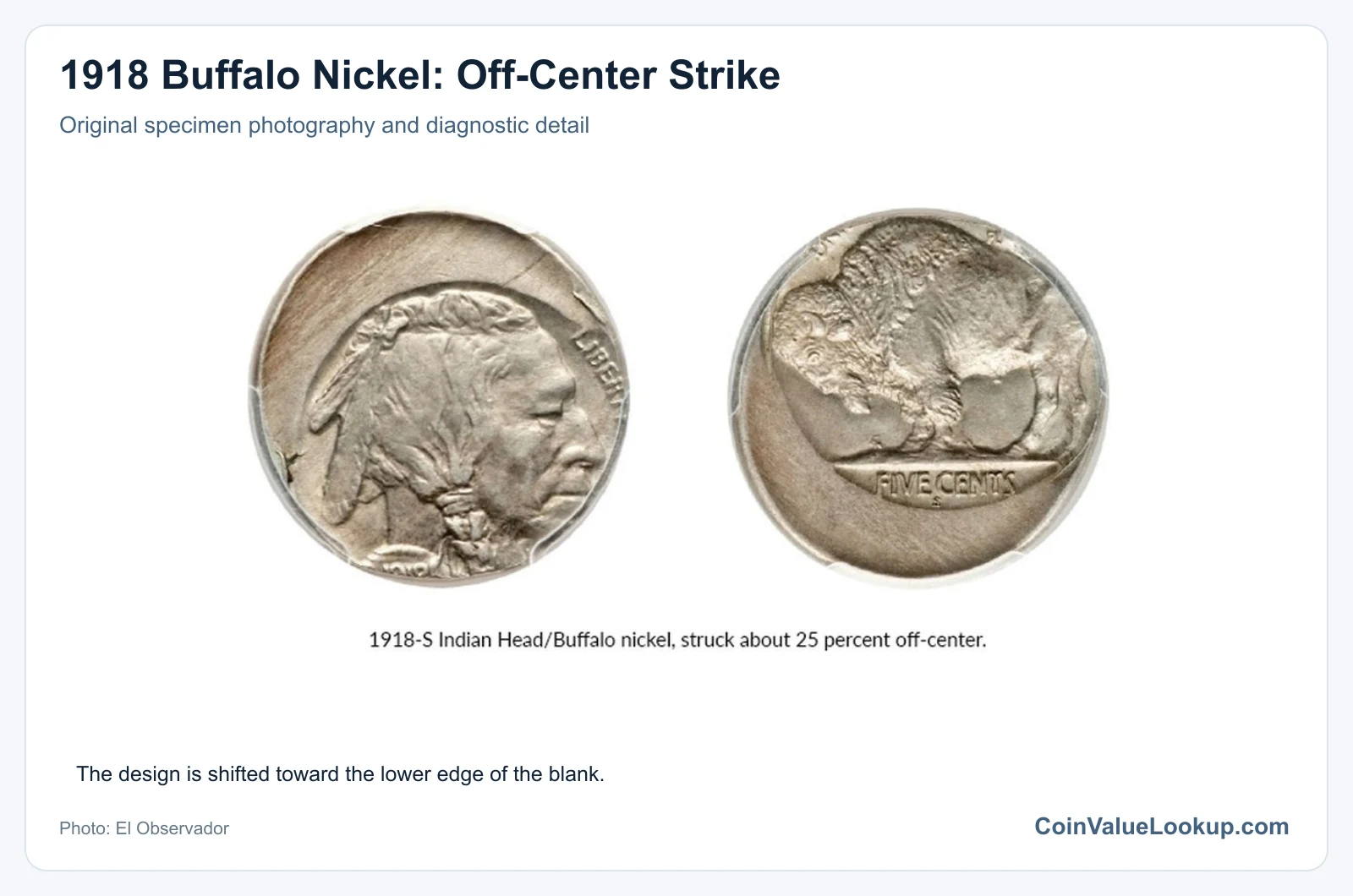
An off-center strike results when the planchet is not properly aligned between the dies. Part of the design is missing, replaced by a blank crescent where the dies never reached.
This has been reported for the 1918-S Buffalo Nickel, combined with a two-feather obverse.
The key diagnostic is a smooth, unstruck area on one side and a shifted but properly detailed design on the other. The most collectible off-center errors retain a readable date, since that confirms the year.
Do not mistake a clipped planchet (which has a curved bite out of a round coin) or post-mint flattening for an off-center strike. Die misalignment can also shift designs but still covers the full planchet.
Value depends on the percentage of offset, whether the date is visible, and the coin's preservation.
6. 1918 Buffalo Nickel — Two Feathers / Abraded Third Feather
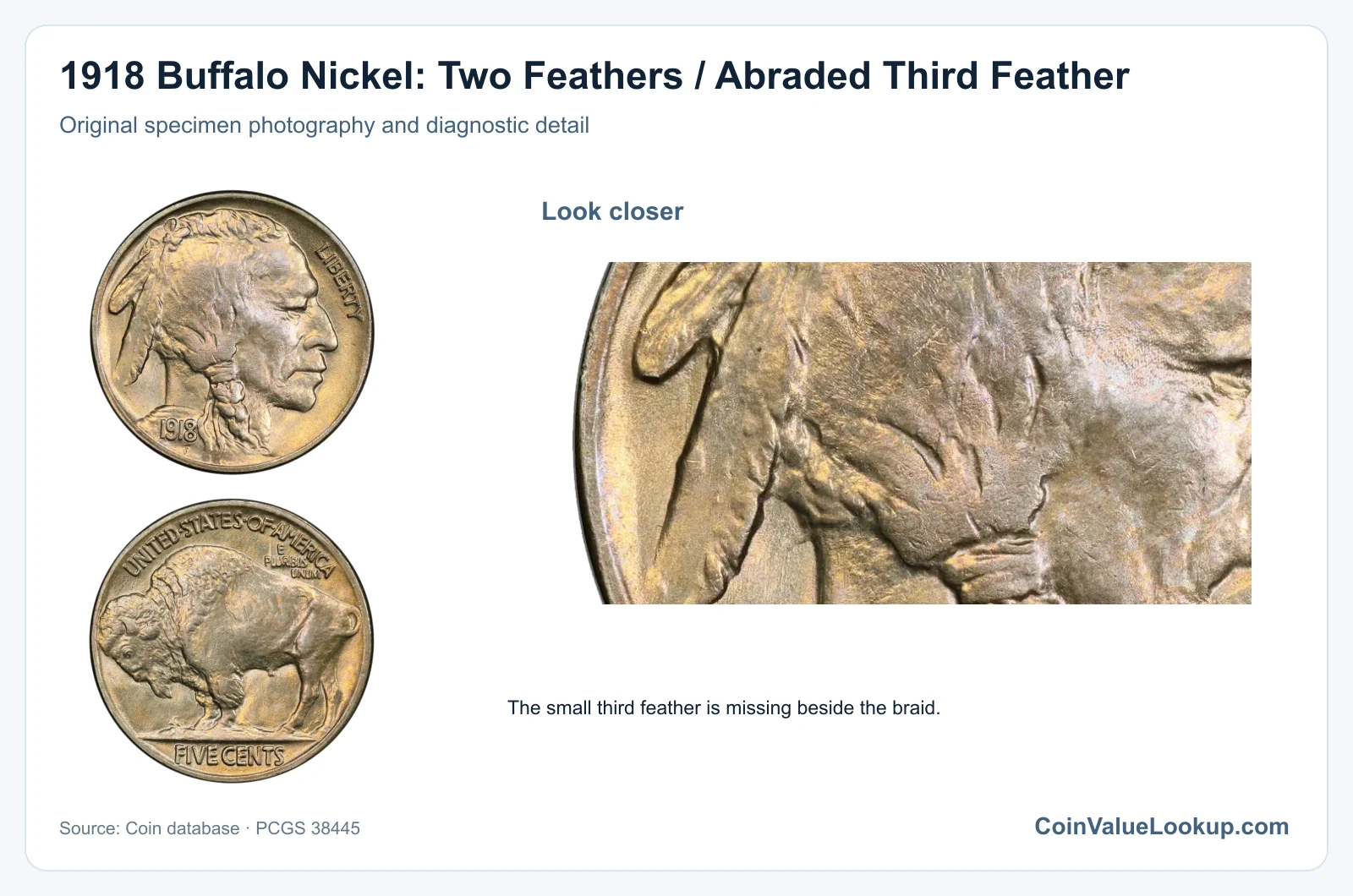
Normal Buffalo Nickel obverses show three feathers trailing behind the Native American's head. The Two Feathers variety, reported on 1918-S nickels, shows only two distinct feathers, with the third either absent or reduced to a faint remnant.
This is attributed to die abrasion or a filled die that effectively erased the smallest feather near the neck. To check, compare the feather cluster on your coin against a known three-feather example.
The missing feather should be consistently absent or barely visible, not just soft in one area.
Heavy circulation wear can flatten a feather and mimic this variety, as can a weak strike or grease-filled die on a single coin. Deliberate scraping is another lookalike.
A genuine variety will show the same absence across multiple known specimens. Individual value depends on how clearly the variety presents and the coin's overall grade.
7. 1918 Buffalo Nickel — Doubled Die Reverse
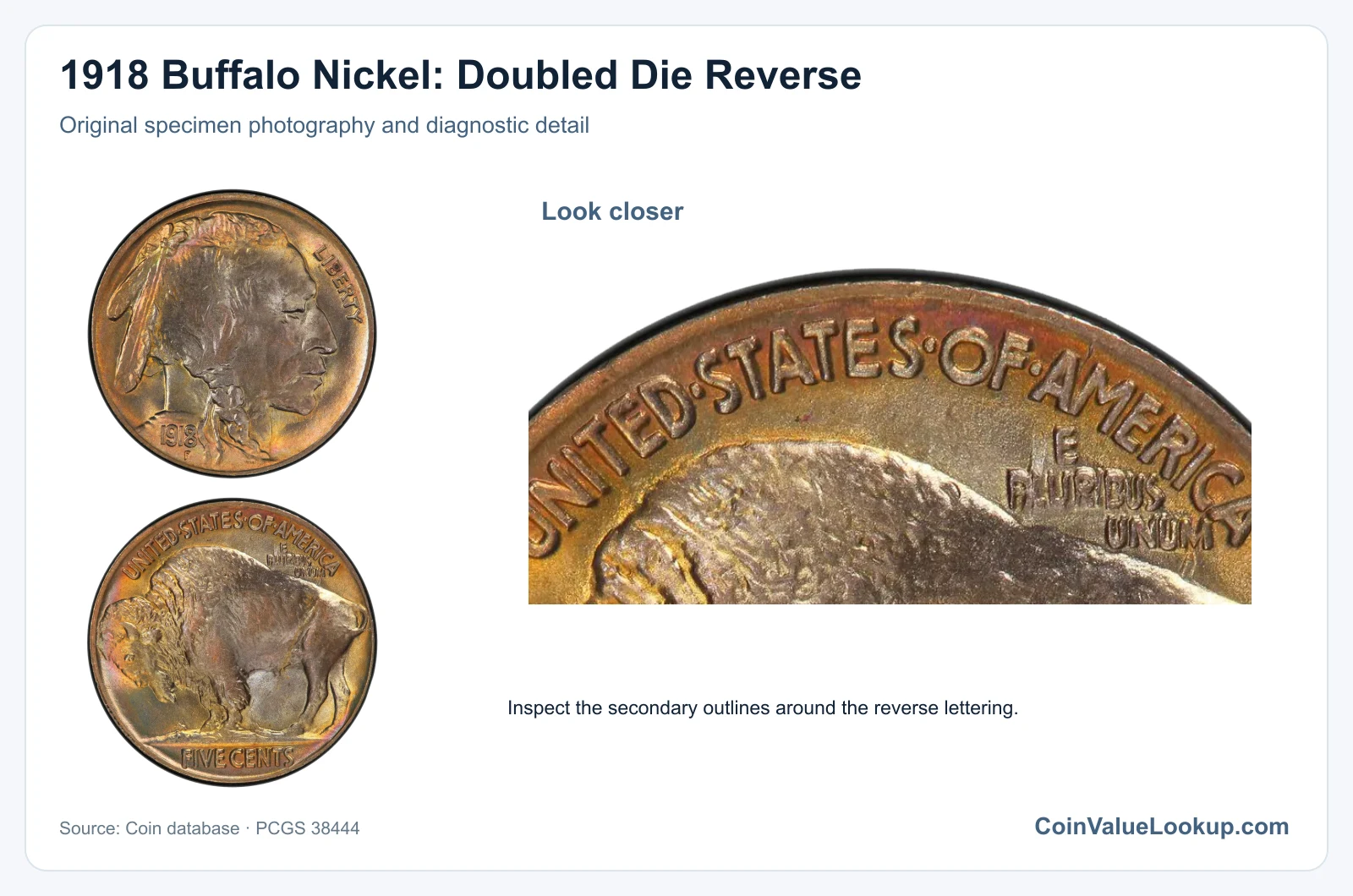
A doubled die reverse on a 1918 Buffalo Nickel means the reverse die received a misaligned secondary impression during its manufacture. Every coin struck from that die shows the same doubling in the same location.
This has been reported on Philadelphia issues. Look for consistent doubling on reverse lettering such as FIVE CENTS, E PLURIBUS UNUM, or UNITED STATES OF AMERICA.
The doubling should be uniform and repeatable, not random.
Machine doubling is the main lookalike. It produces flat, shelf-like distortions without the raised secondary image that a true doubled die exhibits.
Light reflections and surface hits can also fool the eye. Use magnification and compare against a normal reverse.
Value varies with the strength of the doubling and the coin's condition.