1960 Jefferson Nickel Coin Value: How Much Is It Worth?
Most 1960 Jefferson nickels that have seen circulation are worth close to face value. Uncirculated examples are where things get more interesting: guide estimates from USA Coin Book place a Mint State 60 piece around $0.30 and an MS65 example near $19, depending on the mint.
Proof strikes and scarce mint errors occupy their own pricing tiers entirely.
Fast Way to Identify Your 1960 Jefferson Nickel
Snap clear photos of the front and back of your 1960 nickel and upload them here. Our identifier can give you a preliminary read on the mint, finish, and general condition, helping you figure out which version you have before diving deeper into values.
1960 Jefferson Nickel Value
Upload both sides of your 1960 Jefferson Nickel.
Front Obverse
Upload photo
Back Reverse
Upload photo
Which 1960 Jefferson Nickel Versions Are Worth Money?
- Uncirculated Philadelphia and Denver business strikes in MS65 condition list near $19 in guide estimates; Full Steps specimens command separate, typically higher premiums.
- Proof 1960 nickels carry a guide value around $3.62 at PR65 and may be worth more with certified cameo contrast.
- A 1960 nickel struck on a cent planchet is a dramatic wrong-planchet error; authenticated examples are individually assessed based on condition and attribution.
- The 1960 Quadrupled Die Reverse variety shows repeated design elements on the back and is valued according to visibility and grade.
- Split-planchet and clipped-planchet errors each represent distinct manufacturing mishaps that collectors actively seek out for this date.
Step 1: Identify Your 1960 Jefferson Nickel Mint Mark and Version
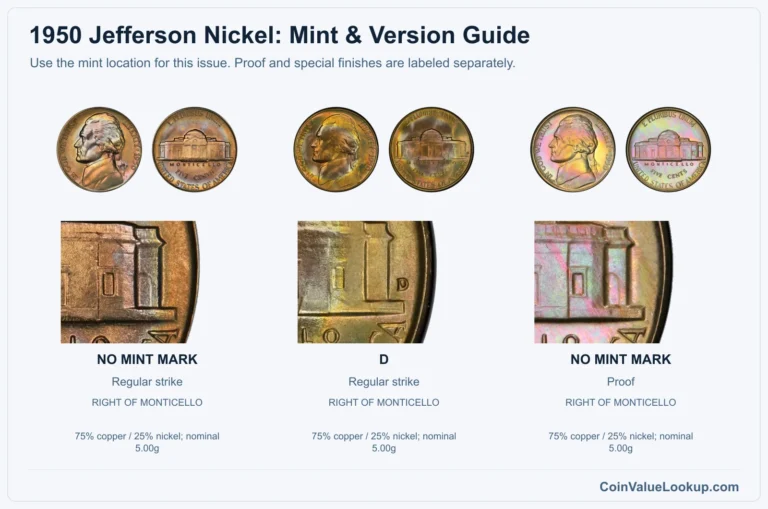
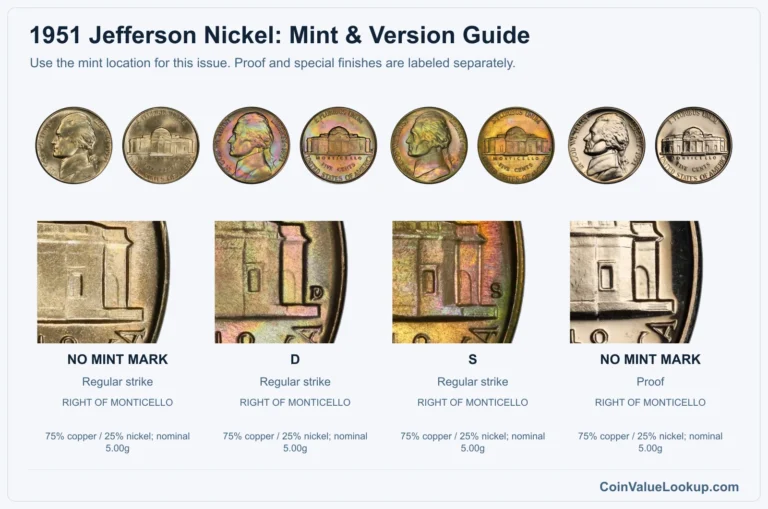
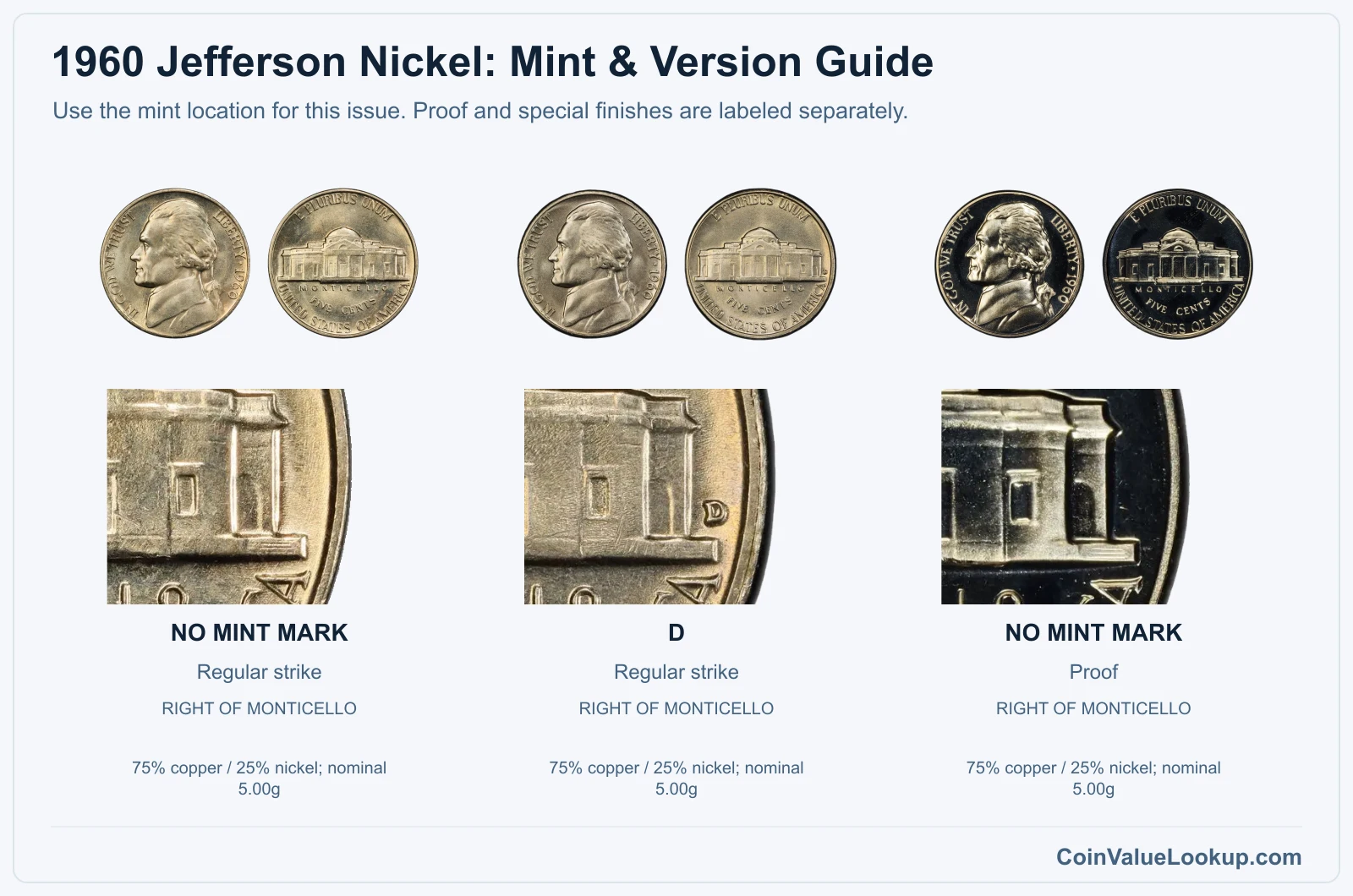
Start by checking the reverse. A Philadelphia strike has no mintmark at all, while a Denver coin shows a small "D" to the right of Monticello.
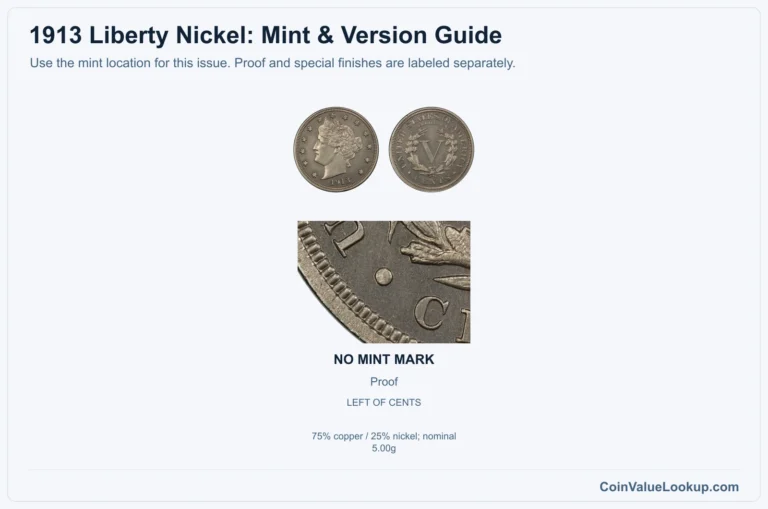
Proofs were struck only at Philadelphia, so they also lack a mintmark, but their mirror-like surfaces and sharp detail give them away immediately.
The coin is 75% copper and 25% nickel, weighs about 5.00 grams, measures 21.2 mm across, and has a plain edge. If your piece weighs noticeably less or more, that could point to a planchet error worth investigating.
Before looking up a value, record the date, mintmark (or absence of one), finish type, and the condition of both sides. Getting those four details right is the difference between an accurate lookup and a wild guess.
Step 2: Check Your 1960 Jefferson Nickel Grade
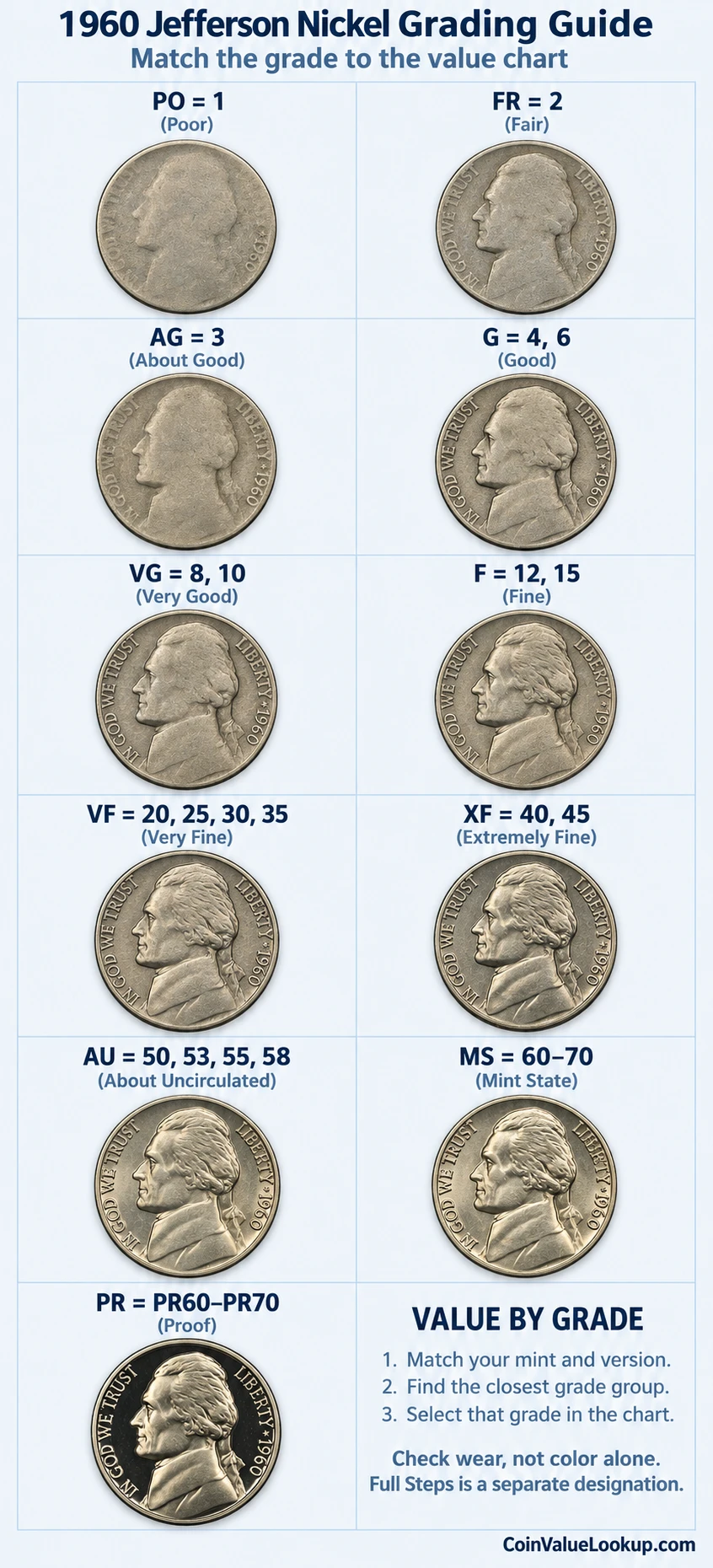
Focus on Jefferson's cheek first. On a well-worn coin the cheek goes flat and loses its original mint luster.
His hair just above the ear is the next checkpoint; fine strands disappear progressively with wear.
Flip the coin over and examine the Monticello roof and the four columns beneath it. These high points wear in tandem with the portrait.
Use the comparison image to match your coin's wear pattern against known grade benchmarks.
Don't confuse a weak strike with actual circulation wear. A weakly struck coin can look mushy in the steps area yet still retain full luster on both sides.
Full Steps is a separate strike-quality designation applied only to Mint State business strikes, not a grade itself. A coin can be MS65 without Full Steps, and the price difference between the two can be significant.
Step 3: Check 1960 Jefferson Nickel Value by Mint and Version
1960 Jefferson Nickel — No mintmark (Philadelphia) Business strike
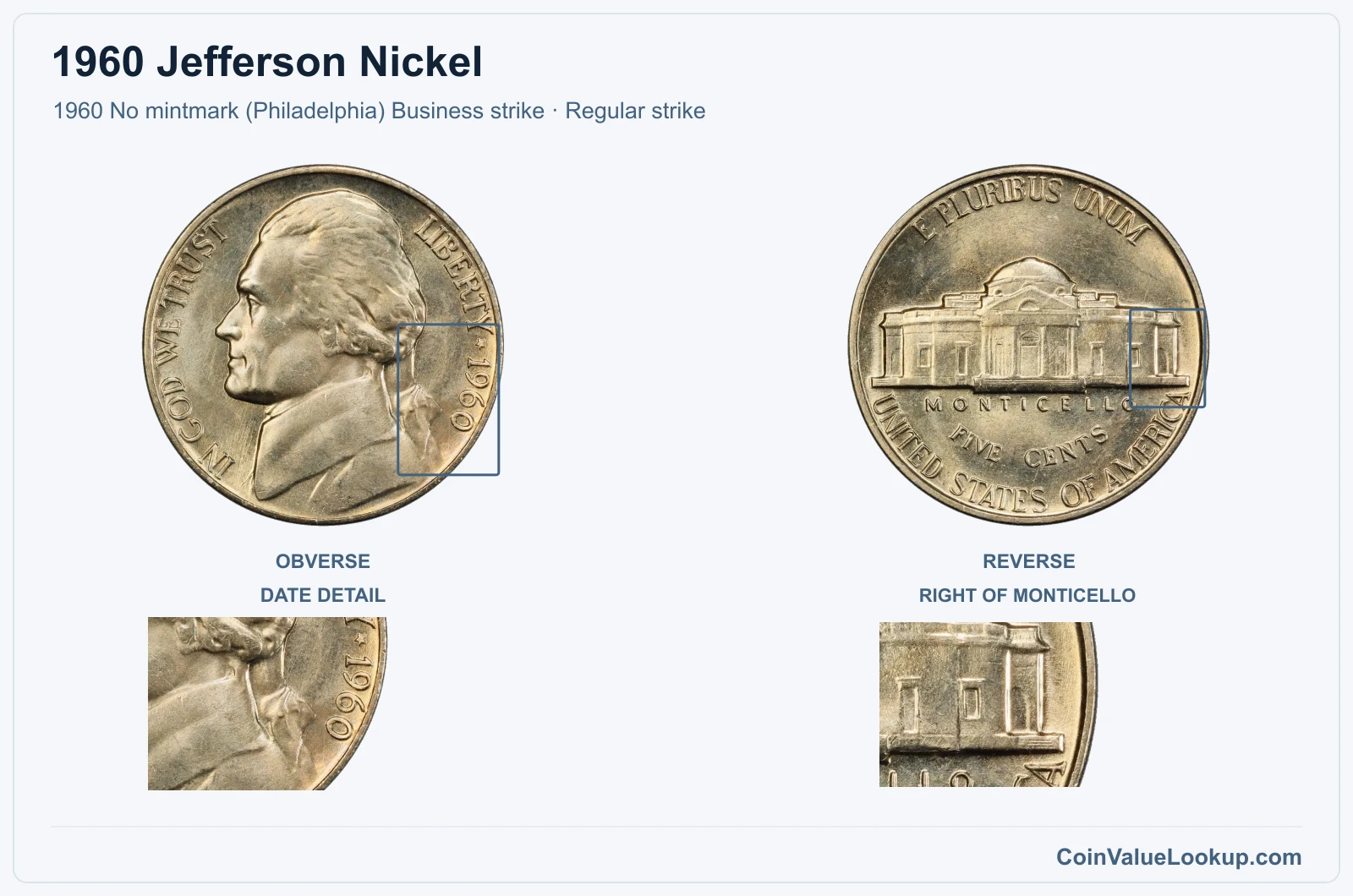
The 1960 Philadelphia business strike is the no-mintmark version. Look at the reverse beside Monticello: nothing there means Philly.
These were produced in large numbers, so circulated pieces rarely trade above face value.
In uncirculated grades the picture changes. A USA Coin Book guide estimate puts MS60 at about $0.30 and MS65 at roughly $19.
Full Steps coins, where the staircase lines on Monticello are unbroken, carry a separate and generally higher premium. A shiny surface alone does not guarantee an uncirculated grade; check for any trace of wear on the cheek and hair before assuming Mint State.
| Range | Grade | Price | Auction Records | Appraisal |
|---|---|---|---|---|
| PO | PO 1 | — | Coin Identifier | |
| FR | FR 2 | — | — | — |
| AG | AG 3 | — | — | — |
| G | G 4 | — | — | — |
| G 6 | — | — | — | |
| VG | VG 8 | — | — | — |
| VG 10 | — | — | — | |
| F | F 12 | — | — | — |
| F 15 | — | — | — | |
| VF | VF 20 | — | — | — |
| VF 25 | — | — | — | |
| VF 30 | — | — | — | |
| VF 35 | — | — | — | |
| XF | XF 40 | — | Coin Identifier | |
| XF 45 | — | Coin Identifier | ||
| AU | AU 50 | — | Coin Identifier | |
| AU 53 | — | Coin Identifier | ||
| AU 55 | — | Coin Identifier | ||
| AU 58 | — | Coin Identifier | ||
| MS | MS 60 | — | Coin Identifier | |
| MS 61 | — | Coin Identifier | ||
| MS 62 | — | Coin Identifier | ||
| MS 63 | — | Coin Identifier | ||
| MS 64 | Coin Identifier | |||
| MS 65 | Coin Identifier | |||
| MS 66 | Coin Identifier | |||
| MS 67 | Coin Identifier | |||
| MS 68 | — | — | — | |
| MS 69 | — | — | — | |
| MS 70 | — | — | — |
1960 Jefferson Nickel — No mintmark (Philadelphia) Proof
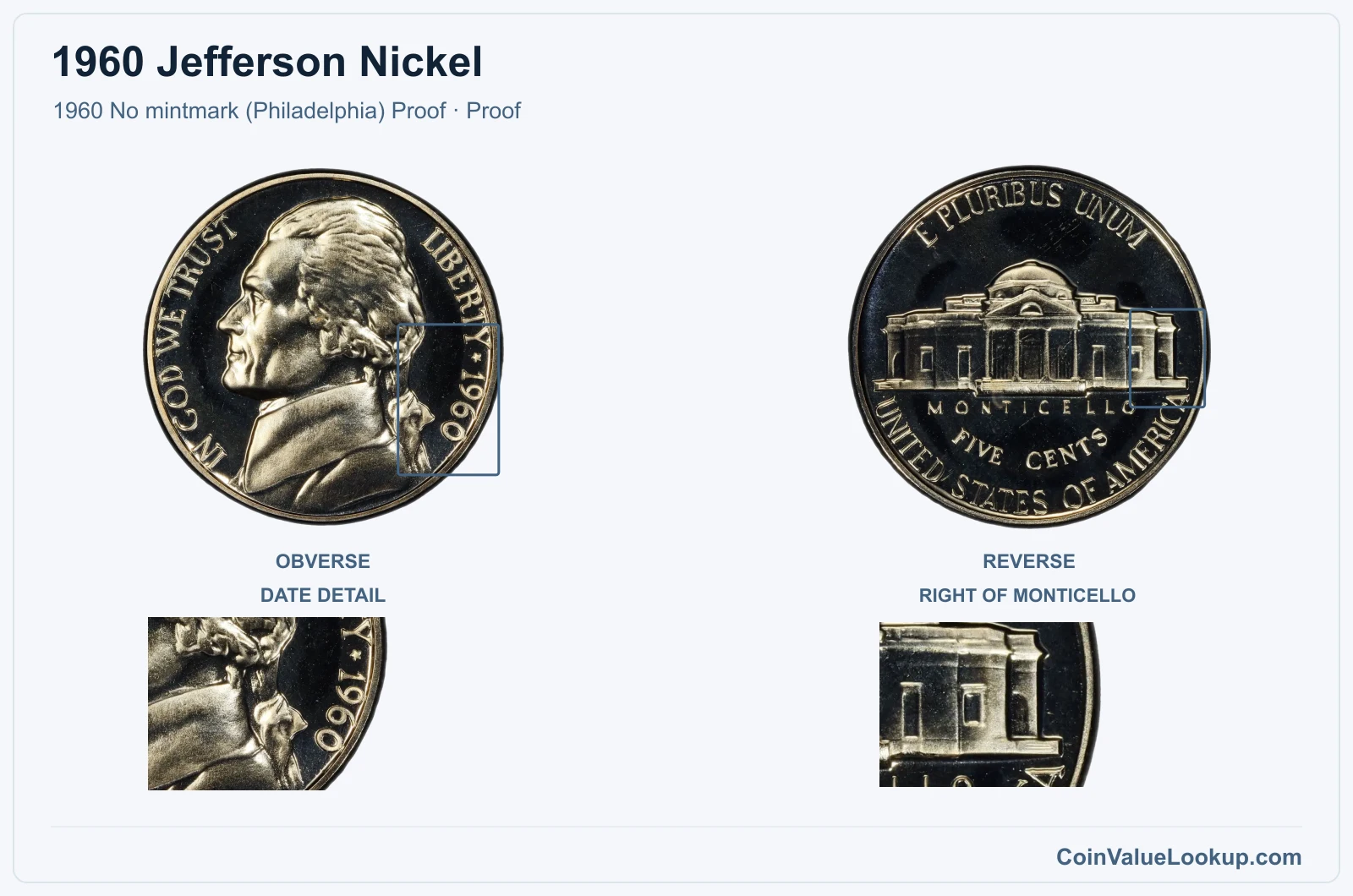
Philadelphia also struck proof 1960 nickels for collector sets. These have mirror fields and frosted devices that distinguish them at a glance from business strikes.
No mintmark appears, same as the regular Philadelphia issue, so finish quality is how you tell them apart.
A PR65 example carries a guide estimate around $3.62 per USA Coin Book. Coins with certified cameo contrast, where frosted design elements stand out sharply against mirror fields, can be worth more, though those values need to be assessed individually.
Coin Value Lookup is a handy starting point if you want to compare this proof against other Jefferson nickel dates and finishes.
| Range | Grade | Price | Auction Records | Appraisal |
|---|---|---|---|---|
| PR | PR 1 | — | Coin Identifier | |
| PR 2 | — | Coin Identifier | ||
| PR 3 | — | Coin Identifier | ||
| PR 4 | — | Coin Identifier | ||
| PR 6 | — | Coin Identifier | ||
| PR 8 | — | Coin Identifier | ||
| PR 10 | — | Coin Identifier | ||
| PR 12 | — | Coin Identifier | ||
| PR 15 | — | Coin Identifier | ||
| PR 20 | — | Coin Identifier | ||
| PR 25 | — | Coin Identifier | ||
| PR 30 | — | Coin Identifier | ||
| PR 35 | — | Coin Identifier | ||
| PR 40 | — | Coin Identifier | ||
| PR 45 | — | Coin Identifier | ||
| PR 50 | — | Coin Identifier | ||
| PR 53 | — | Coin Identifier | ||
| PR 55 | — | Coin Identifier | ||
| PR 58 | — | Coin Identifier | ||
| PR 60 | — | Coin Identifier | ||
| PR 61 | — | Coin Identifier | ||
| PR 62 | — | Coin Identifier | ||
| PR 63 | — | Coin Identifier | ||
| PR 64 | — | Coin Identifier | ||
| PR 65 | Coin Identifier | |||
| PR 66 | Coin Identifier | |||
| PR 67 | Coin Identifier | |||
| PR 68 | Coin Identifier | |||
| PR 69 | Coin Identifier | |||
| PR 70 | — | — | — |
1960 Jefferson Nickel — D Business strike
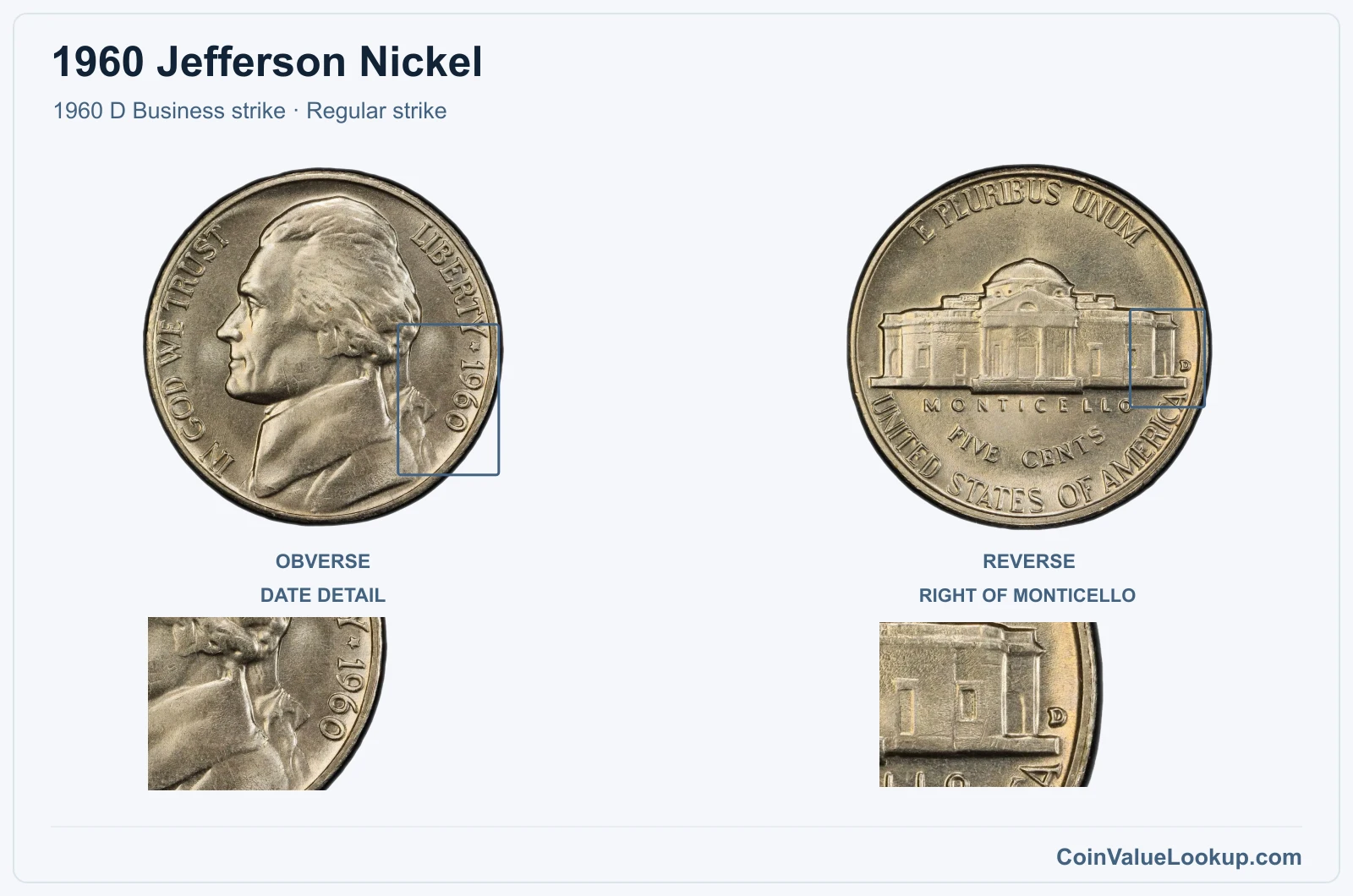
The Denver issue carries a small "D" mintmark on the reverse, positioned to the right of Monticello. It is the only 1960 nickel with a visible mintmark.
Guide estimates from USA Coin Book match the Philadelphia business strike: about $0.30 at MS60 and around $19 at MS65. Circulated examples are common and rarely command a premium.
As with the Philadelphia version, Full Steps designation is a separate consideration that can meaningfully affect value for Mint State coins.
| Range | Grade | Price | Auction Records | Appraisal |
|---|---|---|---|---|
| PO | PO 1 | — | Coin Identifier | |
| FR | FR 2 | — | — | — |
| AG | AG 3 | — | — | — |
| G | G 4 | — | — | — |
| G 6 | — | — | — | |
| VG | VG 8 | — | — | — |
| VG 10 | — | — | — | |
| F | F 12 | — | — | — |
| F 15 | — | — | — | |
| VF | VF 20 | — | — | — |
| VF 25 | — | — | — | |
| VF 30 | — | — | — | |
| VF 35 | — | — | — | |
| XF | XF 40 | — | Coin Identifier | |
| XF 45 | — | Coin Identifier | ||
| AU | AU 50 | — | Coin Identifier | |
| AU 53 | — | Coin Identifier | ||
| AU 55 | — | Coin Identifier | ||
| AU 58 | Coin Identifier | |||
| MS | MS 60 | — | Coin Identifier | |
| MS 61 | — | Coin Identifier | ||
| MS 62 | — | Coin Identifier | ||
| MS 63 | — | Coin Identifier | ||
| MS 64 | Coin Identifier | |||
| MS 65 | Coin Identifier | |||
| MS 66 | Coin Identifier | |||
| MS 67 | Coin Identifier | |||
| MS 68 | — | — | — | |
| MS 69 | — | — | — | |
| MS 70 | — | — | — |
1960 Jefferson Nickel Error List
1. 1960 Jefferson Nickel — Struck on a cent planchet
This is one of the more visually striking errors for the date: a 1960 Jefferson nickel design struck onto a copper cent-sized blank. The result is a noticeably smaller, lighter coin with cropped legends around the rim and a stretched or incomplete design.
A normal nickel weighs about 5 grams; this wrong-planchet piece weighs significantly less and shows a copper color on the edge.
An authenticated example graded PCGS MS64 RB has been documented. Value depends entirely on the individual coin's condition, attribution, and the severity of the visual mismatch.
Lookalikes include nickels that have been copper-plated, chemically toned, or physically ground down. Third-party certification is the clearest way to confirm authenticity.
2. 1960 Jefferson Nickel — Improper annealing
Improper annealing occurs when a planchet is heated incorrectly during preparation at the mint, producing an abnormal surface appearance. The coin may look dark, streaky, or have an unusual texture that differs from ordinary luster.
An NGC AU58 authenticated example of a 1960 nickel with this error has been recorded. The key diagnostic is that the surface anomaly is consistent across the coin and tied to the manufacturing process rather than post-mint damage.
Be cautious: many dark or discolored nickels owe their appearance to corrosion, fire damage, or artificial toning. Not every ugly coin is a mint error.
Individual value depends on authenticated identity, condition, and the degree of the annealing defect.
3. 1960 Jefferson Nickel — Split planchet before strike
A split-planchet-before-strike error means the metal blank separated internally before the dies impressed the design. The resulting coin is noticeably thin and underweight.
An NGC-authenticated 1960-D example weighed roughly 2.5 grams, about half the normal 5 grams.
The struck side shows a complete but often weak design because the thinner flan could not fully fill the die cavities. The exposed inner-metal surface on the opposite side may appear rough or granular.
Coins that have been acid-etched, ground down, or that suffered post-mint peeling can mimic this look. Weight is a useful first check: a coin close to half normal weight is a strong candidate.
Certification confirms the diagnosis. Value is assessed individually based on condition and error characteristics.
4. 1960 Jefferson Nickel — Doubled / Multiple-Hubbed Reverse
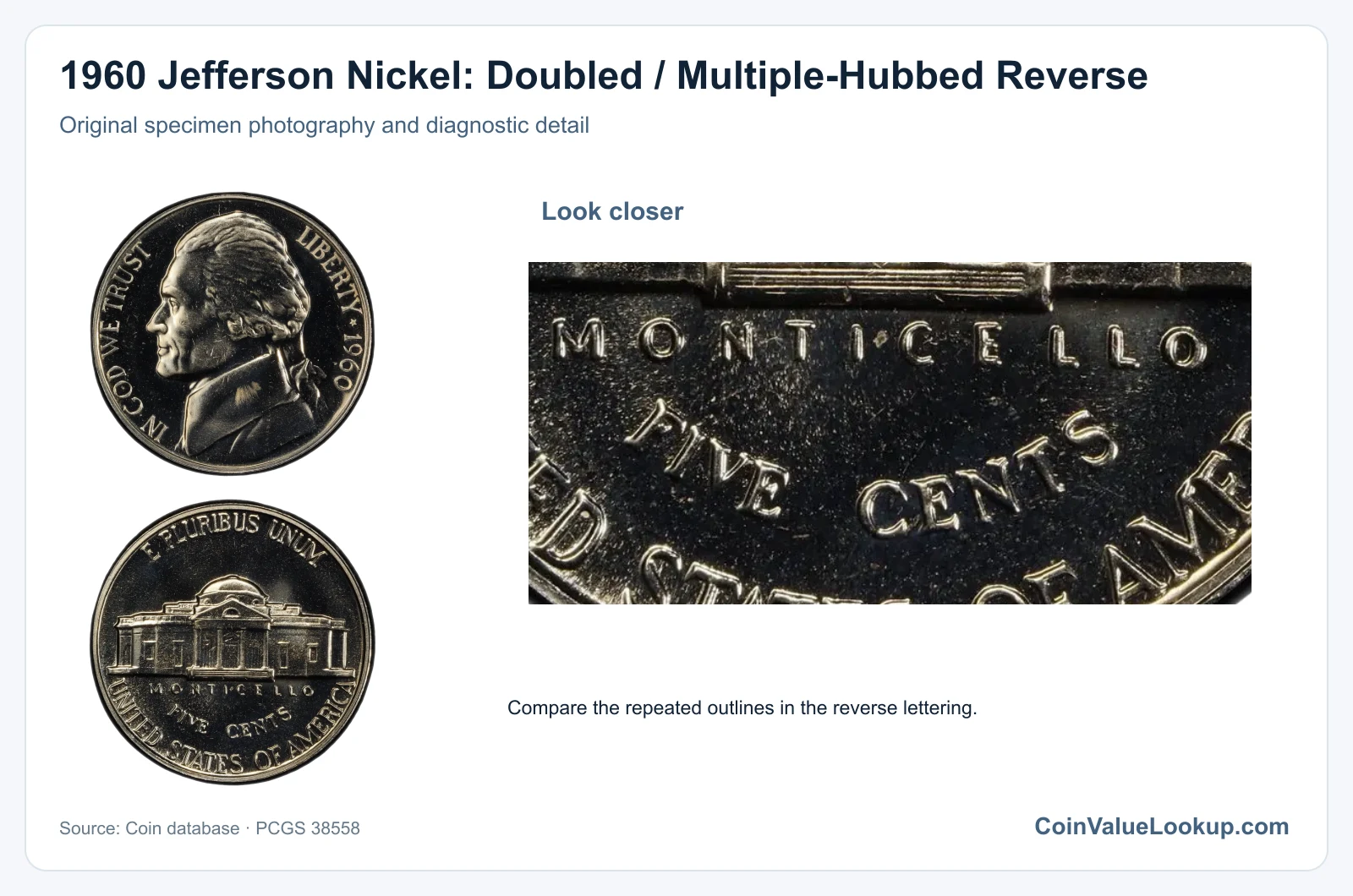
A Quadrupled Die Reverse has been reported for the 1960 Jefferson nickel. This variety shows repeated or shifted design elements on the reverse, created when the hub impressed the die multiple times with slight misalignment.
To check, compare your coin's reverse lettering and architectural details against a known normal example under magnification. Look for secondary outlines or thickening in the legends around Monticello.
Don't confuse this with machine doubling, which tends to produce flat, shelf-like doubling without the raised profile of a true hub-doubled variety. Reflections and random contact marks can also fool you under certain lighting.
Condition, the visibility of the doubling, and the specific die involved all factor into value.
5. 1960 Jefferson Nickel — Repunched Mintmark
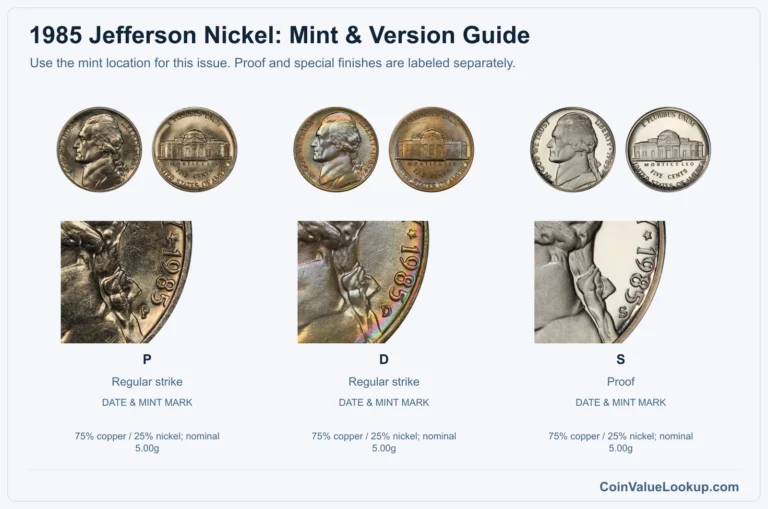
A 1960-D Repunched Mintmark variety has been cataloged. It shows traces of a second "D" mintmark position beneath or beside the primary punch, visible under magnification on the reverse near Monticello.
To identify it, compare the mintmark area closely with a normal 1960-D nickel at the same magnification. You are looking for remnants of an earlier, differently positioned "D" that was not fully covered by the final punch.
Machine doubling around the mintmark, small die chips, or corrosion can all create marks that resemble a repunched mintmark. The distinction matters because a genuine RPM is a die variety with collector demand, while machine doubling generally adds little value.
Condition and clarity of the repunching determine how much this variety is worth.
6. 1960 Jefferson Nickel — Clipped Planchet
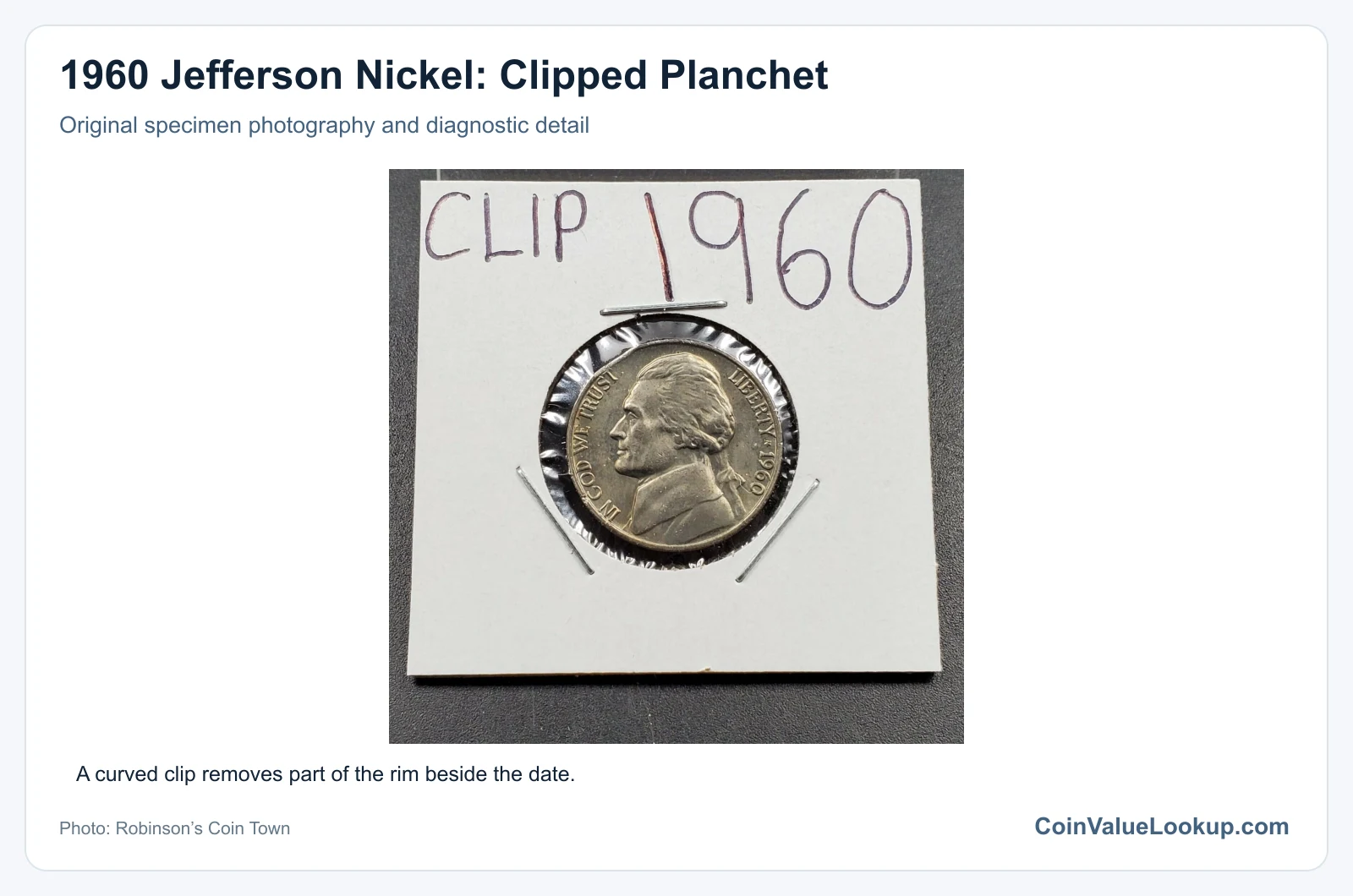
Clipped planchet errors have been reported on 1960 Jefferson nickels. A clip occurs when the blank-cutting press overlaps a previously punched area of the metal strip, leaving the planchet with a missing curved or straight section.
Look for a crescent-shaped or straight absence along the rim. The edge at the clip should show the original strip texture, not a filed or cut surface.
You may also notice design weakness on the opposite side of the coin from the clip, caused by uneven metal flow during striking.
Filed notches, deliberate edge cuts, and corrosion-eaten rims can all look similar at first glance. A genuine clip typically pairs the missing metal with that telltale opposite-side weakness.
Value depends on the size and type of the clip as well as the coin's overall condition.