1976 Jefferson Nickel Coin Value: How Much Is It Worth?
The 1976 Jefferson nickel is a common date, and most circulated examples are worth face value. Uncirculated coins start to get more interesting: USA Coin Book guide estimates place an MS60 around $0.55 and an MS65 around $3.62, so grade matters quite a bit.
Proofs and authenticated errors occupy their own pricing lanes entirely.
Fast Way to Identify Your 1976 Jefferson Nickel
Want a quick read on what you have? Upload clear photos of the front and back of your 1976 nickel.
That lets us offer a preliminary identification of the mint, finish, and any obvious variety. Good lighting and a sharp image of the date and mintmark area go a long way.
1976 Jefferson Nickel Value
Upload both sides of your 1976 Jefferson Nickel.
Front Obverse
Upload photo
Back Reverse
Upload photo
Which 1976 Jefferson Nickel Versions Are Worth Money?
- High-grade Philadelphia or Denver business strikes with certified Full Steps can command a premium above ordinary uncirculated pieces.
- San Francisco proofs follow a completely different market from circulation coins; base proof and deep cameo are separate categories.
- Wrong-planchet errors such as coins struck on cent, dime, or foreign blanks have sold individually for hundreds of dollars at auction.
- Check for doubled die, off-center, clipped planchet, and die crack errors detailed below; alloy color alone does not prove a wrong blank.
Step 1: Identify Your 1976 Jefferson Nickel Mint Mark and Version
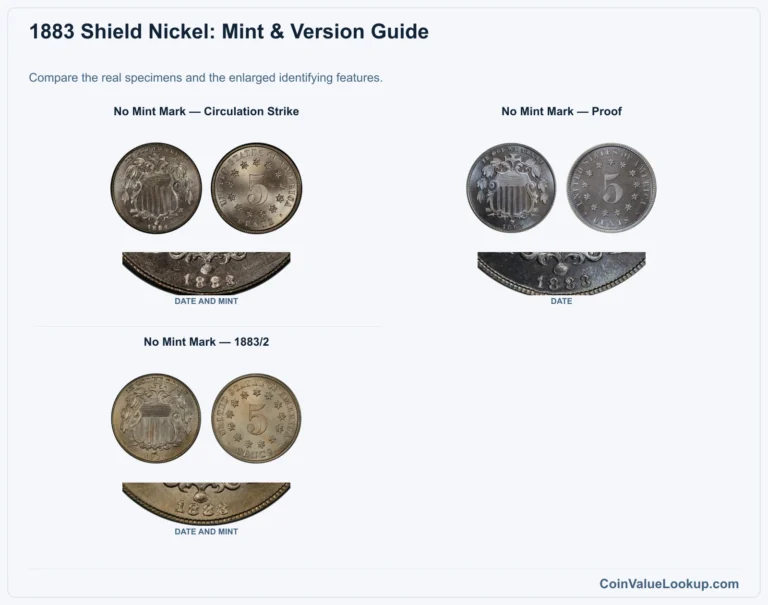
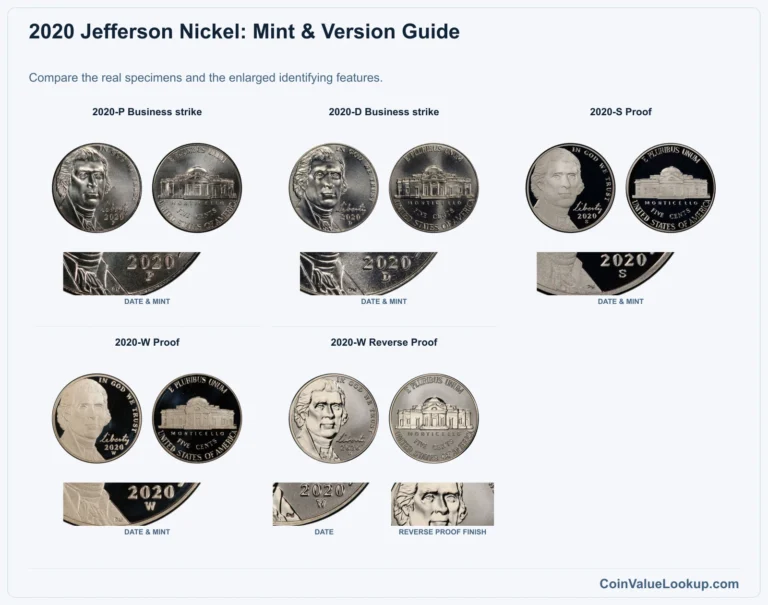
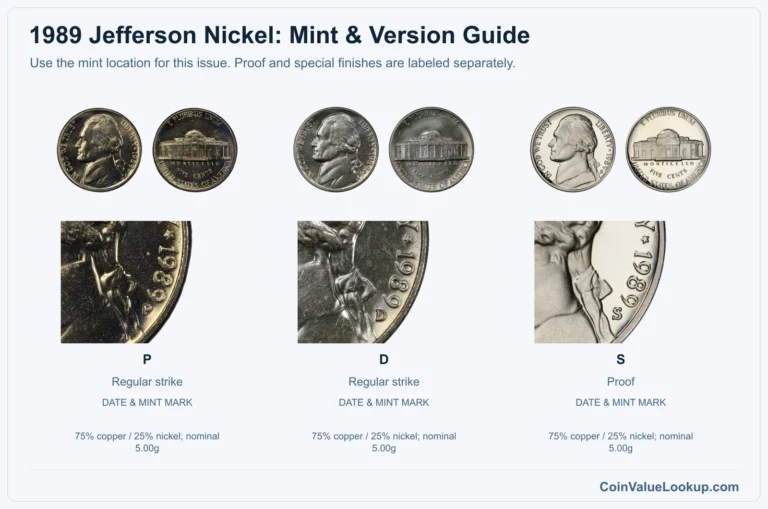
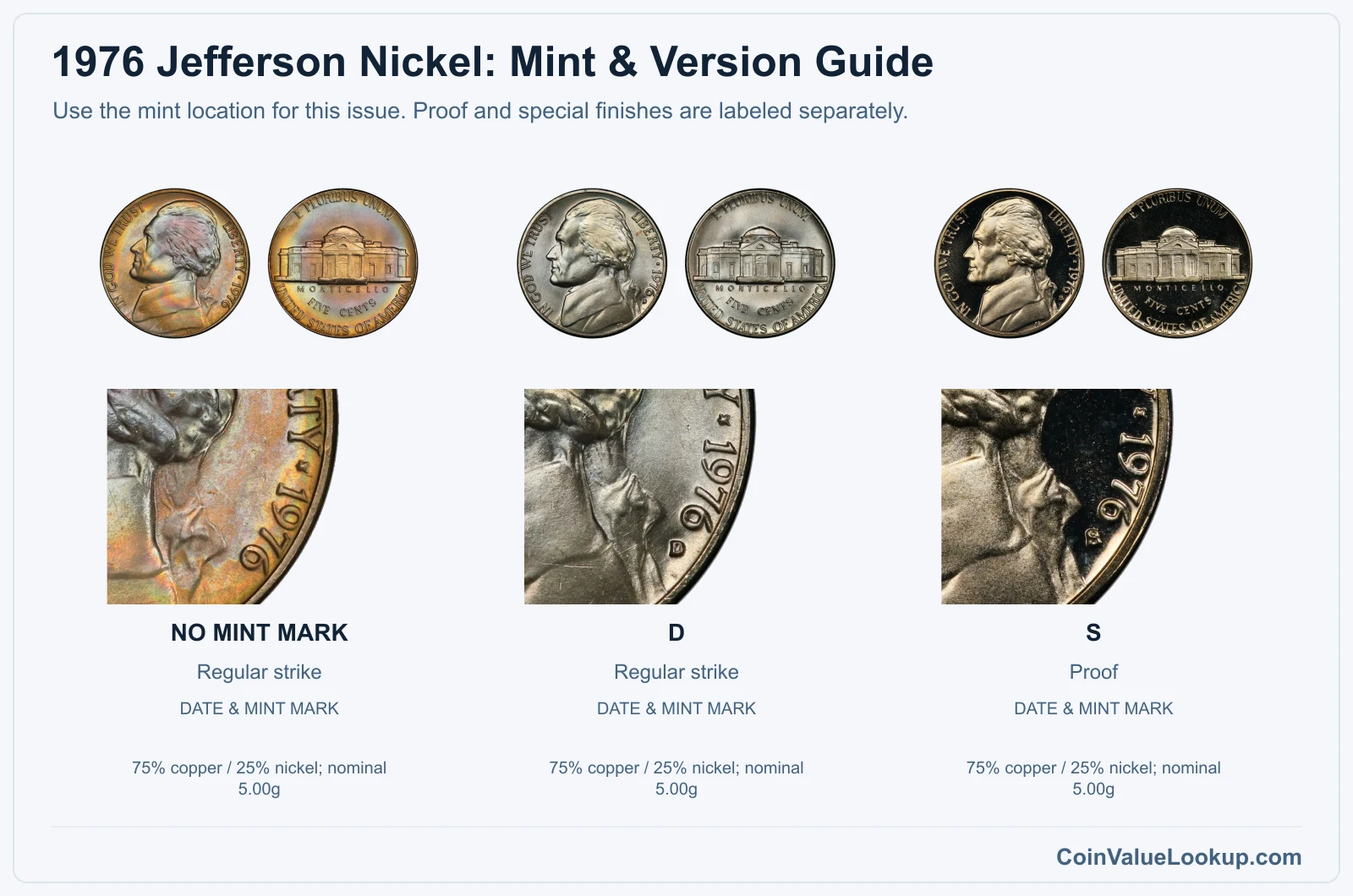
The 1976 Jefferson nickel comes in three basic versions. A coin with no mintmark below the date was struck in Philadelphia for circulation.
A small "D" in that same spot means Denver made it. An "S" means San Francisco, and those are proof coins, not business strikes.
All three share the same composition: 75% copper and 25% nickel, solid through and through. This is not a clad sandwich like a quarter.
The coin should weigh about 5 grams and measure 21.2 mm across with a plain, smooth edge.
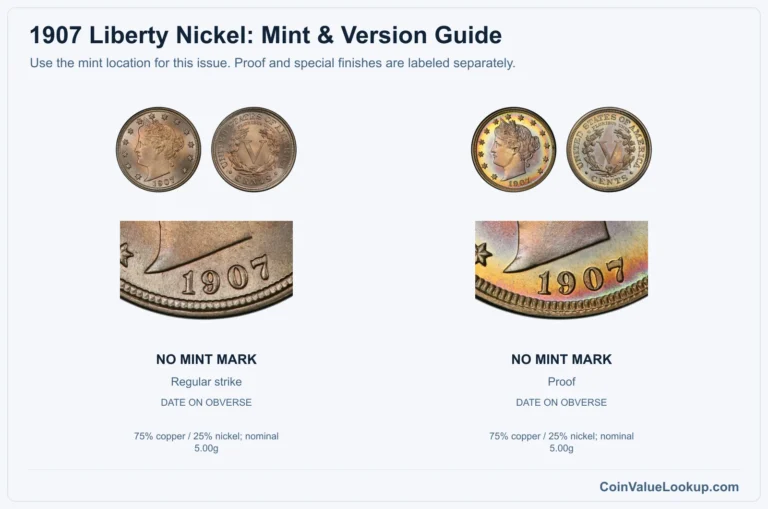
Don't confuse proof finish or cameo contrast with a higher grade. A proof is a method of manufacture, not a step above Mint State.
If you see deep mirror fields and frosted devices, that tells you how the coin was made, not that it grades above MS70.
Step 2: Check Your 1976 Jefferson Nickel Grade
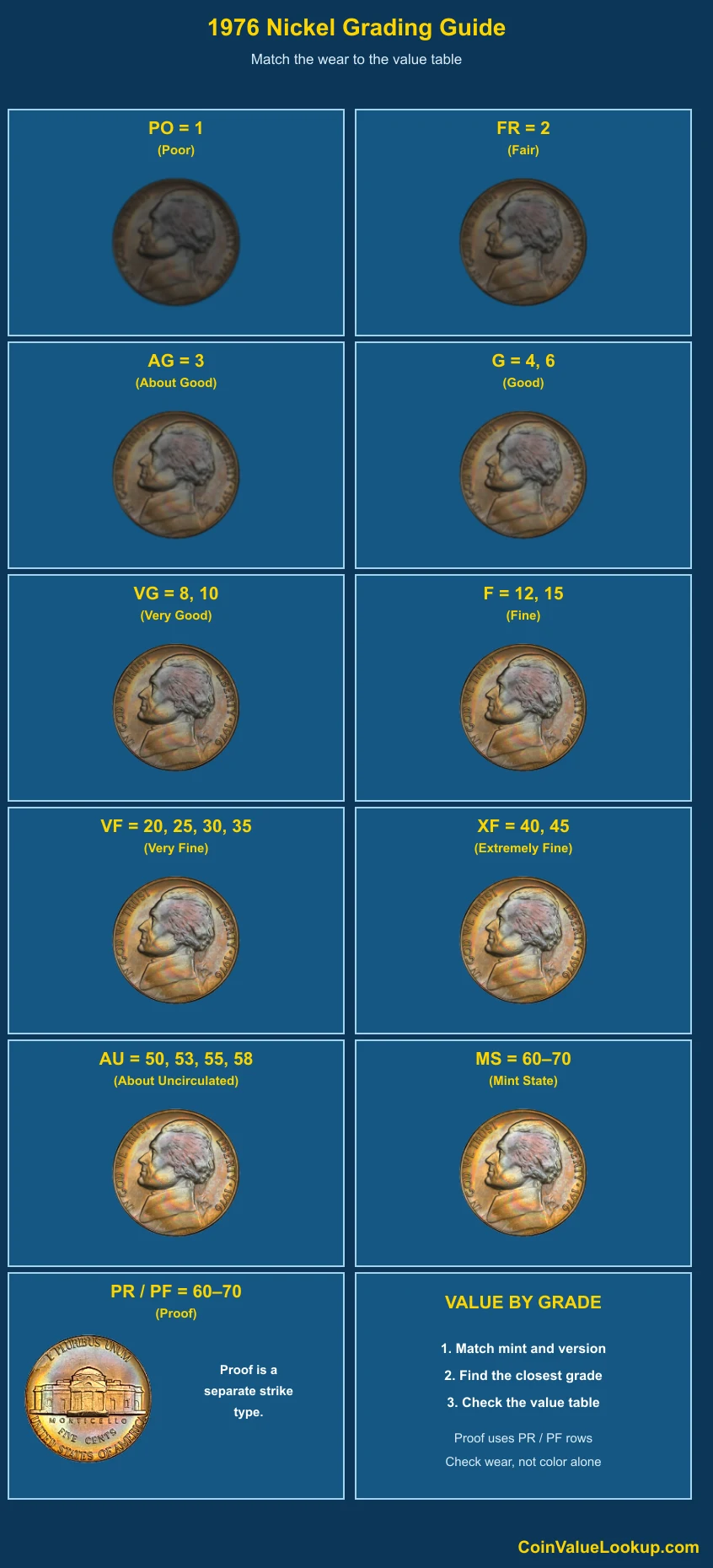
Start on the obverse. Jefferson's cheekbone and hair above the ear show wear first.
A coin that spent real time in pockets will have flattened hair detail and a smooth cheek, while an uncirculated piece retains full luster and sharp definition there.
Flip it over and study Monticello. The building's columns, windows, and especially the steps along the base reveal condition quickly.
Contact marks and bag abrasions separate a true gem from a merely uncirculated coin.
Full Steps is a strike-quality designation, not a grade. It means the horizontal lines across Monticello's base are uninterrupted and complete.
A weakly struck coin can look uncirculated yet still lack Full Steps, so compare your coin to the reference image carefully. Strike weakness is different from wear.
Step 3: Check 1976 Jefferson Nickel Value by Mint and Version
1976 Jefferson Nickel — No mintmark (Philadelphia) Business strike
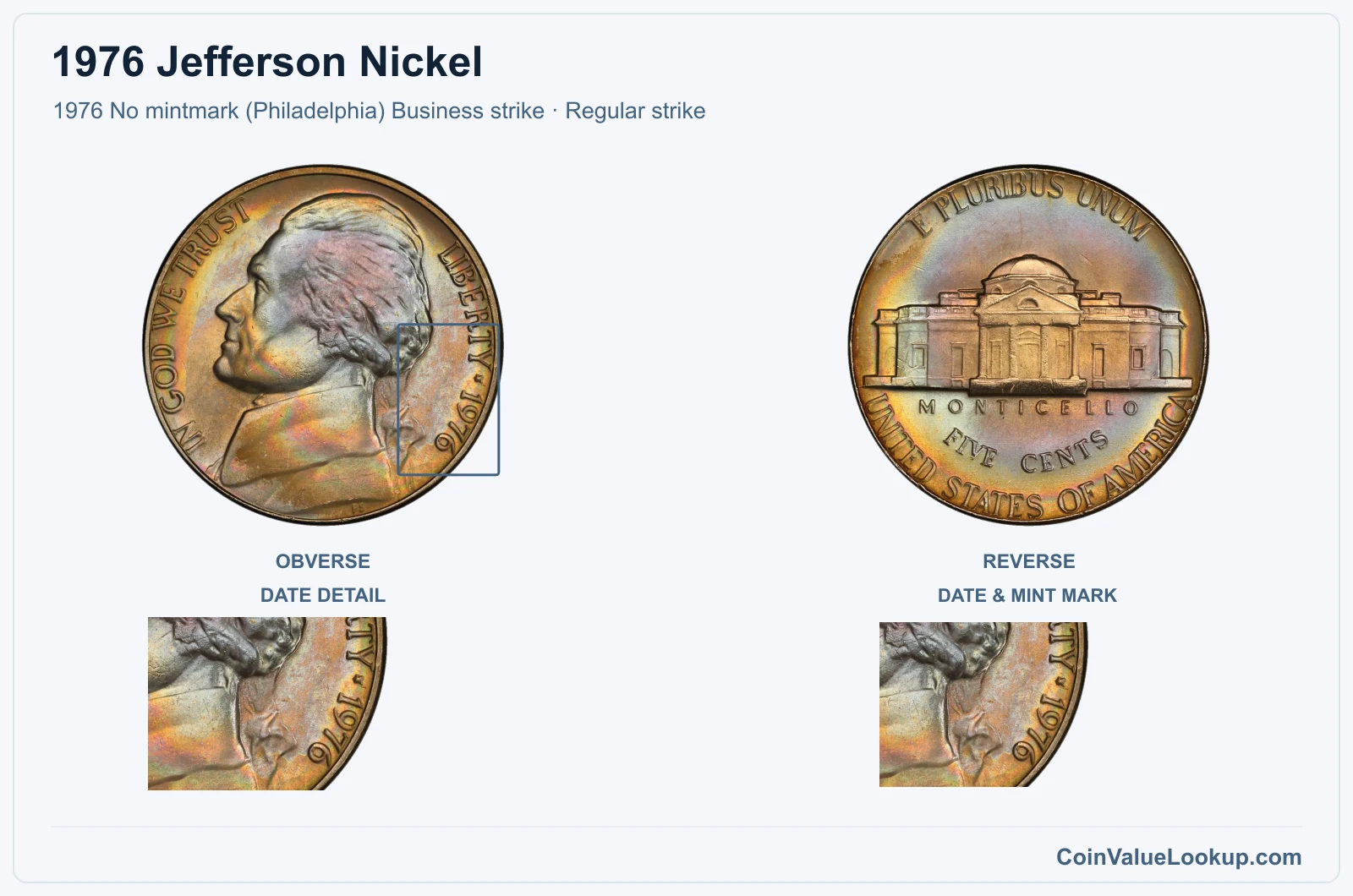
The 1976 Philadelphia nickel has no mintmark. Look below the date on the obverse and you should see bare field, nothing stamped there.
This is the standard business strike meant for everyday commerce.
USA Coin Book lists a guide estimate of about $0.55 at MS60 and $3.62 at MS65. Worn examples are worth face value.
The jump between those two uncirculated grades reflects how much surface quality, luster, and freedom from contact marks matter when a date is this common.
Coins with certified Full Steps can merit a premium, since a clean, fully struck Monticello base is harder to find than simple mint luster.
| Range | Grade | Price | Auction Records | Appraisal |
|---|---|---|---|---|
| PO | PO 1 | — | Coin Identifier | |
| FR | FR 2 | — | Coin Identifier | |
| AG | AG 3 | — | Coin Identifier | |
| G | G 4 | — | Coin Identifier | |
| G 6 | — | Coin Identifier | ||
| VG | VG 8 | — | Coin Identifier | |
| VG 10 | — | Coin Identifier | ||
| F | F 12 | — | Coin Identifier | |
| F 15 | — | Coin Identifier | ||
| VF | VF 20 | — | Coin Identifier | |
| VF 25 | — | Coin Identifier | ||
| VF 30 | — | Coin Identifier | ||
| VF 35 | — | Coin Identifier | ||
| XF | XF 40 | — | Coin Identifier | |
| XF 45 | — | Coin Identifier | ||
| AU | AU 50 | — | Coin Identifier | |
| AU 53 | — | Coin Identifier | ||
| AU 55 | — | Coin Identifier | ||
| AU 58 | — | Coin Identifier | ||
| MS | MS 60 | — | Coin Identifier | |
| MS 61 | — | Coin Identifier | ||
| MS 62 | — | Coin Identifier | ||
| MS 63 | — | Coin Identifier | ||
| MS 64 | — | Coin Identifier | ||
| MS 65 | — | Coin Identifier | ||
| MS 66 | Coin Identifier | |||
| MS 67 | — | — | — | |
| MS 68 | — | — | — | |
| MS 69 | — | — | — | |
| MS 70 | — | — | — |
1976 Jefferson Nickel — D Business strike
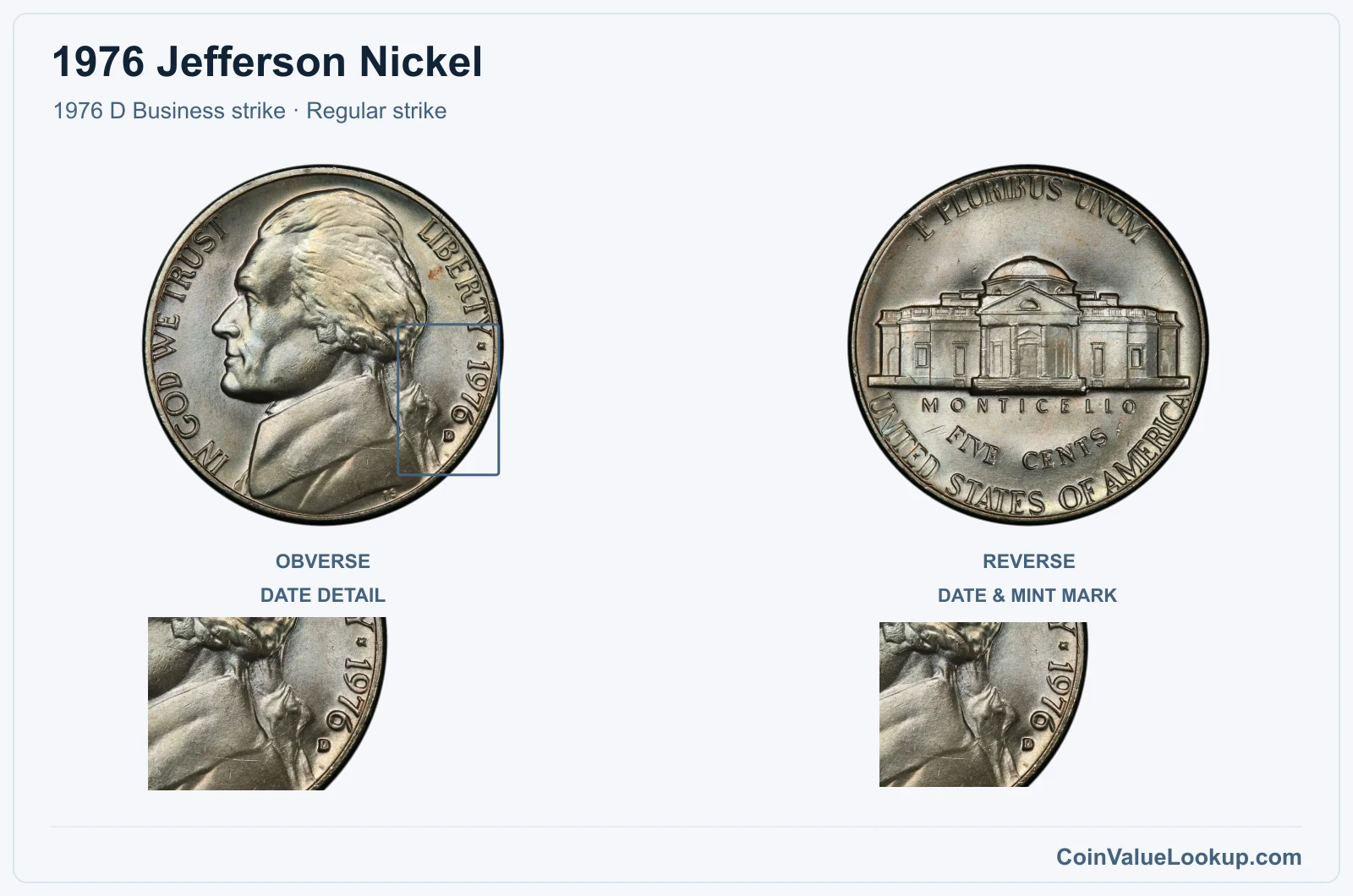
A small "D" mintmark below the date identifies the Denver issue. Same specs as Philadelphia: 75% copper, 25% nickel, 5 grams, plain edge.
Guide estimates from USA Coin Book are $0.55 at MS60 and $3.62 at MS65, identical to the Philadelphia version at these grade points. Circulated pieces are worth five cents.
If you are building a set, look for examples with strong step detail on Monticello's base. Full Steps attribution requires sharp, uninterrupted horizontal lines, and that is a function of die quality and strike pressure, not just how gently the coin was handled.
Coin Value Lookup is a good starting point if you want to compare this date against other Jefferson nickels in the series.
| Range | Grade | Price | Auction Records | Appraisal |
|---|---|---|---|---|
| PO | PO 1 | — | Coin Identifier | |
| FR | FR 2 | — | Coin Identifier | |
| AG | AG 3 | — | Coin Identifier | |
| G | G 4 | — | Coin Identifier | |
| G 6 | — | Coin Identifier | ||
| VG | VG 8 | — | Coin Identifier | |
| VG 10 | — | Coin Identifier | ||
| F | F 12 | — | Coin Identifier | |
| F 15 | — | Coin Identifier | ||
| VF | VF 20 | — | Coin Identifier | |
| VF 25 | — | Coin Identifier | ||
| VF 30 | — | Coin Identifier | ||
| VF 35 | — | Coin Identifier | ||
| XF | XF 40 | — | Coin Identifier | |
| XF 45 | — | Coin Identifier | ||
| AU | AU 50 | — | Coin Identifier | |
| AU 53 | — | Coin Identifier | ||
| AU 55 | — | Coin Identifier | ||
| AU 58 | — | Coin Identifier | ||
| MS | MS 60 | — | Coin Identifier | |
| MS 61 | — | Coin Identifier | ||
| MS 62 | — | Coin Identifier | ||
| MS 63 | — | Coin Identifier | ||
| MS 64 | — | Coin Identifier | ||
| MS 65 | Coin Identifier | |||
| MS 66 | Coin Identifier | |||
| MS 67 | Coin Identifier | |||
| MS 68 | — | — | — | |
| MS 69 | — | — | — | |
| MS 70 | — | — | — |
1976 Jefferson Nickel — S Proof
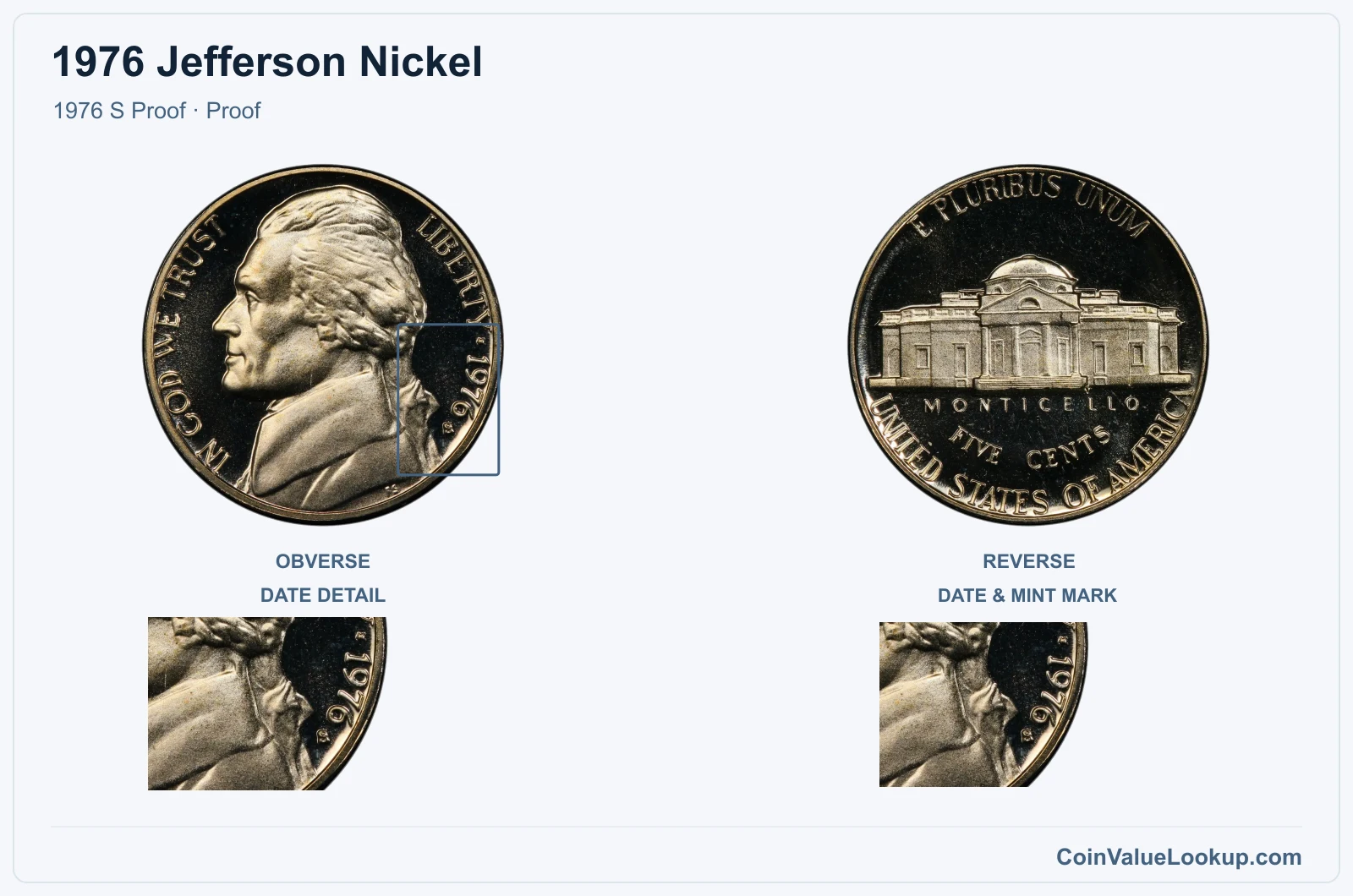
San Francisco struck proof-only nickels in 1976, identified by the "S" mintmark below the date. These were sold in collector sets, not released into circulation.
USA Coin Book places the base proof at roughly $3.08 in PR65. That estimate covers a standard proof finish.
Cameo and deep cameo designations are separate categories with their own market, so do not apply this base price to a PR70 deep cameo.
Proof finish means mirror fields and sharply detailed devices from specially prepared dies and planchets. It is a manufacturing method.
A PR65 is not somehow better than an MS65; they describe different production processes graded on parallel scales.
| Range | Grade | Price | Auction Records | Appraisal |
|---|---|---|---|---|
| PR | PR 1 | — | Coin Identifier | |
| PR 2 | — | Coin Identifier | ||
| PR 3 | — | Coin Identifier | ||
| PR 4 | — | Coin Identifier | ||
| PR 6 | — | Coin Identifier | ||
| PR 8 | — | Coin Identifier | ||
| PR 10 | — | Coin Identifier | ||
| PR 12 | — | Coin Identifier | ||
| PR 15 | — | Coin Identifier | ||
| PR 20 | — | Coin Identifier | ||
| PR 25 | — | Coin Identifier | ||
| PR 30 | — | Coin Identifier | ||
| PR 35 | — | Coin Identifier | ||
| PR 40 | — | Coin Identifier | ||
| PR 45 | — | Coin Identifier | ||
| PR 50 | — | Coin Identifier | ||
| PR 53 | — | Coin Identifier | ||
| PR 55 | — | Coin Identifier | ||
| PR 58 | — | Coin Identifier | ||
| PR 60 | — | Coin Identifier | ||
| PR 61 | — | Coin Identifier | ||
| PR 62 | — | Coin Identifier | ||
| PR 63 | — | Coin Identifier | ||
| PR 64 | — | Coin Identifier | ||
| PR 65 | — | Coin Identifier | ||
| PR 66 | Coin Identifier | |||
| PR 67 | Coin Identifier | |||
| PR 68 | Coin Identifier | |||
| PR 69 | Coin Identifier | |||
| PR 70 | Coin Identifier |
1976 Jefferson Nickel Error List
1. 1976 Jefferson Nickel — Struck on cent planchet
A 1976 nickel struck on a cent-sized copper planchet is a dramatic wrong-planchet error. The nickel dies impress Jefferson and Monticello onto a smaller, lighter blank, so the design is visibly cropped around the rim and peripheral lettering is cut off.
Weight is a key diagnostic. A normal nickel is about 5 grams; a cent blank weighs roughly 3.1 grams.
The copper color will be obvious, but color alone is not proof. Chemical exposure, plating, and environmental damage can turn an ordinary nickel reddish.
You need the correct weight, undersized diameter, and cropped design together.
A Heritage Auctions example from November 2020, a Denver mint coin graded NGC MS61 RB at 3.1 grams, sold for $240. That is one recorded sale, not a guaranteed market price.
Professional authentication matters here.
2. 1976 Jefferson Nickel — Struck on clad dime blank
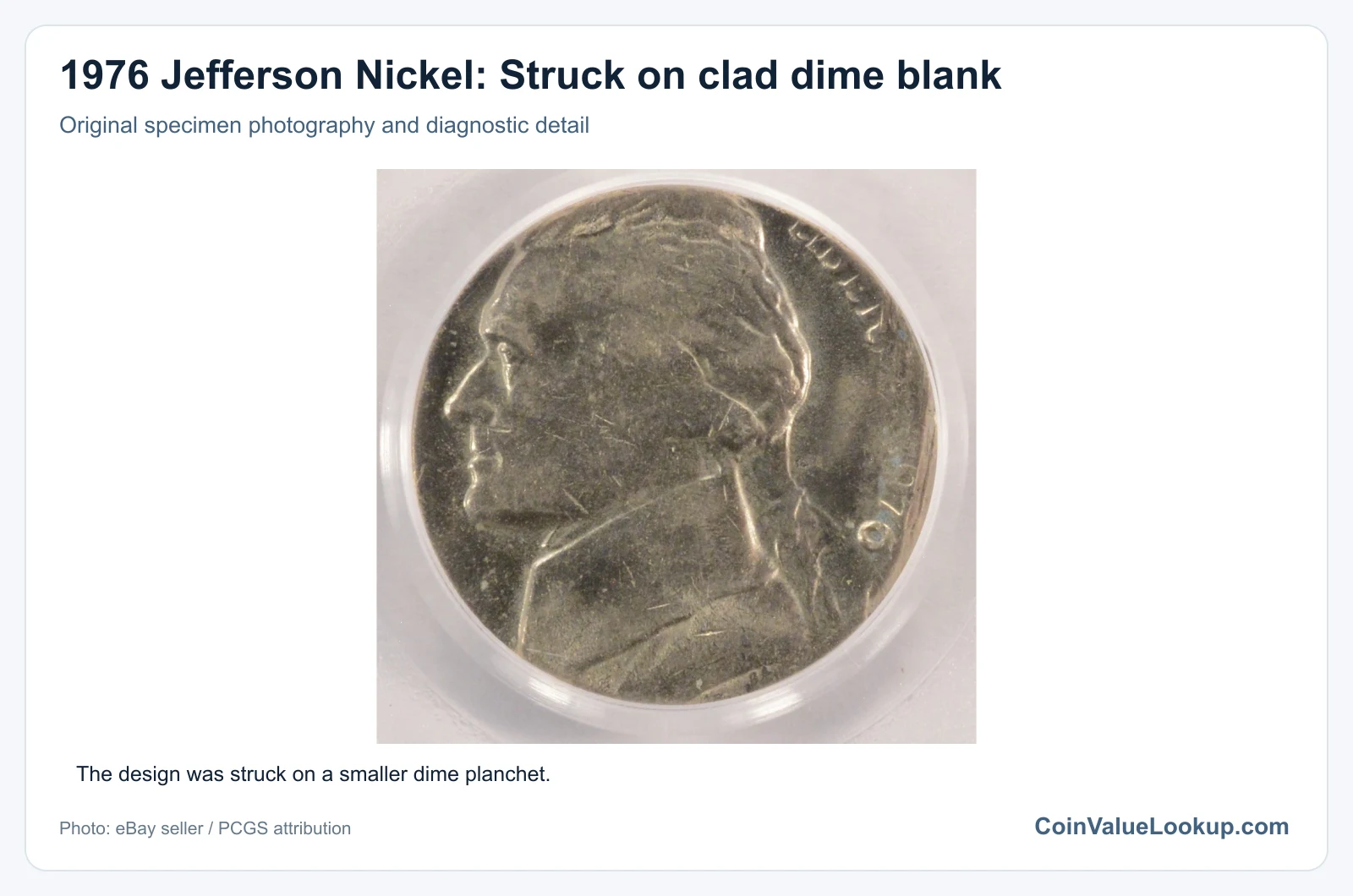
When a nickel is struck on a clad dime blank, the result is an undersized coin with the Jefferson design noticeably cropped at the edges. The blank is thinner and lighter than a proper nickel planchet, and peripheral design elements get cut short.
Look at the edge. A dime blank has the layered clad appearance, while a nickel is solid copper-nickel throughout.
The coin will also be smaller than a standard nickel.
Don't confuse a trimmed or filed-down nickel with this error. Post-mint damage creates irregular edges and tool marks, while a genuine wrong-planchet strike shows clean, uniform design truncation from being struck on a too-small blank.
A Philadelphia example graded PCGS MS64 sold through Heritage Auctions in December 2024 for $492. Individual results vary with condition and buyer competition.
3. 1976 Jefferson Nickel — Struck on Philippines5sentimos blank
This is an unusual one. A 1976 Philadelphia nickel struck on a Philippines 5-sentimos blank has been cataloged and authenticated.
The foreign planchet weighed 3.37 grams, well under the normal 5-gram nickel specification.
Because the blank differs in size and weight, the resulting coin shows a weakened or incomplete impression of the nickel design. It can superficially resemble a poorly struck normal nickel, which is exactly the lookalike to rule out.
Authentication and precise weight measurement are essential.
A Heritage Auctions example graded NGC MS60 sold in January 2011 for $862.50. That single result reflects the rarity of a specifically attributed foreign-blank error.
Do not assume every lightweight or odd-looking 1976 nickel is struck on a foreign planchet; professional third-party attribution is the standard here.
4. 1976 Jefferson Nickel — Doubled Die Obverse
Doubled die obverse errors on the 1976 nickel show consistent doubling on obverse lettering or design elements. Under magnification, you are looking for separation, notching, or a secondary image that appears on multiple letters or features in a uniform direction.
The key word is consistent. Machine doubling, which is flat and shelf-like, is far more common and far less valuable.
True hub doubling produces raised, rounded secondary outlines.
Compare suspect areas against a normal 1976 nickel under the same lighting. If only one letter looks odd, that is more likely damage or die deterioration.
Value depends on the visibility of the doubling, the specific die involved, and overall coin condition. No single price range covers all varieties.
5. 1976 Jefferson Nickel — Off-Center Strike
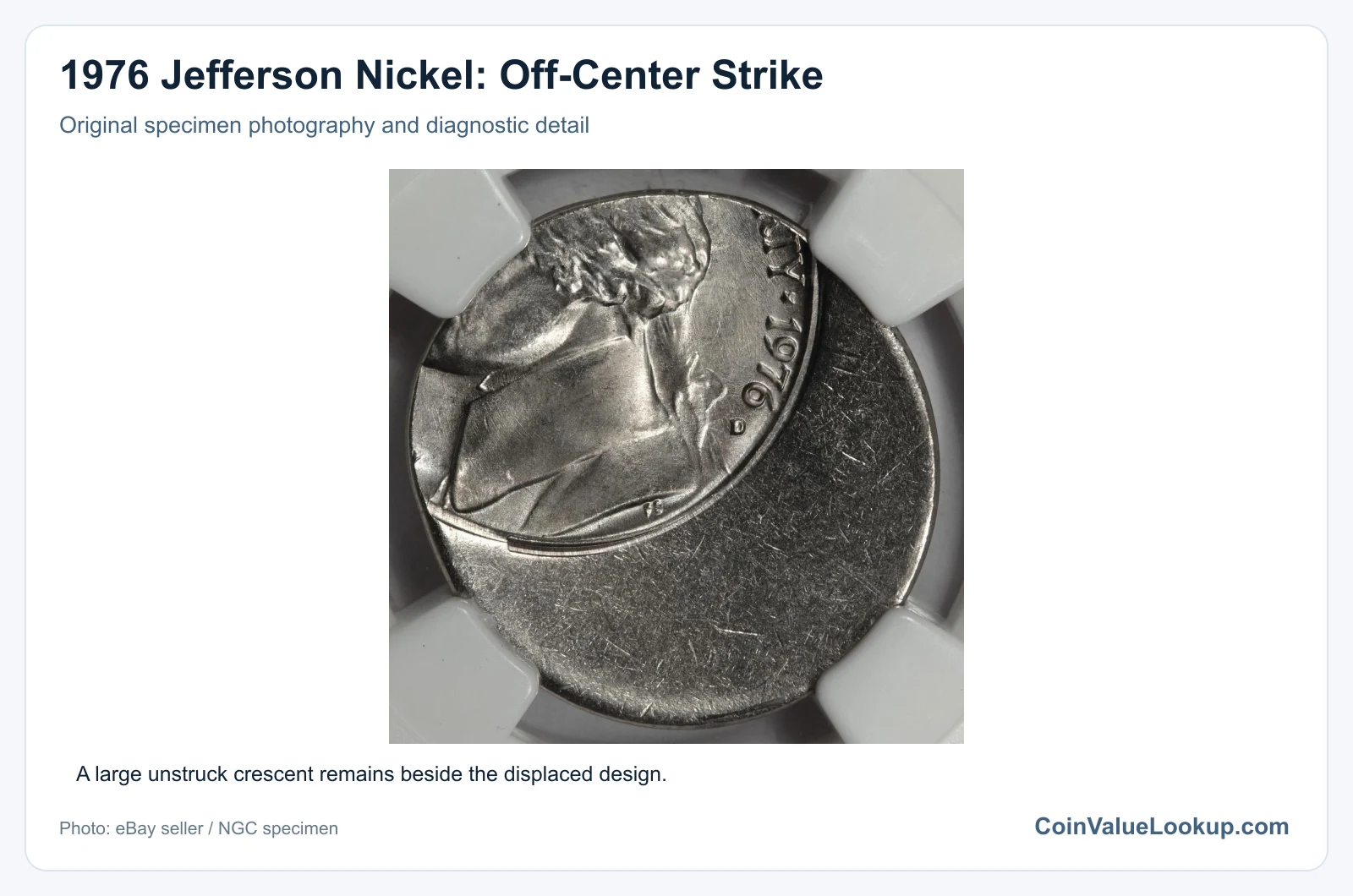
An off-center strike happens when the planchet is not properly seated between the dies. The design shifts to one side, leaving a blank crescent of unstruck metal on the opposite edge.
The value equation is simple in theory: more dramatic off-center percentage plus a fully visible date equals more collector interest. A 5% shift barely catches the eye.
A 50% shift with the date intact is a different conversation entirely.
Don't confuse a clipped planchet or post-mint damage with a true off-center error. A genuine off-center coin has a complete, round planchet with the design displaced, not a missing chunk.
Condition and the degree of misalignment drive value, so no single price applies to every example.
6. 1976 Jefferson Nickel — Clipped Planchet
A clipped planchet error occurs when the coin blank is punched from strip metal that overlaps a previously punched hole. The result is a curved bite missing from the edge of the finished coin.
Look for the Blakesley effect: a zone of weakness on the rim directly opposite the clip. That opposing weakness is a strong indicator of a genuine clip rather than post-mint filing or corrosion eating away the edge.
Edge texture matters too. A real clip will show the original blank's sheared metal, not rough file marks or uneven corrosion pitting.
The missing area follows a smooth curve matching the diameter of the blanking punch.
Value depends on the size and location of the clip and on overall coin condition. No fixed price range applies across all examples.
7. 1976 Jefferson Nickel — Doubled Die Reverse
Doubled die reverse errors appear on the Monticello side of the 1976 nickel. Look for consistent doubling in the reverse lettering, building details, or denomination text.
Under magnification, genuine hub doubling shows rounded, raised secondary contours.
Machine doubling is the common impostor. It produces flat, shelf-like distortion that lacks the defined separation of a true doubled die.
Reflections under certain lighting can also mimic doubling to the naked eye.
Compare your reverse against a known normal example, focusing on areas where letters or design lines are close together. Condition, the strength of the visible doubling, and the specific die all factor into value.
There is no single adopted price range for these, so individual assessment is necessary.
8. 1976 Jefferson Nickel — Die Crack / Die Chip
Die cracks and die chips are raised features caused by a deteriorating die. A crack appears as a thin raised line running across the coin's surface, while a chip shows up as a small raised blob, often on a letter or within the design.
A cud is a larger raised mass connected to the rim where a piece of the die has broken away.
These are raised, not incuse. That is the main way to distinguish them from scratches or damage, which cut into the surface.
Foreign material stuck to a coin can also mimic a small chip, but it will not have the same metallic continuity with the surrounding design.
Value varies widely. A tiny interior die crack is minor.
A full rim-connected cud on a clear example draws more attention. Condition and size determine collector interest for each piece individually.