1981 Jefferson Nickel Coin Value: How Much Is It Worth?
Most 1981 Jefferson nickels you pull from a jar are worth face value. Uncirculated examples carry modest guide estimates, roughly $0.30 at MS60 up to about $3.62 at MS65 according to USA Coin Book.
Those figures apply to business strikes graded in that specific range, not to every coin in a drawer. S-mint proofs and confirmed mint errors occupy their own separate markets and can command significantly more depending on authenticated identity and condition.
Fast Way to Identify Your 1981 Jefferson Nickel
Snap a clear photo of the front and back of your 1981 nickel and upload both images here for a preliminary identification. This helps narrow down the mint, finish, and any visible anomalies before you dig further.
Good lighting at a slight angle reveals surface details that straight-on shots can miss.
1981 Jefferson Nickel Value
Upload both sides of your 1981 Jefferson Nickel.
Front Obverse
Upload photo
Back Reverse
Upload photo
Which 1981 Jefferson Nickel Versions Are Worth Money?
- Uncirculated 1981-P and 1981-D nickels in MS65 condition carry guide values around $3.62 — far above face value but still modest compared to error coins.
- 1981-S Proof Type 1 and Type 2 are distinct collectible varieties; each requires authenticated attribution against confirmed 1981 examples.
- A 1981-P nickel struck over a Lincoln cent sold at Heritage Auctions in November 2020 for $600 — a genuine double-denomination error.
- A bonded pair of 1981-P nickels fused during striking brought $1,610 at Heritage Auctions in August 2010.
- Doubled die obverse examples have been reported for this year and can carry significant premiums depending on the strength and visibility of the doubling.
- Off-center strikes and split blanks are authenticated error types known for 1981-P nickels, each valued individually by condition and severity.
Step 1: Identify Your 1981 Jefferson Nickel Mint Mark and Version
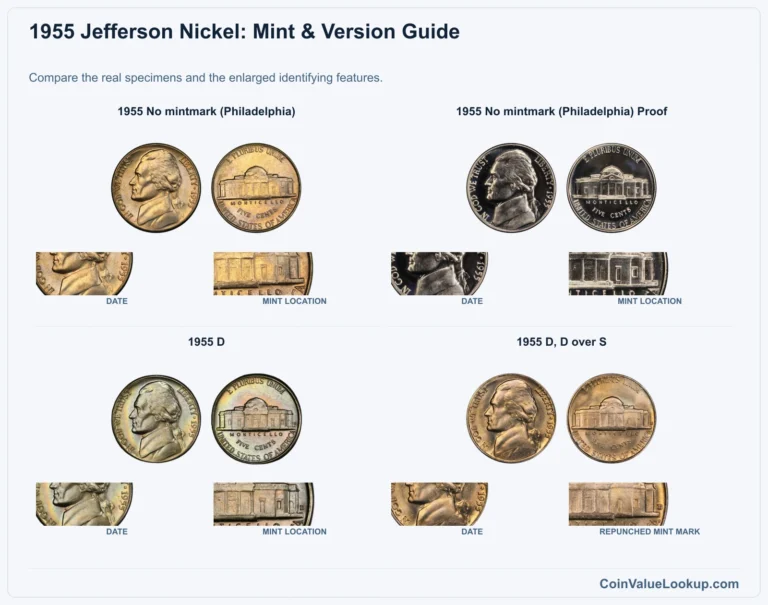
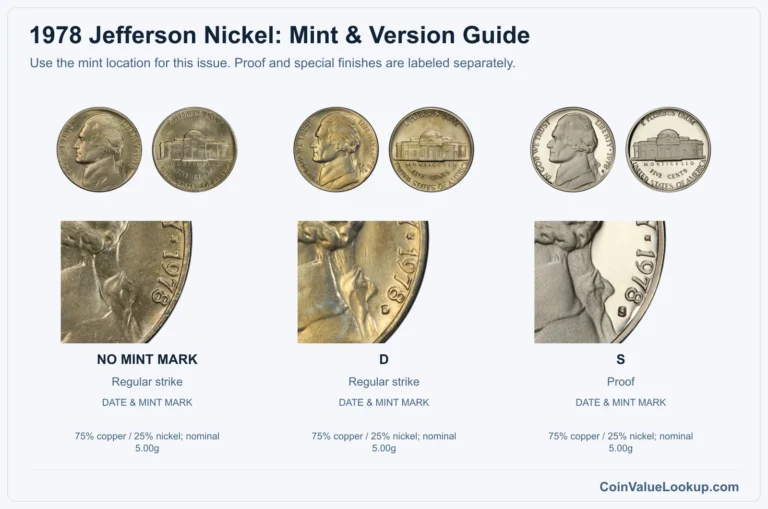
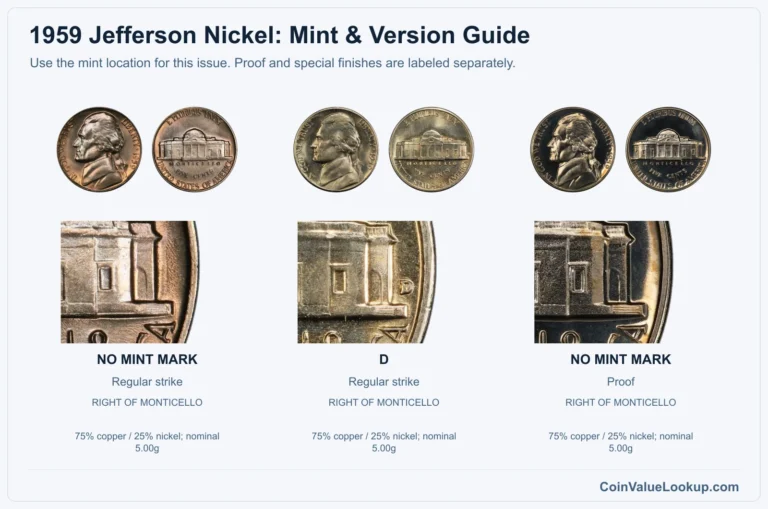
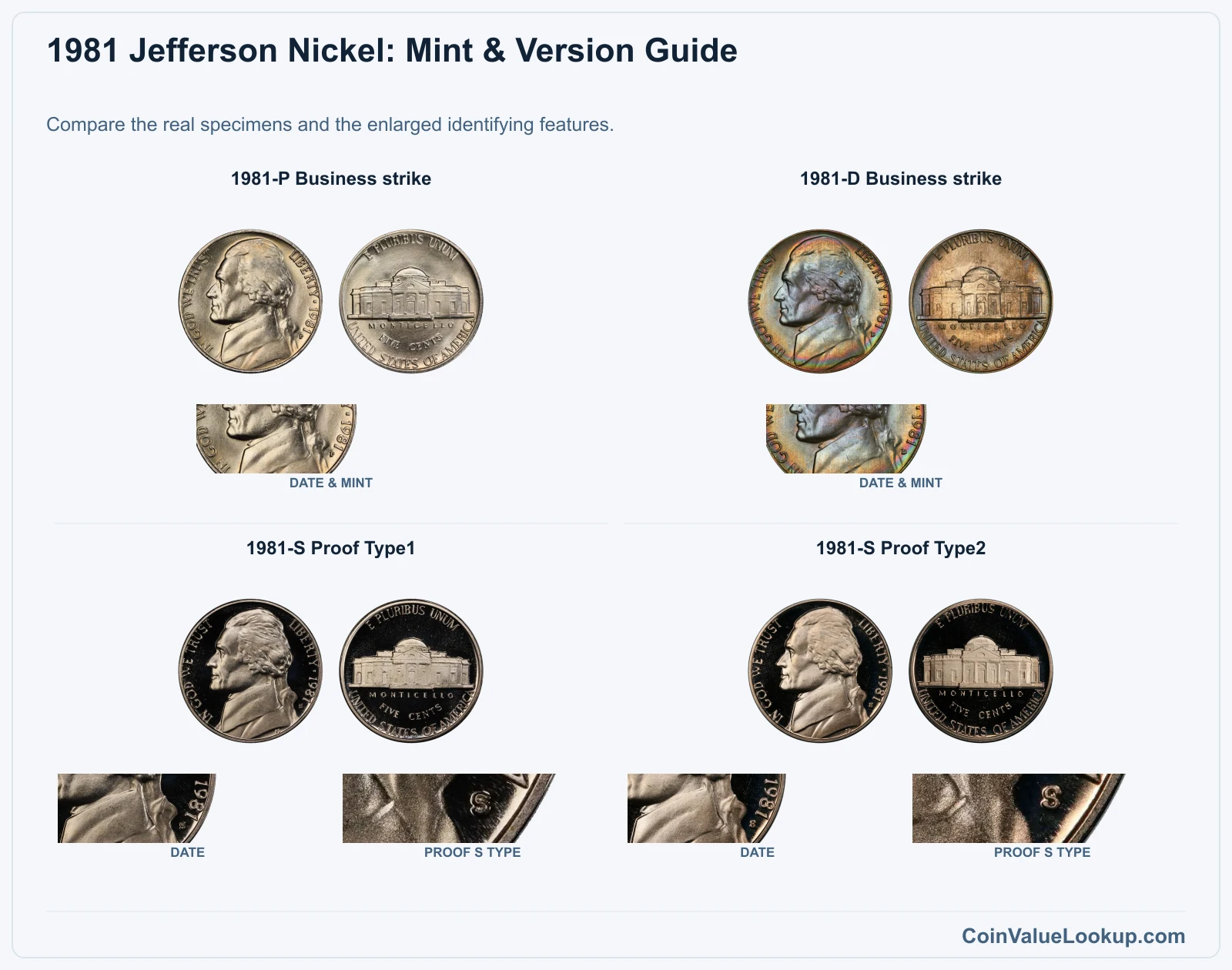
Three mints produced 1981 Jefferson nickels. Philadelphia (P) and Denver (D) made business strikes for circulation, while San Francisco (S) struck proofs for collector sets only.
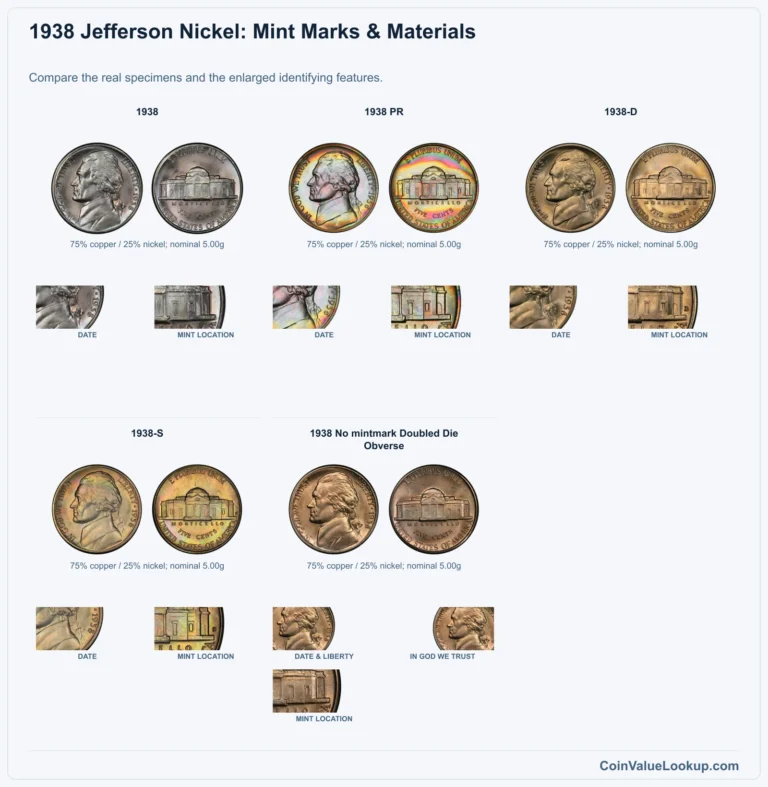
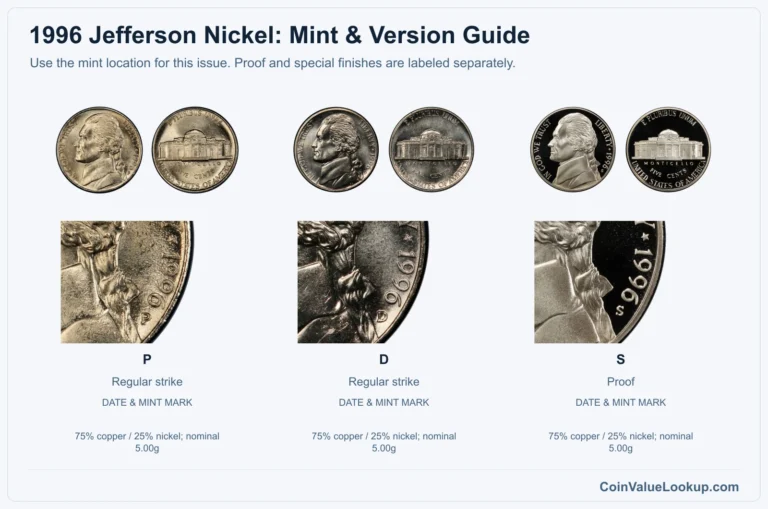
The mintmark sits on the obverse, just below the date and to the right. Starting in 1980, Philadelphia coins carry a small "P" — so a missing letter is not a special variety here; it likely means the mark is weak or obscured.
All versions use the same 75% copper, 25% nickel alloy, weigh about 5 grams, measure 21.2 mm across, and have a plain edge. If your coin looks silver or coppery, that difference in color alone does not confirm a different metal; it needs professional evaluation.
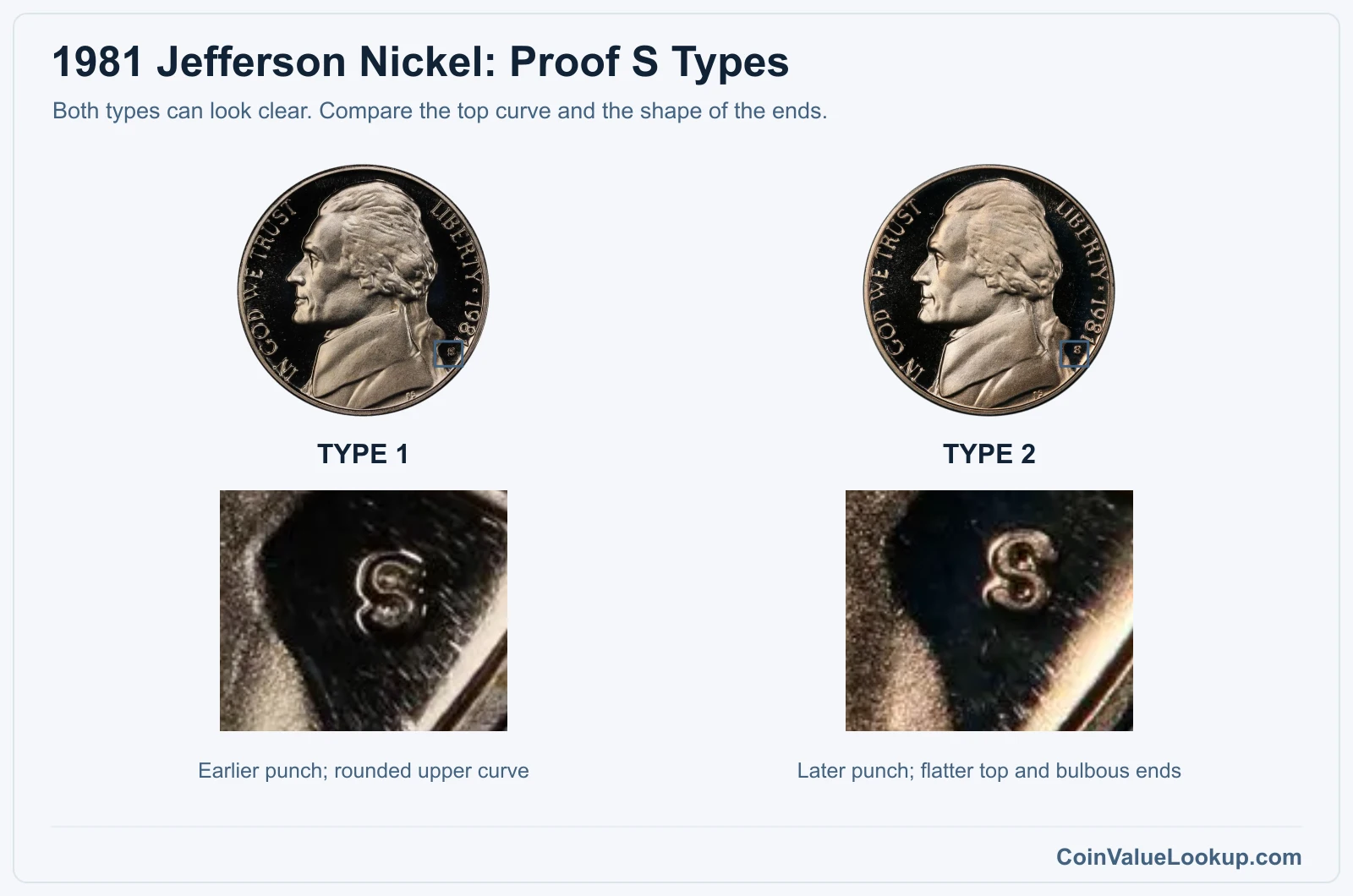
The 1981-S proof comes in two recognized types, Type 1 and Type 2, which must be attributed against authenticated 1981 examples specifically. Do not rely on descriptions written for the 1979 proof varieties, as the distinguishing features are not identical year to year.
Step 2: Check Your 1981 Jefferson Nickel Grade
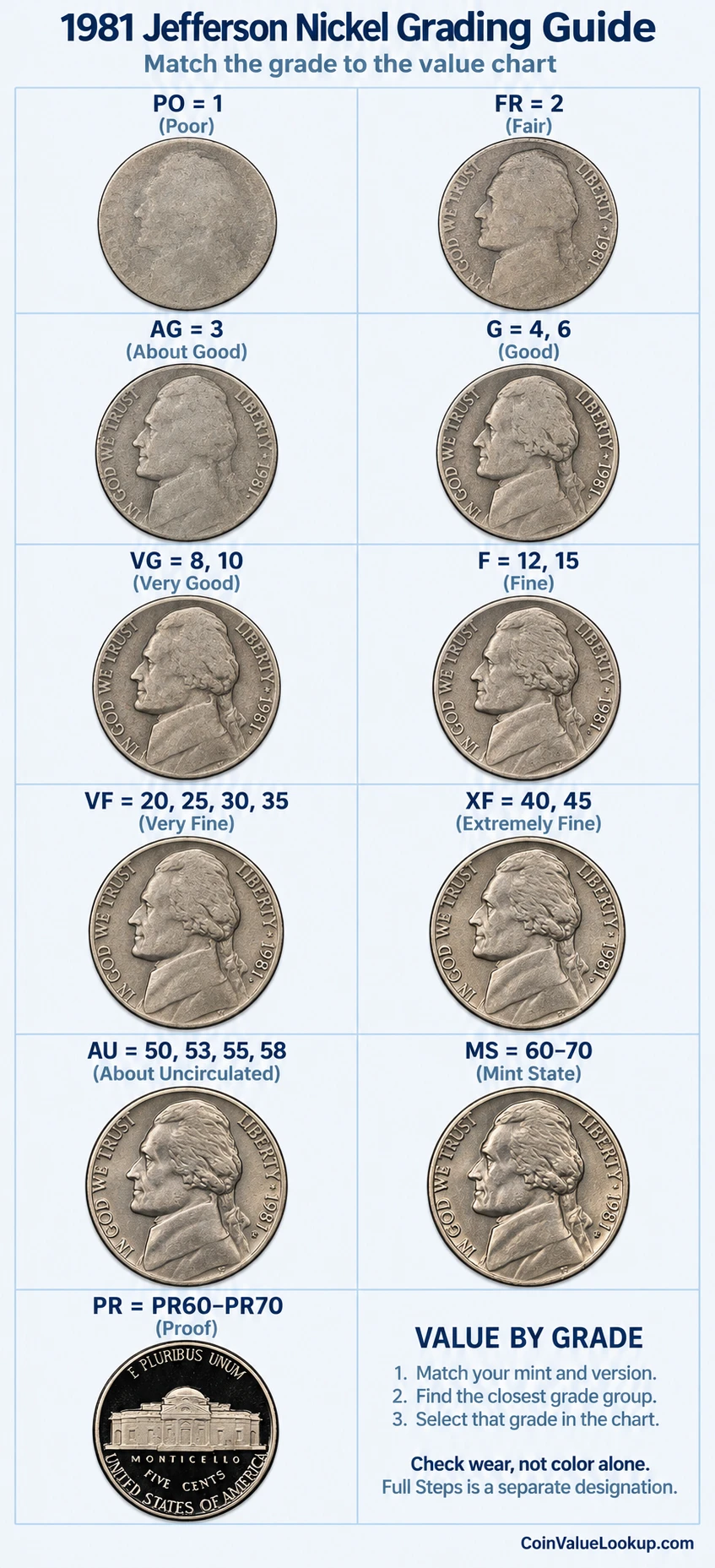
Start with Jefferson's cheekbone and the hair above his ear. On a well-worn coin, the cheek flattens noticeably and the individual hair strands merge into a smooth patch.
A coin with only light friction will still show some luster and fine detail in the hair.
Flip it over and check Monticello. The four columns and the triangular roof area lose sharpness progressively with wear.
On a truly uncirculated piece, all architectural lines remain distinct and the original mint luster is unbroken across the fields.
The steps at the base of Monticello deserve a close look. Sharp, fully separated steps can indicate a strong strike rather than a higher grade, and the "Full Steps" designation applies only to certified Mint State business strikes — it is not a mint error.
Compare your coin against the reference image to gauge where it falls on the wear spectrum.
Proof coins have a different look entirely: mirror-like fields with frosted raised devices. Grade them by checking for hairlines, haze, or contact marks rather than circulation wear.
Step 3: Check 1981 Jefferson Nickel Value by Mint and Version
1981 Jefferson Nickel — P Business strike
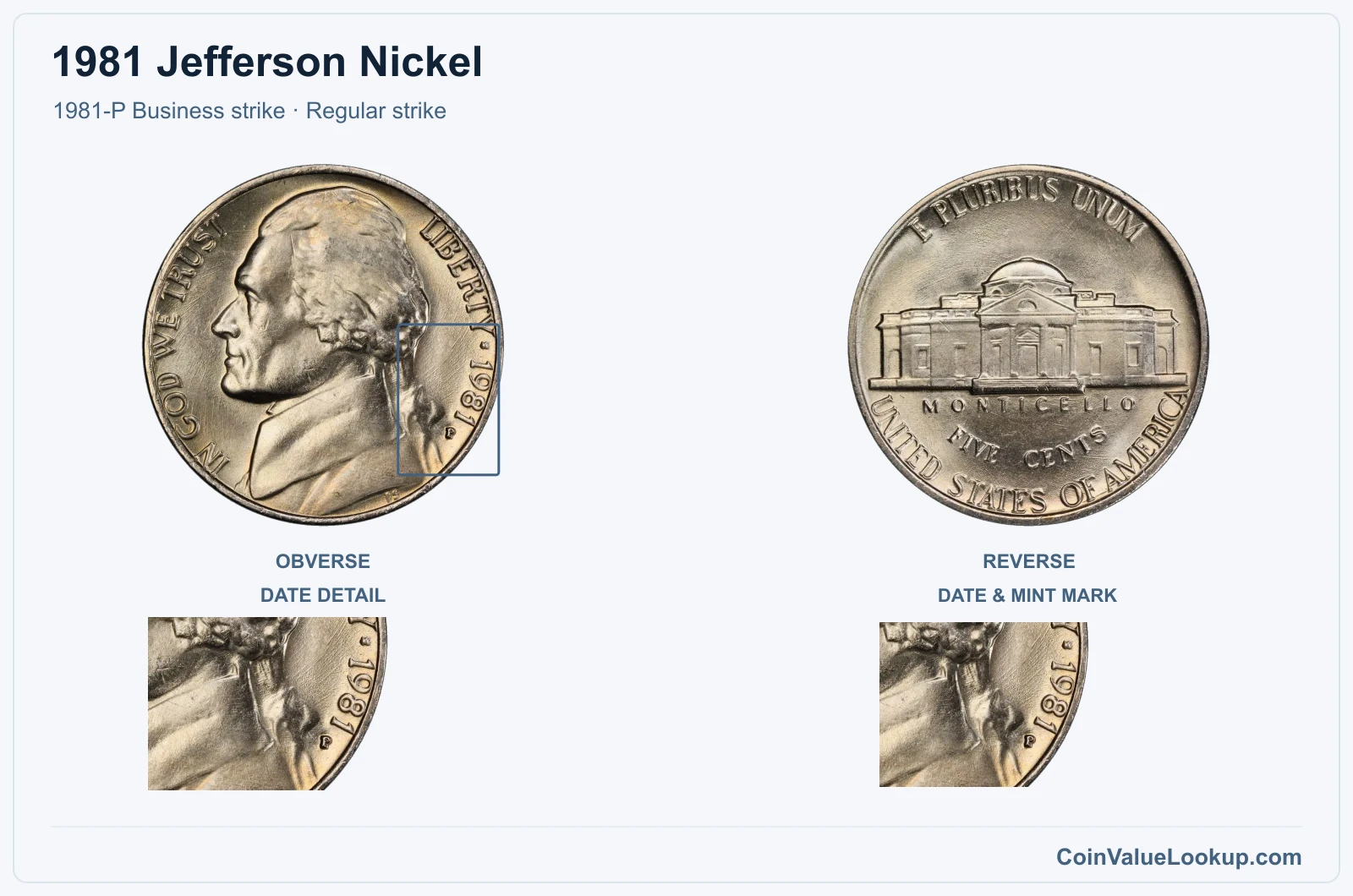
The 1981-P is a standard business strike from the Philadelphia Mint. It carries the small "P" mintmark on the obverse below the date, a feature that began in 1980 for nickels.
The alloy is 75% copper and 25% nickel, weighing roughly 5 grams with a plain edge.
USA Coin Book guide estimates place this coin at about $0.30 in MS60 and $3.62 in MS65. Circulated pieces are generally worth face value.
There is no silver collector version of this date and mint.
| Range | Grade | Price | Auction Records | Appraisal |
|---|---|---|---|---|
| PO | PO 1 | — | Coin Identifier | |
| FR | FR 2 | — | Coin Identifier | |
| AG | AG 3 | — | Coin Identifier | |
| G | G 4 | — | Coin Identifier | |
| G 6 | — | Coin Identifier | ||
| VG | VG 8 | — | Coin Identifier | |
| VG 10 | — | Coin Identifier | ||
| F | F 12 | — | Coin Identifier | |
| F 15 | — | Coin Identifier | ||
| VF | VF 20 | — | Coin Identifier | |
| VF 25 | — | Coin Identifier | ||
| VF 30 | — | Coin Identifier | ||
| VF 35 | — | Coin Identifier | ||
| XF | XF 40 | — | Coin Identifier | |
| XF 45 | — | Coin Identifier | ||
| AU | AU 50 | — | Coin Identifier | |
| AU 53 | — | Coin Identifier | ||
| AU 55 | — | Coin Identifier | ||
| AU 58 | — | Coin Identifier | ||
| MS | MS 60 | Coin Identifier | ||
| MS 61 | Coin Identifier | |||
| MS 62 | Coin Identifier | |||
| MS 63 | Coin Identifier | |||
| MS 64 | Coin Identifier | |||
| MS 65 | Coin Identifier | |||
| MS 66 | Coin Identifier | |||
| MS 67 | — | — | — | |
| MS 68 | — | — | — | |
| MS 69 | — | — | — | |
| MS 70 | — | — | — |
1981 Jefferson Nickel — D Business strike
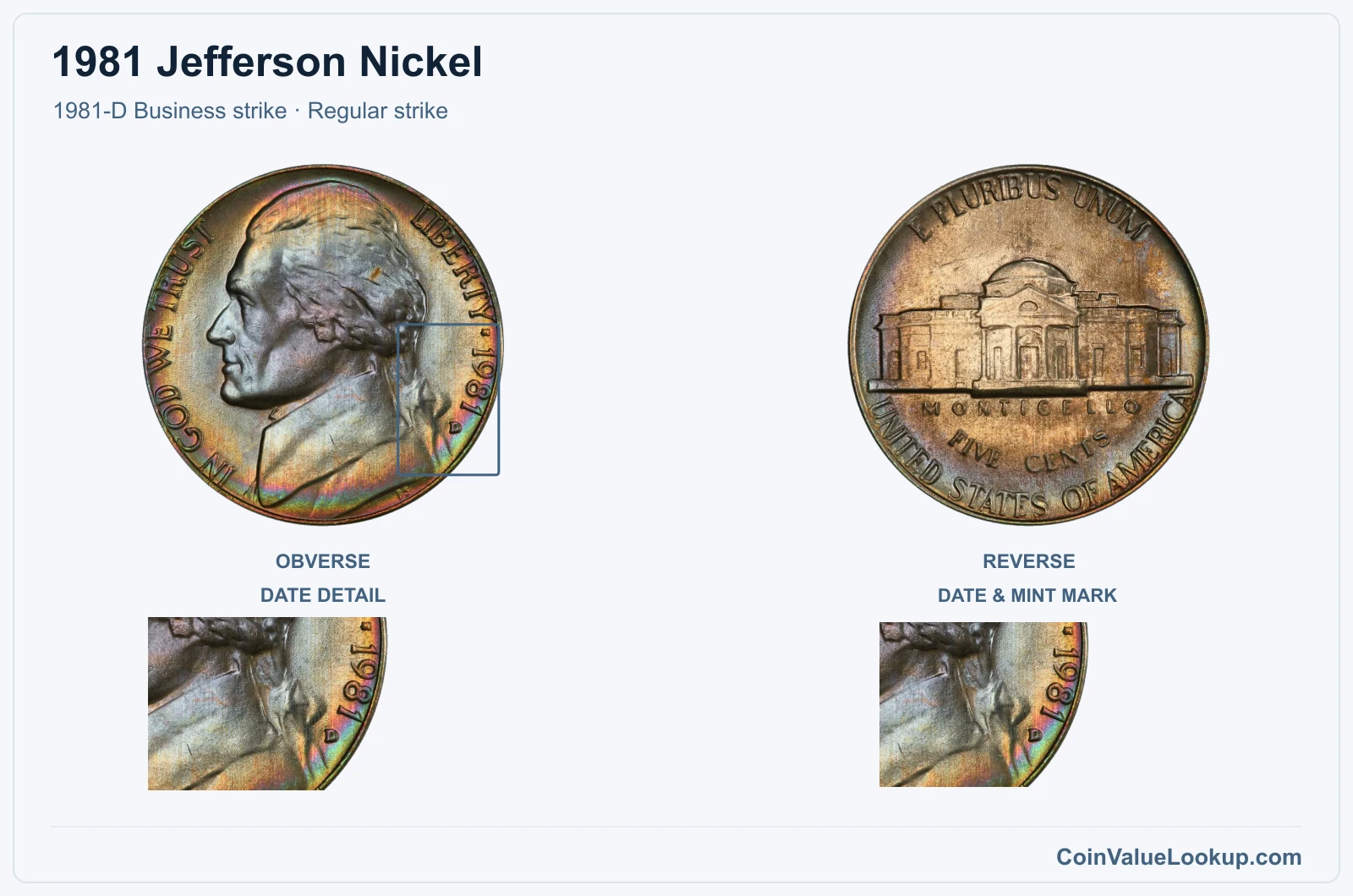
The 1981-D comes from the Denver Mint and shows a "D" mintmark in the same obverse position below the date. Same alloy, same weight, same design as its Philadelphia sibling.
Guide estimates from USA Coin Book match the P mint: around $0.30 at MS60 and $3.62 at MS65. Again, worn examples are five-cent coins in practical terms.
Look for clean, lustrous surfaces and sharp Monticello detail if you are hoping for a higher-grade specimen.
Coin Value Lookup is a good starting point if you want to check values for other dates and mints in the Jefferson nickel series.
| Range | Grade | Price | Auction Records | Appraisal |
|---|---|---|---|---|
| PO | PO 1 | — | Coin Identifier | |
| FR | FR 2 | — | Coin Identifier | |
| AG | AG 3 | — | Coin Identifier | |
| G | G 4 | — | Coin Identifier | |
| G 6 | — | Coin Identifier | ||
| VG | VG 8 | — | Coin Identifier | |
| VG 10 | — | Coin Identifier | ||
| F | F 12 | — | Coin Identifier | |
| F 15 | — | Coin Identifier | ||
| VF | VF 20 | — | Coin Identifier | |
| VF 25 | — | Coin Identifier | ||
| VF 30 | — | Coin Identifier | ||
| VF 35 | — | Coin Identifier | ||
| XF | XF 40 | — | Coin Identifier | |
| XF 45 | — | Coin Identifier | ||
| AU | AU 50 | — | Coin Identifier | |
| AU 53 | — | Coin Identifier | ||
| AU 55 | — | Coin Identifier | ||
| AU 58 | — | Coin Identifier | ||
| MS | MS 60 | — | Coin Identifier | |
| MS 61 | — | Coin Identifier | ||
| MS 62 | — | Coin Identifier | ||
| MS 63 | — | Coin Identifier | ||
| MS 64 | Coin Identifier | |||
| MS 65 | Coin Identifier | |||
| MS 66 | Coin Identifier | |||
| MS 67 | Coin Identifier | |||
| MS 68 | — | — | — | |
| MS 69 | — | — | — | |
| MS 70 | — | — | — |
1981 Jefferson Nickel — S Proof Type1
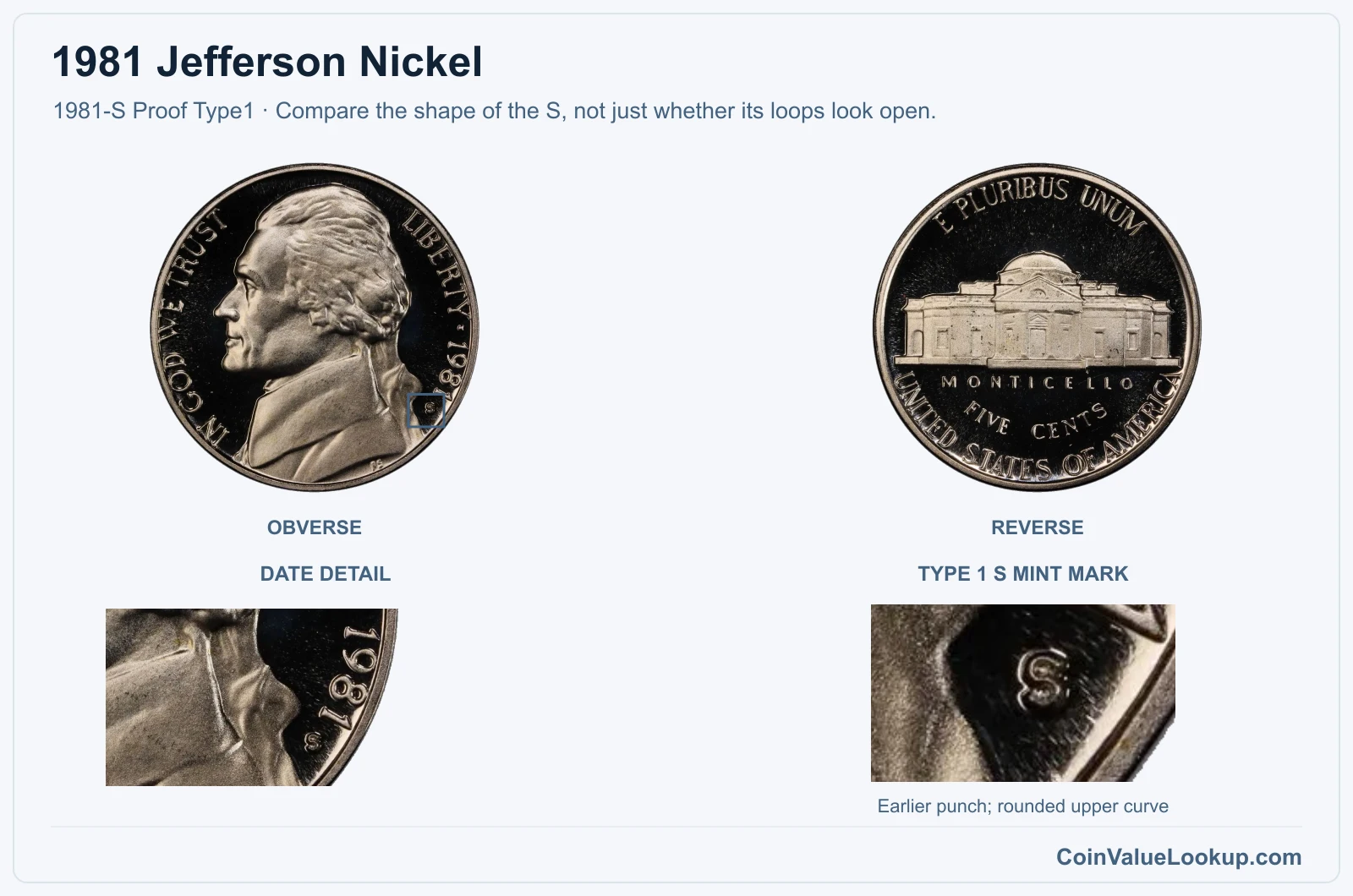
The 1981-S Proof Type 1 was struck at San Francisco exclusively for collector proof sets. It features mirror fields and frosted devices characteristic of the proof finish.
The alloy remains 75% copper, 25% nickel.
Type 1 and Type 2 are recognized as separate major varieties by PCGS, and identifying which type you have requires comparison against authenticated 1981-S specimens specifically. Do not assume descriptions from 1979 proof types apply here.
No supported numeric price range has been adopted for this version. Value depends on the authenticated type identity, the proof grade, and whether cameo or deep cameo contrast is present — each filter changes the coin's market differently.
Individual assessment is the practical path for these.
| Range | Grade | Price | Auction Records | Appraisal |
|---|---|---|---|---|
| PR | PR 1 | — | Coin Identifier | |
| PR 2 | — | Coin Identifier | ||
| PR 3 | — | Coin Identifier | ||
| PR 4 | — | Coin Identifier | ||
| PR 6 | — | Coin Identifier | ||
| PR 8 | — | Coin Identifier | ||
| PR 10 | — | Coin Identifier | ||
| PR 12 | — | Coin Identifier | ||
| PR 15 | — | Coin Identifier | ||
| PR 20 | — | Coin Identifier | ||
| PR 25 | — | Coin Identifier | ||
| PR 30 | — | Coin Identifier | ||
| PR 35 | — | Coin Identifier | ||
| PR 40 | — | Coin Identifier | ||
| PR 45 | — | Coin Identifier | ||
| PR 50 | — | Coin Identifier | ||
| PR 53 | — | Coin Identifier | ||
| PR 55 | — | Coin Identifier | ||
| PR 58 | — | Coin Identifier | ||
| PR 60 | — | Coin Identifier | ||
| PR 61 | — | Coin Identifier | ||
| PR 62 | — | Coin Identifier | ||
| PR 63 | — | Coin Identifier | ||
| PR 64 | Coin Identifier | |||
| PR 65 | — | Coin Identifier | ||
| PR 66 | — | Coin Identifier | ||
| PR 67 | Coin Identifier | |||
| PR 68 | Coin Identifier | |||
| PR 69 | Coin Identifier | |||
| PR 70 | Coin Identifier |
1981 Jefferson Nickel — S Proof Type2
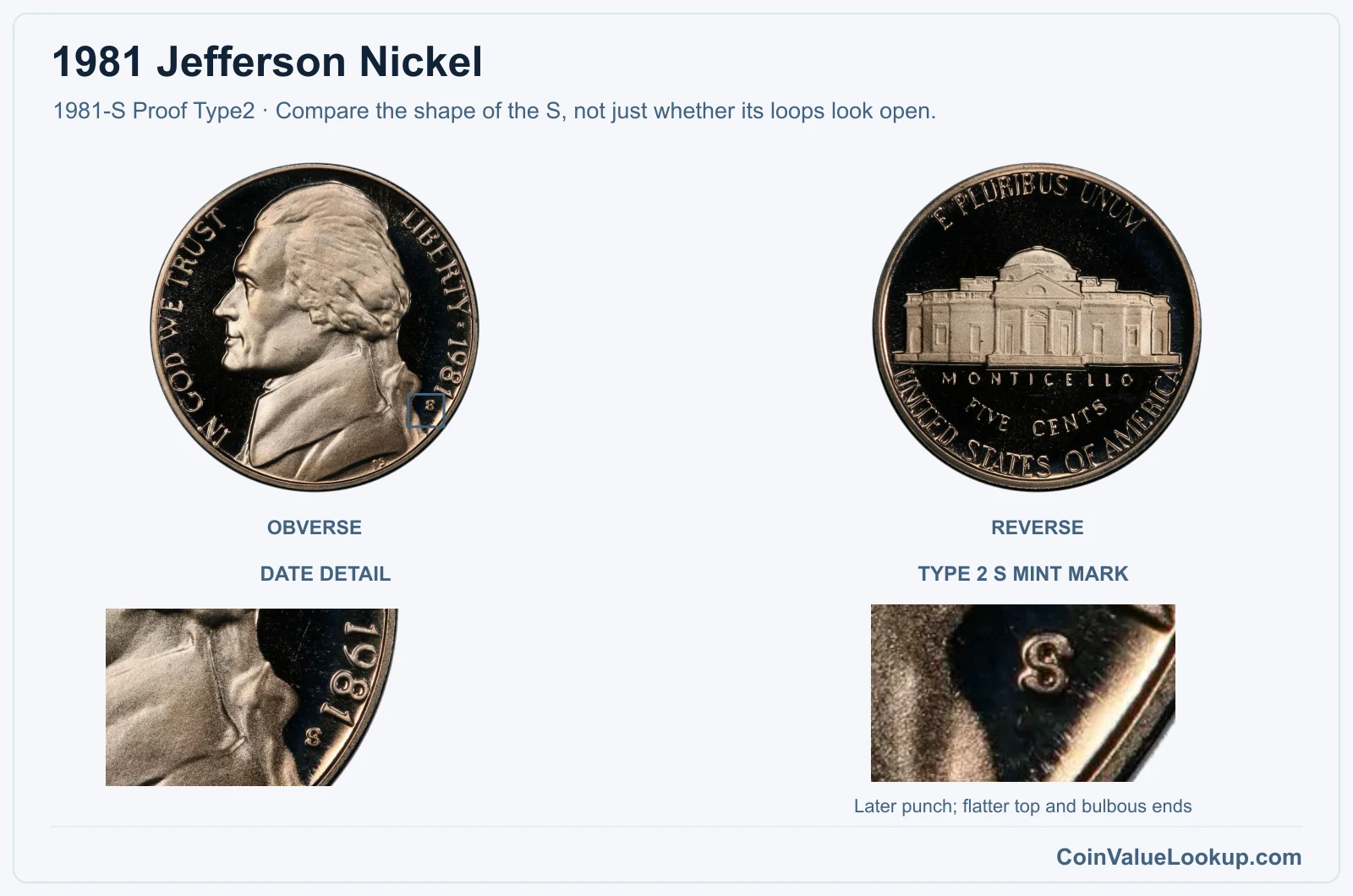
The 1981-S Proof Type 2 is the companion San Francisco proof variety. Like Type 1, it uses the standard copper-nickel alloy and carries the "S" mintmark on the obverse.
Distinguishing Type 2 from Type 1 requires careful comparison of die characteristics specific to 1981. PCGS lists them as separate major varieties, and proper attribution matters because collectors seek each type independently.
As with Type 1, no supported numeric price range has been adopted here. The coin's value hinges on confirmed type attribution, proof grade, and any cameo or deep cameo designation.
Professional certification is the most reliable way to establish which type you hold and what condition grade it merits.
| Range | Grade | Price | Auction Records | Appraisal |
|---|---|---|---|---|
| PR | PR 1 | — | Coin Identifier | |
| PR 2 | — | Coin Identifier | ||
| PR 3 | — | Coin Identifier | ||
| PR 4 | — | Coin Identifier | ||
| PR 6 | — | Coin Identifier | ||
| PR 8 | — | Coin Identifier | ||
| PR 10 | — | Coin Identifier | ||
| PR 12 | — | Coin Identifier | ||
| PR 15 | — | Coin Identifier | ||
| PR 20 | — | Coin Identifier | ||
| PR 25 | — | Coin Identifier | ||
| PR 30 | — | Coin Identifier | ||
| PR 35 | — | Coin Identifier | ||
| PR 40 | — | Coin Identifier | ||
| PR 45 | — | Coin Identifier | ||
| PR 50 | — | Coin Identifier | ||
| PR 53 | — | Coin Identifier | ||
| PR 55 | — | Coin Identifier | ||
| PR 58 | — | Coin Identifier | ||
| PR 60 | — | Coin Identifier | ||
| PR 61 | — | Coin Identifier | ||
| PR 62 | — | Coin Identifier | ||
| PR 63 | — | Coin Identifier | ||
| PR 64 | — | Coin Identifier | ||
| PR 65 | — | Coin Identifier | ||
| PR 66 | Coin Identifier | |||
| PR 67 | Coin Identifier | |||
| PR 68 | Coin Identifier | |||
| PR 69 | Coin Identifier | |||
| PR 70 | Coin Identifier |
1981 Jefferson Nickel Error List
1. 1981 Jefferson Nickel — Struck over a cent
This error is a double-denomination strike: a Lincoln cent planchet that received a Jefferson nickel impression. The surviving cent design is visible beneath the nickel design, which is the key diagnostic.
You need to see remnants of the Lincoln portrait or Memorial building under Jefferson and Monticello, not just copper color.
The reported example is a 1981-P nickel graded NGC MS63 Red. It sold at Heritage Auctions in November 2020 for $600.
That is one auction result for one specific coin, not a blanket price for every copper-toned nickel.
Copper color alone does not prove this error. Coins struck on a wrong blank without an undertype design, as well as coins damaged by chemicals or a vise, can look superficially similar.
Authentic struck-over-cent pieces show two distinct designs layered on the same planchet.
2. 1981 Jefferson Nickel — Split blank
A split blank occurs when the coin's metal separates internally, leaving an underweight planchet with a rough, exposed interior surface on one side. The reported example is a 1981-P nickel graded ANACS MS60 that weighs only 2.91 grams — well below the normal 5 grams.
Weight is the first clue. If your coin feels noticeably light, weigh it.
The split surface has a distinctive rough, layered texture quite different from a normal struck face.
No supported price range has been adopted for this error. Value depends on the specific coin's authenticated identity, condition, and how dramatic the split is.
Coins that have been ground down, acid-treated, or that are peeling from environmental damage can mimic this look, so authentication matters.
3. 1981 Jefferson Nickel — Off-center strike
An off-center strike happens when the blank is not properly seated in the collar before the dies come together. The result is a crescent-shaped unstruck area on one side, with the opposite design detail cut off.
The reported example is a 1981-P nickel graded ANACS MS63, struck approximately 15% off center at the 11 o'clock position. For any off-center coin, the date and both faces must be at least partially readable to confirm it is genuinely a 1981 nickel.
No supported price range has been adopted. Each off-center coin is assessed individually based on the percentage of displacement, whether the date is visible, and overall condition.
A single-die misalignment, a cut rim, or post-mint damage can mimic an off-center appearance, so look for the characteristic unstruck crescent and displaced design.
4. 1981 Jefferson Nickel — Bonded pair
A bonded pair consists of two blanks that became fused together during the striking process. Both pieces are typically off-center, pressed edge to edge or overlapping, and permanently joined — not separable without destroying them.
The reported example is a 1981-P nickel bonded pair graded NGC MS65. It sold at Heritage Auctions in August 2010 for $1,610.
That price reflects one specific specimen in that specific grade.
To identify a genuine bonded pair, both coins should show signs of simultaneous striking, and the 1981 date should be readable on at least one piece. The join is a product of extreme pressure, not adhesive.
Coins that have been glued or soldered together will show residue or uneven bonding lines rather than the clean metal-flow fusion of an authentic mint error.
5. 1981 Jefferson Nickel — Doubled Die Obverse
A doubled die obverse on a 1981 nickel shows consistent doubling on the obverse lettering or design elements — separation or notching that repeats in the same direction on every specimen struck from that die. Compare the letters in LIBERTY and IN GOD WE TRUST against a normal 1981 nickel under the same lighting.
True die doubling appears as a raised secondary image with defined edges. Machine doubling, by contrast, tends to look flat and shelf-like, often appearing on just one side of the raised elements.
Reflections from proof-like surfaces or worn die contours can also create illusions of doubling.
No specific price range has been adopted for this error. Condition, visibility of the doubling, and the particular die variety all influence value.
Professional authentication is the reliable way to confirm a doubled die versus mechanical or environmental lookalikes.