1993 Jefferson Nickel Coin Value: How Much Is It Worth?
Most 1993 Jefferson nickels are worth face value in circulated condition. Uncirculated examples carry modest premiums, with retail guide estimates ranging from about $0.30 at MS60 to $1.24 at MS65 for normal business strikes.
Proofs and authenticated mint errors occupy their own, sometimes much higher, price tiers. Guide figures reflect retail estimates, not guaranteed purchase offers.
Fast Way to Identify Your 1993 Jefferson Nickel
The quickest way to start figuring out what you have is to upload clear photos of both the front and back of your coin. That lets us provide a preliminary identification of the year, mint mark, and general version so you can look up the right value information.
Sharp, well-lit images help the most.
1993 Jefferson Nickel Value
Upload both sides of your 1993 Jefferson Nickel.
Front Obverse
Upload photo
Back Reverse
Upload photo
Which 1993 Jefferson Nickel Versions Are Worth Money?
- Certified Full Steps examples from either the P or D mint can sell for more than ordinary uncirculated coins, though worn pocket-change pieces do not share those premiums.
- The 1993-S Proof has a separate collector market; a PR65 retail guide anchor is about $4.96, with cameo and deep cameo versions potentially worth more.
- A 1993-P nickel struck over a 1993 cent sold at Heritage Auctions in January 2023 for $1,140, making double-denomination errors the standout category for this year.
- A combined off-center and clipped-planchet error brought $91 at a Heritage auction in October 2022, showing that dramatic striking mistakes carry real value.
Step 1: Identify Your 1993 Jefferson Nickel Mint Mark and Version
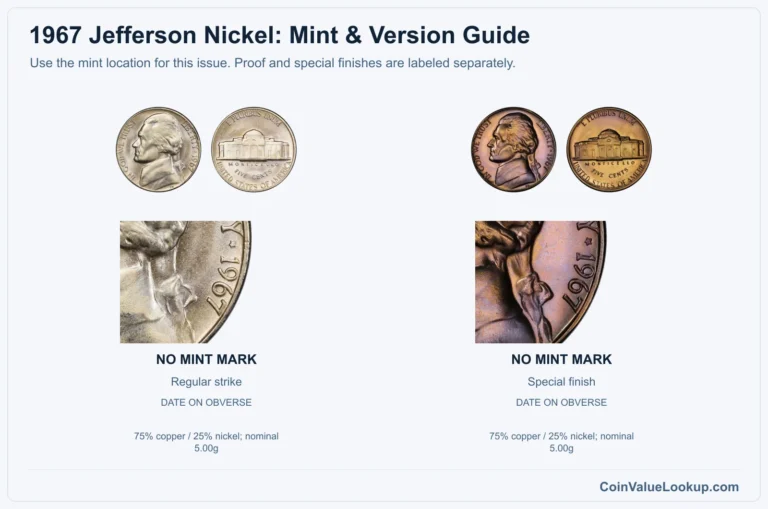
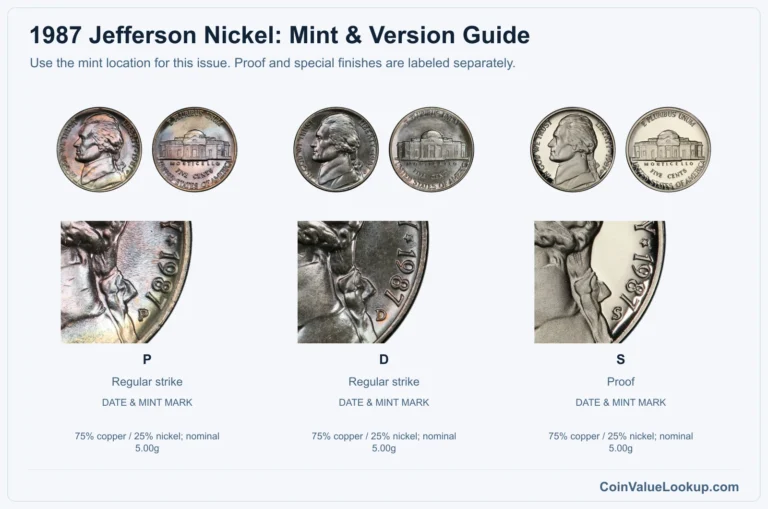
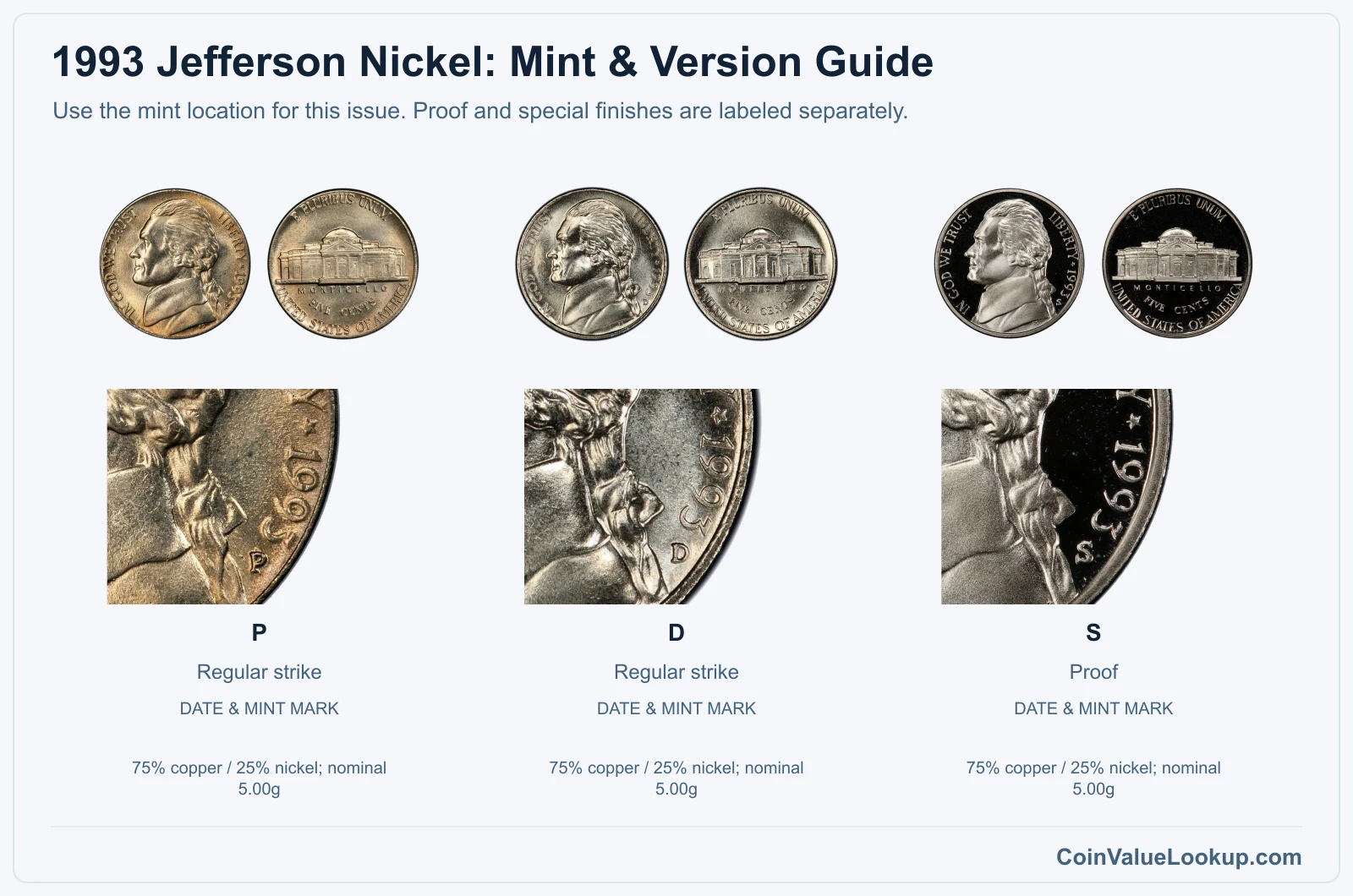
Three versions of the 1993 Jefferson nickel exist: the Philadelphia (P) business strike, the Denver (D) business strike, and the San Francisco (S) proof. The mint mark sits on the obverse, just below the date on the right side.
All three share the same composition: 75% copper and 25% nickel, weighing about 5 grams with a 21.2 mm diameter and a plain edge. If you see a small "P" or "D," you have a regular circulation strike.
An "S" means proof, struck for collectors.
A frosted, mirror-like finish does not automatically make a coin a proof. Correct attribution requires checking the mint mark and understanding the coin's provenance.
Brightness or shininess from cleaning can mislead you, so rely on the mint mark and overall finish quality together.
Step 2: Check Your 1993 Jefferson Nickel Grade
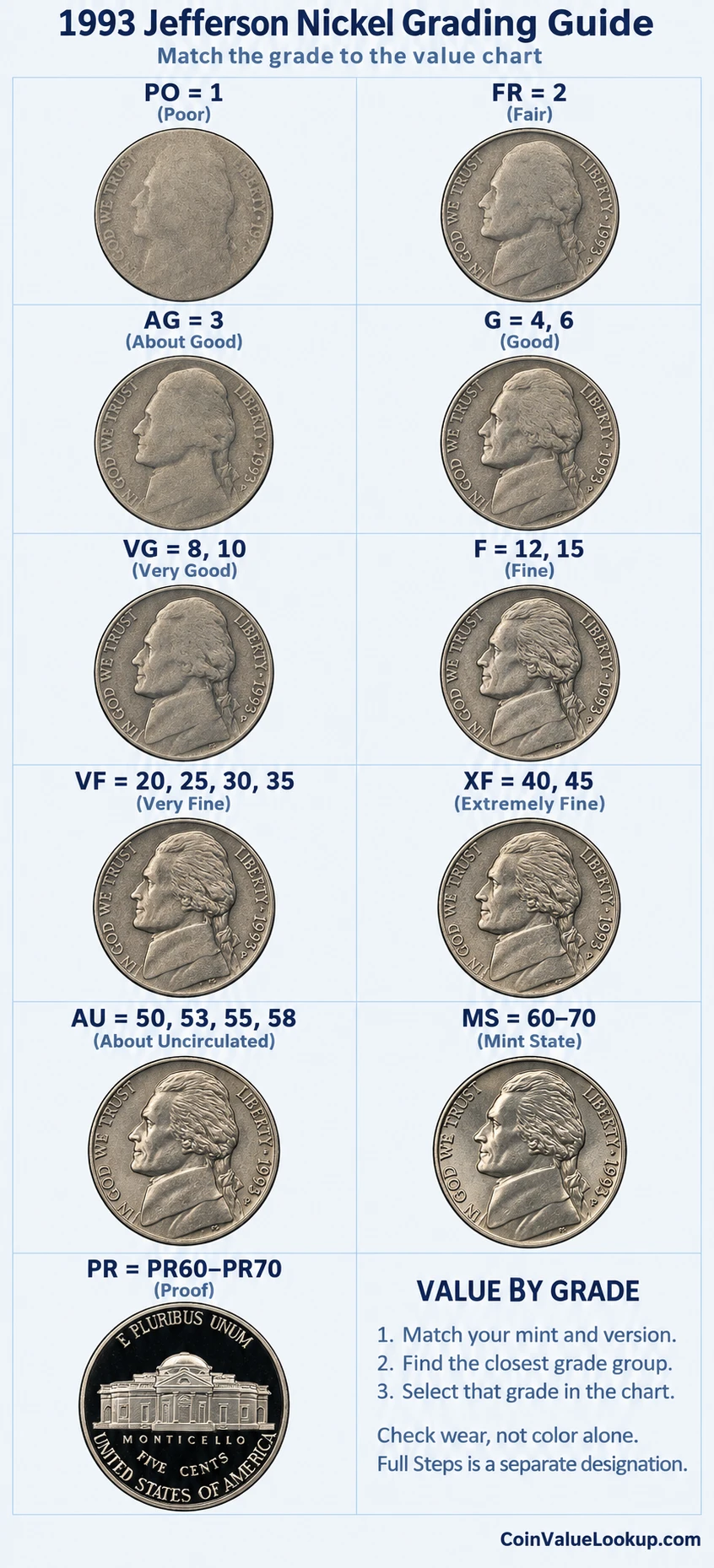
Start by examining Jefferson's cheek and the hair detail above his ear. These are the highest points of the obverse design and show wear first.
A coin with full original luster and no rub on those areas is a candidate for Mint State grades.
On the reverse, check the columns and steps of Monticello. Wear shows up there quickly, flattening the fine horizontal lines between the columns.
Use the comparison image to match your coin's detail level against known grade examples.
Full Steps is a separate strike-quality designation applied only to Mint State coins. It is not a grade above MS, and it is not an error.
Coins with five or six fully struck steps can command premiums over ordinary uncirculated pieces, but the designation requires professional certification.
Proof coins are graded on a separate scale (PR) and evaluated for surface quality, not circulation wear. Cameo and deep cameo distinctions reflect contrast between frosted devices and mirrored fields.
Step 3: Check 1993 Jefferson Nickel Value by Mint and Version
1993 Jefferson Nickel — P Business strike
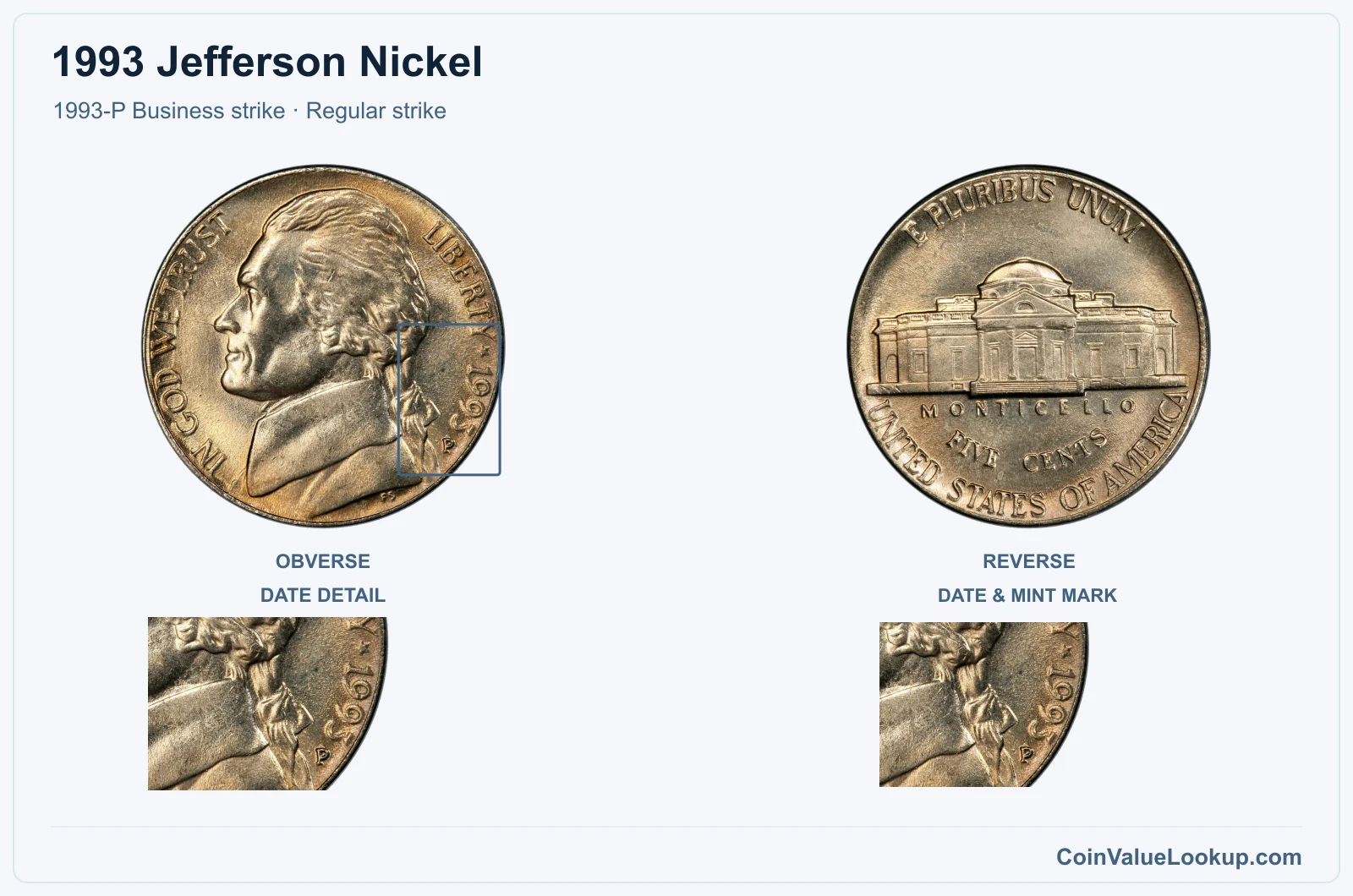
The 1993-P is the Philadelphia business strike, carrying a small "P" mint mark on the obverse below the date. It uses the standard Jefferson portrait obverse and Monticello reverse in the normal copper-nickel alloy.
In circulated grades, these trade at face value. Retail guide estimates place uncirculated examples around $0.30 at MS60 and $1.24 at MS65, according to USA Coin Book.
Pieces certified with a Full Steps designation can bring more, but that requires professional grading to confirm.
| Range | Grade | Price | Auction Records | Appraisal |
|---|---|---|---|---|
| PO | PO 1 | — | Coin Identifier | |
| FR | FR 2 | — | Coin Identifier | |
| AG | AG 3 | — | Coin Identifier | |
| G | G 4 | — | Coin Identifier | |
| G 6 | — | Coin Identifier | ||
| VG | VG 8 | — | Coin Identifier | |
| VG 10 | — | Coin Identifier | ||
| F | F 12 | — | Coin Identifier | |
| F 15 | — | Coin Identifier | ||
| VF | VF 20 | — | Coin Identifier | |
| VF 25 | — | Coin Identifier | ||
| VF 30 | — | Coin Identifier | ||
| VF 35 | — | Coin Identifier | ||
| XF | XF 40 | — | Coin Identifier | |
| XF 45 | — | Coin Identifier | ||
| AU | AU 50 | — | Coin Identifier | |
| AU 53 | — | Coin Identifier | ||
| AU 55 | — | Coin Identifier | ||
| AU 58 | — | Coin Identifier | ||
| MS | MS 60 | — | Coin Identifier | |
| MS 61 | Coin Identifier | |||
| MS 62 | — | Coin Identifier | ||
| MS 63 | — | Coin Identifier | ||
| MS 64 | — | Coin Identifier | ||
| MS 65 | Coin Identifier | |||
| MS 66 | Coin Identifier | |||
| MS 67 | — | — | — | |
| MS 68 | — | — | — | |
| MS 69 | — | — | — | |
| MS 70 | — | — | — |
1993 Jefferson Nickel — D Business strike
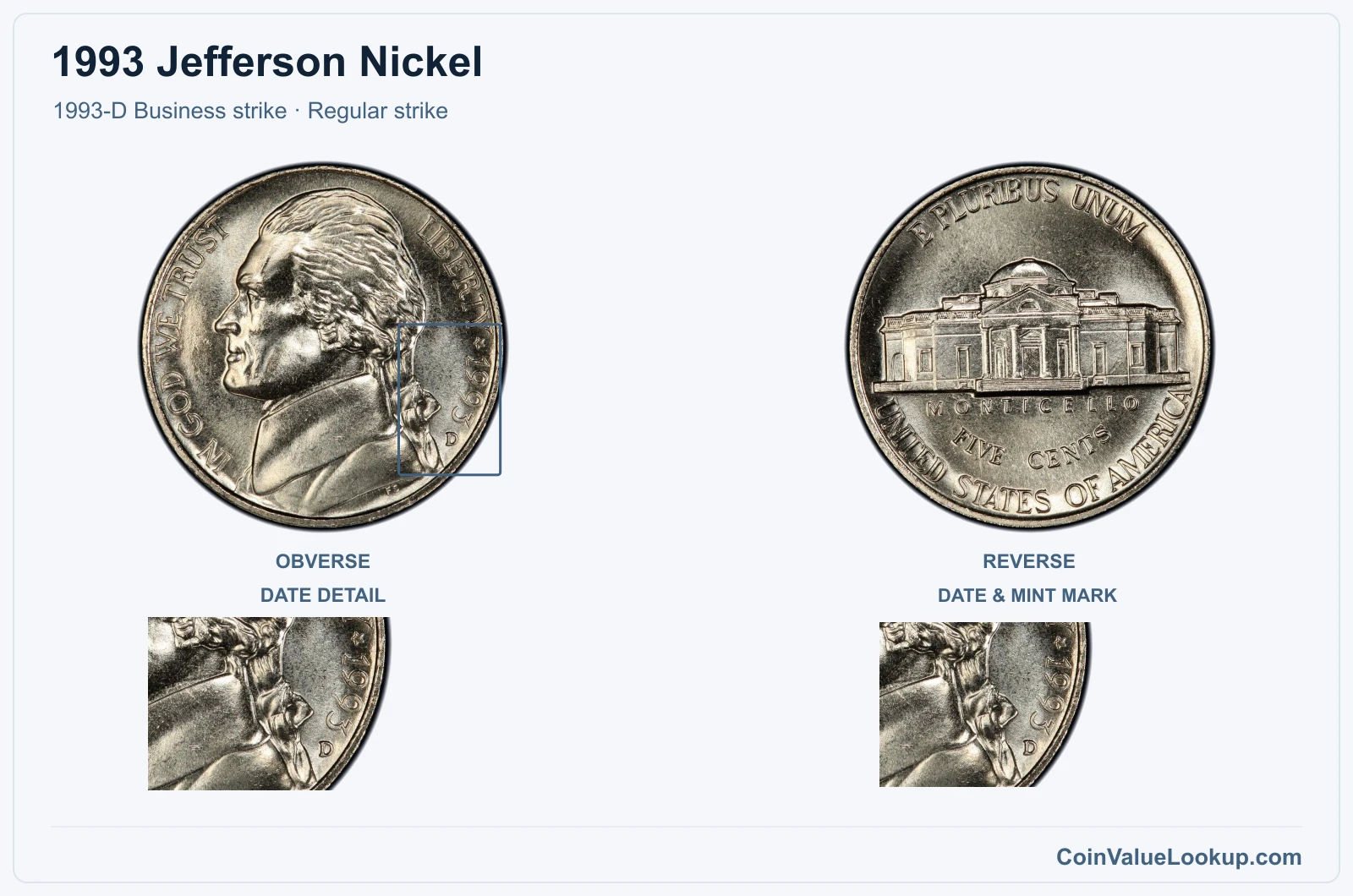
The 1993-D comes from the Denver Mint and shows a "D" below the date. Same alloy, same design, same weight as the Philadelphia issue.
Value-wise, it mirrors the P mint in guide estimates: roughly $0.30 at MS60 and $1.24 at MS65. Circulated coins are worth five cents.
Full Steps certified pieces are the ones that attract collector attention. Without that designation, an uncirculated 1993-D is a common coin.
Coin Value Lookup is a handy starting point if you want to look up guides for other dates and denominations in the Jefferson nickel series.
| Range | Grade | Price | Auction Records | Appraisal |
|---|---|---|---|---|
| PO | PO 1 | — | Coin Identifier | |
| FR | FR 2 | — | Coin Identifier | |
| AG | AG 3 | — | Coin Identifier | |
| G | G 4 | — | Coin Identifier | |
| G 6 | — | Coin Identifier | ||
| VG | VG 8 | — | Coin Identifier | |
| VG 10 | — | Coin Identifier | ||
| F | F 12 | — | Coin Identifier | |
| F 15 | — | Coin Identifier | ||
| VF | VF 20 | — | Coin Identifier | |
| VF 25 | — | Coin Identifier | ||
| VF 30 | — | Coin Identifier | ||
| VF 35 | — | Coin Identifier | ||
| XF | XF 40 | — | Coin Identifier | |
| XF 45 | — | Coin Identifier | ||
| AU | AU 50 | — | Coin Identifier | |
| AU 53 | — | Coin Identifier | ||
| AU 55 | — | Coin Identifier | ||
| AU 58 | — | Coin Identifier | ||
| MS | MS 60 | — | Coin Identifier | |
| MS 61 | — | Coin Identifier | ||
| MS 62 | — | Coin Identifier | ||
| MS 63 | — | Coin Identifier | ||
| MS 64 | — | Coin Identifier | ||
| MS 65 | — | Coin Identifier | ||
| MS 66 | — | Coin Identifier | ||
| MS 67 | — | Coin Identifier | ||
| MS 68 | — | — | — | |
| MS 69 | — | — | — | |
| MS 70 | — | — | — |
1993 Jefferson Nickel — S Proof
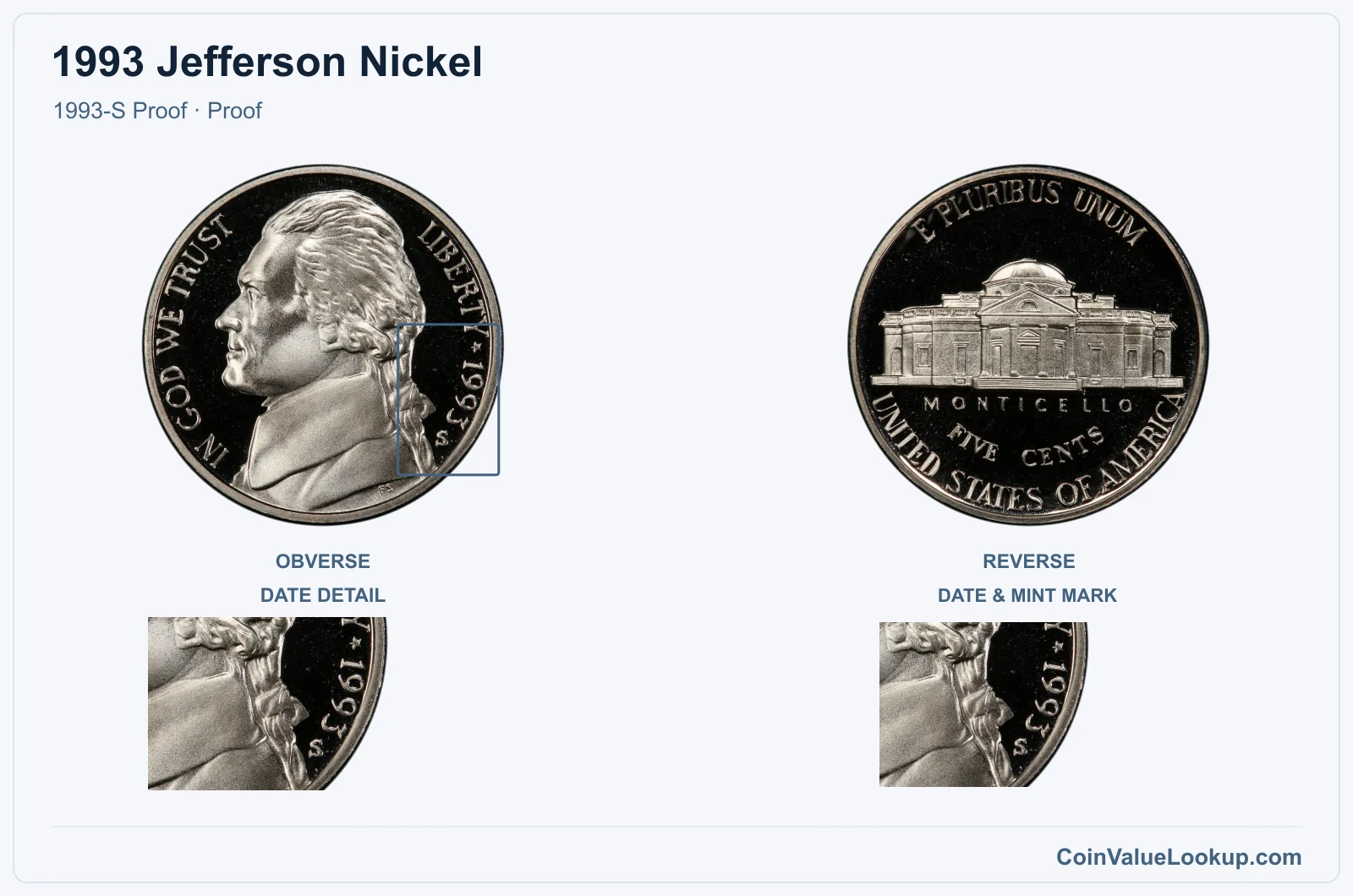
The 1993-S is a proof-only issue struck at the San Francisco Mint for inclusion in that year's proof sets. You will find an "S" mint mark on the obverse below the date.
A retail guide estimate for a PR65 example is about $4.96, per USA Coin Book. That figure is a generic proof anchor and does not specifically reflect deep cameo versions, which typically sell for more.
Cameo contrast and surface quality both matter when pricing proofs. Authentication and professional grading help establish where a specific coin falls in the proof market.
| Range | Grade | Price | Auction Records | Appraisal |
|---|---|---|---|---|
| PR | PR 1 | — | Coin Identifier | |
| PR 2 | — | Coin Identifier | ||
| PR 3 | — | Coin Identifier | ||
| PR 4 | — | Coin Identifier | ||
| PR 6 | — | Coin Identifier | ||
| PR 8 | — | Coin Identifier | ||
| PR 10 | — | Coin Identifier | ||
| PR 12 | — | Coin Identifier | ||
| PR 15 | — | Coin Identifier | ||
| PR 20 | — | Coin Identifier | ||
| PR 25 | — | Coin Identifier | ||
| PR 30 | — | Coin Identifier | ||
| PR 35 | — | Coin Identifier | ||
| PR 40 | — | Coin Identifier | ||
| PR 45 | — | Coin Identifier | ||
| PR 50 | — | Coin Identifier | ||
| PR 53 | — | Coin Identifier | ||
| PR 55 | — | Coin Identifier | ||
| PR 58 | — | Coin Identifier | ||
| PR 60 | — | Coin Identifier | ||
| PR 61 | — | Coin Identifier | ||
| PR 62 | — | Coin Identifier | ||
| PR 63 | — | Coin Identifier | ||
| PR 64 | — | Coin Identifier | ||
| PR 65 | — | Coin Identifier | ||
| PR 66 | — | Coin Identifier | ||
| PR 67 | — | Coin Identifier | ||
| PR 68 | Coin Identifier | |||
| PR 69 | Coin Identifier | |||
| PR 70 | Coin Identifier |
1993 Jefferson Nickel Error List
1. 1993 Jefferson Nickel — Off-center on clipped blank
This error combines two minting mistakes on one coin: a significantly off-center strike and a curved clip from the blanking process. The reported example is a 1993-P graded NGC MS65, struck roughly 45% off center on a planchet with about a 15% crescent-shaped clip.
The off-center strike shifts the design so that part of the planchet is left blank, while the clip removes an additional curved section. Both faces need to be visible, and the date must be readable for proper attribution.
A Heritage Auctions sale in October 2022 realized $91 for this combined error.
Be careful with lookalikes. Coins damaged by sawing, pliers, or post-mint breakage can mimic clips, and an ordinary off-center strike without a genuine blanking clip is a different, typically less valuable, error.
2. 1993 Jefferson Nickel — Struck over a1993 cent
A 1993 nickel struck over a 1993 Lincoln cent is a double-denomination error, one of the more dramatic mistakes a mint can produce. The reported example is a 1993-P graded NGC MS65.
What makes this identifiable is the surviving cent design underneath the nickel impression. You can see traces of Lincoln's portrait and the Memorial building beneath Jefferson and Monticello.
This proves the nickel dies struck an already-finished cent rather than just a wrong-size blank.
A Heritage Auctions sale in January 2023 brought $1,140 for one such piece. That is a single auction result, not a broad market range.
Do not confuse this with a nickel struck on an unused cent blank or with vise-impression damage, where design transfer happens outside the minting press.
3. 1993 Jefferson Nickel — Improperly annealed blank
An improperly annealed 1993 nickel shows surface abnormalities caused by incorrect heat treatment during blank preparation at the mint. A reported example is a 1993-D graded NGC MS63 with a Full Steps designation, sold as part of a four-coin lot at Heritage Auctions.
Because this coin was in a multi-coin lot, no individual price can be reliably assigned to it. Value depends on the specific coin's condition, the severity and visibility of the annealing defect, and its authenticated identity.
Dark or unusual coloring alone does not prove improper annealing. Burning, paint residue, soil deposits, and chemical toning can all produce similar appearances.
Professional authentication is needed to confirm this error. If your coin just looks oddly dark, that is more likely environmental damage than a mint mistake.
4. 1993 Jefferson Nickel — Double / Multiple Strike
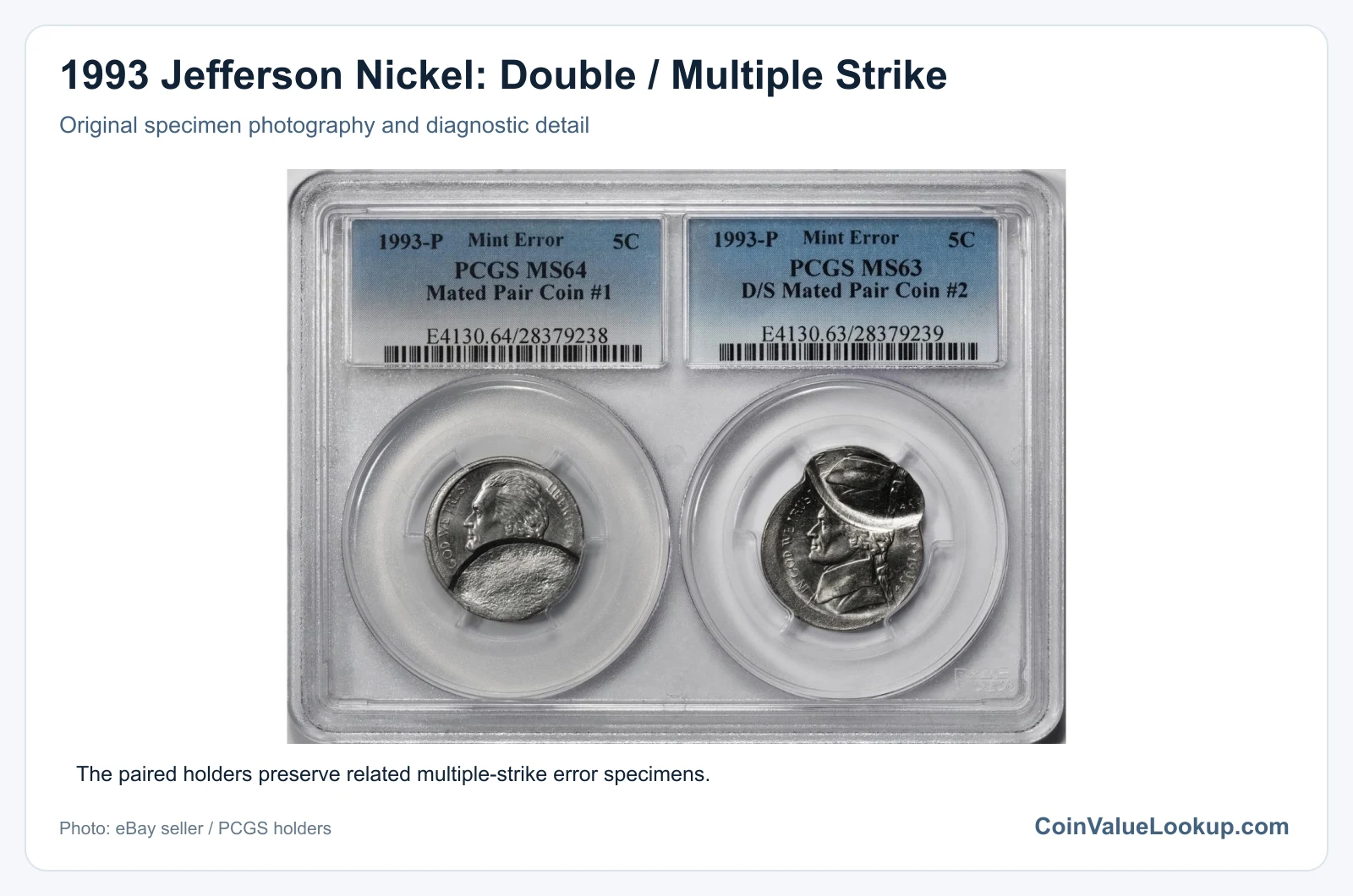
Double-strike and flip-over double-strike errors have been reported for the 1993 Jefferson nickel. In a double strike, the coin receives a second impression from the dies, creating a displaced or rotated duplicate of part or all of the design.
A flip-over double strike means the coin was flipped between impressions, so you see overlapping designs from both orientations.
Look for clearly separate, shifted design elements rather than just slightly thickened or spread lettering. The second impression should be visibly displaced or rotated relative to the first.
Do not confuse this with a doubled die, which is a consistent die variety affecting every coin struck by that die. Post-mint damage from a vise or other mechanical pressure can also leave false impressions.
Value depends on how dramatic the displacement is, overall condition, and professional authentication.
5. 1993 Jefferson Nickel — Struck-Through Error
Struck-through-grease errors have been reported on 1993 Jefferson nickels. These happen when grease or other foreign material fills part of the die cavity before striking, preventing the design from fully impressing into the planchet.
The result is a smooth, slightly depressed area where detail should be.
The affected area typically has soft, rounded edges and sits slightly below the surrounding design surface. It differs from a retained-object struck-through, where the foreign material stays embedded in the coin.
Ordinary wear, cleaning, and weak strikes can all produce areas of missing detail that look superficially similar. The key difference is that a struck-through area is localized and appears on an otherwise well-struck coin.
Value varies with the size, location, and visual impact of the obstruction, along with the coin's overall condition. Authentication helps distinguish genuine errors from post-mint damage.