1996 Jefferson Nickel Coin Value: How Much Is It Worth?
Most 1996 Jefferson nickels are worth face value in circulated condition. For uncirculated examples, retail guide estimates range from about $0.30 at MS60 to $1.24 at MS65, depending on the mint.
Proofs and authenticated error coins occupy their own price tiers. These guide figures are not guaranteed purchase offers for every coin you find in a jar.
Fast Way to Identify Your 1996 Jefferson Nickel
The quickest way to start figuring out what you have is to upload clear photos of the front and back of your 1996 nickel. That lets us offer a preliminary identification of the mint, finish, and any obvious oddities.
Good lighting and a straight-on angle help a lot — blurry phone shots make everything look like an error.
1996 Jefferson Nickel Value
Upload both sides of your 1996 Jefferson Nickel.
Front Obverse
Upload photo
Back Reverse
Upload photo
Which 1996 Jefferson Nickel Versions Are Worth Money?
- High-grade 1996-P or 1996-D nickels certified with Full Steps can carry premiums well above the base guide values for their grade.
- 1996-S proofs, especially those with deep cameo contrast, trade in a separate collector market from business strikes.
- Confirmed mint errors like off-center strikes, clips, and wrong-planchet coins have sold individually for hundreds of dollars at auction.
- Condition, correct attribution, and third-party certification all matter — a worn pocket coin does not inherit auction-record values.
Step 1: Identify Your 1996 Jefferson Nickel Mint Mark and Version
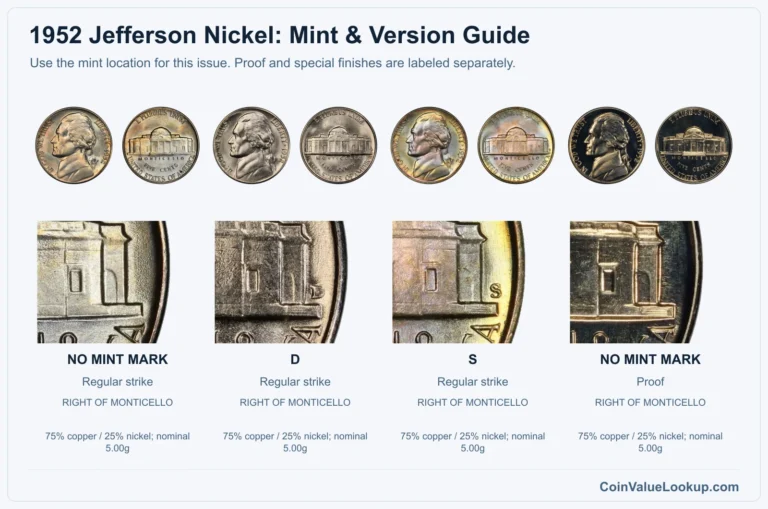
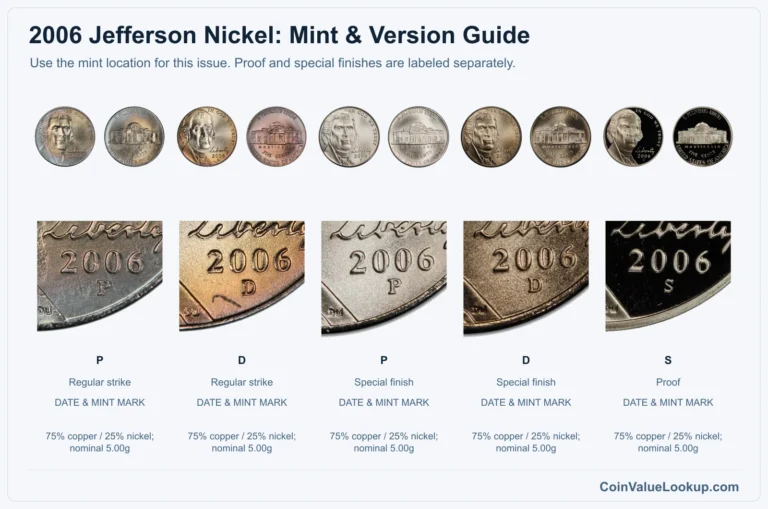
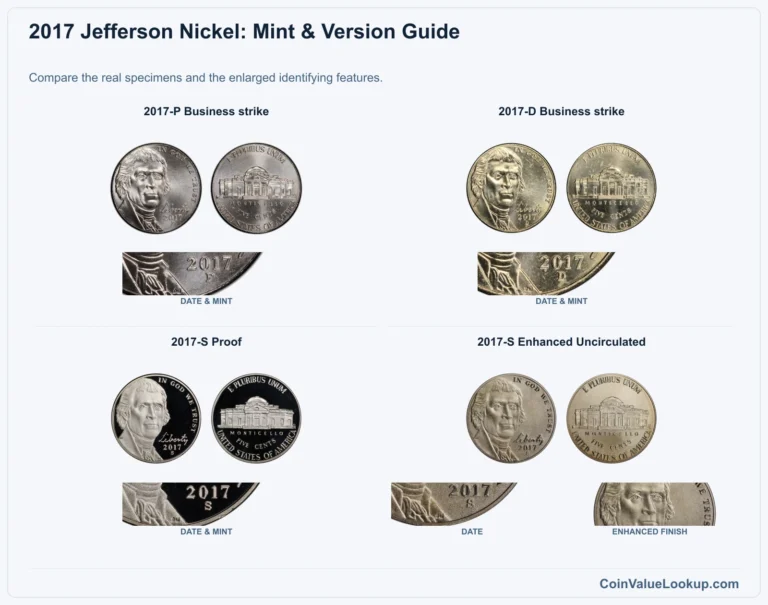
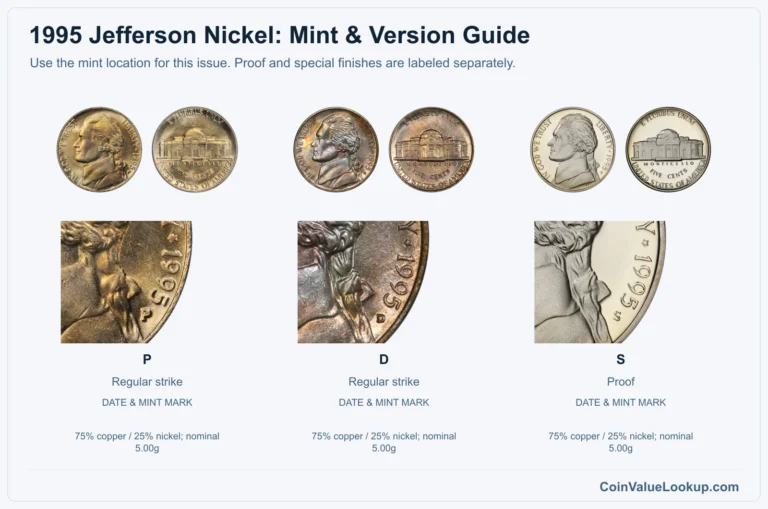
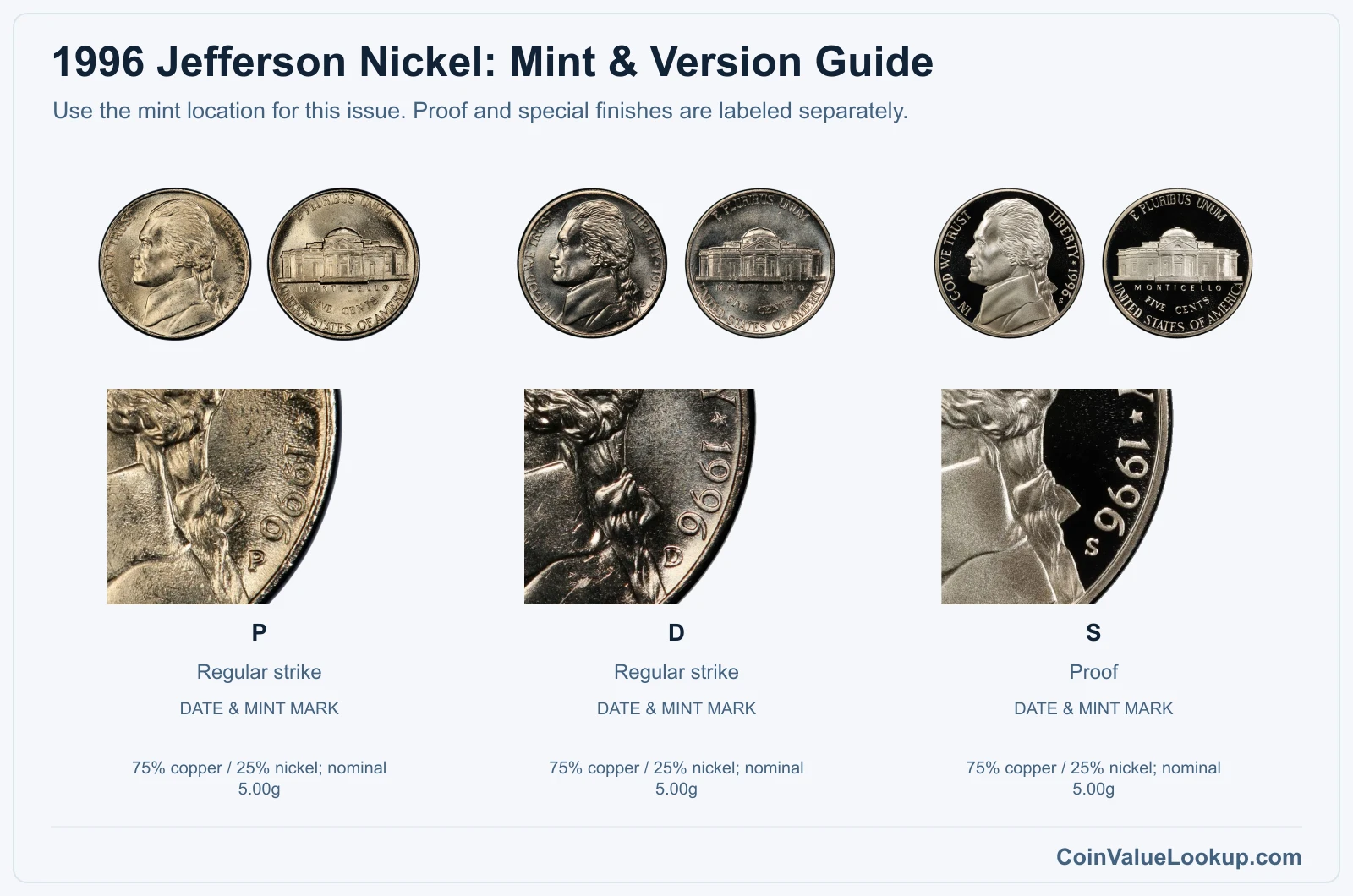
Three versions of the 1996 Jefferson nickel exist, split by mint facility. Flip your coin to the obverse and look just below the date for a small letter: P for Philadelphia, D for Denver, or S for San Francisco.
P and D coins are business strikes made for circulation. S coins are proofs, produced for collectors with a mirror-like or frosted finish.
All three share the same alloy: 75% copper and 25% nickel, weighing about 5 grams with a plain edge and a diameter of 21.2 mm. Record the date, mintmark, and whether the surfaces look satiny (business strike) or glassy and sharp (proof) before comparing to any value chart.
A bright, shiny coin is not automatically a proof. Proof attribution requires the right mintmark and provenance, not just a clean surface.
Plenty of uncirculated business strikes look flashy straight out of a roll.
Step 2: Check Your 1996 Jefferson Nickel Grade
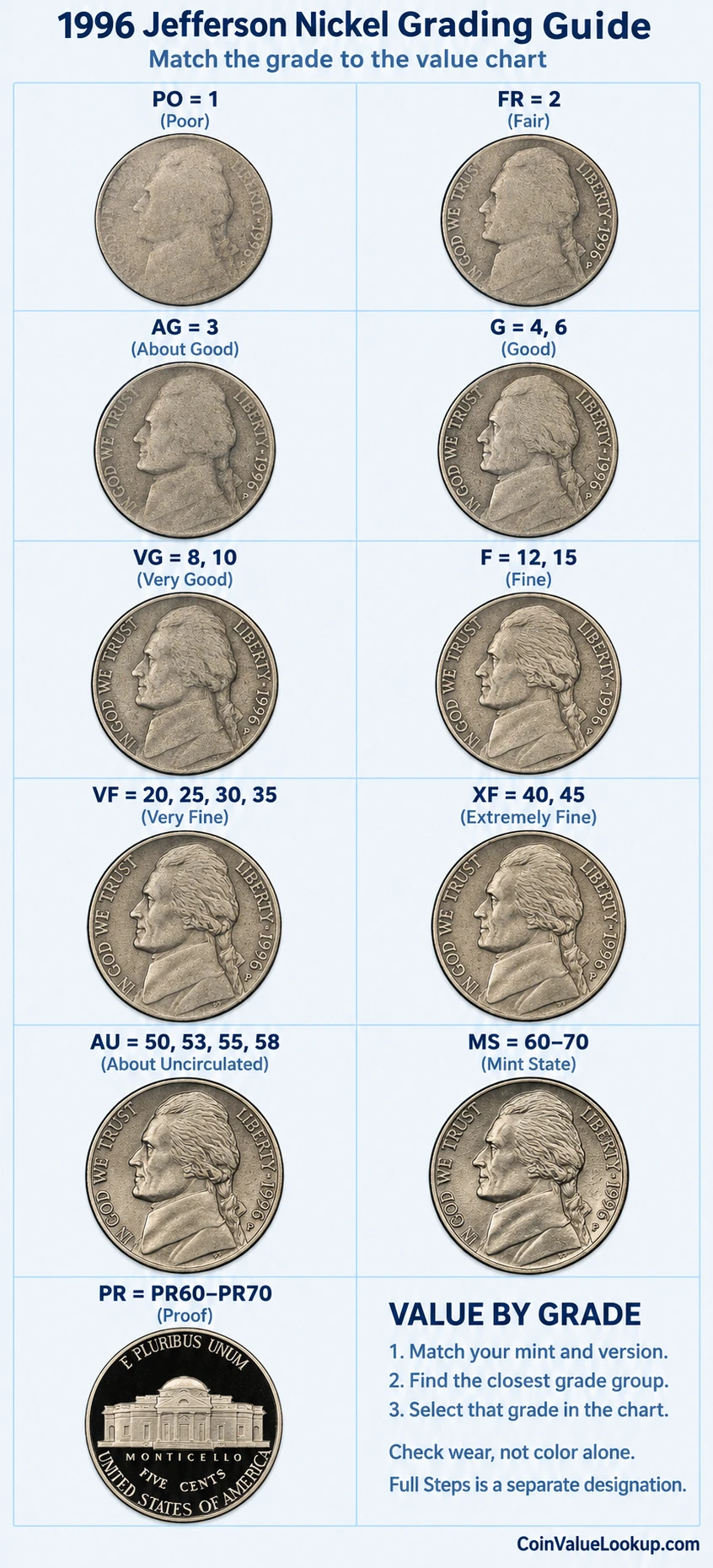
Start with Jefferson's cheek and the hair above his ear — those are the highest points and the first to show friction. A coin with full original luster and no wear qualifies as Mint State.
Even light rub on the cheekbone drops it below that threshold.
On the reverse, check the columns and steps of Monticello. Soft or mushy steps can result from a weak strike rather than actual wear, so look at the overall luster too.
Use the comparison image to gauge where your coin falls.
Full Steps is a separate designation applied only to Mint State coins whose Monticello steps are sharply defined. It is not a grade number and not an error — think of it as a bonus for strike quality.
Proof cameo levels work similarly: they describe frost contrast, not a higher numerical grade.
Step 3: Check 1996 Jefferson Nickel Value by Mint and Version
1996 Jefferson Nickel — P Business strike
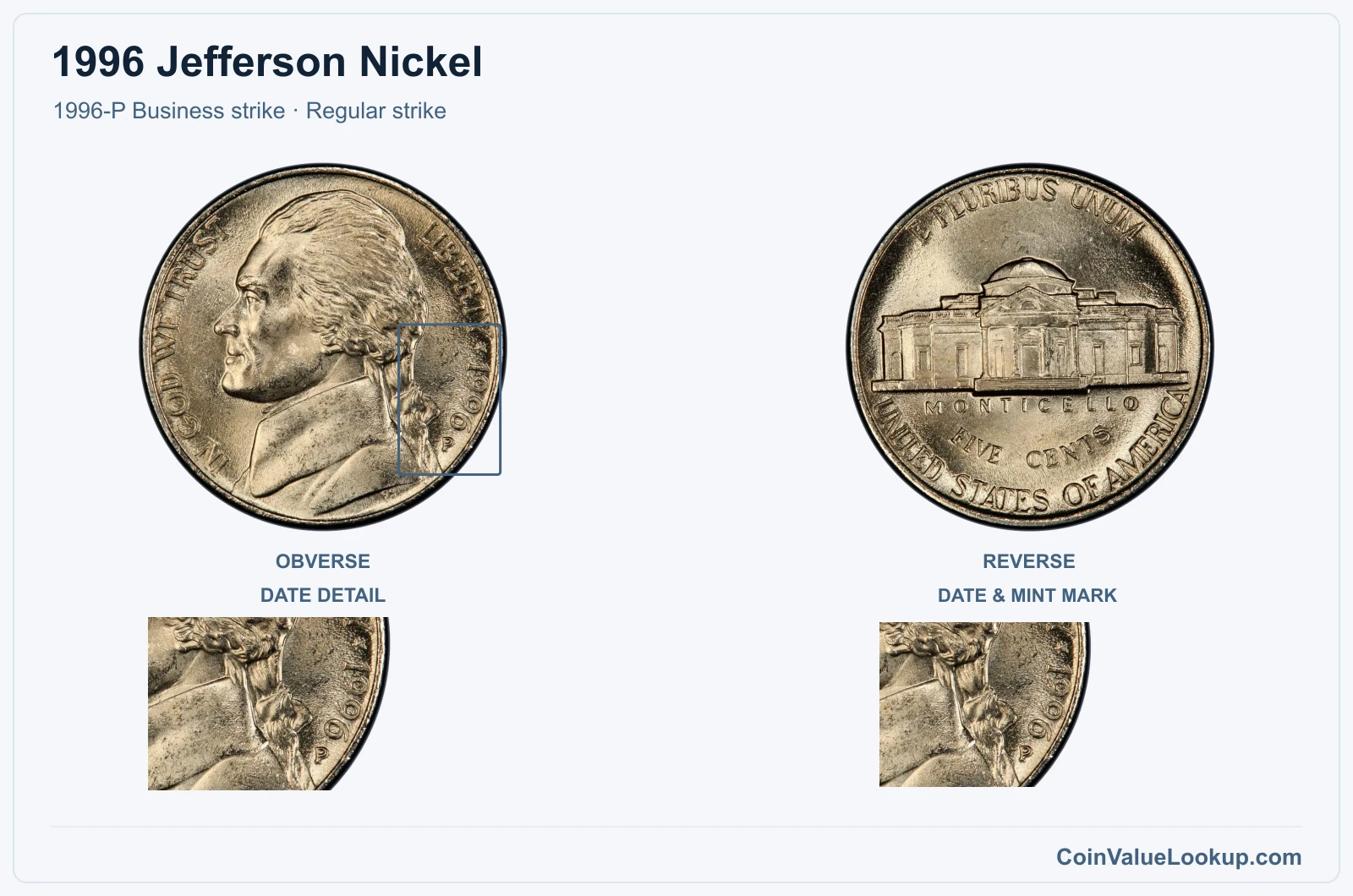
The 1996-P nickel was struck at Philadelphia for everyday circulation. It carries a small P mintmark on the obverse beneath the date.
The design is the standard Jefferson portrait on the front with Monticello on the reverse, struck on a 75% copper / 25% nickel planchet at a nominal 5 grams.
Retail guide estimates place this coin around $0.30 in MS60 condition and about $1.24 in MS65, per USA Coin Book. Circulated examples are worth face value.
Coins certified with Full Steps at high Mint State grades can command premiums above those baseline figures.
| Range | Grade | Price | Auction Records | Appraisal |
|---|---|---|---|---|
| PO | PO 1 | — | Coin Identifier | |
| FR | FR 2 | — | Coin Identifier | |
| AG | AG 3 | — | Coin Identifier | |
| G | G 4 | — | Coin Identifier | |
| G 6 | — | Coin Identifier | ||
| VG | VG 8 | — | Coin Identifier | |
| VG 10 | — | Coin Identifier | ||
| F | F 12 | — | Coin Identifier | |
| F 15 | — | Coin Identifier | ||
| VF | VF 20 | — | Coin Identifier | |
| VF 25 | — | Coin Identifier | ||
| VF 30 | — | Coin Identifier | ||
| VF 35 | — | Coin Identifier | ||
| XF | XF 40 | — | Coin Identifier | |
| XF 45 | — | Coin Identifier | ||
| AU | AU 50 | — | Coin Identifier | |
| AU 53 | — | Coin Identifier | ||
| AU 55 | — | Coin Identifier | ||
| AU 58 | — | Coin Identifier | ||
| MS | MS 60 | — | Coin Identifier | |
| MS 61 | — | Coin Identifier | ||
| MS 62 | — | Coin Identifier | ||
| MS 63 | — | Coin Identifier | ||
| MS 64 | — | Coin Identifier | ||
| MS 65 | Coin Identifier | |||
| MS 66 | Coin Identifier | |||
| MS 67 | — | Coin Identifier | ||
| MS 68 | — | — | — | |
| MS 69 | — | — | — | |
| MS 70 | — | — | — |
1996 Jefferson Nickel — D Business strike
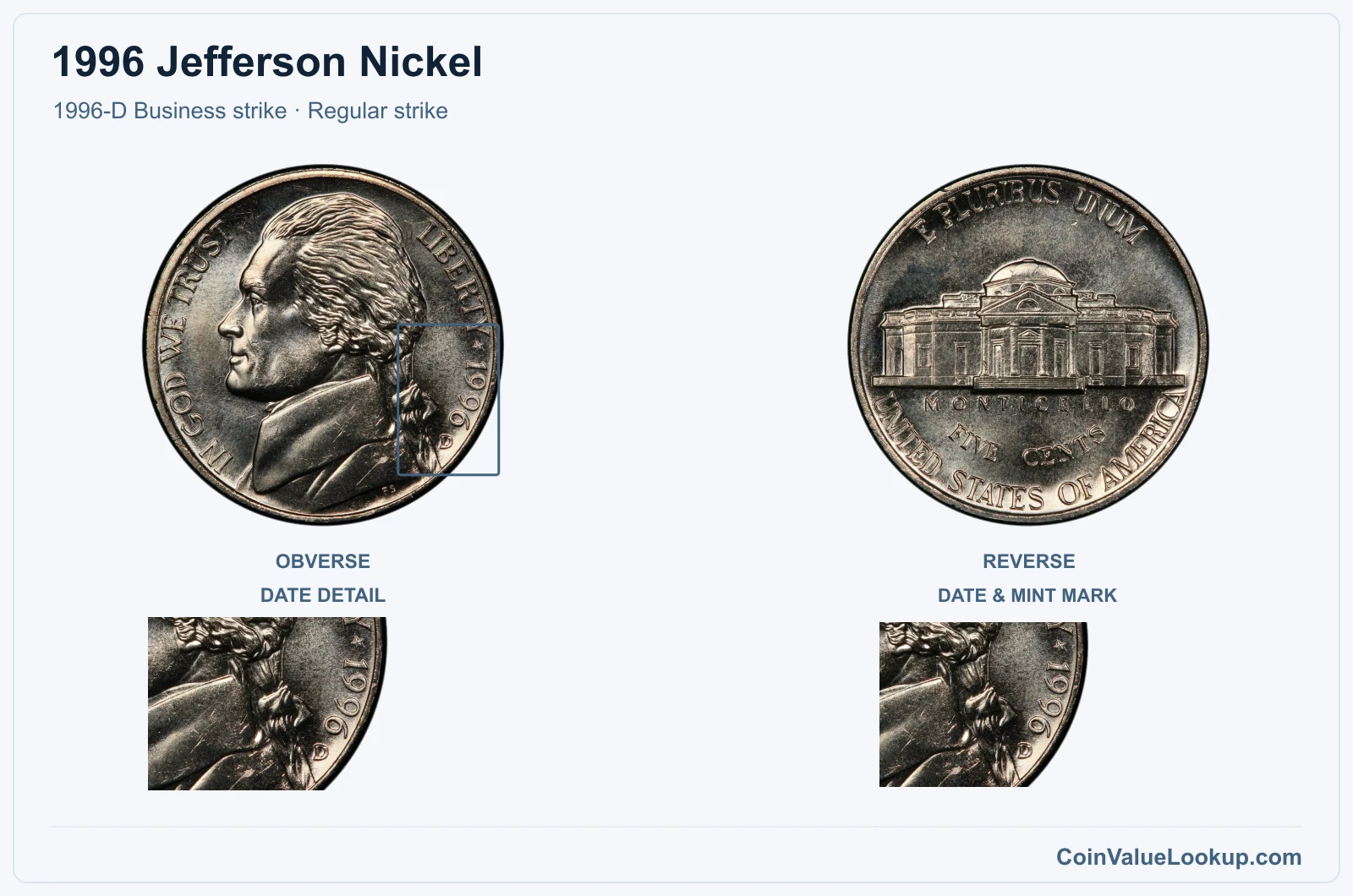
Denver's 1996-D nickel is the same alloy, weight, and design as the Philadelphia issue, distinguished only by a D mintmark below the date on the obverse.
Guide estimates from USA Coin Book are similar: roughly $0.30 at MS60 and $1.24 at MS65. As with the P mint, circulated pieces spend at five cents.
The real action is in the upper Mint State grades, particularly for coins that earn a Full Steps designation from a grading service.
Coin Value Lookup is a handy starting point if you want to look up guides for other dates and denominations in the Jefferson series.
| Range | Grade | Price | Auction Records | Appraisal |
|---|---|---|---|---|
| PO | PO 1 | — | Coin Identifier | |
| FR | FR 2 | — | Coin Identifier | |
| AG | AG 3 | — | Coin Identifier | |
| G | G 4 | — | Coin Identifier | |
| G 6 | — | Coin Identifier | ||
| VG | VG 8 | — | Coin Identifier | |
| VG 10 | — | Coin Identifier | ||
| F | F 12 | — | Coin Identifier | |
| F 15 | — | Coin Identifier | ||
| VF | VF 20 | — | Coin Identifier | |
| VF 25 | — | Coin Identifier | ||
| VF 30 | — | Coin Identifier | ||
| VF 35 | — | Coin Identifier | ||
| XF | XF 40 | — | Coin Identifier | |
| XF 45 | — | Coin Identifier | ||
| AU | AU 50 | — | Coin Identifier | |
| AU 53 | — | Coin Identifier | ||
| AU 55 | — | Coin Identifier | ||
| AU 58 | — | Coin Identifier | ||
| MS | MS 60 | — | Coin Identifier | |
| MS 61 | — | Coin Identifier | ||
| MS 62 | — | Coin Identifier | ||
| MS 63 | Coin Identifier | |||
| MS 64 | — | Coin Identifier | ||
| MS 65 | Coin Identifier | |||
| MS 66 | Coin Identifier | |||
| MS 67 | Coin Identifier | |||
| MS 68 | — | — | — | |
| MS 69 | — | — | — | |
| MS 70 | — | — | — |
1996 Jefferson Nickel — S Proof
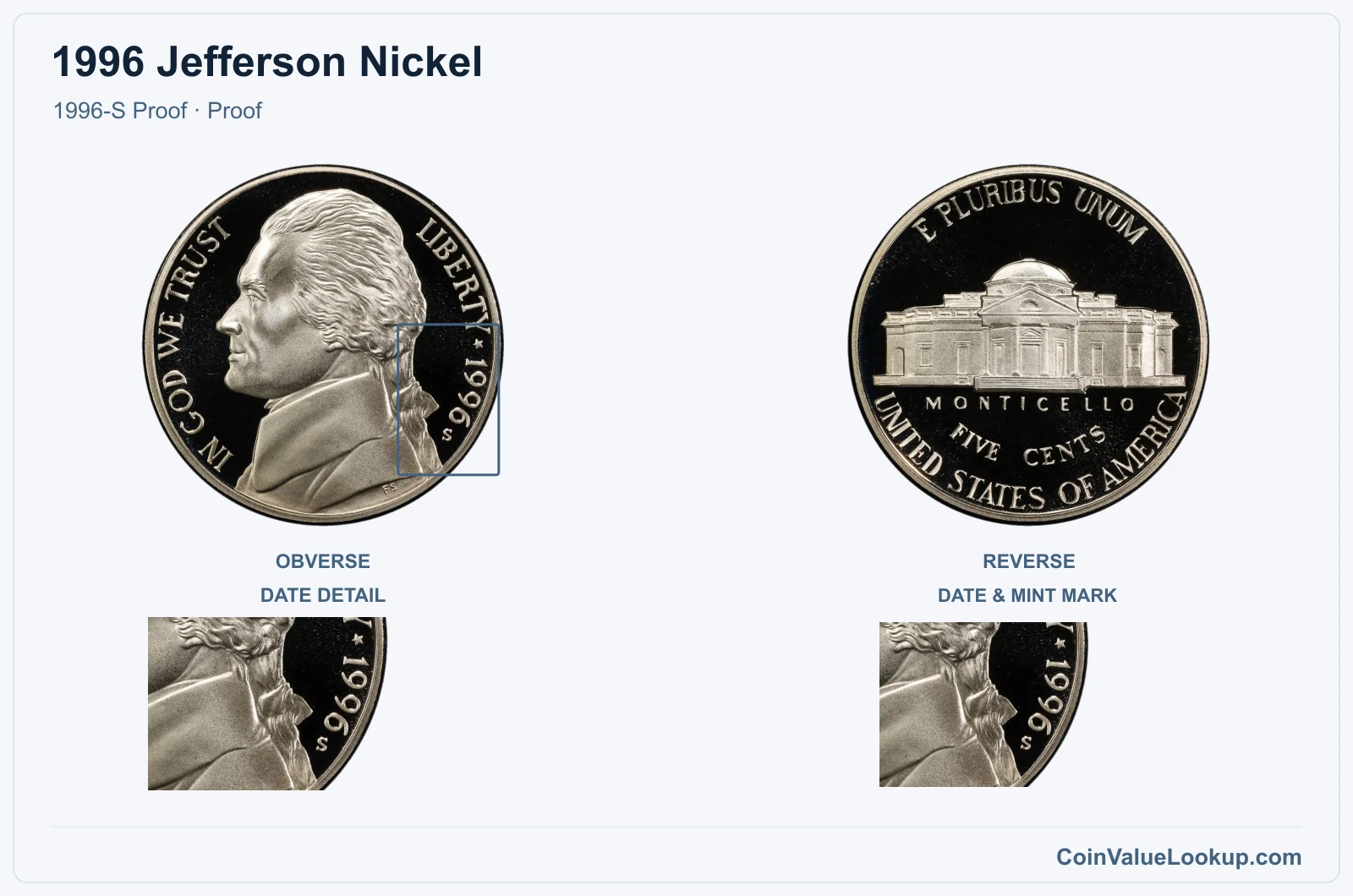
The 1996-S proof was struck at San Francisco exclusively for collector sets. It features the S mintmark on the obverse and sharper design details than its business-strike siblings, with mirror fields and often frosted devices.
A USA Coin Book guide anchor places a generic PR65 example around $3.62. That figure is not specific to deep cameo specimens, which trade in their own tier.
Always note whether your proof has full frosted contrast on both sides — cameo and deep cameo designations affect value separately from the numerical proof grade.
| Range | Grade | Price | Auction Records | Appraisal |
|---|---|---|---|---|
| PR | PR 1 | — | Coin Identifier | |
| PR 2 | — | Coin Identifier | ||
| PR 3 | — | Coin Identifier | ||
| PR 4 | — | Coin Identifier | ||
| PR 6 | — | Coin Identifier | ||
| PR 8 | — | Coin Identifier | ||
| PR 10 | — | Coin Identifier | ||
| PR 12 | — | Coin Identifier | ||
| PR 15 | — | Coin Identifier | ||
| PR 20 | — | Coin Identifier | ||
| PR 25 | — | Coin Identifier | ||
| PR 30 | — | Coin Identifier | ||
| PR 35 | — | Coin Identifier | ||
| PR 40 | — | Coin Identifier | ||
| PR 45 | — | Coin Identifier | ||
| PR 50 | — | Coin Identifier | ||
| PR 53 | — | Coin Identifier | ||
| PR 55 | — | Coin Identifier | ||
| PR 58 | — | Coin Identifier | ||
| PR 60 | — | Coin Identifier | ||
| PR 61 | — | Coin Identifier | ||
| PR 62 | — | Coin Identifier | ||
| PR 63 | — | Coin Identifier | ||
| PR 64 | — | Coin Identifier | ||
| PR 65 | — | Coin Identifier | ||
| PR 66 | — | Coin Identifier | ||
| PR 67 | — | Coin Identifier | ||
| PR 68 | Coin Identifier | |||
| PR 69 | Coin Identifier | |||
| PR 70 | Coin Identifier |
1996 Jefferson Nickel Error List
1. 1996 Jefferson Nickel — Struck on foreign blank
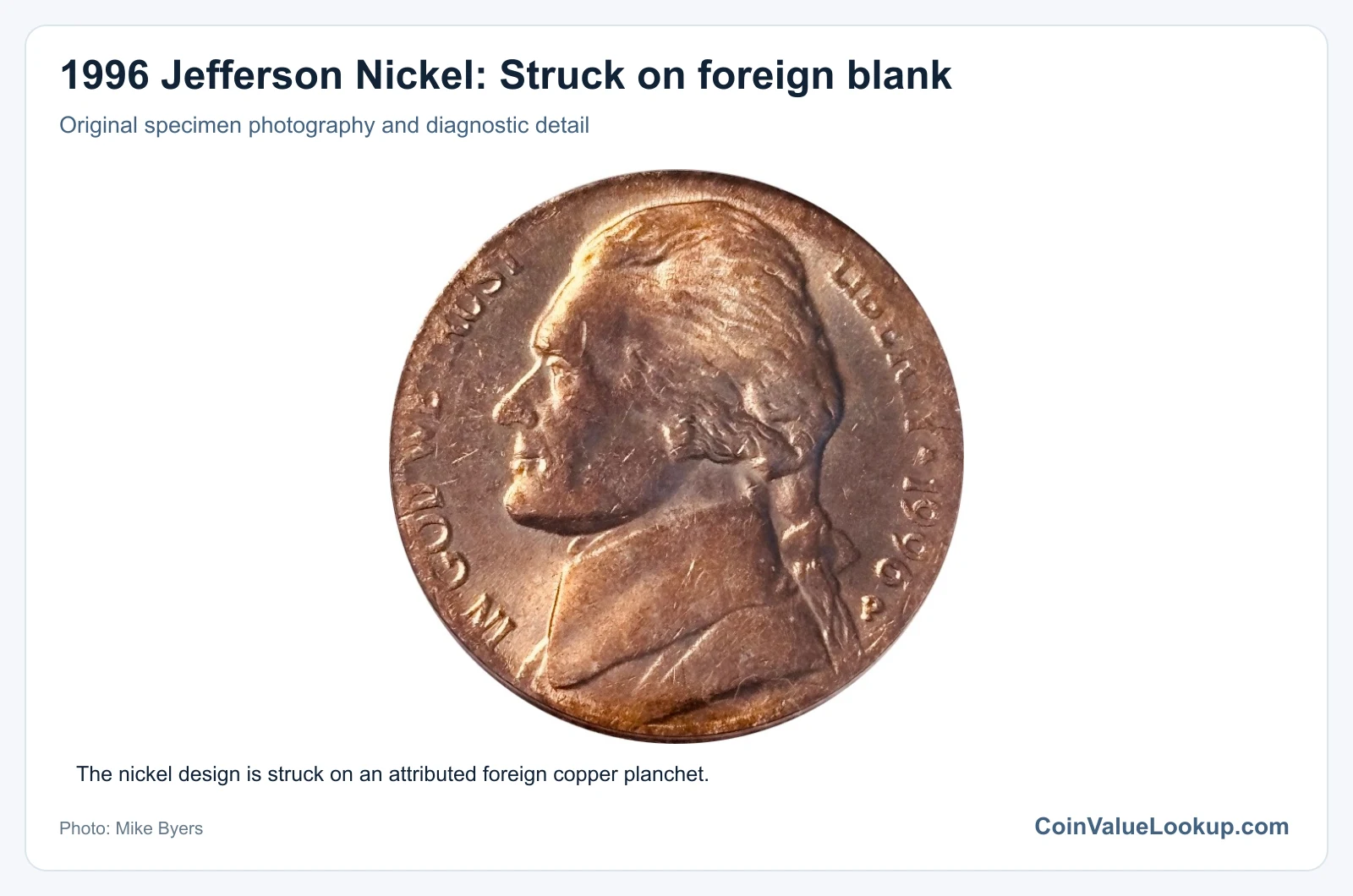
A 1996-P Jefferson nickel struck on a foreign planchet is a dramatic wrong-metal error. The reported example weighs only 4 grams instead of the normal 5 grams, meaning it landed on a blank intended for a different coin entirely.
The exact donor denomination was not identified by the source.
To spot one, weigh your coin carefully and look for an unusual color, diameter, or thickness compared to a normal nickel. A PCGS MS63 example sold through Heritage Auctions in August 2011 for $373.75.
That is a single recorded sale, not a guaranteed market price.
Don't confuse a weak strike or a coin that someone chemically altered with a genuine wrong-planchet error. Third-party certification is the safest way to confirm the planchet is truly foreign.
2. 1996 Jefferson Nickel — Double curved clips
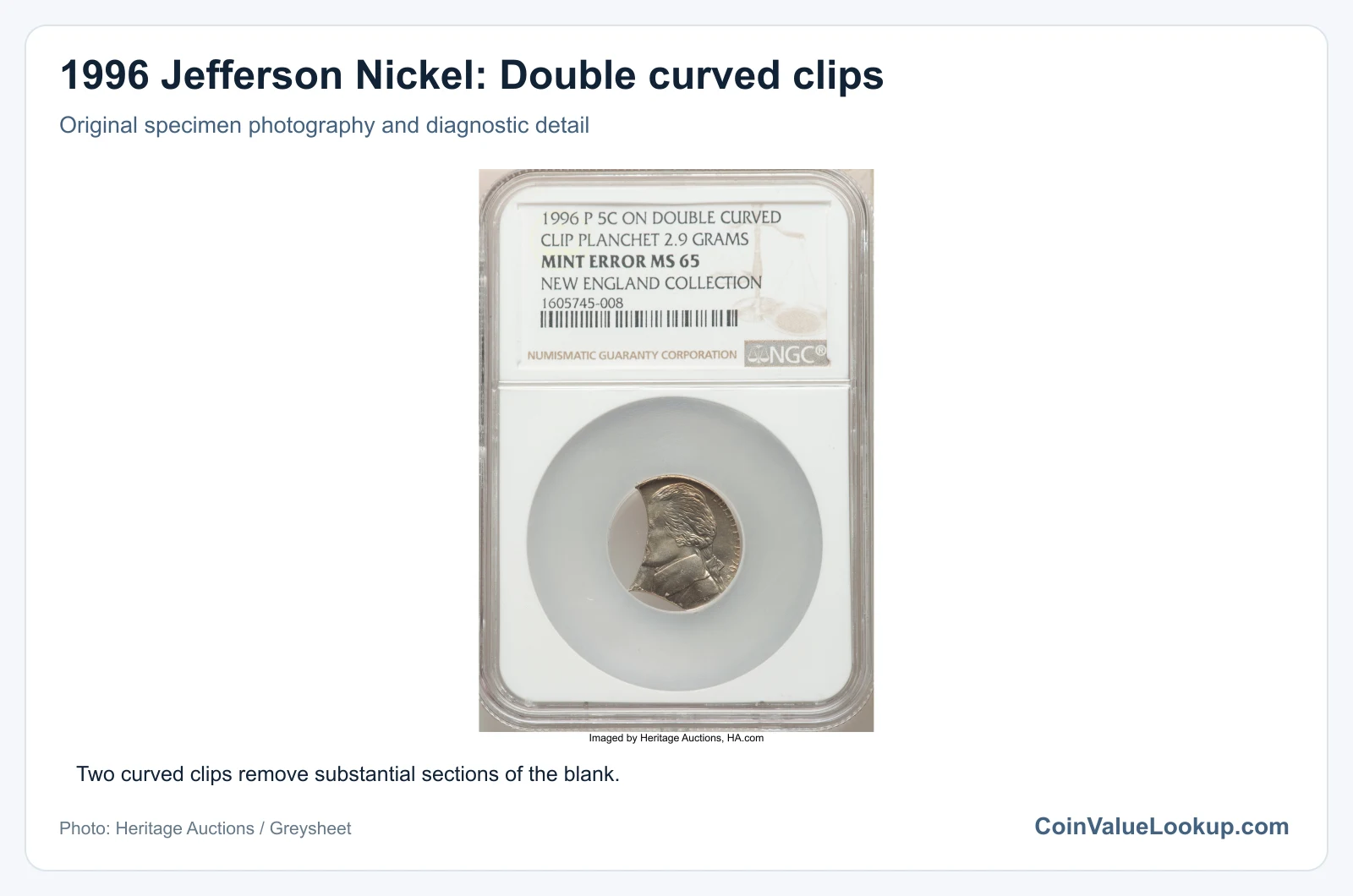
A 1996-P nickel with double curved clips shows two separate areas of missing metal along the rim where the blanking press failed to fully punch the planchet from the strip. The key diagnostic is a natural, curved absence — not a straight cut — with smooth rim transitions where the metal flowed during striking.
This coin weighed just 2.9 grams, well below the standard 5 grams.
An NGC MS65 example with two clips sold through Heritage Auctions in August 2010 for $94. That is one sale, not a standing price.
Post-mint damage from pliers, sawing, or accidental breakage will leave sharp, irregular edges and no corresponding metal-flow pattern. Genuine clips also often show a weakness in the design opposite the missing area, called the Blakesley effect.
3. 1996 Jefferson Nickel — Mated off-center pair
A mated pair means two adjacent blanks were struck simultaneously by the same die, each absorbing part of the other's impression while leaving matching edge contact marks. The reported 1996 Jefferson nickel pair was graded NGC MS66 and shows roughly 60% off-center displacement on each coin.
Heritage Auctions sold this specific pair in August 2010 for $632.50 for both coins together. That price covers the set — it cannot be split and assigned to one coin alone.
Authentic mated pairs must show complementary contact evidence: where one coin's edge pressed in, the other should have a corresponding mark. Unrelated off-center coins placed together, or coins glued or soldered post-mint, will lack that matching witness.
Certification of both pieces as a pair is important for establishing legitimacy.
4. 1996 Jefferson Nickel — Broadstrike
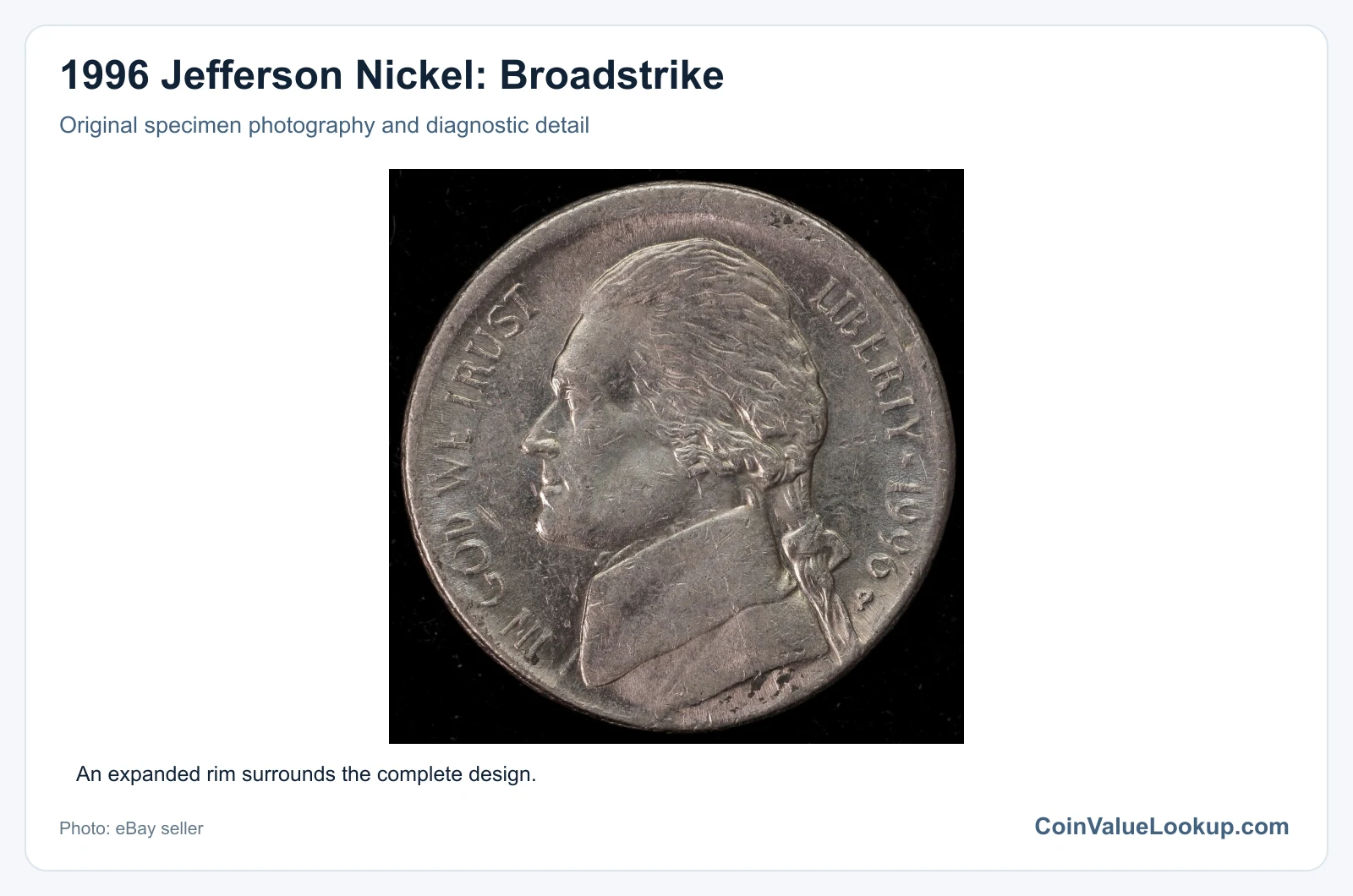
A broadstrike happens when the collar die — the ring that normally confines the planchet — is missing or retracted during striking. The result is a coin with a noticeably wider, thinner profile and outward metal spread, though the design remains roughly centered.
To check, look at the edge of your nickel: a broadstruck coin will lack the normal sharp, uniform rim and may show design elements that extend farther than usual. The coin should still display a complete or nearly complete design, unlike an off-center strike that loses part of the image.
Value depends on the degree of spread, the condition of the coin, and how clearly the error is visible. A coin that was simply flattened after leaving the mint — by a train track or a hammer — is not a broadstrike and has no collector premium.
5. 1996 Jefferson Nickel — Double / Multiple Strike
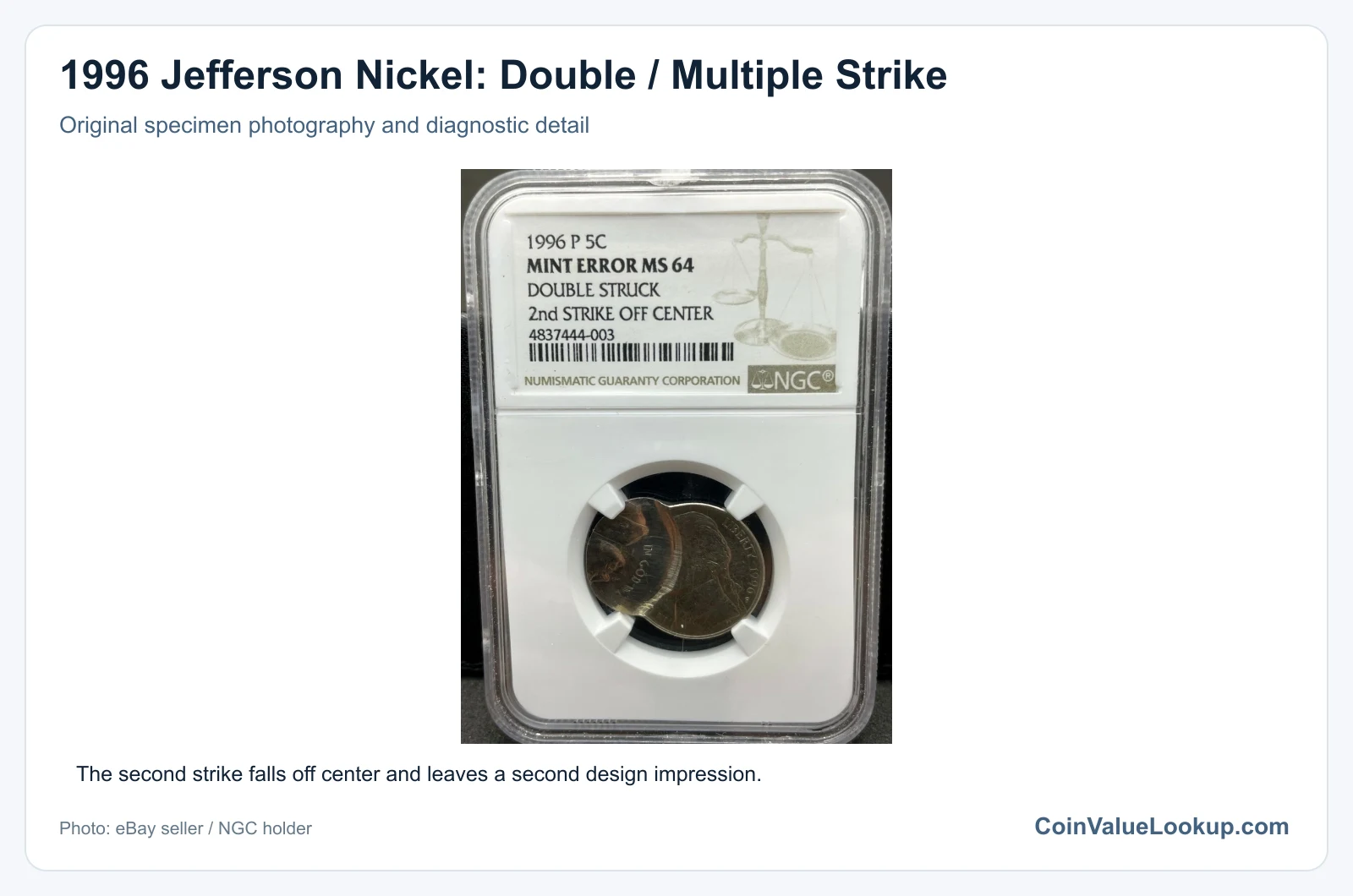
A double or multiple strike occurs when a coin receives a second (or further) blow from the dies, producing a separate, displaced or rotated design impression overlapping the first. The result is two distinct sets of design elements visible on one planchet, sometimes dramatically offset.
Look for a clearly separate second image — a ghost Jefferson portrait shifted to one side, or a duplicated Monticello at a different angle. The displacement should be consistent across the entire coin, not confined to a single letter or digit.
Don't confuse this with a doubled die, which is a hub error visible as slight doubling within the design itself, or with post-mint damage where someone struck the coin against a hard surface. Value hinges on how dramatic the second strike is, the condition of both impressions, and third-party confirmation.