2017 Jefferson Nickel Coin Value: How Much Is It Worth?
Most 2017 Jefferson nickels you pull from pocket change are worth face value or close to it. Ordinary Philadelphia and Denver business strikes carry USA Coin Book guide estimates of about $0.30 at MS60 and $0.61 at MS65.
Proofs, the special Enhanced Uncirculated anniversary finish, certified Full Steps examples, and authentic errors each occupy their own price lane and deserve a closer look.
Fast Way to Identify Your 2017 Jefferson Nickel
The quickest way to start figuring out what you have is to upload clear photos of both sides of your coin. Our identifier can help with preliminary identification of the mint, finish, and basic version from your front and back images.
It is not a substitute for professional authentication or exact grading, but it gives you a solid starting point.
2017 Jefferson Nickel Value
Upload both sides of your 2017 Jefferson Nickel.
Front Obverse
Upload photo
Back Reverse
Upload photo
Which 2017 Jefferson Nickel Versions Are Worth Money?
- Certified high-grade P or D coins with Full Steps designations can command premiums above ordinary business-strike guide estimates.
- The 2017-S Proof nickel retails around $5.30 at PR65 per USA Coin Book, well above face value.
- The 2017-S Enhanced Uncirculated finish from the 225th anniversary set is a separate collectible; value depends on authenticated identity and condition.
- Authentic mint errors such as a nickel struck over a dime, off-center strikes, or improper annealing are individually assessed and can carry significant premiums.
Step 1: Identify Your 2017 Jefferson Nickel Mint Mark and Version
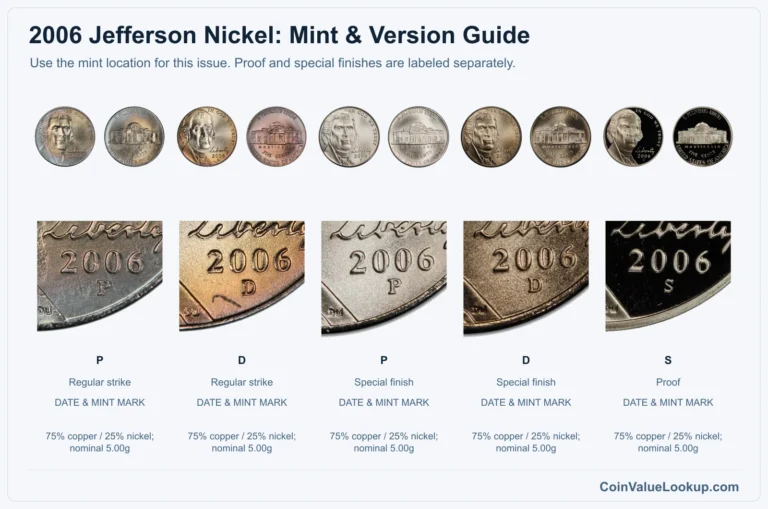
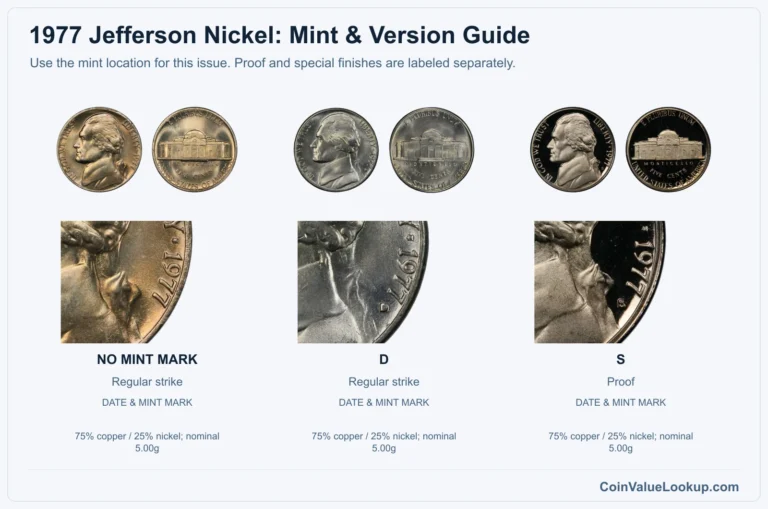
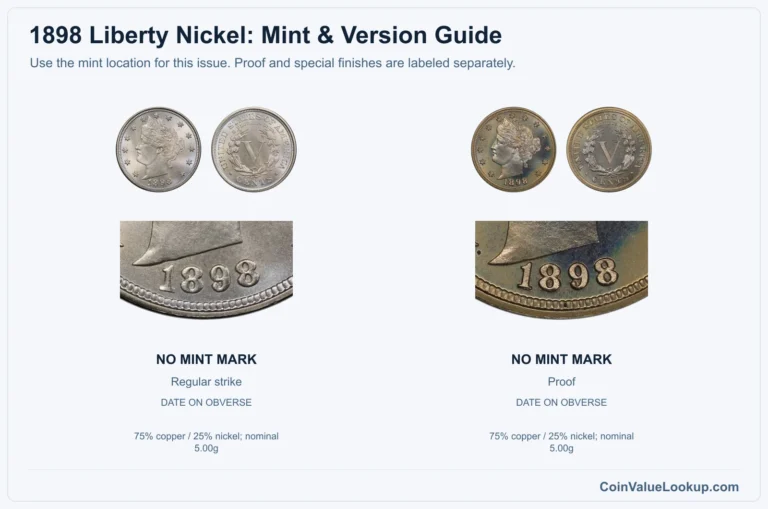
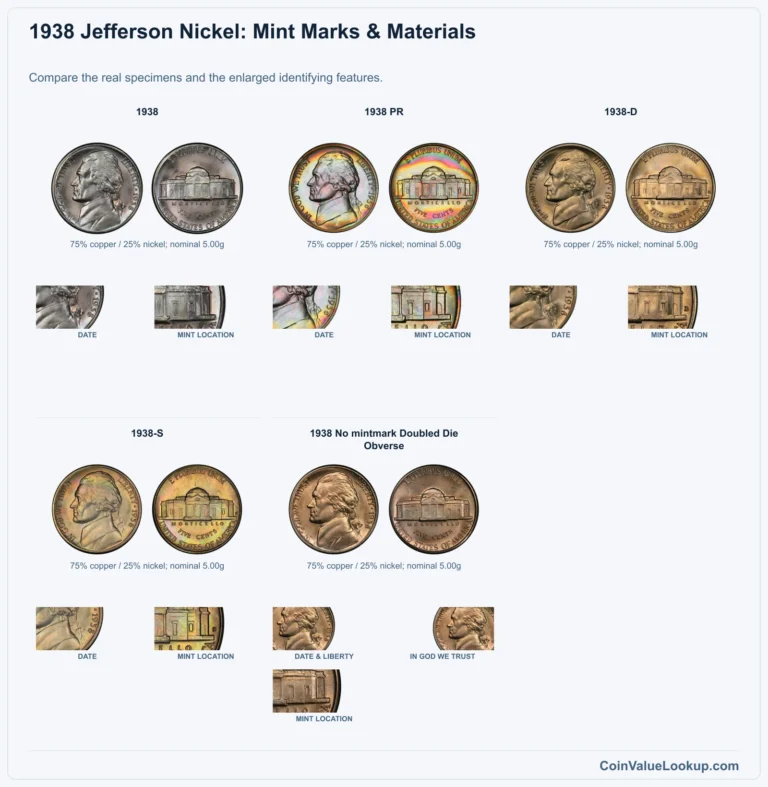
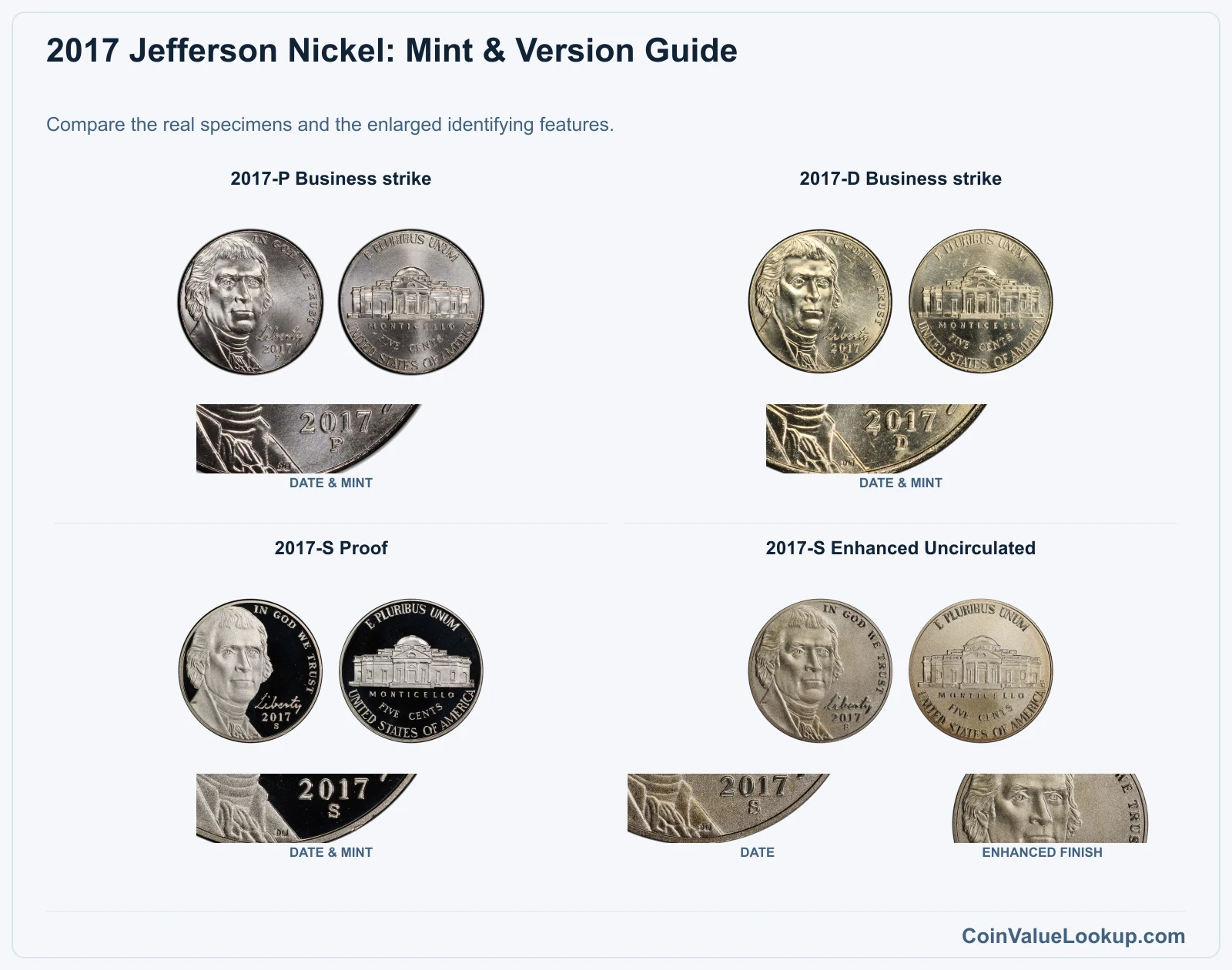
Flip your 2017 nickel to the obverse — the side with Jefferson's forward-facing portrait. Look just below the date for the mintmark: P, D, or S.
Philadelphia (P) and Denver (D) coins are standard business strikes made for circulation.
An S mintmark means San Francisco, and that opens two doors. One is the standard proof, struck with polished dies and sold in proof sets.
The other is the 2017-S Enhanced Uncirculated nickel, produced for the 225th anniversary of the United States Mint. That coin has laser-frosted selected areas with unpolished fields, giving it a look that is clearly different from a normal proof.
All four versions share the same alloy — 75% copper and 25% nickel — weigh 5.00 grams, measure 21.2 mm across, and have a plain edge. The distinguishing factors are mintmark and finish, so take time to examine the surface character under good light before deciding which branch your coin belongs to.
Step 2: Check Your 2017 Jefferson Nickel Grade
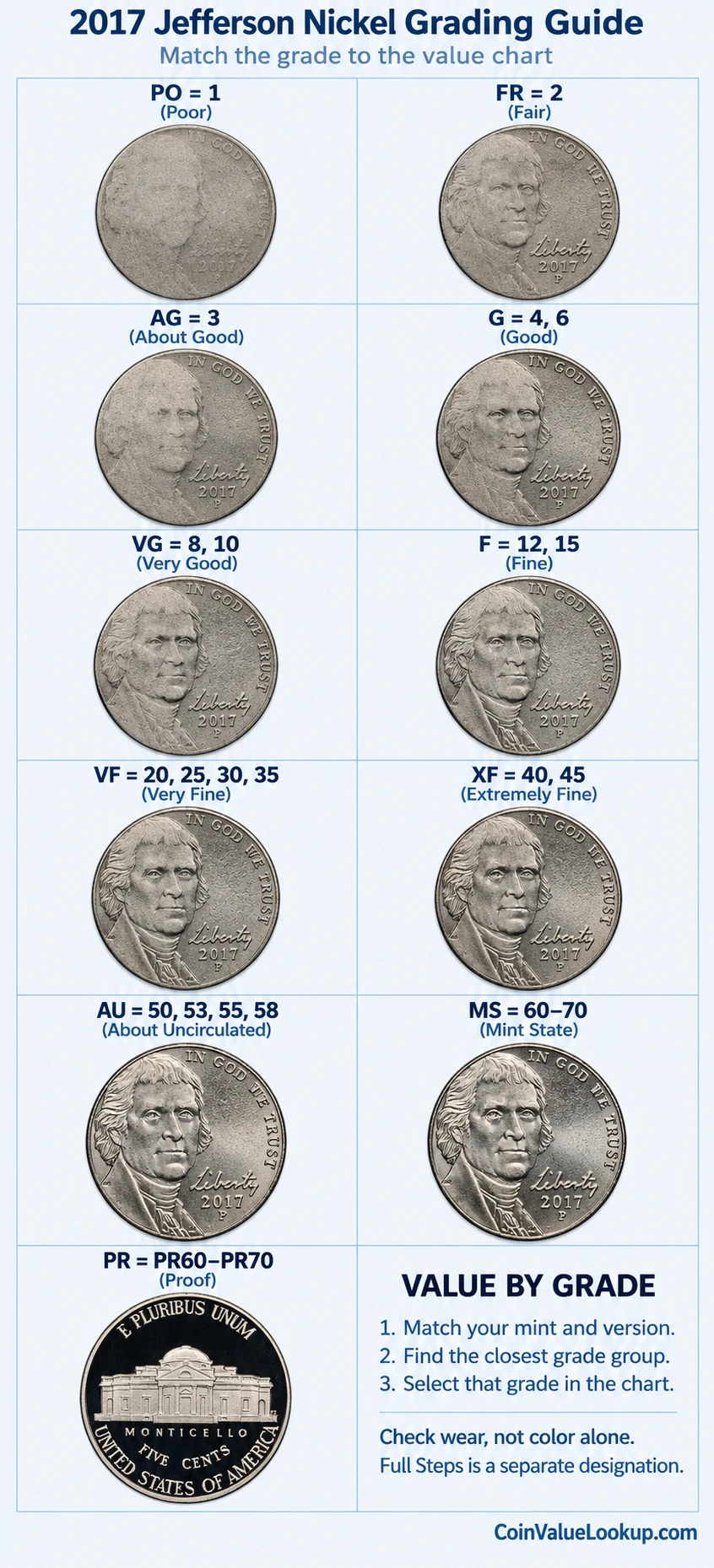
Start by checking the high points on the obverse: the cheekbone, the hair above the ear, and the shoulder area. These spots show wear first.
On a well-preserved Mint State coin, full original luster rolls unbroken across the surface.
Then flip to the reverse. Monticello's steps are the classic sharpness test.
A coin can receive a Full Steps designation when those steps are sharply separated, but that designation is independent of the numerical grade — a coin can be MS65 without Full Steps, or MS63 with them.
Compare your coin to the grading image for the same portrait type. If a proof, evaluate mirror depth and any hairlines rather than circulation wear.
Proof contrast (like deep cameo) is a surface attribute, not a higher grade than Mint State.
Step 3: Check 2017 Jefferson Nickel Value by Mint and Version
2017 Jefferson Nickel — P Business strike
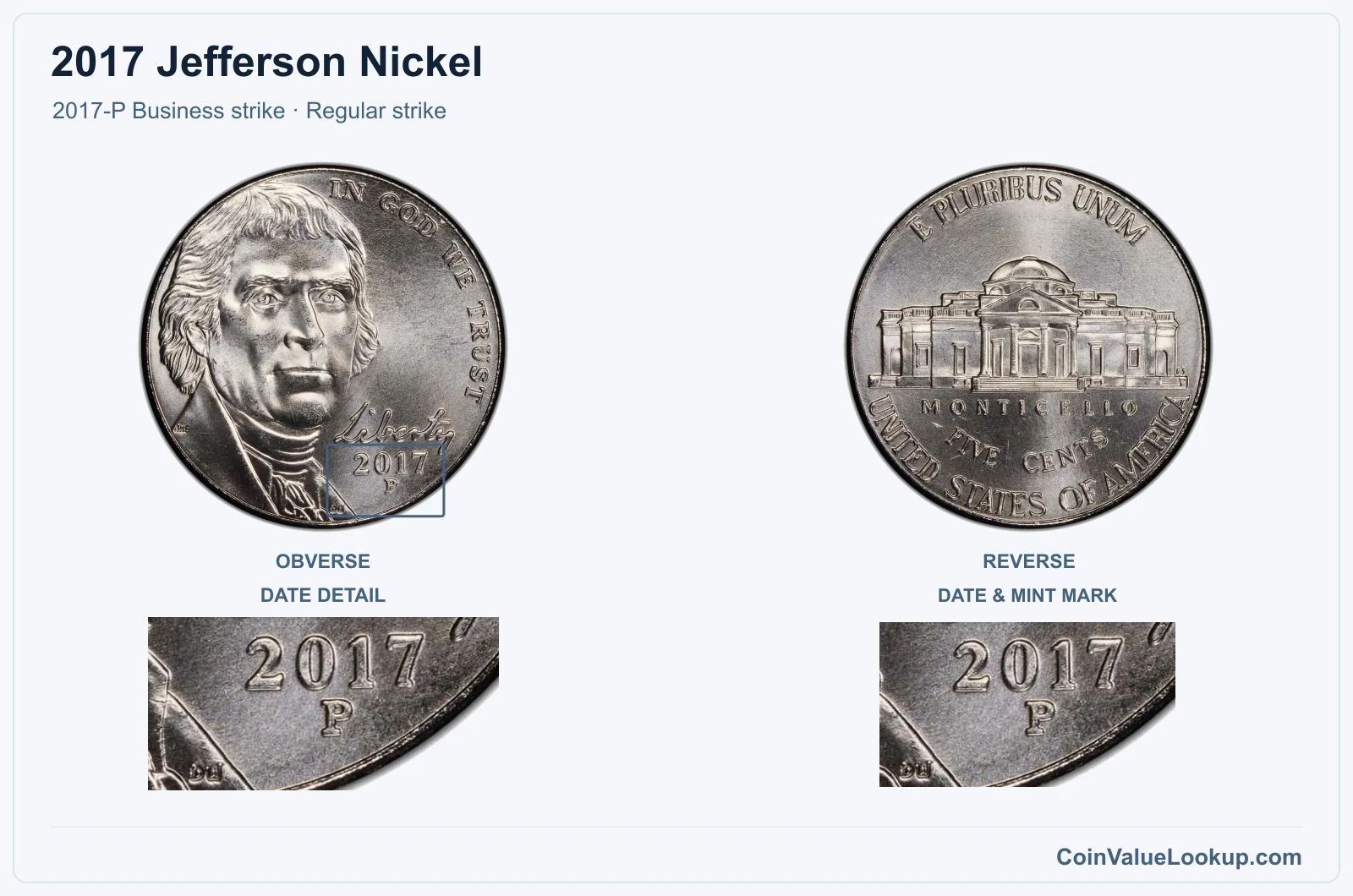
The 2017-P is the Philadelphia business strike, carrying a P mintmark below the date. It uses the standard 75% copper / 25% nickel composition at 5.00 grams.
USA Coin Book guide estimates place this coin at roughly $0.30 in MS60 and $0.61 in MS65. Those figures cover ordinary examples without a Full Steps designation or deep cameo attributes.
If yours is circulated with visible wear on Jefferson's cheek and hair, it is realistically a face-value coin. The premium kicks in at higher certified Mint State grades, especially with a Full Steps label.
| Range | Grade | Price | Auction Records | Appraisal |
|---|---|---|---|---|
| PO | PO 1 | — | Coin Identifier | |
| FR | FR 2 | — | Coin Identifier | |
| AG | AG 3 | — | Coin Identifier | |
| G | G 4 | — | Coin Identifier | |
| G 6 | — | Coin Identifier | ||
| VG | VG 8 | — | Coin Identifier | |
| VG 10 | — | Coin Identifier | ||
| F | F 12 | — | Coin Identifier | |
| F 15 | — | Coin Identifier | ||
| VF | VF 20 | — | Coin Identifier | |
| VF 25 | — | Coin Identifier | ||
| VF 30 | — | Coin Identifier | ||
| VF 35 | — | Coin Identifier | ||
| XF | XF 40 | — | Coin Identifier | |
| XF 45 | — | Coin Identifier | ||
| AU | AU 50 | — | Coin Identifier | |
| AU 53 | — | Coin Identifier | ||
| AU 55 | — | Coin Identifier | ||
| AU 58 | — | Coin Identifier | ||
| MS | MS 60 | — | Coin Identifier | |
| MS 61 | — | Coin Identifier | ||
| MS 62 | — | Coin Identifier | ||
| MS 63 | — | Coin Identifier | ||
| MS 64 | — | Coin Identifier | ||
| MS 65 | — | Coin Identifier | ||
| MS 66 | — | Coin Identifier | ||
| MS 67 | — | Coin Identifier | ||
| MS 68 | — | — | — | |
| MS 69 | — | — | — | |
| MS 70 | — | — | — |
2017 Jefferson Nickel — D Business strike
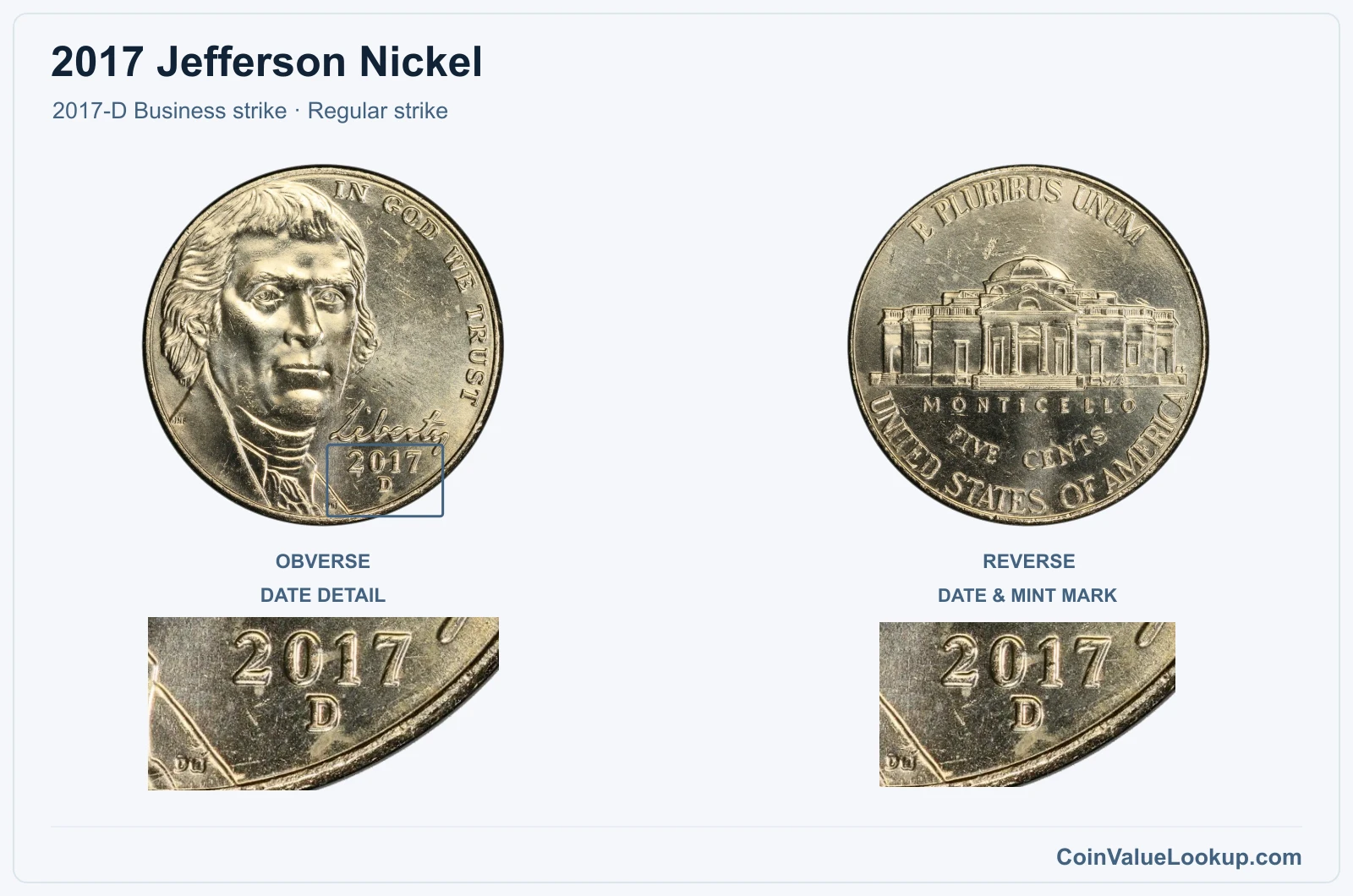
Denver's 2017-D business strike is the same design and alloy as the P, just produced at a different facility. The D mintmark sits in the same spot below the date.
USA Coin Book guide estimates match the P at about $0.30 for MS60 and $0.61 for MS65. Again, these are baseline numbers for ordinary strikes.
A sharp, lustrous example with fully separated Monticello steps and few contact marks could grade higher and be worth more. Worn pieces are spenders.
Coin Value Lookup is a handy place to look up guides for other years and denominations in the Jefferson nickel series if you are working through a collection or a roll find.
| Range | Grade | Price | Auction Records | Appraisal |
|---|---|---|---|---|
| PO | PO 1 | — | Coin Identifier | |
| FR | FR 2 | — | Coin Identifier | |
| AG | AG 3 | — | Coin Identifier | |
| G | G 4 | — | Coin Identifier | |
| G 6 | — | Coin Identifier | ||
| VG | VG 8 | — | Coin Identifier | |
| VG 10 | — | Coin Identifier | ||
| F | F 12 | — | Coin Identifier | |
| F 15 | — | Coin Identifier | ||
| VF | VF 20 | — | Coin Identifier | |
| VF 25 | — | Coin Identifier | ||
| VF 30 | — | Coin Identifier | ||
| VF 35 | — | Coin Identifier | ||
| XF | XF 40 | — | Coin Identifier | |
| XF 45 | — | Coin Identifier | ||
| AU | AU 50 | — | Coin Identifier | |
| AU 53 | — | Coin Identifier | ||
| AU 55 | — | Coin Identifier | ||
| AU 58 | — | Coin Identifier | ||
| MS | MS 60 | — | Coin Identifier | |
| MS 61 | — | Coin Identifier | ||
| MS 62 | — | Coin Identifier | ||
| MS 63 | — | Coin Identifier | ||
| MS 64 | — | Coin Identifier | ||
| MS 65 | — | Coin Identifier | ||
| MS 66 | — | Coin Identifier | ||
| MS 67 | — | Coin Identifier | ||
| MS 68 | — | — | — | |
| MS 69 | — | — | — | |
| MS 70 | — | — | — |
2017 Jefferson Nickel — S Proof
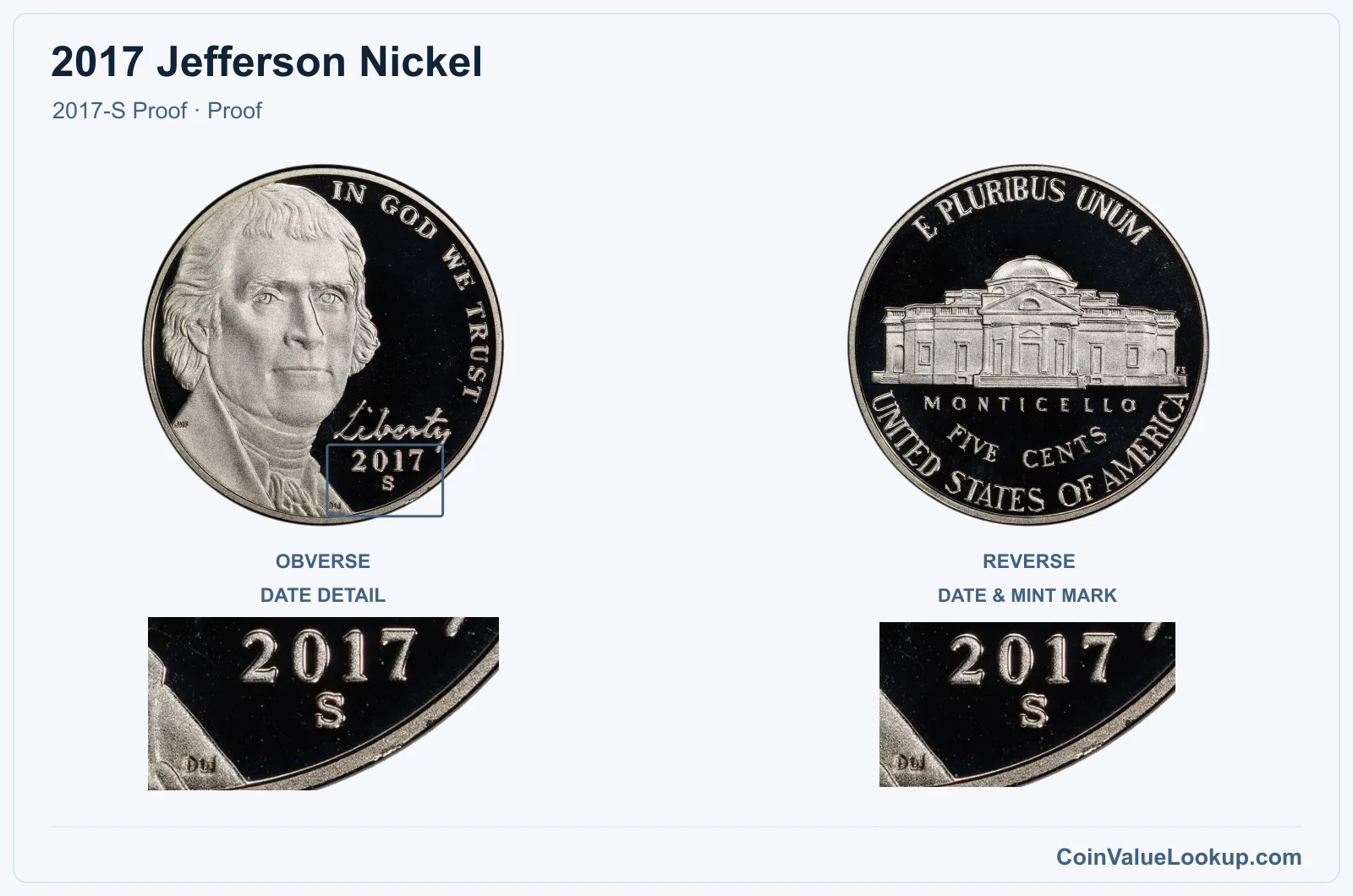
The 2017-S Proof was struck at San Francisco using polished dies and specially prepared planchets, then sold in annual proof sets. It has a mirror-like field and frosted design elements.
USA Coin Book lists a guide estimate of about $5.30 at PR65. That is a decent step above face value, though still modest in the broader proof market.
Do not confuse a shiny circulation strike with a proof — a real proof has deeply reflective fields and was never released into general circulation. Cameo and deep cameo designations can affect value but are separate from the numerical proof grade.
| Range | Grade | Price | Auction Records | Appraisal |
|---|---|---|---|---|
| PR | PR 1 | — | Coin Identifier | |
| PR 2 | — | Coin Identifier | ||
| PR 3 | — | Coin Identifier | ||
| PR 4 | — | Coin Identifier | ||
| PR 6 | — | Coin Identifier | ||
| PR 8 | — | Coin Identifier | ||
| PR 10 | — | Coin Identifier | ||
| PR 12 | — | Coin Identifier | ||
| PR 15 | — | Coin Identifier | ||
| PR 20 | — | Coin Identifier | ||
| PR 25 | — | Coin Identifier | ||
| PR 30 | — | Coin Identifier | ||
| PR 35 | — | Coin Identifier | ||
| PR 40 | — | Coin Identifier | ||
| PR 45 | — | Coin Identifier | ||
| PR 50 | — | Coin Identifier | ||
| PR 53 | — | Coin Identifier | ||
| PR 55 | — | Coin Identifier | ||
| PR 58 | — | Coin Identifier | ||
| PR 60 | — | Coin Identifier | ||
| PR 61 | — | Coin Identifier | ||
| PR 62 | — | Coin Identifier | ||
| PR 63 | — | Coin Identifier | ||
| PR 64 | — | Coin Identifier | ||
| PR 65 | — | Coin Identifier | ||
| PR 66 | — | Coin Identifier | ||
| PR 67 | — | Coin Identifier | ||
| PR 68 | — | Coin Identifier | ||
| PR 69 | — | Coin Identifier | ||
| PR 70 | — | Coin Identifier |
2017 Jefferson Nickel — S Enhanced Uncirculated
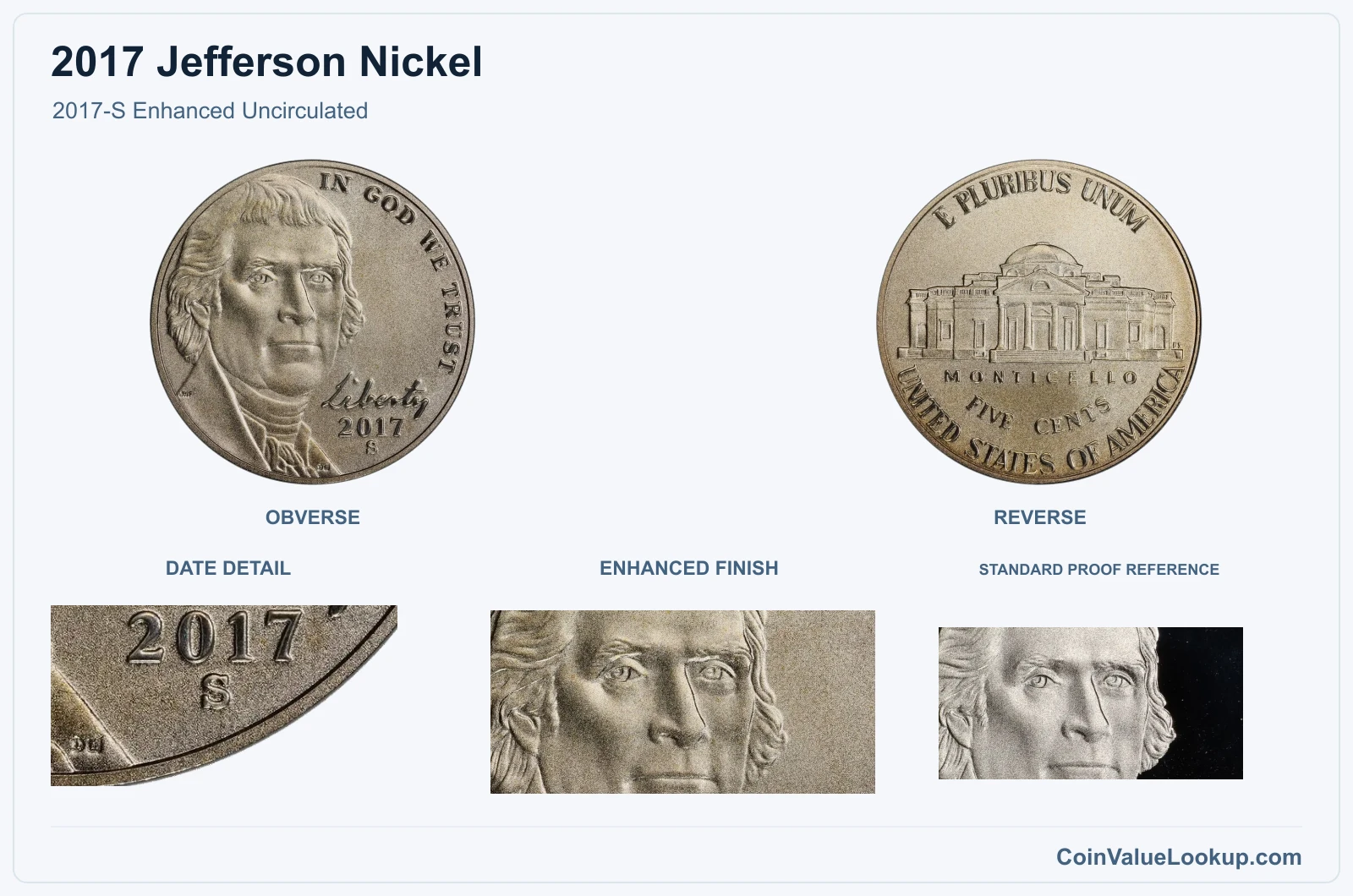
This is the 2017-S Enhanced Uncirculated nickel, created for the United States Mint's 225th anniversary set. It carries the S mintmark but is not a proof.
Selected areas are laser-frosted while the fields remain unpolished, producing a distinctive matte-and-satin appearance that differs from both business strikes and standard proofs.
Because this is a special commemorative finish with limited distribution, its value depends on authenticated identity and condition. No single guide estimate covers every scenario here.
If you think you have one, compare the surface texture carefully against known examples — the frosted zones should be deliberate and consistent, not random or damaged. Professional authentication is the safest path to confirming this variety.
Designation-specific values: The prices below apply only to coins certified Full Steps (FS). They do not represent prices for coins without that designation.
Range Grade
Price Auction Records Appraisal SP SP 1
—
Coin Identifier
SP 2
—
Coin Identifier
SP 3
—
Coin Identifier
SP 4
—
Coin Identifier
SP 6
—
Coin Identifier
SP 8
—
Coin Identifier
SP 10
—
Coin Identifier
SP 12
—
Coin Identifier
SP 15
—
Coin Identifier
SP 20
—
Coin Identifier
SP 25
—
Coin Identifier
SP 30
—
Coin Identifier
SP 35
—
Coin Identifier
SP 40
—
Coin Identifier
SP 45
—
Coin Identifier
SP 50
—
Coin Identifier
SP 53
—
Coin Identifier
SP 55
—
Coin Identifier
SP 58
—
Coin Identifier
SP 60
—
Coin Identifier
SP 61
—
Coin Identifier
SP 62
—
Coin Identifier
SP 63
—
Coin Identifier
SP 64
—
Coin Identifier
SP 65
—
Coin Identifier
SP 66
—
Coin Identifier
SP 67
—
Coin Identifier
SP 68
—
Coin Identifier
SP 69
—
Coin Identifier
SP 70
—
Coin Identifier
2017 Jefferson Nickel Error List
1. 2017 Jefferson Nickel — Struck over a dime
A 2017 Jefferson nickel struck over a previously struck dime is a dramatic wrong-planchet error. The key diagnostic is residual dime design visible beneath the nickel's obverse and reverse impressions.
You should see traces of the dime's reeding, diameter difference, and underlying design elements that do not belong on a nickel.
This is different from a nickel struck on an unused dime-sized blank, which would show no prior design. It is also different from a post-mint vise transfer, where design details are pressed into a coin outside the mint — those tend to be incuse rather than integrated into the strike.
One documented example is a Philadelphia mint specimen certified PCGS MS65. Value for this type of error is assessed individually based on authenticated identity, condition, and the clarity of the underlying dime design.
No standard price range applies.
2. 2017 Jefferson Nickel — Die Crack / Die Chip
Die cracks and die chips appear as raised lines or small raised blobs on the coin's surface, caused by a fracture in the steel die. A thin raised line running across the design is a die crack.
A small raised lump, often near lettering, is a die chip. When a crack reaches the rim and a piece of the die breaks away, the result is a cud — a larger raised blob connected to the edge.
Do not confuse these with incuse scratches, corrosion spots, or foreign material stuck to the surface. Die cracks are raised and follow consistent patterns from coin to coin struck by the same damaged die.
Value depends on the size, location, and visual impact of the crack or chip, plus the coin's overall condition. Each piece needs individual assessment.
3. 2017 Jefferson Nickel — Broadstrike
A broadstrike happens when the collar die — the ring that normally confines the blank during striking — fails to engage. The result is a coin with outward metal spread, making it wider than normal.
The design is fully struck but the edge lacks its usual definition, and the coin may appear slightly larger or have an irregular rim profile.
Look at the edge carefully. A broadstruck nickel will have a noticeably different edge profile compared to a normal plain-edge nickel.
The design should still be relatively centered, which distinguishes a broadstrike from an off-center strike.
Do not confuse this with a coin that was flattened by a train or a hammer after leaving the mint — post-mint damage spreads metal unevenly and often damages the design. Value depends on the degree of spread, condition, and visual appeal.
4. 2017 Jefferson Nickel — Doubled Die Obverse
A doubled die obverse on a 2017 nickel shows consistent separation or notching on obverse design elements — letters, the date, or parts of Jefferson's portrait. The doubling is a result of the die-making process, so it appears identically on every coin struck by that die.
To check, compare the obverse lettering and date to a known normal example under the same lighting. Look for a consistent secondary image with depth, not a flat shelf.
Machine doubling, which is far more common, produces a flat, shelf-like displacement that lacks the raised definition of a true doubled die.
Reflections and worn die contours can also mimic doubling to the untrained eye. Value varies based on the strength and location of the doubling and the coin's condition.
5. 2017 Jefferson Nickel — Clashed Dies
Clashed dies occur when the obverse and reverse dies strike each other without a planchet between them. This transfers ghost-like traces of the opposite design onto each die, which then appear as extra incuse or raised elements on subsequently struck coins.
On a 2017 nickel, look for faint outlines of Monticello appearing in the open fields of the obverse, or traces of Jefferson's portrait visible on the reverse. These ghost images should align with where the opposite design would naturally contact the die.
Do not confuse die clash marks with random scratches, raised lines from debris, or a brockage (where an actual coin acts as a die). Clash marks follow a predictable pattern tied to the opposing design.
Value depends on how prominent the transferred design is and the coin's overall condition.
6. 2017 Jefferson Nickel — Struck-Through Error
A struck-through error occurs when foreign material — grease, cloth, metal fragments, or other debris — gets between the die and the planchet during striking. The result is a localized depression or incomplete design area where the obstruction blocked the die's impression.
Grease-filled dies are the most common version, producing a smooth, featureless patch where detail should be. A retained foreign object, on the other hand, may leave an impression of the object itself embedded in the coin's surface.
Do not confuse struck-through areas with ordinary wear, cleaning damage, or a weak strike from a worn die. A struck-through area has a distinctly different texture from surrounding surfaces.
Value depends on the size of the affected area, what caused the obstruction, and the coin's condition.
7. 2017 Jefferson Nickel — Improper Annealing
Improper annealing refers to a planchet that was heat-treated incorrectly before striking. The result is unusual surface discoloration, abnormal luster, or a distinctive rough or woody texture that differs from a properly prepared coin.
The appearance is a screening clue, not definitive proof of the cause — you need professional evaluation to confirm it. Hold the coin next to a normal 2017 nickel and compare the surface texture and color under the same light.
An improperly annealed coin often looks noticeably darker or has a streaky, uneven tone.
Environmental toning, corrosion, and coins exposed to heat after minting can look similar. The key difference is that annealing issues are struck into the coin's surface, while post-mint damage sits on top.
Value depends on severity, visual impact, and condition.
8. 2017 Jefferson Nickel — Off-Center Strike
An off-center strike happens when the planchet is not properly seated between the dies, so the design lands partially off the blank. This leaves a crescent-shaped unstruck area on one side, while the struck portion shows the design in full relief.
The percentage of off-center displacement and whether the date remains visible are the two biggest value drivers. A 5% off-center coin is mildly interesting.
A 50% off-center coin with a readable date is a different conversation entirely.
Do not confuse an off-center strike with a clipped planchet, which has a curved or straight missing section with a distinct edge profile. Post-mint flattening or one-sided die misalignment can also mimic the look.
Value depends on the degree of displacement, date visibility, and condition.