1896 Liberty Nickel Coin Value: How Much Is It Worth?
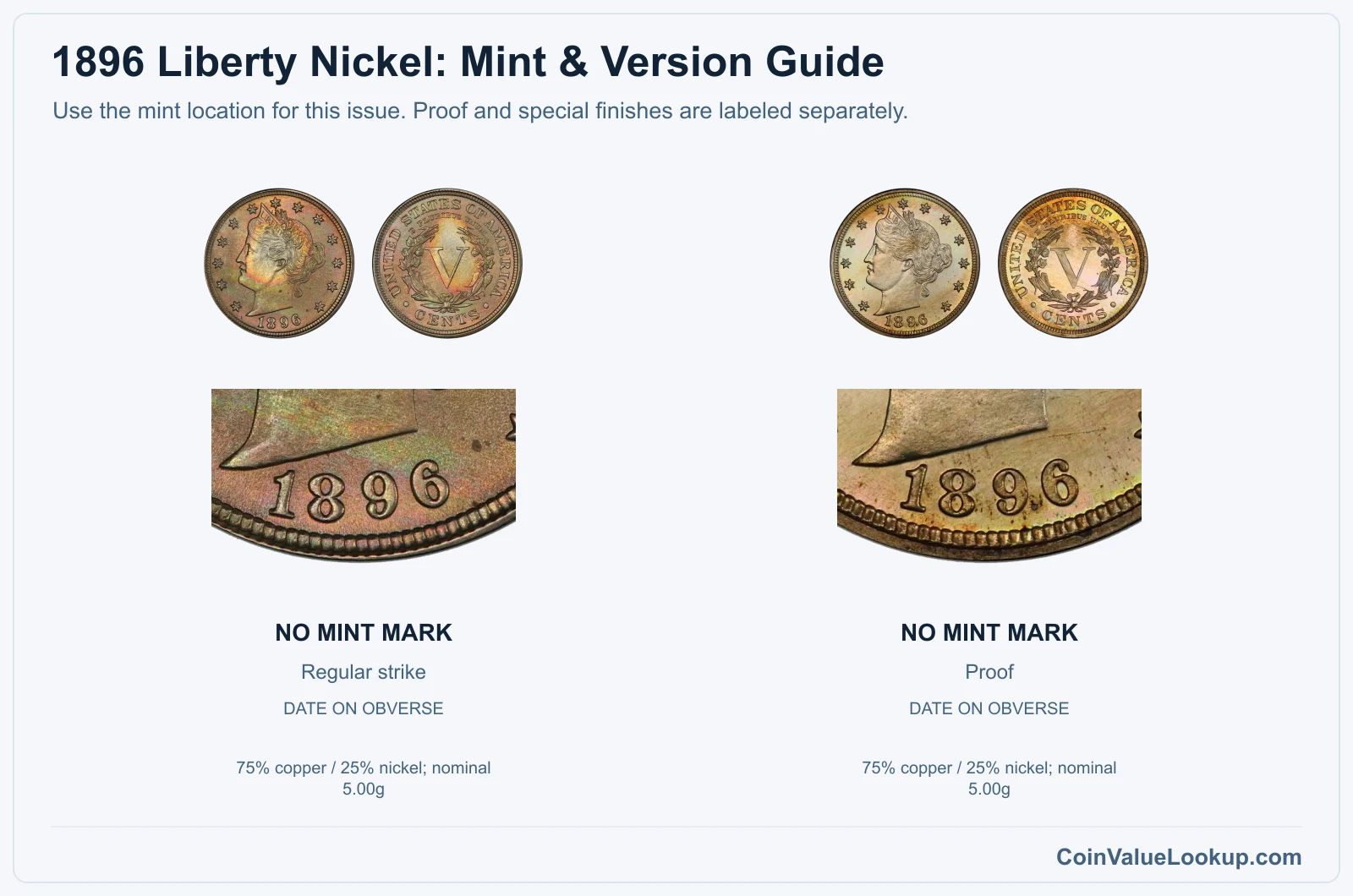
The 1896 Liberty Nickel was struck only at Philadelphia and exists in both business-strike and proof formats. A USA Coin Book guide snapshot places circulated examples around $11 in G4, with uncirculated pieces reaching roughly $330 in MS63.
Proofs carry a guide anchor of about $344 in PR63. Condition, originality of surfaces, and strike sharpness all matter when pinning down where your coin falls.
Fast Way to Identify Your 1896 Liberty Nickel
Want a quick read on your 1896 Liberty Nickel? Upload clear photos of both the front and back, and our identifier can offer a preliminary identification of the version and approximate condition.
Good lighting and a steady shot help — try to capture the full rim on each side so details like date clarity and reverse lettering are visible.
1896 Liberty Nickel Value
Upload both sides of your 1896 Liberty Nickel.
Front Obverse
Upload photo
Back Reverse
Upload photo
Which 1896 Liberty Nickel Versions Are Worth Money?
- Business strikes in MS63 carry a guide value around $330, making well-preserved uncirculated examples the ones to watch for among regular issues.
- Proofs in PR63 sit near $344 according to the same guide snapshot — original, unhairlined proof surfaces command attention.
- Coins showing a repunched date, die cracks, off-center strikes, or the rare die-cap error are worth inspecting closely, as these reported error types can carry premiums depending on visibility and condition.
Step 1: Identify Your 1896 Liberty Nickel Mint Mark and Version
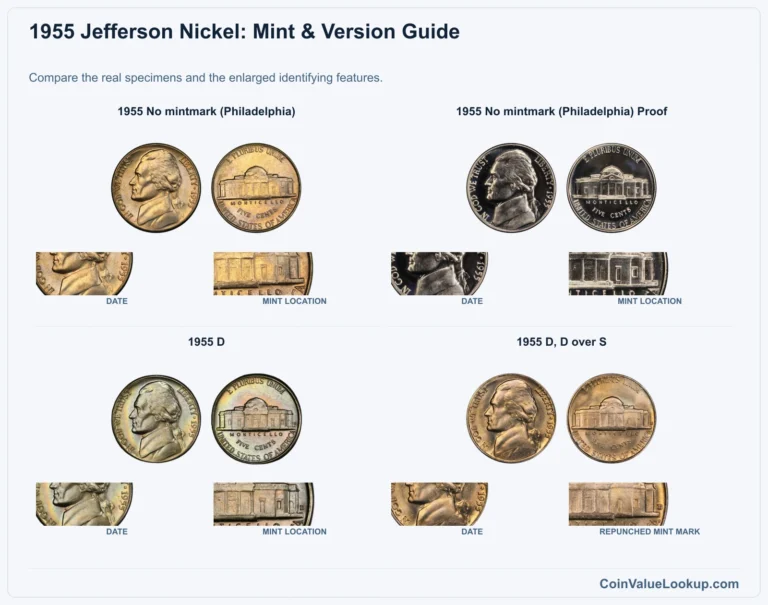
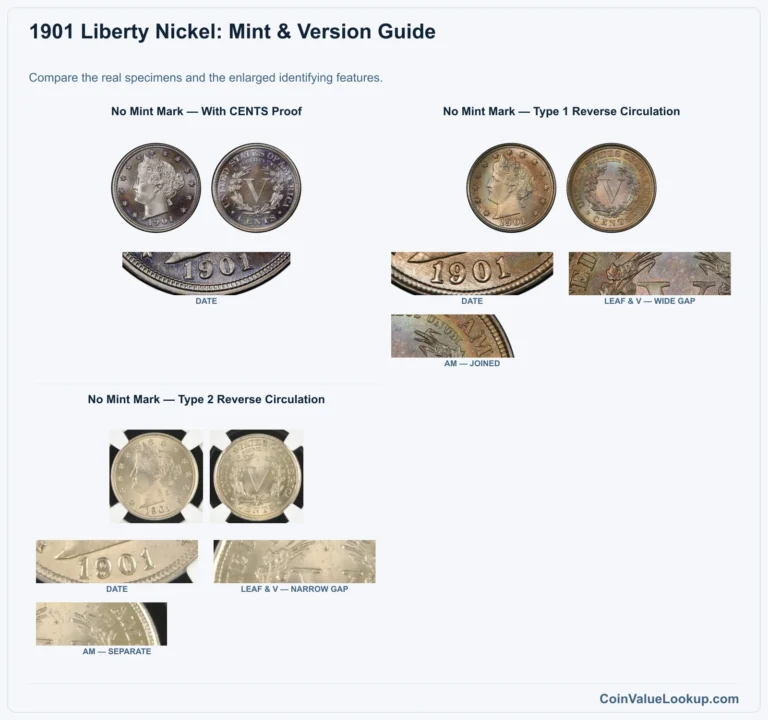
Every 1896 Liberty Nickel came from Philadelphia. There is no mintmark to hunt for, and no branch-mint version exists for this date.
The coin is struck in 75% copper and 25% nickel, weighs about 5 grams, measures 21.2 mm across, and has a plain edge.
All regular 1896 nickels carry the "CENTS" legend on the reverse — the "No CENTS" design was a one-year curiosity back in 1883 and does not apply here. If you see a coin labeled 1896 No CENTS, something is wrong.
One important quirk of the series: Liberty Nickels are notorious for weak strikes, especially in the hair detail above the forehead and on the reverse corn ears. A genuinely uncirculated coin can still look soft in those spots.
Do not assume mushy hair automatically means the coin circulated — check the fields and high points together before drawing conclusions.
Step 2: Check Your 1896 Liberty Nickel Grade
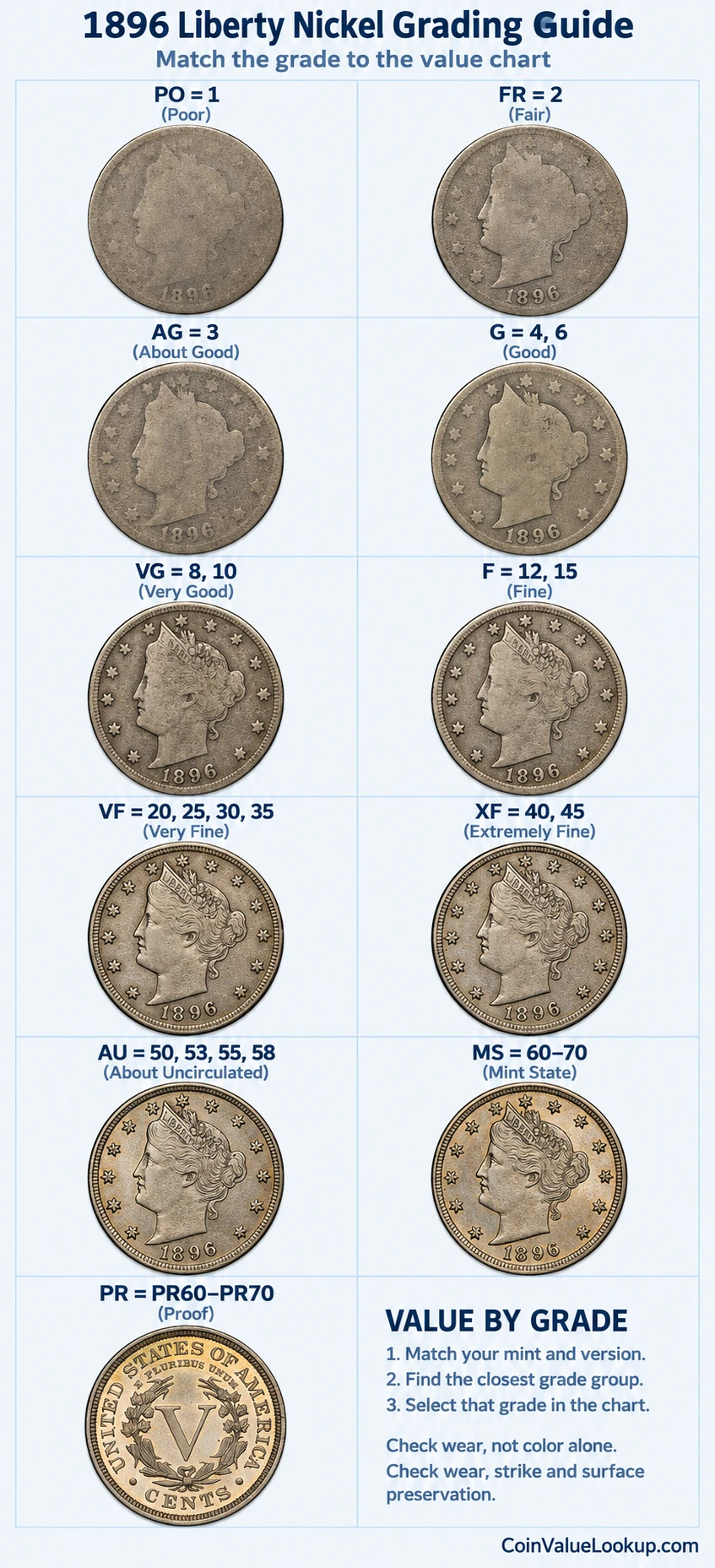
Start on the obverse. The word LIBERTY is stamped into the coronet (headband), and its letters wear down in a predictable order.
In lower grades the B and E go first, then the rest fade. The high curls of hair just above the forehead and the cheek below the eye are the next casualties of circulation.
Flip the coin over. The corn ears and leaves in the wreath lose definition quickly once a coin enters pocket change.
Sharp separation between individual kernels is a good sign.
Here is the catch: strike weakness on this series mimics wear. A coin with full mint luster and no contact marks on the cheek can still show flat hair detail simply because the dies did not fully impress the metal.
Compare your coin to the grading image and focus on whether the fields show cartwheel luster and the high points show rub — not just whether the hair looks soft.
Proof is a manufacturing method, not a grade higher than Mint State. Proof surfaces should appear mirror-like in the fields, and the rims are usually sharp and squared.
Hairlines from old cleaning are common on proofs and reduce the grade. Look at attributed examples for comparison before assuming you have one.
Step 3: Check 1896 Liberty Nickel Value by Mint and Version
1896 Liberty Nickel — No Mint Mark — With CENTS Circulation
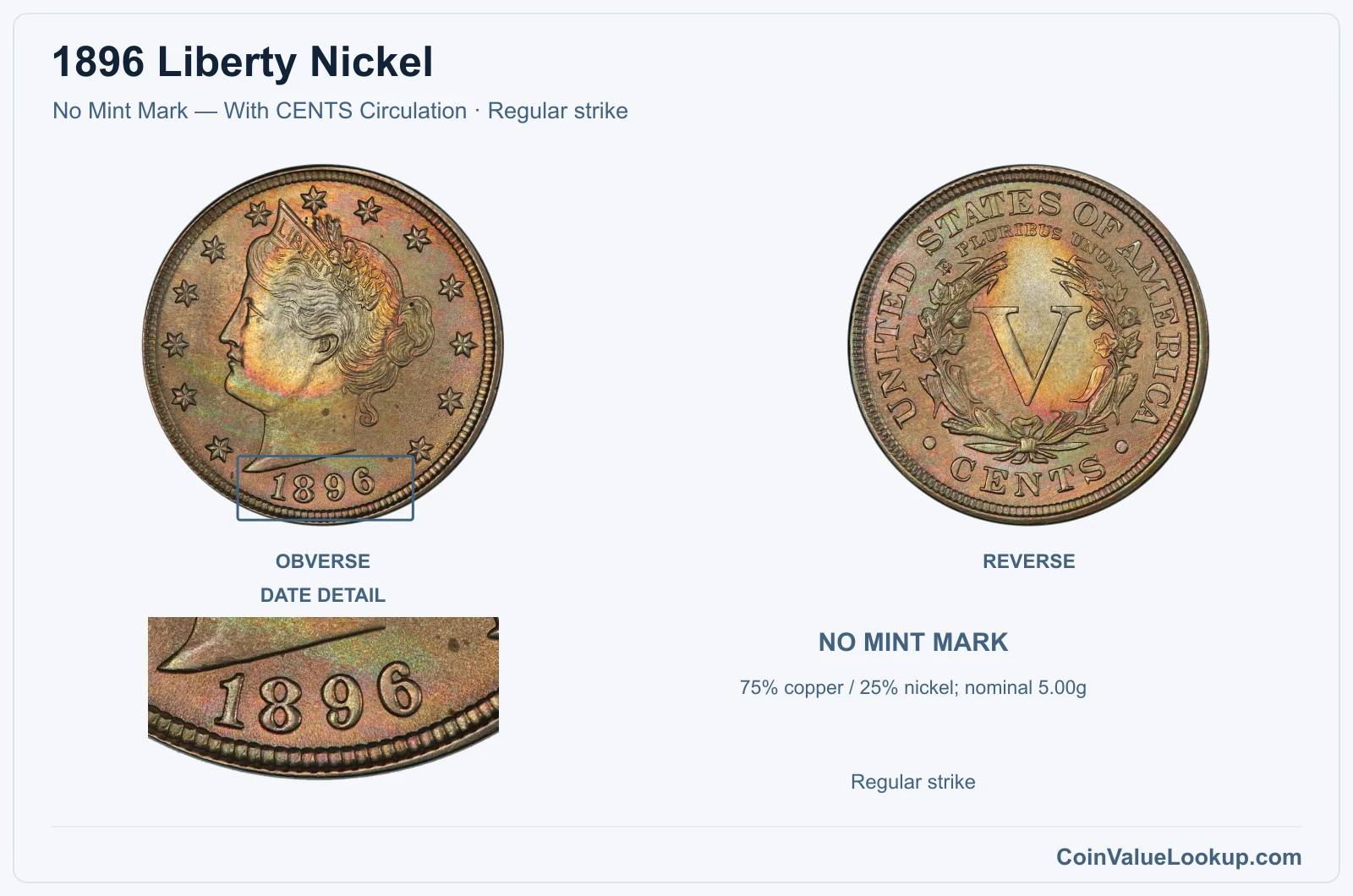
The standard 1896 business strike was produced at Philadelphia with no mintmark. It is a copper-nickel piece with the familiar With CENTS reverse.
A USA Coin Book guide estimate places it at about $11 in G4 and around $330 in MS63.
Strike quality varies. Some examples come well-struck with crisp hair curls; others look soft even in high grade.
When evaluating one of these, check for luster and contact marks rather than relying solely on sharpness of detail. A coin with full cartwheel luster and a flat spot on the hair may still be uncirculated — it just left the press that way.
Coin Value Lookup is a useful starting point if you want to look up guide values for other dates and denominations in the Liberty Nickel series or beyond.
Range Grade
Price Auction Records Appraisal PO PO 1
—
Coin Identifier FR FR 2
—
Coin Identifier AG AG 3
—
Coin Identifier G G 4
—
Coin Identifier
G 6
—
Coin Identifier VG VG 8
—
Coin Identifier
VG 10
—
Coin Identifier F F 12
—
Coin Identifier
F 15
—
Coin Identifier VF VF 20
Coin Identifier
VF 25
—
Coin Identifier
VF 30
Coin Identifier
VF 35
Coin Identifier XF XF 40
Coin Identifier
XF 45
Coin Identifier AU AU 50
Coin Identifier
AU 53
Coin Identifier
AU 55
Coin Identifier
AU 58
Coin Identifier MS MS 60
Coin Identifier
MS 61
Coin Identifier
MS 62
Coin Identifier
MS 63
Coin Identifier
MS 64
Coin Identifier
MS 65
Coin Identifier
MS 66
Coin Identifier
MS 67
—
Coin Identifier
MS 68
—
—
—
MS 69
—
—
—
MS 70
—
—
—
1896 Liberty Nickel — No Mint Mark — With CENTS Proof
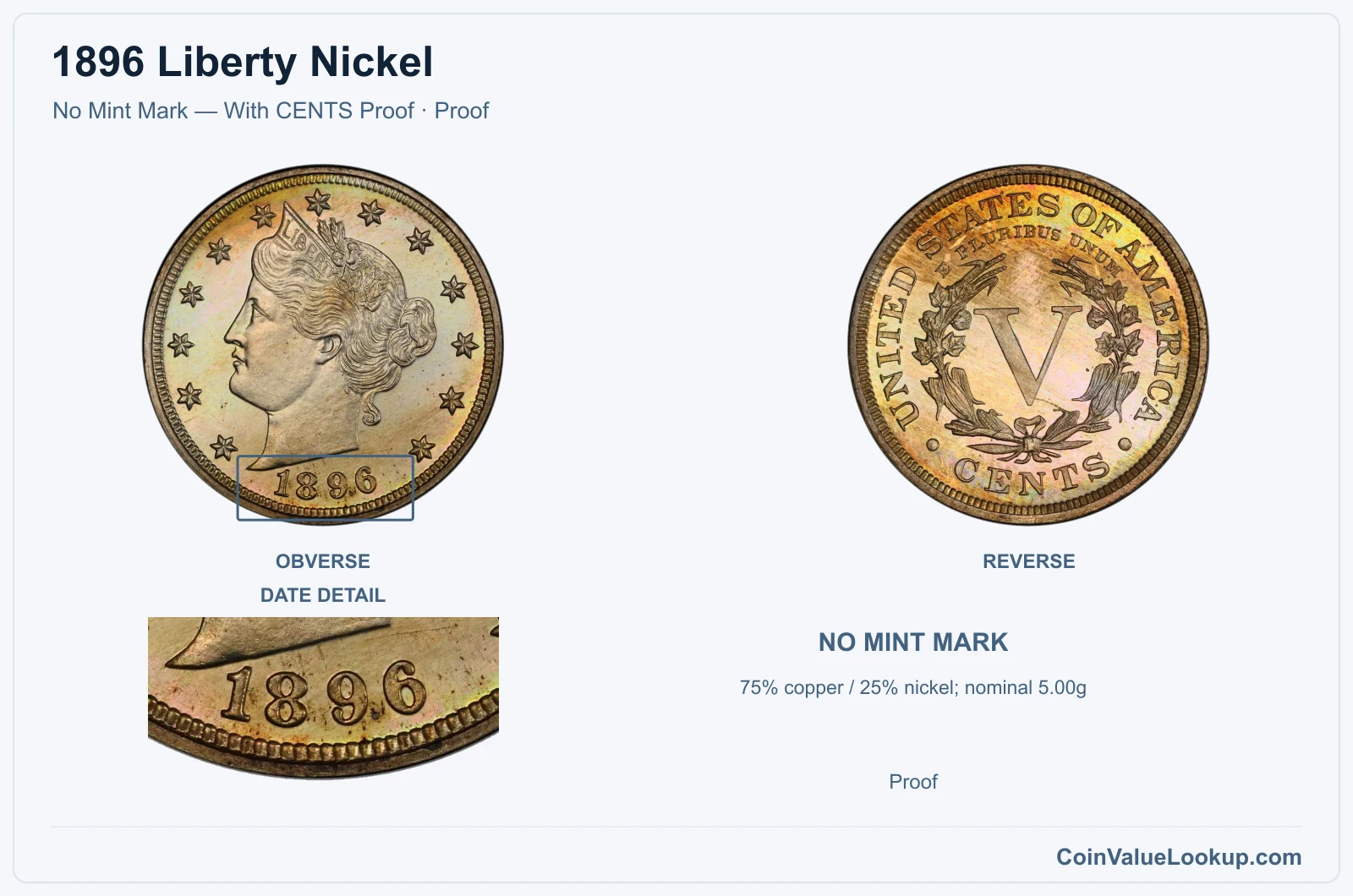
Philadelphia also produced proof Liberty Nickels in 1896 for collectors. The guide anchor from USA Coin Book sits at roughly $344 in PR63.
These were struck with polished dies on prepared planchets, producing mirror-like fields and sharp rims that distinguish them from even the best business strikes.
When examining a suspected proof, look at the flat areas of the fields under angled light. Genuine proof surfaces show deep reflectivity, not just a shiny coin that has been cleaned.
Hairlines from improper storage or old wiping are the most common issue with surviving proofs and will lower the grade. Rim sharpness and edge quality also help separate a proof from a well-struck business coin.
Condition, surface preservation, and the absence of hairlines all influence where a proof lands on the value scale.
Range Grade
Price Auction Records Appraisal PR PR 1
—
Coin Identifier
PR 2
—
Coin Identifier
PR 3
—
Coin Identifier
PR 4
—
Coin Identifier
PR 6
—
Coin Identifier
PR 8
—
Coin Identifier
PR 10
—
Coin Identifier
PR 12
—
Coin Identifier
PR 15
—
Coin Identifier
PR 20
—
Coin Identifier
PR 25
—
Coin Identifier
PR 30
—
Coin Identifier
PR 35
—
Coin Identifier
PR 40
—
Coin Identifier
PR 45
—
Coin Identifier
PR 50
—
Coin Identifier
PR 53
—
Coin Identifier
PR 55
—
Coin Identifier
PR 58
—
Coin Identifier
PR 60
—
Coin Identifier
PR 61
Coin Identifier
PR 62
Coin Identifier
PR 63
Coin Identifier
PR 64
Coin Identifier
PR 65
Coin Identifier
PR 66
Coin Identifier
PR 67
Coin Identifier
PR 68
—
—
—
PR 69
—
—
—
PR 70
—
—
—
1896 Liberty Nickel Error List
1. 1896 Liberty Nickel — Repunched Date
A repunched date on an 1896 Liberty Nickel shows remnants of an earlier position of one or more date numerals alongside the final placement. You are looking for ghost outlines or partial digits slightly offset from the accepted date — usually visible under magnification near the base or tops of the numbers.
This is a die variety, not a strike error. The date punch was applied more than once during die preparation, and each coin from that die carries the same doubling.
Do not confuse it with machine doubling, which produces flat, shelf-like doubling across the whole design, or with simple damage to the date area from a hit or corrosion.
At least one ANACS-attributed 1896 repunched-date specimen has been offered by dealers. Value depends on the visibility of the repunching, overall coin condition, and collector demand for the specific variety.
2. 1896 Liberty Nickel — Die Crack / Die Chip
Die cracks appear as thin raised lines running across the coin's surface, while die chips show up as small raised blobs in the field or on a design element. Both result from fractures in the steel die that transferred to every coin struck afterward.
A crack that connects from the rim inward is just a die crack. A larger break at the rim that leaves a raised, featureless lump is called a cud — a more dramatic form of the same problem.
Interior chips tend to be smaller and isolated.
Do not mistake incuse scratches, corrosion pitting, or foreign material stuck to the surface for a die crack. Die cracks are always raised above the surrounding surface because metal flowed into the fracture during striking.
The premium on any given die crack depends on its size, location, and the coin's overall condition.
3. 1896 Liberty Nickel — Off-Center Strike
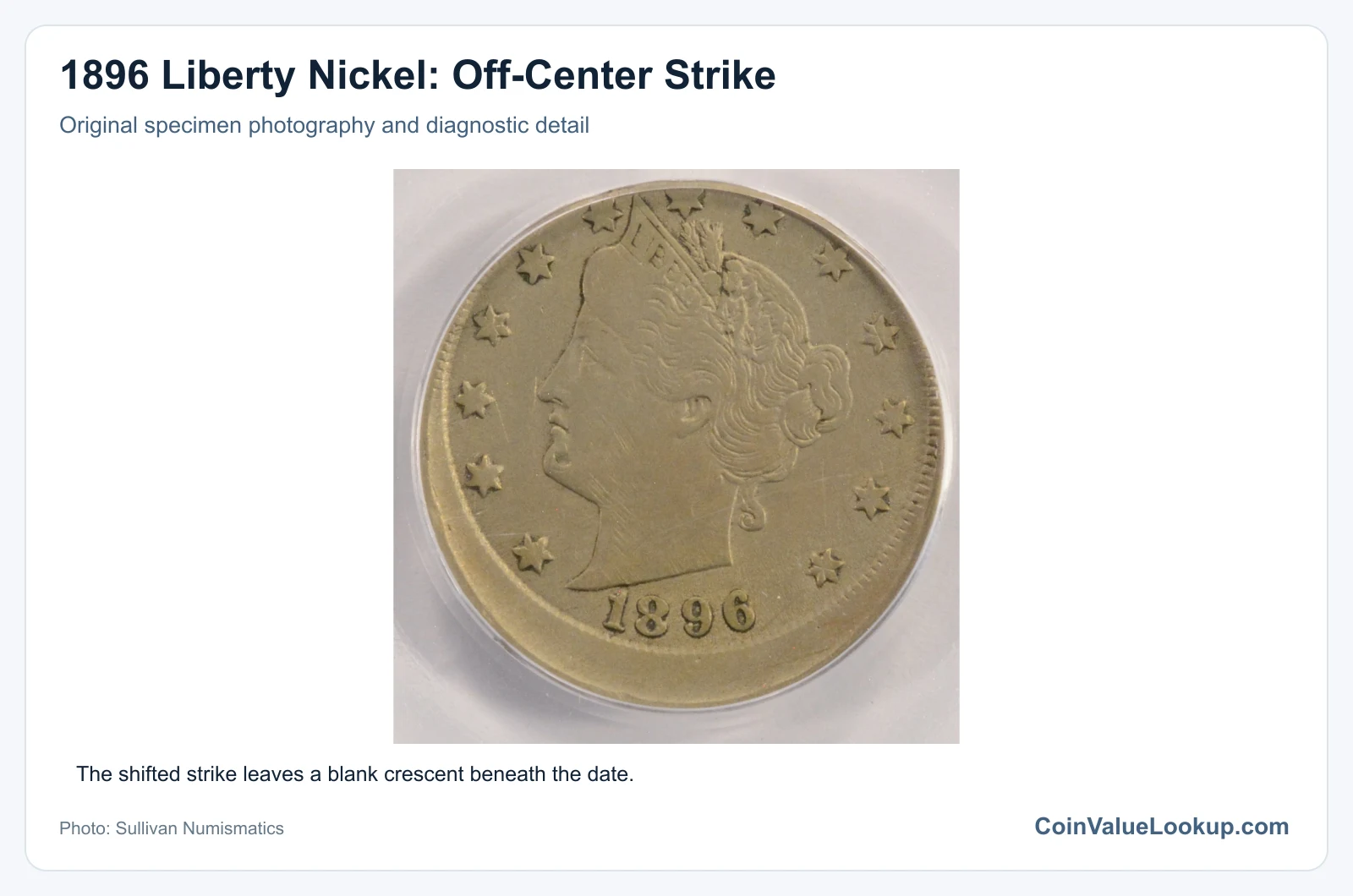
An off-center strike happens when the planchet is not properly seated between the dies. The result is a design that is shifted to one side, leaving a blank, unstruck crescent on the opposite edge.
The percentage of off-center displacement and whether the date remains visible are the two biggest factors in collectibility.
For an 1896 Liberty Nickel, a coin with a readable date and a noticeable off-center shift is more desirable than one where the date has been pushed off the planchet entirely. Look at the overall shape: the coin should still be round, not irregularly clipped or flattened on one side after leaving the mint.
Be careful not to confuse an off-center strike with a clipped planchet, which has a straight or curved cut before striking, or with post-mint damage like a coin that was bent or hammered unevenly. Value depends on the degree of misalignment, date visibility, and condition.
4. 1896 Liberty Nickel — Obverse Die Cap with Flip-Over Double Strike
This is a dramatic compound error. An obverse die cap forms when a struck coin sticks to the upper die and is carried along for subsequent strikes, eventually cupping around the die like a bottle cap.
The flip-over double strike adds a second impression from the opposite orientation, leaving overlapping designs on both faces.
At least one 1896 specimen has been documented — an MS66 example illustrated by Sullivan showing the characteristic cupped shape and dual-strike impressions. The entire coin is physically deformed into a cap shape, which immediately separates it from a merely bent or damaged coin.
A doubled die will show doubling confined to design elements without any physical distortion of the planchet itself. Post-mint impressions from vises or other objects can mimic a second strike but lack the uniform die-impression quality and the cupping.
Authentic examples of this compound error are rare, and value depends on the specific coin's condition and the clarity of both error features.