1869 Shield Nickel Coin Value: How Much Is It Worth?
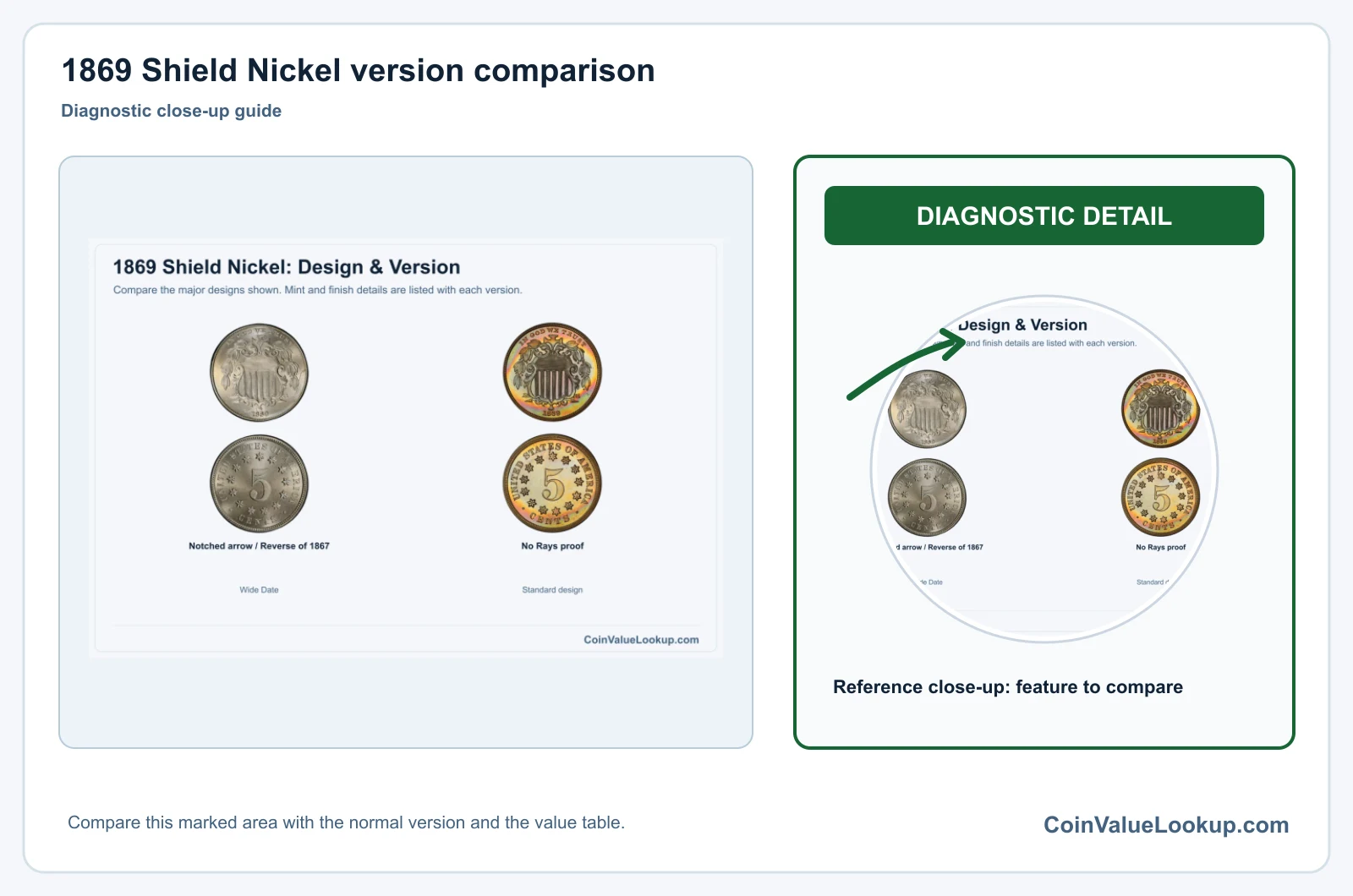
A typical 1869 Shield nickel runs about $38 in G4 and around $281 in MS63, based on USA Coin Book retail guide estimates. Proof examples and the several design sub-varieties carry their own pricing.
Before you spend or sell, you need to know exactly which version you have, because this single year produced multiple die combinations that collectors track separately.
Fast Way to Identify Your 1869 Shield Nickel
The quickest way to start figuring out what you have is to upload clear photos of the front and back of your coin. Good lighting and a steady hand go a long way.
From those images, we can help with a preliminary identification of your date style, arrow type, and reverse variety, so you know where to look next.
1869 Shield Nickel Value
Upload both sides of your 1869 Shield Nickel.
Front Obverse
Upload photo
Back Reverse
Upload photo
Which 1869 Shield Nickel Versions Are Worth Money?
- The Narrow Date variety is a distinct die style worth identifying separately from the four Wide Date combinations.
- Proof strikes in PR63 carry an adopted guide estimate of about $468, well above business-strike values in comparable condition.
- Several mint errors, including doubled die obverse, repunched date, die cracks, rotated dies, and clashed dies, have been reported for this year and can add premiums depending on visibility and condition.
Step 1: Identify Your 1869 Shield Nickel Mint Mark and Version
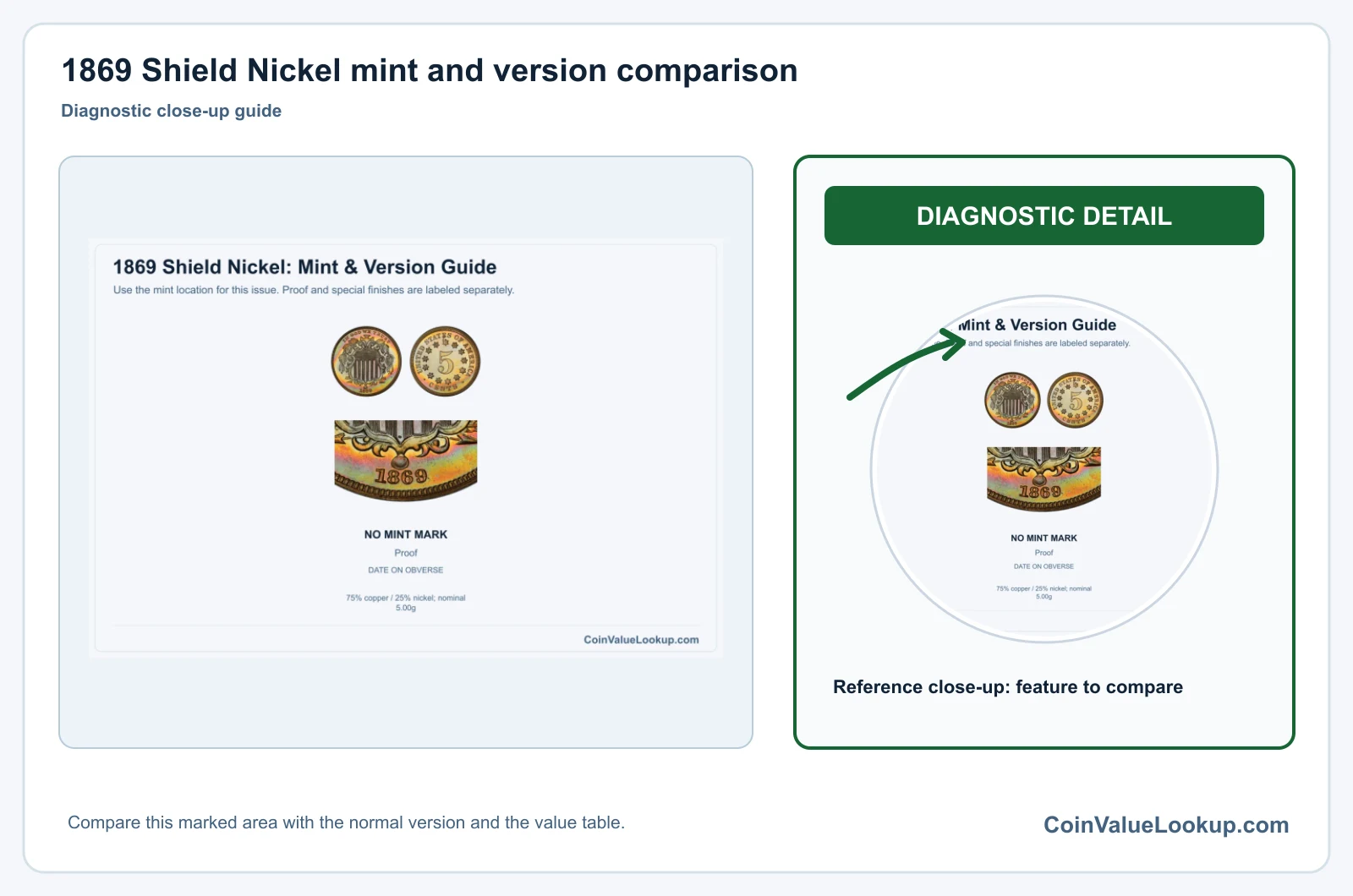
All 1869 Shield nickels were struck at Philadelphia, so there is no mintmark. A missing letter under the wreath is perfectly normal, not an error.
The coin is copper-nickel (75% copper, 25% nickel), weighs about 5 grams, measures 20.5 mm, and has a plain edge. No silver version exists for this date.
Your first job is deciding whether you have a Narrow Date or a Wide Date. Compare the horizontal spacing between the date numerals.
Narrow does not mean the digits are taller; it means they sit closer together.
If your coin is a Wide Date, you are not done yet. Wide Date pieces come in four design combinations built from two arrow styles (notched versus sliced) and two reverse hub types (Reverse of 1867 versus Reverse of 1870).
These are intentional die pairings, not accidental errors. Look closely at the arrow tips on the obverse and then match the reverse wreath and numeral style to the correct hub.
Once you have settled the design branch and confirmed whether the coin is a business strike or proof, then move to grading. And never clean the coin, no matter how rough it looks.
Step 2: Check Your 1869 Shield Nickel Grade
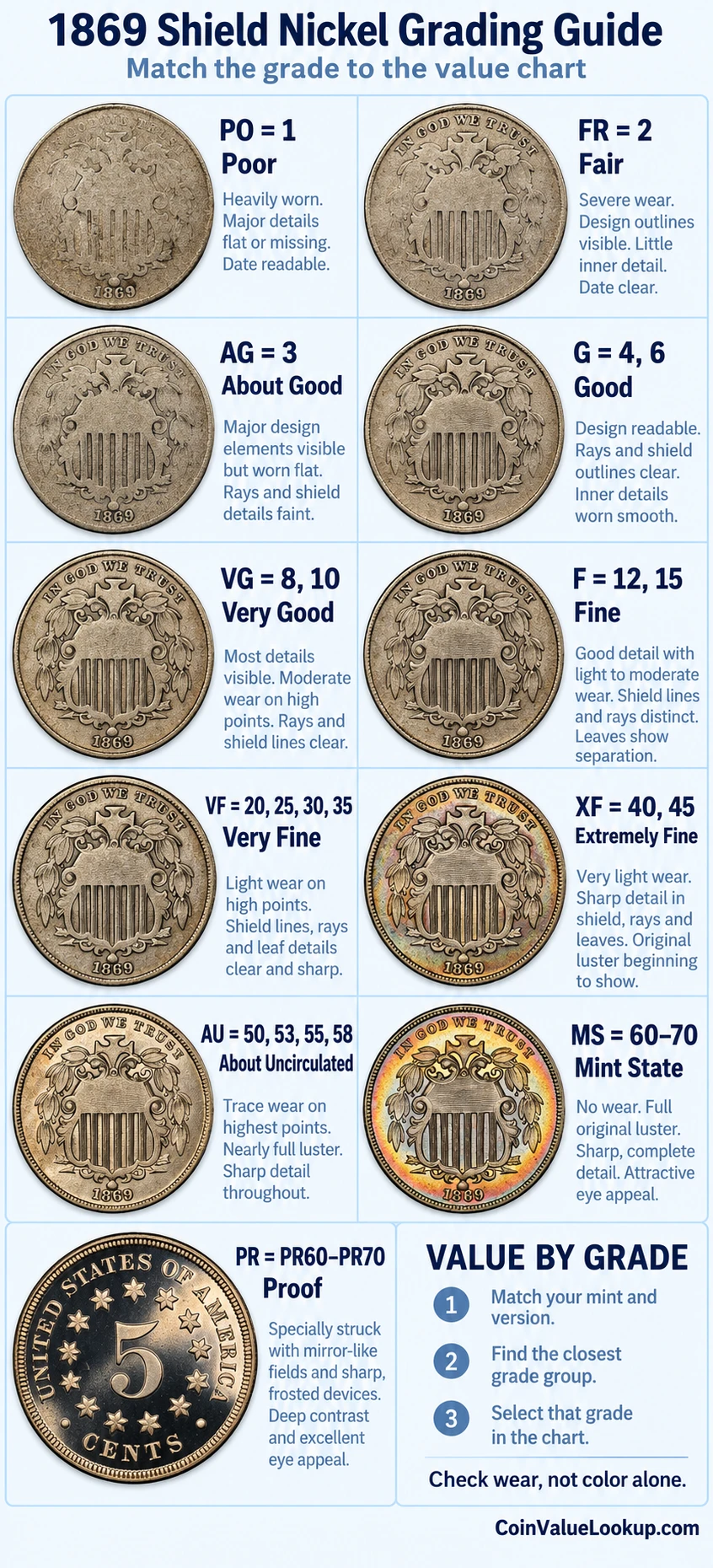
Start by checking the shield on the obverse. The horizontal lines across the shield and the vertical lines near the top are the first details to show wear.
If those lines are partly missing, look at the overall surface before blaming circulation. Shield nickels are notorious for weak original strikes that leave indistinct lines even on uncirculated coins.
Examine the cross above the shield and the leaves flanking the numeral 5 on the reverse. Genuine friction produces a different surface texture than a soft strike.
Compare luster patterns across both faces. An uncirculated coin with a weak strike still shows cartwheel luster; a worn coin does not.
Use the comparison image to match your coin against known grade benchmarks. Separate problem-free pieces from those with cleaning, corrosion, or damage.
Guide values assume a problem-free coin, so issues like old scratches or chemical residue push the realistic value well below those estimates.
Step 3: Check 1869 Shield Nickel Value by Mint and Version
1869 Shield Nickel — No Mint Mark — Narrow Date
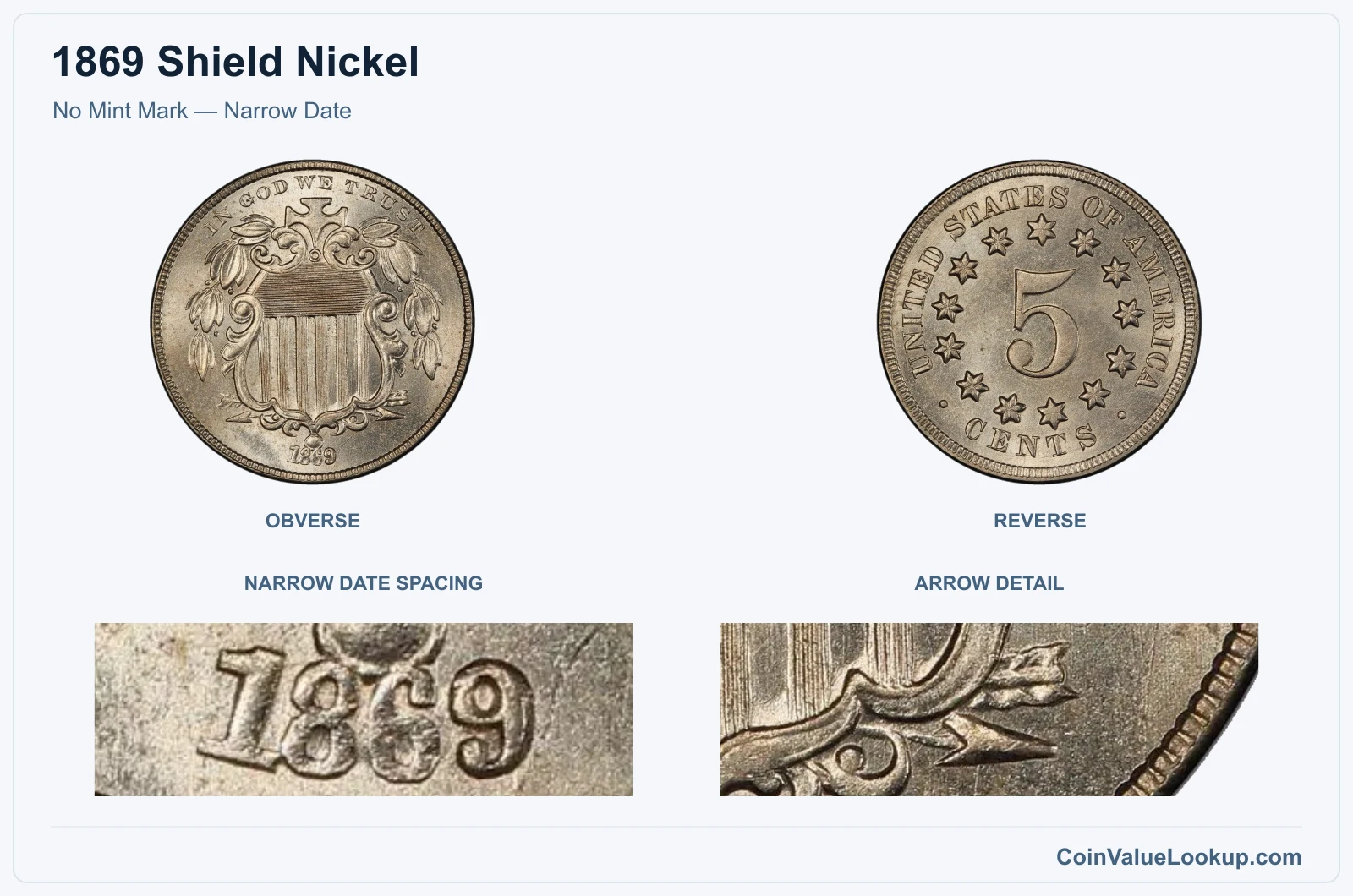
The Narrow Date 1869 uses a notched-arrow obverse paired with the Reverse of 1867. To identify it, compare the horizontal spread of the four date digits against a known Wide Date example.
On the Narrow Date the numerals sit measurably closer together. This is about spacing, not height or font weight.
No specific numeric price range has been adopted for this variety. Value depends on the coin's authenticated identity, its overall condition, and whether any errors are present.
A professional attribution from a grading service helps pin down what you actually have, because eyeballing date width under a desk lamp can fool you.
Ordinary-issue reference: Ordinary-issue reference only: The table below shows prices for the 1869 Shield Nickel (regular strike). It does not represent the value of the specific No Mint Mark — Narrow Date variety or its variety premium. Year, mint, metal and strike type are matched; the specific variety is not priced by this table.
Range Grade
Price Auction Records Appraisal PO PO 1
—
Coin Identifier FR FR 2
—
Coin Identifier AG AG 3
—
Coin Identifier G G 4
—
Coin Identifier
G 6
—
Coin Identifier VG VG 8
—
Coin Identifier
VG 10
—
Coin Identifier F F 12
—
Coin Identifier
F 15
—
Coin Identifier VF VF 20
—
Coin Identifier
VF 25
Coin Identifier
VF 30
Coin Identifier
VF 35
—
Coin Identifier XF XF 40
Coin Identifier
XF 45
Coin Identifier AU AU 50
Coin Identifier
AU 53
Coin Identifier
AU 55
Coin Identifier
AU 58
Coin Identifier MS MS 60
Coin Identifier
MS 61
Coin Identifier
MS 62
Coin Identifier
MS 63
Coin Identifier
MS 64
Coin Identifier
MS 65
Coin Identifier
MS 66
Coin Identifier
MS 67
Coin Identifier
MS 68
—
—
—
MS 69
—
—
—
MS 70
—
—
—
1869 Shield Nickel — No Mint Mark — Wide Date, Notched Arrow / Reverse of 1867
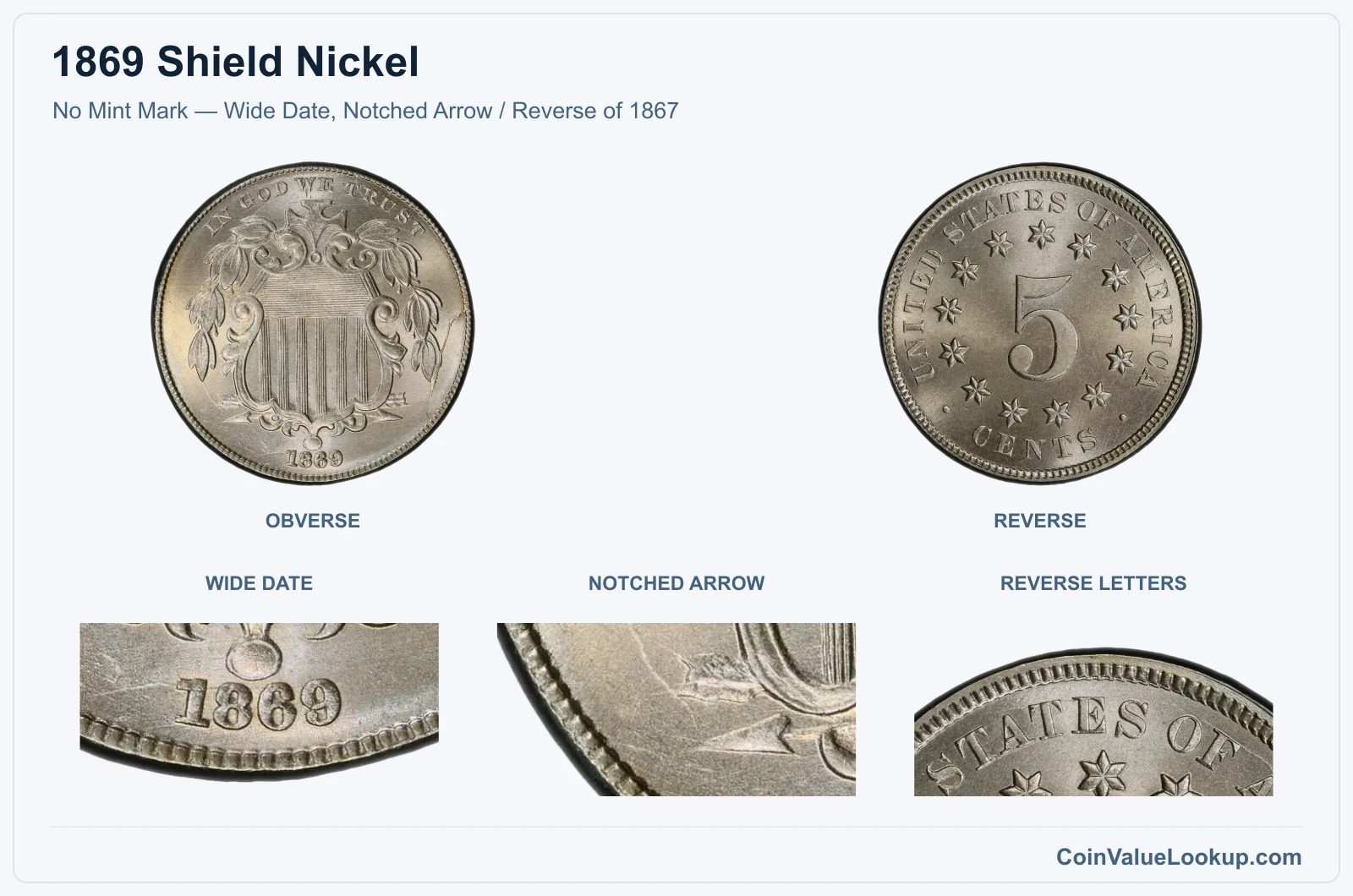
This is the Wide Date with a notched-arrow obverse and the Reverse of 1867. It is one of the more commonly encountered die pairings for 1869.
The wider digit spacing is visible to the naked eye once you know what to compare.
Look at the arrow tips on the obverse: a notched arrow shows a small step or notch in the arrowhead profile. Then flip to the reverse and confirm the wreath and numeral style match the 1867 hub.
No specific numeric price range has been adopted. Condition and any verified errors drive individual value, so authentication and grading matter here.
Ordinary-issue reference: Ordinary-issue reference only: The table below shows prices for the 1869 Shield Nickel (regular strike). It does not represent the value of the specific No Mint Mark — Wide Date, Notched Arrow / Reverse of 1867 variety or its variety premium. Year, mint, metal and strike type are matched; the specific variety is not priced by this table.
Range Grade
Price Auction Records Appraisal PO PO 1
—
Coin Identifier FR FR 2
—
Coin Identifier AG AG 3
—
Coin Identifier G G 4
—
Coin Identifier
G 6
—
Coin Identifier VG VG 8
—
Coin Identifier
VG 10
—
Coin Identifier F F 12
—
Coin Identifier
F 15
—
Coin Identifier VF VF 20
—
Coin Identifier
VF 25
Coin Identifier
VF 30
Coin Identifier
VF 35
—
Coin Identifier XF XF 40
Coin Identifier
XF 45
Coin Identifier AU AU 50
Coin Identifier
AU 53
Coin Identifier
AU 55
Coin Identifier
AU 58
Coin Identifier MS MS 60
Coin Identifier
MS 61
Coin Identifier
MS 62
Coin Identifier
MS 63
Coin Identifier
MS 64
Coin Identifier
MS 65
Coin Identifier
MS 66
Coin Identifier
MS 67
Coin Identifier
MS 68
—
—
—
MS 69
—
—
—
MS 70
—
—
—
1869 Shield Nickel — No Mint Mark — Wide Date, Notched Arrow / Reverse of 1870
Same notched-arrow obverse as the previous variety, but this time paired with the Reverse of 1870 hub. Yes, an 1869-dated coin can carry a reverse die originally made for the 1870 production run.
Match the hub, not the date, when attributing the reverse.
The reverse differences involve the wreath details and the style of the large numeral 5. Side-by-side comparison with a confirmed Reverse of 1867 piece makes the distinction clearer.
Coin Value Lookup is a useful starting point if you want to look up guide values for other dates and denominations in the Shield nickel series.
No adopted price range exists for this combination. Individual assessment based on authenticated identity and condition is the way to go.
Ordinary-issue reference: Ordinary-issue reference only: The table below shows prices for the 1869 Shield Nickel (regular strike). It does not represent the value of the specific No Mint Mark — Wide Date, Notched Arrow / Reverse of 1870 variety or its variety premium. Year, mint, metal and strike type are matched; the specific variety is not priced by this table.
Range Grade
Price Auction Records Appraisal PO PO 1
—
Coin Identifier FR FR 2
—
Coin Identifier AG AG 3
—
Coin Identifier G G 4
—
Coin Identifier
G 6
—
Coin Identifier VG VG 8
—
Coin Identifier
VG 10
—
Coin Identifier F F 12
—
Coin Identifier
F 15
—
Coin Identifier VF VF 20
—
Coin Identifier
VF 25
Coin Identifier
VF 30
Coin Identifier
VF 35
—
Coin Identifier XF XF 40
Coin Identifier
XF 45
Coin Identifier AU AU 50
Coin Identifier
AU 53
Coin Identifier
AU 55
Coin Identifier
AU 58
Coin Identifier MS MS 60
Coin Identifier
MS 61
Coin Identifier
MS 62
Coin Identifier
MS 63
Coin Identifier
MS 64
Coin Identifier
MS 65
Coin Identifier
MS 66
Coin Identifier
MS 67
Coin Identifier
MS 68
—
—
—
MS 69
—
—
—
MS 70
—
—
—
1869 Shield Nickel — No Mint Mark — Wide Date, Sliced Arrow / Reverse of 1867
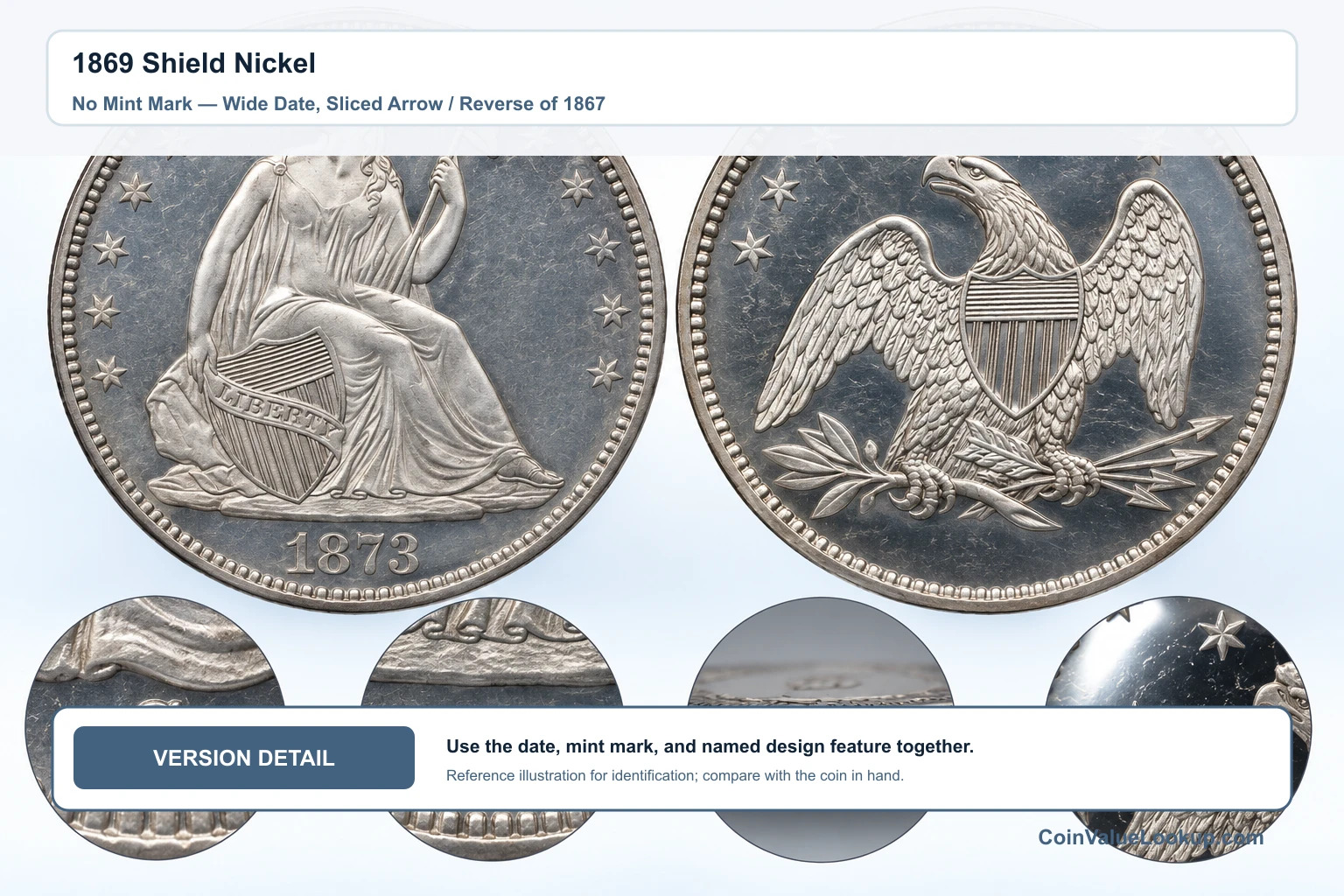
This is the scarce pairing: a sliced-arrow obverse with the Reverse of 1867. The sliced arrow lacks the notch found on the other obverse die.
The arrowhead profile is smoother and more tapered.
Because it is a less common combination, examples do not surface as often, and specialist interest can be higher. That said, no specific numeric price range has been adopted for this version.
The coin's condition, authentication, and any errors present will determine its individual value. Getting a professional opinion is especially worthwhile here.
Ordinary-issue reference: Ordinary-issue reference only: The table below shows prices for the 1869 Shield Nickel (regular strike). It does not represent the value of the specific No Mint Mark — Wide Date, Sliced Arrow / Reverse of 1867 variety or its variety premium. Year, mint, metal and strike type are matched; the specific variety is not priced by this table.
Range Grade
Price Auction Records Appraisal PO PO 1
—
Coin Identifier FR FR 2
—
Coin Identifier AG AG 3
—
Coin Identifier G G 4
—
Coin Identifier
G 6
—
Coin Identifier VG VG 8
—
Coin Identifier
VG 10
—
Coin Identifier F F 12
—
Coin Identifier
F 15
—
Coin Identifier VF VF 20
—
Coin Identifier
VF 25
Coin Identifier
VF 30
Coin Identifier
VF 35
—
Coin Identifier XF XF 40
Coin Identifier
XF 45
Coin Identifier AU AU 50
Coin Identifier
AU 53
Coin Identifier
AU 55
Coin Identifier
AU 58
Coin Identifier MS MS 60
Coin Identifier
MS 61
Coin Identifier
MS 62
Coin Identifier
MS 63
Coin Identifier
MS 64
Coin Identifier
MS 65
Coin Identifier
MS 66
Coin Identifier
MS 67
Coin Identifier
MS 68
—
—
—
MS 69
—
—
—
MS 70
—
—
—
1869 Shield Nickel — No Mint Mark — Wide Date, Sliced Arrow / Reverse of 1870
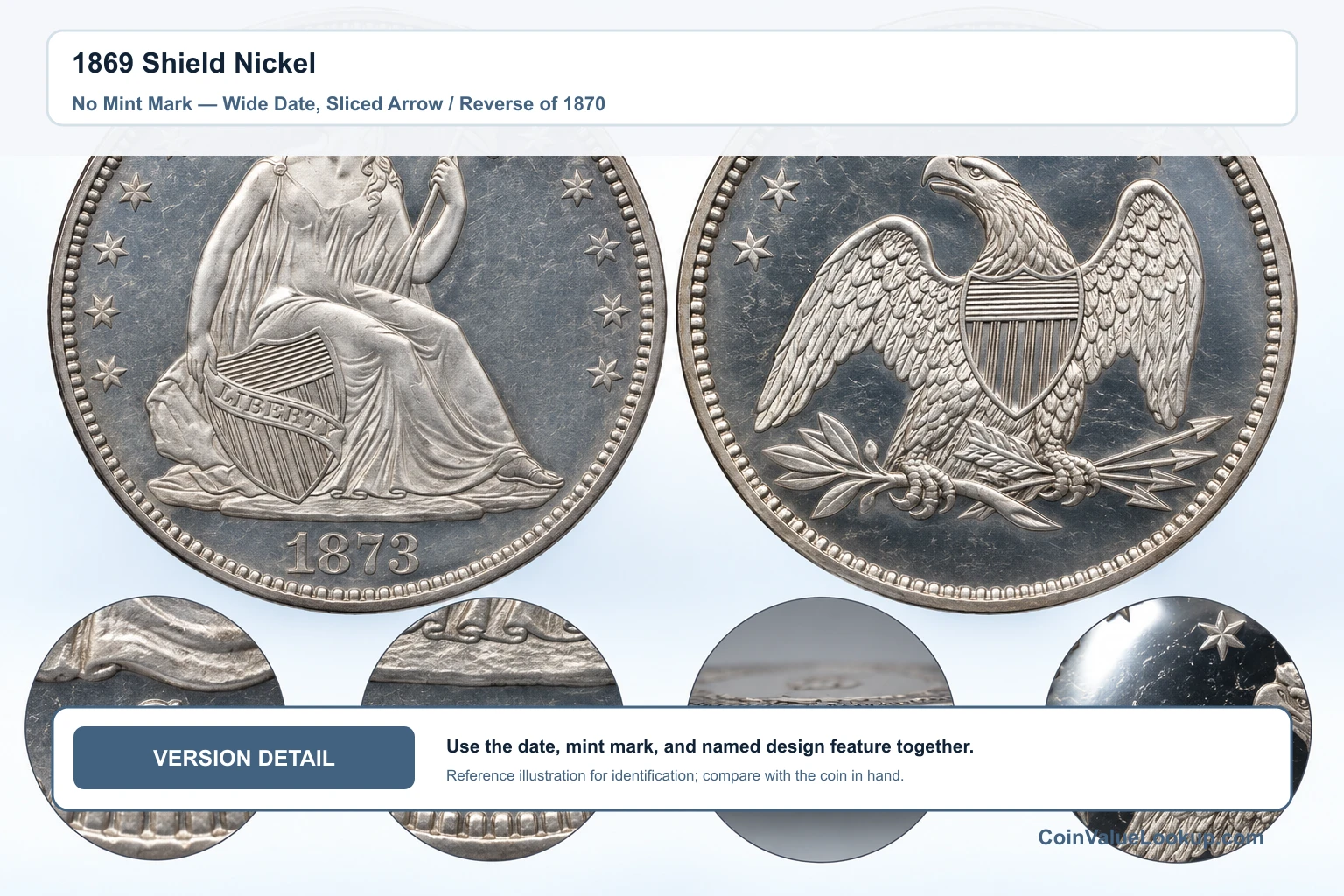
Wide Date, sliced-arrow obverse, Reverse of 1870. To confirm this variety you need to check both sides carefully.
The obverse arrow should show the smooth, sliced profile, and the reverse hub details should correspond to the 1870 type rather than 1867.
Compare the complete faces under good light, not just one feature in isolation. A single mismatch means you have a different die pairing.
No adopted numeric price range is available. As with every 1869 Shield nickel variety, value depends on authenticated identity, overall condition, and the presence or absence of mint errors.
Ordinary-issue reference: Ordinary-issue reference only: The table below shows prices for the 1869 Shield Nickel (regular strike). It does not represent the value of the specific No Mint Mark — Wide Date, Sliced Arrow / Reverse of 1870 variety or its variety premium. Year, mint, metal and strike type are matched; the specific variety is not priced by this table.
Range Grade
Price Auction Records Appraisal PO PO 1
—
Coin Identifier FR FR 2
—
Coin Identifier AG AG 3
—
Coin Identifier G G 4
—
Coin Identifier
G 6
—
Coin Identifier VG VG 8
—
Coin Identifier
VG 10
—
Coin Identifier F F 12
—
Coin Identifier
F 15
—
Coin Identifier VF VF 20
—
Coin Identifier
VF 25
Coin Identifier
VF 30
Coin Identifier
VF 35
—
Coin Identifier XF XF 40
Coin Identifier
XF 45
Coin Identifier AU AU 50
Coin Identifier
AU 53
Coin Identifier
AU 55
Coin Identifier
AU 58
Coin Identifier MS MS 60
Coin Identifier
MS 61
Coin Identifier
MS 62
Coin Identifier
MS 63
Coin Identifier
MS 64
Coin Identifier
MS 65
Coin Identifier
MS 66
Coin Identifier
MS 67
Coin Identifier
MS 68
—
—
—
MS 69
—
—
—
MS 70
—
—
—
1869 Shield Nickel — No Mint Mark — Proof
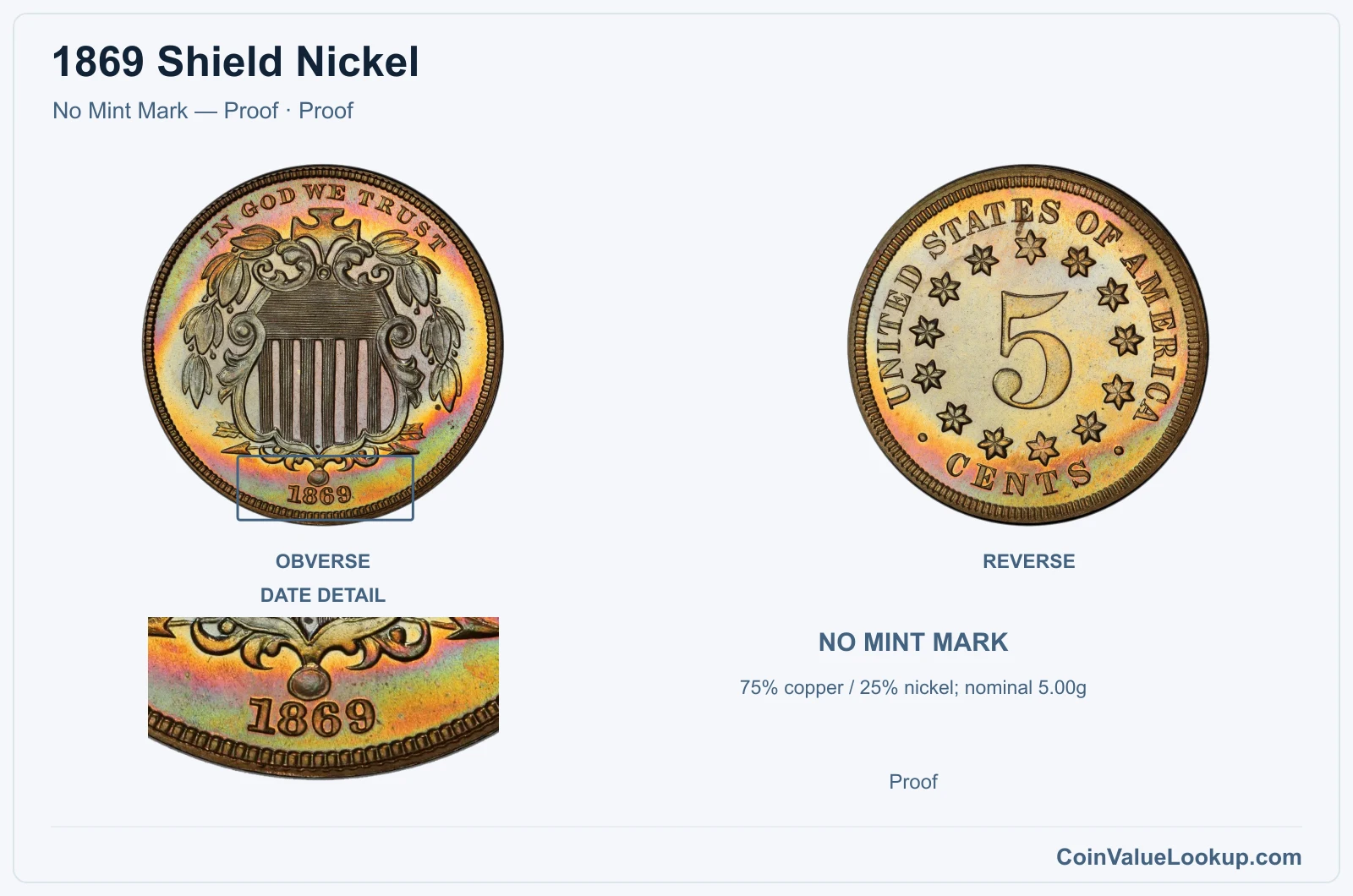
Philadelphia produced proof Shield nickels for collectors in 1869. These are copper-nickel, struck with polished dies on prepared planchets, resulting in mirrored fields and sharp design detail.
A proof is a manufacturing method, not a grade above Mint State.
In PR63, the USA Coin Book guide estimate sits at about $468. That is a retail guide figure, not a guaranteed sale price.
Higher-grade proofs and those with strong contrast between the fields and devices will command more.
Do not automatically apply a Narrow Date premium to a proof unless the date spacing has been specifically confirmed. Attribution matters here too.
Range Grade
Price Auction Records Appraisal PR PR 1
—
Coin Identifier
PR 2
—
Coin Identifier
PR 3
—
Coin Identifier
PR 4
—
Coin Identifier
PR 6
—
Coin Identifier
PR 8
—
Coin Identifier
PR 10
—
Coin Identifier
PR 12
—
Coin Identifier
PR 15
—
Coin Identifier
PR 20
—
Coin Identifier
PR 25
—
Coin Identifier
PR 30
—
Coin Identifier
PR 35
—
Coin Identifier
PR 40
—
Coin Identifier
PR 45
—
Coin Identifier
PR 50
—
Coin Identifier
PR 53
—
Coin Identifier
PR 55
—
Coin Identifier
PR 58
—
Coin Identifier
PR 60
—
Coin Identifier
PR 61
Coin Identifier
PR 62
Coin Identifier
PR 63
Coin Identifier
PR 64
Coin Identifier
PR 65
Coin Identifier
PR 66
Coin Identifier
PR 67
Coin Identifier
PR 68
Coin Identifier
PR 69
—
—
—
PR 70
—
—
—
1869 Shield Nickel Error List
1. 1869 Shield Nickel — Doubled Die Obverse
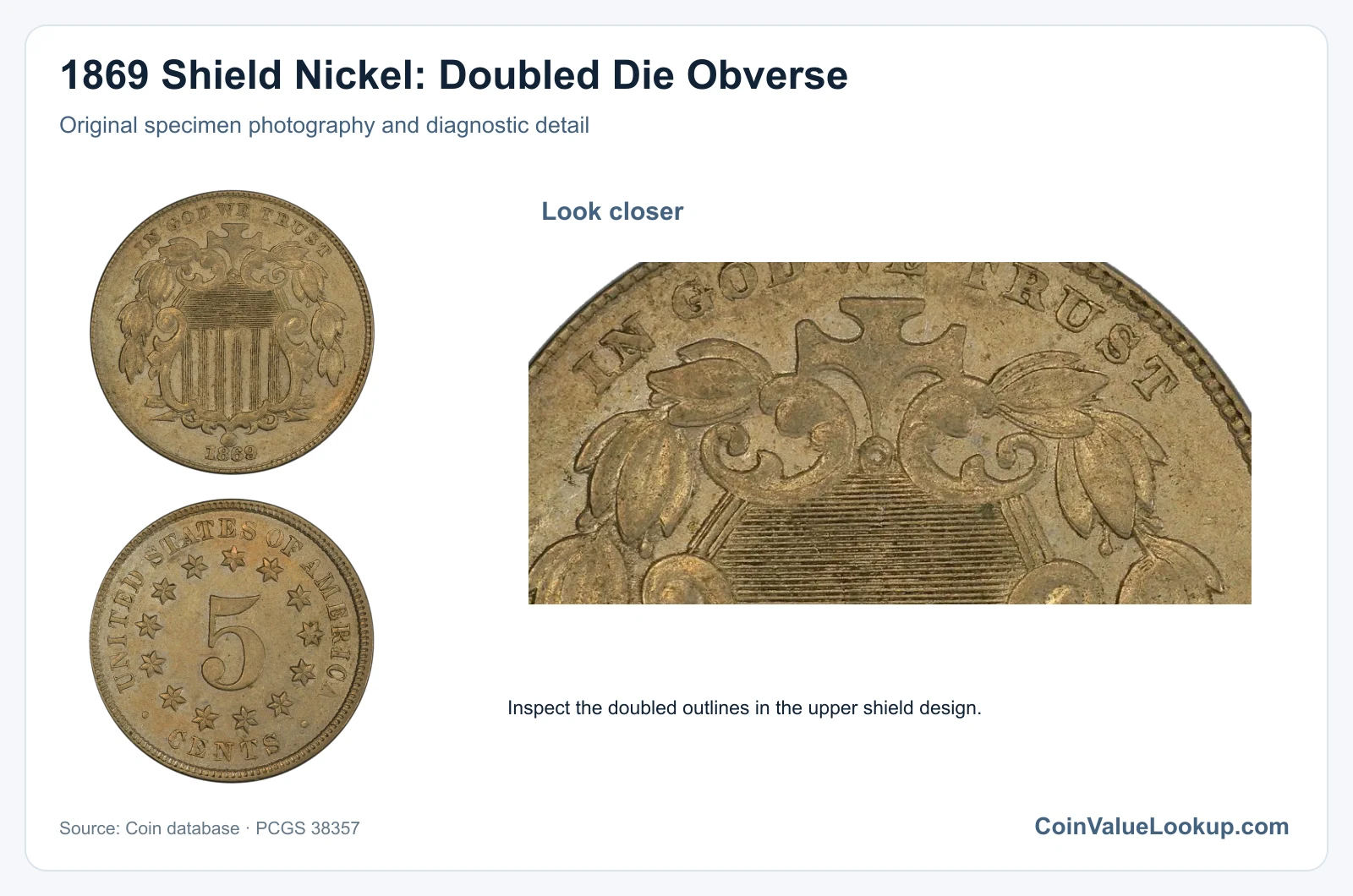
A doubled die obverse on an 1869 Shield nickel shows consistent doubling of the obverse design elements, such as the letters in the motto, the shield lines, or the date digits. Under magnification, look for clear separation or notching on the affected features.
The doubling should repeat in the same direction across multiple elements because it originates from a misaligned hub impression on the working die.
Do not confuse this with machine doubling, which typically appears as a flat, shelf-like distortion without the rounded secondary image of a true doubled die. Reflections under angled light can also mimic doubling.
No numerical price has been adopted. Value depends on the strength and visibility of the doubling, the coin's condition, and professional confirmation of the specific variety.
2. 1869 Shield Nickel — Repunched Date
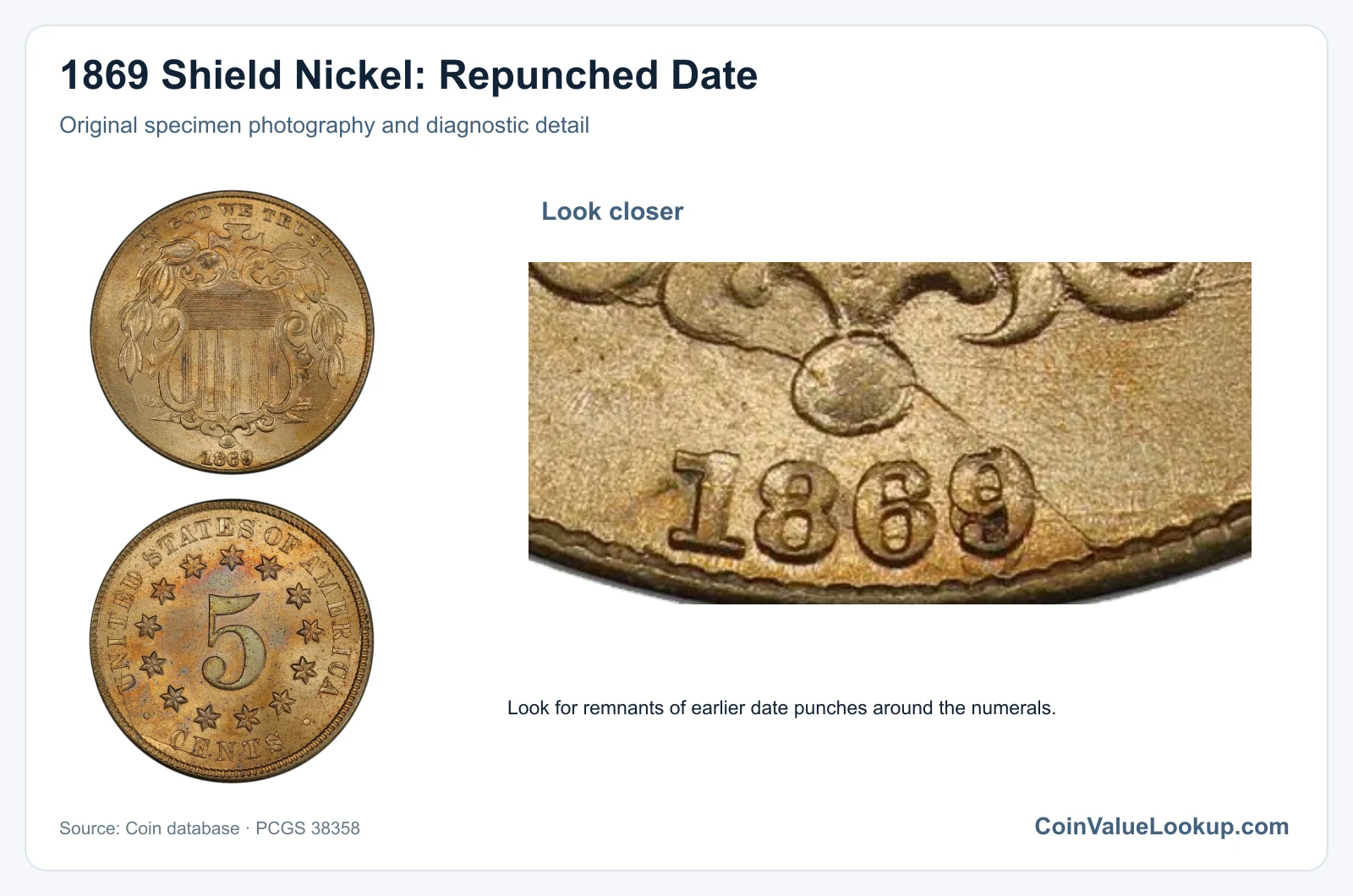
A repunched date occurs when one or more date numerals were punched into the die, then repositioned and punched again. On an 1869 Shield nickel, look for traces of the earlier punch position beside or beneath the final digits.
You may see partial outlines of a numeral slightly offset from where the finished digit sits.
This is a different mechanism than a doubled die. Doubled dies affect the entire obverse hub impression; a repunched date involves only the individually placed date numerals.
Be careful not to mistake post-strike damage or machine doubling for a genuine repunch. The remnants should look like ghostly portions of the original digit in a consistent secondary position.
No numerical price range has been adopted; condition, clarity, and professional attribution determine what a specific example is worth.
3. 1869 Shield Nickel — Die Crack / Die Chip
Die cracks appear as raised lines on the coin's surface, created when the steel die itself fractured during use. On an 1869 Shield nickel, these can run through the design or connect to the rim.
A die chip shows up as a small raised blob where a piece of the die broke away.
An interior chip differs from a rim-connected cud. A cud is a larger, flat area at the edge where a section of the die rim broke off entirely.
Do not confuse die cracks with incuse scratches, surface corrosion, or foreign material stuck to the coin. Cracks are raised because they are impressions of a void in the die.
Scratches are cut into the surface. No numerical price has been adopted; premiums depend on the size, location, and visual drama of the crack, plus overall coin condition.
4. 1869 Shield Nickel — Rotated Dies
On a properly aligned US coin, if you hold the obverse upright and flip the coin top to bottom, the reverse should also appear upright. A rotated die error means the reverse is turned some number of degrees off that normal axis.
To test your 1869 Shield nickel, hold the obverse so the date reads correctly, then rotate the coin on its vertical axis like turning a book page. If the reverse numeral 5 and stars are tilted, you may have a rotation error.
Make sure you are not just looking at a photograph that was rotated independently, or holding the coin sideways by accident. No numerical price has been adopted.
The degree of rotation, the coin's condition, and professional verification all affect what a collector would pay.
5. 1869 Shield Nickel — Clashed Dies
Clashed dies happen when the obverse and reverse dies strike each other without a planchet between them. The resulting ghost impressions transfer design elements from one side onto the opposite die, and every coin struck afterward carries those traces until the die is retired or resurfaced.
On an 1869 Shield nickel, look for faint outlines of the reverse wreath or numeral appearing in the obverse fields, or vice versa. The transferred features should align with where the opposite design would sit during a normal strike.
Do not confuse clash marks with random scratches, incuse lines from contact damage, or a brockage, which involves an actual coin stuck to the die. No numerical price has been adopted for clashed-die examples of this date.
Value depends on the clarity of the clash, overall condition, and authenticated confirmation.