1872 Shield Nickel Coin Value: How Much Is It Worth?
An 1872 Shield Nickel in circulated condition runs roughly $50 in G4 and climbs to around $376 in MS63, according to USA Coin Book retail estimates. Proofs carry their own pricing.
These figures are guide estimates, not guaranteed sale prices, and actual results depend on the specific coin's condition, variety and authentication status.
Fast Way to Identify Your 1872 Shield Nickel
The quickest way to start figuring out what you have is to upload clear photos of both the front and back of your coin. Our identifier can give you a preliminary read on the design type and general condition.
It is not a substitute for professional authentication or precise grading, but it points you in the right direction fast.
1872 Shield Nickel Value
Upload both sides of your 1872 Shield Nickel.
Front Obverse
Upload photo
Back Reverse
Upload photo
Which 1872 Shield Nickel Versions Are Worth Money?
- Circulation strikes come in two obverse hub types, sliced arrow and full arrow, which require careful lower-obverse inspection to distinguish.
- Mint State examples and properly authenticated proofs are worth closer evaluation against their respective guide values.
- Doubled die obverse and reverse varieties, repunched dates, die cracks, and rotated dies have all been reported for this year and can carry premiums depending on visibility and condition.
Step 1: Identify Your 1872 Shield Nickel Mint Mark and Version
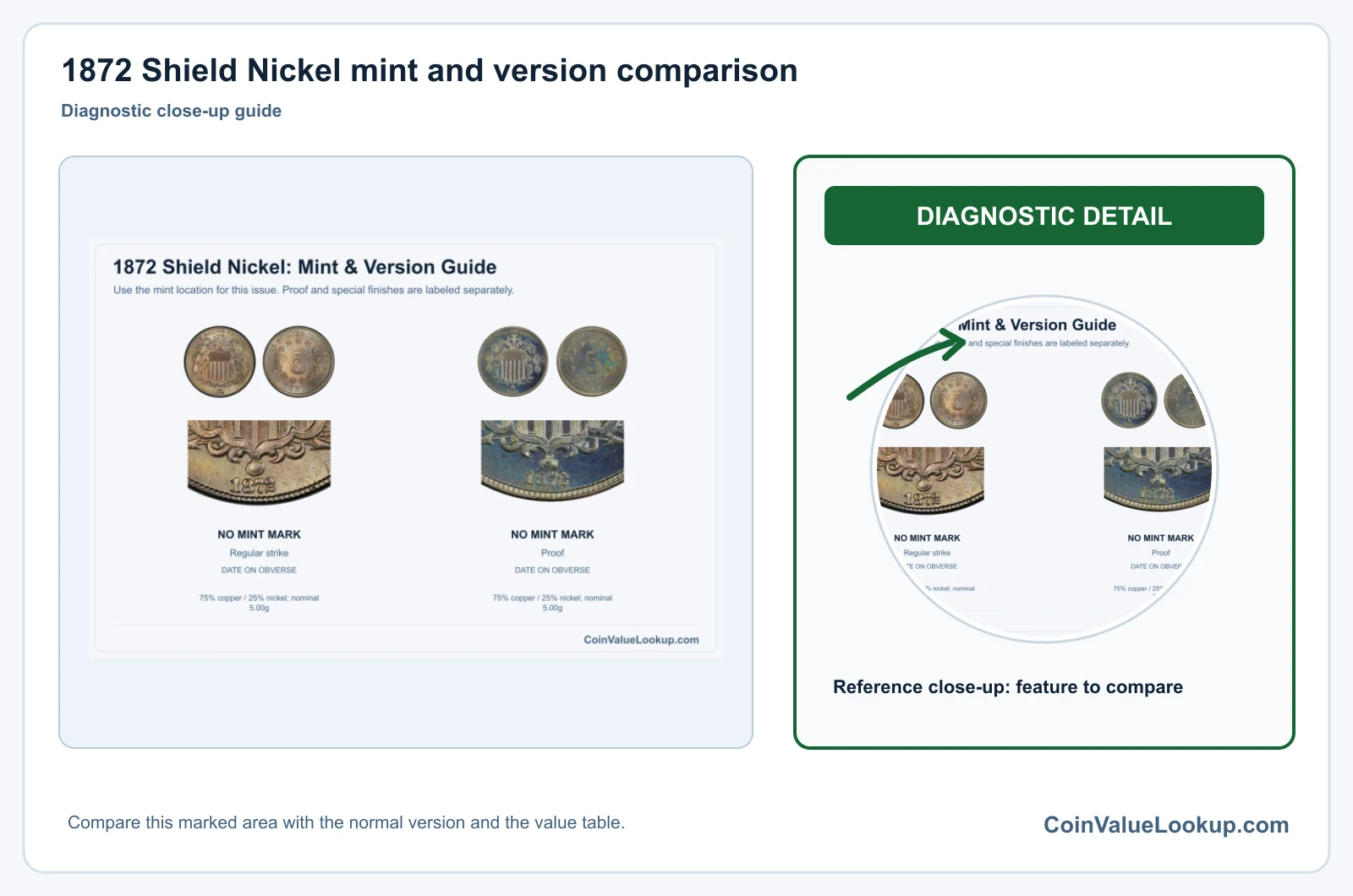
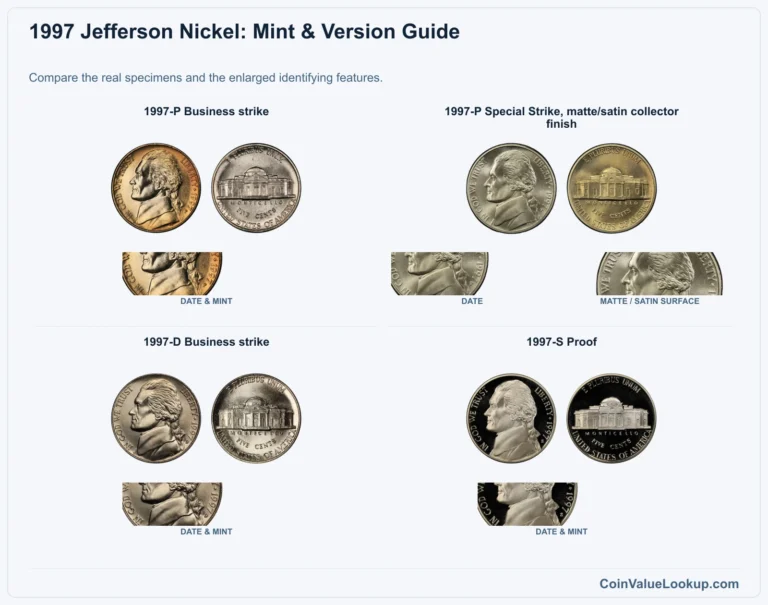
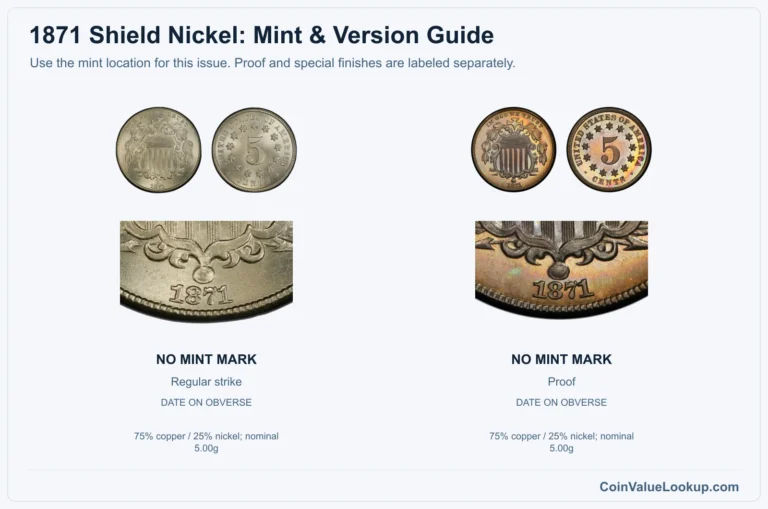
Every 1872 Shield Nickel was struck at the Philadelphia Mint, so there is no mintmark anywhere on the coin. A missing letter does not mean you have a rare variety; it is simply how they were made.
The obverse shows a prominent shield with a cross and vertical and horizontal stripes, surrounded by stars and the date at the bottom. The reverse displays a large numeral 5 encircled by stars and rays-free open fields.
The coin is copper-nickel, 75% copper and 25% nickel, weighing about 5 grams on a 20.5 mm plain-edge planchet. There is no silver version of this date.
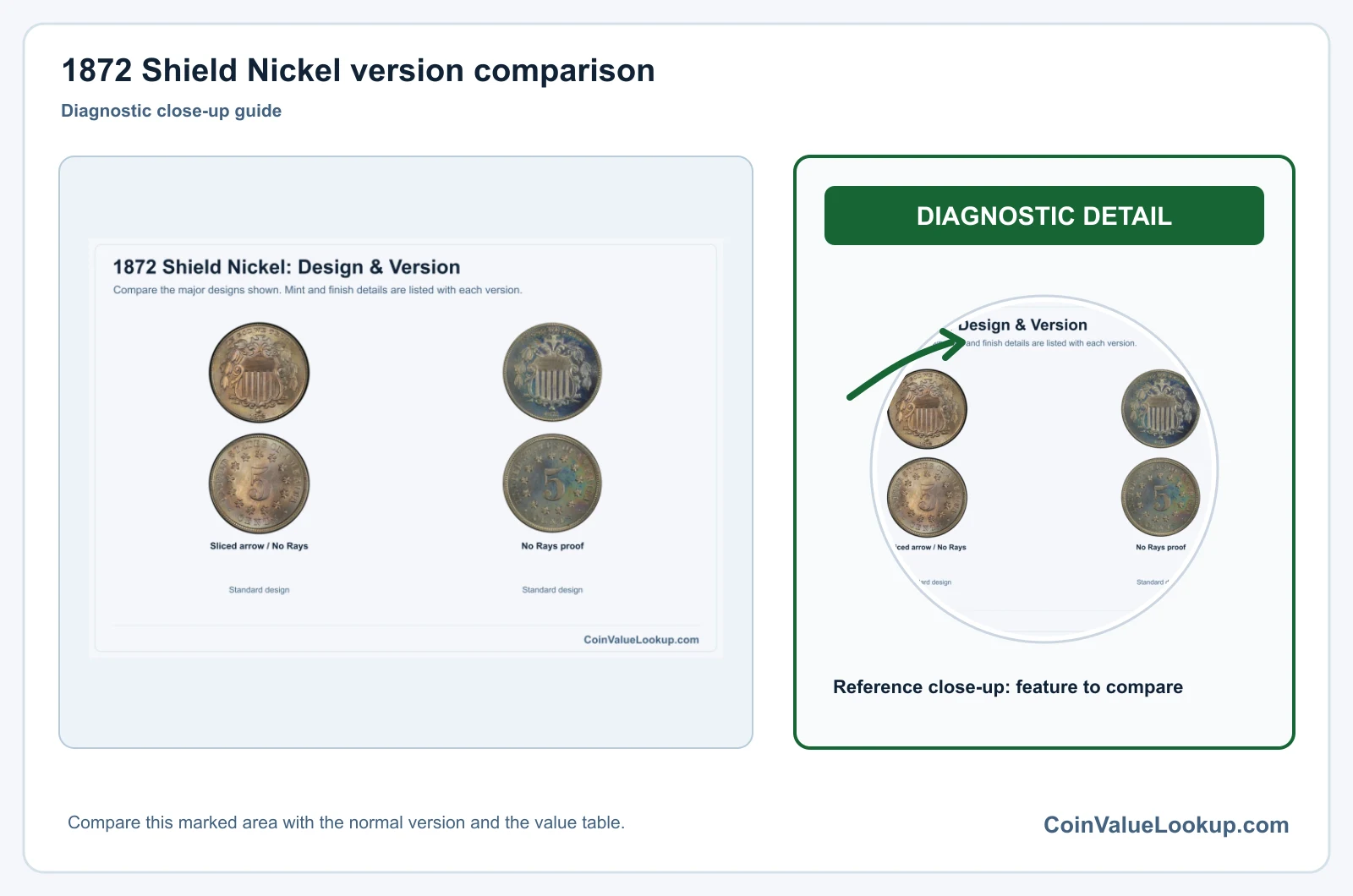
Within the circulation strikes, two obverse hub types exist. One features a sliced or partially visible arrow below the shield, and the other shows a fuller arrow.
Check the lower obverse carefully to see which version your coin matches. These are design-hub differences, not mintmark varieties.
Multiple doubled-die varieties and a repunched date have also been reported for 1872. Before worrying about those, first settle whether your coin is a business strike or a proof, and note its obverse arrow style.
And please, never clean it.
Step 2: Check Your 1872 Shield Nickel Grade
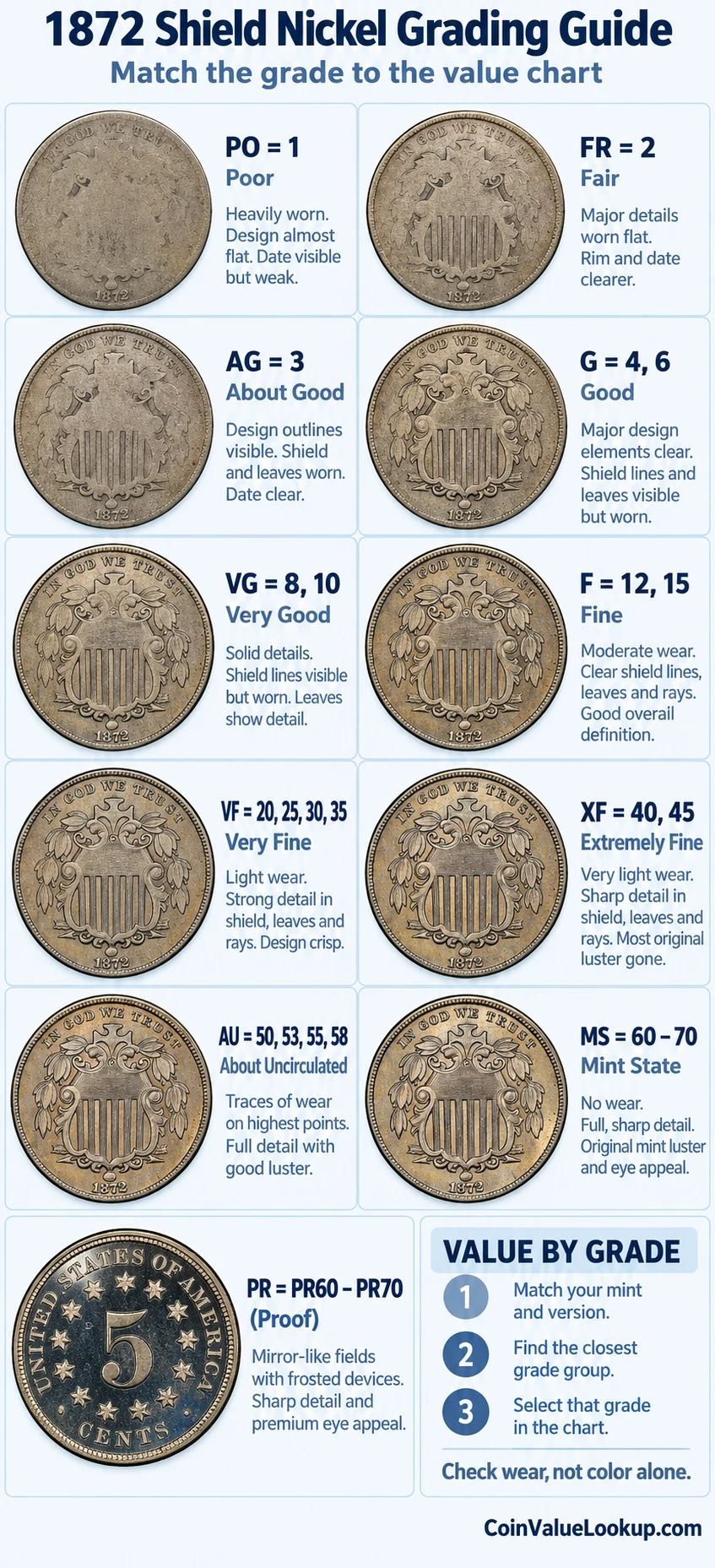
Start by looking at the shield on the obverse. In higher grades the horizontal and vertical lines inside the shield are sharp and fully separated.
As the coin wears, those lines merge, especially at the center and the upper portions of the cross.
One catch with Shield Nickels: a weakly struck coin can look worn even if it never circulated. Check the luster across the entire surface.
A coin that still has original cartwheel luster but shows soft shield lines was probably struck from a tired die, not spent in someone's pocket.
On the reverse, the stars and the numeral 5 lose definition progressively. Compare both sides together.
If one face looks significantly more worn than the other, something unusual may be going on, such as an off-center strike or post-mint damage.
Use the comparison image to match your coin's overall sharpness. Separate any coin with cleaning, corrosion or visible damage from the problem-free guide values listed here.
Problem coins trade at steep discounts and most published guides assume original, undamaged surfaces.
Step 3: Check 1872 Shield Nickel Value by Mint and Version
1872 Shield Nickel — No Mint Mark — Sliced Arrow Obverse
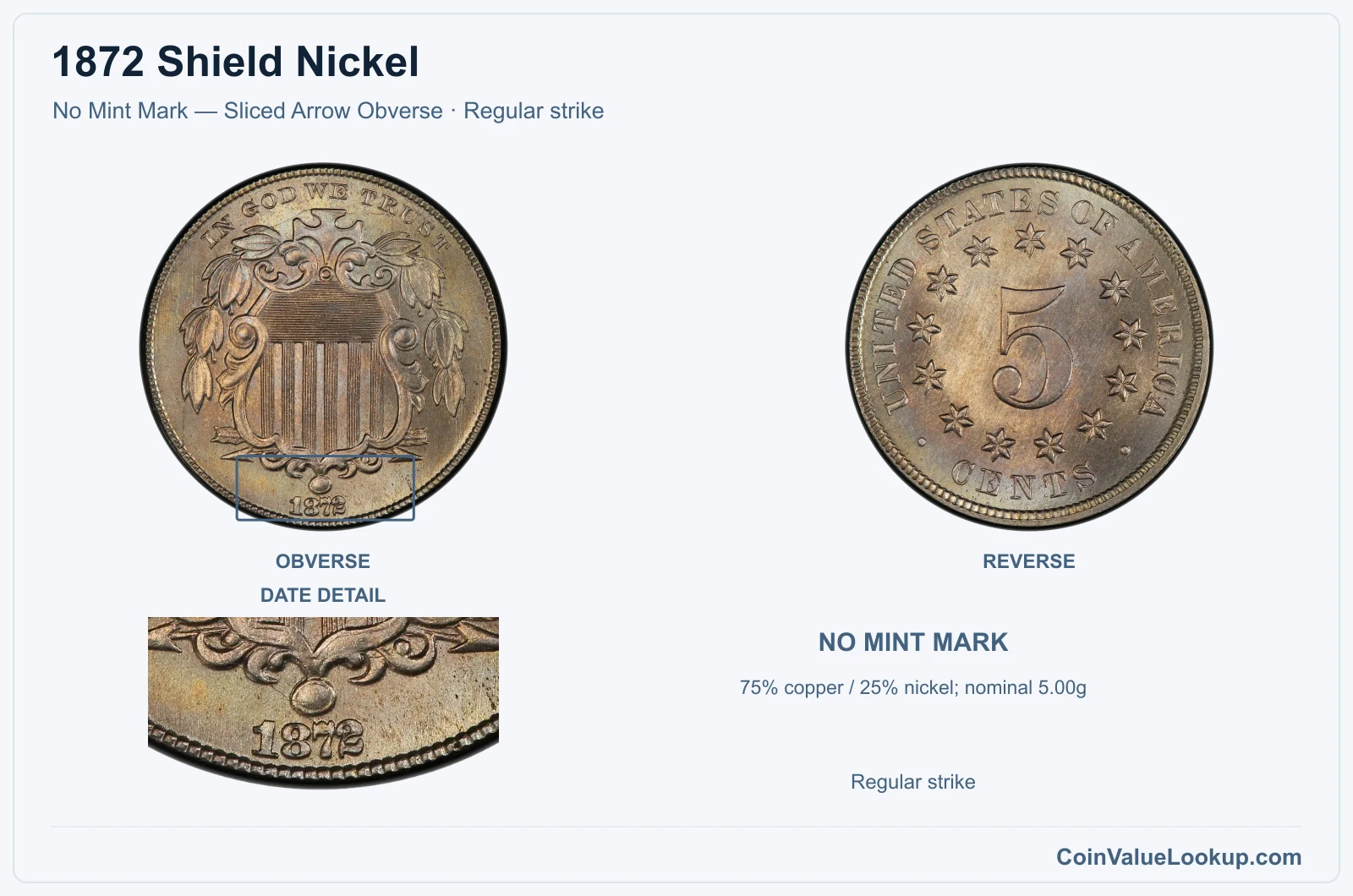
This is the business-strike version with the sliced or partial arrow visible at the lower obverse. The design omits rays on the reverse, which is standard for all Shield Nickels from mid-1867 onward.
To confirm this variety, examine the area just below the shield where the arrows emerge. The sliced-arrow hub shows a truncated or interrupted arrow shaft compared with the full-arrow version.
No specific price range is adopted for this subtype separately from the general 1872 circulation issue. Value depends on authenticated identity, overall condition and whether any recognized die variety is present.
Have your coin evaluated individually rather than assuming a subtype premium.
Range Grade
Price Auction Records Appraisal PO PO 1
—
Coin Identifier FR FR 2
—
Coin Identifier AG AG 3
—
Coin Identifier G G 4
—
Coin Identifier
G 6
—
Coin Identifier VG VG 8
Coin Identifier
VG 10
—
Coin Identifier F F 12
Coin Identifier
F 15
—
Coin Identifier VF VF 20
—
Coin Identifier
VF 25
—
Coin Identifier
VF 30
Coin Identifier
VF 35
Coin Identifier XF XF 40
Coin Identifier
XF 45
Coin Identifier AU AU 50
Coin Identifier
AU 53
Coin Identifier
AU 55
Coin Identifier
AU 58
Coin Identifier MS MS 60
—
Coin Identifier
MS 61
Coin Identifier
MS 62
Coin Identifier
MS 63
Coin Identifier
MS 64
Coin Identifier
MS 65
Coin Identifier
MS 66
Coin Identifier
MS 67
Coin Identifier
MS 68
—
—
—
MS 69
—
—
—
MS 70
—
—
—
1872 Shield Nickel — No Mint Mark — Full Arrow Obverse
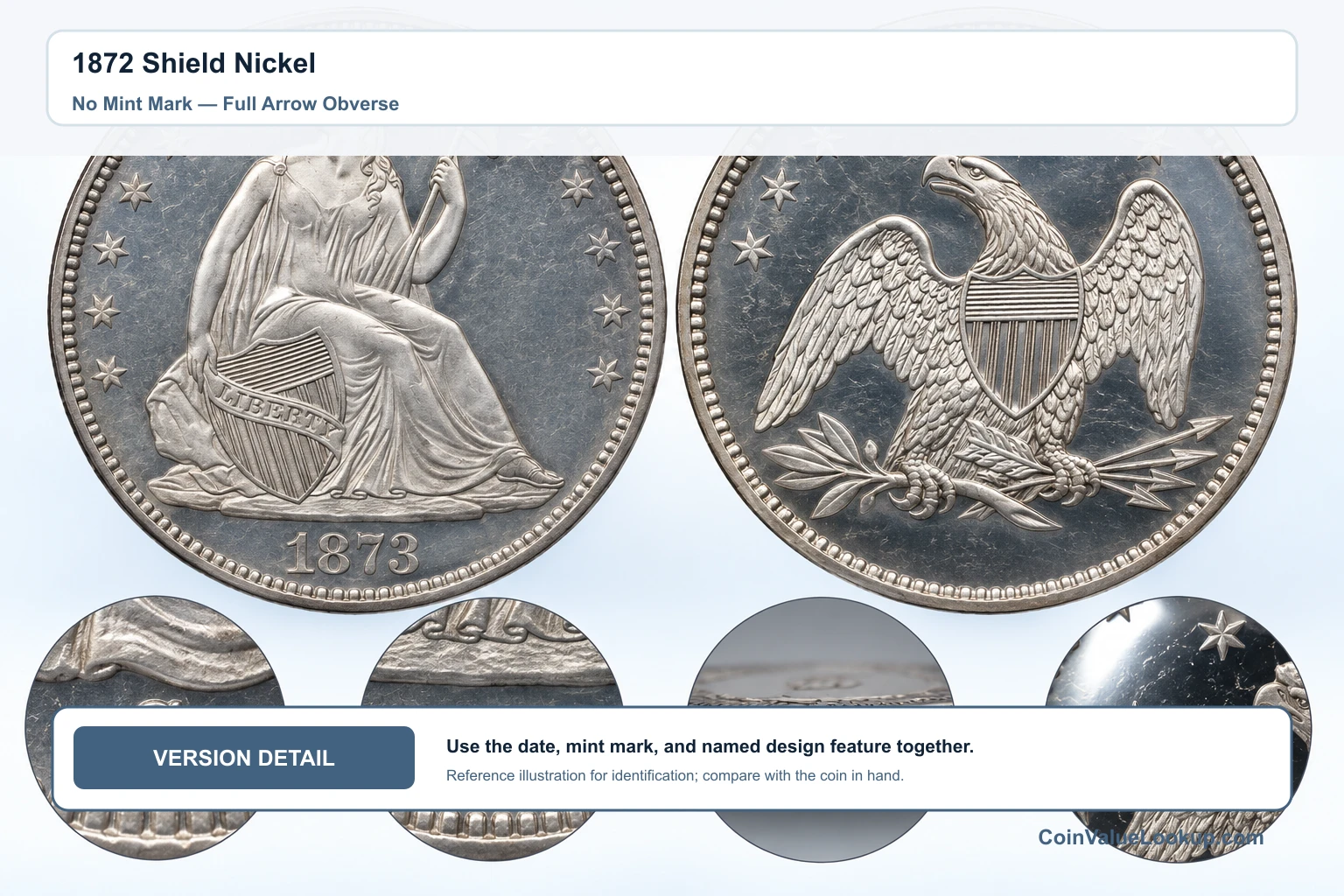
The full-arrow obverse is the other hub type used for 1872 circulation strikes. Here the arrow below the shield appears more complete and better defined than on the sliced-arrow version.
Match your coin against a reliable reference image focusing on the arrow tips and shaft below the shield. The difference is subtle but consistent across coins from the same hub.
Coin Value Lookup is a good starting point when you want to compare your coin against guides for other Shield Nickel dates and denominations. No separate price range is adopted for this variety.
Individual value depends on authenticated identity, condition and any recognized errors, so professional evaluation is the best next step.
Range Grade
Price Auction Records Appraisal PO PO 1
—
Coin Identifier FR FR 2
—
Coin Identifier AG AG 3
—
Coin Identifier G G 4
—
Coin Identifier
G 6
—
Coin Identifier VG VG 8
Coin Identifier
VG 10
—
Coin Identifier F F 12
Coin Identifier
F 15
—
Coin Identifier VF VF 20
—
Coin Identifier
VF 25
—
Coin Identifier
VF 30
Coin Identifier
VF 35
Coin Identifier XF XF 40
Coin Identifier
XF 45
Coin Identifier AU AU 50
Coin Identifier
AU 53
Coin Identifier
AU 55
Coin Identifier
AU 58
Coin Identifier MS MS 60
—
Coin Identifier
MS 61
Coin Identifier
MS 62
Coin Identifier
MS 63
Coin Identifier
MS 64
Coin Identifier
MS 65
Coin Identifier
MS 66
Coin Identifier
MS 67
Coin Identifier
MS 68
—
—
—
MS 69
—
—
—
MS 70
—
—
—
1872 Shield Nickel — No Mint Mark — Proof
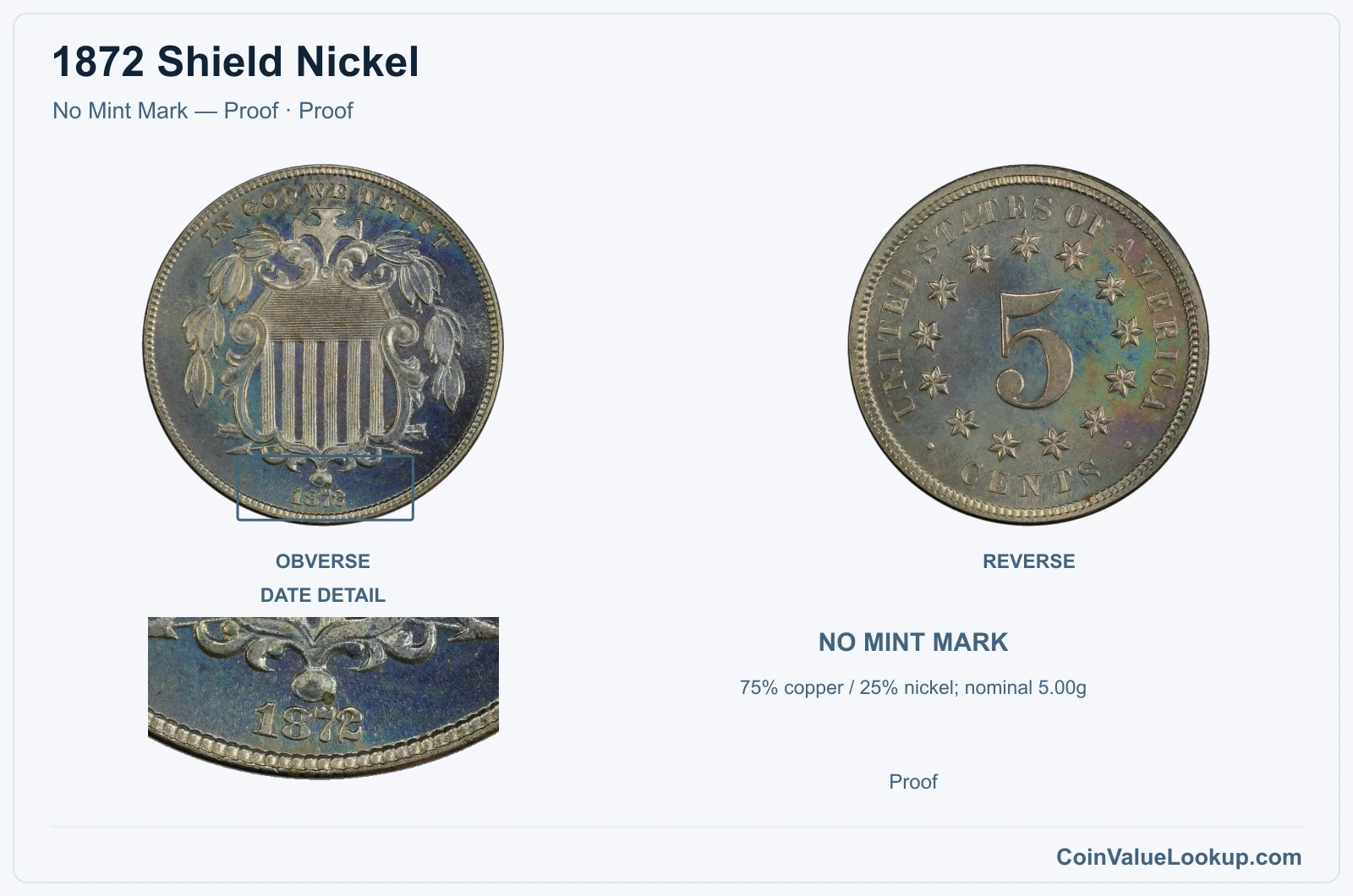
Proof 1872 Shield Nickels were struck on polished planchets with specially prepared dies, producing mirrored fields and sharp design details. Do not confuse a particularly well-struck circulation coin for a proof.
Genuine proofs display squared, knife-like rims and deeply reflective flat surfaces that ordinary business strikes cannot replicate.
A proof graded PR63 is valued at approximately $468 according to USA Coin Book retail estimates. That is a guide figure, not a guaranteed sale price.
Higher proof grades command more, and coins with problems trade for less. Authentication by a recognized grading service matters here, because misidentified proofs are common in this series.
Range Grade
Price Auction Records Appraisal PR PR 1
—
Coin Identifier
PR 2
—
Coin Identifier
PR 3
—
Coin Identifier
PR 4
—
Coin Identifier
PR 6
—
Coin Identifier
PR 8
—
Coin Identifier
PR 10
—
Coin Identifier
PR 12
—
Coin Identifier
PR 15
—
Coin Identifier
PR 20
—
Coin Identifier
PR 25
—
Coin Identifier
PR 30
—
Coin Identifier
PR 35
—
Coin Identifier
PR 40
—
Coin Identifier
PR 45
—
Coin Identifier
PR 50
—
Coin Identifier
PR 53
—
Coin Identifier
PR 55
—
Coin Identifier
PR 58
—
Coin Identifier
PR 60
—
Coin Identifier
PR 61
—
Coin Identifier
PR 62
—
Coin Identifier
PR 63
Coin Identifier
PR 64
Coin Identifier
PR 65
Coin Identifier
PR 66
Coin Identifier
PR 67
Coin Identifier
PR 68
—
—
—
PR 69
—
—
—
PR 70
—
—
—
1872 Shield Nickel Error List
1. 1872 Shield Nickel — Doubled Die Obverse
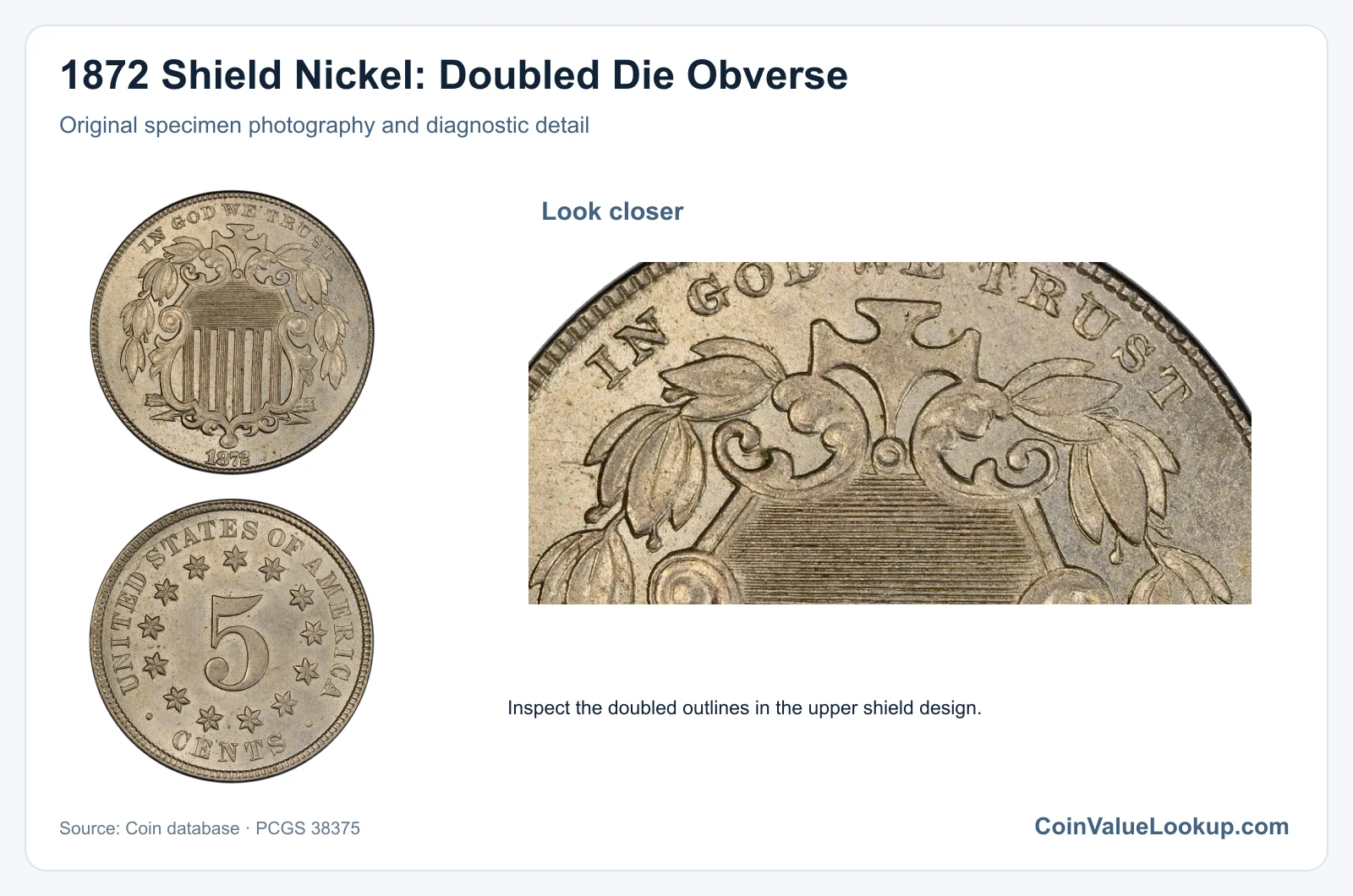
Doubled die obverse varieties have been reported for the 1872 Shield Nickel. On these coins, portions of the obverse design, such as letters, the date or shield elements, show a consistent doubling where a secondary impression is visible alongside the primary one.
To check, compare your coin's obverse lettering and design details against a known normal example under the same lighting. Genuine hub doubling produces uniform separation or notching on affected elements, and it will appear in the same direction on every coin struck from that die.
Watch out for machine doubling, which leaves a flat, shelf-like distortion rather than a rounded secondary image. Reflections from lighting angles and general die wear can also mimic doubling.
No specific price is adopted for these varieties; value depends on the particular die, the strength of the doubling and the coin's overall condition.
2. 1872 Shield Nickel — Doubled Die Reverse
Doubled die reverse varieties are also reported for the 1872 date. These show a secondary impression on reverse design elements such as the numeral 5, stars or lettering.
Examine the reverse legends and design contours closely with magnification and compare directly to a normal coin. True hub doubling will be consistent across every example struck from the same die, affecting the same elements in the same direction.
Machine doubling is the most common lookalike and produces a flat, shelf-like distortion that lacks the rounded, separated character of a genuine doubled die. Random contact marks or corrosion can also create confusing marks.
No numerical price range is adopted here. The specific die, the visibility of the doubling and the coin's condition all influence what a collector will pay.
3. 1872 Shield Nickel — Repunched Date
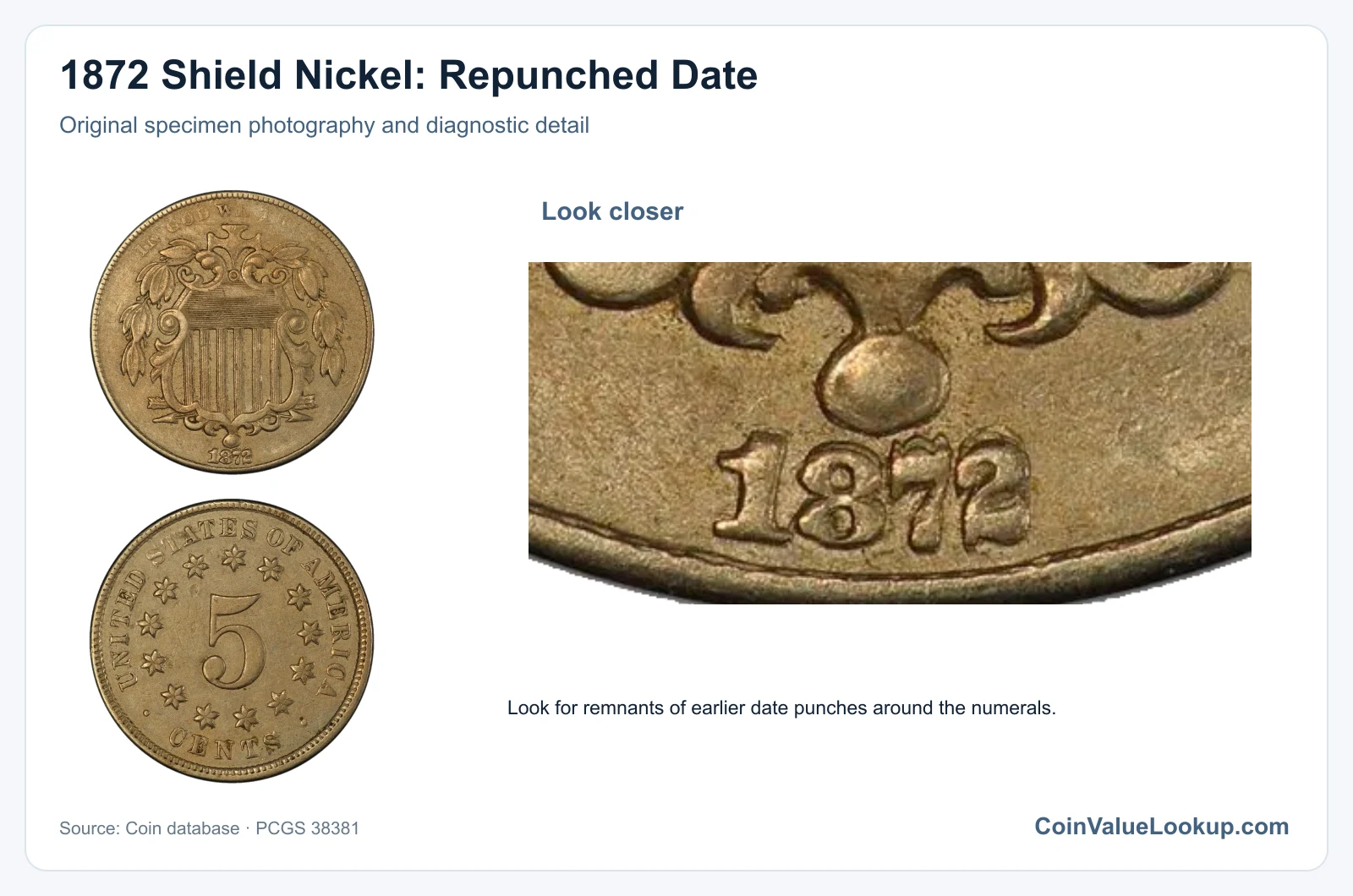
A repunched date occurs when the date numerals were punched into the working die more than once, with a slight shift between impressions. On an 1872 Shield Nickel with this variety, you may see traces of an earlier date position peeking out beside or beneath the final digits.
This is different from a doubled die, which affects the entire obverse design from a misaligned hub. A repunched date is localized to the date area only.
Look for ghost-like remnants of numerals, especially around the tops or bases of the 1, 8, 7 or 2.
Do not confuse a damaged or corroded date with a genuine repunch. Damage tends to be random and irregular, while a repunched date shows a recognizable duplicate numeral form.
No specific price is adopted for this variety; value will depend on how visible the repunching is and the coin's overall grade.
4. 1872 Shield Nickel — Die Crack / Die Chip
Die cracks and die chips are reported for the 1872 Shield Nickel. A die crack appears as a thin raised line on the coin's surface, formed when the steel die developed a fracture during use.
A die chip shows up as a small raised blob where a piece of the die broke away.
These features are raised because the crack or missing chip created a recessed area in the die, and metal flowed into that space during striking. An interior chip is different from a rim-connected cud, which is a larger, flat area of unstruck planchet joined to the rim.
Do not confuse incuse scratches, corrosion or debris stuck to the surface with die cracks. Scratches are recessed into the metal, while die cracks sit above the field.
No price range is adopted; the size, location and visual impact of the crack or chip, along with the coin's condition, determine any premium.
5. 1872 Shield Nickel — Rotated Dies
Rotated dies occur when one of the two dies in the coining press shifts from its normal alignment. On standard United States coins, the obverse and reverse are oriented 180 degrees apart, so when you flip the coin top to bottom, the other side should appear upright.
To test yours, hold the obverse right-side up, then rotate the coin on a vertical axis like turning a page. If the reverse is noticeably tilted from its expected upright position, you may have a rotated-die coin.
Small rotations of a few degrees are relatively minor; significant rotations of 45 degrees or more attract more collector attention.
Make sure you are not simply holding the coin sideways or looking at a rotated photograph. Confirm by repeating the flip test several times.
No numerical price is adopted for this variety. Value depends on the degree of rotation and the coin's overall condition.