1893 Barber Quarter Coin Value: How Much Is It Worth?
The 1893 Barber Quarter is a 90% silver coin struck across three mints and one proof finish. Guide estimates for this year range from about $24.00 in well-worn grades to $1,252.00 for a choice uncirculated San Francisco piece.
Which part of that span applies depends entirely on your coin's mint, condition and whether it is a business strike or proof.
Fast Way to Identify Your 1893 Barber Quarter
The quickest way to start figuring out what you have is to snap clear photos of both sides of your coin. Upload the front and back images to our identifier for a preliminary look at mint, version and approximate condition.
Good lighting and a steady hand go a long way toward an accurate read.
1893 Barber Quarter Value
Upload both sides of your 1893 Barber Quarter.
Front Obverse
Upload photo
Back Reverse
Upload photo
Which 1893 Barber Quarter Versions Are Worth Money?
- 1893-S quarter: guide estimate reaches $1,252.00 at MS63, the highest listed anchor for business strikes this year.
- 1893 PR proof quarter: guide estimate of $799.00 at PR63 reflects the limited proof production at Philadelphia.
- 1893-O quarter: guide estimate of $600.00 at MS63 places it above the Philadelphia business strike at the same grade.
Step 1: Identify Your 1893 Barber Quarter Mint Mark and Version
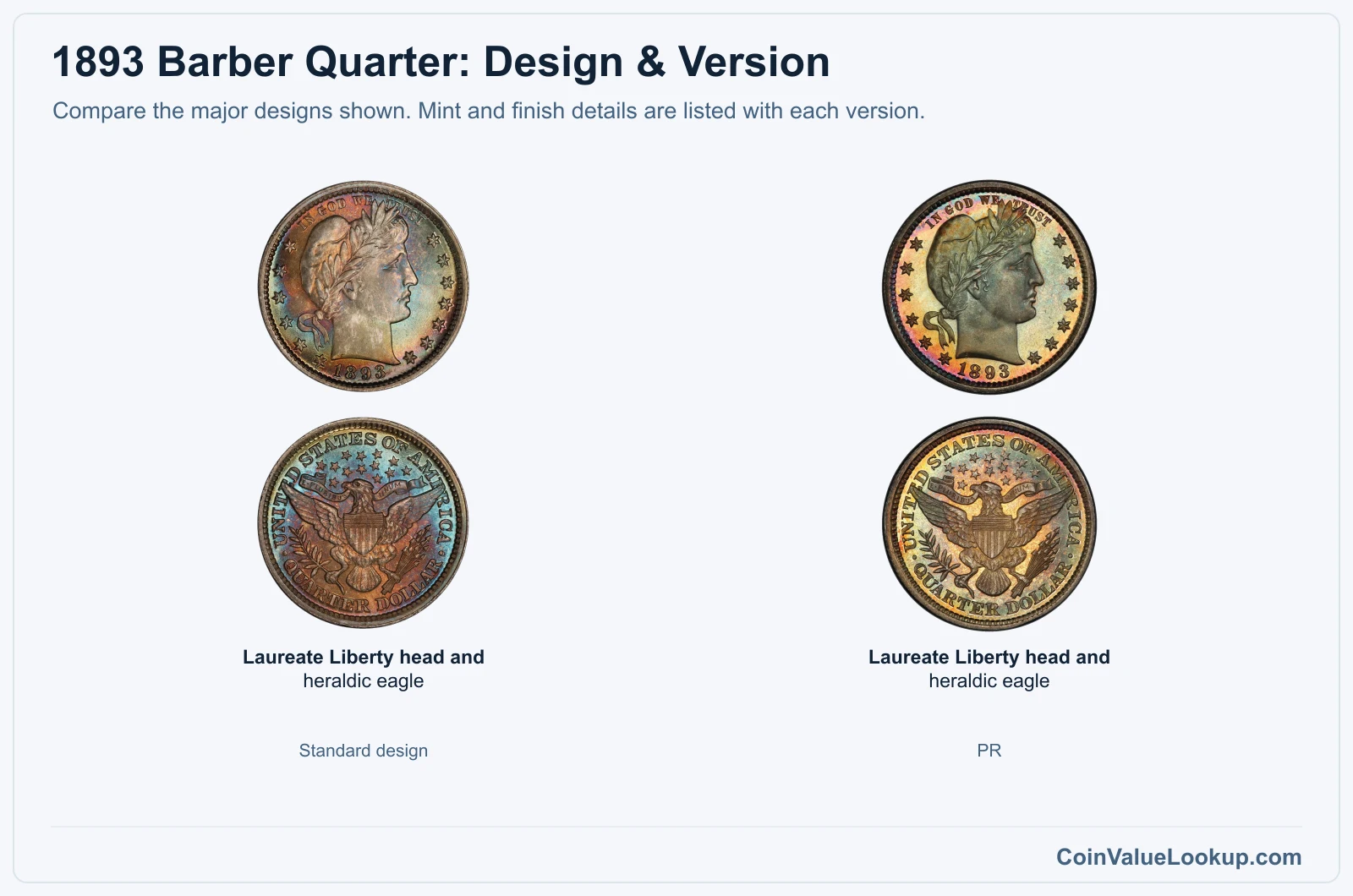
Every 1893 Barber Quarter carries Charles Barber's laureate Liberty head on the obverse and a heraldic eagle on the reverse. The coin is struck in 90% silver with 10% copper and weighs 6.25 grams.
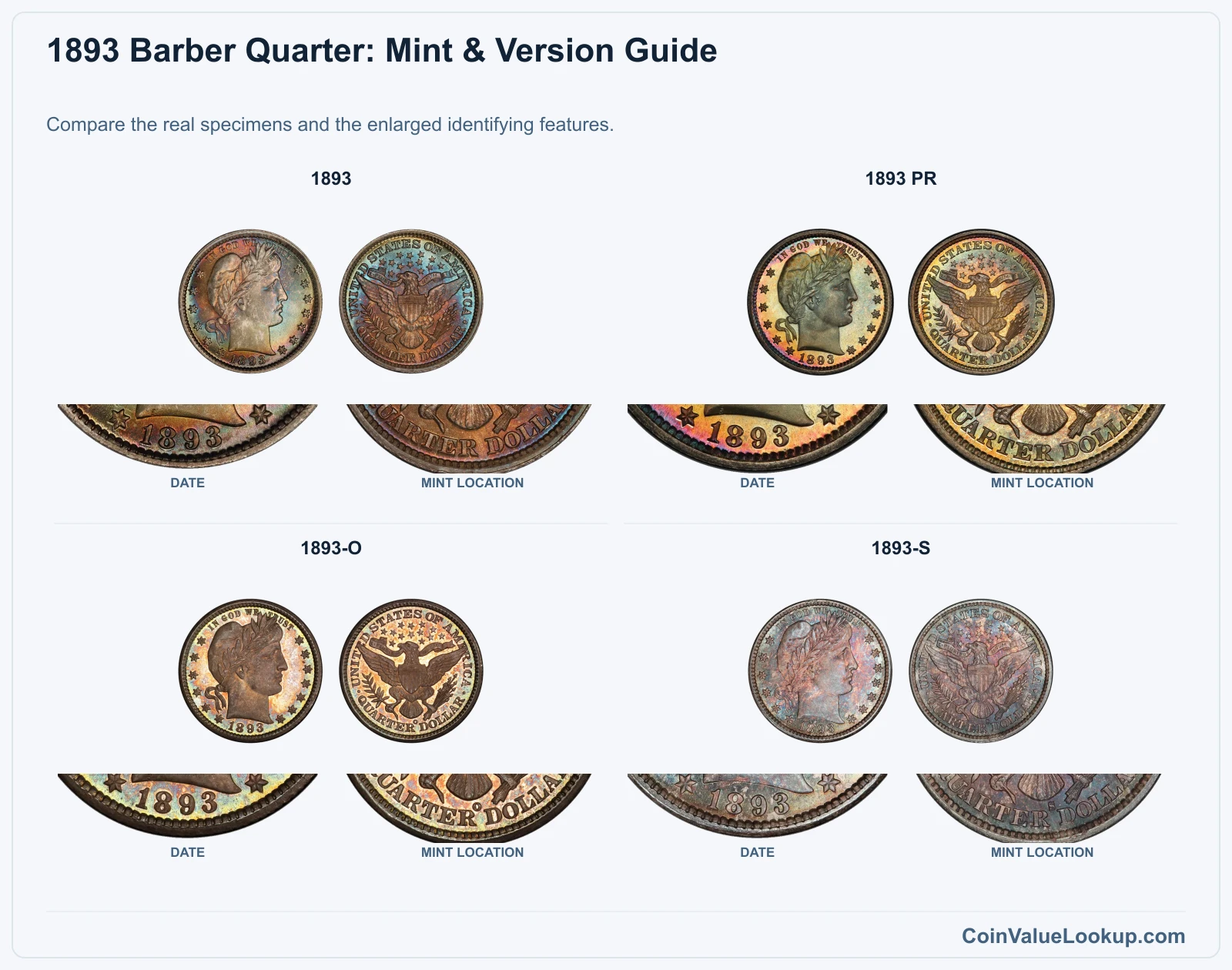
Flip the coin over and look just below the eagle's tail feathers, above the denomination. No letter means Philadelphia.
An "O" means New Orleans, and an "S" means San Francisco.
Philadelphia also produced proof strikes in 1893. Proofs have mirrored fields and sharp, squared-off rims from a different manufacturing process entirely.
A shiny circulated coin is not a proof, so don't jump to conclusions based on brightness alone.
Your four possible branches are: 1893 (Philadelphia business strike), 1893 PR (Philadelphia proof), 1893-O (New Orleans), and 1893-S (San Francisco). Get the mint and finish right before worrying about grade.
Step 2: Check Your 1893 Barber Quarter Grade
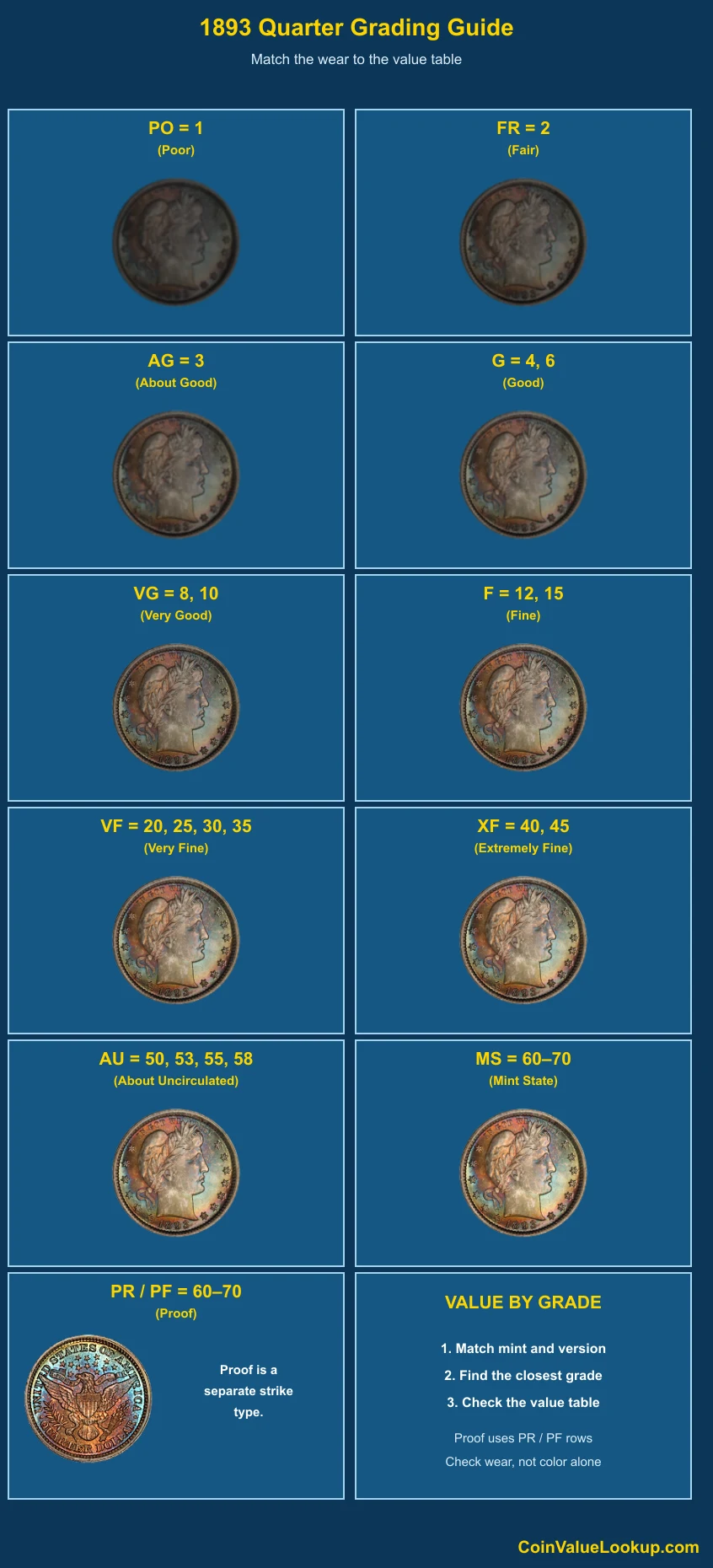
Start with Liberty's hair detail above the forehead and across the cheek. On a lightly worn coin, individual strands begin merging there first.
The laurel wreath loses its leaf separation next.
On the reverse, check the eagle's breast feathers, the tops of the wings and the tail. These high points tell you the grade story before anything else.
The word LIBERTY on the headband is a handy shortcut, but don't rely on it alone. Some weakly struck coins never had full letters even fresh from the press.
Use it as one checkpoint alongside overall surface wear and remaining luster.
Compare your coin against the reference image. A coin with full luster and no wear sits in Mint State territory.
Once the highest points start smoothing, you're into About Uncirculated and below. Cleaning, scratches or artificial toning can reduce a coin's collector value well below what the grade alone suggests.
Step 3: Check 1893 Barber Quarter Value by Mint and Version
1893 Barber Quarter
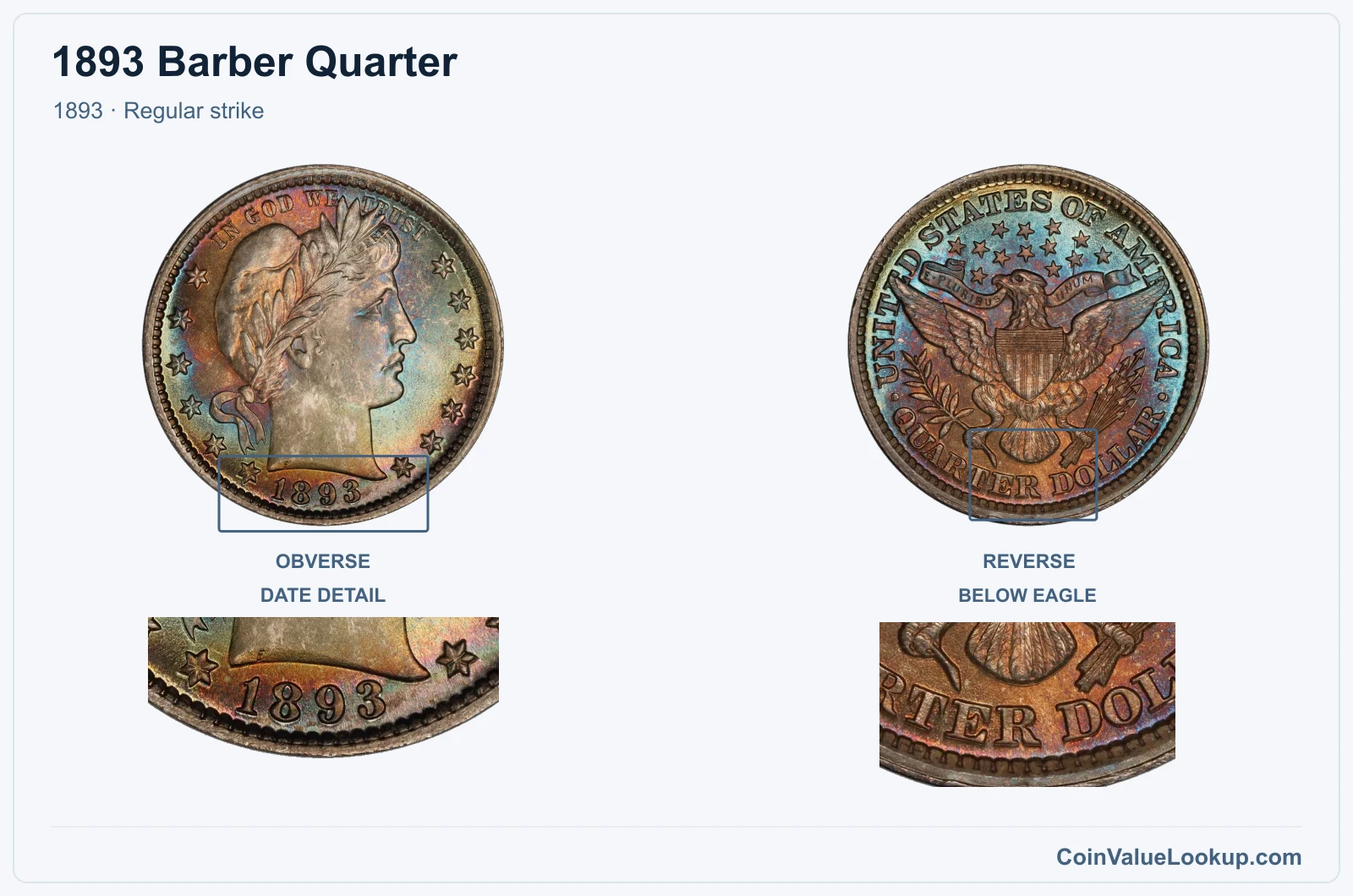
The 1893 Philadelphia quarter has no mintmark on the reverse. It is the most commonly encountered version for this date.
In lower circulated grades like G4, the USA Coin Book guide places it around $24.00. Jump to MS60 and the estimate climbs to $309.00, reaching $565.00 at MS63.
These are guide estimates, not guaranteed sale prices.
Original surfaces matter. A coin that has been cleaned, polished or damaged will trade below these benchmarks regardless of its technical grade.
Look for even, natural toning and undisturbed luster in the protected areas around the stars and letters.
Range Grade
Price Auction Records Appraisal PO PO 1
—
Coin Identifier FR FR 2
—
Coin Identifier AG AG 3
—
Coin Identifier G G 4
—
Coin Identifier
G 6
—
Coin Identifier VG VG 8
—
Coin Identifier
VG 10
Coin Identifier F F 12
—
Coin Identifier
F 15
—
Coin Identifier VF VF 20
Coin Identifier
VF 25
—
Coin Identifier
VF 30
—
Coin Identifier
VF 35
—
Coin Identifier XF XF 40
Coin Identifier
XF 45
Coin Identifier AU AU 50
Coin Identifier
AU 53
Coin Identifier
AU 55
Coin Identifier
AU 58
Coin Identifier MS MS 60
Coin Identifier
MS 61
Coin Identifier
MS 62
Coin Identifier
MS 63
Coin Identifier
MS 64
Coin Identifier
MS 65
Coin Identifier
MS 66
Coin Identifier
MS 67
Coin Identifier
MS 68
—
—
—
MS 69
—
—
—
MS 70
—
—
—
1893 Barber Quarter — PR
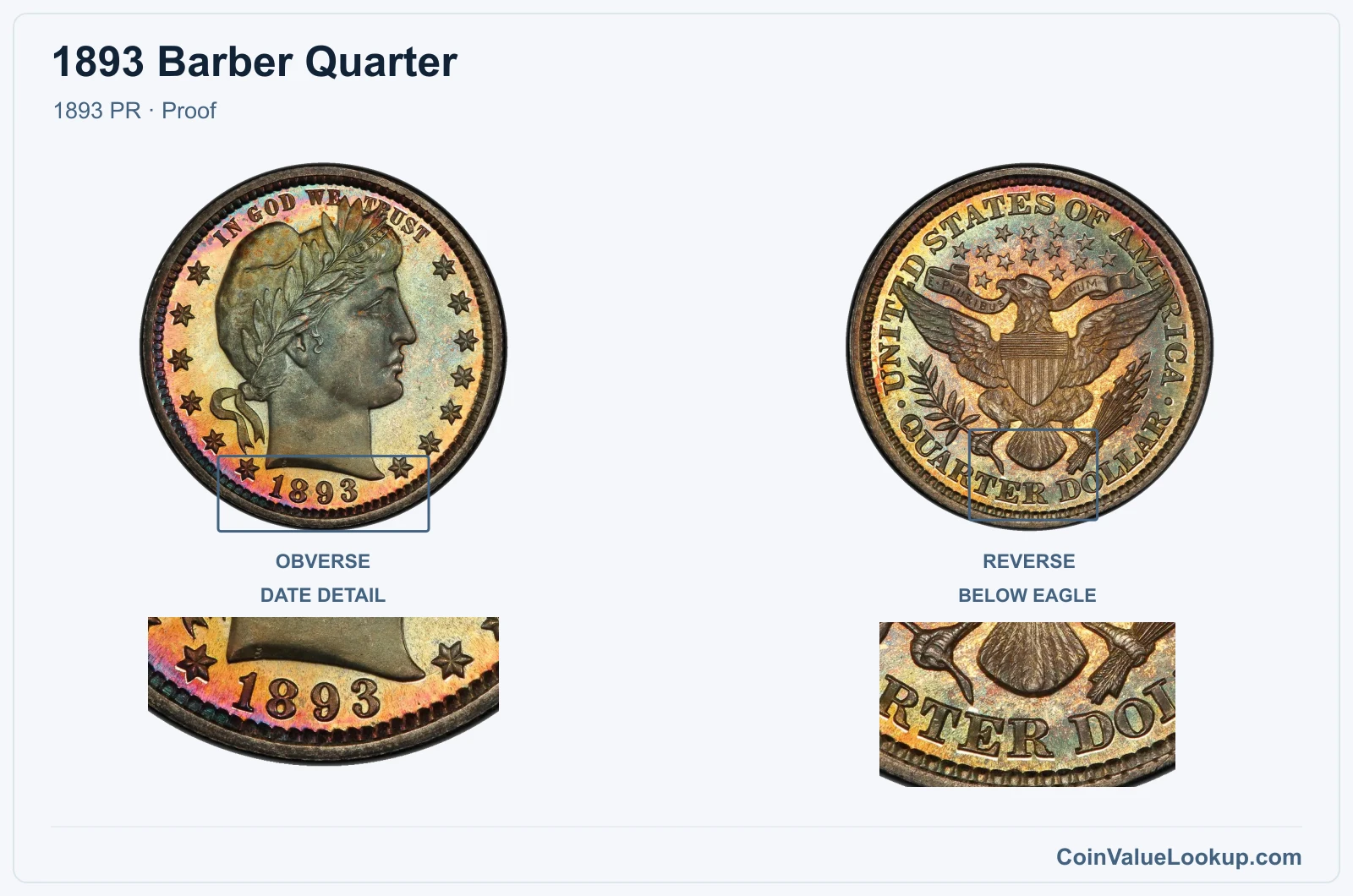
The 1893 proof quarter was struck at Philadelphia using polished dies and specially prepared planchets. There is no mintmark.
You can identify a genuine proof by its deeply mirrored fields and crisp, squared rims rather than the softly rounded rims of a business strike.
The USA Coin Book guide estimates $799.00 at PR63. That figure reflects the proof's limited production and collector demand for original surfaces.
Hairlines from improper storage or handling are the most common grade-limiter for proofs. Surface haze from old holders can also affect eye appeal.
A bright, recently cleaned proof is not the same as one with original reflectivity.
Coin Value Lookup can help you explore guides for other Barber Quarter dates and denominations if you're building a set or just curious about what else is out there.
Range Grade
Price Auction Records Appraisal PR PR 1
—
Coin Identifier
PR 2
—
Coin Identifier
PR 3
—
Coin Identifier
PR 4
—
Coin Identifier
PR 6
—
Coin Identifier
PR 8
—
Coin Identifier
PR 10
—
Coin Identifier
PR 12
—
Coin Identifier
PR 15
—
Coin Identifier
PR 20
—
Coin Identifier
PR 25
—
Coin Identifier
PR 30
—
Coin Identifier
PR 35
—
Coin Identifier
PR 40
—
Coin Identifier
PR 45
—
Coin Identifier
PR 50
—
Coin Identifier
PR 53
—
Coin Identifier
PR 55
—
Coin Identifier
PR 58
—
Coin Identifier
PR 60
Coin Identifier
PR 61
—
Coin Identifier
PR 62
Coin Identifier
PR 63
Coin Identifier
PR 64
Coin Identifier
PR 65
Coin Identifier
PR 66
Coin Identifier
PR 67
Coin Identifier
PR 68
Coin Identifier
PR 69
Coin Identifier
PR 70
—
—
—
1893 Barber Quarter — O
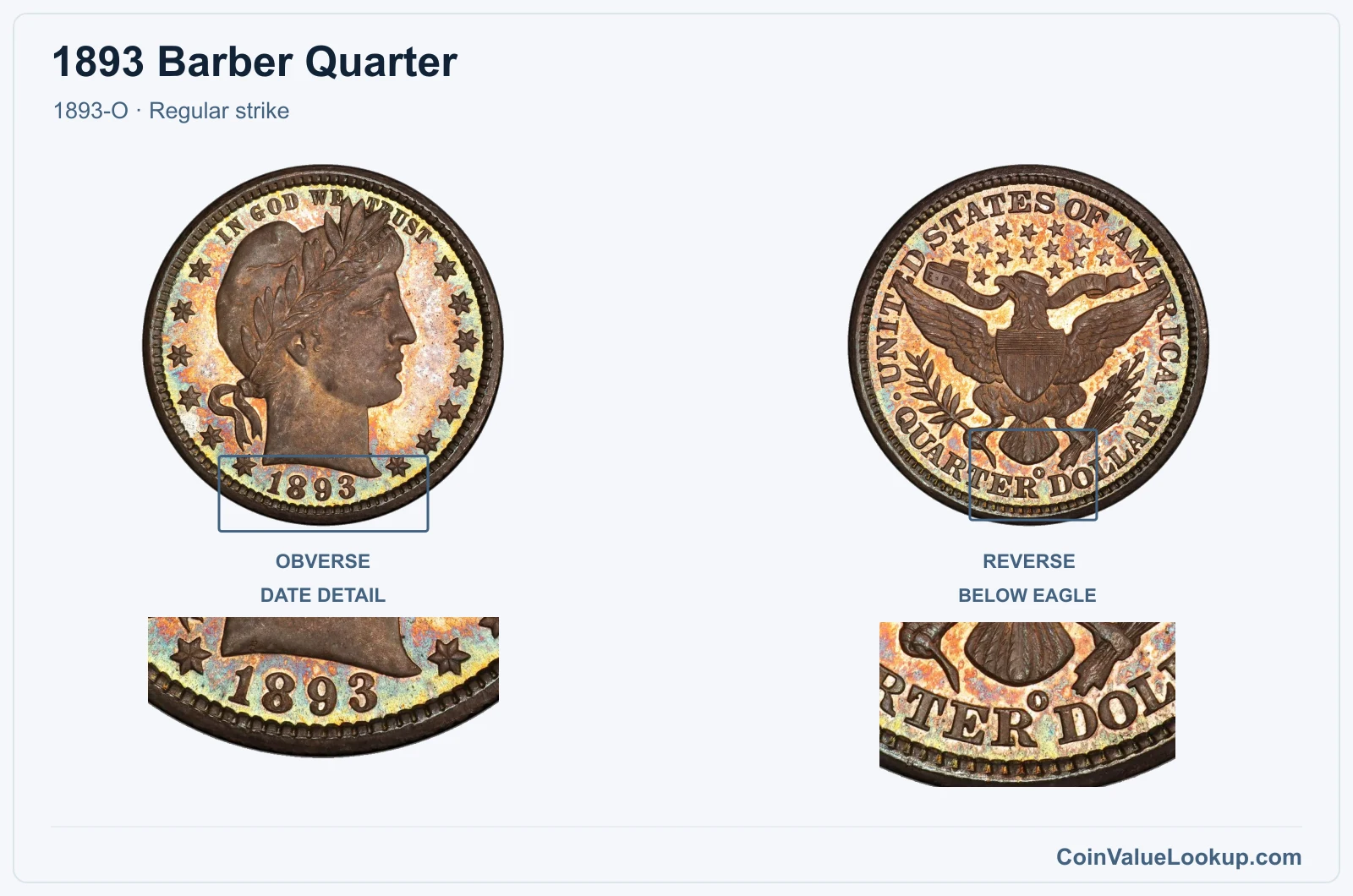
Look for the small "O" mintmark on the reverse, below the eagle's tail. This is the New Orleans issue.
In heavily worn G4 condition, the USA Coin Book guide estimates around $24.00, the same starting point as the Philadelphia coin.
The gap widens higher up the grading scale. At MS60 the estimate is $385.00, and at MS63 it reaches $600.00.
Original, problem-free surfaces are essential for hitting those numbers. Cleaning and environmental damage are common on surviving New Orleans quarters, so be honest about what you see before comparing to guide values.
Range Grade
Price Auction Records Appraisal PO PO 1
—
Coin Identifier FR FR 2
—
Coin Identifier AG AG 3
—
Coin Identifier G G 4
—
Coin Identifier
G 6
—
Coin Identifier VG VG 8
—
Coin Identifier
VG 10
—
Coin Identifier F F 12
—
Coin Identifier
F 15
—
Coin Identifier VF VF 20
Coin Identifier
VF 25
—
Coin Identifier
VF 30
Coin Identifier
VF 35
Coin Identifier XF XF 40
Coin Identifier
XF 45
Coin Identifier AU AU 50
Coin Identifier
AU 53
Coin Identifier
AU 55
Coin Identifier
AU 58
Coin Identifier MS MS 60
—
Coin Identifier
MS 61
Coin Identifier
MS 62
Coin Identifier
MS 63
Coin Identifier
MS 64
Coin Identifier
MS 65
Coin Identifier
MS 66
Coin Identifier
MS 67
Coin Identifier
MS 68
Coin Identifier
MS 69
—
—
—
MS 70
—
—
—
1893 Barber Quarter — S
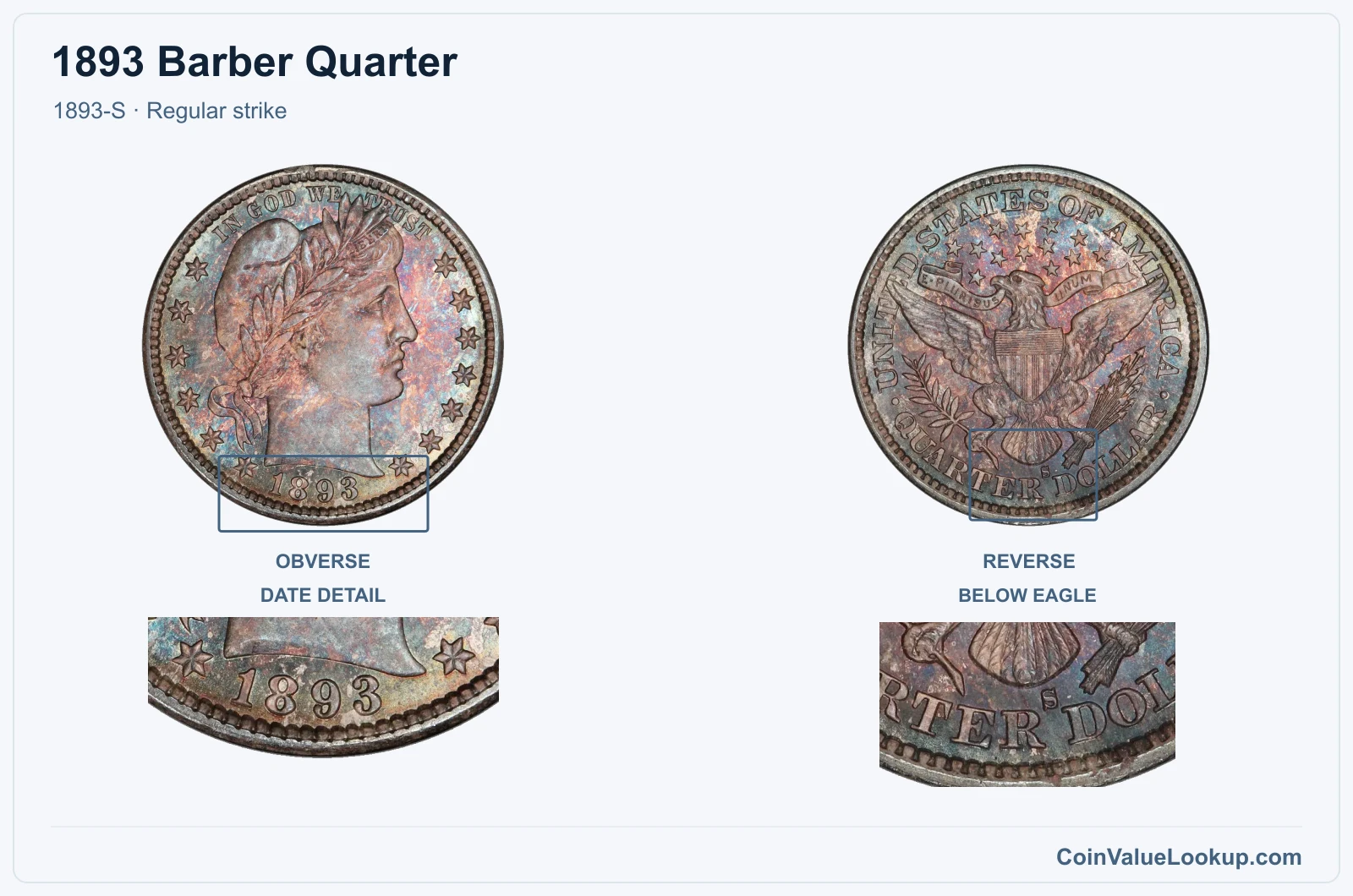
The 1893-S carries an "S" mintmark on the reverse below the eagle. Among the three business-strike mints for this year, San Francisco commands the strongest guide values in uncirculated grades.
At G4 the USA Coin Book estimate is $35.00, already a step above Philadelphia and New Orleans. The climb gets steep from there: $565.00 at MS60 and $1,252.00 at MS63.
That premium reflects the relative difficulty of finding this date-mint combination in higher grades with clean, original surfaces.
Before celebrating, confirm the mintmark under good magnification. Match the coin's overall preservation, wear pattern and surface quality to the grade, not just the mintmark.
Damage or cleaning will sharply reduce the real-world value.
Range Grade
Price Auction Records Appraisal PO PO 1
—
Coin Identifier FR FR 2
—
Coin Identifier AG AG 3
Coin Identifier G G 4
Coin Identifier
G 6
Coin Identifier VG VG 8
—
Coin Identifier
VG 10
—
Coin Identifier F F 12
—
Coin Identifier
F 15
—
Coin Identifier VF VF 20
Coin Identifier
VF 25
Coin Identifier
VF 30
Coin Identifier
VF 35
Coin Identifier XF XF 40
Coin Identifier
XF 45
Coin Identifier AU AU 50
Coin Identifier
AU 53
Coin Identifier
AU 55
Coin Identifier
AU 58
Coin Identifier MS MS 60
—
Coin Identifier
MS 61
Coin Identifier
MS 62
Coin Identifier
MS 63
Coin Identifier
MS 64
Coin Identifier
MS 65
Coin Identifier
MS 66
Coin Identifier
MS 67
Coin Identifier
MS 68
—
—
—
MS 69
—
—
—
MS 70
—
—
—
1893 Barber Quarter Error List
1. 1893 Barber Quarter — Repunched Date
A repunched date on an 1893 Barber Quarter shows remnants of an earlier position of one or more date numerals alongside the final placement. Under magnification you may see a ghostly second impression of a digit slightly offset from where it was ultimately placed.
This is a die variety created during production when the date punch was applied more than once in slightly different positions.
Do not confuse this with machine doubling, which produces flat, shelf-like outlines, or with simple damage to the date area from circulation hits. A true repunched date will show consistent, raised remnants across multiple numerals or one numeral with a clear secondary impression.
Condition, the visibility of the repunching and the specific die involved all affect collector interest. No specific price data is available for this variety.
2. 1893 Barber Quarter — Die Crack / Die Chip
Die cracks appear as thin raised lines running across the coin's surface, caused by fractures in the steel die during striking. On an 1893 Barber Quarter, these can appear on either side, often radiating from the rim toward a design element or connecting letters.
A die chip is a small raised blob where a tiny piece of the die has broken away, leaving a filled void.
Don't confuse these with scratches, which are incuse (pressed into the surface) rather than raised. Corrosion and foreign material stuck to the surface can also mimic a die chip.
Run a fingernail or toothpick lightly across the feature: a genuine die crack or chip is raised. Value depends on the size, location and overall condition of the coin, so no single price applies.
3. 1893 Barber Quarter — Die Break / Cud
A cud is a specific type of die break where a piece of the die near the rim has broken away entirely. The result is a raised, featureless lump of metal connected to the rim, replacing part of the normal design.
On an 1893 Barber Quarter, cuds can show up at any point along the rim on either side.
The boundary between the cud and the remaining design is usually sharp and irregular. Don't mistake a rim dent or contact damage for a cud.
Dents are pushed inward, while a cud is raised and smooth on top. Interior die chips, which sit away from the rim, are a related but separate category.
The size and location of the cud, along with the coin's overall grade, determine collector appeal. No adopted price data is available for this error.
4. 1893 Barber Quarter — Off-Center Strike
An off-center strike happens when the planchet is not properly seated between the dies at the moment of striking. The result is a design that is shifted to one side, with a blank crescent of unstruck metal on the opposite edge.
On an 1893 Barber Quarter, collectors strongly prefer examples where the date remains fully visible despite the misalignment.
Small percentages of off-center, say 5%, can be subtle and easy to overlook. Larger shifts are dramatic and immediately obvious.
Don't confuse an off-center strike with a clipped planchet or with post-mint damage like hammering that flattened one side. The design displacement should be uniform and the blank area should show the original planchet surface.
Value depends on the degree of misalignment, date visibility and condition.
5. 1893 Barber Quarter — Clipped Planchet
A clipped planchet error occurs when the blank was incompletely punched from the metal strip before striking. The resulting coin is missing a curved, straight or irregular section of metal.
On an 1893 Barber Quarter, look at the edge profile: a genuine clip will show a smooth, natural break where the metal was never there, sometimes accompanied by a weak area of the design directly opposite the missing section.
That opposite-side weakness, called the Blakesley effect, is a useful confirmation. A filed notch, deliberate cut or corroded edge will not produce that telltale weakness on the far side.
The clip's size, shape and the coin's overall preservation all factor into collector interest. No specific price data is available for this variety.
6. 1893 Barber Quarter — Lamination / Split Planchet
Lamination errors on an 1893 Barber Quarter appear as peeling, flaking or separated layers of metal on the coin's surface. These result from impurities or gas pockets trapped within the planchet during the rolling and preparation process.
You might see a thin flap of metal still partially attached or a smooth void where a layer has already separated and fallen away.
Photograph the edge alongside the affected face to show the depth of the separation. Genuine laminations follow the contour of the coin and are part of the metal itself.
Scratches, scrapes and deliberate cuts will show tool marks or a different surface texture than the surrounding coin. Corrosion can also flake but typically has a pitted, rough appearance rather than a clean split.
Value depends on severity, location and overall coin condition.