1818 Capped Bust Quarter Coin Value: How Much Is It Worth?
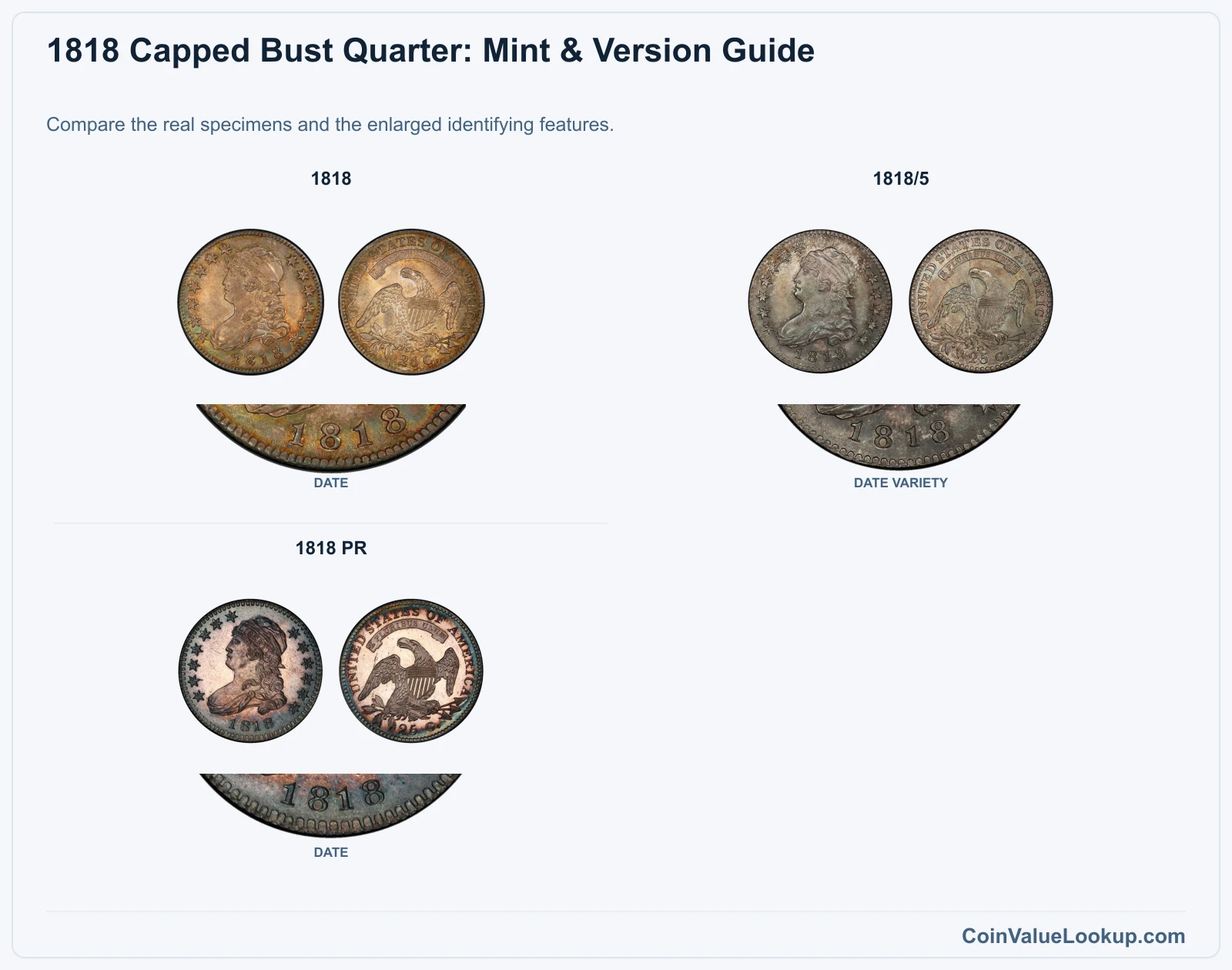
The 1818 Capped Bust Quarter was struck at Philadelphia in a silver-copper alloy of roughly 89.24% silver. Guide estimates for business-strike versions range from about $164.00 in Good-4 condition to $9,340.00 at the MS63 level, depending on the specific version and grade.
Condition, reverse design details and whether yours is an overdate variety all matter when pinning down where your coin sits in that spread.
Fast Way to Identify Your 1818 Capped Bust Quarter
The quickest way to get a preliminary read on your 1818 quarter is to snap clear photos of both sides and upload them here. Good lighting at an angle helps show surface detail.
A front and back image lets us help with identification of the version, design type and approximate condition — though final authentication and precise grading require professional certification.
1818 Capped Bust Quarter Value
Upload both sides of your 1818 Capped Bust Quarter.
Front Obverse
Upload photo
Back Reverse
Upload photo
Which 1818 Capped Bust Quarter Versions Are Worth Money?
- 1818/5 overdate — traces of a 5 beneath the final 8 in the date make this a distinct die variety; USA Coin Book lists it up to $9,340.00 at MS63.
- 1818 standard date — guide estimates reach $9,340.00 at MS63, with even a well-worn Good-4 example listed around $164.00.
- 1818 Proof — no guide price is adopted, so each coin needs individual assessment based on authenticated identity and condition.
Step 1: Identify Your 1818 Capped Bust Quarter Mint Mark and Version
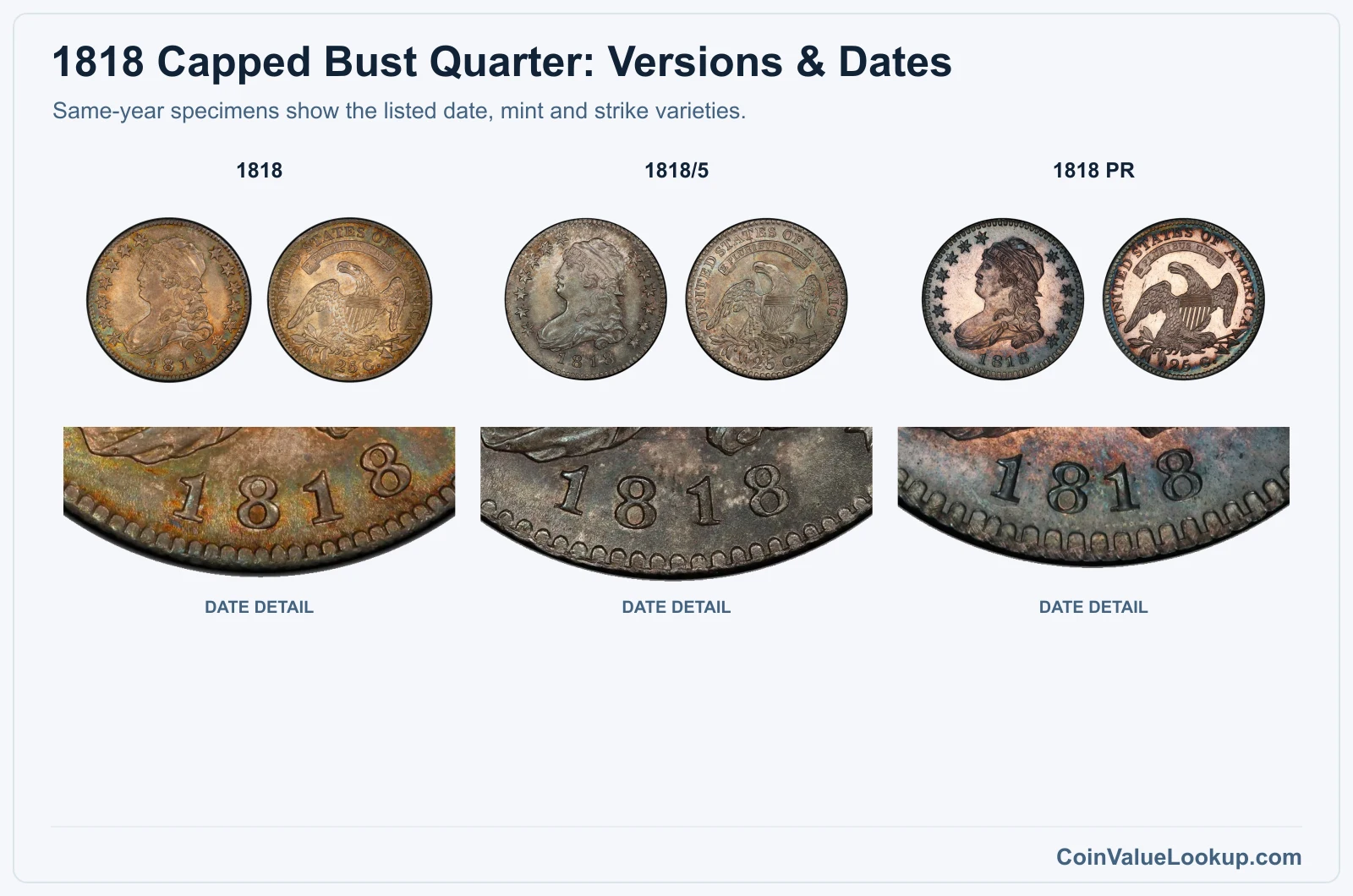
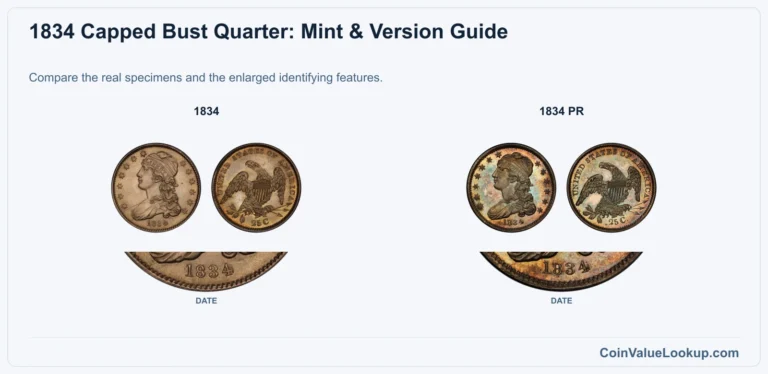
Every 1818 Capped Bust Quarter came from Philadelphia, so there is no mintmark to hunt for. The large-diameter design shows Liberty in a capped bust on the obverse and an eagle on the reverse.
The main thing to check is the date. Look closely at the "8" in 1818 — on the overdate variety (1818/5), you can see traces of a "5" beneath the final digit.
This is a die variety, not damage, and it takes magnification and good light to confirm.
Proof strikes also exist for this year. A proof is a special manufacturing method, not simply a shiny coin.
Proof surfaces show deep mirrored fields and sharp rims that differ from even a pristine business strike. If you suspect a proof, professional authentication is essential.
Beyond those branches, the silver composition, weight and overall design are consistent across all 1818 quarters. Cleaning, polishing or artificial toning does not change your coin into a different version — it just reduces the value of whatever version you have.
Step 2: Check Your 1818 Capped Bust Quarter Grade
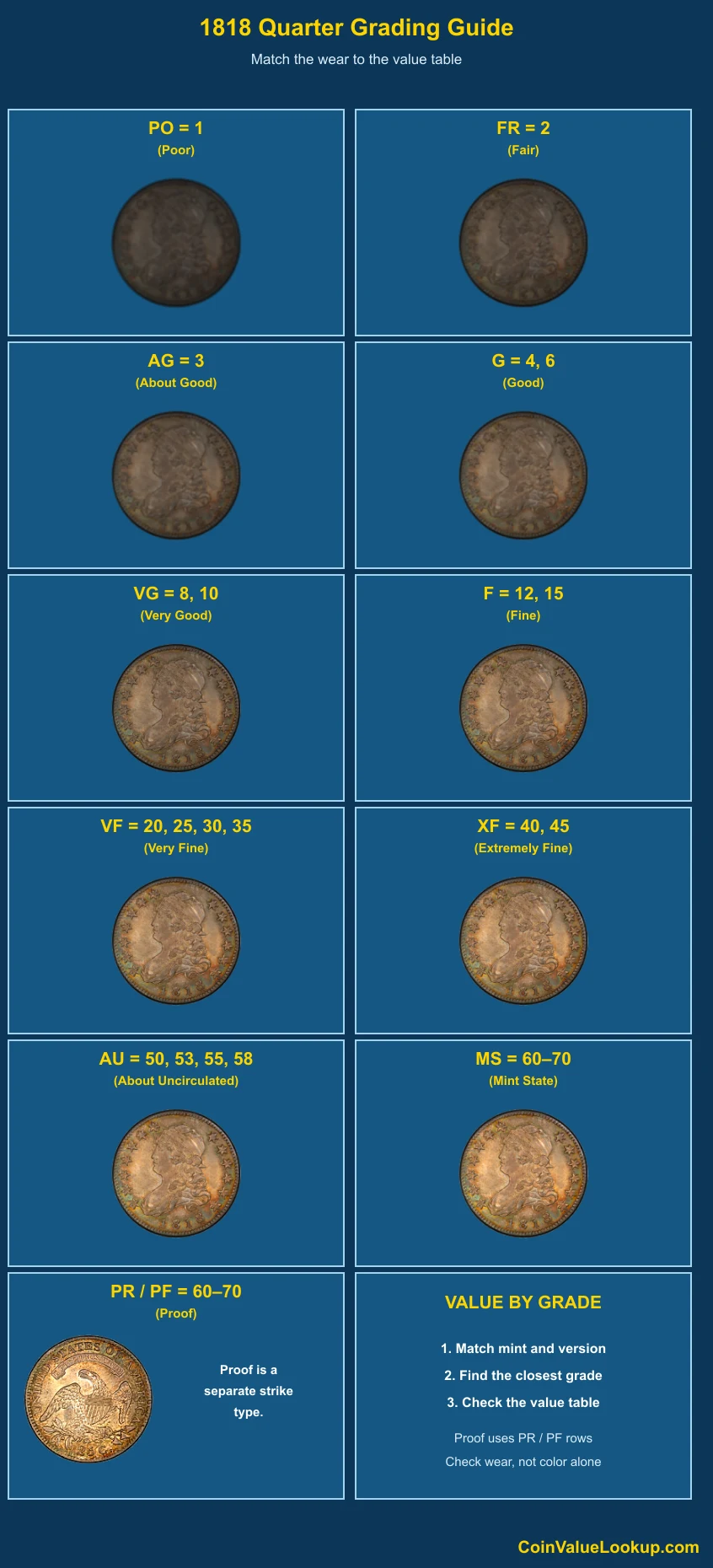
Start with Liberty's hair above the ear. On a well-preserved coin the individual curls are sharp and separated.
As the coin circulates, those curls flatten first, then the cap folds begin to merge, and finally the cheek loses its roundness.
Flip to the reverse and check the eagle's breast feathers and the tops of the wings. These high points wear in step with the obverse — if one side looks dramatically better, something unusual happened.
Strike quality complicates things. A weakly struck 1818 quarter can look worn even if it never spent a day in commerce.
The giveaway is luster: a weak strike still shows original mint luster in the fields, while a circulated coin has dulled or broken luster.
Use the comparison image to match your coin's wear pattern against known grade benchmarks for this type. Do not assume brightness equals high grade — a harshly cleaned coin can gleam yet grade far lower than a naturally toned example with the same wear.
Step 3: Check 1818 Capped Bust Quarter Value by Mint and Version
1818 Capped Bust Quarter
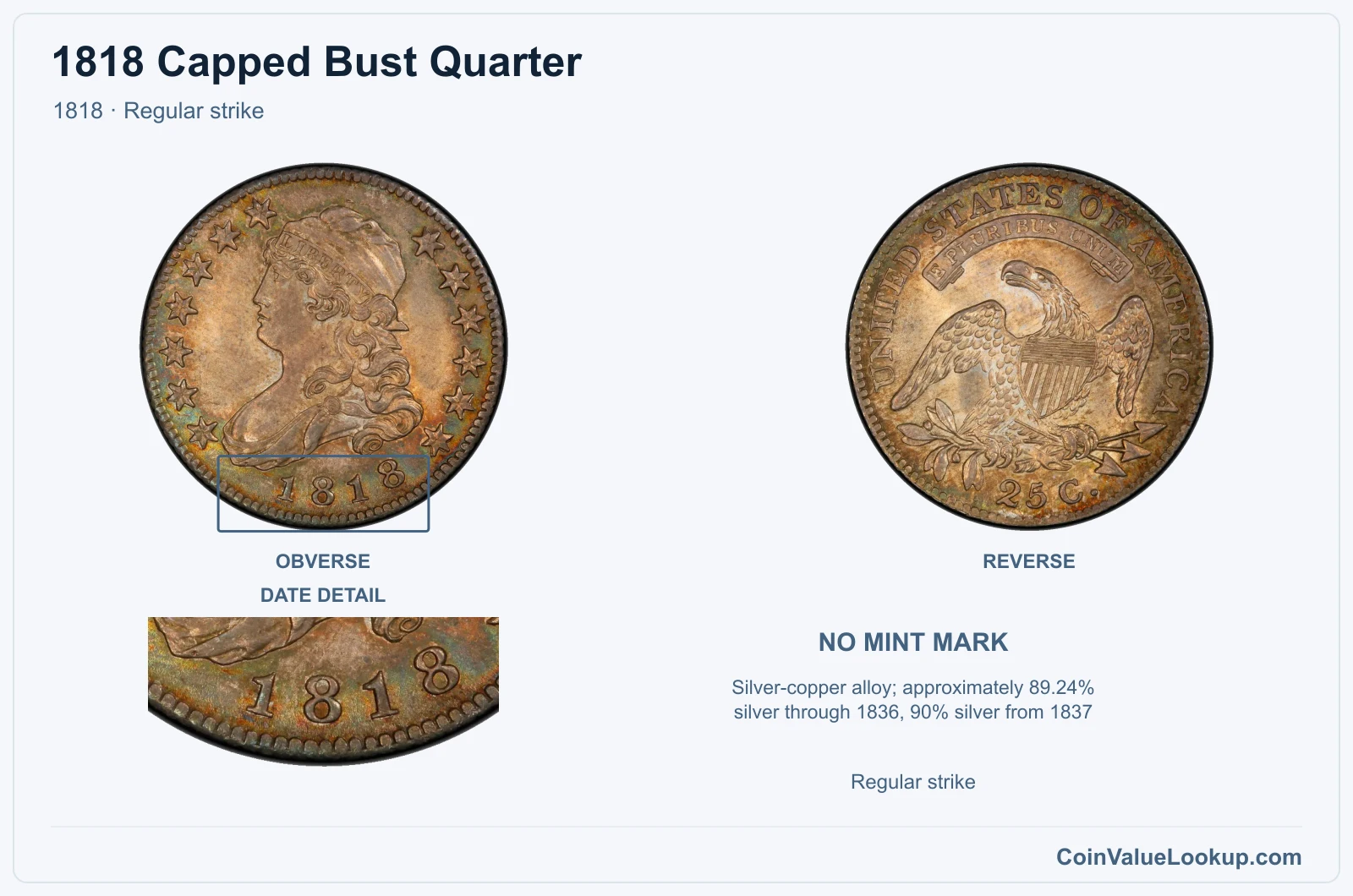
The 1818 quarter without an overdate is the standard Philadelphia business strike. It uses the large-diameter Capped Bust design with a heraldic eagle reverse.
USA Coin Book estimates place a Good-4 example around $164.00, an MS60 around $5,228.00 and an MS63 at $9,340.00 — these are guide figures, not guaranteed sale prices.
To confirm this version, check that the final digit in the date is a clean "8" with no underlying numeral visible. Original surfaces with natural toning hold value better than cleaned or damaged examples at the same apparent grade.
Range Grade
Price Auction Records Appraisal PO PO 1
—
Coin Identifier FR FR 2
Coin Identifier AG AG 3
Coin Identifier G G 4
Coin Identifier
G 6
Coin Identifier VG VG 8
Coin Identifier
VG 10
Coin Identifier F F 12
Coin Identifier
F 15
Coin Identifier VF VF 20
Coin Identifier
VF 25
Coin Identifier
VF 30
Coin Identifier
VF 35
Coin Identifier XF XF 40
Coin Identifier
XF 45
Coin Identifier AU AU 50
Coin Identifier
AU 53
Coin Identifier
AU 55
Coin Identifier
AU 58
Coin Identifier MS MS 60
—
Coin Identifier
MS 61
Coin Identifier
MS 62
Coin Identifier
MS 63
Coin Identifier
MS 64
Coin Identifier
MS 65
Coin Identifier
MS 66
Coin Identifier
MS 67
Coin Identifier
MS 68
—
—
—
MS 69
—
—
—
MS 70
—
—
—
1818 Capped Bust Quarter — /5
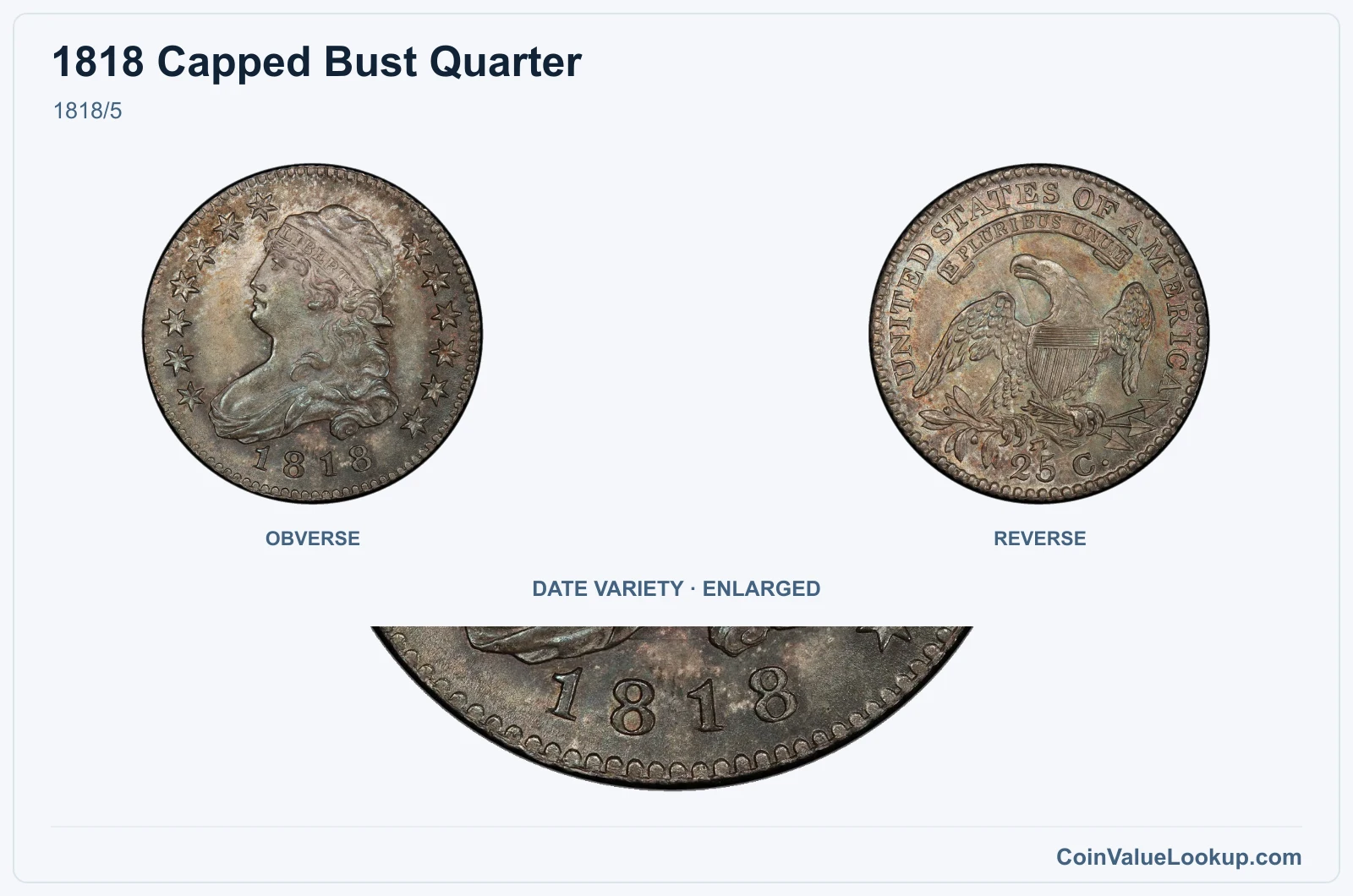
The 1818/5 is an overdate variety where the die originally bore a "5" in the final position, then was re-engraved with an "8." Under magnification you can see remnants of the 5's curves peeking out beneath the 8. It is one of the more recognizable Capped Bust Quarter overdates.
Guide estimates from USA Coin Book match the standard date at $164.00 in G4, $5,228.00 in MS60 and $9,340.00 in MS63. These are retail guide figures, not guaranteed offers.
The overdate detail must be genuine die work, not damage or a filled digit. A loupe and steady hand go a long way here.
Coin Value Lookup is a useful starting point if you want to compare this overdate against other Capped Bust Quarter years and their guide values. It can help you narrow down which version you are holding before seeking professional confirmation.
Range Grade
Price Auction Records Appraisal PO PO 1
—
Coin Identifier FR FR 2
—
Coin Identifier AG AG 3
—
Coin Identifier G G 4
Coin Identifier
G 6
Coin Identifier VG VG 8
Coin Identifier
VG 10
Coin Identifier F F 12
Coin Identifier
F 15
Coin Identifier VF VF 20
Coin Identifier
VF 25
Coin Identifier
VF 30
Coin Identifier
VF 35
Coin Identifier XF XF 40
Coin Identifier
XF 45
Coin Identifier AU AU 50
Coin Identifier
AU 53
—
Coin Identifier
AU 55
Coin Identifier
AU 58
Coin Identifier MS MS 60
—
Coin Identifier
MS 61
—
Coin Identifier
MS 62
Coin Identifier
MS 63
Coin Identifier
MS 64
Coin Identifier
MS 65
Coin Identifier
MS 66
Coin Identifier
MS 67
Coin Identifier
MS 68
—
—
—
MS 69
—
—
—
MS 70
—
—
—
1818 Capped Bust Quarter — PR
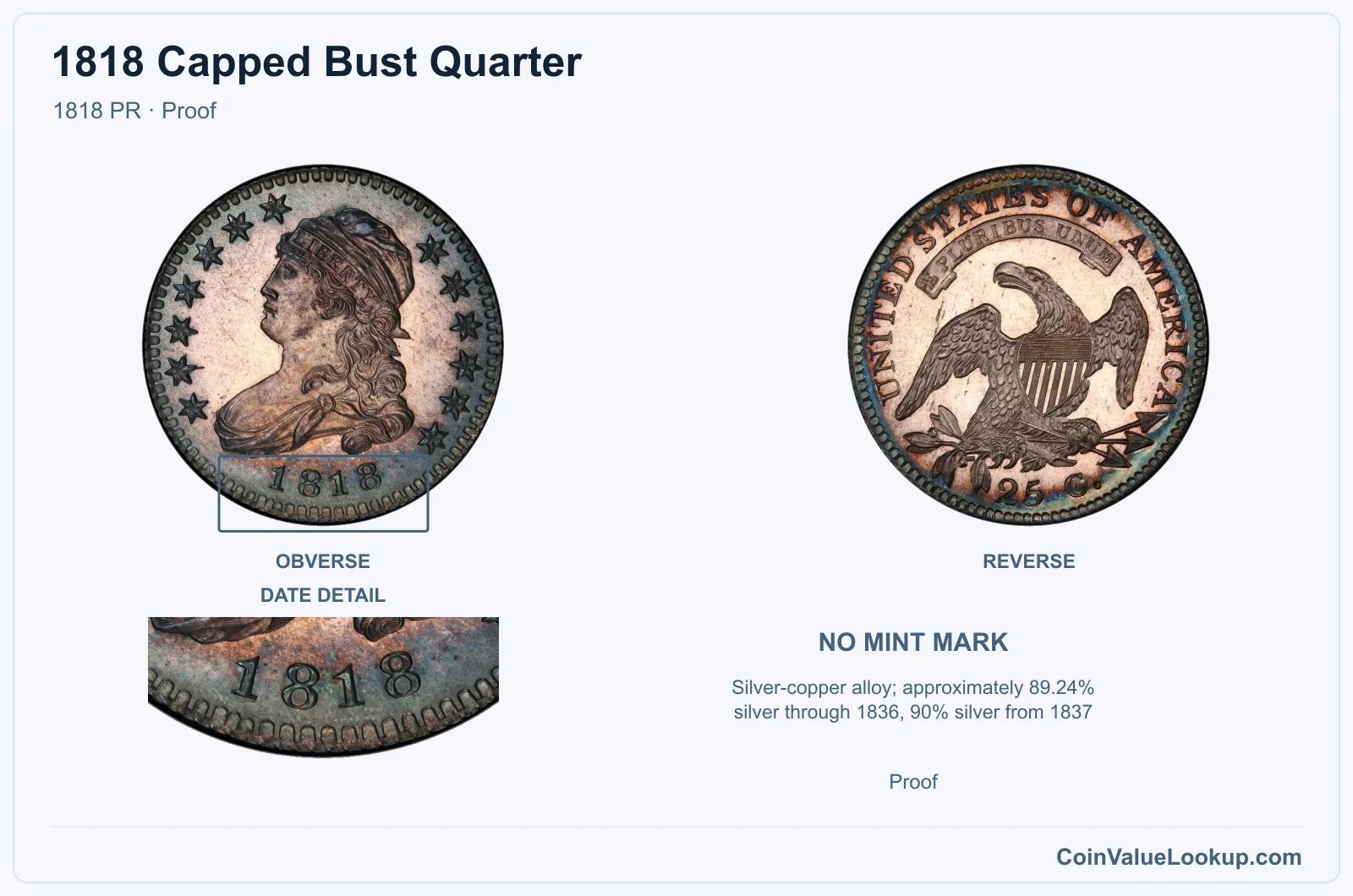
The 1818 Proof is a special-manufacture striking, not simply a nice-looking business strike. Genuine proofs from this era show deeply mirrored fields, razor-sharp design edges and squared rims that regular strikes do not achieve.
No guide price is adopted for this version. Each proof needs individual assessment based on authenticated identity, surface preservation and any hairlines or haze.
Professional certification from a major grading service is essentially required to confirm proof status for coins of this vintage. Cleaning or surface disturbance can significantly affect collector appeal even when the coin is genuine.
Range Grade
Price Auction Records Appraisal PR PR 1
—
Coin Identifier
PR 2
—
Coin Identifier
PR 3
—
Coin Identifier
PR 4
—
Coin Identifier
PR 6
—
Coin Identifier
PR 8
—
Coin Identifier
PR 10
—
Coin Identifier
PR 12
—
Coin Identifier
PR 15
—
Coin Identifier
PR 20
—
Coin Identifier
PR 25
—
Coin Identifier
PR 30
—
Coin Identifier
PR 35
—
Coin Identifier
PR 40
—
Coin Identifier
PR 45
—
Coin Identifier
PR 50
—
Coin Identifier
PR 53
—
Coin Identifier
PR 55
—
Coin Identifier
PR 58
—
Coin Identifier
PR 60
—
Coin Identifier
PR 61
—
Coin Identifier
PR 62
—
Coin Identifier
PR 63
—
Coin Identifier
PR 64
—
Coin Identifier
PR 65
—
Coin Identifier
PR 66
—
Coin Identifier
PR 67
Coin Identifier
PR 68
—
—
—
PR 69
—
—
—
PR 70
—
—
—
1818 Capped Bust Quarter Error List
1. 1818 Capped Bust Quarter — Off-Center Strike
An off-center strike happens when the planchet is not properly seated between the dies. On an 1818 Capped Bust Quarter, this shows up as a displaced design with an unstruck crescent of blank metal along one edge.
The amount of off-center displacement varies — a small percentage is subtle, while a dramatic misalignment is immediately obvious.
For collector interest, the date needs to remain visible. An off-center quarter missing its date loses much of its premium.
No specific price range is adopted for this error; the value depends on the degree of displacement, overall condition and whether the date is fully legible.
Do not confuse an off-center strike with a clipped planchet, one-sided die misalignment or post-mint flattening from damage. The key diagnostic is a consistent crescent of unstruck metal paired with a complete but shifted design impression.
2. 1818 Capped Bust Quarter — Overdate
The overdate on 1818 Capped Bust Quarters refers to traces of a previously engraved date digit visible beneath the final date. The 1818/5 is the recognized overdate for this year — look for the curved remnants of a "5" under the last "8" in the date.
This is a die variety created during manufacture, not a post-mint alteration. Under magnification, the surviving contours of the earlier digit blend smoothly into the metal, unlike gouges or damage which leave rough, irregular marks.
No separate error price is adopted beyond the version-level guide figures. Value depends on how clearly the underlying digit is visible, plus the coin's overall condition.
Be careful not to mistake a damaged or filled date for an overdate — ordinary machine doubling and circulation damage can mimic the look at first glance, but they lack the distinct second-digit contour.
3. 1818 Capped Bust Quarter — Double / Multiple Strike
A double or multiple strike occurs when the coin is struck more than once by the dies, with the planchet shifting between impacts. On an 1818 quarter, this can produce two clearly separate design impressions that overlap or appear rotated relative to each other.
One reported example involved a flip-over double strike, where the coin flipped between impressions so both sides show competing designs.
These are dramatic errors. Look for two distinct sets of design elements — not just thickened lettering, but genuinely displaced complete impressions.
No price range is adopted; value depends on the number of strikes, their displacement and the coin's preservation.
Do not confuse a doubled die (a single strike from a die with doubled features) with a multiple strike. Post-mint damage from a vise or machinery can also create misleading double impressions but lacks the precise die-quality detail of a genuine second strike.
4. 1818 Capped Bust Quarter — Die Crack / Die Chip
Die cracks on 1818 Capped Bust Quarters show up as fine raised lines running across the coin's surface. One reported example describes a crack running from the right edge of the obverse across to the area of the third star from the top, where it joins an earlier crack.
These lines are raised because the cracked die created a recessed channel that filled with metal during striking.
A die chip is a small raised blob rather than a line — it forms when a piece of the die surface breaks away. If the crack reaches the rim and a chunk of the die collapses, the result is a cud: a flat, featureless raised area at the edge.
No price is adopted for this error. Value depends on the crack's prominence and location.
Do not confuse die cracks with incuse scratches, corrosion lines or debris stuck to the surface — those features are recessed or irregular, not cleanly raised.
5. 1818 Capped Bust Quarter — Clashed Dies
Clashed dies result from the obverse and reverse dies striking each other without a planchet between them. This transfers faint ghostly traces of the opposite design onto each die, which then appear on subsequent coins.
On 1818 quarters, one reported instance describes heavy double clash marks visible below the scroll on the reverse.
To spot clash marks, look for design elements that belong to the other side of the coin — outlines of Liberty's bust appearing in the reverse fields, or hints of the eagle's wing on the obverse. These ghost impressions align with where the opposing design would contact the die face.
No specific price is adopted for clashed-die examples. The value depends on how prominent and clear the transferred design traces are, plus the coin's overall condition.
Do not mistake random scratches, raised lines from debris or a brockage error for clash marks — clash impressions follow predictable locations tied to the opposing die's design.