1806 Draped Bust Quarter Coin Value: How Much Is It Worth?
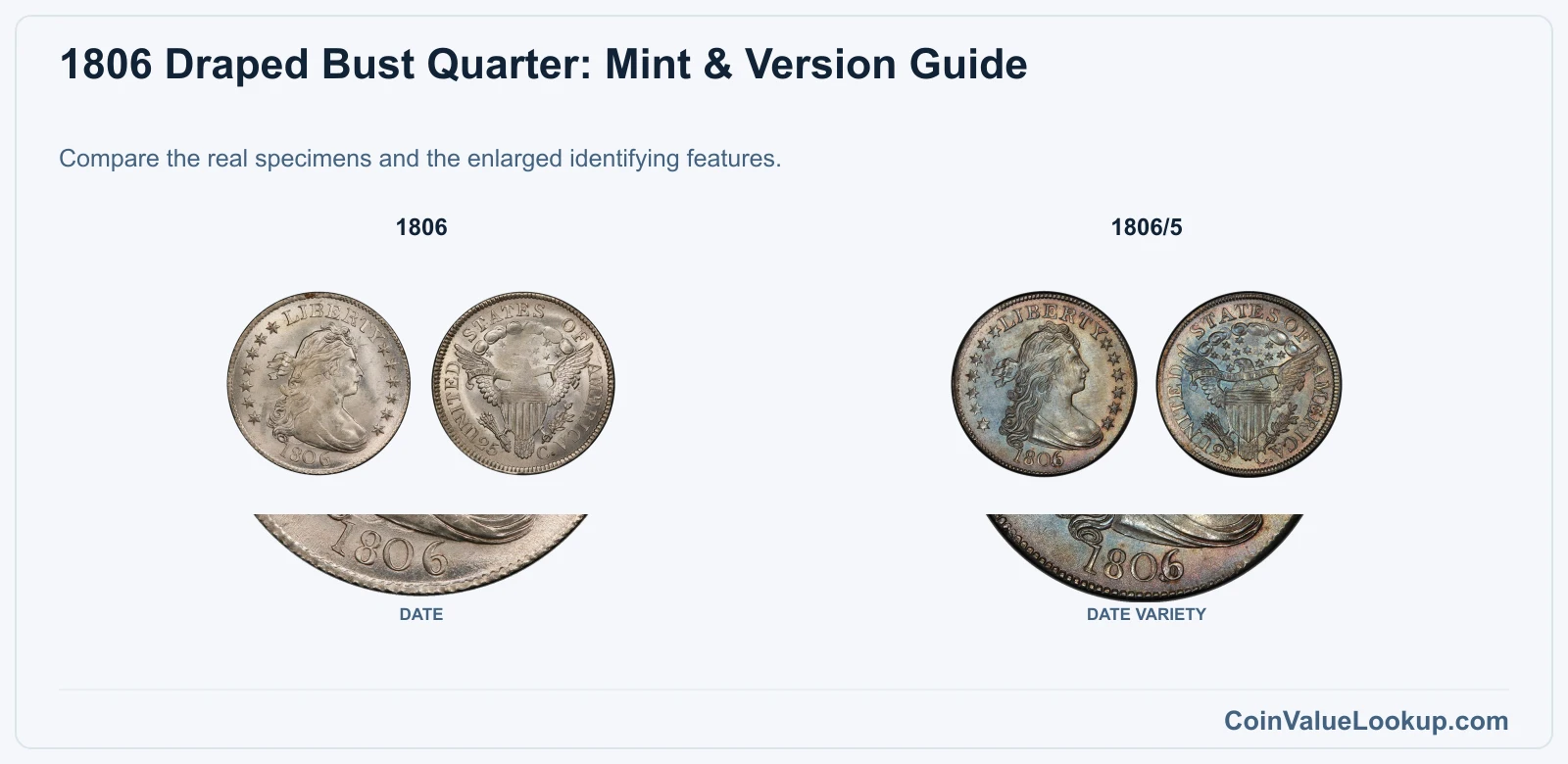
The 1806 Draped Bust Quarter is an early American silver coin struck only at the Philadelphia Mint. USA Coin Book guide estimates place individual versions between $622.00 and $31,429.00 depending on the specific version and grade.
That is not a single range for every coin — the version you hold, its condition, and whether the date shows an overdate all determine where it falls.
Fast Way to Identify Your 1806 Draped Bust Quarter
The quickest way to start figuring out what your 1806 quarter is worth is to upload clear photos of both the front and back. Our identifier can offer a preliminary identification of the version and approximate condition.
Good lighting and a sharp image of the date area are especially helpful for spotting the 1806/5 overdate.
1806 Draped Bust Quarter Value
Upload both sides of your 1806 Draped Bust Quarter.
Front Obverse
Upload photo
Back Reverse
Upload photo
Which 1806 Draped Bust Quarter Versions Are Worth Money?
- 1806/5 overdate: USA Coin Book estimates $675.00 in G4 and up to $31,429.00 in MS63 — the overdate digit is the key identifier.
- 1806 normal date: USA Coin Book estimates $622.00 in G4 and up to $26,779.00 in MS63 — still a scarce early quarter in any grade.
- Check for mint errors such as die breaks or brockages; these can carry additional collector interest beyond the base version value.
Step 1: Identify Your 1806 Draped Bust Quarter Mint Mark and Version
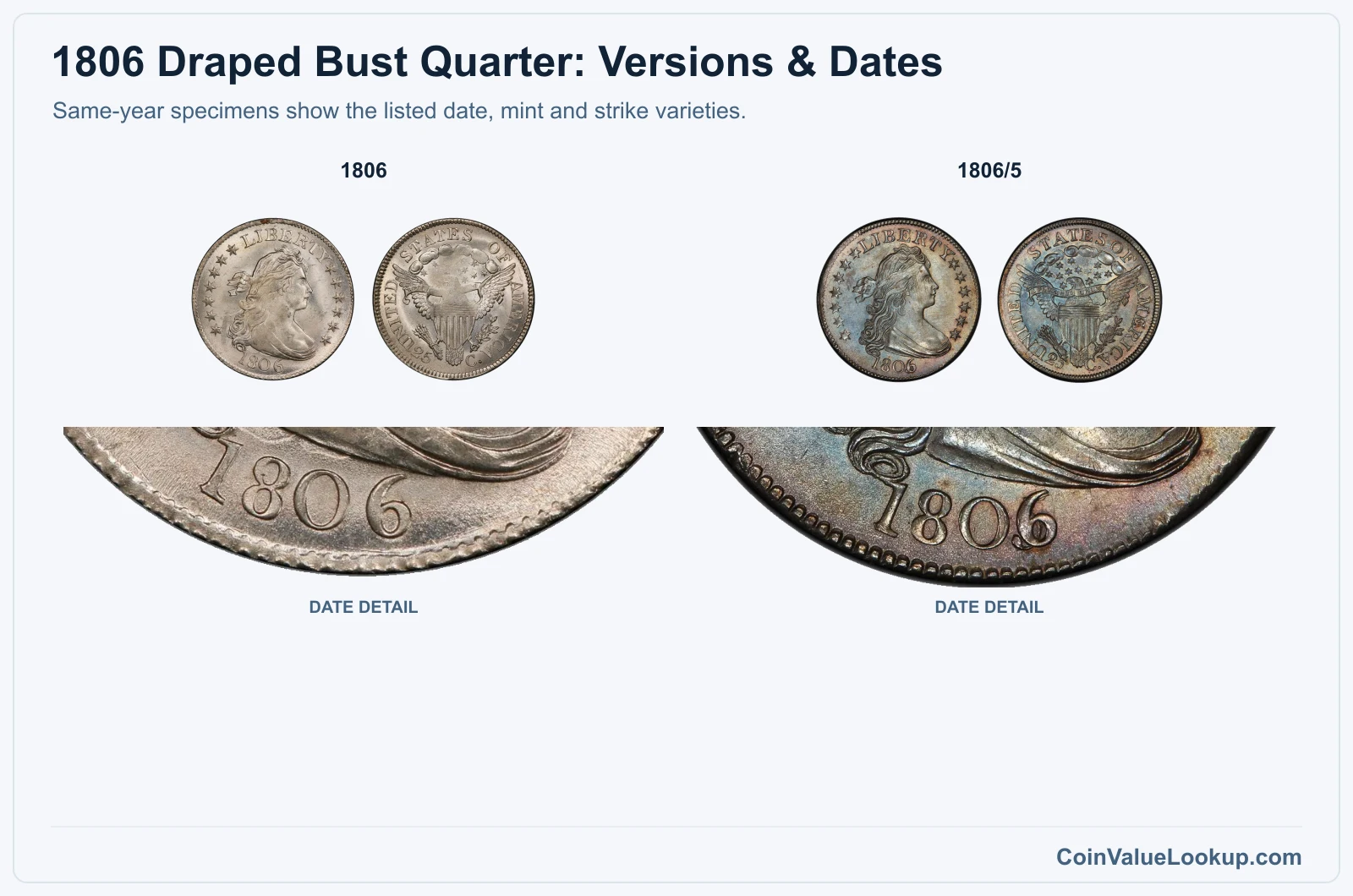
Every 1806 quarter was struck at Philadelphia. There is no mintmark to look for — the early U.S. Mint did not stamp a P on its coins.
The design pairs the Draped Bust obverse with the Heraldic Eagle reverse, which was used on quarters from 1804 through 1807.
The coin is struck in an early silver-copper alloy of approximately 89.24% silver. It will look and feel different from later quarters.
The key branching point for 1806 is the date. A normal 1806 is one version.
The other is the 1806/5, where remnants of an underlying "5" are visible beneath the final "6" in the date. Tilt the coin under a light and examine the bottom curve of the 6 — traces of the 5's upper loop or different curvature may be visible.
If you see that ghost digit, you have the overdate.
Do not assume a cleaned or damaged coin is a rare version just because it looks unusual. Match the mint, design, and date details first, then assess condition.
Step 2: Check Your 1806 Draped Bust Quarter Grade
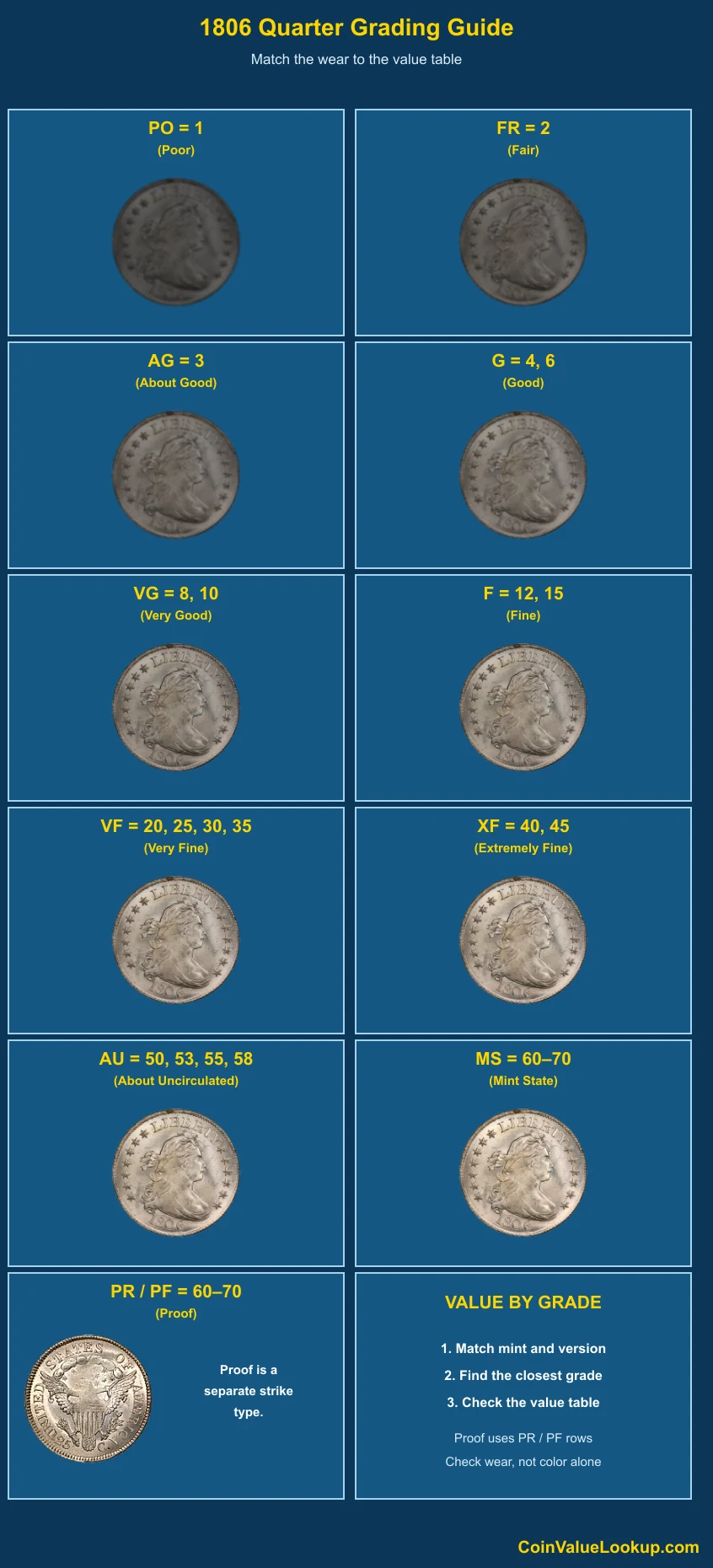
On a well-worn example grading around Good-4, Liberty's portrait is a flat outline with almost no hair detail above the ear. The cheek is smooth, and the drapery lines across the bust are gone or barely suggested.
The Heraldic Eagle on the reverse will show merged wing feathers and a faint shield.
As grades improve toward Very Fine and Extremely Fine, hair strands above the ear become individually visible, the cheek retains some roundness, and drapery folds sharpen. The eagle's breast feathers and wing tips gain separation.
At Mint State (MS60 and above), full original luster should be present, though early-1800s strikes are often unevenly impressed. A coin can be uncirculated yet still show soft spots from a weak strike — that is not wear.
Use the comparison image to check the high points: Liberty's hair above the forehead and the eagle's breast are the first areas to lose detail from actual circulation.
Don't confuse a bright, cleaned surface with mint luster. Cleaned coins lose the original cartwheel sheen and often show fine hairlines under magnification.
Step 3: Check 1806 Draped Bust Quarter Value by Mint and Version
1806 Draped Bust Quarter
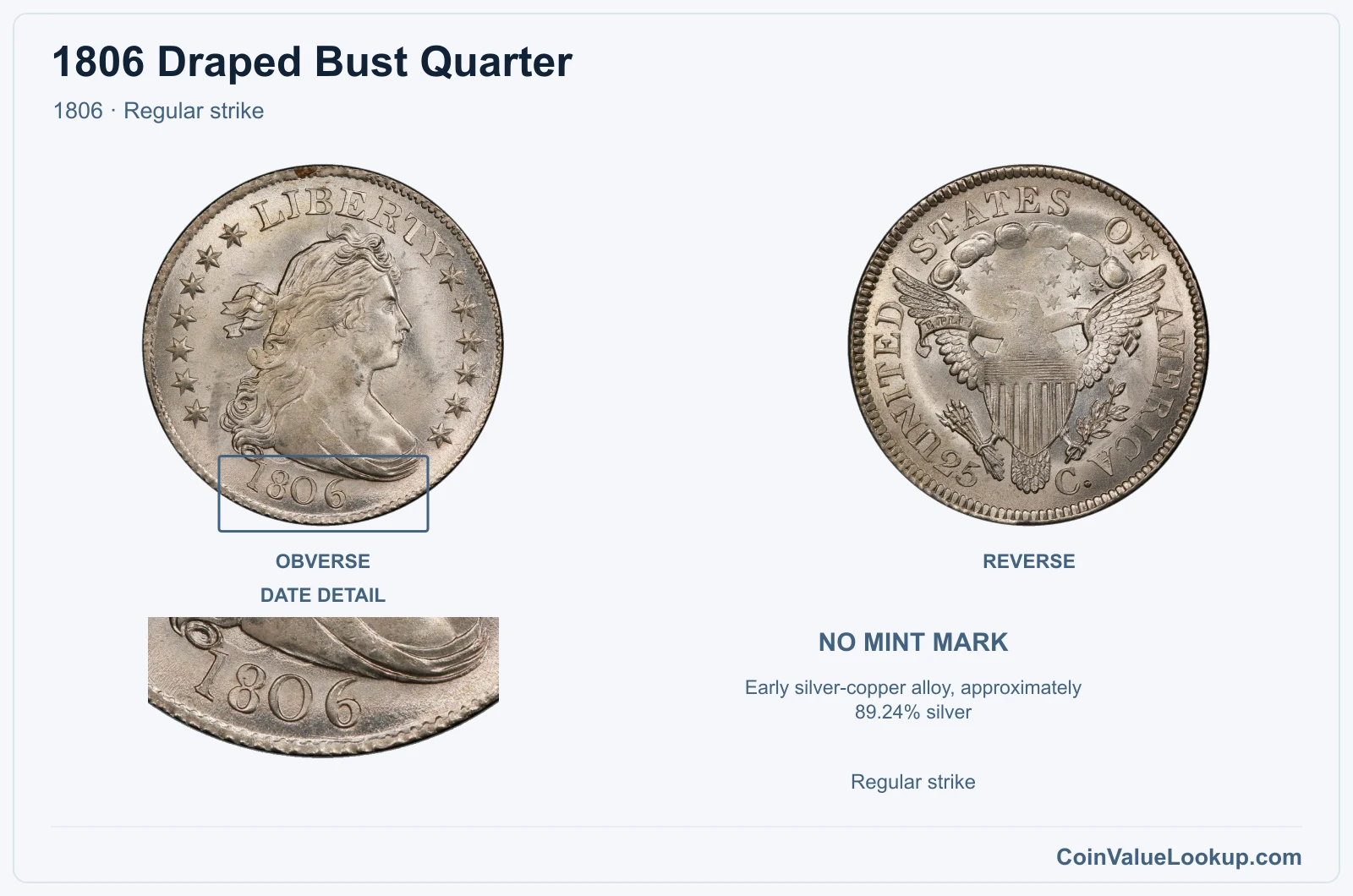
The normal 1806 Draped Bust Quarter was struck at Philadelphia with no mintmark. It features the standard Heraldic Eagle reverse.
USA Coin Book estimates place this version at about $622.00 in G4, $14,888.00 in MS60, and $26,779.00 in MS63 — these are guide estimates, not guaranteed offers.
To confirm you have the normal date, examine the "6" in 1806 carefully. It should be clean with no underlying digit visible.
Original surfaces matter here; a coin that has been cleaned or damaged will trade well below guide figures even if the grade otherwise looks decent. Match the mint, design, and date before comparing condition.
Range Grade
Price Auction Records Appraisal PO PO 1
Coin Identifier FR FR 2
Coin Identifier AG AG 3
Coin Identifier G G 4
Coin Identifier
G 6
Coin Identifier VG VG 8
Coin Identifier
VG 10
Coin Identifier F F 12
Coin Identifier
F 15
Coin Identifier VF VF 20
Coin Identifier
VF 25
Coin Identifier
VF 30
Coin Identifier
VF 35
Coin Identifier XF XF 40
Coin Identifier
XF 45
Coin Identifier AU AU 50
Coin Identifier
AU 53
Coin Identifier
AU 55
Coin Identifier
AU 58
Coin Identifier MS MS 60
—
Coin Identifier
MS 61
Coin Identifier
MS 62
Coin Identifier
MS 63
Coin Identifier
MS 64
Coin Identifier
MS 65
Coin Identifier
MS 66
Coin Identifier
MS 67
—
—
—
MS 68
—
—
—
MS 69
—
—
—
MS 70
—
—
—
1806 Draped Bust Quarter — /5
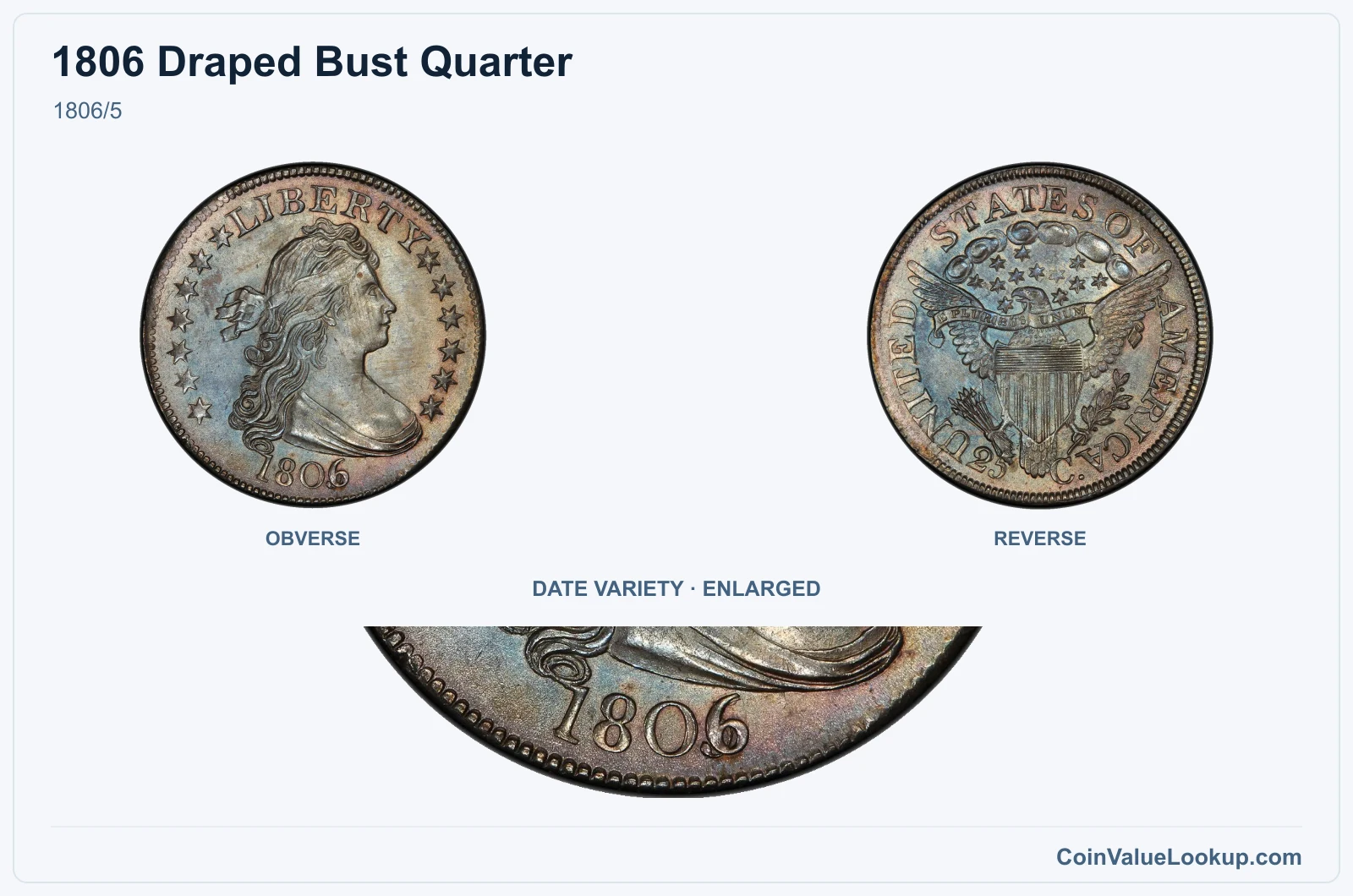
The 1806/5 is an overdate variety where the Mint reused a die originally engraved with the date 1805, punching a 6 over the 5. Look at the final digit of the date under magnification — remnants of the 5's upper curve or different serif angle should be visible beneath or around the 6.
This version carries a modest premium over the normal date across all grades. USA Coin Book estimates are approximately $675.00 in G4, $17,442.00 in MS60, and $31,429.00 in MS63, though these are guide estimates and not guaranteed offers.
Coin Value Lookup is a useful starting point if you want to compare this quarter against other Draped Bust dates and denominations. You can look up guides for the full series in one place.
As with the normal date, original surfaces and accurate version identification are critical. A cleaned overdate will still be worth less than an original-surface example at the same apparent grade.
Range Grade
Price Auction Records Appraisal PO PO 1
Coin Identifier FR FR 2
Coin Identifier AG AG 3
Coin Identifier G G 4
Coin Identifier
G 6
Coin Identifier VG VG 8
Coin Identifier
VG 10
Coin Identifier F F 12
Coin Identifier
F 15
Coin Identifier VF VF 20
Coin Identifier
VF 25
Coin Identifier
VF 30
Coin Identifier
VF 35
Coin Identifier XF XF 40
Coin Identifier
XF 45
Coin Identifier AU AU 50
Coin Identifier
AU 53
Coin Identifier
AU 55
Coin Identifier
AU 58
Coin Identifier MS MS 60
—
Coin Identifier
MS 61
Coin Identifier
MS 62
Coin Identifier
MS 63
Coin Identifier
MS 64
Coin Identifier
MS 65
—
Coin Identifier
MS 66
Coin Identifier
MS 67
—
—
—
MS 68
—
—
—
MS 69
—
—
—
MS 70
—
—
—
1806 Draped Bust Quarter Error List
1. 1806 Draped Bust Quarter — Brockage
A brockage on an 1806 Draped Bust Quarter occurs when a previously struck coin remains in the press and acts as a die for the next blank. The result is one normal side and one side showing an incuse, mirror-image impression of the same or opposite design.
You will see the transferred image sunken into the surface rather than raised.
To tell a genuine brockage from a die clash, check depth and completeness. A die clash leaves faint ghost traces in the field, while a brockage produces a full, deeply impressed reversed design.
Post-mint damage from pressing two coins together can mimic this, but the metal flow and centering will differ.
No specific price is adopted for this error. Value depends on the clarity and extent of the brockage, overall condition, and market demand for early quarter errors.
Professional evaluation is recommended.
2. 1806 Draped Bust Quarter — Die Crack / Die Chip
Die cracks on an 1806 quarter appear as thin raised lines running across the coin's surface, formed when the steel die developed fractures during use. Small raised blobs — die chips — can also appear where tiny pieces of the die broke away, leaving a filled void on the struck coin.
A crack connected to the rim is sometimes classified differently (see die break/cud below). Interior cracks and chips remain within the design area.
To distinguish a genuine die crack from post-mint damage, remember that die cracks are raised, while scratches are incised into the surface. Corrosion and foreign material sit on top of the metal rather than being part of the strike.
No specific price is adopted for die cracks on this date. The value impact depends on the crack's size, location, and the coin's overall condition.
3. 1806 Draped Bust Quarter — Die Break / Cud
A cud on the 1806 Draped Bust Quarter is a major die break where a piece of the die has broken away at the rim, leaving a raised, featureless blob of metal that connects to the edge. The design in that area is displaced or missing entirely.
A terminal die state with a major cud means the die was near the end of its useful life.
Look for a smooth, raised lump attached to the rim with a clear boundary where the normal design resumes. A rim dent will be depressed, not raised.
An interior die chip does not reach the rim and is typically smaller.
Corrosion can sometimes build up near the edge and look vaguely cud-like, but it will lack the sharp boundary and uniform metal flow of a genuine cud. No specific price is adopted for this error — value depends on the cud's size, prominence, and the coin's overall grade.
4. 1806 Draped Bust Quarter — Off-Center Strike
An off-center strike happens when the planchet is not properly seated between the dies, shifting the entire design to one side and leaving an unstruck crescent of blank metal on the opposite edge. On an 1806 quarter, these are rare early-mint errors.
The percentage off center and whether the date remains visible are the two biggest factors collectors consider. A coin struck 10% off center with a full date is more collectible than one struck 50% off center with the date missing.
Do not confuse an off-center strike with a clipped planchet (which removes metal before striking) or with post-mint flattening that shifts the apparent design. A genuine off-center coin shows uniform metal thickness across the struck portion.
No specific price is adopted; value depends on the degree of displacement and overall condition.
5. 1806 Draped Bust Quarter — Clipped Planchet
A clipped planchet error on the 1806 quarter means the blank was incomplete before it entered the press. The missing section can be curved (from an overlapping punch in the strip), straight, or ragged.
The coin will show a portion of missing metal, and the area opposite the clip often displays slight design weakness — this is called the Blakesley effect and helps confirm the clip is genuine.
Edge texture at the clip boundary will differ from a filed or cut edge. A real clip shows the original planchet shear and metal flow consistent with the striking process.
Corrosion eating away an edge can mimic a clip but will show pitting and irregular texture rather than a clean break.
No specific price is adopted for clipped examples of this date. Condition, clip size, and whether the date is complete all affect collector interest.
6. 1806 Draped Bust Quarter — Broadstrike
A broadstrike occurs when the coin is struck without the collar die that normally confines the planchet and forms the edge. The result is a coin that spreads outward, appearing slightly larger than normal with a thinner rim or no defined rim at all.
The full design is present but expanded.
On an 1806 quarter, look for outward metal spread beyond the normal diameter while the design remains centered. Compare the edge profile to a normal example — a broadstrike will lack the usual edge definition.
Post-mint flattening can spread a coin too, but it crushes surface detail and leaves tool marks that a genuine broadstrike will not show.
No specific price is adopted for broadstruck 1806 quarters. The degree of spread, overall condition, and surface preservation drive value.
Professional attribution is advisable for any suspected early-date broadstrike.
7. 1806 Draped Bust Quarter — Wrong Planchet / Off-Metal Strike
A wrong planchet error means the quarter dies struck a blank intended for a different denomination or composition. The coin may appear undersized, oversized, or noticeably different in weight compared to a standard 1806 quarter.
Design details might be incomplete if the planchet was smaller than the dies.
To check, compare measured weight and diameter against known specifications for the 1806 quarter. Edge details and metal color are also useful clues.
Do not assume unusual color alone means wrong planchet — plating, corrosion, acid treatments, and deliberate alterations can all change a coin's appearance.
No specific price is adopted for this error on the 1806 date. Authenticity confirmation through professional evaluation is especially important here, since wrong-planchet errors on early U.S. coins are extremely uncommon and frequently misidentified.