1876 Liberty Seated Quarter Coin Value: How Much Is It Worth?
The 1876 Liberty Seated quarter is a Centennial-year silver coin struck at up to three mints, and it also exists as a proof. Guide estimates from USA Coin Book range from $46.00 to $1,531.00 depending on which mint produced the coin, whether it is a business strike or proof, and its condition.
That spread is not one price for every coin — your specific version and grade determine where it falls.
Fast Way to Identify Your 1876 Liberty Seated Quarter
The quickest way to start figuring out what you have is to upload clear photos of both the front and back of your coin. Our identifier can give you a preliminary read on the mint, design type, and general version based on those images.
It will not authenticate, certify, or assign an exact grade, but it narrows the field so you know where to look next.
1876 Liberty Seated Quarter Value
Upload both sides of your 1876 Liberty Seated Quarter.
Front Obverse
Upload photo
Back Reverse
Upload photo
Which 1876 Liberty Seated Quarter Versions Are Worth Money?
- 1876-CC quarters carry the Carson City mintmark and guide at $78.00 in G4 up to $1,531.00 in MS63, making the CC mint the version to check first.
- 1876 proof quarters were specially manufactured at Philadelphia; the guide lists PR63 at $938.00, so confirming true proof surfaces matters.
- 1876-S quarters from San Francisco guide at $46.00 in G4 to $675.00 in MS63, comparable to Philadelphia strikes but with an "S" mintmark to verify.
- A doubled die obverse has been reported on the 1876-CC; if genuine and well-defined, it adds collector interest beyond the base version value.
Step 1: Identify Your 1876 Liberty Seated Quarter Mint Mark and Version
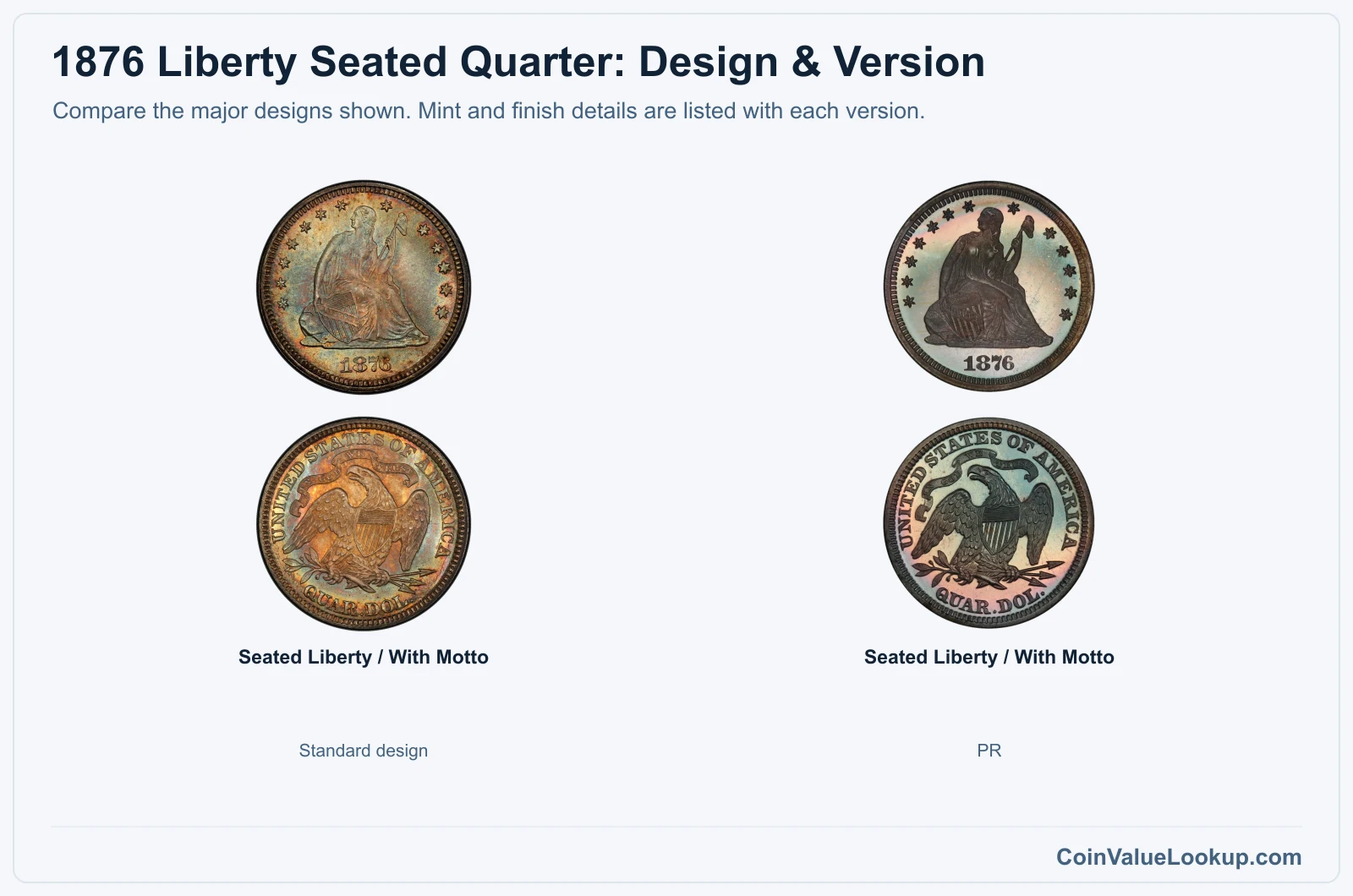
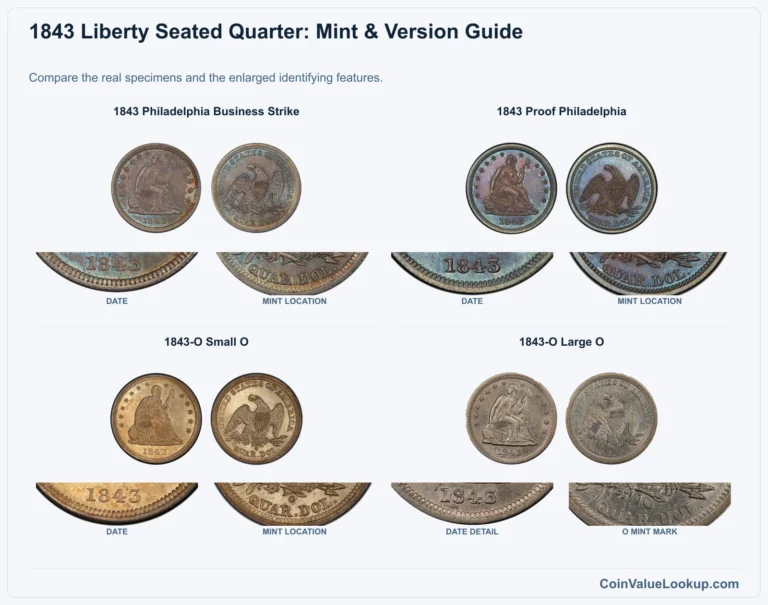
All 1876 quarters share the same basic look: Liberty seated on the obverse, an eagle with a motto ribbon on the reverse. The key difference is the mintmark.
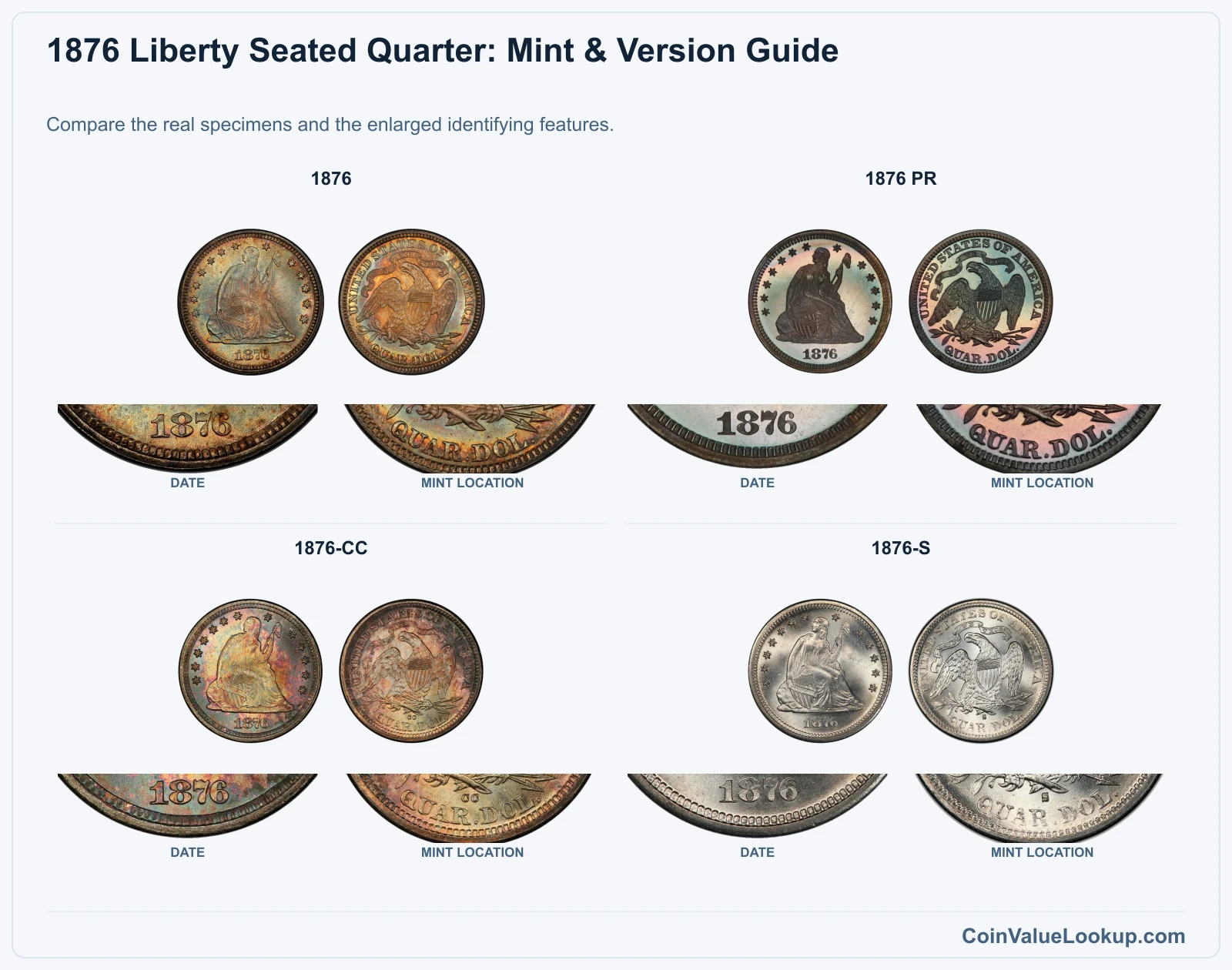
Philadelphia coins carry no mintmark at all. Carson City quarters show a small "CC" on the reverse beneath the eagle, and San Francisco pieces display an "S" in the same spot.
The material is 90% silver and 10% copper, weighing 6.25 grams. If your coin feels too light or doesn't ring like silver, it may be a counterfeit or a heavily damaged piece.
Proofs were struck at Philadelphia only, so a proof will also lack a mintmark. Distinguishing a proof from a business strike requires examining the surfaces: proofs show mirrored fields and sharp rims from specially prepared dies, not just a shiny appearance.
A polished or cleaned regular strike is not a proof. The four collectible branches for this year are 1876, 1876 proof, 1876-CC, and 1876-S.
Step 2: Check Your 1876 Liberty Seated Quarter Grade
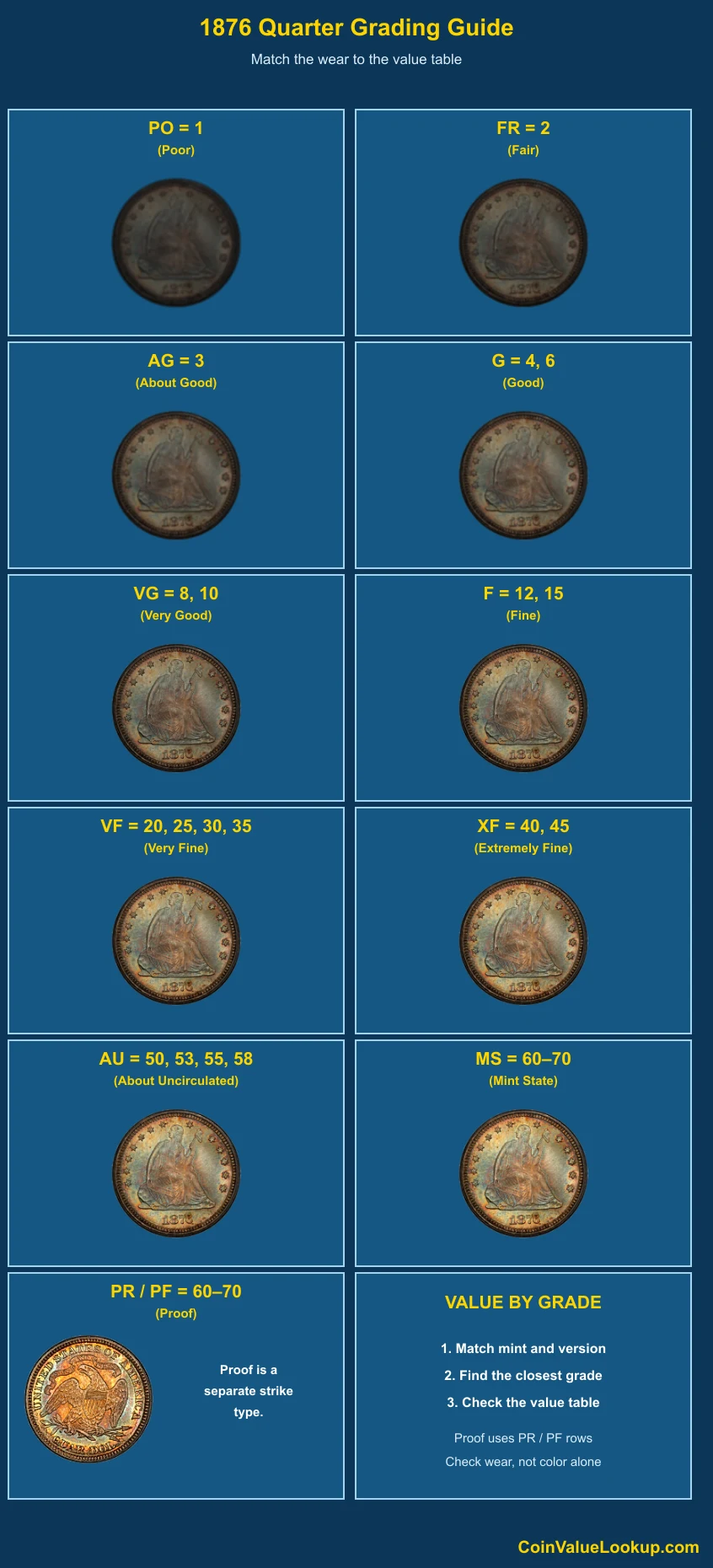
Start at the high points. On the obverse, check Liberty's head, the breast area, knee, and the horizontal lines on her shield.
These wear first. On the reverse, the eagle's breast feathers and the tops of the wings show contact soonest.
A coin in Good-4 will have Liberty's outline visible but most interior detail gone. At Mint State 60, the coin retains full design detail but may show bag marks or contact from storage.
By MS63 those marks are fewer and luster is largely unbroken.
Compare your coin to the reference image for this type. Pay attention to luster as much as detail — a weakly struck coin can look worn even when it isn't, and a cleaned coin can look bright while actually being damaged.
If the fields appear uniformly dull or show fine parallel lines, cleaning may have occurred, which reduces value regardless of remaining detail.
Step 3: Check 1876 Liberty Seated Quarter Value by Mint and Version
1876 Liberty Seated Quarter
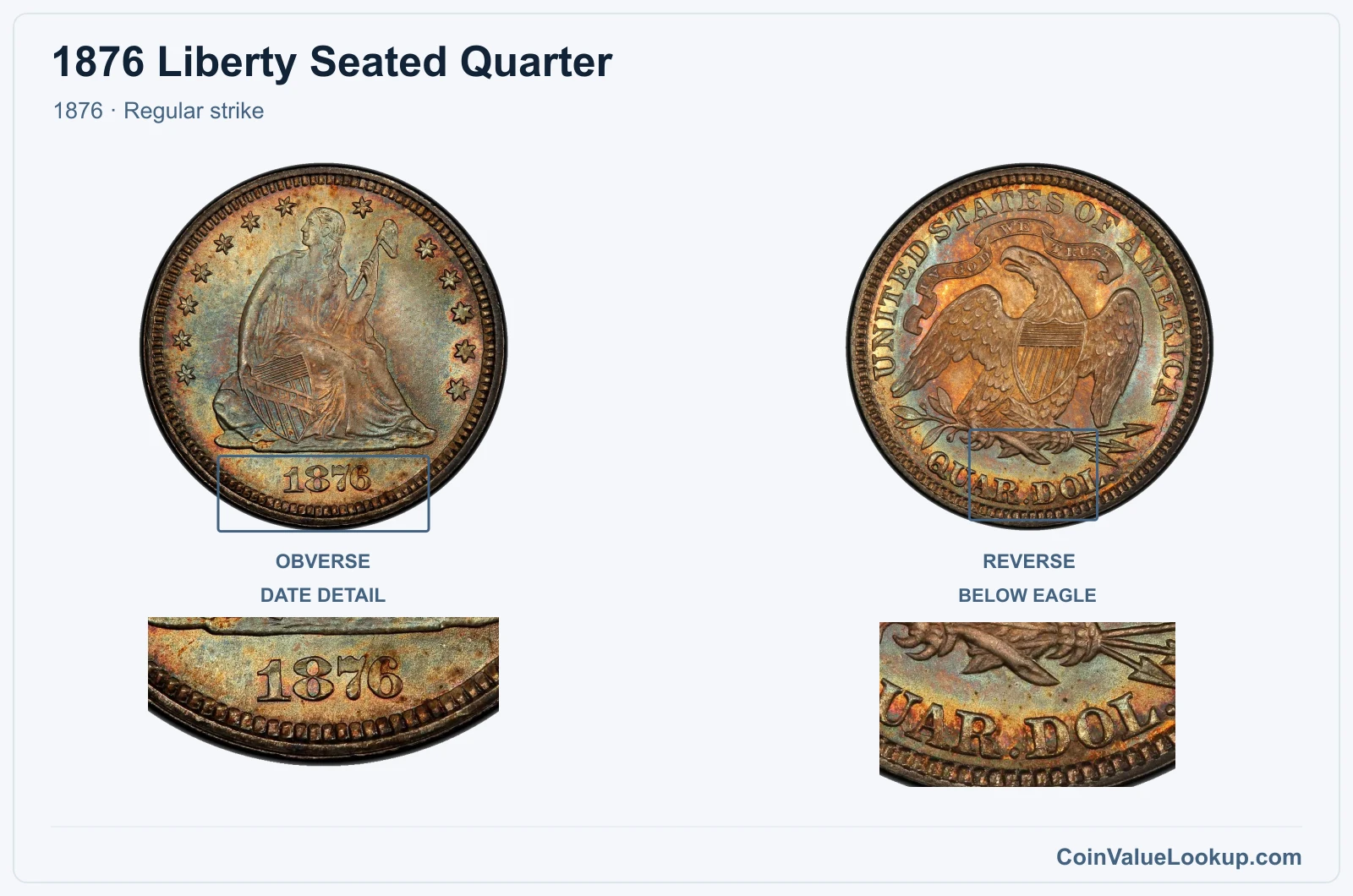
The 1876 Philadelphia quarter has no mintmark. Look at the reverse below the eagle — if that space is blank, you likely have the P-mint issue.
In well-worn Good-4 condition, USA Coin Book guides this at $46.00. A Mint State 60 example jumps to $353.00, and an MS63 piece reaches $675.00.
Original surfaces matter here. Cleaning strips the natural toning and luster that collectors pay a premium for, and it can push the practical value well below these guide figures.
Weakly struck centers are possible on Philadelphia quarters of this era, so don't mistake a soft strike for wear.
Range Grade
Price Auction Records Appraisal PO PO 1
—
Coin Identifier FR FR 2
—
Coin Identifier AG AG 3
—
Coin Identifier G G 4
—
Coin Identifier
G 6
—
Coin Identifier VG VG 8
—
Coin Identifier
VG 10
—
Coin Identifier F F 12
—
Coin Identifier
F 15
—
Coin Identifier VF VF 20
—
Coin Identifier
VF 25
—
Coin Identifier
VF 30
—
Coin Identifier
VF 35
Coin Identifier XF XF 40
Coin Identifier
XF 45
Coin Identifier AU AU 50
Coin Identifier
AU 53
Coin Identifier
AU 55
Coin Identifier
AU 58
Coin Identifier MS MS 60
—
Coin Identifier
MS 61
Coin Identifier
MS 62
Coin Identifier
MS 63
Coin Identifier
MS 64
Coin Identifier
MS 65
Coin Identifier
MS 66
Coin Identifier
MS 67
Coin Identifier
MS 68
Coin Identifier
MS 69
—
—
—
MS 70
—
—
—
1876 Liberty Seated Quarter — PR
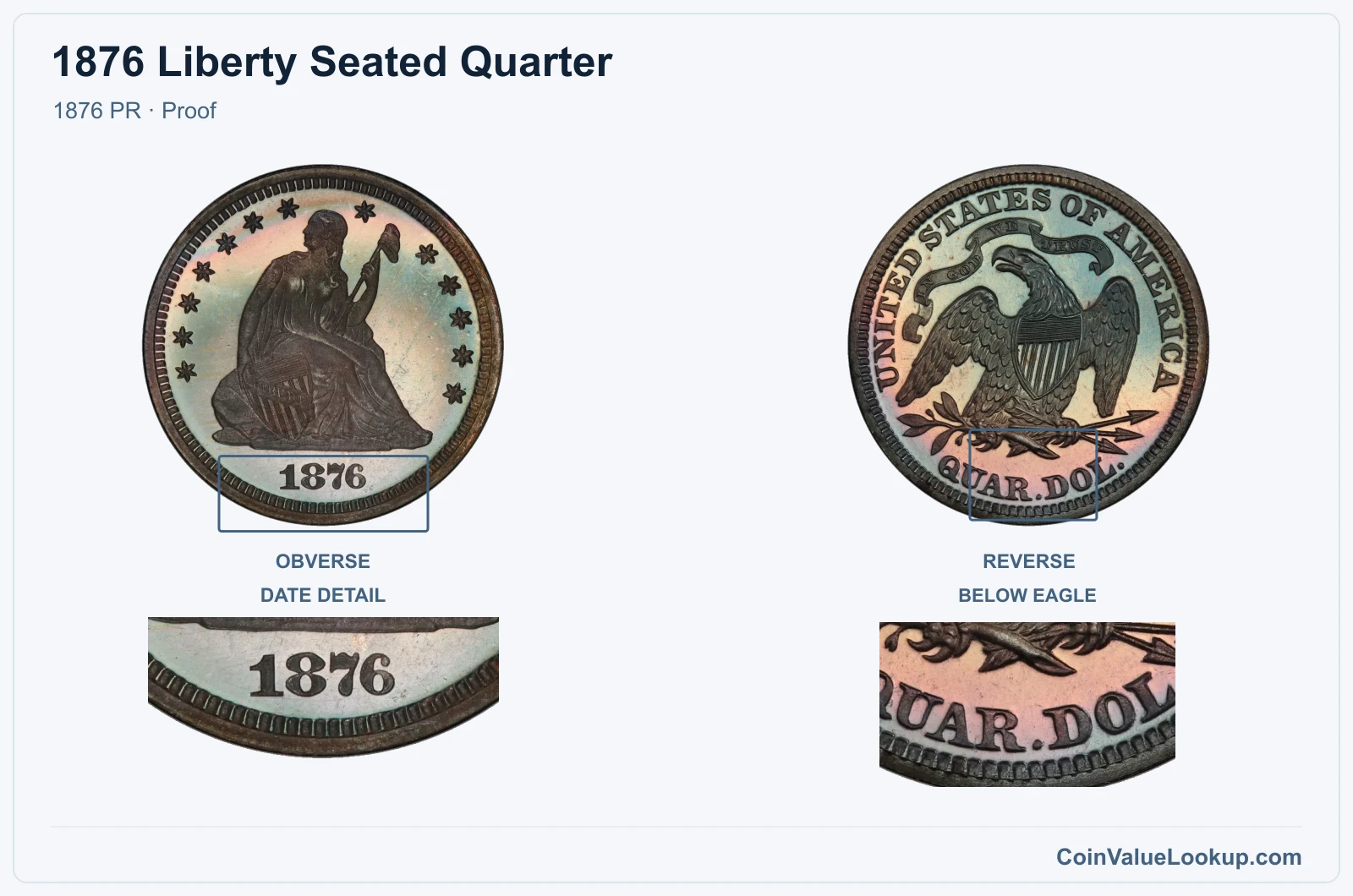
The 1876 proof quarter was made at Philadelphia using polished dies and carefully prepared planchets, producing mirrored fields and sharp design edges. Like regular Philadelphia strikes, it has no mintmark.
The difference between a proof and a shiny business strike trips up a lot of people. Proofs show deep, liquid-looking reflections in the flat fields and typically have squared-off rims.
A business strike that has been polished or dipped may gleam, but the surface texture is different under magnification — look for die polish lines running in one direction across the fields. Hairlines and haze from handling reduce a proof's appeal.
USA Coin Book guides a PR63 example at $938.00. Surface quality is everything with these; a hazy or hairlined proof can trade well below that figure.
Coin Value Lookup is a good starting point if you want to compare this proof value against other dates in the Seated Liberty quarter series.
Range Grade
Price Auction Records Appraisal PR PR 1
—
Coin Identifier
PR 2
—
Coin Identifier
PR 3
—
Coin Identifier
PR 4
—
Coin Identifier
PR 6
—
Coin Identifier
PR 8
—
Coin Identifier
PR 10
—
Coin Identifier
PR 12
—
Coin Identifier
PR 15
—
Coin Identifier
PR 20
—
Coin Identifier
PR 25
—
Coin Identifier
PR 30
—
Coin Identifier
PR 35
—
Coin Identifier
PR 40
—
Coin Identifier
PR 45
—
Coin Identifier
PR 50
—
Coin Identifier
PR 53
Coin Identifier
PR 55
Coin Identifier
PR 58
Coin Identifier
PR 60
Coin Identifier
PR 61
Coin Identifier
PR 62
Coin Identifier
PR 63
Coin Identifier
PR 64
Coin Identifier
PR 65
Coin Identifier
PR 66
Coin Identifier
PR 67
Coin Identifier
PR 68
Coin Identifier
PR 69
—
—
—
PR 70
—
—
—
1876 Liberty Seated Quarter — CC
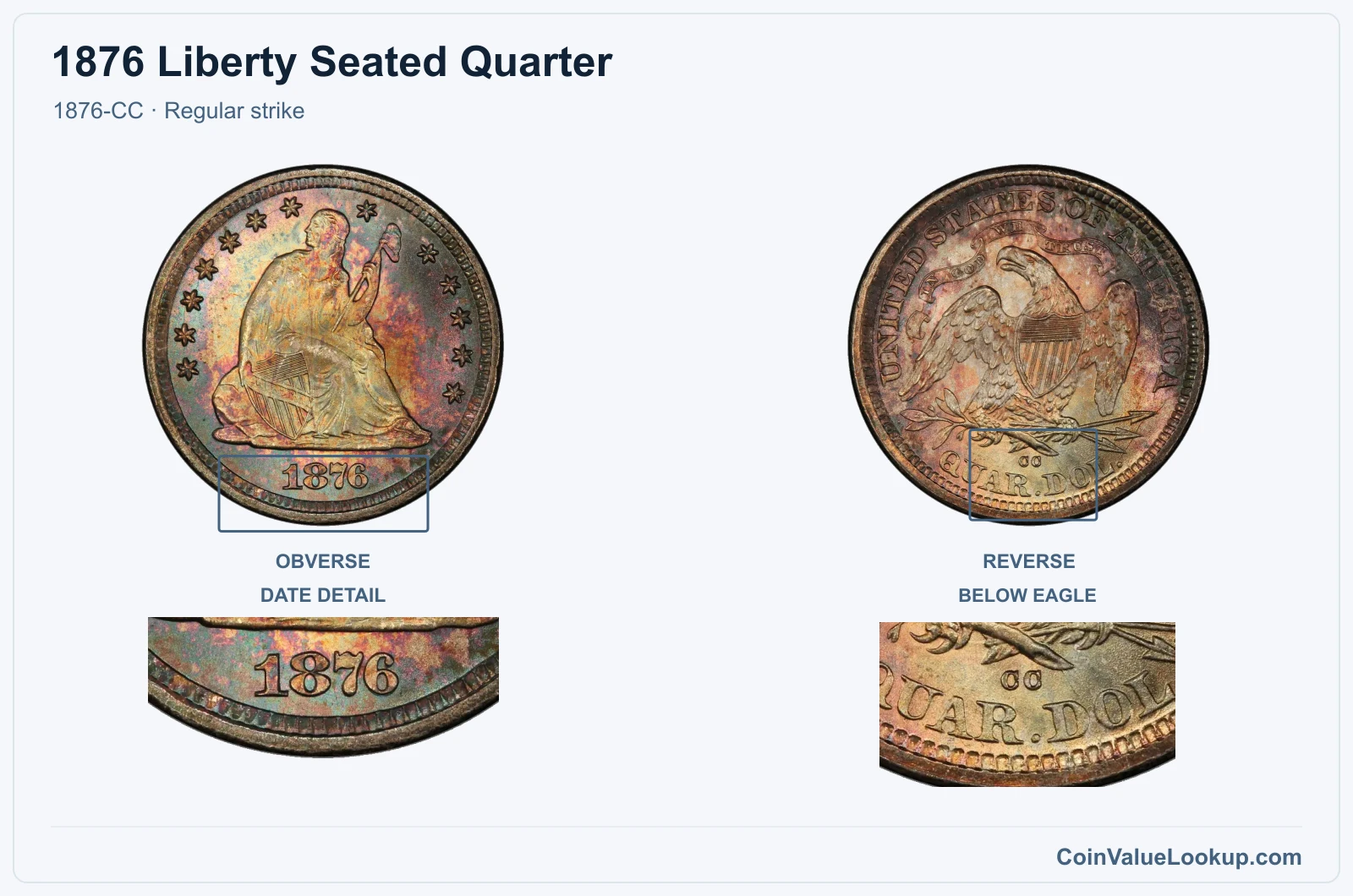
The 1876-CC quarter was struck at the Carson City Mint in Nevada. A small "CC" mintmark sits on the reverse below the eagle.
Carson City coins carry a built-in collector following because the mint operated for a relatively short period and production numbers were generally modest compared to Philadelphia.
USA Coin Book guides the 1876-CC at $78.00 in Good-4, $675.00 at MS60, and $1,531.00 at MS63. That MS63 figure is the highest guide anchor among all 1876 quarter versions at that grade level.
Original, uncleaned surfaces with honest wear are strongly preferred. A cleaned CC quarter loses much of the premium that the mintmark otherwise commands, so resist the urge to polish one up.
Range Grade
Price Auction Records Appraisal PO PO 1
—
Coin Identifier FR FR 2
Coin Identifier AG AG 3
—
Coin Identifier G G 4
—
Coin Identifier
G 6
Coin Identifier VG VG 8
Coin Identifier
VG 10
Coin Identifier F F 12
Coin Identifier
F 15
Coin Identifier VF VF 20
Coin Identifier
VF 25
Coin Identifier
VF 30
Coin Identifier
VF 35
Coin Identifier XF XF 40
Coin Identifier
XF 45
Coin Identifier AU AU 50
Coin Identifier
AU 53
Coin Identifier
AU 55
Coin Identifier
AU 58
Coin Identifier MS MS 60
Coin Identifier
MS 61
Coin Identifier
MS 62
Coin Identifier
MS 63
Coin Identifier
MS 64
Coin Identifier
MS 65
Coin Identifier
MS 66
Coin Identifier
MS 67
Coin Identifier
MS 68
—
—
—
MS 69
—
—
—
MS 70
—
—
—
1876 Liberty Seated Quarter — S
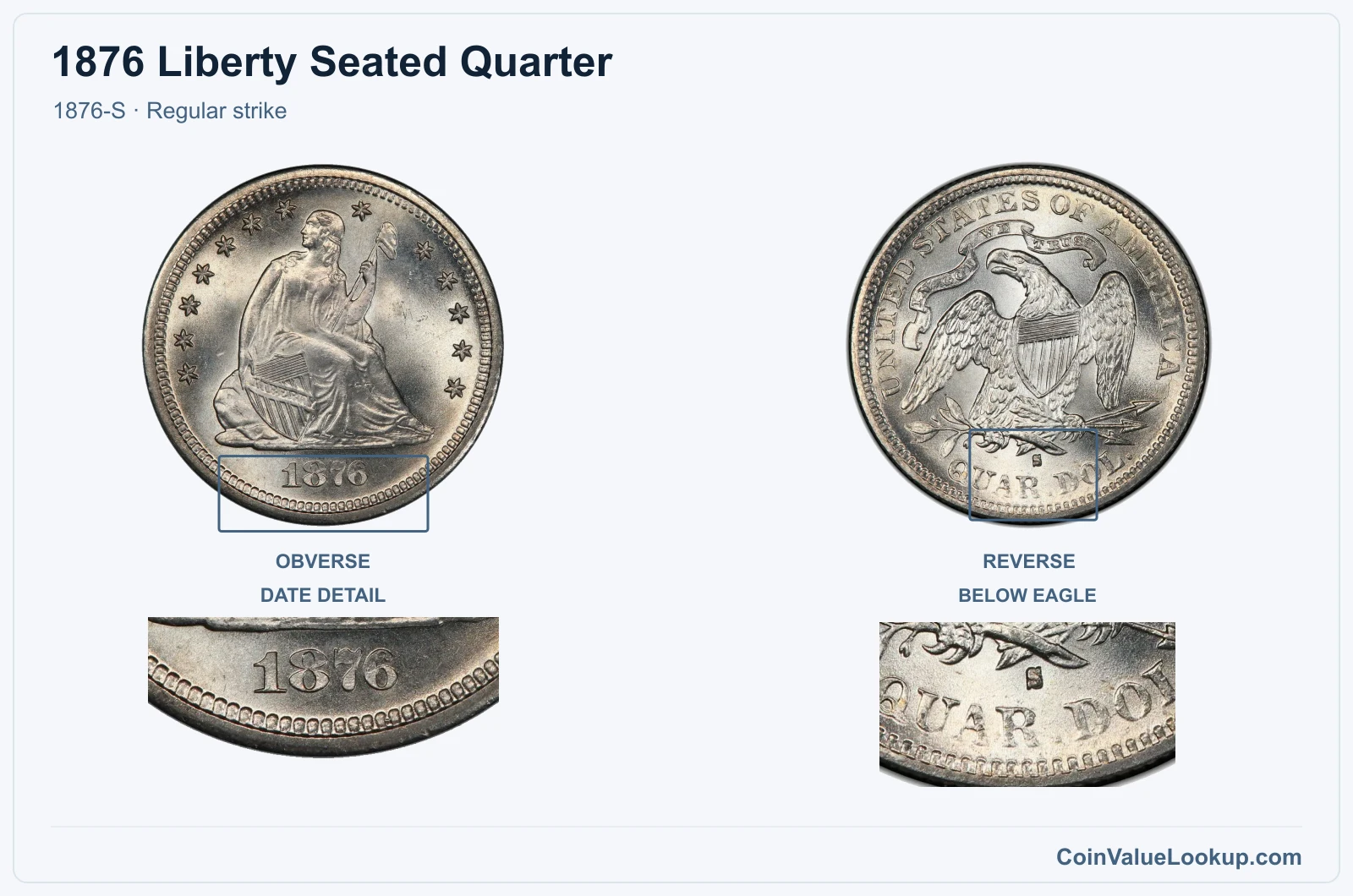
The 1876-S quarter comes from the San Francisco Mint and carries an "S" mintmark on the reverse below the eagle. In Good-4 condition, the USA Coin Book guide places it at $46.00, same as Philadelphia.
At MS60 it reaches $353.00, and MS63 is guided at $675.00.
As with every business-strike Seated Liberty quarter, condition and originality drive value. Confirm the mintmark under magnification if possible — an "S" can sometimes be mistaken for damage or a filled area on a worn coin.
Strike quality can vary, so compare your coin's detail against known examples at the same grade before assuming heavy wear.
Range Grade
Price Auction Records Appraisal PO PO 1
Coin Identifier FR FR 2
—
Coin Identifier AG AG 3
—
Coin Identifier G G 4
—
Coin Identifier
G 6
—
Coin Identifier VG VG 8
—
Coin Identifier
VG 10
—
Coin Identifier F F 12
—
Coin Identifier
F 15
Coin Identifier VF VF 20
—
Coin Identifier
VF 25
—
Coin Identifier
VF 30
Coin Identifier
VF 35
—
Coin Identifier XF XF 40
—
Coin Identifier
XF 45
Coin Identifier AU AU 50
Coin Identifier
AU 53
Coin Identifier
AU 55
Coin Identifier
AU 58
Coin Identifier MS MS 60
Coin Identifier
MS 61
Coin Identifier
MS 62
Coin Identifier
MS 63
Coin Identifier
MS 64
Coin Identifier
MS 65
Coin Identifier
MS 66
Coin Identifier
MS 67
—
—
—
MS 68
—
—
—
MS 69
—
—
—
MS 70
—
—
—
1876 Liberty Seated Quarter Error List
1. 1876 Liberty Seated Quarter — Doubled Die Obverse
A doubled die obverse has been reported specifically on the 1876-CC Liberty Seated quarter. On a genuine doubled die, you will see consistent doubling — slight separation, thickening, or notching — on obverse lettering or design elements.
The doubling appears in the same direction and degree across affected areas because it was created during die manufacture, not during the striking process.
The key distinction is between a true doubled die and machine doubling. Machine doubling produces a flat, shelf-like distortion, usually on one side of the raised design, without the rounded secondary image that a doubled die shows.
Reflections under tilted light can also mimic doubling to the untrained eye.
This variety applies to CC-mint coins only based on reporting; do not assume every 1876 quarter from other mints shares the feature. No specific price data is available for this variety, so its value depends on the strength of the doubling, overall coin condition, and collector demand at the time of sale.
Certification by a grading service is the safest way to confirm the variety.