1882 Liberty Seated Quarter Coin Value: How Much Is It Worth?
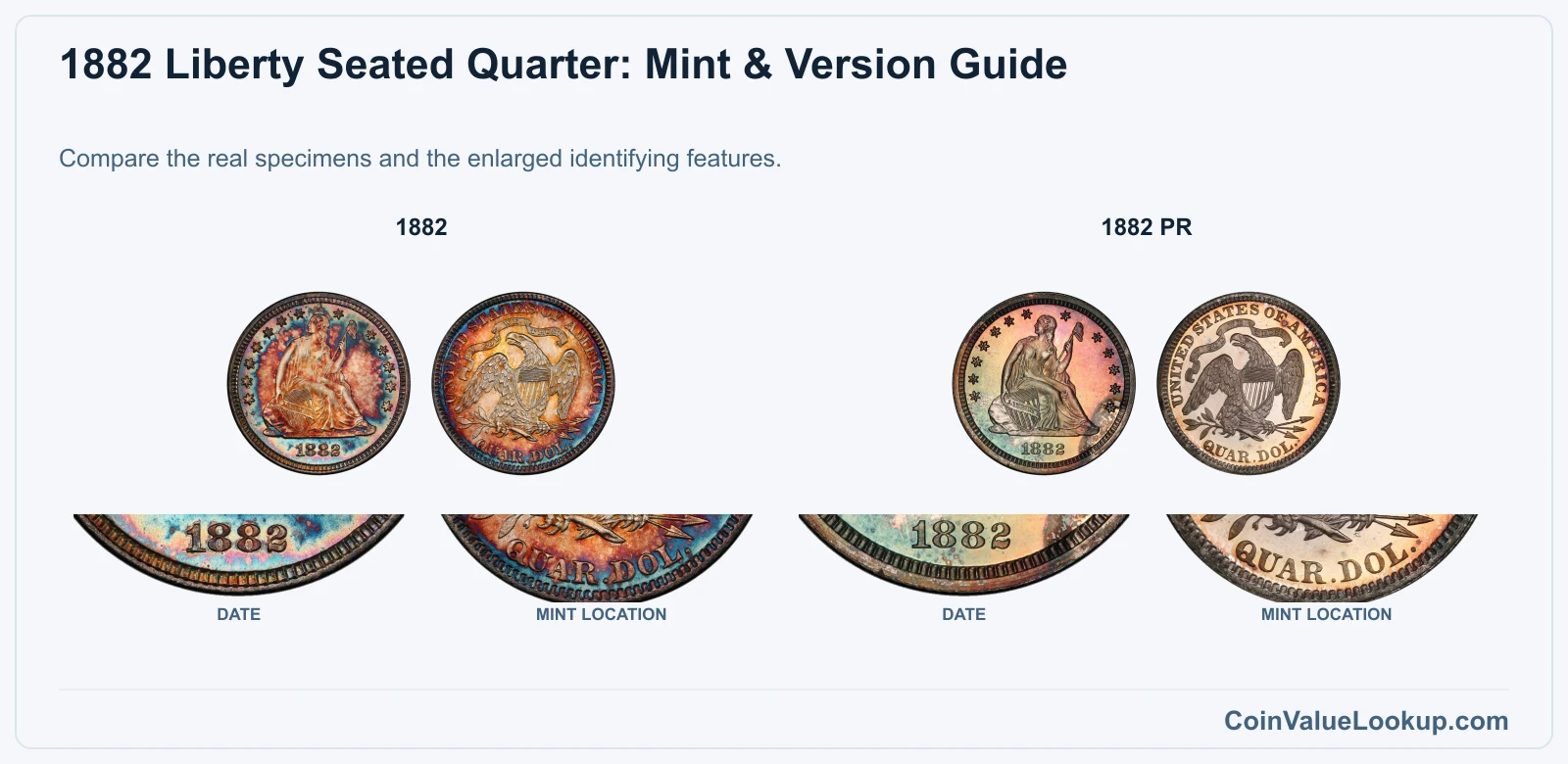
The 1882 Liberty Seated Quarter is a late-date issue in a series that ended just nine years later. Struck in 90% silver at the Philadelphia Mint, these quarters carry guide estimates from about $258 in well-worn condition up to $1,072 in higher uncirculated grades, depending on whether you hold a business strike or a proof.
Mint, condition, and manufacturing finish each shift where your coin lands in that range.
Fast Way to Identify Your 1882 Liberty Seated Quarter
Snap clear photos of both the front and back of your 1882 quarter and upload them here. A preliminary identification can help you figure out whether you have a regular business strike or a proof, and flag anything worth a closer look.
Good lighting and a steady hand go a long way.
1882 Liberty Seated Quarter Value
Upload both sides of your 1882 Liberty Seated Quarter.
Front Obverse
Upload photo
Back Reverse
Upload photo
Which 1882 Liberty Seated Quarter Versions Are Worth Money?
- 1882 business strike: USA Coin Book estimates up to $1,072 at MS63, making higher-grade survivors the ones to watch for.
- 1882 Proof: Guide estimate of $938 at PR63 — a separate collector finish struck in limited quantities at Philadelphia.
- Check finish first: a proof and a business strike look different in hand. Damage, cleaning, or heavy wear won't turn a common coin into a scarce version.
Step 1: Identify Your 1882 Liberty Seated Quarter Mint Mark and Version
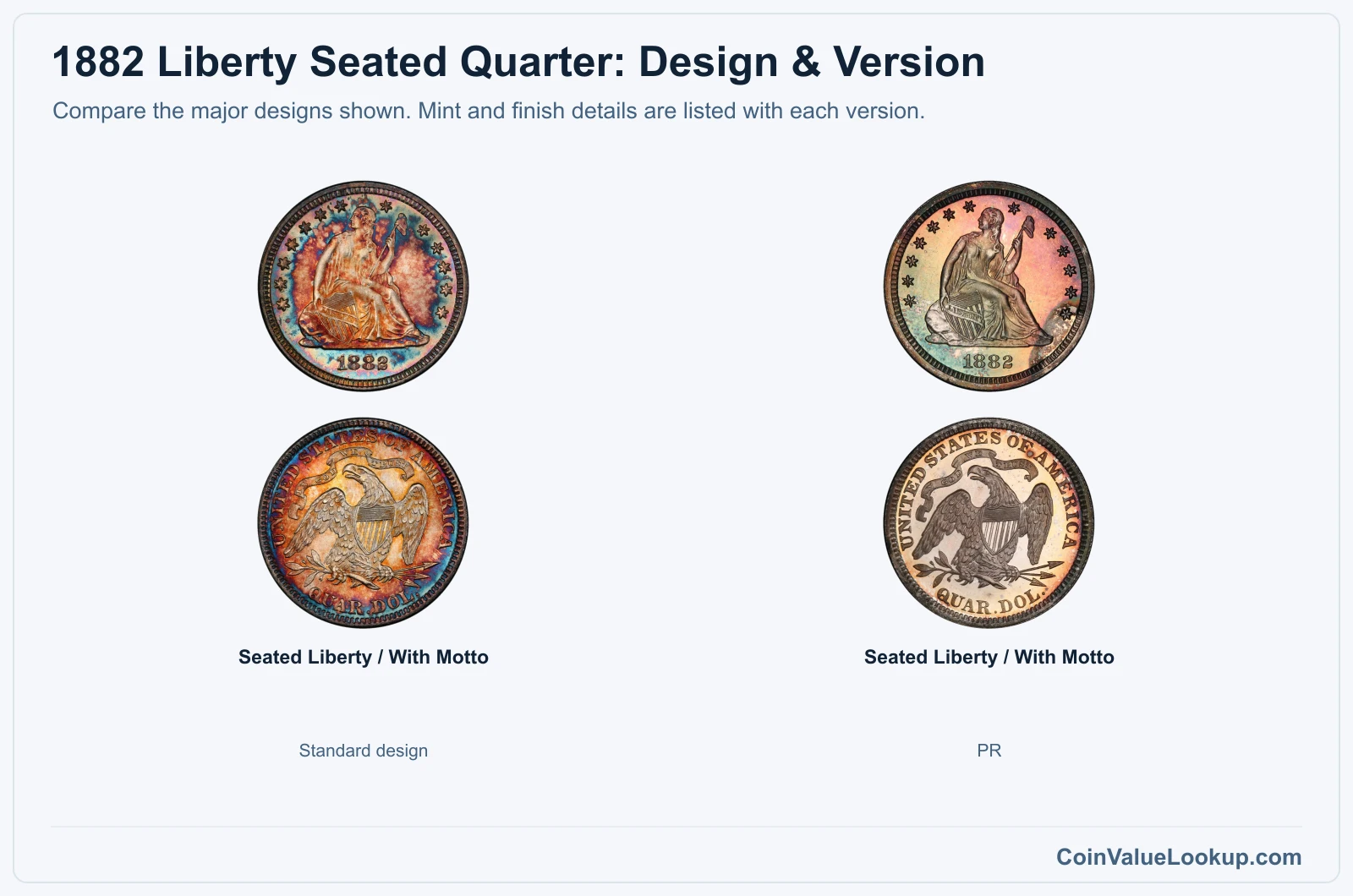
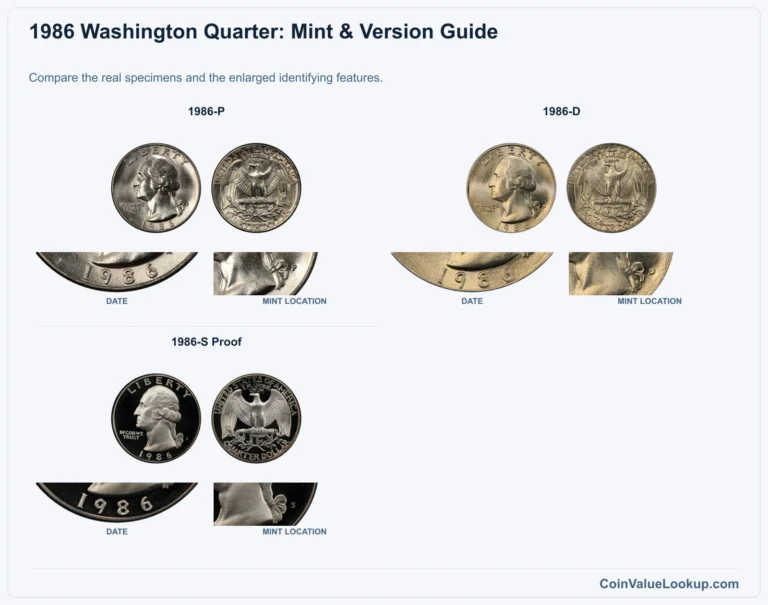
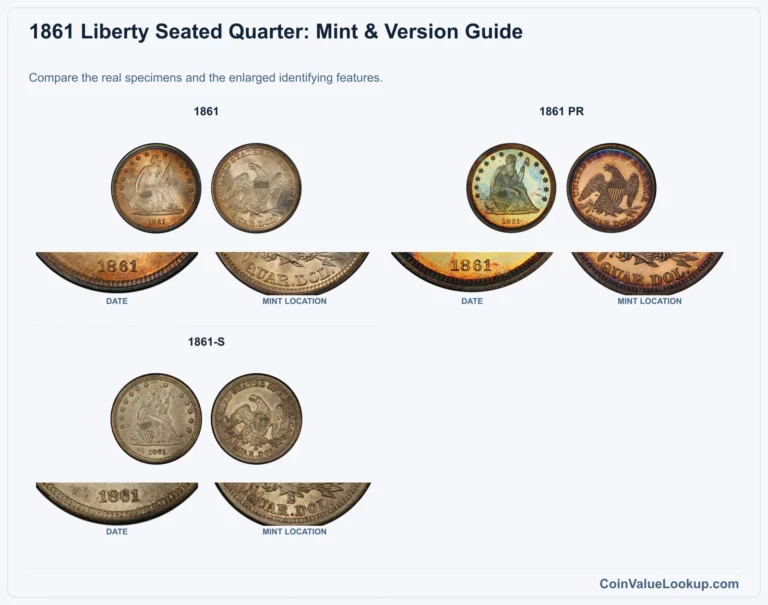
Every 1882 quarter was struck at the Philadelphia Mint, so there is no mintmark on any genuine example. If you see a small letter below the eagle on the reverse, you are looking at a different year or a different coin entirely.
The design shows a seated figure of Liberty holding a pole and cap on the obverse, with a shield at her side. The reverse features a heraldic eagle beneath the motto.
The coin is composed of 90% silver and 10% copper, weighing 6.25 grams.
For this year there are two collectible branches: the standard business strike (1882) and the proof issue (1882 PR). The proof was a special collector finish produced in much smaller numbers.
A shiny, reflective surface alone does not make a coin a proof — genuine proofs have distinctly squared rims and mirror-like fields that differ from a polished or lightly circulated business strike.
Step 2: Check Your 1882 Liberty Seated Quarter Grade
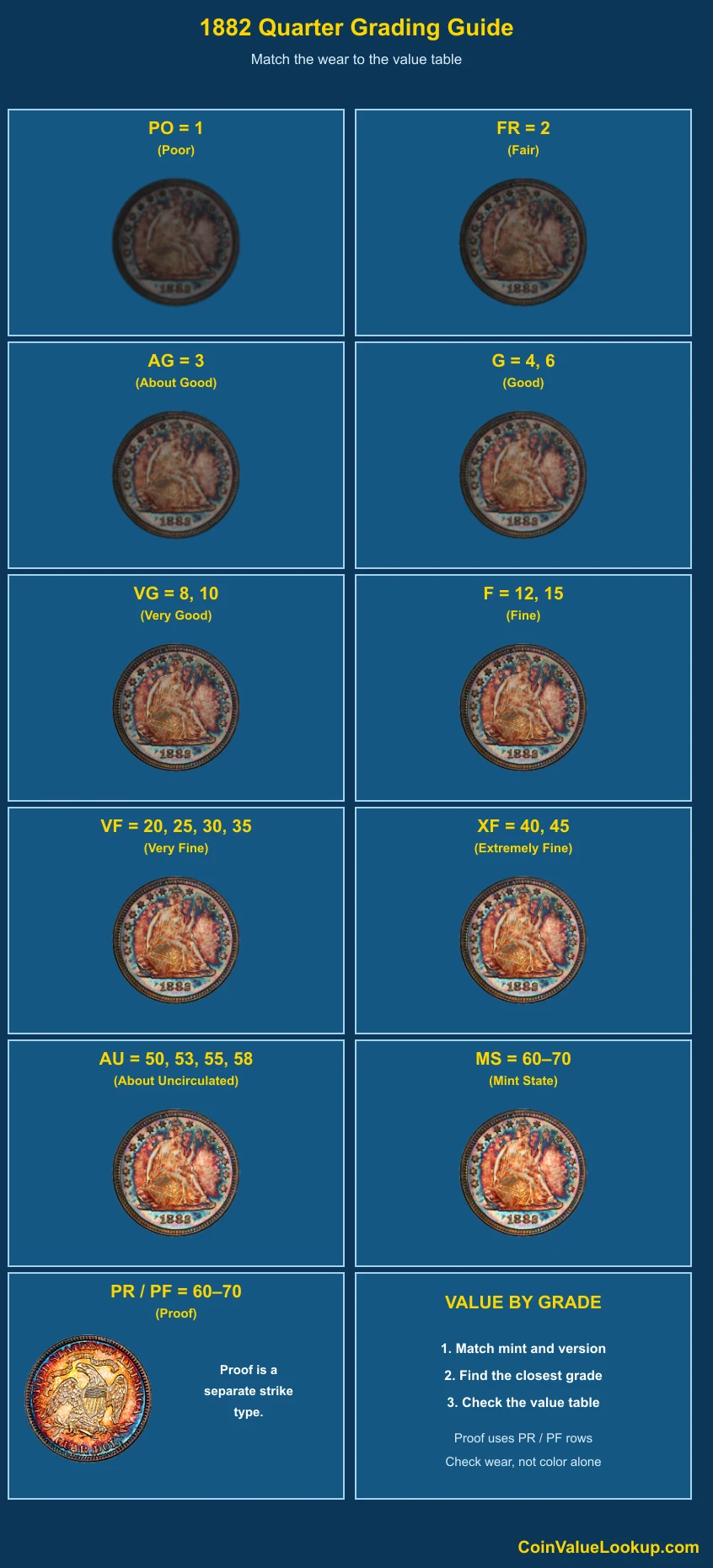
Start by examining Liberty's head, breast, knee, and the horizontal lines on her shield. On the reverse, check the eagle's breast feathers and the tops of the wings.
These are the first areas to lose detail as the coin wears.
A coin graded G4 (Good) will show a mostly flat Liberty outline with little interior detail. An MS60 (Mint State) piece should have no wear at all, though it may show bag marks or contact marks from storage.
MS63 adds the expectation of fewer distracting marks and better eye appeal.
Don't confuse a weak strike with wear. Some 1882 quarters left the press with soft centers even though they were never circulated.
Compare your coin against the reference image for this type to judge wear versus strike weakness.
Cleaning is the silent value killer. If the surfaces look unnaturally bright or show fine hairlines under magnification, the coin has likely been cleaned, and that will push its market value well below guide estimates for the stated grade.
Step 3: Check 1882 Liberty Seated Quarter Value by Mint and Version
1882 Liberty Seated Quarter
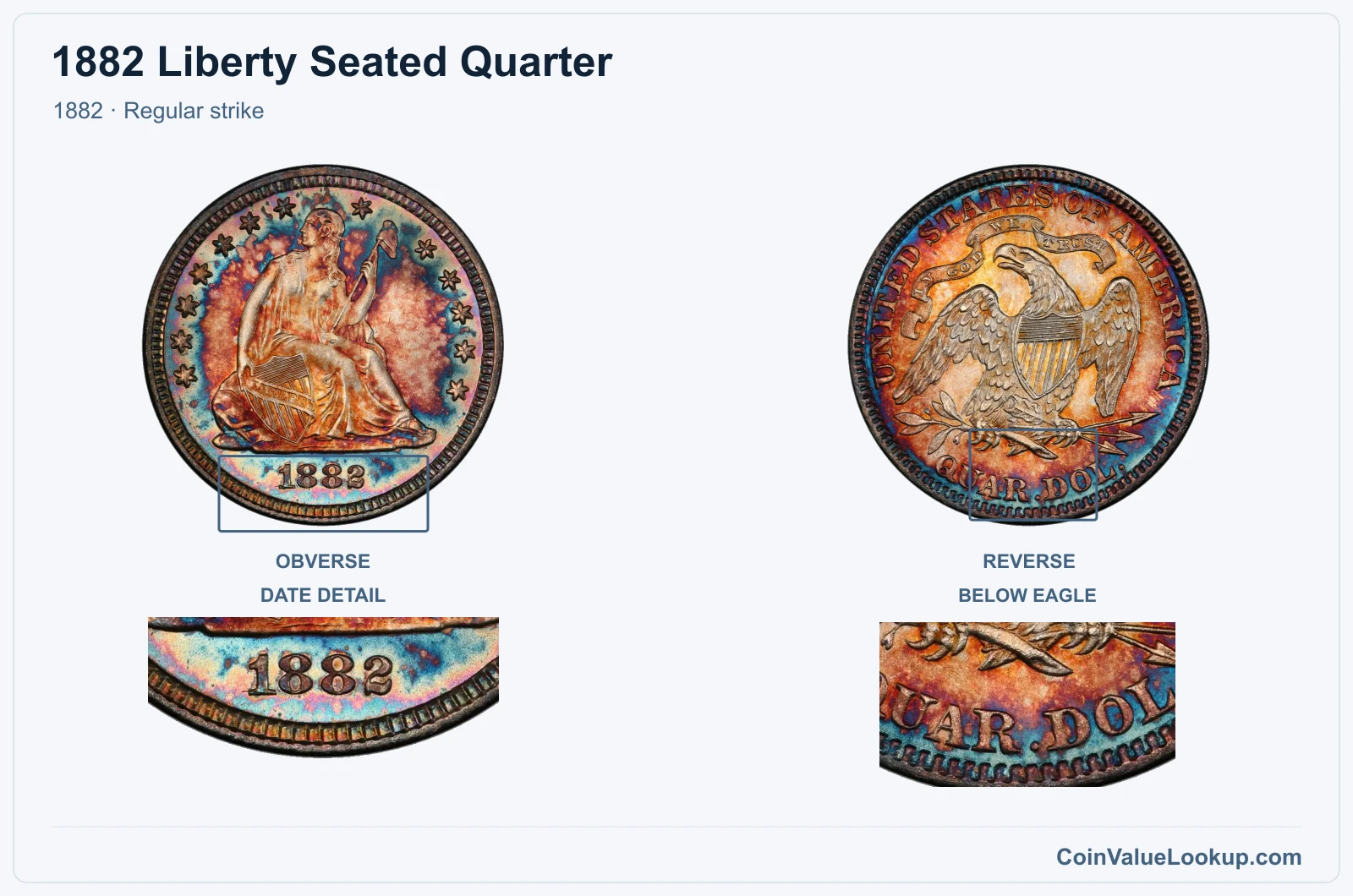
The 1882 business-strike quarter was produced at Philadelphia with no mintmark. In worn condition around G4, USA Coin Book estimates a value near $258.
Jump up to MS60 and that figure climbs to roughly $834, with MS63 examples estimated around $1,072. These are guide estimates, not guaranteed sale prices.
Look for original, uncleaned surfaces when assessing grade. A coin with natural toning and no signs of polishing or whizzing will generally command stronger interest than one that has been brightened.
Match the mint (no mintmark), the Seated Liberty obverse, and the With Motto eagle reverse before assuming your coin fits this version.
Coin Value Lookup is a handy place to look up guide values for quarters and other denominations across different years. If you are comparing several coins at once, it can save you a lot of flipping between tabs.
Range Grade
Price Auction Records Appraisal PO PO 1
—
Coin Identifier FR FR 2
—
Coin Identifier AG AG 3
—
Coin Identifier G G 4
Coin Identifier
G 6
Coin Identifier VG VG 8
—
Coin Identifier
VG 10
—
Coin Identifier F F 12
—
Coin Identifier
F 15
Coin Identifier VF VF 20
Coin Identifier
VF 25
Coin Identifier
VF 30
Coin Identifier
VF 35
—
Coin Identifier XF XF 40
—
Coin Identifier
XF 45
Coin Identifier AU AU 50
Coin Identifier
AU 53
—
Coin Identifier
AU 55
—
Coin Identifier
AU 58
Coin Identifier MS MS 60
—
Coin Identifier
MS 61
Coin Identifier
MS 62
Coin Identifier
MS 63
Coin Identifier
MS 64
Coin Identifier
MS 65
Coin Identifier
MS 66
Coin Identifier
MS 67
Coin Identifier
MS 68
Coin Identifier
MS 69
—
—
—
MS 70
—
—
—
1882 Liberty Seated Quarter — PR
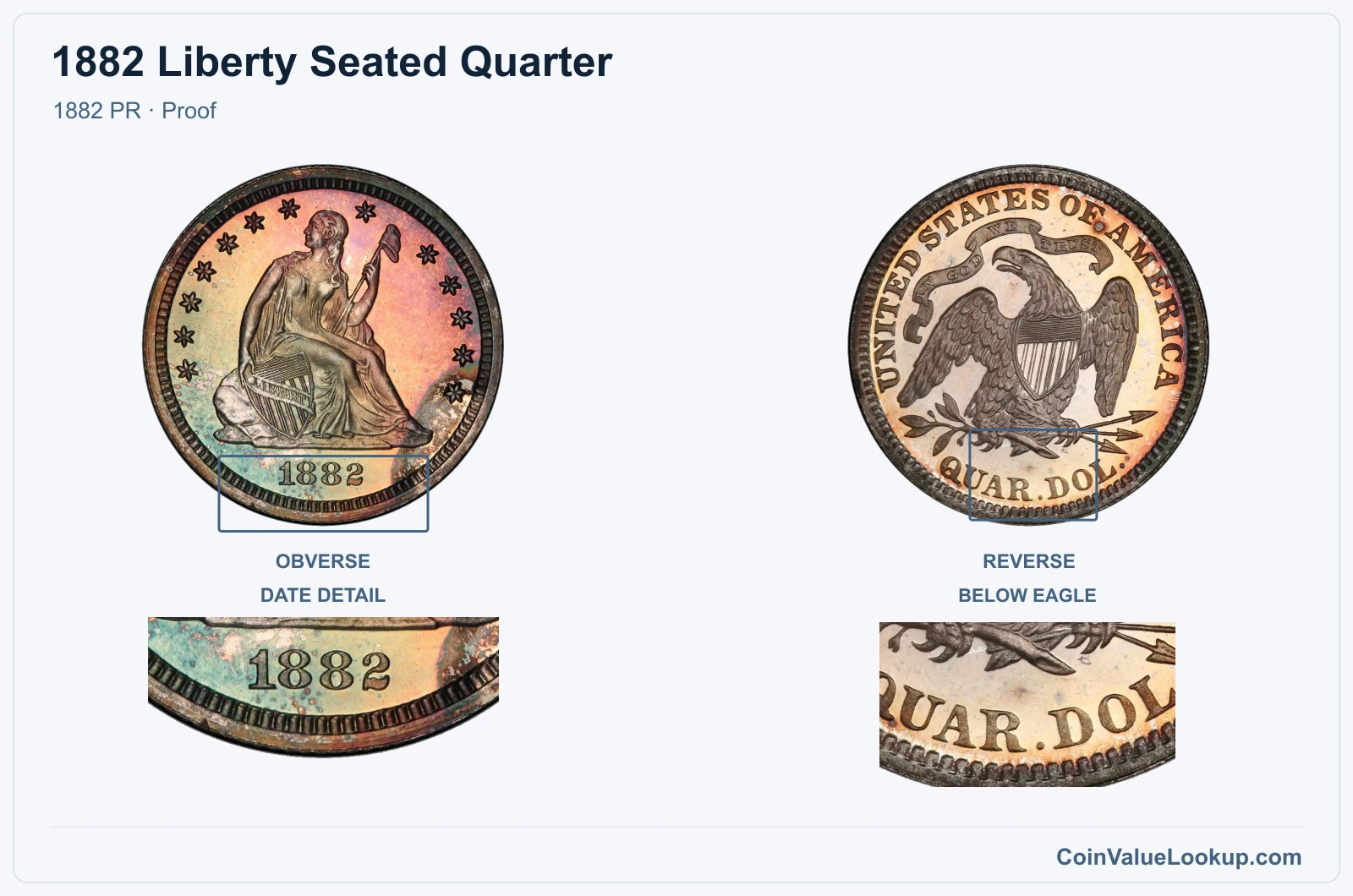
The 1882 Proof quarter was a collector-oriented issue struck at Philadelphia using specially prepared dies and planchets. Proof manufacture produces mirrored fields and sharply detailed devices that look fundamentally different from a business strike, even a lustrous one.
At PR63, USA Coin Book places the guide estimate at $938.
To confirm a proof, look for squared-off, knife-edge rims and deep mirror reflections in the flat areas of the coin. Hairlines from old cleaning or improper handling will lower both the grade and the appeal.
Surface haze is common on proofs stored in original cases for over a century and does not automatically mean the coin was damaged.
These are not guaranteed sale prices. Individual proof quarters can vary based on eye appeal, toning character, and whether the surfaces remain free of distracting contact marks.
Range Grade
Price Auction Records Appraisal PR PR 1
—
Coin Identifier
PR 2
—
Coin Identifier
PR 3
—
Coin Identifier
PR 4
—
Coin Identifier
PR 6
—
Coin Identifier
PR 8
—
Coin Identifier
PR 10
—
Coin Identifier
PR 12
—
Coin Identifier
PR 15
—
Coin Identifier
PR 20
—
Coin Identifier
PR 25
—
Coin Identifier
PR 30
—
Coin Identifier
PR 35
—
Coin Identifier
PR 40
—
Coin Identifier
PR 45
—
Coin Identifier
PR 53
—
Coin Identifier
PR 55
Coin Identifier
PR 58
—
Coin Identifier
PR 60
Coin Identifier
PR 61
Coin Identifier
PR 62
Coin Identifier
PR 63
Coin Identifier
PR 64
Coin Identifier
PR 65
Coin Identifier
PR 66
Coin Identifier
PR 67
Coin Identifier
PR 68
—
Coin Identifier
PR 69
—
—
—
PR 70
—
—
—