1918 Standing Liberty Quarter Coin Value: How Much Is It Worth?
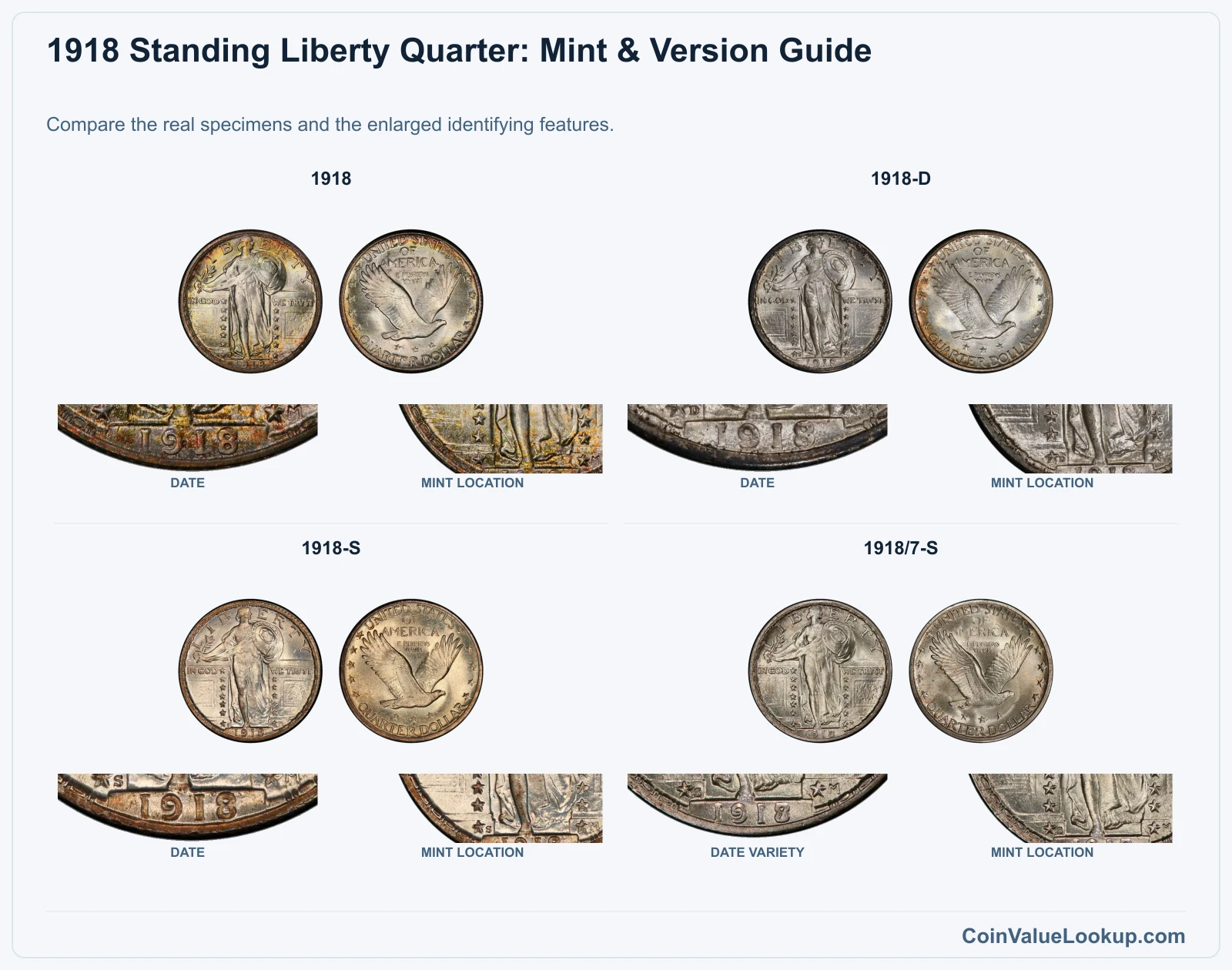
The 1918 Standing Liberty quarter is a 90% silver coin struck at three mints, and one overdate variety that can turn a modest find into a serious payday. Guide estimates across the different versions range from about $34.00 in well-worn grades to $34,450.00 for the top rarity in mint condition.
Which part of that spread applies depends on your coin's mint, condition, and whether an old "7" is hiding under that "8."
Fast Way to Identify Your 1918 Standing Liberty Quarter
Snap clear photos of both sides of your 1918 quarter and upload them here for a preliminary identification. Good lighting helps — try to capture the mintmark area near Liberty's feet and the full date.
This is not a substitute for professional authentication or grading, but it can point you toward the right version and give you a head start.
1918 Standing Liberty Quarter Value
Upload both sides of your 1918 Standing Liberty Quarter.
Front Obverse
Upload photo
Back Reverse
Upload photo
Which 1918 Standing Liberty Quarter Versions Are Worth Money?
- 1918/7-S overdate — guide estimates reach $34,450.00 at MS63; look for traces of a "7" beneath the "8" in the date on S-mint coins.
- 1918-D — guide estimate of $459.00 at MS63, the highest of the three regular-mint issues in that grade.
- 1918-S — guide estimate of $384.00 at MS63; confirm the S mintmark near Liberty's feet before checking for the overdate.
Step 1: Identify Your 1918 Standing Liberty Quarter Mint Mark and Version
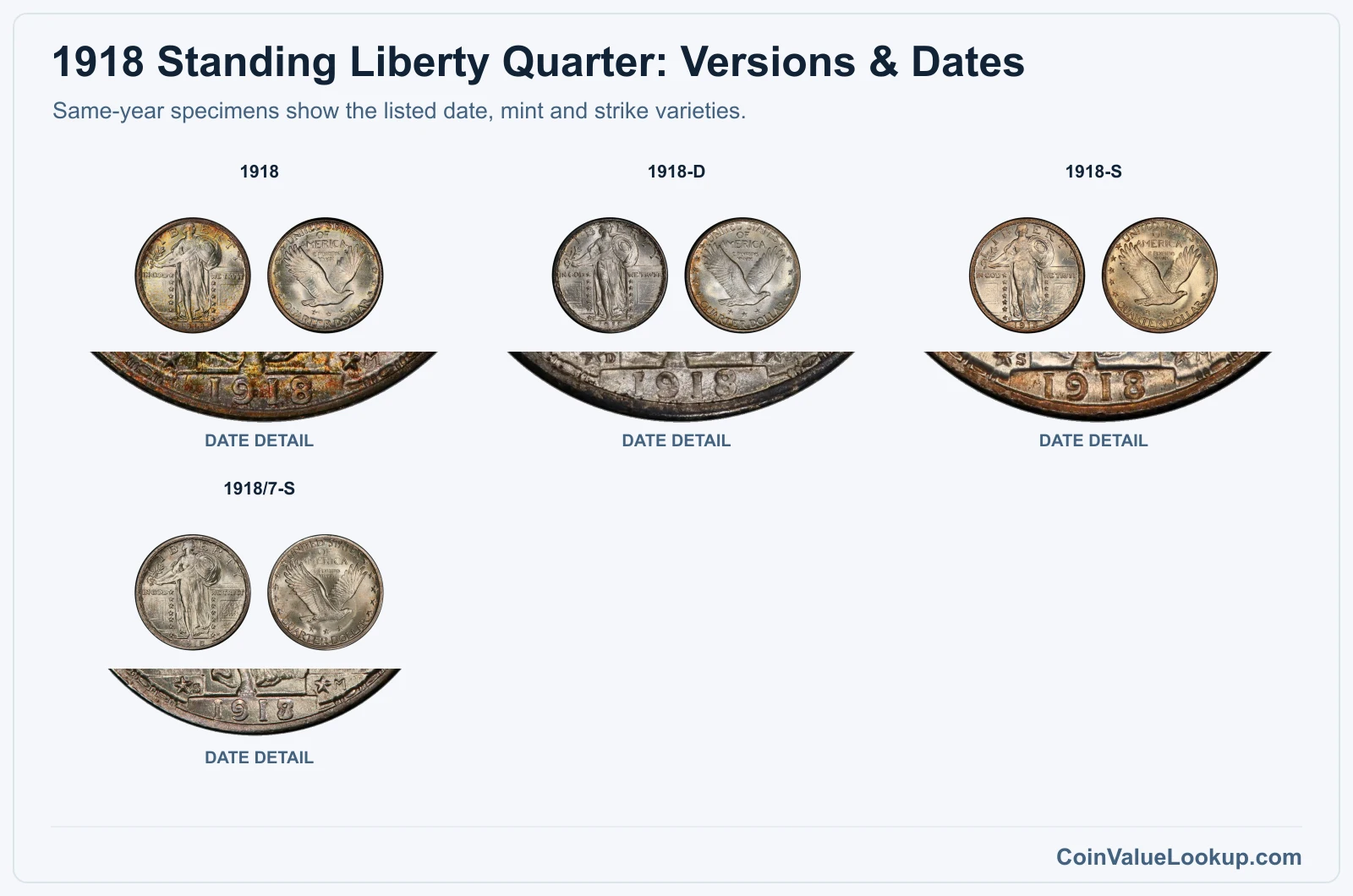
Start with the mintmark. Philadelphia coins carry no mark.
Denver (D) and San Francisco (S) pieces show a small letter on the obverse, near the left base of the wall Liberty stands on. All 1918 quarters use the Type II design: Liberty wears protective chain mail across her breast, and three stars appear below the eagle on the reverse.
The earlier Type I design, with the exposed breast and no stars beneath the eagle, ended in 1917.
The coin is 90% silver and 10% copper, weighing 6.25 grams. The date on all 1918 issues is raised, not recessed — that change came in 1925.
The critical branch to watch for is the 1918/7-S overdate. This is an S-mint coin only, and it shows remnants of a "7" beneath the final "8" in the date.
A regular 1918-S and an 1918/7-S look identical except for that ghostly underdigit, so check the date under magnification before assuming you have the common version.
Step 2: Check Your 1918 Standing Liberty Quarter Grade
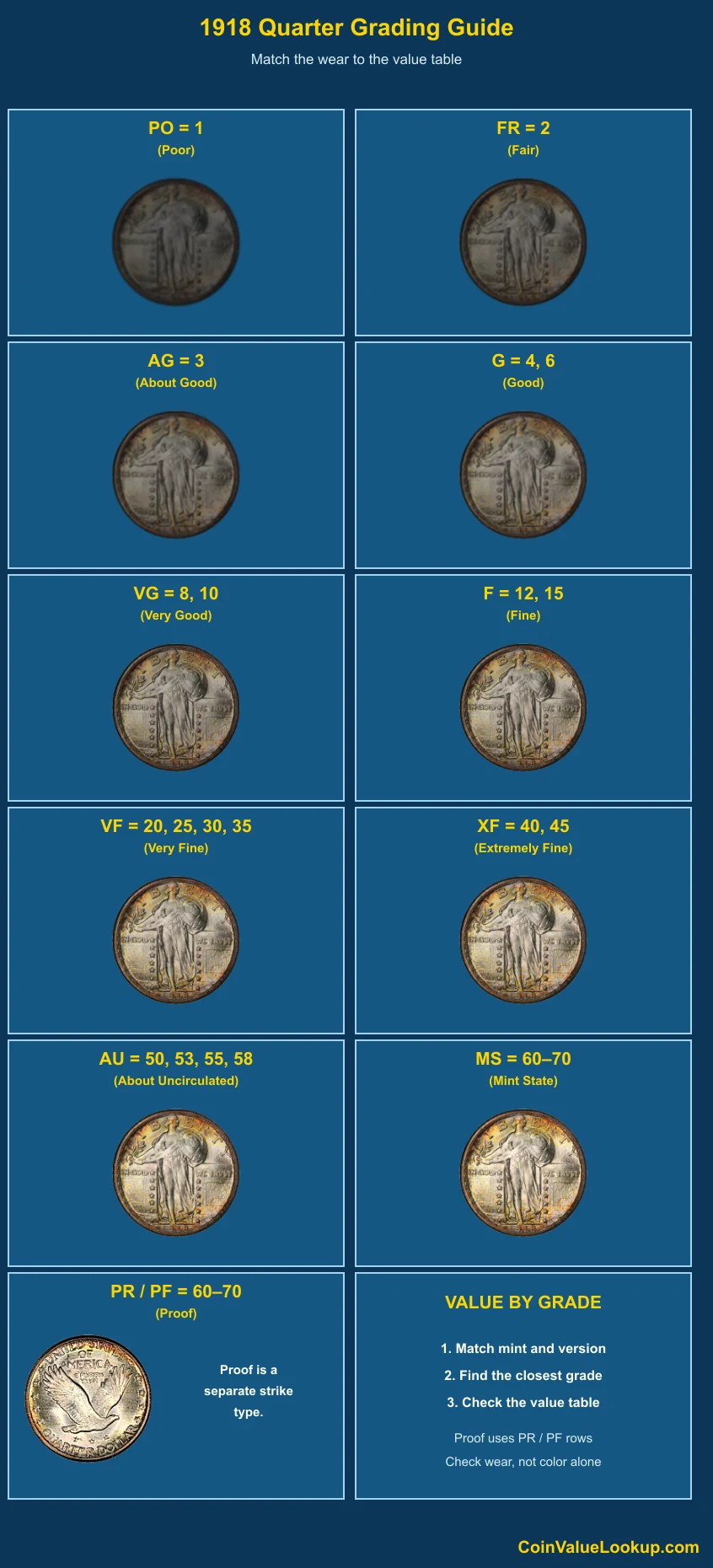
Focus on Liberty's head, the area across the breast and shield, and the exposed knee — these are the first spots to lose detail. On the reverse, check the eagle's breast feathers and wing tips.
Compare your coin to the reference image and look at both wear and luster together.
A coin graded G4 (Good) will have a heavily worn outline of Liberty with very little interior detail. By MS60 (Mint State, lowest uncirculated grade) the coin shows no wear but may have contact marks and subdued luster.
Full Head is a strike-quality designation, not a grade. It means Liberty's head shows three complete leaves in the hair and a full hairline.
Weak strikes at all three mints can blur these details even on unworn coins, so do not assume a sharp head means high grade or vice versa. Similarly, bright surfaces from cleaning are not the same as original mint luster — cleaned coins typically trade for less than their grade would suggest.
Step 3: Check 1918 Standing Liberty Quarter Value by Mint and Version
1918 Standing Liberty Quarter
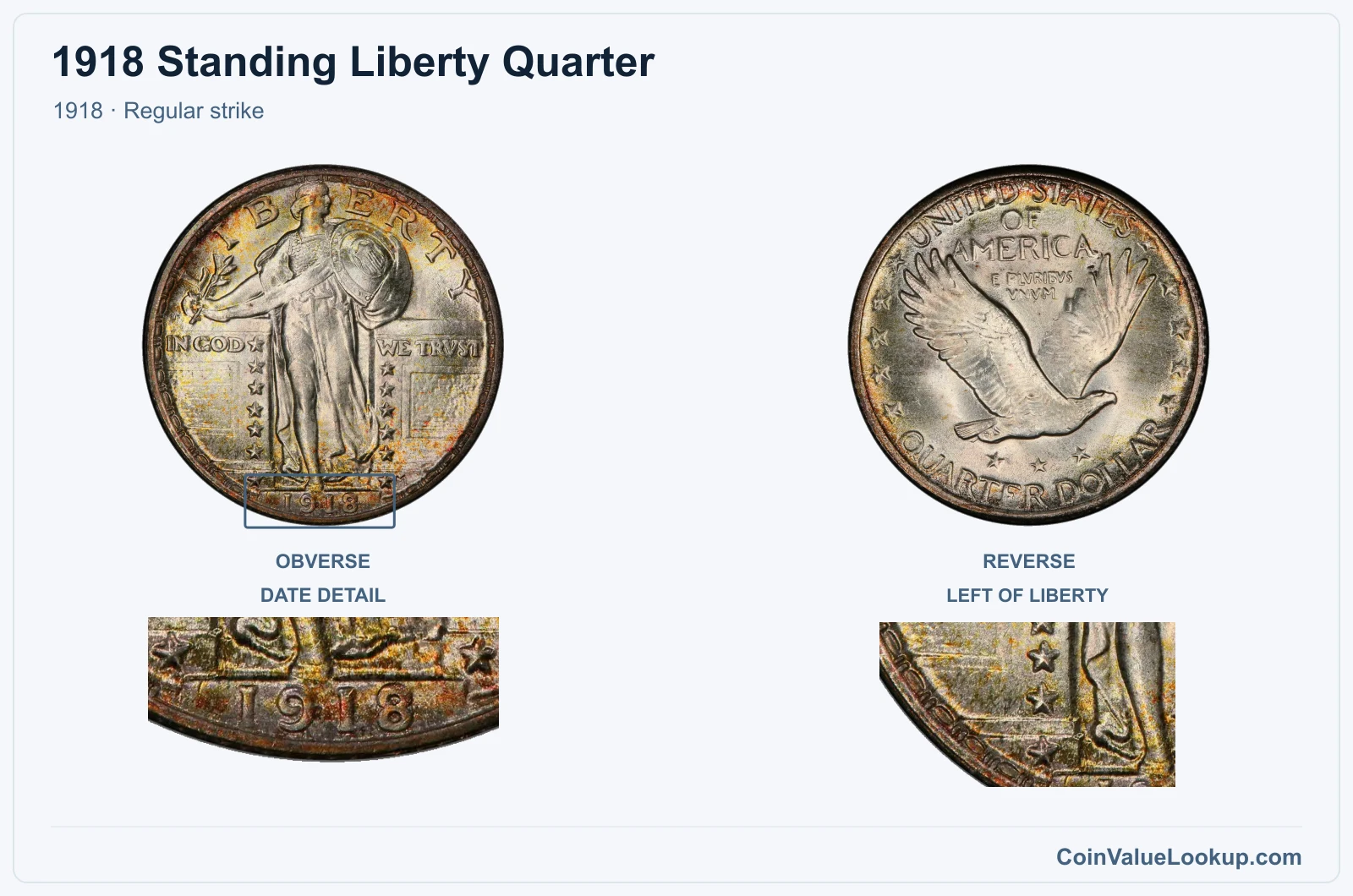
The 1918 Philadelphia quarter has no mintmark. In G4 condition, USA Coin Book estimates it at about $34.00.
At MS60 the guide lists $194.00, rising to $321.00 at MS63. These are guide estimates, not guaranteed sale prices.
Philadelphia issues are the most commonly encountered of the regular 1918 mints. Look for original surfaces — coins that have been cleaned or damaged will trade below these estimates regardless of their technical grade.
Confirm the Type II design (chain mail on Liberty, three stars below the eagle) and a raised date to be sure you have the right year and type.
Range Grade
Price Auction Records Appraisal PO PO 1
—
Coin Identifier FR FR 2
—
Coin Identifier AG AG 3
—
Coin Identifier G G 4
—
Coin Identifier
G 6
—
Coin Identifier VG VG 8
—
Coin Identifier
VG 10
—
Coin Identifier F F 12
Coin Identifier
F 15
—
Coin Identifier VF VF 20
—
Coin Identifier
VF 25
—
Coin Identifier
VF 30
Coin Identifier
VF 35
—
Coin Identifier XF XF 40
Coin Identifier
XF 45
Coin Identifier AU AU 50
Coin Identifier
AU 53
Coin Identifier
AU 55
Coin Identifier
AU 58
Coin Identifier MS MS 60
—
Coin Identifier
MS 61
Coin Identifier
MS 62
Coin Identifier
MS 63
Coin Identifier
MS 64
Coin Identifier
MS 65
Coin Identifier
MS 66
Coin Identifier
MS 67
Coin Identifier
MS 68
Coin Identifier
MS 69
—
—
—
MS 70
—
—
—
1918 Standing Liberty Quarter — D
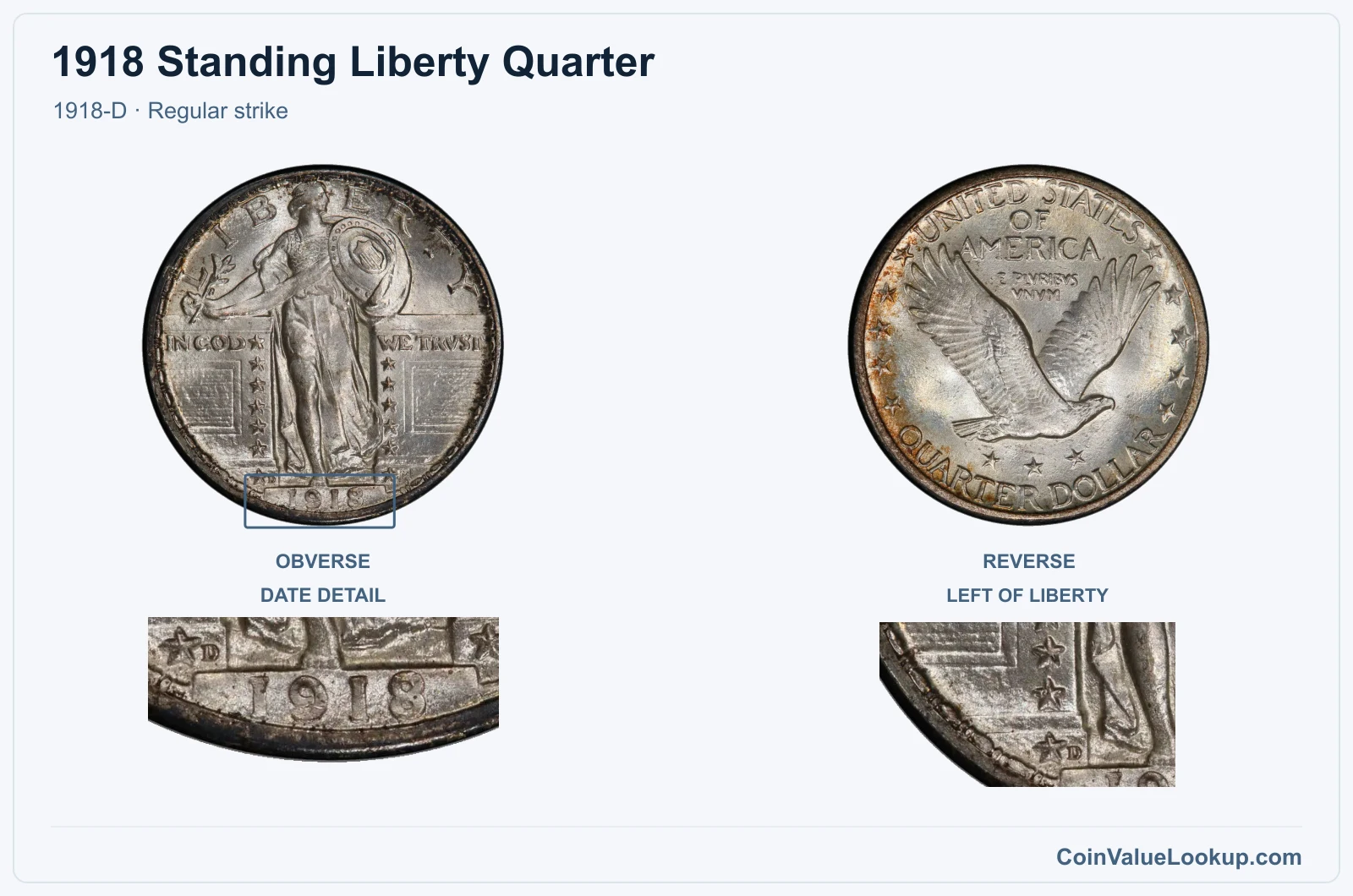
Look for a small "D" mintmark on the obverse beside Liberty, near the base of the wall. The 1918-D carries the highest regular-mint guide values for this year: $35.00 at G4, $258.00 at MS60, and $459.00 at MS63, per USA Coin Book.
Denver quarters from this era can be weakly struck, especially around Liberty's head, so a Full Head piece commands extra attention. As always, match the mint, design and condition before comparing prices.
Cleaning or damage can pull the actual value well below these estimates.
Coin Value Lookup is a handy starting point if you want to look up guide values for other dates and mints in the Standing Liberty series.
Range Grade
Price Auction Records Appraisal PO PO 1
—
Coin Identifier FR FR 2
—
Coin Identifier AG AG 3
—
Coin Identifier G G 4
—
Coin Identifier
G 6
—
Coin Identifier VG VG 8
—
Coin Identifier
VG 10
Coin Identifier F F 12
Coin Identifier
F 15
Coin Identifier VF VF 20
Coin Identifier
VF 25
Coin Identifier
VF 30
Coin Identifier
VF 35
Coin Identifier XF XF 40
Coin Identifier
XF 45
Coin Identifier AU AU 50
Coin Identifier
AU 53
Coin Identifier
AU 55
Coin Identifier
AU 58
Coin Identifier MS MS 60
Coin Identifier
MS 61
Coin Identifier
MS 62
Coin Identifier
MS 63
Coin Identifier
MS 64
Coin Identifier
MS 65
Coin Identifier
MS 66
Coin Identifier
MS 67
Coin Identifier
MS 68
—
—
—
MS 69
—
—
—
MS 70
—
—
—
1918 Standing Liberty Quarter — S
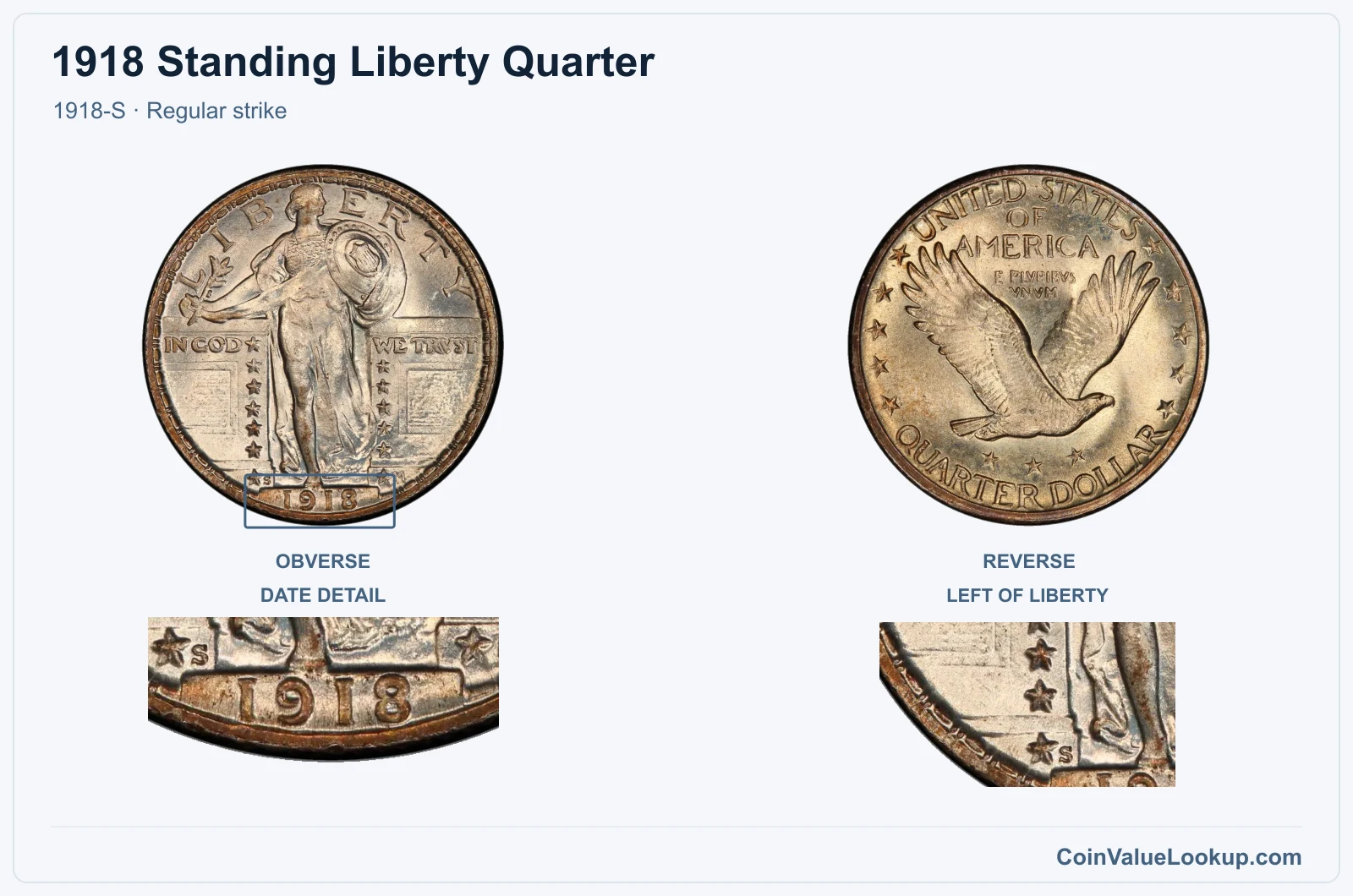
The 1918-S shows a small "S" on the obverse near the left base of the wall. USA Coin Book estimates $34.00 at G4, $232.00 at MS60, and $384.00 at MS63.
These are guide estimates.
Before you settle on "regular 1918-S," examine the date carefully. Every 1918/7-S overdate is also an S-mint coin, and the difference in value is enormous.
Under magnification, look at the lower curve of the "8" — if you see no trace of an underlying "7," you likely have the standard issue. Original surfaces and strong detail still make a nice coin, just not a four-figure one.
Range Grade
Price Auction Records Appraisal PO PO 1
—
Coin Identifier FR FR 2
—
Coin Identifier AG AG 3
—
Coin Identifier G G 4
—
Coin Identifier
G 6
—
Coin Identifier VG VG 8
Coin Identifier
VG 10
Coin Identifier F F 12
Coin Identifier
F 15
—
Coin Identifier VF VF 20
Coin Identifier
VF 25
Coin Identifier
VF 30
Coin Identifier
VF 35
Coin Identifier XF XF 40
Coin Identifier
XF 45
Coin Identifier AU AU 50
Coin Identifier
AU 53
Coin Identifier
AU 55
Coin Identifier
AU 58
Coin Identifier MS MS 60
—
Coin Identifier
MS 61
Coin Identifier
MS 62
Coin Identifier
MS 63
Coin Identifier
MS 64
Coin Identifier
MS 65
Coin Identifier
MS 66
Coin Identifier
MS 67
Coin Identifier
MS 68
—
—
—
MS 69
—
—
—
MS 70
—
—
—
1918 Standing Liberty Quarter — /7-S
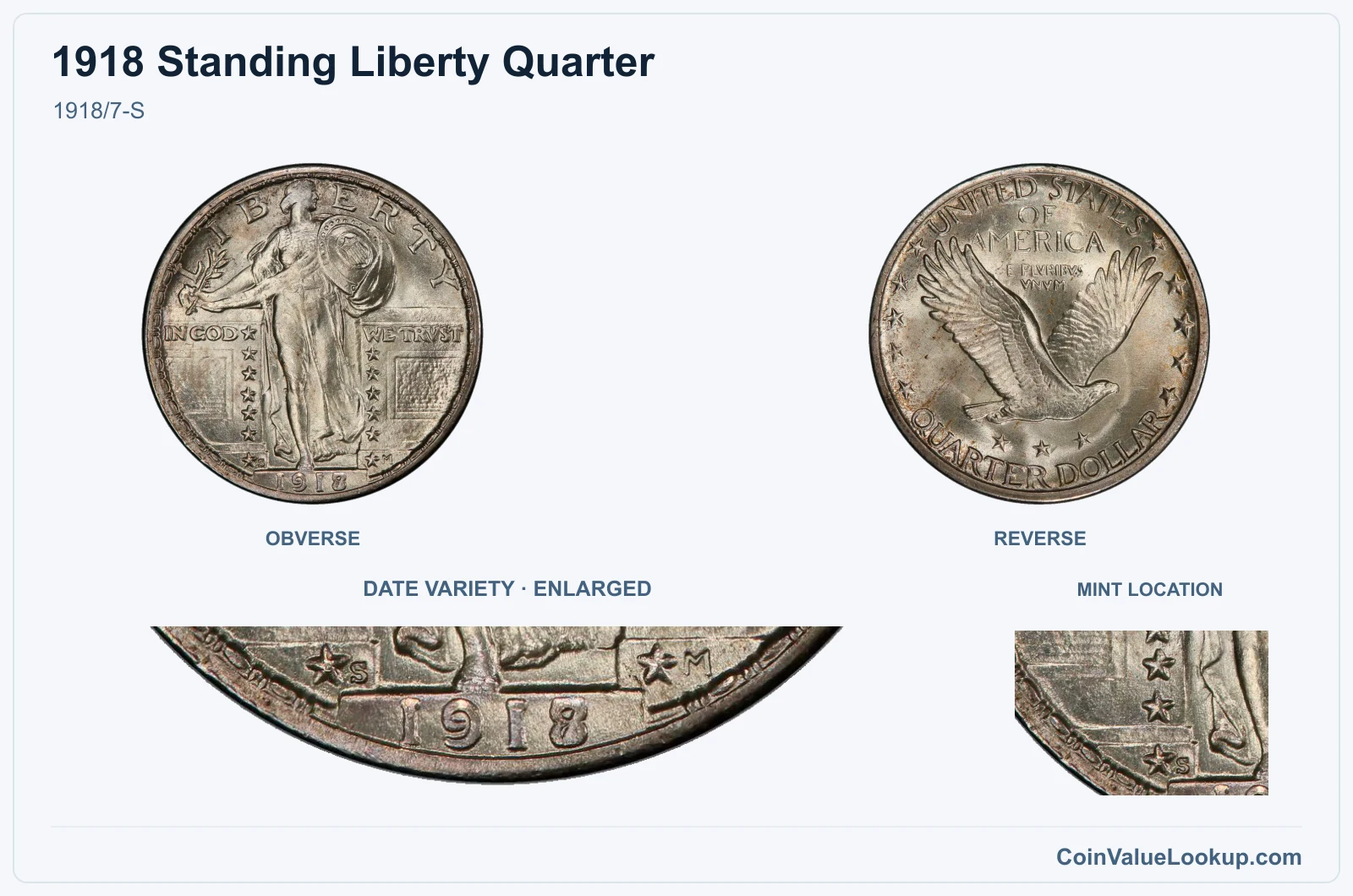
This is the marquee variety of the year. The 1918/7-S was struck from a die originally dated 1917 that was re-engraved with an "8." Remnants of the old "7" remain visible beneath the final digit, most clearly at the lower portion of the numeral.
This only occurs on S-mint coins.
USA Coin Book guide estimates place the 1918/7-S at $1,996.00 in G4, $22,931.00 at MS60, and $34,450.00 at MS63. Even heavily worn examples carry a substantial premium over the standard 1918-S.
Authentication matters here. The overdate detail must be present on the die itself, not created by damage or environmental corrosion.
A clear photograph under magnification is your first step. If the underlying "7" is visible and consistent, professional certification is strongly recommended before any sale.
Range Grade
Price Auction Records Appraisal PO PO 1
—
Coin Identifier FR FR 2
—
Coin Identifier AG AG 3
—
Coin Identifier G G 4
—
Coin Identifier
G 6
Coin Identifier VG VG 8
Coin Identifier
VG 10
Coin Identifier F F 12
Coin Identifier
F 15
Coin Identifier VF VF 20
Coin Identifier
VF 25
Coin Identifier
VF 30
Coin Identifier
VF 35
Coin Identifier XF XF 40
Coin Identifier
XF 45
Coin Identifier AU AU 50
Coin Identifier
AU 53
Coin Identifier
AU 55
Coin Identifier
AU 58
Coin Identifier MS MS 60
—
Coin Identifier
MS 61
Coin Identifier
MS 62
Coin Identifier
MS 63
Coin Identifier
MS 64
Coin Identifier
MS 65
Coin Identifier
MS 66
Coin Identifier
MS 67
—
—
—
MS 68
—
—
—
MS 69
—
—
—
MS 70
—
—
—
1918 Standing Liberty Quarter Error List
1. 1918 Standing Liberty Quarter — Overdate
The 1918/7-S overdate is the most famous overdate in the Standing Liberty series. Look for surviving contours of a "7" lurking beneath the final "8" in the date — especially in the lower curve and the diagonal stroke.
The remnant should be consistent and part of the die impression, not random damage.
This variety is limited to the S mint. A damaged or corroded date can mimic parts of the overdate look, and ordinary machine doubling can create a slightly fuzzy numeral, but neither will produce the distinctive "7" profile in the correct position.
Condition, visibility of the underdigit, and overall surface quality all affect value. Professional authentication is worth pursuing if the diagnostics line up.
2. 1918 Standing Liberty Quarter — Clashed Dies
A die clash happens when the obverse and reverse dies strike each other without a planchet between them. On the 1918 Standing Liberty quarter, look for faint traces of the opposite design ghosted onto the wrong side — elements of the eagle appearing on the obverse, or parts of Liberty's outline on the reverse.
These traces should align with the expected position of the opposing die.
Do not confuse die clash marks with random scratches, raised lines from debris, or a brockage (which involves an actual struck coin acting as a die). Clash impressions are typically shallow and symmetrically placed.
Value depends on the strength and visibility of the transferred design as well as the coin's overall condition.
3. 1918 Standing Liberty Quarter — Double / Multiple Strike
A double-struck 1918 Standing Liberty quarter received two impressions from the dies while still in the coining chamber. The reported example was struck twice within the collar and shows two distinct sets of legends and design edges.
You are looking for clearly separated or overlapping design elements — not just slightly thickened letters.
The displacement between the two strikes can vary. Some are dramatically rotated or offset, while others show only modest separation.
Compare with a normal coin: a genuine double strike produces a second complete or near-complete impression. A doubled die or post-mint damage can resemble a double strike superficially, but a doubled die shows consistent doubling from the die itself, and post-mint damage lacks the sharp definition of a second press strike.
Value depends on the degree of separation and the coin's condition.
4. 1918 Standing Liberty Quarter — Off-Center Strike
An off-center strike occurs when the planchet is not properly seated between the dies. A reported 1918-S Standing Liberty quarter was struck approximately 13% off center, producing a crescent of blank metal along one edge where the dies did not reach.
The design is shifted in the opposite direction.
This error is reported for the S mint specifically. A visible date is important — off-center coins that lose the date are far less desirable.
Do not confuse an off-center strike with a clipped planchet (which removes a curved section from the blank before striking) or with post-mint flattening that distorts the rim. The unstruck crescent should be smooth and uniform.
Value depends on the percentage of displacement, date visibility, and the coin's overall condition.
5. 1918 Standing Liberty Quarter — Doubled Die
Doubled die varieties on 1918 Standing Liberty quarters have been reported. A doubled die occurs during the die-making process, producing consistent doubling or notching on every coin struck from that die.
Look for design separation — slightly split serifs on lettering, doubled star points, or notched outlines on Liberty or the eagle — that repeats in the same direction across the entire design.
This is different from machine doubling, which tends to produce flat, shelf-like distortion and is far less collectible. Reflections from luster and post-mint impressions from contact can also mimic doubling.
Compare your coin carefully with a normal example. Value depends on the strength and location of the doubling as well as the coin's condition and surfaces.