1924 Standing Liberty Quarter Coin Value: How Much Is It Worth?
The 1924 Standing Liberty quarter is a 90% silver coin struck across three mints, and guide estimates from USA Coin Book range from $23.00 to $1,072.00 depending on which mint produced your coin and what condition it is in. That is not one price for every piece.
Your specific mint, surface condition and strike quality determine where your quarter falls within that spread.
Fast Way to Identify Your 1924 Standing Liberty Quarter
The quickest way to start figuring out what you have is to upload clear photos of both the front and back of your coin. Our identifier can provide a preliminary identification based on those images, helping you narrow down the mint and version.
From there you can compare condition details against the guide values listed below.
1924 Standing Liberty Quarter Value
Upload both sides of your 1924 Standing Liberty Quarter.
Front Obverse
Upload photo
Back Reverse
Upload photo
Which 1924 Standing Liberty Quarter Versions Are Worth Money?
- 1924-S: USA Coin Book estimates $1,072.00 at MS63, making the San Francisco mint the version to hope for in higher grades.
- 1924-D: Guide value reaches $446.00 at MS63; Denver coins carry a meaningful premium over Philadelphia strikes.
- 1924 (Philadelphia): Estimated at $321.00 in MS63 condition, still a solid silver quarter worth well above face value even in lower grades.
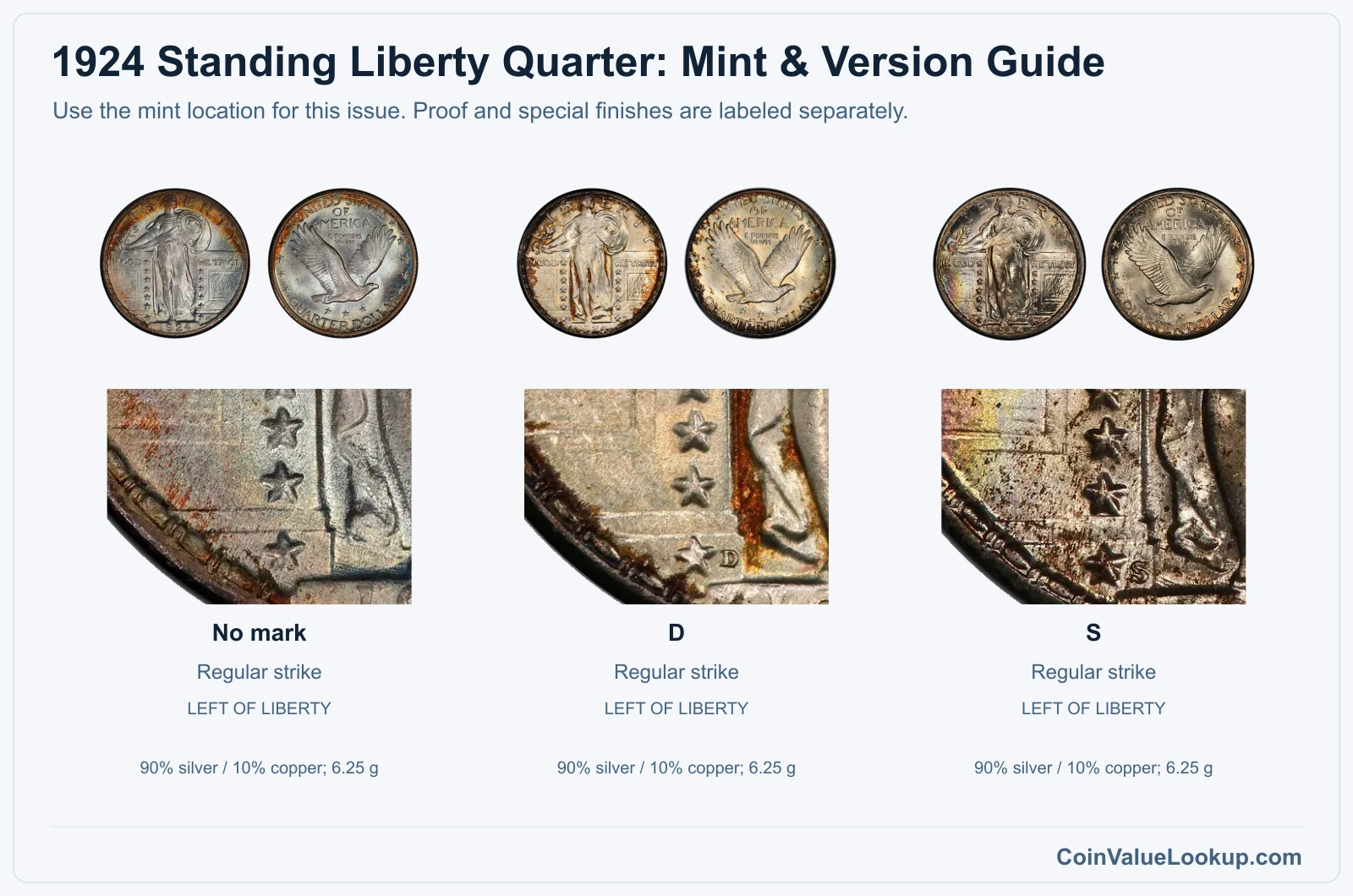
- Check the mintmark location on the obverse near the wall base; the difference between no mark and an S can be hundreds of dollars at the same grade.
Step 1: Identify Your 1924 Standing Liberty Quarter Mint Mark and Version
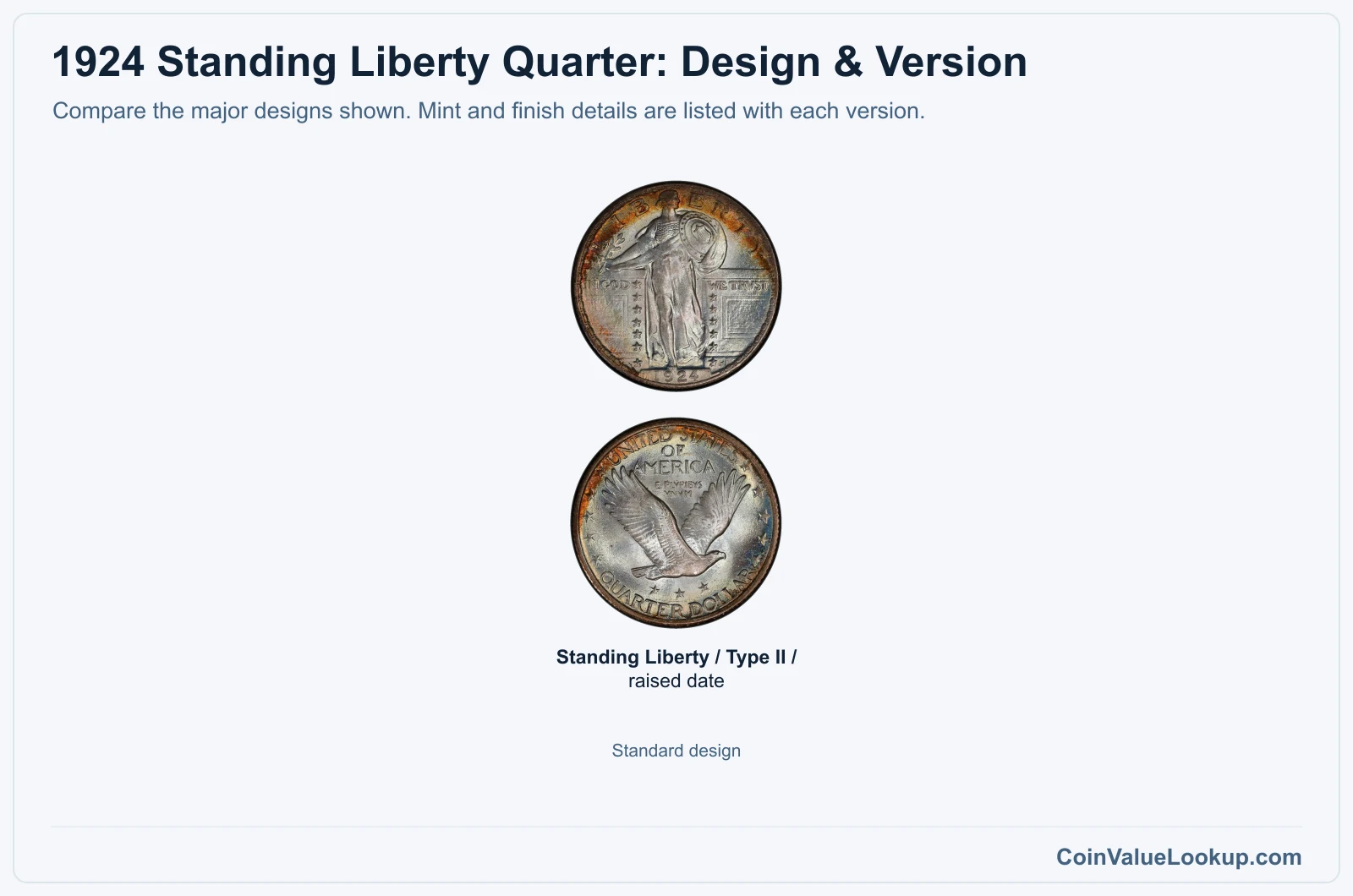
All three 1924 quarter varieties use the Type II Standing Liberty design. That means Liberty wears protective chain mail on her chest and three stars appear below the eagle on the reverse.
If your coin shows an exposed breast and no stars under the eagle, you have a Type I from an earlier year, not a 1924.
The mintmark sits on the obverse, near the left base of the wall Liberty stands beside. A "D" means Denver, an "S" means San Francisco, and no letter at all means Philadelphia.
You may need a magnifier since these marks are small and can fill with grime.
The 1924 date is raised, meaning it sits above the field surface. Starting in 1925 the Mint recessed the date into the field to reduce wear.
So a 1924 with a readable date is not necessarily low-wear; it simply has a raised design that held up a bit better than later recessed versions.
All three versions weigh 6.25 grams and are struck in 90% silver with 10% copper. A coin that feels too light or does not pass a basic silver test may be a counterfeit or an altered piece.
Step 2: Check Your 1924 Standing Liberty Quarter Grade
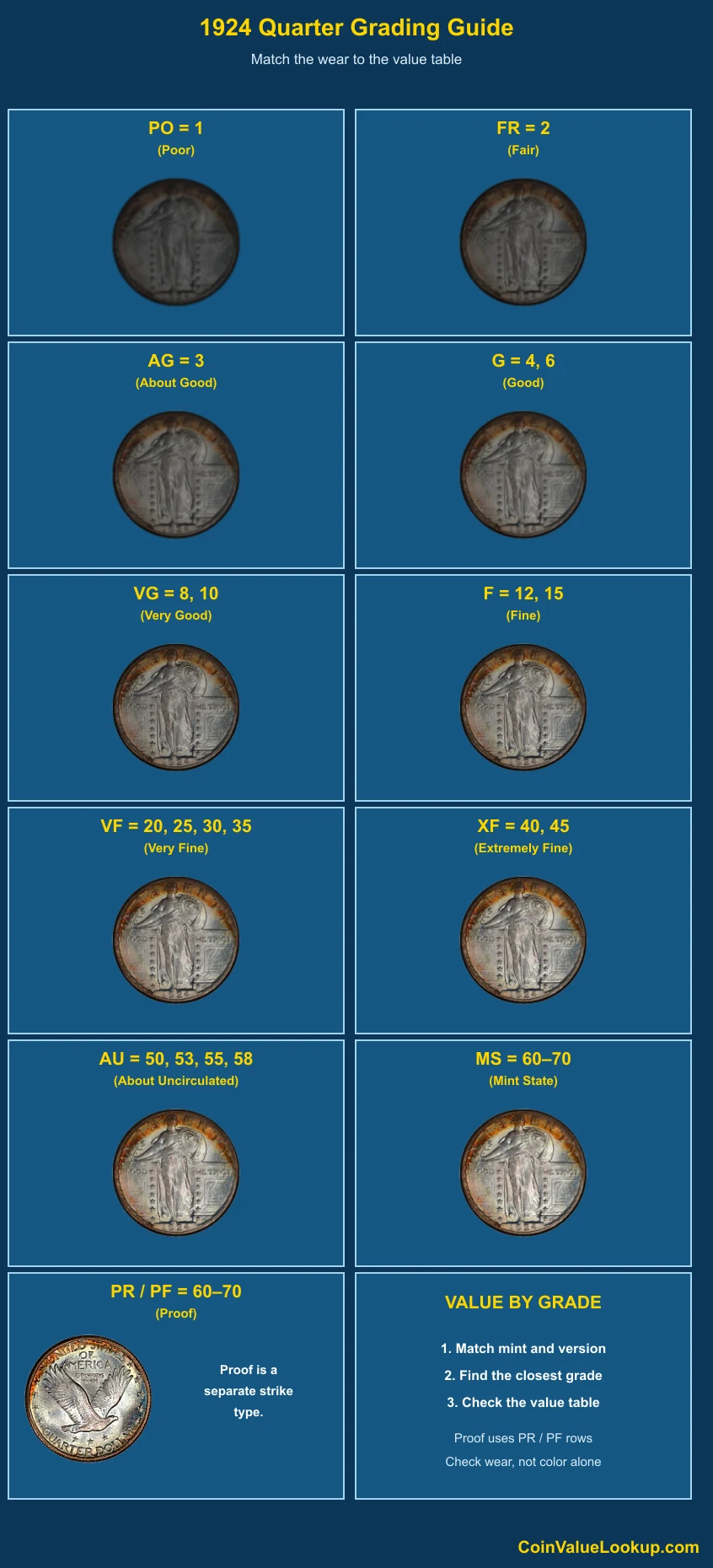
Focus on four areas of Liberty: the head, the breast area covered by chain mail, the shield and the knee. On the reverse, check the eagle's breast feathers and wing tips.
These high points lose detail first as a coin circulates.
A coin in Good condition (G4) will show a flattened Liberty with little interior detail, though the outline and date remain visible. At Mint State (MS60 and above), the coin retains full original luster with no wear on the high points.
Do not confuse strike weakness with wear. Standing Liberty quarters are famous for soft strikes, especially on the head.
A coin can be technically unworn yet still lack full head detail because the dies did not fully impress the metal. "Full Head" is a strike designation, not a grade, and should not be assumed just because a coin looks bright.
Compare your coin against the reference image, matching luster and surface preservation together. Cleaning, polishing or environmental damage will reduce value even if the coin shows little actual wear.
Step 3: Check 1924 Standing Liberty Quarter Value by Mint and Version
1924 Standing Liberty Quarter
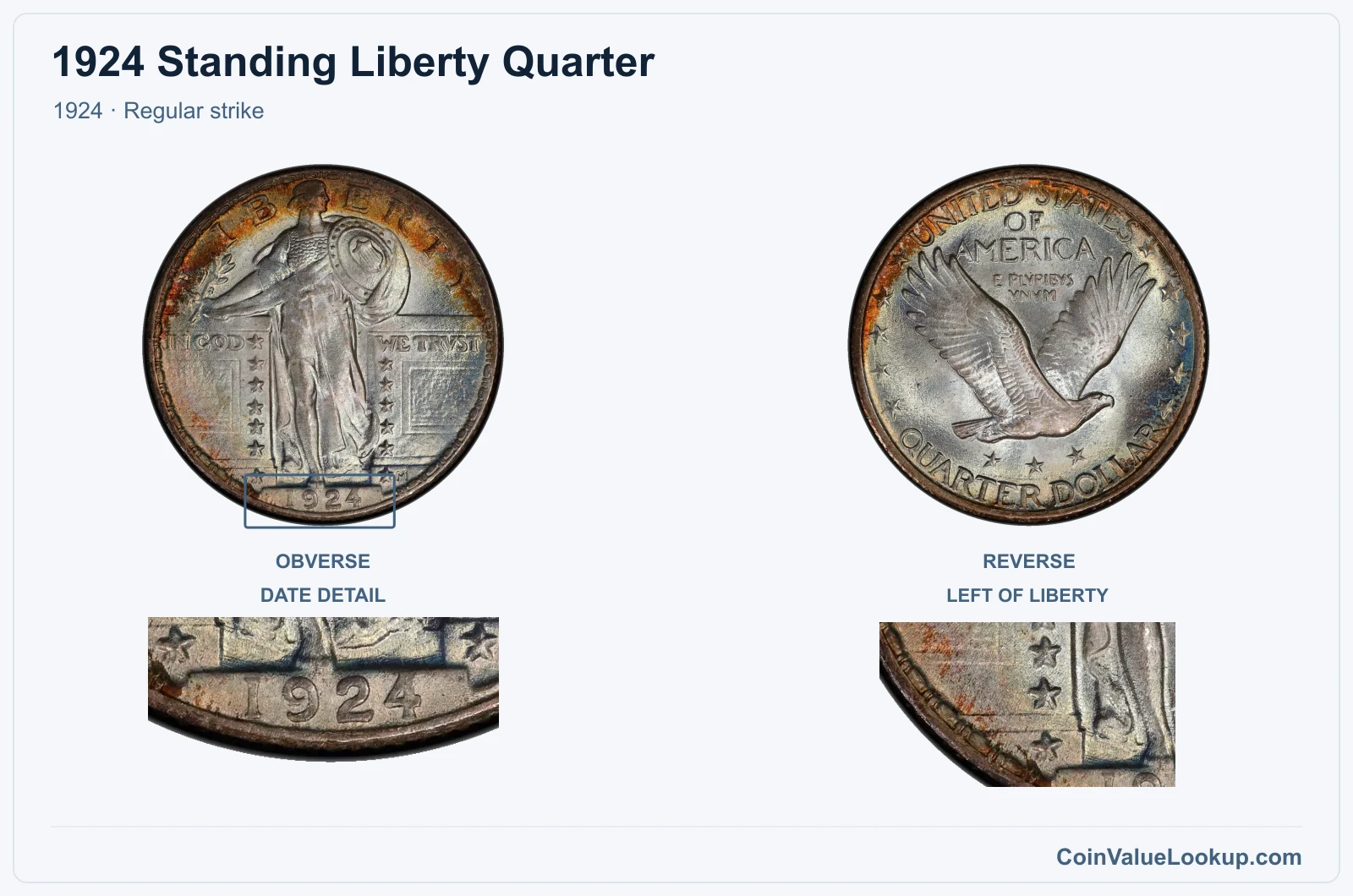
The 1924 Philadelphia quarter carries no mintmark. Look at the obverse near the left base of the wall where Liberty stands; if the space is blank, you have the P issue.
USA Coin Book estimates this version at $23.00 in G4, $194.00 in MS60 and $321.00 in MS63. These are guide estimates, not guaranteed offers.
This is a Type II design with chain mail on Liberty's chest and three stars below the reverse eagle. Original surfaces matter here.
A cleaned or damaged coin will trade below guide levels regardless of its apparent detail. Strike quality also varies; do not assume Full Head status without careful comparison.
Range Grade
Price Auction Records Appraisal PO PO 1
—
Coin Identifier FR FR 2
—
Coin Identifier AG AG 3
—
Coin Identifier G G 4
—
Coin Identifier
G 6
—
Coin Identifier VG VG 8
—
Coin Identifier
VG 10
—
Coin Identifier F F 12
—
Coin Identifier
F 15
—
Coin Identifier VF VF 20
—
Coin Identifier
VF 25
—
Coin Identifier
VF 30
Coin Identifier
VF 35
—
Coin Identifier XF XF 40
Coin Identifier
XF 45
Coin Identifier AU AU 50
Coin Identifier
AU 53
Coin Identifier
AU 55
Coin Identifier
AU 58
Coin Identifier MS MS 60
—
Coin Identifier
MS 61
Coin Identifier
MS 62
Coin Identifier
MS 63
Coin Identifier
MS 64
Coin Identifier
MS 65
Coin Identifier
MS 66
Coin Identifier
MS 67
Coin Identifier
MS 68
Coin Identifier
MS 69
—
—
—
MS 70
—
—
—
1924 Standing Liberty Quarter — D
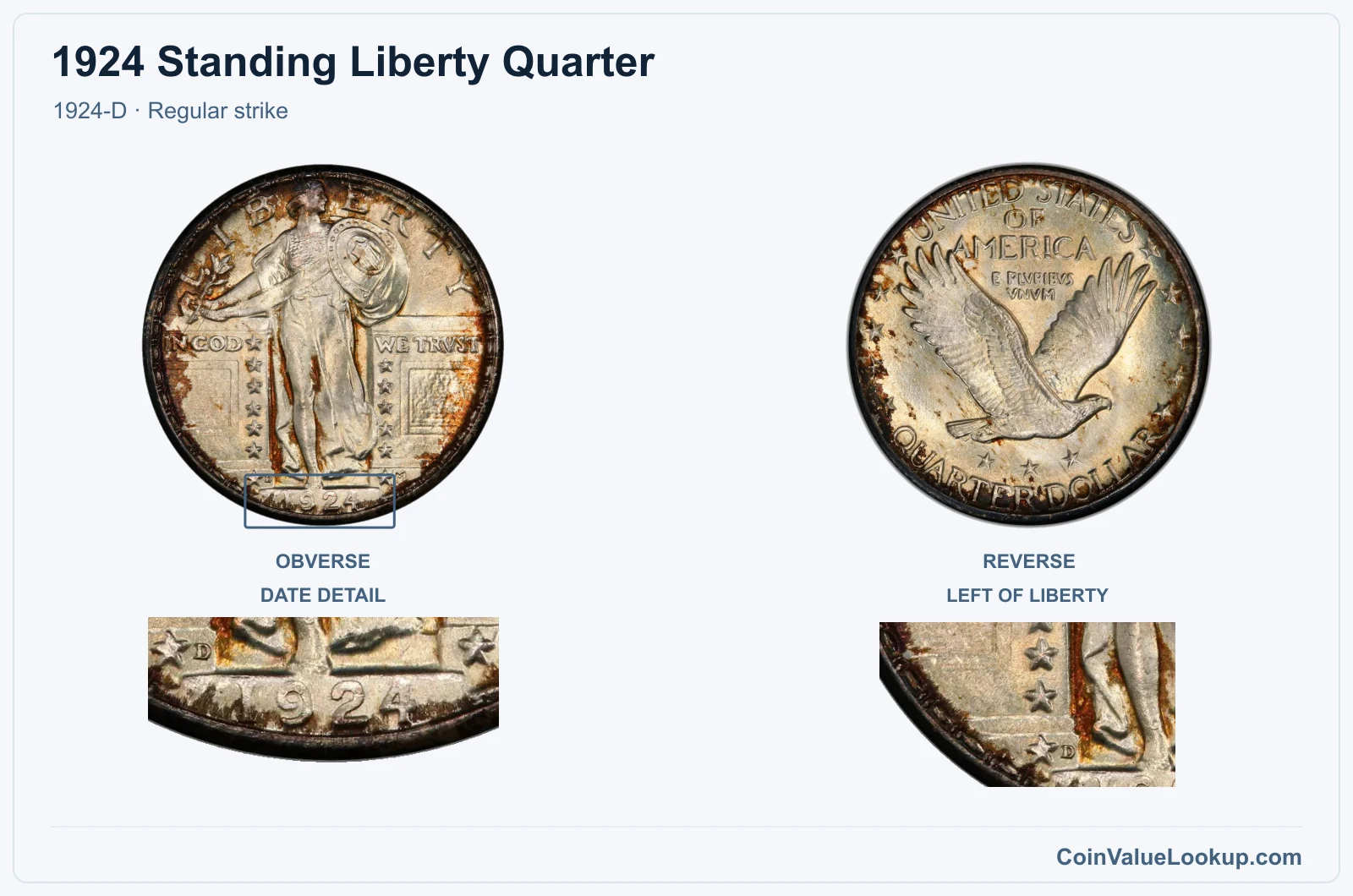
The 1924-D bears a small "D" mintmark on the obverse beside Liberty's feet, near the wall base. Denver quarters from this year carry a noticeable premium.
USA Coin Book places the G4 value at $58.00, the MS60 at $321.00 and the MS63 at $446.00. These are guide estimates, not guaranteed offers.
Denver strikes sometimes come weakly impressed, so separating genuine wear from a soft strike is critical. Compare the head, shield and knee carefully against the reference image.
A coin with original toning and sharp detail will always outperform a cleaned example at the same technical grade.
Coin Value Lookup is a good starting point if you are sorting through a group of coins and need guides for other dates or denominations. You can look up specific years and series to compare values quickly.
Range Grade
Price Auction Records Appraisal PO PO 1
—
Coin Identifier FR FR 2
—
Coin Identifier AG AG 3
—
Coin Identifier G G 4
—
Coin Identifier
G 6
—
Coin Identifier VG VG 8
—
Coin Identifier
VG 10
—
Coin Identifier F F 12
Coin Identifier
F 15
Coin Identifier VF VF 20
Coin Identifier
VF 25
Coin Identifier
VF 30
Coin Identifier
VF 35
Coin Identifier XF XF 40
Coin Identifier
XF 45
Coin Identifier AU AU 50
Coin Identifier
AU 53
Coin Identifier
AU 55
Coin Identifier
AU 58
Coin Identifier MS MS 60
—
Coin Identifier
MS 61
—
Coin Identifier
MS 62
Coin Identifier
MS 63
Coin Identifier
MS 64
Coin Identifier
MS 65
Coin Identifier
MS 66
Coin Identifier
MS 67
Coin Identifier
MS 68
Coin Identifier
MS 69
—
—
—
MS 70
—
—
—
1924 Standing Liberty Quarter — S
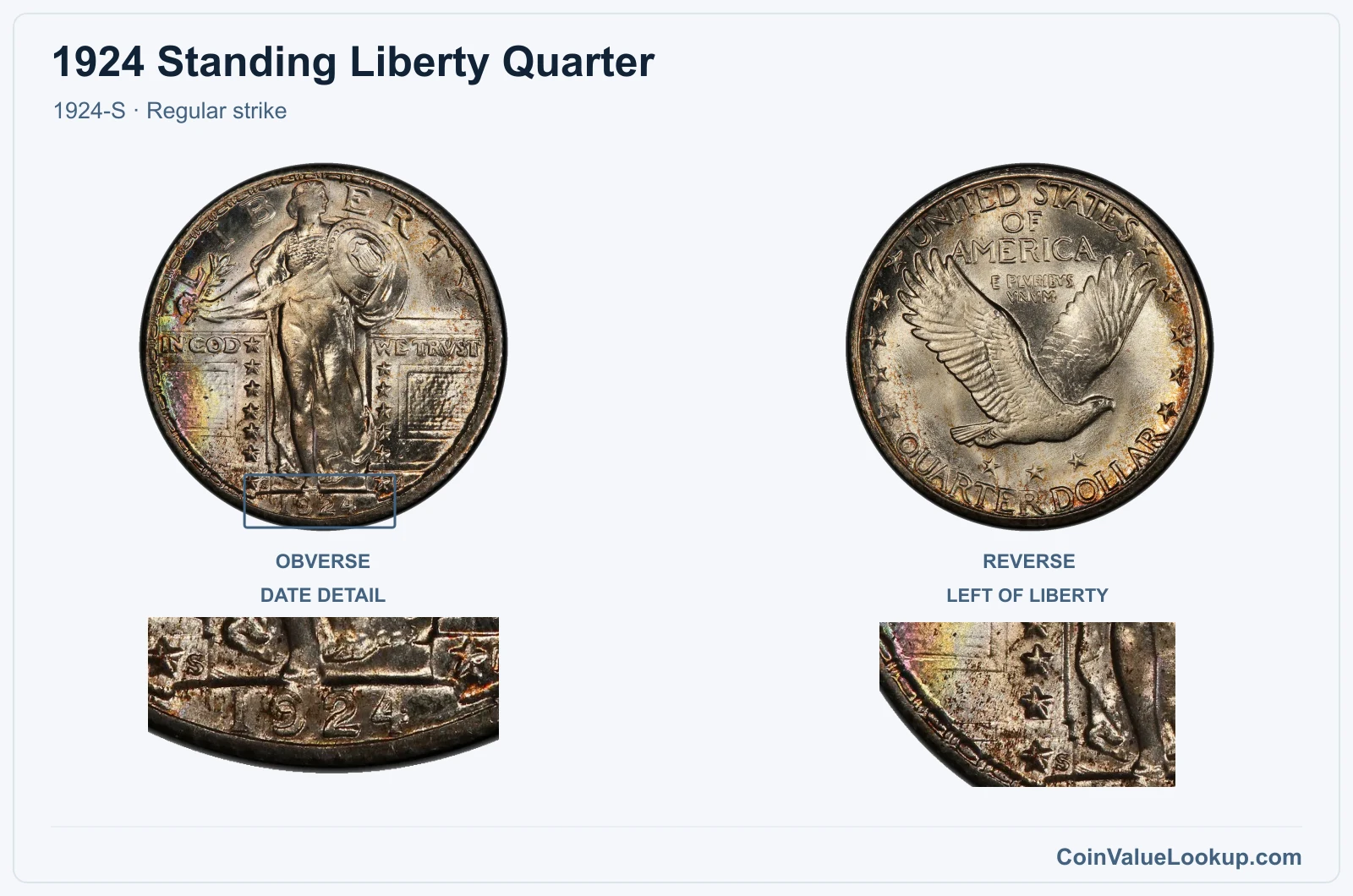
The 1924-S shows an "S" mintmark on the obverse near the left wall base. San Francisco coins from 1924 command the strongest premiums in higher grades.
USA Coin Book estimates $31.00 at G4, $415.00 at MS60 and $1,072.00 at MS63. These are guide estimates, not guaranteed offers.
That jump from MS60 to MS63 is dramatic. The difference comes down to surface quality: fewer contact marks, stronger luster and eye appeal.
A well-struck 1924-S with original surfaces in the MS63 range is a serious coin. However, cleaning or artificial toning will undercut its value sharply, so original skin matters more than brightness.
Always confirm the mintmark under magnification before getting excited.
Range Grade
Price Auction Records Appraisal PO PO 1
—
Coin Identifier FR FR 2
—
Coin Identifier AG AG 3
—
Coin Identifier G G 4
—
Coin Identifier
G 6
—
Coin Identifier VG VG 8
—
Coin Identifier
VG 10
Coin Identifier F F 12
Coin Identifier
F 15
—
Coin Identifier VF VF 20
Coin Identifier
VF 25
Coin Identifier
VF 30
—
Coin Identifier
VF 35
Coin Identifier XF XF 40
Coin Identifier
XF 45
Coin Identifier AU AU 50
Coin Identifier
AU 53
Coin Identifier
AU 55
Coin Identifier
AU 58
Coin Identifier MS MS 60
—
Coin Identifier
MS 61
Coin Identifier
MS 62
Coin Identifier
MS 63
Coin Identifier
MS 64
Coin Identifier
MS 65
Coin Identifier
MS 66
Coin Identifier
MS 67
Coin Identifier
MS 68
Coin Identifier
MS 69
—
—
—
MS 70
—
—
—
1924 Standing Liberty Quarter Error List
1. 1924 Standing Liberty Quarter — Double / Multiple Strike
A double-struck 1924 Standing Liberty quarter received two impressions from the dies, resulting in a visibly displaced or rotated second image layered over the first. Look for a clear secondary outline of Liberty or the eagle that is offset from the primary design.
The displacement is usually obvious to the naked eye, not just slightly thickened letters.
Do not confuse this with a doubled die, which is a different error caused during die manufacture rather than during the striking process. A doubled die shows consistent doubling across every coin struck by that die, while a double strike is unique to the individual coin.
Also watch out for post-mint damage where something pressed into the coin after it left the Mint, creating misleading extra impressions.
No specific price data is available for this error on the 1924 quarter. Value depends on the visibility of the second strike, the degree of rotation or displacement and the coin's overall condition.
Have any suspected example evaluated individually by a qualified grading service.