1930 Standing Liberty Quarter Coin Value: How Much Is It Worth?
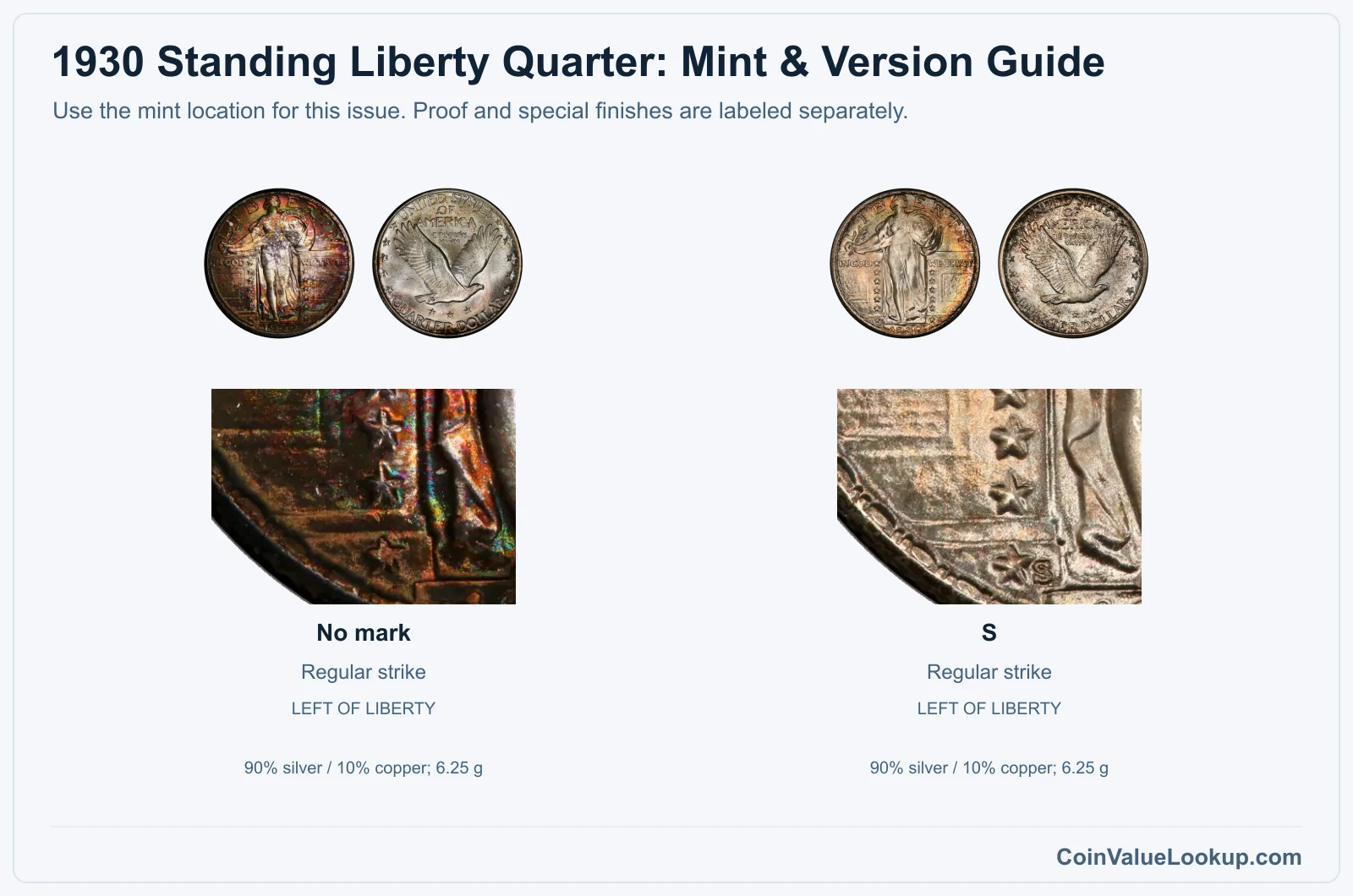
The 1930 Standing Liberty quarter is a late-date entry in a series that ended just one year later. Struck in 90% silver, it comes in two versions — Philadelphia and San Francisco — and guide estimates from USA Coin Book range from about $17.23 in well-worn Good-4 condition to $290.00 at the MS63 grade level.
Which part of that range applies depends on your coin's mint, condition and surface quality.
Fast Way to Identify Your 1930 Standing Liberty Quarter
The quickest way to get a preliminary read on your 1930 quarter is to upload clear photos of both the front and back. Good lighting and a steady shot help distinguish the mintmark, strike details and surface condition.
From there you can narrow down which version you have and where it sits on the value spectrum.
1930 Standing Liberty Quarter Value
Upload both sides of your 1930 Standing Liberty Quarter.
Front Obverse
Upload photo
Back Reverse
Upload photo
Which 1930 Standing Liberty Quarter Versions Are Worth Money?
- 1930-S quarter: USA Coin Book estimates reach $290.00 at MS63. The S mintmark near Liberty's feet is the first thing to confirm.
- 1930 Philadelphia quarter: Also estimated up to $290.00 at MS63 by the same guide. No mintmark is present on this version.
- Check mint and finish first — damage, heavy wear or a bright cleaned surface do not make a coin rare or establish a premium version.
Step 1: Identify Your 1930 Standing Liberty Quarter Mint Mark and Version
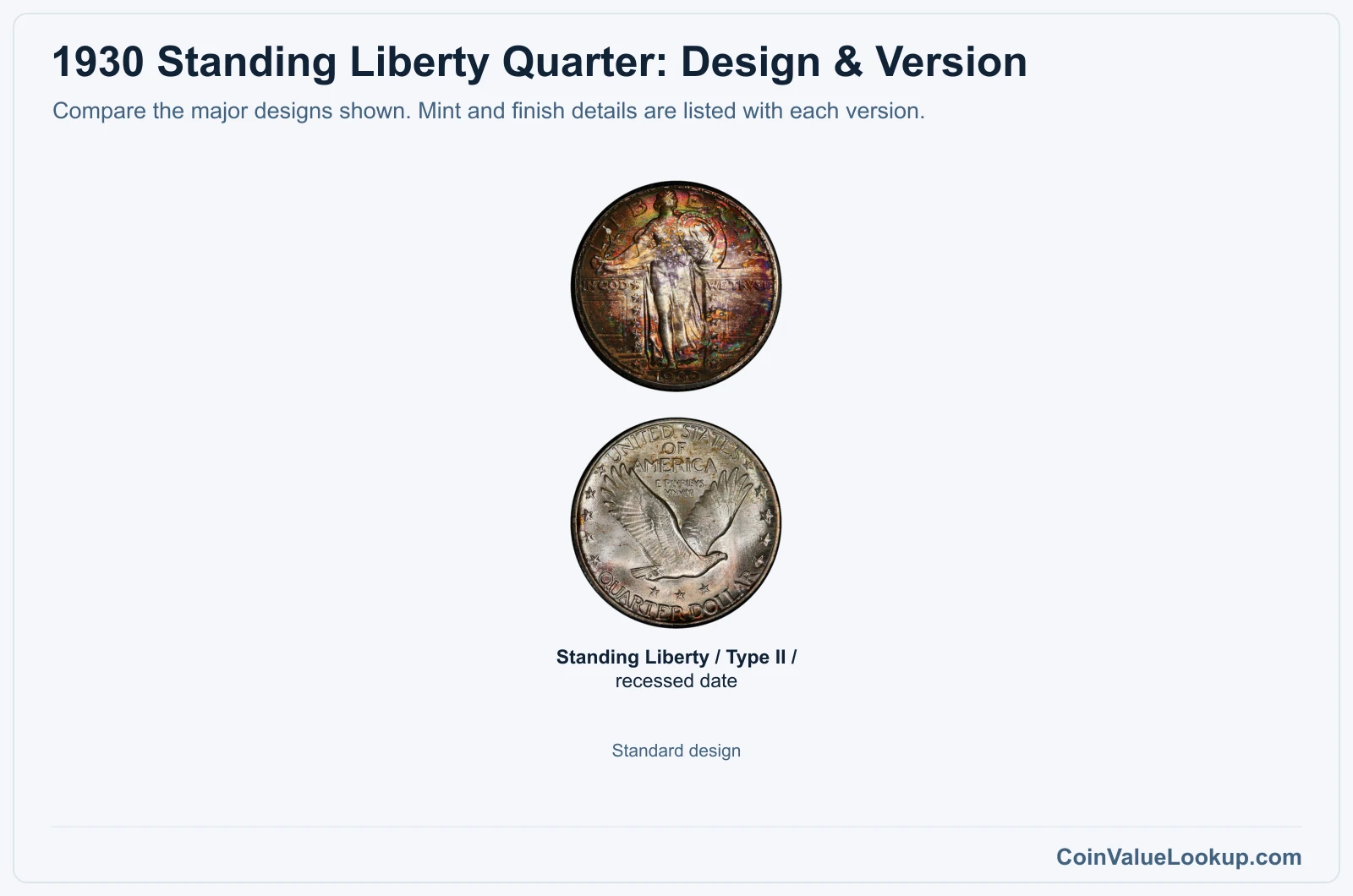
Two business-strike versions exist for 1930: the Philadelphia issue (no mintmark) and the San Francisco issue (S mintmark). The mintmark sits on the obverse, near the left base of the wall behind Liberty's feet.
No mintmark means Philadelphia.
All 1930 quarters are Type II, meaning Liberty wears protective chain mail on her upper body and three stars appear beneath the eagle on the reverse. The date is recessed into the coin — a change introduced in 1925 to slow the date-wear problem that plagued earlier issues.
The coin is 90% silver and 10% copper, weighing 6.25 grams. That silver content alone gives even heavily worn examples a floor value well above face.
Step 2: Check Your 1930 Standing Liberty Quarter Grade
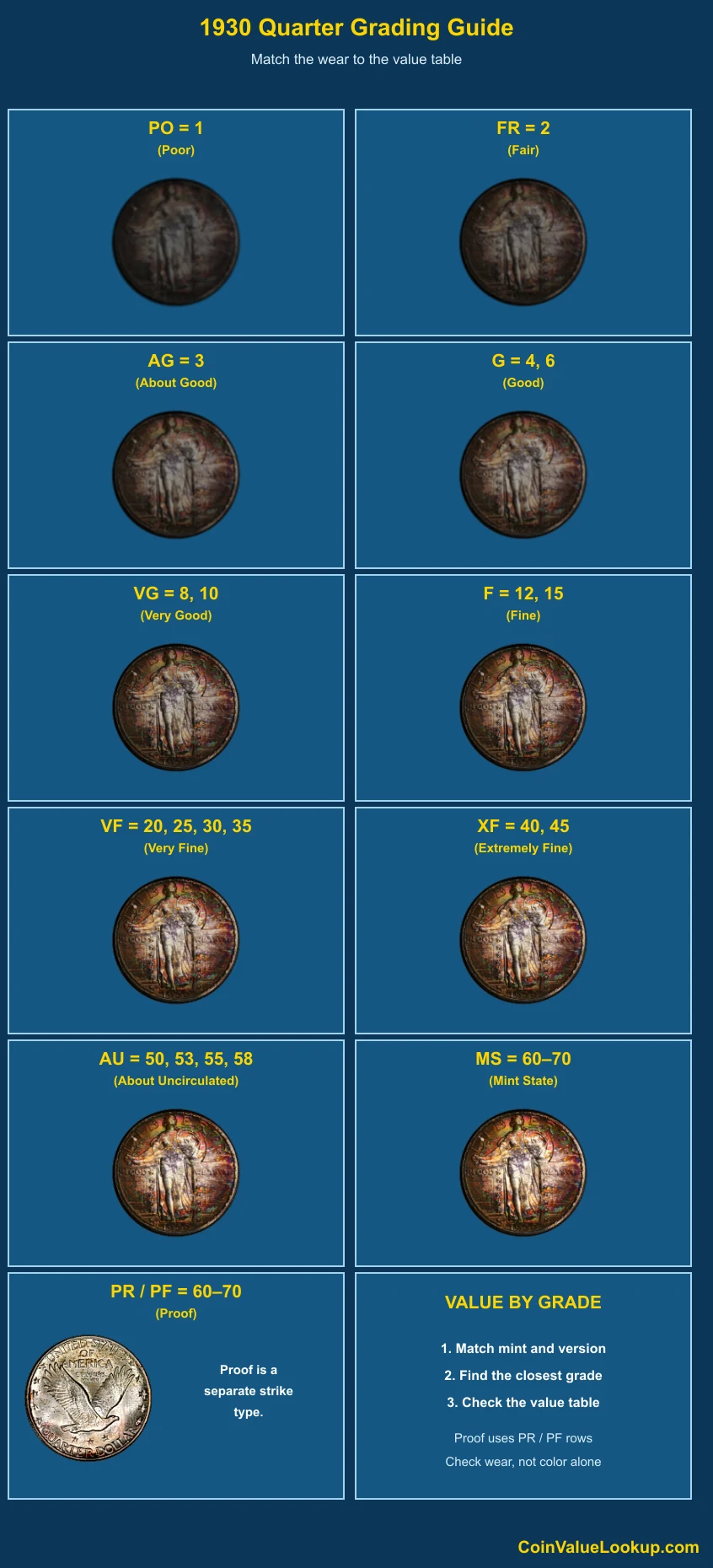
Start with Liberty's head. On a lightly circulated coin the hair detail above her brow softens first, followed by the breast area under the mail and the top of the shield.
The knee and exposed leg show flattening next.
On the reverse, check the eagle's breast feathers and wing tips. These lose definition in roughly the same order as the obverse high points.
Full Head is a strike designation, not a grade. It means the three leaves in Liberty's hair and the hairline above the forehead are fully defined.
A coin can be technically uncirculated yet lack a Full Head because the dies were spaced too far apart or wore down during the production run. Don't confuse a bright, cleaned surface with strong strike detail — they are unrelated.
Use the comparison image to match your coin's wear pattern against known grade benchmarks. Look at luster as well: original mint luster on a Standing Liberty quarter has a satiny, slightly cartwheel appearance.
Once that's gone, no amount of polishing brings it back.
Step 3: Check 1930 Standing Liberty Quarter Value by Mint and Version
1930 Standing Liberty Quarter
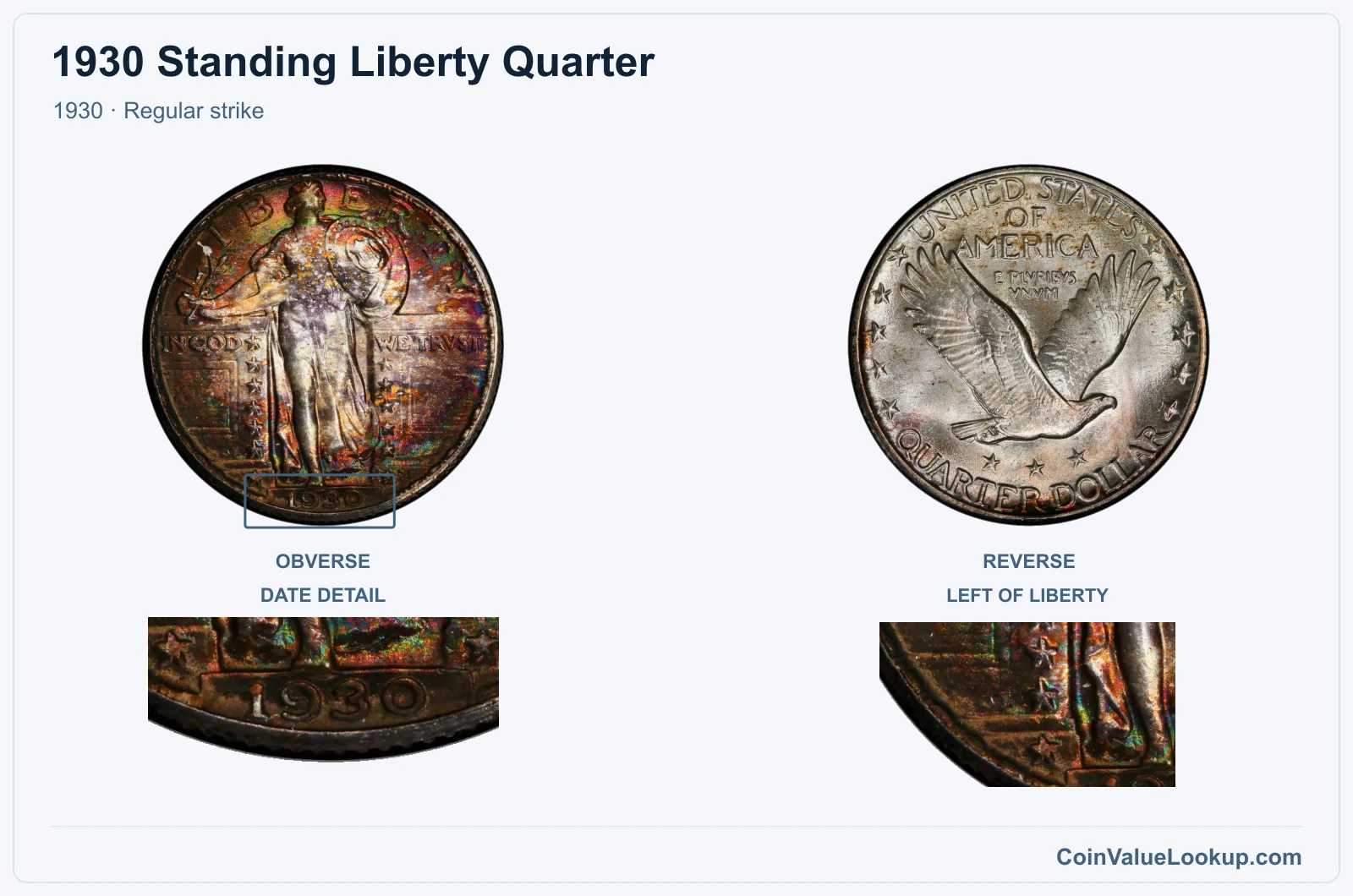
The 1930 Philadelphia quarter carries no mintmark. It is a Type II Standing Liberty design with the recessed date introduced in 1925, struck in 90% silver at 6.25 grams.
USA Coin Book estimates place this version at about $17.23 in G4, $171.00 in MS60 and $290.00 in MS63. These are guide estimates, not guaranteed sale prices.
Original surfaces matter: a cleaned or damaged example will typically trade below these figures regardless of its technical grade.
Coin Value Lookup is a good starting point if you want to compare this quarter against other dates and denominations in the series. You can look up guides for each year without digging through multiple sites.
Range Grade
Price Auction Records Appraisal PO PO 1
—
Coin Identifier FR FR 2
—
Coin Identifier AG AG 3
—
Coin Identifier G G 4
—
Coin Identifier
G 6
Coin Identifier VG VG 8
—
Coin Identifier
VG 10
—
Coin Identifier F F 12
—
Coin Identifier
F 15
—
Coin Identifier VF VF 20
—
Coin Identifier
VF 25
—
Coin Identifier
VF 30
Coin Identifier
VF 35
Coin Identifier XF XF 40
Coin Identifier
XF 45
Coin Identifier AU AU 50
Coin Identifier
AU 53
Coin Identifier
AU 55
Coin Identifier
AU 58
Coin Identifier MS MS 60
—
Coin Identifier
MS 61
Coin Identifier
MS 62
Coin Identifier
MS 63
Coin Identifier
MS 64
Coin Identifier
MS 65
Coin Identifier
MS 66
Coin Identifier
MS 67
Coin Identifier
MS 68
—
—
—
MS 69
—
—
—
MS 70
—
—
—
1930 Standing Liberty Quarter — S
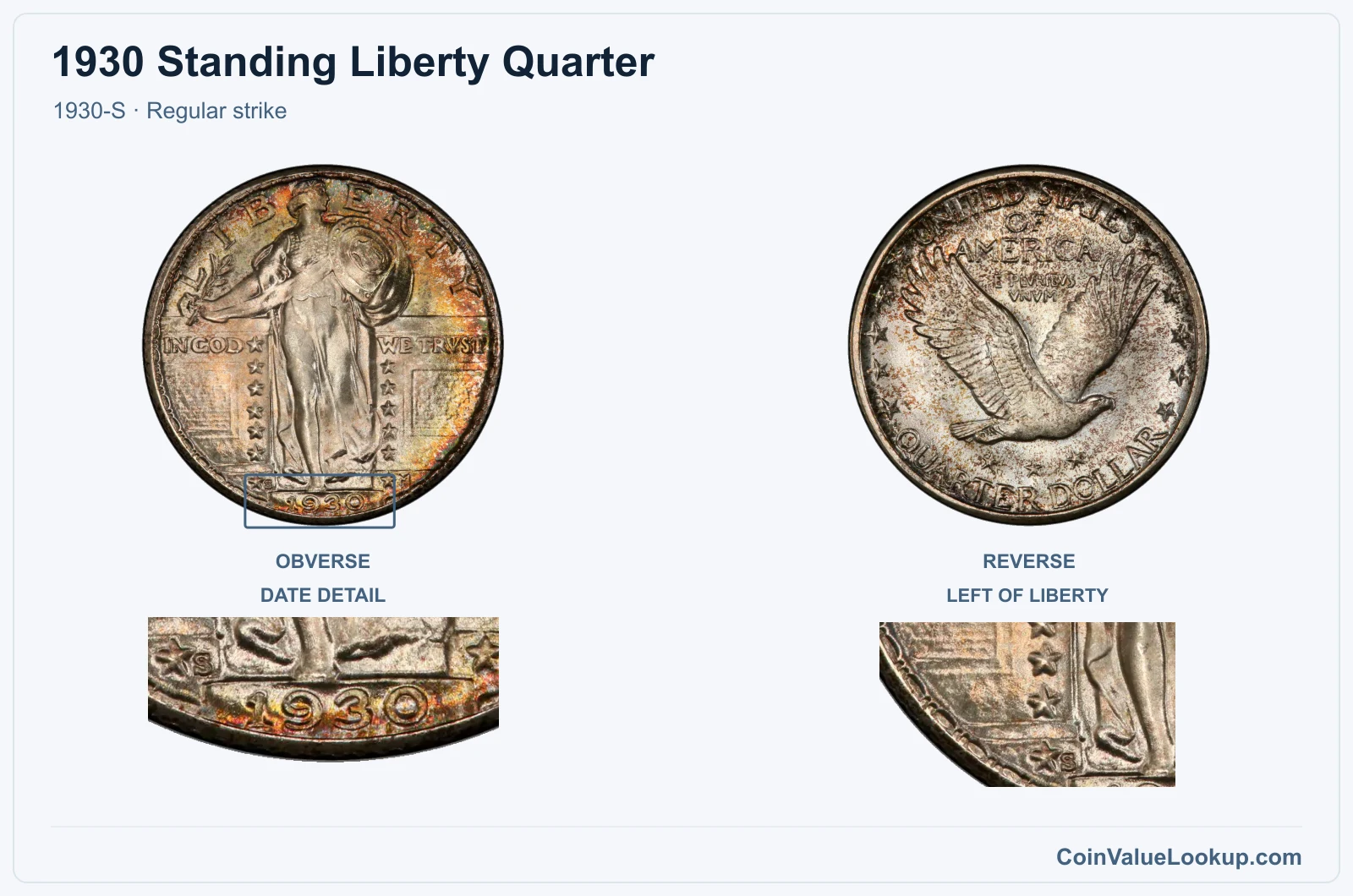
The 1930-S carries an S mintmark near the left base of the wall on the obverse, just beside Liberty's feet. Same Type II design, same 90% silver composition, same 6.25-gram weight.
Guide estimates from USA Coin Book run $17.23 at G4, $171.00 at MS60 and $290.00 at MS63. Identical figures to the Philadelphia issue in this guide, so the real price difference between the two often comes down to strike quality and eye appeal at the individual-coin level.
A Full Head designation — awarded for complete hair and leaf detail — can push values higher, but that is a strike characteristic, not something you can judge from wear alone. Always confirm the mintmark before assuming which version you hold.
Range Grade
Price Auction Records Appraisal PO PO 1
—
Coin Identifier FR FR 2
—
Coin Identifier AG AG 3
—
Coin Identifier G G 4
—
Coin Identifier
G 6
—
Coin Identifier VG VG 8
—
Coin Identifier
VG 10
—
Coin Identifier F F 12
—
Coin Identifier
F 15
Coin Identifier VF VF 20
Coin Identifier
VF 25
—
Coin Identifier
VF 30
Coin Identifier
VF 35
—
Coin Identifier XF XF 40
Coin Identifier
XF 45
Coin Identifier AU AU 50
—
Coin Identifier
AU 53
Coin Identifier
AU 55
Coin Identifier
AU 58
Coin Identifier MS MS 60
—
Coin Identifier
MS 61
Coin Identifier
MS 62
Coin Identifier
MS 63
Coin Identifier
MS 64
Coin Identifier
MS 65
Coin Identifier
MS 66
Coin Identifier
MS 67
Coin Identifier
MS 68
Coin Identifier
MS 69
—
—
—
MS 70
—
—
—
1930 Standing Liberty Quarter Error List
1. 1930 Standing Liberty Quarter — Off-Center Strike
An off-center strike happens when the planchet isn't seated properly in the collar, shifting the entire design toward one side and leaving an unstruck crescent of blank metal on the opposite edge. On a 1930 Standing Liberty quarter, the key question is whether the date remains visible — without it, the coin can't be attributed to 1930 and loses much of its appeal.
Don't confuse a clipped planchet (a curved bite out of the edge) or post-mint damage (a flattened rim from being hit) with a genuine off-center strike. A true off-center shows a complete, undistorted design that simply sits in the wrong position.
Condition, the percentage of misalignment and date visibility all affect what an off-center 1930 quarter might bring; no specific price range is established here.
2. 1930 Standing Liberty Quarter — Struck-Through Error
A struck-through error occurs when foreign material — grease, wire, cloth, even a metal fragment — gets between the die and the planchet during striking. The result is a localized depression or area of incomplete design where the obstruction blocked the metal flow.
On a 1930 quarter, look for a smooth, defined impression that doesn't match the surrounding design. Grease-filled dies tend to leave soft, rounded voids, while a retained foreign object can produce a sharper outline.
The difference from ordinary wear is that a struck-through impression sits within otherwise normal surfaces rather than across all the high points.
Scratches, cleaning marks and general weakness from a tired die pair are the usual lookalikes. Value depends on visibility, location and the coin's overall condition; no specific price is adopted for this error on the 1930 issue.
3. 1930 Standing Liberty Quarter — Clashed Dies
Clashed dies result from the obverse and reverse dies striking each other without a planchet between them. The impact transfers faint ghost images of one die's design onto the other.
On a subsequent coin, you might see traces of the eagle's wing on Liberty's side, or outlines of Liberty's figure in the reverse fields.
These transferred elements will be positioned exactly where the opposing design would normally sit, which is what separates a true die clash from random scratches or raised lines caused by debris. A brockage — where an already-struck coin sticks to a die — produces a mirror-image impression, not a ghost outline, so the two are distinct.
Clashed-die 1930 quarters have been reported. Value depends on how bold the clash marks are and the coin's grade; no specific price is adopted here.
4. 1930 Standing Liberty Quarter — Repunched Mintmark
A repunched mintmark on the 1930-S quarter shows remnants of a second or shifted S punch beneath or beside the primary mintmark. Since only the San Francisco issue carries a mintmark, this error applies exclusively to the 1930-S.
To spot it, examine the S at the base of the wall on the obverse under magnification. Look for a shadow, notch or secondary outline that suggests the punch was applied more than once.
Compare against a normal 1930-S at the same magnification — the doubled outline should be consistent and directional, not random.
Machine doubling (shelf-like flattening), die chips (lumpy raised metal) and corrosion pitting around the letter are the common lookalikes. No specific price is adopted for this variety, but condition, clarity of the repunching and overall eye appeal all factor into what a collector might pay.
5. 1930 Standing Liberty Quarter — Doubled Die
Doubled-die varieties on 1930 Standing Liberty quarters show consistent separation or notching in design elements — letters, stars or portions of Liberty's figure — caused by a misaligned hub impression during die production. The doubling appears in the same location on every coin struck from that die, which is how it differs from machine doubling.
Machine doubling produces flat, shelf-like distortion that lacks the raised, rounded profile of a true doubled die. Reflections under certain lighting and post-mint contact marks can also mimic doubling to the untrained eye.
When checking, compare suspect areas against a known normal example at matching magnification. Look for consistent directional separation rather than random distortion.
No specific price is adopted for doubled-die 1930 quarters; value depends on the strength of the doubling, the affected area and the coin's overall condition.