1949 Washington Quarter Coin Value: How Much Is It Worth?
A 1949 Washington quarter in well-worn condition starts around $16.43 based on USA Coin Book retail estimates, while selected uncirculated examples in MS65 condition reach up to $89. These are guide-level retail estimates, not guaranteed sale prices.
Only two mints produced quarters this year — Philadelphia and Denver — so there are no S-mint or proof issues to hunt for. Philadelphia coins in higher grades deserve a closer look because surface marks tend to limit the number of true premium survivors.
Fast Way to Identify Your 1949 Washington Quarter
Snap a clear photo of the front and back of your 1949 quarter and upload both images to our identifier for a preliminary read on mint, version, and approximate condition. This is not a substitute for professional authentication or certified grading, but it gives you a solid starting point before you dig deeper into specifics.
1949 Washington Quarter Value
Upload both sides of your 1949 Washington Quarter.
Front Obverse
Upload photo
Back Reverse
Upload photo
Which 1949 Washington Quarter Versions Are Worth Money?
- The 1949 Philadelphia quarter in MS65 condition is estimated around $89 by USA Coin Book — higher-grade survivors are limited by contact marks and surface quality.
- The 1949-D quarter with a repunched mintmark (D/D) brought $384 in MS65 at a Heritage auction in March 2018, per PCGS records.
- A 1949-D over S overmintmark variety exists and requires professional authentication — no standard price range is established, so value depends on the individual coin's condition and confirmation.
- Check both mints for original uncirculated surfaces; even common-date silver quarters gain a premium when they survive without cleaning or heavy bag marks.
Step 1: Identify Your 1949 Washington Quarter Mint Mark and Version
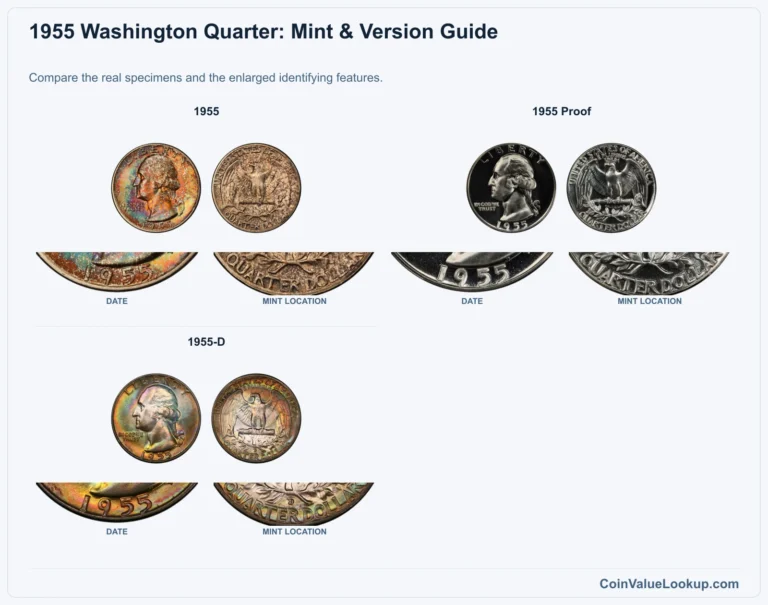
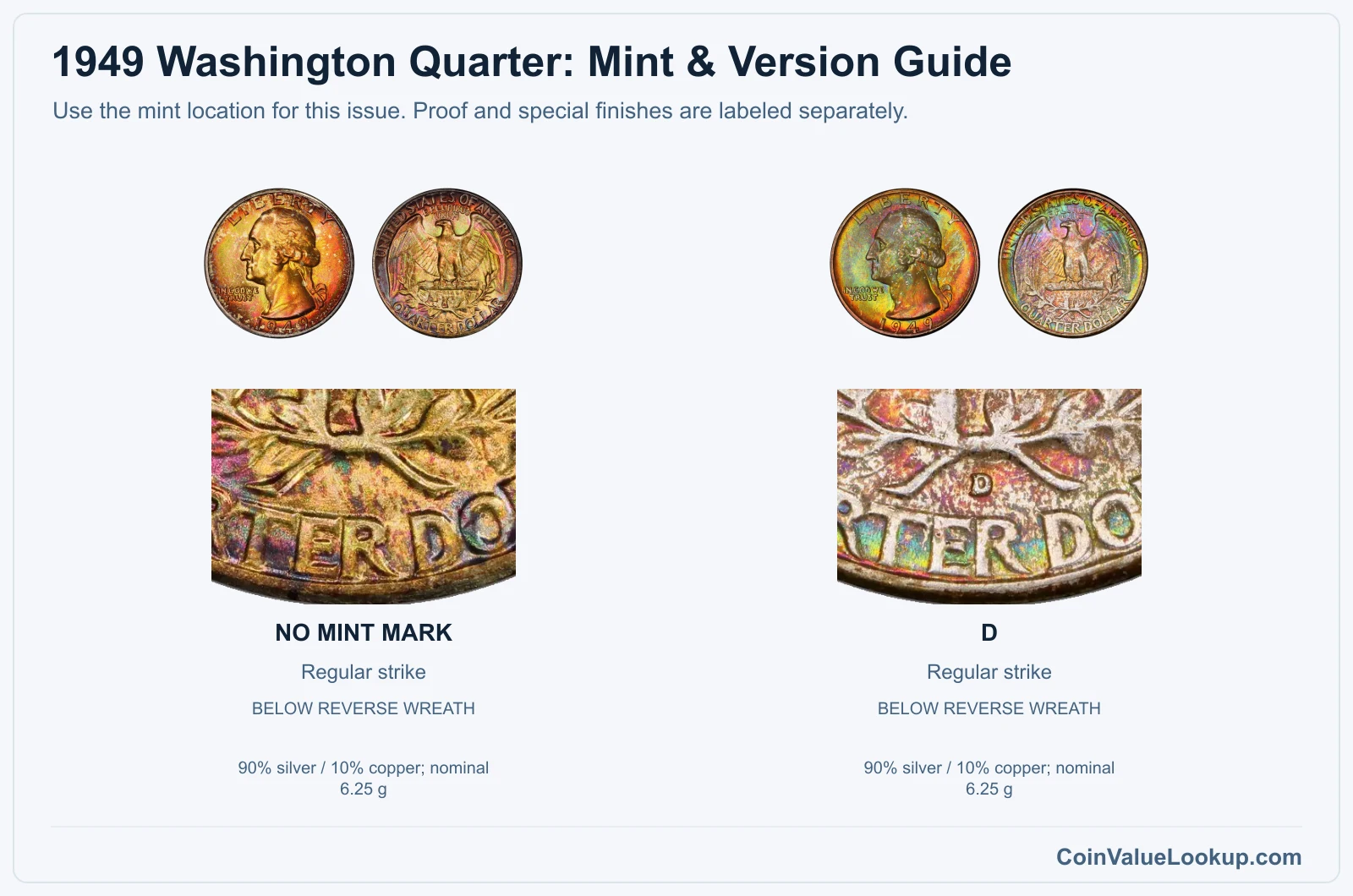
Start with the date on the obverse — it should read 1949, plain as day. Then flip the coin over and look below the wreath on the reverse for a mintmark.
If you see a small "D," you have a Denver issue. If there is nothing there at all, that blank space means Philadelphia, which did not use a mintmark on quarters in this era.
Every regular 1949 quarter is struck in 90% silver and 10% copper, weighing roughly 6.25 grams and measuring about 24.3 mm across. There is no composition variety to worry about — no clad, no different alloy.
The design shows George Washington facing left on the obverse and an eagle flanked by arrows and olive branches on the reverse.
No San Francisco quarters and no proofs exist for 1949. If someone offers you a "1949-S" quarter or a "1949 proof," walk away.
An unusual-looking surface or a blank mintmark area does not automatically make your coin a premium error, either.
Step 2: Check Your 1949 Washington Quarter Grade
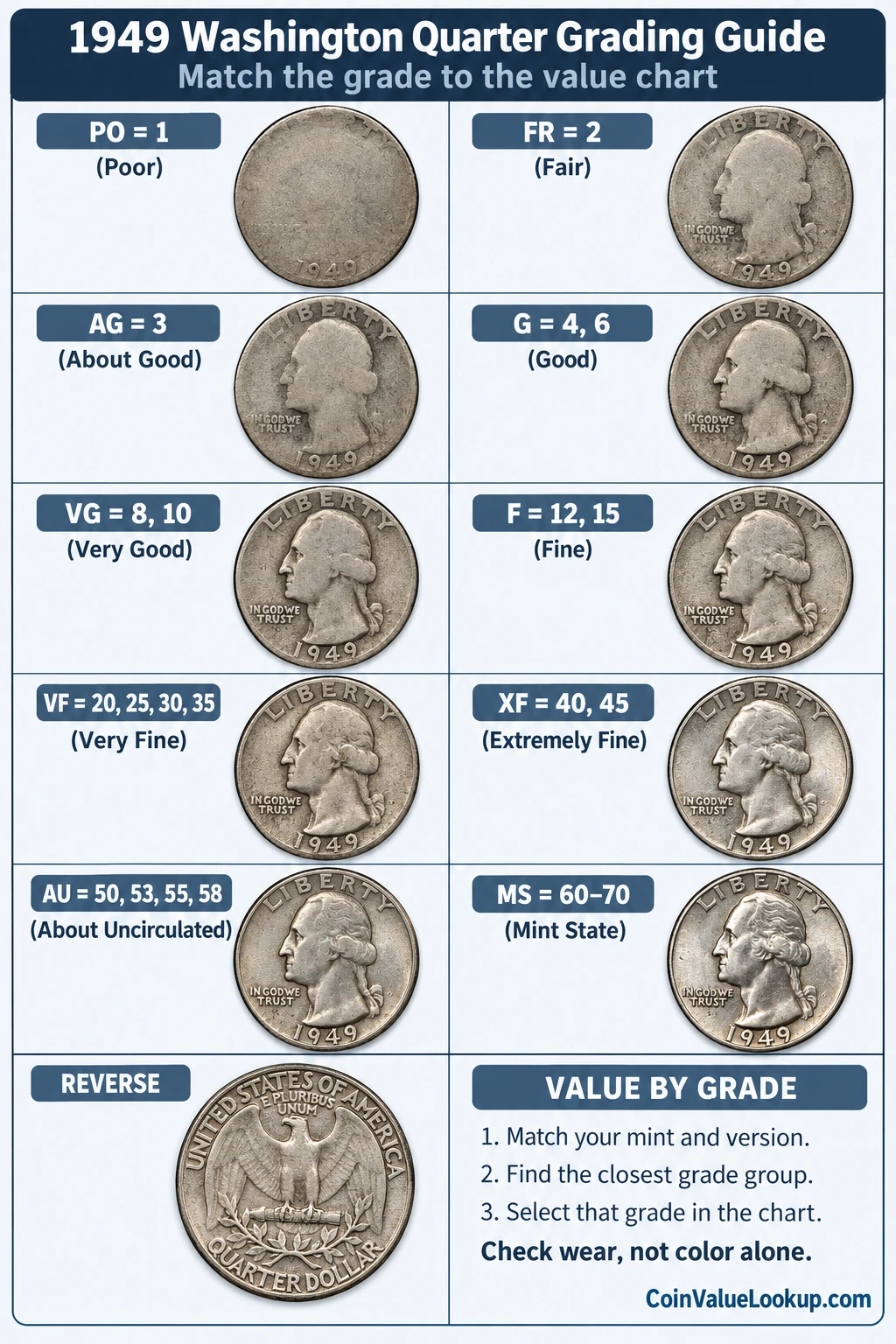
Focus on three spots when judging wear: the hair detail above Washington's ear, the cheek and jawline on the obverse, and the eagle's breast feathers on the reverse. On a well-preserved coin, these areas show full, crisp detail.
As a coin circulates, they flatten first.
The key distinction is telling genuine wear from a weak strike. Wear removes luster — that cartwheel shine you see when you tilt an uncirculated coin under a light.
A weakly struck coin may look flat in spots but still show original luster in the fields around those areas.
Check the fields carefully for hairline scratches from cleaning, rim dings, and contact marks (bag marks from banging against other coins at the mint). These all drag down the grade.
Use the comparison image to match your coin's overall look against known grade benchmarks, paying close attention to how much original surface detail and luster remain.
Step 3: Check 1949 Washington Quarter Value by Mint and Version
1949 Washington Quarter
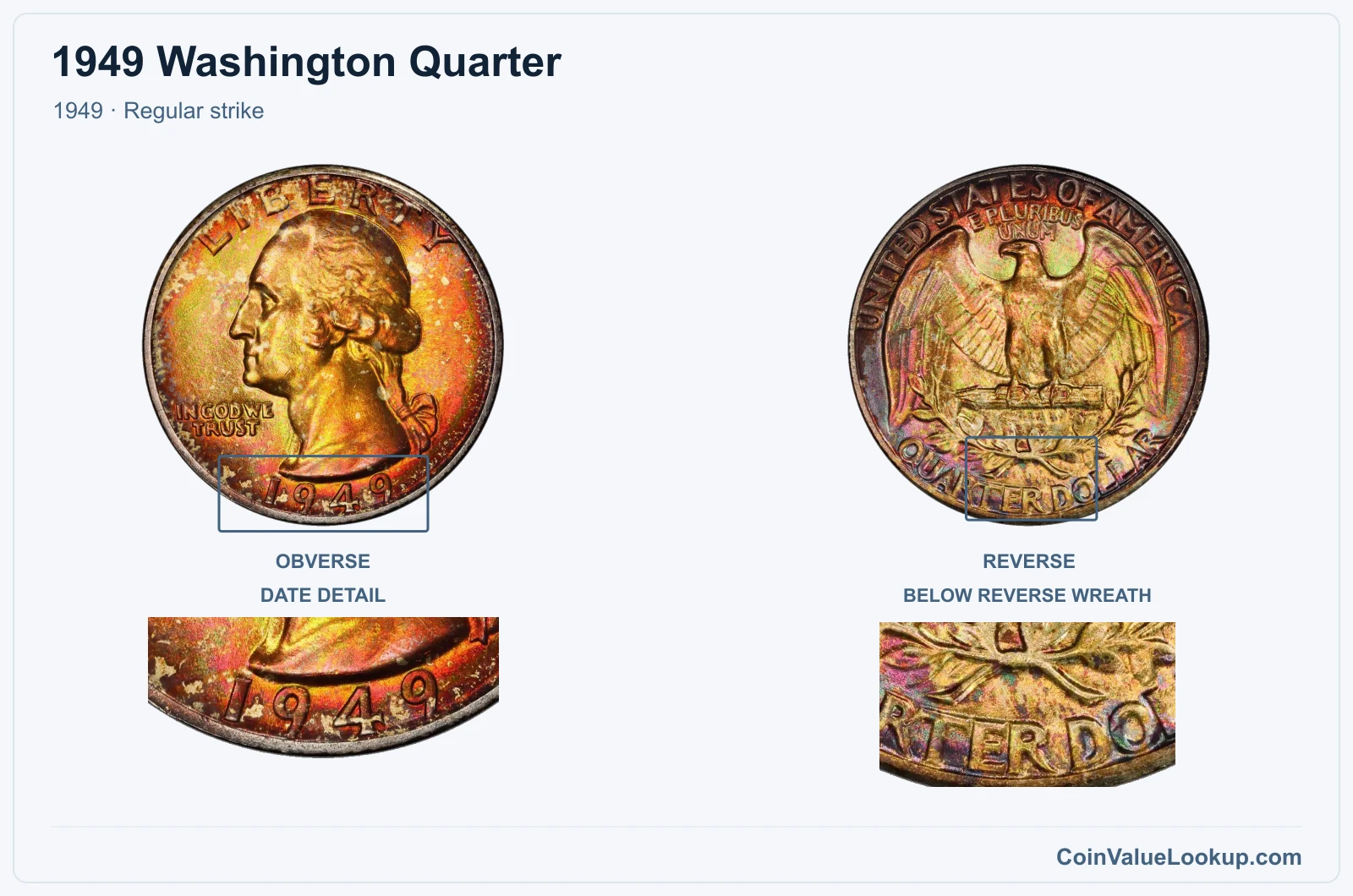
The 1949 Philadelphia quarter carries no mintmark — the space below the reverse wreath is simply blank. It is struck in 90% silver and 10% copper at a nominal weight of 6.25 grams.
USA Coin Book estimates place a well-worn G4 example around $16.43, an MS60 around $51, and a choice MS65 near $89.
Philadelphia higher-grade coins are where the action is for this date. Bag marks and surface blemishes kept many otherwise nice coins out of premium territory, so a genuinely clean MS65 stands apart.
Look for full hair detail above the ear, sharp eagle breast feathers, and unbroken original luster across the fields.
| Range | Grade | Price | Auction Records | Appraisal |
|---|---|---|---|---|
| PO | PO 1 | — | Coin Identifier | |
| FR | FR 2 | — | Coin Identifier | |
| AG | AG 3 | — | Coin Identifier | |
| G | G 4 | — | Coin Identifier | |
| G 6 | — | Coin Identifier | ||
| VG | VG 8 | — | Coin Identifier | |
| VG 10 | — | Coin Identifier | ||
| F | F 12 | — | Coin Identifier | |
| F 15 | — | Coin Identifier | ||
| VF | VF 20 | — | Coin Identifier | |
| VF 25 | — | Coin Identifier | ||
| VF 30 | — | Coin Identifier | ||
| VF 35 | — | Coin Identifier | ||
| XF | XF 40 | — | Coin Identifier | |
| XF 45 | — | Coin Identifier | ||
| AU | AU 50 | — | Coin Identifier | |
| AU 53 | — | Coin Identifier | ||
| AU 55 | Coin Identifier | |||
| AU 58 | Coin Identifier | |||
| MS | MS 60 | — | Coin Identifier | |
| MS 61 | — | Coin Identifier | ||
| MS 62 | — | Coin Identifier | ||
| MS 63 | Coin Identifier | |||
| MS 64 | Coin Identifier | |||
| MS 65 | Coin Identifier | |||
| MS 66 | Coin Identifier | |||
| MS 67 | Coin Identifier | |||
| MS 68 | Coin Identifier | |||
| MS 69 | — | — | — | |
| MS 70 | — | — | — |
1949 Washington Quarter — D
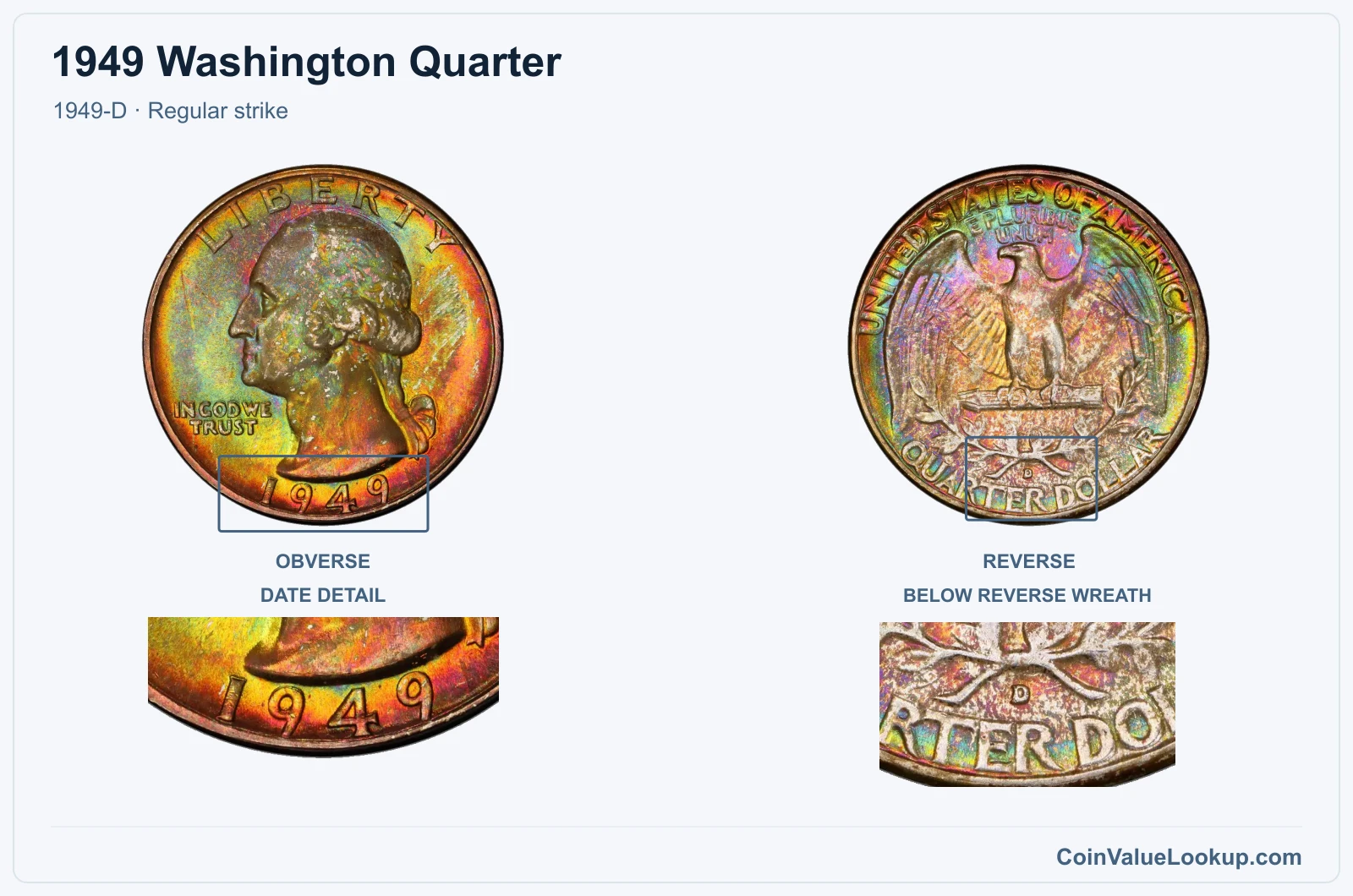
Look for the small "D" mintmark below the wreath on the reverse. The 1949-D shares the same 90% silver, 10% copper composition and 6.25-gram standard weight as its Philadelphia sibling.
USA Coin Book retail estimates put a G4 around $16.43, matching the Philadelphia issue in lower grades. The gap shows up higher on the scale: an MS60 is estimated around $31 and an MS65 around $77 — both a bit below Philadelphia equivalents.
That said, the Denver mint produced its own share of poorly handled coins, so a sharp, original-surface example still commands collector respect.
Coin Value Lookup is a handy place to look up quarter values across different years and mints if you are building a date set or just curious how your coin stacks up.
| Range | Grade | Price | Auction Records | Appraisal |
|---|---|---|---|---|
| PO | PO 1 | — | Coin Identifier | |
| FR | FR 2 | — | Coin Identifier | |
| AG | AG 3 | — | Coin Identifier | |
| G | G 4 | — | Coin Identifier | |
| G 6 | — | Coin Identifier | ||
| VG | VG 8 | — | Coin Identifier | |
| VG 10 | — | Coin Identifier | ||
| F | F 12 | — | Coin Identifier | |
| F 15 | — | Coin Identifier | ||
| VF | VF 20 | — | Coin Identifier | |
| VF 25 | — | Coin Identifier | ||
| VF 30 | — | Coin Identifier | ||
| VF 35 | — | Coin Identifier | ||
| XF | XF 40 | — | Coin Identifier | |
| XF 45 | — | Coin Identifier | ||
| AU | AU 50 | — | Coin Identifier | |
| AU 53 | — | Coin Identifier | ||
| AU 55 | — | Coin Identifier | ||
| AU 58 | — | Coin Identifier | ||
| MS | MS 60 | — | Coin Identifier | |
| MS 61 | — | Coin Identifier | ||
| MS 62 | — | Coin Identifier | ||
| MS 63 | — | Coin Identifier | ||
| MS 64 | Coin Identifier | |||
| MS 65 | Coin Identifier | |||
| MS 66 | Coin Identifier | |||
| MS 67 | Coin Identifier | |||
| MS 68 | Coin Identifier | |||
| MS 69 | — | — | — | |
| MS 70 | — | — | — |
1949 Washington Quarter Error List
1. 1949 Washington Quarter — Repunched D Mintmark
The 1949-D repunched mintmark (D/D) shows overlapping outlines of the D punch below the reverse wreath. You will see a second, slightly offset D contour that was impressed into the working die before the final position was set.
Compare your coin's mintmark to a normal 1949-D at the same magnification — the doubling should be visible as a distinct second impression, not just a blurry edge.
Do not confuse this with machine doubling, which creates a flat, shelf-like echo rather than a rounded second punch. Scratches, wear, or added material near the mintmark can also mimic the look at a glance but will not match the precise die-made pattern of a true repunched mintmark.
A PCGS-graded MS65 example sold for $384 at Heritage Auctions in March 2018. That is a single recorded result at a specific grade, not a guaranteed market range for every specimen.
2. 1949 Washington Quarter — D over S Mintmark
The 1949-D over S overmintmark variety shows remnants of an underlying S punch beneath the final D mintmark on the reverse. Under magnification, you should see traces of the S curves peeking out from behind the D — this happened when a die originally prepared with an S mintmark was re-punched with a D before being put into service.
Be careful not to confuse this Washington quarter variety with the unrelated 1949-D/S Jefferson nickel, which is a different coin entirely. Also, machine doubling creates flat, shelf-like distortion and is not the same thing as a genuine overmintmark, which shows rounded remnant letter forms from the original punch.
No standard price range is established for this variety. Value depends on professional authentication confirming the attribution, the coin's individual condition, and the clarity of the underlying S.
If you suspect you have one, third-party certification is the path forward.