1930 Buffalo Nickel Coin Value: How Much Is It Worth?
A 1930 Buffalo Nickel in ordinary circulated condition starts around $1.56 in Good-4, according to USA Coin Book guide estimates, and can reach $148 in MS63 for the San Francisco issue. No regular proof was made this year.
Only the Type 2 recessed "FIVE CENTS" reverse exists for this date, so every genuine 1930 Buffalo Nickel shares that design.
Fast Way to Identify Your 1930 Buffalo Nickel
Snap clear photos of both sides of your coin, making sure the date is readable and the area below FIVE CENTS on the reverse is in focus. Upload your front and back images for a preliminary identification that can help you figure out which mint struck your nickel and point you toward next steps.
1930 Buffalo Nickel Value
Upload both sides of your 1930 Buffalo Nickel.
Front Obverse
Upload photo
Back Reverse
Upload photo
Which 1930 Buffalo Nickel Versions Are Worth Money?
- The 1930-S in MS63 carries the highest guide estimate of the two mints at $148, compared to $92 for the Philadelphia issue in the same grade.
- Both mints share the same $1.56 guide estimate in G4, so condition is the real separator for value.
- Several error categories are reported for 1930 Buffalo Nickels, including doubled dies and the two-feather variety on the S mint, which are worth checking for individually.
Step 1: Identify Your 1930 Buffalo Nickel Mint Mark and Version
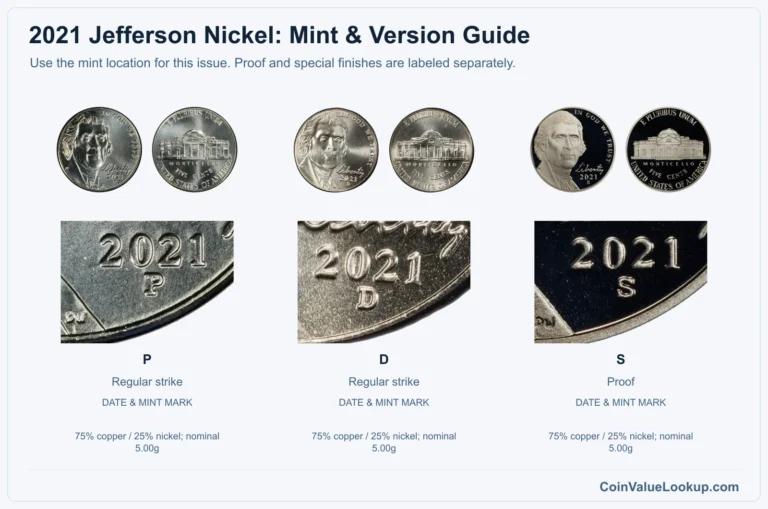
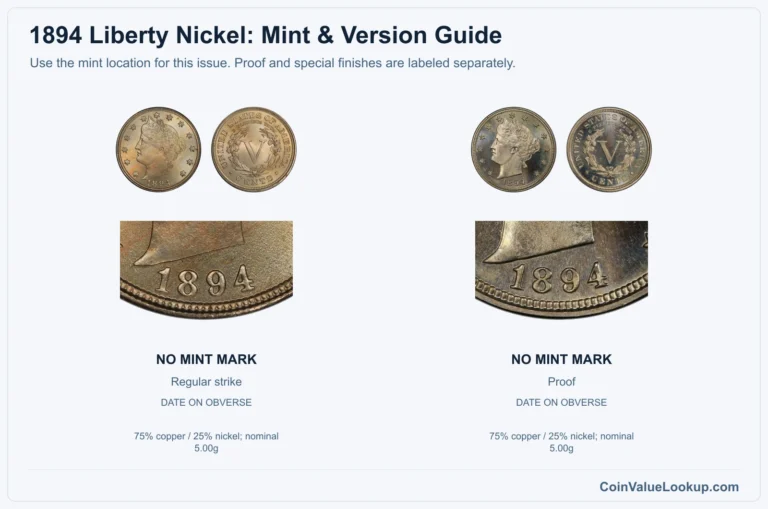
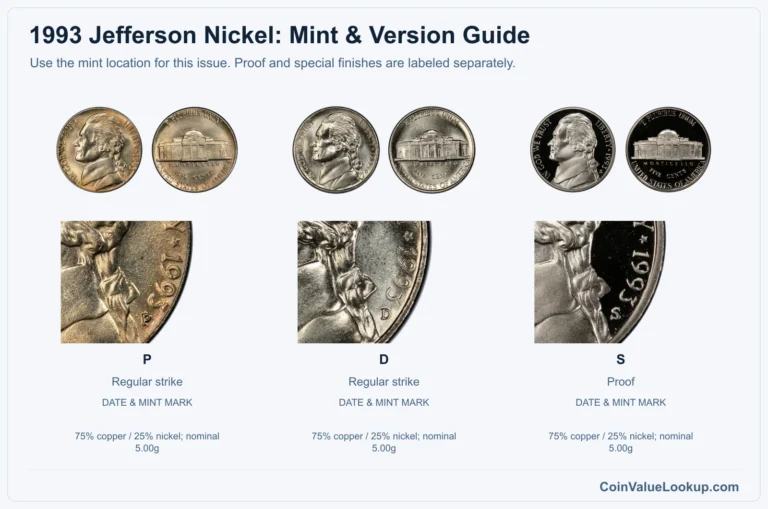
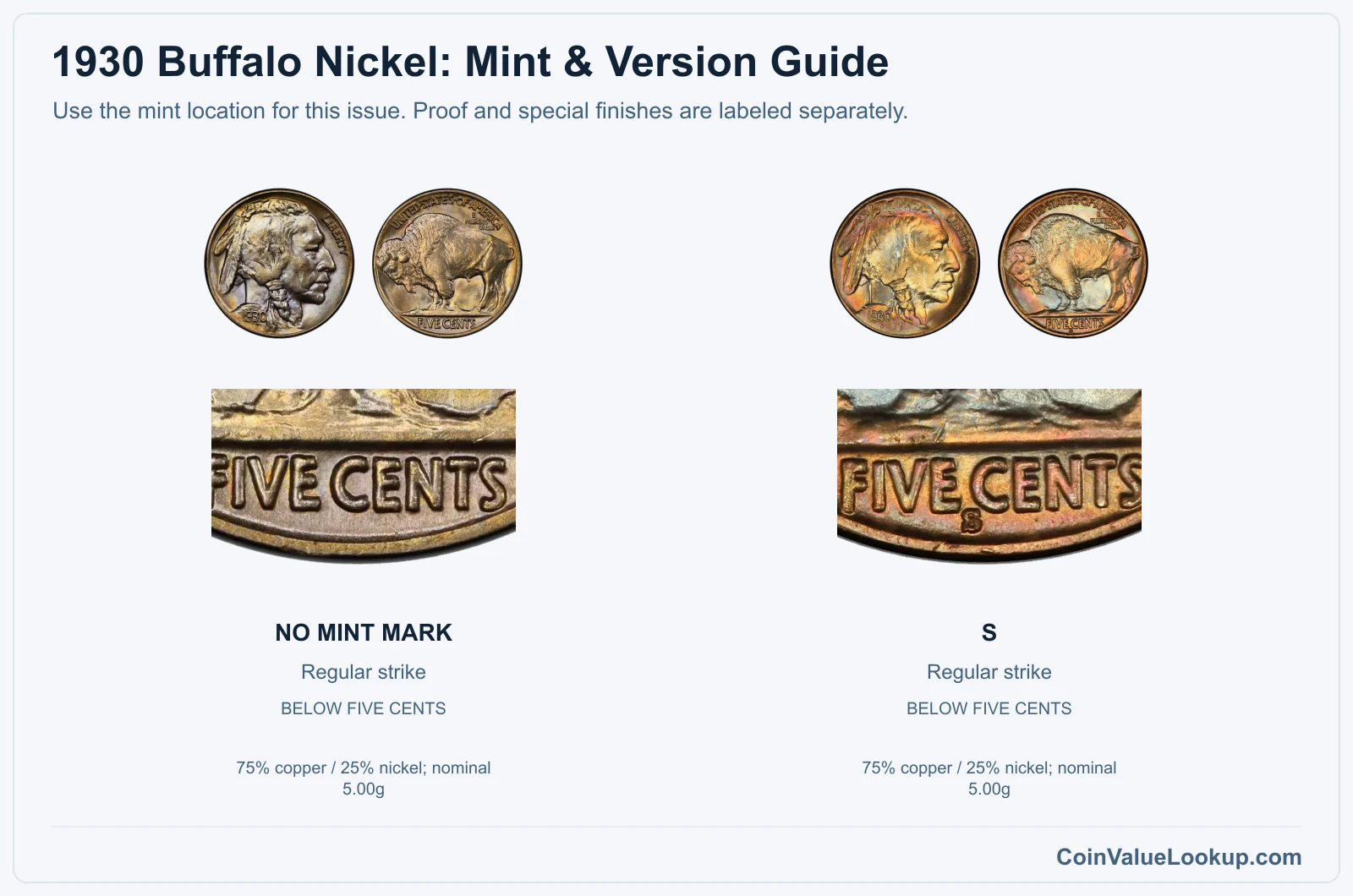
Two mints produced Buffalo Nickels in 1930: Philadelphia and San Francisco. A Philadelphia coin has no mintmark at all.
The San Francisco coin carries a small "S" on the reverse, below FIVE CENTS.
Look on the flat area just below the denomination and above the rim. That is where the S sits, recessed into the ground of the design.
If you see nothing there, you have a Philadelphia strike.
Every 1930 nickel uses the Type 2 reverse, where FIVE CENTS sits in a recessed area below a straight line. The earlier Type 1 mound design was only used in 1913.
Your coin is struck in 75% copper and 25% nickel, weighs about 5 grams, measures 21.2 mm across, and has a plain edge. There is no silver version of this coin.
Step 2: Check Your 1930 Buffalo Nickel Grade
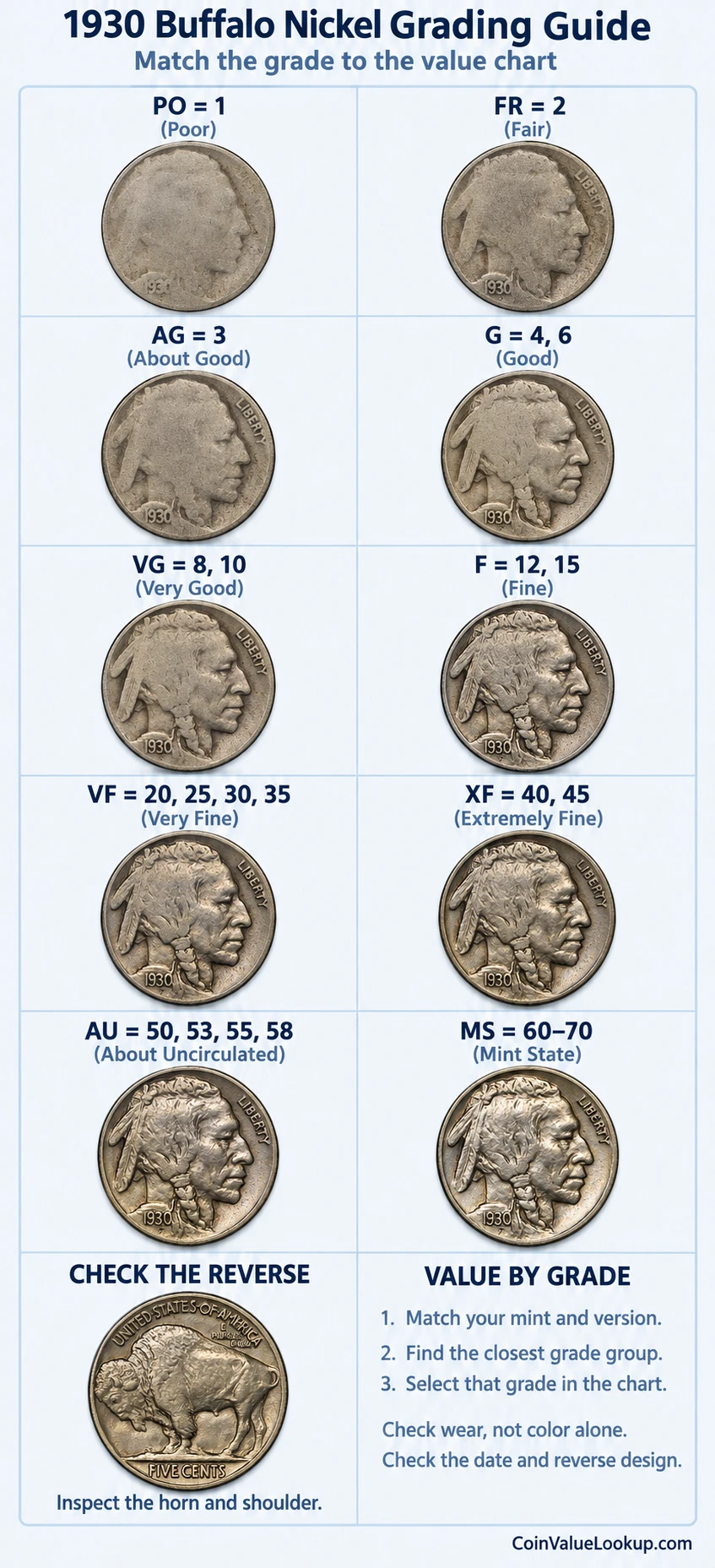
Focus on the Native American portrait first. In higher grades the hair braid has distinct, separated strands and the cheek retains a soft roundness.
As wear increases, the braid merges into a flat ribbon and the cheek flattens.
Flip it over. The bison's shoulder, hip, and horn are the reverse wear points.
A sharp horn with visible detail suggests light wear; a smooth, featureless horn means the coin saw real pocket time.
Here is the tricky part with Buffalo Nickels from 1930: branch-mint strikes can come weakly struck from the factory. A coin missing horn detail is not necessarily heavily worn.
Compare your coin to the grading image, paying attention to whether the surrounding fields still show original luster. Luster left in protected areas, paired with weak high points, often signals a soft strike rather than decades of circulation.
Never acid-treat a Buffalo Nickel to restore the date. It destroys the surface and tanks the value.
Step 3: Check 1930 Buffalo Nickel Value by Mint and Version
1930 Buffalo Nickel — No Mint Mark — Type2 Circulation
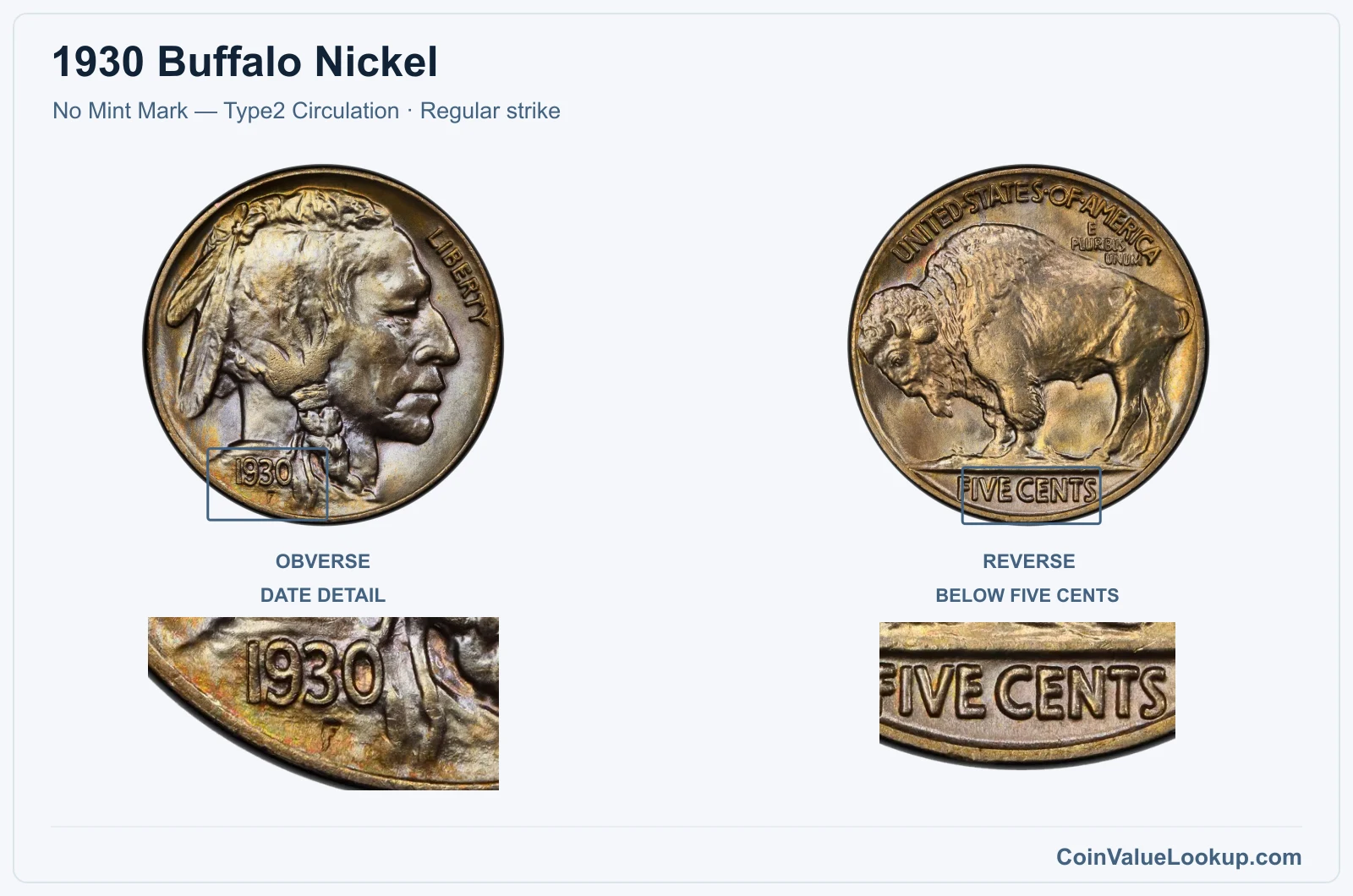
The 1930 Philadelphia Buffalo Nickel has no mintmark. Look at the reverse below FIVE CENTS; if the space is empty, this is your coin.
USA Coin Book guide estimates place it at roughly $1.56 in G4 and $92 in MS63. That MS63 figure assumes full original luster and minimal contact marks.
Most survivors are well-circulated, so finding one with strong detail on the braid and bison horn puts you ahead of the pack.
Coin Value Lookup is a handy starting point when you want to check values across different dates and denominations of Buffalo Nickels or other series.
Range Grade
Price Auction Records Appraisal PO PO 1
—
Coin Identifier FR FR 2
—
Coin Identifier AG AG 3
—
Coin Identifier G G 4
—
Coin Identifier
G 6
—
Coin Identifier VG VG 8
Coin Identifier
VG 10
—
Coin Identifier F F 12
—
Coin Identifier
F 15
—
Coin Identifier VF VF 20
—
Coin Identifier
VF 25
—
Coin Identifier
VF 30
Coin Identifier
VF 35
—
Coin Identifier XF XF 40
—
Coin Identifier
XF 45
—
Coin Identifier AU AU 50
Coin Identifier
AU 53
—
Coin Identifier
AU 55
Coin Identifier
AU 58
Coin Identifier MS MS 60
—
Coin Identifier
MS 61
—
Coin Identifier
MS 62
Coin Identifier
MS 63
Coin Identifier
MS 64
Coin Identifier
MS 65
Coin Identifier
MS 66
Coin Identifier
MS 67
Coin Identifier
MS 68
—
—
—
MS 69
—
—
—
MS 70
—
—
—
1930 Buffalo Nickel — S — Type2 Circulation
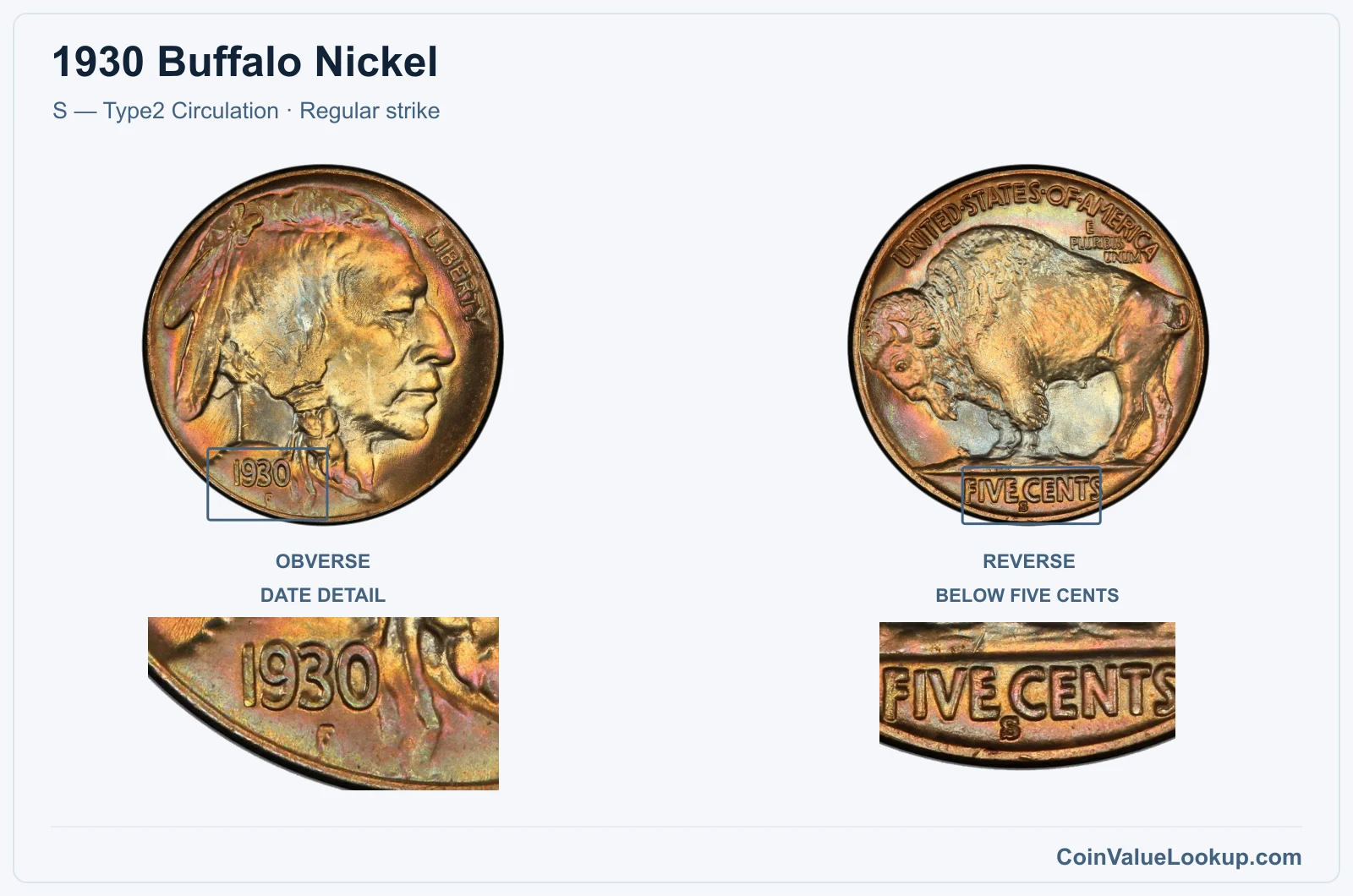
The 1930-S carries a small "S" mintmark on the reverse, sitting below FIVE CENTS. It is the scarcer of the two mints this year in higher grades, and guide estimates reflect that: $1.56 in G4 climbs to $148 in MS63 per USA Coin Book.
San Francisco strikes from this era are sometimes softly struck, so do not assume a weak horn means heavy wear. Check the surrounding fields for luster.
An original-skin MS63 example with sharp detail is a genuinely desirable coin. In lower grades, value tracks closely with the Philadelphia issue.
Range Grade
Price Auction Records Appraisal PO PO 1
—
Coin Identifier FR FR 2
—
Coin Identifier AG AG 3
—
Coin Identifier G G 4
—
Coin Identifier
G 6
—
Coin Identifier VG VG 8
—
Coin Identifier
VG 10
—
Coin Identifier F F 12
—
Coin Identifier
F 15
—
Coin Identifier VF VF 20
—
Coin Identifier
VF 25
—
Coin Identifier
VF 30
—
Coin Identifier
VF 35
Coin Identifier XF XF 40
Coin Identifier
XF 45
Coin Identifier AU AU 50
—
Coin Identifier
AU 53
—
Coin Identifier
AU 55
—
Coin Identifier
AU 58
Coin Identifier MS MS 60
—
Coin Identifier
MS 61
—
Coin Identifier
MS 62
Coin Identifier
MS 63
Coin Identifier
MS 64
Coin Identifier
MS 65
Coin Identifier
MS 66
Coin Identifier
MS 67
Coin Identifier
MS 68
—
—
—
MS 69
—
—
—
MS 70
—
—
—
1930 Buffalo Nickel Error List
1. 1930 Buffalo Nickel — Doubled Die Obverse
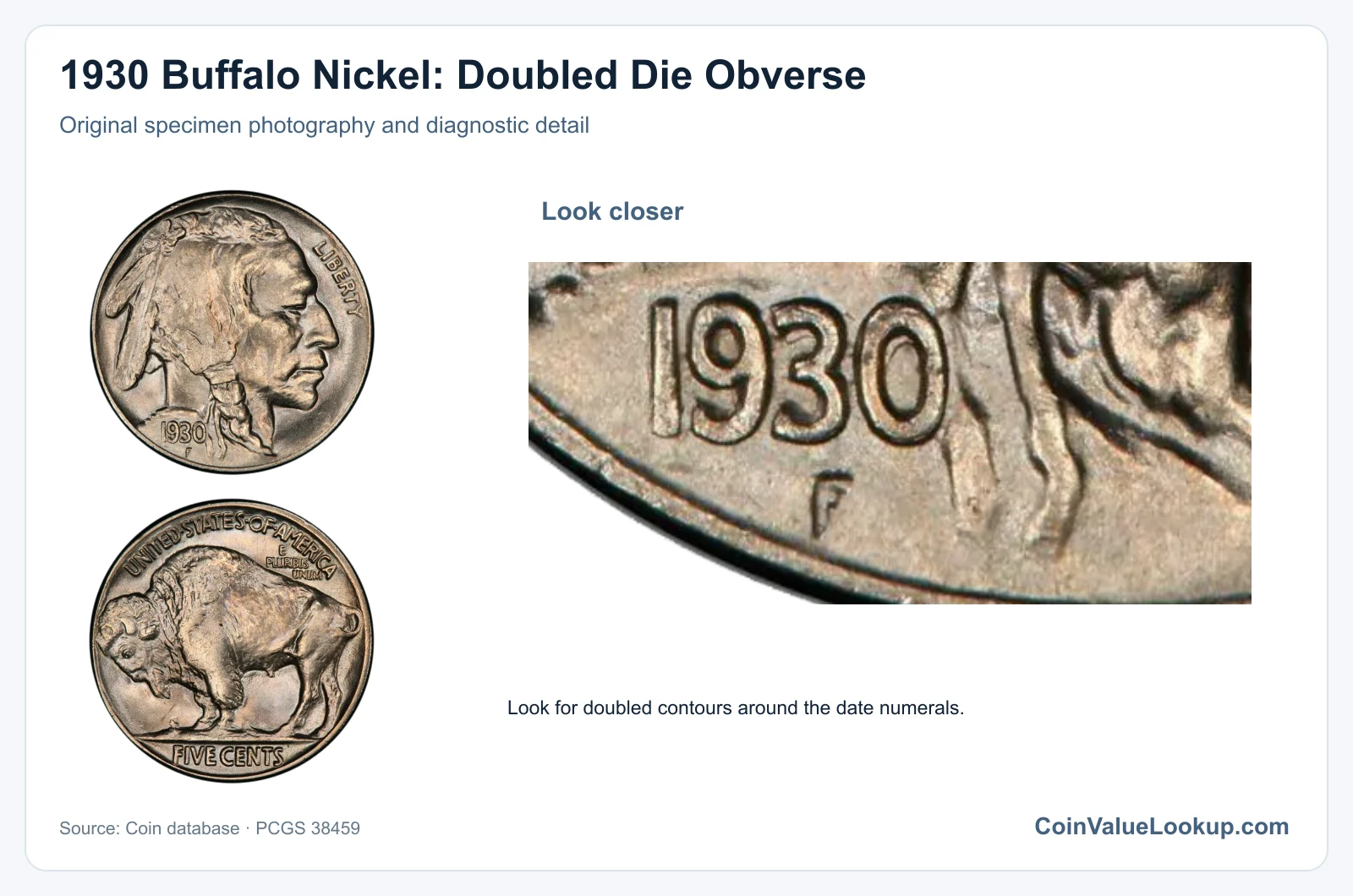
A Doubled Die Obverse on a 1930 Buffalo Nickel shows consistent doubling on obverse lettering or design elements. This has been reported for both the Philadelphia and San Francisco mints.
To check, compare the obverse inscriptions on your coin to a known normal example under the same lighting. Genuine hub doubling produces uniform separation or notching on affected letters, visible from multiple angles.
Do not confuse this with machine doubling, which tends to create a flat, shelf-like distortion rather than a rounded secondary image. Reflections or worn die contours can also mimic doubling at first glance.
Condition, the degree of visible doubling, and the specific die involved all affect what a doubled die example might bring, so individual assessment matters.
2. 1930 Buffalo Nickel — Two Feathers / Abraded Third Feather
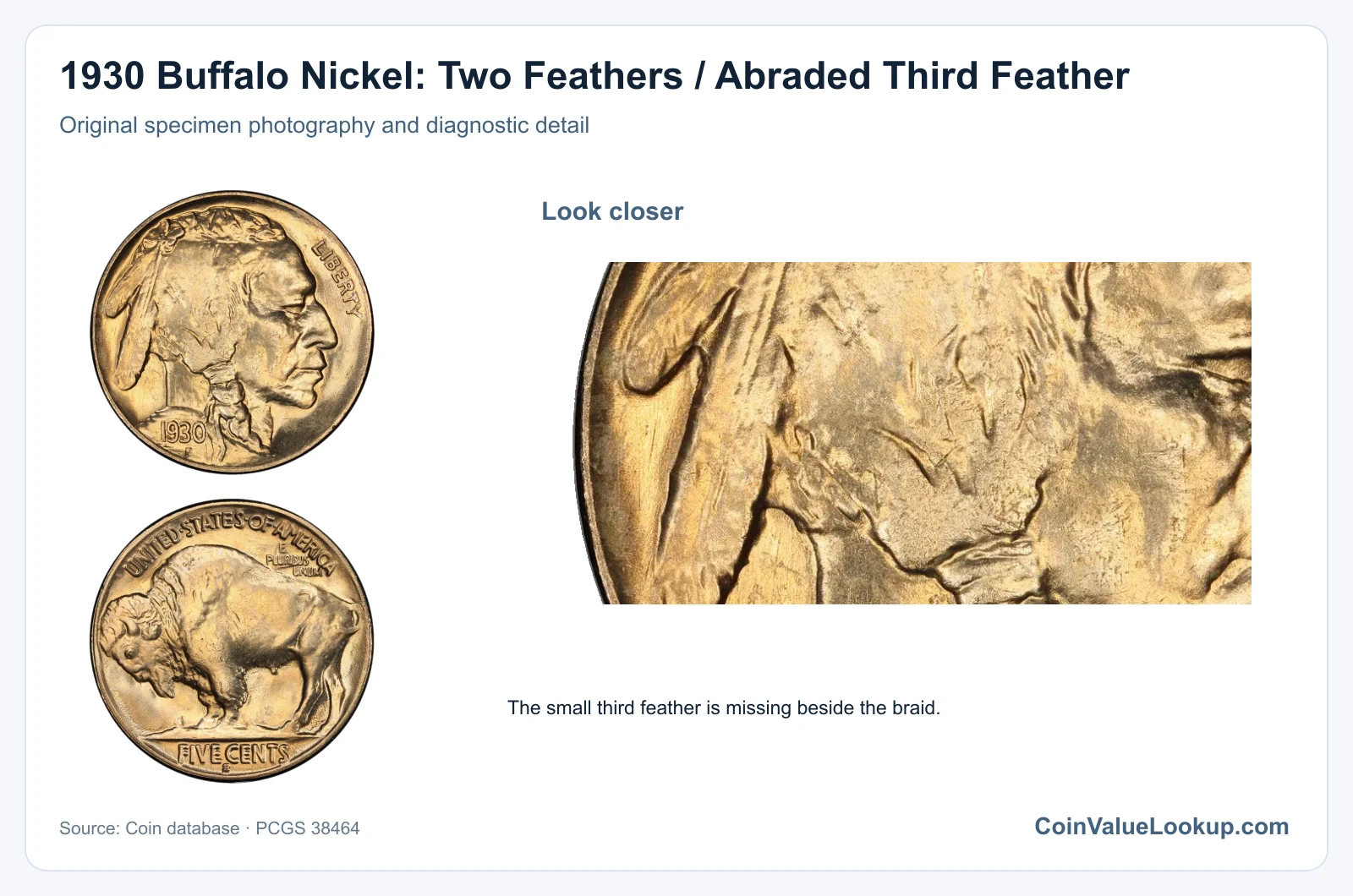
The Two Feathers variety is reported on the 1930-S Buffalo Nickel. Normally, the Native American portrait shows three feathers trailing from the hair.
On a two-feather coin, the third feather was abraded from the die, leaving it absent or showing only a faint remnant.
Compare the feather area on your coin to a normal three-feather example. Look closely near the neck for any ghost of the missing feather, which can help confirm die abrasion rather than simple wear.
Wear, weak strikes, grease-filled dies, and deliberate scraping can all reduce feather detail. The key difference is that die abrasion produces a consistent absence across every coin from that die, while wear patterns vary coin to coin.
Value depends on the clarity of the variety and overall condition.
3. 1930 Buffalo Nickel — Doubled Die Reverse
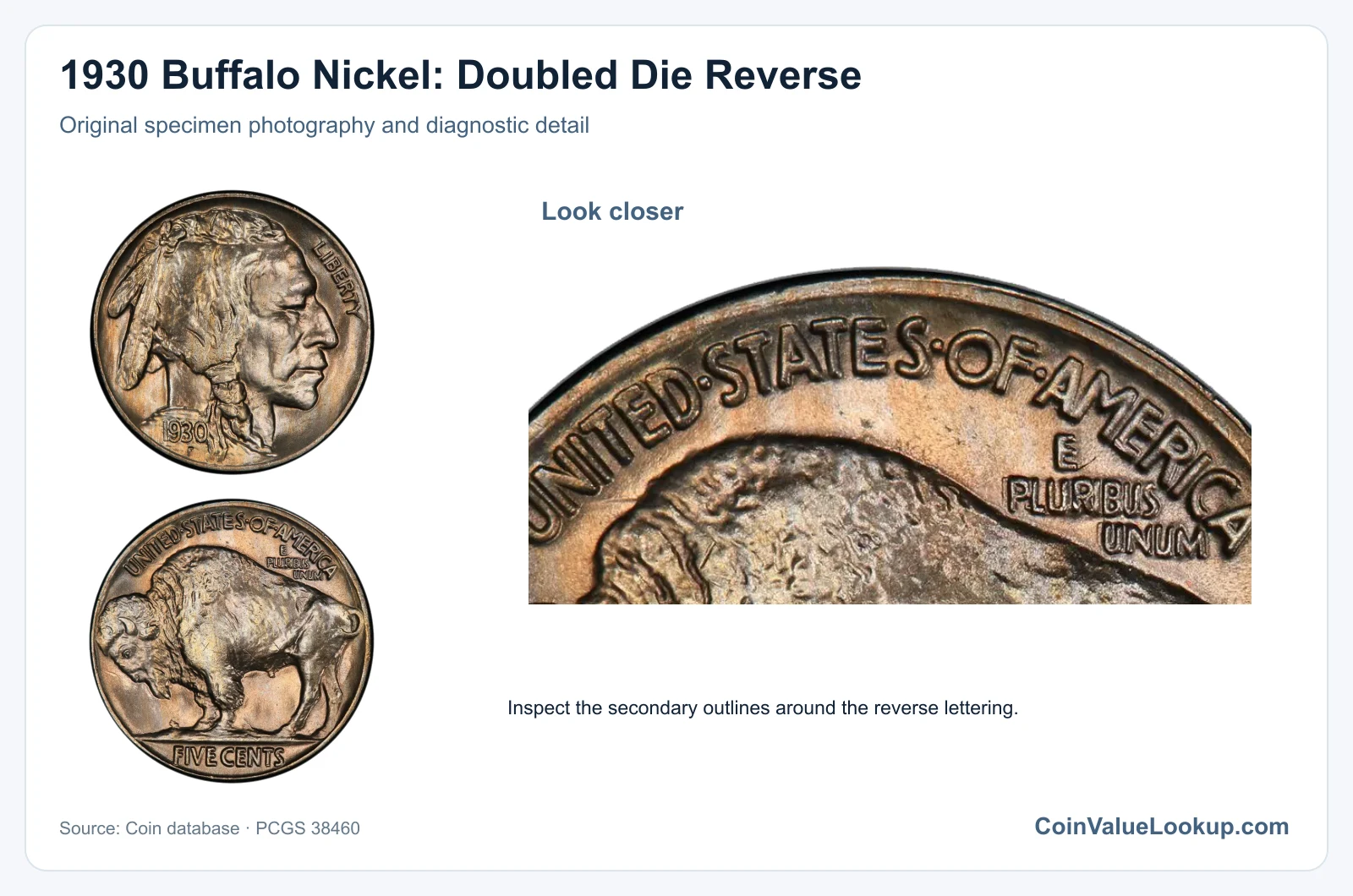
A Doubled Die Reverse on a 1930 nickel displays doubling on the reverse lettering or design contours. Check the FIVE CENTS denomination and UNITED STATES OF AMERICA inscription under magnification.
Genuine doubled die reverses show consistent, repeatable separation in the affected areas. If the doubling looks flat, shelf-like, or only appears on one side of the raised elements, machine doubling is the more likely culprit.
Random nicks and damage can also mimic doubling under certain light.
Compare your coin's reverse carefully to a normal example at the same magnification. The specific die, visibility of the doubling, and condition of the coin all play a role in determining value.
4. 1930 Buffalo Nickel — Repunched Mintmark
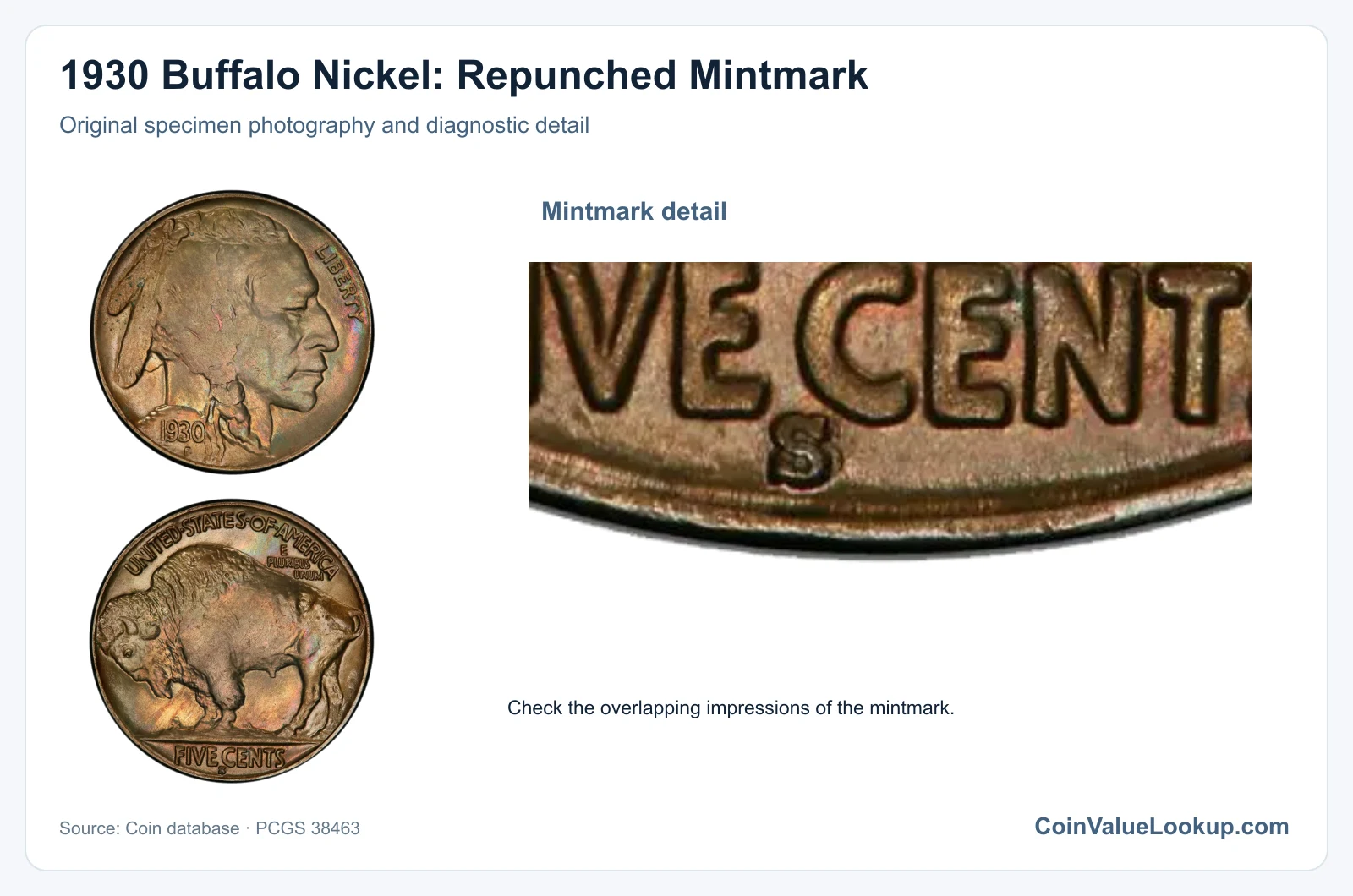
A Repunched Mintmark occurs when the mintmark punch was applied more than once in slightly different positions. On a 1930 nickel, look for traces of a second "S" partly visible beneath or beside the primary mintmark on the reverse.
You will need at least 5x magnification. Compare the mintmark to a known normal example at matching magnification.
A genuine repunched mintmark shows remnants of a separately positioned letter, not just a fuzzy outline.
Die chips on or near the mintmark, machine doubling, and corrosion can all create confusing shapes in that area. Value depends on how dramatic and clear the repunching is, plus the coin's overall condition.
5. 1930 Buffalo Nickel — Die Crack / Die Chip
Die cracks appear as thin raised lines on the coin's surface, caused by fractures in the steel die during production. Die chips are small raised blobs from pieces flaking off the die face.
On a 1930 Buffalo Nickel, look for raised lines that cross fields or design elements. They will feel slightly raised to a fingernail and remain visible from different angles.
Do not confuse die cracks with incuse scratches, which are recessed into the surface. Corrosion deposits and foreign material can also sit on the surface and look like raised features at a glance, but they lack the sharp, linear quality of a genuine die crack.
A crack that connects to the rim starts overlapping with die-break territory. Value varies with size, location, and coin condition.
6. 1930 Buffalo Nickel — Die Break / Cud
A cud is a major die break that connects to the rim, leaving a raised, featureless blob where part of the design should be. It happens when a chunk of the die literally breaks away.
On a 1930 nickel, look for a smooth, raised area along the rim that displaces normal design detail. The boundary between the cud and the remaining design is usually sharp and distinctive.
Rim dents from post-mint damage are recessed, not raised. Corrosion buildup can create lumpy areas but lacks the clean boundary of a cud.
Interior die chips that do not reach the rim are a related but separate category. The size and location of the cud, along with overall condition, determine how much interest it generates.
7. 1930 Buffalo Nickel — Lamination / Split Planchet
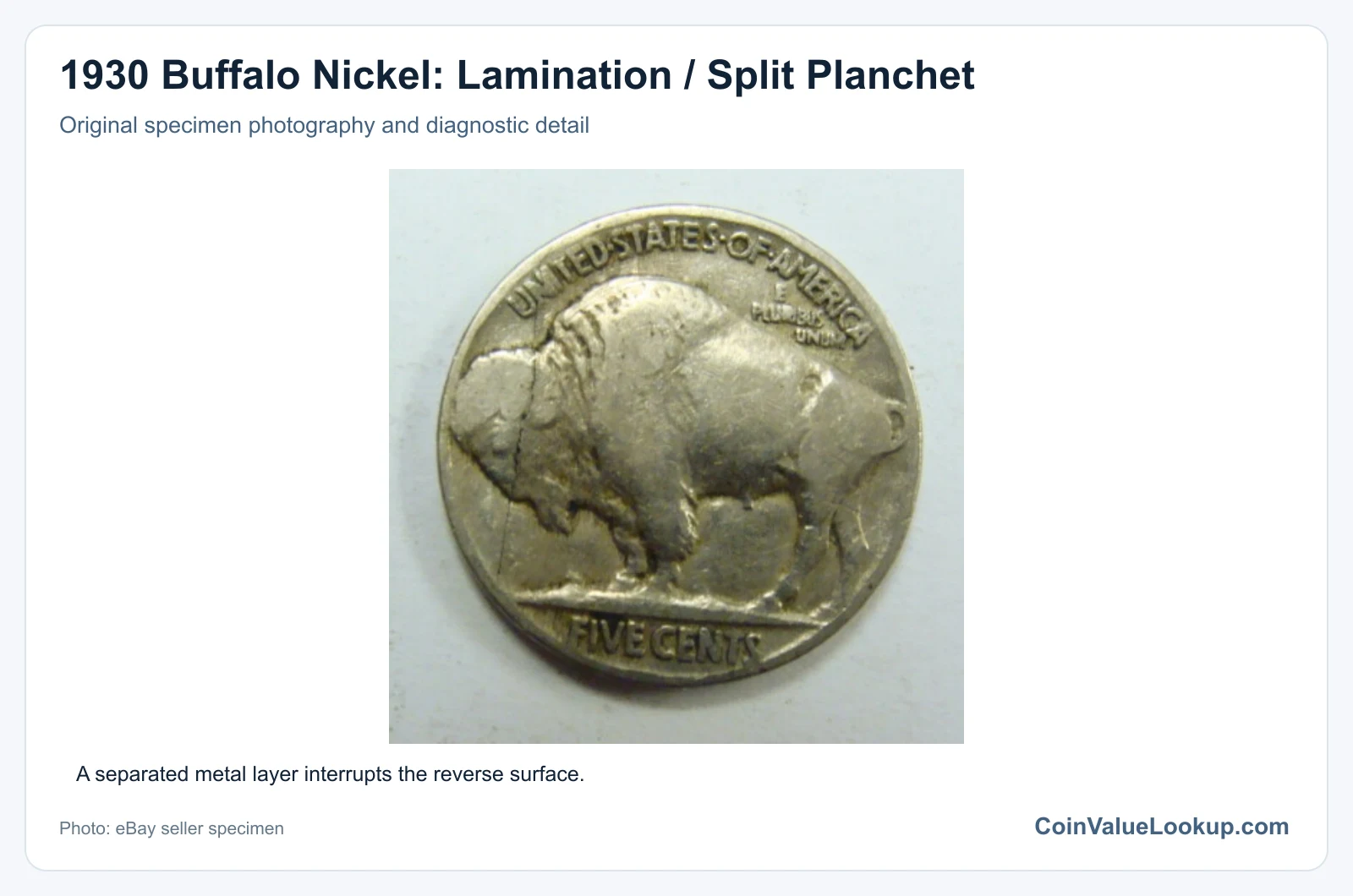
Lamination errors result from impurities or gas trapped in the metal before striking. The alloy separates into layers, producing peeling flaps, missing chunks, or visible cracks within the surface.
On a 1930 nickel, look for areas where the metal appears to lift away or where a thin layer has flaked off, exposing a rough surface beneath. Photograph the edge alongside the affected face for the clearest documentation.
Post-mint scraping, environmental corrosion, and deliberately cut or altered coins can look similar. Genuine laminations typically follow the contour of the planchet rather than showing tool marks or sharp, artificial edges.
The size of the affected area and the coin's overall condition determine collector interest.
8. 1930 Buffalo Nickel — Off-Center Strike
An off-center strike happens when the planchet is not properly seated between the dies. The result is a design shifted to one side, with an unstruck crescent of blank metal on the opposite edge.
For a 1930 Buffalo Nickel, the date needs to be visible for the error to have meaningful collector appeal. A slight 5% off-center may barely register; a 10–20% shift with a readable date is far more dramatic.
Do not confuse off-center strikes with clipped planchets, which show a curved bite from a different stage of production, or with one-sided misalignment, where both sides are struck but one is shifted relative to the other. Post-mint flattening from damage can also push the design around.
Condition and the degree of the shift both matter for value.