1973 Lincoln Penny Coin Value: How Much Is It Worth?
Most 1973 Lincoln pennies you pull from a jar are worth a cent, maybe two. In higher uncirculated grades the picture improves modestly — a USA Coin Book guide estimate places an ordinary MS65 example at about $1.24.
Where the real action lies is in correctly identified mint versions, original copper color and authenticated striking errors, which can push values well beyond pocket change.
Fast Way to Identify Your 1973 Lincoln Penny
Want a quick read on what you have? Upload clear photos of the front and back of your 1973 penny and our identifier will give you a preliminary look at the version and condition.
It is not a substitute for professional authentication, but it is a solid starting point before you dig deeper.
1973 Penny Value
Upload both sides of your 1973 Lincoln Penny.
Front Obverse
Upload photo
Back Reverse
Upload photo
Which 1973 Lincoln Penny Versions Are Worth Money?
- Authenticated S proof double strikes with both impressions off center have sold for thousands — one NGC PR65 Red brought $3,000 at auction in August 2020.
- A 1973-D cent confirmed struck on a clad dime blank sold for $432 in a PCGS MS63 holder in November 2020, because wrong-planchet errors are verifiable and collectible.
- Doubled die obverse, repunched mintmark, BIE die breaks and clipped planchets are all reported for 1973 cents — condition, visibility and authentication determine their individual value.
- High-grade business strikes with full original Red color in MS65 or above are the premium version of otherwise common coins; match both grade and color designation before comparing prices.
Step 1: Identify Your 1973 Lincoln Penny Mint Mark and Version
The 1973 Lincoln cent carries the familiar Lincoln portrait on the obverse and the Lincoln Memorial on the reverse. The alloy is 95% copper and 5% zinc with a nominal weight of 3.11 grams — these are not the copper-plated zinc cents that came later.
Start with the date. Make sure you are actually looking at 1973 and not a worn 1978 or 1975.
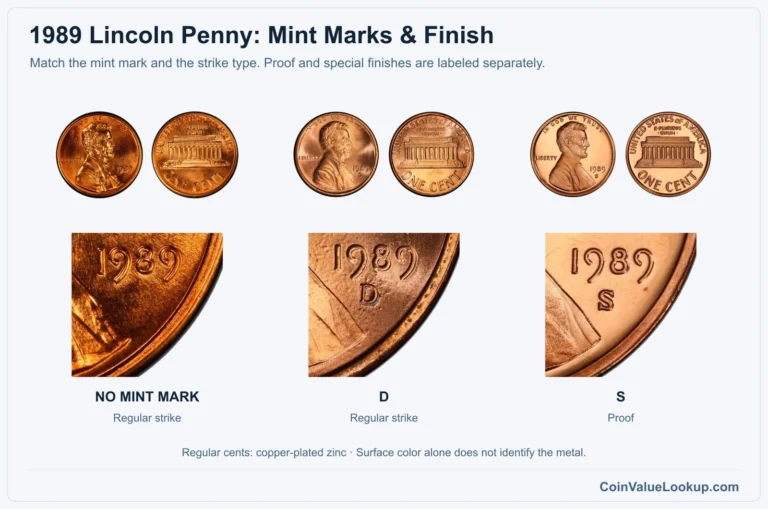
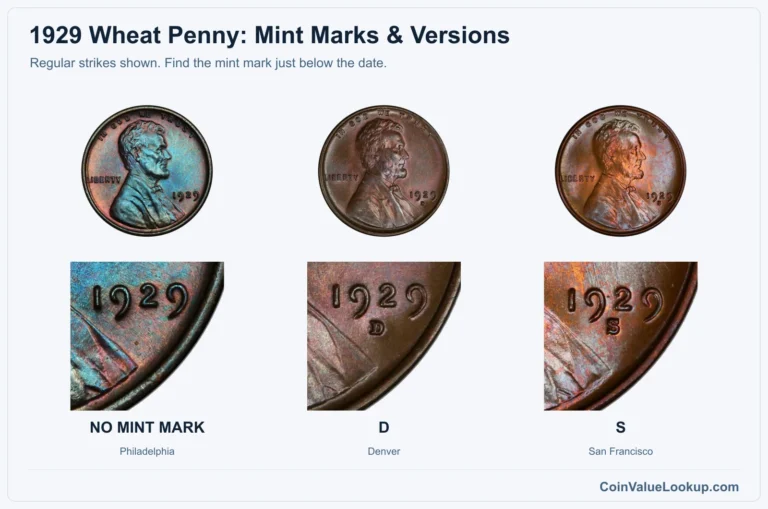
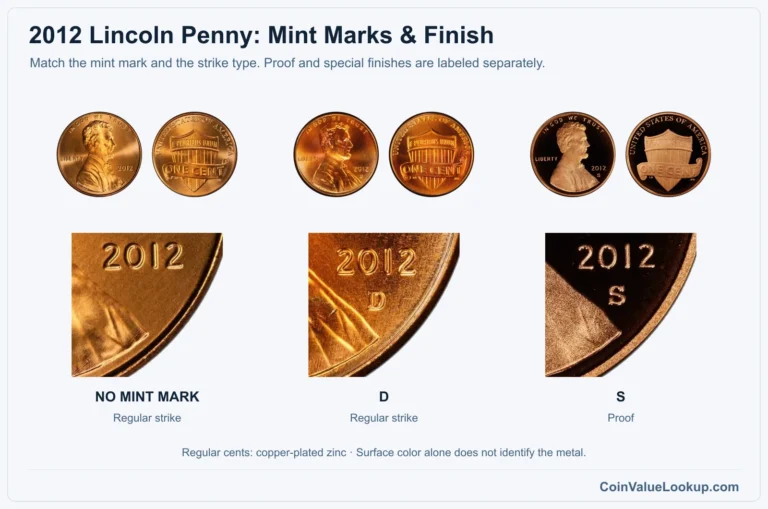
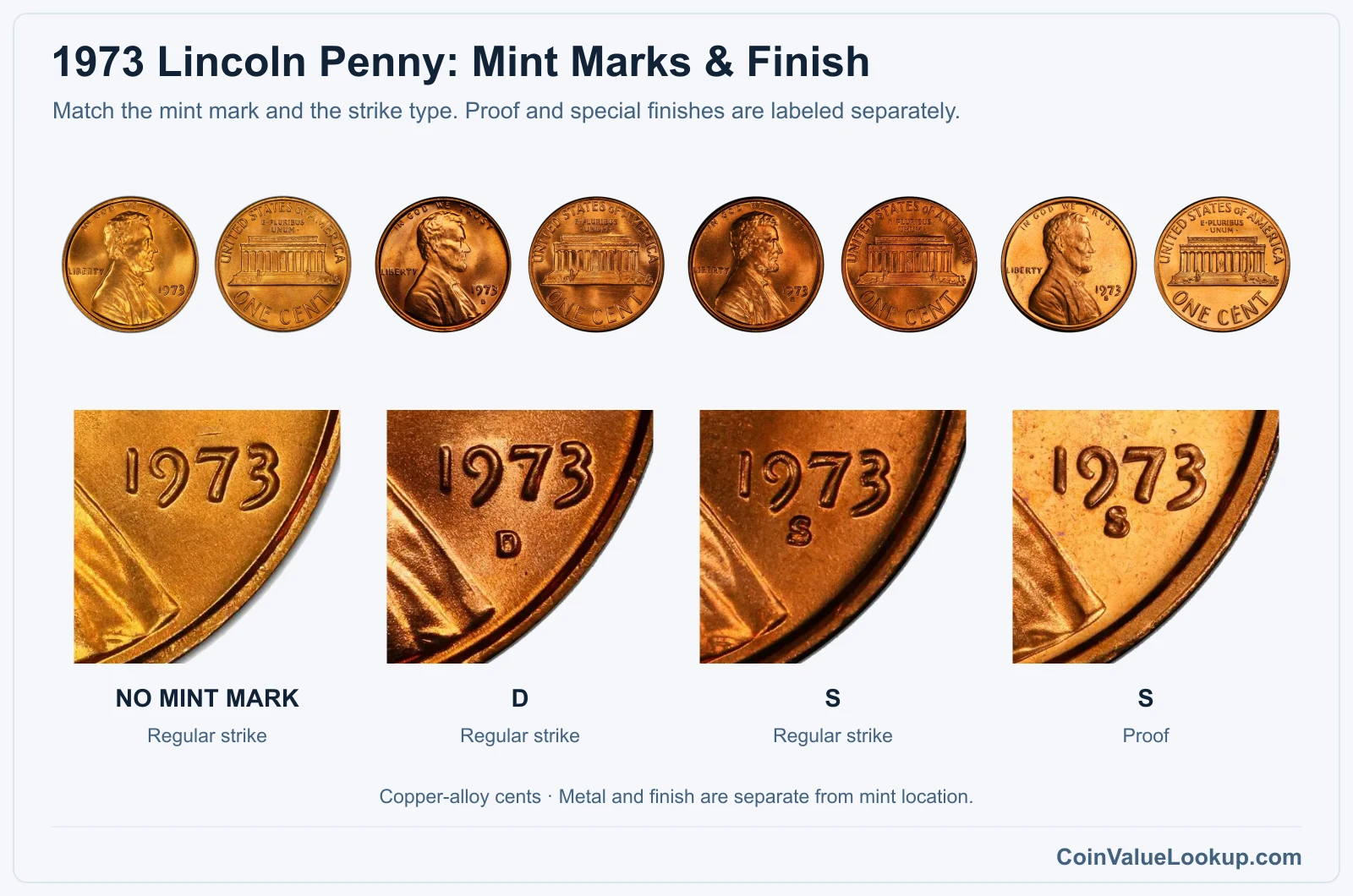
Next, check directly below the date for a mintmark letter. You will find either no letter at all, a small D, or a small S.
Coins with no letter are cataloged in the Philadelphia branch. D means Denver.
S can be either a business strike or a proof, and those are two entirely different animals.
S proofs were made for collectors with specially prepared dies and polished blanks. They have mirror-like fields and sharp details that a regular S business strike does not.
If you are not sure which you have, compare the surface texture: a proof will look reflective, almost glass-like, while a business strike will have a softer, satiny luster.
Copper color matters for pricing. Red means full original copper luster is preserved.
Red-Brown is partial. Brown means the surfaces have toned over.
These are color designations, not different alloys, and they do not by themselves tell you the grade.
Be careful with coins that look suspiciously bright — they may have been chemically cleaned, which is not the same as original Red. And an altered or plated coin is not automatically an error.
Step 2: Check Your 1973 Lincoln Penny Grade
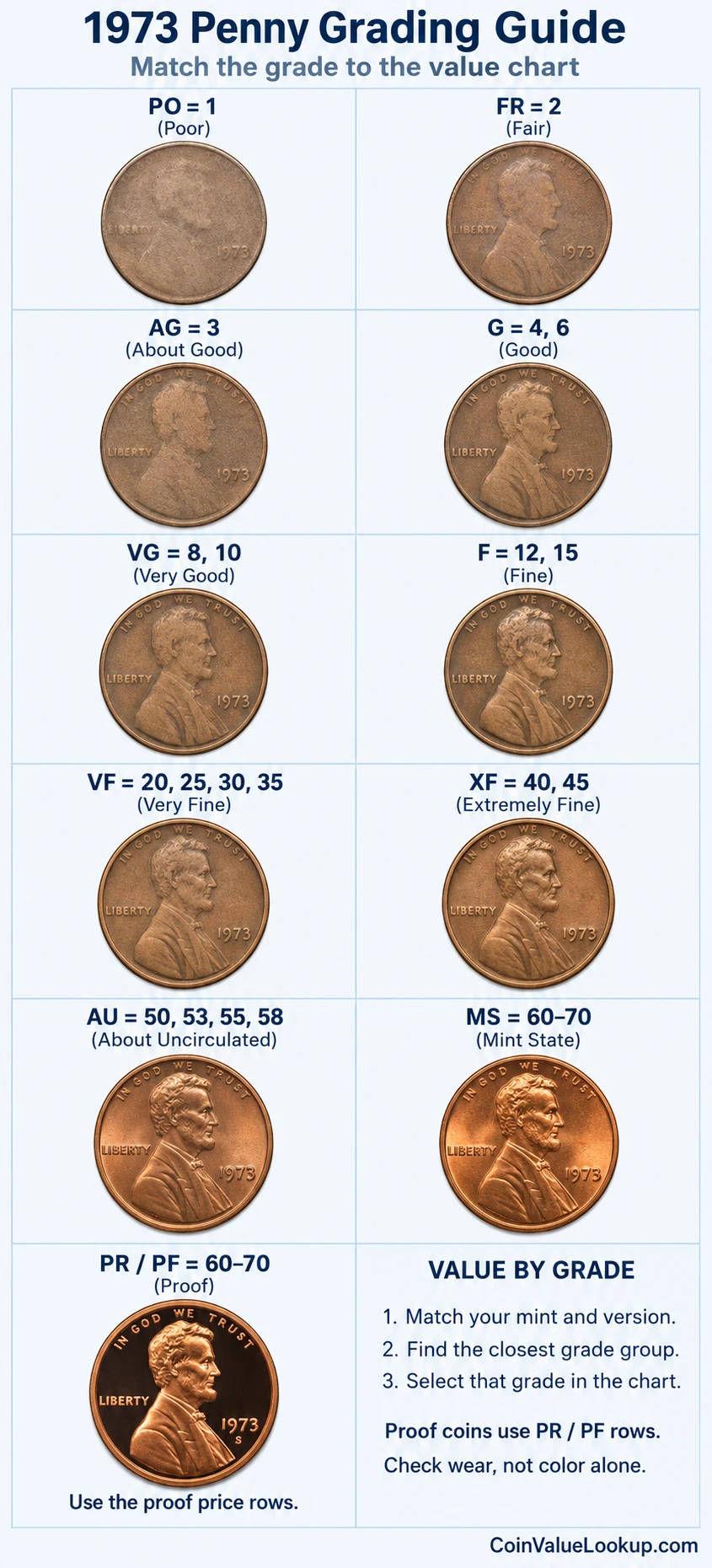
To grade a 1973 penny, start on the obverse. Lincoln's cheek, jawline and the hair detail directly above his ear are the first places to lose definition from circulation wear.
Even light rub on the cheekbone drops the coin below uncirculated.
Flip the coin over. The Memorial roof and the tops of the columns wear next.
If those areas are flat but the rest looks sharp, you are probably in the AU range.
Separate contact marks from actual wear. A coin can have bag marks from jostling against other cents at the mint and still be technically uncirculated.
Remaining luster is your friend here — if the original mint sheen is intact, those dings are contact marks, not wear.
Dark brown copper can be fully uncirculated. A bright penny can be cleaned.
Color alone does not decide grade.
Use the comparison image to match your coin's wear pattern against known grade examples. For proofs, look for hairlines across the mirror fields; even light ones can meaningfully reduce the grade and value.
Step 3: Check 1973 Lincoln Penny Value by Mint and Version
1973 Lincoln Penny — No Mint Mark — Business
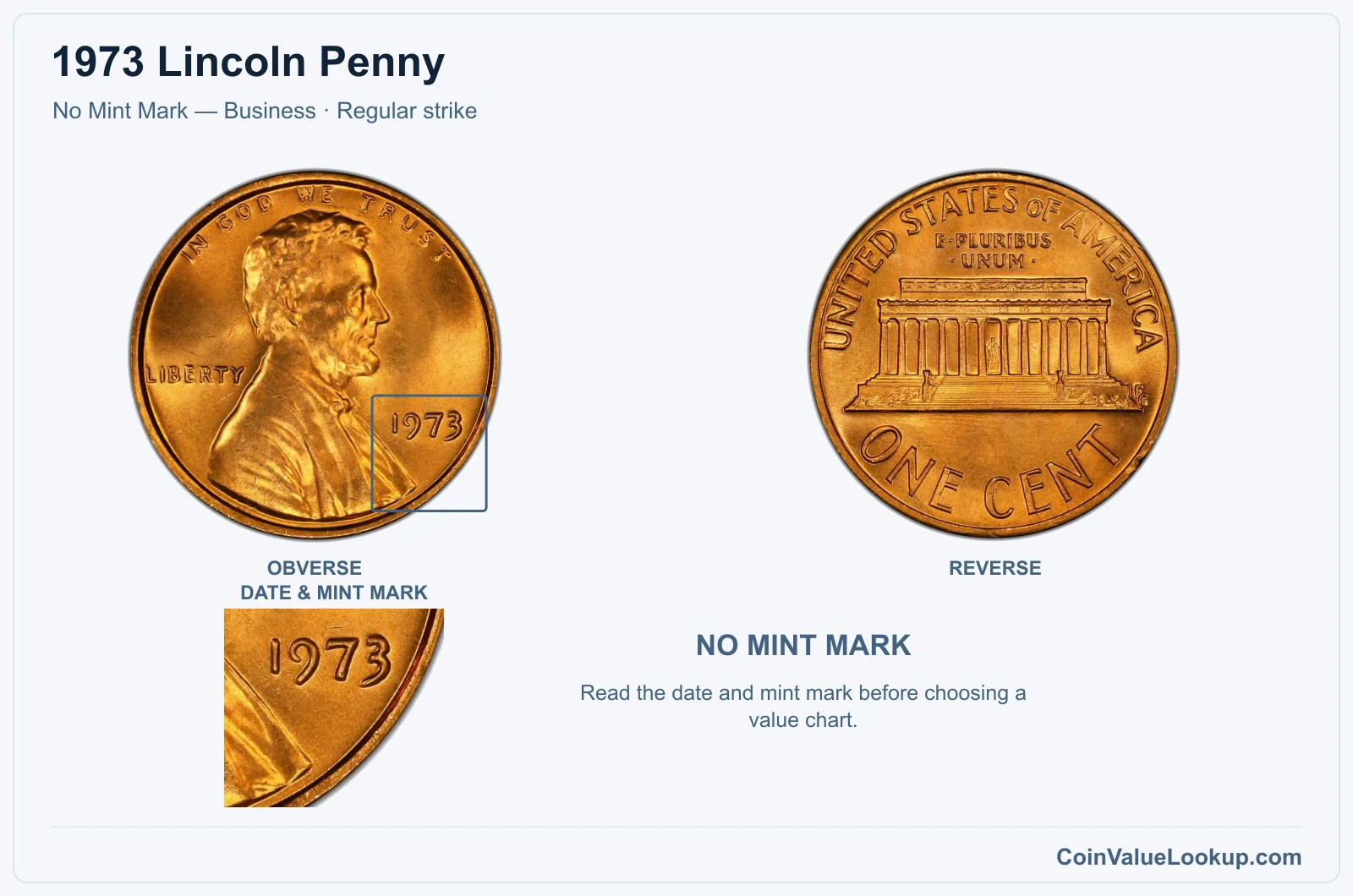
The no-mintmark 1973 penny is the Philadelphia branch and was produced in large numbers for general circulation. These are the coins most likely sitting in your change jar right now.
In typical circulated condition they are worth face value. A USA Coin Book guide estimate puts an MS65 example at around $1.24, but reaching that grade with original Red color intact is harder than it sounds after fifty years of storage.
Match both the grade and the copper-color designation — BN, RB or RD — before comparing your coin to any published estimate. A brown MS65 and a red MS65 are not the same price point.
Range Grade
Price1973 No Mint Mark — Business (BN) Price1973 No Mint Mark — Business (RB) Price1973 No Mint Mark — Business (RD) Auction Records Appraisal PO PO 1
—
Coin Identifier FR FR 2
—
Coin Identifier AG AG 3
—
Coin Identifier G G 4
—
Coin Identifier
G 6
—
Coin Identifier VG VG 8
—
Coin Identifier
VG 10
—
Coin Identifier F F 12
—
Coin Identifier
F 15
—
Coin Identifier VF VF 20
—
Coin Identifier
VF 25
—
Coin Identifier
VF 30
—
Coin Identifier
VF 35
—
Coin Identifier XF XF 40
—
Coin Identifier
XF 45
—
Coin Identifier AU AU 50
—
—
Coin Identifier
AU 53
—
Coin Identifier
AU 55
—
Coin Identifier
AU 58
—
Coin Identifier MS MS 60
—
—
Coin Identifier
MS 61
—
—
Coin Identifier
MS 62
—
Coin Identifier
MS 63
—
Coin Identifier
MS 64
—
Coin Identifier
MS 65
Coin Identifier
MS 66
—
Coin Identifier
MS 67
—
—
Coin Identifier
MS 68
—
—
—
—
—
MS 69
—
—
—
—
—
MS 70
—
—
—
—
—
1973 Lincoln Penny — D — Business
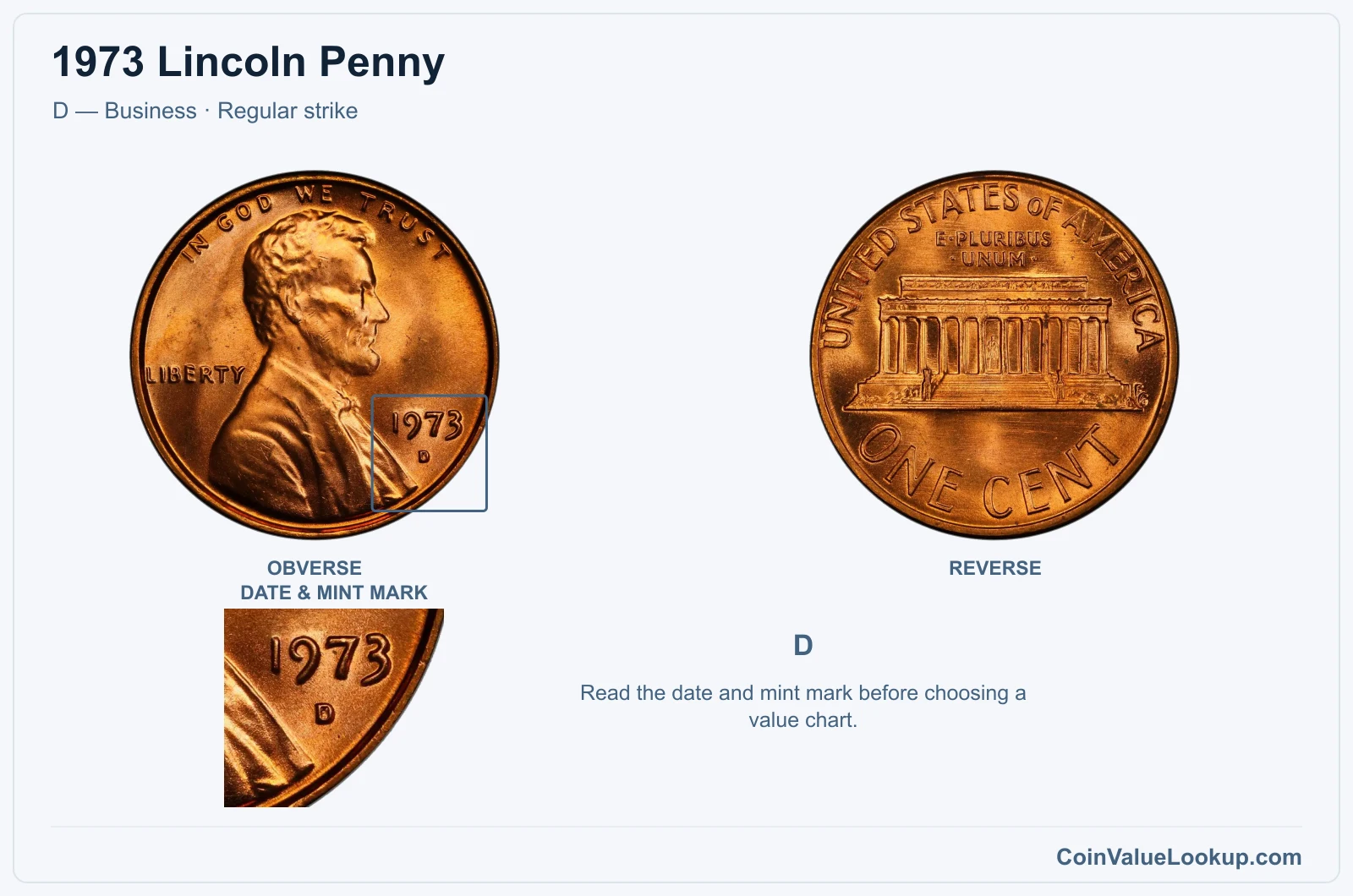
The 1973-D penny was struck at the Denver Mint, identified by the small D below the date. Like the Philadelphia issue, these were made in huge quantities.
A USA Coin Book guide estimate for an MS65 is $1.24. Circulated examples remain common and worth a cent.
What sets a D apart for error collectors is that several known error types — including wrong-planchet strikes and major die breaks — have been confirmed from Denver production runs.
As always, confirm the mintmark is genuinely part of the die impression, not added or altered after the fact.
Range Grade
Price1973 D — Business (BN) Price1973 D — Business (RB) Price1973 D — Business (RD) Auction Records Appraisal PO PO 1
—
Coin Identifier FR FR 2
—
Coin Identifier AG AG 3
—
Coin Identifier G G 4
—
Coin Identifier
G 6
—
Coin Identifier VG VG 8
—
Coin Identifier
VG 10
—
Coin Identifier F F 12
—
Coin Identifier
F 15
—
Coin Identifier VF VF 20
—
Coin Identifier
VF 25
—
Coin Identifier
VF 30
—
Coin Identifier
VF 35
—
Coin Identifier XF XF 40
—
Coin Identifier
XF 45
—
Coin Identifier AU AU 50
—
Coin Identifier
AU 53
—
Coin Identifier
AU 55
—
Coin Identifier
AU 58
—
Coin Identifier MS MS 60
—
Coin Identifier
MS 61
—
—
Coin Identifier
MS 62
—
Coin Identifier
MS 63
—
Coin Identifier
MS 64
—
Coin Identifier
MS 65
Coin Identifier
MS 66
—
Coin Identifier
MS 67
—
Coin Identifier
MS 68
—
—
—
—
—
MS 69
—
—
—
—
—
MS 70
—
—
—
—
—
1973 Lincoln Penny — S — Business
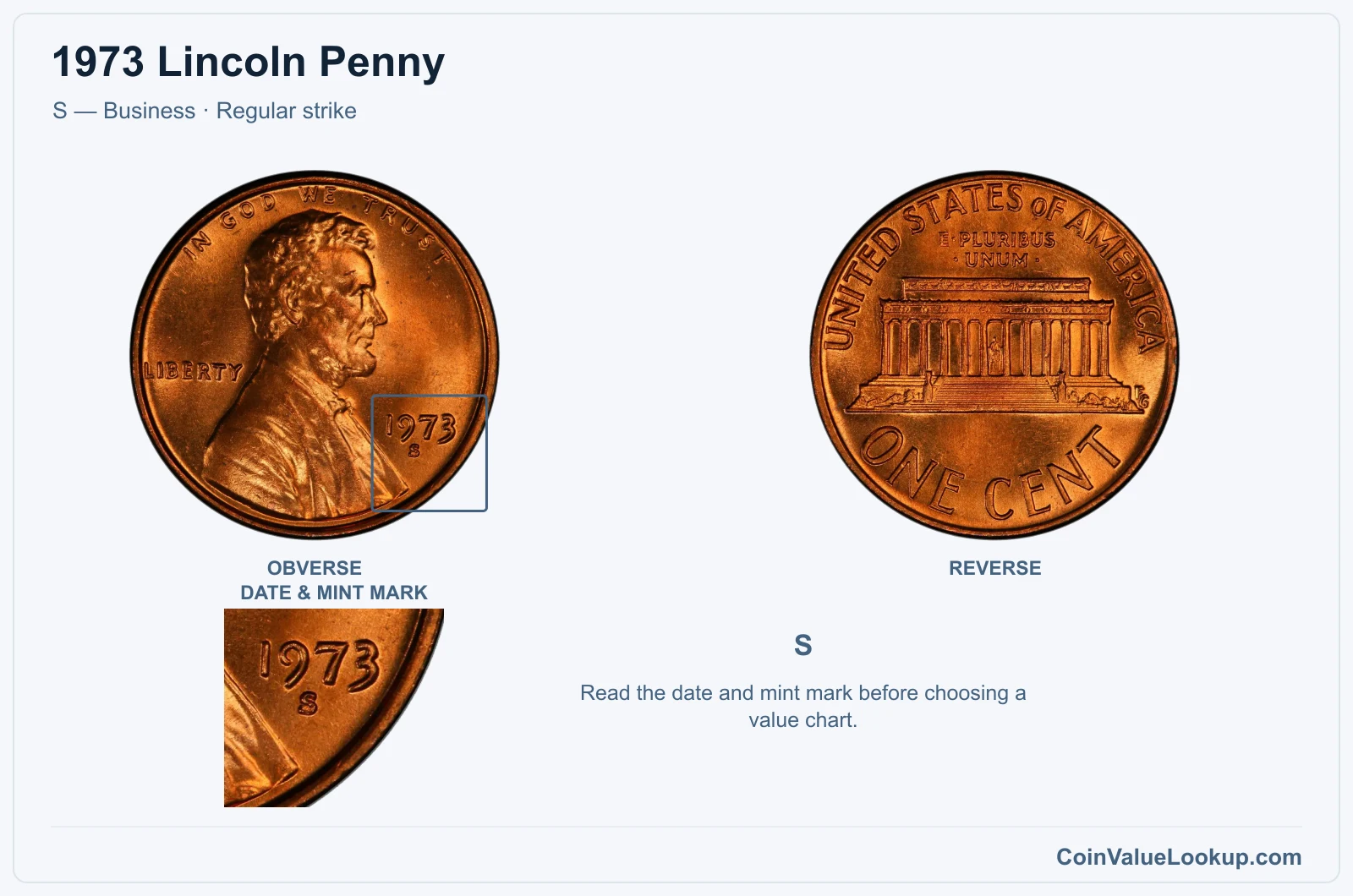
The 1973-S business strike is the San Francisco circulation issue, marked by a small S below the date. Do not confuse it with the S proof — they share a mintmark but differ in surface finish and manufacturing process.
A business-strike S cent has a normal satiny luster, not the mirror-like fields of a proof. The USA Coin Book guide estimate for MS65 is $1.24.
In circulated grades these are worth face value.
Coin Value Lookup is a good place to look up other Lincoln cent years and compare values across different mints and conditions.
Original copper color is the key differentiator at upper grades. A fully Red example at MS65 or higher is worth more attention than a toned Brown piece at the same technical grade.
Range Grade
Price1973 S — Business (BN) Price1973 S — Business (RB) Price1973 S — Business (RD) Auction Records Appraisal PO PO 1
—
Coin Identifier FR FR 2
—
Coin Identifier AG AG 3
—
Coin Identifier G G 4
—
Coin Identifier
G 6
—
Coin Identifier VG VG 8
—
Coin Identifier
VG 10
—
Coin Identifier F F 12
—
Coin Identifier
F 15
—
Coin Identifier VF VF 20
—
Coin Identifier
VF 25
—
Coin Identifier
VF 30
—
Coin Identifier
VF 35
—
Coin Identifier XF XF 40
—
Coin Identifier
XF 45
—
Coin Identifier AU AU 50
—
Coin Identifier
AU 53
—
Coin Identifier
AU 55
—
Coin Identifier
AU 58
—
Coin Identifier MS MS 60
—
—
Coin Identifier
MS 61
—
—
Coin Identifier
MS 62
—
Coin Identifier
MS 63
Coin Identifier
MS 64
Coin Identifier
MS 65
—
Coin Identifier
MS 66
—
Coin Identifier
MS 67
—
—
Coin Identifier
MS 68
—
—
—
—
—
MS 69
—
—
—
—
—
MS 70
—
—
—
—
—
1973 Lincoln Penny — S — Proof
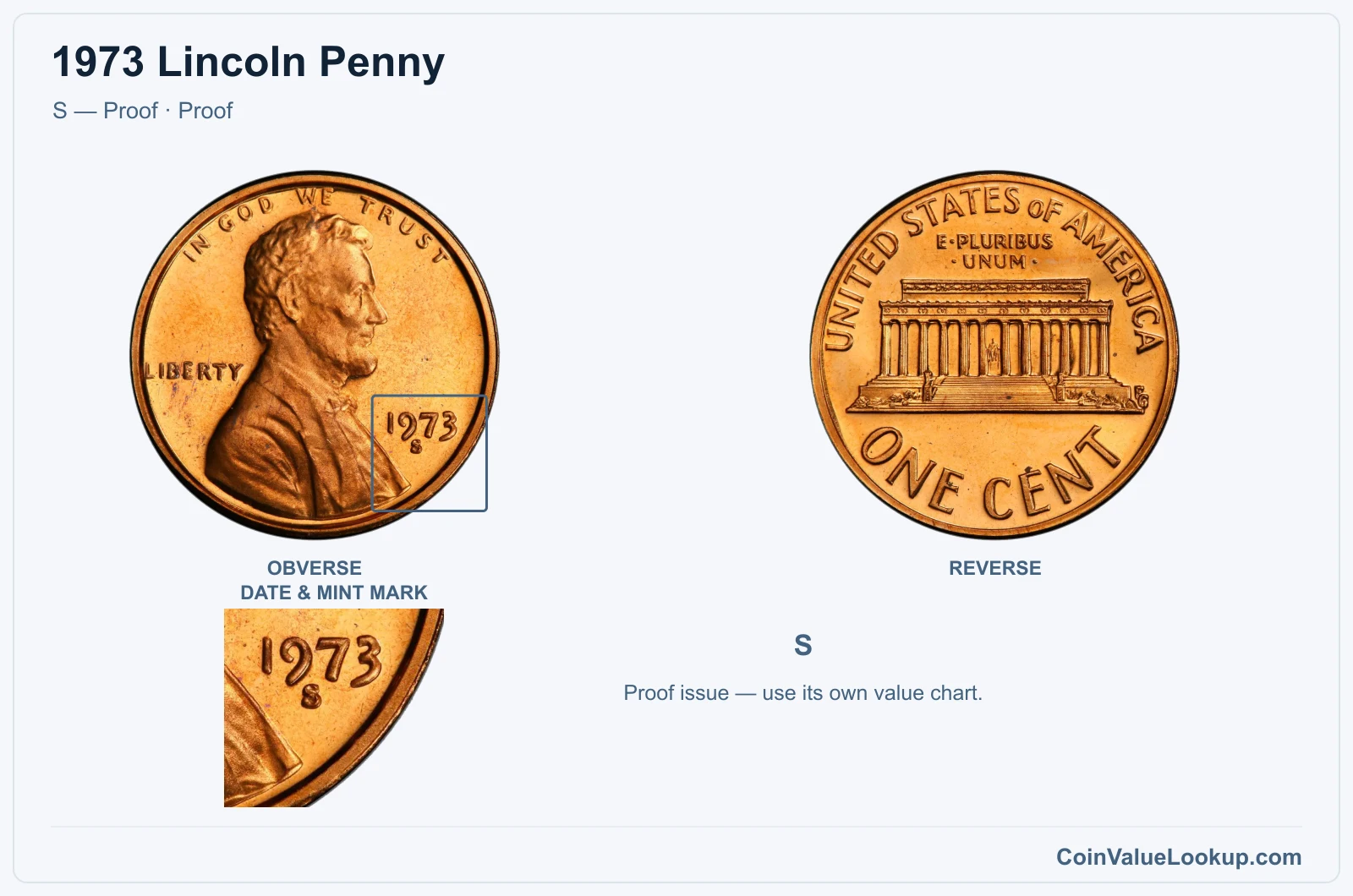
The 1973-S proof penny was struck at the San Francisco Mint on polished blanks using specially prepared dies. The fields should be deeply reflective, and the devices sharply struck with squared-off edges.
A USA Coin Book guide estimate for PR65 is $1.24. Cameo contrast — frosted devices against mirror fields — and color designation are separate factors that affect collector interest.
Hairlines are the enemy of proof grades. Even faint wipes across those mirror surfaces lower the grade.
Handle proofs only by the edges, ideally still in their original government packaging.
The most dramatic known error from this proof run is a double strike with both impressions off center, which is an entirely different category of collectible.
Range Grade
Price1973 S — Proof (CAM) Price1973 S — Proof (DCAM) Auction Records Appraisal PR PR 1
—
Coin Identifier
PR 2
—
Coin Identifier
PR 3
—
Coin Identifier
PR 4
—
Coin Identifier
PR 6
—
Coin Identifier
PR 8
—
Coin Identifier
PR 10
—
Coin Identifier
PR 12
—
Coin Identifier
PR 15
—
Coin Identifier
PR 20
—
Coin Identifier
PR 25
—
Coin Identifier
PR 30
—
Coin Identifier
PR 35
—
Coin Identifier
PR 40
—
Coin Identifier
PR 45
—
Coin Identifier
PR 50
—
Coin Identifier
PR 53
—
Coin Identifier
PR 55
—
Coin Identifier
PR 58
—
Coin Identifier
PR 60
—
Coin Identifier
PR 61
—
Coin Identifier
PR 62
—
Coin Identifier
PR 63
—
Coin Identifier
PR 64
—
Coin Identifier
PR 65
Coin Identifier
PR 66
Coin Identifier
PR 67
Coin Identifier
PR 68
Coin Identifier
PR 69
Coin Identifier
PR 70
—
Coin Identifier
1973 Lincoln Penny Error List
1. 1973 Lincoln Penny — Proof Double Strike, Both Off Center
This is the headline error for 1973 cents. A proof double strike means the coin was struck twice under the proof dies, with each impression landing off center — roughly 50% and 25% off, respectively.
The result is two overlapping design impressions on a single planchet, creating a visually dramatic coin.
Because the strikes were off center, the S mintmark may not appear in the struck area. Attribution to San Francisco comes from the proof manufacturing process itself.
An NGC PR65 Red example sold for $3,000 at auction in August 2020. That is a single recorded sale, not a guaranteed market range.
Do not confuse this with an ordinary proof that shifted slightly in the collar. A true double strike shows two fully distinct design impressions.
Authentication by a major grading service is essential for a coin like this.
2. 1973 Lincoln Penny — Off-Center Strike
A 1973 no-mintmark cent struck approximately 90% off center is a known specimen graded ANACS MS63 Red-Brown. On this coin, only a small sliver of the design appears on an otherwise blank planchet.
Date visibility is crucial. An off-center strike that still shows the date and enough design to attribute the year is far more collectible than an anonymous blank crescent.
The more off center a coin is while retaining its date, the more desirable it becomes.
No broad price range is adopted for this category — each piece depends on the exact percentage of offset, date visibility, condition and authentication.
Watch out for undated blank discs or coins that have been deliberately cut or ground. A genuine off-center strike will show natural metal flow and a consistent unstruck area with the original planchet edge intact.
3. 1973 Lincoln Penny — Struck on a Clad Dime Blank
A 1973-D cent struck on a clad dime planchet is a confirmed wrong-planchet error. The cent dies impressed their design onto a smaller, lighter dime blank, leaving the peripheral design stretched or incomplete because the planchet could not fill the full cent-sized die cavity.
A PCGS MS63 example sold for $432 at Heritage Auctions in November 2020. That is one authenticated sale, not a standing price.
To identify this error, check the coin's diameter, thickness and weight — it will be noticeably smaller and lighter than a normal cent. The alloy will differ as well, since dime blanks are clad rather than the 95% copper composition of a 1973 cent.
Do not mistake a plated cent or a worn, undersized copper cent for this error. Third-party authentication and a weight/alloy check are the only reliable confirmation.
4. 1973 Lincoln Penny — Major Die Break
A 1973-D cent with a major die break is known in an ANACS MS63 Red-Brown holder. A major die break occurs when a section of the die physically cracks and fails, producing a raised, irregular feature on the struck coin where normal design should appear.
The shape and location of the break vary by specimen. Some connect to the rim, others do not.
Examine your coin's raised anomaly closely — it should be part of the metal flow from striking, not something added afterward.
No broad price range is adopted here. Value depends on the size, location and visual impact of the break, plus the coin's overall condition.
Lookalikes include solder blobs, post-mint dents and adhesive residue. A genuine die break has a characteristic raised, slightly rough texture that was impressed during the strike, and it will appear consistently across multiple coins from the same die.
5. 1973 Lincoln Penny — Doubled Die Obverse
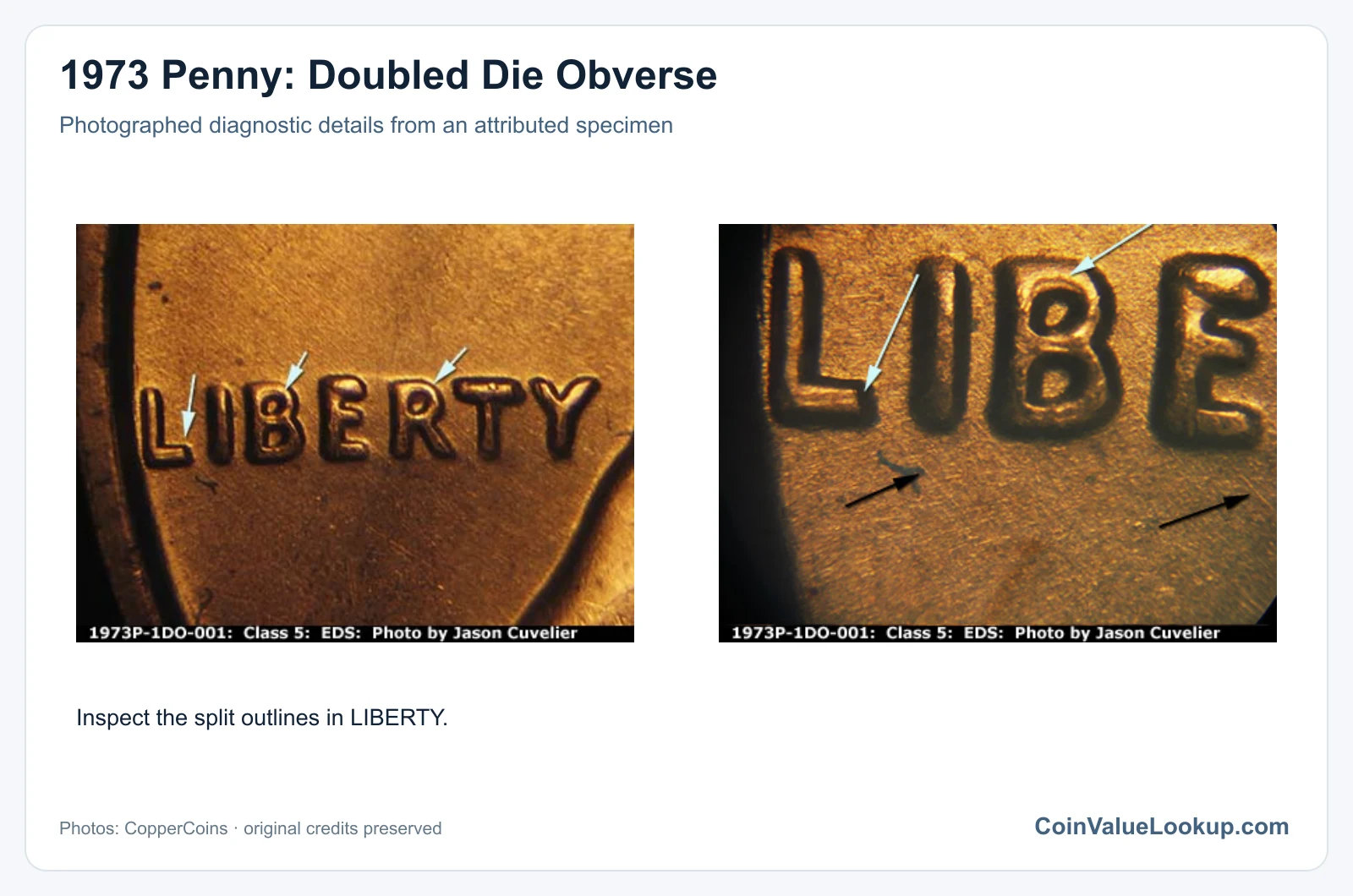
A doubled die obverse has been reported for 1973 Lincoln cents. This error occurs when misalignment during die production causes a second, slightly offset impression of the design to be hubbed into the working die.
Every coin struck from that die inherits the doubling.
Look at the obverse lettering — LIBERTY, IN GOD WE TRUST and the date — under magnification. Genuine doubling shows consistent separation or notching on the affected elements, visible as a shelf or secondary outline that appears the same on every specimen from that die.
Machine doubling is the common lookalike and it is far less valuable. It produces a flat, shelf-like displacement rather than the rounded, separated profiles of a true doubled die.
Worn die contours and lighting reflections can also mimic doubling to the untrained eye.
No specific price range is adopted. Value depends on the visibility of the doubling, the coin's condition and professional authentication.
6. 1973 Lincoln Penny — Repunched Mintmark
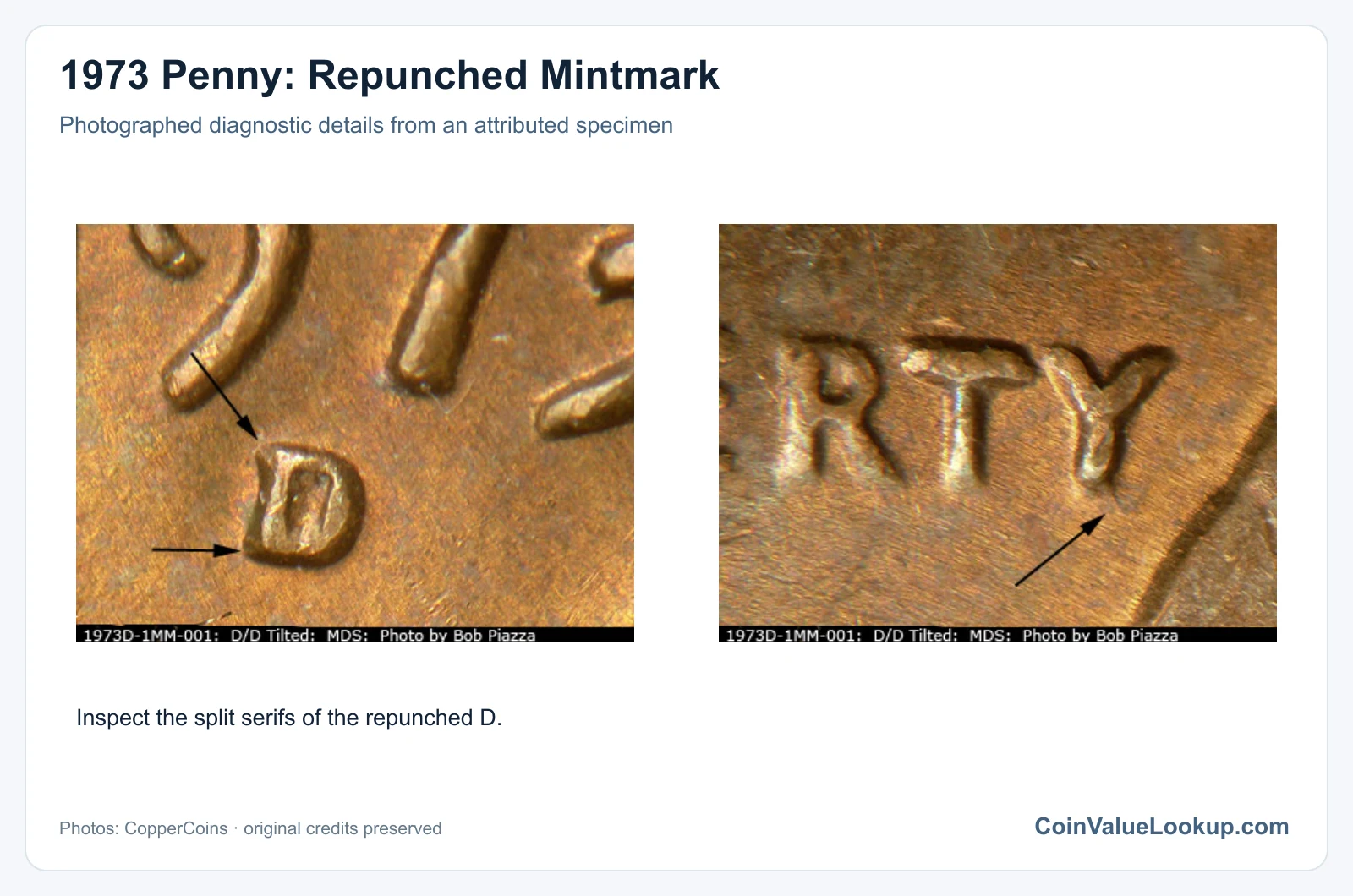
A repunched mintmark has been reported on 1973 cents. This error happened when the mintmark punch was applied to the working die more than once in slightly different positions, leaving traces of the earlier placement visible on every coin struck from that die.
Inspect the mintmark closely under magnification. You are looking for remnants of a second letter partially visible beside, above or below the primary mintmark.
The extra impression will have the same shape and style as the main letter because it came from the same punch.
Do not confuse this with machine doubling of the mintmark, a small die chip sitting near the letter, or simple corrosion that has roughened the area. Genuine repunching shows a distinct second outline of the letter itself.
No specific price range is adopted. The value of any repunched mintmark depends on its visibility, the coin's overall condition and whether the attribution has been confirmed by a grading service.
7. 1973 Lincoln Penny — BIE Die Break
A BIE die break has been reported for 1973 cents. The name comes from a small raised vertical line or blob that appears between the letters B and E in LIBERTY, caused by a tiny crack in the die surface filling with metal during striking.
To check for this, look at LIBERTY under magnification and focus on the space between B and E. A genuine BIE break is raised above the field surface — it is part of the struck coin, not scratched in or deposited on top.
Lookalikes include dirt trapped in that gap, a fine scratch, or a bit of foreign material stuck to the surface. A real die break will have the same metal tone and texture as the surrounding coin and cannot be scraped off.
No specific price range is adopted for this error. Individual value depends on the size and clarity of the break, the coin's grade and its authentication.
8. 1973 Lincoln Penny — Clipped Planchet
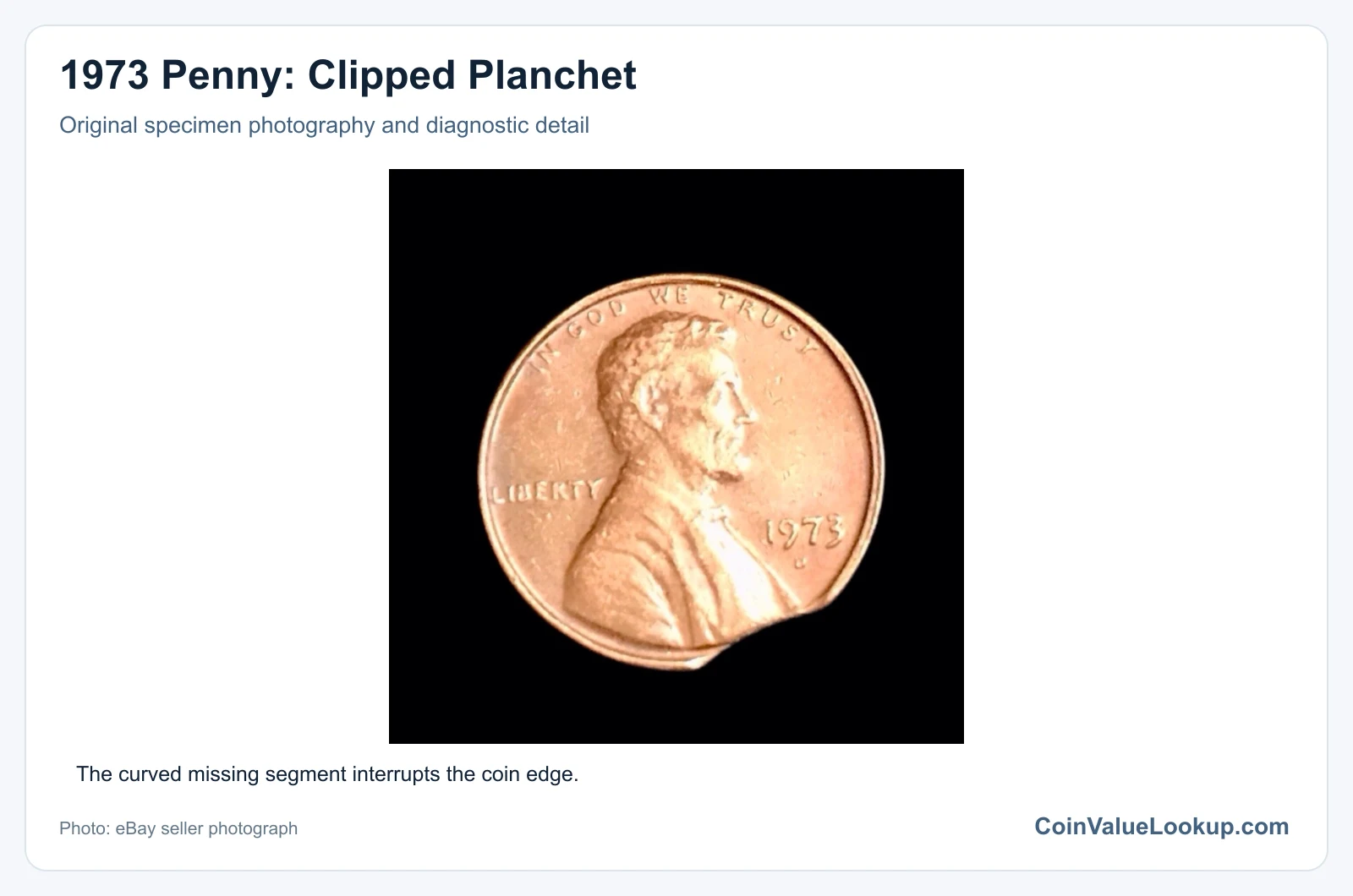
Clipped planchets have been reported on 1973 cents. This error occurs before striking, when the blank-cutting process overlaps a previously punched hole in the strip, shearing off a curved section of the planchet.
The resulting coin is missing a piece of its edge.
Look for a concave missing section along the rim. The area opposite the clip often shows design weakness known as the Blakesley effect, caused by reduced metal flow during striking.
This weakness helps confirm the clip happened before the coin was struck.
Straight clips and ragged clips also exist but are less common on cents of this era.
Do not confuse a clipped planchet with a coin that has been filed, cut or corroded after leaving the mint. Post-mint damage typically shows tool marks, sharp unnatural edges or pitting that differ from the smooth, slightly tapered edge of a genuine clip.
No specific price range is adopted. Value depends on the size and type of clip, the coin's grade and professional authentication.