1902 Indian Head Penny Coin Value: How Much Is It Worth?
The 1902 Indian Head penny is a common-date Philadelphia issue, but condition matters a lot. Selected guide values for regular business strikes range from about $2.50 in Good-4 to $81 in MS-63, according to USA Coin Book retail estimates.
Proofs, major die varieties, and mint errors require separate evaluation and are not covered by those figures. These are guide estimates, not guaranteed offers.
Fast Way to Identify Your 1902 Indian Head Penny
Want a quick read on what you have? Upload clear photos of the front and back of your 1902 Indian Head cent and our identifier can give you a preliminary take on which version you're holding.
It won't authenticate, certify, or precisely grade your coin, but it's a solid first step before digging deeper.
1902 Indian Head Penny Value
Upload both sides of your 1902 Indian Head Penny.
Front Obverse
Upload photo
Back Reverse
Upload photo
Which 1902 Indian Head Penny Versions Are Worth Money?
- A business strike in MS-63 condition can reach around $81 according to guide estimates, well above the $2.50 a worn Good-4 copy brings.
- A proof example in PR-63 carries a guide value near $313, reflecting its limited original mintage as a special collector issue.
- Coins retaining original uncirculated surfaces and natural bronze color tend to bring stronger prices than cleaned or damaged examples of similar grade.
- Certain die errors such as doubled dies, off-center strikes, and cuds are reported for this date and can carry premiums that depend on authenticated identity, condition, and severity.
Step 1: Identify Your 1902 Indian Head Penny Mint Mark and Version
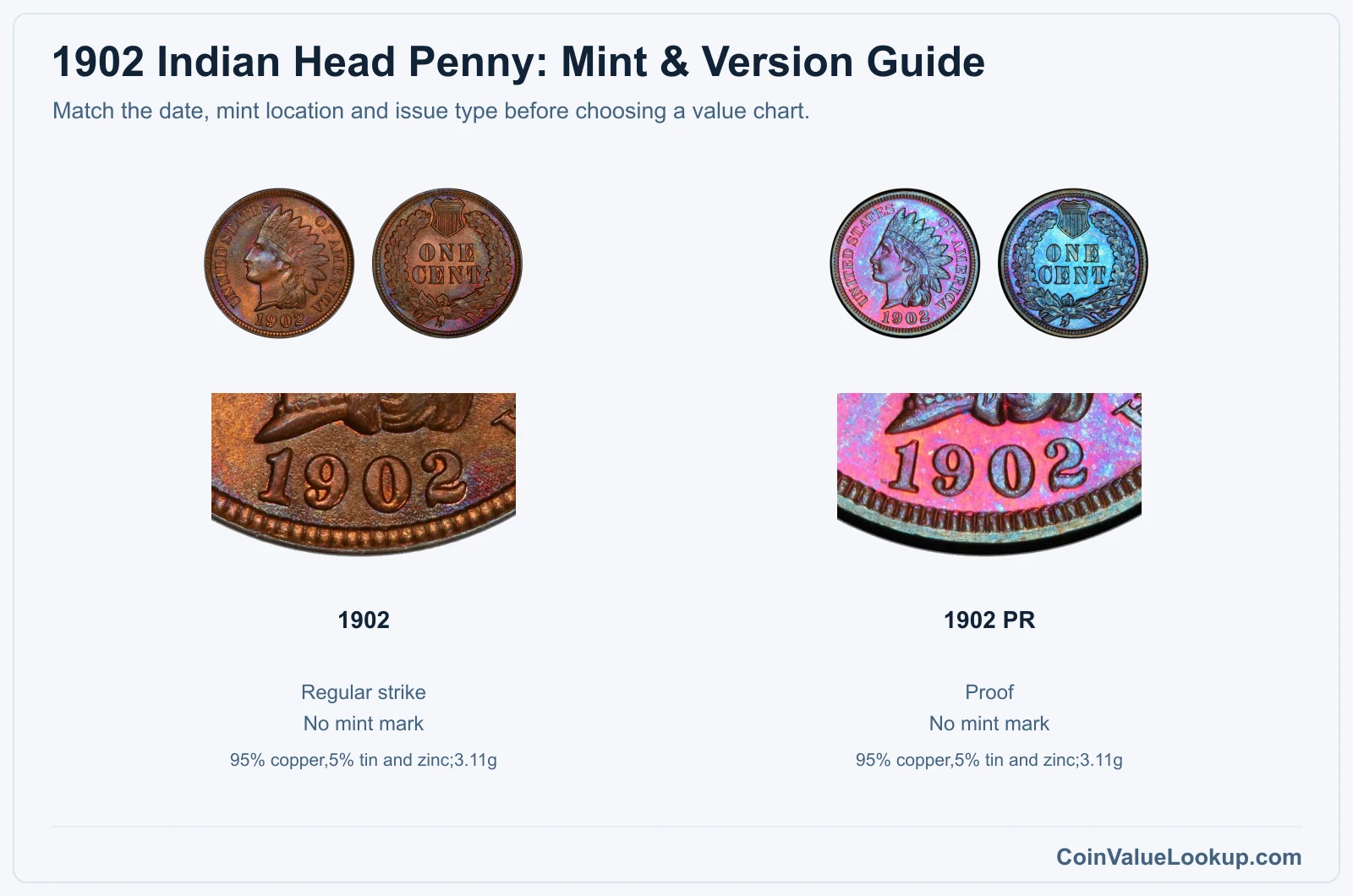
Every regular 1902 Indian Head cent was struck at the Philadelphia Mint. There is no mintmark on this coin, and that is normal.
The small "L" on the ribbon behind the neck is the designer's initial, not a mintmark.
The obverse shows a Liberty head wearing a feathered headdress with LIBERTY spelled across the headband. The reverse carries an oak wreath enclosing ONE CENT, topped by a small shield.
If your coin has a wheat-ear reverse or a plain wreath without the shield, you're looking at a different series entirely.
This year's coins are bronze, composed of 95% copper with 5% tin and zinc, weighing 3.11 grams. Don't confuse them with the heavier copper-nickel Indian cents made before mid-1864.
The two main branches to separate are the standard business strike and the proof. A proof is a special manufacturing method, not simply a high grade.
Genuine proofs show squared rims, fully mirrored fields, and sharp detail that goes beyond what even a perfect business strike can deliver. A polished circulated coin is not a proof, no matter how shiny someone made it.
Step 2: Check Your 1902 Indian Head Penny Grade
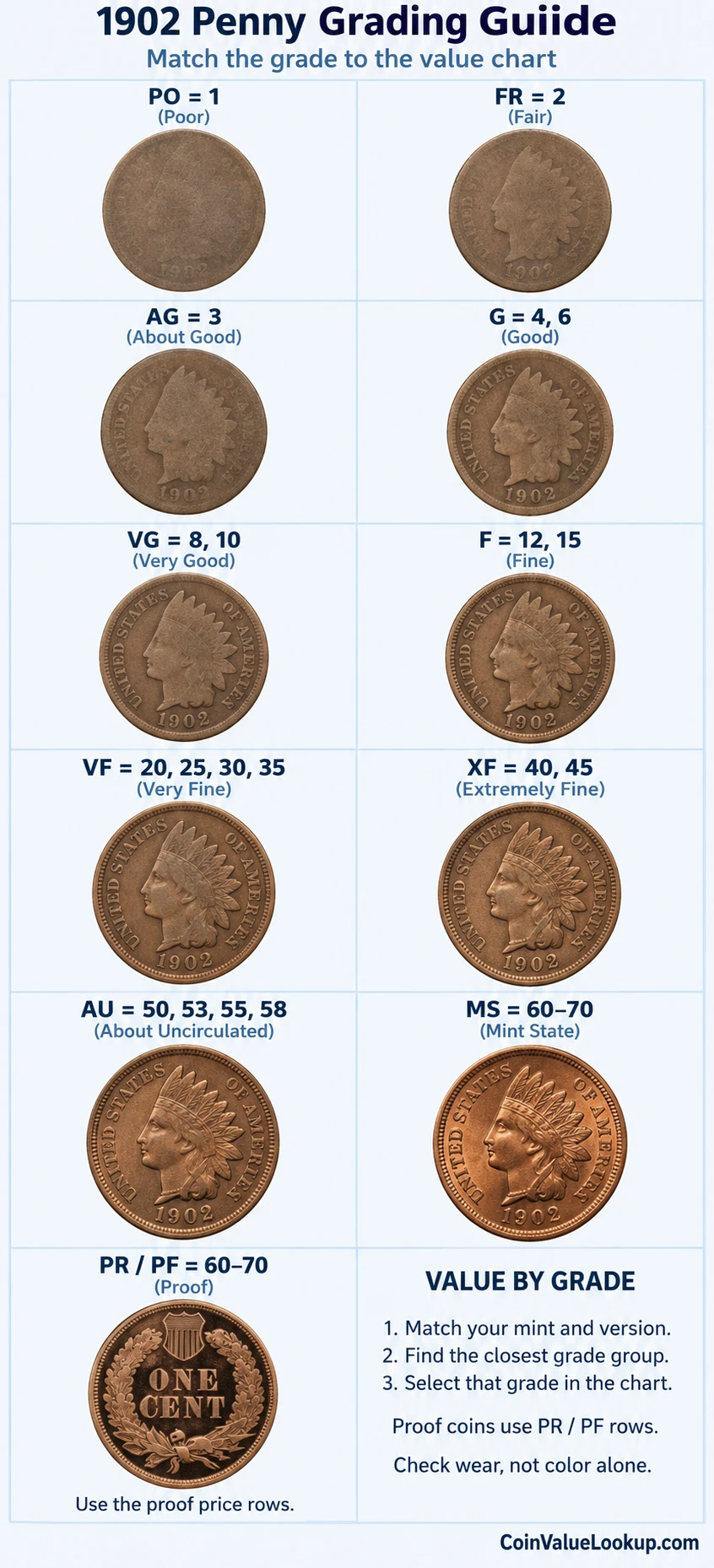
Start with the headband. On a well-worn coin, LIBERTY will be partially or fully gone.
On a Good-4 example, expect a smooth headband with little or no lettering visible.
Next check the feather tips above the headband and the hair detail below the ear. These are high points that wear first.
A coin in the mid-grades will show partial feather definition and a softened cheek.
Here's the catch: some 1902 cents left the mint with a weak strike at the feathers and hair. A soft original strike can look like light wear if you only check one spot.
Compare multiple areas before deciding.
The wreath on the reverse loses its leaf veins early in circulation. By Very Good the wreath is smooth on top but the shield and lettering remain clear.
At MS-63, expect full detail, decent luster, and only minor contact marks. Bronze color designations like BN, RB, and RD describe how much original copper-red color survives.
They are not separate materials. A coin retaining more original red generally commands a premium over a fully brown example of the same technical grade.
Use the comparison image to match your coin's wear pattern. Look at the overall package: sharpness, luster, marks, and color together, not any single feature in isolation.
Step 3: Check 1902 Indian Head Penny Value by Mint and Version
1902 Indian Head Penny
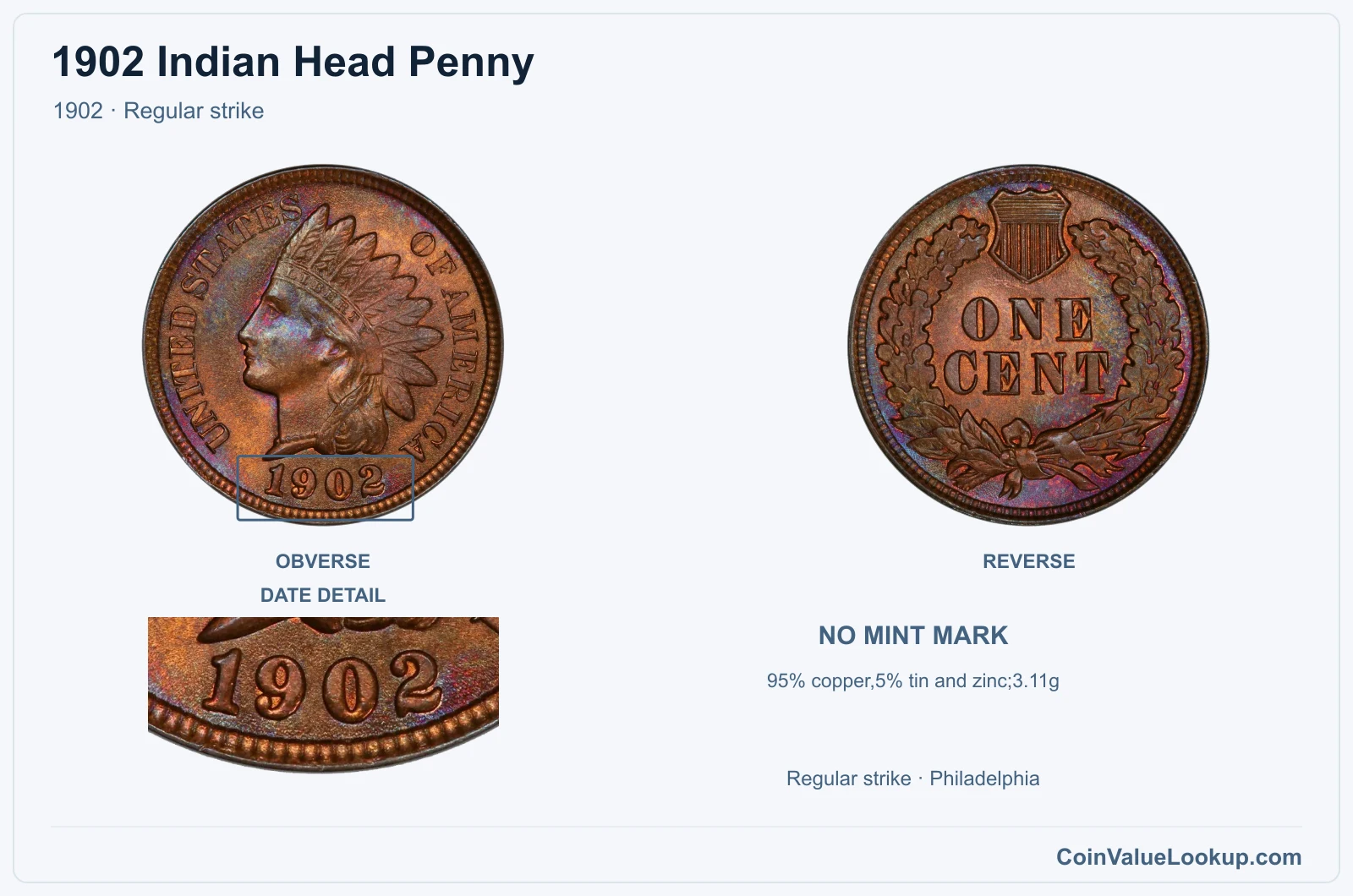
This is the standard 1902 business strike from Philadelphia. No mintmark appears on the coin.
It weighs 3.11 grams in its bronze alloy of 95% copper and 5% tin and zinc, with the familiar Indian portrait obverse and oak-wreath-and-shield reverse.
USA Coin Book retail guide values place this coin at roughly $2.50 in Good-4 and around $81 in MS-63. The jump between those two figures tells you that surface preservation drives the price.
Cleaned, corroded, or damaged coins trade below guide levels even if the remaining detail looks decent. Don't borrow pricing from rare varieties or proofs when evaluating a regular strike.
| Range | Grade | Price | Auction Records | Appraisal |
|---|---|---|---|---|
| PO | PO 1 | — | Coin Identifier | |
| FR | FR 2 | — | Coin Identifier | |
| AG | AG 3 | — | Coin Identifier | |
| G | G 4 | — | Coin Identifier | |
| G 6 | — | Coin Identifier | ||
| VG | VG 8 | — | Coin Identifier | |
| VG 10 | — | Coin Identifier | ||
| F | F 12 | — | Coin Identifier | |
| F 15 | — | Coin Identifier | ||
| VF | VF 20 | Coin Identifier | ||
| VF 25 | Coin Identifier | |||
| VF 30 | — | Coin Identifier | ||
| VF 35 | — | Coin Identifier | ||
| XF | XF 40 | — | Coin Identifier | |
| XF 45 | — | Coin Identifier | ||
| AU | AU 50 | Coin Identifier | ||
| AU 53 | Coin Identifier | |||
| AU 55 | Coin Identifier | |||
| AU 58 | Coin Identifier | |||
| MS | MS 60 | — | Coin Identifier | |
| MS 61 | — | Coin Identifier | ||
| MS 62 | Coin Identifier | |||
| MS 63 | Coin Identifier | |||
| MS 64 | Coin Identifier | |||
| MS 65 | Coin Identifier | |||
| MS 66 | Coin Identifier | |||
| MS 67 | — | — | — | |
| MS 68 | — | — | — | |
| MS 69 | — | — | — | |
| MS 70 | — | — | — |
1902 Indian Head Penny — PR
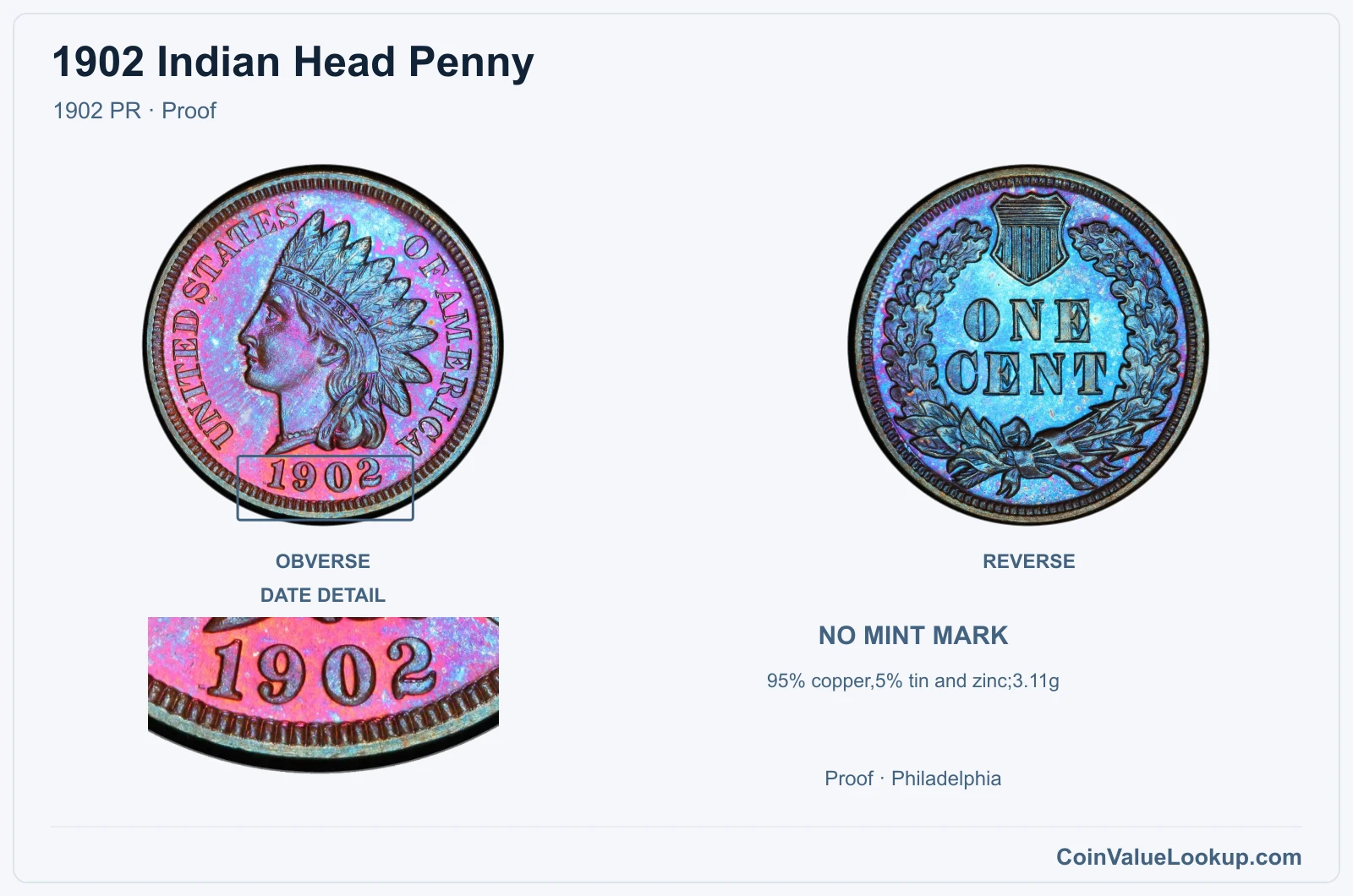
The 1902 proof Indian Head cent was a limited-production coin struck specifically for collectors at the Philadelphia Mint. It shares the same bronze composition and design as the business strike, but the manufacturing process is entirely different.
Expect squared, knife-sharp rims, deeply mirrored fields, and crisp detail on every feather and leaf vein.
A PR-63 example carries a USA Coin Book guide value of about $313. That's a meaningful step above any business strike grade, so correct identification matters.
A polished or lightly circulated business strike is not a proof. Look at the rim profile and field texture under good light before drawing conclusions.
Coin Value Lookup is a good starting point if you want to compare this coin's guide values with other Indian Head cent dates and see where your piece might fit.
| Range | Grade | Price | Auction Records | Appraisal |
|---|---|---|---|---|
| PR | PR 1 | — | Coin Identifier | |
| PR 2 | — | Coin Identifier | ||
| PR 3 | — | Coin Identifier | ||
| PR 4 | — | Coin Identifier | ||
| PR 6 | — | Coin Identifier | ||
| PR 8 | — | Coin Identifier | ||
| PR 10 | — | Coin Identifier | ||
| PR 12 | — | Coin Identifier | ||
| PR 15 | — | Coin Identifier | ||
| PR 20 | — | Coin Identifier | ||
| PR 25 | — | Coin Identifier | ||
| PR 30 | — | Coin Identifier | ||
| PR 35 | — | Coin Identifier | ||
| PR 40 | — | Coin Identifier | ||
| PR 45 | — | Coin Identifier | ||
| PR 50 | — | Coin Identifier | ||
| PR 53 | — | Coin Identifier | ||
| PR 55 | — | Coin Identifier | ||
| PR 58 | — | Coin Identifier | ||
| PR 60 | — | Coin Identifier | ||
| PR 61 | — | Coin Identifier | ||
| PR 62 | Coin Identifier | |||
| PR 63 | Coin Identifier | |||
| PR 64 | Coin Identifier | |||
| PR 65 | Coin Identifier | |||
| PR 66 | Coin Identifier | |||
| PR 67 | Coin Identifier | |||
| PR 68 | — | — | — | |
| PR 69 | — | — | — | |
| PR 70 | — | — | — |
1902 Indian Head Penny Error List
1. 1902 Indian Head Penny — Die Break / Cud
A cud is a raised, blobby area that connects to the rim, caused by a piece of the die breaking away. The missing die fragment means the press pushes metal into an unsupported space, leaving a featureless lump where design detail should be.
To spot one on a 1902 Indian cent, look along the entire rim for a flat, raised area that replaces part of the lettering, denticles, or portrait. Compare the suspicious spot with a normal coin.
A cud has a distinct boundary where normal design abruptly stops.
Don't confuse a rim dent, corrosion bubble, or small interior die chip with a true cud. Rim damage is depressed or irregular, while a cud is raised and smooth.
Value depends on size, location, and overall coin condition, assessed individually by authenticated identity and error severity.
2. 1902 Indian Head Penny — Doubled Die Reverse
A doubled die reverse shows consistent doubling on the reverse design elements, created during the die-making process. On a 1902 Indian cent, compare the reverse lettering of ONE CENT and UNITED STATES OF AMERICA to a known normal example.
True doubling produces a clear, uniform separation or notching on the affected letters or wreath elements.
The key diagnostic is consistency. Every affected letter or design element shifts in the same direction by the same amount.
Machine doubling, by contrast, usually shows flat, shelf-like distortion without that uniform offset.
Reflections or photographic artifacts can also mimic doubling in images. Examine under direct light with magnification.
Pricing depends on the specific die, the strength of doubling, and the coin's condition, so individual authentication and assessment are necessary.
3. 1902 Indian Head Penny — Misplaced Date
A misplaced date occurs when partial impressions of one or more date digits appear somewhere they shouldn't, typically embedded in the denticles or near the portrait's neck, away from the final date position. This happened because the die was punched in the wrong spot before being corrected.
On a 1902 Indian cent, look carefully in the denticles below the date and near the bust truncation for ghost-like remnants of a numeral. These partial digits will match the shape of the 1, 9, 0, or 2 from the date.
Die chips, scratches, and random bumps can look similar but won't form a recognizable numeral shape. Magnification and comparison with a source photograph of the known variety are essential.
No fixed price range applies; value depends on authenticated identity, condition, and how visible the misplacement is.
4. 1902 Indian Head Penny — Repunched Date
A repunched date shows traces of an earlier date-punch position alongside the final numerals. On a 1902 Indian cent, look closely at each digit for a shadow or remnant slightly offset from the primary impression.
The remnants are typically visible as partial outlines of numerals peeking out from under the final strike.
This is a die-making variety, not the same thing as a doubled die. A doubled die affects the entire design; a repunched date only involves the date numerals because they were individually hand-punched into the die.
Damaged dates and machine doubling are common lookalikes. Damage tends to be irregular and inconsistent, while a repunched date produces clean, repeated numeral outlines.
Value is assessed individually based on the specific repunching, its visibility, and the coin's overall condition.
5. 1902 Indian Head Penny — Die Crack
Die cracks show up as thin, raised lines crossing the coin's surface. They're caused by stress fractures in the steel die, and they transfer to every coin struck until the die is retired.
On a 1902 Indian cent, trace any suspicious line across the field or through design elements. A genuine crack is raised above the surrounding surface.
Note where the crack starts and ends. Some run rim to rim, others branch through lettering or the portrait.
Each pattern can help identify the specific die.
A scratch is the main lookalike, but scratches are incuse, meaning they sit below the surface rather than above it. Corrosion lines and displaced-metal scrapes also mimic cracks but lack the clean, continuous profile.
Value depends on prominence, location, and overall coin grade, requiring individual evaluation.
6. 1902 Indian Head Penny — Die Gouge / Named Raised-Line Variety
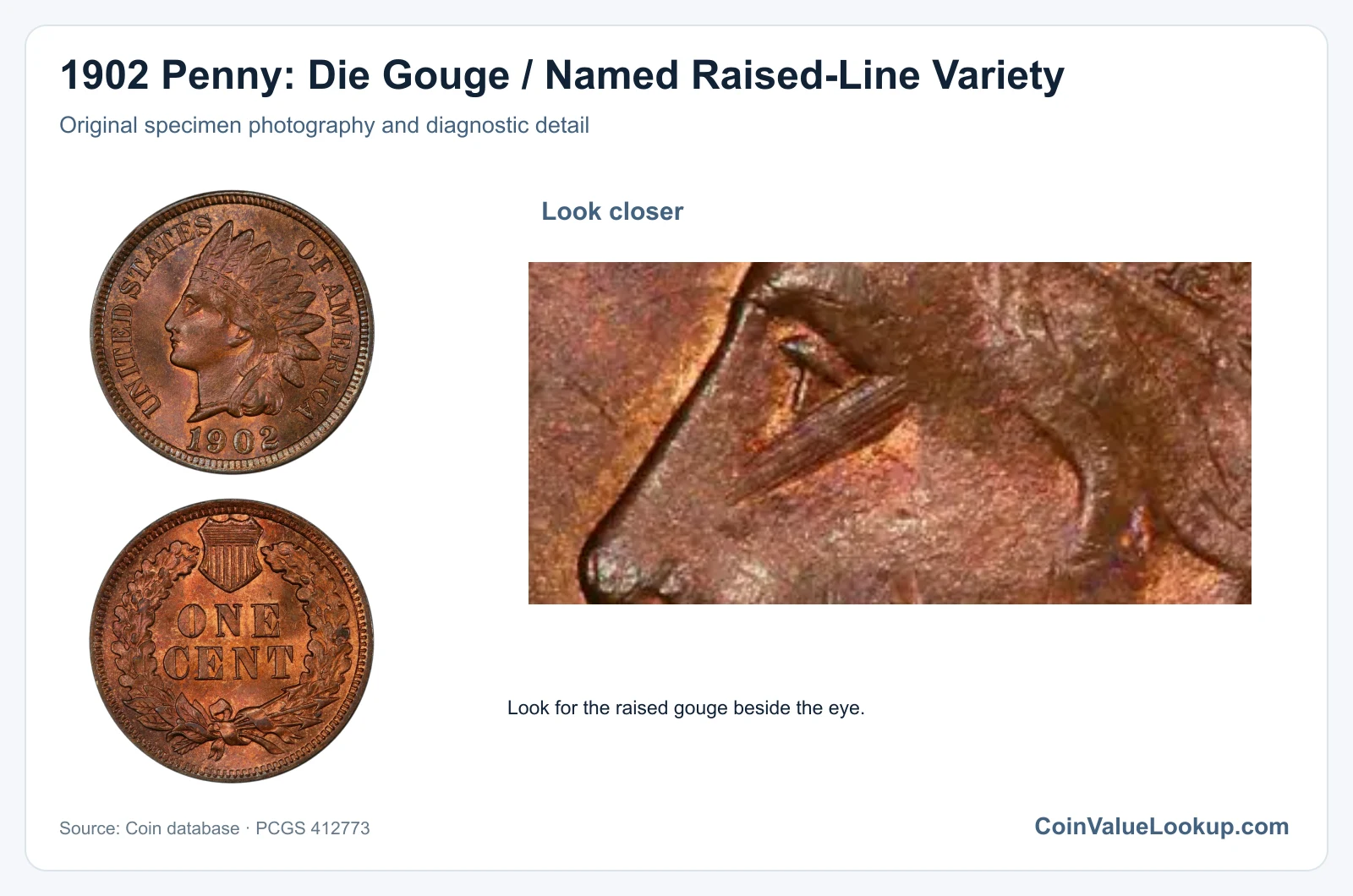
A die gouge appears as a raised blob or line of extra metal on the coin, caused by accidental damage to the die's surface. Because the gouge is cut into the die, it produces a raised feature on every coin struck from that die.
On a 1902 Indian cent, look for any unexplained raised feature that doesn't belong to the normal design. Note its exact position relative to letters, the portrait, or the wreath.
Some named varieties are identified by a distinctive gouge in a specific location.
Incuse scratches, post-mint damage, and unrelated die cracks are common lookalikes. A gouge is raised and repeatable across multiple coins from the same die; a scratch is depressed and unique to one coin.
Pricing requires individual assessment based on authenticated identity, error severity, and condition.
7. 1902 Indian Head Penny — Doubled Die Obverse
A doubled die obverse results from a misalignment during die production, leaving a consistent doubled impression across obverse design elements. On a 1902 Indian cent, compare the headband letters of LIBERTY, the date numerals, and the portrait outline against a normal example under matching lighting.
True die doubling shows consistent separation or notching. The direction and amount of offset are uniform across all affected areas.
That uniformity is the single best diagnostic.
Machine doubling is the most common lookalike. It produces a flat, shelf-like distortion rather than a rounded secondary image.
Worn die contours and photographic reflections can also fool you. Magnification under steady, angled light is your friend.
No fixed price range applies; value hinges on authenticated identity, the strength of the doubling, and the coin's overall condition.
8. 1902 Indian Head Penny — Off-Center Strike
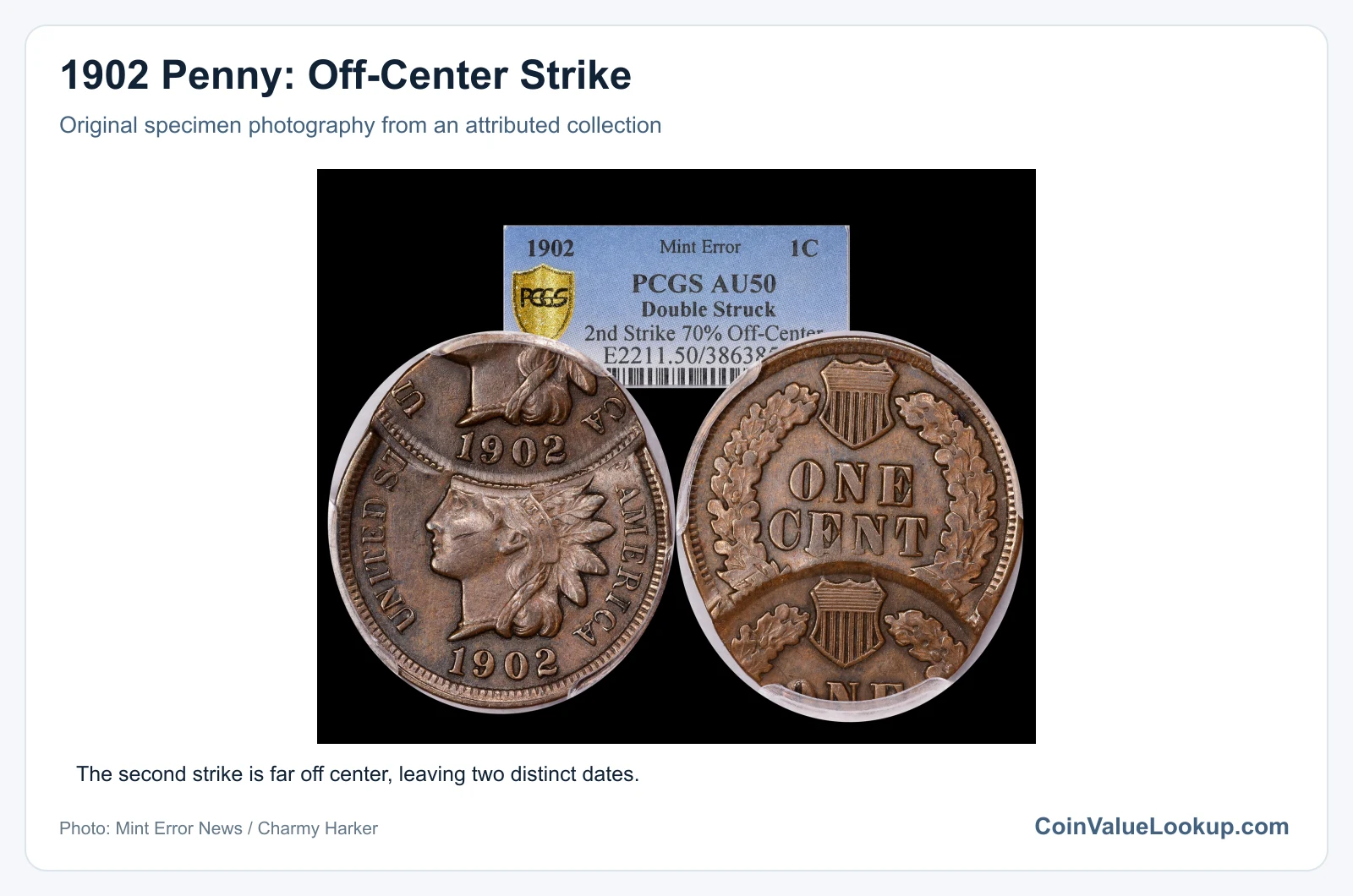
An off-center strike happens when the planchet isn't seated properly between the dies, so part of the design is missing and a blank crescent of unstruck metal appears on one side. On a 1902 Indian cent, you'll see the portrait or wreath shifted toward one edge with a corresponding unstruck area opposite it.
The date needs to be visible for the coin to be attributed to 1902, which also tends to increase its desirability. A small percentage off-center is less dramatic; a major shift with a readable date is unusual.
Don't confuse this with a clipped planchet, a one-sided die misalignment, or post-mint flattening. An off-center coin has a symmetrically round planchet with displaced design, not a missing edge.
Pricing varies widely with the percentage of off-center shift, date visibility, and overall condition.
9. 1902 Indian Head Penny — Double / Multiple Strike
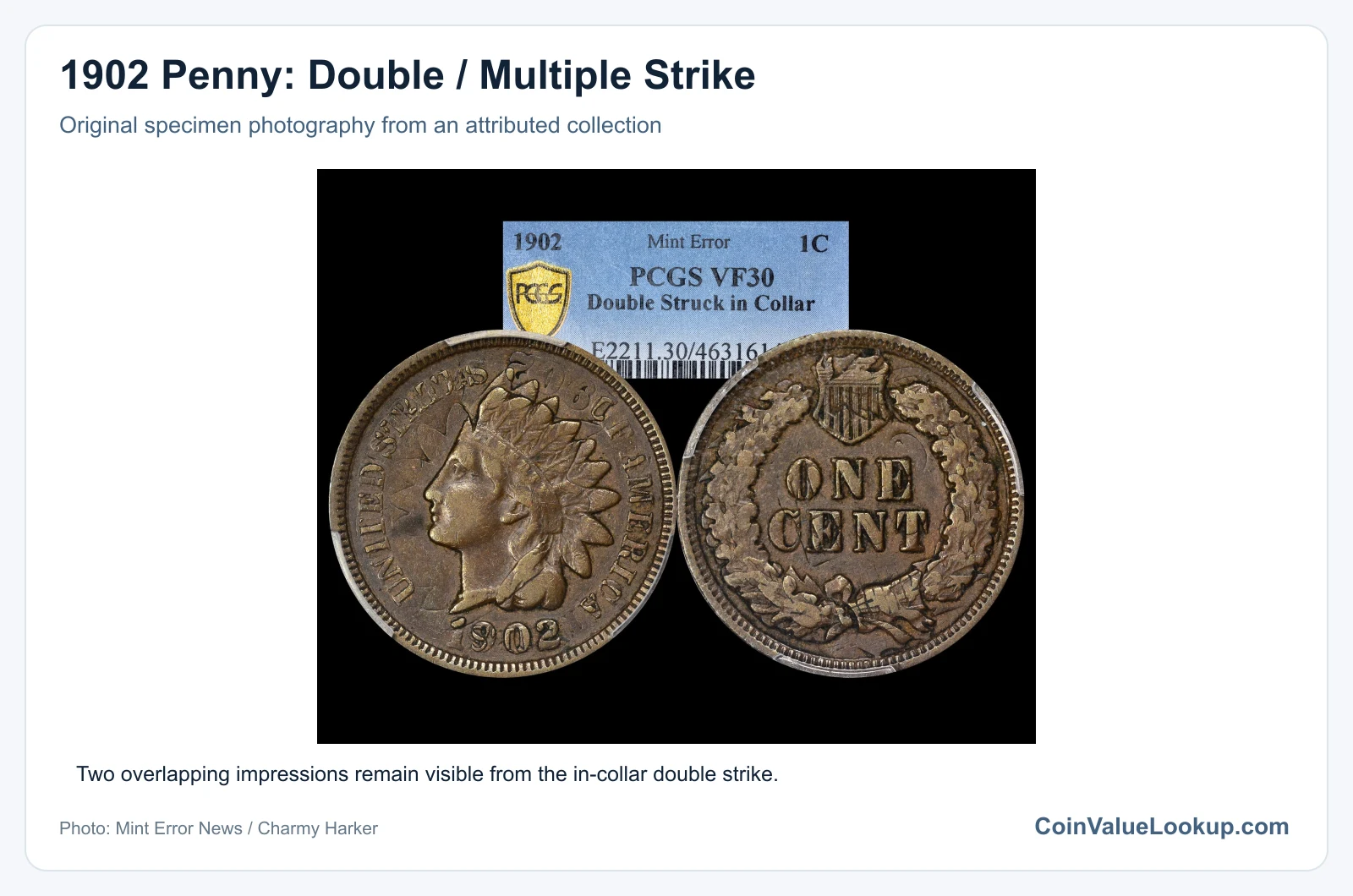
A double or multiple strike occurs when a coin is hit by the dies more than once, with the planchet shifting or rotating between impacts. The result is two or more separate, overlapping impressions of the design on the same coin.
On a 1902 Indian cent, look for a clearly displaced second image of the portrait or wreath, not just enlarged letters.
The key diagnostic is separate, distinct design impressions that are rotated or offset from each other. You can often trace the outline of each individual strike.
A doubled die is the main lookalike, but doubled dies show tight, uniform doubling from the die-making process, not widely displaced full-design impressions. Post-mint vise marks or novelty alterations can also create overlapping images.
Value depends on the number of strikes, the degree of displacement, and the coin's authenticated condition.
10. 1902 Indian Head Penny — Clipped Planchet
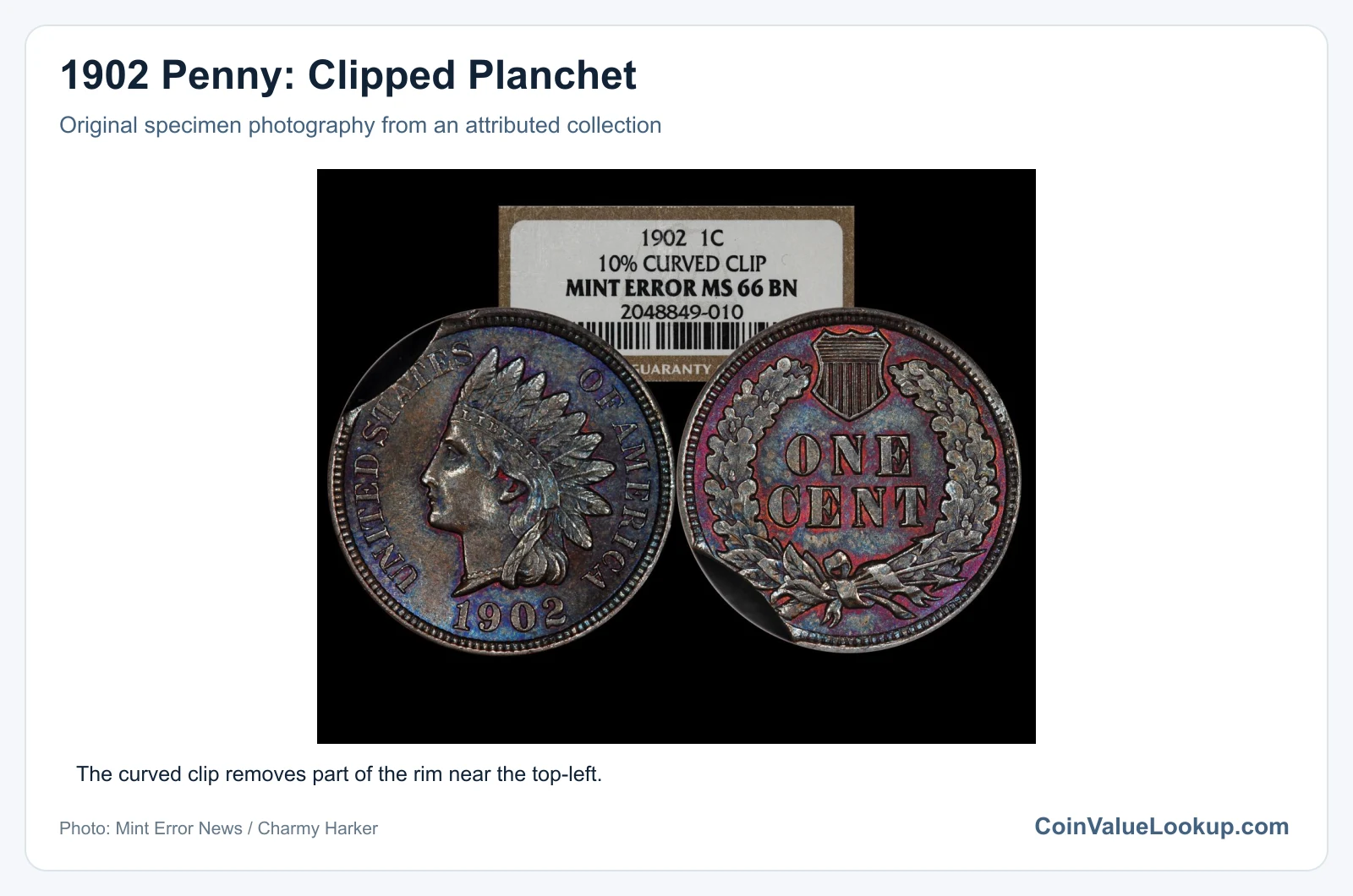
A clipped planchet error means the blank was cut incorrectly before striking, leaving a missing curved, straight, or ragged section. On a 1902 Indian cent, look for an absent portion of the rim and adjacent design, plus a characteristic weakness in the strike directly opposite the clip, called the Blakesley effect.
The edge at the clip should show the original planchet texture, not tool marks or filing. Metal flow near the clip area often appears stretched or thinned, which is another good diagnostic.
An edge cut, filed notch, or corroded rim can mimic a clip but will lack the opposite-side weakness and smooth planchet-edge texture. Post-mint damage is usually sharper and more irregular.
Value varies by clip size, type, and overall coin condition, so individual assessment by authenticated identity and severity is needed.