1965 Roosevelt Dime Coin Value: How Much Is It Worth?
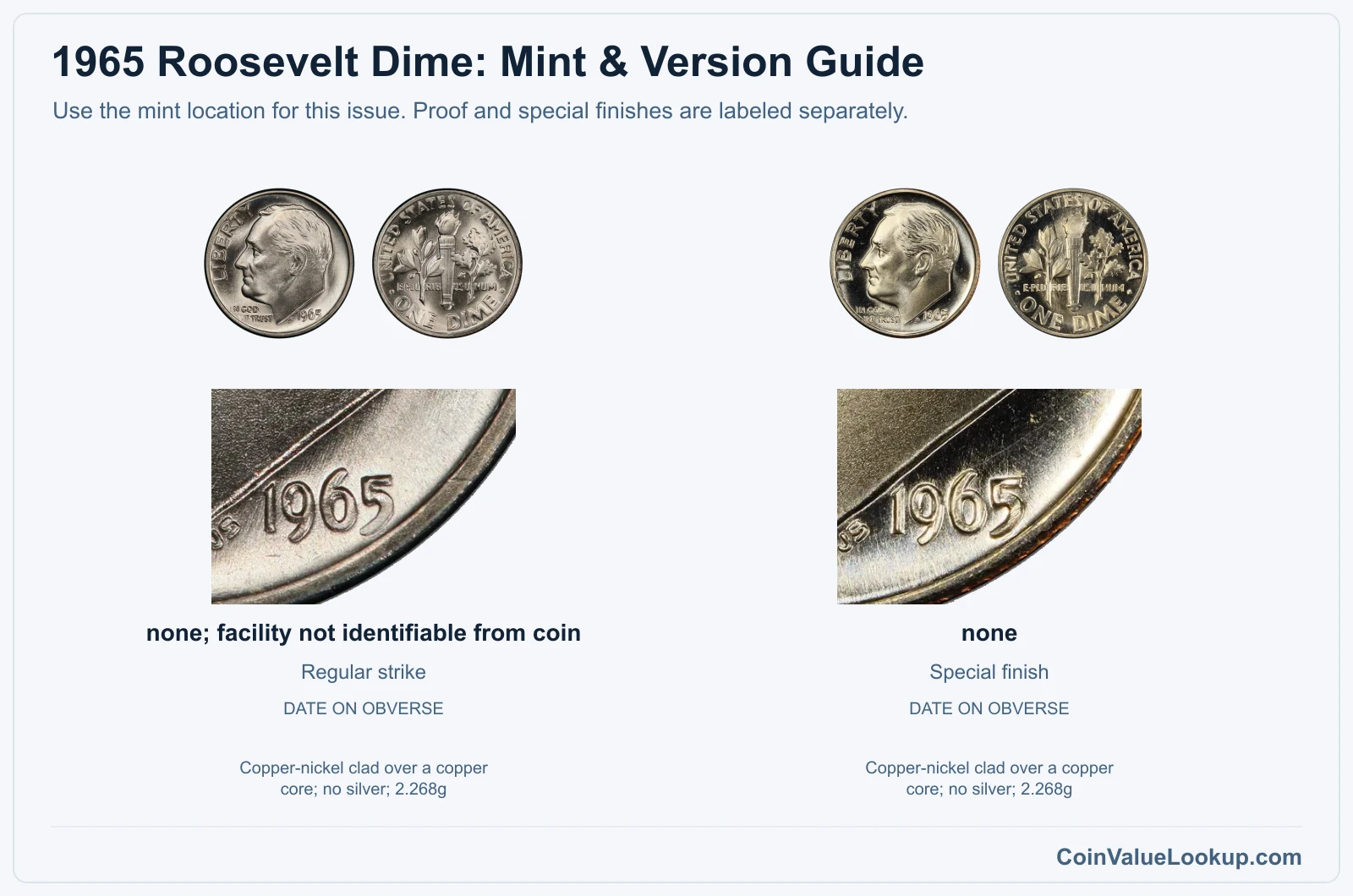
Most 1965 Roosevelt dimes in circulation are worth face value — ten cents. A guide estimate for a copper-nickel clad example in MS65 condition is about $3.08, and a non-cameo Special Mint Set piece graded SP65 runs around $8.
Authenticated errors, especially a silver transitional planchet, occupy a different price category entirely. Keep high-grade coins, cameo SMS specimens and confirmed errors separate when comparing values.
Fast Way to Identify Your 1965 Roosevelt Dime
Snap clear photos of both the front and back of your 1965 dime and upload them here for a preliminary identification. This can help you figure out whether you have a standard circulation strike or something worth a closer look.
Sharp, well-lit images of the date, rim and edge are the most useful.
1965 Roosevelt Dime Value
Upload both sides of your 1965 Roosevelt Dime.
Front Obverse
Upload photo
Back Reverse
Upload photo
Which 1965 Roosevelt Dime Versions Are Worth Money?
- Determine whether your coin is a regular circulation strike or an authenticated Special Mint Set specimen before comparing prices.
- Original uncirculated surfaces and strong torch band separation can push a clad business strike above face value in higher grades.
- A silver transitional planchet error — a 1965 date struck on a leftover 90% silver blank — is rare and requires professional authentication; one AU53 example sold for $9,150 at auction.
Step 1: Identify Your 1965 Roosevelt Dime Mint Mark and Version
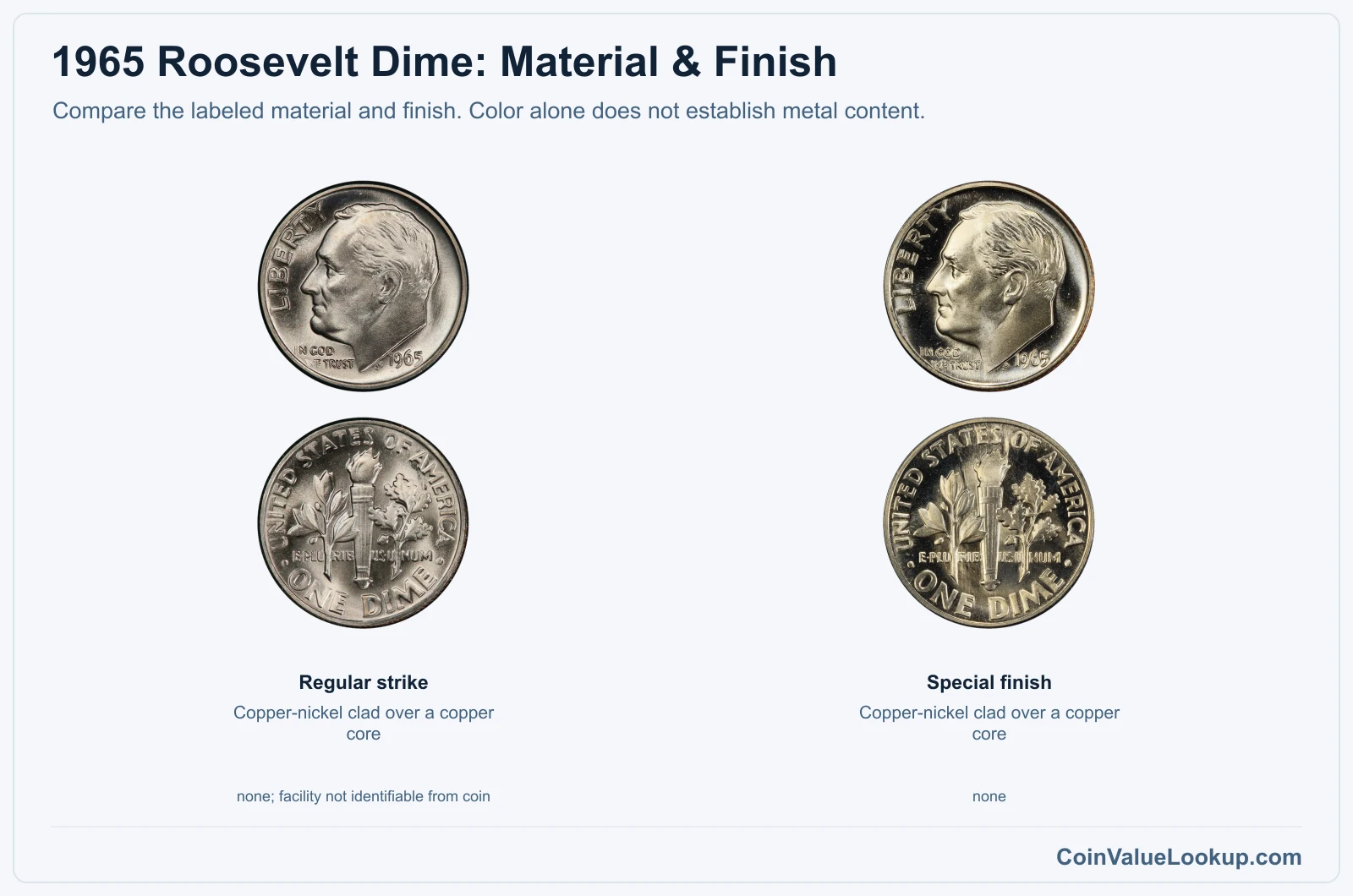
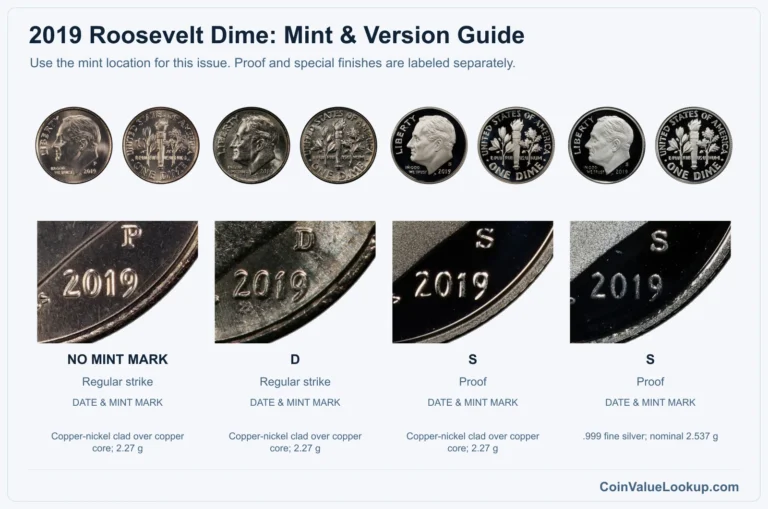
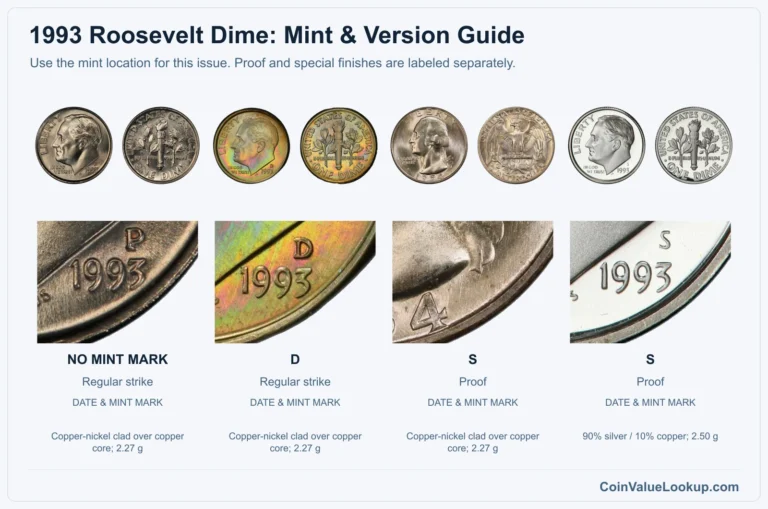
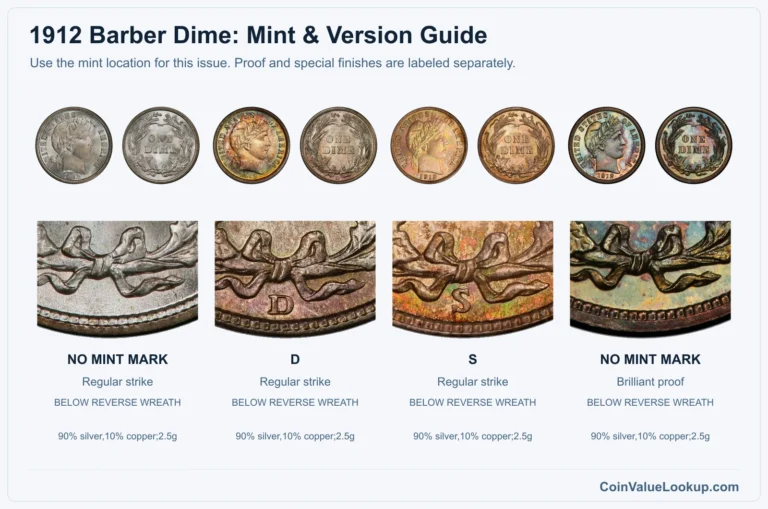
No 1965 dime carries a mintmark. That is normal.
The Mint dropped mintmarks from all circulating coins dated 1965 through 1967, so a bare space below the date is not an error and does not tell you which facility struck the coin.
There are two main categories to sort out: regular circulation strikes and Special Mint Set (SMS) specimens. SMS coins replaced traditional proof sets during these years.
They have a distinctive finish, but surface shine alone does not make a coin SMS — proper attribution matters.
All standard 1965 dimes use a copper-nickel clad composition with a nominal weight of 2.268 grams and a reeded edge. You may see a copper-colored stripe on the edge where the core shows through.
That is normal for clad coinage and does not indicate an error.
The design is Franklin Roosevelt on the obverse with a torch flanked by olive and oak branches on the reverse. Compare your coin's date, rim condition and both faces carefully against known examples.
Step 2: Check Your 1965 Roosevelt Dime Grade
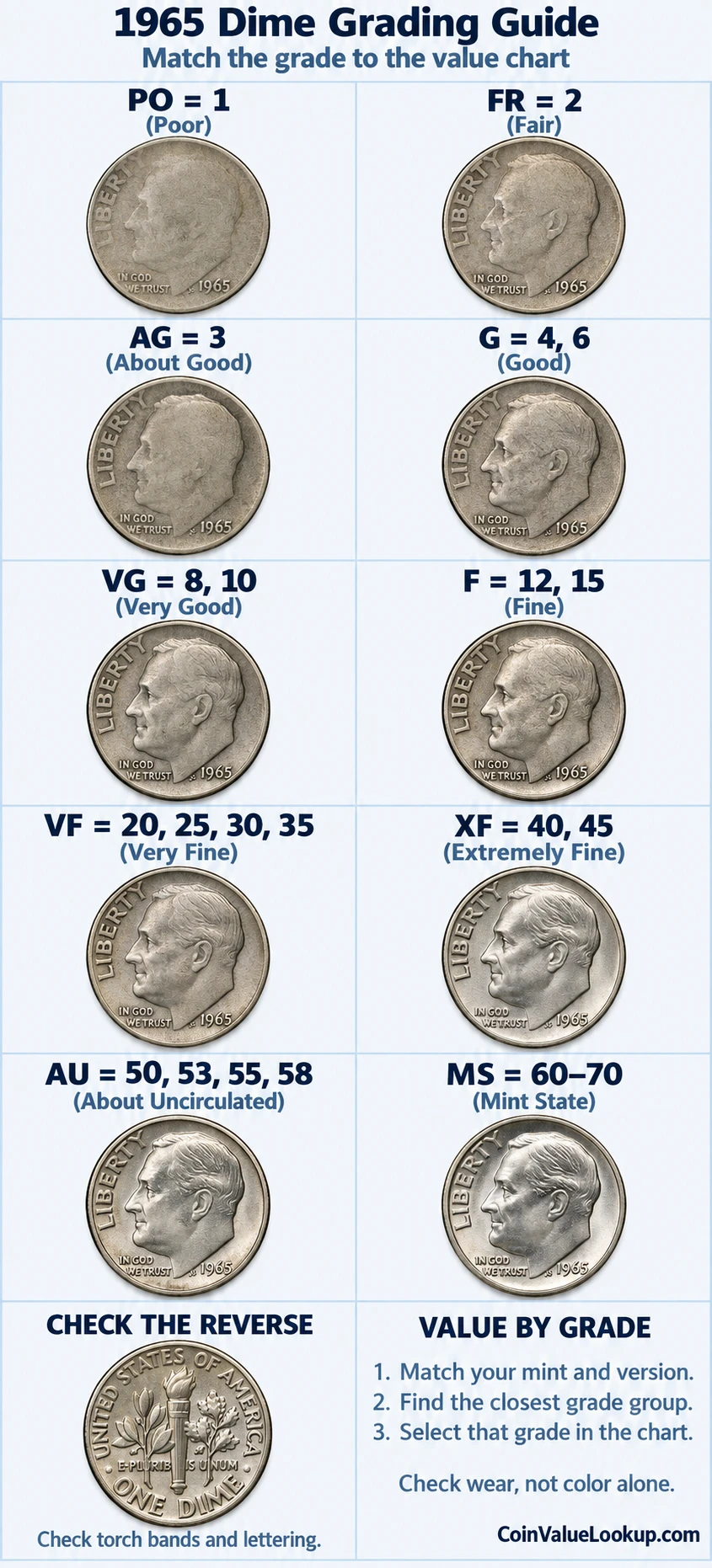
Start on the obverse. Roosevelt's cheekbone, jawline and the hair above his ear show wear first.
A coin that still has sharp detail in those spots is in better shape than one where the profile looks flat or mushy.
Flip it over. The torch lines, individual leaves on the olive and oak branches, and the horizontal bands separating the torch flame from the shaft are your reverse checkpoints.
"Full Bands" refers to clearly separated torch bands — it is a strike characteristic, not a defect.
Use the comparison image to match your coin's overall detail level. Look for contact marks, bag abrasions and scratches under good light.
A coin can be bright and still grade low if the surfaces are chewed up.
SMS specimens are graded on the SP scale, not the MS scale. Cameo contrast — frosted devices against mirror fields — is a separate designation on SMS coins and should not be confused with a different mint origin.
Brightness or a reflective surface alone does not guarantee a high grade; original luster quality and surface preservation together determine the number.
Step 3: Check 1965 Roosevelt Dime Value by Mint and Version
1965 Roosevelt Dime — No Mint Mark — Circulation Strike
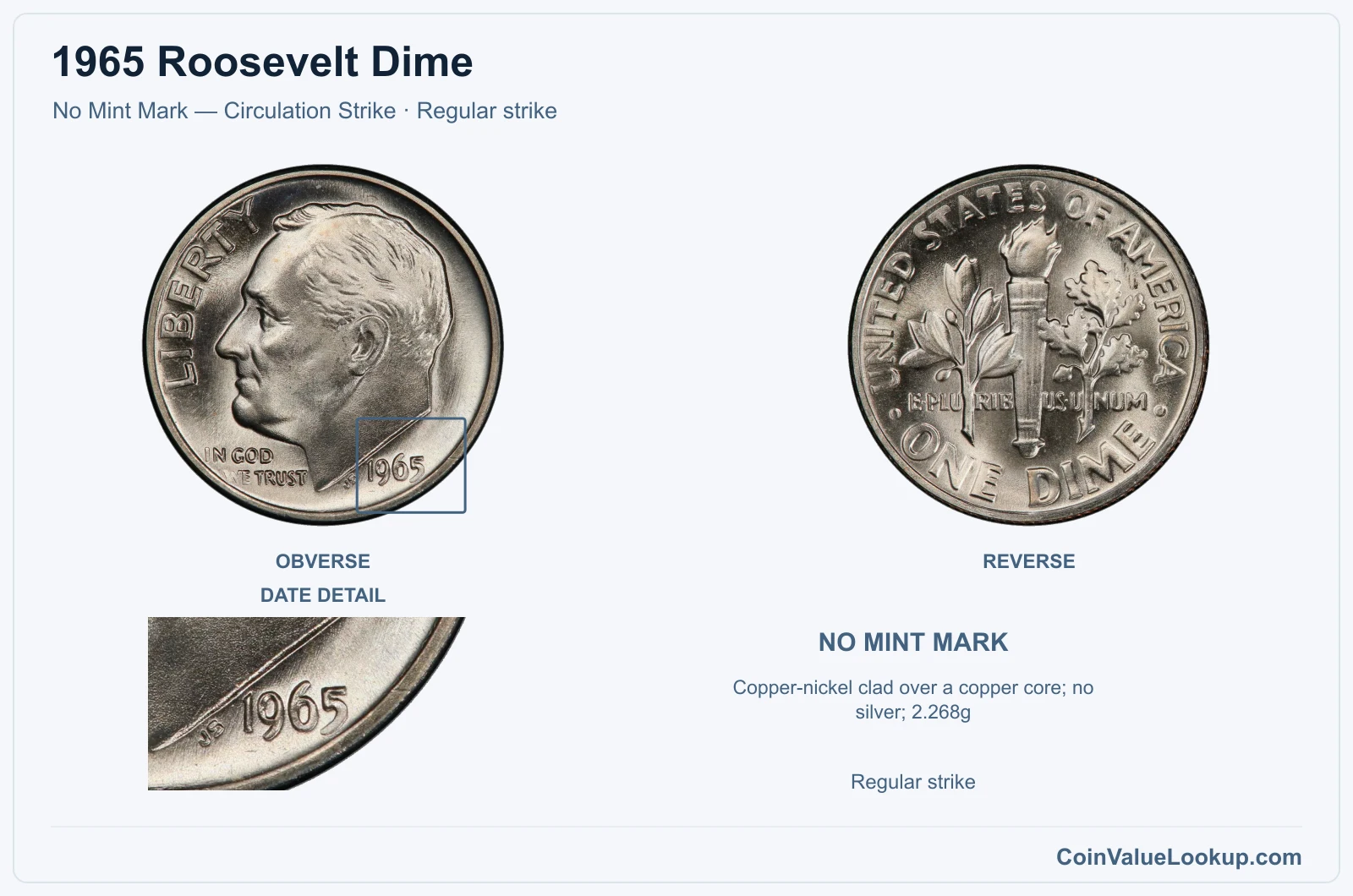
This is the coin most people find in pocket change. It is a standard copper-nickel clad dime with no mintmark, produced for everyday circulation.
In worn condition it is worth ten cents.
A USA Coin Book guide estimate puts the MS65 value at about $3.08. That is an uncirculated coin with minimal contact marks and good luster.
Below MS65, values drop quickly toward face value. Above it, certified examples with clean surfaces can bring more, but the vast majority of surviving 1965 dimes show at least light wear.
Do not compare your circulation strike against SMS or silver-planchet pricing — those are different animals entirely.
Range Grade
Price Auction Records Appraisal PO PO 1
—
Coin Identifier FR FR 2
—
Coin Identifier AG AG 3
—
Coin Identifier G G 4
—
Coin Identifier
G 6
—
Coin Identifier VG VG 8
—
Coin Identifier
VG 10
—
Coin Identifier F F 12
—
Coin Identifier
F 15
—
Coin Identifier VF VF 20
—
Coin Identifier
VF 25
—
Coin Identifier
VF 30
—
Coin Identifier
VF 35
—
Coin Identifier XF XF 40
—
Coin Identifier
XF 45
—
Coin Identifier AU AU 50
—
Coin Identifier
AU 53
—
Coin Identifier
AU 55
—
Coin Identifier
AU 58
Coin Identifier MS MS 60
—
Coin Identifier
MS 61
—
Coin Identifier
MS 62
—
Coin Identifier
MS 63
—
Coin Identifier
MS 64
Coin Identifier
MS 65
Coin Identifier
MS 66
Coin Identifier
MS 67
Coin Identifier
MS 68
Coin Identifier
MS 69
—
—
—
MS 70
—
—
—
1965 Roosevelt Dime — No Mint Mark — Special Mint Set
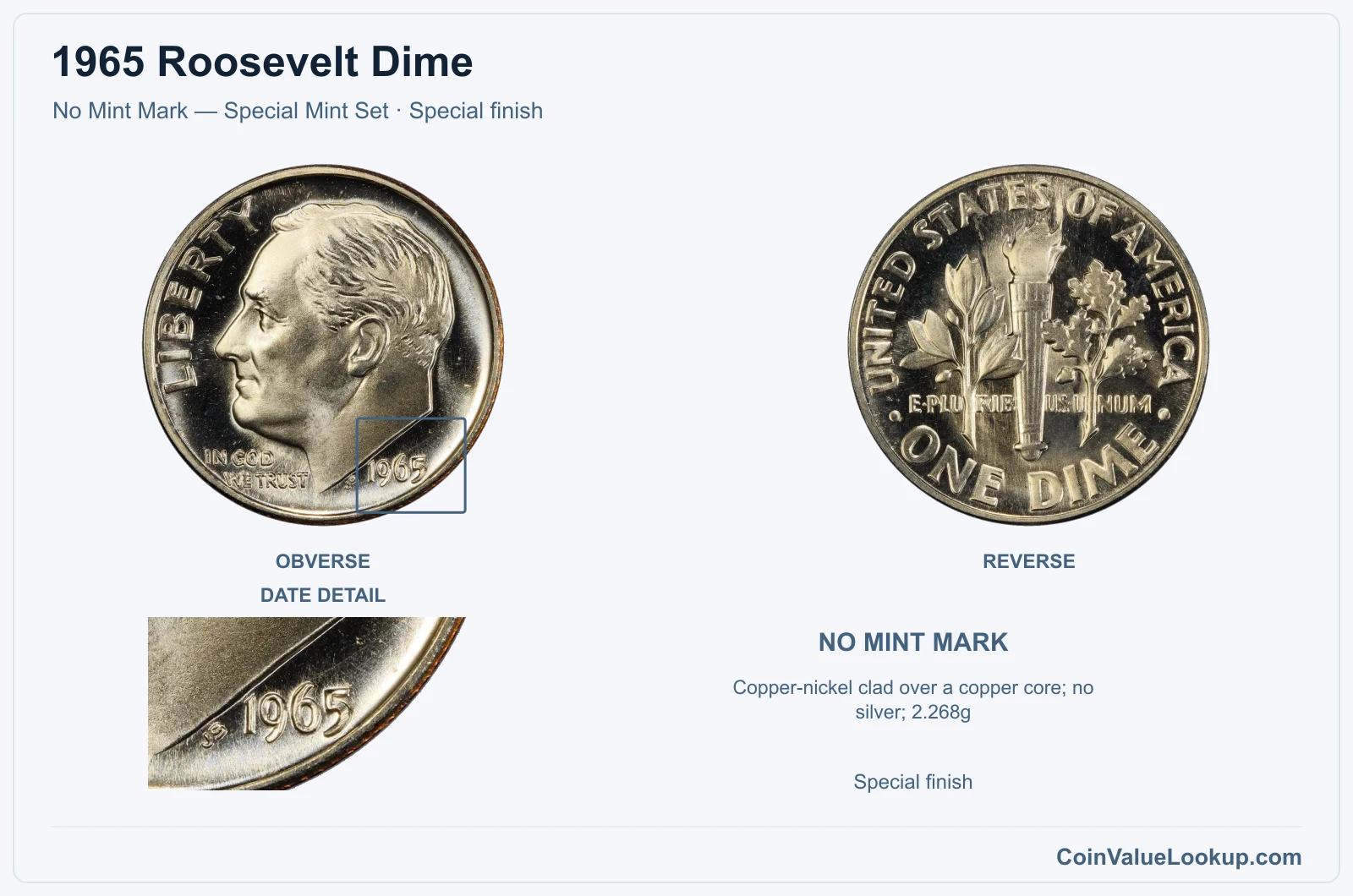
Special Mint Set dimes replaced proof issues for 1965–1967. They were sold in sealed government packaging and have a distinct strike quality that sits between a business strike and a traditional proof.
No mintmark appears, same as the circulation version.
A PCGS guide estimate for an ordinary non-cameo SP65 is about $8. Cameo and deep cameo designations are graded separately and carry different values, so make sure you are filtering correctly when checking prices.
Original SMS packaging supports identification but does not substitute for a numerical grade. If you are looking up various coin guides and want a reliable starting point, Coin Value Lookup can help you find the right reference for your specific coin type and finish.
Shine alone does not prove SMS origin. A polished circulation strike can look reflective, but the underlying die preparation and strike characteristics are what distinguish a genuine SMS specimen.
Range Grade
Price Auction Records Appraisal SP SP 1
—
Coin Identifier
SP 2
—
Coin Identifier
SP 3
—
Coin Identifier
SP 4
—
Coin Identifier
SP 6
—
Coin Identifier
SP 8
—
Coin Identifier
SP 10
—
Coin Identifier
SP 12
—
Coin Identifier
SP 15
—
Coin Identifier
SP 20
—
Coin Identifier
SP 25
—
Coin Identifier
SP 30
—
Coin Identifier
SP 35
—
Coin Identifier
SP 40
—
Coin Identifier
SP 45
—
Coin Identifier
SP 50
—
Coin Identifier
SP 53
—
Coin Identifier
SP 55
—
Coin Identifier
SP 58
—
Coin Identifier
SP 60
—
Coin Identifier
SP 61
—
Coin Identifier
SP 62
—
Coin Identifier
SP 63
—
Coin Identifier
SP 64
Coin Identifier
SP 65
Coin Identifier
SP 66
Coin Identifier
SP 67
Coin Identifier
SP 68
Coin Identifier
SP 69
Coin Identifier
SP 70
—
—
—
1965 Roosevelt Dime Error List
1. 1965 Roosevelt Dime — Silver Transitional Planchet
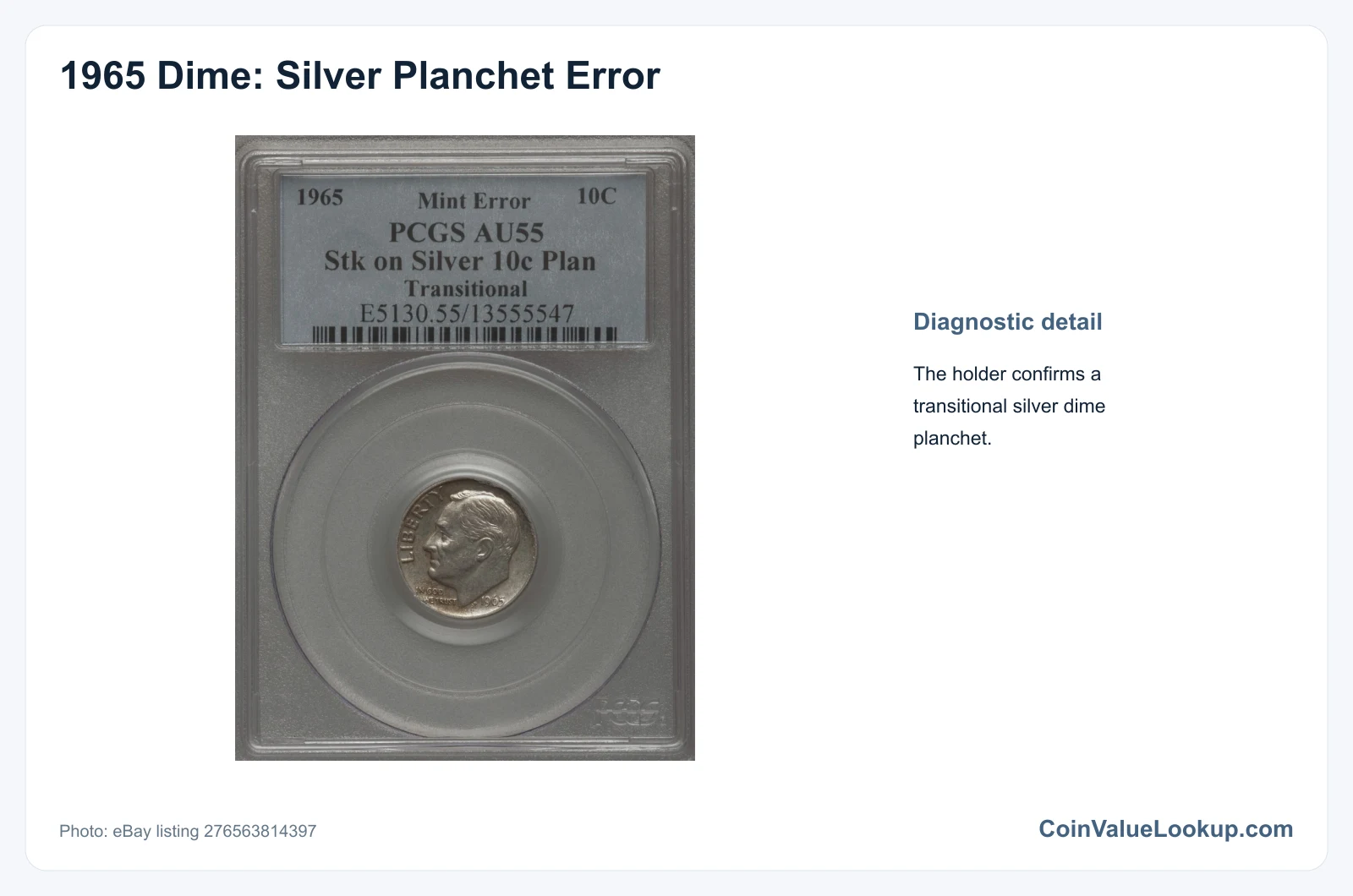
This is the headline error for 1965 dimes. During the changeover from silver to clad coinage, a few planchets left over from the old 90% silver composition reportedly ended up in the press.
The result is a 1965-dated dime struck on a silver blank.
The key diagnostic is weight: a silver dime planchet weighs approximately 2.50 grams versus the normal clad weight of 2.268 grams. A precise scale gets you started, but weight alone is not proof.
Professional composition testing and date authentication are necessary because altered dates and silver-plated clad dimes exist as lookalikes.
One NGC AU53 example sold for $9,150 at Heritage Auctions in January 2026. That is a single documented sale, not a guaranteed market price — condition, authentication service and buyer competition all affect what any individual coin brings.
2. 1965 Roosevelt Dime — Missing Clad Layer
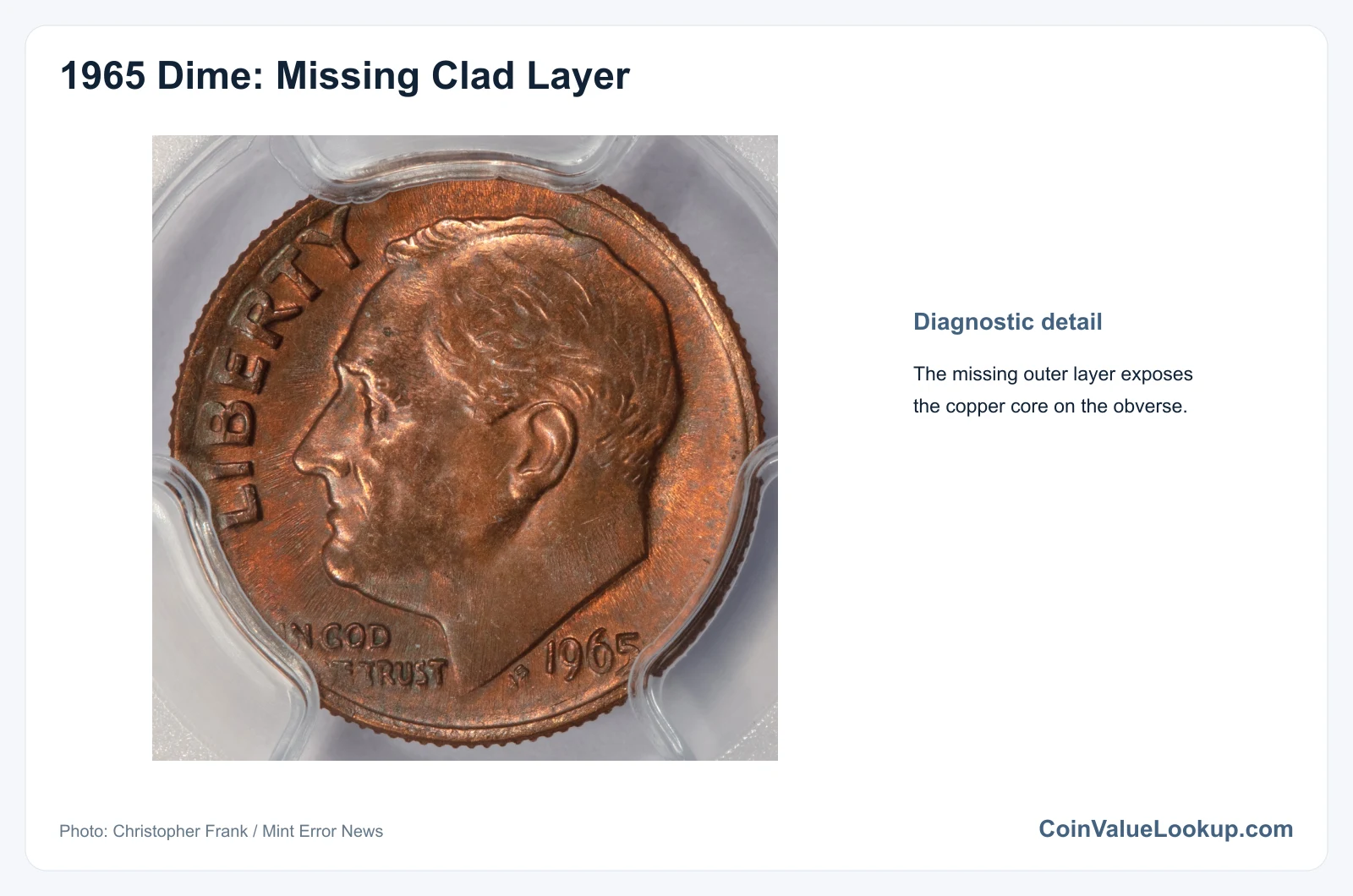
A missing clad layer error occurs when one of the outer copper-nickel layers fails to bond to the copper core before striking. On a 1965 dime with the obverse layer missing, the front face appears copper-colored while the reverse looks normal.
Look for consistent copper coloring across the entire obverse, plus the texture and detail you would expect from a genuine strike impressed into exposed core metal. Weight should differ from a standard 2.268-gram clad dime because an entire layer is absent.
An ANACS MS62 example sold for $391 at Heritage Auctions in August 2004. Do not confuse this error with environmental staining, chemical stripping of plating or post-mint abrasion, all of which can make one side look discolored without involving a genuine missing layer.
3. 1965 Roosevelt Dime — Incomplete Curved Clip
An incomplete curved clip happens during the blanking stage when a planchet is punched from an area of strip that overlaps a previous punch hole. The result is a crescent-shaped bite out of the coin's edge.
On a 1965 dime, look for the curved missing section along with the Blakesley effect — a weak area of the rim directly opposite the clip. The clip edge should show a smooth, unstruck contour consistent with the blanking punch, not a jagged or corroded break.
One NGC MS66 example brought $139 at Heritage Auctions in October 2022. Common lookalikes include scratches near the rim, corrosion lines and ordinary die cracks that can mimic the appearance of a clip.
A genuine clip will affect the overall shape of the planchet, not just the surface.
4. 1965 Roosevelt Dime — Double Strike
A double-struck dime received two impressions from the dies, with at least one strike landing off-center. You will see two overlapping but displaced designs, plus blank unstruck areas where the planchet was not covered by both strikes.
This is visually dramatic and hard to fake convincingly. The two sets of design elements should each show full strike depth and sharp detail consistent with die contact, not the flat shelf-like distortion of machine doubling or a post-mint impression.
Heritage Auctions has offered a 1965 double-struck dime graded NGC MS65 where both strikes were off-center. Value for this type of error depends heavily on the degree of displacement, visual appeal and authenticated condition.
Each piece is essentially unique, so individual assessment by a grading service matters more than any fixed price range.
5. 1965 Roosevelt Dime — Die Crack / Die Chip
Die cracks and die chips are raised features caused by a failing die. A crack appears as a thin raised line running across the coin's surface, sometimes connecting design elements or extending from the rim.
A chip shows up as a small raised blob, often near letters or the rim.
If the crack reaches the rim and produces a larger raised area, that is sometimes called a cud — a distinct subcategory. Interior chips tend to be smaller and less dramatic.
Lookalikes include incuse scratches, corrosion lines and bits of foreign material stuck to the surface. The key difference: a genuine die crack or chip is raised above the field because it originated on the die, while a scratch is typically incuse, cutting into the metal.
Condition, size and location of the crack all affect collector interest, so no single price applies across the board.
6. 1965 Roosevelt Dime — Off-Center Strike
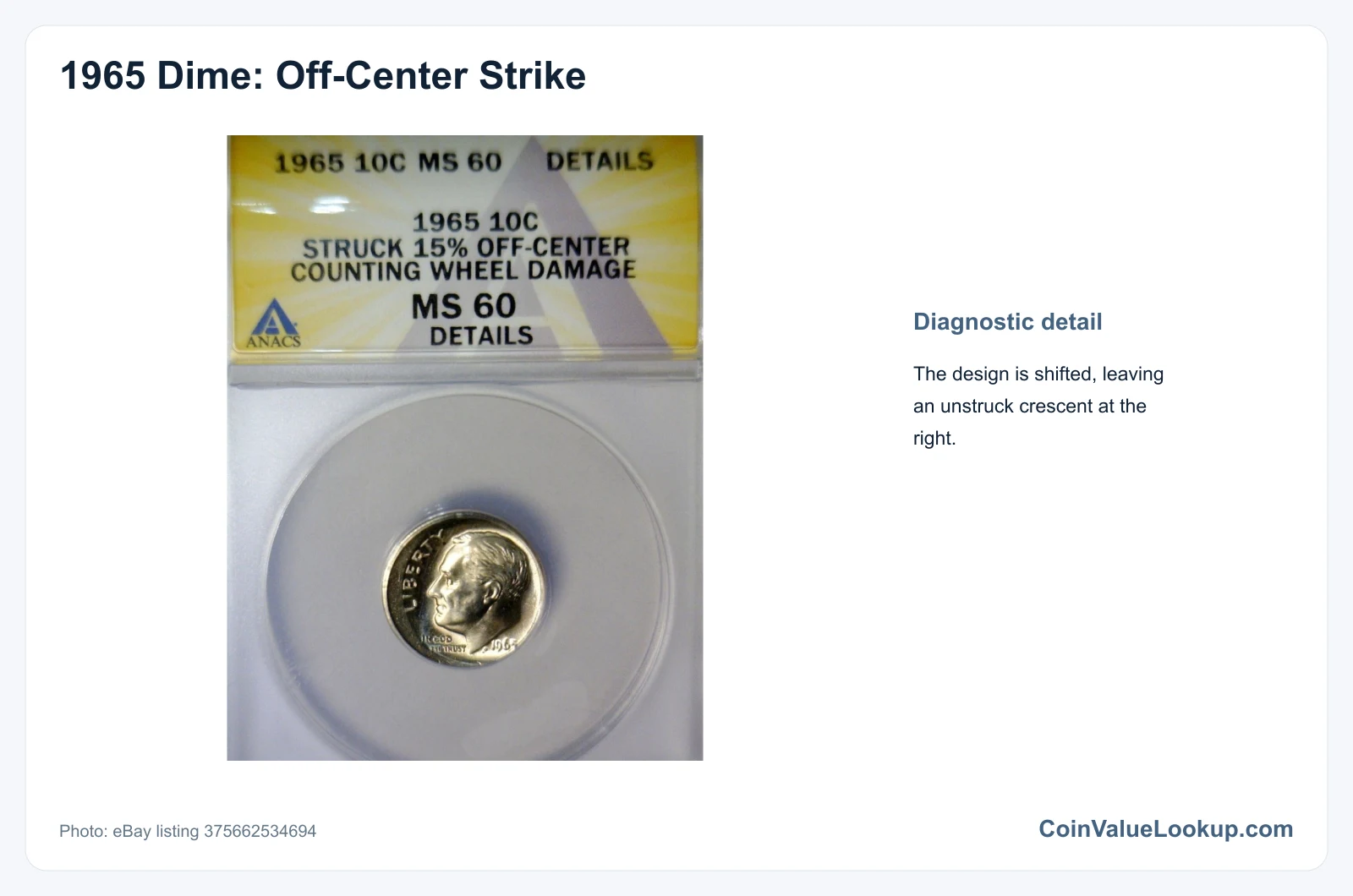
An off-center strike happens when the planchet is not properly seated in the collar before the dies come together. The design shifts to one side, leaving a blank crescent on the opposite edge.
The most collectible off-center dimes still show the full date, because without a readable date you cannot confirm the year. Look for a clear unstruck area and a design that is uniformly displaced — not just weak on one side.
Do not confuse an off-center strike with a clipped planchet or simple die misalignment. A clip removes metal from the blank before striking, while misalignment can shift the design without producing a fully blank crescent.
Post-mint flattening from a vise or hammer can also push the design around. Value depends on the percentage off-center, date visibility and overall condition.
7. 1965 Roosevelt Dime — Broadstrike
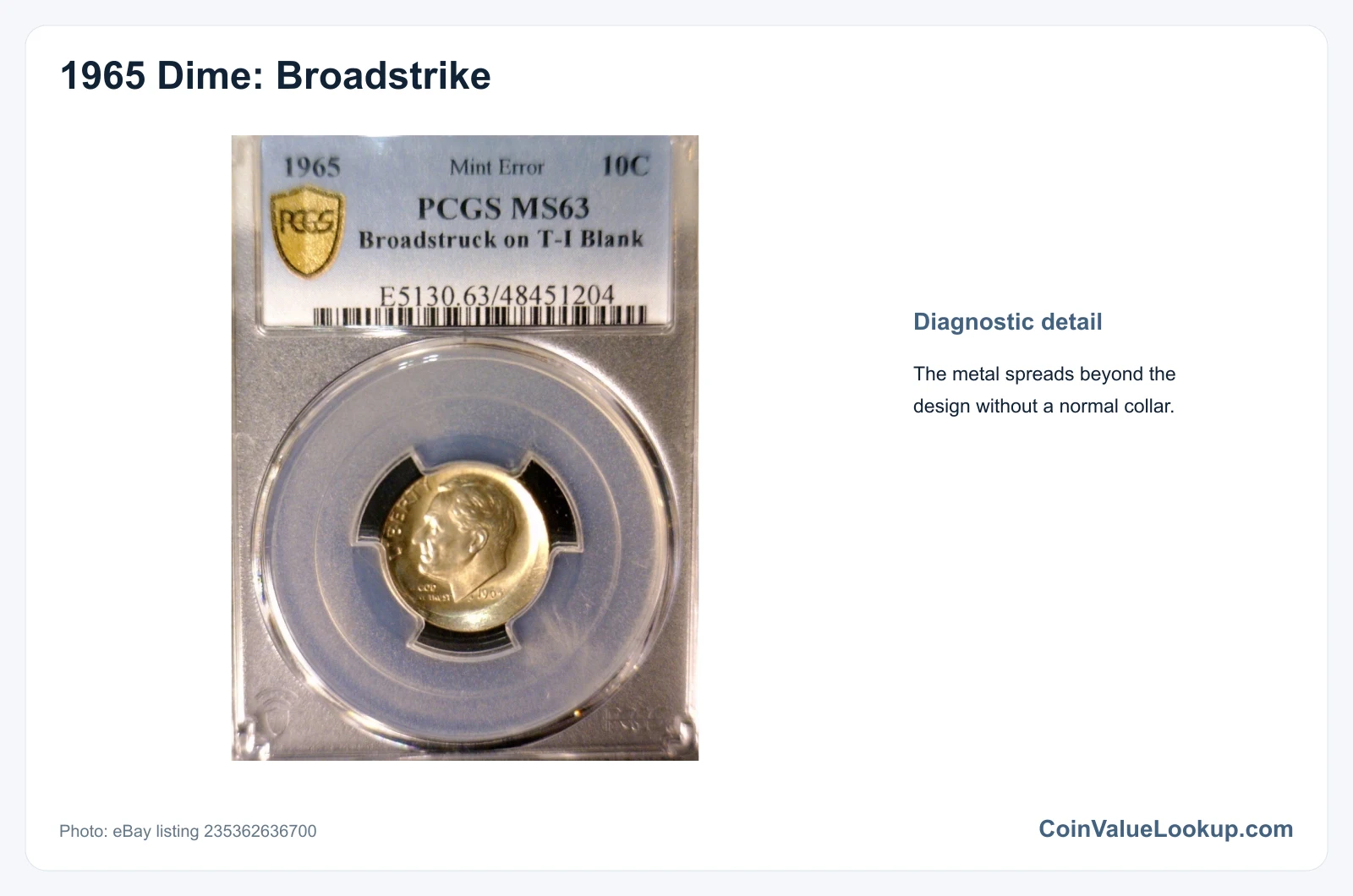
A broadstrike occurs when a coin is struck outside or without the retaining collar that normally forms the rim and reeded edge. The metal spreads outward, making the coin visibly wider than normal with a weak or absent rim.
Check the edge carefully. A broadstruck 1965 dime will lack the sharp reeding of a normal clad dime, and the overall diameter should exceed the standard 17.91 mm.
The design may look slightly expanded but should still be recognizable on both sides.
This error differs from an off-center strike because the design remains roughly centered — the coin just expanded beyond its intended boundary. Coins flattened after leaving the mint can mimic the wider profile, but they usually show damage patterns inconsistent with a genuine single-blow strike.
Condition and the degree of collar absence affect what any individual broadstrike is worth.
8. 1965 Roosevelt Dime — Die Cap / Capped-Die Strike
A die cap forms when a struck coin sticks to one of the dies and remains in place for subsequent strikes. That stuck coin gradually cups around the die like a bottle cap, and every coin struck beneath it picks up a distorted mirror image — called a brockage — instead of the normal design.
There are two collectible forms here: the cap itself, which is a deeply cupped coin with progressive distortion, and the brockage coin struck underneath it, which shows a normal design on one side and a flattened incuse mirror image on the other.
Lookalikes include coins bent by a vise, damaged in a dryer or weakly struck by worn dies. A genuine die cap shows progressive cupping consistent with repeated strikes and will have characteristic metal flow.
Authentication matters because post-mint damage can roughly mimic the shape. Value depends on the stage of capping, visual impact and authenticated condition.